 Maria Fernanda Santos1†
 Aline F. Bastos1†
 Jose M. Oliveira1
 Ivan Figueira2
 Sonia Gleiser2
 Mirtes G. Pereira3
 Eliane Volchan1*
 Fátima S. Erthal1
- 1Institute of Biophysics Carlos Chagas Filho, Universidade Federal do Rio de Janeiro, Rio de Janeiro, Brazil
- 2Institute of Psychiatry, Universidade Federal do Rio de Janeiro, Rio de Janeiro, Brazil
- 3Biomedical Institute, Universidade Federal Fluminense, Niterói, Brazil
Threatening cues and surrounding contexts trigger specific defensive response patterns. Posturography, a technique for measuring postural strategies, has been used to evaluate motor defensive reactions in humans. When exposed to gun pointed pictures, humans were shown to exhibit an immobility reaction. Short and long-term exposure to violent video games was shown to be a causal risk factor for increased violent and aggressive behavior. Assaultive violence with a gun is a major trigger for motor defensive reactions, and post-traumatic stress disorder (PTSD) is the most characteristic psychiatric sequelae. Recent studies point to links between PTSD symptoms and emotional shortfalls in non-clinical trauma-exposed samples. The present study investigated defensive reactions to gun threat and PTSD symptoms in heavy players of violent video games compared to non-players. Male university students were screened according to use of violent video games and divided in three groups: non-players, moderate players, and heavy players. Stimuli were pictures depicting a man pointing a gun directed at the participant. In matched control pictures, non-lethal objects replaced the gun. Posturography was recorded and PTSD symptoms were assessed. When exposed to the threat pictures, non-players exhibited the expected reduction in amplitude of body sway (immobility), heavy players presented atypical augmented amplitude of body sway, and moderate players showed intermediate reactivity. Heavy players presented a significant distinct reaction compared to non-players. They also scored significantly higher in PTSD symptoms than non-players. Disadvantageous defensive reactions and higher vulnerability to PTSD symptoms, revealed in the present study, add to other shortcomings for heavy players.
Introduction
“Violence is an extreme form of aggression that has the potential to produce severe physical harm, such as injury or death, to another” (Anderson et al., 2017, p. 143). Interpersonal violence involving guns has increased across the world (WHO, 2014; Grinshteyn and Hemenway, 2016), and populations living in large urban centers are specially affected (Ribeiro et al., 2013; Fowler et al., 2015). Assaultive violence with a gun is a major trigger for motor defensive reactions in humans, and posttraumatic stress disorder (PTSD) is the most characteristic psychiatric sequelae. Patients with PTSD were shown to be more susceptible to the hazardous effects of repeated activation of stress mediators on dysregulation of brain and body allostasis (McEwen and Gianaros, 2010). Recent studies point to links between PTSD symptoms and emotional shortfalls in non-clinical trauma-exposed samples (Miles et al., 2017).
The Global Status Report on Violence Prevention (WHO, 2014) proposed adopting a number of preventive strategies. Besides the reduction of access to guns and knives, changing of cultural and social norms that support violence was stressed. Guns figure prominently in the culture of violence, with a heavy contribution from the media (Smith et al., 2004). Indeed, “violence in screen entertainment media (i.e., television, film, video games, and the Internet), defined as depictions of characters (or players) trying to physically harm other characters (or players), is ubiquitous” (Anderson et al., 2017, p. 142).
Extensive research has shown that media violent content is a causal risk factor for increased violent and aggressive behavior (Bender et al., 2018). Playing video games, more than passively watching violent TV and films, has an even greater effect. Exposure to violent scenes in video games occurs in a more active context and the player is rewarded by acting violently (Anderson and Gentile, 2014).
Through posturography, a technique to study body sway, distinct defensive reactions were revealed (Volchan et al., 2017). Bastos et al. (2016) recorded defensive reactions to pictures depicting realistic gun attack and showed a reduction in amplitude of body sway indicating an immobility reaction to pictures of men pointing guns straight at the participant. The authors excluded heavy players of violent video games from the analyses, considering the literature on their proneness to aggression (Anderson et al., 2010; Greitemeyer, 2014).
Given the importance of studying the hazardous effects of exposure to violent video games, the present study investigated if those heavy players of violent video games present atypical defensive reactions to gun threat and whether they show differences in PTSD symptoms compared to non-players.
Materials and Methods
Participants
The database for the present study derived from Bastos et al. (2016). The sample consisted of 88 (48 men) undergraduate and graduate students who reported no neurological, psychiatric, or orthopedic disorders and were not under medications with nervous system action. The Ethics Institutional Review Board of the Federal University of Rio de Janeiro approved the study and participants provided written informed consent.
Questionnaires
Frequency of Violent Video Game Play
Participants had to answer the following question “Do you play video games with violent contents (people using firearms)?”. The alternatives were “never”, “sometimes”, “often”, and “almost always”.
Posttraumatic Stress Symptoms
Participants completed the Trauma History Questionnaire (Green, 1996; Fiszman et al., 2005). This questionnaire lists life-threatening events. Participants indicated the event they considered the most intense and completed the PTSD Checklist for DSM-IV (PCL-C for DSM-IV) (Weathers et al., 1993; Berger et al., 2004) based on this event. The PCL-C for DSM-IV is a 17-item self-report measure of the severity of symptoms. Using a 5-point Likert scale (1 = not at all, 5 = extremely), participants rated the extent to which each symptom has disturbed them in the past month, providing a total symptom score and a score for each cluster (re-experiencing, avoidance and numbing, and hyperarousal). Participants scoring above the cutoff for clinical PTSD were excluded. Thus, in the sample of 88 participants, none reached the criterion for possible PTSD.
Visual Stimuli
Sixteen pictures showed a man pointing a gun directed toward the participant (threat set). Sixteen other pictures (control set) showed, instead of a weapon, a man carrying a non-lethal object directed toward the participant. Within each set, individual pictures were presented for three seconds with no interval between them. Each set lasted for 48 s and the control set preceded the threat set. See Supplementary Material for more details.
Data Collection
Details of posturographic recordings are described in Bastos et al. (2016). Briefly, amplitude of body sway was estimated by recording center of pressure displacement using a force platform. Participants stood motionless on the force platform looking at the presentation monitor while control and threat pictures were presented and posturographic signals were recorded. The posturographic parameter analyzed here was the standard deviation of center of pressure displacement (amplitude of body sway) in the anterior-posterior direction.
Data Analysis
The difference in the anterior-posterior amplitude of sway during exposure to threat and control sets of pictures defined a reactivity index (Δ = threat – control). Total scores on the PCL-C for DSM-IV and scores in the three clusters (hyperarousal, reexperiencing, and numbing/avoidance) were computed.
Statistical analyses were performed with Kruskal-Wallis H and Mann-Whitney U tests. The threshold for significance was p < 0.05.
Results
Frequency of Violent Video Game Play
Participants were grouped according to the frequency of violent video game play. Participants reporting never playing violent video games were classified as “non-players” and the ones who reported playing “sometimes” were classified as “moderate players”. “Heavy players” were those that reported using violent video games “often” or “almost always”. The distribution of the three groups separated by gender is presented in Table 1.

Table 1. Distribution of the three groups separated by gender.
To avoid bias due to the very different proportion of men and women in each group and the low number of heavy players who were women, the analyses focused on men.
The final sample of 48 men had age (23.5 ± 4.11 y.o.) and weight (70.1 ± 11.17 kg) evenly distributed among the three groups (Age: F(2,45) = 0.90, p = 0.40; weight: F(2,45) = 0.36, p = 0.70).
Posturography
Figure 1 illustrates the reactivity index (threat – control) associated with the anterior-posterior amplitude of body sway for the three groups. It can be observed that non-players exhibited a reduction in amplitude of body sway (negative reactivity index), heavy players presented an augmented amplitude of body sway (positive reactivity index), and moderate players showed intermediate reactivity.
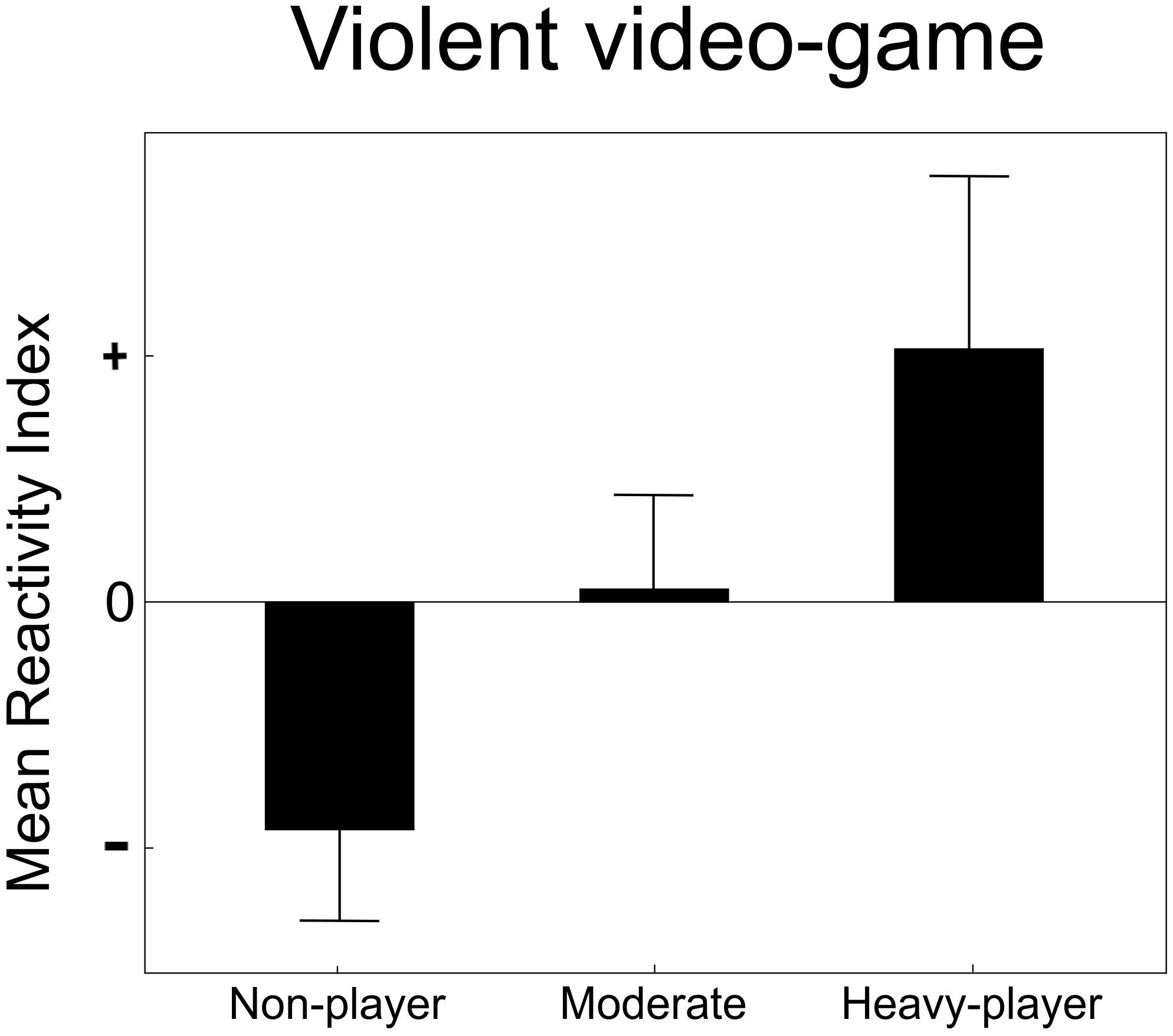
Figure 1. Exposure to violent video games and defensive reactions to pointing gun pictures. Anterior-posterior amplitude of body sway during presentation of threat (gun) minus control (non-lethal object) pictures, the reactivity index, is displayed according to participants’ frequency of violent video game play. Bars illustrate means and standard errors. Non-players exhibit reduced anterior-posterior amplitude of sway (immobility), heavy players exhibit a reverse reaction (augmented anterior-posterior amplitude of sway), and moderate players exhibit intermediate reactivity.
Analysis of the reactivity index revealed a significant main effect for group (H(2,48) = 7.39, p = 0.02). Follow-up post hoc analyses showed a significant difference between the reactivity of non-players and heavy players (Z = -2.56, p = 0.01). Heavy players presented a distinct reaction compared to non-players.
PTSD Symptoms
Given the postural differences between heavy players and non-players, scores on the PTSD symptoms scale (PCL-C for DSM-IV) were compared between the two groups. Participants who anchored their PCL-C responses on a life-threatening trauma were included in the present analysis (14 non-players and 8 heavy players).
Total scores on the PCL-C were significantly higher for heavy players compared to non-players (Z = -2.06, p = 0.04). Scores on the PCL-C hyperarousal cluster were also significantly higher for heavy players (Z = -2.08, p = 0.04). Scores on the numbing/avoidance cluster, although higher for heavy players, did not reach statistical significance (Z = -1.77, p = 0.08). Scores on the reexperiencing cluster did not differ (Z = 0.78, p = 0.41).
The difference in PTSD symptoms between heavy players and non-players remained statistically significant (PCL-C total score (Z = 2.58, p = 0.01)) when participants who did not anchor their PCL-C responses on a life-threatening trauma were included in the analysis.
Discussion
Previously, we studied defensive reactions in a sample that did not include heavy players (Bastos et al., 2016). That work showed a reduction in anterior-posterior amplitude of sway under exposure to threatening pictures depicting a man pointing a gun at the participant. Here, non-players presented this expected immobility reaction. Heavy players showed, as hypothesized, an atypical reaction (augmented anterior-posterior amplitude of sway). Furthermore, heavy players presented higher scores on the PTSD symptoms scale.
Motor Defensive Response Patterns
Across species, threatening cues and surrounding contexts trigger specific defensive response patterns. Motor reactions, either overt actions or immobility, are the core of the observable defensive behaviors. Research on rodents (Blanchard and Blanchard, 1971, 1989; Blanchard et al., 1986) showed that, under attack by a predator or co-specific, flight is the dominant response when escape is available. When escape routes are blocked, immobility ensues. This action inhibition is considered an evolutionary adaptive strategy embedding preparatory states for action to be released only when appropriate context conditions trigger an action shift, like jump-attack seen in rodents (Blanchard et al., 1986).
In the present study, an attack-like condition was created by the presentation of pictures depicting a man pointing a gun at the participant. Non-players exhibited an immobility-like reaction. Heavy players behaved as if “jumping the gun”, increasing mobilization, instead of immobilizing and waiting for the best chance to get rid from danger. Indeed, “... the simple sight of a weapon increases the likelihood of aggression if the person has mentally paired a weapon such as a gun with killing or hurting people...” [Anderson and Warburton (2012), p. 72]. This is the case for heavy players of violent video games who are frequently exposed to weapon use for the purpose of killing and hurting others. The contrasting reaction of heavy vs. non-players to attack-like pictures add to converging evidence showing that exposure to violent video games is a causal risk factor for increased violent and aggressive behavior [for meta-analyses, see Anderson and Bushman (2001), Anderson et al. (2010), Bushman and Huesmann (2006), Greitemeyer and Mügge (2014)]. No previous study had employed posturography to investigate reactions of heavy-players to gun attack pictures.
PTSD Symptoms
There are several potential drawbacks associated with a high frequency of violent video game playing. Heavy exposure to violent video games can lead people to see the world as more dangerous, to be more fearful, and initiate more self-protective behaviors such as carrying guns (Anderson and Gentile, 2014). Several studies have shown that civilian gun ownership, rather than protecting, increases the risk of both perpetrating and being a fatal victim of violence (Bangalore and Messerli, 2013; Branas et al., 2009; Cukier and Eagen, 2018; Monuteaux et al., 2015).
Heavy players scored higher than non-players on the PTSD symptoms scale, especially on the hyperarousal cluster, which includes feeling irritable or having angry outbursts, being “super-alert” or watchful or on guard, and feeling jumpy or easily startled. Symptoms such as angry outbursts may be related to the results of numerous studies that point to the effects of violent video games on increasing aggressiveness (Anderson et al., 2010; Anderson and Gentile, 2014; Greitemeyer and Mügge, 2014). Being on guard and feeling jumpy, along with angry outbursts, are consistent with heavy players adopting a precipitated (and possibly disadvantageous) response to an attack-like context.
Limitations
This is a secondary analysis of previously collected data. The experiment was originally designed to investigate basic defensive reactions in humans. A convenience sample was recruited, ending up with a relatively small proportion of heavy players of violent video games. Characterization of heavy players was based on the high use of violent video games depicting guns, whereas other forms of violent content were not assessed. Furthermore, a standard validated questionnaire was not employed. The sample was not screened by trait questionnaires that assess aggressiveness. Finally, the present research is based on a cross-sectional sample and does not allow conclusions to be made regarding causality.
Conclusion
Accumulating evidence led to a clear consensus that a high frequency of exposure to violent video games significantly alters important interpersonal behaviors in negative ways (Bender et al., 2018). Atypical disadvantageous defensive reactions and higher vulnerability to PTSD symptoms, revealed in the present study, add to other shortcomings for the heavy players themselves.
Ethics Statement
This study was carried out in accordance with the recommendations of Declaration of Helsinki. The protocol was approved by the Ethics Institutional Review Board of the Federal University of Rio de Janeiro. All subjects gave written informed consent.
Author Contributions
MS, AB, JO, SG, MP, EV, and FE designed the research. MS, AB, JO, IF, EV, and FE performed the research and analyzed data. AB, JO, SG, EV, and FE wrote the paper. All authors reviewed draft versions and approved the final version.
Funding
This work was supported by National Council for Scientific and Technological Development (CNPq) and Carlos Chagas Filho Foundation of Research Support in Rio de Janeiro (FAPERJ). Partial support was provided by Coordenação de Aperfeiçoamento de Pessoal de Nível Superior – Brasil (CAPES – Finance Code 001), and Financiadora de Estudos e Projetos (FINEP – Apoio Institucional 03/2016 – Ref 0354/16).
Conflict of Interest Statement
The authors declare that the research was conducted in the absence of any commercial or financial relationships that could be construed as a potential conflict of interest.
Supplementary Material
The Supplementary Material for this article can be found online at: https://www.frontiersin.org/articles/10.3389/fpsyg.2019.00191/full#supplementary-material
References
Anderson, C. A., and Bushman, B. J. (2001). Effects of violent video games on aggressive behavior, aggressive cognition, aggressive affect, physiological arousal, and prosocial behavior: a meta-analytic review of the scientific literature. Psychol. Sci. 12, 353–359. doi: 10.1111/1467-9280.00366
Anderson, C. A., Bushman, B. J., Bartholow, B. D., Cantor, J., Christakis, D., Coyne, S. M., et al. (2017). Screen violence and youth behavior. Pediatrics 140, S142–S147. doi: 10.1542/peds.2016-1758T
Anderson, C. A., and Gentile, D. A. (2014). “Violent video game effects on aggressive thoughts, feelings, physiology, and behavior,” in Media Violence and Children: A Complete Guide for Parents and Professionals, ed. D. A. Gentile (California: Praeger), 229–270.
Anderson, C. A., Shibuya, A., Ihori, N., Swing, E. L., Bushman, B. J., Sakamoto, A., et al. (2010). Violent video game effects on aggression, empathy, and prosocial behavior in eastern and western countries: a meta-analytic review. Psychol. Bull. 136, 151–173. doi: 10.1037/a0018251
Anderson, C. A., and Warburton, W. A. (2012). “The impact of violent video games: An overview,” in Growing up Fast and Furious: Reviewing the Impacts of Violent and Sexualised Media on Children, eds W. Warburton and D. Braunstein (Annandale: The Federation Press), 56–84.
Bangalore, S., and Messerli, F. H. (2013). Gun ownership and firearm-related deaths. Am. J. Med. 126, 873–876. doi: 10.1016/j.amjmed.2013.04.012
Bastos, A. F., Vieira, A. S., Oliveira, J. M., Oliveira, L., Pereira, M. G., Figueira, I., et al. (2016). Stop or move: defensive strategies in humans. Behav. Brain Res. 302, 252–262. doi: 10.1016/j.bbr.2016.01.043
Bender, P. K., Plante, C., and Gentile, D. A. (2018). The effects of violent media content on aggression. Curr. Opin. Psychol. 19, 104–108. doi: 10.1016/j.copsyc.2017.04.003
Berger, W., Mendlowicz, M. V., Souza, W. F., and Figueira, I. (2004). Semantic equivalence of the portuguese version of the post-traumatic stress disorder checklist-civilian version (PCL-C) for the screening of post-traumatic stress disorder. Rev. Psiquiatr. Rio Gd Sul 26, 167–175. doi: 10.1590/S0101-81082004000200006
Blanchard, R. J., and Blanchard, D. C. (1971). Defensive reactions in the albino rat. Learn. Motiv. 2, 351–362. doi: 10.1016/0023-9690(71)90016-6
Blanchard, R. J., and Blanchard, D. C. (1989). Attack and defense in rodents as ethoexperimental models for the study of emotion. Prog. Neuropsychopharmacol. Biol. Psychiatry 13, S3–S14. doi: 10.1016/0278-5846(89)90105-X
Blanchard, R. J., Flannelly, K. J., and Blanchard, D. C. (1986). Defensive behaviors of laboratory and wild Rattus norvegicus. J. Comp. Psychol. 100:101.
Branas, C. C., Richmond, T. S., Culhane, D. P., Have, T. R. T., and Wiebe, D. J. (2009). Investigating the link between gun possession and gun assault. Am. J. Public Health 99, 2034–2040. doi: 10.2105/AJPH.2008.143099
Bushman, B. J., and Huesmann, L. R. (2006). Short-term and long-term effects of violent media on aggression in children and adults. Arch. Pediatr. Adolesc. Med. 160, 348–352. doi: 10.1001/archpedi.160.4.348
Cukier, W., and Eagen, S. A. (2018). Gun violence. Curr. Opin. Psychol. 19, 109–112. doi: 10.1016/j.copsyc.2017.04.008
Fiszman, A., Cabizuca, M., Lanfredi, C., and Figueira, I. (2005). The cross-cultural adaptation to portuguese of the trauma history questionnaire to identify traumatic experiences. Rev. Bras. Psiquiatr. 27, 63–66. doi: 10.1590/S1516-44462005000100014
Fowler, K. A., Dahlberg, L. L., Haileyesus, T., and Annest, J. L. (2015). Firearm injuries in the United States. Prev. Med. 79, 5–14. doi: 10.1016/j.ypmed.2015.06.002
Green, B. L. (1996). “Psychometric review of trauma history questionnaire (self-report),” in Trauma Assessments a Clinician’s. Guide, ed. E. B. Carlson (Lutherville, MD: Sidran Press), 366–388.
Greitemeyer, T. (2014). Playing violent video games increases intergroup bias. Pers. Soc. Psychol. Bull. 40, 70–78. doi: 10.1177/0146167213505872
Greitemeyer, T., and Mügge, D. O. (2014). Video games do affect social outcomes: a meta-analytic review of the effects of violent and prosocial video game play. Pers. Soc. Psychol. Bull. 40, 578–589. doi: 10.1177/0146167213520459
Grinshteyn, E., and Hemenway, D. (2016). Violent death rates: the US compared with other high-income OECD countries, 2010. Am. J. Med. 129, 266–273. doi: 10.1016/j.amjmed.2015.10.025
McEwen, B. S., and Gianaros, P. J. (2010). Central role of the brain in stress and adaptation: links to socioeconomic status, health, and disease: central links between stress and SES. Ann. N. Y. Acad. Sci. 1186, 190–222. doi: 10.1111/j.1749-6632.2009.05331.x
Miles, S. R., Sharp, C., Tharp, A. T., Stanford, M. S., Stanley, M., Thompson, K. E., et al. (2017). Emotion dysregulation as an underlying mechanism of impulsive aggression: reviewing empirical data to inform treatments for veterans who perpetrate violence. Aggress. Violent Behav. 34, 147–153. doi: 10.1016/j.avb.2017.01.017
Monuteaux, M. C., Lee, L. K., Hemenway, D., Mannix, R., and Fleegler, E. W. (2015). Firearm ownership and violent crime in the U.S. Am. J. Prev. Med. 49, 207–214. doi: 10.1016/j.amepre.2015.02.008
Ribeiro, W. S., Mari Jde, J., Quintana, M. I., Dewey, M. E., Evans-Lacko, S., et al. (2013). The impact of epidemic violence on the prevalence of psychiatric disorders in sao paulo and rio de janeiro, Brazil. PLoS One 8:e63545. doi: 10.1371/journal.pone.0063545
Smith, S. L., Lachlan, K., Pieper, K. M., Boyson, A. R., Wilson, B. J., Tamborini, R., et al. (2004). Brandishing guns in american media: two studies examining how often and in what context firearms appear on television and in popular video games. J. Broadcast. Electron. Media 48, 584–606. doi: 10.1207/s15506878jobem4804_4
Volchan, E., Rocha-Rego, V., Bastos, A. F., Oliveira, J. M., Franklin, C., Gleiser, S., et al. (2017). Immobility reactions under threat: a contribution to human defensive cascade and PTSD. Neurosci. Biobehav. Rev. 76, 29–38. doi: 10.1016/j.neubiorev.2017.01.025
Weathers, F. W., Litz, B. T., Herman, D. S., Huska, J. A., and Keane, T. (1993). The PTSD checklist: reliability, validity, and diagnostic utility. Paper presented at the Annual Meeting of the International Society for Traumatic Stress Studies, San Antonio, TX.
Keywords: violent games, posturography, defensive reactions, PTSD, immobility, video games, gun, emotion
Citation: Santos MF, Bastos AF, Oliveira JM, Figueira I, Gleiser S, Pereira MG, Volchan E and Erthal FS (2019) Hands Up! Atypical Defensive Reactions in Heavy Players of Violent Video Games When Exposed to Gun-Attack Pictures. Front. Psychol. 10:191. doi: 10.3389/fpsyg.2019.00191
Received: 08 August 2018; Accepted: 21 January 2019;
Published: 05 February 2019.
Edited by:
Carlos Gantiva, University of San Buenaventura, ColombiaReviewed by:
Paulo Sergio Dillon Soares-Filho, Universidad de San Buenaventura, Bogota, ColombiaDelin Sun, Duke University, United States
Copyright © 2019 Santos, Bastos, Oliveira, Figueira, Gleiser, Pereira, Volchan and Erthal. This is an open-access article distributed under the terms of the Creative Commons Attribution License (CC BY). The use, distribution or reproduction in other forums is permitted, provided the original author(s) and the copyright owner(s) are credited and that the original publication in this journal is cited, in accordance with accepted academic practice. No use, distribution or reproduction is permitted which does not comply with these terms.
*Correspondence: Eliane Volchan, ZWxpdm9sY2hhbkBnbWFpbC5jb20=
†These authors have contributed equally to this work as first authors