In the original article, there were mistakes in Tables 2, 3, 4, and 6 as published.
There were three mistakes in Table 2. Firstly, column “Media” should be column “Mean.” Secondly, in reference 6 (footnote) “subsides” should be “subsidies.” Thirdly, in row “Frequency of mother child play (by week),” column “Urban/Mean” it says 2.14 and it should say 5.14.
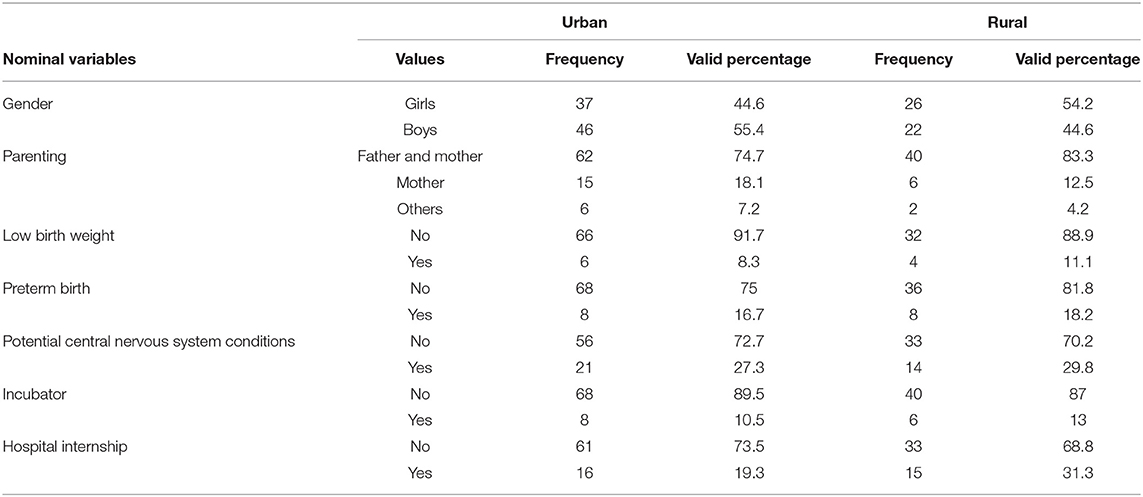
There were two mistakes in Table 3. In row “Incubator/yes,” column “Urban/valid percentage,” it says 1.5 and it should say 10.5. Also, in row “Potential Nervous System conditions: No,” column “Rural/ Valid percentage,” it says 7.2 and it should say 70.2.
There were four mistakes in Table 4. Firstly, in rows “0–3 switchs,” “4–5 switchs,” and “6 switchs,” the word “switchs” should be “switches.” Additionally, in row “Learning,” column “Urban/mean,” it says 2.87 and it should say 20.87.
Finally, there were two mistakes in Table 6. In row “Number of siblings,” column “F,” it says 2.151 and it should say 20.151. Also, in row “Past preschool attendance,” column “F,” it says 5.798 and it should say 50.798.
The corrected Tables 2, 3, 4, and 6 appear below.
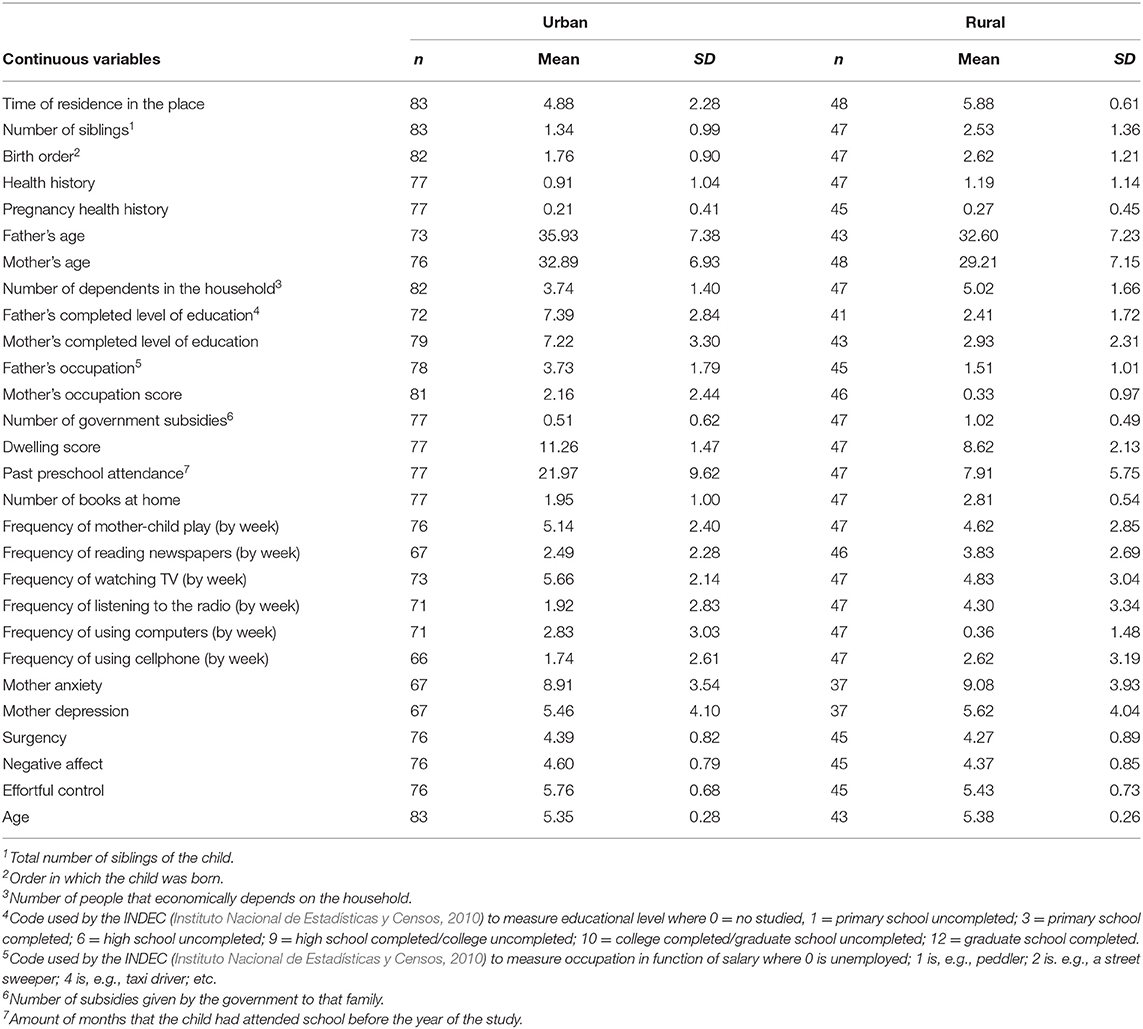
Table 2
| Urban | Rural | |||||
|---|---|---|---|---|---|---|
| Continuous variables | n | Mean | SD | n | Mean | SD |
| Time of residence in the place | 83 | 4.88 | 2.28 | 48 | 5.88 | 0.61 |
| Number of siblings1 | 83 | 1.34 | 0.99 | 47 | 2.53 | 1.36 |
| Birth order2 | 82 | 1.76 | 0.90 | 47 | 2.62 | 1.21 |
| Health history | 77 | 0.91 | 1.04 | 47 | 1.19 | 1.14 |
| Pregnancy health history | 77 | 0.21 | 0.41 | 45 | 0.27 | 0.45 |
| Father's age | 73 | 35.93 | 7.38 | 43 | 32.60 | 7.23 |
| Mother's age | 76 | 32.89 | 6.93 | 48 | 29.21 | 7.15 |
| Number of dependents in the household3 | 82 | 3.74 | 1.40 | 47 | 5.02 | 1.66 |
| Father's completed level of education4 | 72 | 7.39 | 2.84 | 41 | 2.41 | 1.72 |
| Mother's completed level of education | 79 | 7.22 | 3.30 | 43 | 2.93 | 2.31 |
| Father's occupation5 | 78 | 3.73 | 1.79 | 45 | 1.51 | 1.01 |
| Mother's occupation score | 81 | 2.16 | 2.44 | 46 | 0.33 | 0.97 |
| Number of government subsidies6 | 77 | 0.51 | 0.62 | 47 | 1.02 | 0.49 |
| Dwelling score | 77 | 11.26 | 1.47 | 47 | 8.62 | 2.13 |
| Past preschool attendance7 | 77 | 21.97 | 9.62 | 47 | 7.91 | 5.75 |
| Number of books at home | 77 | 1.95 | 1.00 | 47 | 2.81 | 0.54 |
| Frequency of mother-child play (by week) | 76 | 5.14 | 2.40 | 47 | 4.62 | 2.85 |
| Frequency of reading newspapers (by week) | 67 | 2.49 | 2.28 | 46 | 3.83 | 2.69 |
| Frequency of watching TV (by week) | 73 | 5.66 | 2.14 | 47 | 4.83 | 3.04 |
| Frequency of listening to the radio (by week) | 71 | 1.92 | 2.83 | 47 | 4.30 | 3.34 |
| Frequency of using computers (by week) | 71 | 2.83 | 3.03 | 47 | 0.36 | 1.48 |
| Frequency of using cellphone (by week) | 66 | 1.74 | 2.61 | 47 | 2.62 | 3.19 |
| Mother anxiety | 67 | 8.91 | 3.54 | 37 | 9.08 | 3.93 |
| Mother depression | 67 | 5.46 | 4.10 | 37 | 5.62 | 4.04 |
| Surgency | 76 | 4.39 | 0.82 | 45 | 4.27 | 0.89 |
| Negative affect | 76 | 4.60 | 0.79 | 45 | 4.37 | 0.85 |
| Effortful control | 76 | 5.76 | 0.68 | 45 | 5.43 | 0.73 |
| Age | 83 | 5.35 | 0.28 | 43 | 5.38 | 0.26 |
Descriptive statistic of the continuous variables obtained from parents' interviews in urban and rural contexts.
Total number of siblings of the child.
Order in which the child was born.
Number of people that economically depends on the household.
Code used by the INDEC (Instituto Nacional de Estadísticas y Censos, ) to measure educational level where 0 = no studied, 1 = primary school uncompleted; 3 = primary school completed; 6 = high school uncompleted; 9 = high school completed/college uncompleted; 10 = college completed/graduate school uncompleted; 12 = graduate school completed.
Code used by the INDEC (Instituto Nacional de Estadísticas y Censos, ) to measure occupation in function of salary where 0 is unemployed; 1 is, e.g., peddler; 2 is. e.g., a street sweeper; 4 is, e.g., taxi driver; etc.
Number of subsidies given by the government to that family.
Amount of months that the child had attended school before the year of the study.
Table 3
| Urban | Rural | ||||
|---|---|---|---|---|---|
| Nominal variables | Values | Frequency | Valid percentage | Frequency | Valid percentage |
| Gender | Girls | 37 | 44.6 | 26 | 54.2 |
| Boys | 46 | 55.4 | 22 | 44.6 | |
| Parenting | Father and mother | 62 | 74.7 | 40 | 83.3 |
| Mother | 15 | 18.1 | 6 | 12.5 | |
| Others | 6 | 7.2 | 2 | 4.2 | |
| Low birth weight | No | 66 | 91.7 | 32 | 88.9 |
| Yes | 6 | 8.3 | 4 | 11.1 | |
| Preterm birth | No | 68 | 75 | 36 | 81.8 |
| Yes | 8 | 16.7 | 8 | 18.2 | |
| Potential central nervous system conditions | No | 56 | 72.7 | 33 | 70.2 |
| Yes | 21 | 27.3 | 14 | 29.8 | |
| Incubator | No | 68 | 89.5 | 40 | 87 |
| Yes | 8 | 10.5 | 6 | 13 | |
| Hospital internship | No | 61 | 73.5 | 33 | 68.8 |
| Yes | 16 | 19.3 | 15 | 31.3 | |
Descriptive statistic of the nominal variables obtained from parents' interviews in urban and rural contexts.
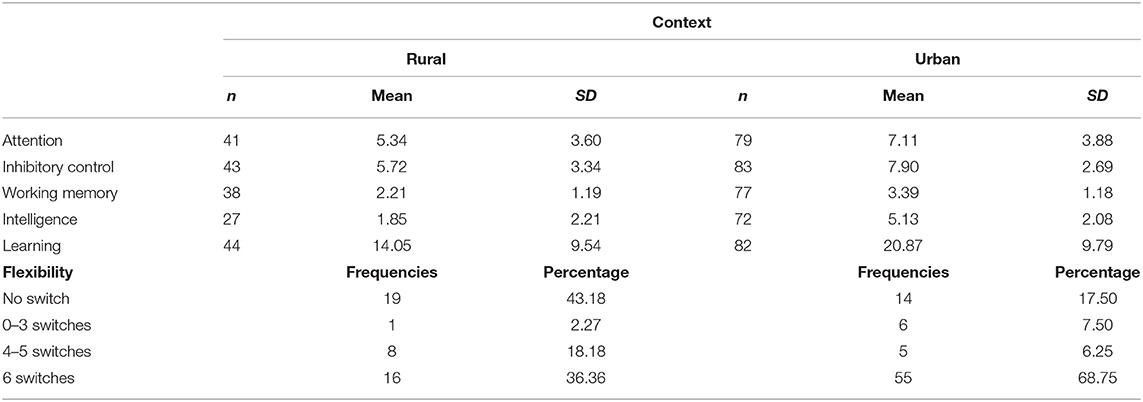
Table 4
| Context | ||||||
|---|---|---|---|---|---|---|
| Rural | Urban | |||||
| n | Mean | SD | n | Mean | SD | |
| Attention | 41 | 5.34 | 3.60 | 79 | 7.11 | 3.88 |
| Inhibitory control | 43 | 5.72 | 3.34 | 83 | 7.90 | 2.69 |
| Working memory | 38 | 2.21 | 1.19 | 77 | 3.39 | 1.18 |
| Intelligence | 27 | 1.85 | 2.21 | 72 | 5.13 | 2.08 |
| Learning | 44 | 14.05 | 9.54 | 82 | 20.87 | 9.79 |
| Flexibility | Frequencies | Percentage | Frequencies | Percentage | ||
| No switch | 19 | 43.18 | 14 | 17.50 | ||
| 0–3 switches | 1 | 2.27 | 6 | 7.50 | ||
| 4–5 switches | 8 | 18.18 | 5 | 6.25 | ||
| 6 switches | 16 | 36.36 | 55 | 68.75 | ||
Descriptive statistics of cognitive variables by context and UBN indicators.
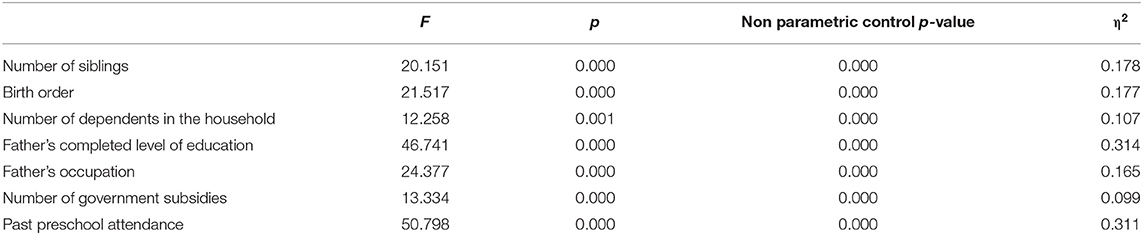
Table 6
| F | p | Non parametric control p-value | η2 | |
|---|---|---|---|---|
| Number of siblings | 20.151 | 0.000 | 0.000 | 0.178 |
| Birth order | 21.517 | 0.000 | 0.000 | 0.177 |
| Number of dependents in the household | 12.258 | 0.001 | 0.000 | 0.107 |
| Father's completed level of education | 46.741 | 0.000 | 0.000 | 0.314 |
| Father's occupation | 24.377 | 0.000 | 0.000 | 0.165 |
| Number of government subsidies | 13.334 | 0.000 | 0.000 | 0.099 |
| Past preschool attendance | 50.798 | 0.000 | 0.000 | 0.311 |
Significant results of ANOVAs: environmental and individual variables that differ by context.
The authors apologize for these errors and state that they do not change the scientific conclusions of the article in any way. The original article has been updated.
References
1
Instituto Nacional de Estadísticas y Censos (2010). Anuario Estadístico de la República Argentina. Buenos Aires: INDEC, 96.
Summary
Keywords
socioeconomic status, rural context, urban context, child cognitive development, executive functions, preschool attendance, father's educational level
Citation
Hermida MJ, Shalom DE, Segretin MS, Goldin AP, Abril MC, Lipina SJ and Sigman M (2021) Corrigendum: Risks for Child Cognitive Development in Rural Contexts. Front. Psychol. 12:647039. doi: 10.3389/fpsyg.2021.647039
Received
28 December 2020
Accepted
15 January 2021
Published
11 February 2021
Volume
12 - 2021
Edited and reviewed by
Yvette Renee Harris, Miami University, United States
Updates
Copyright
© 2021 Hermida, Shalom, Segretin, Goldin, Abril, Lipina and Sigman.
This is an open-access article distributed under the terms of the Creative Commons Attribution License (CC BY). The use, distribution or reproduction in other forums is permitted, provided the original author(s) and the copyright owner(s) are credited and that the original publication in this journal is cited, in accordance with accepted academic practice. No use, distribution or reproduction is permitted which does not comply with these terms.
*Correspondence: Maria Julia Hermida julia.hermida@gmail.com
This article was submitted to Developmental Psychology, a section of the journal Frontiers in Psychology
Disclaimer
All claims expressed in this article are solely those of the authors and do not necessarily represent those of their affiliated organizations, or those of the publisher, the editors and the reviewers. Any product that may be evaluated in this article or claim that may be made by its manufacturer is not guaranteed or endorsed by the publisher.