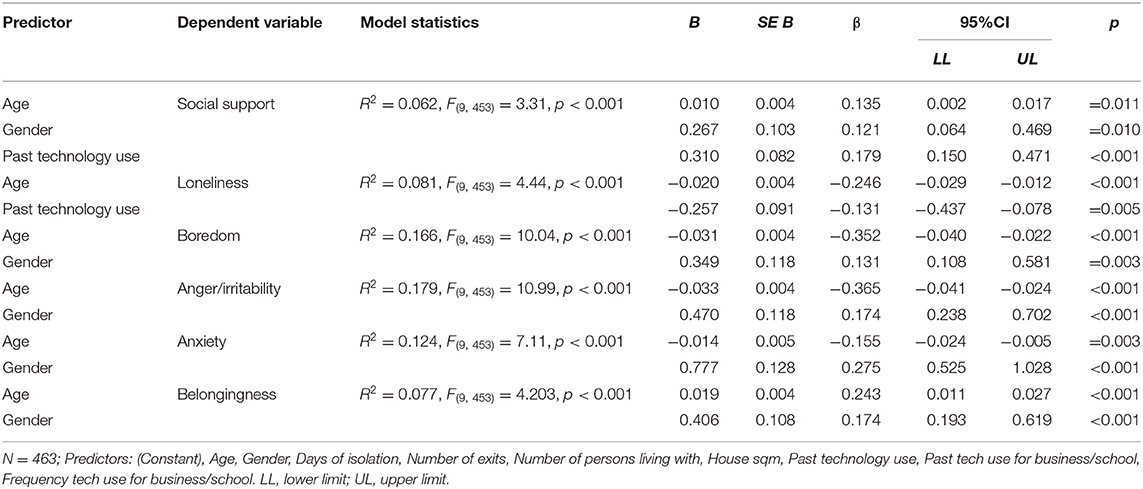
Due to a clerical error, the values for the amount of technology use for business/school motives before the lockdown were reported incorrectly in Table 2 and Table 3. The amended Table 2 and Table 3 appears below.
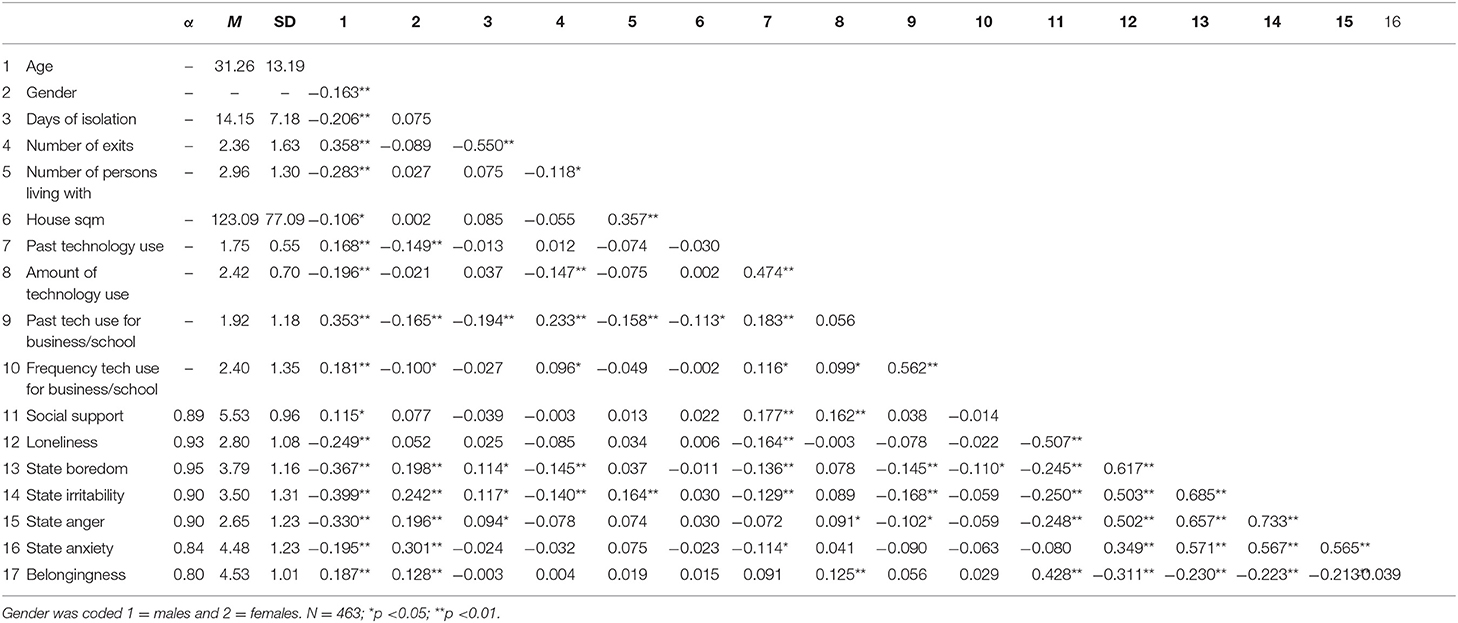
Table 2
| α | M | SD | 1 | 2 | 3 | 4 | 5 | 6 | 7 | 8 | 9 | 10 | 11 | 12 | 13 | 14 | 15 | 16 | ||
|---|---|---|---|---|---|---|---|---|---|---|---|---|---|---|---|---|---|---|---|---|
| 1 | Age | – | 31.26 | 13.19 | ||||||||||||||||
| 2 | Gender | – | – | – | −0.163** | |||||||||||||||
| 3 | Days of isolation | – | 14.15 | 7.18 | −0.206** | 0.075 | ||||||||||||||
| 4 | Number of exits | – | 2.36 | 1.63 | 0.358** | −0.089 | −0.550** | |||||||||||||
| 5 | Number of persons living with | – | 2.96 | 1.30 | −0.283** | 0.027 | 0.075 | −0.118* | ||||||||||||
| 6 | House sqm | – | 123.09 | 77.09 | −0.106* | 0.002 | 0.085 | −0.055 | 0.357** | |||||||||||
| 7 | Past technology use | – | 1.75 | 0.55 | 0.168** | −0.149** | −0.013 | 0.012 | −0.074 | −0.030 | ||||||||||
| 8 | Amount of technology use | – | 2.42 | 0.70 | −0.196** | −0.021 | 0.037 | −0.147** | −0.075 | 0.002 | 0.474** | |||||||||
| 9 | Past tech use for business/school | – | 1.92 | 1.18 | 0.353** | −0.165** | −0.194** | 0.233** | −0.158** | −0.113* | 0.183** | 0.056 | ||||||||
| 10 | Frequency tech use for business/school | – | 2.40 | 1.35 | 0.181** | −0.100* | −0.027 | 0.096* | −0.049 | −0.002 | 0.116* | 0.099* | 0.562** | |||||||
| 11 | Social support | 0.89 | 5.53 | 0.96 | 0.115* | 0.077 | −0.039 | −0.003 | 0.013 | 0.022 | 0.177** | 0.162** | 0.038 | −0.014 | ||||||
| 12 | Loneliness | 0.93 | 2.80 | 1.08 | −0.249** | 0.052 | 0.025 | −0.085 | 0.034 | 0.006 | −0.164** | −0.003 | −0.078 | −0.022 | −0.507** | |||||
| 13 | State boredom | 0.95 | 3.79 | 1.16 | −0.367** | 0.198** | 0.114* | −0.145** | 0.037 | −0.011 | −0.136** | 0.078 | −0.145** | −0.110* | −0.245** | 0.617** | ||||
| 14 | State irritability | 0.90 | 3.50 | 1.31 | −0.399** | 0.242** | 0.117* | −0.140** | 0.164** | 0.030 | −0.129** | 0.089 | −0.168** | −0.059 | −0.250** | 0.503** | 0.685** | |||
| 15 | State anger | 0.90 | 2.65 | 1.23 | −0.330** | 0.196** | 0.094* | −0.078 | 0.074 | 0.030 | −0.072 | 0.091* | −0.102* | −0.059 | −0.248** | 0.502** | 0.657** | 0.733** | ||
| 16 | State anxiety | 0.84 | 4.48 | 1.23 | −0.195** | 0.301** | −0.024 | −0.032 | 0.075 | −0.023 | −0.114* | 0.041 | −0.090 | −0.063 | −0.080 | 0.349** | 0.571** | 0.567** | 0.565** | |
| 17 | Belongingness | 0.80 | 4.53 | 1.01 | 0.187** | 0.128** | −0.003 | 0.004 | 0.019 | 0.015 | 0.091 | 0.125** | 0.056 | 0.029 | 0.428** | −0.311** | −0.230** | −0.223** | −0.213** | -0.039 |
Descriptive statistics and correlations among variables.
Gender was coded 1 = males and 2 = females. N = 463;
p < 0.05;
p < 0.01.
Table 3
| Predictor | Dependent variable | Model statistics | B | SE B | β | 95%CI | p | |
|---|---|---|---|---|---|---|---|---|
| LL | UL | |||||||
| Age | Social support | R2 = 0.062, F(9, 453) = 3.31, p < 0.001 | 0.010 | 0.004 | 0.135 | 0.002 | 0.017 | =0.011 |
| Gender | 0.267 | 0.103 | 0.121 | 0.064 | 0.469 | =0.010 | ||
| Past technology use | 0.310 | 0.082 | 0.179 | 0.150 | 0.471 | <0.001 | ||
| Age | Loneliness | R2 = 0.081, F(9, 453) = 4.44, p < 0.001 | −0.020 | 0.004 | −0.246 | −0.029 | −0.012 | <0.001 |
| Past technology use | −0.257 | 0.091 | −0.131 | −0.437 | −0.078 | =0.005 | ||
| Age | Boredom | R2 = 0.166, F(9, 453) = 10.04, p < 0.001 | −0.031 | 0.004 | −0.352 | −0.040 | −0.022 | <0.001 |
| Gender | 0.349 | 0.118 | 0.131 | 0.108 | 0.581 | =0.003 | ||
| Age | Anger/irritability | R2 = 0.179, F(9, 453) = 10.99, p < 0.001 | −0.033 | 0.004 | −0.365 | −0.041 | −0.024 | <0.001 |
| Gender | 0.470 | 0.118 | 0.174 | 0.238 | 0.702 | <0.001 | ||
| Age | Anxiety | R2 = 0.124, F(9, 453) = 7.11, p < 0.001 | −0.014 | 0.005 | −0.155 | −0.024 | −0.005 | =0.003 |
| Gender | 0.777 | 0.128 | 0.275 | 0.525 | 1.028 | <0.001 | ||
| Age | Belongingness | R2 = 0.077, F(9, 453) = 4.203, p < 0.001 | 0.019 | 0.004 | 0.243 | 0.011 | 0.027 | <0.001 |
| Gender | 0.406 | 0.108 | 0.174 | 0.193 | 0.619 | <0.001 | ||
Significant results of simple and multiple linear regressions.
N = 463; Predictors: (Constant), Age, Gender, Days of isolation, Number of exits, Number of persons living with, House sqm, Past technology use, Past tech use for business/school, Frequency tech use for business/school. LL, lower limit; UL, upper limit.
The authors apologize for this error and state that this does not change the scientific conclusions of the article in any way. The original article has been updated.
Summary
Keywords
COVID-19, social isolation, social support, digital technology, negative affect
Citation
Gabbiadini A, Baldissarri C, Durante F, Valtorta RR, De Rosa M and Gallucci M (2021) Corrigendum: Together Apart: The Mitigating Role of Digital Communication Technologies on Negative Affect During the COVID-19 Outbreak in Italy. Front. Psychol. 12:701130. doi: 10.3389/fpsyg.2021.701130
Received
27 April 2021
Accepted
05 May 2021
Published
26 May 2021
Volume
12 - 2021
Edited and reviewed by
PatrÃcia Arriaga, University Institute of Lisbon (ISCTE), Portugal
Updates
Copyright
© 2021 Gabbiadini, Baldissarri, Durante, Valtorta, De Rosa and Gallucci.
This is an open-access article distributed under the terms of the Creative Commons Attribution License (CC BY). The use, distribution or reproduction in other forums is permitted, provided the original author(s) and the copyright owner(s) are credited and that the original publication in this journal is cited, in accordance with accepted academic practice. No use, distribution or reproduction is permitted which does not comply with these terms.
*Correspondence: Alessandro Gabbiadini alessandro.gabbiadini@unimib.it
This article was submitted to Personality and Social Psychology, a section of the journal Frontiers in Psychology
Disclaimer
All claims expressed in this article are solely those of the authors and do not necessarily represent those of their affiliated organizations, or those of the publisher, the editors and the reviewers. Any product that may be evaluated in this article or claim that may be made by its manufacturer is not guaranteed or endorsed by the publisher.