Abstract
In instructional-learning contexts, the relationship between teacher verbal and non-verbal immediacy and student motivation has gained increasing attention. However, no systematic research has been done to review the empirical studies conducted on the impact of teacher immediacy on students' motivation. Hence, the aim of the present study was to systematically review the available literature on different types of teacher immediacy and student motivation. Some common databases were searched and 30 eligible manuscripts were identified. With regard to the key features of the included studies, the review's findings were categorized into different sections, namely “the measures of teacher immediacy employed,” “the measures of student motivation employed,” “designs,” and “educational contexts”. The main findings of the studies were also discussed. The reviewed studies pointed to positive associations between teacher immediacy and student motivation. Finally, limitations of the included studies are discussed and some practical directions for further research are offered, accordingly.
Introduction
During the past four decades, no construct has gained more attention than teacher immediacy in the field of instructional communication (Madigan and Kim, 2021). Immediacy was first introduced by Mehrabian (1969), who defined this concept as “communication behaviors that enhance closeness to and non-verbal interaction with another” (p. 202). In light of “approach-avoidance theory”, Mehrabian proposed that “people are likely to move toward those they like and away from those they dislike” (Mehrabian, 1971, p. 22). He also distinguished between verbal and non-verbal activities that minimize the perceived physical/psychological intimacy between communicators (Allen et al., 2006). Concerning the significance of immediacy in educational settings, Witt et al. (2004) expounded that verbal and non-verbal behaviors that instructors employ in interactions with their pupils can be deemed as rewarding. These rewarding behaviors can inspire students to become more motivated, attentive, and engaged during a whole session. Richmond et al. (2008) also reported that teachers can minimize students' anxiety, stress, and negative reactions through exhibiting verbal and non-verbal immediate actions.
Besides the aforementioned remarks illustrating the importance of teacher verbal and non-verbal immediacy in general, several scholars (e.g., Yu, 2011; Roberts and Friedman, 2013; Sutiyatno, 2018; Violanti et al., 2018; Sheybani, 2019; Lee, 2020) have pointed to the pivotal role of teachers' immediate behaviors in English as a Foreign Language (EFL)/English as a Second Language (ESL) classrooms. Violanti et al. (2018), for instance, explicated that language teachers' immediate behaviors play a crucial role in the EFL/ESL classrooms because these actions are capable of leading students toward more desirable outcomes. Sheybani (2019) further expounded that teacher immediacy attributes can dramatically enhance EFL/ESL students' willingness to attend classes, which in turn improves their academic achievements. It is mainly due to the fact that “students who attend class regularly have a much greater chance of making high grades” (Moore et al., 2003, p. 325).
Given the importance of teacher immediacy in any educational context (i.e., English language classes and general education courses), numerous studies have sought to examine the association between this interpersonal behavior—immediacy—and student-related factors such as academic engagement, involvement, willingness to attend classes, cognitive learning, affective learning, course retention, satisfaction, and state/trait motivation (e.g., Park et al., 2009; Habash, 2010; Roberts and Friedman, 2013; Faranda, 2015; Gholamrezaee and Ghanizadeh, 2018; Kalat et al., 2018; Pishghadam et al., 2019; Hussain et al., 2020; Derakhshan, 2021). Among different student-related factors, motivation as a prominent factor has received remarkable attention in the field of general education; many studies have investigated the probable correlation between teacher immediacy and student motivation (e.g., Comadena et al., 2007; Velez and Cano, 2008, 2012; Kalish, 2009; Baker, 2010; Littlejohn, 2012; Estepp and Roberts, 2015; Furlich, 2016; Tanriverdi Canbaz and Yavuz, 2016; Barahona Guerrero, 2017; Wijaya, 2017; Stilwell, 2018; Hussain et al., 2021). However, the association between these two variables has remained elusive in English language education (Hsu, 2010; Fallah, 2014).
To deepen our understanding of the depth and breadth of the available literature on teacher immediacy and student motivation, a systematic study is needed to review the empirical studies conducted on this topic. Accordingly, in the present study, the previous research is extended by providing the first systematic review of teacher immediacy and student motivation. It is hoped that this review will contribute to a better understanding of how to enhance students' motivation in instructional-learning contexts, notably EFL,and ESL classrooms.
Teacher Immediacy
The concept of immediacy, coined by a social psychologist Mehrabian (1969), is defined as “a set of communication behaviors which enhance closeness to and non-verbal interaction with another” (p. 202). Mehrabian worked on non-verbal immediacy at first, but later established a taxonomy of verbal components as well (Averbeck et al., 2006). In terms of his principles of immediacy, Mehrabian submitted “that individuals are attracted to those they like and they ignore or step away from those they dislike” (Allen et al., 2006, p. 24). Immediacy has been attributed to the motivational characteristic of approach-avoidance theory, which states that people approach what they like and avoid what they do not like (Myers et al., 2002; Rocca, 2007).
In 1979, Andersen introduced the application of immediacy to educational environments. She characterized immediacy as a notion that teachers, through the use of certain cues, can reduce the perceived gap between themselves and their students. In this regard, theoretical models posit that teacher immediacy, an interpersonal behavior perceived by students, leads to greater student academic engagement, motivation, and enthusiasm (Hsu, 2010; Marx et al., 2016). Teacher immediacy behaviors (e.g., close proxemics, direct body orientation, smiling, and vocal varieties are all found to be highly effective teaching behaviors (Pogue and AhYun, 2006; York, 2013). Early studies in the field of education named these behaviors as “teacher enthusiasm” or “teacher expressiveness”, while communication scholars referred to them as “immediacy behaviors” (Rocca, 2007). These immediacy behaviors, according to Mehrabian's immediacy taxonomy, can be categorized as verbal and non-verbal behaviors.
Verbal Immediacy
Verbal immediacy applies to communication behaviors such as “calling students by names”, “asking for students' feedback about the lessons”, “referring to the class as we and our”, and “engaging in conversations with students before and after class” (Seifu and Gebru, 2012, p. 80). Andersen's (1979) inquiry on the teacher immediacy included behaviors such as discussing outside-of-class experiences, interacting with students before and after classes, inspiring students to actively participate, praising students' work, and offering immediate feedback (Andersen and Andersen, 2005).
Non-verbal Immediacy
Non-verbal immediacy is characterized as “communication behaviors that reduce physical and/or psychological distance between teachers and students” (Andersen, 1979, p. 543). These communication behaviors include employing physical gestures, making eye contact, having a relaxed body position, directing body position toward students, and smiling (Chesebro and McCroskey, 2001; Hsu, 2010). Such non-verbal cues enhance the sensory stimulation of interlocutors, resulting in more intense and effective interactions (York, 2013).
Student Motivation
Pintrich and Schunk (2002) characterized motivation as “the process whereby goal-directed activity is instigated and sustained” (p. 5). Motivation as a communicative mechanism resembles “approach and avoidance motivation”. According to Elliot (1999), approach motivation behavior is prompted by positive consequences, whereas avoidance motivation is instigated by negative results. For instructors, this involves “attempting to give students a reason to be motivated toward a subject by making that subject a desirable event” (Guilloteaux and Dörnyei, 2008, p. 57). As put forward by Katt and Condly (2009), student motivation to learn can be classified into two main categories of “trait motivation” and “state motivation”. Trait motivation is a “general inclination toward learning”, while state motivation is “an attitude toward a particular course” (Trad et al., 2014, p. 138). Although students' trait motivation tends to be relatively constant, their state motivation can be affected by their perceptions of teachers and directly by teachers' actual behaviors (Allen et al., 2006; Katt and Condly, 2009; Dörnyei, 2020; Hiver and Al-Hoorie, 2020). Accordingly, teachers can be active agents within the instructional-learning settings and, therefore, capable of promoting the development of student motivation toward learning.
Teacher Immediacy and Student Motivation
The most crucial norm in student academic motivation that should be emphasized is the interpersonal behavior of the teacher (Witt and Schrodt, 2006; Ushioda and Dörnyei, 2017; Henry and Thorsen, 2018). Dörnyei and Ushioda (2021) also articulated that teachers are the most important predictors of students' learning motivation. Different theoretical models designed to explain how teacher interpersonal behaviors can influence students propose that teacher immediacy will affect the motivation of students. Of these theories, the Keller's (1987) ARCS model is probably the most relevant theoretical model, describing teacher immediacy as a mediating variable on student motivation. Keller (1987) characterized motivation as requiring four conditions, including “attention”, “relevance”, “confidence”, and “satisfaction”. Among them, getting students' attention is the most crucial factor in motivating students to learn. It is due to the fact that if students do not pay attention, they will not be engaged and will not make effort to learn.
Keller (1987) stated that immediate teachers can enhance their students' motivation because they can address at least three conditions of motivation by employing verbal and non-verbal immediate actions. Initially, immediate teachers gain their students' attention by moving around the class, making eye contact, using vocal variety, and calling students by name. The use of immediate actions can also help teachers to build positive expectancies or confidence in their students. An immediate teacher also seems to generate a positive feeling among students, creating an atmosphere where success appears more likely. Such an atmosphere will in turn make positive expectancies or confidence in students. In regards to satisfaction, Keller (1987) proposed that students who have an immediate teacher are more likely be pleased with their learning experience than those who have a low immediacy teacher.
Method
Databases and Search Keywords
Over the period of 7–14 May, 2021, a thorough electronic bibliographic search was performed using some common databases, namely Google Scholar, ERIC, LLBA, ProQuest, Web of Science, PSYCINFO, MEDLINE, and SCOPUS. To locate the related studies, the keywords of “teacher”, “immediacy”, “verbal immediacy”, “non-verbal immediacy”, “student”, and “motivation” were used. The initial search returned 1,030 manuscripts. Following the removal of duplicates and the checking abstracts, 46 manuscripts remained. These manuscripts were evaluated further employing the inclusion and exclusion criteria mentioned hereunder.
Criteria for Inclusion and Exclusion
Manuscripts were included in the present review if they met the following criteria:
-
a. Studies measured teacher immediacy (verbal, non-verbal, both);
-
b. Studies measured student motivation (state, trait, both);
-
c. Studies were reported or published from inception up to May 2021;
-
d. Studies were written in English
Manuscripts were excluded if they;
-
a. Did not assess teacher immediacy
-
b. Did not assess student motivation
The aforementioned inclusion and exclusion criteria culminated in the inclusion of 30 eligible studies (Figure 1).
Figure 1
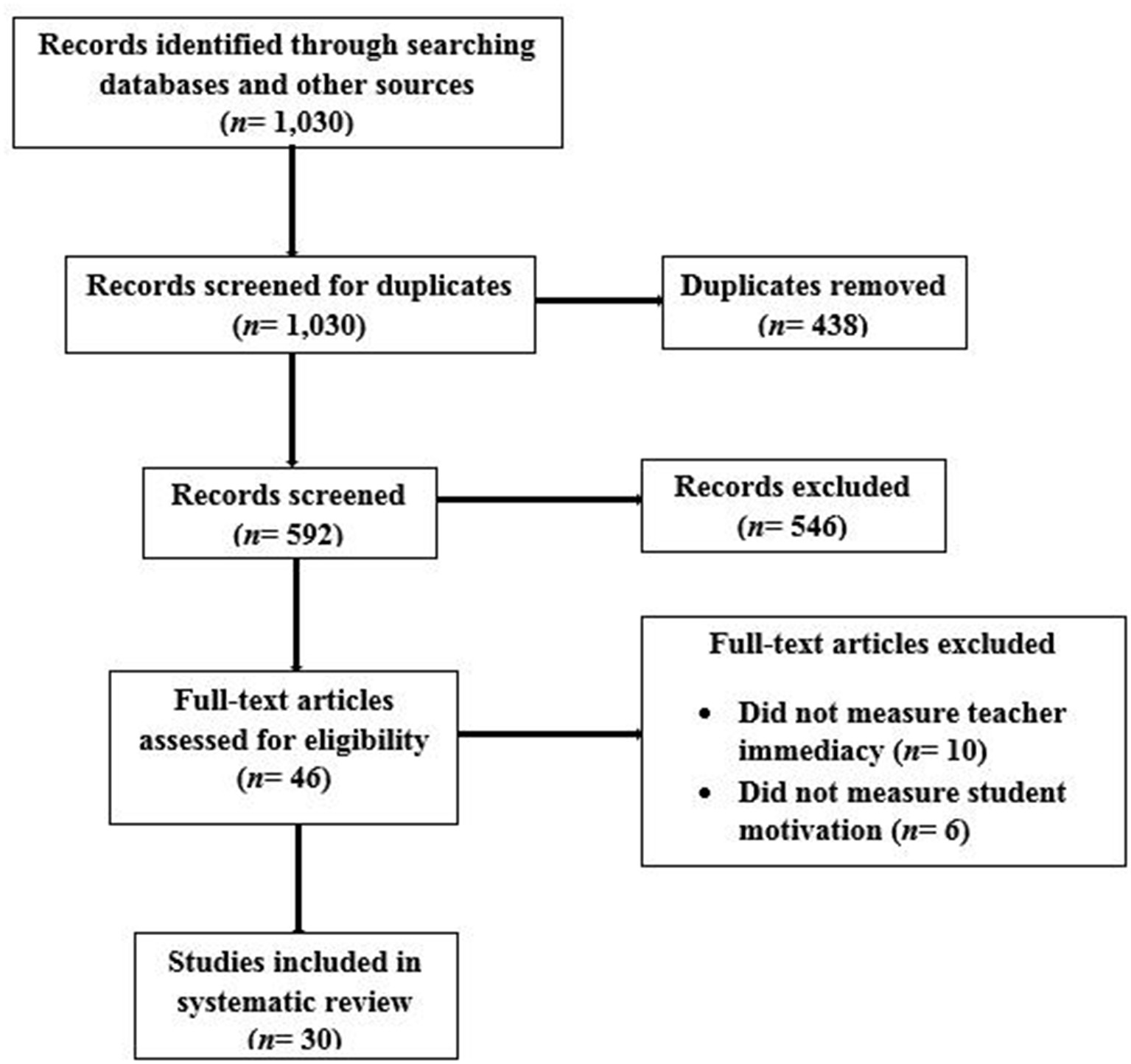
PRISMA diagram demonstrating study selection.
Data Extraction
The included manuscripts were thoroughly reviewed by two researchers. The following information was extracted to summarize the identified studies: (a) publication information, (b) participants demographic information, (c) measure of teacher immediacy, (d) measure of student motivation, (e) Context, (f) main statistical analyses employed, (g) design, and (h) main findings. The derived information is presented in Table 1. Employing Cohen's Kappa, inter-rater reliability was estimated as 0.95 indicated a high degree of consensus between the researchers. The few disagreements were fixed through a consensus between researchers referring to the source data.
Table 1
| References | Sample (N) | Context | Immediacy measure | Motivation measure | Statistical analysis | Design | Main findings |
|---|---|---|---|---|---|---|---|
| Christophel (1990) | Students, teaching assistants, and faculty members | Arts and Sciences classes | “The Immediacy Behavior Scale” (Christophel, 1990) | “Motivation Scale” (Christophel, 1990) | Simple and multiple correlations and regression | Correlational Research | “Positive correlation between verbal and non-verbal immediacy and student motivation/Positive relationship between immediacy and learning” |
| Frymier (1993) | 178 undergraduate students (87 were female, 87 were male, and 4 did not indicate their sex) | Communication courses | “Verbal Immediacy Scale” (Gorham, 1988), “Non-verbal Immediacy Scale” (Richmond et al., 1987) | “Motivation Scale” (Richmond, 1990) | ANOVA with repeated measures, Pearson correlations, Multiple regression, Factorial analysis of variance | Experimental Research (pretest-posttest) | “Student motivation showed positive association with teachers' verbal and non-verbal immediacy” |
| Christophel and Gorham (1995) | 319 students (190 female and 129 male) | Different contexts | “Verbal Immediacy Scale” (Gorham, 1988), “Non-verbal Immediacy Scale” (Richmond et al., 1987) | “Trait/State Motivation Scale” (Christophel, 1990) | Pearson correlation | Test-retest analysis | “A causal relationship between teacher immediacy and student motivation” |
| Christensen and Menzel (1998) | 115 undergraduate students | Not specified! | “Generalized Immediacy Scale” (Andersen, 1979) | “State Motivation Scale” (Christophel, 1990) | One-way ANOVAs | Correlational Research | “Positive relationship between both types of teacher immediacy (verbal and non-verbal) and student motivation/A positive, linear relationships between teacher non-verbal and verbal immediacy and perceived cognitive, affective, and behavioral learning” |
| Jaasma and Koper (1999) | 274 students (172 were female, 100 were male, and 2 did not indicate their sex) Range = 18–60 years (M = 23.6) | Not specified! | “Revised Non-verbal Immediacy Measure” (McCroskey et al., 1996), “Verbal Immediacy Scale” (Gorham, 1988) | “Student Motivation Scale” (Rubin et al., 1994) | Pearson product-moment correlation coefficients | Correlational Research | “Positive correlation between verbal and non-verbal immediacy and student motivation” |
| Cox and Todd (2001) | 1,196 students, 12 instructors | Self-contained and Mass-Lecture courses | “Verbal Immediacy Scale” (Gorham, 1988), “Non-verbal Immediacy Scale” (Richmond et al., 1987) | “Student Motivation Scale” (Christophel, 1990) | Pearson product moment correlation coefficients, ANOVA | Correlational Research | “Positive correlation between verbal and non-verbal immediacy and student motivation in both self-contained and mass-lecture formats of the basic communication courses” |
| Pribyl et al. (2004) | 259 students (179 female, 80 male) | Lecture classes | “Non-verbal Immediacy Behaviors Instrument” (Richmond et al., 1987) | “Student Motivation Scale” (Rubin et al., 1994) | Pearson correlation | Correlational Research | “Positive correlation between students' perceptions of teacher non-verbal immediacy, their motivation and cognitive learning” |
| Jung (2006) | 167 students | Business classes | “Non-verbal Immediacy Scale-Observer Report” (Richmond et al., 2003) | “Motivation Scale” (Richmond, 1990) | Pearson's coefficient of correlation | Correlational Research | “Positive and significant association between perceived non-verbal immediacy and perceived course motivation” |
| Pogue and AhYun (2006) | 586 college students (350 were female, 234 were male, and 2 did not report their sex). Mean age= 21.75 | General education classes | “Generalized Immediacy Scale” (Andersen, 1979) | “Student State Motivation Scale” (Christophel, 1990) | ANOVA | Experimental Research (factorial design) | “Students experience more motivation with highly immediate teachers/increased achievement is a function of teachers' immediate behaviors” |
| Comadena et al. (2007) | 233 undergraduate students (136 females & 97 males). Range= 18–25 years (M = 18.82) | Communication skills course | “Generalized Immediacy Scale” (Andersen, 1979) | “State Motivation Scale” (Christophel, 1990) | ANOVA | Experimental Research (factorial design) | “Teacher immediacy plays an important role in enhancing student motivation and a complimentary role in improving student learning outcomes” |
| Furlich (2007) | 240 undergraduate students | Communication skills course | “Verbal Immediacy Scale” (Gorham, 1988), “Non-verbal Immediacy Scale” (Richmond et al., 1987) | “State Motivation Scale” (Christophel, 1990) | ANCOVA | Correlational Research (descriptive) | “Positive correlation between teacher immediacy and student motivation to learn” |
| Furlich and Dwyer (2007) | 103 undergraduate students | Mathematics classes | “Verbal Immediacy Scale” (Gorham, 1988), “Non-verbal Immediacy Scale” (Richmond et al., 1987) | “State Motivation Scale” (Christophel, 1990) | Multiple linear regression | Correlational Research | “Teachers' verbal and non-verbal immediacy behaviors are positively associated with student motivation” |
| Zhang and Sapp (2008) | 172 college students (114 females & 58 males). | English, business, and communication classes | “Non-verbal Immediacy Measure” (McCroskey et al., 1996) | “State Motivation Scale” (Christophel, 1990) | MANOVA | Experimental Research (factorial design) | “Teachers' non-verbal immediacy behaviors are positively associated with student state motivation and affective learning” |
| Velez and Cano (2008) | 41 undergraduate students | Agriculture course | “Verbal Immediacy Scale” (Gorham, 1988), “Non-verbal Immediacy Scale” (Richmond et al., 1987) | “Approach-Avoidance Motivation Instrument” (Midgley et al., 1998) | Pearson correlation | Correlational Research (descriptive) | “Teacher immediacy has a strong and positive association with students' motivation” |
| Kalish (2009) | 240 undergraduate students (143 were female, 92 were male, and 5 did not report their sex) | General education courses | “Non-verbal Immediacy Scale” (Richmond et al., 1987) | “State Motivation Scale” (Christophel, 1990) | Factorial analysis of variance | Correlational Research | “Teacher non-verbal immediacy has a positive effect on student levels of state motivation” |
| Baker (2010) | 377 undergraduate and graduate students (265 females & 112 males) | Not specified! | “Verbal Immediacy Scale” (Gorham, 1988) | “State Motivation Scale” (Christophel, 1990) | Multiple regression analysis | Correlational Research | “A statistically significant positive relationship between teacher verbal immediacy and student motivation/ A positive association between teacher verbal immediacy and student affective learning” |
| Hsu (2010) | 303 students (259 females & 44 males) | English courses | “Non-verbal Immediacy Scale” (Thomas et al., 1994) | “State Motivation Scale” (Christophel, 1990) | Pearson correlation | Correlational Research | “Teacher non-verbal immediacy has a positive association with students' motivation to learn English” |
| Littlejohn (2012) | 500 high school science students, 32 science teachers | Science courses | “Teacher Communication Behavior Questionnaires” (She and Fisher, 2002) | “State Motivation Scale” (Christophel, 1990) | Pearson correlation, ANOVA | Correlational Research | “Teacher immediacy behaviors lead to increased student motivation” |
| Kerssen-Griep and Witt (2012) | 265 students (144 were female, 121 were male, and 4 did not report their sex) Range= 18–55 years (M = 20.04) | Communication courses | “Theoretical taxonomy of TNI” (Richmond et al., 1987) | “State Motivation Scale” (Christophel, 1990) | MANOVA | Experimental Research | “Teachers' non-verbal behaviors play a significant role in increasing student motivation” |
| Seifu and Gebru (2012) | 123 grade 8 students and grade 8 English teachers | English classes | “Verbal Immediacy Scale” (Gorham, 1988), “Non-verbal Immediacy Scale” (Thomas et al., 1994) | “Student Motivational State Questionnaire” (Guilloteaux, 2007) | Pearson correlation | Correlational Research (descriptive) | “Positive correlation between teacher immediacy and student motivation to learn English” |
| Velez and Cano (2012) | 208 students (36% were female and 64% were male) | Agricultural and Environmental sciences courses | “Verbal Immediacy Scale” (Gorham, 1988), “Non-verbal Immediacy Scale” (Richmond et al., 1987) | “Motivated Strategies for Learning Questionnaire” (Pintrich et al., 1991) | Pearson product–moment correlations | Correlational Research (descriptive) | “Verbal immediacy has a high correlation with student motivation to do the tasks” |
| Fallah (2014) | 252 Iranian EFL learners (151 were female and 101 were male) Range= 18-43 years (M = 20.71) | English classes | “Verbal Immediacy Scale” (Gorham, 1988), “Non-verbal Immediacy Scale” (Richmond et al., 1987) | “Motivation Scale” (Gardner et al., 1985) | Structural equation model (SEM) | Correlational Research | “Teacher immediacy has a significant positive effect on the learners' motivation” |
| Estepp and Roberts (2015) | 306 undergraduate students (63.7% were female and 36.3% were male) | Agricultural and Life sciences courses | “Immediacy Behavior Scale” (Christophel, 1990) | “Motivated Strategies for Learning Questionnaire” (Pintrich et al., 1991) | Pearson correlation | Correlational Research (descriptive) | “Positive correlation between teacher immediacy and student motivation” |
| Furlich (2016) | 77 undergraduate students | Communication courses | “Verbal Immediacy Scale” (Gorham, 1988), “Non-verbal Immediacy Scale” (Richmond et al., 1987) | “State Motivation Scale” (Christophel, 1990) | Independent linear regression | Correlational Research | “A significant linear regression relationship between teacher verbal immediacy and student motivation” |
| Tanriverdi Canbaz and Yavuz (2016) | 221 students Range= 17-25 years | Schools | “Teacher Immediacy Behaviors Questionnaire” (Tanriverdi Canbaz and Yavuz, 2016) | “Student Motivation Questionnaire” (Tanriverdi Canbaz and Yavuz, 2016) | ANOVA | Correlational Research | “A considerable difference between the motivation scores of the students with the lower immediacy perception and those of the students with the higher immediacy perception scores” |
| Barahona Guerrero (2017) | 139 undergraduate students (23.7% female, 76.3% male) Range= 18–39 years, M = 20.9 | Engineering classes | “Verbal Immediacy Scale” (Gorham, 1988), “Non-verbal Immediacy Scale” (Richmond et al., 1987) | “State Motivation Scale” (Christophel, 1990) | A multiple linear regression | Correlational Research | “Teacher verbal and non-verbal immediacy predict student motivation” |
| Wijaya (2017) | 60 students | X IIS 2/XI MIA 4 | Questionnaire, Group Interview, Observation | Questionnaire, Group Interview, Observation | Simple descriptive statistic, Interactive model of data analysis | Mixed Method Research | “Teacher non-verbal immediacy enhances students' motivation to learn English” |
| Stilwell (2018) | 530 students | Schools | “Verbal Immediacy Scale” (Gorham, 1988), “Non-verbal Immediacy Scale Observer Reports” (Richmond et al., 2003) | “Teacher Rating of Academic Achievement Motivation” (Stinnett et al., 1991) | Pearson correlation | Correlational Research | “Positive relationship among teacher immediacy, student motivation, and cognitive learning” |
| Megawati and Hartono (2020) | EFL teachers and students | English classes | Interview, Observation | Interview, Observation | Simple descriptive statistic, Interactive model of data analysis | Qualitative research | “Students' motivation are affected by both teachers' verbal and non-verbal communication behaviors, notably questions, and facial expressions” |
| Hussain et al. (2021) | 726 students | General education courses | “Verbal Immediacy Scale” (Gorham, 1988), “Revised Non-verbal Immediacy Measures” (McCroskey et al., 1996) | “Students Motivation Scale” (Rubin et al., 1994) | Pearson correlation | Correlational Research (descriptive) | “A strong correlation between verbal and non-verbal teacher immediacy and student motivation” |
Studies examining teacher immediacy and student motivation.
Results
The review's findings were listed according to the key features of the included manuscripts, including “the measures of teacher immediacy employed”, “the measures of student motivation employed”, “designs”, and “educational contexts”. Afterwards, the main findings of the manuscripts were discussed based on different types of teacher immediacy: (1) Verbal immediacy, (2) Non-verbal immediacy, and (3) Both verbal and non-verbal immediacy.
Measures of Teacher Immediacy
As shown in Table 1, most of the included studies (60%) utilized “Verbal Immediacy Scale” (Gorham, 1988) and/or “Non-verbal Immediacy Scale” (Richmond et al., 1987) to measure teacher immediacy. The rest (40%) assessed teacher immediacy through observation, group interview, and other reliable scales such as “Generalized Immediacy Scale” (Andersen, 1979), “Immediacy Behavior Scale” (Christophel, 1990), “Revised Non-verbal Immediacy Measure” (McCroskey et al., 1996), and “Non-verbal Immediacy Scale-Observer Report” (Richmond et al., 2003).
Measures of Student Motivation
Table 1 delineates that the majority of studies (53%) used “Motivation Scale” (Christophel, 1990) to measure student motivation. The remaining studies (47%) evaluated student motivation via observation, interview, and other scales such as “Student Motivation Scale” (Rubin et al., 1994), “Motivation Scale” (Richmond, 1990), “Motivated Strategies for Learning Questionnaire” (Pintrich et al., 1991), “Motivation Scale” (Gardner et al., 1985), and “Student Motivational State Questionnaire” (Guilloteaux, 2007).
Educational Contexts (General Education and English Language Education)
Of 30 included studies, only 5 empirical studies (17%) were carried out in EFL/ESL classes, the rest (83%) examined the interplay of teacher immediacy and students' motivation in general educational contexts such as science classes, engineering classes, communication courses, business courses, agricultural courses. That is, the consequences of English teachers' immediate behaviors for EFL/ESL students' academic motivation received scant attention (Figure 2).
Figure 2
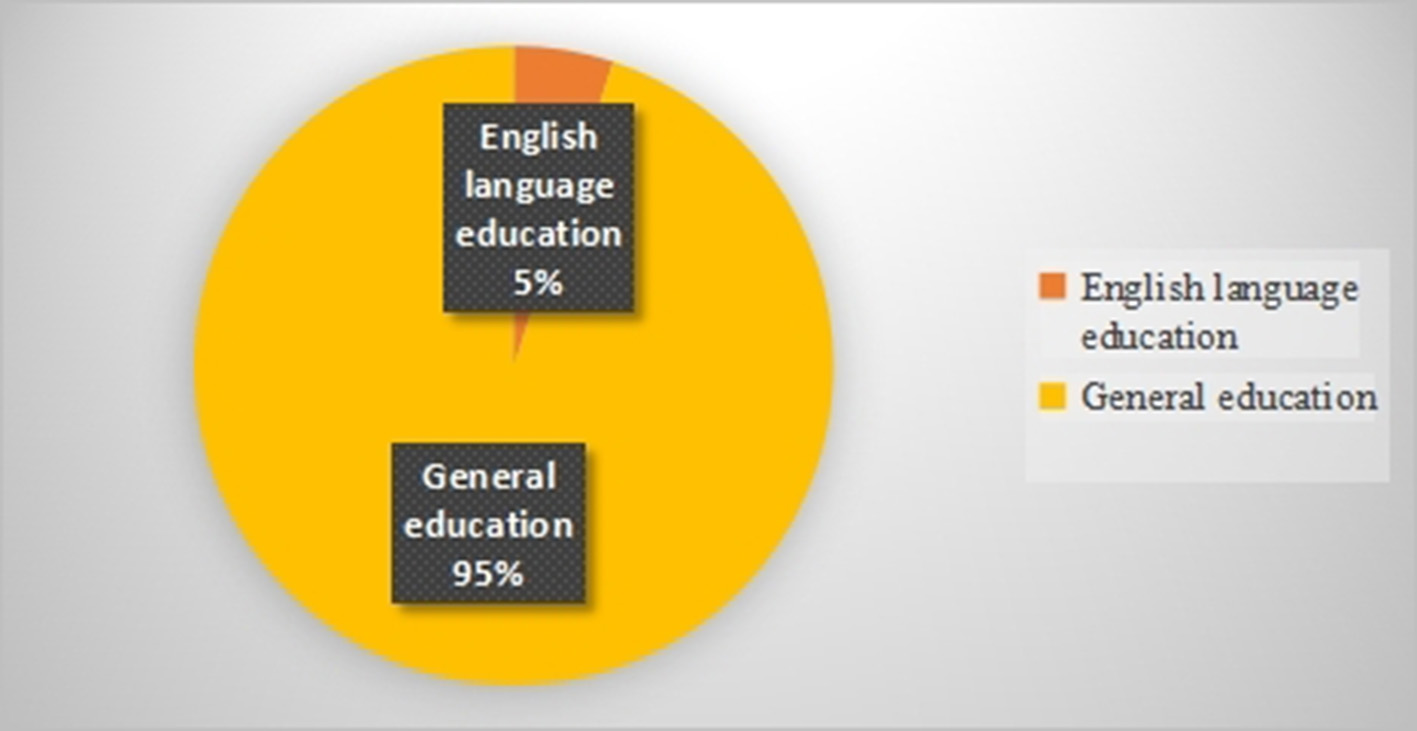
Educational contexts.
Study Designs
As shown in Figure 3, several studies (74%) in the current systematic review utilized correlational designs (non-experimental). The rest used experimental (20%), qualitative (3%), and mixed-methods research (3%) in studying teacher immediacy and student motivation.
Figure 3
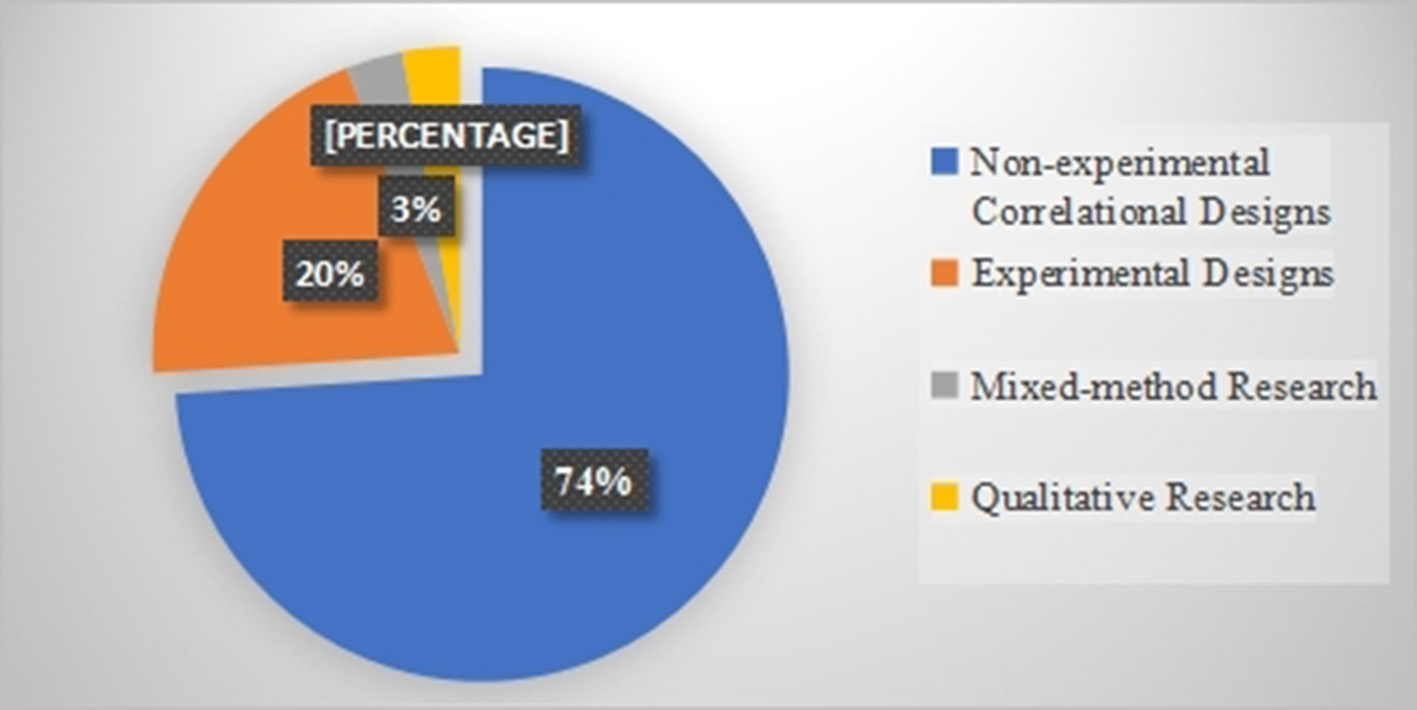
Designs of the included studies.
Teacher Immediacy and Student Motivation
Teacher Verbal Immediacy and Student Motivation
Among the included studies, only one study (Baker, 2010) investigated the relationship between teacher verbal immediacy and student motivation. In doing so, 699 graduate and undergraduate students voluntarily completed two questionnaires, namely “Verbal Immediacy Scale” (Gorham, 1988) and “State Motivation Scale” (Christophel, 1990). Analyzing students' perceptions, Baker (2010) found that students perceive teachers' immediacy behaviors as an important motivational factor in instructional-learning environments.
Teacher Non-verbal Immediacy and Student Motivation
Of 30 studies included in this review, seven studies (Pribyl et al., 2004; Jung, 2006; Zhang and Sapp, 2008; Kalish, 2009; Hsu, 2010; Kerssen-Griep and Witt, 2012; Wijaya, 2017) examined the role of teacher non-verbal immediacy in students' motivation. The findings indicated that teachers' non-verbal behaviors play a significant role in enhancing student motivation. To put differently, the results of these studies revealed that teacher non-verbal immediacy is a strong predictor of student motivation.
Teacher Verbal and Non-verbal Immediacy and Student Motivation
The majority of reviewed studies (n = 22) probed the association between teacher verbal and non-verbal immediacy and student motivation to learn. Of these studies, 20 studies found a positive relationship between both verbal and non-verbal immediacy and student motivation. In other words, they reported that students' level of motivation can be remarkably enhanced by their teachers' verbal and non-verbal immediacy. On the other hand, two studies (Velez and Cano, 2012; Furlich, 2016) found that only teacher verbal immediacy can lead to increased student motivation.
Discussion
The current study sought to offer the first systematic review on teacher verbal and non-verbal immediacy and student motivation. By reviewing, summarizing, and analyzing the relevant studies on this topic, it is hoped to shed more light on the significance of teacher immediacy for students, on the one hand, and to develop a broader picture of the current state of the art, on the other hand. This section discusses the main findings and crucial points. In light of these key findings, the limitations of the included studies are highlighted, and some practical directions for future research are delineated.
Main Findings
While research has substantiated that teacher immediacy has numerous positive effects on teachers (e.g., Teven and Hanson, 2004; Santilli et al., 2011; Kelly and Westerman, 2014; Lybarger et al., 2017; Kalat et al., 2018; Frymier et al., 2019; Nayernia et al., 2020), the results indicate that the effects may also apply to their students. One of the most outstanding results is that there was some indication that teacher immediacy is tied with increased student motivation. Students being instructed by a teacher using verbal and non-verbal immediacy behaviors are more motivated than those instructed by teachers not employing immediacy actions. This finding may be explained by the fact that getting students' attention is the most crucial factor in motivating students. Moving around the class, making eye contact, and calling students by name enable teachers to do so (Keller, 1987). Another possible explanation for this is that those teachers tend to enhance their students' state motivation may strengthen their interaction with them (Allen et al., 2006; Myers et al., 2014).
Furthermore, we noticed some indications that immediacy behaviors will influence students beyond their motivation and probably interact with their learning outcomes—with moderate correlations identified with higher students' achievements. A probable explanation for this might be that the immediacy behaviors that teachers exhibit in interactions with students can inspire students to become more attentive, which in turn improves students' achievements (Mazer, 2013; York, 2013; Ai and Giang, 2018).
Limitations of the Included Studies
A number of limitations need to be noted regarding the included studies. First, it was found that all studies merely employed observer-report questionnaires to measure teacher immediacy; hence, the voices/perceptions of teachers regarding their immediacy are not heard. Second, all but one study (Wijaya, 2017) relied solely on questionnaires to measure teacher immediacy and student motivation. Third, most studies (74%) utilized non-experimental correlational designs; the experimental designs received scant attention. Forth, a scant number of studies have examined the role of teacher immediacy in school students' motivation. To put it differently, most of the included studies were conducted in universities. Fifth, the majority of studies (95%) focused on the impact of teacher immediacy on general education courses. That is, a limited number of studies probed the consequences of teacher immediacy in EFL/ESL classes. Finally, the studies included in this review scarcely examined the mediating effects of situational variables (e.g., age, gender, academic degree, etc.) on the relationship between teacher immediacy and student motivation.
Directions for Future Research
In light of the critical evaluation of the studies presented in this review, some suggestions for future research are provided to deepen the current understanding of the topic. Given the importance of the topic, first and foremost, more empirical studies examining the associations between teacher immediacy and student motivation are needed. While the included studies provide some indications for the aforementioned associations, more extensive research in terms of design, samples, and findings is required. Moreover, given the scarcity of studies investigating the consequences of language teacher immediacy for EFL/ESL students' motivation, future research needs to be carried out to establish whether present findings will be generalized to English language classes.
A further practical direction for future work pertains to the measurement of teacher immediacy. As the voices of teachers regarding their immediacy are not heard, it would be interesting to provide different perspectives on this phenomenon beyond observer-report scales. Additionally, more research is needed to consider the role of situational variables. Future studies are highly recommended to determine whether different situational variables (e.g., age, gender, academic degree, etc.) might moderate the effects of teacher verbal and non-verbal immediacy on student motivation. Personality traits should also be taken into consideration in future research.
Implications for Practice
The findings of the present review can be informative and beneficial for teachers in all instructional-learning contexts (i.e., English language classes and general education courses). Employing verbal and non-verbal actions, teachers can increase the psychological intimacy between themselves and their students, which contributes to increased student motivation (Averbeck et al., 2006; Richmond et al., 2008). A higher degree of students' motivation can increase their learning outcomes, which is the ultimate goal of any educational system (Allen et al., 2006; Ai and Giang, 2018; Gholamrezaee and Ghanizadeh, 2018; Pishghadam et al., 2019; Derakhshan, 2021). Furthermore, the review's outputs may also be informative for teacher educators. They should highlight the significance of teachers' interpersonal variables, especially verbal non-verbal immediacy to assist both pre- and in-service teachers in enhancing the amount of students' trait and state motivation. Being aware of the significance of verbal and non-verbal immediacy behaviors, teachers can also provide more efficient and appealing instruction. Hence, in teacher training courses, both pre- and in-service teachers should be equipped with the knowledge of appropriate immediacy behaviors (e.g., close proxemics, smiling, vocal varieties, etc.) to take advantage of these actions in their classrooms.
Conclusions
To sum up, the current systematic review has shed more light on the association between teacher verbal and non-verbal immediacy and student motivation, raising several concerns that have not been addressed in this area. To the best of our knowledge, this is the first systematic review focusing on the relationship between teacher immediacy and student motivation in instructional-learning contexts. The findings indicate that immediate teachers are capable of enhancing students' motivation. Based on the key features of the included studies, it is concluded that further research adopting more robust designs, employing self-report questionnaires, and examining the mediating effects of situational variables are required. Moreover, with regard to the number of studies conducted on the influence of immediate behaviors on EFL and ESL students' academic motivation, it is reasonable to infer that this area is still in its infancy and needs much more attention.
Statements
Data availability statement
The original contributions presented in the study are included in the article/supplementary files, further inquiries can be directed to the corresponding authors.
Author contributions
The author confirms being the sole contributor of this work and has approved it for publication.
Conflict of interest
The author declares that the research was conducted in the absence of any commercial or financial relationships that could be construed as a potential conflict of interest.
References
1
Ai T. H. Giang L. H. (2018). The role of teacher immediacy as a motivational factor in student learning. J. Glob. Socio-Economic Dyn.6, 54–63. 10.35678/2539-5645.6(13).2018.54-63
2
Allen M. Witt P. L. Wheeless L. R. (2006). The role of teacher immediacy as a motivational factor in student learning: using meta-analysis to test a causal model. Commun. Educ. 55, 21–31. 10.1080/03634520500343368
3
Andersen J. F. (1979). Teacher immediacy as a predictor of teaching effectiveness. Annals Int. Commun. Assoc.3, 543–559. 10.1080/23808985.1979.11923782
4
Andersen P. A. Andersen J. F. (2005). “Measurements of perceived non-verbal immediacy,” in Sourcebook of Non-verbal Measures: Going Beyond Words, ed V. Manusov (New York, NY: Routledge), 113–126.
5
Averbeck J. Morthland R. Mufteyeva A. (2006). Teacher immediacy in live and online classrooms. Texas Speech Communication Journal Online, 31. Retrieved from: http://www.etsca.com/tscjonline/1206-immediacy/.
6
Baker C. (2010). The impact of instructor immediacy and presence for online student affective learning, cognition, and motivation. J. Educ. Online7, 1–30. 10.9743/JEO.2010.1.2
7
Barahona Guerrero A. N. (2017). Exploring the relationship between immediacy behaviors and student motivation in engineering classrooms: Immediacy as a cause of motivation (Doctoral Dissertation). South Dakota State University, South Dakota.
8
Chesebro J. L. McCroskey J. C. (2001). The relationship of teacher clarity and immediacy with student state receiver apprehension, affect, and cognitive learning. Commun. Educ. 50, 59–68. 10.1080/03634520109379232
9
Christensen L. J. Menzel K. E. (1998). The linear relationship between student reports of teacher immediacy behaviors and perceptions of state motivation, and of cognitive, affective, and behavioral learning. Commun. Educ. 47, 82–90. 10.1080/03634529809379112
10
Christophel D. M. (1990). The relationships among teacher immediacy behaviors, student motivation, and learning. Commun. Educ. 39, 323–340. 10.1080/03634529009378813
11
Christophel D. M. Gorham J. (1995). A test-retest analysis of student motivation, teacher immediacy, and perceived sources of motivation and demotivation in college classes. Commun. Educ. 44, 292–306. 10.1080/03634529509379020
12
Comadena M. E. Hunt S. K. Simonds C. J. (2007). The effects of teacher clarity, non-verbal immediacy, and caring on student motivation, affective and cognitive learning. Commun. Res. Rep.24, 241–248. 10.1080/08824090701446617
13
Cox S. A. Todd T. S. (2001). Contrasting the relationships between teacher immediacy, teacher credibility, and student motivation in self-contained and mass lecture courses. Basic Commun. Course Annual13, 23–45.
14
Derakhshan A. (2021). The predictability of Turkman students' academic engagement through Persian language teachers' non-verbal immediacy and credibility. J. Teach. Persian Speakers Other Languages10, 3–26. 10.30479/jtpsol.2021.14654.1506t
15
Dörnyei Z. (2020). Innovations and Challenges in Language Learning Motivation. New York, NY: Routledge. 10.4324/9780429485893
16
Dörnyei Z. Ushioda E. (2021). Teaching and Researching Motivation: New Directions for Language Learning, 3rd Edn. New York, NY: Routledge. 10.4324/9781351006743
17
Elliot A. J. (1999). Approach and avoidance motivation and achievement goals. Educ. Psychol. 34, 169–189. 10.1207/s15326985ep3403_3
18
Estepp C. M. Roberts T. G. (2015). Teacher immediacy and professor/student rapport as predictors of motivation and engagement. NACTA J.59, 155–163.
19
Fallah N. (2014). Willingness to communicate in English, communication self-confidence, motivation, shyness and teacher immediacy among Iranian English-major undergraduates: A structural equation modeling approach. Learn. Individ. Differ. 30, 140–147. 10.1016/j.lindif.2013.12.006
20
Faranda W. T. (2015). The effects of instructor service performance, immediacy, and trust on student–faculty out-of-class communication. Marketing Educ. Rev.25, 83–97. 10.1080/10528008.2015.1029853
21
Frymier A. B. (1993). The impact of teacher immediacy on students' motivation: is it the same for all students?Commun. Q. 41, 454–464. 10.1080/01463379309369905
22
Frymier A. B. Goldman Z. W. Claus C. J. (2019). Why non-verbal immediacy matters: a motivation explanation. Commun. Q. 67, 526–539. 10.1080/01463373.2019.1668442
23
Furlich S. A. (2007). An Exploration of the Relation Among Verbal and Non-verbal Instructor Immediacy Behaviors and Student Motivation to Learn Within the Higher Education Classroom (Doctoral Dissertation). Texas Tech University, Lubbock, Texas.
24
Furlich S. A. (2016). Understanding instructor non-verbal immediacy, verbal immediacy, and student motivation at a small liberal arts university. J. Scholarship Teach. Learn.16, 11–22. 10.14434/josotl.v16i3.19284
25
Furlich S. A. Dwyer J. F. (2007). Student motivation and instructor immediacy in community college mathematics classes. Mathematics Educ.10, 55–70.
26
Gardner R. C. Lalonde R. N. Moorcroft R. (1985). The role of attitudes and motivation in second language learning: correlational and experimental considerations. Lang. Learn. 35, 207–227. 10.1111/j.1467-1770.1985.tb01025.x
27
Gholamrezaee S. Ghanizadeh A. (2018). EFL teachers' verbal and non-verbal immediacy: a study of its impact on students' emotional states, cognitive learning, and burnout. Psychol. Stud.63, 398–409. 10.1007/s12646-018-0467-5
28
Gorham J. (1988). The relationship between verbal teacher immediacy behaviors and student learning. Commun. Educ. 37, 40–53. 10.1080/03634528809378702
29
Guilloteaux M. J. (2007). Motivating language learners: A classroom-oriented investigation of teachers' motivational practices and students' motivation (Doctoral Dissertation). University of Nottingham, Nottingham, England.
30
Guilloteaux M. J. Dörnyei Z. (2008). Motivating language learners: a classroom-oriented investigation of the effects of motivational strategies on student motivation. TESOL Quart.42, 55–77. 10.1002/j.1545-7249.2008.tb00207.x
31
Habash S. H. (2010). Exploring the relationship between perceived teacher non-verbal immediacy and perceived teacher misbehaviors on student course retention in urban community colleges (Doctoral Dissertation). University of California, Berkeley.
32
Henry A. Thorsen C. (2018). Teacher–student relationships and L2 motivation. Modern Language J.102, 218–241. 10.1111/modl.12446
33
Hiver P. Al-Hoorie A. H. (2020). Reexamining the role of vision in second language motivation: a preregistered conceptual replication of ‘You'. Lang. Learn. 70, 48–102. 10.1111/lang.12371
34
Hsu L. (2010). The impact of perceived teachers' non-verbal immediacy on students' motivation for learning English. Asian EFL J.12, 188–204.
35
Hussain T. Azeem A. Abid N. (2021). Examining the correlation between University students' perceived teacher immediacy and their motivation. Psychol. Educ. J.58, 5809–5820. 10.17762/pae.v58i1.1990
36
Hussain T. Khalid M. Akbar F. (2020). Teacher immediacy and students classroom participation: a relationship study in Pakistan. J. Res. Soc. Pakistan57, 436–446.
37
Jaasma M. A. Koper R. J. (1999). The relationship of student-faculty out-of-class communication to instructor immediacy and trust and to student motivation. Commun. Educ. 48, 41–47. 10.1080/03634529909379151
38
Jung H. Y. (2006). Transactional Distance and Student Motivation: Student Perception of Teacher Immediacy, Solidarity Toward Peer Students and Student Motivation in Distance Education (Doctoral Dissertation). West Virginia University, Morgantown, West Virginia.
39
Kalat F. L. Yazdi Z. A. Ghanizadeh A. (2018). EFL teachers' verbal and non-verbal immediacy: a study of its detriments and consequences. Eur. J. Educat. Stud.63, 398–409.
40
Kalish S. (2009). Effects of Instructor Immediacy and Student Need for Cognition on Student Motivation and Perceptions of Learning (Doctoral Dissertation). University of Central Florida, Orlando, Florida.
41
Katt J. A. Condly S. J. (2009). A preliminary study of classroom motivators and de-motivators from a motivation-hygiene perspective. Commun. Educ. 58, 213–234. 10.1080/03634520802511472
42
Keller J. M. (1987). Development and use of the ARCS model of instructional design. J. Instructional Dev.10, 2–10. 10.1007/BF02905780
43
Kelly S. Westerman C. Y. K. (2014). Immediacy as an influence on supervisor-subordinate communication. Commun. Res. Rep.31, 252–261. 10.1080/08824096.2014.924335
44
Kerssen-Griep J. Witt P. L. (2012). Instructional feedback II: How do instructor immediacy cues and facework tactics interact to predict student motivation and fairness perceptions?. Commun. Stud.63, 498–517. 10.1080/10510974.2011.632660
45
Lee J. H. (2020). Relationships among students' perceptions of native and non-native EFL teachers' immediacy behaviours and credibility and students' willingness to communicate in class. Oxford Rev. Educ.46, 153–168. 10.1080/03054985.2019.1642187
46
Littlejohn V. (2012). Student and teacher perceptions of teacher immediacy behaviors and the influence of teacher immediacy behaviors on student motivation to learn science (Doctoral Dissertation). Gardner-Webb University, North Carolina.
47
Lybarger J. E. Rancer A. S. Lin Y. (2017). Superior–subordinate communication in the workplace: verbal aggression, non-verbal immediacy, and their joint effects on perceived superior credibility. Commun. Res. Rep.34, 124–133. 10.1080/08824096.2016.1252909
48
Madigan D. J. Kim L. E. (2021). Does teacher burnout affect students? A systematic review of its association with academic achievement and student-reported outcomes. Int. J. Educ. Res.105:101714. 10.1016/j.ijer.2020.101714
49
Marx A. A. Simonsen J. C. Kitchel T. (2016). Undergraduate student course engagement and the influence of student, contextual, and teacher variables. J. Agricultural Educ.57, 212–228. 10.5032/jae.2016.01212
50
Mazer J. P. (2013). Associations among teacher communication behaviors, student interest, and engagement: a validity test. Commun. Educ. 62, 86–96. 10.1080/03634523.2012.731513
51
McCroskey J. C. Sallinen A. Fayer J. M. Richmond V. P. Barraclough R. A. (1996). Non-verbal immediacy and cognitive learning: a cross-cultural investigation. Commun. Educ. 45, 200–211. 10.1080/03634529609379049
52
Megawati W. Hartono R. (2020). The impact of teachers' verbal and non-Verbal communication on students' motivation in learning English. English Educ. J.10, 436–448. 10.15294/EEJ.V10I4.39157
53
Mehrabian A. (1969). Significance of posture and position in the communication of attitude and status relationships. Psychol. Bull.71, 359–372. 10.1037/h0027349
54
Mehrabian A. (1971). “Immediacy: Liking and approach,” in Silent Messages, ed A. Mehrabian (Belmont: Wadsworth), 1–23.
55
Midgley C. Kaplan A. Middleton M. Maehr M. L. Urdan T. Anderman L. H. et al . (1998). The development and validation of scales assessing students' achievement goal orientations. Contemp. Educ. Psychol.23, 113–131. 10.1006/ceps.1998.0965
56
Moore R. Jensen M. Hatch J. Duranczyk I. Staats S. Koch L. (2003). Showing up: the importance of class attendance for academic success in introductory science courses. Am. Biol. Teach. 65, 325–329. 10.2307/4451508
57
Myers S. A. Goodboy A. K. Members of COMM 600 . (2014). College student learning, motivation, and satisfaction as a function of effective instructor communication behaviors. Southern Commun. J.79, 14–26.
58
Myers S. A. Martin M. M. Mottet T. P. (2002). Students' motives for communicating with their instructors: considering instructor socio-communicative style, student socio-communicative orientation, and student gender. Commun. Educ.51, 121–133. 10.1080/03634520216511
59
Nayernia A. Taghizadeh M. Farsani M. A. (2020). EFL teachers' credibility, non-verbal immediacy, and perceived success: a structural equation modelling approach. Cogent Educ.7, 1–15. 10.1080/2331186X.2020.1774099
60
Park H. S. Lee S. A. Yun D. Kim W. (2009). The impact of instructor decision authority and verbal and non-verbal immediacy on Korean student satisfaction in the US and South Korea. Commun. Educ. 58, 189–212. 10.1080/03634520802450531
61
Pintrich P. R. Schunk D. H. (2002). Motivation in Education: Theory, Research, and Applications, 2nd Edn.Columbus, OH: Merrill-Prentice Hall.
62
Pintrich P. R. Smith D. A. F. García T. McKeachie W. J. (1991). A manual for the use of the Motivated Strategies for Learning Questionnaire (MSLQ).Ann Arbor, MI: University of Michigan, National Center for Research to Improve Postsecondary Teaching and Learning.
63
Pishghadam R. Derakhshan A. Zhaleh K. (2019). The interplay of teacher success, credibility, and stroke with respect to EFL students' willingness to attend classes. Polish Psychol. Bull.284–292. 10.24425/ppb.2019.131001
64
Pogue L. L. AhYun K. (2006). The effect of teacher non-verbal immediacy and credibility on student motivation and affective learning. Commun. Educ. 55, 331–344. 10.1080/03634520600748623
65
Pribyl C. B. Sakamoto M. Keaten J. A. (2004). The relationship between non-verbal immediacy, student motivation, and perceived cognitive learning among Japanese college students 1. Jpn. Psychol. Res.46, 73–85. 10.1111/j.0021-5368.2004.00238.x
66
Richmond V. P. (1990). Communication in the classroom: power and motivation. Commun. Educ. 39, 181–195. 10.1080/03634529009378801
67
Richmond V. P. Gorham J. S. McCroskey J. C. (1987). The relationship between selected immediacy behaviors and cognitive learning. Annals Int. Commun. Assoc.10, 574–590. 10.1080/23808985.1987.11678663
68
Richmond V. P. McCroskey J. C. Hickson M. (2008). Non-verbal Behavior in Interpersonal Relations. Boston, MA: Allyn and Bacon.
69
Richmond V. P. McCroskey J. C. Johnson A. D. (2003). Development of the non-verbal immediacy scale (NIS): measures of self-and other-perceived non-verbal immediacy. Commun. Q. 51, 504–517. 10.1080/01463370309370170
70
Roberts A. Friedman D. (2013). The impact of teacher immediacy on student participation: an objective cross-disciplinary examination. Int. J. Teach. Learn. Higher Educ.25, 38–46.
71
Rocca K. (2007). Immediacy in the classroom: research and practical implications. Commun. Educ. 50, 283–297.
72
Rubin R. B. Palmgreen P. Sypher H. E . (editors). (1994). Communication Research Measures: A Sourcebook. New York, NY: The Guilford Press.
73
Santilli V. Miller A. N. Katt J. (2011). A comparison of the relationship between instructor non-verbal immediacy and teacher credibility in Brazilian and US classrooms. Commun. Res. Rep.28, 266–274. 10.1080/08824096.2011.588583
74
Seifu A. Gebru A. (2012). Relationship between teacher verbal and non-verbal immediacy and student motivation in EFL classes. Ethiopian J. Educ.32, 71–104.
75
She H. C. Fisher D. (2002). Teacher communication behavior and its association with students' cognitive and attitudinal outcomes in science in Taiwan. J. Res. Sci. Teach.39, 63–78. 10.1002/tea.10009
76
Sheybani M. (2019). The relationship between EFL Learners' willingness to communicate (WTC) and their teacher immediacy attributes: a structural equation modelling. Cogent Psychol.6, 1–14. 10.1080/23311908.2019.1607051
77
Stilwell J. R. (2018). Does Teacher Immediacy Matter? The relationship among teacher immediacy, student motivation, engagement, and cognitive learning (Doctoral Dissertation). Gardner-Webb University, North Carolina.
78
Stinnett T. A. Oehler-Stinnett J. Stout L. J. (1991). Development of the teacher rating of academic achievement motivation: TRAAM. School Psych. Rev. 20, 609–622. 10.1080/02796015.1991.12085582
79
Sutiyatno S. (2018). The effect of teacher's verbal communication and non-verbal communication on students' English achievement. J. Language Teach. Res.9, 430–437. 10.17507/jltr.0902.28
80
Tanriverdi Canbaz S. Yavuz M. A. (2016). Effects of teacher immediacy behaviors on students' motivation towards language learning. Int. Online J. Primary Educ.5, 11–19.
81
Teven J. J. Hanson T. L. (2004). The impact of teacher immediacy and perceived caring on teacher competence and trustworthiness. Commun. Q. 52, 39–53. 10.1080/01463370409370177
82
Thomas C. E. Richmond V. P. McCroskey J. C. (1994). The association between immediacy and socio-communicative style. Commun. Res. Rep.11, 107–114. 10.1080/08824099409359946
83
Trad L. Katt J. Neville Miller A. (2014). The effect of face threat mitigation on instructor credibility and student motivation in the absence of instructor non-verbal immediacy. Commun. Educ. 63, 136–148. 10.1080/03634523.2014.889319
84
Ushioda E. Dörnyei Z. (2017). Beyond global English: Motivation to learn languages in a multicultural world: introduction to the special issue. Modern Language J.101, 451–454. 10.1111/modl.12407
85
Velez J. J. Cano J. (2008). The relationship between teacher immediacy and student motivation. J. Agricultural Educ.49, 76–86. 10.5032/jae.2008.03076
86
Velez J. J. Cano J. (2012). Instructor verbal and non-verbal immediacy and the relationship with student self-efficacy and task value motivation. J. Agricultural Educ.53, 87–98. 10.5032/jae.2012.02087
87
Violanti M. T. Kelly S. E. Garland M. E. Christen S. (2018). Instructor clarity, humor, immediacy, and student learning: Replication and extension. Commun. Stud.69, 251–262. 10.1080/10510974.2018.1466718
88
Wijaya R. K. (2017). Students' perception of teachers non-verbal immediacy behavior toward students' attitude and motivation in learning English. ELT Worldwide4, 75–91. 10.26858/eltww.v4i1.3198
89
Witt P. L. Schrodt P. (2006). The influence of instructional technology use and teacher immediacy on student affect for teacher and course. Commun. Rep.19, 1–15. 10.1080/08934210500309843
90
Witt P. L. Wheeless L. R. Allen M. (2004). A meta-analytical review of the relationship between teacher immediacy and student learning. Commun. Monogr. 71, 184–207. 10.1080/036452042000228054
91
York D. (2013). Investigating a Relationship Between Non-verbal Communication and Student Learning (Doctoral Dissertation). Lindenwood University, Saint Charles, Missouri.
92
Yu M. (2011). Effect of communication variables, affective variables, and teacher immediacy on willingness to communicate of foreign language learners. Chin. J. Commun.4, 218–236. 10.1080/17544750.2011.565678
93
Zhang Q. Sapp D. A. (2008). A burning issue in teaching: the impact of perceived teacher burnout and non-verbal immediacy on student motivation and affective learning. J. Commun. Stud.1, 152–168.
Summary
Keywords
verbal immediacy, non-verbal immediacy, students, motivation, systematic review, teachers
Citation
Liu W (2021) Does Teacher Immediacy Affect Students? A Systematic Review of the Association Between Teacher Verbal and Non-verbal Immediacy and Student Motivation. Front. Psychol. 12:713978. doi: 10.3389/fpsyg.2021.713978
Received
24 May 2021
Accepted
31 May 2021
Published
25 June 2021
Volume
12 - 2021
Edited by
Ali Derakhshan, Golestan University, Iran
Reviewed by
Saeed Khazaie, Isfahan University of Medical Sciences, Iran; Kiyana Zhaleh, Allameh Tabataba'i University, Iran
Updates
Copyright
© 2021 Liu.
This is an open-access article distributed under the terms of the Creative Commons Attribution License (CC BY). The use, distribution or reproduction in other forums is permitted, provided the original author(s) and the copyright owner(s) are credited and that the original publication in this journal is cited, in accordance with accepted academic practice. No use, distribution or reproduction is permitted which does not comply with these terms.
*Correspondence: Wei Liu xylw@xynu.edu.cn
This article was submitted to Educational Psychology, a section of the journal Frontiers in Psychology
Disclaimer
All claims expressed in this article are solely those of the authors and do not necessarily represent those of their affiliated organizations, or those of the publisher, the editors and the reviewers. Any product that may be evaluated in this article or claim that may be made by its manufacturer is not guaranteed or endorsed by the publisher.