Abstract
Background:
Chinese colleges have implemented strict closed-off management in response to the outbreak of a new variant of the new coronavirus, Omicron. But such management measures may lead to more aggressive behavior. The study aimed to determine the associations between boredom and aggressive behavior with aggression and to examine the impact of boredom on aggression through the moderating role of cognitive flexibility.
Methods:
The Multidimensional State Boredom Scale, the Reactive–Proactive Aggression Questionnaire, and the Cognitive Flexibility Inventory were applied to a sample of 719 college students who were in a closed-off management environment.
Results:
For individuals with high cognitive flexibility, the relationship between state boredom and proactive aggression was not significant. The relationship between state boredom and proactive aggression was significantly positively correlated for individuals with low cognitive flexibility, especially low substitutability. Cognitive flexibility has no significant moderating effect on the relationship between state boredom and reactive aggression.
Conclusion:
The findings highlighted the importance of boredom as a potential risk factor for aggression, while cognitive flexibility appears as a potential protective factor.
Introduction
COVID-19, a novel coronavirus disease, has caused numerous infections worldwide. To break the transmission link of the virus and curb the outbreak of the COVID-19 pandemic, the Chinese government has taken aggressive public health monitoring and interventions, such as mass nucleic acid testing, contact tracing, travel restrictions, and avoiding crowd gathering (Cheng et al., 2021; Hu et al., 2021; Wan et al., 2022). As the Omicron variant has caused COVID-19 resurgences in many places, in cities with severe epidemics, primary and middle schools have to be closed and converted to online teaching, and colleges have implemented relatively closed-off management. Except for necessary medical treatment, college students are not permitted to leave campus without special circumstances, in a bid to reduce the likelihood of COVID-19 (Roberton et al., 2012; Sun et al., 2021; Zhang et al., 2021; Tu et al., 2022; Zhang and Zhu, 2022).
Such strict quarantine and restrictive policies have greatly relieved the pressure on the healthcare system and played a role in keeping infection and death rates low (Fu et al., 2021; Ge et al., 2021; Bo et al., 2022). These policies, however, also affect normal study, socialization, and life, potentially leading to psychological and behavioral problems for college students (Copeland et al., 2021; Li et al., 2021a, b; Baleanu et al., 2022).
Aggression
In general, aggression is defined as behavior with the immediate intention of harming another individual. Moreover, the perpetrator must believe that the behavior will cause harm to the target as well as the target must be motivated to avoid the behavior (Anderson and Bushman, 2002). Reactive aggression occurs in response to a real or perceived threat, whereas proactive aggression occurs in order to accomplish a specific goal(Miller and Lynam, 2006; Romero-Martínez et al., 2022). During the COVID-19 pandemic, many young people have been directly or indirectly exposed to violence and aggression during the pandemic (Field, 2021; Bera et al., 2022). Compared with people who were not under stay-at-home restrictions, individuals who were under lockdown status were more likely to be depressed, face more domestic violence risks (Humphreys et al., 2020; Mazza et al., 2020). A significant number of students showed more and more destructive and aggressive behavior (Pfefferbaum and North, 2020; Killgore et al., 2021; Ye et al., 2021). Not only that, the content of aggressive behavior also appears in dreams (Kilius et al., 2021). Researchers have examined changes in aggressive behavior before and after the epidemic, and found a rise in cyberbullying behaviors, physical aggression, verbal aggression (Barlett et al., 2021; Wang et al., 2022).
Various empirical studies show that the emotion regulation motivation may play an important role in aggression (Bushman et al., 2001; Roberton et al., 2012; DeWall et al., 2016; Chester et al., 2019). There is preliminary evidence in the literature that indicates that under-regulation of emotion is likely to be associated with aggressive behavior. The presence of uncomfortable emotions, which an individual cannot otherwise manage, is likely to increase his or her willingness to act aggressively (Roberton et al., 2012). In some situations, aggression allows the individual to externalize their internal emotional state and regulate others’ behavior. A person may engage in aggressive behavior in the hope that it will make them feel better (Bushman et al., 2001).They believe that aggressive behavior could facilitates the control of emotional experiences, alleviates discomfort, and contributes to the achievement of goals (Bushman et al., 2001; Baumeister et al., 2007; Pfattheicher et al., 2021b).
Boredom and aggression
Boredom is the adverse experience of wanting, but being unable, to engage in stimulating and satisfying activity (Eastwood et al., 2012; Van Tilburg and Igou, 2012; Elpidorou, 2018; Westgate and Wilson, 2018). There are two types of boredom: state boredom (an emotion that appears in a specific setting) and trait boredom (an individual’s proneness to experience feelings of disinterest). According to the Meaning and Attention Components (MAC) model of boredom, boredom emerges when the task have little meaning or under stimulating (Mercer-Lynn et al., 2014; Westgate and Wilson, 2018; Liang et al., 2020). During the COVID-19, the reduced autonomy or perceived limitations in environment leads to a lower degree of individual arousal, cognitive resources may not optimally used (Liang et al., 2020; Weybright et al., 2022). Such monotonous and constrained quarantine environment is more likely to increase the risk that individuals will experience state boredom (Homel et al., 1992; Rupp and Vodanovich, 1997; Dahlen et al., 2004; Elpidorou, 2018). In order to fight it, individuals have to change their behavioral or cognitive patterns (Nett et al., 2011).
Findings from the psychological and neural sciences have shown that aggressive behavior can indeed reduce boredom and bring positive feelings to some extent (Raine et al., 2006). Such aggressive pleasures may have evolved from predatory behaviors that were later rewarded with reproductive benefits (Griskevicius et al., 2009; Chester, 2017; LIU et al., 2022).Various studies have shown that boredom is associated with aggressive behavior, such as dangerous driving (Dahlen et al., 2005), self-harm (Chapman and Dixon-Gordon, 2007; Nederkoorn et al., 2016), school bullying, and abusive behavior (Pfattheicher et al., 2021a), etc. In an empirical study, Homel, Tomsen, and Thommeny examined the relationship between boredom proneness and aggressive behavior. They founded that boredom affected adolescents’ aggressive behaviors such as public violence and alcohol-related aggression (Homel et al., 1992). This view was confirmed by research by Rupp and Vodanovich, who found that a high total boredom score was positively correlated with aggression scores, significantly predicting the expression of aggressive behavior (Rupp and Vodanovich, 1997). Vodanovich concluded from a review of previous studies that individuals with high boredom have higher levels of aggression and are prone to bad social behaviors such as alcoholism, drug use, and violence (Vodanovich, 2003). People may even regulate their boredom through exposure to violent contents and through mediated aggression (Vandebosch and Poels, 2021).
Moderating role of cognitive flexibility
It is worth noting that the current emotional state cannot determine whether an individual engages in aggression (Rupp and Vodanovich, 1997; Dahlen et al., 2004). Not all of us fought boredom with aggressive behavior during the COVID-19 pandemic. Both person factors (e.g., personality traits) as well as situational factors (e.g., aggressive cues) affect an individual’s readiness to engage in aggression (Dahlen et al., 2004). Recent research has found that anticipating the emotions and the consequences of actions has a major impact on behavior (Chester et al., 2019). If individuals believe that aggression worsens their emotional state, their aggressive behavior will not increase or even decrease under negative emotions (Bushman et al., 1999).
Cognitive flexibility plays a key role in reappraising situations (Dennis and Vander Wal, 2010; Inozu et al., 2022). It refers to people’s mental ability to switch cognitive sets to adapt to changing environmental stimuli (Martin and Rubin, 1994; Dennis and Vander Wal, 2010). Individuals with high cognitive flexibility solve problem through more constructive and adaptive cognition (e.g., focus on problem coping, focus on the positive, seek social support; Rende, 2000; Kalia et al., 2019). They perceive difficult situations as controllable and generate multiple alternative explanations for life events (Dennis and Vander Wal, 2010). Cognitive flexibility has been shown to be a protective factor against external and internal stress (Koesten et al., 2009; Dennis and Vander Wal, 2010; Murphy et al., 2012; Sağar, 2021). Rather than ruminate on the perceive inability to problem solve, it can motivate individuals to generate multiple alternative solutions (Dennis and Vander Wal, 2010). Individuals with cognitive flexibility may be able to reframe their understanding of global pandemics. It may enable them to reconsider behaviors that would mitigate their risk in a challenging environment (Bonanno and Burton, 2013).
In fact, people’s attempts to regulate their emotion through aggression may be risky and counterproductive. Due to the fact that aggression can cause more physical and psychological harm to both parties, pleasure may be short-lived and soon replaced by discomfort. In addition, cultural values and beliefs may inhibit or encourage people’s expressions of aggression (Bond, 2004). In the perspective of an individualist, aggression can be viewed as a method for achieving self-reliance and winning competitions, whereas in a collectivist perspective, aggression leads to an erosion of interpersonal relations and group harmony (Li et al., 2010). It appears that aggression may not be the most effective means of regulating emotions. By extending previous research on the relationship between boredom and aggressive behavior, exploring how the cognitive flexibility influence the decision-making, a deeper understanding of the mechanisms can be gained. We could provide individuals with better options for regulating emotions.
The current study
In the present study, we sought to determine whether state boredom is associated with two forms of aggressive behaviors (proactive aggression and reactive aggression). In addition, cognitive flexibility was divided into two facets (control and alternative), enabling a more nuanced distinction between the variables. Based on a hierarchical regression model, we examined whether cognitive flexibility moderates the relationship between state boredom and aggressive behavior. We hypothesized that there would be a significant positive relationship between the state boredom and aggressive behavior. Moreover, cognitive flexibility would show a significant negative relationship with aggressive behavior. Finally, cognitive flexibility would moderate the relationship between state boredom and aggressive behavior.
Materials and methods
Participants
719 Chinese participants (356 male; age range 18–22; Mage = 20.56, SDage = 2.33) were recruited from a college in Shandong province in China to participate in this study in April 2022. As the Omicron variant has caused COVID-19 resurgences, these participants have been under the strict closed-off management for nearly 2 months.
Investigators explained the study to all participants before collecting any data. Each participant provided written consent prior to the beginning of the study, which was approved by the researchers’ University Ethical Advisory Committee. All participants were required to indicate their demographic information and complete three questionnaires. They were tested independently, lasting approximately 25 min, and all received same research credit in exchange for participation. Researchers encouraged students to respond as truthfully as they could, highlighting that their answers would be kept confidential.
Measures
State boredom
The Multidimensional State Boredom Scale (MSBS) is a self-reported 29-item scale developed by Fahlman et al. (2013). We used the Chinese version of Liu et al. (2013), which was revised according to Chinese cultural background. In accordance with both theoretical and empirical definitions of boredom, the boredom scale identifies five factors: disengagement, high arousal, low arousal, inattention and time perception. Using Likert 7 grade score (completely disagree–completely agree, in turn recorded as 1~7 points), the higher total 24 items score represents the higher levels of state boredom. In previous studies, the scale has shown good reliability and validity (Ng et al., 2015; Zhao et al., 2016; Liang et al., 2020). In this study, the Cronbach’s alpha was 0.912.
Cognitive flexibility
The cognitive flexibility inventory (CFI) is a brief self-reported cognitive flexibility measurement tool developed by Dennis and Vander Wal (2010). The CFI measures aspects of cognitive flexibility that enable individuals to respond adaptively to stressful life events. We used the Chinese version of Wang et al. (2016), which was revised according to Chinese expression habit. The scale consists of two dimensions (Alternatives and Control). The items use a 7-point Likert rating system with response options ranging from 1 (completely disagree) to 7 (completely agree). There are 13 items in the Alternatives subscale, which measures the ability of individuals to generate alternative explanations for occurrences and alternative solutions to problems. The Control subscale consists of 7 items, which measure an individual’s tendency to perceive difficult situations as controllable. Items were reverse scored when necessary and summed. The higher total score represents the higher levels. In previous studies, the scale has shown good reliability and validity (Yu et al., 2020; Zhou et al., 2020; Zou et al., 2020). In this study, the Cronbach’s alpha was 0.856.
Aggressive behavior
The Reactive–Proactive Aggression Questionnaire (RPQ) is a brief is a self-report questionnaire designed to assess reactive and proactive aggression in adolescent (Raine et al., 2006). We used the Chinese version of Zhang et al. (2014) which was revised according to Chinese cultural background. The scale consists of two dimensions (proactive aggression and reactive aggression). It has a 6-point Likert rating system with response options ranging from 1 (not at all characteristic of me) to 6 (entirely characteristic of me), the higher total items score represents the higher levels of aggressive behavior. In previous studies, the scale has shown good reliability and validity (Fossati et al., 2009; Fung et al., 2009; Pechorro et al., 2017). In this study, the Cronbach’s alpha was 0.877.
Statistical analyses
SPSS 24.0 was used to process the data for this study. The first step was analyzing whether the data had a common method bias using Harman’s single-factor test (Pm, 2003). In the second step, descriptive statistics and Pearson bivariate correlations were used to analyze the scores from the three questionnaires. As a final step, the moderation model was tested using the SPSS macro PROCESS (model 1) introduced by Hayes et al. (2017). The age and gender were entered as covariant into the moderation model. For the significant effects, pick-a-point approximation was used to interpret the results.
Results
Common method biases
By using factor analysis, a common variance analysis was applied to the three questionnaires. As a result of Bartlett’s test of spherical, the chi-square reached significance. A total of 15 eigenvalues greater than one were extracted after principal component analysis. There was a first factor that explained 13.69% of the variance, which was less than the 40% required by the critical standard (Pm, 2003). It appears that common method bias is not a major concern based on these results.
Descriptive and bivariate correlations analysis
Table 1 provides descriptive statistics and a correlation matrix for state boredom, aggressive behavior and its sub-dimensions (proactive aggression and reactive aggression), and cognitive flexibility and its sub-dimensions (alternatives and control). Bivariate correlation analysis revealed a negative correlation between aggression and cognitive flexibility (r = −0.085, p < 0.05) and a positive correlation between aggression and boredom (r = 0.145, p < 0.01). Moreover, Proactive aggressive behavior score was negatively correlated with cognitive flexibility (r = −0.114, p < 0.01).
Table 1
| Variables | Mean | SD | Median | Mode | 1 | 2 | 3 | 4 | 5 | 6 |
|---|---|---|---|---|---|---|---|---|---|---|
| 1 Boredom | 89.22 | 33.03 | 91 | 96 | 1 | |||||
| 2 Cognitive flexibility | 73.28 | 31.23 | 71 | 65 | 0.019 | 1 | ||||
| 3 Alternatives | 50.58 | 21.79 | 49 | 46 | 0.016 | 0.866** | 1 | |||
| 4 Control | 22.7 | 11.63 | 21 | 19 | 0.022 | 0.875** | 0.721** | 1 | ||
| 5 Aggressive behavior | 54.99 | 20.58 | 55 | 50 | 0.145** | −0.085* | −0.116** | −0.009 | 1 | |
| 6 Proactive aggression | 24.92 | 13.44 | 21 | 12 | 0.158 | −0.114** | −0.167** | 0.007 | 0.614** | 1 |
| 7 Reactive aggression | 30.06 | 16.25 | 27 | 10 | 0.052 | −0.013 | −0.009 | −0.017 | 0.758** | −0.049 |
Descriptive statistics and results of correlational analysis.
p < 0.05.
p < 0.01.
Moderation effect of cognitive flexibility on the relationship between boredom and aggressive behavior
The results of the moderation analysis with selected aggressive behavior (and its components) as the dependent variable, boredom as an independent variable, and cognitive flexibility as a moderator are presented in Table 2.
Table 2
| Interaction effect | Coefficient | SE | t | P |
|---|---|---|---|---|
| Aggressive behavior as dependent variable | ||||
| Boredom × CF | −0.085 | 0.039 | −2.176 | 0.03 |
| Proactive aggression as dependent variable | ||||
| Boredom × CF | −0.101 | 0.039 | −2.588 | 0.01 |
| Boredom × A | −0.101 | 0.038 | −2.646 | 0.008 |
| Boredom × C | −0.072 | 0.039 | −1.853 | 0.064 |
| Reactive aggression as dependent variable | ||||
| Boredom × CF | −0.025 | 0.04 | −0.619 | 0.536 |
| Boredom × A | −0.024 | 0.04 | −0.595 | 0.552 |
| Boredom × C | −0.019 | 0.039 | −0.473 | 0.636 |
Results of moderation analysis with the aggressive behavior, proactive aggression, and reactive aggression as dependent variables, boredom as the independent variable, and cognitive flexibility as the moderator.
CF, Cognitive Flexibility; A, Alternatives; C, Control.
The results show that cognitive flexibility moderated the relationship between boredom and aggressive behavior (β = −0.085, p < 0.05). Results of a simple slope test further revealed that, for individuals with low cognitive flexibility, state boredom could positively predict aggressive behavior (βsimple = 0.234, p < 0.001). For individuals with high cognitive flexibility, the relationship between state boredom and aggressive behavior was not significant (βsimple = 0.064, p = 0.228; see Figure 1).
Figure 1
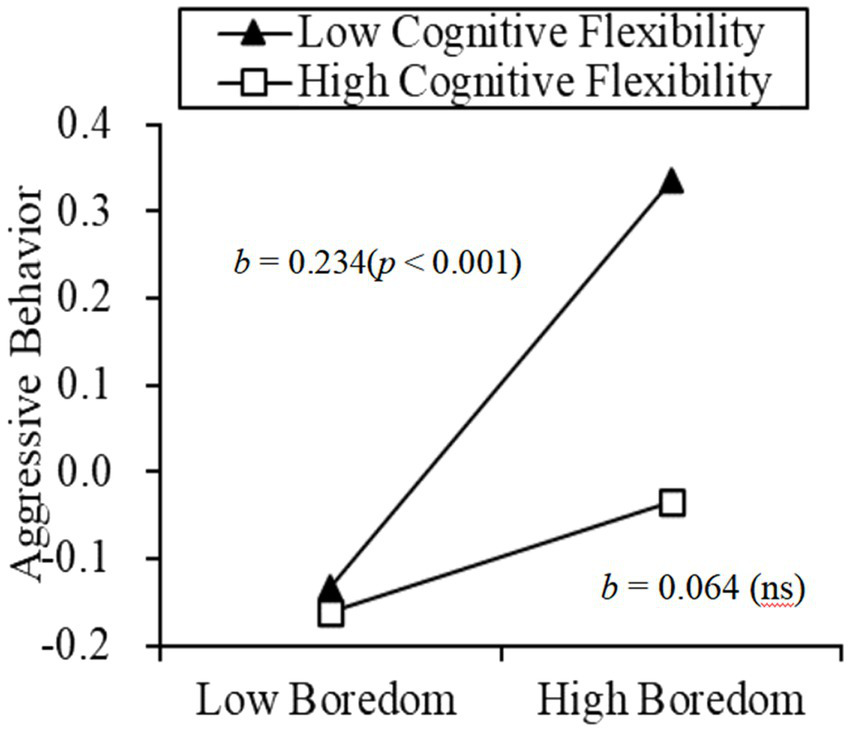
Moderation effect of cognitive flexibility on the relationship between boredom and aggressive behavior.
Further, the various components of aggressive behavior were used as dependent variables. Cognitive flexibility and its two subcomponents were used as moderators, respectively. The results are as follows: cognitive flexibility moderated the relationship between boredom and proactive aggression (β = −0.101, p < 0.05). Results of a simple slope test further revealed that, for individuals with low cognitive flexibility, state boredom could positively predict proactive aggression (βsimple = 0.264, p < 0.001). For individuals with high cognitive flexibility, the relationship between state boredom and proactive aggression was not significant (βsimple = 0.063, p = 0.232; see Figure 2). Moreover, alternatives moderated the relationship between boredom and proactive aggression (β = −0.101, p < 0.01). Simple slope test revealed that, for individuals with low alternatives, state boredom could positively predict proactive aggression (βsimple = 0.266, p < 0.001). For individuals with high alternatives, the relationship between state boredom and proactive aggression was not significant (βsimple = 0.063, p = 0.224; see Figure 3). Control has no significant effect on the relationship between state boredom and proactive aggression (β = −0.072, p = 0.064).
Figure 2
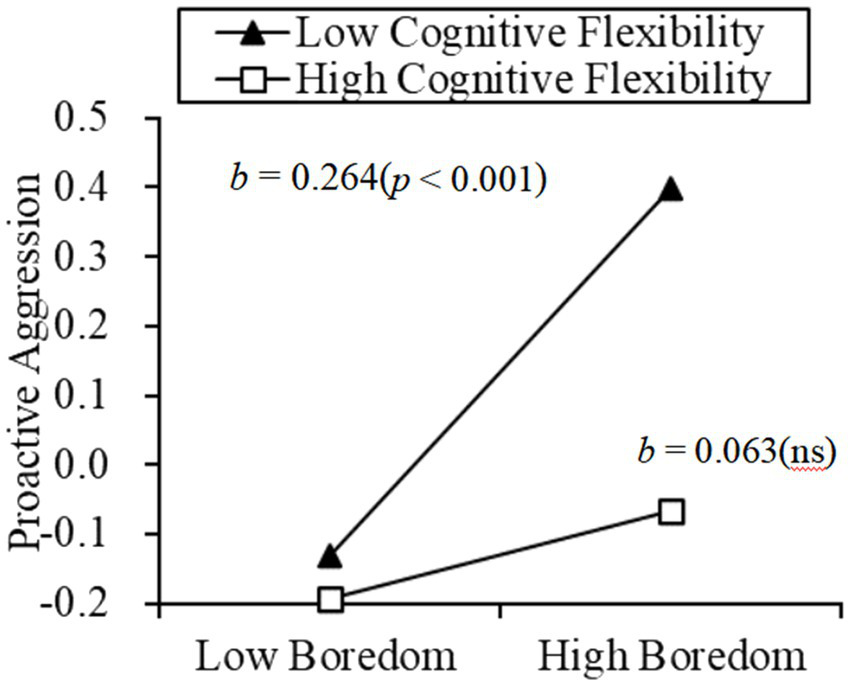
Moderation effect of cognitive flexibility on the relationship between boredom and proactive aggression.
Figure 3
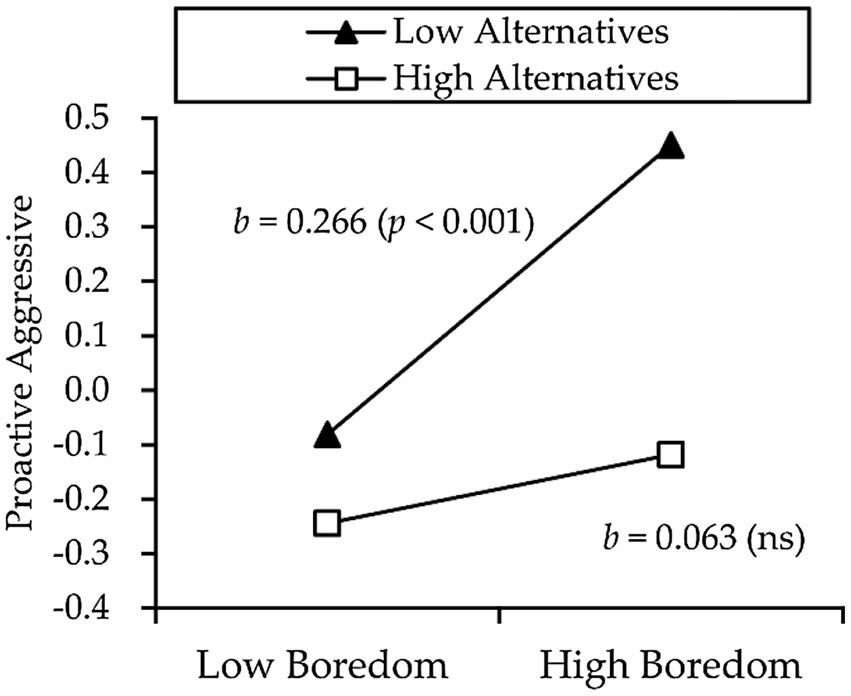
Moderation effect of alternatives on the relationship between boredom and proactive aggression.
For reactive aggression, cognitive flexibility has no significant effect on the relationship between state boredom and reactive aggression (β = −0.025, p = 0.536; see Figure 4). Alternatives and control also have no significant effect on the relationship between state boredom and reactive aggression (β = −0.024, p = 0.552; β = −0.019, p = 0.636).
Figure 4
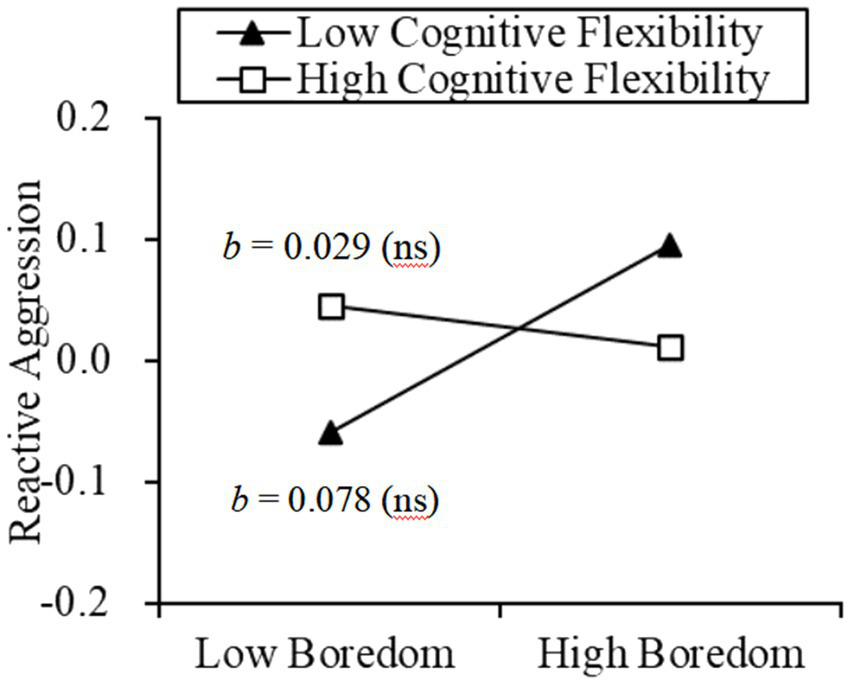
Moderation effect of cognitive flexibility on the relationship between boredom and reactive aggression.
Discussion
The relationship between boredom and aggression
When the environment is monotonous, repetitive, boring, etc., or the environment does not match the internal standards, it is easy to induce the individual’s state boredom. Due to the new coronavirus epidemic caused by the “Omicron” variant, college students are facing more inconvenience and restrictions in their lives, which significantly increased the boredom level (Chao et al., 2020). Individuals will adopt coping strategies when their environments cannot be exited or changed. The purpose of this study was to examine the relationship between boredom and aggressive behaviors (proactive aggression and reactive aggression) during close-off management.
As a coping strategy for boredom, there was no significant positive association between the two forms of aggressive behaviors and boredom. The results of this study are in line with previous research on coping strategies and boredom (Droit-Volet et al., 2020; Gazmer et al., 2020; Liang et al., 2020; Donati et al., 2022). In light of this, aggression may not be a meaningful and satisfying alternative target activity for everyone as a means to alleviate boredom.
Moderating role of cognitive flexibility
The results of the moderation analysis revealing that cognitive flexibility is a moderator that affects the strength of the relationship between boredom and proactive aggression. Previous research has found that individuals with lower psychological flexibility were more likely to experience depression, anxiety, or worry, while those with higher psychological flexibility had better mental wellbeing since they could choose the right coping mechanisms to adapt to novel situations better (Dawson and Golijani-Moghaddam, 2020). It has been shown that people with a high level of cognitive flexibility are more likely to be able to cope with the COVID-19 epidemic environment than individuals with a low level of cognitive flexibility. Through cognitive restructuring and effective coping, cognitive flexibility might compensate for intolerance of uncertainty’s negative impact on psychological well-being. Thus, people with high cognitive flexibility are able to resist behaviors that are harmful to their physical and mental health during the COVID-19 epidemic (Demirtaş, 2021; Sadler et al., 2021).
The results of our study indicate that there was significant negative association between the cognitive flexibility and aggressive behavior. Being high in cognitive flexibility dampens the effect of boredom on aggression. For individuals with high cognitive flexibility, increased boredom did not increase the likelihood of the emergence of individuals’ aggressive behavior. Although aggressive behavior can increase positive emotions, its modulating effect on emotion may only be temporary (Chester et al., 2019). The antisocial nature of aggression dictates that aggression for self-interest and pleasure is inherently contrary to social norms such as morality and law. Individuals may fear poor social evaluation or legal punishment after their aggressive behavior. The duration of pleasure from aggression is relatively short compared to the negative effects of aggression (Miller and Lynam, 2006). In general, aggression is more of a “double-edged sword.” This implies that for individuals with high cognitive flexibility, the use of antisocial behavior such as aggression to regulate emotions is distinctly non-adaptive.
During the COVID-19, closed-off management of the university may contribute to an increased risk of psychological and behavioral problems among college students (Chang and Hou, 2022). Adapting to the restrictive and isolating conditions requires a reappraisal and restructuring of cognitive processes. Since cognitive flexibility provides adaptive solutions to changing conditions and demands, adjustment to this changed context can be particularly difficult for individuals with lower cognitive flexibility. The results of this study indicate that individuals with low cognitive flexibility are more susceptible to boredom levels during closed-off management. The relationship between boredom and aggression varied among individuals who exhibited certain aspects of cognitive flexibility. As boredom increased, proactive aggressive behavior increased for those with low CFI-Alternatives.
As a result of closed-off management, many of the original methods of regulating emotions are limited. In the past, people with low cognitive flexibility might have been able to regulate boredom through activities such as exercise, concerts, and excursions (Tu et al., 2022). It is, however, not possible to obtain these at this time. For people with low CFI-Alternatives, coming up with more solutions is difficult. Proactive aggression that is proactive increases the individual’s level of arousal and draws the attention of others. When compared to people with high CFI-Alternatives, they are more likely end up choosing to commit proactive aggression due to a greater focus on short-term positive emotional experiences (Garivani et al., 2021; Kerekes, 2021; Scheinost et al., 2021). Furthermore, although positive emotions do not trigger aggressive behavior (Burgdorf and Panksepp, 2006), the pleasurable experience and the rapid high arousal of aggression may also be an important factor in triggering aggression (Ramírez et al., 2005; Roberton et al., 2012). Individuals may release stress and psychological discomfort by aggressive behavior (Larsen, 2000; Raine et al., 2006). Despite this, for participants with low CFI-Control, two forms of aggressive behavior did not increase with boredom. This is may because people with low CFI-Control engage in less constructive cognition (e.g., wishful thinking or ruminative self-blame) in difficult situations rather than more constructive cognition (e.g., problem solving)(Dennis and Vander Wal, 2010; Lambert et al., 2014; Eadeh et al., 2017).
Limitations and further work
This study has several limitations, which also provide avenues for future research. Since our study is non-experimental and cross-sectional, we cannot draw causal conclusions from our moderation model. It does not fully account for the causal relationship between aggressive behavior and state boredom in nature, and similar problems exist in studies of aggression with other variables. In light of this, it is necessary to exercise caution when interpreting and extending the conclusions. To address this limitation, future research can use empirical sampling. For example, researchers can ask participants to keep diaries or report their boredom levels at random points over time (Nett et al., 2011).
Although the aggression could regulate emotions, providing pleasure (Raine, 2018). Over time, the individual may become dependent on the aggressive behavior, aggression may be reinforced. Our study further highlights the critical value of enhanced cognitive flexibility in combating the experience of boredom during the COVID-19 epidemic. Psychological interventions that target the improvement of cognitive flexibility could be utilized to reduce psychological symptoms. For example. Interventions such as positive meditation can help individuals develop the belief that aggression is not a reasonable means of regulating emotions, and help them acquire reasonable methods of emotion regulation.
Conclusion
Our findings indicate that cognitive flexibility is an important factor affecting the relationship between boredom and the two forms of aggression. The results can increase our understanding of the factors that influence aggressive behavior in closed-off management environments. For individuals with high cognitive flexibility, the relationship between state boredom and proactive aggression was not significant. The relationship between state boredom and proactive aggression was significantly positively correlated for individuals with low cognitive flexibility, especially low substitutability. In addition, cognitive flexibility has no significant moderating effect on the relationship between state boredom and reactive aggression. Due to differences in consideration of alternatives and sense of control, boredom may affect decisions about aggressive behavior differently for individuals with different levels of cognitive flexibility. This suggests that cognitive flexibility should be valued as a protective factor that can reduce aggression during closed-off management period of COVID-19 pandemic management (Denson, 2015).
Publisher’s note
All claims expressed in this article are solely those of the authors and do not necessarily represent those of their affiliated organizations, or those of the publisher, the editors and the reviewers. Any product that may be evaluated in this article, or claim that may be made by its manufacturer, is not guaranteed or endorsed by the publisher.
Statements
Data availability statement
The raw data supporting the conclusions of this article will be made available by the authors, without undue reservation.
Ethics statement
The studies involving human participants were reviewed and approved by Ethics Institutional Review Board of Shandong Drug and Food Vocational College. The patients/participants provided their written informed consent to participate in this study.
Author contributions
YL: conceptualization, formal analysis, and writing—original draft. XC: investigation, methodology, and writing—review and editing. All authors contributed to the article and approved the submitted version.
Conflict of interest
The authors declare that the research was conducted in the absence of any commercial or financial relationships that could be construed as a potential conflict of interest.
References
1
Anderson C. A. Bushman B. J. (2002). Human aggression. Annu. Rev. Psychol.53, 27–51. doi: 10.1146/annurev.psych.53.100901.135231
2
Baleanu D. Abadi M. H. Jajarmi A. Vahid K. Z. Nieto J. J. (2022). A new comparative study on the general fractional model of COVID-19 with isolation and quarantine effects. Alex. Eng. J.61, 4779–4791. doi: 10.1016/j.aej.2021.10.030
3
Barlett C. P. Simmers M. M. Roth B. Gentile D. (2021). Comparing cyberbullying prevalence and process before and during the COVID-19 pandemic. J. Soc. Psychol.161, 408–418. doi: 10.1080/00224545.2021.1918619
4
Baumeister R. F. Vohs K. D. Nathan DeWall C. Zhang L. (2007). How emotion shapes behavior: feedback, anticipation, and reflection, rather than direct causation. Pers. Soc. Psychol. Rev.11, 167–203. doi: 10.1177/1088868307301033
5
Bera L. Souchon M. Ladsous A. Colin V. Lopez-Castroman J. (2022). Emotional and behavioral impact of the COVID-19 epidemic in adolescents. Curr. Psychiatry Rep.24, 37–46. doi: 10.1007/s11920-022-01313-8
6
Bo W. Ahmad Z. Alanzi A. R. Al-Omari A. I. Hafez E. H. Abdelwahab S. F. (2022). The current COVID-19 pandemic in China: an overview and corona data analysis. Alex. Eng. J.61, 1369–1381. doi: 10.1016/j.aej.2021.06.025
7
Bonanno G. A. Burton C. L. (2013). Regulatory flexibility: an individual differences perspective on coping and emotion regulation. Perspect. Psychol. Sci.8, 591–612. doi: 10.1177/1745691613504116
8
Bond M. H. (2004). Culture and aggression—from context to coercion. Pers. Soc. Psychol. Rev.8, 62–78. doi: 10.1207/s15327957pspr0801_3
9
Burgdorf J. Panksepp J. (2006). The neurobiology of positive emotions. Neurosci. Biobehav. R.30, 173–187. doi: 10.1016/j.neubiorev.2005.06.001
10
Bushman B. J. Baumeister R. F. Phillips C. M. (2001). Do people aggress to improve their mood? Catharsis beliefs, affect regulation opportunity, and aggressive responding. J. Pers. Soc. Psychol.81, 17–32. doi: 10.1037/0022-3514.81.1.17
11
Bushman B. J. Baumeister R. F. Stack A. D. (1999). Catharsis, aggression, and persuasive influence: self-fulfilling or self-defeating prophecies?J. Pers. Soc. Psychol.76, 367–376. doi: 10.1037/0022-3514.76.3.367
12
Chang B. Hou J. (2022). The association between perceived risk of COVID-19, psychological distress, and internet addiction in college students: an application of stress process model. Front. Psychol.13, 1–8. doi: 10.3389/fpsyg.2022.898203
13
Chao M. Chen X. Liu T. Yang H. Hall B. J. (2020). Psychological distress and state boredom during the COVID-19 outbreak in China: the role of meaning in life and media use. Eur. J. Psychotraumatol.11:1769379. doi: 10.1080/20008198.2020.1769379
14
Chapman A. L. Dixon-Gordon K. L. (2007). Emotional antecedents and consequences of deliberate self-harm and suicide attempts. Suicide Life Threat37, 543–552. doi: 10.1521/suli.2007.37.5.543
15
Cheng Z. J. Zhan Z. Xue M. Zheng P. Lyu J. Ma J. et al . (2021). Public health measures and the control of COVID-19 in China. Clin Rev Allergy Immunol1–16, 1–16. doi: 10.1007/s12016-021-08900-2
16
Chester D. S. (2017). The role of positive affect in aggression. Curr. Dir. Psychol. Sci.26, 366–370. doi: 10.1177/0963721417700457
17
Chester D. S. DeWall C. N. Enjaian B. (2019). Sadism and aggressive behavior: inflicting pain to feel pleasure. Pers. Soc. Psychol. B.45, 1252–1268. doi: 10.1177/0146167218816327
18
Copeland W. E. McGinnis E. Bai Y. Adams Z. Nardone H. Devadanam V. et al . (2021). Impact of COVID-19 pandemic on college student mental health and wellness. J. Am. Acad. Child Psychiatry60, 134–141.e2. doi: 10.1016/j.jaac.2020.08.466
19
Dahlen E. R. Martin R. C. Ragan K. Kuhlman M. M. (2004). Boredom proneness in anger and aggression: effects of impulsiveness and sensation seeking. Pers. Individ. Differ.37, 1615–1627. doi: 10.1016/j.paid.2004.02.016
20
Dahlen E. R. Martin R. C. Ragan K. Kuhlman M. M. (2005). Driving anger, sensation seeking, impulsiveness, and boredom proneness in the prediction of unsafe driving. Accid. Anal. Prev.37, 341–348. doi: 10.1016/j.aap.2004.10.006
21
Dawson D. L. Golijani-Moghaddam N. (2020). COVID-19: psychological flexibility, coping, mental health, and wellbeing in the UK during the pandemic. J. Contextual Behav. Sci.17, 126–134. doi: 10.1016/j.jcbs.2020.07.010
22
Demirtaş A. S. (2021). Predictive roles of state hope and cognitive control/flexibility in state anxiety during COVID-19 outbreak in Turkey Dusunen Adam: J Psy. Neurol. Sci, 34, 89–96. doi: 10.14744/DAJPNS.2020.00124
23
Dennis J. P. Vander Wal J. S. (2010). The cognitive flexibility inventory: instrument development and estimates of reliability and validity. Cogn. Ther. Res.34, 241–253. doi: 10.1007/s10608-009-9276-4
24
Denson T. F. (2015). Four promising psychological interventions for reducing reactive aggression. Curr. Opin. Behav. Sci.3, 136–141. doi: 10.1016/j.cobeha.2015.04.003
25
DeWall C. N. Baumeister R. F. Chester D. S. Bushman B. J. (2016). How often does currently felt emotion predict social behavior and judgment? A meta-analytic test of two theories. Emot. Rev.8, 136–143. doi: 10.1177/1754073915572690
26
Donati M. A. Beccari C. Primi C. (2022). Boredom and problematic Facebook use in adolescents: what is the relationship considering trait or state boredom?Addict. Behav.125:107132. doi: 10.1016/j.addbeh.2021.107132
27
Droit-Volet S. Gil S. Martinelli N. Andant N. Clinchamps M. Parreira L. et al . (2020). Time and Covid-19 stress in the lockdown situation: time free, «dying» of boredom and sadness. PLoS One15:e0236465. doi: 10.1371/journal.pone.0236465
28
Eadeh F. R. Peak S. A. Lambert A. J. (2017). The bittersweet taste of revenge: on the negative and positive consequences of retaliation. J. Exp. Soc. Psychol.68, 27–39. doi: 10.1016/j.jesp.2016.04.007
29
Eastwood J. D. Frischen A. Fenske M. J. Smilek D. (2012). The unengaged mind: defining boredom in terms of attention. Perspect. Psychol. Sci.7, 482–495. doi: 10.1177/1745691612456044
30
Elpidorou A. (2018). The bored mind is a guiding mind: toward a regulatory theory of boredom. Phenomenol. Cogn. Sci.17, 455–484. doi: 10.1007/s11097-017-9515-1
31
Fahlman S. A. Mercer-Lynn K. B. Flora D. B. Eastwood J. D. (2013). Development and validation of the multidimensional state boredom scale. Assessment20, 68–85. doi: 10.1177/1073191111421303
32
Field T. (2021). Aggression and violence affecting youth during the COVID-19 pandemic: a narrative review. J. Psychiatr. Res.3, 1–7. doi: 10.47363/JPSRR/2021(3)128
33
Fossati A. Raine A. Borroni S. Bizzozero A. Volpi E. Santalucia I. et al . (2009). A cross-cultural study of the psychometric properties of the Reactive–Proactive Aggression Questionnaire among Italian nonclinical adolescents. Psychol assessment.21, 131–135. doi: 10.1037/a0014743
34
Fung A. L.-C. Raine A. Gao Y. (2009). Cross-cultural generalizability of the reactive–proactive aggression questionnaire (RPQ). J pers assess.91, 473–479. doi: 10.1080/00223890903088420
35
Fu H. Wang H. Xi X. Boonyasiri A. Wang Y. Hinsley W. et al . (2021). Database of epidemic trends and control measures during the first wave of COVID-19 in mainland China. Int. J. Infect. Dis.102, 463–471. doi: 10.1016/j.ijid.2020.10.075
36
Garivani G. Taheri E. Alizadeh Z. (2021). Effectiveness of acceptance and commitment therapy on the anger rumination, hostile attribution and aggression in immigrant children. Soc determinants Health.7, 1–9. doi: 10.22037/sdh.v7i1.35232
37
Gazmer S. P. Bandopadhyay S. Mohan K. R. (2020). COVID-19 pandemic lockdown and music listening: a case study in Sikkim Himalayas. J. Soc. Sci.48, 1751–1765.
38
Ge Y. Chen Z. Handel A. Martinez L. Xiao Q. Li C. et al . (2021). The impact of social distancing, contact tracing, and case isolation interventions to suppress the COVID-19 epidemic: a modeling study. Epidemics36:100483. doi: 10.1016/j.epidem.2021.100483
39
Griskevicius V. Tybur J. M. Gangestad S. W. Perea E. F. Shapiro J. R. Kenrick D. T. (2009). Aggress to impress: hostility as an evolved context-dependent strategy. J. Pers. Soc. Psychol.96, 980–994. doi: 10.1037/a0013907
40
Hayes A. F. Montoya A. K. Rockwood N. J. (2017). The analysis of mechanisms and their contingencies: PROCESS versus structural equation modeling. Australas mark j.25, 76–81. doi: 10.1016/j.ausmj.2017.02.001
41
Homel R. Tomsen S. Thommeny J. (1992). Public drinking and violence: not just an alcohol problem. J. Drug Issues22, 679–697. doi: 10.1177/002204269202200315
42
Hu C. Tang Y. Su Q. Lei Y. Cui W. Zhang Y. et al . (2021). Public health measures during the COVID-19 pandemic reduce the spread of other respiratory infectious diseases. Front. Public Health9, 1–7. doi: 10.3389/fpubh.2021.771638
43
Humphreys K. L. Myint M. T. Zeanah C. H. (2020). Increased risk for family violence during the COVID-19 pandemic. Pediatrics146, 1–3. doi: 10.1542/peds.2020-0982
44
Inozu M. Gök B. G. Tuzun D. Haciomeroglu A. B. (2022). Does cognitive flexibility change the nature of the relationship between intolerance of uncertainty and psychological symptoms during the COVID-19 outbreak in Turkey?Curr. Psychol.1–12, 1–12. doi: 10.1007/s12144-021-02450-8
45
Kalia V. Fuesting M. Cody M. (2019). Perseverance in solving Sudoku: role of grit and cognitive flexibility in problem solving. J. Cogn. Psychol.31, 370–378. doi: 10.1080/20445911.2019.1604527
46
Kerekes N. (2021). Yoga as Complementary Care for Young People Placed in Juvenile Institutions—A Study Plan. Front psychiatry.12:877. doi: 10.3389/fpsyt.2021.575147
47
Kilius E. Abbas N. H. McKinnon L. Samson D. R. (2021). Pandemic nightmares: COVID-19 lockdown associated with increased aggression in female university students’ dreams. Front. Psychol.12:562. doi: 10.3389/fpsyg.2021.644636
48
Killgore W. D. Cloonan S. A. Taylor E. C. Anlap I. Dailey N. S. (2021). Increasing aggression during the COVID-19 lockdowns. J. Affect. Disord.5:100163. doi: 10.1016/j.jadr.2021.100163
49
Koesten J. Schrodt P. Ford D. J. (2009). Cognitive flexibility as a mediator of family communication environments and young adults’ well-being. Health Commun.24, 82–94. doi: 10.1080/10410230802607024
50
Lambert A. J. Peak S. A. Eadeh F. R. Schott J. P. (2014). How do you feel now? On the perceptual distortion of extremely recent changes in anger. J. Exp. Soc. Psychol.52, 82–95. doi: 10.1016/j.jesp.2014.01.004
51
Larsen R. J. (2000). Toward a science of mood regulation. Inquiry11, 129–141. doi: 10.1207/S15327965PLI1103_01
52
Li Y. Qin L. Shi Y. Han J. (2021a). The psychological symptoms of college student in China during the lockdown of COVID-19 epidemic. Healthcare9:447. doi: 10.3390/healthcare9040447
53
Li Y. Wang M. Wang C. Shi J. (2010). Individualism, collectivism, and Chinese adolescents’ aggression: intracultural variations. Aggress. Behav.36, 187–194. doi: 10.1002/ab.20341
54
Li Y. Zhao J. Ma Z. McReynolds L. S. Lin D. Chen Z. et al . (2021b). Mental health among college students during the COVID-19 pandemic in China: a 2-wave longitudinal survey. J. Affect. Disord.281, 597–604. doi: 10.1016/j.jad.2020.11.109
55
Liang Z. Zhao Q. Zhou Z. Yu Q. Li S. Chen S. (2020). The effect of “novelty input” and “novelty output” on boredom during home quarantine in the COVID-19 pandemic: the moderating effects of trait creativity. Front. Psychol.11, 1–10. doi: 10.3389/fpsyg.2020.601548
56
Liu Y. Chen J. Jiang M. Xu H. Liu J. Eastwood J. D. et al . (2013). The Chinese version of the multidimensional state boredom scale (MSBS): its applicability in Chinese college students. Chin. J. Clin. Psych.21, 558–562.
57
Liu Y. Zhou B. Yang B. (2022). How does emotion shape aggressive behavior of violent offenders? An explanation based on emotion regulation theory. Acta Psychol. Sin.54, 270–280. doi: 10.3724/SP.J.1041.2022.00270
58
Martin M. M. Rubin R. B. (1994). Development of a communication flexibility measure. Southern j Commun.59, 171–178. doi: 10.1080/10417949409372934
59
Mazza M. Marano G. Lai C. Janiri L. Sani G. (2020). Danger in danger: interpersonal violence during COVID-19 quarantine. Psychiatry Res.289:113046. doi: 10.1016/j.psychres.2020.113046
60
Mercer-Lynn K. B. Bar R. J. Eastwood J. D. (2014). Causes of boredom: the person, the situation, or both?Pers. Individ. Differ.56, 122–126. doi: 10.1016/j.paid.2013.08.034
61
Miller J. D. Lynam D. R. (2006). Reactive and proactive aggression: similarities and differences. Pers. Individ. Differ.41, 1469–1480. doi: 10.1016/j.paid.2006.06.004
62
Murphy F. C. Michael A. Sahakian B. J. (2012). Emotion modulates cognitive flexibility in patients with major depression. Psychol. Med.42, 1373–1382. doi: 10.1017/S0033291711002418
63
Nederkoorn C. Vancleef L. Wilkenhöner A. Claes L. Havermans R. C. (2016). Self-inflicted pain out of boredom. Psychiatry Res.237, 127–132. doi: 10.1016/j.psychres.2016.01.063
64
Nett U. E. Goetz T. Hall N. C. (2011). Coping with boredom in school: an experience sampling perspective. Contemp. Educ. Psychol.36, 49–59. doi: 10.1016/j.cedpsych.2010.10.003
65
Ng A. H. Liu Y. Chen J. Eastwood J. D. (2015). Culture and state boredom: a comparison between European Canadians and Chinese. Pers. Individ. Differ.75, 13–18. doi: 10.1016/j.paid.2014.10.052
66
Pechorro P. Ray J. V. Raine A. Maroco J. Goncalves R. A. (2017). The Reactive–Proactive Aggression Questionnaire: Validation among a Portuguese sample of incarcerated juvenile delinquents. J interpers violence.32, 1995–2017. doi: 10.1177/0886260515590784
67
Pfattheicher S. Lazarević L. B. Nielsen Y. A. Westgate E. Krstic K. Schindler S. (2021a). I enjoy hurting my classmates: on the relation of boredom and sadism in schools. PsyArXiv [Preprint].
68
Pfattheicher S. Lazarević L. B. Westgate E. C. Schindler S. (2021b). On the relation of boredom and sadistic aggression. J. Pers. Soc. Psychol.121, 573–600. doi: 10.1037/pspi0000335
69
Pfefferbaum B. North C. S. (2020). Mental health and the Covid-19 pandemic. New Engl. J. Med.383, 510–512. doi: 10.1056/nejmp2008017
70
Pm P. (2003). Common method biases in behavioral research: a critical review of the literature and recommended remedies. J Appl Psychol.88, 879–903. doi: 10.1037/0021-9010.88.5.879
71
Raine A. Dodge K. Loeber R. Gatzke-Kopp L. Lynam D. Reynolds C. et al . (2006). The reactive–proactive aggression questionnaire: differential correlates of reactive and proactive aggression in adolescent boys. Aggress. Behav.32, 159–171. doi: 10.1002/ab.20115
72
Raine A. (2018). Antisocial personality as a neurodevelopmental disorder. Annu rev clin psycho.14, 259–289. doi: 10.1146/annurev-clinpsy-050817-084819
73
Ramírez J. M. Bonniot-Cabanac M.-C. Cabanac M. (2005). Can aggression provide pleasure?Eur. Psychol.10, 136–145. doi: 10.1027/1016-9040.10.2.136
74
Rende B. (2000). Cognitive flexibility: theory, assessment, and treatment. Semin. Speech Lang.21, 0121–0153. doi: 10.1055/s-2000-7560
75
Roberton T. Daffern M. Bucks R. S. (2012). Emotion regulation and aggression. Aggress. Violent Behav.17, 72–82. doi: 10.1016/j.avb.2011.09.006
76
Romero-Martínez Á. Sarrate-Costa C. Moya-Albiol L. (2022). Reactive vs proactive aggression: a differential psychobiological profile? Conclusions derived from a systematic review. Neurosci. Biobehav. R.136, 1–28. doi: 10.1016/j.neubiorev.2022.104626
77
Rupp D. E. Vodanovich S. J. (1997). The role of boredom proneness in self-reported anger and aggression. J. Soc. Behav. Pers.12, 925–936.
78
Sadler J. R. Thapaliya G. Jansen E. Aghababian A. H. Smith K. R. Carnell S. (2021). COVID-19 stress and food intake: protective and risk factors for stress-related palatable food intake in US adults. Nutrients13:901. doi: 10.3390/nu13030901
79
Sağar M. E. (2021). Predictive role of cognitive flexibility and self-control on social media addiction in university students. Int. Educ. Stud.14, 1–10. doi: 10.5539/ies.v14n4p1
80
Scheinost D. Dadashkarimi J. Finn E. S. Wambach C. G. MacGillivray C. Roule A. L. et al . (2021). Functional connectivity during frustration: a preliminary study of predictive modeling of irritability in youth. Neuropsychopharmacol.46, 1300–1306. doi: 10.1038/s41386-020-00954-8
81
Sun S. Chen Y. Mu S. Jiang B. Lin Y. Gao T. et al . (2021). The psychological restorative effects of campus environments on college students in the context of the COVID-19 pandemic: a case study at northwest a&F university, Shaanxi, China. Int. J. Environ. Res. Public Health18:8731. doi: 10.3390/ijerph18168731
82
Tu C.-C. Yang D. Pan L. Dai X. Mediating effect of resilience in the relationship between loneliness and life satisfaction during COVID-19: a cross-country study of Thai and Chinese college students. Psychol. Schools., 3, 1–16 doi: 10.1002/pits.22693
83
Van Tilburg W. A. Igou E. R. (2012). On boredom: lack of challenge and meaning as distinct boredom experiences. Motiv Emot.36, 181–194. doi: 10.1007/s11031-011-9234-9
84
Vandebosch H. Poels K. (2021). “Cooling down or charging up?: engagement with aggressive entertainment contents as an emotion regulation strategy of boredom and anger” in The Oxford handbook of entertainment theory. eds. VordererP.KlimmtC. (New York: Oxford University Press), 479–497.
85
Vodanovich S. J. (2003). On the possible benefits of boredom: a neglected area in personality research. Psychol. Educ.40, 28–33.
86
Wan Z. Lu R. Zhao Y. Zhang C. (2022). Diagnostic strategy of SARS-CoV-2 for containment under China’s zero-COVID-19 policy. J. Infect.85, e7–e9. doi: 10.1016/j.diagmicrobio.2020.115181
87
Wang Z. Li C. Ai K. (2022). Family economic strain and adolescent aggression during the COVID-19 pandemic: roles of Interparental conflict and parent–child conflict. Appl. Res. Qual. Life17, 2369–2385. doi: 10.1007/s11482-022-10042-2
88
Wang Y. Yang Y. Xiao W.-T. Su Q. (2016). Validity and reliability of the Chinese version of the cognitive flexibility inventory in college students. Chin Ment Health j.30, 58–63. doi: 10.3969/j.issn.1000-6729.2016.01.012
89
Westgate E. C. Wilson T. D. (2018). Boring thoughts and bored minds: the MAC model of boredom and cognitive engagement. Psychol. Rev.125, 689–713. doi: 10.1037/rev0000097
90
Weybright E. H. Doering E. L. Perone S. (2022). Difficulties with emotion regulation during COVID-19 and associations with boredom in college students. Behav. Sci.12:296. doi: 10.3390/bs12080296
91
Ye B. Zeng Y. Im H. Liu M. Wang X. Yang Q. (2021). The relationship between fear of COVID-19 and online aggressive behavior: a moderated mediation model. Front. Psychol.12:589615. doi: 10.3389/fpsyg.2021.589615
92
Yu Y. Yu Y. Lin Y. (2020). Anxiety and depression aggravate impulsiveness: the mediating and moderating role of cognitive flexibility. Psychol health med.25, 25–36. doi: 10.1080/13548506.2019.1601748
93
Zhang X. Huang P. Li B. Xu W. Li W. Zhou B. (2021). The influence of interpersonal relationships on school adaptation among Chinese university students during COVID-19 control period: multiple mediating roles of social support and resilience. J. Affect. Disord.285, 97–104. doi: 10.1016/j.jad.2021.02.040
94
Zhang W. L. Jia S. W. Chen G. H. Zhang W. X. (2014). Reliability and validity of reactive-proactive aggression questionnaire in college students. Chin J Clin Psychol.22, 260–263.
95
Zhang Y. Zhu Y. (2022). Responses to the COVID-19 pandemic in Chinese higher education: a reflection upon international student support. J. Int. Stud.12, 118–124. doi: 10.32674/jis.v12iS1.4612
96
Zhao J. Zhang S. Liu Y. Zhou Y. Chen J. Jiang Y. et al . (2016). Factorial invariance of the multidimensional state boredom scale in Chinese and Canadian students. Chin. J. Clin. Psych.24, 464–469. doi: 10.16128/j.cnki.1005-3611.2016.03.018
97
Zhou X. Meng Y. Schmitt H. S. Montag C. Kendrick K. M. Becker B. (2020). Cognitive flexibility mediates the association between early life stress and habitual behavior. Pers indiv differ.167:110231. doi: 10.1016/j.paid.2020.110231
98
Zou Y. Li P. Hofmann S. G. Liu X. (2020). The mediating role of non-reactivity to mindfulness training and cognitive flexibility: A randomized controlled trial. Front psychol.1053. doi: 10.3389/fpsyg.2020.01053
Summary
Keywords
COVID-19, boredom, cognitive flexibility, aggression, moderation
Citation
Li Y and Chu X (2022) Aggressive behavior, boredom, and protective factors among college students during closed-off management of the COVID-19 pandemic in China. Front. Psychol. 13:1012536. doi: 10.3389/fpsyg.2022.1012536
Received
05 August 2022
Accepted
22 November 2022
Published
16 December 2022
Volume
13 - 2022
Edited by
Wong Ming Wong, Krirk University, Thailand
Reviewed by
Caizhen Yue, Guizhou Minzu University, China; Guanyu Cui, Wenzhou University, China
Updates
Copyright
© 2022 Li and Chu.
This is an open-access article distributed under the terms of the Creative Commons Attribution License (CC BY). The use, distribution or reproduction in other forums is permitted, provided the original author(s) and the copyright owner(s) are credited and that the original publication in this journal is cited, in accordance with accepted academic practice. No use, distribution or reproduction is permitted which does not comply with these terms.
*Correspondence: Xiaoyi Chu, 100406@sddfvc.edu.cn
This article was submitted to Personality and Social Psychology, a section of the journal Frontiers in Psychology
Disclaimer
All claims expressed in this article are solely those of the authors and do not necessarily represent those of their affiliated organizations, or those of the publisher, the editors and the reviewers. Any product that may be evaluated in this article or claim that may be made by its manufacturer is not guaranteed or endorsed by the publisher.