 Citra Kusuma Dewi1
 Mahir Pradana
- 1Department of Business Administration, Telkom University, Bandung, Indonesia
- 2Department of Business, University of Barcelona, Barcelona, Spain
Introduction
In recent years, there have been several studies conducted on intentions of Muslim consumers to measure the right attitude in buying halal food so that business development of halal food products can be augmented (Wilson, 2014). Moreover, as revealed by Sandikçi (2011), acceptance of halal products is also increasingly widespread among non-Muslims. Furthermore, researchers on business and psychology have been busy in examining this phenomenon either in Muslim or non-Muslim countries.
It is essential for Islamic believers that the category of the products they consume is halal or haram (Madiawati and Pradana, 2016). “Haram” is unlawful according to Islamic holy bible (Al Qur'an) (Alserhan, 2010). In reality, some groups of Muslim consumers in certain countries still do not have access to sufficient information about halal certification or halal logo (Pradana et al., 2021). On the other hand, there is a lack of academic research regarding the effect or relationship between halal concepts and consumer purchase intention, in this case, consumers' attitude or subjective norms, halal certification and halal food purchase intention (Aziz and Chok, 2013).
At the world population level, Islam is a religion with a fairly large number of followers, reaching 23 percent (Garg and Joshi, 2018). Around 52 percent of the world's Muslims are still in the category of young consumers, making Muslims a significant and large potential market (Wilson, 2014). Several prominent publications related to this topic are Bonne and Verbeke (2008), Tieman et al. (2013), and many more.
In this article, we discuss the literature observing the behavior of the Indonesian and Spanish Muslim communities in purchasing halal products. Indonesia is an interesting location to conduct such study, mainly for the reason that it can be a representation of the world's Muslim community, while Spain is taken as a comparison because of the author's previous studies on related matter (Pradana et al., 2019, 2020, 2021).
Halal consumer behavior literature in Indonesia
In this case, the potential main study object is Indonesia. It is one of the largest contributors to the world's Muslim population, reaching over 12.6% in 2019 (Madiawati et al., 2021). The market potential for Muslims will continue to grow, as revealed by the Pew Research Institute, which predicts that by 2070 Muslims will become the largest religious group in the world (Madiawati and Pradana, 2016).
Studies have argued on how halal food consumers in different countries have different perspectives and levels of trust on the concept of halal certification (Rios et al., 2014; Meixner et al., 2018). Indonesia, as the largest Muslim country, already has a sufficient number of publications related to this matter (Prabowo et al., 2015; Adinugraha et al., 2019). Other prominent publications related to this topic can be seen in Table 1.
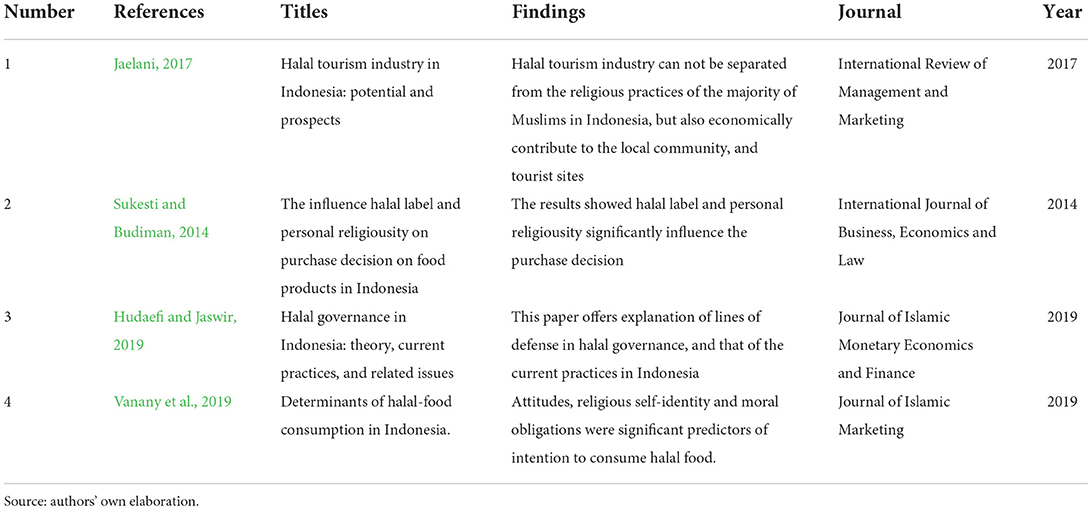
Table 1. Some Indonesian publications on halal topics.
If we take a deeper look at the halal literature on Indonesia, it has not focused on halal tourism development. We might argue that Indonesia might not regard it as an essential topic since the majority of Indonesian population is Muslim. However, Indonesia is a potential destination for tourists from the Middle East who are mostly Muslims (KataData, 2017). Therefore, we suggest that more studies on halal tourism should be conducted in Indonesia, next to studies on halal consumer behavior.
Halal literature in Spain
Spain has a long Islamic history, dating back to the Moors' reign in 800 A.D (Mesa, 2012). Islamic consumption of halal foods in Spain has increased, proven by the facts that in Spain 62 percent of lamb and 56 percent of beef come from animals slaughtered according to Islamic law (Vargas-Sánchez and Moral-Moral, 2019).
Spain is currently expanding exhibitions for halal food and will increase the number of participating companies specializing in this type of food (Pradana et al., 2019). It will also host the third edition of the Halal Congress, which will include international experts and several cooking events (Bottoni, 2021). There is also a greater demand from non-Muslim consumers for products that are organic and healthy and that have a halal certification as a guarantee of quality (Abbasian, 2021). However, academic approaches supporting the growing halal market in Spain are limited. Vargas-Sánchez and Moral-Moral (2019) and Pradana et al. (2020) are among the publications that focused on this region. The limited number of publications can be seen in Table 2.
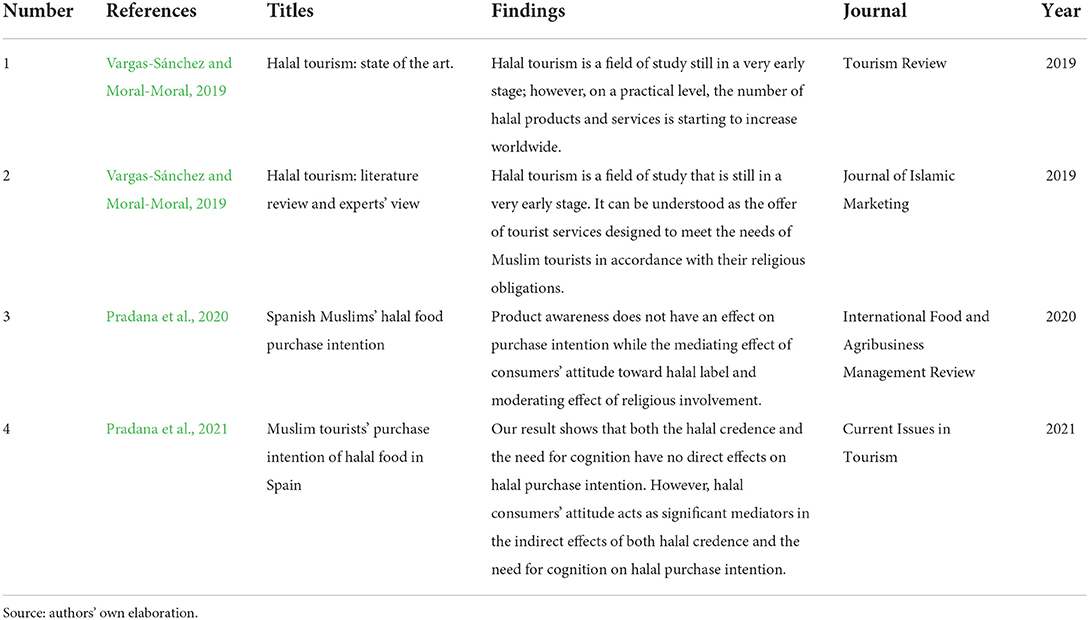
Table 2. Some Spanish publications on halal topics.
Although the numbers are few, three main publications regarding halal topics in Spain focus on tourism. The academic discussion has become popular in the last few years, mainly because Spain had welcomed over five million Muslim tourists until 2019, visiting ancient Islamic sites in Cordoba and Granada (Vargas-Sánchez and Moral-Moral, 2019; Walker, 2019). However, halal tourism in Spain remains stagnant although the country has been reaping Muslim visitors (Pradana et al., 2021).
Therefore, it is our offered future research recommendation that halal consumer behavior and halal tourism literature in Spain should be expanded. Comparison with the Indonesian case and collaboration between Indonesian and Spanish researchers can be beneficial in boosting the number of Spanish academic publications related to this matter. Both Indonesia and Spain need to explore halal tourism more, while Indonesian researchers can assist their Spanish counterparts in developing halal consumer behavior literature.
Author contributions
CD, RH-G, NR, MP, and SS discussed, wrote, and finalized the manuscript together. All authors contributed to the article and approved the submitted version.
Acknowledgments
The authors would like to thank LPPM Telkom University and University of Barcelona for supporting the publication of this article.
Conflict of interest
The authors declare that the research was conducted in the absence of any commercial or financial relationships that could be construed as a potential conflict of interest.
Publisher's note
All claims expressed in this article are solely those of the authors and do not necessarily represent those of their affiliated organizations, or those of the publisher, the editors and the reviewers. Any product that may be evaluated in this article, or claim that may be made by its manufacturer, is not guaranteed or endorsed by the publisher.
References
Abbasian, S. (2021). Good idea but not here! A Pilot Study of Swedish Tourism Stakeholders' perceptions of halal tourism. Sustainability 13, 2646. doi: 10.3390/su13052646
Adinugraha, H. H., Sartika, M., and Ulama'i, A. H. A. A. (2019). Halal Lifestyle Di Indonesia. An-Nisbah J. Ekon. Syariah 5, 57–81. doi: 10.21274/an.2019.6.1.57-81
Alserhan, B. A. (2010). Islamic branding: a conceptualization of related terms. J. Brand Manag. 18, 34–49. doi: 10.1057/bm.2010.18
Aziz, Y. A., and Chok, N. V. (2013). The role of Halal awareness, Halal certification, and marketing components in determining Halal purchase intention among non-Muslims in Malaysia: A structural equation modeling approach. J. Int. Food Agribus. Mark. 25, 1–23. doi: 10.1080/08974438.2013.723997
Bonne, K., and Verbeke, W. (2008). Muslim consumer trust in halal meat status and control in Belgium. Meat Sci. 79, 113–123. doi: 10.1016/j.meatsci.2007.08.007
Bottoni, R. (2021). “The Italian and Spanish legal experiences with halal certifying bodies,” in Rethinking Halal. (Leiden: Brill), 196–220.
Garg, P., and Joshi, R. (2018). Purchase intention of ‘halal’brands in India: the mediating effect of attitude. J. Islam. Mark. 9, 683–694. doi: 10.1108/JIMA-11-2017-0125
Hudaefi, F. A., and Jaswir, I. (2019). Halal governance in Indonesia: theory, current practices, and related issues. J. Islam. Monet. Econ. Finance 5, 89–116 doi: 10.21098/jimf.v5i1.1049
Jaelani, A. (2017). Halal tourism industry in Indonesia: potential and prospects. Int. Rev. Manag. Mark. 7, 25–34. doi: 10.2139/ssrn.2899864
KataData (2017). Rata-rata Turis Arab Saudi Habiskan 12 Hari di Indonesia. Available online at: https://databoks.katadata.co.id/datapublish/2017/02/27/rata-rata-turis-arab-saudi-habiskan-12-hari-di-indonesia (accessed January 2, 2022).
Madiawati, P. N., and Pradana, M. (2016). Celebrity and halal certificates factors influence on customers' buying interest. AктуальнI проблEми EкономIки. 177, 109–116. doi: 10.2139/ssrn.3791162
Madiawati, P. N., Sulistijono, S., and Fitri, J. Z. (2021). The influence of the role of halal tourist destinations on interest in visiting. Religious 5, 111–122. doi: 10.15575/rjsalb.v5i1.11615
Meixner, O., Friedl, R., and Hartl, B. (2018). Preferences for attributes of halal meat: empirical evidence from the Muslim community in Vienna, Austria. Int. J. Food Syst. Dyn. 9, 265–278. doi: 10.18461/ijfsd.v9i3.935
Mesa, E. S. (2012). Los moriscos que se quedaron. La permanencia de la población de origenislámicoen la EspañaModerna (Reino de Granada, siglos XVII-XVIII): Vínculos de Historia. Revista del Departamento de Historia de laUniversidad de Castilla-La Mancha.
Prabowo, S., Abd Rahman, A., Ab Rahman, S., and Samah, A. A. (2015). Revealing factors hindering halal certification in East Kalimantan Indonesia. J. Islam. Mark. 6. doi: 10.1108/JIMA-05-2014-0040
Pradana, M., Huertas-García, R., and Marimon, F. (2020). Spanish Muslims' halal food purchase intention. Int. Food Agribus. Manag. Rev. 23, 189–202. doi: 10.22434/IFAMR2019.0200
Pradana, M., Huertas-García, R., and Marimon, F. (2021). Muslim tourists' purchase intention of halal food in Spain. Curr. Issues Tour. 24, 1814–1818. doi: 10.1080/13683500.2020.1797647
Pradana, M., Syarifuddin, S., Hafid, H., Gilang, A., and Diandri, M. (2019). Purchase intention determinants of halal food in secular countries. Int. J. Supply Chain Manag. 8, 83–89.
Rios, R. E., Riquelme, H. E., and Abdelaziz, Y. (2014). Do halal certification country of origin and brand name familiarity matter?. Asia Pacific J. Mark. Logist. 26, 665–86. doi: 10.1108/APJML-03-2014-0046
Sandikçi, Ö. (2011). Researching islamic marketing: past and future perspectives. J. Islam. Mark. doi: 10.1108/17590831111164778
Sukesti, F., and Budiman, M. (2014). The influence halal label and personal religiousity on purchase decision on food products in Indonesia. Int. J. Bus. Econ. Law 4, 150–153.
Tieman, M., Ghazali, M. C., and Van Der Vorst, J. G. (2013). Consumer perception on halal meat logistics. Br. Food J. 115, 1112–1129. doi: 10.1108/BFJ-10-2011-0265
Vanany, I., Soon, J. M., Maryani, A., and Wibawa, B. M. (2019). Determinants of halal-food consumption in Indonesia. J. Islam. Mark. 11. doi: 10.1108/JIMA-09-2018-0177
Vargas-Sánchez, A., and Moral-Moral, M. (2019). Halal tourism: literature review and experts' view. J. Islam. Mark. 11. doi: 10.1108/JIMA-04-2017-0039
Walker, K. (2019). ‘Muslim Spain' vies for moment in the sun as halal tourism takes off. The National News. Available online at: https://www.thenationalnews.com/business/travel-and-tourism/muslim-spain-vies-for-moment-in-the-sun-as-halal-tourism-takes-off-1.844291 (accessed December 20, 2021).
Keywords: halal, consumer behavior, halal accessibility, Islamic, consumer
Citation: Dewi CK, Pradana M, Huertas-García R, Rubiyanti N and Syarifuddin S (2022) Developing halal consumer behavior and tourism studies: Recommendations for Indonesia and Spain. Front. Psychol. 13:863130. doi: 10.3389/fpsyg.2022.863130
Received: 26 January 2022; Accepted: 13 July 2022;
Published: 05 August 2022.
Edited by:
Abdul Hafaz Ngah, University of Malaysia Terengganu, MalaysiaReviewed by:
Aan Jaelani, State Institute for Islamic Studies (IAIN) Syekh Nurjati, IndonesiaZul Ariff Abdul Latiff, Universiti Malaysia Kelantan, Malaysia
Muniaty Aisyah, Syarif Hidayatullah State Islamic University Jakarta, Indonesia
Copyright © 2022 Dewi, Pradana, Huertas-García, Rubiyanti and Syarifuddin. This is an open-access article distributed under the terms of the Creative Commons Attribution License (CC BY). The use, distribution or reproduction in other forums is permitted, provided the original author(s) and the copyright owner(s) are credited and that the original publication in this journal is cited, in accordance with accepted academic practice. No use, distribution or reproduction is permitted which does not comply with these terms.
*Correspondence: Mahir Pradana, bWFoaXIucHJhZGFuYUBnbWFpbC5jb20=