Abstract
This paper provides a comprehensive overview of field experiments utilizing social norms, commitment and price-based interventions to promote energy conservation, load shifting, and energy efficiency behaviors. Treatment effects reported in the extant literature, as well as the factors that may strengthen or dampen these effects are reviewed. We find that social norm and incentive-based interventions mostly achieve small reductions in energy consumption, and that the effects of commitment-based interventions are essentially zero for the most part. Incentive effects on energy efficiency investments are mostly non-existent, safe for a few exceptions. One gap that we identify is the almost complete absence of field experiments leveraging social norms or commitment to promote energy efficiency investments. We discuss a broad range of (mostly under-researched) plausible moderators of the interventions' effects. Crucially, a more careful attention to moderators in future research can highlight instances in which interventions can be effective, notwithstanding their modest or non-existent average treatment effects. Our review offers a starting point in this regard.
Introduction
It has long been theorized that social norms, prices and commitment are important determinants of people's decisions, including in the energy domain. More recently, policy makers and other practitioners are becoming increasingly interested in the possibility of harnessing these factors to promote desirable behaviors on a large scale. These behaviors include energy conservation, load shifting, and the uptake of low-emission technologies such as electric cars and residential solar panels. A widespread adoption of these behaviors represents one of the cornerstones of climate protection policies (Dietz et al., 2009; Stern et al., 2016; Ivanova et al., 2020). However, while existing laboratory and survey research can serve as a tentative guide for policy makers aiming to implement normative, pecuniary and commitment strategies in policy design, there are clear limitations of these methodologies in terms of internal and/or external validity: most notable is the difficulty of transplanting findings beyond laboratory settings and the commonly used convenience samples (Levitt and List, 2007; Mitchell, 2012; Galizzi and Navarro-Martinez, 2019), the difficulty of drawing causal conclusions from correlational research (Ferraro and Miranda, 2014, 2017; Wichman and Ferraro, 2017), as well as biased responses when behavior is self-reported rather than objectively measured (Kormos and Gifford, 2014; but see Vesely and Klöckner, 2020). All these issues are compounded by more general methodological limitations of much previous research in the social sciences, especially the reliance on small samples, leading to unreliable findings (Stanley et al., 2018). For these and other reasons, researchers in the energy domain are turning to field experiments, a method particularly well-suited for accurate program evaluation and for drawing policy recommendations (Frederiks et al., 2016).
A number of previous meta-analyses focus on the role of social norms (Delmas et al., 2013; Andor et al., 2020a; Buckley, 2020; Nemati and Penn, 2020), prices (Faruqui and Sergici, 2010; Delmas et al., 2013; Labandeira et al., 2017, 2020; Zhu et al., 2018; Buckley, 2020; Nemati and Penn, 2020) and commitment (Andor et al., 2020a) in the energy domain. Here we in part build on these efforts, reflecting their conclusions in our overall evaluation of the field. The present review is nevertheless built on a considerably broader evidence base than any of the previous meta-analyses. We also review the latest research in the area produced since the publication of previous meta-studies. By synthesizing findings from previous meta-analyses, as well as from recent studies, we are able to provide the most comprehensive overview of research on norms, incentives and commitment in the energy domain up to date.
Unlike any of the previous research syntheses, we in addition provide a detailed outline of factors possibly moderating the interventions' effects (i.e., interventions being more or less effective in some contexts or for some target groups). Current research in the energy domain increasingly focuses on the contexts and target group characteristics that may contribute to the interventions' success or failure, as this is of great theoretical but also applied interest (e.g., Andor et al., 2020b). Despite this growing interest, and as our review reveals, research on factors moderating intervention effects specifically in the energy field is still quite limited. To supplement this limited evidence, we discuss moderators that were identified in studies other than field experiments (e.g., in lab experiments) and in studies focusing on pro-environmental and sustainable behaviors more generally and not solely in the energy domain.
Thus, our goal is to evaluate the likely effects of applying three types of interventions (norms, incentives, and commitment) in the energy behavior domain, as well as discussing possible moderators of the interventions' effects (the latter discussion being based also on the broader literature on sustainable behavior). We deliberately abstain from discussing the manifold and diverse theoretical underpinnings of norm compliance (here the interested reader is referred for example to Cialdini et al., 1990; Bicchieri, 2006; Jacobson et al., 2011), commitment and goal setting (see e.g., Frederick et al., 2002; Locke and Latham, 2002), and incentive effects (see e.g., Camerer and Hogarth, 1999; Bonner and Sprinkle, 2002), as these are not directly relevant to this work's objectives.
Social norm interventions are based on providing participants of field experiments with information about the behavior of other people and about the socially acceptable standards of behavior. They have been employed in hundreds of previous field experiments on energy conservation (for seminal contributions see especially Schultz et al., 2007 and Allcott, 2011b). An advantage of norm-based interventions is that they are easily scalable (Allcott, 2011b; Bator et al., 2014) and often fairly cost-effective (Allcott and Rogers, 2014; Gillingham and Tsvetanov, 2018; but see Andor et al., 2020b). Behavioral effects, however, are typically only modest in magnitude, as detailed in Section Overall effectiveness of social norm interventions. We suspect this may be partly due to the treatment interacting with baseline behavior levels (Schultz et al., 2007, 2016) and other factors such as electricity prices (Sudarshan, 2017), decision observability (Vesely and Klöckner, 2018), participants' issue involvement (Göckeritz et al., 2010), group identification (De Dominicis et al., 2019) or political orientation (Costa and Kahn, 2013). We therefore discuss possible boundary conditions and moderators of social norm intervention effects in Section Boundary conditions and moderators of intervention effects.
We further discuss interventions based on providing participants in field experiments with monetary incentives (e.g., rebates) or with information on financial implications of their actions (e.g., financial savings that can be achieved by purchasing an energy efficient appliance). It is a standard assumption in economics that incentives shape and constrain people's decisions. Thus, it is not surprising that people can be motivated by financial considerations also in the context of energy-related behaviors, including hybrid and battery electric vehicle adoption (Hardman et al., 2017; Münzel et al., 2019), installation of residential solar panels (Dharshing, 2017; Bollinger et al., 2020), preferences for green electricity (Ek and Söderholm, 2008; Neumann and Mehlkop, 2020), and electricity consumption (Faruqui and Sergici, 2010; Labandeira et al., 2017). We take a closer look at the magnitude of incentive effects reported in previous field experimental studies in Section Effectiveness of incentive-based interventions overall.
In commitment/goal-setting interventions, participants are asked to commit to future behaviors or specific behavioral goals that are related to reducing energy consumption. They have been used, with varying degrees of success, to encourage various sustainable behaviors, including unplugging electrical appliances when not in use (van der Werff et al., 2019), electricity conservation (Pallak and Cummings, 1976; Loock et al., 2013), water conservation (Jaeger and Schultz, 2017), travel mode choice (Matthies et al., 2006), and towel reuse during hotel stays (Baca-Motes et al., 2013; Terrier and Marfaing, 2015). Meta-analyses of experimental studies by Abrahamse and Steg (2013), Lokhorst et al. (2013) and Nisa et al. (2019) indicate that commitment tends to have a positive effect on pro-environmental behavior, but as we show in Section Effectiveness of commitment-based interventions overall, the usefulness of commitment-based strategies in the energy behavior domain appears to be limited.
The focus of our paper is on social norms, incentives and commitment. In selecting these three intervention types, we cover the prime price and non-price intervention approaches in the energy behavior field, while keeping the scope of the review manageable. Specifically, we chose to exclude feedback interventions from our review (the interested reader is referred e.g., to Karlin et al., 2015) and information-based interventions. Additionally, we also chose not to cover interventions that have only been deployed occasionally so far and including them in a review may be premature before additional evidence accumulates (e.g., competition or pro-social incentives, see Alberts et al., 2016; Azarova et al., 2020).
Unlike most previous research syntheses, we pay particularly close attention to potential moderators of the interventions' effects. Moderators are factors that can render the effect of an intervention more or less pronounced (MacKinnon, 2011; Hayes, 2013). For instance, when an intervention motivates behavioral change in one segment of the population (e.g., people above a certain age) but leaves another segment of the population unaffected (e.g., people below a certain age), then the characteristic that defines this population segment (i.e., age) is expected to moderate the intervention's effect.
We deem moderators to be highly relevant from an applied perspective: Suppose a field trial shows an intervention having a small overall effect on energy conservation (a very common outcome, as we shall see in the Results Section). This can mean different things depending on the presence of influential moderators. Assuming that there are no variables moderating the intervention's effect, the intervention has a small effect on all its targets across the board, and as a result, the policy maker may decide to discard it from future programs due to its lack of effectiveness. In a second scenario, let us assume that there is a variable strongly moderating the intervention's effect – e.g., young people do not respond to it at all and older people respond to it strongly. In this second scenario, it makes sense for the policy maker to target subgroups responsive to the treatment in subsequent deployments of the intervention program.
Methods
Inclusion criteria
The following criteria were applied to select studies for inclusion in the part of the literature review focusing on the interventions' main effects (i.e., Sections Overall effectiveness of social norm interventions, Effectiveness of incentive-based interventions overall, and Effectiveness of commitment-based interventions overall below):
-
(1) The study was a published or unpublished empirical study (e.g., journal article, book chapter, working paper) or a meta-analysis of empirical studies. The full text of the study was accessible through our database subscriptions.
-
(2) The method used in the study was either a field experiment or a quantitative meta-analysis of field experimental studies.
-
(3a) Among the treatments investigated in the study was at least one of the following: social norms, incentives, commitment.
-
(4a) Among the dependent variables was at least one behavior in the energy domain (e.g., energy consumption, adoption of energy efficient appliances).
-
(5) If a study was included in one of the meta-analyses covered in the present review, that study itself was not included in the present review in order to minimize bias due to double-counting of effect sizes.
For inclusion of studies in the part of the literature review focusing on moderators of the interventions' effects, we retained the above criterion (1), omitted criteria (2) and (5), and relaxed criteria (3a) and (4a) as follows: 1
-
(3b) Among the (measured or manipulated) independent variables investigated in the study was at least one of the following: social norms, incentives, commitment.
-
(4b) Among the dependent variables was at least one pro-environmental behavior (e.g., energy consumption, adoption of energy efficient appliances, recycling).2
Finally, to be included in the part of the review focusing on moderators, the study had to:
-
Present results for one or more moderators of the effect of one or more of the independent variables norms, incentives, and commitment.
Literature search and selection of studies
We located sources potentially relevant for inclusion in our review using three search strategies:
-
(1) The first strategy consisted of searching the Web of Science database using a combination of terms such as “norm,” “social comparison” and “field experiment.” The search string is reproduced in Appendix. This way, we located 31,052 potentially relevant sources.
-
(2) The second strategy consisted of ancestry and descendancy searches. This yielded 83 additional potentially relevant sources.
-
(3) Finally, we included 23 additional potentially relevant papers previously known to the authors.
The search was completed in March 2021. In the next step, we screened the abstracts of all sources located via the above search strategies, retaining those that could not be excluded based on the inclusion criteria presented in Section Inclusion criteria. This resulted in a selection of 429 potentially relevant sources. The full texts of these sources were then inspected to determine whether they met our inclusion criteria. Fifty studies met criteria for inclusion in the sections on main effects, 101 studies met criteria for inclusion in the sections on moderator effects, and 26 sources met both sets of criteria.
Coding of studies
For each source included in the review, we coded the methodology used, the target behavior, the type of intervention, an approximate size of the effect of the intervention (see the next paragraph for details), and whether there were relevant moderator effects.
For the purposes of this report, a change of < 5 percent compared to control was considered a “small” effect, a change of 5–10 percent was considered a “medium-sized” effect, and a change of more than 10 percent was considered a “large” effect. Similarly, a change of 40 percent or less of standard deviation compared to control was considered a small effect, a change of 40–80 percent of standard deviation was considered a medium-sized effect, and a change of over 80 percent of standard deviation was considered a large effect. A correlation below |0.2| was considered a small effect, a correlation between |0.2| and |0.4| was considered medium-sized, and a correlation above |0.4| was considered large.
These cut-offs are selected based on established recommendations (e.g., Cohen, 1988) and taking into account opinions of scholars and practitioners in the energy field. In case an effect reported in a primary study or meta-analysis was statistically indistinguishable from zero, we state that there was “no effect” (rather than that the effect was “small”). Only the direction of the effect is coded when its size cannot be determined from what is reported in the primary study. It should be noted that it is not always easy to compare the effect size metrics used in the different papers (e.g., percentage change vs. change expressed in standard deviation units). The above interpretation of the quantitative values is therefore only meant to give an approximate sense of the quantitative data, without attempting to precisely compare the effect sizes across studies.
We summarize the methodological framework used in our paper in Figure 1.
Figure 1

Methodological framework.
Results
For each intervention, we first present an overview of the results regarding their overall effect, then review possible moderators and boundary conditions of those effects, and conclude by discussing limitations of existing research and directions for future research.
Social norms interventions
Overall effectiveness of social norm interventions
As documented in Table 1, previous social norm field experiments mostly achieved small and often statistically insignificant reductions in energy consumption (e.g., Delmas et al., 2013; Jachimowicz et al., 2018; Buckley, 2020). However, larger effects were occasionally observed (e.g., Leoniak and Cwalina, 2019; Brülisauer et al., 2020). Furthermore, observational and survey research suggests the possibility of substantial norm effects on eco-friendly technology adoption (Graziano and Gillingham, 2015; Barth et al., 2016; Wolske et al., 2017; Bollinger et al., 2022). However, there are almost no field experiments that leverage social norms to promote eco-friendly technology adoption—with the exception of Beltramo et al. (2015, finding no effect of norms on adoption of fuel efficient cook stoves in Uganda), Bollinger et al. (2022, finding no effect of norms on adoption of fuel efficient cook stoves in Mali), Bollinger et al. (2020, finding a large effect on the adoption of residential solar panels), and partly Holladay et al. (2019, finding no effect on energy efficiency investments via normative messages promoting home energy audits).
Table 1
| Source | Main methodology used | Main target behavior(s) | Effect of social norm confirmed? |
|---|---|---|---|
| Andor et al. (2020a) | Meta-analysis of field experimental studies | Energy conservation | Small decrease in energy consumption |
| Buckley (2020) | Meta-analysis of field experimental studies | Energy conservation | No effect (meta-regression results, full model specification) |
| Delmas et al. (2013) | Meta-analysis of field experimental studies | Energy conservation | No effect (meta-regression results, full model specification) |
| Jachimowicz et al. (2018) | Meta-analysis of field experimental studies | Energy conservation | Small decrease in energy consumption (results for Opower trials) |
| Andor et al. (2020b) | Field experiment | Energy conservation | Small, marginally significant decrease in energy consumption (the estimate reaches conventional levels of statistical significance in models with outliers removed) |
| Bator et al. (2019) | Field experiment | Energy conservation | Small short-term and moderate long-term decrease in energy consumption (results for the “feedback” treatment in Study 2) |
| Beltramo et al. (2015) | Field experiment | Adoption of fuel-efficient cook stoves | No effect |
| Bogard et al. (2020) | Field experiment | Energy conservation | Moderate decrease to small increase (sic!) in energy consumption (depending on treatment) |
| Bollinger et al. (2020) | Field experiment | Adoption of residential solar panels | Large increase in installations relative to control (result for the “pro-social” treatment; longer-term post-campaign effects not considered here) |
| Bonan et al. (2019) | Field experiment | Energy conservation | No effect |
| Bonan et al. (2021) | Field experiment | Adoption of fuel-efficient cook stoves | No effect |
| Bonan et al. (2020) | Field experiment | Energy conservation | No effect to small decrease in energy consumption (depending on program duration) |
| Brandon et al. (2017) | Field experiment | Energy conservation | Small decrease in energy consumption |
| Brandon et al. (2019) | Field experiment | Energy conservation during peak-load events | Small to moderate decrease in energy consumption (depending on treatment) |
| Brülisauer et al. (2020) | Field experiment | Energy conservation | Large decrease in energy consumption |
| Byrne et al. (2018) | Field experiment | Energy conservation | No effect |
| Caballero and DellaValle (2021) | Field experiment | Energy conservation | Mixed results depending on model specification (no effect in the model without controls; moderate decrease in consumption in the model with psycho-social controls; large increase in consumption in the model with household and demographic controls) |
| Charlier et al. (2021) | Field experiment | Energy conservation | No effect |
| Crago et al. (2020) | Field experiment | Energy conservation | No effect |
| Henry et al. (2019) | Field experiment | Energy conservation | Small decrease in energy consumption |
| Holladay et al. (2019) | Field experiment | Takeup of home energy audits | No effect (result for social comparisons in terms of CO2 emissions) Large increase in audit takeup (results for social comparisons in terms of energy consumption and in terms of energy consumption expenditures) |
| Investment in home energy efficiency improvements | No effect | ||
| Kácha and Ruggeri (2019) | Field experiment | Energy conservation | No effect |
| Kandul et al. (2020) | Field experiment | Energy conservation | Small decrease in temperature setting |
| Komatsu and Nishio (2015) | Field experiment | Motivation to conserve energy | No effect to small increase in motivation compared to control (depending on the type of normative message used) |
| Leoniak and Cwalina (2019) | Field experiment | Switching off unused lights | Large increase in light switching (main effect of the injunctive norm sign compared to request only in Studies 1 and 2) No effect (main effect of the descriptive norm sign compared to request only in Studies 1 and 2) |
| List et al. (2017) | Field experiment | Energy conservation | Small decrease in energy consumption |
| Liu et al. (2016) | Field experiment | Signing a petition to adjust a public building's thermostat to save energy | Moderate increase in likelihood of signing the petition |
| Mi et al. (2020a) | Field experiment | Energy conservation | No effect (result for the “normative information” condition) |
| Mi et al. (2020b) | Field experiment | Energy conservation | Large decrease in energy consumption (result for groups with comparative feedback) |
| Murakami et al. (2022) | Field experiment | Energy conservation during peak-demand hours | No effect |
| Myers and Souza (2020) | Field experiment | Energy conservation | No effect |
| Ojima et al. (2019) | Field experiment | Energy conservation | No effect (compared to a feedback only condition) |
| Pellerano et al. (2017) | Field experiment | Energy conservation | Small decrease in energy consumption |
| Wong-Parodi et al. (2019) | Field experiment | Energy conservation | Large decrease in energy consumption |
Overview of former research—social norms.
Boundary conditions and moderators of intervention effects
To answer the question whether social norm interventions are more effective under select conditions and when specific subgroups are targeted, we provide an overview of possible boundary conditions and moderators of social norm intervention effects proposed and tested in the literature. Here, we emphasize that the evidence base concerning factors modulating the effectiveness of social norms is still limited. Thus, the findings presented below, should be regarded as tentative prior to additional replication efforts (see Maniadis et al., 2014; Allcott, 2015).
We find that there are 14 possible moderators of social norm effects, which we discuss in turn in the following:
-
(a) Baseline behavior levels. Participants with higher energy consumption at baseline tend to be more responsive to social norm information (e.g., Allcott, 2011b; Ayres et al., 2013; Ferraro and Price, 2013; Byrne et al., 2018; Andor et al., 2020b; Brülisauer et al., 2020; but see Schultz et al., 2015; Henry et al., 2019). This is especially true when high pre-treatment users also endorse pro-environmental values (Bonan et al., 2019).
-
(b) Group identification. People who identify with a reference group are more likely to adhere to that group's norms. For evidence from an energy conservation field experiment, see De Dominicis et al. (2019). Dixon et al. (2015), on the other hand, found no evidence for a moderating effect of group identification in their survey on energy conservation in the workplace. Thus, while the notion of an interaction between group norms and group identification is relatively uncontroversial in other sustainability domains (Terry et al., 1999; Fielding et al., 2008; White et al., 2009; Masson and Fritsche, 2014; Bertoldo and Castro, 2016; for related evidence on the role of “self-construal” see White and Simpson, 2013), only tenuous support for this hypothesis currently exists in the context of performing energy-related behaviors.
-
(c) Proximity of the norm source. Existing research indicates that proximity of the norm source (the reference group) matters for norm-compliance in the context of energy and resource conservation (Goldstein et al., 2008; Loock et al., 2012; Shen et al., 2016) and eco-friendly technology adoption (Graziano and Gillingham, 2015; Barth et al., 2016; Bonan et al., 2021; Bollinger et al., 2022). At least up to a point, greater proximity of the reference group seems to be associated with its greater normative influence (but see Mertens and Schultz, 2021). Among the reasons for a greater influence of (relatively) proximal reference groups could be that people are more aware of them (Bollinger et al., 2022), that the conduct of these groups provides cues that seem more pertinent to the decision maker's own situation (Goldstein et al., 2008; Passafaro et al., 2019) or that the decision maker identifies with these groups (Agerström et al., 2016).
-
(d) Subjective social norms. Participants with strong subjective social norms for energy conservation at baseline are more responsive to normative interventions (Anderson et al., 2017).
-
(e) Personal norms. Participants holding strong personal pro-environmental norms are less susceptible to social norms conveyed via interventions (Schultz et al., 2016; but see Wan et al., 2017).
-
(f) Issue involvement. Somewhat similar to the previous case, participants exhibiting greater personal involvement in conservation issues are less responsive to social norms (Göckeritz et al., 2010; see also Lapinski et al., 2017).
-
(g) Environmental concern. Environmental concern does not seem to reliably predict how people respond to normative peer influence (Moons and De Pelsmacker, 2012, 2015; Delmas and Lessem, 2014). Results reported in Ek and Söderholm (2008), however, suggest that people scoring high on environmental concern may be more receptive to social norms in the context of purchasing electricity from renewable sources.
-
(h) Innovativeness. Innovative individuals do not seem to differ from others in their willingness to align their behavior with perceived normative expectations of their peers (Moons and De Pelsmacker, 2015; Lundheim et al., 2021).
-
(i) Altruism. Delmas and Lessem (2014) report that conformity with energy saving norms is generally not affected by one's altruism.
-
(j) Decision observability. People can become more norm compliant when their decisions are publicly observable—see Vesely and Klöckner (2018) for an experiment on donations to environmental organizations, and Babutsidze and Chai (2018) for a correlational study focusing on a range of pro-environmental behaviors. However, this effect was not confirmed in the context of investments in renewable energy (Vesely et al., 2022). More broadly, Nemati and Penn (2020) report that when behavior was publicly observable, information-based interventions (including, but not limited to, norm-based interventions) had more pronounced effects on electricity conservation.
-
(k) Behavior difficulty and other costs. Sudarshan (2017) report that an intervention utilizing normative feedback led to reduced consumption of cheap grid electricity, but not of more expensive electricity generated from a backup diesel source. Thus, when prices were high, norms seemed powerless to motivate energy conservation.
Andersson and von Borgstede (2010), on the other hand, found that while perceived social norms influenced both low-cost and high-cost waste recycling behaviors in households, normative influences were more pronounced in the latter. In another study on household recycling, however, Hage et al. (2009) found no evidence for an interaction between perceived social norms and a proxy for behavior difficulty, namely the access to nearby waste collection points.
Taken together, these findings suggest that normative influences can be relatively ineffective both when behavior costs are high and when they are low, but do not offer clear answers as to when to expect which. More research in this area is needed, especially in the context of energy-related decisions.
-
(l) Cultural context. Analyses reported by Bergquist et al. (2019) suggest that people in more individualistic countries (e.g., many European countries) may be more responsive to pro-environmental social norms than people in collectivistic countries (e.g., many Asian countries, see Hofstede et al., 2010). However, this finding should be interpreted with caution, as it is based on a meta-analysis across studies with design differences, which were not taken into account in the analysis. A counter-example can be found in a questionnaire study by Eom et al. (2016), where social norms predicted intention to purchase eco-friendly products in participants from a highly collectivist country (Japan), but not in participants from a highly individualistic country (the US).
Cultural differences (broadly speaking) exist within nations as well—some suggestive evidence on how these can impact the effectiveness of norm-based interventions is provided by Gillingham and Tsvetanov (2018). They detected a substantially greater effect of their intervention, designed to promote the uptake of home energy audits, in rural compared to urban areas (but see Loock et al., 2012 reporting comparable norm effects in urban and rural areas).
-
(m) Perceived social norms appear to shape moral obligation to engage in energy conservation and efficiency behaviors only in liberals, but not in conservatives, in the United States (Arpan et al., 2013). Costa and Kahn (2013) report heterogeneous treatment effects that can be traced back to political ideology, with liberals responding more strongly than conservatives to energy conservation norms. No differences in treatment effects related to the political ideology of the intervention's targets were, however, found in Gillingham and Tsvetanov (2018). Using municipality-level data from Germany, Inhoffen et al. (2019) detected weaker peer effects on solar panel installations in municipalities with larger Green party vote shares (however, this result should be interpreted as suggestive, due to the spatial data aggregation).
Limitations of existing research and future directions
We see four main areas in which subsequent research can advance our understanding of social norm effects, as well as policy applications of norm-based interventions.
First, it would be beneficial to broaden the scope of targeted behaviors. Previous social norm field experiments focused primarily on low-cost curtailment behaviors, notably on encouraging people to curtail their energy consumption at home and in public spaces (Allcott, 2011b; Bator et al., 2014; Leoniak and Cwalina, 2019) and on other simple low-cost, low-involvement actions like towel reuse (Goldstein et al., 2008; Schultz et al., 2008), tire pressure checks (Yeomans and Herberich, 2014) and closing windows when the heating is on (Ornaghi et al., 2018). Even though a portion of energy use reductions achieved in energy conservation campaigns à la Allcott (2011b) seems to stem from energy efficiency investments, rather than solely from a change in habits (Brandon et al., 2017), promoting household energy efficiency and eco-friendly investments also more directly would be useful.
With the exception of Beltramo et al. (2015), Holladay et al. (2019), Bollinger et al. (2020) and Bonan et al. (2021), we are aware of no previous field experiments using norm-based interventions to motivate high-cost investment decisions in the energy domain, such as purchasing electric cars or solar panels. This contrasts with an abundance of correlational studies on eco-friendly technology adoption (e.g., Korcaj et al., 2015; Barth et al., 2016; Wolske et al., 2017; Noppers et al., 2019). Future field experimental research should devote increased attention to a wider variety of energy-related choices, comprising both curtailment and investment. Motivating such a broader range of high-cost, high-involvement behaviors is essential for achieving ambitious climate change mitigation goals (Dietz et al., 2009; Stern et al., 2016; Bjelle et al., 2018; Ivanova et al., 2020).
Results reported by McCoy and Lyons (2017) even suggest that interventions (in their case, providing feedback via smart meters) successfully targeting energy curtailment may unintentionally inhibit households' investments in energy efficiency, supporting the argument for targeting both investment and curtailment behaviors.
Secondly, replicating promising findings on factors modulating interventions' effects is needed. Previous research suggests that social norm interventions can be particularly effective, for example, when targeting intensive energy users, or those with strong ties to their (norm) reference group, as discussed in Section Boundary conditions and moderators of intervention effects. However, initially promising findings need to be replicated and tested in field conditions.
Third, subsequent research should carefully evaluate possible unintended side effects of normative interventions. One limitation of earlier studies is that the interventions' impact on their targets' emotional wellbeing has been largely neglected. Interventions are typically solely evaluated in terms of their effects on the target behavior, and sometimes in terms of their cost-effectiveness. Evidence on how social norm interventions designed to foster sustainable energy-related behavior affect their targets' emotional wellbeing is sparse and inconclusive. A number of studies suggest that social norm interventions can induce negative emotional states, for example anger (Aronson and O'Leary, 1982-83; Allcott, 2011b; Sussman and Gifford, 2012; Ayres et al., 2013; Costa and Kahn, 2013; Bergquist and Nilsson, 2016), other studies suggest a positive effect on emotions (Delmas and Lessem, 2014; Vesely et al., 2022), and some studies detect no discernible effects or report mixed findings (Toner et al., 2014; Allcott and Kessler, 2019; Leoniak and Cwalina, 2019). Ensuring that customers' and constituents' emotional discomfort does not result from an intervention is vital for companies and policy makers. Such considerations are similarly vital in terms of promoting subsequent sustainable behaviors; in particular, Carrus et al. (2021) specifically support the role of emotions and their strong link with energy-related behaviors and intentions in their meta-analysis of previous research on this topic.
Finally, to understand if social norm interventions work, it is necessary to isolate their unique effects (i.e., effects that can be uniquely attributed to norms and not to other intervention elements). Many “social norm” interventions employed in field experiments on energy conservation combine information on social norms with additional treatment elements. For example, in Allcott (2011b), Ayres et al. (2013), Costa and Kahn (2013) and many other studies, social norm information is augmented with feedback on own consumption and with energy saving advice. Bator et al. (2019) and Mack et al. (2019) combine social norm information with other intervention modules, including energy saving recommendations, individual feedback, and commitment (see also Andor and Fels, 2018, who present a graphical overview of different intervention combinations in a larger set of studies). Bundling social norm information with other instruments in this way creates an identification problem, making it difficult to isolate the unique effect of norms. Thus, there is a need for more field experiments capable of estimating the unique effect of social norms (see Delmas et al., 2013; Harries et al., 2013; Anderson et al., 2017; Bhanot, 2021).
In Figure A1 in the Appendix, we summarize the results of the analysis of social norm interventions.
Incentive-based interventions
Effectiveness of incentive-based interventions overall
Incentive-based interventions typically achieve small or statistically insignificant reductions in energy use, as documented in Supplementary Table 1 (e.g., Delmas et al., 2013; Buckley, 2020). However, cases of larger effects are not unknown (Faruqui and Sergici, 2010; Ito et al., 2018; Burkhardt et al., 2019; Bollinger and Hartmann, 2020). In the next section, we discuss a number of factors potentially contributing to the interventions' success or failure.
Concerning eco-friendly technology adoption, most field experiments found no effect of pecuniary strategies (e.g., Allcott and Sweeney, 2017; Gillingham and Bollinger, 2021). However, interestingly, large effects have been found in a number of cases (e.g., Allcott and Taubinsky, 2015; Gillan, 2018; Bollinger et al., 2020; Fowlie et al., 2021), and some non-experimental studies also suggest a substantial potential of monetary instruments (see Gallagher and Muehlegger, 2011; Münzel et al., 2019). For a detailed overview see Supplementary Table 1.
Incentives seem to represent a potentially powerful policy instrument, despite the real possibility that an incentive-based strategy will be unsuccessful. Thus, there is a need for continued examination of the types of incentive-based strategies that fare better than others, and of the specific contexts and recipient characteristics affecting their performance. For example, cash incentives may be more effective than providing information on prospective savings in some cases (Allcott and Taubinsky, 2015; Rodemeier and Löschel, 2020).
Moreover, even when incentives have the desired effect initially, research in a number of domains, including energy conservation and eco-friendly technology adoption, suggests that the effects may quickly dissipate once incentives are withdrawn (Dharshing, 2017; Ito et al., 2018; Azarova et al., 2020). Many authors also argue that incentives partially crowd out intrinsic motivation and pro-social motives (Deci, 1971; Deci et al., 1999; but see Steinhorst and Klöckner, 2018; Kaiser et al., 2020). Thus, if the mere provision of incentives crowds out intrinsic motivation and pro-sociality to some extent, incentives need to be powerful enough to create a positive net effect on the desired outcome.
Another question concerns the relative suitability of positive motivation (e.g., subsidies and discounts) vs. negative motivation (e.g., taxes and fines). As far as behavioral outcomes go, negative motivation may be somewhat more effective (for evidence from a labor context see Hossain and List, 2012; Hong et al., 2015). Research on public acceptance of sustainability policies, however, indicates that the more heavy-handed “push” measures (e.g., taxes and fines) are typically less acceptable than softer “pull” measures like subsidies and rebates (Tobler et al., 2012; Rhodes et al., 2017; Mahmoodi et al., 2018; Keizer et al., 2019).
Boundary conditions and moderators of intervention effects
Are incentive-based interventions more effective under certain conditions and when targeting specific subgroups of the population? Apart from studies exploring the role of socio-demographic moderators, existing research in the energy-behavior domain is largely silent on this issue. Given the paucity of available data, we should therefore once again underscore that the findings presented here should be regarded as tentative prior to several rounds of successful replication.
Our literature review suggests eight possible moderators of incentive-based effects, which are discussed below.
-
(a) Socio-demographic characteristics. Numerous studies3 provide evidence that socio-demographic characteristics, including age, gender, education, income, home ownership, and parental status, help determine people's responsiveness to incentives and prices. Findings are, however, typically mixed and inconclusive. For example, lower-income consumers sometimes appear to be more responsive to incentives and energy and technology prices (Reiss and White, 2005; Alberini et al., 2011; Allcott, 2011a; Ito, 2015; Ida et al., 2016; DeShazo et al., 2017; Houde, 2018; Charlier and Kahouli, 2019; Lundgren and Schultzberg, 2019; Schmitz and Madlener, 2020), but other studies disconfirm or qualify this link (Nesbakken, 1999; Herter, 2007; Faruqui et al., 2013; Moshiri, 2015; Zhang, 2015; Schulte and Heindl, 2017; Hansen, 2018; Alberini et al., 2019; Harding et al., 2020; Prest, 2020). Inconsistent findings could be partly due to methodological differences across studies or context-dependency of the effects.
-
(b) Political preferences and environmental concern. Schwartz et al. (2015) and Xu et al. (2015) report that the relative effectiveness of monetary vs. environmental appeals depends on the target audience's political preferences (and environmental concern, in Xu et al., 2015).
-
(c) Personal norms. Steinhorst and Matthies (2016) found that people with strong (but not people with weak) pro-environmental personal norms may be more responsive to information about the negative environmental impacts of energy consumption compared to information about monetary savings associated with energy conservation. Hunecke et al. (2001), on the other hand, found no interaction between incentives and personal norms in the context of travel mode choice. For related evidence concerning the role of personal norms and values in the context of paper conservation appeals, see van den Broek et al. (2017).
-
(d) Environmental identity and attitudes. DellaValle and Zubaryeva (2019) indicate that individuals scoring high on pro-environmental identity may be more responsive to incentive-based interventions promoting the uptake of eco-friendly technology. See also Fenrick et al. (2014) for suggestive evidence of environmental attitudes affecting consumer responses to electricity pricing.
-
(e) Time preferences. Response to potential future cost-savings from eco-friendly technology adoption appears to be steeper for individuals more willing to delay consumption (DellaValle and Zubaryeva, 2019).
-
(f) Baseline behavior levels. Findings concerning responsiveness to energy prices of households with different consumption levels are mixed (Herter, 2007; Kaza, 2010; Gilbert and Graff Zivin, 2014; List et al., 2017; Royal and Rustamov, 2018; Harding et al., 2020; Prest, 2020; Schmitz and Madlener, 2020; Todd-Blick et al., 2020; Murakami et al., 2022). This could be partly due to context- or behavior-specificity of the effects (see Kaza, 2010). In addition, it may be difficult to detect subtle non-linear effects with conventional methods (see Prest, 2020).
-
(g) Context effects. The influence of incentives on energy-related behaviors may depend on the context determined by other policies and intervention tools, for example information provision (see Hayes and Cone, 1977; Sexton et al., 1989; Allcott, 2011a; Ashraf et al., 2013; Kahn and Wolak, 2013; Krause et al., 2013; Harding and Lamarche, 2016; Jenn et al., 2018; Palmer et al., 2018; Figueroa et al., 2019; Bollinger and Hartmann, 2020; Frondel and Kussel, 2020; Harding et al., 2020; Rodemeier and Löschel, 2020; McKenna et al., 2021), feedback on own consumption (see Hayes and Cone, 1977; Woo et al., 2013; Jessoe and Rapson, 2014; Harding and Lamarche, 2016; Martin and Rivers, 2018; Bollinger and Hartmann, 2020; Harding et al., 2020; Prest, 2020; McKenna et al., 2021), social norms feedback (see Dolan and Metcalfe, 2015; List et al., 2017; Sudarshan, 2017; Rezvani et al., 2018; Brent and Wichman, 2020), or the use of enabling and automation technologies like smart programmable thermostats (see Faruqui and Sergici, 2011; Davis et al., 2013; Faruqui et al., 2013; Suter and Shammin, 2013; Woo et al., 2013; Harding and Lamarche, 2016; Gillan, 2018; Bollinger and Hartmann, 2020; Harding et al., 2020).
Limitations of existing research and future directions
Three main avenues for subsequent research are apparent. As in the case of social norm interventions, replicating promising findings on factors modulating interventions' effects is necessary before drawing firm theoretical and policy conclusions. Economic theory provides substantial support for the general idea that the effects of monetary incentives vary according to individuals, and that contextual factors modulate incentive effects. This issue should be more thoroughly investigated in the domain of energy-related behavior, building on research by Reiss and White (2005), Schwartz et al. (2015), Xu et al. (2015), and others.
Secondly, the presence of incentives may alter the effect of interventions invoking social norms, pro-environmental attitudes and other intrinsic motives (Drews et al., 2020; but see Brent and Wichman, 2020; West et al., 2021). Results reported by Sudarshan (2017) showcase the potential importance of this issue for energy conservation campaigns. The author found that, in the absence of monetary incentives to conserve energy, adding incentives to a norm- and feedback-based intervention completely eliminated the positive effect of the intervention. Pellerano et al. (2017) report a similar finding. The usefulness of complementing financial incentives with non-pecuniary instruments (and vice versa) thus needs to be assessed in subsequent research.
And finally, one may wonder about the long-term effects of incentives on behavior and motivation. It can be useful to examine whether, and if so, to what extent, their effect remains after incentives are discontinued (see e.g., Ito et al., 2018; Azarova et al., 2020), and to what extent provision of incentives affects intrinsic motivation (see Steinhorst and Klöckner, 2018).
The results of our analysis of incentive-based interventions are illustrated in Figure A2 in the Appendix.
Commitment and goal setting
Effectiveness of commitment-based interventions overall
As documented in Table 2, the effectiveness of commitment and goal setting strategies employed in previous field experimental studies on energy conservation has been very limited (e.g., Lokhorst et al., 2015; van der Werff et al., 2019; Andor et al., 2020a; but see Aydin et al., 2018 who found suggestive evidence for a strong effect of combining feedback and goal setting in their field quasi-experiment). The results are slightly more encouraging for pro-environmental behavior more generally (Lokhorst et al., 2013; Nisa et al., 2019). A possible approach therefore is to increase the salience of the environmental impact of intense energy consumption when asking participants to commit to energy conservation goals.
Table 2
| Source | Main methodology used | Main target behavior(s) | Effect of commitment confirmed? |
|---|---|---|---|
| Andor et al. (2020a) | Meta-analysis of field experimental studies | Energy conservation | No effect (results for self-set goals) |
| Small decrease in energy consumption (results for externally set goals) | |||
| Barata et al. (2017) | Field experiment | Energy conservation | No effect |
| Bell et al. (2016) | Field experiment | Energy conservation | Moderate increase in self-reported energy conservation behaviors |
| Ghesla et al. (2020) | Field experiment | Energy conservation | No effect (result for the “goal” treatment) |
| Legault et al. (2020) | Field experiment | Energy conservation | No effect (result for the motivational and goal-setting intervention) |
| Lokhorst et al. (2015) | Field experiment | Energy conservation | No effect on most behaviors, but a large increase in room temperature setting (i.e., an increase in energy consumption) |
| Loock et al. (2013) | Field experiment | Energy conservation | No effect to small decrease in energy consumption (depending on treatment) |
| Löschel et al. (2020) | Field experiment | Energy conservation | No effect |
| Shen et al. (2019) | Field experiment | Energy conservation | No effect |
| van der Werff et al. (2019) | Field experiment | Completely switching off unused appliances (instead of using standby) | No effect |
Overview of former research—commitment and goal setting.
Boundary conditions and moderators of intervention effects
Evidence concerning possible boundary conditions and moderators of the effect of commitment on energy-related behaviors is extremely limited. What evidence there is suggests that the following six factors may moderate the success of commitment interventions:
-
(a) Personal pro-environmental norms. Matthies et al. (2006) demonstrate that the efficacy of commitment-based strategies is enhanced when the committing individuals hold strong personal norms in favor of the target behavior.
-
(b) Values. People holding strong “egoistic” values appear to be more responsive to commitment opportunities, and people with strong “biospheric” values are sometimes less responsive (Brandsma and Blasch, 2019).
-
(c) Public commitment. Commitments made in public appear to be more effective than private commitments (Pallak and Cummings, 1976; see also Epton et al., 2017). People may also be more willing to commit when doing so publicly rather than privately (see Exley and Naecker, 2017 for evidence from an academic context).
-
(d) Behavior difficulty. van der Werff et al. (2019) report that commitment can be used as a lever to motivate difficult energy-saving behaviors, but not easy behaviors.
-
(e) Goal difficulty. When combined with feedback on own consumption, difficult energy saving goals appear to be more effective in curbing consumption than easier ones (Becker, 1978; for related evidence from other domains see Epton et al., 2017).
-
(f) Feedback provision. When difficult energy saving goals are set, feedback provision boosts energy conservation. Feedback does not appear to facilitate conservation when easy to achieve energy saving goals are set (Becker, 1978; for related evidence from other domains see Neubert, 1998; Epton et al., 2017).
Limitations of existing research and future directions
Additional research is needed to examine the emotional experiences that accompany commitment. These would presumably depend on whether or not a commitment was made, and, if so, on whether or not the actor successfully completed the behavior or goal to which they committed. The possibility of negative emotions that may be associated especially with public commitment is discussed in Lokhorst et al. (2015), and results in Löschel et al. (2020) illustrate that people may prefer to avoid receiving goal-setting nudges. On the other hand, Baca-Motes et al. (2013) and Joo et al. (2018) found no negative effects of commitment interventions on customer satisfaction in the context of resource conservation campaigns in hotels.
As we found only very limited evidence regarding influential moderators of commitment strategies, subsequent research is called for investigating the attitudinal, personality and contextual moderators affecting their success. Null results reported e.g., in Lokhorst et al. (2015) stress the need for a careful implementation of commitment-based strategies, including the consideration of influential moderators of the interventions' effects.
Similarly to the case of social norm research, also in case of studies on commitment it would be useful to isolate the unique effect of commitment and goal setting interventions. One problem with existing research is that commitment-based interventions are oftentimes coupled with other intervention elements, such as energy consumption feedback and energy saving tips (Abrahamse et al., 2007; Harding and Hsiaw, 2014; Mack et al., 2019; Mi et al., 2019; Legault et al., 2020), which precludes a clean attribution of the interventions' effects specifically to commitment.
Finally, to the best of our knowledge, although relatively easy to implement, there are no field experimental studies on the influence of prior commitment on subsequent eco-friendly technology adoption and energy-efficiency investments. This is a promising area for future investigations.
Figure A3 in the Appendix provides a graphical presentation of the key results presented in this subsection about commitment and goal setting interventions.
Concluding discussion
This literature review gives us an idea of what could be the most effective approaches in behavioral intervention design. In Figure 2, we present a graphical summary of the key outcomes and results of our analysis, which we discuss below.
Figure 2
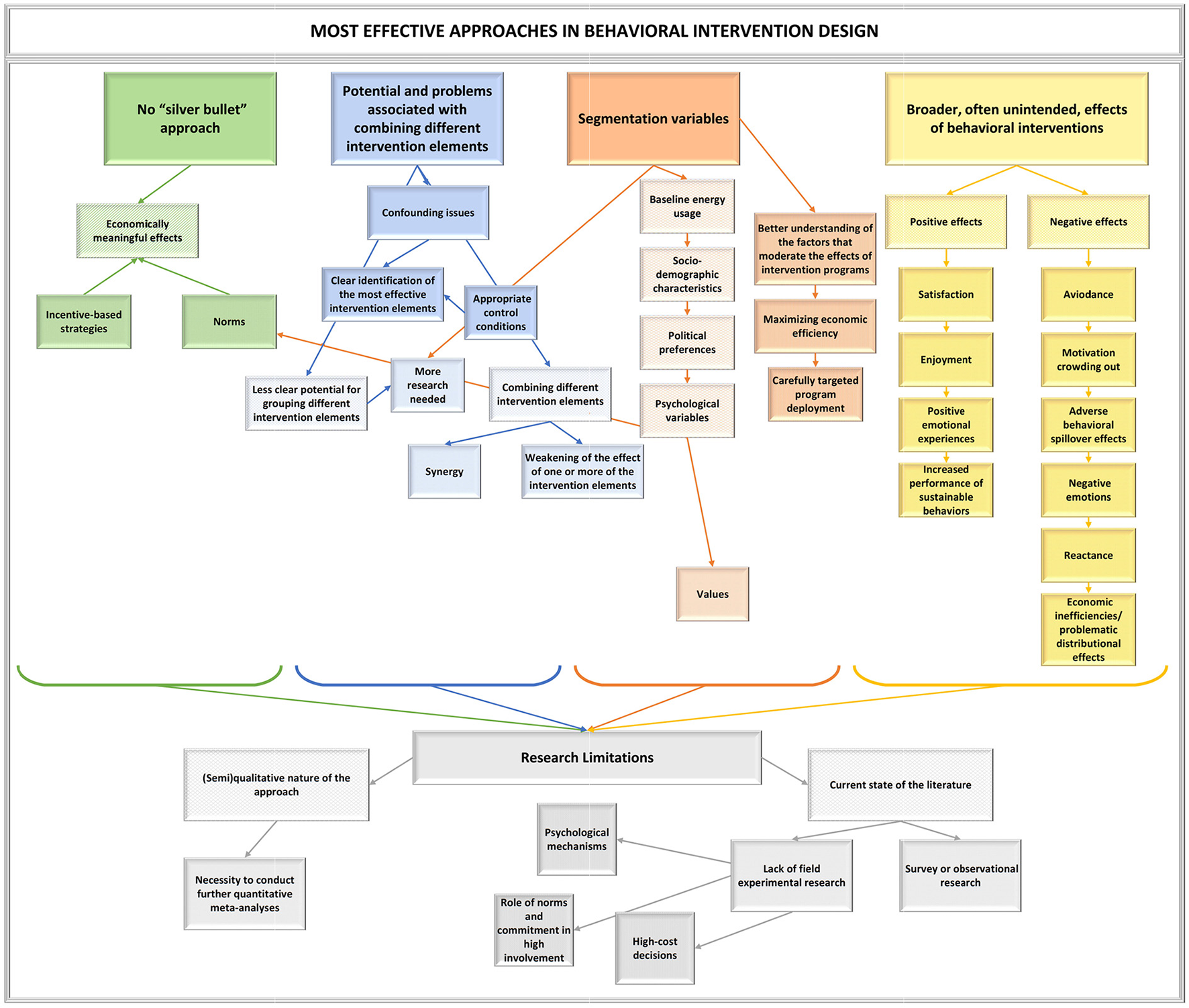
Overview of general conclusions.
First, we show that there is no “silver bullet” approach. None of the intervention types have reliably large effects (i.e., irrespective of the context and target population). However, some interventions seem to have greater potential than others. In a number of cases, economically meaningful effects have been achieved with incentive-based strategies (e.g., Faruqui and Sergici, 2010; Allcott and Taubinsky, 2015; Ito et al., 2018; Bollinger et al., 2020) and norms (e.g., Leoniak and Cwalina, 2019; Brülisauer et al., 2020). The evidence to support the usefulness of commitment and goal setting strategies is much weaker.
Second, we discussed the potential, as well as the problems associated with combining different intervention elements (e.g., norms and incentives) in a single intervention package. The drawbacks are clear: confounding issues preclude a clear identification of the most effective intervention elements when they are bundled without appropriate control conditions (cf. Delmas et al., 2013; Harries et al., 2013; Frederiks et al., 2016; Bhanot, 2021). The potential for grouping different intervention elements is less clear, and this important issue requires more research. As discussed in a recent paper by Drews et al. (2020), combining different intervention elements can lead to synergy (the intervention package as a whole having a stronger effect than each individual component), but it can also lead to a weakening of the effect of one or more of the intervention elements. While intuition suggests that interventions with more elements are more effective (cf. Abrahamse et al., 2007; Dietz et al., 2009; Osbaldiston and Schott, 2012; Mack et al., 2019), research often rather suggests an absence of synergistic effects when using multiple intervention elements (Harries et al., 2013; Schwartz et al., 2015; Alberts et al., 2016; Anderson et al., 2017; Pellerano et al., 2017; Sudarshan, 2017; Martin and Rivers, 2018).
Third, regardless of whether the intervention has a generally relatively strong effect, the effect can be substantially increased by targeting the intervention to the most receptive groups. The segmentation variables that we reviewed include, for example, baseline energy usage (Schultz et al., 2007, 2016; Allcott, 2011b), socio-demographic characteristics (Bollinger et al., 2020; Rodemeier and Löschel, 2020; Stojanovski et al., 2020), political preferences (Costa and Kahn, 2013; Schwartz et al., 2015; Xu et al., 2015), and psychological variables, such as personal norms (Schultz et al., 2016; Steinhorst and Matthies, 2016) and values (Bonan et al., 2019; Brandsma and Blasch, 2019). More research is needed to consolidate our understanding of the role of the various segmentation variables. A better understanding of the factors that moderate the effects of intervention programs is a prerequisite for maximizing economic efficiency via carefully targeted program deployment. Similarly, a shift toward more advanced, tailored and sequentially adaptive intervention programs (such as those showing promise in the medical field, see e.g., Nahum-Shani et al., 2018; Miller, 2019) depends on insights into the type of interventions most suited to particular individuals.
Fourth, researchers and practitioners' attention should focus on the broader, often unintended, effects of behavioral interventions. These can be positive, such as satisfaction, enjoyment and other positive emotional experiences (Herter, 2007; Delmas and Lessem, 2014; Vesely et al., 2022), and increased performance of sustainable behaviors not targeted by the interventions (Steinhorst et al., 2015; Carlsson et al., 2021; Jessoe et al., 2021; see Maki et al., 2019; Geiger et al., 2021 for meta-analyses). However, negative effects include avoidance (Löschel et al., 2020), motivation crowding out (Lavergne et al., 2010; Schwartz et al., 2015), adverse behavioral spillover effects (Tiefenbeck et al., 2013; McCoy and Lyons, 2017; Bjelle et al., 2018), negative emotions (Sussman and Gifford, 2012) and reactance (Bergquist and Nilsson, 2016), as well as economic inefficiencies (Allcott and Greenstone, 2012) and problematic distributional effects (Azarova et al., 2019; White and Sintov, 2020). To find the best approach, interventions thus need to be thoroughly pre-tested prior to their large-scale roll out, and evaluated not only in terms of their intended behavioral impact, but also in terms of their (unintended) downstream effects.
Like all literature reviews, we were limited by the semi-qualitative nature of our approach. As new evidence accumulates, it will be appropriate to conduct further quantitative meta-analyses covering these topics. Still, our approach made it possible to combine evidence from previous meta-analyses and more recent studies in a much more comprehensive manner than previous works in the area. To lay the groundwork for the future, experimenters should adhere to reporting standards conducive to subsequent research synthesis efforts.
Another limitation of the present study stemmed from the current state of the literature itself. In particular, our conclusions were not always based solely on field experimental research (where no or very little field experimental evidence was available). Instead, we occasionally resorted to evidence from laboratory, survey or observational research to illustrate various points. To some extent, this is perhaps inevitable, as field experimental research can only go so far when examining for example the underlying psychological mechanisms. On the other hand, in some cases, field experimental research was conspicuous by its absence, especially regarding the role of norms and commitment in high-involvement, high-cost decisions such as the uptake of eco-friendly technologies. This research gap and others outlined in this review point to many opportunities for meaningful research contributions.
Funding
This research was supported by a grant from the EU (ENCHANT project, grant agreement no. 957115). This work was additionally supported by a grant of the Ministry of Education and Research to AS, CNCS/CCCDI-UEFISCDI, project number PN-III-P3.6-H2020-2020-0063.
Publisher's note
All claims expressed in this article are solely those of the authors and do not necessarily represent those of their affiliated organizations, or those of the publisher, the editors and the reviewers. Any product that may be evaluated in this article, or claim that may be made by its manufacturer, is not guaranteed or endorsed by the publisher.
Statements
Data availability statement
The original contributions presented in the study are included in the article/supplementary files, further inquiries can be directed to the corresponding author/s.
Author contributions
Conceptualization and writing—review and editing: SV, CK, GC, LT, FC, MB, AK, and AS. Methodology: SV, CK, GC, LT, and FC. Data collection and analysis and writing—original draft: SV. All authors contributed to the article and approved the submitted version.
Conflict of interest
The authors declare that the research was conducted in the absence of any commercial or financial relationships that could be construed as a potential conflict of interest.
Supplementary material
The Supplementary Material for this article can be found online at: https://www.frontiersin.org/articles/10.3389/fpsyg.2022.967318/full#supplementary-material
Footnotes
^1 The reason for modifying the inclusion criteria for the sections focusing on moderators was the limited number of studies reporting relevant moderator effects that met the stricter criteria.
^2 Note that naturally we also cite studies unrelated to pro-environmental behavior as part of discussing the main findings.
^3 See e.g., Nesbakken (1999), Reiss and White (2005), Herter (2007), Rehdanz (2007), Meier and Rehdanz (2010), Alberini et al. (2011, 2019), Allcott (2011a), Mills and Schleich (2012), Ito (2015), Moshiri (2015), Yang and Zhao (2015), Zhang (2015), Bjerkan et al. (2016), Ida et al. (2016), Wichman et al. (2016), Zhang et al. (2016), DeShazo et al. (2017), Schulte and Heindl (2017), Hansen (2018), Houde (2018), Ščasný et al. (2018), Silva et al. (2018), Sovacool et al. (2018, 2019), Charlier and Kahouli (2019), Kormos et al. (2019), Lundgren and Schultzberg (2019), Bollinger et al. (2020), Deryugina et al. (2020), Harding et al. (2020), Jenn et al. (2020), Rodemeier and Löschel (2020), Schmitz and Madlener (2020), Stojanovski et al. (2020), and Wolske (2020).
References
1
Abrahamse W. Steg L. (2013). Social influence approaches to encourage resource conservation: A meta-analysis. Glob. Environ. Change23, 1773–1785. 10.1016/j.gloenvcha.2013.07.029
2
Abrahamse W. Steg L. Vlek C. Rothengatter T. (2007). The effect of tailored information, goal setting, and tailored feedback on household energy use, energy-related behaviors, and behavioral antecedents. J. Environ. Psychol.27, 265–276. 10.1016/j.jenvp.2007.08.002
3
Agerström J. Carlsson R. Nicklasson L. Guntell L. (2016). Using descriptive social norms to increase charitable giving: The power of local norms. J. Econ. Psychol.52, 147–153. 10.1016/j.joep.2015.12.007
4
Alberini A. Gans W. Velez-Lopez D. (2011). Residential consumption of gas and electricity in the U.S.: The role of prices and income. Energy Econ.33, 870–881. 10.1016/j.eneco.2011.01.015
5
Alberini A. Khymych O. Ščasný M. (2019). Response to extreme energy price changes: Evidence from Ukraine. Energy J.40, 189–212. 10.5547/01956574.40.1.aalb
6
Alberts G. Gurguc Z. Koutroumpis P. Martin R. Muûls M. Napp T. (2016). Competition and norms: A self-defeating combination?Energy Policy96, 504–523. 10.1016/j.enpol.2016.06.001
7
Allcott H. (2011a). Rethinking real-time electricity pricing. Resour. Energy Econ.33, 820–842. 10.1016/j.reseneeco.2011.06.003
8
Allcott H. (2011b). Social norms and energy conservation. J. Public Econ.95, 1082–1095. 10.1016/j.jpubeco.2011.03.003
9
Allcott H. (2015). Site selection bias in program evaluation. Q. J. Econ.130, 1117–1165. 10.1093/qje/qjv015
10
Allcott H. Greenstone M. (2012). Is there an energy efficiency gap?J. Econ. Perspect.26, 3–28. 10.1257/jep.26.1.3
11
Allcott H. Kessler J. B. (2019). The welfare effects of nudges: A case study of energy use social comparisons. Am. Econ. J. Appl. Econ.11, 236–276. 10.1257/app.20170328
12
Allcott H. Rogers T. (2014). The short-run and long-run effects of behavioral interventions: Experimental evidence from energy conservation. Am. Econ. Rev.104, 3003–3037. 10.1257/aer.104.10.3003
13
Allcott H. Sweeney R. L. (2017). The role of sales agents in information disclosure: Evidence from a field experiment. Manage. Sci.63, 21–39. 10.1287/mnsc.2015.2327
14
Allcott H. Taubinsky D. (2015). Evaluating behaviorally motivated policy: Experimental evidence from the lightbulb market. Am. Econ. Rev.105, 2501–2538. 10.1257/aer.20131564
15
Anderson K. Song K. Lee S. Krupka E. Lee H. Park M. (2017). Longitudinal analysis of normative energy use feedback on dormitory occupants. Appl. Energy189, 623–639. 10.1016/j.apenergy.2016.12.086
16
Andersson M. von Borgstede C. (2010). Differentiation of determinants of low-cost and high-cost recycling. J. Environ. Psychol.30, 402–408. 10.1016/j.jenvp.2010.02.003
17
Andor M. Bensch G. Fels K. Kneppel N. (2020a). Per Stups zum Energiesparen? Eine Meta-Analyse zu den kausalen Effekten von verhaltensökonomischen Interventionen auf den Energieverbrauch privater Haushalte. Perspekt. Wirtschaftspolitik20, 352–382. 10.1515/pwp-2018-0039
18
Andor M. A. Fels K. M. (2018). Behavioral economics and energy conservation – a systematic review of nonprice interventions and their causal effects. Ecol. Econ.148, 178–210. 10.1016/j.ecolecon.2018.01.018
19
Andor M. A. Gerster A. Peters J. Schmidt C. M. (2020b). Social norms and energy conservation beyond the US. J. Environ. Econ. Manage.103, 102351. 10.1016/j.jeem.2020.102351
20
Aronson E. O'Leary M. (1982-83). The relative effectiveness of models and prompts on energy conservation: A field experiment in a shower room. J. Environ. Syst.12, 219–224. 10.2190/UBD5-4Y9B-61EF-WUM6
21
Arpan L. M. Opel A. R. Lu J. (2013). Motivating the skeptical and unconcerned: Considering values, worldviews, and norms when planning messages encouraging energy conservation and efficiency behaviors. Appl. Environ. Educ. Communic.12, 207–219. 10.1080/1533015X.2013.838875
22
Ashraf N. Jack B. K. Kamenica E. (2013). Information and subsidies: Complements or substitutes?J. Econ. Behav. Organiz.88, 133–139. 10.1016/j.jebo.2012.12.031
23
Aydin E. Brounen D. Kok N. (2018). Information provision and energy consumption: Evidence from a field experiment. Energy Econ.71, 403–410. 10.1016/j.eneco.2018.03.008
24
Ayres I. Raseman S. Shih A. (2013). Evidence from two large field experiments that peer comparison feedback can reduce residential energy usage. J. Law Econ. Organiz.29, 992–1022. 10.1093/jleo/ews020
25
Azarova V. Cohen J. J. Kollmann A. Reichl J. (2020). Reducing household electricity consumption during evening peak demand times: Evidence from a field experiment. Energy Policy144, 111657. 10.1016/j.enpol.2020.111657
26
Azarova V. Engel D. Ferner C. Kollmann A. Reichl J. (2019). Exploring the impact of network tariffs on household electricity expenditures using load profiles and socio-economic characteristics. Nat. Energy3, 317–325. 10.1038/s41560-018-0105-4
27
Babutsidze Z. Chai A. (2018). Look at me saving the planet! The imitation of visible green behavior and its impact on the climate value-action gap. Ecol. Econ.146, 290–303. 10.1016/j.ecolecon.2017.10.017
28
Baca-Motes K. Brown A. Gneezy A. Keenan E. A. Nelson L. D. (2013). Commitment and behavior change: Evidence from the field. Journal of Consumer Research39, 1070–1084. 10.1086/667226
29
Barata R. Castro P. Martins-Loução M. A. (2017). How to promote conservation behaviours: The combined role of environmental education and commitment. Environ. Educ. Res.23, 1322–1334. 10.1080/13504622.2016.1219317
30
Barth M. Jugert P. Fritsche I. (2016). Still underdetected – social norms and collective efficacy predict the acceptance of electric vehicles in Germany. Transport. Res. Part F37, 64–77. 10.1016/j.trf.2015.11.011
31
Bator R. J. Phelps K. Tabanico J. Schultz P. W. Walton M. L. (2019). When it is not about the money: Social comparison and energy conservation among residents who do not pay for electricity. Energy Res. Soc. Sci.56, 101198. 10.1016/j.erss.2019.05.008
32
Bator R. J. Tabanico J. J. Walton M. L. Schultz P. W. (2014). Promoting energy conservation with implied norms and explicit messages. Soc. Influence9, 69–82. 10.1080/15534510.2013.778213
33
Becker L. J. (1978). Joint effect of feedback and goal setting on performance: FIELD-study of residential energy-conservation. J. Appl. Psychol.63, 428–433. 10.1037/0021-9010.63.4.428
34
Bell B. T. Toth N. Little L. Smith M. A. (2016). Planning to save the planet: Using an online intervention based on implementation intentions to change adolescent self-reported energy-saving behavior. Environ. Behav.48, 1049–1072. 10.1177/0013916515583550
35
Beltramo T. Blalock G. Levine D. I. Simons A. M. (2015). Does peer use influence adoption of efficient cookstoves? Evidence from a randomized controlled trial in Uganda. J. Health Communic.20, 55–66. 10.1080/10810730.2014.994244
36
Bergquist M. Nilsson A. (2016). I saw the sign: Promoting energy conservation via normative prompts. J. Environ. Psychol.46, 23–31. 10.1016/j.jenvp.2016.03.005
37
Bergquist M. Nilsson A. Schultz W. P. (2019). A meta-analysis of field-experiments using social norms to promote pro-environmental behaviors. Glob. Environ. Change59, 101941. 10.1016/j.gloenvcha.2019.101941
38
Bertoldo R. Castro P. (2016). The outer influence inside us: Exploring the relation between social and personal norms. Resour. Conserv. Recycl.112, 45–53. 10.1016/j.resconrec.2016.03.020
39
Bhanot S. P. (2021). Isolating the effect of injunctive norms on conservation behavior: New evidence from a field experiment in California. Organiz. Behav. Hum. Decis. Processes. 163, 30–42. 10.1016/j.obhdp.2018.11.002
40
Bicchieri C. (2006). The Grammar of Society: The Nature and Dynamics of Social Norms. Cambridge: Cambridge University Press. 10.1017/CBO9780511616037
41
Bjelle E. L. Steen-Olsen K. Wood R. (2018). Climate change mitigation potential of Norwegian households and the rebound effect. J. Clean. Prod.172, 208–217. 10.1016/j.jclepro.2017.10.089
42
Bjerkan K. Y. Nørbech T. E. Nordtømme M. E. (2016). Incentives for promoting Battery Electric Vehicle (BEV) adoption in Norway. Transport. Res. Part D43, 169–180. 10.1016/j.trd.2015.12.002
43
Bogard J. E. Delmas M. A. Goldstein N. J. Vezich I. S. (2020). Target, distance, and valence: Unpacking the effects of normative feedback. Organ. Behav. Hum. Decis. Process.161, 61–73. 10.1016/j.obhdp.2020.10.003
44
Bollinger B. Gillingham K. Kirkpatrick A. J. Sexton S. (2022). Visibility and peer influence in durable good adoption. Market. Sci. 41, 453–476. 10.1287/mksc.2021.1306
45
Bollinger B. Gillingham K. T. Ovaere M. (2020). Field experimental evidence shows that self-interest attracts more sunlight. Proc. Nat. Acad. Sci. U. S. A.117, 20503–20510. 10.1073/pnas.2004428117
46
Bollinger B. K. Hartmann W. R. (2020). Information vs. automation and implications for dynamic pricing. Manag. Sci.66, 290–314. 10.1287/mnsc.2018.3225
47
Bonan J. Battiston P. Bleck J. LeMay-Boucher P. Pareglio S. Sarr B. et al . (2021). Social interaction and technology adoption: Experimental evidence from improved cookstoves in Mali. World Dev. 144, 105467. 10.1016/j.worlddev.2021.105467
48
Bonan J. Cattaneo C. d'Adda G. Tavoni M. (2019). Heterogeneity of Social Information Programs: The Role of Identity and Values. Working paper.
49
Bonan J. Cattaneo C. d'Adda G. Tavoni M. (2020). The interaction of descriptive and injunctive social norms in promoting energy conservation. Nat. Energy5, 900–909. 10.1038/s41560-020-00719-z
50
Bonner S. E. Sprinkle G. B. (2002). The effects of monetary incentives on effort and task performance: Theories, evidence, and a framework for research. Account. Organiz. Soc.27, 303–345. 10.1016/S0361-3682(01)00052-6
51
Brandon A. Ferraro P. J. List J. A. Metcalfe R. D. Price M. K. Rundhammer F. (2017). Do the Effects of Social Nudges Persist? Theory and Evidence From 38 Natural Field Experiments. Working paper. 10.3386/w23277
52
Brandon A. List J. A. Metcalfe R. D. Price M. K. Rundhammer F. (2019). Testing for crowd out in social nudges: Evidence from a natural field experiment in the market for electricity. Proc. Nat. Acad. Sci. U. S. A.116, 5293–5298. 10.1073/pnas.1802874115
53
Brandsma J. S. Blasch J. E. (2019). One for all? – the impact of different types of energy feedback and goal setting on individuals' motivation to conserve electricity. Energy Policy135, 110992. 10.1016/j.enpol.2019.110992
54
Brent D. A. Wichman C. J. (2020). Do Behavioral Nudges Interact With Prevailing Economic Incentives? Pairing Experimental and Quasi-Experimental Evidence from Water Consumption. Working paper.
55
Brülisauer M. Goette L. Jiang Z. Schmitz J. Schubert R. (2020). Appliance-specific feedback and social comparisons: Evidence from a field experiment on energy conservation. Energy Policy145, 111742. 10.1016/j.enpol.2020.111742
56
Buckley P. (2020). Prices, information and nudges for residential electricity conservation: A meta-analysis. Ecol. Econ.172, 106635. 10.1016/j.ecolecon.2020.106635
57
Burkhardt J. Gillingham K. Kopalle P. K. (2019). Experimental Evidence on the Effect of Information and Pricing on Residential Electricity Consumption. Working paper. 10.3386/w25576
58
Byrne D. P. La Nauze A. Martin L. A. (2018). Tell me something I don't already know: Informedness and the impact of information programs. Rev. Econ. Stat.100, 510–527. 10.1162/rest_a_00695
59
Caballero N. Della Valle N. (2021). Tackling energy poverty through behavioral change: A pilot study on social comparison interventions in social housing districts. Front. Sustain. Cities2, 601095. 10.3389/frsc.2020.601095
60
Camerer C. Hogarth R. M. (1999). The effects of financial incentives in experiments: A review and capital-labor-production framework. J. Risk Uncertain.19, 7–42. 10.1023/A:1007850605129
61
Carlsson F. Jaime M. Villegas C. (2021). Behavioral spillover effects from a social information campaign. J. Environ. Econ. Manag.109, 102325. 10.1016/j.jeem.2020.102325
62
Carrus G. Tiberio L. Mastandrea S. Chokrai P. Fritsche I. Klöckner C. A. et al . (2021). Psychological predictors of energy saving behaviour: A meta-analytic approach. Front. Psycholo.12, 648221. 10.3389/fpsyg.2021.648221
63
Charlier C. Guerassimoff G. Kirakozian A. Selosse S. (2021). Under pressure! Nudging electricity consumption within firms. Feedback from a field experiment. Energy J.42, 129–154. 10.5547/01956574.42.1.ccha
64
Charlier D. Kahouli S. (2019). From residential energy demand to fuel poverty: Income-induced non-linearities in the reactions of households to energy price fluctuations. Energy J.40, 101–138. 10.5547/01956574.40.2.dcha
65
Cialdini R. B. Reno R. Kallgren C. (1990). A focus theory of normative conduct: Recycling the concept of norms to reduce littering in public places. J. Pers. Soc. Psychol.58, 1015–1026. 10.1037/0022-3514.58.6.1015
66
Cohen J. (1988). Statistical Power Analysis for the Behavioral Sciences, 2nd Edn. Hillsdale, NJ: Erlbaum.
67
Costa D. L. Kahn M. E. (2013). Energy conservation “nudges” and environmentalist ideology: evidence from a randomized residential electricity field experiment. J. Eur. Econ. Assoc.11, 680–702. 10.1111/jeea.12011
68
Crago C. L. Spraggon J. M. Hunter E. (2020). Motivating non-ratepaying households with feedback and social nudges: A cautionary tale. Energy Policy145, 111764. 10.1016/j.enpol.2020.111764
69
Davis A. L. Krishnamurti T. Fischhoff B. de Bruin W. B. (2013). Setting a standard for electricity pilot studies. Energy Policy62, 401–409. 10.1016/j.enpol.2013.07.093
70
De Dominicis S. Sokoloski R. Jaeger C. Schultz P. W. (2019). Making the smart meter social promotes long-term energy conservation. Palgrave Communic.5, 51. 10.1057/s41599-019-0254-5
71
Deci E. L. (1971). Effects of externally mediated rewards on intrinsic motivation. J. Pers. Soc. Psychol.18, 105–115. 10.1037/h0030644
72
Deci E. L. Koestner R. Ryan R. M. (1999). A meta-analytic review of experiments examining the effects of extrinsic rewards on intrinsic motivation. Psychol. Bull.125, 627–668. 10.1037/0033-2909.125.6.627
73
DellaValle N. Zubaryeva A. (2019). Can we hope for a collective shift in electric vehicle adoption? Testing salience and norm-based interventions in South Tyrol, Italy. Energy Res. Soc. Sci.55, 46–61. 10.1016/j.erss.2019.05.005
74
Delmas M. A. Fischlein M. Asensio O. I. (2013). Information strategies and energy conservation behavior: A meta-analysis of experimental studies from 1975-2011. Energy Policy61, 729–739. 10.1016/j.enpol.2013.05.109
75
Delmas M. A. Lessem N. (2014). Saving power to conserve your reputation? The effectiveness of private versus public information. J. Environ. Econ. Manag.67, 353–370. 10.1016/j.jeem.2013.12.009
76
Deryugina T. MacKay A. Reif J. (2020). The long-run dynamics of electricity demand: Evidence from municipal aggregation. Am. Econ. J. Appl. Econ.12, 86–114. 10.1257/app.20180256
77
DeShazo J. R. Sheldon T. L. Carson R. T. (2017). Designing policy incentives for cleaner technologies: Lessons from California's plug-in electric vehicle rebate program. J. Environ. Econ. Manag.84, 18–43. 10.1016/j.jeem.2017.01.002
78
Dharshing S. (2017). Household dynamics of technology adoption: A spatial econometric analysis of residential solar photovoltaic (PV) systems in Germany. Energy Res. Soc. Sci.23, 113–124. 10.1016/j.erss.2016.10.012
79
Dietz T. Gardner G. T. Gilligan J. Stern P. C. Vandenbergh M. P. (2009). Household actions can provide a behavioral wedge to rapidly reduce US carbon emissions. Proc. Nat. Acad. Sci.106, 18452–18456. 10.1073/pnas.0908738106
80
Dixon G. N. Deline M. B. McComas K. Chambliss L. Hoffmann M. (2015). Saving energy at the workplace: The salience of behavioral antecedents and sense of community. Energy Res. Soc. Sci.6, 121–127. 10.1016/j.erss.2015.01.004
81
Dolan P. Metcalfe R. (2015). Neighbors, Knowledge, and Nuggets: Two Natural Field Experiments on the Role of Incentives on Energy Conservation. Working paper. 10.2139/ssrn.2589269
82
Drews S. Exadaktylos F. van den Bergh J. C. J. M. (2020). Assessing synergy of incentives and nudges in the energy policy mix. Energy Policy144, 111605. 10.1016/j.enpol.2020.111605
83
Ek K. Söderholm P. (2008). Norms and economic motivation in the Swedish green electricity market. Ecol. Econ.58, 169–182. 10.1016/j.ecolecon.2008.02.013
84
Eom K. Kim H. S. Sherman D. K. Ishii K. (2016). Cultural variability in the link between environmental concern and support for environmental action. Psychol. Sci.27, 1331–1339. 10.1177/0956797616660078
85
Epton T. Currie S. Armitage C. J. (2017). Unique effects of setting goals on behavior change: Systematic review and meta-analysis. J. Consult. Clin. Psychol.85, 1182–1198. 10.1037/ccp0000260
86
Exley C. L. Naecker J. K. (2017). Observability increases the demand for commitment devices. Manage. Sci.63, 3262–3267. 10.1287/mnsc.2016.2501
87
Faruqui A. Sergici S. (2010). Household response to dynamic pricing of electricity: A survey of 15 experiments. J. Regul. Econ.38, 193–225. 10.1007/s11149-010-9127-y
88
Faruqui A. Sergici S. (2011). Dynamic pricing of electricity in the mid-Atlantic region: Econometric results from the Baltimore gas and electric company experiment. J. Regul. Econ.40, 82–109. 10.1007/s11149-011-9152-5
89
Faruqui A. Sergici S. Akaba L. (2013). Dynamic pricing of electricity for residential customers: The evidence from Michigan. Energy Effic.6, 571–584. 10.1007/s12053-013-9192-z
90
Fenrick S. A. Getachew L. Ivanov C. Smith J. (2014). Demand impact of a critical peak pricing program: opt-in and opt-out options, green attitudes and other customer characteristics. Energy J.35, 1–24. 10.5547/01956574.35.3.1
91
Ferraro P. J. Miranda J. J. (2014). The performance of non-experimental designs in the evaluation of environmental programs: A design-replication study using a large-scale randomized experiment as a benchmark. J. Econ. Behav. Organiz.107, 344–365. 10.1016/j.jebo.2014.03.008
92
Ferraro P. J. Miranda J. J. (2017). Panel data designs and estimators as substitutes for randomized controlled trials in the evaluation of public programs. J. Assoc. Environ. Resour. Economists4, 281–317. 10.1086/689868
93
Ferraro P. J. Price M. K. (2013). Using nonpecuniary strategies to influence behavior: Evidence from a large-scale field experiment. Rev. Econ. Stat.95, 64–73. 10.1162/REST_a_00344
94
Fielding K. S. Terry D. J. Masser B. M. Hogg M. A. (2008). Integrating social identity theory and the theory of planned behaviour to explain decisions to engage in sustainable agricultural practices. Br. J. Soc. Psychol.47, 23–48. 10.1348/014466607X206792
95
Figueroa A. de Moliere L. Pegels A. Never B. Kutzner F. (2019). Show me (more than) the money! Assessing the social and psychological dimensions to energy efficient lighting in Kenya. Energy Res. Soc. Sci.47, 224–232. 10.1016/j.erss.2018.10.002
96
Fowlie M. Wolfram C. Baylis P. Spurlock C. A. Todd-Blick A. Cappers P. (2021). Default effects and follow-on behaviour: Evidence from an electricity pricing program. Rev. Econ. Stud. 88, 2886–2934. 10.1093/restud/rdab018
97
Frederick S. Loewenstein G. O'Donoghue T. (2002). Time discounting and time preference: a critical review. J. Econ. Lit.40, 351–401. 10.1257/jel.40.2.351
98
Frederiks E. R. Stenner K. Hobman E. V. Fischle M. (2016). Evaluating energy behavior change programs using randomized controlled trials: Best practice guidelines for policymakers. Energy Res. Soc. Sci.22, 147–164. 10.1016/j.erss.2016.08.020
99
Frondel M. Kussel G. (2020). Switching on electricity demand response: Evidence for German households. Energy J.40, 1–16. 10.5547/01956574.40.5.mfro
100
Galizzi M. M. Navarro-Martinez D. (2019). On the external validity of social preference games: A systematic lab-field study. Manage. Sci.65, 976–1002. 10.1287/mnsc.2017.2908
101
Gallagher K. S. Muehlegger E. (2011). Giving green to get green? Incentives and consumer adoption of hybrid vehicle technology. J. Environ. Econ. Manag.61, 1–15. 10.1016/j.jeem.2010.05.004
102
Geiger S. J. Brick C. Nalborczyk L. Jostmann N. B. (2021). More green than gray? Toward a sustainable overview of environmental spillover effects: A Bayesian meta-analysis. Manuscript under review. 10.31234/osf.io/u24tx
103
Ghesla C. Grieder M. Schmitz J. Stadelmann M. (2020). Pro-environmental incentives and loss aversion: A field experiment on electricity saving behavior. Energy Policy137, 111131. 10.1016/j.enpol.2019.111131
104
Gilbert B. Graff Zivin J. (2014). Dynamic salience with intermittent billing: evidence from smart electricity meters. J. Econ. Behav. Organiz.107, 176–190. 10.1016/j.jebo.2014.03.011
105
Gillan J. M. (2018). Dynamic Pricing, Attention, and Automation: Evidence from a Field Experiment in Electricity Consumption. Working paper.
106
Gillingham K. Bollinger B. (2021). Social learning and solar photovoltaic adoption. Manag. Sci. 67, 6629–7289. 10.1287/mnsc.2020.3840
107
Gillingham K. Tsvetanov T. (2018). Nudging energy efficiency audits: Evidence from a field experiment. J. Environ. Econ. Manage.90, 303–316. 10.1016/j.jeem.2018.06.009
108
Göckeritz S. Schultz P. W. Rendon T. Cialdini R. B. Goldstein N. J. Griskevicius V. (2010). Descriptive normative beliefs and conservation behavior: The moderating roles of personal involvement and injunctive normative beliefs. Eur. J. Soc. Psychol.40, 514–523. 10.1002/ejsp.643
109
Goldstein N. J. Cialdini R. B. Griskevicius V. (2008). A room with a view point: Using social norms to motivate environmental conservation in hotels. J. Consumer Res.35, 472–482. 10.1086/586910
110
Graziano M. Gillingham K. (2015). Spatial patterns of solar photovoltaic system adoption: The influence of neighbors and the built environment. J. Econ. Geogr.15, 815–839. 10.1093/jeg/lbu036
111
Hage O. Söderholm P. Berglund C. (2009). Norms and economic motivation in household recycling: Empirical evidence from Sweden. Resour. Conserv. Recycl.53, 155–165. 10.1016/j.resconrec.2008.11.003
112
Hansen A. R. (2018). Heating homes: Understanding The Impact Of Prices. Energy Policy121, 138–151. 10.1016/J.Enpol.2018.06.021
113
Harding M. Hsiaw A. (2014). Goal setting and energy conservation. J. Econ. Behav. Organiz.107, 209–227. 10.1016/j.jebo.2014.04.012
114
Harding M. Lamarche C. (2016). Empowering consumers through data and smart technology: Experimental evidence on the consequences of time-of-use electricity pricing policies. J. Policy Anal. Manag.35, 906–931. 10.1002/pam.21928
115
Harding M. Lamarche C. Pesaran M. H. (2020). Common correlated effects estimation of heterogeneous dynamic panel quantile regression models. J. Appl. Econometr.35, 294–314. 10.1002/jae.2753
116
Hardman S. Chandan A. Tal G. Turrentine T. (2017). The effectiveness of financial purchase incentives for battery electric vehicles – a review of the evidence. Renew. Sust. Energy Rev.80, 1100–1111. 10.1016/j.rser.2017.05.255
117
Harries T. Rettie R. Studley M. Burchell K. Chambers S. (2013). Is social norms marketing effective? A case study in domestic electricity consumption. Eur. J. Market.47, 1458–1475. 10.1108/EJM-10-2011-0568
118
Hayes A. F. (2013). Introduction to Mediation, Moderation, and Conditional Process Analysis: A Regression-Based Approach. New York, NY: Guilford Press.
119
Hayes S. C. Cone J. D. (1977). Reducing residential electrical energy use: Payments, information, and feedback. J. Appl. Behav. Anal.103, 425–435. 10.1901/jaba.1977.10-425
120
Henry M. L. Ferraro P. J. Kontoleon A. (2019). The behavioural effect of electronic home energy reports: Evidence from a randomised field trial in the United States. Energy Policy132, 1256–1261. 10.1016/j.enpol.2019.06.039
121
Herter K. (2007). Residential implementation of critical-peak pricing of electricity. Energy Policy35, 2121–2130. 10.1016/j.enpol.2006.06.019
122
Hofstede G. Hofstede G. J. Minkov M. (2010). Cultures and Organizations: Software of the Mind, 3rd Edn.New York, NY: McGraw-Hill.
123
Holladay S. LaRiviere J. Novgorodsky D. Price M. (2019). Prices versus nudges: What matters for search versus purchase of energy investments?J. Public Econ.172, 151–173. 10.1016/j.jpubeco.2018.12.004
124
Hong F. Hossain T. List J. A. (2015). Framing manipulations in contests: A natural field experiment. Journal of Economic Behavior and Organization118, 372–382. 10.1016/j.jebo.2015.02.014
125
Hossain T. List J. A. (2012). The behavioralist visits the factory: Increasing productivity using simple framing manipulations. Manage. Sci.58, 2151–2167. 10.1287/mnsc.1120.1544
126
Houde S. (2018). How consumers respond to product certification and the value of energy information. RAND J. Econ.49, 453–477. 10.1111/1756-2171.12231
127
Hunecke M. Blöbaum A. Matthies E. Höger R. (2001). Responsibility and environment: Ecological norm orientation and external factors in the domain of travel mode choice behavior. Environ. Behav.33, 830–852. 10.1177/00139160121973269
128
Ida T. Murakami K. Tanaka M. (2016). Electricity demand response in Japan: Experimental evidence from a residential photovoltaic power generation system. Econ. Energy Environ. Policy5, 73–88. 10.5547/2160-5890.5.1.itak
129
Inhoffen J. Siemroth C. Zahn P. (2019). Minimum prices and social interactions: Evidence from the German renewable energy program. Energy Econ.78, 350–364. 10.1016/j.eneco.2018.11.034
130
Ito K. (2015). Asymmetric incentives in subsidies: Evidence from a large-scale electricity rebate program. Am. Econ. J. Econ. Policy7, 209–237. 10.1257/pol.20130397
131
Ito K. Ida T. Tanaka M. (2018). Moral suasion and economic incentives: Field experimental evidence from energy demand. Am. Econ. J. Econ. Policy10, 240–267. 10.1257/pol.20160093
132
Ivanova D. Barrett J. Wiedenhofer D. Macura B. Callaghan M. Creutzig F. (2020). Quantifying the potential for climate change mitigation of consumption options. Environ. Res. Lett.15, 093001. 10.1088/1748-9326/ab8589
133
Jachimowicz J. M. Hauser O. P. O'Brien J. D. Sherman E. Galinsky A. D. (2018). The critical role of second-order normative beliefs in predicting energy conservation. Nat. Hum. Behav.2, 757–764. 10.1038/s41562-018-0434-0
134
Jacobson R. P. Mortensen C. R. Cialdini R. B. (2011). Bodies obliged and unbound: differentiated response tendencies for injunctive and descriptive social norms. J. Pers. Soc. Psychol.100, 433–448. 10.1037/a0021470
135
Jaeger C. M. Schultz P. W. (2017). Coupling social norms and commitments: Testing the underdetected nature of social influence. J. Environ. Psychol.51, 199–208. 10.1016/j.jenvp.2017.03.015
136
Jenn A. Lee J. H. Hardman S. Tal G. (2020). An in-depth examination of electric vehicle incentives: Consumer heterogeneity and changing response over time. Transport. Res. Part A132, 97–109. 10.1016/j.tra.2019.11.004
137
Jenn A. Springel K. Gopal A. R. (2018). Effectiveness of electric vehicle incentives in the United States. Energy Policy119, 349–356. 10.1016/j.enpol.2018.04.065
138
Jessoe K. Lade G. E. Loge F. Spang E. (2021). Spillovers from behavioral interventions: Experimental evidence from water and energy use. J. Assoc. Environ. Resour. Econ.8, 315–346. 10.1086/711025
139
Jessoe K. Rapson D. (2014). Knowledge is (less) power: Experimental evidence from residential energy use. Am. Econ. Rev.104, 1417–1438. 10.1257/aer.104.4.1417
140
Joo H. H. Lee J. Park S. (2018). Every drop counts: A water conservation experiment with hotel guests. Econ. Inq.56, 1788–1808. 10.1111/ecin.12563
141
Kácha O. Ruggeri K. (2019). Nudging intrinsic motivation in environmental risk and social policy. J. Risk Res.22, 581–592. 10.1080/13669877.2018.1459799
142
Kahn M. E. Wolak F. A. (2013). Using Information to Improve the Effectiveness of Nonlinear Pricing: Evidence From a Field Experiment. Working paper.
143
Kaiser F. G. Henn L. Marschke B. (2020). Financial rewards for long-term environmental protection. J. Environ. Psychol.68, 101411. 10.1016/j.jenvp.2020.101411
144
Kandul S. Lang G. Lanz B. (2020). Social comparison and energy conservation in a collective action context: A field experiment. Econ. Lett.188, 108947. 10.1016/j.econlet.2020.108947
145
Karlin B. Zinger J. F. Ford R. (2015). The effects of feedback on energy conservation: A meta-analysis. Psychol. Bull.141, 1205–1227. 10.1037/a0039650
146
Kaza N. (2010). Understanding the spectrum of residential energy consumption: A quantile regression approach. Energy Policy38, 6574–6585. 10.1016/j.enpol.2010.06.028
147
Keizer M. Sargisson R. J. van Zomeren M. Steg L. (2019). When personal norms predict the acceptability of push and pull car-reduction policies: Testing the ABC model and low-cost hypothesis. Transport. Res. Part F64, 413–423. 10.1016/j.trf.2019.06.005
148
Komatsu H. Nishio K.-i. (2015). An experimental study on motivational change for electricity conservation by normative messages. Appl. Energy158, 35–43. 10.1016/j.apenergy.2015.08.029
149
Korcaj L. Hahnel U. J. Spada H. (2015). Intentions to adopt photovoltaic systems depend on homeowners' expected personal gains and behavior of peers. Renew. Energy75, 407–415. 10.1016/j.renene.2014.10.007
150
Kormos C. Axsen J. Long Z. Goldberg S. (2019). Latent demand for zero-emissions vehicles in Canada (Part 2): Insights from a stated choice experiment. Transport. Res. Part D67, 685–702. 10.1016/j.trd.2018.10.010
151
Kormos C. Gifford R. (2014). The validity of self-report measures of proenvironmental behavior: A meta-analytic review. J. Environ. Psychol.40, 359–371. 10.1016/j.jenvp.2014.09.003
152
Krause R. M. Carley S. R. Lane B. W. Graham J. D. (2013). Perception and reality: Public knowledge of plug-in electric vehicles in 21 U.S. cities. Energy Policy63, 433–440. 10.1016/j.enpol.2013.09.018
153
Labandeira X. Labeaga J. M. Linares P. López-Otero X. (2020). The impacts of energy efficiency policies: Meta-analysis. Energy Policy147, 111790. 10.1016/j.enpol.2020.111790
154
Labandeira X. Labeaga J. M. López-Otero X. (2017). A meta-analysis on the price elasticity of energy demand. Energy Policy102, 549–568. 10.1016/j.enpol.2017.01.002
155
Lapinski M. K. Zhuang J. Koh H. Shi J. (2017). Descriptive norms and involvement in health and environmental behaviors. Communic. Res.44, 367–387. 10.1177/0093650215605153
156
Lavergne K. J. Sharp E. C. Pelletier L. G. Holtby A. (2010). The role of perceived government style in the facilitation of self-determined and non self-determined motivation for pro-environmental behavior. J. Environ. Psychol.30, 169–177. 10.1016/j.jenvp.2009.11.002
157
Legault L. Bird S. Powers S. E. Sherman A. Schay A. Hou D. et al . (2020). Impact of a motivational intervention and interactive feedback on electricity and water consumption: A smart housing field experiment. Environ. Behav.52, 666–692. 10.1177/0013916518811433
158
Leoniak K. J. Cwalina W. (2019). The role of normative prompts and norm support cues in promoting light-switching behavior: A field study. J. Environ. Psychol.64, 1–11. 10.1016/j.jenvp.2019.04.014
159
Levitt S. D. List J. A. (2007). What do laboratory experiments measuring social preferences tell us about the real world?J. Econ. Perspect.21, 153–174. 10.1257/jep.21.2.153
160
List J. A. Metcalfe R. D. Price M. K. Rundhammer F. (2017). Harnessing Policy Complementarities to Conserve Energy: Evidence From a Natural Field Experiment. Working paper. 10.3386/w23355
161
Liu Y. Q. Verissimo D. Farhidi F. (2016). Using social norm to promote energy conservation in a public building. Energy Build.133, 32–36. 10.1016/j.enbuild.2016.09.041
162
Locke E. A. Latham G. P. (2002). Building a practically useful theory of goal setting and task motivation: A 35-year odyssey. Am. Psychol.57, 705–717. 10.1037/0003-066X.57.9.705
163
Lokhorst A. M. Staats H. van Iterson J. (2015). Energy saving in office buildings: Are feedback and commitment-making useful instruments to trigger change?Hum. Ecol.43, 759–768. 10.1007/s10745-015-9783-8
164
Lokhorst A. M. Werner C. Staats H. van Dijk E. Gale J. L. (2013). Commitment and behavior change: A meta-analysis and critical review of commitment-making strategies in environmental research. Environ. Behav.45, 3–34. 10.1177/0013916511411477
165
Loock C.-M. Landwehr J. R. Staake T. Fleisch E. Pentland A. S. (2012). The influence of reference frame and population density on the effectiveness of social normative feedback on electricity consumption, in: Proceedings of the International Conference on Information Systems (ICIS) (Orlando, FL).
166
Loock C.-M. Staake T. Thiesse F. (2013). Motivating energy-efficient behavior with green IS: An investigation of goal setting and the role of defaults. MIS Quart.37, 1313–1332. 10.25300/MISQ/2013/37.4.15
167
Löschel A. Rodemeier M. Werthschulte M. (2020). When Nudges Fail to Scale: Field Experimental Evidence From Goal Setting on Mobile Phones. Working paper. 10.2139/ssrn.3676090
168
Lundgren B. Schultzberg M. (2019). Application of the economic theory of self-control to model energy conservation behavioral change in households. Energy183, 536–546. 10.1016/j.energy.2019.05.217
169
Lundheim S. H. Vesely S. Nayum A. Klöckner C. A. (2021). From vague interest to strong intentions to install solar panels on private homes in the North – An analysis of psychological drivers. Renew. Energy165, 455–463. 10.1016/j.renene.2020.11.034
170
Mack B. Tampe-Mai K. Kouros J. Roth F. Taube O. Diesch E. (2019). Bridging the electricity saving intention-behavior gap: A German field experiment with a smart meter website. Energy Res. Soc. Sci.53, 34–46. 10.1016/j.erss.2019.01.024
171
MacKinnon D. P. (2011). Integrating mediators and moderators in research design. Res. Soc. Work Pract.21, 675–681. 10.1177/1049731511414148
172
Mahmoodi J. Prasanna A. Hille S. Patel M. K. Brosch T. (2018). Combining “carrot and stick” to incentivize sustainability in households. Energy Policy123, 31–40. 10.1016/j.enpol.2018.08.037
173
Maki A. Carrico A. R. Raimi K. T. Truelove H. B. Araujo B. Yeung K. L. (2019). Meta-analysis of pro-environmental behavior spillover. Nat. Sust.2, 307–315. 10.1038/s41893-019-0263-9
174
Maniadis Z. Tufano F. List J. A. (2014). One swallow doesn't make a summer: New evidence on anchoring effects. Am. Econ. Rev.104, 277–290. 10.1257/aer.104.1.277
175
Martin S. Rivers N. (2018). Information provision, market incentives, and household electricity consumption: Evidence from a large-scale field deployment. J. Assoc. Environ. Resour. Econ.5, 207–231. 10.1086/694036
176
Masson T. Fritsche I. (2014). Adherence to climate change-related ingroup norms: Do dimensions of group identification matter?Eur. J. Soc. Psychol.44, 455–465. 10.1002/ejsp.2036
177
Matthies E. Klöckner C. A. Preißner C. L. (2006). Applying a modified moral decision making model to change habitual car use: How can commitment be effective?Appl. Psychol.55, 91–106. 10.1111/j.1464-0597.2006.00237.x
178
McCoy D. Lyons S. (2017). Unintended outcomes of electricity smart-metering: Trading-off consumption and investment behaviour. Energy Effic.10, 299–318. 10.1007/s12053-016-9452-9
179
McKenna R. Hernando D. A. ben Brahim T. Bolwig S. Cohen J. J. Reichl J. (2021). Analyzing the energy system impacts of price-induced demand-side-flexibility with empirical data. J. Clean. Prod.279, 123354. 10.1016/j.jclepro.2020.123354
180
Meier H. Rehdanz K. (2010). Determinants of residential space heating expenditures in Great Britain. Energy Econ.32, 949–959. 10.1016/j.eneco.2009.11.008
181
Mertens S. N. Schultz P. W. (2021). Referent group specificity: Optimizing normative feedback to increase residential recycling. J. Environ. Psychol.73, 101541. 10.1016/j.jenvp.2020.101541
182
Mi L. Ding C. Yang J. Yu X. Cong J. Zhu H. et al . (2019). Using goal and contrast feedback to motivate Chinese urban families to save electricity actively – a randomized controlled field trial. J. Clean. Prod.226, 443–453. 10.1016/j.jclepro.2019.04.068
183
Mi L. Y. Qiao L. J. Du S. S. Xu T. Gan X. L. Wang W. S. et al . (2020a). Evaluating the effect of eight customized information strategies on urban households' electricity saving: A field experiment in China. Sust. Cities Soc.62, 102344. 10.1016/j.scs.2020.102344
184
Mi L. Y. Qiao L. J. Gan X. L. Xu T. Lv T. Qiao Y. N. et al . (2020b). Assessing the effect of non-financial information intervention on promoting group-level energy savings. Sci. Total Environ.720, 137533. 10.1016/j.scitotenv.2020.137533
185
Miller C. K. (2019). Adaptive intervention designs to promote behavioral change in adults: What is the evidence?Curr. Diab. Rep.19, 7–16. 10.1007/s11892-019-1127-4
186
Mills B. Schleich J. (2012). Residential energy-efficient technology adoption, energy conservation, knowledge, and attitudes: An analysis of European countries. Energy Policy49, 616–628. 10.1016/j.enpol.2012.07.008
187
Mitchell G. (2012). Revisiting truth or triviality: The external validity of research in the psychological laboratory. Perspect. Psychol. Sci.7, 109–117. 10.1177/1745691611432343
188
Moons I. De Pelsmacker P. (2012). Emotions as determinants of electric car usage intention. J. Market. Manag.28, 195–237. 10.1080/0267257X.2012.659007
189
Moons I. De Pelsmacker P. (2015). An extended decomposed theory of planned behaviour to predict the usage intention of the electric car: A multi-group comparison. Sustainability7, 6212–6245. 10.3390/su7056212
190
Moshiri S. (2015). The effects of the energy price reform on households consumption in Iran. Energy Policy79, 177–188. 10.1016/j.enpol.2015.01.012
191
Münzel C. Plötz P. Sprei F. Gnann T. (2019). How large is the effect of financial incentives on electric vehicle sales? – a global review and European analysis. Energy Econ.84, 104493. 10.1016/j.eneco.2019.104493
192
Murakami K. Shimada H. Ushifusa Y. Ida T. (2022). Heterogeneous treatment effects of nudge and rebate: Causal machine learning in a field experiment on electricity conservation. Int. Econ. Rev.10.1111/iere.12589 [Epub ahead of print].
193
Myers E. Souza M. (2020). Social comparison nudges without monetary incentives: Evidence from home energy reports. J. Environ. Econ. Manag.101, 102315. 10.1016/j.jeem.2020.102315
194
Nahum-Shani I. Smith S. N. Spring B. J. Collins L. M. Witkiewitz K. Tewari A. et al . (2018). Just-in-Time Adaptive Interventions (JITAIs) in mobile health: Key components and design principles for ongoing health behavior support. Ann. Behav. Med. 52, 446–462. 10.1007/s12160-016-9830-8
195
Nemati M. Penn J. (2020). The impact of information-based interventions on conservation behavior: A meta-analysis. Resour. Energy Econ.62, 101201. 10.1016/j.reseneeco.2020.101201
196
Nesbakken R. (1999). Price sensitivity of residential energy consumption in Norway. Energy Econ.21, 493–515. 10.1016/S0140-9883(99)00022-5
197
Neubert M. J. (1998). The value of feedback and goal setting over goal setting alone and potential moderators of this effect: A meta-analysis. Human Perform.11, 321–335. 10.1207/s15327043hup1104_2
198
Neumann R. Mehlkop G. (2020). Framing electricity plan choices to enhance green energy usage: A choice experiment with panel data from Germany. Energy Res. Soc. Sci.70, 101741. 10.1016/j.erss.2020.101741
199
Nisa C. F. Bélanger J. J. Schumpe B. M. Faller D. G. (2019). Meta-analysis of randomised controlled trials testing behavioural interventions to promote household action on climate change. Nat. Commun.10, 4545. 10.1038/s41467-019-12457-2
200
Noppers E. Keizer K. Milovanovic M. Steg L. (2019). The role of adoption norms and perceived product attributes in the adoption of Dutch electric vehicles and smart energy systems. Energy Res. Soc. Sci.57, 101237. 10.1016/j.erss.2019.101237
201
Ojima K. Akashi Y. Lim J. Yoshimoto N. Chen J. (2019). Effect of energy information provision on occupant's behavior and energy consumption in public spaces. IOP Conf. Series Earth Environ. Sci.294, 012080. 10.1088/1755-1315/294/1/012080
202
Ornaghi C. Costanza E. Kittley-Davies J. Bourikas L. Aragon V. James P. A. B. (2018). The effect of behavioural interventions on energy conservation in naturally ventilated offices. Energy Econ.74, 582–591. 10.1016/j.eneco.2018.07.008
203
Osbaldiston R. Schott J. P. (2012). Environmental sustainability and behavioral science: Meta-analysis of proenvironmental behavior experiments. Environ. Behav.44, 257–299. 10.1177/0013916511402673
204
Pallak M. S. Cummings W. (1976). Commitment and voluntary energy conservation. Pers. Soc. Psychol. Bull.2, 27–30. 10.1177/014616727600200105
205
Palmer K. Tate J. E. Wadud Z. Nellthorp J. (2018). Total cost of ownership and market share for hybrid and electric vehicles in the UK, US and Japan. Appl. Energy209, 108–119. 10.1016/j.apenergy.2017.10.089
206
Passafaro P. Livi S. Kosic A. (2019). Local norms and the theory of planned behavior: Understanding the effects of spatial proximity on recycling intentions and self-reported behavior. Front. Psychol.10, 744. 10.3389/fpsyg.2019.00744
207
Pellerano J. A. Price M. K. Puller S. L. Sánchez G. E. (2017). Do extrinsic incentives undermine social norms? Evidence from a field experiment in energy conservation. Environ. Resour. Econ.67, 413–428. 10.1007/s10640-016-0094-3
208
Prest B. C. (2020). Peaking interest: How awareness drives the effectiveness of time-of-use electricity pricing. J. Assoc. Environ. Resour. Econ.7, 103–143. 10.1086/705798
209
Rehdanz K. (2007). Determinants of residential space heating expenditures in Germany. Energy Econ.29, 167–182. 10.1016/j.eneco.2006.04.002
210
Reiss P. C. White M. W. (2005). Household electricity demand, revisited. Rev. Econ. Stud.72, 853–883. 10.1111/0034-6527.00354
211
Rezvani Z. Jansson J. Bengtsson M. (2018). Consumer motivations for sustainable consumption: The interaction of gain, normative and hedonic motivations on electric vehicle adoption. Business Strat. Environ.27, 1272–1283. 10.1002/bse.2074
212
Rhodes E. Axsen J. Jaccard M. (2017). Exploring citizen support for different types of climate policy. Ecol. Econ.137, 56–69. 10.1016/j.ecolecon.2017.02.027
213
Rodemeier M. Löschel A. (2020). The Welfare Effects of Persuasion and Taxation: Theory and Evidence From the Field. Working paper. 10.2139/ssrn.3594011
214
Royal A. Rustamov G. (2018). Do small pecuniary incentives motivate residential peak energy reductions? Experimental evidence. Appl. Econ.50, 6193–6202. 10.1080/00036846.2018.1489508
215
Ščasný M. Zvěrinová I. Czajkowski M. (2018). Electric, plug-in hybrid, hybrid, or conventional? Polish consumers' preferences for electric vehicles. Energy Effic.11, 2181–2201. 10.1007/s12053-018-9754-1
216
Schmitz H. Madlener R. (2020). Heterogeneity in price responsiveness for residential space heating in Germany. Empir. Econ.59, 2255–2281. 10.1007/s00181-019-01760-y
217
Schulte I. Heindl P. (2017). Price and income elasticities of residential energy demand in Germany. Energy Policy102, 512–528. 10.1016/j.enpol.2016.12.055
218
Schultz P. W. Estrada M. Schmitt J. Sokoloski R. Silva-Send N. (2015). Using in-home displays to provide smart meter feedback about household electricity consumption: A randomized control trial comparing kilowatts, cost, and social norms. Energy90, 351–358. 10.1016/j.energy.2015.06.130
219
Schultz P. W. Messina A. Tronu G. Limas E. F. Gupta R. Estrada M. (2016). Personalized normative feedback and the moderating role of personal norms: a field experiment to reduce residential water consumption. Environ. Behav.48, 686–710. 10.1177/0013916514553835
220
Schultz P. W. Nolan J. M. Cialdini R. B. Goldstein N. J. Griskevicius V. (2007). The constructive, destructive, and reconstructive power of social norms. Psychol. Sci.18, 429–434. 10.1111/j.1467-9280.2007.01917.x
221
Schultz W. P. Khazian A. M. Zaleski A. C. (2008). Using normative social influence to promote conservation among hotel guests. Soc. Infl.3, 4–23. 10.1080/15534510701755614
222
Schwartz D. Bruine de Bruin W. Fischhoff B. Lave L. (2015). Advertising energy saving programs: The potential environmental cost of emphasizing monetary savings. J. Exp. Psychol. Appl.21, 158–166. 10.1037/xap0000042
223
Sexton R. J. Sexton T. A. Wann J. J.-W. Kling C. L. (1989). The conservation and welfare effects of information in a time-of-day pricing experiment. Land Econ.65, 272–279. 10.2307/3146671
224
Shen M. Lu Y. Law Y. E. (2019). The effect of goal setting strategy and residents' goal commitment on household electricity consumption in Singapore, in: Proceedings of 11th International Conference on Applied Energy (Västerås, Sweden).
225
Shen M. Young R. Cui Q. (2016). The normative feedback approach for energy conservation behavior in the military community. Energy Policy98, 19–32. 10.1016/j.enpol.2016.08.014
226
Silva S. Soares I. Pinho C. (2018). Electricity residential demand elasticities: Urban versus rural areas in Portugal. Energy144, 627–632. 10.1016/j.energy.2017.12.070
227
Sovacool B. K. Abrahamse W. Zhang W. Ren J. (2019). Pleasure or profit? Surveying the purchasing intentions of potential electric vehicle adopters in China. Transport. Res. Part A124, 69–81. 10.1016/j.tra.2019.03.002
228
Sovacool B. K. Kester J. Noel L. de Rubens G. Z. (2018). The demographics of decarbonizing transport: The influence of gender, education, occupation, age, and household size on electric mobility preferences in the Nordic region. Glob. Environ. Change52, 86–100. 10.1016/j.gloenvcha.2018.06.008
229
Stanley T. D. Carter E. C. Doucouliagos H. (2018). What meta-analyses reveal about the replicability of psychological research. Psychol. Bull.144, 1325–1346. 10.1037/bul0000169
230
Steinhorst J. Klöckner C. A. (2018). Effects of monetary versus environmental information framing: Implications for long-term pro-environmental behavior and intrinsic motivation. Environ. Behav.50, 997–1031. 10.1177/0013916517725371
231
Steinhorst J. Klöckner C. A. Matthies E. (2015). Saving electricity – FOR the money or the environment? Risks of limiting pro-environmental spillover when using monetary framing. J. Environ. Psychol.43, 125–135. 10.1016/j.jenvp.2015.05.012
232
Steinhorst J. Matthies E. (2016). Monetary or environmental appeals for saving electricity? – potentials for spillover on low carbon policy acceptability. Energy Policy93, 335–344. 10.1016/j.enpol.2016.03.020
233
Stern P. C. Janda K. B. Brown M. A. Steg L. Vine E. L. Lutzenhiser L. (2016). Opportunities and insights for reducing fossil fuel consumption by households and organizations. Nat. Energy1, 16043. 10.1038/nenergy.2016.43
234
Stojanovski O. Leslie G. W. Wolak F. A. Wong J. E. H. Thurber M. C. (2020). Increasing the energy cognizance of electricity consumers in Mexico: Results from a field experiment. J. Environ. Econ. Manag.102, 102323. 10.1016/j.jeem.2020.102323
235
Sudarshan A. (2017). Nudges in the marketplace: The response of household electricity consumption to information and monetary incentives. J. Econ. Behav. Organiz.134, 320–335. 10.1016/j.jebo.2016.12.015
236
Sussman R. Gifford R. (2012). Please turn off the lights: The effectiveness of visual prompts. Appl. Ergon.43, 596–603. 10.1016/j.apergo.2011.09.008
237
Suter J. F. Shammin M. R. (2013). Returns to residential energy efficiency and conservation measures: A field experiment. Energy Policy59, 551–561. 10.1016/j.enpol.2013.04.003
238
Terrier L. Marfaing B. (2015). Using social norms and commitment to promote pro-environmental behavior among hotel guests. J. Environ. Psychol.44, 10–15. 10.1016/j.jenvp.2015.09.001
239
Terry D. J. Hogg M. A. White K. M. (1999). The theory of planned behaviour: Self-identity, social identity and group norms. Br. J. Soc. Psychol.38, 225–244. 10.1348/014466699164149
240
Tiefenbeck V. Staake T. Roth K. Sachs O. (2013). For better or for worse? Empirical evidence of moral licensing in a behavioral energy conservation campaign. Energy Policy57, 160–171. 10.1016/j.enpol.2013.01.021
241
Tobler C. Visschers V. H. M. Siegrist M. (2012). Addressing climate change: Determinants of consumers' willingness to act and to support policy measures. J. Environ. Psychol.32, 197–207. 10.1016/j.jenvp.2012.02.001
242
Todd-Blick A. Spurlock C. A. Jin L. Cappers P. Borgeson S. Fredman D. et al . (2020). Winners are not keepers: Characterizing household engagement, gains, and energy patterns in demand response using machine learning in the United States. Energy Res. Soc. Sci.70, 101595. 10.1016/j.erss.2020.101595
243
Toner K. Gan M. Leary M. R. (2014). The impact of individual and group feedback on environmental intentions and self-beliefs. Environ. Behav.46, 24–45. 10.1177/0013916512451902
244
van den Broek K. Bolderdijk J. W. Steg L. (2017). Individual differences in values determine the relative persuasiveness of biospheric, economic and combined appeals. J. Environ. Psychol.53, 145–156. 10.1016/j.jenvp.2017.07.009
245
van der Werff E. Taufik D. Venhoeven L. (2019). Pull the plug: How private commitment strategies can strengthen personal norms and promote energy-saving in the Netherlands. Energy Res. Soc. Sci.54, 26–33. 10.1016/j.erss.2019.03.002
246
Vesely S. Klöckner C. A. (2018). How anonymity and norms influence costly support for environmental causes. J. Environ. Psychol.58, 27–30. 10.1016/j.jenvp.2018.07.013
247
Vesely S. Klöckner C. A. (2020). Social desirability in environmental psychology research: Three meta-analyses. Front. Psychol.11, 1395. 10.3389/fpsyg.2020.01395
248
Vesely S. Klöckner C. A. Carrus G. Chokrai P. Fritsche I. Masson T. et al . (2022). Donations to renewable energy projects: The role of social norms and donor anonymity. Ecol. Econ.193, 107277. 10.1016/j.ecolecon.2021.107277
249
Wan C. Shen G. Q. Choi S. (2017). Experiential and instrumental attitudes: Interaction effect of attitude and subjective norm on recycling intention. J. Environ. Psychol.50, 69–79. 10.1016/j.jenvp.2017.02.006
250
West J. Fairlie R. W. Pratt B. Rose L. (2021). Automated enforcement of irrigation regulations and social pressure for water conservation. J. Assoc. Environ. Resour. Economists8, 1179–1207. 10.1086/715472
251
White K. Simpson B. (2013). When do (and don't) normative appeals influence sustainable consumer behaviors?J. Mark.77, 78–95. 10.1509/jm.11.0278
252
White K. M. Smith J. R. Terry D. J. Greenslade J. H. McKimmie B. M. (2009). Social influence in the theory of planned behaviour: The role of descriptive, injunctive, and in-group norms. Br. J. Soc. Psychol.48, 135–158. 10.1348/014466608X295207
253
White L. V. Sintov N. D. (2020). Health and financial impacts of demand-side response measures differ across sociodemographic groups. Nat. Energy5, 50–60. 10.1038/s41560-019-0507-y
254
Wichman C. J. Ferraro P. J. (2017). A cautionary tale on using panel data estimators to measure program impacts. Econ. Lett.151, 82–90. 10.1016/j.econlet.2016.11.029
255
Wichman C. J. Taylor L. O. von Haefen R. H. (2016). Conservation policies: Who responds to price and who responds to prescription?J. Environ. Econ. Manag. 79, 114–134. 10.1016/j.jeem.2016.07.001
256
Wolske K. S. (2020). More alike than different: Profiles of high-income and low-income rooftop solar adopters in the United States. Energy Res. Soc. Sci.63, 101399. 10.1016/j.erss.2019.101399
257
Wolske K. S. Stern P. C. Dietz T. (2017). Explaining interest in adopting residential solar photovoltaic systems in the United States: Toward an integration of behavioral theories. Energy Res. Soc. Sci.25, 134–151. 10.1016/j.erss.2016.12.023
258
Wong-Parodi G. Krishnamurti T. Gluck J. Agarwal Y. (2019). Encouraging energy conservation at work: A field study testing social norm feedback and awareness of monitoring. Energy Policy130, 197–205. 10.1016/j.enpol.2019.03.028
259
Woo C. K. Li R. Shiu A. Horowitz I. (2013). Residential winter kW h responsiveness under optional time-varying pricing in British Columbia. Appl. Energy108, 288–297. 10.1016/j.apenergy.2013.03.042
260
Xu X. Arpan L. M. Chen C.-f. (2015). The moderating role of individual differences in responses to benefit and temporal framing of messages promoting residential energy saving. J. Environ. Psychol.44, 95–108. 10.1016/j.jenvp.2015.09.004
261
Yang S. Zhao D. (2015). Do subsidies work better in low-income than in high-income families? Survey on domestic energy-efficient and renewable energy equipment purchase in China. J. Clean. Prod.108, 841–851. 10.1016/j.jclepro.2015.07.022
262
Yeomans M. Herberich D. (2014). An experimental test of the effect of negative social norms on energy-efficient investments. J. Econ. Behav. Organiz.108, 187–197. 10.1016/j.jebo.2014.09.010
263
Zhang F. (2015). Energy price reform and household welfare: The case of Turkey. Energy J.36, 71–96. 10.5547/01956574.36.2.4
264
Zhang Y. Qian Z. Sprei F. Li B. (2016). The impact of car specifications, prices and incentives for battery electric vehicles in Norway: Choices of heterogeneous consumers. Transport. Res. Part C69, 386–401. 10.1016/j.trc.2016.06.014
265
Zhu X. Li L. Zhou K. Zhang X. Yang S. (2018). A meta-analysis on the price elasticity and income elasticity of residential electricity demand. J. Clean. Prod.201, 169–177. 10.1016/j.jclepro.2018.08.027
Appendix: Figures
Figure A1
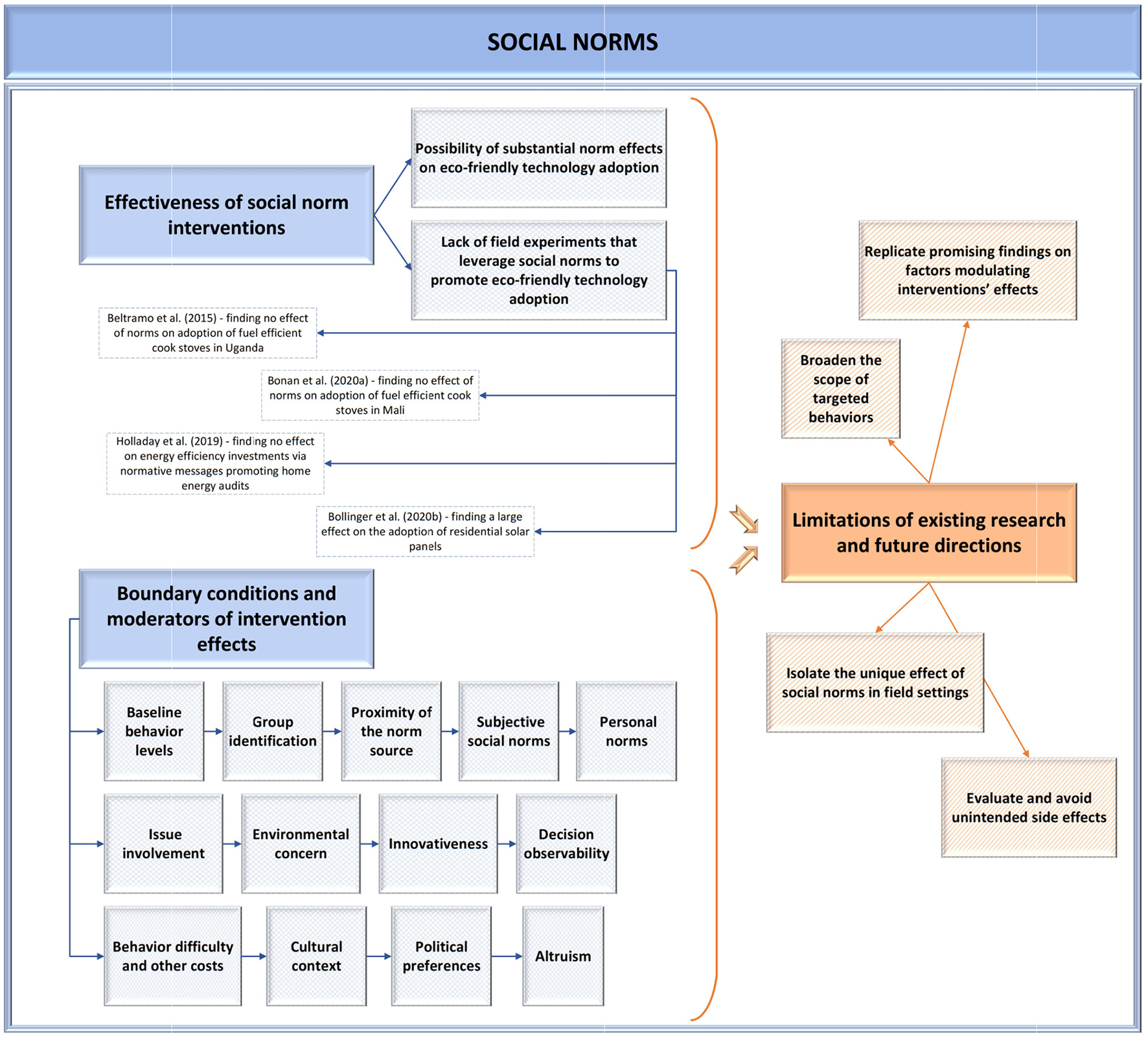
Overview of findings on social norms.
Figure A2
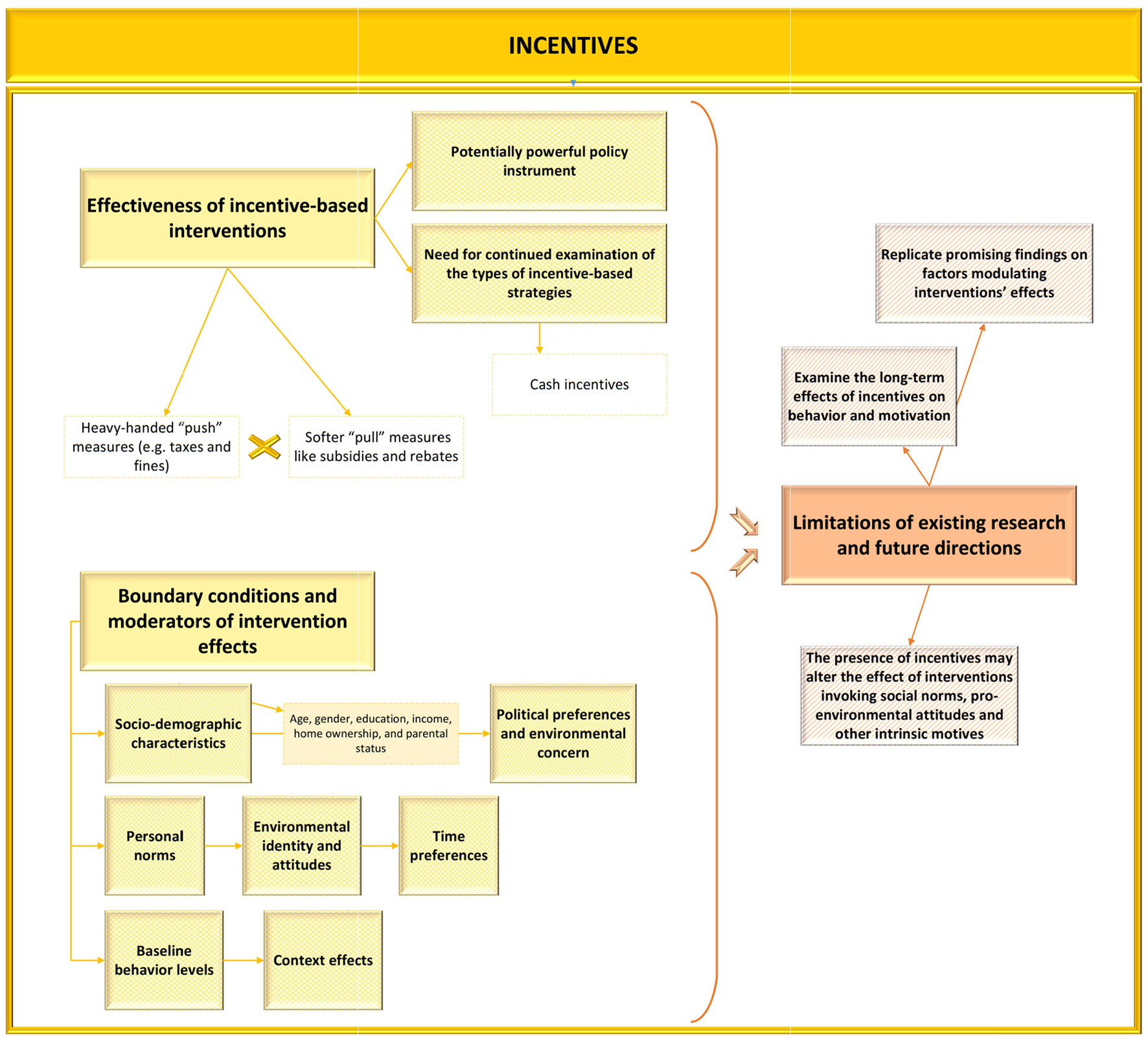
Overview of findings on incentives.
Figure A3
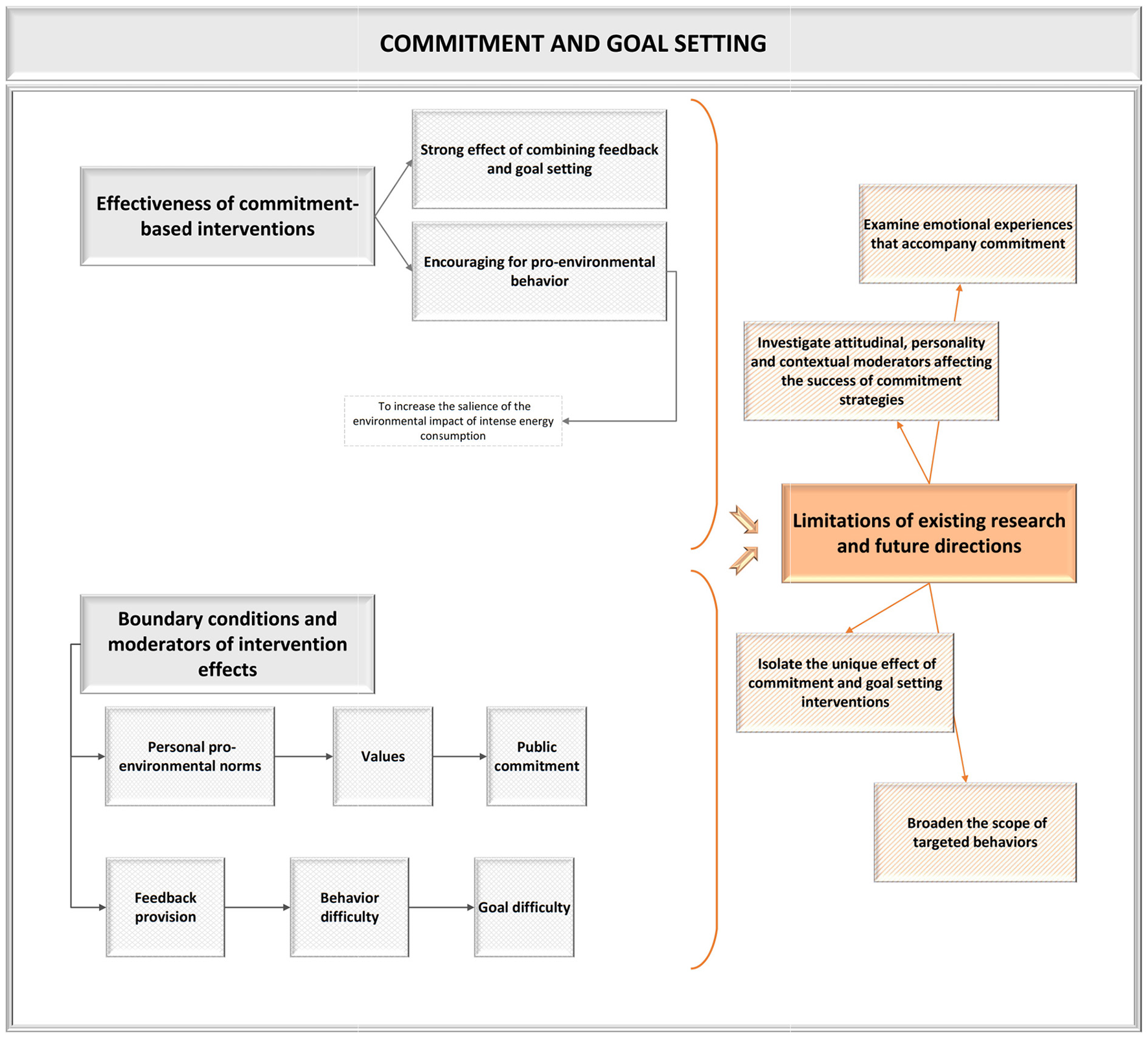
Overview of findings on commitment.
Appendix: Search string used to search the Web of Science database
TOPIC: ((norm* OR peer* OR “social comparison*” OR “social influence*” OR “social feedback” OR “social nudge*” OR “social information” OR “social pressure” OR “social signal*” OR “social group*” OR “group comparison*” OR “group feedback” OR “group pressure” OR conform* OR “home energy report*” OR “model*ing” OR “neighbo*” OR “block leader*” OR commit* OR goal* OR pledge* OR “self*control” OR “self*regulation” OR incentiv* OR pric* OR money OR pay* OR cash OR cost* OR sale* OR discount* OR expenditure* OR financ* OR monetary OR pecuniary OR economic OR subsid* OR rebate* OR tariff* OR tax* OR credit* OR reward* OR penal* OR sanction* OR gain* OR loss* OR “time*of*use” OR “critical*peak” OR “peak*demand” OR “peak*time” OR “real*time pric*” OR “electricity bill*” OR “energy bill*” OR waive*) AND (“field experiment*” OR “field stud*” OR “field trial*” OR “randomized controlled trial*” OR RCT OR pilot* OR “program* evaluation*”) AND (energy OR electric* OR renewable* OR wind OR solar OR consum* OR conserv* OR curtail* OR reduc* OR “energy saving*” OR “electricity saving*” OR “energy us*” OR “electricity us*” OR “energy demand” OR “electricity demand” OR “demand management” OR “demand response” OR invest* OR adopt* OR purchas* OR buy* OR subscri* OR uptake OR install* OR weatheariz* OR heat* OR cooling OR “air conditioning” OR energy audit* OR “electric car*” OR “electric vehicle*” OR e-car* OR hybrid* OR “electric bicycle*” OR e-bike* OR “energy*efficien*” OR “smart meter*” OR technolog* OR appliance* OR photovoltaic*)) Refined by: WEB OF SCIENCE CATEGORIES: (ENVIRONMENTAL SCIENCES OR GREEN SUSTAINABLE SCIENCE TECHNOLOGY OR PSYCHOLOGY OR ENERGY FUELS OR ENGINEERING ELECTRICAL ELECTRONIC OR TRANSPORTATION SCIENCE TECHNOLOGY OR MANAGEMENT OR EDUCATION SCIENTIFIC DISCIPLINES OR ENGINEERING ENVIRONMENTAL OR BUSINESS OR ENVIRONMENTAL STUDIES OR ECONOMICS OR OPERATIONS RESEARCH MANAGEMENT SCIENCE OR MULTIDISCIPLINARY SCIENCES OR TELECOMMUNICATIONS OR INFORMATION SCIENCE LIBRARY SCIENCE OR BEHAVIORAL SCIENCES OR ENGINEERING MULTIDISCIPLINARY OR PSYCHOLOGY APPLIED OR SOCIAL SCIENCES INTERDISCIPLINARY OR PSYCHOLOGY MULTIDISCIPLINARY OR EDUCATION EDUCATIONAL RESEARCH) Timespan: All years. Indexes: SCI-EXPANDED, SSCI, A&HCI, CPCI-S, CPCI-SSH, ESCI.
Summary
Keywords
energy conservation, energy efficiency, social norms, incentives, commitment, goal setting, interventions, moderators
Citation
Vesely S, Klöckner CA, Carrus G, Tiberio L, Caffaro F, Biresselioglu ME, Kollmann AC and Sinea AC (2022) Norms, prices, and commitment: A comprehensive overview of field experiments in the energy domain and treatment effect moderators. Front. Psychol. 13:967318. doi: 10.3389/fpsyg.2022.967318
Received
12 June 2022
Accepted
13 September 2022
Published
08 November 2022
Volume
13 - 2022
Edited by
Margareta Friman, Karlstad University, Sweden
Reviewed by
Hossam A. Gabbar, Ontario Tech University, Canada; Herre Van Oostendorp, Utrecht University, Netherlands
Updates
Copyright
© 2022 Vesely, Klöckner, Carrus, Tiberio, Caffaro, Biresselioglu, Kollmann and Sinea.
This is an open-access article distributed under the terms of the Creative Commons Attribution License (CC BY). The use, distribution or reproduction in other forums is permitted, provided the original author(s) and the copyright owner(s) are credited and that the original publication in this journal is cited, in accordance with accepted academic practice. No use, distribution or reproduction is permitted which does not comply with these terms.
*Correspondence: Stepan Vesely stepan.vesely@ntnu.no
This article was submitted to Environmental Psychology, a section of the journal Frontiers in Psychology
Disclaimer
All claims expressed in this article are solely those of the authors and do not necessarily represent those of their affiliated organizations, or those of the publisher, the editors and the reviewers. Any product that may be evaluated in this article or claim that may be made by its manufacturer is not guaranteed or endorsed by the publisher.