Abstract
Although a large body of research has developed on corrective feedback in second language acquisition (SLA) in the past 30 years, there are few empirical studies examining the relationship between feedback timing and SLA. To begin to address this gap, this study reviews the existing research on the impact of corrective feedback timing on SLA. It aims to investigate the possible influential factors that might have led to inconsistent research findings and theoretical explanations. The review was conducted according to PRISMA-statement through searches in peer-reviewed electronic databases including Social Sciences Citation Index (SSCI), Scopus, EBSCO, which includes ERIC and the British Education Index and gray literature (doctoral dissertations in ProQuest). Twenty studies conducted and published between 2006 and 2021 were finally analyzed to reveal the current trends. The results of this review indicate that there is no definite answer to the question of when errors in L2 should be treated. The difficulty of drawing a conclusive finding can be attributed to the communicative modality examined and variations in research design, including the explicitness of feedback and various ways of measuring feedback timing. No certain theoretical framework has been applied to guide these studies and they have applied different theoretical explanations to interpret the inconsistent results. The review highlights the need to continue to investigate the effectiveness of corrective feedback under different timing conditions. In addition, it discusses some research gaps that should be addressed in future studies and suggests future research directions in the area of feedback timing.
1. Introduction
Corrective feedback (CF) ‘refers to any signal that a learner’s utterance may be erroneous in some way’ (Nassaji and Kartchava, 2021, p. 1). It is also known as negative evidence in SLA literature (Gass, 2003). Following decades of CF research, there has been a consensus that CF is beneficial to L2 learning. The most widely investigated topics include what types of CF are more effective (Ammar and Spada, 2006; Sheen, 2010), what factors influence the effectiveness of CF (Sheen, 2008; Goo, 2012; Li, 2014), the positive effects of CF on cognitive processes such as attention (Moret-Tatay et al., 2016, 2022) and teachers’ and learners’ beliefs about CF (Li, 2017), etc. Despite the abundance of the acceptance of feedback in L2 learning, the timing of correction is still a point of contention among researchers. CF timing refers to when errors in L2 are treated (Quinn, 2021). CF provided directly after an error is made is immediate CF, while CF provided at a later time is delayed CF. Dated back to the first synthesis of corrective feedback research, the second fundamental question raised by Hendrickson (1978) is “when should learners’ errors be addressed?” (p.389). However, it was not until recent years did researchers start to investigate CF timing as an independent variable.
As far as research is concerned, many studies have examined the effect of feedback timing in the field of cognitive psychology (Kulik and Kulik, 1988; Butler et al., 2007; Metcalfe et al., 2009; see Nakata, 2014 for a review). It was not until recent years did researchers begin to directly compare the efficacy of immediate and delayed feedback on L2 learning. Among these few studies, they have not shown a clear difference between the two timings of feedback. The investigation of CF timing in SLA is recent popularity probably because it is widely accepted that immediate CF is a common practice in oral CF in L2 learning and teaching. The motivation to investigate how delayed CF facilitates L2 learning and the comparative effectiveness with immediate CF is comparatively less strong (Quinn and Nakata, 2017). Also, there is a lack of widely accepted theoretical explanations about how L2 learners could benefit from delated CF. However, from a pedagogical perspective, teachers and practitioners care much about when feedback should be provided. On the whole, corrective feedback in L2 has been widely researched but the key question of when to provide CF remains unanswered. In this case, a general overall picture of the evidence in a CF timing is needed to direct future research efforts, and more importantly an accurate picture of existent research, and methodological issues are required. A systematic review of CF timing could investigate international empirical research evidence to inform future practice and research.
2. Theoretical explanations
The timing of corrective feedback refers to ‘the juncture in the instructional sequence when learners’ errors are addressed’ (Quinn and Nakata, 2017. p.35). The optimal time to provide CF has attracted theoretical debates, but most SLA theories do not make overt claims about the ideal time to provide CF. The effectiveness of immediate feedback can firstly be explained by behaviorism, which treats feedback as a device that corrects errors and reinforces correct behaviors (Skinner, 1953). Learning is thus viewed as habit formation and errors should be immediately corrected, otherwise, they could turn into bad habits. The utility of immediate correction is also advocated by the skill acquisition theory (SAT; Anderson, 1983; DeKeyser, 2015). According to SAT, explicit knowledge becomes implicit knowledge through practice and researchers advocate the use of prompts. Prompts, according to Ranta and Lyster (2007) are more likely to encourage learners to retrieve a learned grammar rule and reattempt to produce the language more accurately with that rule in mind and thus can facilitate the proceduralization of previous knowledge. Therefore, when aiming to facilitate the proceduralization of the knowledge, CF must be provided during communicative interaction, and during not after communicative tasks. As such, it seems that SAT explains the effectiveness of immediate CF. The third theoretical support for immediate CF is the immediate cognitive comparison. Certain types of CF such as recasts or reformulations provide learners with the opportunities to have an immediate cognitive comparison between their errors and the accurate models (Doughty, 2001). Doughty (2001) further argues that the effective comparison should occur within the “cognitive window of opportunity” (p. 257), which is about 40 s later as long as the learner could hold a representation of the propositional message. As this theoretical support highlights the importance of immediate CF after errors during communication, it also supports the beneficial role of immediate CF in SLA. The last theory that can be drawn on to support immediate CF is Sociocultural theory (SCT; Aljaafreh and Lantolf, 1994). According to SCT, CF should be provided in a tailored, graduated and contingent way, which can only be provided in the learners’ zone of proximal development (ZPD). In this case, CF should be dynamically provided as a tailored response to learners’ changing needs.
On the other hand, the theoretical arguments for the utility of delayed CF are comparatively less. A cognitively oriented model related to CF timing is Transfer Appropriate Processing (TAP; Morris et al., 1977; Lightbown, 2008), which indicates that immediate and delayed CF may result in the development of different types of L2 knowledge. Based on this theory, the context where learned knowledge is retrieved and applied must be consistent with the context where the knowledge is acquired (Li, 2020). As a result, providing immediate CF that is integrated into synchronous oral or written communication may lead to an increase in procedural grammar knowledge while providing delayed CF following communicative discourse may lead to an increase in explicit knowledge. Another theoretical perspective that supports the advantage of delayed feedback is Spacing Theory, which emphasizes that maximal learning occurs through ‘repeated presentations that are spaced (distributed) as opposed to massed’ (Butler et al., 2007, p.274). In this case, massed instruction provided in immediate feedback imposes more cognitive burden than spaced instruction in delayed or separating feedback. The reactivation and reconsolidation theory (Nader and Einarsson, 2010) in cognitive psychology also predicts the advantage of delayed over immediate feedback. It argues that when a learner is reminded of a previously learned pattern, a long-term mental representation of it is activated. The memories become labile and susceptible to influence and learners’ labile state allows for reconsolidation, which is retrieval-induced and occurs in both declarative and procedural memory systems. Quinn (2014) argues that although both immediate and delayed CF can stimulate the retrieval and reconsolidation of linguistic forms, delayed CF is more effective since more time can be allocated for both retrieval and reconsolidation to take place.
In summary, despite the differences in the theoretical positions supporting immediate or delayed CF, they provide possible explanations as to why immediate or delayed CF is comparatively more effective. However, deciding when to provide CF is an empirical question which has received little investigation.
3. Methodology
The principal aim of this review was to analyze and synthesize empirical literature on feedback timing in SLA. When there are too few studies to yield data in an immature research field, it has been argued that a literature review may be less valuable. A systematic review rather than a scoping review was conducted. Scoping reviews may be conducted as a first step of systematic reviews (Petticrew and Roberts, 2006) to “identify knowledge gaps, scope a body of literature, clarify concepts or to investigate research conduct” (Munn et al., 2018, p.1). However, this study takes a further step to investigate conflicting results of each study and identify trends in the current evidence to provide suggestions for future studies. In this situation, a systematic review can highlight the absence of data, and point to the fact that any understanding is based on limited empirical underpinnings. Thus, this study conducts a systematic review, which ‘adheres closely to a set of scientific methods that explicitly aim to limit systematic error (bias), mainly by attempting to identify, appraise and synthesize all relevant studies’ (Petticrew and Roberts, 2006, p. 9). The design and reporting of the results of this systematic review were conducted according to the PRISMA statement (Moher et al., 2009, 2015). The research protocol used included designing research questions, creating the search strategy to collect studies; a selection of scientific databases, criteria for the inclusion and exclusion for studies; and an approach for selection, extraction, and analysis.
3.1. Research questions
This systematic review aimed to answer the following research questions:
-
What are the main influential factors that affected the comparative effectiveness of immediate and delayed feedback in the literature?
-
What theoretical explanations have been applied to explain the results?
3.2. Research strategies
Searching for the appropriate studies is the most important step in conducting a systematic review. Both published and unpublished studies including PhD dissertations were included to help alleviate publication bias (Rosenthal, 1979). The research of the international literature was conducted in the following peer-reviewed electronic databases including Social Sciences Citation Index (SSCI), Scopus, EBSCO, which includes ERIC and the British Education Index Index and gray literature (doctoral dissertations in ProQuest). The World Wide Web (like Google academic search) was also used as an additional resource to search for relevant empirical studies on feedback timing in SLA. We also searched the reference lists of records selected and forward citations to identify all relevant publications.
These databases include leading publications on SLA and thus, are considered to be reliable for searching the latest research in this field. The literature search was conducted from October 5, December 2021 to August 6, 2022. We used the following key words: (feedback OR corrective feedback OR CF) AND (feedback timing OR immediate feedback OR delayed feedback OR synchronous computer-mediated communication OR SCMC OR asynchronous computer-mediated communication OR ACMC) AND (L2 learning OR second language learning OR second language acquisition OR SLA OR language), etc. The generality of the keywords was purposely selected to include all the categories of feedback and feedback timing identified in the previous literature.
There were no time limitations among the publications of the articles, books, book chapters, or doctoral dissertations. The search covered titles, authors, abstracts, and keywords to minimize irrelevant articles. The selection strictly followed the inclusion and exclusion criteria. The two researchers searched the databases independently. They screened the abstracts to determine which studies fitted the inclusion criteria. Then these studies were examined more closely with a reading of the full papers in order to confirm their eligibility for the subsequent analysis. All these studies were examined by the two researchers to ensure consensus in their adequacy. Employing Cohen’s Kappa, inter-rater reliability was estimated as 0.96 indicating a high degree of consensus between two researchers. The few disagreements were fixed through a consensus between researchers referring to the source data.
3.3. Inclusion and exclusion criteria for studies
To be included in this systematic review, this study followed a set of predetermined criteria for the inclusion and exclusion of articles. Studies should follow the following combined criteria:
-
The study had to have been published in English.
-
Only intervention or experimental studies were included.
-
The study must have compared the effects of immediate and delayed feedback in L2 learning.
-
The effects of feedback timing should have been measured.
-
The study should have been published in a peer-reviewed scientific journal or be a book chapter or an unpublished doctoral dissertation.
The following exclusion criteria were applied during the selection process:
-
The study was written in a language other than English.
-
The study reported either only the effectiveness of immediate feedback or only delayed feedback without comparing them.
-
The study was published in a journal that was not peer-reviewed or was an MA dissertation/thesis, systematic review, meta-analysis or commentary, conference proceedings, or working paper.
This first search identified a total of 109 potentially eligible articles. After removing duplicates and initial screening of the titles, 57 studies remained in the pool. The two authors then analyzed the titles and abstracts separately. Then they discussed the results of the reviewed studies and excluded 29 studies, leading to 28 studies to assess for eligibility based on full-text analysis. The first and second author read the 28 full-text studies and independently analyzed whether they met the inclusion/exclusion criteria. After independent analysis, the authors discussed the results to determine which studies should be included in the synthesis. The full-text analysis led to the elimination of 8 studies: 3 because of applying different modalities in immediate and delayed CF conditions, 2 because of using improper ways of measuring the effectiveness of CF, and 2 because of not comparing the practice of feedback (see Figure 1 for the flow chart). 20 studies were included in the systematic review (see Table 1 for details). According to Petticrew and Roberts (2006) and Gough et al. (2012), the number of studies included in a systematic review mainly depends on the research topic and all available studies related to that question. Although the number of included studies seems to be small, Gough et al. (2012) argued that to find the few that are on topic, a lot of irrelevant studies have to be sifted through. Given feedback research almost invariably examines immediate feedback, feedback timing is a narrow scope and a new territory in feedback research and in SLA research in general. In this case, the amount of supportive evidence available is limited (Table 2).
Figure 1
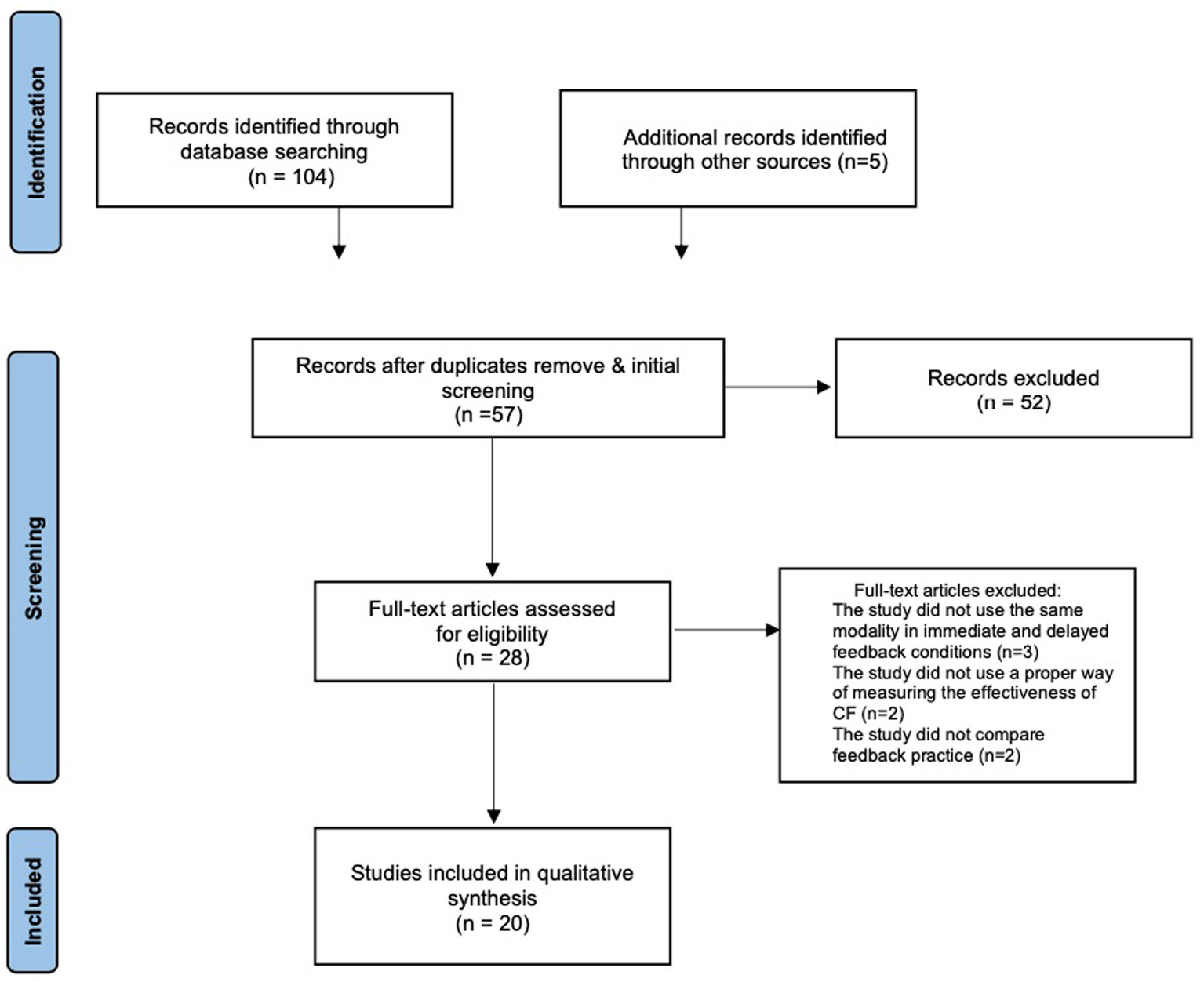
PRISMA flow chart of study selection.
Table 1
| Author and year | Sample | L1 → L2 | Communication mode | Feedback type | Feedback timing | Key findings |
|---|---|---|---|---|---|---|
| Arroyo and Yilmaz (2017) | 45 adults | English→ Spanish | Text-based CMC | Reformulations | Immediate CF: immediately following the non-target like productions during task; delayed CF: at the end of the task | Immediate feedback was more effective than delayed feedback |
| Arroyo and Yilmaz (2018) | 45 adults | English→ Spanish | Text-based CMC | Reformulations | Immediate CF: immediately following the non-target like productions during task; delayed CF: at the end of the task | Immediate feedback was more effective than delayed feedback in OPT |
| Canals et al. (2021) | 52 adults | Spanish→ English | Video-based CMC | Immediate CF: explicit CF; delayed CF: edited video recording of the interaction | Immediate CF: during the task delayed CF: 24 h later | No significant differences between immediate and delayed CF |
| Fu and Li (2019) | 106 teenagers | Chinese → English | Face-to-face oral | Corrective recasts | Immediate CF: session 1 delayed CF: session 3 | Immediate CF was more facilitative than delayed CF |
| Fu and Li (2020) | 145 teenagers | Chinese → English | Face-to-face oral | A prompt followed by a recast | Immediate CF: in the first session delayed CF: in the final session | Immediate CF was more facilitative than delayed CF |
| Guo (2018) | 60 undergraduates (17–21 years old) | ? → English | Face-to-face oral | Proactive approach of peer-review and whole-class discussion | Immediate CF: after the initial test delayed CF: at the beginning of the next class session | Delayed CF was more facilitative than immediate CF |
| Henderson (2021) | 30 adults | English→ Spanish | Text-based CMC | Error repetition + recast | Immediate CF: immediate after an error delayed CF: when the task was finished | No significant differences between immediate and delayed CF |
| Henshaw (2011) | 102 adults | English→ Spanish | CALL | Explicit feedback+ one-sentence metalinguistic explanation | Immediate CF: immediate after each response submission; first delayed CF: immediately after all 40 responses; second delayed CF: 24 h after all responses | No significant differences between immediate and delayed CF |
| Lavolette (2015) | 118 adults | Chinese+ Arabic → English | CALL | With or without metalinguistic information | Item-by-item or end-of-test | No significant differences between immediate and delayed CF |
| Lavolette et al. (2015) | 32 adults | Majority Chinese→ English | CALL | Copying and pasting their work from TextEdit into Criterion, then clicking a button to submit it | Immediate CF: immediate after writing; delayed CF: 1 to 3 weeks after writing | No significant differences between immediate and delayed CF |
| Li et al. (2016a) | 120 teenagers | Chinese → English | Face-to-face oral | Prompts + recasts | Immediate CF: immediate after an error delayed CF: after the second oral task | Immediate CF was more facilitative than delayed CF in lower-level learners |
| Li et al. (2016b) | 120 teenagers | Chinese → English | Face-to-face oral | Prompts + recasts | Immediate CF: immediate after an error delayed CF: after the second oral task | No difference in EIT scores, immediate CF was found more effective than delayed feedback in GJT |
| Nakata (2014) | 98 teenagers | Japanese→ English | CALL | Immediate CF: The target English word, Japanese translation, and learners’ response were given in the feedback window. Feedback also indicated whether the response was correct, partially correct, or incorrect. delayed CF: Feedback for all eight delayed feedback items was presented one at a time | Immediate CF: immediate after each response; delayed CF: not given until the end of each retrieval phase | No significant differences between immediate and delayed CF |
| Quinn (2021) | 90 adults | Various→ English | Face-to-face oral | Prompt + reformulation | Immediate CF: Immediate after an error; delayed CF: at the end of the task | No significant differences between immediate and delayed CF |
| Rahimi and Vahid Dastjerdi (2012) | 20 teenagers | Iranian→ English | Face-to-face oral | Not mentioned | Immediate CF: during the speech delayed: after finishing the speech | Delayed CF has positive effect on fluency and accuracy but not on complexity |
| Shang (2017) | 44 adults | Chinese → English | Text-based SCMC+ CALL | Immediate CF: CALL delayed CF: CMC text-based from peers | Immediate CF: immediate after the writing delayed CF: at the convenience of the learners | ACF was more effective than SCF |
| Shintani (2015) | 2 adults | Japanese → English | Text-based CMC | Focused direct feedback | Synchronous CF: immediate after an error; Asynchronous CF: after the writing task | SCF was more effective than ACF |
| Shintani and Aubrey (2016) | 68 adults | Japanese → English | Text-based CMC | Focused direct feedback | Synchronous CF: immediate after an error; Asynchronous CF: after the writing task | SCF was more effective than ACF |
| Varnosfadrani (2006) | 28 immediate level adults | Iranian→ English | Face-to-face oral | Immediate CF: explicit feedback delayed CF: a reminder of the error + explicit CF | Immediate CF: during the interview delayed feedback: after the interview | No significant differences between immediate and delayed CF |
| Yilmaz and Sağdıç (2019) | 43 adults | English→ Spanish | Text-based CMC | Reformulations | Immediate CF: immediate after the errors; delayed CF: at the end of the task | Immediate CF was more facilitative than delayed CF in OPT |
Studies included in the systematic review.
Table 2
| Research questions | Summary of main results |
|---|---|
| RQ 1: What are the main influential factors that affected the comparative effectiveness of immediate and delayed feedback in the literature |
1. Communicative modality
|
2. The explicitness of the feedback
|
|
3. Feedback timing of delayed feedback
|
|
| RQ 2: What theoretical explanations have been applied to explain the results? |
|
Summary of the main results.
This study evaluated the quality of the selected studies based on the quality assessment tool proposed by Kmet et al. (2004). Accordingly, a total of 14 formal criteria were used for assessing quantitative studies, such as sufficient description of questions, evident and appropriate study design, sufficient details of results reported, etc. A total of 10 formal criteria were applied to the assessment of qualitative studies, such as clear context for the study, and clearly described and systematic data collection methods. The inter-rater agreement ranged from 70 to 100%, which is of acceptable quality. If the second researcher disagreed with the first researcher, the two of them discussed the issue with each other until they reached a consensus. No study was excluded based on the quality ratings.
4. Limitations
Our systematic review of feedback timing has certain limitations. First, we have only searched and included literature written in English, and possibly overlook some articles with new ideas and methods in other languages. Furthermore, although we have conducted a comparatively thorough search, we may have missed articles that examine the same issue. For the above reasons, we do not claim our review is comprehensive due to the methods applied that could have been more systematic and well-designed. However, we do feel that this review is the first try to focus on both empirical and theoretical issues in feedback timing in SLA.
5. Results
5.1. Publication year
Among the 20 studies selected for systematic view, the earliest experimental feedback timing research identified in this study was published in 2006 and the latest in 2021. One article was published in 2006, one article was published in 2011, one article was published in 2012, two articles were published in 2014, three articles were published in 2015, three articles were published in 2016, two articles were published in 2017, two articles were published in 2018, two articles were published in 2019, one article was published in 2020, and two articles were published in 2021. From 2006 to 2011, there were few numbers of research outputs on feedback timing in L2 learning. 2012 saw a gradual increase with respect to the number of scholarly publications in this area, which was likely due to the development of computer-assisted language learning (CALL) and the advantage of providing both immediate feedback and delayed individualized feedback (see Figure 2 for more details).
Figure 2
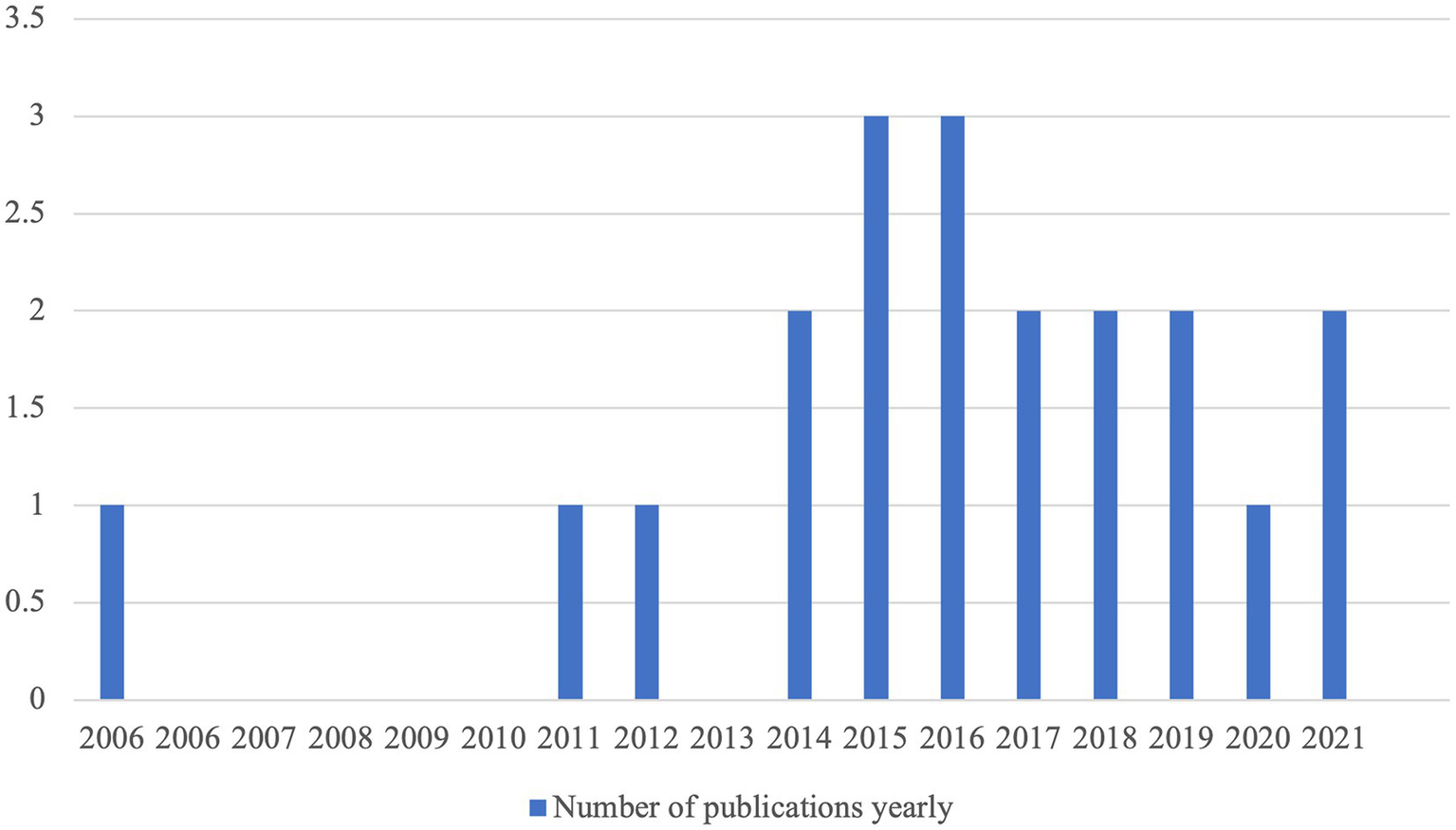
The yearly distribution of the publications included in this systematic review (2006–2021).
Considering the importance of the question “when should learner errors be corrected,” and the timing issue was treated addressed in the 1970s (see Hendrickson, 1978, p.389), the total number of 20 was smaller than previously expected.
5.2. Descriptive analysis
Before performing the analysis, we conducted a descriptive analysis to summarize the trends and issues of feedback timing in the literature. Of the 20 articles, all but one used quantitative data collection methodologies in their exploration of the impact of feedback timing by applying experimental or quasi-experimental designs. The majority of the presented studies used the pretest-posttest-delayed posttest designs (11 studies), 4 studies used pretest-posttest designs, and 4 studies only applied posttests or post measurements but did not have pre-tests to ensure no significant differences between experimental and control groups. For instance, since Varnosfadrani (2006) compared the effects of immediate and delayed CF on learners’ performance of oral English in tailor-mased tests which were created after activities had been finished, the researcher was not able to provide pre-tests. Rahimi and Vahid Dastjerdi (2012) investigated the comparative effectiveness of immediate and delayed error correction methods in developing learners’ complexity, fluency, and accuracy (CAF) in speech. CAF measures as post-tests were developed and showed that delayed feedback has positive effect on fluency and accuracy but not on complexity. The lack of pretest makes it difficult to determine whether the errors are systematic or slips of the tongue. Lavolette et al. (2015) and Shang (2017) investigated English writing by measuring the revised essays and the syntactic complexity of the revised essays, respectively. The above-mentioned studies all considered oral production or written production as a whole and did not use pretests. The lack of pretests of these studies to compare the different feedback timing conditions is problematic because it is impossible to know if the delayed CF participants were more capable prior to the CF treatment.
There is only one case study (Shintani, 2015) which investigated how two L2 learners responded to synchronous and asynchronous corrective feedback using Google Docs. By analyzing the texts and interview data, Shintani (2015) reported that self-correction was more successful in the SCF condition compared with ACF condition and focusing on meaning and form took place contiguously in the SCF condition while it occurred separately in the ACF condition.
5.3. Influential factors
Of the 20 studies, half found immediate feedback outperformed delayed feedback in the post-tests or delayed post-tests, or both. Seven of the comparative analyses found no differences between immediate and delayed CF. Only three studies concluded that delayed CF was more effective than immediate feedback, but they share limitations due to internal validity issues (Rahimi and Vahid Dastjerdi, 2012; Shang, 2017; Guo, 2018). None of the three studies had control groups that did not receive CF. It can be argued that due to the lack of a control group, the improvement that occurs over time cannot be dependably attributed to CF treatments. Moreover, there was no pretest in Shang (2017) study. In sum, studies have produced mixed results regarding the relative effectiveness of immediate and delayed CF on L2 learning. The following review will mainly focus on the factors influencing the different results.
5.3.1. Communicative modality
Of the presented studies examining the role of feedback in SLA, 40% were conducted in face-to-face communication (eight studies), 30% (six studies) used text-based feedback, 20% (four studies) used computerized feedback provided by computer-assisted language learning (CALL) software, one study used video-based feedback, and one study used text-based feedback as delayed feedback and computerized feedback as immediate feedback.
When studies are conducted in face-to-face oral communication, the findings are mixed. Four studies found immediate feedback condition outperformed the delayed feedback condition (Li et al., 2016a,b; Fu and Li, 2019, 2020), two studies found that delayed feedback was comparatively more effective (Rahimi and Vahid Dastjerdi, 2012; Guo, 2018), and two studies found no difference between the effectiveness of immediate and delayed feedback (Varnosfadrani, 2006; Quinn, 2014).
When studies are conducted in text-based CMC, immediate feedback is argued to be more beneficial to learners than delayed feedback (Shintani, 2015; Shintani and Aubrey, 2016; Arroyo and Yilmaz, 2017, 2018; Yilmaz and Sağdıç, 2019). These studies unanimously agreed that the advantages found for the immediate CF on the post-test might be that learners in this timing condition were able to make a cognitive comparison. Only one study found no significant differences between immediate and delayed feedback when learning Spanish vocabulary (Henderson, 2021). Henderson (2021) argued that ‘the salient nature of the modality, type and target of the CF may have neutralized a timing effect’ (p. 100).
When studies are conducted in the CALL environment, the results are the same. Feedback timing has been found to have little effect on language learning, such as grammar learning (Henshaw, 2011; Lavolette et al., 2015), vocabulary learning (Nakata, 2014), and writing as a whole (Lavolette et al., 2015). As Lavolette et al. (2015) suggested, in this communicative modality, the different timing did not distinguish the participants’ cognitive resources demands since they were able to go back and see the written text when revising in both feedback timing conditions; in other words, both immediate and delayed conditions involved similar cognitive processes.
As for the only video-based CMC study, Canals et al. (2021) also found no statistically significant differences between the two feedback timing groups. They investigated the relative effectiveness of immediate and delayed CF on grammar acquisition by Spanish EFL learners. The delayed feedback provided in this study was contextualized and feedback instances are spaced or naturally spread throughout the interaction. The way of providing delayed feedback with needed information about the target language in context thus improved the effectiveness of delayed CF.
Shang (2017) compared synchronous CALL feedback and asynchronous peer feedback. The results showed that asynchronous peer feedback was found more effective than synchronous computerized feedback when comparing students’ syntactic complexity in writing. However, a factor that could account for this finding is the modalities and feedback providers investigated, which means how CALL affected synchronous feedback and how peers in the CMC context affected asynchronous feedback.
5.3.2. The explicitness of the feedback
CF treatments were operationalized in different types in the presented studies, such as explicit direct feedback, focused direct feedback, reformulations, partial reformulations, prompts plus recasts, and error repetitions plus recasts, etc. These feedback types can be classified into three categories including explicit, implicit, or hybrid. The majority of the presented studies provided explicit feedback in both feedback conditions (n = 10), six studies applied hybrid feedback, and three studies used implicit feedback. One study did not clarify what CF types, including the explicitness of the feedback (Rahimi and Vahid Dastjerdi, 2012).
Among the 10 studies providing explicit feedback, most studies found no difference between the effectiveness of immediate and delayed CF (n = 6). CALL environment tends to provide explicit feedback to language learners (Henshaw, 2011; Nakata, 2014; Lavolette, 2015; Lavolette et al., 2015). Henshaw (2011), for instance, investigated the effects of timing on written CF and concluded that written CF was effective over time, regardless of its timing. It has been argued that the explicitness of the feedback was especially helpful for learners to confirm or refute interlanguage hypotheses, given that several studies have shown an advantage for explicit feedback, especially in CALL (e.g., Rosa and Leow, 2004). Likewise, those studies that applied more explicit types of feedback in other modalities also tend to find no difference between the two feedback conditions (Varnosfadrani, 2006; Canals et al., 2021). For instance, Canals et al. (2021) investigated the relative effectiveness of immediate and delayed CF in video-based CMC and argued the feedback type used in the study, i.e., explicit corrections, might have contributed to no statistical differences between the two feedback timing conditions. Because explicit corrections are relatively direct about the ungrammaticality of the learner’s utterance, they might have promoted the mental comparison between the error and correct alternative more reliably. Shintani (2015) and Shintani and Aubrey (2016), both of which applied focused direct feedback, which is explicit in nature, found SCF was more effective than ACF. This is probably due to the text-based modality they used, which has been discussed in Subsection 5.1.1. As for the two studies that used explicit feedback and found ACF was more effective, proactive feedback of Guo (2018) delayed feedback is likely to be the main cause. Shang (2017) finding is less convincing by comparing feedback provided by different providers, CALL software and peers, in different timing conditions, which can be regarded as a limitation since the difference of feedback providers could act as a confounding variable.
As for studies using implicit feedback, that is, reformulations (Arroyo and Yilmaz, 2017, 2018; Yilmaz and Sağdıç, 2019), it has been consistently found that immediate feedback was comparatively more effective. In oral communication, for instance, Arroyo and Yilmaz (2017, 2018) found that the immediate feedback group outperformed the delayed feedback group in oral production. They argued that the implicit nature of the feedback treatment (declarative reformulations) might lead to the ineffectiveness of the delayed reformulations, thus, they recommended a more explicit or salient treatment when providing delayed feedback.
The six studies providing hybrid CF tend to find that immediate feedback was more effective than delayed feedback (Li et al., 2016a,b; Fu and Li, 2019, 2020). While two exceptions are Quinn (2014) and Henderson (2021), both of which found no difference between the two CF timing conditions. In Quinn (2021) study, a recast was provided regardless of whether the learner was able to correct themselves, thus making the actual feedback more explicit. As for Henderson (2021), although a hybrid CF was claimed to be used, the researcher admitted the salient nature of the CF type, because the delayed corrective intent was perceived by learners.
5.3.3. Feedback timing of delayed feedback
The exact time of providing delayed feedback is another important issue to consider when investigating feedback timing. In the presented studies, delayed CF could refer to the CF that is provided after a treatment task (e.g., Varnosfadrani, 2006; Rahimi and Vahid Dastjerdi, 2012; Quinn, 2014), CF provided 24 h later (e.g., Canals et al., 2021), or CF provided several days later (e.g., Lavolette et al., 2015).
Henshaw (2011) is the only study that has the length of delay as an independent variable, that is, CF immediately after all 40 responses or CF 24 h after all responses, but no statistically significant differences were found between different timing conditions.
The majority of the studies used delayed feedback which refers to the CF provided after a task or an interview (n = 14). Among those studies providing delayed feedback at the end of the task or after finishing their speech, the results tend to support great benefits for language learning in immediate feedback condition (Shintani, 2015; Shintani and Aubrey, 2016; Li et al., 2016a,b; Arroyo and Yilmaz, 2017, 2018; Yilmaz and Sağdıç, 2019; Fu and Li, 2020). A total of 5 studies found no difference between the effects of the two feedback timing conditions. Varnosfadrani, 2006; Nakata, 2014; Quinn, 2014; Lavolette, 2015; Henderson, 2021). Only one study found error correction provided after participants’ speech had a more positive effect on fluency and accuracy but not on complexity in oral performance than immediate feedback (Rahimi and Vahid Dastjerdi, 2012).
The delayed feedback in three studies was provided a day or several days later. One study (Shang, 2017) using peer feedback required students to provide delayed feedback within 3 days but did not specify how delayed the feedback was. As to studies providing delayed feedback 1 day or several days later, the findings are more consistent since no difference was found between immediate and delayed feedback except in Guo (2018) study. The results provided evidence to the spacing effect hypothesis the delay provides another distributed episode of encoding to solidify the semantic mapping, which in turn, contributes to retention (Butler et al., 2007). In Lavolette et al. (2015) study, the delayed feedback was provided to students as computer-assisted feedback several days (1 to 3 weeks) after their writing essays. The results indicated that the condition – delayed versus immediate – did not affect students’ response rates nor their accuracy on the first drafts. Similarly, in the study by Canals et al. (2021), the delayed feedback group received the feedback 24 h later. In both the grammaticality judgment test and the oral production task, the results showed no differences between the two feedback timing groups.
5.4. Theoretical explanations applied
There have been various theoretical explanations for different views about when to provide CF. Since feedback timing is an emerging area in SLA research, the present studies share the similarities that there was not a single or main theoretical framework to frame these studies before conduction, in other words, none of them was strongly theoretically oriented.
Six studies (33.3%) did not discuss any theoretical explanations in their studies. Others only reviewed theoretical explanations or discuss theoretical implications in certain sections. Moreover, there are different theoretical explanations for the results about when to provide CF. We mainly identified five categories for theoretical explanations that have been applied in the selected studies.
The first theoretical explanation is immediate cognitive comparison (Quinn, 2014; Shintani, 2015; Arroyo and Yilmaz, 2017, 2018; Canals et al., 2021). From this view, a cognitive comparison would take place within a cognitive window. Quinn (2014) argued the reason that there was no difference was that the delayed feedback was not delayed long enough to be different from the immediate CF treatment as feedback should be provided within the ‘cognitive window of opportunity for pedagogical intervention’ (p.257), which has been indicated to be less than 1 min. Canals et al. (2021) also argued that no difference was found because of the similar reason.
The second applied theoretical explanation about why immediate CF is comparatively more facilitative to L2 development is skill acquisition theory (SAT; Shintani and Aubrey, 2016; Li et al., 2016a,b; Fu and Li, 2019, 2020). For instance, Fu and Li (2020) explained that feedback is more effective before errors are proceduralized through communicative practice. Once proceduralized, linguistic knowledge is programmed into a system and is available for use ‘as a ready-made chuck’ (DeKeyser, 2015, p.95). Therefore, repeated behavioral practice of this kind would be effective.
Sociocultural theory (SCT) was used by Shintani and Aubrey (2016) to explain the comparative advantage of SCF. Suggested by Aljaafreh and Lantolf (1994), the scaffolding in the two treatment tasks reduced gradually in the SCF timing condition. It was only when the researcher identified the learners’ errors did he provide interactive SCF in the ongoing writing process. Such a gradual shift within the two writing tasks did not occur in the ACF group, indicating that SCF provided more optimal scaffolding for learners than ACF did.
As to those explanations that support delayed feedback, the most applied one is the Spacing theory from cognitive psychology (Nakata, 2014; Li et al., 2016a,b; Guo, 2018). Although Nakata (2014) found feedback timing may have little effect on learning, the theoretical explanation used supports delayed feedback. Nakata (2014) argued that larger spacing would generally lead to better long-term retention compared with short spacing, which can be called distributed practice. However, in this study the lack of a significant feedback timing effect was suggested because the beneficial effects of delaying feedback which involves larger spacing, and less interference might have been offset by the risk of not correcting an error immediately. As to Guo (2018) study, which found learners in the delayed feedback condition produced better final test performance than those in immediate feedback condition, it was argued that the results provided evidence to the spacing effect hypothesis the delay provides another distributed episode of encoding to solidify the semantic mapping, which in turn, contributes to retention (Butler et al., 2007).
The last theoretical framework applied in these studies to explain L2 knowledge development from either immediate or delayed feedback is TAP (Arroyo and Yilmaz, 2017; Henderson, 2021). According to TAP, providing grammar instruction which is integrated into communicative activity may lead to an increase in implicit knowledge while providing isolated grammar instruction may lead to an increase in explicit knowledge. Because immediate CF is provided during a communicative activity, it is arguably integrated grammar instruction. If CF were to be delayed until after a communicative activity, arguably, it could be considered isolated grammar instruction. In this interpretation, immediate and delayed CF is likely to result in greater development of implicit and explicit knowledge, respectively. Arroyo and Yilmaz (2017) found that immediate CF was significantly more facilitative in the oral production test (OPT), which was a meaning-based and contextualized task. In this way, the results of the OPT that immediate feedback was more facilitative are consistent with TAP. The lack of outperformance of the delayed CF in grammaticality judgment test (GJT), which was decontextualized, was possibly due to implicit nature of the feedback.
6. Discussion
The studies we have reviewed pointed out that there is not a simple model of perfect CF timing pedagogy. Overall, this literature review showed that immediate feedback was more effective or equally effective compared with delayed feedback. The different findings could result from the different communicative modalities used, different degrees of explicitness of the feedback and the exact time of providing delayed feedback. Having described the different designs adopted in these empirical studies, we now turn to a discussion of the areas this review has highlighted for improving future study quality.
An interesting finding that emerges from this literature review is the lack of attention to CF in CMC modalities other than text-based interaction, which tend to support the beneficial role of immediate feedback due to the salience of the modality that could neutralize the timing effect. As to the only study conducted in a video-based CMC context, the asynchronous feedback was provided 24 h later by means of an edited video recording of the interaction (Canals et al., 2021). In other words, the delayed feedback processing was contextualized and thus learners were able to link the errors that were represented to them. The limitation is the lack of ecological validity as it could cost a great deal of time to provide delayed feedback. Considering the current COVID-19 pandemic, synchronous online teaching using tools, such as Zoom and Tencent Meeting, has become more widespread. Communication in SCMC can be text-based, audio-based, video-based, or multimodal (a combination of text, audio or video). Moreover, with the development of smartphone technology, mobile-assisted language learning has received attention in language learning as it is largely free of time and location constrains and thus, convenient for language learning. In particular, the advance of mobile technologies with social communication features, such as the ability to review content (in text or audio) and then provide comments accordingly, makes it possible for teachers to provide feedback via test, voice, and video images. Nevertheless, little research has been conducted to investigate the characteristics of feedback using social communication apps, let alone the ideal time to provide CF. Since communication modality can influence the amount and nature of interactional features that occur naturally in communication, further research could be conducted in different modalities.
Our review has shown that the issue of the construct of ‘delayed feedback’ needs to be clarified and unified in future studies. Even though all the presented studies on feedback timing compared the immediate and delayed feedback, little discussion has been made about the definition of delayed CF and the boundary between immediate and delayed CF. The original definition of immediate correction as correction that interrupts utterances, and delayed correction as correction that allows learners to finish their utterances (Chaudron, 1977; Long, 1977). Li et al., (2016a,b) argued that the timing of CF can be classified at least in two ways: immediate versus delayed and online versus offline. The former refers to whether errors should be corrected immediately after learners receive instruction on a certain linguistic structure or sometime later after the instruction. The latter refers to whether errors should be corrected during a communicative task or after finishing it. Future research is needed to clarify and unify the term ‘feedback timing’. Apart from online and offline (context), immediate and delayed (schedule), the CF timing constructs in those studies must be well-defined. One research question that specifically needs investigation is whether delayed CF is a monolithic construct. Future researchers could also further investigate whether a difference in the length of delay makes the findings different in other modalities and learning other target structures. In other words, it should be considered whether there are empirical differences in the effects of end-of-task, end-of-class, subsequent-day delayed CF, and several-days delayed CF.
The effects of feedback timing may be mediated by the nature of linguistic targets, therefore, there should be more linguistic targets, which refer to what to correct in feedback, considered in future studies. In the existing studies, feedback is provided on a very restricted range of linguistic errors, which does not resemble what really happens in real language classrooms. The research has mainly been conducted in grammatical category. However, grammar learning in these studies, such as hypothetical conditional structure, is complex but also rule based. Shintani et al. (2014) found that, whereas traditional direct written CF had a positive effect on the accuracy of the hypothetical conditional, it had no effect on the indefinite article, a particularly nonsalient feature. One area for future investigation would be whether immediate and delayed CF is effective in helping learners acquire such non-salient features (Shintani and Aubrey, 2016). Other linguistic focuses, such as lexical, phonological, and pragmatic, have seldom been investigated. Kamiya and Nakata (2021) mentioned that an interesting area of research would be to examine the effects of timing of oral CF on vocabulary learning. In practice, oral CF can be provided immediately after the learner’s erroneous utterance (immediate OCF) or after a delay (delayed OCF). Although cognitive psychology literature on the distributed practice effect predicts the advantage of delayed OCF over immediate OCF, existing studies on grammar learning have provided little evidence for the benefits of delaying OCF (Quinn and Nakata, 2017). However, it is possible that vocabulary acquisition benefits more from delayed OCF than grammar acquisition. This is because research has shown that the timing of instruction, not OCF, has larger effects on vocabulary learning (Nakata, 2015; Nakata and Webb, 2016) than grammar learning (e.g., Suzuki and DeKeyser, 2017). In future research, it may be useful to examine whether delaying OCF facilitates vocabulary learning compared with immediate feedback.
As to the methodological issues, one positive trend in the studies we reviewed was the widespread use of the control group in pretest-posttest-delayed post-test design. Without control groups, an improvement over time cannot be convincingly attributed to the CF treatments but improvement over time, which is a very important internal validity issue. However, feedback conditions in some studies differ not only in terms of timing but also in terms of other factors that could have been confounded with timing, such as feedback types. For instance, the CF used for immediate CF differs in type from the CF used for delayed CF, which makes it difficult to claim that differences in outcomes are the result of CF timing differences. Future research should employ a rigorous methodology that avoids confounding CF type and timing and includes no-CF control groups and post-test. Secondly, more long-term CF timing studies should also be conducted to determine whether the effects found in one-off studies are maintained over longer time periods. Thirdly, future research is needed to investigate whether the results would be the same for advanced learners and beginners or not. Additionally, other research can be undertaken to compare the effects on learners of different age groups. As Nakata suggested in his study, it can be suggested that the findings would be of difference in the age of participants (grade school vs. college students). In addition, it would be advisable for future studies to include introspective methods (e.g., stimulated recall and think aloud) to provide further insight into how learners process immediate and delayed CF in different contexts and what additional factors might contribute to such processing (Arroyo and Yilmaz, 2017, 2018; Henderson, 2021). Last but not least, more replication studies should be done to advance scientific knowledge by establishing the generalizability of the research findings (Marsden et al., 2016). Despite the benefits of replication, little replication research has been conducted in the area of CF in recent years. To increase the certainty in the results reported, the full set of data and research instruments should be publicly available online to researchers. Future CF timing researchers should follow Arroyo and Yilmaz (2018) in making their materials available to assess the generalizability of the present findings.
As to the theoretical explanations, it can be concluded that various theoretical explanations exist for why immediate or delayed CF may be effective. However, empirical studies under a solid theoretical framework which is important to direct researchers through common challenges in the development, collection, and analysis of research (Ravitch and Riggan, 2017). Arroyo and Yilmaz (2018) also argued that the L2 acquisition literature is rich with regard to theoretical perspectives that can be used to justify the provision of immediate or delayed feedback, but the focus-on-form (Long, 1991) perspective is probably the only theoretical framework that has made an explicit claim about the relationship between feedback timing and the effectiveness of feedback, which suggests the lack of theoretical framework applied in previous studies. Apart from the theories discussed in the studies, other theoretical frameworks could be applied to explore the timing of providing CF. For instance, according to the desirable difficulty framework (Schmidt and Bjork, 1992), delayed feedback (summarized) was better than immediate (continuous) feedback during practice as the former tends to slow down the initial learning and result in better retention in the long run. Suzuki et al. (2019) pointed that feedback timing was an emerging area and could be conducted in the scope of L2 practice and desirable difficulty framework.
7. Conclusion
Feedback timing is an issue of great importance to investigate. The studies we have reviewed pointed out that there is not a simple model of perfect CF timing pedagogy. Overall, this literature review showed that immediate feedback was more effective or equally effective compared with delayed feedback. This study adds to our knowledge that the differences in terms of the comparative effectiveness of immediate and delayed feedback could result from the different communicative modalities used, different degrees of explicitness of the feedback and the exact time of providing delayed feedback.
Funding
This study was supported by Minzu University of China in 2021 (No. 2021QNPY69) and Shenzhen Federation of Humanities and Social Sciences (grant number SZ2020B031).
Publisher’s note
All claims expressed in this article are solely those of the authors and do not necessarily represent those of their affiliated organizations, or those of the publisher, the editors and the reviewers. Any product that may be evaluated in this article, or claim that may be made by its manufacturer, is not guaranteed or endorsed by the publisher.
Statements
Data availability statement
The original contributions presented in the study are included in the article/Supplementary material, further inquiries can be directed to the corresponding author.
Author contributions
MX: conceptualization of the review, literature search, writing of the original draft, revision, and editing of the manuscript. SZ: revision and editing of the manuscript. All authors contributed to the article and approved the submitted version.
Conflict of interest
The authors declare that the research was conducted in the absence of any commercial or financial relationships that could be construed as a potential conflict of interest.
References
1
Aljaafreh A. Lantolf J. P. (1994). Negative feedback as regulation and second language learning in the zone of proximal development. Mod. Lang. J.78, 465–483. doi: 10.1111/j.1540-4781.1994.tb02064.x
2
Ammar A. Spada N. (2006). One size fits all? Recasts, prompts, and L2 learning. Stud. Second. Lang. Acquis.28, 543–574. doi: 10.1017/S0272263106060268
3
Anderson J. (1983). The architecture of cognition. Cambridge: Cambridge University Press.
4
Arroyo D. C. Yilmaz Y. (2017). “The role of language analytic ability in the effectiveness of different feedback timing conditions” in Expanding individual difference research in the interaction approach: Investigating learners, instructors, and other interlocutors. ed. Gurzynski-WeissL. (Amsterdam: John Benjamins), 72–97. doi: 10.1075/aals.16.04arr
5
Arroyo D. C. Yilmaz Y. (2018). An open for replication study: the role of feedback timing in synchronous computer-mediated communication. Lang. Learn.68, 942–972. doi: 10.1111/lang.12300
6
Butler A. C. Karpicke J. D. Roediger H. L. (2007). The effect of type and timing of feedback on learning from multiple-choice tests. J. Exp. Psychol. Appl.13, 273–281. doi: 10.1037/1076-898X.13.4.273
7
Canals L. Granena G. Yilmaz Y. Malicka A. (2021). The relative effectiveness of immediate and delayed corrective feedback in video-based computer-mediated communication. Lang. Teach. Res.:136216882110527. doi: 10.1177/13621688211052793
8
Chaudron C. (1977). A descriptive model of discourse in the corrective treatment of learners’ errors. Lang. Learn.27, 29–46. doi: 10.1111/j.1467-1770.1977.tb00290.x
9
DeKeyser R. (2015). “Skill acquisition theory” in Theories in second language acquisition: An introduction. eds. VanPattenB.WilliamsJ. (New York: Routledge), 94–112.
10
Doughty C. (2001). “Cognitive underpinnings of focus on form” in Cognition and second language instruction. ed. RobinsonP. (Cambridge: Cambridge University Press), 206–257. doi: 10.1017/CBO9781139524780.010
11
Fu M. Li S. (2019). The associations between individual differences in working memory and the effectiveness of immediate and delayed corrective feedback. J. Sec. Lang. Stud.2, 233–257. doi: 10.1075/jsls.19002.fu
12
Fu M. Li S. (2020). The effects of immediate and delayed corrective feedback on L2 development. Stud. Second. Lang. Acquis.44, 2–34. doi: 10.1017/S0272263120000388
13
Gass S. M. (2003). “Input and interaction” in The handbook of second language acquisition. eds. DoughtyC. J.LongM. H. (Oxford: Blackwell), 224–255. doi: 10.1002/9780470756492.ch9
14
Goo J. (2012). Corrective feedback and working memory capacity in interaction-driven L2 learning. Stud. Second. Lang. Acquis.34, 445–474. doi: 10.1017/S0272263112000149
15
Gough D. Oliver S. Thomas J. (2012). An introduction to systematic reviews. London: Sage. doi: 10.1186/2046-4053-1-28
16
Guo L. (2018). Effects of the initial test interval and feedback timing on L2 vocabulary retention. Lang. Learn. J.49, 1–17. doi: 10.1080/09571736.2018.1551416
17
Henderson C. (2021). The effect of feedback timing on L2 Spanish vocabulary acquisition in synchronous computer-mediated communication. Lang. Teach. Res.25, 185–208. doi: 10.1177/1362168819832907
18
Hendrickson J. M. (1978). Error correction in foreign language teaching: recent theory, research, and practice. Mod. Lang. J.62, 387–398. doi: 10.1111/j.1540-4781.1978.tb02409.x
19
Henshaw F. (2011). “Effects of feedback timing in SLA: a computer assisted study on the Spanish subjunctive” in Implicit and explicit language learning: Conditions, processes, and knowledge in SLA and bilingualism. eds. SanzC.LeowR. (Washington, DC: Georgetown University Press), 85–99.
20
Kamiya N. Nakata T. (2021). “Corrective feedback and the development of second language vocabulary” in The Cambridge handbook of corrective feedback in second language learning and teaching Cambridge handbooks in language and linguistics. eds. NassajiH.KartchavaE. (Cambridge: Cambridge University Press), 387–406.
21
Kmet L. M. Lee R. C. Cook L. S. (2004). Standard Quality Assessment Criteria for Evaluating Primary Research Papers from a Variety of Fields. Alberta: Alberta Heritage Foundation for Medical Research.
22
Kulik J. A. Kulik C.-L. C. (1988). Timing of feedback and verbal learning. Rev. Educ. Res.58, 79–97. doi: 10.2307/1170349
23
Lavolette E. (2015). Effects of feedback timing and type on learning ESL grammar rules. Michigan State University, Michigan, US.
24
Lavolette E. Polio C. Kahng J. (2015). The accuracy of computer-assisted feedback and students’ responses to it. Lang. Learn. Technol.19, 50–68. doi: 10125/44417
25
Li S. (2014). The interface between feedback type, L2 proficiency, and the nature of the linguistic target. Lang. Teach. Res.18, 373–396. doi: 10.1177/1362168813510384
26
Li S. (2017). “The effects of cognitive aptitudes on the process and product of L2 interaction” in Expanding individual difference research in the interaction approach: Investigating learners, instructors, and other interlocutors. ed. Gurzynski-WeissL. (Amsterdam: John Benjamins), 41–70. doi: 10.1075/aals.16.03li
27
Li S. (2020). What is the ideal time to provide corrective feedback? Replication of Li, Zhu & Ellis (2016) and Arroyo & Yilmaz (2018). Lang. Teach.53, 96–108. doi: 10.1017/S026144481800040X
28
Li S. Ellis R. Shu D. (2016a). The differential effects of immediate and delayed feedback on learners of different proficiency levels. For. Lang. For. Lang. Res.286, 1–15. doi: 10.13458/j.cnki.flatt.004214
29
Li S. Zhu Y. Ellis R. (2016b). The effects of the timing of corrective feedback on the acquisition of a new linguistic structure. Mod. Lang. J.100, 276–295. doi: 10.1111/modl.12315
30
Lightbown P. M. (2008). “Transfer appropriate processing as a model for classroom second language acquisition” in Understanding second language process. ed. HanZ. H. (Clevedon: Multilingual Matters), 27–44.
31
Long M. H. (1977). “Teacher feedback on learner error: mapping cognitions” in On TESOL ’77. eds. BrownH. D.YorioC. A.CrymesR. H. (Washington, DC: TESOL), 278–293.
32
Long M. H. (1991). “Focus on form: a design feature in language teaching methodology” in Foreign language research in cross-cultural perspective. eds. de BotK.GinsbergR. B.KramschC. (Amsterdam: John Benjamins), 39–52. doi: 10.1075/sibil.2.07lon
33
Marsden E. Mackey A. Plonsky L. (2016). “The IRIS repository: advancing research practice and methodology” in Advancing methodology and practice: The IRIS repository of instruments for research into second languages. eds. MackeyA.MarsdenE. (New York: Routledge), 1–21.
34
Metcalfe J. Kornell N. Finn B. (2009). Delayed versus immediate feedback in children’s and adults’ vocabulary learning. Mem. Cogn.37, 1077–1087. doi: 10.3758/MC.37.8.1077
35
Moher D. Liberati A. Tetzlaff J. Altman D. G. The PRISMA Group (2009). Preferred reporting items for systematic reviews and meta-analyses: the PRISMA statement. Ann. Intern. Med.151, 264–269. doi: 10.7326/0003-4819-151-4-200908180-00135
36
Moher D. Shamseer L. Clarke M. Ghersi D. Liberati A. Petticrew M. et al . (2015). Preferred reporting items for systematic review and meta-analysis protocols (PRISMA-P) 2015 statement. Syst. Rev.4:4053. doi: 10.1186/2046-4053-4-1
37
Moret-Tatay C. Leth-Steensen C. Irigaray T. Q. Argimon I. I. L. Gamermann D. Abad-Tortosa D. et al . (2016). The effect of corrective feedback on performance in basic cognitive tasks: an analysis of RT components. Psychologica Belgica56, 370–381. doi: 10.5334/pb.240
38
Moret-Tatay C. Vaquer-Cardona E. Bernabé-Valero G. Blasco-Magraner J. S. Sáiz-Mauleón B. Jorques-Infante M. J. et al . (2022). The effect of corrective feedback in basic cognitive tasks: a study in early childhood. Children9:145. doi: 10.3390/children9020145
39
Morris C. D. Bransford J. D. Franks J. J. (1977). Levels of processing versus transfer appropriate processing. J. Verbal Learn. Verbal Behav.16, 519–533. doi: 10.1016/S0022-5371(77)80016-9
40
Munn Z. Peters M. D. J. Stern C. Tufanaru C. McArthur A. Aromataris E. (2018). Systematic review or scoping review? Guidance for authors when choosing between a systematic or scoping review approach. BMC Med. Res. Methodol.18:143. doi: 10.1186/s12874-018-0611-x
41
Nader K. Einarsson E. O. (2010). Memory reconsolidation: an update. Ann. N. Y. Acad. Sci.1191, 27–41. doi: 10.1111/j.1749-6632.2010.05443.x
42
Nakata T. (2014). Effects of feedback timing on second language vocabulary learning: does delaying feedback increase learning?Lang. Teach. Res.19, 416–434. doi: 10.1177/1362168814541721
43
Nakata T. (2015). Effects of expanding and equal spacing on second language vocabulary learning. Stud. Second. Lang. Acquis.37, 677–711. doi: 10.1017/S0272263114000825
44
Nakata T. Webb S. (2016). Does studying vocabulary in smaller sets increase learning?Stud. Second. Lang. Acquis.38, 523–552. doi: 10.1017/S0272263115000236
45
Nassaji H. Kartchava E. (2021). (eds.) The Cambridge handbook of corrective feedback in second language learning and teaching. Cambridge: Cambridge University Press.
46
Petticrew M. Roberts H. (2006). Systematic reviews in the social sciences. Malden, MA: Blackwell Publishing, doi: 10.1002/9780470754887.
47
Quinn P. (2014). Delayed versus immediate corrective feedback on orally produced passive errors in English. University of Toronto, Toronto, Canada.
48
Quinn P. (2021). “Corrective feedback timing and second language grammatical development: research, theory, and practice” in The Cambridge handbook of corrective feedback in second language learning and teaching. eds. NassajiH.KartchavaE. (Cambridge: Cambridge University Press), 322–340. doi: 10.1017/9781108589789.016
49
Quinn P. Nakata T. (2017). “The timing of oral corrective feedback” in Corrective feedback in second language teaching and learning: Research, theory, applications, implications. eds. NassajiH.KartchavaE. (New York: Routledge), 35–47. doi: 10.4324/9781315621432-4
50
Rahimi A. Vahid Dastjerdi H. (2012). Impact of immediate and delayed error correction on EFL learners’ oral production: CAF. Mediterr. J. Soc. Sci.3, 45–54. doi: 10.5901/mjss.2012.03.01.45
51
Ranta L. Lyster R. (2007) in A cognitive approach to improving immersion students’ oral language abilities: The awareness–practice–feedback sequence. ed. DeKeyserR. (Cambridge: Cambridge University Press), 141–160.
52
Ravitch S. M. Riggan M. (2017). Reason & rigor: How conceptual frameworks guide research. Los Angeles: SAGE
53
Rosa E. Leow R. (2004). Computerized task-based exposure, explicitness and type of feedback on Spanish L2 development. Mod. Lang. J.88, 192–216. doi: 10.1111/j.0026-7902.2004.00225.x
54
Rosenthal R. (1979). The file drawer problem and tolerance for null results. Psychol. Bull.86, 638–641. doi: 10.1037/0033-2909.86.3.638
55
Schmidt R. A. Bjork R. A. (1992). New conceptualizations of practice: common principles in three paradigms suggest new concepts for training. Psychol. Sci.3, 207–218. doi: 10.1111/j.1467-9280.1992.tb00029.x
56
Shang H.-F. (2017). An exploration of asynchronous and synchronous feedback modes in EFL writing. J. Comput. High. Educ.29, 496–513. doi: 10.1007/s12528-017-9154-0
57
Sheen Y. (2008). Recasts, language anxiety, modified output, and L2 learning. Lang. Learn.58, 835–874. doi: 10.1111/j.1467-9922.2008.00480.x
58
Sheen Y. (2010). Differential effects of oral and written corrective feedback in the ESL classroom. Stud. Second. Lang. Acquis.32, 203–234. doi: 10.1017/S0272263109990507
59
Shintani N. (2015). The effects of computer-mediated synchronous and asynchronous direct corrective feedback on writing: a case study. Comput. Assist. Lang. Learn.29, 517–538. doi: 10.1080/09588221.2014.993400
60
Shintani N. Aubrey S. (2016). The effectiveness of synchronous and asynchronous written corrective feedback on grammatical accuracy in a computer-mediated environment. Mod. Lang. J.100, 296–319. doi: 10.1111/modl.12317
61
Shintani N. Ellis R. Suzuki W. (2014). Effects of written feedback and revision on learners’ accuracy in using two English grammatical structures. Lang. Learn.64, 103–131. doi: 10.1111/lang.12029
62
Skinner B. F. (1953). Science and human behavior. New York: The Free Press.
63
Suzuki Y. DeKeyser R. (2017). Effects of distributed practice on the proceduralization of morphology. Lang. Teach. Res.21, 166–188. doi: 10.1177/1362168815617334
64
Suzuki Y. Nakata T. DeKeyser R. M. (2019). The desirable difficulty framework as a theoretical foundation for optimizing and researching second language practice. Mod. Lang. J.103, 713–720. doi: 10.1111/modl.12585
65
Varnosfadrani A. D. (2006). A comparison of the effects of implicit/explicit and immediate/delayed corrective feedback on learners’ performance in tailor-made tests. University of Auckland, New Zealand.
66
Yilmaz Y. Sağdıç A. (2019). The interaction between inhibitory control and corrective feedback timing. ITL Int. J. Appl. Linguis.170, 204–227. doi: 10.1075/itl.19010.yil
Summary
Keywords
corrective feedback, feedback timing, second language acquisition, interaction, systematic review
Citation
Xu M and Zeng S (2023) Optimal timing of treatment for errors in second language learning – A systematic review of corrective feedback timing. Front. Psychol. 14:1026174. doi: 10.3389/fpsyg.2023.1026174
Received
23 August 2022
Accepted
01 February 2023
Published
23 February 2023
Volume
14 - 2023
Edited by
Douglas F. Kauffman, Medical University of the Americas – Nevis, United States
Reviewed by
Keyu Zhai, China University of Mining and Technology, China; Carmen Moret-Tatay, Catholic University of Valencia San Vicente Mártir, Spain
Updates
Copyright
© 2023 Xu and Zeng.
This is an open-access article distributed under the terms of the Creative Commons Attribution License (CC BY). The use, distribution or reproduction in other forums is permitted, provided the original author(s) and the copyright owner(s) are credited and that the original publication in this journal is cited, in accordance with accepted academic practice. No use, distribution or reproduction is permitted which does not comply with these terms.
*Correspondence: Mingfei Xu, ✉ mingfeixu@muc.edu.cnSimin Zeng, ✉ siminz290@hotmail.com
This article was submitted to Educational Psychology, a section of the journal Frontiers in Psychology
Disclaimer
All claims expressed in this article are solely those of the authors and do not necessarily represent those of their affiliated organizations, or those of the publisher, the editors and the reviewers. Any product that may be evaluated in this article or claim that may be made by its manufacturer is not guaranteed or endorsed by the publisher.