Abstract
Introduction:
This study tested a moderated mediation model of child number (CN) and parenting styles (PS) in the relationships between family socioeconomic status (SES) and young children’s problem behaviors (PB).
Methods:
A sample of 1,101 children (Mage = 4.90 years, SD = 1.07) and their parents participated in this study. Parents reported on PS, SES, and children’s PB.
Results and Discussion:
The results show SES was positively related to authoritative parenting and negatively related to authoritarian parenting; problem behaviors were negatively related to authoritative parenting and positively related to authoritarian parenting; authoritative parenting and authoritarian parenting mediated the relationship between SES and PB; and singleton moderated the relationship between SES and PB. The combination of only children and low levels of SES could lead to high PB levels, while the combination of non-only children and high levels of SES could lead to high PB levels. At the same SES, only children had higher PB levels than non-only children.
1. Introduction
China’s population policy has been in the process of constant updating and adjustment to an aging population. After the one-child policy was initiated in 1980, China’s unique “sandwich family structure” gradually emerged (Gong et al., 2016), with adults expected to care for the elderly and the young. As China began implementing its two-child and three-child policies, family structures transformed from ones with only one child to ones including siblings (Padmadas et al., 2017). Sibling relationships have a significant and lasting impact on children’s development (Wolke et al., 2015). On the one hand, children may benefit directly from the learning, company, and affection siblings can provide (Rochebrochard and Joshi, 2013); on the other, siblings could be a liability. For example, there is increasing evidence that sibling bullying, a form of repeated aggression, adversely affects children’s mental health and triggers behavioral problems (Wolke et al., 2015). Parents play a crucial role in avoiding this situation by educating their multiple children and providing good parenting to buffer children’s negative behaviors.
Many factors influence parenting styles and children’s problem behaviors, including social-economic status. According to family system theory, the family is conceptualized as a system in which family members and relationships influence each other directly and indirectly (Ensminger and Fotherill, 2003). The previous study has found that social-economic status affects families’ and individuals’ functioning through various stress and investment processes (Conger and Donnellan, 2007). Besides that, many studies have revealed the influences of parenting and siblings on young children’s development, but little is known of how these factors interactively affect child problem behaviors (Gibbs et al., 1987; Teti and Ablard, 1989; Stormshak et al., 2010; Lipina et al., 2013; Dolean et al., 2019; Kracht et al., 2019). To fill the knowledge gap, we explored how social-economic status influences children’s problem behaviors by examining the role of parenting styles and the number of children in the family. The results of this study most importantly revealed that singleton could moderate the mediation relationships between family socio-economic status, different parenting styles, and children’s problem behaviors.
1.1. Socioeconomic status and child development
Socioeconomic status has long played a central role in social and developmental sciences (Ensminger and Fotherill, 2003). The measures of social-economic status are typically comprised of three indicators, family income, parents’ education and parents’ occupation (Rindermann and Baumeister, 2015). Social-economic status is not only an important factor in determining the placement of families within the social hierarchy (Daphne et al., 2019), but also a powerful predictor of many aspects of child development and well-being (Hoff, 2010; Tonizzi et al., 2020). Children from families with higher SES can experience a better quality of literacy and other aspects (Irwin et al., 2007). However, children from socio-economically disadvantaged backgrounds demonstrate lower performance on short-term memory, inhibition and reading-related factors (Lipina et al., 2013; Dolean et al., 2019; Sheridan et al., 2020), since the financially stressed families are less able to provide the tangible or intangible resources necessary to support their children’s successful development (Bradley and Corwyn, 2002).
Family environment is another strong determinant of children’s development (Peter et al., 2018), especially in Chinese contexts (Yiu et al., 2021). Focusing on the family environment is natural because it is the social context in which children typically spend most of their time and have many key relationships (Barber and Olsen, 1997). The family environment is the sum of physical and psychological conditions, which carries the development of individual personality and behavior (Zhao and Zhao, 2022). According to the family systems theory, the family is composed of several subsystems, which are interconnected and mutually constrained to make the whole family function well, and the better the coordination of the family system, the better the psychological shape and academic performance of the members (Miller et al., 1985). Research on typical child development has extensively and consistently demonstrated the family environment’s effects on children’s language and behavior pullulation (Mcgillicuddy-Delisi, 1983; Soliday et al., 2001; Hoff, 2003). For example, children reared in family environments characterized by marital discord especially parental conflict, are more aggressive than children from comparison families (Halpern, 2004). Bronfenbrenner (1983) ecological theory suggests that social class differences in the microenvironment influence children’s development but does not explain why the differences exist (Bradley et al., 1989). Given that social-economic status is often confounded with such environmental variables as paternal absence, degree of crowding within the home, birth order, and so forth (Zajonc, 1976), it would be meaningful to explore how social-economic status is reflected in the family environment first and then affects children’s development (Bradley and Caldwell, 2015). Casey et al. (1984) suggested that low social-economic status families are more likely to have less healthy family environments, leading to situations that are not conducive to child behavioral development.
1.2. Socioeconomic status, parenting styles, and children’s problems behaviors
Problem behavior in children can be manifested in either externalizing or internalizing behavior (Aunola and Nurmi, 2005). The link between social-economic status and children’s problem behaviors has received little attention from researchers before. Recently, more scholars have begun to pay attention to this problem. Some researchers found social-economic status affects families’ and individuals’ functioning through various stress and investment processes (Conger and Donnellan, 2007). For example, a low social-economic status family may have more family conflict, reduced marital warmth, and diminished parenting qualities, thus affecting parenting styles and jeopardizing child development (Wang et al., 2021). Besides, some researchers hypothesized that low and unstable social-economic status over the first 10 years would relate to more child behavior problems, noting that children whose families had low social-economic status were at greater risk of having internalizing behaviors during their first 10 years than those in middle social-economic status families (Sim et al., 2012). The results of this study did not find the relationship between social-economic status and children’s problem behaviors. This problem needs to be addressed in our future research.
Parental socialization refers to the process by which the adult can transmit to the young person the habits and values of the culture of origin so that the child adopts adequate functioning within the culture to which the child belongs (Villarejo et al., 2020; Climent-Galarza et al., 2022). Of the many parental socialization variables, parenting styles are among the most frequently investigated (Steinberg, 2001), with several studies examining their role in children’s internalizing and externalizing problem behaviors (Hart et al., 2003; Alizadeh et al., 2011; Berkien et al., 2012; Shafipour et al., 2015). Parenting styles refer to the typical ways parents think, feel and behave in terms of child-rearing (Levin, 2011), which captures two important elements of parenting: strictness and warmth. Strictness refers to the degree to which parents try to control their children’s behavior by setting rational standards for behavior. This parenting dimension has been labeled in different ways as control (Jastrow, 1929; Schaefer and Earl, 1959), firm control (Steinberg, 2005), demandingness or authority (Maccoby and Martin, 1983), more recently called strictness or imposition (Climent-Galarza et al., 2022). Warmth refers to the amount and way love is expressed to the children and acceptance of the children’s points of view. This parenting dimension has been called acceptance or involvement (Lamborn et al., 1991; Chao, 2001) and affection or responsiveness (Maccoby and Martin, 1983). Both dimensions have been associated with children’s problem behavior (Aunola and Nurmi, 2005). A meta-analytic review involving 1,435 studies of parenting and child problem behaviors showed that punitive parenting practices and psychological control were likely to trigger children’s problem behaviors (Pinquart, 2017). Conversely, a warm relationship between parents and children has been shown to reduce children’s emotional and behavioral problems (Lansford, et al., 2014).
The three categories of parenting styles based on these dimensions and accepted by most researchers are proposed by Baumrind (1971), including authoritarian, authoritative, and permissive parenting. Authoritarian parents are used to controlling the behavior and attitudes of children, they value obedience as a virtue and favors punitive and expect their orders to be obeyed without explanation (Santrock, 2011). On the contrary, the authoritative parents attempt to direct the child’s activities in a rational, issue-oriented manner. These parents are more responsive to their children and allow for an open dialog and space for questioning authority (Baumrind, 2012). Permissive parenting, wherein parents are least demanding of their children. They do not expect much from their children in terms of maturity and self-control and fail to discipline them (Baumrind, 1971). Maccoby and Martin (1983) expanded Baumrind’s permissive parenting style into two different parenting types: permissive style (also referred to as indulgent parenting style) and neglectful parenting (also referred to as uninvolved parenting style). Children’s freedom and autonomy are highly valued in permissive parenting family, and parents tend to rely mostly on reasoning and explanation. An uninvolved or neglectful parenting style is when parents are often emotionally absent and sometimes even physically absent.
The two-dimensional model and four types of parenting styles triggered many discussions and researches. Many researchers have suggested that parenting style variables contribute less to children’s adjustment separately than in certain combinations (Baumrind, 1991). And the link between parenting styles and problem behavior varies widely across cultures. For instance, characterized by a high level of parental affection and behavioral control, the authoritative parenting in Anglo-Saxon contexts with European-American samples (mostly white middle-class families) is positively associated with adjustment in children of various ages (Baumrind, 1966; Lamborn et al., 1991; Laurence et al., 1994). However, the authoritarian parenting was associated with the best child adjustment in other studies conducted in Arabs societies (Dwairy, 2006) and in ethnic minority groups in the United States such as Chinese Americans (Chao, 2001) or African American (Deater-Deckard et al., 1996). While the most recent research, conducted in European and Latin American countries, indicates that children from indulgent families show greater adjustment on different adjustment criteria including self-concept, satisfaction with life, empathy and psychosocial maturity (Garcia et al., 2020; Perez-Gramaje et al., 2020).
1.3. The role of child number
The existing literature mainly focuses on the relationships between social-economic status and children’s development, whereas limited research pays attention to the important influence of family structures and sibling relationships between social-economic status and children’s development. The Family Investment Model (FIM) claims that parents with higher social-economic status have more social capital to promote their children’s greater development (Roubinov and Boyce, 2017). China has begun to implement the two-child and three-child policies. However, affected by many aspects such as the high cost of raising a child and the changing of the Chinses traditional thinking of “raising children to provide against old age,” the fertility desires of middle and above-income families from China seem to be low (Eklund, 2016; Li et al., 2021). Therefore, lower social-economic status families may have higher fertility desires thus forming multi-child family structures. For those low social-economic status families, sibling resource sharing can reduce the average costs of each child, and then parents may invest more money in children’s education to promote their children’s development with better educational environments. Besides that, according to attachment theory, children’s internal working model of relationships shapes their behaviors in subsequent relationships, such as the sibling relationship (Teti and Ablard, 1989). The sibling subsystem provides a unique and powerful influence that can promote, detract from, or be independent of parents’ efforts to socialize their children (Brody, 1998). The first study of older siblings’ contributions to their younger brothers’ and sisters’ development were conducted in Britain around the turn of the 20th century (Brody, 2004). Since then, parents and researchers in developmental psychology have gradually recognized the sibling relationship’s significant contribution to children’s development. Many studies have demonstrated that sibling relationships could contribute to children’s cognitive, linguistic, social, emotional, and healthy development (Gibbs et al., 1987; Gass et al., 2007; Stormshak et al., 2010; Kracht et al., 2019). For example, Stormshak et al. (2010) found that sibling relationships provide one of the most stable and powerful developmental contexts for the transmission of prosocial behavior, which can build children’s competence in self-regulation and emotional understanding (Stormshak et al., 2010). The above literature shows that children with siblings are less likely to develop problem behaviors.
1.4. The present study
This paper explores the relationship between social-economic status, problem behaviors, patenting styles and child number. As the literature review revealed that social-economic status could impact problem behaviors through the family environment, which includes factors like parenting styles and family member, we took social-economic status as the independent variable, problem behaviors as the dependent variable, and used parenting styles and child number as intermediate variables. In this setting, we design a mediating model (Figure 1) that can clearly show how social-economic status affects problem behaviors through parenting styles and child number.
Figure 1
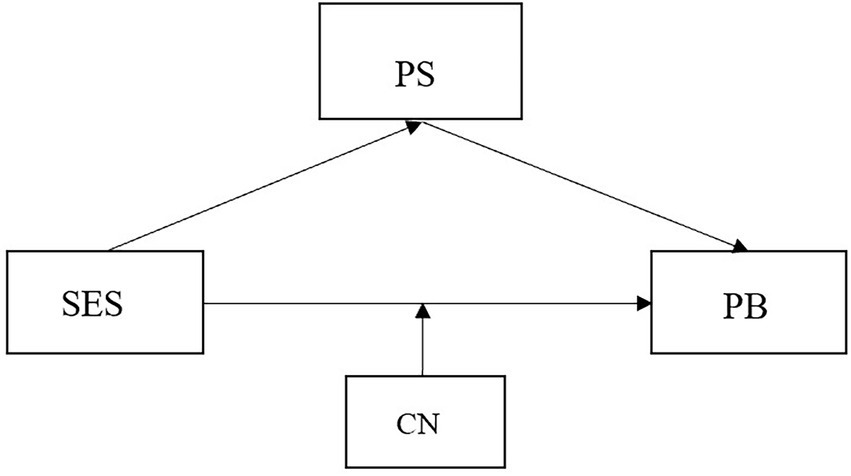
Theoretical model. SES, socioeconomic status; PS, parenting style; PB, problem behaviors; CN, child number.
Accordingly, the following specific hypotheses are tested in this study:
Hypothesis 1: Social-economic status would be negatively related to problem behaviors (H1a). Social-economic status would be positively related to authoritative parenting (H1b) and negatively related to authoritarian parenting (H1c).
Hypothesis 2: Problem behaviors would be negatively related to authoritative parenting (H2a) and positively related to authoritarian parenting (H2b).
Hypothesis 3: Authoritative parenting and authoritarian parenting would mediate the relationship between social-economic status and problem behaviors.
Hypothesis 4: Singleton would moderate the relationship between social-economic status and problem behaviors (H4a). At the same levels of social-economic status, only children would have higher problem behaviors levels than non-only children do (H4b).
2. Materials and Methods
2.1. Participants and procedure
Participants (1,101 children—529 girls and 672 boys—and their parents) were recruited from three kindergartens in Fuzhou, a large city in southeastern China. Most parents (61.6%) held a bachelor’s degree or higher, while 17.3% of fathers and 17.5% of mothers had a high school education or lower. Monthly family income was divided into three levels: under RMB7,000 (6.9%); RMB7,000 to RMB 24,999 (66.9%); and over RMB25,000 (26.2%). The results indicated most participants were from middle-and high-SES families. Table 1 presents the participants’ demographic information.
Table 1
| Demographic characteristics | Frequency (%) |
|---|---|
| Child age in month (M ± SD) | 58.8 ± 12.9 |
| Child gender | |
| Female | 529 (48.0) |
| Male | 672 (57.2) |
| Child number | |
| Only children | 419 (38.1) |
| None-only children | 682 (61.9) |
| Paternal education | |
| High school and below | 190 (17.3) |
| Associated degree | 233 (21.2) |
| Bachelor degree | 511 (46.4) |
| Master degree and above | 167 (15.2) |
| Maternal education | |
| High school and below | 193 (17.5) |
| Associated degree | 230 (20.9) |
| Bachelor degree | 556 (50.5) |
| Master degree and above | 122 (11.1) |
| Household income | |
| Low (<6,999 RMB per month) | 75 (6.8) |
| Medium (≥7,000 and <24,999 RMB per month) | 737 (66.9) |
| High (≥25,000 RMB per month) | 289 (26.2) |
Participant characteristics (N = 1,101).
The numbers in the brackets represent the percentage of the sample. High, medium and low household incomes are based on top quartile, middle half and bottom quartile of the urban population in Fujian (Chunhong and Yang, 2018).
The subjects were recruited from three kindergartens with different quality levels in Fuzhou, a coastal city in Southeast China. After being told the purpose of this study, parents first completed the questionnaires [a demographic form, a Children’s Behavior Evaluation (CBE) based on their children’s behaviors, and then filled out a Parenting Style and Dimension Questionnaire (PSDQ)] via the Internet. Informed consent was obtained at the start of the survey; all involved parents were advised that their participation was purely voluntary and they could withdraw at any time. The online survey took approximately 15 min to complete. Two researchers downloaded the completed questionnaires and analyzed the data.
2.2. Measures
2.2.1. Demographics
The demographic questionnaire collected background information from the participants. The first part dealt with children’s information, including age and gender; the second collected parents’ education and family income data.
2.2.2. Parenting styles.
Robinson et al. (1995) developed the Parenting Style and Dimension Questionnaire (PSDQ), which has been tested to be applicable in both Western (Robinson et al., 1995) and Chinese contexts (Fu et al., 2013). It is a 32-item self-report measure that assesses parenting styles in accordance with Baumrind’s (1991) typologies of parenting styles. Its authoritative parenting style scale (Cronbach’s alpha = 0.86) includes 15 items and three sub-projects. Connection (warmth and support) means parents being supportive, understanding and responsive to children’s feelings or needs. The topics included are “Aware of problems or concerns about child in school” or “Gives praise when child is good” and so on. Adjustment (rules) is of regulation dimension, which means whether the parents will explain or emphasizes reasons to children. Topics in adjustment include such as “Gives child reasons why rules should be obeyed” or “Emphasizes the reasons for rules.” Autonomy (democratic participation) dimensions means whether parents willing to consider their children’s ideas and give them the opportunity to make decisions about certain things including items like “Allows child to give input into family rules” or “Takes into account child’s preferences in making family plans.” Its authoritarian parenting style scale (Cronbach’s alpha = 0.82) comprises 12 items and three sub-projects. The corporal punishment means using physical punishment as a way of disciplining children, containing items such as “Uses physical punishment as a way of disciplining our child” or “Spanks when our child is disobedient.” Hostile speech indicates yelling or shouting to children, which comprises descriptions “Explodes in anger towards child” or “Yells or shouts when child misbehaves.” And arbitrary punishment dimensions points to punishing children without reasons or explanations, including items such as “Punishes by taking privileges away from child with little if any explanations” or “Uses threats as punishment with little or no justification.” These two subscales used a five-point scale ranging from 1 (never) to 5 (always). In this study, Cronbach’s alphas for authoritative and authoritarian parenting were 0.91 and 0.81, respectively.
2.2.3. The children’s behavior evaluation
Part of the Social Competence and Behavior Evaluation, the Children’s Behavior Evaluation (CBE) evaluates children’s problem behaviors (LaFreniere and Dumas, 1996). Its two subscales—anger-aggression (Cronbach’s alpha = 0.66) and anxiety-withdrawal (Cronbach’s alpha = 0.81)—use six-point scales ranging from 1 (never) to 6 (always). The scale has been validated as appropriate in the Chinese context (Qin and Yong, 2002). The anger-aggression scale utilizes anger and aggression levels to evaluate children’s externalizing problem behaviors. There are items such as “Be irritable and lose temper easily” and “Conflict with other children easily.” The anxiety-withdrawal scale covers aspects of depression, anxiety, and isolation to mirror children’s internalizing problem behaviors. This scale includes following topics like “Usually stay alone” or “Easily frustrated.” Young children with a high score on these two scales are more likely to have problem behaviors. In this study, the Cronbach’s alphas for the anger-aggression and anxiety-withdrawal subscales were 0.75 and 0.87, respectively.
2.2.4. Socioeconomic status
social-economic status (SES) is a comprehensive indicator that can be synthesized in many ways (Ren, 2010). Based on previous research, social-economic status in this study includes two main indicators: parental education and family income (e.g., Prus, 2007; Guo et al., 2018). Factor analysis is a usual means of constructing a social-economic status index (Naeeim and Rahman, 2018). Using SPSS, we calculated the standard values of parental education and family income, conducted factor analyses on both, and used the synthesis score to determine each family’s social-economic status.
2.3. Data analysis
Descriptive analysis was first conducted within all variables of the study. Structural equation modeling (SEM) was then carried out to test the hypothesized moderated mediation model that specifies the relationship among SES, parenting styles, child number, and child problem behaviors using Mpus 7.0. SEM was evaluated using the Maximum Likelihood method of parameter estimation. The Indirect effect was evaluated by bootstrapping procedures (Preacher and Hayes, 2008), and the following indices were used to test the hypothetical model’s data fit: the chi-square test (χ2), the Root Mean Square Error of Approximation (RMSEA < 0.08), the Standardized Root Mean Square Residual (SRMR < 0.10), the Tucker-Lewis Index (TLI > 0.95), and the Bentler’s comparative Fit Index (CFI > 0.95).
3. Results
3.1. Descriptive statistics
The descriptive statistics of all variables, including SES (socio-economic status), PS (parenting styles), CN (child number), and PB (problem behaviors), are displayed in Table 2. Results showed that the mean problem behaviors score was positively related to authoritarian parenting (r = 0.324, p < 0.001) and negatively related to authoritative parenting (r = −0.232, p < 0.001). Results also indicated that problem behaviors were negatively related to child number (r = −0.100, p < 0.01) and SES (r = −0.232, p < 0.001). Additionally, socio-economic status was significantly related to child number (r = −0.099, p < 0.01), authoritative parenting (r = 0.282, p < 0.001), and authoritarian parenting (r = −0.107, p < 0.001). However, there was no significant relationship between socio-economic status and problem behaviors.
Table 2
| M | SD | 1 | 2 | 3 | 4 | 5 | |
|---|---|---|---|---|---|---|---|
| 1. Child number | — | — | 1 | ||||
| 2. SES | — | — | −0.099** | 1 | |||
| 3. Authoritative parenting | 4.126 | 0.548 | −0.087** | 0.282*** | 1 | ||
| 4. Authoritarian parenting | 1.638 | 0.354 | 0.006 | −0.107*** | −0.0410*** | 1 | |
| 5. Problem behaviors | 2.195 | 0.578 | −0.100** | 0.017 | −0.232*** | 0.324*** | 1 |
Means, standard deviations, and intercorrelations of variables in this study.
*p < 0.05; **p < 0.01; ***p < 0.001. The standardization index of SES was calculated by factor analysis in this study.
3.2. Moderated mediation model
The model examined the associations between socio-economic status, child number, authoritative parenting, authoritarian parenting, and problem behaviors (see Figure 2). Mplus analysis proved that the moderated mediation model had a good model fit. χ2 = 5.910 (N = 1,101), CFI = 0.996, TLI = 0.987, RMSEA = 0.021, SRMR = 0.012. Bootstrapping of 2000 samples was used to identify the indirect effect with a 95% CI not containing zero. Results showed that authoritative parenting (β = −0.043, SE = 0.012, p < 0.001, 95%CI = [−0.014, −0.006]) and authoritarian parenting (β = −0.029, SE = 0.010, p < 0.01, 95%CI = [−0.010, −0.003]) mediated the relationship between socio-economic status and problem behaviors, supporting H3. socio-economic status’s direct effect on problem behaviors was not significant (see Table 3).
Figure 2
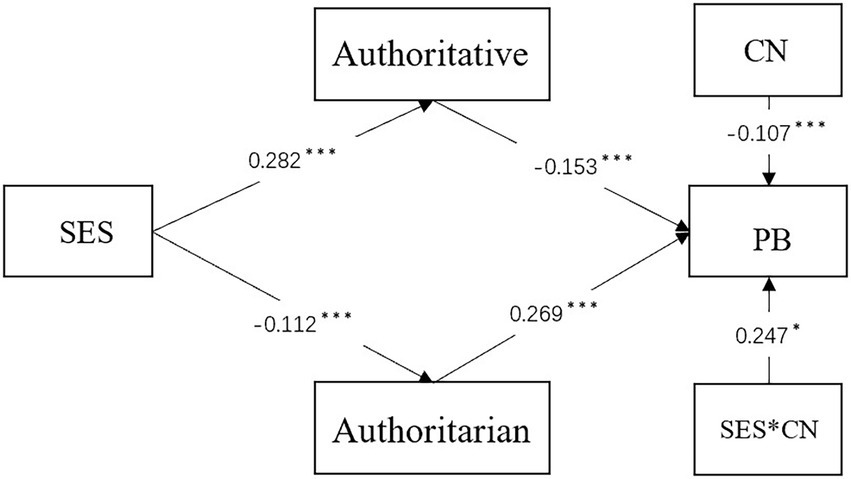
The moderated mediation model. N = 1,101. ∗p < 0.05, ∗∗p < 0.01 and ∗∗∗p < 0.001. SES, socioeconomic status; PB, problem behaviors; CN, child number.
Table 3
| Coefficient | SE | P | 95%CI | |||
|---|---|---|---|---|---|---|
| PB | SES | −0.161 | 0.104 | 0.121 | −0.343 | 0.004 |
| Authoritative | −0.153 | 0.046 | 0.000 | −0.214 | −0.094 | |
| Authoritarian | 0.269 | 0.037 | 0.000 | 0.206 | 0.0326 | |
| CN | −0.112 | 0.029 | 0.000 | −0.158 | −0.065 | |
| SES*CN | 0.247 | 0.104 | 0.018 | 0.077 | 0.425 | |
| Authoritative | SES | 0.282 | 0.031 | 0.000 | 0.227 | 0.329 |
| Authoritarian | SES | −0.107 | 0.033 | 0.001 | −0.162 | −0.056 |
Structural coefficients of the final model.
N = 1,101, CN, child number; PB, problem behaviors; SES, socioeconomic status.
Additionally, the interaction of socio-economic status and child number significantly influenced PB (β = 0.247, t = 2.368, p < 0.05), supporting H4a (see Table 3). We explained this significant interaction via a simple slope (Figure 3). As the figure shows, the combination of only children and low socio-economic status could lead to high problem behaviors levels; in contrast, the combination of non-only children and high socio-economic status could lead to high problem behaviors levels. In addition, at the same socio-economic status level, only children might have higher problem behaviors levels than non-only children, supporting H4b.
Figure 3
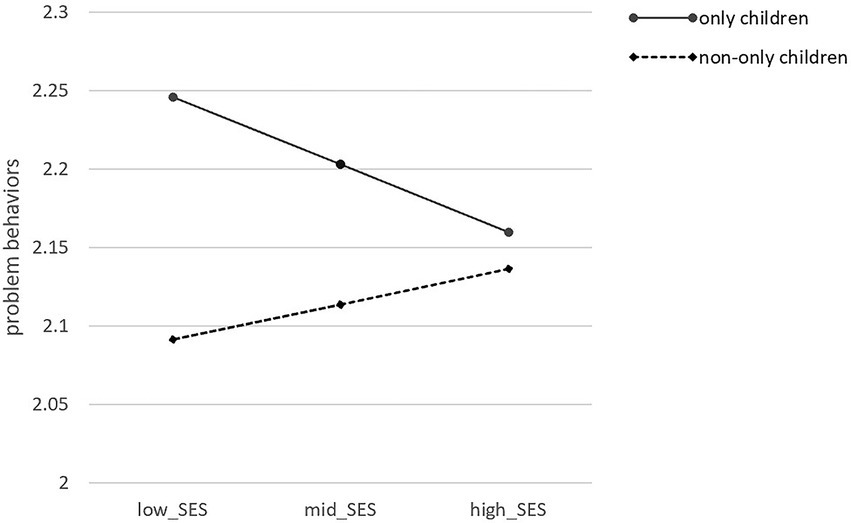
Conditional Effects of the Focal Predictor (SES) at Values of the Moderator as only child number. N = 1,101. Mean change is displayed separately for only children and non-only children.
4. Discussion
The goal of this study is to find out the links between family socioeconomic status, children’s problem behaviors, patenting styles and child number. Based on this, we proposed four hypotheses and elaborated them separately. Through per path analysis, this study revealed that socio-economic status could significantly predict both authoritative parenting and authoritarian parenting. Additionally, we found a negative relationship between problem behaviors and authoritative parenting, and a positive relationship between problem behaviors and authoritarian parenting. Our analysis also revealed that authoritative parenting and authoritarian parenting could mediate the relationship between socio-economic status and problem behaviors, and child number could moderate the relationship between socio-economic status and problem behaviors.
Our first hypothesis is social-economic status would be negatively related to problem behaviors (H1a), positively related to authoritative parenting (H1b) and negatively related to authoritarian parenting (H1c). We found a significantly positive correlation between socio-economic status and authoritative parenting and a negative correlation between socio-economic status and authoritarian parenting, partially supporting H1. Parenting differs across socioeconomic strata (Hoff and Laursen, 2019). Many empirical studies confirm that low socio-economic status families show higher levels of confused and unstable routines than high socio-economic status families (Evans et al., 2005; Fiese et al., 2013). Parents with lower socio-economic status tend to act harsher and be more punitive (Hoffman, 2003). We found no significant direct effect between socio-economic status and problem behaviors in the present study, inconsistent with the study of Granero et al. (2015). In line with Bronfenbrenner’s theory, young children’s development is affected by the interaction of the exosystem (SES) and the microsystem (PS).
The second hypothesis is problem behaviors would be negatively related to authoritative parenting (H2a) and positively related to authoritarian parenting (H2b). More recent studies confirm that complex models of family contextual factors shape children’s development, indicating that the correlation between socio-economic status and problem behaviors might be influenced by other family environmental factors, such as parenting style and family structure (Roubinov and Boyce, 2017; Luo et al., 2019). Supporting H2, we found that problem behaviors were negatively related to authoritative parenting and positively related to authoritarian parenting, corroborating existing studies (Baumrind, 1991; Padilla-Walker et al., 2010). Authoritarian parenting with high demand and low response is more likely to lead to young children’s misbehaviors (Rinaldi and Howe, 2012). These findings disagree with other recent studies conducted in European and Latin American countries in which indulgent parenting is related to the best child adjustment (Garcia et al., 2020; Perez-Gramaje et al., 2020).
The third hypothesis is authoritative parenting and authoritarian parenting would mediate the relationship between social-economic status and problem behaviors. The results revealed authoritative parenting and authoritarian parenting could mediate the relationship between socio-economic status and problem behaviors, consistent with Luo et al.’s (2019) study and supporting H3. More specifically, parents with high socio-economic status tend to be more authoritative, providing young children with an autonomous environment and emotional support (Williams et al., 2009). Such parenting can reduce young children’s possibility of developing problem behaviors. In contrast, low socio-economic status parents exhibit harsher practices and offer little emotional attention (Hoffman, 2003), resulting in tense parenting and young children’s negative emotions and problem behaviors.
The last hypothesis is child number would moderate the relationship between social-economic status and problem behaviors (H4a), only children would have higher problem behaviors levels than non-only children do at the same levels of social-economic status (H4b). The study reveals that child number significantly moderated the effect between socio-economic status and problem behaviors, supporting H4a. The combination of only children and low socio-economic status could lead to high problem behaviors levels, while the combination of non-only children and high socio-economic status could lead to high problem behaviors levels. Previous research has documented the significance of family structure and sibling relationships in shaping young children’s developmental outcomes (MacKinnon, 1989). The Family Investment Model (FIM) holds that parents with higher socio-economic status have more social capital to promote their children’s greater development (Roubinov and Boyce, 2017). Shi et al. (2021) showed that only children in rural China are in more unfavorable conditions than non-only children due to low socio-economic status family contexts and insufficient educational resources. The average cost of raising only children could be higher than for raising non-only children (Chen, 2010). In low socio-economic status families, multi-child family structures contribute to sibling resource sharing, and parents may invest more money in children’s education (Qian, 2009). By comparison, only children from low socio-economic status families are at greater risk of disadvantageous developmental outcomes—partly because of a lack of cross-age sibling interactions and partly because their parents’ investment in education could be limited by the higher costs of raising only children (Shi et al., 2021). Only children might have higher problem behaviors levels than non-only children at the same socio-economic status level, supporting H4b. Many empirical studies indicate that only and non-only children have different developmental situations (Jiao et al., 1986; Falbo and Polit, 1993). Sibling interaction is important in promoting young children’s social competence (Broderick, 1995). Therefore, only children are in an inferior social development position due to a shortage of sibling interactions and probably engage in higher levels of problem behavior (Lamarche et al., 2006; Padilla-Walker et al., 2010).
5. Limitations, future directions, and implications
This study still has some limitations. First, all study variables were assessed using questionnaires completed by parents, meaning that participants may periodically respond to queries in a given direction, amplifying obvious results. To avoid this phenomenon, future studies should examine socio-economic status and children’s problem behaviors using observational and direct assessment methods. Additionally, the study was conducted in cities along China’s eastern coast, where most families have an upper-middle socio-economic status; as such, caution must be exercised in promoting our findings. Future studies should broaden the scope of participants to make the findings more relevant.
Despite these limitations, this study has theoretical implications. We examined a model that investigates parenting styles and child number in a family as mediating and moderating mechanisms between family socio-economic status and young children’s problem behaviors. This study revealed a significantly positive correlation between socio-economic status and authoritative parenting, and a negative correlation between socio-economic status and authoritarian parenting. This study also has practical implications. It further examined how socio-economic status affects children’s problem behaviors through parenting styles and the moderating role of child number between socio-economic status and children’s problem behaviors, which could help parents choose an appropriate parenting style based on their family’s socio-economic status and number of children.
Funding
This project was supported by the National Education Sciences Planning Fund of China (project no. BDA210076).
Publisher’s note
All claims expressed in this article are solely those of the authors and do not necessarily represent those of their affiliated organizations, or those of the publisher, the editors and the reviewers. Any product that may be evaluated in this article, or claim that may be made by its manufacturer, is not guaranteed or endorsed by the publisher.
Statements
Data availability statement
The raw data supporting the conclusions of this article will be made available by the authors, without undue reservation.
Ethics statement
The studies involving human participants were reviewed and approved by the Ethics Committee in the College of Education at Fujian Normal University. Written informed consent to participate in this study was provided by the participants.
Author contributions
XL contributed to conception and design of the study and organized the database. YL performed the statistical analysis. YZ, YL, and XL wrote the first draft of the manuscript and wrote sections of the manuscript. All authors contributed to the article and approved the submitted version.
Conflict of interest
The authors declare that the research was conducted in the absence of any commercial or financial relationships that could be construed as a potential conflict of interest.
References
1
Alizadeh S. Talib M. B. A. Abdullah R. Mansor M. (2011). Relationship between parenting style and children’s behavior problems. Asian Soc. Sci.7, 195–200. doi: 10.5539/ass.v7n12p195
2
Aunola K. Nurmi J. (2005). The role of parenting styles in children's problem behavior. Child Dev.76, 1144–1159. doi: 10.1111/j.1467-8624.2005.00840.x-i1
3
Barber B. K. Olsen J. A. (1997). Socialization in context: connection, regulation, and autonomy in the family, school, and neighborhood, and with peers. J. Adolesc. Res.12, 287–315. doi: 10.1177/0743554897122008
4
Baumrind D. (1966). Effects of authoritative parental control on child behavior. Child Dev.37, 887–907. doi: 10.2307/1126611
5
Baumrind D. (1971). Current patterns of parental authority. Dev. Psychol.4, 1–103. doi: 10.1037/h0030372
6
Baumrind D. (1991). The influence of parenting styles on adolescent competence and substance use. J. Early Adolesc.11, 56–95. doi: 10.1177/0272431691111004
7
Baumrind D. (2012). Differentiating between confrontive and coercive kinds of parental power-assertive disciplinary practices. Hum. Dev.55, 35–51. doi: 10.1159/000337962
8
Berkien M. Louwerse A. Verhulst F. van der Ende J. (2012). Children’s perceptions of dissimilarity in parenting styles are associated with internalizing and externalizing behavior. Eur. Child Adolesc. Psychiatry21, 79–85. doi: 10.1007/s00787-011-0234-9
9
Bradley R. H. Caldwell B. M. (2015). The home inventory and family demographics. Dev. Psychol.20, 315–320. doi: 10.1037/0012-1649.20.2.315
10
Bradley R. H. Caldwell B. M. Rock S. L. Ramey C. T. Barnard K. E. Gray C. et al . (1989). Home environment and cognitive development in the first 3 years of life: a collaborative study involving six sites and three ethnic groups in North America. Dev. Psychol.25, 217–235. doi: 10.1037/0012-1649.25.2.217
11
Bradley R. H. Corwyn R. F. (2002). Socioeconomic status and child development. Annu. Rev. Psychol.53, 371–399. doi: 10.1146/annurev.psych.53.100901.135233
12
Broderick C. B. (1995). Understanding Family Process: Basics of Family Systems Theory. Thousand Oaks, CA: Sage Publications Press.
13
Brody G. H. (1998). Sibling relationship quality: its causes and consequences. Annu. Rev. Psychol.49, 1–24. doi: 10.1146/annurev.psych.49.1.1
14
Brody G. H. (2004). Siblings, direct and indirect contributions to child development. Curr. Dir. Psychol. Sci.13, 124–126. doi: 10.1111/j.0963-7214.2004.00289.x
15
Bronfenbrenner U. (1983). “Beyond policies without people: An ecological perspective on child and family policy,” in Children, families, and government: perspectives on american social policy. eds. ZiglerE.KaganS.KlugmanE. (Cambridge University Press), 393–414.
16
Casey P. H. Wortham B. Bradley R. (1984). Social and nonsocial home environments of infants with nonorganic failure-to thrive. Pediatrics73, 348–353. doi: 10.1542/peds.73.3.348
17
Chao R. K. (2001). Extending research on the consequences of parenting style for Chinese Americans and European Americans. Child Dev.72, 1832–1843. doi: 10.1111/1467-8624.00381
18
Chen Y. H. (2010). Research on the risk of one-child policy. J. Coll. Popul. Dev.16, 19–32.
19
Chunhong Yang . (2018). Fujian Statistical Yearbook. Beijing: China Statistics Press. Available at: http://tjj.fujian.gov.cn/
20
Climent-Galarza S. Alcaide M. Garcia O. F. Chen F. Garcia F. (2022). Parental socialization, delinquency during adolescence and adjustment in adolescents and adult children. Behav. Sci.12:448. doi: 10.3390/bs12110448
21
Conger R. D. Donnellan M. B. (2007). An interactionist perspective on the socioeconomic context of human development. Annu. Rev. Psychol.58, 175–199. doi: 10.1146/annurev.psych.58.110405.085551
22
Daphne A. Henry A. Elizabeth V. D. B. Portia M. B. (2019). Child development at the intersection of race and SES: an overview. Adv. Child Dev. Behav.57, 1–25. doi: 10.1016/bs.acdb.2019.05.002
23
Deater-Deckard K. Bates J. Dodge K. A. Pettit G. S. (1996). Physical discipline among African American and European American mothers: Links to children's. Dev. Psychol.32, 1065–1072. doi: 10.1037/0012-1649.32.6.1065
24
Dolean D. Melby-Lervåg M. Tincas I. Damsa C. Lervåg A. (2019). Achievement gap: socioeconomic status affects reading development beyond language and cognition in children facing poverty. Learn. Instr.63:101218. doi: 10.1016/j.learninstruc.2019.101218
25
Dwairy M. (2006). Parenting styles in Arab societies a first cross-regional research study. J. Cross Cult. Psychol.37, 230–247. doi: 10.1177/0022022106286922
26
Eklund L. (2016). Preference or aversion? Exploring fertility desires among China’s young urban elite. Intersections39, 1–16.
27
Ensminger M. Fotherill K. (2003). “A decade of measuring SES: what it tells us and where to go from here” in Socioeconomic status, parenting, and child development. eds. Born-steinM.BradleyR. (Mahwah, NJ: Lawrence Erlbaum), 13–28.
28
Evans G. W. Gonnella C. Marcynyszyn L. A. Gentile L. Salpekar N. (2005). The role of chaos in poverty and children’s socioemotional adjustment. Psychol. Sci.16, 560–565. doi: 10.1111/j.0956-7976.2005.01575.x
29
Falbo T. Polit D. F. (1993). The academic, personality, and physical outcomes of only children in China. Child Dev.64, 18–35. doi: 10.2307/1131435
30
Fiese B. H. Rhodes H. G. Beardslee W. R. (2013). Rapid changes in American family life: consequences for child health and pediatric practice. Pediatrics132, 552–559. doi: 10.1542/peds.2013-0349
31
Fu Y. Hou X. Qin Q. Meng H. Xie P. Huang Y. et al . (2013). Can parenting styles and dimensions questionnaire (PSDQ) be used in China?Psychology04, 535–540. doi: 10.4236/psych.2013.46076
32
Garcia O. F. Fuentes M. C. Gracia E. Serra E. Garcia F. (2020). Parenting warmth and strictness across three generations: parenting styles and psychosocial adjustment. Int. J. Environ. Res. Public Health17:7487. doi: 10.3390/ijerph17207487
33
Gass K. Jenkins J. Dunn J. (2007). Are sibling relationships protective? A longitudinal study. J. Child Psychol. Psychiatry48, 167–175. doi: 10.1111/j.1469-7610.2006.01699.x
34
Gibbs E. D. Teti D. M. Bond L. A. (1987). Infant-sibling communication: relationships to birth-spacing and cognitive and linguistic development. Infant Behav. Dev.10, 307–323. doi: 10.1016/0163-6383(87)90019-1
35
Gong W. Xu D. Caine E. D. (2016). Challenges arising from china's two-child policy. Lancet387:1274. doi: 10.1016/S0140-6736(16)30020-4
36
Granero R. Louwaars L. Ezpeleta L. (2015). Socioeconomic status and oppositional defiant disorder in preschoolers: parenting practices and executive functioning as mediating variables. Front. Psychol.6:1412. doi: 10.3389/fpsyg.2015.01412
37
Guo X. Lv B. Zhou H. Liu C. Liu J. Jiang K. et al . (2018). Gender differences in how family income and parental education relate to reading achievement in China: the mediating role of parental expectation and parental involvement. Front. Psychol.9:783. doi: 10.3389/fpsyg.2018.00783
38
Halpern L. F. (2004). The relations of coping and family environment to preschoolers' problem behavior. J. Appl. Dev. Psychol.25, 399–421. doi: 10.1016/j.appdev.2004.06.001
39
Hart C. H. Newell L. D. Olsen S. F. (2003). “Parenting skills and social-communicative competence in childhood” in Handbook of communication and social interaction skills. eds. GreeneJ. O.BurlesonB. R. (Mahwah, NJ: Lawrence Erlbaum Associates), 753–797.
40
Hoff E. (2003). The specificity of environmental influence: socioeconomic status affects early vocabulary development via maternal speech. Child Dev.74, 1368–1378. doi: 10.1111/1467-8624.00612
41
Hoff E. (2010). The specificity of environmental influence: socioeconomic status affects early vocabulary development via maternal speech. Child Dev.74, 1368–1378. doi: 10.1111/1467-8624.00612
42
Hoff E. Laursen B. (2019). “Socioeconomic status and parenting” in Handbook of Parenting. ed. M. H. Bornstein (Routledge), 421–447.
43
Hoffman L. W. (2003). “Methodological issues in studies of SES, parenting, and child development” in Socioeconomic status, parenting, and child development. eds. M. H. Bornstein and R. H. Bradley (Lawrence Erlbaum Associates Publishers). 125–143.
44
Irwin L. G. Siddiqi A. Hertzman C. (2007). Early child development: A powerful equalizer. Vancouver, British Columbia, Canada: World Health Organization’s Commission on the Social Determinants of Health.
45
Jastrow A. (1929). Psychological care of infant and child. Science69, 455–457. doi: 10.1126/science.69.1791.455.b
46
Jiao S. Ji G. Jing Q. (1986). Comparative study of behavioral qualities of only children and sibling children. Child Dev.57, 357–361. doi: 10.2307/1130591
47
Kracht C. L. Facsm S. Guseman E. H. Hubbs-Tait L. Arnold S. H. Graef R. J. et al . (2019). Family eating behavior and child eating patterns differences between children with and without siblings. J. Nutr. Educ. Behav.51, 1188–1193. doi: 10.1016/j.jneb.2019.08.004
48
LaFreniere P. J. Dumas J. E. (1996). Social competence and behavior evaluation in children aged three to six: the short form (SCBE-30). Psychol. Assess.8, 369–377. doi: 10.1037/1040-3590.8.4.369
49
Lamarche V. Brendgen M. Boivin M. Vitaro F. Perusse D. Dionne G. (2006). Do friendships and sibling relationships provide protection against peer victimization in a similar way?Soc. Dev.15, 373–393. doi: 10.1111/j.1467-9507.2006.00347.x
50
Lamborn S. D. Mounts N. S. Steinberg L. Dornbusch S. M. (1991). Patterns of competence and adjustment among adolescents from authoritative, authoritarian, indulgent, and neglectful families. Child Dev.62, 1049–1065. doi: 10.2307/1131151
51
Laurence S. Susie D. Lamborn N. Nancy D. (1994). Over-time changes in adjustment and competence among adolescents from authoritative, authoritarian, indulgent, and neglectful families. Child Dev.65, 754–770. doi: 10.1111/j.1467-8624.1994.tb00781.x
52
Levin E. (2011). Baumrind's Parenting Styles. Springer: US.
53
Li Z. Yang H. Zhu X. Xie L. (2021). A multilevel study of the impact of egalitarian attitudes toward gender roles on fertility desires in China. Popul. Res. Policy Rev.40, 747–769. doi: 10.1007/s11113-020-09600-z
54
Lipina S. J. Segretin S. Hermida J. Prats L. Fracchia C. Camelo J. L. et al . (2013). Linking childhood poverty and cognition: environmental mediators of non-verbal executive control in an argentine sample. Dev. Sci.16, 697–707. doi: 10.1111/desc.12080
55
Luo S. Liu Y. Zhang D. (2019). Socioeconomic status and young children’s problem behaviours–mediating effects of parenting style and psychological suzhi. Early Child Dev. Care191, 148–158. doi: 10.1080/03004430.2019.1608196
56
Maccoby E. E. Martin J. A. (1983). Socialization in the context of the family: parent-child interaction. In MussenP. H. (Ed.) & HetheringtonE. M. (Vol. Ed.), Handbook of child psychology: Vol. 4, socialization, personality and social development. (4th ed., pp. 1–101). New York: Wiley
57
MacKinnon C. E. (1989). Sibling interactions in married and divorced families: influence of ordinal position, socioeconomic status, and play context. J. Divorce12, 221–234. doi: 10.1300/J279v12n02_12
58
Mcgillicuddy-Delisi J. A. (1983). Family environment factors and children's knowledge of rules and conventions. Child Dev.54, 218–226. doi: 10.2307/1129879
59
Miller I. W. Epstein N. B. Bishop D. S. Keitner G. I. (1985). The mcmaster family assessment device: reliability and validity. J. Marit. Fam. Ther.11, 345–356. doi: 10.1111/j.1752-0606.1985.tb00028.x
60
Naeeim N. Rahman N. A. (2018). Construction of a socio-economic status (SES) index in peninsular Malaysia using the factor analysis approach. Pertanika J. Soc. Sci. Human.26, 1265–1281.
61
Padilla-Walker L. M. Harper J. M. Jensen A. C. (2010). Self-regulation as a mediator between sibling relationship quality and early adolescents' positive and negative outcomes. J. Fam. Psychol.24, 419–428. doi: 10.1037/a0020387
62
Padmadas S. S. (2017). Two-child policy in China: Rhetoric versus reality. Ann. Hum. Biol.44, 97–98. doi: 10.1080/03014460.2016.1177113
63
Perez-Gramaje A. F. Garcia O. F. Reyes M. Serra E. Garcia F. (2020). Parenting styles and aggressive adolescents: relationships with self-esteem and personal maladjustment. Eur. J. Psychol. Appl. Legal Context12, 1–10. doi: 10.5093/ejpalc2020a1
64
Peter B. Chana E. V. Nicole N. R. (2018). Parent skills and information asymmetries: experimental evidence from home visits and text messages in middle and high schools. Econ. Educ. Rev.66:S027277571630629X. doi: 10.1016/j.econedurev.2018.06.008
65
Pinquart M. (2017). Associations of parenting dimensions and styles with externalizing problems of children and adolescents: an updated meta-analysis. Dev. Psychol.53, 873–932. doi: 10.1037/dev0000295
66
Preacher K. J. Hayes A. F. (2008). Asymptotic and resampling strategies for assessing and comparing indirect effects in multiple mediator models. Behav. Res. Methods40, 879–891. doi: 10.3758/BRM.40.3.879
67
Prus S. G. (2007). Age, SES, and health: a population level analysis of health inequalities over the lifecourse. Sociol. Health Illn.29, 275–296. doi: 10.1111/j.1467-9566.2007.00547.x
68
Qin C. Yong J. (2002). Social competence and behavior problems in Chinese preschoolers. Early Educ. Dev.13, 171–186. doi: 10.1207/s15566935eed1302_4
69
Qian N. (2009). Quantity-quality and the One-child Policy: The Only-child Disadvantage in School Enrollment in Rural China. NBER Working Papers.
70
Ren C.-R. (2010). Measurement methodology on social economic status index of students. J. Educ. Stud.6, 77–82. doi: 10.14082/j.cnki.1673-1298.2010.05.010
71
Rinaldi C. M. Howe N. (2012). Mothers’ and fathers’ parenting styles and associations with toddlers’ externalizing, internalizing, and adaptive behaviors. Early Child. Res. Q.27, 266–273. doi: 10.1016/j.ecresq.2011.08.001
72
Rindermann H. Baumeister A. (2015). Parents' SES vs. parental educational behavior and children's development: a reanalysis of the hart and risley study. Learn. Individ. Differ.37, 133–138. doi: 10.1016/j.lindif.2014.12.005
73
Robinson C. C. Mandleco B. Olsen S. F. Hart C. H. (1995). Authoritative, authoritarian, and permissive parenting practices: development of a new measure. Psychol. Rep.77, 819–830. doi: 10.2466/pr0.1995.77.3.819
74
Rochebrochard E. Joshi H. (2013). Siblings and child development. Longitudinal Life Course Stud.4, 276–287. doi: 10.14301/llcs.v4i3.248
75
Roubinov D. S. Boyce W. T. (2017). Parenting and SES: relative values or enduring principles?Curr. Opin. Psychol.15, 162–167. doi: 10.1016/j.copsyc.2017.03.001
76
Santrock J. W. (2011). Life span development (13th edition). New York: McGraw-Hill.
77
Schaefer D. Earl S. (1959). A circumplex model for maternal behavior. J. Abnorm. Soc. Psychol.59, 226–235. doi: 10.1037/h0041114
78
Shafipour S. Z. Sheikhi A. Mirzaei M. KazemnezhadLeili E. (2015). Parenting styles and its relation with children behavioral problems. J. Holist. Nurs. Midwifery25, 49–56.
79
Sheridan M. A. Shi F. Miller A. B. Salhi C. McLaughlin K. A. (2020). Network structure reveals clusters of associations between childhood adversities and development outcomes. Dev. Sci.23:e12934. doi: 10.1111/desc.12934
80
Shi J. Li L. Wu D. Li H. (2021). Are only children always better? Testing the sibling effects on academic performance in rural Chinese adolescents. Child Youth Serv. Rev.131:106291. doi: 10.1016/j.childyouth.2021.106291
81
Sim D. Blanco E. Martinez S. M. Castillo M. Gahagan S. (2012). SES from birth to 10 years and the odds of child behavior problems in a cohort of low-to middle-SES Chilean children. 140st APHA Annual Meeting and Exposition 2012.
82
Soliday E. Kool E. Lande M. B. (2001). Family environment, child behavior, and medical indicators in children with kidney disease. Child Psychiatry Hum. Dev.31, 279–295. doi: 10.1023/A:1010282305881
83
Steinberg L. (2001). We know some things: parent – adolescent relationships in retrospect and prospect. J. Res. Adolesc.11, 1–19. doi: 10.1111/1532-7795.00001
84
Steinberg L. (2005). Psychological control: style or substance?New Dir. Child Adolesc. Dev.2005, 71–78. doi: 10.1002/cd.129
85
Stormshak E. A. Bullock B. M. Falkenstein C. A. (2010). Harnessing the power of sibling relationships as a tool for optimizing social-emotional development. New Dir. Child Adolesc. Dev.2009, 61–77. doi: 10.1002/cd.257
86
Teti D. M. Ablard K. E. (1989). Security of attachment and infant-sibling relationships: a laboratory study. Child Dev.60:1519. doi: 10.1111/j.1467-8624.1989.tb04022.x
87
Tonizzi I. Traverso L. Usai M. C. Viterbori P. (2020). Fostering number sense in low SES children: a comparison between low-and high-intensity interventions. Math. Educ. Res. J.33, 345–363. doi: 10.1007/s13394-019-00307-9
88
Villarejo S. Martinez-Escudero J. A. Garcia O. F. (2020). Parenting styles and their contribution to children personal and social adjustment. Ansiedad y Estres.26, 1–8. doi: 10.1016/j.anyes.2019.12.001
89
Wang J. Chen C. Gong X. (2021). The impact of family socioeconomic status and parenting styles on children's academic trajectories: a longitudinal study comparing migrant and urban children in China. New Dir. Child Adolesc. Dev.2021, 81–102. doi: 10.1002/cad.20394
90
Williams L. R. Degnan K. A. Perez-Edgar K. E. Henderson H. A. Rubin K. H. Pine D. S. et al . (2009). Impact of behavioral inhibition and parenting style on internalizing and externalizing problems from early childhood through adolescence. J. Abnorm. Child Psychol.37, 1063–1075. doi: 10.1007/s10802-009-9331-3
91
Wolke D. Tippett N. Dantchev S. (2015). Bullying in the family: sibling bullying. Lancet Psychiatry2, 917–929. doi: 10.1016/S2215-0366(15)00262-X
92
Yiu H. C. Zang Y. Chew J. H. S. Chau J. P. C. (2021). The influence of Confucianism on the perceptions and process of caring among family caregivers of persons with dementia: a qualitative study. J. Transcult. Nurs.32, 153–160. doi: 10.1177/1043659620905891
93
Zajonc R. (1976). Family configuration and intelligence. Science192, 227–236. doi: 10.1126/science.192.4236.227
94
Zhao L. Zhao W. (2022). Impacts of family environment on adolescents' academic achievement: the role of peer interaction quality and educational expectation gap. Front. Psychol.13:911959. doi: 10.3389/fpsyg.2022.911959
Summary
Keywords
SES, parenting styles, young children, child number, problem behaviors, moderated mediation
Citation
Lin X, Zhang Y, Liao Y and Xie W (2023) Socioeconomic status and problem behaviors in young Chinese children: A moderated mediation model of parenting styles and only children. Front. Psychol. 14:1029408. doi: 10.3389/fpsyg.2023.1029408
Received
27 August 2022
Accepted
02 January 2023
Published
03 February 2023
Volume
14 - 2023
Edited by
Leonardo De Pascalis, University of Liverpool, United Kingdom
Reviewed by
Fitri Ariyanti Abidin, Padjadjaran University, Indonesia; Marta Alcaide, University of Valencia, Spain
Updates
Copyright
© 2023 Lin, Zhang, Liao and Xie.
This is an open-access article distributed under the terms of the Creative Commons Attribution License (CC BY). The use, distribution or reproduction in other forums is permitted, provided the original author(s) and the copyright owner(s) are credited and that the original publication in this journal is cited, in accordance with accepted academic practice. No use, distribution or reproduction is permitted which does not comply with these terms.
*Correspondence: Yutong Liao, liaoyutong1008@163.com
This article was submitted to Developmental Psychology, a section of the journal Frontiers in Psychology
Disclaimer
All claims expressed in this article are solely those of the authors and do not necessarily represent those of their affiliated organizations, or those of the publisher, the editors and the reviewers. Any product that may be evaluated in this article or claim that may be made by its manufacturer is not guaranteed or endorsed by the publisher.