Abstract
Objective:
With consumers’ concerns about food safety and the environment growing, the interest in organic food has increased. However, due to the late start of the organic food market in China, the market size of the Chinese organic food industry is still relatively small. This study aims to examine whether organic food credence attributes have an impact on consumers’ attitudes and willingness to pay a premium (WTPP), in order to provide valuable information to facilitate the development of the organic food market in China.
Methods:
A questionnaire survey was conducted with 647 respondents in China. Structural equation modeling (SEM) was utilized to verify the model and test the relationships among the constructs.
Results:
SEM analyses showed that credence attributes stimulate consumers’ attitudes and increase consumers’ WTPP. Utilitarian attitudes and hedonistic attitudes play a partially mediating role in the relationship between credence attributes and WTPP. Uncertainty negatively moderates the role between utilitarian attitudes and WTPP, while it positively moderates the role between hedonistic attitudes and WTPP.
Discussion:
The findings reveal the motivations and barriers for Chinese consumers to purchase organic food at a premium, providing a theoretical basis for companies to gain a deeper understanding of consumer groups and develop organic food marketing strategies.
1. Introduction
With rising consumer preference for food that is perceived as healthy, high quality, safe, and eco-friendly, organic food is being pursued by an increasing number of Chinese consumers. Data show that organic food sales in China reached approximately RMB 951 billion in 2021, an increase of 18.3% compared to 2020 (China, 2022). Organic consumption has become a new trend in China. However, there is a clear gap between consumers’ intentions and behavior in the decision-making process related to purchasing organic food (Sultan et al., 2020; Bernabéu et al., 2022). In other words, although consumers have positive intentions to purchase organic food, their actual purchase frequency and payment amount do not match their intentions, and the key reason for this mismatch is that consumers consider the price of organic food too high. The price premium for organic food has become a major obstacle in the purchasing decision process for consumers (Kim et al., 2021; Liu and Sam, 2022). Therefore, increasing consumers’ willingness to pay a premium (WTPP) is important to promote the development of China’s organic food market.
The motivations for organic food consumption have been extensively explored in previous literature. Studies have found that consumers’ motivations for purchasing organic food include economic reasons (e.g., price), social/cultural reasons (e.g., social status), personal reasons (e.g., egoistic and altruistic values), and product reasons (e.g., attributes such as health and safety; Dorce et al., 2021; Galati et al., 2022; Knaggs et al., 2022; Wei et al., 2022). In particular, concern for health, environmental protection, food safety, and taste have been identified as the main purchase motivations for organic food (Hemmerling et al., 2015). As organic food is a credence product and its product information is harder to obtain, credence attributes play an important role in influencing consumers’ organic food purchasing behavior (Giampietri et al., 2018). The existing studies on the credence attributes of organic food mainly focus on two aspects. One is to investigate the influence of credence attributes on consumers’ perception of quality and value (Lee and Hwang, 2016; Konuk, 2019). Scholars believe that the overall quality and value perception is based on consumers’ evaluation of credence attributes of organic food, and consumers with a positive evaluation of the credence attributes have a higher perception of the quality and value of organic food. The other is based on consumers’ psychological decision-making process. The influence of credence attributes on consumers’ purchase attitudes and intentions was analyzed, and it was found that credence attributes such as health, safety, and environment-related factors of organic food all lead to positive attitudes and purchase intentions (Szolnoki and Hauck, 2020; Galati et al., 2022). These studies on credence attributes have provided insights into consumers’ motivations for purchasing organic food. However, the existing studies have focused more on the relationship between credence attributes and willingness to buy (WTB) than on willingness to pay a premium (WTPP; Lee and Hwang, 2016; Lee et al., 2019). Given that organic food is a credence good and that there is a degree of premium, the relationship between credence attributes and WTPP needs to be explored in more depth.
In terms of barriers to organic food consumption, several studies have attempted to explain the constraints in consumers’ decisions related to organic food purchases through moderating variables, such as scepticism about organic certification (Moruzzo et al., 2020), limited availability (Rabadán et al., 2020), and price (Rödiger and Hamm, 2015). Due to the late start of the organic food market in China, there is still a significant information asymmetry between organic food sellers and consumers (Zhao et al., 2019), which creates uncertainty about the benefits of organic food and to some extent weakens consumers’ intention to buy organic food (Talwar et al., 2020). Therefore, addressing consumers’ uncertainty regarding organic food may be of great significance in promoting organic food consumption. Nonetheless, there have been scarce studies emphasizing the association of uncertainty with organic food consumption.
China is the fourth largest organic food market after the United States, Germany, and France (China, 2022). The Chinese organic food market represents a great opportunity not only for Chinese producers but also for national exporters of organic food (Pedersen et al., 2022). Given the situational background of the organic food market in China, it is necessary to investigate and fully understand the reaction of Chinese consumers related to organic food. Therefore, this study explores the content of food safety and eco-friendliness, two key credence attributes that promote organic food consumption (Hemmerling et al., 2015), based on a survey from China. The theoretical model of the stimulus-organic-response (S-O-R) model is then used to examine the relationship between the credence attributes, attitudes along the dimensions of utilitarianism and hedonism, and WTPP. Uncertainty is added as a moderating variable to delve into the barriers in the formation of consumers’ purchase decisions. This study is of particular importance because it provides both new, practice-relevant empirical evidence in the field of organic food consumption and useful information for organic food producers, retailers, and exporters to gain a deeper understanding of consumer motivations. In addition, this study could greatly assist relevant regulators and policy-makers in their efforts to improve and expand the organic food market.
2. Theoretical background and hypotheses
The stimulus-organism-response (S-O-R) model has its origins in environmental psychology, which assumes that external stimuli trigger internal cognitive and psycho-affective changes in individuals, resulting in certain behavioral outcomes (Darby and Karni, 1973). Stimuli are specific cues that affect an individual’s internal state, i.e., various information that is internal or external, controllable or uncontrollable, in response to the quality of the product. The organism is the emotional and cognitive state of an individual when exposed to external stimuli, including attitudes, emotions, perceptions, and beliefs that typically mediate the relationship between stimuli and responses. Reactions are the final behavioral outcomes of individuals, including intentions, preferences, and behaviors, which may be positive or negative (Ahmed et al., 2021).
The S-O-R model has been successfully used in the field of organic food consumption. For example, Wang et al. (2021) adopted SOR theory and found that organic appeal advertising positively influences intrinsic motivation, increasing consumers’ purchase intention toward organic milk. According to the S-O-R model, Sultan et al. (2021) found that marketing communication channels for organic food and perceived organic food value (S) had a positive effect on utilitarian and hedonistic attitudes (O) and further influenced consumers’ behavioral intentions (R). Liu and Zheng (2019) used health concerns, environmental concerns, and food safety as external stimuli, organic cognition as the organism, and purchase intentions as the response, confirming the significant role between consumers’ food safety, health, environmental concerns, and their purchase intentions. Although the S-O-R model has shown to be useful in predicting intentions and behaviors related to organic foods (Hempel and Hamm, 2016; Kim et al., 2021; Liang and Lim, 2021), most studies have included purchase intentions as a response in the S-O-R model, with less attention given to consumers’ WTPP for organic food. This study uses consumers’ WTPP as a response, which helps to complement the theoretical research on S-O-R models in the organic food field. Furthermore, although some past studies have emphasized the importance of credence attributes for predicting consumers’ behavioral intentions toward organic food (Lee and Hwang, 2016; Kushwah et al., 2019), there is a lack of studies that combine credence attributes with S-O-R. Lee and Yun (2015) suggested that future research should extend the S-O-R model and measure how other causal and moderating factors affect behavioral intentions. We further extended the S-O-R model by adding uncertainty as a new moderating variable, according to the study by Lee and Yun (2015).
In conclusion, given the importance of S-O-R in explaining the relationship between external factors and consumer responses in previous studies, this study applies S-O-R theory to explain the effect of credence attributes on willingness to pay a premium for organic food by defining stimuli as food safety and eco-friendliness, organisms as utilitarian and hedonistic attitudes, responses as consumers’ willingness to pay a premium, and introducing uncertainty as a moderating variable. On the one hand, the change in consumers’ attitudes and their willingness to pay a premium in their natural state, stimulated externally by the credence attributes of organic food, fits well with S-O-R theory. On the other hand, introducing uncertainty as a moderating variable to extend S-O-R theory is supported by both previous theory and practice, and there is a practical need to conduct a more in-depth exploration of the underlying mechanism of consumers’ willingness to pay a premium.
2.1. Food safety, utilitarian attitudes, and hedonistic attitudes
Attitude is the likelihood that an individual will respond positively or negatively to behavior (Ajzen, 2011), and consumers’ attitudes are considered to be a key element in effectively predicting their behavioral intentions toward organic food (Sadiq et al., 2021). Drawing on Lee and Yun (2015), this paper classifies attitudes into two dimensions based on the function of use and purchase motivation: utilitarian attitudes and hedonistic attitudes. Utilitarian attitudes relate to the functional value of organic food, reflecting the consumer assessment of the benefits when purchasing organic food (Ditlevsen et al., 2019), while hedonistic attitudes relate to emotional satisfaction or sensory experience, reflecting the perceived value derived from the multisensory and emotional aspects of purchasing organic food, such as the taste, freshness, or pleasure derived from doing something good for one’s health and the environment (Wang et al., 2019).
Expectancy-value-attitude theory suggests that an individual’s attitude toward an object is determined by the subjective probability that the object has a particular attribute (Ajzen and Fishbein, 2000). Specifically, an individual will form an overall attitude toward an object by assessing the attributes associated with it and the extent to which its needs are met. Organic food is a credence product that is closely related to consumers’ health and safety and for which product information is difficult to obtain, and there is a certain degree of premium (Yu et al., 2022), so consumers tend to rely on credence attributes for psychological judgment (Janssen and Hamm, 2012; Massey et al., 2018). In organic food consumption, consumers usually pay attention to the food safety of organic food (Vapa-Tankosić et al., 2020; Joya et al., 2021). They believe that organic food is produced without pesticides, chemical fertilizers, artificial additives, and other harmful substances and is safer than ordinary food (Tan et al., 2021; Lang and Rodrigues, 2022), which makes them have a positive attitude toward organic food (Çabuk et al., 2014; Pham et al., 2019). Consumers make positive psychological judgments about food safety that meet their own needs. Such judgments are mainly motivated by the functional and emotional affirmation of organic food, which facilitates the formation of utilitarian attitudes and hedonistic attitudes among consumers. Therefore, the following hypotheses were proposed:
H1a: Food safety has a positive effect on utilitarian attitudes.
H1b: Food safety has a positive effect on hedonistic attitudes.
2.2. Eco-friendliness, utilitarian attitudes, and hedonistic attitudes
Eco-friendliness means that organic food follows the principles of sustainable development in the production process, using specific techniques to avoid genetic engineering and not causing harm to the environment and animals (Honkanen et al., 2006). Information about the sustainability benefits and environmental value of eco-friendliness can influence consumer attitudes toward organic food (Puteri et al., 2022). Consumers will psychologically discern whether the eco-friendliness of organic food meets their needs and further consider whether the pro-environmental characteristics of organic food enhances their personal emotional experience (Gkargkavouzi et al., 2019, Canio et al., 2021). The production process of organic food is concerned with animal welfare and production equity, which promotes ecological balance and makes consumers perceive that buying organic food not only satisfies their own needs but also benefits the ecological environment, which leads to more positive utilitarian attitudes and hedonistic attitudes. Therefore, the following hypotheses were proposed:
H2a: Eco-friendliness has a positive effect on utilitarian attitudes.
H2b: Eco-friendliness has a positive effect on hedonistic attitudes.
2.3. Utilitarian attitudes, hedonistic attitudes, and willingness to pay a premium
The WTPP is the willingness of consumers to pay a higher price for organic food compared to regular food (Konuk, 2018). Consumers’ positive attitudes toward organic food can lead to a greater WTPP (Nassivera et al., 2017). Consumers with a high WTPP are not paying a premium for the organic food itself but for the health and environmental benefits they feel when consuming organic food (Bryła, 2016; Molinillo et al., 2020). This perceived stimulus induces changes in consumers’ emotions and attitudes, which, in turn, affects their WTPP.
According to the theory of planned behavior, attitude is an important antecedent variable of willingness (Yazar and Burucuoğlu, 2019). Attitude reflects not only the individual’s emotional evaluation of a specific thing but also the individual’s behavioral intention. The more positive the individual’s attitude toward a particular thing, the more positive the individual’s intention to develop that behavior (Clark et al., 2019; Salvatore et al., 2021). A positive attitude is an important prerequisite for organic food consumption (Boobalan et al., 2021; Santos et al., 2021). Compared to consumers with a negative attitude, those with a positive utilitarian attitudes and hedonistic attitudes toward organic food believe that organic consumption is beneficial to health and the environment, and this belief not only results in psychological satisfaction but also stimulates their WTPP. Therefore, the following hypotheses were proposed:
H3a: Consumers’ utilitarian attitudes have a positive effect on their willingness to pay a premium.
H3b: Consumers’ hedonistic attitudes have a positive effect on their willingness to pay a premium.
2.4. Mediating role of utilitarian attitudes and hedonistic attitudes
S-O-R theory holds that an individual’s internal psychological state plays a mediating role between external stimuli and behavioral responses; that is, external characteristics stimulate consumers’ behavioral responses by influencing their mental states (Su and Swanson, 2017). Consumers also go through a series of psychological reactions before forming a WTPP for organic food. Specifically, consumers will carefully evaluate the credence attributes of organic food to satisfy their utilitarian and hedonistic goals when purchasing organic food (Sultan et al., 2021). With the external stimulus of the credence attributes of organic food, consumers will develop different attitudes (Brach et al., 2018). On the one hand, the functional value that consumers perceive from the credence attributes of organic food contributes to the development of utilitarian attitudes (Fuljahn and Moosmayer, 2011). On the other hand, consumers may develop hedonistic attitudes because they feel good about doing something that is good for their health and the environment (Maehle et al., 2015). In this case, credence attributes provide consumers a perceived stimulus that influences their attitudes toward organic food and further affects their WTPP. Therefore, the following hypotheses were proposed:
H4a: Utilitarian attitudes play a mediating role in the effect of credence attributes and willingness to pay a premium.
H4b: Hedonistic attitudes play a mediating role in the effect of credence attributes and willingness to pay a premium.
2.5. Moderating role of uncertainty
Uncertainty can be described as a state of incomplete information (Vieira, 2008). When consumers lack reliable information resources and professional knowledge to distinguish organic food, they will doubt the true properties of organic food and generate uncertainty (Yenipazarli, 2015). The current state of information credibility and standards of the organic food market is in a state of confusion, with a variety of certification systems and labels making it difficult for consumers to identify organic food. These potential information asymmetries and ambiguities can increase consumers’ uncertainty (Nuttavuthisit and Thøgersen, 2017) and prevent them from accurately assessing the functional and emotional value of organic food. In this case, uncertainty will reduce consumers’ WTPP even if they have a positive attitude toward organic food (Thøgersen, 2016). Conversely, if the information about the production and control processes of organic food is sufficient, credible, and easily accessible, consumers’ uncertainty about organic food will be reduced, which in turn will lead to a higher WTPP. Therefore, the following hypotheses were proposed:
H5a: Uncertainty plays a negative moderating role in the relationship between utilitarian attitudes and willingness to pay a premium.
H5b: Uncertainty plays a negative moderating role in the relationship between hedonistic attitudes and willingness to pay a premium.
Based on the above hypotheses, the theoretical model of this paper is shown in Figure 1.
Figure 1
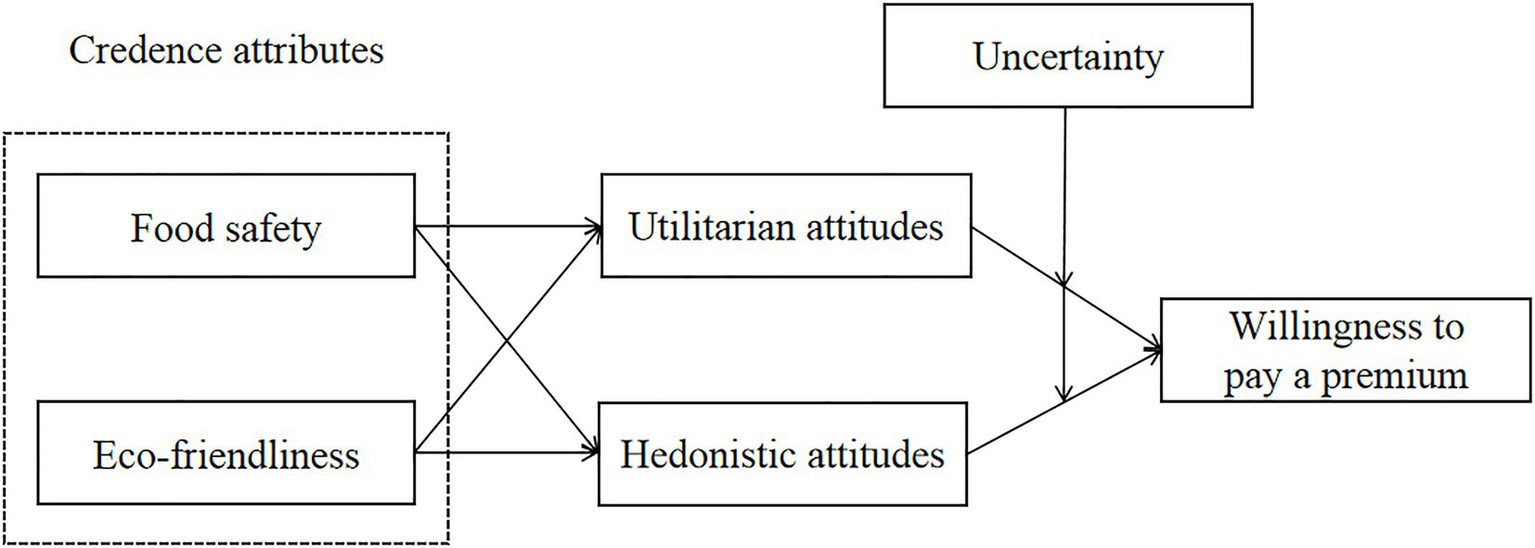
Theoretical model.
3. Methodology
In methodology, we used descriptive statistics to analyze the profile of the sample. Then we conducted reliability and validity analyses to check the appropriateness of the constructs. Finally, we used structural equation modeling (SEM) to conduct main effects analysis and Process macro in SPSS for mediating and moderating effects analysis.
3.1. Sample and procedures
We used the Questionnaire Star platform to design questionnaires. The first part of the questionnaire set up an introductory paragraph introducing organic food and the organic certification label so that participants could fully understand organic food. Two screening questions were also included in the design of the first section. The first was, “Would you like to take part in this survey?” The second was, “Have you ever purchased organic food?” This was done to verify that the participants agreed to participate in the survey and had purchased organic food in order to improve the accuracy of the questionnaire. The second part required participants to answer questions on a 5-point Likert scale regarding credence attributes, attitudes, uncertainty, and willingness to pay a premium, and each page was set to be nonreturnable to prevent participants from repeatedly checking or changing their answers which would invalidate the results of the study. In the third section, participants were asked to fill in some personal information.
Prior to the formal survey, an initial online questionnaire was sent to 10 PhDs in the field of marketing at a large university in Northeast China to ensure that the questions were designed to be easy to understand. Based on their suggestions, unclearly phrased questions were revised and repetitive questions were removed to create the final questionnaire. The formal survey was launched in mid-April. We joined several supermarket discount chat groups and community buying chat groups on the WeChat platform and asked participants to share the online survey among their network of acquaintances using a “snowball” approach to spread the questionnaire online. Given the diversity of organic food buyers, there was no geographical restriction on the distribution of the questionnaires, and a total of 1,000 questionnaires were collected. According to Huang et al. (2015), the presence of insufficient effort responding (IER) in survey data should be assessed prior to hypothesis testing. Therefore, we used response times (Huang et al., 2015; Cheung et al., 2017) to detect and screen out inattentive/careless responding to ensure the reliability of the questionnaire. We tested response times and derived a standard time based on the number of questions, and then excluded questionnaires that took less than the standard time to complete, as well as those with missing data and contradictory questions. A total of 647 valid questionnaires were finally collected.
3.2. Measures
The constructs in this study were measured by existing scales adopted from previous studies. Food safety was measured mainly from Steptoe et al. (1995), which contains three measurement items; Eco-friendliness was measured from the Lindeman and Väänänen (2000) four-item scale; Willingness to pay a premium was measured by three question items from Zhang et al. (2020), and the measurement of uncertainty was borrowed from Shiu et al. (2011). These four constructs were measured using a 5-point Likert scale, which classified subjects’ agreement with the question items on seven levels from 1 to 5 (strongly disagree to strongly agree). The utilitarian attitudes and hedonistic attitudes were measured using a scale developed by Voss et al. (2003), each containing four measurement items. The 5-point semantic differential scale was used to classify the subjects’ understanding of the question items on a 5-point scale from 1 to 5. To improve the validity of the questionnaire, opinions were sought from experts in the food and marketing fields, and appropriate modifications were made in the context of the study to ensure that subjects could better understand each question item. The specific question items are shown in Table 1.
Table 1
| Construct | Item | |
|---|---|---|
| Food safety | Q1 | Organic food contains no additives |
| Q2 | Organic food contains no artificial ingredients | |
| Q3 | Organic food contains natural ingredients | |
| Eco-friendliness | Q1 | The production process of organic food is not harmful to the environment |
| Q2 | The production process of organic food does not disturb the ecological balance | |
| Q3 | Organic food is packaged in an eco-friendly way | |
| Q4 | The production of organic food does not harm the survival of animals | |
| Utilitarian attitudes | Q1 | Non-beneficial - beneficial |
| Q2 | Unhelpful - helpful | |
| Q3 | Non-functional - functional | |
| Q4 | Unnecessary - necessary | |
| Hedonistic attitudes | Q1 | Unpleasant - pleasant |
| Q2 | Unexciting - exciting | |
| Q3 | Not fun - fun | |
| Q4 | Not thrilling - thrilling | |
| Uncertainty | Q1 | I’m not sure that my knowledge of organic food is accurate |
| Q2 | I’m not sure I’m justified in my view of organic food | |
| Q3 | The organic food label does not allow me to determine if my choice is the best | |
| Willingness to pay a premium | Q1 | I am willing to spend more money on organic food than regular food |
| Q2 | For me, it’s worth buying organic food despite the high price | |
| Q3 | I am willing to pay a premium price for organic food | |
Constructs and items.
4. Results
4.1. Participant demographics
The descriptive statistical characteristics of the sample are specifically shown in Table 2. The results show that there are more women than men among the respondents, accounting for 62.3%, which reflects that the purchasers of organic food in households are mostly women. The age of the respondents is mainly distributed between 20 and 45 years old, and the consumers who buy organic food are mainly young and middle aged. An education level of college, bachelor’s degree, and above accounted for 80.4%, and the monthly income was mainly in the 3,000–6,000 RMB range, accounting for 39.6%, indicating that the average education level and income level of the respondents are relatively high. Overall, the sample has a good representation.
Table 2
| Feature | Personal characteristics | Relative frequency | Feature | Personal characteristics | Relative frequency |
|---|---|---|---|---|---|
| Gender | Male | 37.7% | Education | Senior high school and below | 19.6% |
| Female | 62.3% | Junior college or bachelor degree | 58.7% | ||
| Age | 18–25 years old (including 25 years old) | 32.5% | Master degree and above | 21.7% | |
| 26–35 years old (including 35 years old) | 22.7% | Monthly Income | CNY 3000 and below | 39.3% | |
| 36–45 years old (including 45 years old) | 23.6% | CNY 3001–6,000 (including CNY 6000) | 39.6% | ||
| 46–60 years old (including 60 years old) | 19.8% | CNY 6001–9,000 (including CNY 9000) | 13.4% | ||
| Over 60 years old | 1.4% | Over CNY 9000 | 7.7% |
Demographics of participant (N = 647).
4.2. Reliability and validity analysis
Cronbach’s α value was used to test the reliability. As seen in Table 3, the Cronbach’s α values of each construct were above 0.7 (Fornell and Larcker, 1981), and the reliability of the scale was good. Confirmatory factor analysis (CFA) was used to evaluate the validity of the scale, and the results showed that X2/df = 3.309, less than 5; RMSEA = 0.056, less than 0.08; GFI = 0.928, AGFI = 0.90, CFI = 0.964, NFI = 0.948, IFI = 0.964, all above the benchmark of 0.9, which indicated a good fit of the model and the data (Tabachnick et al., 2007). The standardized factor loadings (estimate) for each item were above the critical value of 0.5. The average variance extracted (AVE) for each construct was above the recommended value of 0.5, and the combined reliability (CR) was above the benchmark of 0.7, implying relatively good convergent validity (Schwab, 2006). Discriminant validity was tested by comparing the AVE with the correlation coefficients of the variables. The square roots of the AVEs on the diagonal in Table 4 were all greater than the correlation coefficients between them and the other constructs, indicating good discriminant validity between the variables (Schwab, 2006).
Table 3
| Construct | Item | Estimate | AVE | CR | Cronbach’s α |
|---|---|---|---|---|---|
| Food safety | Q1 | 0.923*** | 0.646 | 0.841 | 0.823 |
| Q2 | 0.866*** | ||||
| Q3 | 0.580*** | ||||
| Eco-friendliness | Q1 | 0.858*** | 0.716 | 0.910 | 0.907 |
| Q2 | 0.890*** | ||||
| Q3 | 0.765*** | ||||
| Q4 | 0.866*** | ||||
| Utilitarian attitudes | Q1 | 0.882*** | 0.617 | 0.861 | 0.838 |
| Q2 | 0.930*** | ||||
| Q3 | 0.545*** | ||||
| Q4 | 0.726*** | ||||
| Hedonistic attitudes | Q1 | 0.855*** | 0.730 | 0.915 | 0.913 |
| Q2 | 0.884*** | ||||
| Q3 | 0.894*** | ||||
| Q4 | 0.780*** | ||||
| Uncertainty | Q1 | 0.842*** | 0.658 | 0.850 | 0.838 |
| Q2 | 0.912*** | ||||
| Q3 | 0.657*** | ||||
| Willingness to pay a premium | Q1 | 0.851*** | 0.734 | 0.892 | 0.894 |
| Q2 | 0.887*** | ||||
| Q3 | 0.843*** |
Confirmatory factor analysis results.
***p < 0.001.
Table 4
| FS | EF | UA | HA | UC | WTPP | |
|---|---|---|---|---|---|---|
| FS | 0.804 | |||||
| EF | 0.273*** | 0.846 | ||||
| UA | 0.107*** | 0.187*** | 0.785 | |||
| HA | 0.100*** | 0.191*** | 0.400*** | 0.854 | ||
| UC | 0.051*** | 0.120*** | 0.026** | 0.038** | 0.811 | |
| WTPP | 0.207*** | 0.377*** | 0.285*** | 0.329*** | 0.076*** | 0.857 |
Pearson’s correlations.
Diagonal values are square roots of average variance extracted (AVE). FS = Food safety; EF = Eco-friendliness; UA = Utilitarian attitudes; HA = Hedonistic attitudes; UC = Uncertainty; WTPP = Willingness to pay a premium. *p < 0.05, ** p < 0.01, *** p < 0.001.
4.3. Hypothesis testing
The hypothesis is tested by the SEM of maximum likelihood estimation. The model fit was X2 = 418.478, df = 120, p < 0.01, X2/df = 3.487, GFI = 0.934, AGFI = 0.906, CFI = 0.966, NFI = 0.953, IFI = 0.966, RMSEA = 0.062. All fit indicators meet the requirements, indicating a good fit of the model (Browne and Cudeck, 1992). The results based on the structural equation model are shown in Table 5. Food safety had a significant positive influence on both utilitarian attitudes UA (β = 0.220, t = 2.528, p = 0.011) and hedonistic attitudes (β = 0.200, t = 2.674, p = 0.007). Thus, hypotheses H1a and H1b were verified. Eco-friendliness had a significant positive influence on both utilitarian attitudes (β = 0.170, t = 2.025, p = 0.043) and hedonistic attitudes (β = 0.220, t = 2.603, p = 0.009). Thus, hypotheses H2a and H2b were verified. Utilitarian attitudes had a significant positive influence on WTPP (β = 0.130, t = 3.471, p = 0.000). Hedonistic attitudes had a significant positive influence on WTPP (β = 0.490, t = 11.442, p = 0.000). Thus, hypotheses H3a and H3b were verified.
Table 5
| Hypothesized path | β | C.R. | P |
|---|---|---|---|
| H1a: Food safety → utilitarian attitudes | 0.22 | 2.528 | 0.011 |
| H1b: Food safety → hedonistic attitudes | 0.20 | 2.674 | 0.007 |
| H2a: Eco-friendliness → utilitarian attitudes | 0.17 | 2.025 | 0.043 |
| H2b: Eco-friendliness → hedonistic attitudes | 0.22 | 2.603 | 0.009 |
| H3a: Utilitarian attitudes → willingness to pay a premium | 0.13 | 3.471 | 0.000 |
| H3b: Hedonistic attitudes → willingness to pay a premium | 0.49 | 11.442 | 0.000 |
Results of structural model analysis.
4.4. Mediation effect test
The mediating effects of utilitarian and hedonistic attitudes were tested using Model 4 (Model 4 is a simple mediation model) in the Process macro proposed by Hayes and Scharkow (2013). The Bootstrap test (a statistical method of multiple repeated sampling) was chosen and set with a number of repetitions of 5,000 and a 95% confidence interval. As shown in Table 6, the bootstrap 95% confidence intervals for both the indirect [0.071, 0.180] and direct [0.386, 0.548] effects of utilitarian attitudes in path 1 did not contain 0, which indicated that utilitarian attitudes partially mediate the relationship between food safety and WTPP. The bootstrap 95% confidence intervals for both the indirect [0.068, 0.169] and direct [0.405, 0.562] effects of utilitarian attitudes in path 3 did not contain 0, which indicated that utilitarian attitudes play a partially mediating role in the relationship between eco-friendliness and WTPP. Hypothesis H4a was verified. The bootstrap 95% confidence intervals for both the indirect [0.103, 0.218] and direct [0.353, 0.511] effects of hedonistic attitudes in path 2 did not contain 0, which indicated that hedonistic attitudes play a partially mediating role in the relationship between food safety and WTPP. In path 4, the bootstrap 95% confidence intervals for both the indirect [0.010, 0.207] and direct [0.372, 0.525] effects of hedonistic attitudes did not contain 0, which indicated that hedonistic attitudes play a partially mediating role in the relationship between eco-friendliness and WTPP. Thus, hypothesis H4b was verified.
Table 6
| Path | Direct effect | Indirect effect | ||
|---|---|---|---|---|
| β | Bias-corrected 95% CI | β | Bias-corrected 95% CI | |
| FS → UA → WTPP | 0.432 | [0.386, 0.548] | 0.156 | [0.071, 0.180] |
| FS → HA → WTPP | 0.467 | [0.353, 0.511] | 0.121 | [0.103, 0.218] |
| EF → UA → WTPP | 0.484 | [0.405, 0.562] | 0.114 | [0.068, 0.169] |
| EF → HA → WTPP | 0.449 | [0.372, 0.525] | 0.149 | [0.010, 0.207] |
Results of mediation analysis.
FS = Food safety; EF = Eco-friendliness; UA = Utilitarian attitudes; HA = Hedonistic attitudes; WTPP = Willingness to pay a premium.
By comparing the relative magnitude of the mediating effect, in the indirect relationship between food safety and WTPP, the proportion of the mediating effect of utilitarian attitudes is 0.156/0.588 = 26.53% and the proportion of the mediating effect of hedonistic attitudes is 0.121/0.588 = 20.58%, indicating that the mediating effect of utilitarian attitudes is greater than that of hedonistic attitudes. However, in the indirect relationship between eco-friendliness and WTPP, the proportion of the mediating effect of utilitarian attitudes is 0.114/0.598 = 19.06%, and the proportion of the mediating effect of hedonistic attitudes is 0.149/0.598 = 24.91%, indicating that the mediating effect of hedonistic attitudes is greater than that of utilitarian attitudes.
4.5. Moderating effect test
The moderated mediation analysis model (Process Model 14) proposed by Hayes (2018) was used to test for moderating effects and mediating effects with moderation. Food safety and eco-friendliness were placed into the model as independent variables, utilitarian and hedonistic attitudes as mediating variables, uncertainty as a moderating variable, and WTPP as a dependent variable. The results of the test for the moderating effect of uncertainty (Table 7) show that uncertainty plays a significant negative interaction effect on the relationship between utilitarian attitudes and WTPP (β = −0.185, p = 0.012; β = −0.186, p = 0.011). Thus, hypothesis H5a was verified. Uncertainty plays a significant positive interaction effect on the relationship between hedonistic attitudes and WTPP (β = 0.132, p = 0.040; β = 0.138, p = 0.030). Thus, hypothesis H5b was not verified.
Table 7
| Independent variable | Interaction items | β | Boot SE | t | p |
|---|---|---|---|---|---|
| Food safety | Utilitarian attitudes * Uncertainty | −0.185 | 0.074 | −2.518 | 0.012 |
| Hedonistic attitudes * Uncertainty | 0.132 | 0.064 | 2.056 | 0.040 | |
| Eco-friendliness | Utilitarian attitudes * Uncertainty | −0.186 | 0.073 | −2.548 | 0.011 |
| Hedonistic attitudes * Uncertainty | 0.138 | 0.063 | 2.180 | 0.030 |
Results of the moderating effect test.
The test for mediating effects with moderation is shown in Table 8. When the independent variable was food safety, the moderating effect of low-uncertainty consumers on the mediating effect of utilitarian attitudes was significant (indirect effect = 0.007, boot CI = [0.029, 0.140]); the moderating effect of high-uncertainty consumers on the mediating effect of utilitarian attitudes was not significant (indirect effect = −0.015, boot CI = [−0.080, 0.067]). The results indicate that there is a significant difference between the low-uncertainty and high-uncertainty groups in terms of whether they influence the WTPP through utilitarian attitudes. The mediating effect of utilitarian attitudes is moderated by uncertainty. In addition, according to the determination index, it can be further shown that uncertainty strengthens the mediating role of utilitarian attitudes in food safety and WTPP (index = −0.069, boot CI = [−0.140, −0.003]).
Table 8
| Independent variable | Intermediate variables | Regulating variables | Effect | Boot CI | Index | Boot CI |
|---|---|---|---|---|---|---|
| Food safety | Utilitarian attitudes | Low uncertainty | 0.077 | [0.029, 0.140] | −0.069 | [−0.140, −0.003] |
| High uncertainty | −0.015 | [−0.080, 0.067] | ||||
| Hedonistic attitudes | Low uncertainty | 0.100 | [0.042, 0.160] | 0.056 | [0.001, 0.121] | |
| High uncertainty | 0.174 | [0.106, 0.251] | ||||
| Eco-friendliness | Utilitarian attitudes | Low uncertainty | 0.074 | [0.029, 0.138] | −0.065 | [−0.138, −0.001] |
| High uncertainty | −0.013 | [−0.075, 0.067] | ||||
| Hedonistic attitudes | Low uncertainty | 0.092 | [0.035, 0.152] | 0.057 | [0.001, 0.121] | |
| High uncertainty | 0.168 | [0.104, 0.243] |
Mediating effects with moderation.
The high-uncertainty group (indirect effect = 0.174, boot CI = [0.106, 0.251]) moderated the mediating effect of hedonistic attitudes more than the low-uncertainty group (indirect effect = 0.100, boot CI = [0.042, 0.160]), and there was a significant difference in the indirect effect between the two groups, indicating that the mediating effect of hedonistic attitudes was moderated by uncertainty. In addition, uncertainty strengthened the mediating role of hedonistic attitudes between food safety and WTPP (index = 0.056, boot CI = [0.001, 0.121]). Similarly, when the independent variable is eco-friendliness, uncertainty strengthens the mediating role of utilitarian attitudes and hedonistic attitudes between eco-friendliness and WTPP.
5. Discussion and conclusion
We found that the credence attributes of organic food, as a psychological evaluation of consumers after receiving information about organic food, significantly and positively influence consumers’ utilitarian and hedonistic attitudes. This result is consistent with previous studies that found that health, safety, and sustainability motivations (environmental factors) positively influence consumer attitudes toward organic food (Pham et al., 2019; Rana and Paul, 2020). Based on these studies, our research focused on two attributes—food safety and eco-friendliness—and further found that consumers’ perceived functional value comes mainly from the food safety of organic food, which is more likely to stimulate consumers’ utilitarian attitudes and influence their WTPP compared to eco-friendliness. Eco-friendliness has pro-environmental characteristics and can enhance consumers’ emotional experience compared to food safety, so eco-friendliness is more likely to stimulate consumers’ hedonistic attitudes and thus promote their WTPP.
Lee and Yun (2015) showed that utilitarian and hedonistic attitudes have a significant positive effect on behavioral intention to purchase organic food and that utilitarian attitudes have a greater impact on consumers’ purchase intention than hedonistic attitudes, with consumers tending to approach organic purchase intention with utilitarian attitudes. Our research also found that utilitarian and hedonistic attitudes positively influence consumers’ WTPP, meaning that consumers are looking not only for superior functional value when buying organic food but also for an emotional experience of consumption. However, we found that hedonistic attitudes had a greater impact on consumers’ WTPP than utilitarian attitudes, which may be due to the fact that consumers react differently to the willingness to pay a premium price (WTPP) versus the willingness to buy (WTB). When the consumer has decided to purchase organic food and is then confronted with a high price, hedonistic attitudes become more prominent in the decision-making process.
In this study, we found that utilitarian and hedonistic attitudes partially mediate the effect of credence attributes on consumers’ WTPP. In other words, food safety and eco-friendly attributes have a significant direct effect on WTPP, while they are also mediated indirectly by utilitarian and hedonistic attitudes. Lee et al. (2019) found that utilitarian and hedonistic attitudes mediated the relationship between factors related to credence attributes such as healthy content, local production, and organic food labels on purchase behavior. In fact, consumers make positive cognitive and emotional judgments about the credence attributes associated with organic food, such as associating organic food with safety and health and ecological conservation (Knaggs et al., 2022), which makes them aware of the functional and emotional benefits and value of organic food, thus increasing their WTPP.
Both Teng and Lu (2016) and Nuttavuthisit and Thøgersen (2017) showed in their studies that high levels of uncertainty reduce consumers’ willingness to purchase organic food. This differs somewhat from our study, where we argue that the effect of uncertainty on consumers’ behavioral intentions depends on consumers’ attitudes. We found that uncertainty negatively moderates the effect of utilitarian attitudes on the WTPP and positively moderates the effect of hedonistic attitudes on the WTPP. This result suggests that perceived risk due to uncertainty negatively affects utilitarian consumers’ WTPP, meaning that utilitarian consumers are less likely to make the decision to pay a premium price when they feel uncertain about information related to organic food, as they do not have the relevant knowledge or information to accurately predict the outcome of the transaction (Hassan et al., 2013). For hedonistic consumers, uncertainty does not reduce their WTPP, probably because most consumers with hedonistic attitudes are less price sensitive and more willing to take risks when making hedonistic purchases (Sadiq et al., 2021), so they may also be willing to pay a premium for organic food in the face of uncertainty because of the emotional satisfaction that buying organic food can bring them. In addition, we further found that uncertainty moderates the mediating role of utilitarian and hedonistic attitudes between credence attributes and WTPP, suggesting that the difference in indirect effects is significant at high and low levels of uncertainty.
5.1. Theoretical implications
The foremost theoretical contribution of this research is the extension of the S-O-R model in the context of organic food consumption. Although S-O-R models have been used for predicting purchase intentions of organic food (Kim et al., 2021; Sultan et al., 2021), the S-O-R framework in the organic food context is currently still underrepresented in the literature, especially in the Chinese context. Moreover, there is still a lack of studies to measure other causal and moderating factors in the framework (Lee and Yun, 2015), so a more robust exploration of the framework is necessary. This study is among the first to develop a model that explains how consumers’ willingness to pay a premium for organic food is driven and constrained by integrating food safety, eco-friendliness, utilitarian attitudes, hedonistic attitudes, and uncertainty. It extends the S-O-R theory and its application context. At the same time, the results of the study provide a new theoretical basis for companies to develop organic food marketing strategies.
Secondly, this study reveals the internal psychological mechanisms involved in the decision-making process of consumers in purchasing organic food. While a large number of studies have highlighted the role of attitudes in intention to purchase organic food and actual purchase behavior (Boobalan et al., 2021; Santos et al., 2021), they have mainly focused on unidimensional attitudes (Lee and Goudeau, 2014). This research investigated utilitarian and hedonic dimensions of attitudes toward purchasing organic foods. This conceptualization is a more integrative approach than the previous studies in which one-dimensional concept of attitudes is considered. Further, the findings suggest that hedonistic attitudes have a greater impact on consumers’ WTPP, implying that consumers may be more inclined to seek a superior emotional experience when purchasing organic food, which will provide new dimensions of exploration for future research in the area of consumer attitudes and behavior.
Thirdly, this study strengthens the explanatory power of the S-O-R model by adding uncertainty as a moderating variable to the model. Our study identifies the moderating role of uncertainty in the relationship between different dimensions of attitudes and WTPP, contributing to the explanation of the attitude-behavior gap in organic food research. Furthermore, our study found that uncertainty strengthens the mediating role of utilitarian and hedonistic attitudes between credence attributes and WTPP. This moderated mediating role could provide new and substantial insights into marketing theory and future research directions and could expand the boundaries of existing organic food research. Finally, the study spotlights the behavior of Chinese consumers in regard to organic food. Findings bridge the gap of deficient theoretical knowledge on the unique characteristics of Chinese consumers and their responses to organically grown food items.
5.2. Managerial implications
Firstly, we suggest that manufacturers could consider carefully designing safety and environmental messages to showcase how organic food contributes to the health and well-being of consumers. Specifically, in terms of eco-friendliness, manufacturers may consider reporting the carbon footprint of their products and creating a consumer sustainability index (Nikolaou and Kazantzidis, 2016) to improve the perceived environmental value of a product among consumers. In terms of food safety, retailers could cite the latest and most authoritative scientific findings or endorsements by national agencies to support their claims on the safety of organic food, such as less additives and pesticide residues, more beneficial nutrients, etc. In addition, retailers could communicate the safety and environmental benefits of organic foods through social networks, mass media, and interactive screens in-store, and include integrated promotional mix elements in their communication campaign (Chekima et al., 2019).
Secondly, as established consumer attitudes are difficult to change (Aaker, 1996), we suggest that marketers could stimulate positive attitudes toward organic food by providing consumers with cues that organic food contains hedonic and utilitarian attributes that will satisfy their needs. Specifically, for utilitarian consumers, marketers may participate or sponsor research related to the organic food safety testing and reflect the findings in advertising, packaging, or leaflets, which will help stimulate utilitarian attitudes among consumers. For hedonistic consumers, marketers could focus on hedonic gratification derived from purchasing organic foods. For example, by emphasizing that an organic food purchase is a way to ultimately save animals and the environment, or by using experiential marketing methods, organizing food tastings, food festival competitions, etc. to stimulate hedonic feelings such as satisfaction. According to our findings, hedonistic attitudes have a stronger impact on consumers’ WTPP compared to utilitarian attitudes. Therefore, marketers could leverage the hedonic benefits of the consumption of organic food by engaging in emotional appeal advertising and highlight the hedonic attributes of their products through a multi-sensory marketing approach (attractive packaging and good taste, etc.), thus enhancing consumer pleasure and enjoyment.
Finally, we recommend that manufacturers may consider introducing the latest blockchain technology. Blockchain food traceability system has the characteristics of traceability and tamper-proof, which can ensure the authenticity of information (Wei et al., 2022), thus reducing the perceived information asymmetry between consumers and organic food suppliers. Manufacturers could also introduce QR codes with traceability information on product packaging. By scanning the QR code, consumers could have information on the entire process of organic products from production to distribution, which will help increase transparency and address consumers’ uncertainty. In addition, organic producers could show more production details to consumers through media and social platforms to reduce consumers’ uncertainty and increase their organic purchase intentions.
6. Limitations and future directions
One limitation of this study is that participants were recruited from supermarket discount chat groups and community buying chat groups on WeChat. There were more participants who were female and aged 20–45 years old, which may not be generalizable. Future studies could expand the sample set in terms of gender and age so that the findings may be more valid. Another limitation is that the sample in this study was not stratified by place of purchase. Future studies could divide the sample set into different segments such as organic food supermarkets, specialty shops, and bazaars. In addition, this paper is an exploration of the willingness to pay a premium for organic food, and future research could further explore consumers’ willingness to repurchase organic food.
Funding
This study was funded by the reform and develop high-level talent projects in local universities supported by the central government (2020GSP13); National Social Science Fund of China (22BJY157); Natural Science Foundation of Heilongjiang Province (LH2022G014); Social Science Foundation Project of Heilongjiang Province (20GLB114); and Postdoctoral research start-up fund project of Heilongjiang Province (LBH-Q21103).
Publisher’s note
All claims expressed in this article are solely those of the authors and do not necessarily represent those of their affiliated organizations, or those of the publisher, the editors and the reviewers. Any product that may be evaluated in this article, or claim that may be made by its manufacturer, is not guaranteed or endorsed by the publisher.
Statements
Data availability statement
The raw data supporting the conclusions of this article will be made available by the authors, without undue reservation.
Ethics statement
Ethical review and approval were not required for the study on human participants in accordance with the local legislation and institutional requirements. Written informed consent for participation was not required for this study in accordance with the national legislation and institutional requirements.
Author contributions
HH: conceptualization. XJ and CH: data curation. XJ: formal analysis. HH and SW: funding acquisition. DY and YT: investigation. CH: methodology. HH and CH: resources. XJ and YT: writing—original draft. SW and DY: writing—review and editing. All authors contributed to the article and approved the submitted version.
Conflict of interest
The authors declare that the research was conducted in the absence of any commercial or financial relationships that could be construed as a potential conflict of interest.
References
1
Aaker D. A. (1996). Measuring brand equity across products and markets. Calif. Manag. Rev.38, 102–120. doi: 10.2307/41165845
2
Ahmed N. Li C. Khan A. Qalati S. A. Naz S. Rana F. (2021). Purchase intention toward organic food among young consumers using theory of planned behavior: role of environmental concerns and environmental awareness. J. Environ. Plan. Manag.64, 796–822. doi: 10.1080/09640568.2020.1785404
3
Ajzen I. (2011). The theory of planned behaviour: reactions and reflections. Psychol. Health26, 1113–1127. doi: 10.1080/08870446.2011.613995
4
Ajzen I. Fishbein M. (2000). Attitudes and the attitude-behavior relation: reasoned and automatic processes. Eur. Rev. Soc. Psychol.11, 1–33. doi: 10.1080/14792779943000116
5
Bernabéu R. Nieto R. Rabadán A. (2022). Effect of self-reported attitudes toward organic foods in consumer preferences and willingness to pay. Renew. Agric. Food Syst.37, 360–368. doi: 10.1017/s1742170522000035
6
Boobalan K. Nachimuthu G. S. Sivakumaran B. (2021). Understanding the psychological benefits in organic consumerism: an empirical exploration. Food Qual. Prefer.87:104070. doi: 10.1016/j.foodqual.2020.104070
7
Brach S. Walsh G. Shaw D. (2018). Sustainable consumption and third-party certification labels: consumers’ perceptions and reactions. Eur. Manag. J.36, 254–265. doi: 10.1016/j.emj.2017.03.005
8
Browne M. W. Cudeck R. (1992). Alternative ways of assessing model fit. Sociol. Methods Res.21, 230–258. doi: 10.1177/0049124192021002005
9
Bryła P. (2016). Organic food consumption in Poland: motives and barriers. Appetite105, 737–746. doi: 10.1016/j.appet.2016.07.012
10
Çabuk M. Eratak S. Alçicek A. Bozkurt M. (2014). Effects of herbal essential oil mixture as a dietary supplement on egg production in quail. Sci. World J.2014, 1–4. doi: 10.1155/2014/573470
11
Canio D. Francesca M. Emiro E. E. (2021). Enhancing consumers’ pro-environmental purchase intentions: the moderating role of environmental concern. Int. J. Retail Distrib. Manag.49, 1312–1329. doi: 10.1108/ijrdm-08-2020-0301
12
Chekima B. Chekima K. Chekima K. (2019). Understanding factors underlying actual consumption of organic food: the moderating effect of future orientation. Food Qual. Prefer.74, 49–58. doi: 10.1016/j.foodqual.2018.12.010
13
Cheung J. H. Burns D. K. Sinclair R. R. Sliter M. (2017). Amazon mechanical Turk in organizational psychology: an evaluation and practical recommendations. J. Bus. Psychol.32, 347–361. doi: 10.1007/s10869-016-9458-5
14
China (2022). China market supervision administration. China Organic Product Certification and organic Industry Develop. Report2022, 81–91.
15
Clark E. Mulgrew K. Kannis-Dymand L. Schaffer V. Hoberg R. (2019). Theory of planned behaviour: predicting tourists’ pro-environmental intentions after a humpback whale encounter. J. Sustain. Tour.27, 649–667. doi: 10.1080/09669582.2019.1603237
16
Darby M. R. Karni E. (1973). Free competition and the optimal amount of fraud. J. Law Econ.16, 67–88. doi: 10.1086/466756
17
Ditlevsen K. Sandøe P. Lassen J. (2019). Healthy food is nutritious, but organic food is healthy because it is pure: the negotiation of healthy food choices by Danish consumers of organic food. Food Qual. Prefer.71, 46–53. doi: 10.1016/j.foodqual.2018.06.001
18
Dorce L. C. da Silva M. Corrêa M. Carrijo J. R. Domingues D. F. Heloisa C. et al . (2021). Extending the theory of planned behavior to understand consumer purchase behavior for organic vegetables in Brazil: the role of perceived health benefits, perceived sustainability benefits and perceived price. Food Qual. Prefer.91:104191. doi: 10.1016/j.foodqual.2021.104191
19
Fornell C. Larcker D. F. (1981). Evaluating structural equation models with unobservable variables and measurement error. J. Mar. Res.18, 39–50. doi: 10.2307/3151312
20
Fuljahn A. Moosmayer D. C. (2011). The myth of guilt: a replication study on the suitability of hedonic and utilitarian products for cause related marketing campaigns in Germany. Int. J. Business Res.11, 85–92. https://www.redalyc.org/articulo.oa?id=87812765001
21
Galati A. Migliore G. Thrassou A. Schifani G. Rizzo G. Adamashvili N. et al . (2022). Consumers’ willingness to pay for Agri-food products delivered with electric vehicles in the short supply chains. FIIB Business Rev.23197145221112743:231971452211127. doi: 10.1177/23197145221112743
22
Giampietri E. Verneau F. Giudice D. Teresa C. Valentina Adele F. (2018). A theory of planned behaviour perspective for investigating the role of trust in consumer purchasing decision related to short food supply chains. Food Qual. Prefer.64, 160–166. doi: 10.1016/j.foodqual.2017.09.012
23
Gkargkavouzi A. Halkos G. Matsiori S. (2019). How do motives and knowledge relate to intention to perform environmental behavior? Assessing the mediating role of constraints. Ecol. Econ.165:106394. doi: 10.1016/j.ecolecon.2019.106394
24
Hassan L. Shaw D. Shiu E. Walsh G. Parry S. (2013). Uncertainty in ethical consumer choice: a conceptual model. J. Consum. Behav.12, 182–193. doi: 10.1002/cb.1409
25
Hayes A. F. (2018). Partial, conditional, and moderated moderated mediation: quantification, inference, and interpretation. ComM.85, 4–40. doi: 10.1080/03637751.2017.1352100
26
Hayes A. F. Scharkow M. (2013). The relative trustworthiness of inferential tests of the indirect effect in statistical mediation analysis: does method really matter?Psychol. Sci.24, 1918–1927. doi: 10.1177/0956797613480187
27
Hemmerling S. Hamm U. Spiller A. (2015). Consumption behaviour regarding organic food from a marketing perspective—a literature review. Org. Agric.5, 277–313. doi: 10.1007/s13165-015-0109-3
28
Hempel C. Hamm U. (2016). Local and/or organic: a study on consumer preferences for organic food and food from different origins. Int. J. Consum. Stud.40, 732–741. doi: 10.1111/ijcs.12288
29
Honkanen P. Verplanken B. Olsen S. O. (2006). Ethical values and motives driving organic food choice. J. Consumer Behav.: Int. Res. Rev.5, 420–430. doi: 10.1002/cb.190
30
Huang J. L. Liu M. Bowling N. A. (2015). Insufficient effort responding: examining an insidious confound in survey data. J. Appl. Psychol.100, 828–845. doi: 10.1037/a0038510
31
Janssen M. Hamm U. (2012). Product labelling in the market for organic food: consumer preferences and willingness-to-pay for different organic certification logos. Food Qual. Prefer.25, 9–22. doi: 10.1016/j.foodqual.2011.12.004
32
Joya K. Ramli N. N. Shamsudin M. N. Kamarulzaman N. H. (2021). Consumers’ willingness to pay for food safety attributes of tomato. Br. Food J.124, 701–717. doi: 10.1108/bfj-02-2021-0164
33
Kim E.-k. Kwon Y.-s. Kim S. Lee J.-Y. Park Y. H. (2021). Agrifood consumer competency and organic food purchase intentions according to food-related lifestyle: based on data the 2019 consumer behavior survey for food. Nutr. Res. Pract.16, 517–526. doi: 10.4162/nrp.2022.16.4.517
34
Knaggs J. Pruitt J. R. Anderson L. Palma M. (2022). Influence of social status, physical activity, and socio-demographics on willingness to pay for a basket of organic foods. Agricul. Food Econ.10:25. doi: 10.1186/s40100-022-00233-8
35
Konuk F. A. (2018). Antecedents of pregnant women’s purchase intentions and willingness to pay a premium for organic food. Br. Food J.120, 1561–1573. doi: 10.1108/bfj-11-2017-0631
36
Konuk F. A. (2019). The influence of perceived food quality, price fairness, perceived value and satisfaction on customers’ revisit and word-of-mouth intentions towards organic food restaurants. J. Retail. Consum. Serv.50, 103–110. doi: 10.1016/j.jretconser.2019.05.005
37
Kushwah S. Dhir A. Sagar M. Gupta B. (2019). Determinants of organic food consumption. A systematic literature review on motives and barriers. Appetite143:104402. doi: 10.1016/j.appet.2019.104402
38
Lang M. Rodrigues A. C. (2022). A comparison of organic-certified versus non-certified natural foods: perceptions and motives and their influence on purchase behaviors. Appetite168:105698. doi: 10.1016/j.appet.2021.105698
39
Lee T. H. Fu C.-J. Chen Y. Y. (2019). Trust factors for organic foods: consumer buying behavior. Br. Food J.122, 414–431. doi: 10.1108/bfj-03-2019-0195
40
Lee H.-J. Goudeau C. (2014). Consumers’ beliefs, attitudes, and loyalty in purchasing organic foods: the standard learning hierarchy approach. Br. Food J.116, 918–930. doi: 10.1108/bfj-02-2013-0030
41
Lee H.-J. Hwang J. (2016). The driving role of consumers’ perceived credence attributes in organic food purchase decisions: a comparison of two groups of consumers. Food Qual. Prefer.54, 141–151. doi: 10.1016/j.foodqual.2016.07.011
42
Lee H.-J. Yun Z.-S. (2015). Consumers’ perceptions of organic food attributes and cognitive and affective attitudes as determinants of their purchase intentions toward organic food. Food Qual. Prefer.39, 259–267. doi: 10.1016/j.foodqual.2014.06.002
43
Liang A. R.-D. Lim W.-M. (2021). Why do consumers buy organic food? Results from an SOR model. Asia Pac. J. Mark. Logist.33, 394–415. doi: 10.1108/apjml-03-2019-0171
44
Lindeman M. Väänänen M. (2000). Measurement of ethical food choice motives. Appetite34, 55–59. doi: 10.1006/appe.1999.0293
45
Liu Y. Sam A. G. (2022). The organic premium of baby food based on market segments. Agribusiness38, 533–556. doi: 10.1002/agr.21745
46
Liu C. Zheng Y. (2019). The predictors of consumer behavior in relation to organic food in the context of food safety incidents: advancing hyper attention theory within an stimulus-organism-response model. Front. Psychol.10:2512. doi: 10.3389/fpsyg.2019.02512
47
Maehle N. Iversen N. Hem L. Otnes C. (2015). Exploring consumer preferences for hedonic and utilitarian food attributes. Br. Food J.117, 3039–3063. doi: 10.1108/bfj-04-2015-0148
48
Massey M. O’Cass A. Otahal P. (2018). A meta-analytic study of the factors driving the purchase of organic food. Appetite125, 418–427. doi: 10.1016/j.appet.2018.02.029
49
Molinillo S. Vidal-Branco M. Japutra A. (2020). Understanding the drivers of organic foods purchasing of millennials: evidence from Brazil and Spain. J. Retail. Consum. Serv.52:101926. doi: 10.1016/j.jretconser.2019.101926
50
Moruzzo R. Riccioli F. Boncinelli F. Zhang Z. Zhao J. Tang Y. et al . (2020). Urban consumer trust and food certifications in China. Foods.9:1153. doi: 10.3390/foods9091153
51
Nassivera F. Troiano S. Marangon F. Sillani S. Nencheva I. M. (2017). Willingness to pay for organic cotton: consumer responsiveness to a corporate social responsibility initiative. Br. Food J.119, 1815–1825. doi: 10.1108/bfj-12-2016-0583
52
Nikolaou I. E. Kazantzidis L. (2016). A sustainable consumption index/label to reduce information asymmetry among consumers and producers. Sustain. production Consumption.6, 51–61. doi: 10.1016/j.spc.2016.01.001
53
Nuttavuthisit K. Thøgersen J. (2017). The importance of consumer trust for the emergence of a market for green products: the case of organic food. J. Bus. Ethics140, 323–337. doi: 10.1007/s10551-015-2690-5
54
Pedersen S. Zhang T. Zhou Y. Aschemann-Witzel J. Thøgersen J. (2022). Consumer attitudes towards imported organic food in China and Germany: the key importance of trust. J. Macromark.02761467221077079:027614672210770. doi: 10.1177/02761467221077079
55
Pham T. H. Nguyen T. N. Phan T. T. Hoai Nguyen Thanh N. (2019). Evaluating the purchase behaviour of organic food by young consumers in an emerging market economy. J. Strateg. Mark.27, 540–556. doi: 10.1080/0965254x.2018.1447984
56
Puteri B. Buttlar B. Jahnke B. (2022). Take it or leave it? Investigating the ambivalence and willingness to pay for suboptimal fruits and vegetables among organic consumers in Germany. Front. Sustain. Food Systems.6:934954. doi: 10.3389/fsufs.2022.934954
57
Rabadán A. Díaz M. Brugarolas M. Bernabéu R. (2020). Why don’t consumers buy organic lamb meat?A Spanish case study. Meat science.162:108024. doi: 10.1016/j.meatsci.2019.108024
58
Rana J. Paul J. (2020). Health motive and the purchase of organic food: a meta-analytic review. Int. J. Consum. Stud.44, 162–171. doi: 10.1111/ijcs.12556
59
Rödiger M. Hamm U. (2015). How are organic food prices affecting consumer behaviour?Rev. Food Quality and Preference.43, 10–20. doi: 10.1016/j.foodqual.2015.02.002
60
Sadiq M. A. Rajeswari B. Ansari L. Kirmani M. D. (2021). The role of food eating values and exploratory behaviour traits in predicting intention to consume organic foods: an extended planned behaviour approach. J. Retail. Consum. Serv.59:102352. doi: 10.1016/j.jretconser.2020.102352
61
Salvatore F. P. Adamashvili N. Conto F. (2021). Factors affecting consumer purchasing behavior of functional food: a comparative analysis for consumer management. Br. Food J.124, 1519–1536. doi: 10.1108/bfj-11-2020-1043
62
Santos V. Gomes S. Nogueira M. (2021). Sustainable packaging: does eating organic really make a difference on product-packaging interaction?J. Clean. Prod.304:127066. doi: 10.1016/j.jclepro.2021.127066
63
Schwab D. P. (2006). Book review: research methods for organizational studies. Organ. Res. Methods9, 572–574. doi: 10.1177/1094428106290197
64
Shiu E. M. K. Walsh G. Hassan L. M. Shaw D. (2011). Consumer uncertainty, revisited. Psychol. Mark.28, 584–607. doi: 10.1002/mar.20402
65
Steptoe A. Pollard T. M. Wardle J. (1995). Development of a measure of the motives underlying the selection of food: the food choice questionnaire. Appetite25, 267–284. doi: 10.1006/appe.1995.0061
66
Su L. Swanson S. R. (2017). The effect of destination social responsibility on tourist environmentally responsible behavior: compared analysis of first-time and repeat tourists. Tour. Manag.60, 308–321. doi: 10.1016/j.tourman.2016.12.011
67
Sultan P. Tarafder T. Pearson D. Henryks J. (2020). Intention-behaviour gap and perceived behavioural control-behaviour gap in theory of planned behaviour: moderating roles of communication, satisfaction and trust in organic food consumption. Food Qual. Prefer.81:103838. doi: 10.1016/j.foodqual.2019.103838
68
Sultan P. Wong H. Y. Shah A. M. (2021). How perceived communication source and food value stimulate purchase intention of organic food: an examination of the stimulus-organism-response (SOR) model. J. Clean. Prod.312:127807. doi: 10.1016/j.jclepro.2021.127807
69
Szolnoki G. Hauck K. (2020). Analysis of German wine consumers’ preferences for organic and non-organic wines. Br. Food J.122, 2077–2087. doi: 10.1108/bfj-10-2019-0752
70
Tabachnick Barbara G. Fidell Linda S. Ullman Jodie B. (2007). Using multivariate statistics. Pearson Education, Boston, Massachusetts.
71
Talwar S. Dhir A. Khalil A. Mohan G. Islam A. K. M. N. (2020). Point of adoption and beyond. Initial trust and mobile-payment continuation intention. J. Retail. Consum. Serv.55:102086. doi: 10.1016/j.jretconser.2020.102086
72
Tan B. C. Lau T. C. Sarwar A. Khan N. (2021). The effects of consumer consciousness, food safety concern and healthy lifestyle on attitudes toward eating “green”. Br. Food J.124, 1187–1203. doi: 10.1108/bfj-01-2021-0005
73
Teng C.-C. Lu C.-H. (2016). Organic food consumption in Taiwan: motives, involvement, and purchase intention under the moderating role of uncertainty. Appetite105, 95–105. doi: 10.1016/j.appet.2016.05.006
74
Thøgersen John . (2016). Consumer decision-making with regard to organic food products. London: Routledge. 187–206.
75
Vapa-Tankosić J. Ignjatijević S. Kiurski J. Milenković J. Milojević I. (2020). Analysis of consumers’ willingness to pay for organic and local honey in Serbia. Sustain. For.12:4686. doi: 10.3390/su12114686
76
Vieira L. M. (2008). The applicability of transaction costs economics to vertical integration decision: evidences from a Brazilian beef processor. Organizações Rurais & Agroindustriais.10, 317–327. https://www.redalyc.org/articulo.oa?id=87812765001
77
Voss K. E. Spangenberg E. R. Grohmann B. (2003). Measuring the hedonic and utilitarian dimensions of consumer attitude. J. Mar. Res.40, 310–320. doi: 10.1509/jmkr.40.3.310.19238
78
Wang J. Dang W. Hui W. Muqiang Z. Qi W. (2021). Investigating the effects of intrinsic motivation and emotional appeals into the link between organic appeals advertisement and purchase intention toward organic Milk. Front. Psychol.12:679611. doi: 10.3389/fpsyg.2021.679611
79
Wang L. Wang J. Huo X. (2019). Consumer’s willingness to pay a premium for organic fruits in China: a double-hurdle analysis. Int. J. Environ. Res. Public Health16:126. doi: 10.3390/ijerph16010126
80
Wei S. Liu F. She S. Wu R. (2022). Values, motives, and organic food consumption in China: a moderating role of perceived uncertainty. Front. Psychol.13:736168. doi: 10.3389/fpsyg.2022.736168
81
Yazar E. E. Burucuoğlu M. (2019). Consumer attitude towards organic foods: a multigroup analysis across genders. Istanbul Business Res.48, 176–196. doi: 10.26650/ibr.2019.48.0001
82
Yenipazarli A. (2015). The economics of eco-labeling: standards, costs and prices. Int. J. Prod. Econ.170, 275–286. doi: 10.1016/j.ijpe.2015.09.032
83
Yu W. Han X. Cui F. (2022). Increase consumers’ willingness to pay a premium for organic food in restaurants: explore the role of comparative advertising. Front. Psychol.13:982311. doi: 10.3389/fpsyg.2022.982311
84
Zhang Y. Xiao C. Zhou G. (2020). Willingness to pay a price premium for energy-saving appliances: role of perceived value and energy efficiency labeling. J. Clean. Prod.242:118555. doi: 10.1016/j.jclepro.2019.118555
85
Zhao J. Gerasimova K. Peng Y. Sheng J. (2019). Information asymmetry, third party certification and the integration of organic food value chain in China. China Agricul. Econ. Rev.12, 20–38. doi: 10.1108/caer-05-2018-0111
Summary
Keywords
organic food, credence attribute, food safety, eco-friendliness, willingness to pay a premium, attitude, uncertainty
Citation
Huo H, Jiang X, Han C, Wei S, Yu D and Tong Y (2023) The effect of credence attributes on willingness to pay a premium for organic food: A moderated mediation model of attitudes and uncertainty. Front. Psychol. 14:1087324. doi: 10.3389/fpsyg.2023.1087324
Received
02 November 2022
Accepted
31 January 2023
Published
17 February 2023
Volume
14 - 2023
Edited by
Daniel Rodriguez, La Salle University, United States
Reviewed by
Nino Adamashvili, University of Foggia, Italy; Laura Frank, La Salle University, United States; Asim Nawaz, Government College University, Faisalabad, Pakistan
Updates
Copyright
© 2023 Huo, Jiang, Han, Wei, Yu and Tong.
This is an open-access article distributed under the terms of the Creative Commons Attribution License (CC BY). The use, distribution or reproduction in other forums is permitted, provided the original author(s) and the copyright owner(s) are credited and that the original publication in this journal is cited, in accordance with accepted academic practice. No use, distribution or reproduction is permitted which does not comply with these terms.
*Correspondence: Chunjia Han, ✉ chunjia.han@bbk.ac.uk
This article was submitted to Eating Behavior, a section of the journal Frontiers in Psychology
Disclaimer
All claims expressed in this article are solely those of the authors and do not necessarily represent those of their affiliated organizations, or those of the publisher, the editors and the reviewers. Any product that may be evaluated in this article or claim that may be made by its manufacturer is not guaranteed or endorsed by the publisher.