Abstract
Aims:
This study aimed to design the Chinese Modified Olfactory Identification (CMOI) test based on the Sniffin' Sticks Olfactory Identification (SSOI) test by changing unfamiliar distractors and odors for more familiar ones for the Chinese population.
Materials and methods:
We recruited 200 healthy volunteers (103 males and 97 females, aged 18–65 years, mean age 35.04 years, SD 10.96); in a survey, 100 volunteers rated their familiarity with 121 odors, including all the SSOI test odor descriptors and common odors in Chinese daily life. The SSOI test was modified according to the survey results. The other 100 volunteers were tested three times using the SSOI test, the Modified Distractors Olfactory Identification (MDOI) test established by modifying distractors in the SSOI test, and the CMOI test developed by using familiar unpleasant odors to displace the odors with low correct recognition rates in the MDOI test. We compared the test scores of the volunteers during the modification process.
Results:
Volunteers were unfamiliar with 31 odor descriptors in the SSOI test; 23 distractors with low familiarity were displaced with more familiar distractors. The three odors with the lowest correct recognition rate in the MDOI test (apple, leather, and pineapple) were displaced with familiar unpleasant odors. The test scores were significantly higher in the CMOI test than in others (p < 0.0001); the correct recognition rate in the CMOI test was significantly higher than in the SSOI test (p < 0.01).
Conclusion:
The test scores in the CMOI test were significantly improved; it prevented choosing wrongly due to unfamiliarity with an odor and its distractors.
1. Introduction
Olfaction is an important sense that can regulate emotions, affects cognition and behavior (Liu et al., 2020; Zambom-Ferraresi et al., 2021), and also reminds us of dangers in the environment (Husain et al., 2021). It can be impaired by chronic rhinosinusitis, head trauma, infections, aging, long-term smoking, alcoholism, metabolic diseases, and autoimmune diseases (Topan et al., 2021). Olfactory dysfunction can significantly affect patients' quality of life (Denis et al., 2021), and it is an early marker of neurodegenerative diseases such as Alzheimer's disease and Parkinson's disease (Cha et al., 2021; Wang et al., 2021).
The diagnosis and classification of olfactory dysfunction mainly depends on olfactory psychophysical tests such as the Sniffin' Sticks test (Hummel et al., 1997), the Connecticut Chemosensory Clinical Research Center test (Cain et al., 1988), the University of Pennsylvania Smell Identification test (Doty et al., 1984), and the T&T test (Takagi, 1987). As one of the most widely used olfactory tests (Niklassen et al., 2018), the Sniffin' Sticks test is composed of the olfactory threshold test, the olfactory discrimination test, and the olfactory identification test (SSOI test) (Hummel et al., 1997).
According to the research by Chrea et al. (2004), differences in culture, customs, and other factors in different countries and regions can lead to different people's familiarity with the same smell. When examinees receive olfactory identification tests that are not suitable for their region, they may be unfamiliar with the odor itself or its distractors, which may affect the results of olfactory tests. Therefore, quite a few researchers designed olfactory test methods suitable for local people (Konstantinidis et al., 2008; Jiang et al., 2010; Ogihara et al., 2011; Yücepur et al., 2012; Fenólio et al., 2022). Among them, the modified scheme for the Sniffin' Sticks test is the most common. SSOI test includes 16 odors and a total of 64 odor descriptors (four for each stimulus), of which 48 are distractors (Hummel et al., 1997). Researchers in different countries and regions, including Spain, Malaysia, Congo, and Turkey, have put forward the modified scheme for the Sniffin' Sticks test suitable for local people by changing odors and distractors (Balungwe et al., 2020; Delgado-Losada et al., 2020; Sai-Guan et al., 2020; Demir et al., 2021).
In recent years, some researchers in China also have been committed to putting forward modified schemes of olfactory tests suitable for Chinese people. The Institute of Psychology of the Chinese Academy of Sciences and the Beijing Anzhen Hospital, Affiliated with Capital Medical University, has put forward the modified scheme of olfactory tests suitable for Chinese people, CSIT, and COIT (Feng et al., 2019; Su et al., 2021). Although they both used odors familiar to Chinese people to modify the olfactory identification test, they ignored two problems. First, both schemes just changed some odors but did not modify the distractors of other options. Second, researchers mostly choose pleasant or neutral odors instead of unpleasant odors in most olfactory test modification schemes, including these two modification schemes. The warning function is an important olfactory function, and most of the odors with warning functions have unpleasant smells, such as burnt smell in case of fire and special smells in case of natural gas leakage.
To detect the olfactory function of examinees more comprehensively, it is necessary to introduce some unpleasant odors with warning functions into olfactory tests. In this study, we modified the distractors in an olfactory identification test appropriately, and some unpleasant odors with warning functions were introduced to modify the olfactory identification test. We intended to modify the Sniffin' Sticks test according to the Chinese population and include unpleasant odors due to their importance in daily life.
2. Materials and methods
For the development of this report, the STROBE guide for observational studies has been followed.
2.1. Participants
We recruited 200 volunteers with normal olfaction from 2021 to 2022. The first 100 volunteers (42 males and 58 females, aged 18–65 years, mean age 35.70 years, SD 10.88) participated in the odor familiarity survey. The remaining 100 volunteers (61 males and 39 females, aged 18–60 years, mean age 34.38 years, SD 11.00) participated in the modification of the olfactory identification test. They reported having no obvious olfactory disorder and no previous history of nasal craniocerebral surgery. Physical examination showed that both nasal cavities and olfactory clefts were unobstructed. Signed informed consent was obtained. All procedures used in this experiment involving human participants were approved by the First Affiliated Hospital of China Medical University Ethics Committee in 2021 and were in accordance with the Declaration of Helsinki.
2.2. Odorants preparation
This experiment used three odorants, namely, tetrahydrothiophene, 2-methylpyrazine, and trimethylindole, purchased from Aladdin Company (Shanghai, China). We dissolved 1 g of trimethylindole in 20 ml of corn oil, while tetrahydrothiophene and 2-methylpyrazine are both liquids that can be directly used, and the amounts of tetrahydrothiophene, trimethylindole, and 2-methylpyrazine used in this experiment were 1, 2, and 300 mg, respectively. The three odorants were added to three blank felt-tip pens (Burgart Messtechnik, Wedel, Germany) by pipette, respectively. Regarding the safety of the odorants, first, after adding an appropriate amount of the three odorants, the pen can be used for 6 months without adding odorants again during the period. Then, we found that the damage of these three odorants to the human body can be ignored by animal experiments and literature review (Yu et al., 1996; Li et al., 2010, 2020).
2.3. Test procedure
Sniffin' Sticks Olfactory Identification test: This test comprises 16 felt-tip pen-like devices, and during the testing procedure, only one olfactory pen cap can be opened at a time. The pen tip was placed ~2 cm under the middle of the examinee's double nostrils and did not touch the examinee's skin. The time for the examinee to smell each pen shall not exceed 2–3 s, with an interstimulus interval of about 30 s. After presenting a stick, the examinees were provided with four odor descriptors to select the option that could best describe the presented odor. Even if examinees were uncertain about the odor, they were required to use the exclusion method to make a choice. The test was repeated successively until all 16 odors were presented (Hummel et al., 1997).
2.4. Study design
2.4.1. Odor familiarity survey
The familiarity of 121 odors was investigated in 100 volunteers. Based on Niklassen et al.'s (2018) study, we developed an odor familiarity questionnaire containing 121 kinds of odors. The questionnaire included basic information about the volunteers: name, gender, age, contact details, and occupation (strict measures were taken to ensure that the privacy and personally identifiable information of volunteers were not exposed during the research process, and the names of volunteers were hidden and replaced by numbers only). According to the familiarity with the 121 common odors provided in the questionnaire, we used a Likert-type scale for the volunteers to score by using an online or paper questionnaire (the content of the online and paper questionnaires were similar). The scale ranged from 1 to 5, in which 1 is not familiar and 5 is highly familiar. If the volunteers scored 4 or 5 on an odor, they were considered “familiar” with the odor. The number of volunteers who were “familiar” with an odor among 100 volunteers was the final familiarity score of the odor.
2.4.2. Modification of the olfactory identification test
(1) Preparation of the olfactory test: First, we did not change the odors in the SSOI test but adjusted the distractors according to the odor familiarity results and randomly displaced the unfamiliar distractors with the distractors with an odor familiarity score higher than 75 (Gudziol and Hummel, 2009), to form the MDOI test. Then, we used tetrahydrothiophene, 2-methylpyrazine, and trimethylindole to simulate natural gas, burnt smell, and fecal odor, respectively, and distractors were randomly assigned to the three odors.
(2) Olfactory identification test modification: First, the SSOI test was conducted on 100 volunteers. Then, the volunteers were tested by MDOI test after 30 min, with the test process unchanged. Finally, because the odors, distractors, and volunteers participating in the other 13 odors' tests remained unchanged, to reduce the olfactory fatigue of volunteers, the volunteers were only tested with three odors of natural gas, burnt smell, and fecal odor to complete the olfactory identification test.
2.5. Statistical analysis
R version 3.5.3 was used for statistical analysis. A p-value of <0.05 indicated statistical significance. Measurement data are expressed as mean ± standard deviation (x ± s) and counting data as rate (%). The correct recognition rate of odors in each test was calculated, and the test scores in the modification process were tested by paired sample Friedman M-test. The correct recognition rate of odors in the SSOI and CMOI tests was tested by the paired sample Wilcoxon signed rank-sum test. Figures 1, 2 were drawn using the GraphPad Prism 8 (GraphPad Software, La Jolla, CA, USA).
Figure 1
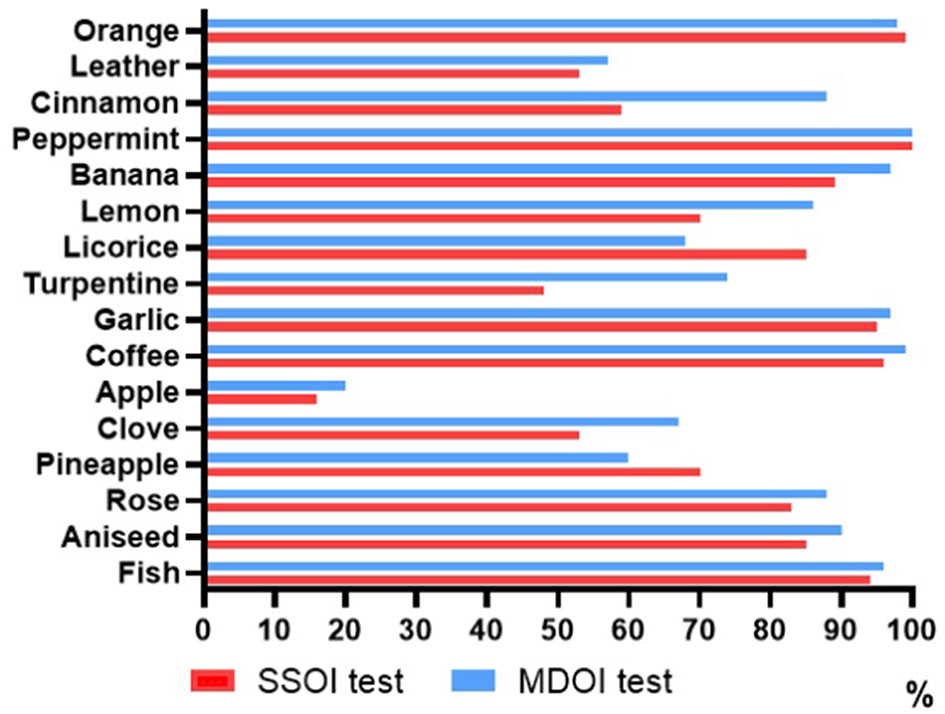
Correct recognition rate of odors in the SSOI and MDOI tests.
Figure 2
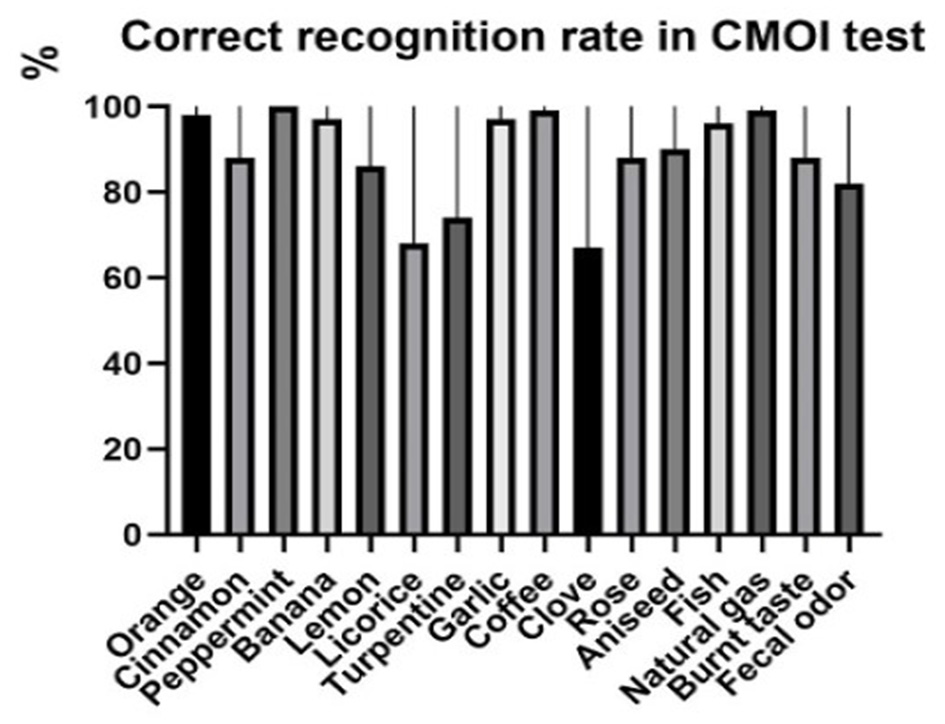
Correct recognition rate of odors in the CMOI test.
3. Results
3.1. Odor familiarity test
As shown in Table 1, the most familiar odors in Chinese culture are garlic (95), cantaloupe (93), apple (93), onions (92), orange (91), banana (91), and watermelon (91); the least familiar are fir (6), elderberry (6), raspberry (7), artemisia annua (8), spearmint (10), and oregano (10). Among the 64 odor descriptors in SSOI, 31 odor descriptors had a familiarity of <75 points, such as blackberries (24), fumes (72), glue (70), vanilla (39), fir (6), coconut (59), walnut (73), curry (63), and so on; 23 distractors with odor familiarity >75, including leek (88), paint (88), watermelon (91), mango (90), alcohol (88), chlorine disinfectant (87), pepper (86), and corn (85), were selected to randomly replace the distractors with low familiarity in the first modification.
Table 1
| No. | Odor | % | No. | Odor | % | No. | Odor | % | No. | Odor | % |
|---|---|---|---|---|---|---|---|---|---|---|---|
| 1 | Apricot | 73 | 32 | Pickle | 81 | 63 | Spruce | 11 | 94 | Cream | 70 |
| 2 | Cranberries | 23 | 33 | Coffee | 86 | 64 | Coke | 38 | 95 | Cabbage | 53 |
| 3 | Peach | 90 | 34 | Fumes | 72 | 65 | Mint | 67 | 96 | Mushroom | 74 |
| 4 | Leather | 68 | 35 | Wine | 79 | 66 | Pancake | 73 | 97 | Green pepper | 83 |
| 5 | Grass | 80 | 36 | Rose | 72 | 67 | Quill | 51 | 98 | Pea | 68 |
| 6 | Cigarette | 89 | 37 | Clove | 44 | 68 | Strawberry | 90 | 99 | Hazelnut | 67 |
| 7 | Glue | 70 | 38 | Pepper | 86 | 69 | Caramel | 57 | 100 | Broccoli | 67 |
| 8 | Vanilla | 39 | 39 | Pineapple | 89 | 70 | Elder | 6 | 101 | Lavender | 50 |
| 9 | Cinnamon | 31 | 40 | Plum | 49 | 71 | Stables | 19 | 102 | Celery | 88 |
| 10 | Honey | 76 | 41 | Raspberry | 7 | 72 | Paprika | 83 | 103 | Balsamic vinegar | 82 |
| 11 | Chocolate | 87 | 42 | Rum | 11 | 73 | Lox | 21 | 104 | Avocado | 35 |
| 12 | Onions | 92 | 43 | Fennel | 52 | 74 | Orange | 91 | 105 | Blackcurrant | 26 |
| 13 | Fir | 6 | 44 | Fish | 90 | 75 | Timber | 77 | 106 | Nutmeg | 14 |
| 14 | Leek | 88 | 45 | Bread | 85 | 76 | Ginger | 84 | 107 | Asparagus | 37 |
| 15 | Watermelon | 91 | 46 | Cheese | 66 | 77 | Oregano | 10 | 108 | Artemisia annua | 8 |
| 16 | Banana | 91 | 47 | Salami | 27 | 78 | Beetroot | 17 | 109 | Truffles | 16 |
| 17 | Cherry | 81 | 48 | Ham | 68 | 79 | Soybean | 67 | 110 | Aniseed | 69 |
| 18 | Walnut | 73 | 49 | Pear | 83 | 80 | Candy floss | 70 | 111 | Eucalyptus | 11 |
| 19 | Coconut | 59 | 50 | Cantaloupe | 93 | 81 | Peanut | 78 | 112 | Green tea | 66 |
| 20 | Grapefruit | 53 | 51 | Blackberries | 24 | 82 | Butter | 51 | 113 | Alcohol | 88 |
| 21 | Apple | 93 | 52 | Gasoline | 90 | 83 | Fruit sugar | 76 | 114 | Chlorine disinfectant | 87 |
| 22 | Lemon | 88 | 53 | Curry | 63 | 84 | Celery | 65 | 115 | Musty smell | 73 |
| 23 | Cookies | 61 | 54 | Popcorn | 81 | 85 | Corn | 85 | 116 | Spoiled oil | 42 |
| 24 | Licorice | 31 | 55 | Paint | 88 | 86 | Chamomile | 24 | 117 | Camphor | 53 |
| 25 | Spearmint | 10 | 56 | Bacon | 67 | 87 | Tomato | 80 | 118 | Sesame oil | 81 |
| 26 | Pine oil | 24 | 57 | Almond | 66 | 88 | Cucumber | 84 | 119 | Natural gas | 76 |
| 27 | Rubber | 47 | 58 | Sweat | 75 | 89 | Basil leaf | 13 | 120 | Burnt taste | 84 |
| 28 | Mustard | 74 | 59 | Steak | 80 | 90 | Nougat | 48 | 121 | Fecal odor | 89 |
| 29 | Thyme | 24 | 60 | Soap | 84 | 91 | Raisin | 74 | |||
| 30 | Carrot | 81 | 61 | Ketchup | 77 | 92 | Mango | 90 | |||
| 31 | Garlic | 95 | 62 | Urine | 77 | 93 | Seaweed | 43 |
Odor familiarity survey results.
3.2. Establishment of the CMOI test
As shown in Figure 1, the correct recognition rates of leather, cinnamon, lemon, turpentine, apple, clove, and pineapple in the SSOI test were <75%. After the modification of distractors, the correct recognition rate of orange decreased from 99 to 98%. The correct recognition rates of licorice and pineapple also decreased, and that of peppermint was still 100%. The correct recognition rates of all other odors were significantly improved, such as cinnamon from 59 to 88% and lemon from 70 to 86%. However, the recognition rates of apple, leather, and pineapple were still low, which were 20, 57, and 60%, respectively. We added natural gas, burnt smell, and fecal odor into the MDOI test to displace the three odors of apple, leather, and pineapple and established the CMOI test (as shown in Table 2, the bolded words are the correct odors). The results of natural gas, burnt smell, and fecal odor were combined with the test results of 13 odors other than apple, leather, and pineapple in the MDOI test to form the final result of the CMOI test. The correct recognition rate of 16 odors in the CMOI test is shown in Figure 2.
Table 2
| Number | Descriptor 1 | Descriptor 2 | Descriptor 3 | Descriptor 4 |
|---|---|---|---|---|
| 1 | Strawberry | Leek | Orange | Pineapple |
| 2 | Honey | Mango | Cinnamon | Chocolate |
| 3 | Peppermint | Leek | Onions | Alcohol |
| 4 | Chlorine disinfectant | Pepper | Corn | Banana |
| 5 | Peach | Apple | Burnt paste | Lemon |
| 6 | Paprika | Licorice | Cherry | Ginger |
| 7 | Turpentine | Fecal odor | Timber | Cucumber |
| 8 | Onions | Garlic | Sauerkraut | Carrot |
| 9 | Cigarette | Wine | Tomato | Coffee |
| 10 | Clove | Pepper | Natural gas | Peanut |
| 11 | Rose | Cherry | Chamomile | Lemon |
| 12 | Green pepper | Aniseed | Honey | Paint |
| 13 | Bread | Carrot | Gasoline | Fish |
| 14 | Natural gas | Honey | Mango | Chocolate |
| 15 | Paprika | Cherry | Ginger | Burnt taste |
| 16 | Steak | Fecal odor | Cucumber | Timber |
Final version of the CMOI test.
Bolded words are the correct answers to this test.
Statistical methods were used to analyze the scores of volunteers in the SSOI, MDOI, and CMOI tests. The mean scores in the SSOI, MDOI, and CMOI tests were 11.95 ± 1.37, 12.85 ± 1.37, and 14.17 ± 1.28, respectively. The tenth percentile scores in the SSOI, MDOI, and CMOI tests were 10, 11, and 12.9, respectively. After the paired sample Friedman M-test, the average values of the three groups were not the same (p < 0.0001), and the scores of volunteers in the MDOI test were significantly higher than those in the SSOI test (p < 0.0001). The scores of volunteers in the CMOI test were significantly higher than those in the MDOI test (p < 0.0001) and SSOI test (p < 0.0001). The correct recognition rates of odors in the SSOI and CMOI tests were tested by the Wilcoxon signed rank-sum test of paired samples. The correct recognition rates of test odors in the CMOI test were significantly higher than those in the SSOI test (p < 0.01).
4. Discussion
Based on the SSOI test, the CMOI test significantly improved the olfactory identification test score and the correct recognition rate of odors, by using the distractors and odors more familiar to Chinese people. It may be an effective tool for evaluating the olfactory function of Chinese people.
From the odor familiarity survey, we found that out of the 64 odor descriptors in the SSOI test, the familiarity scores of 31 odor descriptors were <75 points; volunteers were unfamiliar with nearly half of the odors in the SSOI test. When examinees undergo the olfactory test, it is likely that although the examinees perceived the odors, they found it difficult to make a correct choice because they were unfamiliar with the odors or distractors. Comparing the result with the research of Hummel et al. (1997) and Niklassen et al. (2018), we found that Germans were familiar with leather, cinnamon, licorice, rose, clove, etc., and Danish people may be more familiar with leather, vanilla, cinnamon, cheese, bacon, elder, and stables, while Chinese people were more familiar with watermelon, cherry, carrot, peanut, corn, mango, mushroom, and so on, highlighting the significance of modifying the olfactory test.
After adjusting the 23 distractors of the SSOI test according to the odor familiarity survey results, the scores of the olfactory identification test of volunteers were significantly improved. Taking the odor “cinnamon” as an example, in the SSOI test, only 59% of the volunteers could correctly identify the odor “cinnamon”. However, after changing the distractors, the correct recognition rate of the odor “cinnamon” reached 88%. This may be because volunteers were more familiar with the smell of some new distractors and could choose the correct answer through exclusion. However, the correct recognition rates of some odors were still low. The first reason may be that volunteers were unfamiliar with these odors, even if the distractors were modified. The second reason may be that the odor was familiar, but the name was inaccurate. Taking the odor “apple” as an example, there are many varieties of apples in the world, and the smell is not exactly the same, and the apple aroma is relatively light, which can be easily ignored. Therefore, it was difficult for volunteers to make the correct choice in the test. If the names of both odors and distractors are inaccurate, the interference of volunteers may be more serious. The last reason may be the high similarity between odors and distractors, and the difference was insignificant. Taking the odor “apple” as an example again, the distractors of the odor were melon, peach, and orange. In the identification test, most volunteers could only smell fruit flavors but all these four options had fruit flavors, increasing the difficulty of accurate identification. To further improve the score of the olfactory identification test and enable it to have the ability to test unpleasant odors, through a literature search, tetrahydrothiophene, 2-methylpyrazine, and trimethylindole were selected to simulate natural gas, burnt smell, and fecal odor, respectively, and used to displace three odors: apple, leather, and pineapple. After randomly assigning distractors, the CMOI test was composed of 16 odors: 3 new odors and 13 unchanged odors.
In the research studies by Oniz et al. (2013), Kim et al. (2014), and Niklassen et al. (2018), they modified the olfactory identification test by modifying distractors, while in the research studies by Konstantinidis et al. (2008), Oleszkiewicz et al. (2016), and Balungwe et al. (2020), they modified both distractors and odors, and the new odors used by researchers included ginger, honey, eucalyptus, onion, smoked meat, ouzo, Greek grappa, painter oil, wall paint, paint thinner, pepper, and mango. However, no one had proposed using unpleasant odors with warning functions as new test odors.
At present, patients with olfactory disorders mostly use pleasant odor reagents in olfactory training but rarely use unpleasant odor reagents with important warning functions, such as natural gas odorant and simulated burnt odor reagents used in the experiment, which may cause poor recovery of patients' olfactory ability to this kind of odor. In this experiment, the unpleasant smell with a warning function was introduced into the olfactory test, which could better detect the recovery situation of patients' perception of this kind of smell; this was of great significance in evaluating the effect of olfactory treatment. It is hoped to screen patients who cannot correctly identify natural gas, burnt smell, and fecal odor for the next treatment to reduce patients' risk of natural gas leakage, fire, and other dangerous events.
Of course, there are still some limitations to the article. All the volunteers participating in the experiment had normal olfactory senses. Future research should be conducted in patients with olfactory disorders to study how the new CMOI test can distinguish between patients with anosmia and those with hyposmia.
5. Conclusion
In this experiment, we modified both distractors and odors in the SSOI test to establish the CMOI test. The odor identification score of healthy volunteers in the CMOI test was significantly improved, reducing instances where volunteers found it difficult to name an odor because they were unfamiliar with the odor and corresponding distractors despite perceiving it. The CMOI test proposed in this study is an effective tool for evaluating the olfactory function of Chinese people.
Statements
Data availability statement
The raw data supporting the conclusions of this article will be made available by the authors, without undue reservation.
Ethics statement
The studies involving humans were approved by Ethics Committee of the First Affiliated Hospital of China Medical University. The studies were conducted in accordance with the local legislation and institutional requirements. The participants provided their written informed consent to participate in this study.
Author contributions
HZ: Data curation, Formal analysis, Investigation, Methodology, Writing—original draft, Writing—review and editing. MW: Data curation, Methodology, Resources, Writing—review and editing. MQ: Data curation, Resources, Software, Writing—review and editing. HW: Conceptualization, Funding acquisition, Methodology, Supervision, Writing—review and editing.
Funding
The author(s) declare financial support was received for the research, authorship, and/or publication of this article. This work was supported by the Shenyang Science and Technology Bureau, grant number 21-173-9-48, for the project “Clinical and mechanism study of nerve growth factor and olfactory training in the treatment of olfactory dysfunction” (to HW).
Conflict of interest
The authors declare that the research was conducted in the absence of any commercial or financial relationships that could be construed as a potential conflict of interest.
Publisher’s note
All claims expressed in this article are solely those of the authors and do not necessarily represent those of their affiliated organizations, or those of the publisher, the editors and the reviewers. Any product that may be evaluated in this article, or claim that may be made by its manufacturer, is not guaranteed or endorsed by the publisher.
References
1
Balungwe P. Huart C. Matanda R. Bisimwa G. Mouraux A. Rombaux P. et al . (2020). Adaptation of the Sniffin' Sticks Test in South-Kivu. Eur. Ann. Otorhinolaryngol. Head Neck Dis. 137, 467–471. 10.1016/j.anorl.2020.01.012
2
Cain W. S. Gent J. F. Goodspeed R. B. Leonard G. (1988). Evaluation of olfactory dysfunction in the Connecticut Chemosensory Clinical Research Center. Laryngoscope98, 83–88. 10.1288/00005537-198801000-00017
3
Cha H. Kim S. Son Y. (2021). Associations between cognitive function, depression, and olfactory function in elderly people with dementia in Korea. Front. Aging Neurosci. 13, 799897. 10.3389/fnagi.2021.799897
4
Chrea C. Valentin D. Sulmont-Rosse C. Mai H. L. Nguyen D. H. Abdi H. et al . (2004). Culture and odor categorization: agreement between cultures depends upon the odors. Food Qual. Pref. 15, 669–679. 10.1016/j.foodqual.2003.10.005
5
Delgado-Losada M. L. Delgado-Lima A. H. Bouhaben J. (2020). Spanish validation for olfactory function testing using the Sniffin' Sticks olfactory test: threshold, discrimination, and identification. Brain Sci. 10, 943. 10.3390/brainsci10120943
6
Demir S. Sizer B. Gül A. Topçu I. (2021). Culturally modified olfactory test adapted to East-Turkey: a comparison with Sniffin' Sticks. Int. J. Clin. Pract.75, e14458. 10.1111/ijcp.14458
7
Denis F. Septans A. L. Periers L. Maillard J. M. Legoff F. Gurden H. et al . (2021). Correction: olfactory training and visual stimulation assisted by a web application for patients with persistent olfactory dysfunction after SARS-CoV-2 infection: observational study. J. Med. Int. Res. 23, e32120. 10.2196/32120
8
Doty R. L. Shaman P. Kimmelman C. P. Dann M. S. (1984). University of Pennsylvania Smell Identification Test: a rapid quantitative olfactory function test for the clinic. Laryngoscope94, 176–178. 10.1288/00005537-198402000-00004
9
Feng G. Zhuang Y. Yao F. Ye Y. Wan Q. Zhou W. et al . (2019). Development of the Chinese smell identification test. Chem. Senses44, 189–195. 10.1093/chemse/bjz006
10
Fenólio G. H. M. Anselmo-Lima W. T. Tomazini G. C. Compagnoni I. M. Amaral M. S. A. D. Fantucci M. Z. et al . (2022). Validation of the Connecticut olfactory test (CCCRC) adapted to Brazil. Braz. J. Otorhinolaryngol. 88, 725–732. 10.1016/j.bjorl.2020.09.013
11
Gudziol V. Hummel T. (2009). The influence of distractors on odor identification. Arch. Otolaryngol. Head Neck Surg. 135, 143–145. 10.1001/archotol.135.2.143
12
Hummel T. Sekinger B. Wolf S. R. Pauli E. Kobal G. (1997). ‘Sniffin' Sticks': olfactory performance assessed by the combined testing of odor identification, odor discrimination and olfactory threshold. Chem. Senses22, 39–52. 10.1093/chemse/22.1.39
13
Husain S. Hamid I. A. Zahedi F. D. Wan Hamizan A. K. (2021). Normative data of olfactory abilities using cultural adaption Sniffin' Sticks smell test in different age groups. Saudi Med. J. 42, 1209–1216. 10.15537/smj.2021.42.11.20210529
14
Jiang R. S. Su M. C. Liang K. L. Shiao J. Y. Wu S. H. Hsin C. H. et al . (2010). A pilot study of a traditional Chinese version of the University of Pennsylvania Smell Identification Test for application in Taiwan. Am. J. Rhinol. Allergy24, 45–50. 10.2500/ajra.2010.24.3388
15
Kim J. M. Jeong M. S. Shin D. H. Seol J. H. Hong S. C. Cho J. H. et al . (2014). Olfactory identification test using familiar distracters for koreans. Clin. Exp. Otorhinolaryngol. 7, 19–23. 10.3342/ceo.2014.7.1.19
16
Konstantinidis I. Printza A. Genetzaki S. Mamali K. Kekes G. Constantinidis J. (2008). Cultural adaptation of an olfactory identification test: the Greek version of Sniffin' sticks. Rhinology46, 292–296. 10.1016/S1166-7087(08)72486-2
17
Li L. Xie D. Luo H. Pan J. Liang J. (2020). Rationality analysis of tetrahydrothiophene as LPG odorant. Gas Heat. (2020) 4, B17–B19.
18
Li S. Wang L. Zhang C. et al . (2010). Analysis of the key odorants of roasted peanut. Sci. Agricult. Sinica43, 3199–3203. 10.3864/j.issn.0578-1752.2010.15.018
19
Liu D. T. Besser G. Renner B. Seyferth S. Hummel T. Mueller C. A. et al . (2020). Retronasal olfactory function in patients with smell loss but subjectively normal flavor perception. Laryngoscope130, 1629–1633. 10.1002/lary.28258
20
Niklassen A. S. Ovesen T. Fernandes H. Fjaeldstad A. W. (2018). Danish validation of Sniffin' Sticks olfactory test for threshold, discrimination, and identification. Laryngoscope128, 1759–1766. 10.1002/lary.27052
21
Ogihara H. Kobayashi M. Nishida K. Kitano M. Takeuchi K. (2011). Applicability of the cross-culturally modified University of Pennsylvania Smell Identification Test in a Japanese population. Am. J. Rhinol. Allergy25, 404. 10.2500/ajra.2011.25.3658
22
Oleszkiewicz A. Taut M. Sorokowska A. Radwan A. Kamel R. Hummel T. et al . (2016). Development of the Arabic version of the “Sniffin' Sticks” odor identification test. Eur. Arch. Otorhinolaryngol. 273, 1179–1184. 10.1007/s00405-015-3718-2
23
Oniz A. Erdogan I. Ikiz A. O. Evirgen N. Ozgoren M. (2013). The modified Sniffin' sticks test in Turkish population based on odor familiarity survey. J Neurol Sci. 30, 270–280.
24
Sai-Guan L. Husain S. Zahedi F. D. Ahmad N. Gendeh B. S. (2020). Cultural adaptation of Sniffin' sticks smell identification test: the Malaysian version. Iran J. Otorhinolaryngol.32, 213–222. 10.22038/ijorl.2019.34346.2138
25
Su B. Wu D. Wei Y. (2021). Development of Chinese odor identification test. Ann. Transl. Med. 9, 499. 10.21037/atm-21-913
26
Takagi S. F. (1987). A standardized olfactometer in Japan. A review over ten years. Ann. NY Acad. Sci. 510, 113–118. 10.1111/j.1749-6632.1987.tb43476.x
27
Topan Y. E. Bozkurt B. Yilmaz S. Elsürer Ç. Gorcuyeva S. Bozkurt M. K. (2021). Olfactory dysfunction in primary Sjogren's syndrome and its correlation with dry eye. Acta Otorhinolaryngol. Ital. 41, 443–449. 10.14639/0392-100X-N1344
28
Wang Q. Chen B. Zhong X. Zhou H. Zhang M. Mai N. et al . (2021). Neuropsychiatric symptoms mediated the relationship between odor identification and cognition in Alzheimer's disease spectrum: a structural equation model analysis. Front. Aging Neurosci. 13, 732840. 10.3389/fnagi.2021.732840
29
Yu B. Zhang H. Yu F. et al . (1996). A study on maximum allowable concentration of 3-methylindole in closed environment. Space Med. Med. Eng.9, 426–430.
30
Yücepur C. Ozücer B. Degirmenci N. Yildirim Y. Veyseller B. Ozturan O. (2012). University of Pennsylvania smell identification test: application to Turkish population. Kulak Burun Bogaz Ihtis. Derg. 22, 77–80. 10.5606/kbbihtisas.2012.014
31
Zambom-Ferraresi F. Zambom-Ferraresi F. Fernández-Irigoyen J. Lachén-Montes M. Cartas-Cejudo P. Lasarte J. J. et al . (2021). Olfactory characterization and training in older adults: protocol study. Front. Aging Neurosci. 13, 757081. 10.3389/fnagi.2021.757081
Summary
Keywords
odor familiarity, olfactory test, modification, distractor, unpleasant odor, correct recognition rates
Citation
Zhang H, Wang M, Qian M and Wei H (2023) Odor familiarity and improvement of olfactory identification test in Chinese population. Front. Psychol. 14:1278668. doi: 10.3389/fpsyg.2023.1278668
Received
19 August 2023
Accepted
21 September 2023
Published
16 October 2023
Volume
14 - 2023
Edited by
Emilia Iannilli, University of Graz, Austria
Reviewed by
Antti Knaapila, University of Helsinki, Finland; Carla Masala, University of Cagliari, Italy
Updates
Copyright
© 2023 Zhang, Wang, Qian and Wei.
This is an open-access article distributed under the terms of the Creative Commons Attribution License (CC BY). The use, distribution or reproduction in other forums is permitted, provided the original author(s) and the copyright owner(s) are credited and that the original publication in this journal is cited, in accordance with accepted academic practice. No use, distribution or reproduction is permitted which does not comply with these terms.
*Correspondence: Hongquan Wei hongquanwei@163.com
Disclaimer
All claims expressed in this article are solely those of the authors and do not necessarily represent those of their affiliated organizations, or those of the publisher, the editors and the reviewers. Any product that may be evaluated in this article or claim that may be made by its manufacturer is not guaranteed or endorsed by the publisher.