Abstract
Introduction:
The aim of this investigation was to determine which factors were associated with symptoms of sleep and mental health disorders in former athletes.
Methods:
Former athletes (N = 173, 50% women) who retired from any competition level within the last 20 years participated in an online survey. The survey consisted of the Athlete Sleep Screening Questionnaire (ASSQ), Personal Wellbeing Index-Adult (PWI-A), Center for Epidemiologic Studies Depression Scale-Revised (CESD-R), and Generalised Anxiety Disorder Assessment (GAD-7).
Results:
Binary logistic regressions revealed that both age (OR = 0.95 [95% CI:0.92, 0.99], p = 0.007) and gender (OR = 2.28 [95% CI:1.09, 4.79], p = 0.029) were associated with anxiety, with women and younger ex-athletes presenting greater risk of anxiety symptoms. Higher body mass was associated with an increased risk for sleep difficulty (OR = 1.13 [95% CI:1.03, 1.23], p = 0.008), sleep disordered breathing (OR = 1.20 [95% CI:1.10, 1.30], p < 0.001), and compromised wellbeing (OR = 0.89 [95% CI:0.83, 0.96], p = 0.001). Athletes who subjectively placed a lower priority on sport while competing presented greater risk of sleep disordered breathing (OR = 2.00[95% CI:1.05, 3.80], p = 0.035). No associations between recency retirement and any outcome measures were observed.
Discussion:
Findings suggest potential predictive factors for difficulty transitioning out of sport. Future longitudinal research should consider the interplay between sport re-engagement and the incidence and chronicity of sleep and mental health disorders.
Introduction
Athletic retirement can be psychologically distressing, particularly when it is sudden and involuntary (Montero et al., 2022). Navigating this transition out of sport brings substantial lifestyle and social changes, which is a difficult time for many, especially those who highly identify with their athletic role (Park et al., 2013; Giannone et al., 2017) and those forced to retire (Esopenko et al., 2020). Involuntary retirement from sport can leave an athlete emotionally unprepared for this transition (Esopenko et al., 2020). With unexpected career-ending injuries, post-retirement planning is often not yet considered (Kaul, 2017). For professional athletes, career termination results in a loss of income; therefore, they are not only mentally, but potentially financially unprepared for a life outside of sport (Fortunato and Marchant, 1999). Exiting the high physical and psychological demands of sport on their own terms can be a form of relief for some (Jones and Denison, 2017). However, this transition can contribute to depression, anxiety, disordered eating, substance abuse, and suicide (Montero et al., 2022). Psychological distress and poor sleep go hand in hand; worry, stress, and rumination after retirement can manifest into sleep problems (Fernandes et al., 2019). The incidence of mental ill-health is believed to be the most prominent among recently retired athletes (<15 years; Oltmans et al., 2022). Individuals are likely to still be navigating this adjustment period of life outside of sport long after retirement.
A range of causal factors may contribute to the high rates of sleep and mental health disorders observed in retired athletes (Kerr et al., 2012, 2014; Gouttebarge et al., 2016; Luyster et al., 2017; Willer et al., 2018). Lindqvist et al. (2014) reported that suicide rates are 2–4 times higher for former male athletes than the general male population. Research on the health of retired athletes has identified key risk factors for mental health problems immediately following athletic retirement. Social breakdown, high and exclusive athletic identity, and involuntary or unplanned retirement can cause reduced wellbeing and psychological distress during the transition out of sport (Wippert and Wippert, 2010; Cosh et al., 2012a; Gouttebarge et al., 2015; Giannone et al., 2017). Athletes place significant emphasis on sport such that they often fail to engage in alternatives, hindering the establishment of their identity outside of sport (Hatamleh, 2013). In terms of gender, Lantz and Schroeder (1999) found that athletic identity is positively associated with masculinity and negatively associated with femininity in a cohort of male and female collegiate athletes. Indeed, men often identify more strongly with their athletic role than women (Brewer and Petitpas, 2017). These associations may be more prominent in sports that promote hegemonic masculine ideals such as stoicism, strength, and dominance (e.g., Australian football, rugby, cricket, etc.; Drummond et al., 2022). This may place males at greater risk of difficulty transitioning out of sport, as high athletic identity is associated with psychological distress following athletic retirement (Cosh et al., 2012a; Giannone et al., 2017). Furthermore, 70% of former male collegiate basketballers interviewed by Beamon (2012) reported a loss of personal and social identity after retirement, which led to identity crisis and depression. Australian skier Brittany George, discussed issues associated with suicide and mental illness during a recent podcast “Couching the Mind” (Woolaston, 2021). When reflecting on her life after retirement due to a back injury, she explained, “it has literally been my whole life, I’ve been ‘the athlete’ from when I was 2 until when I was 20 or 21,” “I did not have an identity. I was labelled ‘the athlete’ from a very young age and just rode with it” (Woolaston, 2021). Just months later, in January 2022, George took her own life.
A small body of research on the sleep health of retired athletes suggests a high prevalence of disordered sleep. Retired male National Football League (NFL) players have been a major focus of sleep research, demonstrating a high prevalence of sleep disordered breathing, being 2.5 times more likely to have sleep apnoea than a matched community cohort (Hyman et al., 2012; Luyster et al., 2017). For sleep disorders such as sleep apnoea, we understand that increased neck circumference and BMI are risk factors (Emsellem and Murtagh, 2005). Not only is this important for identifying potential risk profiles, but sleep apnoea has strong links with depression too (Kaufmann et al., 2017). Insomnia is extensively understudied in athletic populations, especially after retirement. A meta-analysis by Gouttebarge et al. (2019) identified that 20.9% of former athletes studied have sleep disturbances, suggesting symptomology of insomnia. Worryingly, insomnia is often comorbid to mental health disorders such as anxiety and depression (Khurshid, 2018).
Support networks and access to resources are typically removed after retirement (Jewett et al., 2019). This reduction in support not only thwarts the coping mechanisms required to deal with threats to mental ill-health and disordered sleep, but a lack of support prevents help-seeking and receiving necessary treatment. Inadequate support is problematic, as we know that the treatment of sleep disorders such as sleep apnoea have been efficacious in reducing symptomology and preventing mental health problems like depression (Zheng et al., 2019; Wimms et al., 2020). The removal of these support networks and consequential lack of treatment may inadvertently prevent the management of sleep health, perpetuating the cyclical nature of disordered sleep and mental ill-health, thus culminating to poor health outcomes.
Post-retirement research to date has focussed on predominantly elite competitors (Montero et al., 2022). Most research in this field has recruited athletes who compete at an elite/international level and world class level as defined by McKay et al.’s (2022) performance classification framework. Consequently, we have little knowledge of how retirement transitions affect athletes from other competition levels (i.e., highly trained/national level, trained/developmental, and recreationally active). Additionally, there is little knowledge about the sleep health of former athletes. Further exploration is warranted for factors that do not necessarily relate to the circumstances of retirement. Identifying risk factors which contribute to sleep and mental health problems is essential for early identification, prevention, and treatment.
Therefore, the aim of this study is to investigate whether factors such as age, gender, body mass, recency of retirement, and priority placed on sport are associated with the prevalence and severity of sleep and mental health problems following retirement from sport. In the same way that high athletic identity is associated with greater psychological distress following retirement (Cosh et al., 2012a; Giannone et al., 2017), investigating whether the priority level placed on sport while competing has any effect on psychological distress after retirement would be advantageous. A higher priority placed on sport (i.e., winning at all costs) is thought to relate to a greater emphasis on an athlete’s athletic role. We hypothesise that a higher priority level placed on sport whilst competing will be associated with greater sleep and mental health problems. With more emphasis placed on sport, the removal of this integral part of their life is thought to elicit significant psychological distress and in turn, produce sleep problems. Drawing from previous literature (Giannone et al., 2017; Oltmans et al., 2022), we hypothesise that more recently retired athletes are more vulnerable to sleep and mental health issues, whilst still adjusting to life outside of sport. Since men typically identify more strongly with their athletic role than women (Drummond, 2019), we hypothesise that they will have placed greater priority on sport during their careers and therefore be at greater risk for sleep and mental health problems following retirement. Since body mass is a predictor of sleep disordered breathing (Emsellem and Murtagh, 2005; Senaratna et al., 2016), which is associated with poorer mental health (Kaufmann et al., 2017), we hypothesise that increased body mass will be associated with greater sleep and mental health difficulties.
Materials and methods
Research design
A cross sectional prospective study design was used to assess data from a large scale online quantitative survey from which non-probability sampling was employed. This study was part of a larger study (N = 946) that investigated the prevalence and severity of sleep and mental health problems in current and retired athletes.
Participants
Convenience sampling was used to obtain survey responses from an open anonymous online survey. The presented data includes only the one hundred and seventy-three former athletes (women = 87, men = 86) who completed the survey. These athletes had retired from sports competition within the last 20 years. Demographic and sporting history information can be seen in Table 1.
TABLE 1
| Characteristic | n | % |
| Age (years) | ||
| 18–29 | 73 | 42.2 |
| 30–39 | 32 | 18.5 |
| 40–49 | 41 | 23.7 |
| 50–59 | 13 | 7.5 |
| ≥60 | 14 | 8.1 |
| Body mass index (BMI) | ||
| Underweight (<18.50) | 5 | 2.9 |
| Healthy range (18.50–24.99) | 70 | 40.5 |
| Overweight (25–29.99) | 60 | 34.7 |
| Obese (30 ≤ ) | 38 | 22.0 |
| Sport | ||
| American football/gridiron | 9 | 5.2 |
| Athletics | 6 | 3.5 |
| Australian rules football | 10 | 5.8 |
| Basketball | 4 | 2.3 |
| Bowling | 1 | 0.6 |
| Cheerleading/dance | 3 | 1.7 |
| Climbing/mountaineering/orienteering | 3 | 1.7 |
| Combat sports (e.g., boxing, karate, judo, etc.) | 6 | 3.5 |
| Cricket | 6 | 3.5 |
| Cycling | 4 | 2.3 |
| Equestrian | 1 | 0.6 |
| Football/soccer | 12 | 6.9 |
| Golf | 1 | 0.6 |
| Gymnastics/trampoline | 9 | 5.2 |
| Hockey/ice hockey | 2 | 1.2 |
| Lacrosse | 1 | 0.6 |
| Netball | 5 | 2.9 |
| Paddle sports (e.g., canoeing, rowing, etc.) | 7 | 4.0 |
| Racquet sports (e.g., tennis, squash, etc.) | 7 | 4.0 |
| Rugby | 26 | 15.0 |
| Skating | 1 | 0.6 |
| Skipping | 4 | 2.3 |
| Surf life-saving/surfing | 2 | 1.2 |
| Swimming/diving | 22 | 12.7 |
| Triathlon | 3 | 1.7 |
| Volleyball | 4 | 2.3 |
| Water polo | 4 | 2.3 |
| Weightlifting/cross fit | 10 | 5.8 |
| Level of competition | ||
| Amateur | 79 | 45.7 |
| Sports Institute or university/college | 49 | 28.3 |
| Semi-professional | 26 | 15.0 |
| Professional | 19 | 11.0 |
| Country of residence | ||
| Australia | 106 | 61.3 |
| Canada | 2 | 1.2 |
| Ireland | 5 | 2.9 |
| New Zealand | 11 | 6.4 |
| South Africa | 2 | 1.2 |
| United Kingdom | 9 | 5.2 |
| United States of America | 38 | 22.0 |
| Priority placed on sport | 79 | 45.7 |
| Low | 9 | 5.2 |
| Medium | 48 | 27.7 |
| High | 116 | 67.1 |
| Recency of retirement (years) | ||
| 0–5 | 100 | 57.8 |
| 6–10 | 34 | 19.7 |
| 11–15 | 22 | 12.7 |
| 16–20 | 17 | 9.8 |
Participant characteristics.
Materials/instruments
Several measures were used which contain the necessary psychometric properties to screen for sleep and mental health problems in athletes. All measures chosen are relevant to athletic populations, with questions also being relevant for non-athletic populations; thus, each screening measure is considered suitable for retired athletes. Sleep disordered breathing and sleep difficulty were screened for using the Athlete Sleep Screening Questionnaire (ASSQ; Samuels et al., 2016) and is recommended by the International Olympic Committee (IOC) Mental Health Working Group (Gouttebarge et al., 2021). The Generalised Anxiety Disorder–7 (GAD-7; Spitzer et al., 2006) was used to screen for anxiety, which is also recommended by the IOC Mental Health Working Group. The Center for Epidemiologic Studies Depression Scale–Revised (CESD-R; Eaton et al., 2004) was chosen to screen for depression as it is based on more updated Diagnostic and Statistical Manual of Mental Disorders (DSM) criteria than the IOC Mental Health Working Group’s recommended depression screening measure. Currently, there is no consensus approach to measuring subjective wellbeing in athletic populations, therefore the Personal Wellbeing Index–Adult (PWI-A) was chosen due to its proven reliability in diverse populations (International Wellbeing Group, 2013). Participants were asked about their demographics, sporting history, and retirement circumstances.
Procedure
The voluntary survey was available to adult athletes from all sports, genders, and levels of competition, at any stage of their career. Sporting organisations from Australia, Canada, Ireland, New Zealand, South Africa, United Kingdom, and United States of America were approached to promote the study. Further advertising was conducted via social media, recruitment flyers, and word of mouth (i.e., passive snowballing). All participants provided their informed consent online prior to completing the survey. This research was approved by the Flinders University Human Research Ethics Committee (Project ID 4276) and was conducted in accordance with the Declaration of Helsinki (World Medical Association, 2013) and Standards for Ethics in Sport and Exercise Science Research (Harriss et al., 2022).
Statistical analysis
The independent variables of interest were age, body mass index (BMI), gender, recency of retirement [i.e., duration since retirement from competition (years)] and priority level placed on sport: low (i.e., maintaining health and fitness, played mainly for the social aspect); medium (i.e., competitive, desire to play at a reasonable level); or high (i.e., extremely competitive, desired to make representative/professional teams). Dependent variables from the screening tools were prevalence (i.e., based on cut-off scores) which was categorised into minimal risk or at risk (Table 2). Those who reported that they loudly snore, choke, gasp, or stop breathing during sleep were deemed at risk for sleep disordered breathing (ASSQ Sleep Disordered Breathing).
TABLE 2
| Minimal risk | At risk | ||||
| CESD-R (0–60) | No clinical significance: <16 | Subthreshold depressive symptoms, but at risk: ≥16 | Possible MD: 2 DSM symptoms for at least 5–7 days in past week* | Probable MD: 3 DSM symptoms for at least 5–7 days in past week* | Meets criteria for MD: 4 DSM symptoms nearly every day for past 2 weeks* |
| ASSQ Sleep Difficulty Score (SDS: 0–17) | None: 0–4 | Mild: 5–7 | Moderate: 8–10 | Severe: 11–17 | |
| GAD-7 (0–21) | Minimal: 0–4 | Mild: 5–9 | Moderate: 10–14 | Severe: 15–21 | |
| PWI-A (0–100) | Normal levels: ≥70 | Compromised levels: ≤69 | |||
Diagnostic criteria and risk thresholds for outcome measures.
*Plus anhedonia or dysphoria nearly every day for past 2 weeks.
IBM SPSS Statistics V28 (IBM Corp; Armonk, NY, USA) was used for statistical analysis of these data. Using cutoff scores for diagnostic criteria, binary logistic regressions revealed the odds of athletes presenting clinical disorders based on the recency of retirement (years), priority level (low, medium, high), gender (women, men), age (years), and BMI (kg/m2). An alpha level of 0.05, with 95% confidence intervals were used for all statistical tests.
Across all outcome measures, a total 4.62% of data was missing. A Little’s missing completely at random (MCAR; Little and Rubin, 2019) test revealed that data were missing completely at random (p = 0.351). The amount of missing data was below the consensus threshold of missingness (5%; Schafer, 1999) and the analyses were unlikely to be biased as a result (Bennett, 2001). Considering these factors, no imputation methods for missing data were used. Tests to see if the data met the assumption of collinearity indicated that multicollinearity was not a concern [gender, tolerance = 0.77, variance inflation factor (VIF) = 1.29; age, tolerance = 0.56, VIF = 1.79; BMI, tolerance = 0.80, VIF = 1.26; recency of retirement, tolerance = 0.70, VIF = 1.43; priority level, tolerance = 0.82, VIF = 1.22].
Results
Former athletes from 28 different sport types, who retired from any level of competitive sport within the last 20 years were screened for point prevalence risk for sleep and mental health problems. Binary logistic regressions were performed to ascertain the effects of age, BMI, gender, recency of retirement, and priority level on the odds that participants were at risk for sleep and mental health problems. As seen in Table 3, models were statistically significant for predicting risk for sleep difficulty, sleep disordered breathing, anxiety, and wellbeing, but not depression (Figures 1D, 2D). For sleep difficulty, BMI predicted risk, but not age, gender (Figure 1A), priority placed on sport (Figure 2A), or recency of retirement; whereby higher body mass was associated with greater risk for sleep difficulty. For sleep disordered breathing, BMI and priority placed on sport predicted risk (Figure 2B), but not age, gender (Figure 1B), or recency of retirement; whereby higher body mass and lower priority placed on sport were associated with a greater risk of sleep disordered breathing. For compromised wellbeing, BMI predicted risk, but not age, gender (Figure 1C), priority placed on sport (Figure 2C), or recency of retirement; whereby higher body mass was associated with a greater risk of compromised wellbeing. For anxiety, both age and gender (Figure 1E) were associated with risk, but not BMI, priority placed on sport (Figure 2E), or recency of retirement; whereby younger individuals and women presented a greater risk of anxiety.
TABLE 3
| Model | OR | [95% CI] | p |
| ASSQ: sleep difficulty [X2 (5) = 11.79, p = 0.038*] | |||
| Age (years) | 0.98 | [0.94, 1.01] | 0.234 |
| BMI (kg/m2) | 1.13 | [1.03, 1.23] | 0.008* |
| Gender (men, women) | 1.77 | [0.80, 3.92] | 0.161 |
| Priority placed on sport (low, medium, high) | 0.69 | [0.37, 1.28] | 0.238 |
| Recency of retirement (years) | 1.00 | [0.92, 1.08] | 0.945 |
| ASSQ: sleep disordered breathing [X2 (5) = 42.16, p < 0.001*] | |||
| Age (years) | 0.98 | [0.95, 1.02] | 0.283 |
| BMI (kg/m2) | 1.20 | [1.10, 1.30] | <0.001* |
| Gender (men, women) | 0.47 | [0.22, 1.02] | 0.057 |
| Priority placed on sport (low, medium, high) | 2.00 | [1.05, 3.80] | 0.035* |
| Recency of retirement (years) | 1.05 | [0.97, 1.13] | 0.219 |
| PWI-A: wellbeing [X2 (5) = 14.87, p = 0.011*] | |||
| Age (years) | 1.03 | [1.00, 1.07] | 0.076 |
| BMI (kg/m2) | 0.89 | [0.83, 0.96] | 0.001* |
| Gender (men, women) | 1.20 | [0.57, 2.50] | 0.636 |
| Priority placed on sport (low, medium, high) | 1.04 | [0.56, 1.92] | 0.899 |
| Recency of retirement (years) | 0.96 | [0.90, 1.03] | 0.297 |
| CESD-R: depression [X2 (5) = 8.98, p = 0.110] | |||
| Age (years) | 0.98 | [0.95, 1.02] | 0.326 |
| BMI (kg/m2) | 1.00 | [0.93, 1.07] | 0.982 |
| Gender (men, women) | 2.27 | [1.07, 4.80] | 0.032* |
| Priority placed on sport (low, medium, high) | 1.22 | [0.66, 2.28] | 0.529 |
| Recency of retirement (years) | 1.03 | [0.96, 1.12] | 0.216 |
| GAD-7: anxiety [X2 (5) = 25.44, p < 0.001*] | |||
| Age (years) | 0.95 | [0.92, 0.99] | 0.007* |
| BMI (kg/m2) | 0.97 | [0.91, 1.04] | 0.432 |
| Gender (men, women) | 2.28 | [1.09, 4.79] | 0.029* |
| Priority placed on sport (low, medium, high) | 1.17 | [0.60, 2.26] | 0.647 |
| Recency of retirement (years) | 1.06 | [0.98, 1.14] | 0.182 |
Logistic regression model inferential statistics.
*Denotes significance at the p < 0.05 level (two-tailed).
FIGURE 1
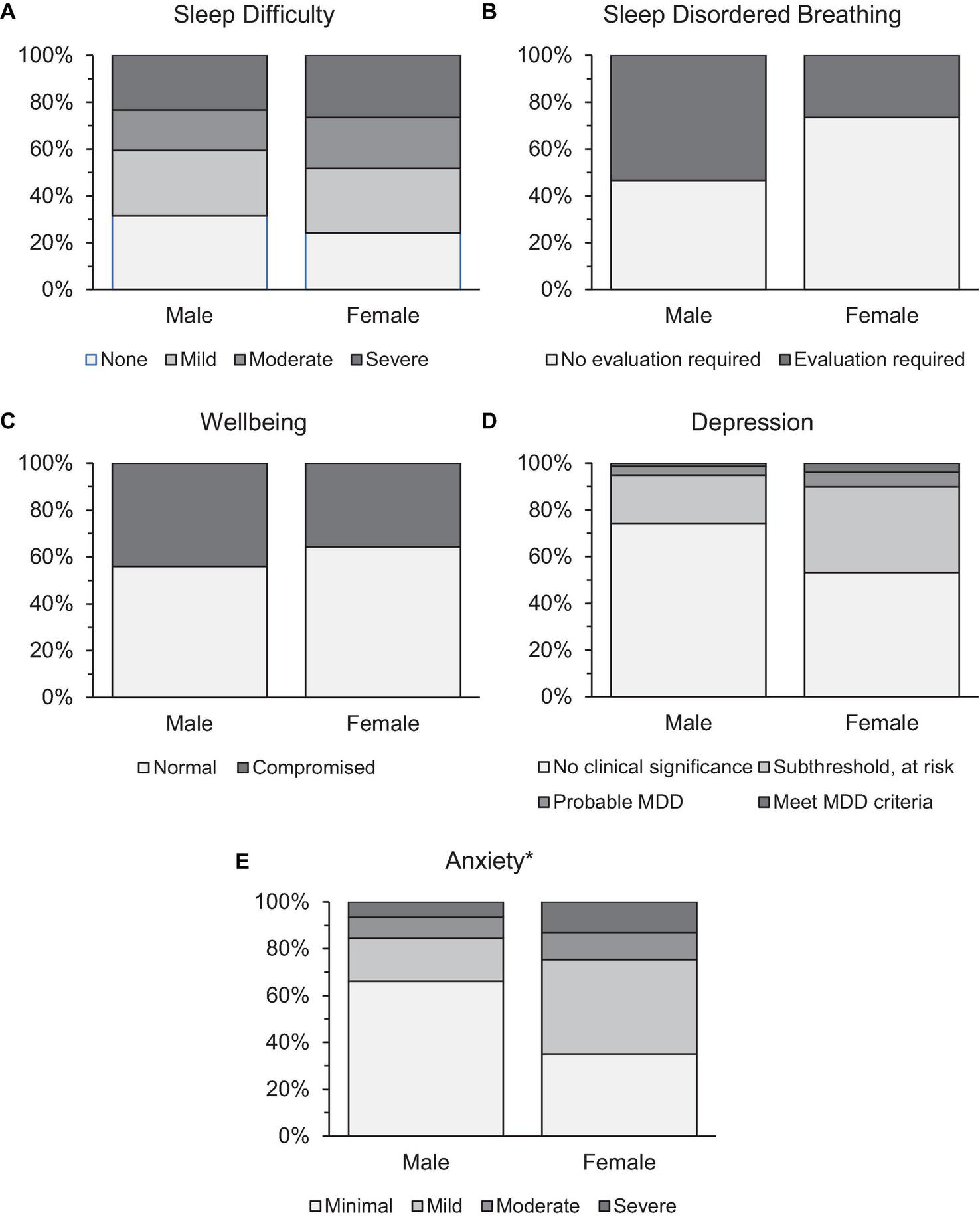
Prevalence rates of retired athletes at risk for panel (A) sleep difficulty, (B) sleep disordered breathing, (C) compromised wellbeing, (D) depression, and (E) anxiety by gender. *Significance at p < 0.05 level.
FIGURE 2
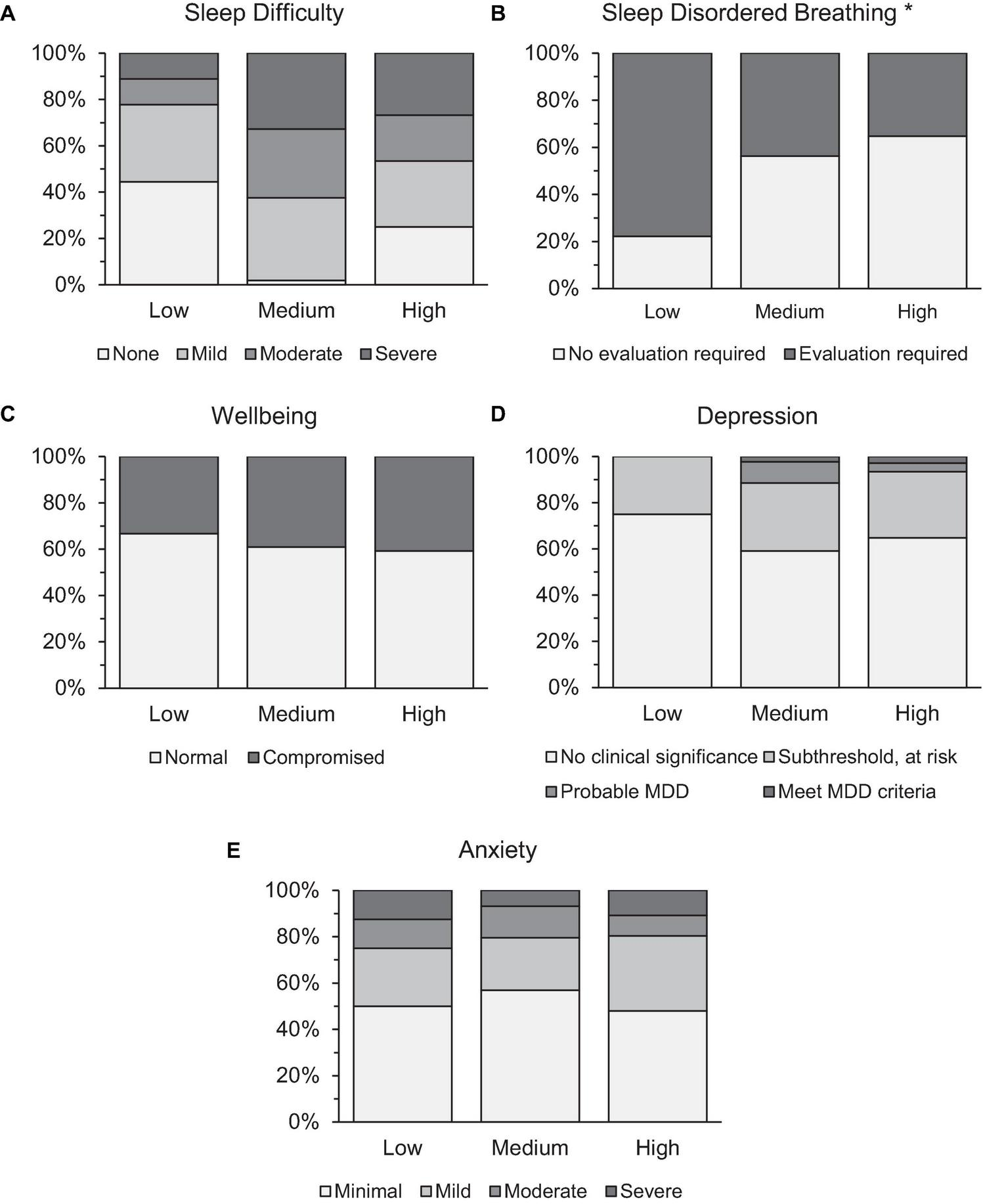
Prevalence rates of retired athletes at risk for panel (A) sleep difficulty, (B) sleep disordered breathing, (C) compromised wellbeing, (D) depression, and (E) anxiety by priority placed on sport during their career. *Significance at p < 0.05 level.
Discussion
Extending previous research investigating predictors of difficulty following athletic retirement (i.e., forced/involuntary retirement, high athletic identity), we explored factors such as age, gender, body mass, recency of retirement, and perceived priority placed on sport. All factors except recency of retirement predicted risk for some form of sleep or mental health issue; although sleep and mental health problems may have been present whilst competing, findings provide some indication of predictive factors for presenting symptomology following retirement from sport.
Oltmans et al. (2022) found that retired athletes are most susceptible to psychological distress during the first 15 years of retirement. However, in this sample, recency of retirement was not associated with the risk of presenting symptomology for sleep or mental health problems, despite the assumption that perceived adjustment to athletic transitions generally improves over time (Reifsteck et al., 2023). With 90.2% of the sample having completed the survey within 15 years of retiring from competition, perhaps sleep and mental health issues are highly prevalent and severity does not necessarily differ across time due to the nuanced and varied experiences of individuals (Stambulova et al., 2021).
Extensive literature suggests that high and exclusive athletic identity predicts psychological distress following retirement from sport (Park et al., 2013; Giannone et al., 2017). Priority placed on sport while competing may be linked to athletic identity. However, we found that the priority placed on sport did not predict risk for depression, anxiety, compromised wellbeing, or sleep difficulty. Those who placed a low priority on sport while competing were at greater risk to sleep disordered breathing. One possible explanation is that this low priority of sport during competition may have reflected a lower priority on physical activity and healthy eating, which has endured following retirement. This may be related to body mass; we know that increased body mass is associated with sleep disordered breathing (Emsellem and Murtagh, 2005; Senaratna et al., 2016), which was also observed in this sample.
Body mass also predicted risk for sleep difficulty and compromised wellbeing. A study of ultra-marathon swimmers found that higher BMI was associated with reduced total sleep time (Dunican et al., 2022). A systematic review and meta-analysis by Amiri (2023) found a direct linear relationship between BMI and sleep disturbances. Potential mechanisms identified for this association were an accumulation of fat in the respiratory tract, in the chest and in the abdomen that causes respiratory issues, and subsequently disturbed and fragmented sleep (Amiri, 2023). From a psychological standpoint, the association between increased body mass and compromised wellbeing may reflect lower satisfaction with life domains such as health, self-esteem, achievement, and standard of living (Wardle and Cooke, 2005; Morris et al., 2010; Haga et al., 2019). These findings highlight the importance of maintaining healthy habits following the cessation of sport.
Abel and Carreiro (2011) suggest that sport science professionals (e.g., strength and conditioning coaches, dietitians, etc.) should educate athletes and help them to develop the skills necessary for living a healthy lifestyle after sport. Evidence-based, theory-driven programmes that assist with developing goal-setting strategies have shown to improve motivation for engaging in physical activity and healthy eating for life after retirement (Reifsteck et al., 2018; Davis Brooks et al., 2019). Greater emphasis on education and awareness on recommended physical activity levels and nutrition guidelines may help to mitigate the association between body mass, poor sleep, and poor wellbeing.
We explored gender as a predictive factor for disordered sleep and mental ill-health following athletic retirement. Research suggests that males often have higher athletic identity (Sturm et al., 2011) and high athletic identity predicts psychological distress after retirement (Park et al., 2013; Giannone et al., 2017). Contrary to our hypothesis, retired women athletes had higher depression and anxiety scores than retired men athletes. Women had 2.28 times greater odds of presenting symptoms of anxiety. Interestingly, gender was not associated with disordered sleep. This may be attributed to the fact that there are mixed findings in relation to sex differences in athletes sleep quality (e.g., Carter et al., 2020; Kawasaki et al., 2020; Hrozanova et al., 2021; Vlahoyiannis et al., 2021; Romdhani et al., 2022), or potentially the fact that these sex differences are less pronounced following the cessation of sport. Therefore, findings suggest that retired women may experience greater psychological distress, but not poorer sleep. Similar trends have been observed in current athlete cohorts. Mascaro et al. (2021) reported that female athletes had high depression, anxiety, stress, and later sleep times than male athletes. An avenue of exploration would be gender differences in the reasons for retirement. For example, some women may be forced to retire from sport for family reasons, such as having children. While women appear to present greater risk for mental ill-health, research by DeFreese et al. (2021) found that social support and mental, nutritional, and physical health resources were catalysts for successful retirement transitions in former women’s soccer athletes—suggesting that appropriate support may mitigate these effects.
Like gender, age was associated with anxiety, whereby younger athletes were more anxious. Compared with other careers, athletes typically retire at a young age, therefore, they need to possess alternative skills and passions outside of sport, to move into other employment and career pathways (Cosh et al., 2012a). Initial transitions out of sport at an early age may be challenging as they navigate alternatives outside of sport, translating into increased levels of anxiety.
Several limitations should be addressed. Research suggests that those who have not planned for retirement face significant difficulty upon exiting sport (Knights et al., 2019). However, we did not obtain data regarding the level of preparation or planning for retirement. Future studies could simply employ a visual analog scale from 0 (not at all prepared) to 100 (extremely prepared), which may help to determine whether preparedness mediates difficulty following athletic retirement. Similarly, data was not obtained on the circumstances of retirement which are known to cause psychological distress (e.g., injury, contract termination; Kaul, 2017; Esopenko et al., 2020); investigation into the cause of retirement may indicate whether these factors mediate the effects observed in the present study.
To reduce survey length, data on physical activity, dietary behaviours, alcohol consumption, and drug use were not recorded. We observed that increased body mass was associated with difficulty following retirement and suspect that this is a consequence of deregulation of these behaviours. Further inquiry into these behaviours following retirement may uncover the mechanistic properties for poor sleep and mental ill-health after the cessation of sport.
Future research into fluid transitions and re-engagement back into sport, investigated by Cosh et al. (2012b), would be worthwhile. Some athletes return to sport after a period of retirement; it would be interesting to see how these different transition pathways affect sleep and mental health. Similarly, it would be valuable to investigate social integration in sporting clubs following retirement. This is perhaps more difficult at an elite level where there are often specialised roles. But at a community level, continued social connectivity or participation at a lower level has shown many health and social benefits (Jenkin et al., 2021). Longitudinal research would provide opportunity to monitor the contribution of developing mental health problems throughout and following athletes’ careers—an area Ivanović and Macak (2020) identified as being unexplored.
Evaluation and optimisation of support interventions surrounding retirement transitions would be beneficial. Programmes focussed on education and dialogue around retirement, developing coaching strategies, identifying resources, setting goals, and peer engagement have shown to enhance the transition experience (Hansen et al., 2019; Reifsteck et al., 2023). Investigation into the efficacy of sleep interventions following athletic retirement, as a means of both improving not only sleep but also mental health would also be advantageous. A meta-analysis by Gwyther et al. (2022) identified that sleep interventions in current athletes have shown to significantly improve negative affect. The authors highlighted the need for further research into the efficacy of sleep interventions for mental health improvement and prevention in athletic populations. Developing intervention frameworks combining elements of education around sleep, mental health, physical activity, nutrition, and help seeking within the context of athlete career transitions is viable and could facilitate healthier exits from sport.
Majority of participants were Australian (61.3%) and demographics are largely consistent with WEIRD criteria (i.e., Western, educated, industrialised, rich and democratic); thus, interpretations cannot be systematically generalised to all athletes across the globe. Nevertheless, this research provides preliminary evidence to suggest that factors such as age, body mass, gender, and priority level placed on sport predict risk of disordered sleep and mental ill-health following athletic retirement. These contributions appear to be more prominent for mental health domains such as anxiety and poor quality of life, than for sleep difficulty, sleep disordered breathing and depression. There is no evidence to indicate that recency of retirement is associated with these issues in the 20 years following retirement from sport. Although we have identified potential factors associated with the risk for sleep and mental health issues following athletic retirement, we recognise that transition outcomes are not binary (i.e., adaptive or maladaptive; Stambulova et al., 2021), and those considered to have a “successful” transition journey are certainly not exempt from poor mental health and sleep difficulties.
Longitudinal research into the timing and chronicity of sleep and mental health issues would provide greater insight into predictive and contributing factors during and after an athletic career. By extending our current understanding of potential risk factors and profiles for mental ill-health and disordered sleep, sports organisations can better identify and mitigate these risks by tailoring support accordingly. While we endorse the implementation of education and support on health optimisation during an athlete’s sporting career, we argue that equal, if not greater, priority should be placed on support throughout retirement transitions. Adopting career transition interventions, physical activity and nutrition promotion strategies, and continued dialogue may facilitate easier transitions out of sport. Exploring the potential of employing sleep interventions as a preventative measure and management tool for improving mental health following retirement shows promise. In all, multidisciplinary efforts are needed by researchers to identify and optimise evidence-based interventions. Meanwhile, sport science professionals are needed to implement and tailor these support practices in a more holistic, athlete centred approach.
Statements
Data availability statement
The data that support the findings of this study are available from the corresponding author upon reasonable request.
Ethics statement
The studies involving humans were approved by the Flinders University Human Research Ethics Committee (Project ID 4276). The studies were conducted in accordance with the local legislation and institutional requirements. The participants provided their written informed consent to participate in this study.
Author contributions
AM: Writing – review and editing, Writing – original draft, Visualization, Project administration, Methodology, Investigation, Formal Analysis, Data curation, Conceptualization. JB: Writing – review and editing, Supervision. RA: Writing – review and editing, Supervision. MD: Writing – review and editing, Supervision.
Funding
The author(s) declare that no financial support was received for the research, authorship, and/or publication of this article.
Acknowledgments
We would like to thank the participants who voluntarily took part in this study.
Conflict of interest
The authors declare that the research was conducted in the absence of any commercial or financial relationships that could be construed as a potential conflict of interest.
Publisher’s note
All claims expressed in this article are solely those of the authors and do not necessarily represent those of their affiliated organizations, or those of the publisher, the editors and the reviewers. Any product that may be evaluated in this article, or claim that may be made by its manufacturer, is not guaranteed or endorsed by the publisher.
References
1
Abel M. G. Carreiro B. (2011). Preparing for the big game: Transitioning from competitive athletics to a healthy lifestyle.Strength Condit. J.3312–27.
2
Amiri S. (2023). Body mass index and sleep disturbances: a systematic review and meta-analysis.Postep. Psychiatr. Neurol.3296–109. 10.5114/ppn.2023.129067
3
Beamon K. (2012). “I’m a baller”: Athletic identity foreclosure among African-American former student-athletes.J. Afr. Am. Stud.16195–208. 10.1007/s12111-012-9211-8
4
Bennett D. A. (2001). How can I deal with missing data in my study?Austral. N. Zealand J. Public Health25464–469. 10.1111/j.1467-842X.2001.tb00294.x
5
Brewer B. W. Petitpas A. J. (2017). Athletic identity foreclosure.Curr. Opin. Psychol.16118–122. 10.1016/j.copsyc.2017.05.004
6
Carter J. R. Gervais B. M. Adomeit J. L. Greenlund I. M. (2020). Subjective and objective sleep differ in male and female collegiate athletes.Sleep Health6623–628. 10.1016/j.sleh.2020.01.016
7
Cosh S. Crabb S. LeCcuteur A. (2012a). Elite athletes and retirement: Identity, choice and agency.Austral. J. Psychol.6588–97. 10.1111/j.1742-9536.2012.00060.x
8
Cosh S. LeCouteur A. Crabb S. Kettler L. (2012b). Career transitions and identity: a discursive psychological approach to exploring athlete identity in retirement and the transition back into elite sport.Qual. Res. Sport Exerc. Health521–42. 10.1080/2159676X.2012.712987
9
Davis Brooks D. Reifsteck E. J. Powell S. M. Gill D. L. (2019). Moving beyond college sports: Participants’ views of the moving on! transition program.Int. J. Kinesiol. High. Educ.32–11. 10.1080/24711616.2018.1489743
10
DeFreese J. D. Weight E. DeCicco J. Nedimyer A. Kerr Z. Carneiro K. et al (2021). Transition experiences of former collegiate women’s soccer athletes.J. Intercoll. Sport14:14523. 10.17161/jis.v14i2.14523
11
Drummond M. (2019). Boys’ bodies: Sport, health and physical activity.Berlin: Springer.
12
Drummond M. Wadham B. Prichard I. Elliott S. Drummond C. Crossman S. (2022). Level playing field: young males, masculinity and mental wellbeing through sport.BMC Public Health22:756. 10.1186/s12889-022-13200-1
13
Dunican I. C. Perry E. L. Gemma M. Nesci E. Roberts S. (2022). Understanding the sleep of ultra-marathon swimmers: Guidance for coaches and swimmers.Int. J. Sports Sci. Coach.17974–983. 10.1177/17479541221089385
14
Eaton W. W. Smith C. Ybarra M. Muntaner C. Tien A. (2004). “Center for Epidemiologic Studies Depression Scale: review and revision (CESD and CESD-R),” in The use of psychological testing for treatment planning and outcomes assessment: Instruments for adults, 3rd Edn, ed.MaruishM. E. (Mahwah, NJ: Lawrence Erlbaum Associates Publishers), 363–377.
15
Emsellem H. A. Murtagh K. E. (2005). Sleep apnea and sports performance.Clin. Sports Med.24329–341.
16
Esopenko C. Coury J. R. Pieroth E. M. Noble J. M. Trofa D. P. Bottiglieri T. S. (2020). The psychological burden of retirement from sport.Curr. Sports Med. Rep.19430–437. 10.1249/JSR.0000000000000761
17
Fernandes G. S. Parekh S. M. Moses J. Fuller C. W. Scammell B. Batt M. E. et al (2019). Depressive symptoms and the general health of retired professional footballers compared with the general population in the UK: a case–control study.BMJ Open9e030056. 10.1136/bmjopen-2019-030056
18
Fortunato V. Marchant D. (1999). Forced retirement from elite football in Australia.J. Pers. Interpers. Loss4269–280. 10.1080/10811449908409735
19
Giannone Z. A. Haney C. J. Kealy D. Ogrodniczuk J. S. (2017). Athletic identity and psychiatric symptoms following retirement from varsity sports.Int. J. Soc. Psychiatry63598–601. 10.1177/0020764017724184
20
Gouttebarge V. Bindra A. Blauwet C. Campriani N. Currie A. Engebretsen L. et al (2021). International Olympic Committee (IOC) sport mental health assessment tool 1 (SMHAT-1) and sport mental health recognition tool 1 (SMHRT-1): towards better support of athletes’ mental health.Br. J. Sports Med.5530–37. 10.1136/bjsports-2020-102411
21
Gouttebarge V. Castaldelli-Maia J. M. Gorczynski P. Hainline B. Hitchcock M. E. Kerkhoffs G. M. et al (2019). Occurrence of mental health symptoms and disorders in current and former elite athletes: a systematic review and meta-analysis.Br. J. Sports Med.53700–706. 10.1136/bjsports-2019-100671
22
Gouttebarge V. Frings-Dresen M. H. Sluiter J. K. (2015). Mental and psychosocial health among current and former professional footballers.Occup. Med.65190–196. 10.1093/occmed/kqu202
23
Gouttebarge V. Kerkhoffs G. Lambert M. (2016). Prevalence and determinants of symptoms of common mental disorders in retired professional rugby union players.Eur. J. Sport Sci.16595–602. 10.1080/17461391.2015.1086819
24
Gwyther K. Rice S. Purcell R. Pilkington V. Santesteban-Echarri O. Bailey A. et al (2022). Sleep interventions for performance, mood and sleep outcomes in athletes: A systematic review and meta-analysis.Psychol. Sport Exerc.58:102094.
25
Haga B. M. Furnes B. Dysvik E. Ueland V. (2019). Aspects of well-being when struggling with obesity.Int. J. Qual. Stud. Health Well-Being14:1699637. 10.1080/17482631.2019.1699637
26
Hansen A. Perry J. Ross M. Montgomery T. (2019). Facilitating a successful transition out of sport: Introduction of a collegiate student-athlete workshop.J. Sport Psychol. Action101–9. 10.1080/21520704.2018.1463329
27
Harriss D. Jones C. MacSween A. (2022). Ethical standards in sport and exercise science research: 2022 update.Int. J. Sports Med.431065–1070. 10.1055/a-1957-2356
28
Hatamleh M. R. (2013). The life transitions of high performance athletes retirement from sport.Eur. Sci. J.9148–159.
29
Hrozanova M. Klöckner C. A. Sandbakk O. Pallesen S. Moen F. (2021). Sex differences in sleep and influence of the menstrual cycle on women’s sleep in junior endurance athletes.PLoS One16:e0253376. 10.1371/journal.pone.0253376
30
Hyman M. H. Dang D. L. Liu Y. (2012). Differences in obesity measures and selected comorbidities in former National Football League professional athletes.J. Occup. Environ. Med.54816–819. 10.1097/JOM.0b013e3182572e53
31
International Wellbeing Group (2013). Personal Wellbeing Index, 5th Edn. Potomac, MA: International Wellbeing Group.
32
Ivanović M. Macak D. (2020). Occurrence of common mental disorders among former elite athletes.Exerc. Qual. Life1247–54. 10.31382/eqol.200606
33
Jenkin C. Eime R. M. Van Uffelen J. G. Westerbeek H. (2021). How to re-engage older adults in community sport? Reasons for drop-out and re-engagement.Leisure Stud.40441–453.
34
Jewett R. Kerr G. Tamminen K. (2019). University sport retirement and athlete mental health: A narrative analysis.Qual. Res. Sport Exerc. Health11416–433. 10.1080/2159676X.2018.1506497
35
Jones L. Denison J. (2017). Challenge and relief: A Foucauldian disciplinary analysis of retirement from professional association football in the United Kingdom.Int. Rev. Sociol. Sport52924–939. 10.1177/1012690215625348
36
Kaufmann C. N. Susukida R. Depp C. A. (2017). Sleep apnea, psychopathology, and mental health care.Sleep Health3244–249.
37
Kaul N. (2017). Involuntary retirement due to injury in elite athletes from competitive sport: A qualitative approach.J. Ind. Acad. Appl. Psychol.43305–315.
38
Kawasaki Y. Kasai T. Koikawa N. Hanazato N. Suda S. Murata A. et al (2020). Sex differences in factors associated with poor subjective sleep quality in athletes.J. Sports Med. Phys. Fitness60140–151. 10.23736/S0022-4707.19.09875-X
39
Kerr Z. Y. DeFreese J. Marshall S. W. (2014). Current physical and mental health of former collegiate athletes.Orthopaed. J. Sports Med.2:2325967114544107. 10.1177/2325967114544107
40
Kerr Z. Y. Marshall S. W. Harding H. P. Jr. Guskiewicz K. M. (2012). Nine-year risk of depression diagnosis increases with increasing self-reported concussions in retired professional football players.Am. J. Sports Med.402206–2212. 10.1177/0363546512456193
41
Khurshid K. A. (2018). Comorbid insomnia and psychiatric disorders: An update.Innov. Clin. Neurosci.1528–32.
42
Knights S. Sherry E. Ruddock-Hudson M. O’Halloran P. (2019). The end of a professional sport career: Ensuring a positive transition.J. Sport Manage.33518–529. 10.1123/jsm.2019-0023
43
Lantz C. D. Schroeder P. J. (1999). Endorsement of masculine and feminine gender roles: Differences between participation in and identification with the athletic role.J. Sport Behav.22545–545.
44
Lindqvist A. S. Moberg T. Ehrnborg C. Eriksson B. O. Fahlke C. Rosén T. (2014). Increased mortality rate and suicide in S wedish former elite male athletes in power sports.Scand. J. Med. Sci. Sports241000–1005. 10.1111/sms.12122
45
Little R. J. Rubin D. B. (2019). Statistical analysis with missing data, Vol. 793. London: John Wiley & Sons.
46
Luyster F. S. Dunn R. E. Lauderdale D. S. Carnethon M. R. Tucker A. M. Vogel R. A. et al (2017). Sleep-apnea risk and subclinical atherosclerosis in early-middle-aged retired National Football League players.Nat. Sci. Sleep9:31. 10.2147/NSS.S125228
47
Mascaro L. Drummond S. Leota J. Boardman J. Hoffman D. Rajaratnam S. et al (2021). P091 The impact of cognitive fitness and gender on sleep quantity and timing and mental health of competitive athletes.Sleep Adv.2A50–A51. 10.1093/sleepadvances/zpab014.135
48
McKay A. K. A. Stellingwerff T. Smith E. S. Martin D. T. Mujika I. Goosey-Tolfrey V. L. et al (2022). Defining training and performance caliber: A participant classification framework.Int. J. Sports Physiol. Perform.17317–331. 10.1123/ijspp.2021-0451
49
Montero A. Stevens D. Adams R. Drummond M. (2022). Sleep and mental health issues in current and former athletes: A mini review [Mini Review].Front. Psychol.13:868614. 10.3389/fpsyg.2022.868614
50
Morris J. Koehn S. Happell B. Dwyer T. Moxham L. (2010). Implications of excess weight on mental wellbeing.Austral. Health Rev.34368–374. 10.1071/AH09708
51
Oltmans E. Confectioner K. Jonkers R. Kerkhoffs G. Moen M. Verhagen E. et al (2022). A 12-month prospective cohort study on symptoms of mental health disorders among Dutch former elite athletes.Phys Sportsmed.50123–131. 10.1080/00913847.2020.1868276
52
Park S. Lavallee D. Tod D. (2013). Athletes’ career transition out of sport: a systematic review.Int. Rev. Sport Exerc. Psychol.622–53. 10.1080/1750984X.2012.687053
53
Reifsteck E. J. Brooks D. D. Newton J. D. Shriver L. H. (2018). Promoting a healthy post-collegiate lifestyle: An evaluation of the moving on! transition program for student-athletes.J. High. Educ. Athlet. Innov.154–76. 10.15763/issn.2376-5267.2018.1.4.54-76
54
Reifsteck E. J. DeFreese J. D. Brooks D. D. Seo Y. Beisecker L. Rao N. et al (2023). Call It an “Evolution”: Promoting student-athlete well-being during the transition from collegiate sport.J. Athlet. Train.58697–703. 10.4085/1062-6050-0548.22
55
Romdhani M. Rae D. E. Nédélec M. Ammar A. Chtourou H. Al Horani R. et al (2022). COVID-19 Lockdowns: A worldwide survey of circadian rhythms and sleep quality in 3911 athletes from 49 countries, with data-driven recommendations.Sports Med.521433–1448. 10.1007/s40279-021-01601-y
56
Samuels C. James L. Lawson D. Meeuwisse W. (2016). The athlete sleep screening questionnaire: A new tool for assessing and managing sleep in elite athletes.Br. J. Sports Med.50418–422. 10.1136/bjsports-2014-094332
57
Schafer J. L. (1999). Multiple imputation: A primer.Stat. Methods Med. Res.83–15. 10.1177/096228029900800102
58
Senaratna C. V. English D. R. Currier D. Perret J. L. Lowe A. Lodge C. et al (2016). Sleep apnoea in Australian men: disease burden, co-morbidities, and correlates from the Australian longitudinal study on male health.BMC Public Health16:51–61. 10.1186/s12889-016-3703-8
59
Spitzer R. L. Kroenke K. Williams J. B. Löwe B. (2006). A brief measure for assessing generalized anxiety disorder: the GAD-7.Arch. Intern. Med.1661092–1097. 10.1001/archinte.166.10.1092
60
Stambulova N. B. Ryba T. V. Henriksen K. (2021). Career development and transitions of athletes: the International Society of Sport Psychology Position Stand Revisited.Int. J. Sport Exerc. Psychol.19524–550. 10.1080/1612197X.2020.1737836
61
Sturm J. E. Feltz D. L. Gilson T. A. (2011). A comparison of athlete and student identity for Division I and Division III athletes.J. Sport Behav.34295–306.
62
Vlahoyiannis A. Aphamis G. Bogdanis G. C. Sakkas G. K. Andreou E. Giannaki C. D. (2021). Deconstructing athletes’ sleep: A systematic review of the influence of age, sex, athletic expertise, sport type, and season on sleep characteristics.J. Sport Health Sci.10387–402. 10.1016/j.jshs.2020.03.006
63
Wardle J. Cooke L. (2005). The impact of obesity on psychological well-being.Best Pract. Res. Clin. Endocrinol. Metab.19421–440. 10.1016/j.beem.2005.04.006
64
Willer B. S. Tiso M. Haider M. N. Hinds A. L. Baker J. G. Miecznikowski J. C. et al (2018). Evaluation of executive function and mental health in retired contact sport athletes.J. Head Trauma Rehabil.33:E9. 10.1097/HTR.0000000000000423
65
Wimms A. J. Kelly J. L. Turnbull C. D. McMillan A. Craig S. E. O’Reilly J. F. et al (2020). Continuous positive airway pressure versus standard care for the treatment of people with mild obstructive sleep apnoea (MERGE): a multicentre, randomised controlled trial.Lancet Respir. Med.8349–358. 10.1016/S2213-2600(19)30402-3
66
Wippert P.-M. Wippert J. (2010). The effects of involuntary athletic career termination on psychological distress.J. Clin. Sport Psychol.4133–149. 10.1123/jcsp.4.2.133
67
Woolaston J. (2021). Couching The Mind In ‘All Or Nothing’, Featuring Brittany George (former Australian winter olympics ski aerialist).
68
World Medical Association (2013). World medical association declaration of Helsinki: ethical principles for medical research involving human subjects.JAMA3102191–2194. 10.1001/jama.2013.281053
69
Zheng D. Xu Y. You S. Hackett M. L. Woodman R. J. Li Q. et al (2019). Effects of continuous positive airway pressure on depression and anxiety symptoms in patients with obstructive sleep apnoea: Results from the sleep apnoea cardiovascular endpoint randomised trial and meta-analysis.EClinicalMedicine1189–96. 10.1016/j.eclinm.2019.05.012
Summary
Keywords
sport, anxiety, depression, gender, recency of retirement, sleep disorders
Citation
Montero A, Baranoff J, Adams R and Drummond M (2024) Athletic retirement: factors contributing to sleep and mental health problems. Front. Psychol. 15:1350925. doi: 10.3389/fpsyg.2024.1350925
Received
07 December 2023
Accepted
26 February 2024
Published
15 March 2024
Volume
15 - 2024
Edited by
Mohamed Romdhani, Université Paris Nanterre, France
Reviewed by
Eric Hall, Elon University, United States
Verónica Morales-Sánchez, Universidad de Málaga, Spain
Maher Souabni, Université de Toulon, France
Updates
Copyright
© 2024 Montero, Baranoff, Adams and Drummond.
This is an open-access article distributed under the terms of the Creative Commons Attribution License (CC BY). The use, distribution or reproduction in other forums is permitted, provided the original author(s) and the copyright owner(s) are credited and that the original publication in this journal is cited, in accordance with accepted academic practice. No use, distribution or reproduction is permitted which does not comply with these terms.
*Correspondence: Ashley Montero, ashley.montero@flinders.edu.au
Disclaimer
All claims expressed in this article are solely those of the authors and do not necessarily represent those of their affiliated organizations, or those of the publisher, the editors and the reviewers. Any product that may be evaluated in this article or claim that may be made by its manufacturer is not guaranteed or endorsed by the publisher.