Abstract
Introduction:
This study examines the dynamics of public service motivation (PSM), organizational commitment, and perceived innovative culture and their collective influence on innovative behavior in public organizations. It uniquely focuses on intrinsic motivational factors, extends the scope of motivational studies to the public sector, and highlights the crucial role of organizational culture in fostering innovation.
Methods:
A web-based survey was administered to 1,021 public servants in the central government of the Republic of Korea. Structured questionnaires were used to collect data, and structural equation modeling (SEM) was employed to analyze the relationships between the variables.
Results:
The SEM results confirmed positive correlations between PSM and both organizational commitment and innovative behavior. However, contrary to expectations, organizational commitment did not significantly predict innovative behavior. Additionally, no mediating effect of organizational commitment was observed. Notably, perceived innovative culture was found to moderate the relationship between PSM and organizational commitment, and between organizational commitment and innovative behavior, particularly in environments with a strong innovation focus.
Discussion:
These findings underscore the significance of PSM in spurring innovative behavior in the public sector, broadening our understanding of intrinsic motivation. This study also accentuates the influence of organizational culture on these dynamics. In practical terms, this suggests the importance of nurturing individuals with high PSM and fostering an environment that balances perceived innovative culture. While contributing to the fields of organizational psychology and public administration, this study has certain limitations and indicates the need for further research in various contexts.
1 Introduction
The rapidly evolving global landscape, characterized by technological innovation, demographic shifts, and changing societal expectations, presents unique challenges and opportunities for public organizations (Northcott and Taulapapa, 2012; Hansen and Pihl-Thingvad, 2019; Nguyen et al., 2023). More specifically, innovations in digital public services are vital for addressing social and economic inequalities and ensuring universal access to services (Osborne and Brown, 2011; Bertot et al., 2016; Khorakian et al., 2019). Challenges such as climate change, public health crises, and social inequality further necessitate creative and innovative solutions beyond traditional bureaucratic approaches (Bernier et al., 2015; Brunetto et al., 2021). Moreover, periods of economic constraint and increasing demands for accountability and transparency compel public organizations to find innovative ways to maintain or enhance service delivery (Moore and Hartley, 2008; Agostino et al., 2020; Heinonen and Strandvik, 2020).
Therefore, the agility and adaptability of these institutions are paramount for addressing these complexities. Central to this adaptability is the innovative behavior of individuals within these organizations (Bysted and Hansen, 2015). To make an organization more efficient, innovative behavior has become important not only in the private sector but also in the public sector (Park and Jo, 2018). Innovative behavior can be a strategy for long-term organizational survival in response to rapidly changing internal and external environments. Public sector innovation, traditionally perceived as conservative and procedurally rigid, is not merely a function of technological adoption or procedural overhaul, but represents a profound shift in organizational ethos and behavior, encompassing a holistic approach to service design, delivery, and policy development (Miao et al., 2018). This necessitates a re-evaluation of the factors that drive innovative behavior in public sector employees (Zandberg and Morales, 2019), particularly focusing on psychological constructs.
Innovative behavior in the public sector is influenced by a constellation of factors, with recent literature underscoring the critical roles of leadership styles, public service motivation (PSM), organizational culture, psychological empowerment, learning orientation, and both intrinsic and extrinsic motivations (Gu et al., 2017; Klaeijsen et al., 2018; Ritala et al., 2019; Venketsamy and Lew, 2024). Transformational leadership, emphasizing inspirational motivation and intellectual stimulation, is pivotal in fostering an innovative environment (Askaripoor et al., 2020; Mahmood et al., 2020). PSM, the intrinsic desire to serve the public good, directly drives innovative efforts aimed at enhancing public welfare (Miao et al., 2018; Khan and Burdey, 2021). An organizational culture that prioritizes innovation, coupled with a climate that supports risk-taking and values flexibility, further catalyzes innovative behaviors (Nguyen et al., 2023). Psychological empowerment, reflecting employees’ perceptions of autonomy and significance (Miao et al., 2018), along with a strong learning orientation within the organization (Nguyen et al., 2023), are also instrumental in promoting innovation. Moreover, the balance between intrinsic motivation, derived from the joy of work itself, and extrinsic motivation, influenced by rewards and recognition (Liu et al., 2016; Fischer et al., 2019), plays a significant role in encouraging innovative behavior.
Recent studies have shed light on the relationship between PSM and innovative behavior in the public sector, highlighting the importance of mediating factors and the influence of leadership and cultural context. Miao et al. (2018) found that psychological empowerment mediates the relationship between PSM and innovative behavior in China, suggesting that empowerment is crucial for converting PSM into innovative actions. Askaripoor et al. (2020) in Iran and Mahmood et al. (2020) in Pakistan both emphasized the significant role of leadership in enhancing the PSM-innovation link. Khan and Burdey (2021) established a direct positive association between PSM and innovative behavior in Pakistan, a finding echoed by Vuong (2023) who also highlighted how leadership strengthens the PSM-innovation relationship. Suryani et al. (2023) and Rafique et al. (2023) further confirmed the positive impact of PSM on innovation in Pakistan, with Rafique et al. pointing out specific PSM dimensions like compassion and self-sacrifice as key drivers. Lastly, Nguyen et al. (2023) identified learning goal orientation as a mediator in Vietnam, underlining the role of a learning mindset in facilitating innovation through PSM. These studies collectively illustrate PSM’s pivotal role in driving public sector innovation, mediated by empowerment, leadership, and a culture of continuous learning.
The significance of innovative behaviors in driving administrative reform within public organizations is widely acknowledged. However, there is a shortage of research delving into the link between PSM and innovative behaviors, with a consideration of organizational culture. The limited empirical studies available are constrained by their focus on the cultural context of a specific country (i.e., Pakistan) as shown in Table 1. This study endeavors to address this gap by meticulously observing empirical data to elucidate the intricate relationship between PSM and the inclination toward innovative conduct, taking into account organizational culture within the Korean context.
Table 1
| Authors | Year | Relationship | Main findings |
|---|---|---|---|
| Miao et al. | 2018 | Indirect | Psychological empowerment mediates the relationship between PSM and innovative behavior of bureau directors in China. |
| Askaripoor et al. | 2020 | Mediation | PSM mediates between leadership and innovative work behavior in the public sector in Iran. |
| Mahmood et al. | 2020 | Mediation | PSM mediates between transformational leadership and innovative behavior of teachers in Pakistan. |
| Khan and Burdey | 2021 | Direct | PSM is positively associated with innovative behavior in Pakistan. |
| Vuong | 2023 | Direct and Moderation | PSM positively affected innovative work behavior and strengthens the relationship between leadership and innovative behavior in the public sector in Pakistan. |
| Suryani et al. | 2023 | Direct | PSM positively affect innovative behavior of civil servants in Pakistan. |
| Rafique et al. | 2023 | Direct | Attraction to policymaking, compassion, and self-sacrifice are associated with the innovative behaviors of educators in Pakistan. |
| Nguyen et al. | 2023 | Indirect | Learning goal orientation mediates between PSM and innovative behaviors among public sector employees in Vietnam. |
Recent studies addressing the relationship between PSM and innovative behavior.
Organizational commitment, the psychological attachment and loyalty employees feel toward their organization, has emerged as a potential mediator between public officials’ PSM and its positive outcomes (Vandenabeele, 2009; Im et al., 2016). When public officials are deeply committed to their organization, they are more likely to channel their altruistic motivations toward initiatives that not only align with the organization’s goals but also push the boundaries of traditional public service methods. Moreover, an perceived innovative culture characterized by an emphasis on creativity, openness to new ideas, and support for risk-taking may amplify or attenuate the effects of PSM and organizational commitment on innovative behavior (Austen and Zacny, 2015).
As a result, the literature points to a critical need for further exploration into the mechanisms through which PSM influences innovative behavior, with specific attention to the roles of organizational commitment and culture. This study aims to address these gaps by examining the mediating effect of organizational commitment and the moderating role of perceived innovative culture on the PSM-innovation nexus within public organizations.
This research provides significant theoretical contributions to the literature on PSM, organizational behavior, and innovation within public organizations. Our study makes three primary theoretical advancements:
First, it deepens the PSM literature by elucidating the direct influence of PSM on innovative behavior in the public sector. Unlike previous studies that have predominantly focused on PSM’s impact on job satisfaction and organizational commitment, our research explores its role as a catalyst for innovation, revealing how intrinsic motivation tied to public service can drive employees toward innovative behavior. This expands the understanding of PSM beyond traditional outcome variables, highlighting its critical role in fostering a culture of innovation in public organizations.
Second, our findings contribute to the organizational commitment literature by dissecting the mediating role of organizational commitment in the PSM-innovation nexus. By delineating the conditions under which organizational commitment acts as a bridge between PSM and innovative behavior, this study adds complexity to our grasp of commitment dynamics. This insight is particularly valuable for crafting targeted strategies that leverage organizational commitment to stimulate innovation, offering a refined perspective on managing employee engagement in the public sector.
Lastly, by examining the moderating effect of perceived innovative culture, this study enriches the organizational culture literature. We demonstrate how the presence of an perceived innovative culture can amplify or mitigate the effects of PSM and organizational commitment on innovative behavior. This underscores the critical importance of aligning organizational culture with employee motivations to enhance innovative outcomes, offering a novel viewpoint on the strategic role of culture in driving public sector innovation. Overall, we propose the conceptual model in Figure 1.
Figure 1

Conceptual model.
2 Theoretical background and research hypotheses
2.1 Public service motivation
Although Rainey (1982) first coined the term “PSM” in his article published in American Review of Public Administration in 1982, Perry and Wise (1990) elaborated the concept of PSM. Before PSM had been posited, it was widely accepted that bureaucrats or those who work in the government are utility maximizers pursuing selfish ends in their workplace, and their motivation is the same as that of those who act in the market. Kelman (1987) was critical of this trend, stating that “this account of the operation of the political process is a terrible caricature of reality. It ignores the ability of ideas to defeat interests, and the role of that public spirit plays in motivating the behavior of participants in the political process” (p. 81). The origins of such positive views of a bureaucrat can be traced to the traditional intellectual approach to bureaucracy initiated by Max Weber. He envisaged those who work in the bureaucratic system (or bureaucrats) as sincere servants, suggesting that the bureaucrat is an impartial implementer in pursuit of organizational goals who does not place his personal goals over organizational goals in a bureaucratic system, even if his claims were empirically unproven.
For more than four decades, public administration scholars have identified differences between public and private organizations in terms of the behaviors and work-related attitudes of organizational members and organizational characteristics (Bozeman, 1987; Scott and Falcone, 1998; Rainey and Bozeman, 2000). Research on public-private sector differences has yielded fruitful empirical results, showing that the characteristics and behaviors of public organizations are sharply distinct from those of their private counterparts (Wright and Grant, 2010; Ingrams, 2020). One strand of these findings is that employees in public organizations (or bureaucrats) have different motivations and reward preferences from those in private organizations; numerous studies have reported identical findings. Rainey (1982), for example, compared middle managers in the public and private sectors, revealing that while the latter place a high importance on “higher pay” and “making a good deal of money,” the former focus on “engaging in meaningful public service” and “doing work that is helpful to other people” (p. 292). Based on these findings, he suggests developing the concept of PSM in research on public administration.
Full-scale PSM research has been conducted since the work of Perry and Wise (1990), who define PSM as “an individual’s predisposition to respond to motives grounded primarily or uniquely in public institutions and organizations” (p. 368). Perry and Wise propose three types of motives that lay the foundation for PSM: affective, norm-based, and rational. The affective motive refers to actions grounded in emotional responses to various social situations, the norm-based motive involves actions caused by endeavors to conform to social norms or rules, and the rational motive refers to behavior based on an individual’s desire to participate in policymaking. To measure the construct of PSM at the empirical level, Perry (1996) suggested four dimensions–public policymaking, public interest, compassion, and self-sacrifice–with 24 measurement items through survey-based observation of graduate students. Since the development of Perry’s PSM measurement items, ample empirical findings have been produced, constituting the bulk of evidence in the field.
The concept of PSM has two important implications for academia. First, there are two types of motivations–intrinsic versus extrinsic––in organization theory, which do not reflect or account for individuals’ motivation to serve the public. Thus, PSM fills this knowledge gap. Second, self-interest was recognized as a universal motivation of bureaucrats at a time before the concept of PSM when public choice theory dominated the territories of knowledge.
PSM has been studied extensively in the context of public administration and organizational behavior, with research highlighting its positive impacts on job satisfaction, commitment, and performance (Perry and Vandenabeele, 2015; Ritz et al., 2016).
Table 2 provides a synthesis of recent empirical investigations concerning the correlations between PSM and positive outcomes in organizational settings. Despite the multitude of empirical inquiries conducted thus far, they can be classified into several thematic clusters regarding these favorable outcomes. Chief among these outcomes are job attitudes, with job satisfaction and turnover intentions being notably significant in organizational contexts (Bright, 2020). High levels of PSM among public servants have been consistently linked to heightened job satisfaction during task performance (Naff and Crum, 1999; Andersen and Kjeldsen, 2013; Roh et al., 2016; Prysmakova and Vandenabeele, 2020; Zhang, 2023), consequently mitigating turnover intentions (Naff and Crum, 1999; Shim et al., 2017; Gan et al., 2020; Wang et al., 2024).
Table 2
| Authors | Year | Positive outcomes | Main findings |
|---|---|---|---|
| Carpenter et al. | 2012 | Attraction to the public sector | Individuals with higher PSM levels are more likely to choose the public sector as their job preference. |
| Belle | 2013 | Job performance | PSM has been found to be positively associated with individual job performance among Italian nurses. |
| Anderson et al. | 2014 | Student performance | Students with higher PSM achieved academic performance. |
| Chen and Hsieh | 2015 | Knowledge sharing | There is positive association between PSM and knowledge sharing. |
| Koumenta | 2015 | Organizational citizenship behavior | PSM positively influences organizational citizenship behavior in UK government agencies. |
| Esteve et al. | 2015 | Collaborative behavior | PSM is positively associated with collaborative behavior in an organization. |
| Stazyk and Davis | 2015 | Ethical obligations | PSM is positively correlated with ethical obligations. |
| Cho and Song | 2015 | Whistleblowing | PSM increases public managers’ whistleblowing intention in U.S. federal government agencies. |
| Roh et al. | 2016 | Job satisfaction | Employees with high levels of commitment to public interest have high levels of personal satisfaction in an organization. |
| Campbell and Im | 2016 | Turnover intention | PSM has been linked to reduced turnover intention in 16 central government ministry headquarters in Korea. |
| Tepe | 2016 | Trust behavior | PSM is positively associated with trust behavior among college students. |
| Esteve et al. | 2016 | Prosocial behavior | PSM is positively related correlated with prosocial behavior among college students in the Netherlands. |
| Cooke et al. | 2019 | Work engagement | Positive relationship between PSM and work engagement has been found. |
| Yudiatmaja | 2019 | Service orientation | PSM positively influences employee service orientation. |
| Asseburg and Homberg | 2020 | Public sector choice | Individuals with higher PSM levels tend to choose a public sector job. |
| Sun | 2021 | Affective commitment | PSM is positively related to affective commitment to change in Chinese government agencies. |
| Ki | 2021 | Willingness to learn in an organization | PSM is positively associated with government officials’ willingness to learn. |
| Leisink et al. | 2021 | Volunteering activities | PSM positively affects employees’ participation in voluntary activities. |
| Weißmüller et al. | 2021 | Prosocial rule-breaking behavior | High-PSM individuals tend to engage in prosocial rule-breaking behavior within an organization. |
| Lim et al. | 2022 | Organizational performance | Public employees with higher PSM levels are more likely to contribute to organizational performance. |
| Park and Lee | 2022 | Morale | The higher the level of PSM, the higher the level of moral. |
| Gams-Morse et al. | 2022 | Anti-corruption, Bribe, cheat rates | Higher levels of PSM are associated with lower rates of anti-corruption, bribery, and cheating. |
| Nguyen et al. | 2023 | Learning goal orientation | Employees’ PSM is positively associated with employees’ learning goal orientation in Vietnamese government agencies. |
| Ripoll et al. | 2023 | Ethical behavior | Highly public service-motivated individuals tend to behave ethically. |
Examples of the relationship between PSM and positive outcomes in pubic organizations.
PSM fosters socially desirable conduct both within and beyond organizational boundaries, stemming from individuals’ altruistic inclinations and commitment to public goods (Walton et al., 2017). Houston (2006) observed a higher propensity for charitable volunteering and blood donation among government agency employees, attributed to elevated levels of PSM compare to their private sector counterparts. Subsequent empirical studies have explored the association between PSM and volunteering behaviors, consistently affirming his relationship (Walton et al., 2017; Leisink et al., 2021).
Furthermore, PSM positively influences altruistic behaviors within organizations, exemplified by organizational citizenship behaviors which surpass formal role expectations, thereby enhancing organizational effectiveness and performance (Kim, 2006). Notably, a robust correlation between PSM and organizational citizenship behaviors has been observed in public administration studies. For instance, Koumenta (2015) demonstrated a significant promotion of organizational citizenship behaviors by PSM among British civil servants, concurrently reducing organizational deviance. Various empirical inquiries have replicated and reinforced these findings (Campbell and Im, 2016; Shim and Faerman, 2017; Abdelmotaleb and Saha, 2019; Ingrams, 2020; Li and Wang, 2022). Additionally, PSM serves as a precursor to prosocial and altruistic behaviors beyond organizational citizenship behaviors (Esteve et al., 2016; Piatak and Holt, 2020; Gans-Morse et al., 2022).
PSM is also under scrutiny as a driver of ethical conduct such as anti-corruption measures and whistleblowing within organizations. Despite conceptual overlaps with ethics, empirical studies have discerned a distinct positive association between PSM and ethical outcomes (Choi, 2004; Kwon, 2014; Stazyk and Davis, 2015; Wright et al., 2016). Particularly, whistleblowing, an ethical imperative in combating corruption and misconduct, is notably influenced by PSM (Cho and Song, 2015; Potipiroon and Wongpreedee, 2021; Prysmakova and Evans, 2022).
Lastly, research on PSM has explored its impact on individual and organizational performance within diverse settings. PSM emerges as a significant determinant of performance across various domains. Drawing on the field experimental method, Bellé (2013), for instance, showed nurses with higher levels of PSM achieved higher job performance in hospitals. Andersen et al. (2014) revealed that the students taught by teachers with high level of PSM exhibited higher academic achievement in school. Numerous studies affirm PSM’s role as a performance determinant (Naff and Crum, 1999; Ritz, 2009; Vandenabeele, 2009; Zhu and Wu, 2016; Lim et al., 2022; Thuy and Phinaitrup, 2023).
2.2 Innovative behavior and public service motivation
Janssen (2000) defined innovative behavior as a complex behavior that includes the generation, promotion, and idealization of ideas, specifically focusing on the individual creation of novel and useful ideas in the workplace across various domains. Innovation goes beyond performing tasks in a routine manner according to standard business procedures. It is an activity that voluntarily improves work methods, incorporates new technologies, views phenomena from a different perspective, and attempts to solve problems through new ideas (Woods et al., 2018). Furthermore, it is a continuous effort to spread experience and change fundamental work methods and systems (Scott and Bruce, 1994).
Innovative behavior is regarded as an important form of capital that enables an organization to effectively achieve its goals (Kanter, 1983; West and Far, 1990; Yuan and Woodman, 2010). In general, public organizations are not considered innovative because they do not operate within a market mechanism and are characterized by excessive rules and controls that constrain the innovative behavior of public servants (Miao et al., 2018). However, there has been recent emphasis on innovation that aims to improve efficiency and performance in the public sector (Fernandez and Moldogaziev, 2013; Waheed et al., 2017; Park and Yun, 2022).
While various factors, including organizational culture and climate, influence an individual’s innovation behavior, the psychological aspect of intrinsic motivation has been emphasized as an antecedent of innovative behavior (Yuan and Woodman, 2010). Given that innovation involves changing both the way people do things and the processes themselves, public sector employees are agents who facilitate and implement the innovative process (Nguyen et al., 2023). In public organizations, the outcome of innovation is an increase in the quality of public services, which benefits citizens. Public servants’ motivation to enhance the quality of their lives is a precondition for innovative behavior in public organizations.
The positive impact of intrinsic motivation on innovative or creative behavior has been well-documented in organizational studies (Liu et al., 2016; Fischer et al., 2019). Intrinsically motivated individuals tend to be curious, which facilitates creative ideas when they are at work (Devloo et al., 2015). In addition to intrinsic motivation, extrinsic motivation contributes to innovative or creative performance in organizations (Chen et al., 2010). For instance, extrinsic or monetary rewards are widely utilized as incentives for employees to promote innovative behavior in private-sector organizations.
As a type of motivation, PSM is understudied in the psychology or management domains, but it is regarded as a driving force that enables individuals to produce positive outcomes in public-sector organizations (Perry and Vandenabeele, 2015; Ritz et al., 2016). PSM is an important psychological resource that drives innovative behavior in public organizations, and it is an important factor in organizational innovative behavior because members of public organizations are motivated by the ideal of serving the public interest and are committed to serving the people rather than monetary rewards. One of the most important factors in innovative behavior is the voluntary participation of organizational members. This indicates that innovative behavior is driven by individuals’ attitudes, psychology, and motivation, which are intrinsic to the organization, rather than by external rewards and control.
Perry and Wise (1990) propose that PSM encompasses three distinct motives: rational, normative, and affective. The rational motive entails individuals’ aspiration to engage in the policymaking process, prioritizing societal or communal interests over personal gain, contrary to the assumptions of economic theory. Normative motive involves a desire to advance the common good and fulfill civic duties as a citizen. Affective motive reflects a commitment to government programs driven by a conviction of their societal significance, accompanied by feelings of empathy and affection toward others. These three motives, integral to PSM, are closely linked to intrinsic motivation (Jung et al., 2018).
The measurement of PSM relies on four sub-elements that mirror these motives. Rational motive is gaged by the inclination to participate in policymaking and attraction toward attraction to policymaking (APM), while normative motive is assessed through commitment to public interest (CPI), indicating the extent to which individuals strive for the common good. Affective motive is measured through compassion (COM) and self-sacrifice (SS) (Perry, 2000). Since the sub-dimensions of PSM overlap with characteristics of intrinsic motivation, some scholars contend that PSM constitutes a form of intrinsic motivation (e.g., Crewson, 1997; Houston, 2000).
Despite similarities, some scholars distinguish between PSM and intrinsic motivation (Paarlberg and Lavigna, 2009; Bozeman and Su, 2015). PSM tends to be more altruistic, driving individuals to perform challenging tasks not solely for personal enjoyment but for the benefit of society and communities. Consequently, individuals with high PSM levels are inclined to invest extra effort in achieving outcomes that hold meaning and significance for society and others (Perry and Hondeghem, 2008; Ki, 2021). Rafique et al. (2023) identified correlations between PSM sub-dimensions and innovative behaviors within the Pakistani context. Thus, public service-motivated individuals consistently approach problem-solving from a citizen’s perspective, striving to ensure that public services are delivered in an innovative manner that is both convenient and efficient for citizens.
In addition, innovative behavior can be explained by PSM because this type of motivation is based on self-sacrifice, aims to realize the public good, and drives proactive and active behavior. Given that innovative behavior involves trying to solve problems through new ideas beyond routine work procedures and taking the risk of failure, it is difficult to achieve without an active and positive psychological state and motivation to accept the risk of failure. Therefore, PSM serves as a key driver of innovative behavior because individuals motivated by public service values are more likely to engage in activities that foster organizational innovation.
While the nexus between PSM and innovative behavior has not been comprehensively explored, recent studies have suggested a significant positive relationship. Employees with high PSM may be more inclined to engage in innovative behaviors, as they align with their intrinsic motivation to serve public goods and improve public welfare (Miao et al., 2018; Lee et al., 2020). For instance, Vuong (2023) found that civil servants with high levels of PSM tended to exhibit innovative work behavior in Vietnamese local governments. Khan and Burdey (2021) and Suryani et al. (2023) discovered that individuals motivated by public service are inclined to exhibit innovative behaviors in the workplaces in Pakistan.
Self-determination theory (SDT), proposed by Deci and Ryan (1985), explains PSM can be a potent intrinsic motivator for individuals in the public sector. PSM, characterized by an altruistic desire to serve the public and contribute to society, aligns with the principles of SDT (autonomy, competence, and relatedness). Specifically, PSM fulfills the need for autonomy (engaging in work that feels personally meaningful), competence (feeling effective in contributing to public good), and relatedness (connecting with societal values and the community) (Corduneanu et al., 2020). These alignments suggest that civil servants with high PSM are motivated to serve the public good. Therefore, they will likely engage in proactive behaviors, seeking new and creative work processes to deliver public service efficiently and effectively to citizens.
H1: Public service motivation is positively related to innovative behavior.
2.3 Mediating effect of organizational commitment
Organizational commitment, as defined by Meyer and Allen (1991), encompasses an employee’s psychological attachment and loyalty toward their organization, highlighting its complex and multifaceted nature. It encompasses affective commitment (emotional attachment to the organization), continuance commitment (perceived cost of leaving the organization), and normative commitment (sense of obligation to remain with the organization). Although organizational commitment is a multidimensional construct, these three dimensions are not mutually exclusive (Camilleri and Van Der Heijden, 2007).
While PSM and organizational commitment exhibit mutual interdependence, it is more logically argued that PSM serves as an antecedent of organizational commitment within public organizations (Vandenabeele, 2009). As previously noted, there are three dimensions comprising the concept of organizational commitment. Normative commitment pertains to an obligation-based loyalty to the organization (Allen and Meyer, 1990). Public service-motivated individuals entering and working in the public sector strongly embrace the values and goals of public service for the betterment of the public good (Witesman and Walters, 2013). The alignment between individuals and the organization in public services enables employees to uphold the obligations expected by the organization. Adherence to norms and values can serve as a fulfilling motivation for public servants (Andersen et al., 2013). Normative commitment acts as a cohesive force between public service-motivated employees and value-oriented behaviors within public organizations. Consequently, public employees, guided by normative and value-oriented attitudes, endeavor to enhance society by refining and improving the process through which public services are delivered.
Affective commitment refers to emotional attachment to the organization, where organizational members identify themselves with the organization, leading to enjoyment of tasks within the organization (Allen and Meyer, 1990). Public service-motivate individuals identify themselves with public services, fostering a public service identity (Bednarczuk, 2018). Individuals with a high level of affective commitment, or public service identification, tend to derive satisfaction from their tasks and actively engage in them, thereby enhancing organizational performance. Increased identification with the public service organization correlates with a higher likelihood of employees making significant personal investments in the organization and actively engaging in actions that contribute positively to its success (Miao et al., 2019).
Continuance commitment can be defined as “a desire to maintain organizational membership” (Porter et al., 1974:604). People with this type of commitment and PSM typically internalize the values of public services through the socialization process during their tenure in public organizations. Empirical evidence supports that organizational members with a high level of PSM exhibit a low intention to turnover (Campbell and Im, 2016; Shim et al., 2017; Jia et al., 2022). In other words, low turnover intention indicates high continuance commitment. As a result, employees with high continuance commitment are presumed to engage in innovative behaviors to address imminent challenges, staying with the organization to contribute to its performance and sustainability.
According to social exchange theory, relationships within organizations are driven by the reciprocal exchange of resources, benefits, and rewards between individuals and the organization (Cropanzano and Mitchell, 2005; Blau, 2017). Employees with high levels of PSM are motivated by altruistic values and a desire to contribute to the public good. The initial step in this reciprocal relationship is catalyzed by employees’ perception that their altruistic efforts and motivations are recognized and supported by the organization. Next, committed employees are more likely to take initiative, propose new ideas, and implement changes that align with organizational goals, viewing innovation as a way to give back to the organization and further its mission. As a result, organizational commitment mediates the relationship between PSM and innovative behavior by acting as the mechanism through which the social exchange process translates intrinsic motivation (stemming from PSM) into actions that benefit the organization (innovative behavior). The stronger the commitment, the more likely employees are to engage in innovative activities, as they feel an emotional and psychological investment in the organization’s success (Mowday et al., 1979; Wright and Pandey, 2008). Specifically, Vandenabeele (2009) empirically found that PSM is linked to performance exhibiting a high correlation with innovative behavior mediated by organizational commitment.
Consequently, the positive influence of PSM on innovative behavior is mediated by the degree of an employee’s commitment to the organization, as stronger commitment may lead to greater involvement in innovative activities. Accordingly, we hypothesize that:
H2: Organizational commitment mediates the effect of public service motivation on innovative behavior.
2.4 Moderating effect of perceived innovative culture
Organizational culture refers to a “complex set of values, beliefs, assumptions, and symbols that define the way in which a firm conducts its business” (Barney, 1986, p. 657). Culture is a collective context, such as an institution, that guides organizational members’ behaviors and choices. Within this context, individuals internalize and learn shared cultural values to sustain in-group homogeneity (Wilkins and Ouchi, 1983; Büschgens et al., 2013). When innovation is a shared value within an organization, it fosters an perceived innovative culture and actively motivates its members to innovate in terms of both willingness and behavior.
The influence of organizational culture, specifically perceived innovative culture, on employee behavior is well-established in organizational psychology. An perceived innovative culture characterized by support for creativity, tolerance of risk, and openness to new ideas is considered crucial for fostering innovation within organizations (Martins and Terblanche, 2003). A group with a collective organizational culture of innovation will serve as a catalyst to enhance the level of innovative behavior and its relationship with other factors influencing innovation compared to a group lacking such a culture.
The moderating role of perceived innovative culture in the relationship between PSM, organizational commitment, and innovative behavior is rooted in fit theory (Kristof, 1996). According to this perspective, the congruence between an individual’s values (such as those associated with PSM) and the organizational environment (such as an perceived innovative culture) enhances the likelihood of certain behaviors, including innovation (Schneider, 1987; Chatman, 1989). Thus, perceived innovative culture may amplify or mitigate the effects of PSM and organizational commitment on innovative behavior.
The alignment between PSM and an perceived innovative culture arises because individuals with a high level of PSM are often intrinsically motivated to achieve outcomes that benefit the public and seek out creative ways to overcome barriers to public service delivery. An organizational culture that values and supports innovation can amplify the impact of PSM by providing the resources, support, and recognition needed to transform creative ideas into tangible improvements in public services. Thus, when PSM and an innovative organizational culture coexist, the organization is more likely to foster a proactive and creative workforce dedicated to public service excellence.
Also, the link between organizational commitment and innovation behavior is grounded in the idea that committed employees are more likely to engage in behaviors that go beyond their basic job requirements, including innovative behavior. This is because committed employees have a stronger desire to contribute to the organization’s success and are more willing to engage in risk-taking and experimentation, which are essential for innovation. Furthermore, committed employees are likely to have a deeper understanding of the organization’s goals and challenges, enabling them to identify opportunities for innovation that align with organizational objectives.
Hence, the presence of an perceived innovative culture within an organization strengthens the relationship between PSM, organizational commitment, and innovative behavior, creating an environment more conducive to innovation.
Accordingly, Hypothesis 3-1 states that an perceived innovative culture influences how PSM translates into organizational commitment, potentially enhancing the alignment between personal values and organizational objectives. Hypothesis 3-2 implies that the impact of organizational commitment on innovative behavior varies depending on the level of perceived innovative culture, with a stronger culture likely to enhance the commitment-behavior link. Finally, hypothesis 3-3 suggests that perceived innovative culture within an organization can moderate the relationship between PSM and innovative behavior.
H3: Perceived innovative culture moderates the relationships among PSM, organizational commitment, and innovative behavior.
H3-1: Perceived innovative culture moderates the relationship between PSM and organizational commitment.
H3-2: Perceived innovative culture moderates the relationship between organizational commitment and innovative behavior.
H3-3: Perceived innovative culture moderates the relationship between PSM and innovative behavior.
3 Methods
3.1 Sampling and data collection
The survey in this study targeted public servants within the central government of the Republic of Korea. Due to the challenge of obtaining a comprehensive sampling frame of all government agency employees in Korea, we utilized two sources for sampling: an online panel pool and a list of employees from the Ministry of the Interior and Safety (MOIS). The online panel pool, owned by Mbrane Public, a reputable research company in Korea, comprises approximately 1.5 million individuals as of May 2022. We distributed an email containing a web survey instrument and sent text messages requesting participation to all 6,333 panelists who identified their occupation as “public servant in a centralized administrative organization.” Ultimately, 714 respondents out of the 6,333 panelists participated in the web survey, resulting in a survey participation rate of 11.3%.
However, due to the insufficient sample size to meet our target, we extended the survey to include public employees in the central government through the MOIS. A cooperation letter containing the survey URL was issued to 3,845 employees working in the MOIS headquarters and agencies, with 307 employees participating in the survey, yielding a response rate of 8.0%. The combined response rate for both surveys was 10.0%. Data collection took place from May 24 to June 5, 2022, and was conducted by Mbrane Public. To analyze the survey data and test the proposed hypotheses, structural equation modeling (SEM) was employed.
3.2 Measures
3.2.1 Public service motivation
PSM was measured using four survey items from PSM measurement instruments suggested by Kim (2009). The four items include: ‘Meaningful public service is very important to me’ (Commitment to the public interest dimension), ‘I am interested in making public programs that are beneficial for my country I belong to’ (Attraction to policymaking dimension), ‘I feel sympathetic to the plight of the underprivileged’ (Compassion dimension), and ‘I am prepared to make enormous sacrifices for the good of society’ (Self-sacrifice dimension). The reliability of the survey items, as measured by Cronbach’s α, was 0.80.
3.2.2 Perceived innovative culture
Perceived innovative culture was measured using two survey items modified from Cameron and Quinn’s (1999) Competing Values Framework Scale. The two survey items include ‘My organization emphasizes innovation and creativity,’ and ‘My organization takes into account employees’ insights to resolve the challenges’ The value of Cronbach’s α of the scale was 0.81. These two items were incorporated into a single metric variable. We transformed the variable into a non-metric variable and dichotomized it into high- and low-innovation culture groups based on the average value.
3.2.3 Organizational commitment
Organizational commitment was evaluated using four modified survey items referenced from Allen and Meyer (1990). The four survey items are: “I feel a strong sense of belonging to my organization’ (Affective commitment dimension), I feel proud of belonging to my organization’ (Affective commitment dimension), ‘I am willing to work additionally if my organization wants’(Normative commitment dimension), and ‘I have never thought about leaving this organization’(Continuance commitment dimension). The reliability of the items in this study was indicated by a Cronbach’s α value of 0.81.
3.2.4 Innovative behavior
Innovative behavior was assessed using three modified survey items developed by Scott and Bruce (1994). The three items include: ‘I frequently generate creative ideas,’ and ‘I try to develop new ideas to solve problems at work,’ ‘I do my best to revamp the irrational status quo.’ The Cronbach’s α value of the scale was 0.86.
3.2.5 Control variables
We include employee gender (1: male, 0: female), education level (1: graduate degree, 0: undergraduate degree), and job tenure (0–38 years) as control variables that may affect innovative behavior in the model. All the variables except the control variables were scored on a five-point Likert scale. The sample consists of 562 males (55.0%) and 459 females (45.0%). In terms of education, 327 individuals are graduates (31.7%), and the majority, 697, have an undergraduate level of education or less (68.3%). Regarding job tenure, the sample is divided among those with less than 2 years (109 individuals, 10.7%), 2–6 years (276 individuals, 27.0%), 6–10 years (188 individuals, 18.4%), 11–20 years (261 individuals, 25.6%), and more than 20 years (187 individuals, 18.3%).
4 Analytical results
4.1 Reliability and validity
The factor loadings of the measurement items demonstrated sufficient representation of their respective constructs. Both the overall Cronbach’s α value and those of all constructs exceeded 0.8, exceeding the established threshold of 0.70 (Kline, 2016). Convergent and discriminant validity were assessed to ensure the convergence of multiple indicators within the same construct and the distinctiveness of the indicators across different constructs (Neuman, 2011). The evaluation of convergent validity relies on average variance extracted (AVE) and composite reliability (CR). As presented in Table 3, the CR values exceeded 0.8 and the AVE values exceeded 0.6, meeting the criteria for sufficient convergent validity.
Table 3
| Variable | Items | Factor loading | CR | AVE | Cronbach’s α |
|---|---|---|---|---|---|
| Public service motivation | PSM 1 | 0.786*** | 0.846 | 0.702 | 0.803 |
| PSM 2 | 0.730*** | ||||
| PSM 3 | 0.621*** | ||||
| PSM 4 | 0.708*** | ||||
| Organizational commitment | OC 1 | 0.807*** | 0.871 | 0.748 | 0.814 |
| OC 2 | 0.658*** | ||||
| OC 3 | 0.803*** | ||||
| OC 4 | 0.668*** | ||||
| Innovative behavior | IB 1 | 0.822*** | 0.861 | 0.790 | 0.861 |
| IB 2 | 0.864*** | ||||
| IB 3 | 0.778*** | ||||
| Perceived innovative culture | PC 1 | 0.745*** | 0.824 | 0.809 | 0.814 |
| PC 2 | 0.923*** |
Reliability of the constructs.
***p < 0.001.
For discriminant validity, a comparison was made between correlation coefficients of the three latent variables and the square root values of their respective AVE. According to the established criterion, discriminant validity was affirmed if the square root values of AVE surpass the correlation coefficients. The results in Table 4 indicate that the square root values of the AVE for all four latent variables consistently exceeded the correlation coefficients among the variables, confirming the model’s satisfactory discriminant validity.
Table 4
| Variable | PSM | OC | IB | PC | Gender | Work year | Edu | |
|---|---|---|---|---|---|---|---|---|
| PSM | 0.83 | 1 | ||||||
| OC | 0.86 | 0.28*** | 1 | |||||
| IB | 0.88 | 0.24*** | 0.22*** | 1 | ||||
| PC | 0.89 | 0.33*** | 0.29*** | 0.17*** | 1 | |||
| Gender | – | 0.15*** | 0.06*** | 0.08 | 0.01 | 1 | ||
| Work year | – | 0.20*** | 1.36*** | 1.66 | 0.58* | 1.18*** | 1 | |
| Edu | – | 0.07* | 0.02 | 0.02 | 0.01 | 0.01 | 0.63*** | 1 |
Correlation coefficients and discriminant validity.
*p < 0.05; ***p < 0.001.
4.2 Common method variance
To check for common method bias, we followed Podsakoff et al. (2003) and applied Harman’s one-factor technique. Harman’s one-factor analytical results identified the variance of the first factor as 38.44%, which was less than 50%, indicating that common-source bias was not a serious concern in our data. Additionally, the Heterotrait-Monotrait (HTMT) ratios for our study ranged from 0.33 to 0.598, effectively confirming the discriminant validity of the constructs. Since all HTMT values are significantly below the conventional thresholds of 0.85, it is clear that the constructs are distinct and measure separate phenomena (Henseler et al., 2015). This is a crucial validation point, particularly in addressing potential concerns related to common method variance.
4.3 Confirmatory factor analysis
Confirmatory factor analysis (CFA) was conducted to identify the optimal model through multiple confirmatory factor comparisons. As depicted in Table 5, the model fit least favorably when all factors were combined into a single factor ( 2343.765, df = 65, CFI = 0.608, TLI = 0.530, RMSEA = 0.185, SRMR = 0.110). The most suitable model was determined to be the four-factor model, demonstrating a good fit to the data (= 327.478, df = 59, CFI = 0.954, TLI = 0.939, RMSEA = 0.067, SRMR = 0.050). Significantly, the proposed four factor-model outperformed the three-factor model, as evidenced by Δ(3) = 485.146, p < 0.001.
Table 5
| Model | χ 2 | df | CFI | TLI | RMSEA | SRMR |
|---|---|---|---|---|---|---|
| Four-factor model (PSM, PC, OC, IB) |
327.478 | 59 | 0.954 | 0.939 | 0.067 | 0.050 |
| Three-factor model (PSM, OC + PC, IB) |
812.624 | 62 | 0.871 | 0.838 | 0.109 | 0.068 |
| Three-factor model (PSM + PC, OC, IB) |
975.656 | 62 | 0.843 | 0.802 | 0.120 | 0.081 |
| Two-factor model (PSM + OC, PC + IB) |
1,616.130 | 64 | 0.733 | 0.675 | 0.154 | 0.107 |
| Two-factor model (PSM + PC, OC+ IB) |
2,114.574 | 64 | 0.647 | 0.570 | 0.177 | 0.109 |
| One-factor model (PSM + OC + IB + PC) |
2,343.765 | 65 | 0.608 | 0.530 | 0.185 | 0.110 |
Confirmatory factor analysis.
4.4 Hypothesis testing
4.4.1 Main effects
Structural equation modeling revealed a favorable fit to the data ( = 271.19, df = 67, CFI = 0.960, TLI = 0.947, RMSEA = 0.055, SRMR = 0.069). As illustrated in Figure 2 and Table 6, PSM exhibited a positive relationship with organizational commitment (β = 0.658, p < 0.001), and was also positively associated with innovative behavior (β = 0.433, p < 0.001), supporting our hypotheses. Contrary to our expectations, however, organizational commitment did not emerge as a predictor of innovative behavior (β = 0.110, p > 0.05).
Figure 2
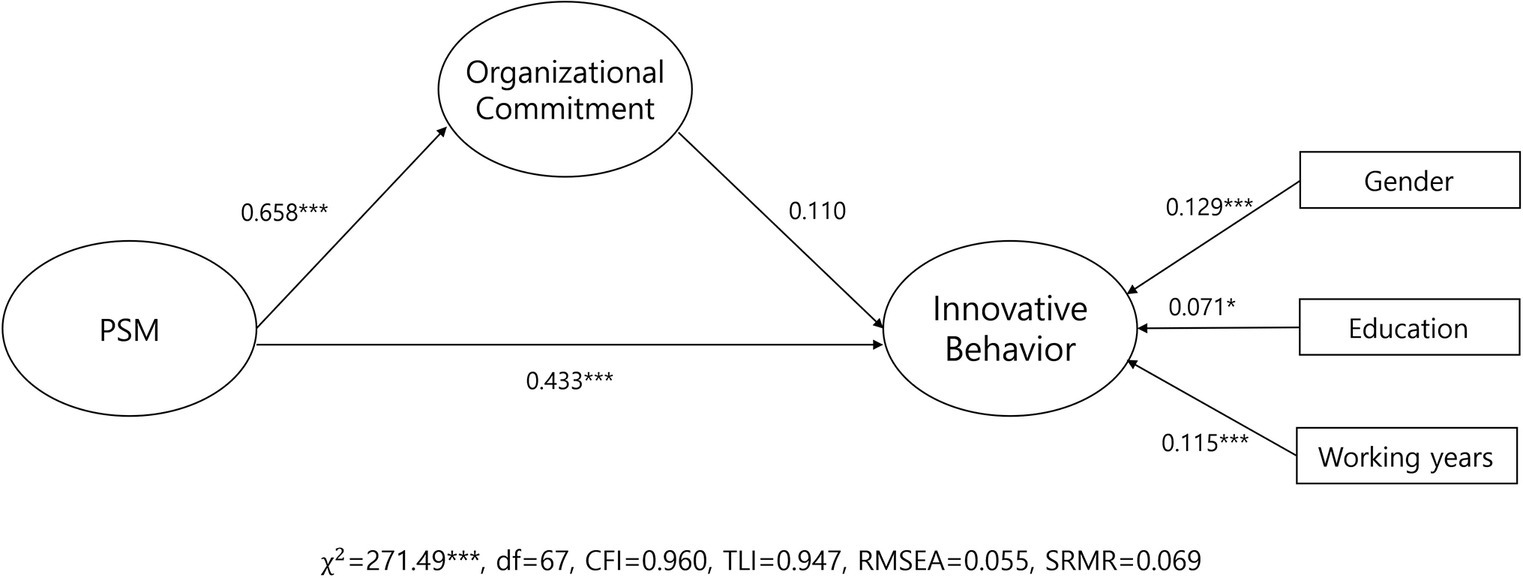
Path coefficients of the proposed model.
Table 6
| Direct Path | Coefficient | S.E | 95% Confidence Interval | |
|---|---|---|---|---|
| Lower 2.5% | Upper 2.5% | |||
| PSM → OC | 0.658*** | 0.034 | 0.591 | 0.723 |
| OC → IB | 0.110 | 0.062 | −0.012 | 0.234 |
| PSM → IB | 0.433*** | 0.061 | 0.312 | 0.549 |
| Gender → IB | 0.129*** | 0.031 | 0.068 | 0.188 |
| Education → IB | 0.071* | 0.029 | 0.014 | 0.128 |
| Working year → IB | 0.115*** | 0.029 | 0.058 | 0.172 |
Main effects of the proposed model.
*p < 0.05; ***p < 0.001.
Regarding the control variables, gender demonstrated a positive association with innovative behavior, indicating that male employees were more inclined to be innovative than their female counterparts. Education was found to be linked to innovative behavior, suggesting that employees with graduate degrees are more likely to innovate than those with undergraduate degrees. In addition, job tenure displayed a positive association with innovative behavior in public organizations, which supports that Woods et al. (2018)‘s findings that employees’ organizational tenure has a pivotal role of innovative work behavior.
4.4.2 Mediation effect
To examine the mediation effect, we performed bootstrap resampling with 5,000 replications. The bootstrap analysis in Table 7, revealed that the mediation effect value of organizational commitment between PSM and innovative behavior was 0.08, with a 95% confidence interval of [−0.009, 00172], which includes 0, indicating the absence of a mediating effect of organizational commitment in the model, contrary to our hypothesis. In this causal path, the direct effect was 0.48 and the indirect effect was 0.08, and the total effect was thus 0.56. This finding indicates that most of the effect can be attributed to the direct relationship between PSM and innovative behavior.
Table 7
| Mediation | Estimate | S.E. | 95% CI |
|---|---|---|---|
| PSM → OC → IB | 0.080 | 0.045 | −0.009, 0.172 |
| Total effect | 0.560 | 0.049 | 0.463, 0.656 |
| Direct effect | 0.480 | 0.072 | 0.339, 0.621 |
| Indirect effect | 0.080 | 0.045 | −0.009, 0.172 |
Analytical results of bootstrap resampling for mediation (replication = 5,000).
4.4.3 Moderating effects
To examine the moderating effect of perceived innovative culture, we conducted separate structural equation modeling for the high and low innovation groups. Table 8 presents the coefficients for all paths in both groups. The effect value of PSM on organizational commitment for the high innovation group was 0.832 (p < 0.001), while that for the low innovation group was 0.557 (p < 0.001). However, it remains uncertain whether the coefficient of the high innovation group differs significantly from that of the low innovation group.
Table 8
| Path | High innovation group | Low innovation group | Unconstrained model | Constrained model |
|---|---|---|---|---|
| β (S.E.) |
β (S.E.) |
(df) | (df) | |
| PSM → OC | 0.832*** (0.060) |
0.557*** (0.076) |
361.66 (150) |
373.27 (151) |
| OC → IB | 0.219** (0.081) |
−0.029 (0.065) |
361.66 (150) |
367.31 (151) |
| PSM → IB | 0.334*** (0.094) |
0.550*** (0.064) |
361.66 (150) |
365.17 (151) |
Group analysis for moderation effects.
**p < 0.01; ***p < 0.001.
To test the significance of the difference between the two coefficients, the unconstrained model was compared with the constrained model while holding the effects of PSM on organizational commitment equal. The chi-square difference value, between the unconstrained ( = 361.66, df = 150) and constrained ( = 373.27, df = 151) models was 11.61, exceeding the critical value of 3.84 at the 0.05 significance level. This indicates a moderating effect, suggesting that the effect of PSM on organizational commitment is significantly higher for the high-innovation group than for the low-innovation group.
For the causal path between organizational commitment and innovative behavior, the effect of organizational commitment on innovative behavior for the high innovation culture group was positive and statistically significant (β = 0.219, p < 0.01), but that of its counterpart was not statistically significant. The chi-square difference value, between the unconstrained ( = 361.66, df = 150) and constrained ( = 367.31, df = 151) models was 5.65, indicating that the effect for the high innovation group is significantly different from that for the low innovation group—that is, there is a moderating effect.
For the effect of PSM on innovative behavior, the chi-square difference value, between the unconstrained and constrained models was 3.51, which is less than the critical value of 3.84. This finding demonstrates that perceived innovative culture has no moderating effect.
5 Discussion and implications
5.1 Discussion
The results offer significant insight into the dynamics of innovative behavior within public organizations. The acceptance of Hypothesis 1 confirms that PSM is positively related to innovative behavior. This finding aligns with the existing literature, suggesting that employees motivated by a desire to serve the public are more inclined to engage in innovative activities aimed at making citizens more comfortable with public services (Miao et al., 2018; Lee et al., 2020; Nguyen et al., 2023). This relationship underscores the importance of intrinsic motivation in fostering an environment conducive to innovation, particularly in the public sector.
The non-acceptance of Hypothesis 2 suggests that organizational commitment may not play the hypothesized mediating role in the relationship between PSM and innovative behavior. This could indicate that the direct influence of PSM on innovative behavior is not significantly channeled through organizational commitment. This finding suggests that PSM directly influences innovative behavior without mediation through organizational commitment, perhaps implying that the intrinsic motivation provided by PSM is sufficient to drive innovative behavior independently. Alternatively, the nature of public sector work, with its complex regulations and bureaucratic constraints, might limit the extent to which individual commitment can translate into observable innovative outcomes (Demircioglu and Audretsch, 2017; Acar et al., 2018).
The acceptance of Hypotheses 3–1 and 3–2 with positive moderation underscores the significant role of perceived innovative culture in enhancing the relationships between PSM and organizational commitment (H3-1) and between organizational commitment and innovative behavior (H3-2). This indicates that in environments where innovation is culturally valued and nurtured, employees with high PSM are likely to develop stronger organizational commitment, which in turn, more effectively translates into innovative behavior. This result highlights the pivotal role of an innovative organizational culture in leveraging employee motivation and commitment toward fostering innovation (Lukoto and Chan, 2016; Li and Liu, 2022; Pradana et al., 2022).
The finding that Hypothesis 3-3, positing that perceived innovative culture moderates the relationship between PSM and innovative behavior, is not supported prompts several possible explanations. This outcome suggests that the influence of an innovative organizational culture may not be as pivotal in moderating the impact of PSM on innovative behavior as initially theorized.
The results offer significant insight into the dynamics of innovative behavior within public organizations. The hypothesis 1 was supported. It confirms that PSM is positively related to innovative behavior. This finding aligns with the existing literature, suggesting that employees motivated by a desire to serve the public are more inclined to engage in innovative activities aimed at making citizens more comfortable with public services (Miao et al., 2018; Lee et al., 2020; Nguyen et al., 2023). This relationship underscores the importance of intrinsic motivation in fostering an environment conducive to innovation, particularly in the public sector.
The hypothesis 2 was not supported. It suggests that organizational commitment may not play the hypothesized mediating role in the relationship between PSM and innovative behavior. This could indicate that the direct influence of PSM on innovative behavior is not significantly channeled through organizational commitment. This finding suggests that PSM directly influences innovative behavior without mediation through organizational commitment, perhaps implying that the intrinsic motivation provided by PSM is sufficient to drive innovative behavior independently. Alternatively, the nature of public sector work, with its complex regulations and bureaucratic constraints, might limit the extent to which individual commitment can translate into observable innovative outcomes (Demircioglu and Audretsch, 2017; Acar et al., 2018). Given the limited research on this relationship, further investigation is necessary across different sociocultural and methodological contexts.
The hypotheses 3–1 and 3–2 were supported; positive moderation underscores the significant role of perceived innovative culture in enhancing the relationships between PSM and organizational commitment (H3-1) and between organizational commitment and innovative behavior (H3-2). This indicates that in environments where innovation is culturally valued and nurtured, employees with a high level of PSM are likely to develop stronger organizational commitment, which in turn, more effectively translates into innovative behavior. This result highlights the pivotal role of an innovative organizational culture in leveraging employee motivation and commitment toward fostering innovation (Lukoto and Chan, 2016; Li and Liu, 2022; Pradana et al., 2022).
The finding that hypothesis 3-3, positing that perceived innovative culture moderates the relationship between PSM and innovative behavior, is not supported prompts several possible explanations. This outcome suggests that the influence of an innovative organizational culture may not be as pivotal in moderating the impact of PSM on innovative behavior as initially theorized.
One possible explanation for this result could be the inherent strength of PSM itself. Individuals with high PSM may be intrinsically motivated to innovate, regardless of organizational culture. This aligns with one of the core principles of PSM that individuals are driven by a commitment to the public good and societal values, potentially overshadowing environmental factors like organizational culture (Perry and Vandenabeele, 2015).
5.2 Implications
5.2.1 Theoretical implications
The study’s findings on the interplay between PSM, organizational commitment, innovative behavior, and the role of perceived innovative culture within public organizations offer several potential contributions to the literature of organizational psychology. These contributions revolve around understanding how individual motivations and organizational factors interact to influence behavior in workplace settings, particularly in the context of fostering innovation. Here are some possible contributions.
First, the direct relationship between PSM and innovative behavior is in line with self-determination theory, which emphasizes the importance of intrinsic motivation in driving workplace behavior (Klaeijsen et al., 2018; Ryan and Deci, 2020). This finding contributes to organizational psychology by providing empirical support for theories that emphasize the role of intrinsic factors, such as a sense of purpose or a desire to contribute to the public good, in motivating behavior beyond extrinsic rewards or formal organizational structures (Reiss, 2012; Kuvaas et al., 2017).
Second, the findings related to the moderating role of perceived innovative culture in enhancing the relationship between PSM and organizational commitment and between organizational commitment and innovative behavior contribute to organizational culture theories. They highlight the importance of alignment between individual motivations, organizational commitment, and the broader cultural context in facilitating innovative behaviors. This aligns with and expands upon person-organization fit theory, providing a view of how culture interacts with individual and organizational-level factors to support or hinder innovation (Goldberg et al., 2015; Lau et al., 2017; Chen et al., 2018).
Third, the study reveals a direct relationship between PSM and innovative behavior in public organizations, challenging the conventional roles of organizational commitment and culture as mediators and moderators. Organizational commitment is based on extrinsic rewards within an organization. However, since PSM is based on intrinsic rewards and operates through a passion for serving the public interest, it can lead to innovative behavior even in the absence of a strong connection to rewards, especially in public organizations. Therefore, self- determination theory can account for this relationship, suggesting that the dynamics of intrinsic motivation play a significant role. In conclusion, within public organizations, it is posited that the motivation driving innovation is more strongly associated with PSM than with organizational commitment (Rosa et al., 2020).
Lastly, we discovered that although organizational culture is an important factor, as demonstrated in previous studies (Naveed et al., 2022; Pradana et al., 2022; Budur et al., 2024), its moderating role of organizational culture is not uniformly influenced and varies depending on other individual characteristics, including commitment or motivation. Furthermore, the lack of a significant moderating effect of perceived innovative culture on the PSM-innovative behavior link indicates that the powerful drive of PSM may transcend organizational cultural influences. These findings underscore PSM’s potent and independent role in fostering innovation within the public sector, highlighting the need for further exploration into how motivational dynamics operate in contexts where public service and innovation intersect, without necessarily relying on organizational commitment or culture to facilitate this process.
5.2.2 Practical implications
From a practical standpoint, this study offers actionable strategies for public sector organizations to foster innovation.
First, by recognizing the link between PSM and innovation, public organizations should develop strategies to attract and retain individuals with high PSM. This could involve highlighting service-oriented values in recruitment and promoting a culture that values public service. Although we focused on innovative behavior, PSM has been identified as playing a role in positive outcomes such as job satisfaction, organizational citizenship behavior, and performance within organizations (Ritz et al., 2016). PSM serves as motivation not only for civil servants but also for citizens and employees in private companies. It is widely acknowledged that training programs can cultivate PSM in public organizations. From an innovative standpoint, emphasizing public values and a sense of community through training programs in an organization can directly or indirectly inculcate this motivation within the workforce, thus fostering innovative behavior to enhance public services for citizens.
Second, the role of perceived innovative culture as a catalyst for innovation underscores the necessity for organizations to deliberately foster such a culture. It is critical to create an environment that not only encourages creativity and risk-taking but also deeply values and supports PSM and organizational commitment. Employees are pivotal in driving organizational innovation, crucial for maintaining a competitive advantage and ensuring long-term sustainability (Borins, 2002). Consequently, cultivating a workplace culture or climate that actively encourages employees to embrace and demonstrate innovative behaviors is increasingly becoming an essential strategic approach for organizations (Guo et al., 2023).
Third, the moderating effect of perceived innovative culture on the PSM-commitment relationship implies a need to balance flexibility and innovation with stability and commitment. Organizations should strive for a culture that simultaneously promotes innovation and values the stability brought by committed employees.
In conclusion, this research offers both theoretical and practical insights, enhancing the understanding of how PSM, organizational commitment, and perceived innovative culture interact to drive innovation in the public sector. This underscores the need for a holistic approach to managing public sector organizations, in which individual motivations and organizational culture are aligned to foster innovative behaviors.
6 Conclusion
This study seeks to deepen our understanding of the relationships among PSM, organizational commitment, perceived innovative culture, and innovative behavior in public sector organizations. It illuminates how these factors interact and influence each other, contributing significantly to the body of knowledge in organizational psychology and public administration. These findings underscore the pivotal role of PSM in fostering innovative behavior. Furthermore, this study highlights the critical moderating role of perceived innovative culture in this dynamic. This understanding is invaluable for public-sector organizations striving to enhance innovation and adaptability in a rapidly changing global environment.
However, this study has some limitations that should be acknowledged as opportunities for future research. This study’s findings are based on a specific demographic and institutional context, which may limit their generalizability. Different public sector environments, cultural contexts, and organizational structures might yield different results. While this study examined perceived innovative culture as a moderating factor, the multifaceted nature of culture suggests that other cultural elements could influence the observed relationships. Further research could explore additional cultural dimensions and their interplay with PSM and innovative behavior. Other variables not considered in this study may influence innovative behavior in public organizations, such as personal values, leadership styles, policy environments, or external societal pressures (Borins, 2002; Purc and Laguna, 2019). A shortened version of measures was utilized for PSM, organizational commitment, and innovative behavior in this study, potentially compromising the validity of the constructs. Future research should replicate using a full scale of measurement for those variables.
In conclusion, while this study contributes to a valuable understanding of the factors driving innovative behavior in public organizations, it highlights the need for continued exploration in this field. Future research should build on these findings, explore new contexts and incorporate diverse methodologies to further our understanding of innovation in the public sector.
Statements
Data availability statement
The data analyzed in this study is subject to the following licenses/restrictions: The data was created by the Korea Institute of Public Administration and is used with permission in accordance with the Research Data Management Rules of the Korea Institute of Public Administration. The data that support the findings of this study are available on request from Korea Institute of Public Administration. Requests to access these datasets should be directed to https://www.kipa.re.kr/site/kipa/stadb/selectBaseDBFList.do.
Ethics statement
The studies involving humans were approved by Korea Institute of Public Administration. The studies were conducted in accordance with the local legislation and institutional requirements. The participants provided their written informed consent to participate in this study. Written informed consent was obtained from the individual(s) for the publication of any potentially identifiable images or data included in this article.
Author contributions
GL: Conceptualization, Data curation, Formal analysis, Funding acquisition, Investigation, Methodology, Project administration, Resources, Software, Supervision, Validation, Visualization, Writing – original draft, Writing – review & editing. CK: Conceptualization, Data curation, Formal analysis, Funding acquisition, Investigation, Methodology, Project administration, Resources, Software, Supervision, Validation, Visualization, Writing – original draft, Writing – review & editing.
Funding
The author(s) declare financial support was received for the research, authorship, and/or publication of this article. This work was supported by the research fund of Hanyang University (HY-201900000000921).
Conflict of interest
The authors declare that the research was conducted in the absence of any commercial or financial relationships that could be construed as a potential conflict of interest.
Publisher’s note
All claims expressed in this article are solely those of the authors and do not necessarily represent those of their affiliated organizations, or those of the publisher, the editors and the reviewers. Any product that may be evaluated in this article, or claim that may be made by its manufacturer, is not guaranteed or endorsed by the publisher.
References
1
Abdelmotaleb M. Saha S. K. (2019). Corporate social responsibility, public service motivation and organizational citizenship behavior in the public sector. Int. J. Public Adm.42, 929–939. doi: 10.1080/01900692.2018.1523189
2
Acar O. Tarakci M. Knippenberg D. (2018). Creativity and innovation under constraints: A cross-disciplinary integrative review. J. Manag.45, 96–121. doi: 10.1177/0149206318805832
3
Agostino D. Arnaboldi M. Lema M. (2020). New development: COVID-19 as an accelerator of digital transformation in public service delivery. Public Money Manag.41, 69–72. doi: 10.1080/09540962.2020.1764206
4
Allen N. J. Meyer J. P. (1990). The measurement and antecedents of affective, continuance and normative commitment to the organization. J. Occup. Psychol.63, 1–18. doi: 10.1111/j.2044-8325.1990.tb00506.x
5
Andersen L. B. Heinesen E. Pedersen L. H. (2014). How does public service motivation among teachers affect student performance in schools?J. Public Adm. Res. Theory24, 651–671. doi: 10.1093/jopart/mut082
6
Andersen L. B. Jørgensen T. B. Kjeldsen A. M. Pedersen L. H. Vrangbæk K. (2013). Public values and public service motivation: conceptual and empirical relationships. Am. Rev. Public Adm.43, 292–311. doi: 10.1177/0275074012440031
7
Andersen L. B. Kjeldsen A. M. (2013). Public service motivation, user orientation, and job satisfaction: A question of employment sector?Int. Public Manag. J.16, 252–274. doi: 10.1080/10967494.2013.817253
8
Askaripoor M. Motaghi Pisheh M. H. Sheikhy A. (2020). The impact of servant leadership on innovative work behavior in the public sector of Iran: analyzing the mediating role of public service motivation and the moderating role of political skill. J. Public Adm.12, 67–87. doi: 10.22059/jipa.2019.292773.2661
9
Austen A. Zacny B. (2015). The role of public service motivation and organizational culture for organizational commitment. Management19, 21–34. doi: 10.1515/manment-2015-0011
10
Barney J. B. (1986). Organizational culture: can it be a source of sustained competitive advantage?Acad. Manag. Rev.11, 656–665. doi: 10.2307/258317
11
Bednarczuk M. (2018). Identity and vote Overreporting by bureaucrats: implications for public service motivation. Am. Rev. Public Adm.48, 148–158. doi: 10.1177/0275074016672345
12
Bellé N. (2013). Experimental evidence on the relationship between public service motivation and job performance. Public Adm. Rev.73, 143–153. doi: 10.1111/j.1540-6210.2012.02621.x
13
Bernier L. Hafsi T. Deschamps C. (2015). Environmental determinants of public sector innovation: A study of innovation awards in Canada. Public Manag. Rev.17, 834–856. doi: 10.1080/14719037.2013.867066
14
Bertot J. Estevez E. Janowski T. (2016). Universal and contextualized public services: digital public service innovation framework. Gov. Inf. Q.33, 211–222. doi: 10.1016/j.giq.2016.05.004
15
Blau P. (2017). Exchange and Power in Social Life. Abingdon-on-Thames: Routledge. doi: 10.4324/9780203792643
16
Borins S. (2002). Leadership and innovation in the public sector. Leadersh. Organ. Dev. J.23, 467–476. doi: 10.1108/01437730210449357
17
Bozeman B. (1987). All organizations are public: Comparing public and private organizations. Washington, DC: Beard Books.
18
Bozeman B. Su X. (2015). Public service motivation concepts and theory: A criticque. Public Adm. Rev.75, 700–710. doi: 10.1111/puar.12248
19
Bright L. (2020). Does perception of organizational prestige mediate the relationship between public service motivation, job satisfaction, and the turnover intentions of federal employees?Public Personnel Manage.50, 408–429. doi: 10.1177/0091026020952818
20
Brunetto Y. Saheli N. Dick T. Nelson S. (2021). Psychosocial safety climate, psychological capital, healthcare SLBs’ wellbeing and innovative behaviour during the COVID 19 pandemic. Public Perform. Manag. Rev.45, 751–772. doi: 10.1080/15309576.2021.1918189
21
Budur T. Demirer H. Rashid C. A. (2024). The effects of knowledge sharing on innovative behaviours of academicians; mediating effect of innovative organization culture and quality of work life. J. Appl. Res. Higher Educ.16, 405–426. doi: 10.1108/JARHE-08-2022-0257
22
Büschgens T. Bausch A. Balkin D. B. (2013). Organizational culture and innovation: a meta-analytic review. J. Prod. Innov. Manag.30, 763–781. doi: 10.1111/jpim.12021
23
Bysted R. Hansen J. R. (2015). Comparing public and private sector employees’ innovative behaviour: understanding the role of job and organizational characteristics, job types, and subsectors. Public Manag. Rev.17, 698–717. doi: 10.1080/14719037.2013.841977
24
Cameron K. Quinn R. (1999). Diagnosing and changing organizational culture. Base on the competing values framework. Reading, MA: Addison-Wesley.
25
Camilleri E. Van Der Heijden B. I. J. M. (2007). Organizational commitment, public service motivation, and performance within the public sector. Public Perform. Manag. Rev.31, 241–274. doi: 10.2753/PMR1530-9576310205
26
Campbell J. W. Im T. (2016). PSM and turnover intention in public organizations: does change-oriented organizational citizenship behavior play a role?Rev. Public Pers. Adm.36, 323–346. doi: 10.1177/0734371X14567366
27
Chatman J. A. (1989). Improving interactional organizational research: A model of person-organization fit. Acad. Manag. Rev.14, 333–349. doi: 10.2307/258171
28
Chen Z. Huang S. Liu C. Min M. Zhou L. (2018). Fit between organizational culture and innovation strategy: implications for innovation performance. Sustain. For.10:378. doi: 10.3390/SU10103378
29
Chen S. Wu M. Chen C. (2010). Employee’s personality traits, work motivation and innovative behavior in marine tourism industry. J. Serv. Sci. Manag.03, 198–205. doi: 10.4236/jssm.2010.32025
30
Cho Y. J. Song H. J. (2015). Determinants of whistleblowing within government agencies. Public Pers. Manage.44, 450–472. doi: 10.1177/0091026015603206
31
Choi D. L. (2004). Public service motivation and ethical conduct. Int. Rev. Public Adm.8, 99–106. doi: 10.1080/12294659.2004.10805032
32
Clerkin R. M. Paynter S. R. Taylor J. K. (2009). Public service motivation in undergraduate giving and volunteering decisions. Am. Rev. Public Adm.39, 675–698. doi: 10.1177/0275074008327512
33
Corduneanu R. Dudau A. Kominis G. (2020). Crowding-in or crowding-out: the contribution of self-determination theory to public service motivation. Public Manag. Rev.22, 1070–1089. doi: 10.1080/14719037.2020.1740303
34
Crewson P. E. (1997). Public-service motivation: building empirical evidence of incidence and effect. J. Public Adm. Res. Theory7, 499–518. doi: 10.1093/oxfordjournals.jpart.a024363
35
Cropanzano R. Mitchell M. S. (2005). Social exchange theory: an interdisciplinary review. J. Manag.31, 874–900. doi: 10.1177/0149206305279602
36
Deci E. L. Ryan R. M. (1985). Intrinsic motivation and self-determination in human behavior. New York: Plenum Press.
37
Demircioglu M. Audretsch D. (2017). Conditions for innovation in public sector organizations. Res. Policy46, 1681–1691. doi: 10.1016/J.RESPOL.2017.08.004
38
Devloo T. Anseel F. De Beuckelaer A. Salanova M. (2015). Keep the fire burning: reciprocal gains of basic need satisfaction, intrinsic motivation and innovative work behaviour. Eur. J. Work Organ. Psychol.24, 491–504. doi: 10.1080/1359432X.2014.931326
39
Esteve M. Urbig D. van Witteloostuijn A. Boyne G. (2016). Prosocial behavior and public service motivation. Public Adm. Rev.76, 177–187. doi: 10.1111/puar.12480
40
Fernandez S. Moldogaziev T. (2013). Using employee empowerment to encourage innovative behavior in the public sector. J. Public Admin. Res. Theor.23, 155–187. doi: 10.1093/jopart/mus008
41
Fischer C. Malycha C. P. Schafmann E. (2019). The influence of intrinsic motivation and synergistic extrinsic motivators on creativity and innovation. Front. Psychol.10:137. doi: 10.3389/fpsyg.2019.00137
42
Gan K. Lin Y. Wang Q. (2020). Public service motivation and turnover intention: testing the mediating effects of job attitudes. Front. Psychol.11:1289. doi: 10.3389/fpsyg.2020.01289
43
Gans-Morse J. Kalgin A. Klimenko A. Vorobyev D. Yakovlev A. (2022). Public service motivation as a predictor of corruption, dishonesty, and altruism. J. Public Adm. Res. Theory32, 287–309. doi: 10.1093/jopart/muab018
44
Goldberg A. Srivastava S. Manian V. Monroe W. Potts C. (2015). Fitting in or standing out? The tradeoffs of structural and cultural embeddedness. Am. Sociol. Rev.81, 1190–1222. doi: 10.1177/0003122416671873
45
Gu H. Duverger P. Yu L. (2017). Can innovative behavior be led by management? A study from the lodging business. Tour. Manage.63, 144–157. doi: 10.1016/J.TOURMAN.2017.06.010
46
Guo U. Peng Y. Zhu Y. (2023). How does empowering leadership motivate employee innovative behavior: A job characteristics perspective. Curr. Psychol.42, 18280–18290. doi: 10.1007/s12144-022-03000-6
47
Hansen J. A. Pihl-Thingvad S. (2019). Managing employee innovative behaviour through transformational and transactional leadership styles. Public Manag. Rev.21, 918–944. doi: 10.1080/14719037.2018.1544272
48
Heinonen K. Strandvik T. (2020). Reframing service innovation: COVID-19 as a catalyst for imposed service innovation. J. Serv. Manag.32, 101–112. doi: 10.1108/JOSM-05-2020-0161
49
Henseler J. Ringle C. M. Sarstedt M. (2015). A new criterion for assessing discriminant validity in variance-based structural equation modeling. Journal of the academy of marketing science, 43, 115–135. doi: 10.1007/s11747-014-0403-8
50
Houston D. J. (2000). Public-service motivation: A multivariate test. J. Public Adm. Res. Theory10, 713–728. doi: 10.1093/oxfordjournals.jpart.a024288
51
Houston D. J. (2006). “Walking the walk” of public service motivation: public employees and charitable gifts of time, blood, and money. J. Public Adm. Res. Theory16, 67–86. doi: 10.1093/jopart/mui028
52
Im T. Campbell J. W. Jeong J. (2016). Commitment intensity in public organizations. Rev. Public Pers. Admin.36, 219–239. doi: 10.1177/0734371X13514094
53
Ingrams A. (2020). Organizational citizenship behavior in the public and private sectors: A multilevel test of public service motivation and traditional antecedents. Rev. Public Pers. Admin.40, 222–244. doi: 10.1177/0734371X18800372
54
Janssen O. (2000). Job demands, perceptions of effort-reward fairness and innovative behavior. J. Occup. Organ. Psychol.73, 287–302. doi: 10.1348/096317900167038
55
Jia H. Gao S. Shang P. Cao P. Yu J. Yu X. (2022). The relationship between public service motivation and turnover intention: the mediating role of work stress and task performance. Environ. Health Prev. Med.27, 31–10. doi: 10.1265/ehpm.22-00045
56
Jung K. Lee S. H. Workman J. E. (2018). Exploring a relationship between creativity and public service motivation. Knowl. Manag. Res. Pract.16, 292–304. doi: 10.1080/14778238.2018.1471327
57
Kanter R. M. (1983). The change masters. New York: Simon and Schuster.
58
Kelman S. (1987). Public choice and public spirit. Public Interest87, 305–360,
59
Khan J. Burdey M. B. (2021). Enhancing job performance and innovative work behavior through public service motivation-A case study of employees working in federal government of Pakistan. Journal of the Research Society of Pakistan, 58, 269–282.
60
Khorakian A. Shahroodi H. Jahangir M. Farkhani Z. (2019). Innovative work behavior in public organizations: the roles of ethical and knowledge sharing behaviors. Creat. Res. J.31, 164–173. doi: 10.1080/10400419.2019.1607444
61
Ki N. (2021). Public service motivation and government officials’ willingness to learn in public sector benchmarking process. Public Manag. Rev.23, 610–632. doi: 10.1080/14719037.2019.1708437
62
Kim S. (2006). Public service motivation and organizational citizenship behavior in Korea. Int. J. Manpow.27, 8, 722–740. doi: 10.1108/01437720610713521
63
Kim S. (2009). Revising Perry’s measurement scale of public service motivation. Am. Rev. Public Admin.39, 149–163. doi: 10.1177/0275074008317681
64
Klaeijsen A. Vermeulen M. Martens R. (2018). Teachers’ innovative behaviour: the importance of basic psychological need satisfaction, intrinsic motivation, and occupational self-efficacy. Scand. J. Educ. Res.62, 769–782. doi: 10.1080/00313831.2017.1306803
65
Kline R. B. (2016). Principles and practice of structural equation modeling. 4th Edn. New York: The Guilford Press.
66
Koumenta M. (2015). Public service motivation and organizational citizenship. Public Money & Management, 35, 341–348. doi: 10.1080/09540962.2015.1061169
67
Kristof A. L. (1996). Person-organization fit: an integrative review of its conceptualizations, measurement, and implications. Pers. Psychol.49, 1–49. doi: 10.1111/j.1744-6570.1996.tb01790.x
68
Kuvaas B. Buch R. Weibel A. Dysvik A. Nerstad C. G. L. (2017). Do intrinsic and extrinsic motivation relate differently to employee outcomes?J. Econ. Psychol.61, 244–258. doi: 10.1016/j.joep.2017.05.004
69
Kwon I. (2014). Motivation, discretion, and corruption. J. Public Adm. Res. Theory24, 765–795. doi: 10.1093/jopart/mus062
70
Lau P. McLean G. Hsu Y. Lien B. (2017). Learning organization, organizational culture, and affective commitment in Malaysia: A person–organization fit theory. Hum. Resour. Dev. Int.20, 159–179. doi: 10.1080/13678868.2016.1246306
71
Lee H. J. Kim M. Y. Park S. M. Robertson P. J. (2020). Public service motivation and innovation in the Korean and Chinese public sectors: exploring the role of Confucian values and social capital. Int. Public Manag. J.23, 496–534. doi: 10.1080/10967494.2019.1639570
72
Leisink P. Knies E. van Loon N. (2021). Does public service motivation matter? A study of participation in various volunteering domains. Int. Public Manag. J.24, 865–885. doi: 10.1080/10967494.2018.1428254
73
Li Z. Liu L. (2022). The impact of organizational innovation culture on employees' innovation behavior. Soc. Behav. Personal. Int. J.50, 1–10. doi: 10.2224/sbp.11934
74
Li Y. Wang F. (2022). Challenge stressors from using social media for work and change-oriented organizational citizenship behavior: effects of public service motivation and job involvement. Gov. Inf. Q.39:101741. doi: 10.1016/j.giq.2022.101741
75
Lim J. Y. Moon K.-K. Christensen R. K. (2022). Does psychological empowerment condition the impact of public service motivation on perceived organizational performance? Evidence from the US federal government. Int. Rev. Adm. Sci.88, 682–701. doi: 10.1177/00208523211008958
76
Liu D. Jiang K. Shalley C. E. Keem S. Zhou J. (2016). Motivational mechanisms of employee creativity: A meta-analytic examination and theoretical extension of the creativity literature. Organ. Behav. Hum. Decis. Process.137, 236–263. doi: 10.1016/j.obhdp.2016.08.001
77
Lukoto K. Chan K. (2016). The perception of innovative organisational culture and its influence on employee innovative work behaviour. Portland Int. Conf. Manage. Eng. Technol.2016, 972–977. doi: 10.1109/PICMET.2016.7806707
78
Mahmood S. Khan J. Iqbal S. M. J. Farooq R. M. A. (2020). Investigating the impact of transformational leadership on employee innovative behavior and job performance: the mediating role of public service motivation. Pak. J. Soc Sci.40, 455–465,
79
Martins E. C. Terblanche F. (2003). Building organisational culture that stimulates creativity and innovation. Eur. J. Innov. Manag.6, 64–74. doi: 10.1108/14601060310456337
80
Meyer J. P. Allen N. J. (1991). A three-component conceptualization of organizational commitment. Hum. Resour. Manag. Rev.1, 61–89. doi: 10.1016/1053-4822(91)90011-Z
81
Miao Q. Eva N. Newman A. Schwarz G. (2019). Public service motivation and performance: the role of organizational identification. Public Money Manage.39, 77–85. doi: 10.1080/09540962.2018.1556004
82
Miao Q. Newman A. Schwarz G. Cooper B. (2018). How leadership and public service motivation enhance innovative behavior. Public Admin. Rev.78, 71–81. doi: 10.1111/PUAR.12839
83
Moore M. Hartley J. (2008). Innovations in governance. Public Manag. Rev.10, 3–20. doi: 10.1080/14719030701763161
84
Mowday R. T. Steers R. M. Porter L. W. (1979). The measurement of organizational commitment. J. Vocat. Behav.14, 224–247. doi: 10.1016/0001-8791(79)90072-1
85
Naff K. C. Crum J. (1999). Working for America: does public service motivation make a difference?Rev. Public Pers. Adm.19, 5–16. doi: 10.1177/0734371X9901900402
86
Naveed R. Alhaidan H. Al Halbusi H. Al-Swidi A. (2022). Do organizations really evolve? The critical link between organizational culture and organizational innovation toward organizational effectiveness: pivotal role of organizational resistance. J. Innov. Knowl.7, 100178–100114. doi: 10.1016/j.jik.2022.100178
87
Neuman W. L. (2011). Social research methods: Qualitative and quantitative approaches. London, United Kingdom: Pearson.
88
Nguyen N. Nguyen D. Vo N. Tuan L. (2023). Fostering public sector employees’ innovative behavior: the roles of servant leadership, public service motivation, and learning goal orientation. Adm. Soc.55, 30–63. doi: 10.1177/00953997221100623
89
Northcott D. Taulapapa T. M. (2012). Using the balanced scorecard to manage performance in public sector organizations: issues and challenges. Int. J. Public Sect. Manag.25, 166–191. doi: 10.1108/09513551211224234
90
Osborne S. P. Brown L. (2011). Innovation, public policy and public services delivery in the UK. The word that would be king?Public Adm.89, 1335–1350. doi: 10.1111/j.1467-9299.2011.01932.x
91
Paarlberg L. E. Lavigna R. (2009). Using research on altruism, prosocial behavior, and public service motivation to change how we manage people in public organizations. Paper presented at the international public service motivation research conference, Bloomington, IN, June 7-9.
92
Park S. Jo S. J. (2018). The impact of proactivity, leader-member exchange, and climate for innovation on innovative behavior in the Korean government sector. Leadersh. Organ. Dev. J.39, 130–149. doi: 10.1108/LODJ-09-2016-0216
93
Park Y. Yun C. (2022). Innovative behavior and performance in the public sector: determinants of innovative behavior and their impacts on performance. Korean Assoc. Gov. Stud.32, 63–99. doi: 10.26847/mspa.2022.32.3.63
94
Perry J. L. (1996). Measuring public service motivation: an assessment of construct reliability and validity. J. Public Admin. Res. Theor.6, 5–22. doi: 10.1093/oxfordjournals.jpart.a024303
95
Perry J. L. (2000). Bringing society in: toward a theory of public service motivation. J. Public Adm. Res. Theory10, 471–488. doi: 10.1093/oxfordjournals.jpart.a024277
96
Perry J. L. Hondeghem A. (2008). Motivation in public management: The call of public service. Oxford, UK: Oxford University Press.
97
Perry J. L. Vandenabeele W. (2015). Public service motivation research: achievements, challenges, and future directions. Public Admin. Rev.75, 692–699. doi: 10.1111/puar.12430
98
Perry J. L. Wise L. R. (1990). The motivational bases of public service. Public Admin. Rev.50, 367–373. doi: 10.2307/976618
99
Piatak J. S. Holt S. B. (2020). Prosocial behaviors: A matter of altruism or public service motivation?J. Public Adm. Res. Theory30, 504–518. doi: 10.1093/jopart/muz041
100
Podsakoff P. M. MacKenzie S. B. Lee J. Y. Podsakoff N. P. (2003). Common method biases in behavioral research: A critical review of the literature and recommended remedies. J. Appl. Psychol.88, 879–903. doi: 10.1037/0021-9010.88.5.879
101
Porter L. W. Steers R. M. Mowday R. T. (1974). Organizational commitment, job satisfaction, and turnover among psychiatric technicians. J. Appl. Psychol.59, 603–609. doi: 10.1037/h0037335
102
Potipiroon W. Wongpreedee A. (2021). Ethical climate and whistleblowing intentions: testing the mediating roles of public service motivation and psychological safety among local government employees. Public Pers. Manage.50, 327–355. doi: 10.1177/0091026020944547
103
Pradana M. Silvianita A. Syarifuddin S. Renaldi R . (2022). The Implication of Digital Organisational Culture on Firm Performance. Front. Psychol.13:840699. doi: 10.3389/fpsyg.2022.840699
104
Prysmakova P. Evans M. D. (2022). Whistleblowing motivation and gender: vignette-based study in a local government. Rev. Public Pers. Adm.42, 165–190. doi: 10.1177/0734371X20967982
105
Prysmakova P. Vandenabeele W. (2020). Enjoying police duties: public service motivation and job satisfaction. J. Police Crim. Psychol.35, 304–317. doi: 10.1007/s11896-019-09324-7
106
Purc E. Laguna M. (2019). Personal values and innovative behavior of employees. Front. Psychol.10:865. doi: 10.3389/fpsyg.2019.00865
107
Rafique M. A. Hou Y. Chudhery M. A. Z. Gull N. Ahmed S. J. (2023). The dimension linkage between public service motivation and innovative behavior in public sector institutions: the mediating role of psychological empowerment. Eur. J. Innov. Manag.1, 207–229. doi: 10.1108/EJIM-02-2021-0098
108
Rainey H. G. (1982). Reward preference among public and private managers: in search of the service ethic. Am. Rev. Public Admin.16, 288–302. doi: 10.1177/027507408201600402
109
Rainey H. G. Bozeman B. (2000). Comparing public and private organizations: empirical research and the power of the priori. J. Public Admin. Res. Theor.10, 447–470. doi: 10.1093/oxfordjournals.jpart.a024276
110
Reiss S. (2012). Intrinsic and extrinsic motivation. Teach. Psychol.39, 152–156. doi: 10.1177/0098628312437704
111
Ritala P. Vanhala M. Järveläinen K. (2019). The role of employee incentives and motivation on organizational innovativeness in different organisational culture. Int. J. Innov. Manage.2019:759. doi: 10.1142/s1363919620500759
112
Ritz A. (2009). Public service motivation and organizational performance in Swiss federal government. Int. Rev. Adm. Sci.75, 53–78. doi: 10.1177/0020852308099506
113
Ritz A. Brewer G. A. Neumann O. (2016). Public service motivation: A systematic literature review and outlook. Public Admin. Rev.76, 414–426. doi: 10.1111/puar.12505
114
Roh C. Moon M. H. Yang S. Jung K. (2016). Linking emotional labor, public service motivation, and job satisfaction: social workers in health care settings. Soc. Work Public Health31, 43–57. doi: 10.1080/19371918.2015.1087904
115
Rosa E. Najberg E. Sousa M. (2020). Does PSM matter among innovative government managers?REGE Rev. Gestão27, 263–279. doi: 10.1108/rege-05-2019-0059
116
Ryan R. Deci E. (2020). Intrinsic and extrinsic motivation from a self-determination theory perspective: definitions, theory, practices, and future directions. Contemp. Educ. Psychol.61:101860. doi: 10.1016/j.cedpsych.2020.101860
117
Schneider B. (1987). The people make the place. Pers. Psychol.40, 437–453. doi: 10.1111/j.1744-6570.1987.tb00609.x
118
Scott S. G. Bruce R. A. (1994). Determinants of innovative behavior: A path model of individual innovation in the workplace. Acad. Manag. J.37, 580–607. doi: 10.2307/256701
119
Scott P. G. Falcone S. (1998). Comparing public and private organizations. Am. Rev. Public Admin.28, 126–145. doi: 10.1177/027507409802800202
120
Shim D. C. Faerman S. (2017). Government employees’ organizational citizenship behavior: the impacts of public service motivation, organizational identification, and subjective OCB norms. Int. Public Manag. J.20, 531–559. doi: 10.1080/10967494.2015.1037943
121
Shim D. C. Park H. H. Eom T. H. (2017). Street-level bureaucrats’ turnover intention: does public service motivation matter?Int. Rev. Adm. Sci.83, 563–582. doi: 10.1177/0020852315582137
122
Stazyk E. C. Davis R. S. (2015). Taking the ‘high road’: does public service motivation alter ethical decision making processes?Public Adm.93, 627–645. doi: 10.1111/padm.12158
123
Suryani S. T. Fachmi M. Yahya M. Tamsah H. (2023). Structural modeling analysis of public service motivation on civil Servants' performance through innovative behavior. Int. J. Multicult. Multireligious Understand10, 404–413. doi: 10.18415/ijmmu.v10i10.5235
124
Thuy N. T. T. Phinaitrup B.-A. (2023). The effect of public service motivation on job performance of public servants in Vietnam: the role of mediation of job satisfaction and person-organization fit. Int. J. Public Adm.46, 326–343. doi: 10.1080/01900692.2021.1995747
125
Vandenabeele W. (2009). The mediating effect of job satisfaction and organizational commitment on self-reported performance: more robust evidence of the PSM–performance relationship. Int. Rev. Admin. Sci.75, 11–34. doi: 10.1177/0020852308099504
126
Venketsamy A. Lew C. (2024). Intrinsic and extrinsic reward synergies for innovative work behavior among south African knowledge workers. Pers. Rev.53, 1–17. doi: 10.1108/PR-02-2021-0108
127
Vuong B. N. (2023). The influence of servant leadership on job performance through innovative work behavior: does public service motivation matter?Asia Pac. J. Public Admin.45, 295–315. doi: 10.1080/23276665.2022.2070517
128
Waheed A. Xiaoming M. Ahmad N. Waheed S. (2017). Impact of work engagement and innovative work behavior on organizational performance; moderating role of perceived distributive fairness. Int. Conf. Manag. Sci. Eng.2017, 127–133. doi: 10.1109/ICMSE.2017.8574390
129
Walton M. Clerkin R. Christensen R. K. Paarlberg L. Nesbit R. Tschirhart M. (2017). Means, motive and opportunity: exploring board volunteering. Pers. Rev.46, 115–135. doi: 10.1108/PR-01-2015-0012
130
Wang Q. Gan K. P. Wei H. Y. Sun A. Wang Y. Zhou X. M. (2024). Public service motivation and public employees’ turnover intention: the role of job satisfaction and career growth opportunity. Pers. Rev.53, 99–118. doi: 10.1108/PR-11-2020-0836
131
West M. A. Far J. L. (1990). Innovation and creativity at work: Psychological and organizational strategies. Chichester, UK: Wiley.
132
Wilkins A. L. Ouchi W. G. (1983). Efficient cultures: exploring the relationship between culture and organizational performance. Admin. Sci. Q.28, 468–481. doi: 10.2307/2392253
133
Witesman E. Walters L. (2013). Public service values: A new approach to the study of motivation in the public sphere. Public Adm.92, 375–405. doi: 10.1111/padm.12000
134
Woods S. Mustafa M. Aderson N. Sayer B. (2018). Innovative work behavior and personality traits: examining the moderating effects of organizational tenure. J. Managerial Psychol.33, 29–42. doi: 10.1108/JMP-01-2017-0016
135
Wright B. E. Grant A. M. (2010). Unanswered questions about public service motivation: designing research to address key issues of emergence and effects. Public Admin. Rev.70, 691–700. doi: 10.1111/j.1540-6210.2010.02197.x
136
Wright B. Hassan S. Park J. (2016). Does a public service ethic encourage ethical behavior? Public service motivation, ethical leadership and the willingness to report ethical problems. Public Adm.94, 647–663. doi: 10.1111/padm.12248
137
Wright B. E. Pandey S. K. (2008). Public service motivation and the assumption of person-organization fit: testing the mediating effect of value congruence. Admin. Soc.40, 502–521. doi: 10.1177/0095399708320187
138
Yuan F. Woodman R. W. (2010). Innovative behavior in the workplace: the role of performance and image outcome expectations. Acad. Manag. J.53, 323–342. doi: 10.5465/amj.2010.49388995
139
Zandberg T. Morales F. N. (2019). Public managers’ networking and innovative work behavior: the importance of career incentives. Int. Rev. Admin. Sci.85, 286–303. doi: 10.1177/0020852317692138
140
Zhang Y. (2023). Disclosing the relationship between public service motivation and job satisfaction in the Chinese public sector: A moderated mediation model. Front. Psychol.14:1073370. doi: 10.3389/fpsyg.2023.1073370
141
Zhu C. Wu C. (2016). Public service motivation and organizational performance in Chinese provincial governments. Chin. Manag. Stud.10, 770–786. doi: 10.1108/CMS-08-2016-0168
Summary
Keywords
public service motivation, innovative behavior, organizational commitment, perceived innovative culture, innovative work behavior
Citation
Lee G and Kim C (2024) Antecedents of innovative behavior in public organizations: the role of public service motivation, organizational commitment, and perceived innovative culture. Front. Psychol. 15:1378217. doi: 10.3389/fpsyg.2024.1378217
Received
29 January 2024
Accepted
06 May 2024
Published
30 May 2024
Volume
15 - 2024
Edited by
Mike James Mustafa, Division of organizational and Applied Psychology University of Nottingham Malaysia, Malaysia
Reviewed by
Sheng Huang, University of Nottingham Malaysia Campus, Malaysia
Mandy Sim, University of Nottingham Malaysia Campus, Malaysia
Updates
Copyright
© 2024 Lee and Kim.
This is an open-access article distributed under the terms of the Creative Commons Attribution License (CC BY). The use, distribution or reproduction in other forums is permitted, provided the original author(s) and the copyright owner(s) are credited and that the original publication in this journal is cited, in accordance with accepted academic practice. No use, distribution or reproduction is permitted which does not comply with these terms.
*Correspondence: Chulwoo Kim, cwkim@gachon.ac.kr
Disclaimer
All claims expressed in this article are solely those of the authors and do not necessarily represent those of their affiliated organizations, or those of the publisher, the editors and the reviewers. Any product that may be evaluated in this article or claim that may be made by its manufacturer is not guaranteed or endorsed by the publisher.