 J. Francisco Santibáñez-Palma
 Rodrigo Ferrer-Urbina
 Geraldy Sepúlveda-Páez
 Josefa Bravo de la Fuente
 Karina Alarcón-Castillo*
- Escuela de Psicología y Filosofía, Universidad de Tarapacá, Arica, Chile
The COVID-19 pandemic has generated a global crisis with severe consequences for public health. There have been negative impacts on people’s quality of life and mental health due to various stressors arising in this context, such as physical, social, economic, and psychological challenges. Noteworthy among these are the indirect effects of health measures, especially social distancing and confinement, which have significantly altered people’s daily lives and social activities, producing high levels of anxiety, depression, and stress. This study proposes developing and validating a cross-sectional scale called the “Environmental Stressors Scale (ECSS-20)” to address the need to measure the impact of environmental stressors during confinement. The scale, which has been validated following ethical and methodological guidelines, consists of four dimensions: economic stressors (EE), social activities (SA), habitability (H), and exposure to virtual media (EMV). A pilot study (n = 113) and a main study (n = 314) were applied. The results showed that the instrument has a reliable and valid structure, with satisfactory internal consistency and factorial validity. Likewise, gender invariance tests supported its suitability for its applicability to women and men. Overall, the ECSS-20 is a valuable instrument for assessing the impact of confinement and improving the understanding of people’s subjective experiences in this situation. Future research could further develop its applicability in different contexts and populations to better understand its usefulness and psychometric properties.
Introduction
The pandemic context resulting from COVID-19 has depicted a global emergency, from the health point of view, with more than 6,987,222 deaths to date [World Health Organization (WHO), 2023], and in terms of the quality of life and mental health of people, due to the set of stressors that arose in this context (i.e., physical, social, economic, and psychological) (Bavel et al., 2020; Ornell et al., 2020; Wang et al., 2020; Wetherall et al., 2022). Within these stressors are those that emerged from the indirect effects of health policies and containment efforts, specifically, the policies of confinement and social distancing (Caqueo-Urízar et al., 2020), designed to reduce personal interactions and movements (Maier and Brockmann, 2020; Mayr et al., 2020; Badenes-Plá, 2022; Yu et al., 2023), which generated changes in the social and daily activities of the population (e.g., studies, work, intimate relationships, financial management, home habitability) (Ammar et al., 2020; Gloster et al., 2020; Marroquín et al., 2020; Akbari et al., 2021; Amerio et al., 2021; Gruber et al., 2021; Lal et al., 2021; Manchia et al., 2022; Quintana, 2022; von Keyserlingk et al., 2022).
As is well known, the social environment systematically influences health, considering social, psychological, economic, demographic, local and cultural aspects (Wild, 2005; McMichael, 2011; Pettini and Mazzocco, 2022; Whipple and Evans, 2022; Eyre et al., 2023; Gudi-Mindermann et al., 2023; Ibanez and Eyre, 2023). In this sense, any variation in these aspects will impact the health status of people, being detrimental or beneficial to the population. For example, there is ample evidence on how contexts of physical and social isolation (i.e., plague, influenza, cholera, leprosy, or others) and subjective social isolation are associated with negative impacts on mental health (Cacioppo and Hawkley, 2009; Cacioppo and Cacioppo, 2014; Cacioppo et al., 2015; Bzdok and Dunbar, 2022; Gilbar et al., 2022). The growth of such literature has been exponential during and following the COVID-19 pandemic (Jakovljevic et al., 2020; Mukhtar, 2020; Wilder-Smith and Freedman, 2020; Clair et al., 2021; Liu et al., 2021; Neville et al., 2021; Takian et al., 2021), highlighting negative psychological impacts (i.e., distress, anxiety, depression, and high levels of stress) that are primarily attributed to side effects of confinement (Cuadra-Martínez et al., 2020; Gloster et al., 2020; Kujawa et al., 2020; Kokkinos et al., 2022; Nanath et al., 2022). These effects, which have been reported in all types of populations (e.g., children, adolescents, adults, pregnant women, senior citizens, among others) (Manchia et al., 2022), would be explained by the increase in environmental stressors and the variability of coping resources (Verdolini et al., 2021; McLaughlin et al., 2022; Tracy et al., 2022; Yang et al., 2022; Delhey et al., 2023). Now, stress refers to an emergent relationship between the person and the environment (Lazarus and Cohen, 1977) involving environmental stimuli, their evaluation and the organism’s response (Cohen et al., 1983, 2007, 2019; Segerstrom and O’Connor, 2012). Likewise, environmental stress is defined as the physiological, cognitive, and emotional response that people may experience to various environmental situations, whether at the macro-level (e.g., population density in a city) or in the immediate environment (e.g., housing conditions; Gatersleben and Griffin, 2017).
A wide range of environmental stressors derived from confinement are observed in the literature (Ellen et al., 2021; Hussong et al., 2021; Kumar and Shah, 2021; Kunzler et al., 2021; Salazar et al., 2021; Sheek-Hussein et al., 2021; Szkody et al., 2021; Valdés-Florido et al., 2022; Morgado et al., 2023). Researched are: (1) economic stressors (ES), which refer to the perceived economic impact that a variation in the estimated household budget generates, and thus impacts on job insecurity and economic livelihood in households (Bazzoli et al., 2021; Friedline et al., 2021; Low and Mounts, 2022) (2) everyday activities (EA), understood as the impact on the performance of routine activities, being considered an individual facet of social practice (Rieger and Wang, 2020; Ellen et al., 2021); (3) social activities (SA), which refers to the perceived impact on social recreation activities such as interaction with others and leisure (Kunzler et al., 2021; Nielsen et al., 2021); (4) home habitability (H), referring to the operational housing conditions and comfort (i.e., conditions necessary to satisfy the physical, biological, psychological, and social well-being) of those who inhabit a dwelling (Corral-Verdugo et al., 2011; Zulaica and Oriolani, 2019); and (5) virtual media exposure (VME), understood as the level of person’s exposure to, or interaction with, virtual or technological media (e.g., television viewing, computer use, use of social networks, websites and mobile applications; Dubey, 2020; Rivest-Beauregard et al., 2022).
Consequently, the frequency of environmental stressors, whether higher or lower, defines how confinement or other situations that cause stressful environmental changes in people’s habitability (e.g., population displacement due to natural disasters and/or in search of shelter) will be experienced, thereby affecting their health (Choi et al., 2020; Kim et al., 2021; Bzdok and Dunbar, 2022). Thus, the evaluation of these environmental factors will provide a more complete view of how the health of the population is affected, and how to counteract this situation. In this way, it will be possible to generate preventive actions, either at the individual or collective level, that are aimed at the well-being of people.
In this line, and considering that efforts to study this phenomenon lack a psychometric instrument with evidence of validity, the present study aims to design a scale that assesses the perception of change in environmental conditions of confinement incorporating a cross-sectional approach, and thus reduce the existing gap in research on the measurement of the impact of confinement (Manchia et al., 2022). To this end, updated evidence of both reliability and validity is presented, following the guidelines of ethical and methodological standards recognized in the field of psychometric evaluation (Prieto and Delgado, 2010; American Educational Research Association, 2014; Muñiz and Fonseca-Pedrero, 2019).
Method
Procedures
The study was approved by the Ethics Committee of the Universidad de Tarapacá. An instrumental study was conducted, i.e., a battery of instruments was applied, with a cross-sectional design, i.e., applied over a period of time (Ato et al., 2013).
Initially, 68 items were profiled and evaluated by expert judges (two judges with experience in psychometrics and one judge specialized in the health area) in terms of grammatical adequacy (coherence and clarity) and construct representativeness, using a score of “−1, 0, 1” where “1” represents the grammatical adequacy and construct representativeness of the item. Means were then calculated and items with means less than or equal to 0 were eliminated; 45 items were retained from this process and applied to an online pilot study.
The pilot sample was collected through non-probability sampling strategies (Otzen and Manterola, 2017), using snowball and social network strategies (Montero and León, 2007). It consisted of 113 adults between 18 and 51 years of age (M = 27.1; SD = 7.29), 83 women (73.5%), 27 men (23.9%) and 3 (2.7%) individuals who did not identify with any of the aforementioned groups, coming from the Biobío region (45%, n = 50), the Arica and Parinacota region (42.3%, n = 47) and other regions of the country (12.7%, n = 16). It was surveyed online during October 2021 using a Google Form with a response procedure of 30 to 35 min.
Once the pilot sample was collected, an exploratory factor analysis (EFA) was conducted to explore the underlying structure of the data (Costello and Osborne, 2019). In addition, to provide a brief and concise scale representing the construct of interest, items with values below 0.50 on the factor loadings of each item were iteratively removed.
The results of the EFA suggested a new dimension, which included items related to exposure to virtual media (e.g., being exposed to computers or television and participating in virtual meetings). Thus, a 30-item version was obtained, which was applied to the main study sample, which like the pilot sample, was collected through non-probability sampling strategies (Otzen and Manterola, 2017), using snowball and social networking strategies (Montero and León, 2007), during January 2022 using a Google Form with a response procedure of 20 to 25 min.
Participants
The main study sample consisted of 314 adults between 18 and 79 years of age (M = 27.34; SD = 9.58), 191 women (60.8%), 123 men (39.2%), from the Biobío region (31.5%, n = 99), the Arica and Parinacota region (43.8%, n = 137), the Metropolitan region (9.6%, n = 30), and other regions of the country (15.1%, n = 48). The main study was conducted in the classrooms of the Universidad de Tarapacá during April and May 2022, using QR codes and paper-and-pencil surveys.
Instruments
The Environmental Confinement Stressors Scale (ECSS-20) was developed to evaluate the subjective comparison, before and during, of the most predominant environmental stressors established in periods of stress and confinement. The final version of the questionnaire consists of four dimensions of perception: (a) economic stressors (ES), (b) social activities (SA), (c) home habitability (H), and (d) exposure to virtual media (VME), with five items each, for a total of 20 items. The response options have a Likert format of 5 ranked categories (−2 = “Much less than before,” 2 = “Much more than before”). In the EE and EMV dimensions, higher scores are interpreted as experiencing a significant increase in environmental stress than before confinement. In the AS and H dimensions, higher scores are interpreted as experiencing a significant decrease in environmental stress than before confinement. The statements refer to facts and behaviors associated with environmental stressors in confinement.
Perceived Stress Scale (PSS-14): It is a 14 item self-report designed to assess “the degree to which life situations are evaluated as stressful” (Cohen et al., 1983), was applied in the main study. Tapia et al. (2007) validated and adapted this inventory in Chile. In the Chilean population, this inventory has presented a Cronbach’s alpha higher than 0.889 (González-Tovar and Hernández-Rodríguez, 2020). Half of the questions are positively formulated and reverse-coded. Each item is scored on a 5-point scale (0 = never, 4 = very often). Individual scores on the PSS-14 can range from 0 to 56, considering that (1) scores between 0 and 19 would be considered no stress; (2) scores ranging from 2 to 28 are considered low stress; (3) scores ranging from 29 to 38 would be considered moderate stress; and (4) scores ranging from 39 to 56 are considered high perceived stress (Tapia et al., 2007).
Data analysis
First, in the main investigation, an exploratory structural equation model (ESEM) was performed. An exploratory structural equation model is a statistical modeling technique that combines the advantages of exploratory factor analysis (EFA) and confirmatory factor analysis (CFA), allowing estimating the effects and relationships between variables in a more precise and flexible way by accounting for measurement errors in both dependent and independent variables (Morin et al., 2016; Marsh et al., 2020). Oblimin rotation (Asparouhov and Muthén, 2009) and the weighted least square mean and variance adjusted (WLSMV) estimation method were used for the ESEM, which is robust, with non-normal discrete variables from the matrix of polychoric correlations (Muthén and Asparouhov, 2011; Brown, 2015).
Second, the following cut-off points were considered for the overall model fit: values higher than 0.96 in comparative fit index (CFI) or Tucker–Lewis index (TLI) and values lower than 0.07 in root-mean-squared error of approximation (RMSEA) (Hair et al., 2019). The modification indexes and cross-loadings between various items of different dimensions were analyzed.
Using an iterative approach, three fundamental criteria were applied: selecting items with moderate or vigorous factor loadings (λ > 0.50), the elimination of redundant items, and the deletion of items with solid cross-loadings (λ > 0.30) (Muthén and Asparouhov, 2012; Xiao et al., 2019).
Third, reliability was estimated for each dimension using Cronbach’s Alpha coefficient. Additionally, McDonald’s hierarchical omega was provided to report more efficient reliability criteria, with values above 0.70 considered acceptable and above 0.80 adequate (Cho and Kim, 2015; McNeish, 2018).
Fourth, to assess the instrument’s stability between different genders (women and men), invariance tests were performed to verify that the scores of the items have the same meaning for both groups and do not present biases (Leitgöb et al., 2023). For this purpose, the increase in RMSEA (> 0.010) and the decrease in CFI (>0.005) were considered as evidence of invariance (Cheung and Rensvold, 2002; Chen, 2007; Dimitrov, 2010).
Finally, to establish existing relationships with other variables, a SET-ESEM was performed between ECSS-20 dimensions and PSS-14 dimensions (Cohen et al., 1983); for this, the WLSMV estimation method and the polychoric correlations matrix were used. Sequential analyses were performed using Mplus (8.0) (Muthén et al., 2017) and Jamovi (2.2.5) (The Jamovi, Project, 2021) statistical software.
Results
First, based on a qualitative analysis, it was decided to discard one item of the dimension because it loaded positively on the factor despite being classified as an inverse item. Then, a 29 items ESEM model (Model 1; M1) was estimated, as shown in Table 1. This model showed an excellent statistical fit according to the parameters proposed by Hair et al. (2019), for the CFI estimator (CFI = 0.972; TLI = 0.958). However, three items of the everyday activities factor presented relevant cross-loadings (i.e., λ > 0.5) on the social activities factor (i.e., perform physical activity; obtain medical or health care easily; take walks/visits).
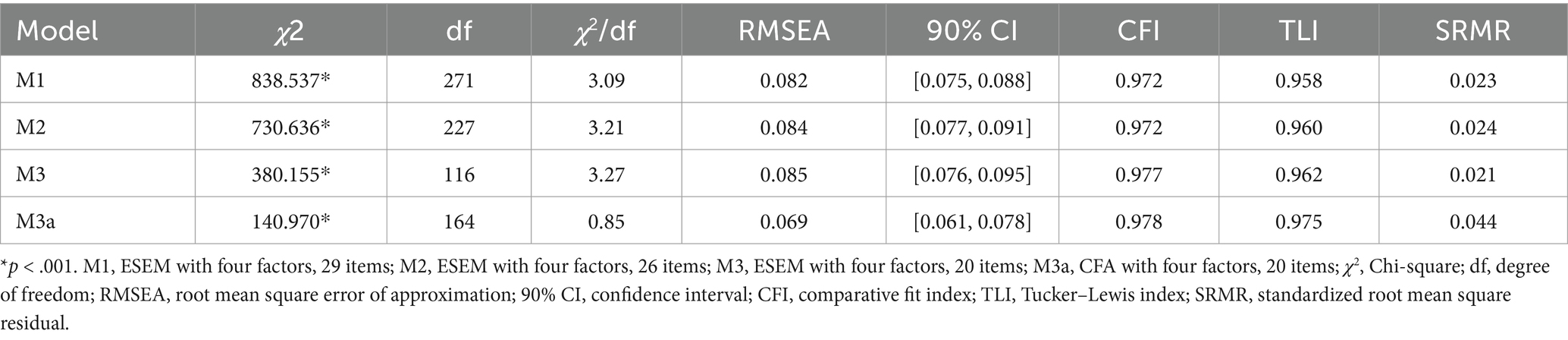
Table 1. Fit indexes for models ESEM and CFA of ECSS-20.
Consequently, after a qualitative analysis (i.e., item relevance and construct definition), the items above became part of the social activities factor. Likewise, the remaining items of the everyday activities factor (e.g., carrying out procedures typically) were discarded due to their redundancy, leaving 26 items.
Second, a 4-factor model with 26 items was estimated (Model 2; M2), which presented better internal structure adjustments in the CFI and TLI indicators (CFI = 0.972; TLI = 0.960), compared to M1. As previously mentioned, items with lower factor loadings referring to the factor (λ > 0.5) and that presented cross-loadings (λ ≤ 0.3) were iteratively eliminated to reduce the number of items in the scale. In total, 20 items were retained, estimated in Model 3 (M3).
The ESEM analysis of M3 presented better internal structure adjustments in the CFI and TLI indicators (CFI = 0.977; TLI = 0.962) than the previous models. This structure was confirmed by performing a CFA, which evidenced a satisfactory fit for the CFI, TLI, and RMSEA indicators (CFI = 0.978; TLI = 0.975; RMSEA = 0.069) (Hair et al., 2019). Finally, the ECSS-20 comprises four dimensions (i.e., ES, SA, H, and VME) and five items per dimension (i.e., 20 items in total).
Table 2 presents the factor loadings with their corresponding factorial covariances and reliability coefficients of the M3. Factorial loadings for this model proved adequate for each factor, and no relevant cross-loadings were observed. Also, structural relationships between dimensions were moderate (r > 0.30), mild (r > 0.10; Cohen, 1988), and null, and reliability estimates were adequate (ω > 0.89; α > 0.89; Cho and Kim, 2015).
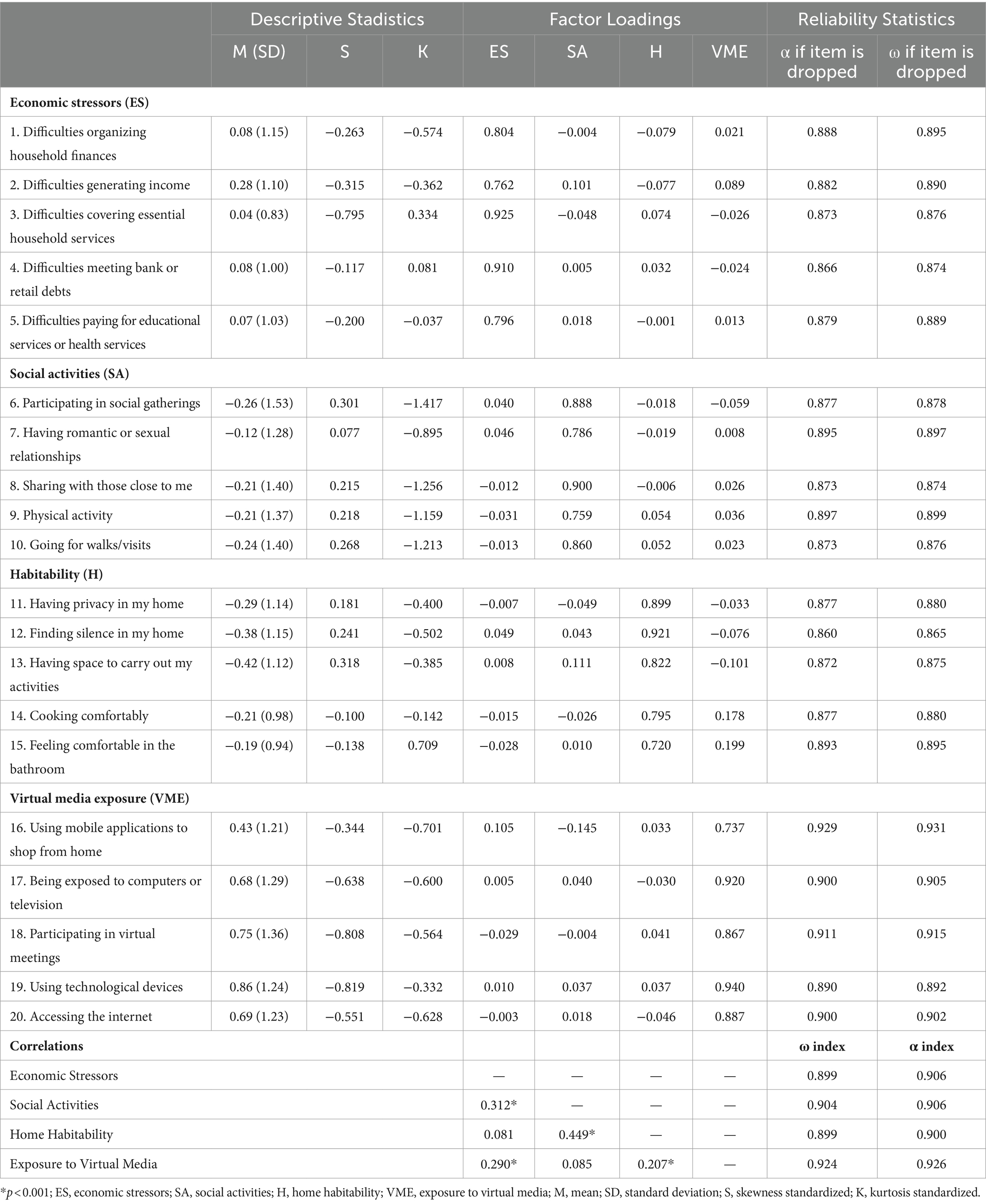
Table 2. Standardized factor loadings resulting from ESEM, factorial covariations and reliability coefficients (Cronbach’s alpha and McDonald’s omega) for each dimension of ECSS-20.
Third, a multigroup CFA model was estimated between M3 men and women; the results are presented in Table 3. This model was first tested for configural invariance, i.e., a baseline model was fitted for each group separately. Compared with the configural model, the metric model showed no relevant changes in the RMSEA differential or CFI, thus confirming that the factor loadings of the items are the same in both groups. Finally, the scalar model compared with the configural model also showed no relevant changes in the RMSEA differential or CFI, which means that the intercepts of the items are the same in both groups.

Table 3. Fit indexes for multiple-group CFA of ECSS-20.
Thus, strong measurement invariance is demonstrated by the existence of metric and scalar invariance, i.e., the equivalence between factor loadings and thresholds for those who identified themselves as female or male is sustained (Cheung and Rensvold, 2002; Chen, 2007; Dimitrov, 2010; Leitgöb et al., 2023).
Finally, the SET-ESEM model that estimated the association between the latent dimensions of the ECSS-20 and the PSS-14 one-dimensional showed comparative and absolute fit indices far from the recommendations [χ2(469) = 1780.710; CFI = 0.911; TLI = 0.893; RMSEA = 0.094; 90% CI = (0.090, 0.099); SRMR = 0.094]. The observed mismatches could be attributed to the factor loadings shown by the PSS-14 (see Figure 1). Finally, significant direct and inverse loadings are observed for the ES factor (λ = 0.323) and the H factor (λ = −0.301) concerning PSS-14. The details of the standardized relationships between the latent dimensions and the PSS-14 indicators are shown in the Figure 1.
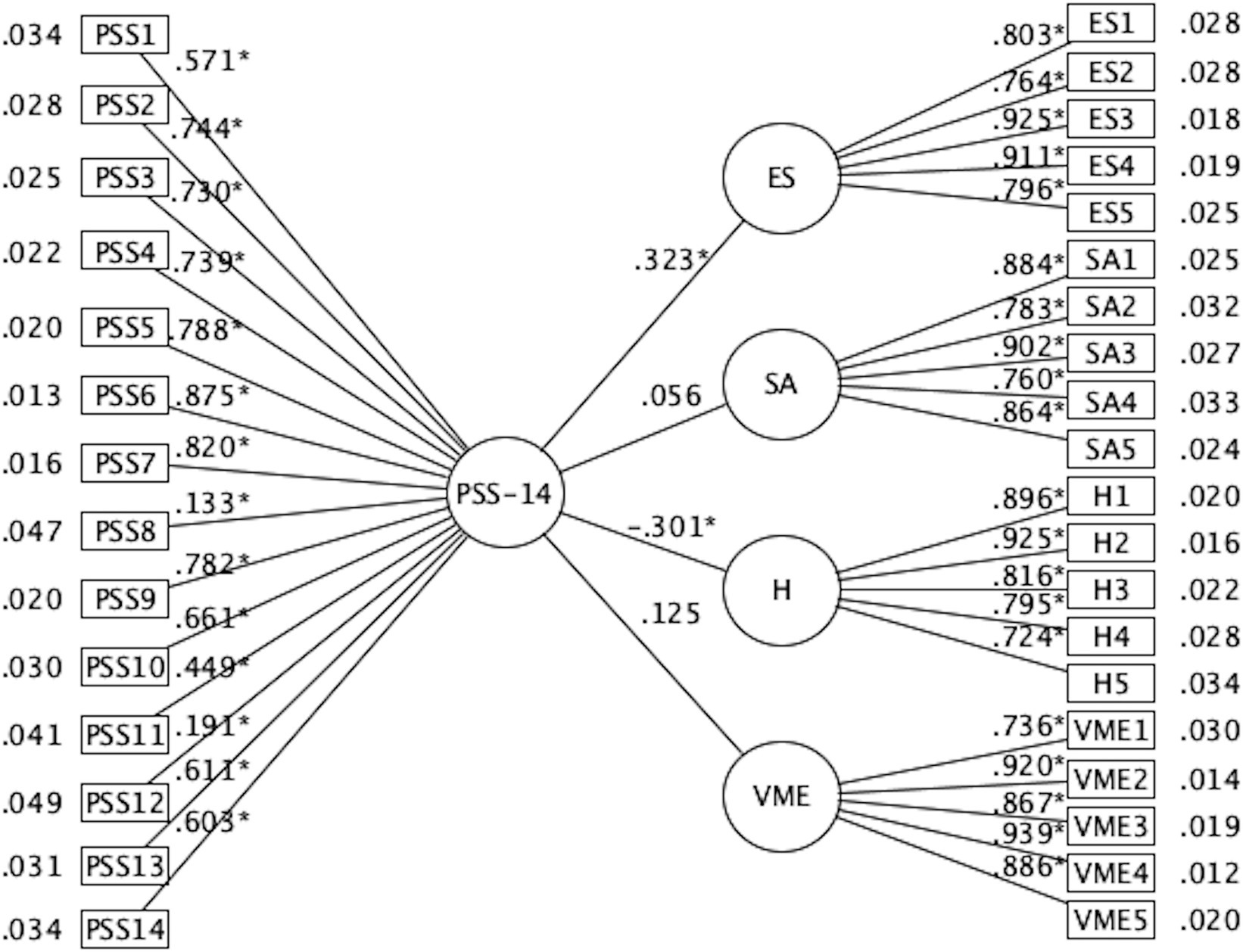
Figure 1. SET-ESEM ECSS-20 and PSS-14.
Discussion
The present study focused on developing and validating the Environmental Stressors in Confinement Scale (ECSS-20), which assesses the perception of change in environmental stressors produced by confinement circumstances. Theoretical and practical contributions, limitations, and future lines of research emerging from this study are discussed below.
In first place, the final structure of the ECSS-20, composed of four dimensions: economic stressors (ES), social activities (SA), habitability (H), and exposure to virtual media (VME), proved to be robust and consistent with previous literature evidencing the existence of environmental stressors stemming from confinement (Ellen et al., 2021; Kunzler et al., 2021; Sheek-Hussein et al., 2021). The reason for this is that the observed factor loadings indicate that each dimension uniquely impacts the perception of environmental stress in confinement situations. McDonald’s omega (ω > 0.89) and Cronbach’s alpha (α > 0.89; Cho and Kim, 2015), internal consistency values were also shown to be satisfactory, providing evidence of the reliability of the instrument. That is, the ECSS-20 can be applied to the Chilean adult population experiencing confinement measures.
Second, the application of gender invariance tests supported the equivalence of factor loadings between women and men, suggesting that the ECSS-20 can be used in both groups without distinction. Thus, this strengthens the instrument’s usefulness, as it demonstrates that it assesses the impact of environmental stressors accurately and comparatively, as has been evidenced in other studies analyzing gender invariance in confinement contexts (Prime et al., 2021).
Third, validity tests based on the association with other variables were established by demonstrating significant relationships between the ECSS-20 and PSS-14 dimensions. Specifically, direct significant relationships were observed between the economic stressors (ES) dimension and the perception of stress. Therefore, the greater the perception of variation in the estimated household budget, the greater the feeling of stress. Likewise, inverse relationships were observed between the dimension of habitability (H) and the perception of stress. In other words, the higher the perception of well-being with those who share a dwelling, the lower the feeling of stress. As a result, this supports previous research that suggests these factors impact the change in people’s mental health (Kunzler et al., 2021; Sheek-Hussein et al., 2021). Thus, this demonstrates that habitability and economic conditions could function as protective and risk factors in the perception of stress during confinement situations, such as during the COVID-19 pandemic. Therefore, it is proposed to consider these subscales to assess these factors in confinement circumstances.
In contrast, one of the limitations of this study is the mismatch in the RMSEA values of M1, M2, and M3 in the ESEM analyses, suggesting that the model structure and accuracy of fit could be improved. This discrepancy could be explained by factors such as the complexity of the interrelationships between dimensions or the presence of variables not considered in the model (Shi et al., 2020). In addition, the sample size and the absence of validity tests on a sample other than those collected in this study should be considered as a limitation of this study. Finally, a limitation of this research is that the survey was conducted during the medium health impact phase mandated by the Chilean government, characterized by the reduction of social interactions through measures such as social distancing or confinement, including a distance of one meter between two people and the use of a permit demonstrating current vaccination status for transit in the city (Ministerio de Salud, 2022).
This context of dynamic and sometimes irregular confinements, as evidenced in studies such as Patrono et al. (2024), demonstrates the heterogeneity of the confinement experience in the country, with differentiated impacts on the mental and physical health of the population (Duarte and Jiménez-Molina, 2022; Gutiérrez-Pérez et al., 2024). The research by Dagnino et al. (2020) underscores the significant psychological impact and the high demand for psychological support in Santiago, reflecting a critical need that could influence the structure of the ECSS-20 under different confinement intensities. Governmental policies, criticized for their improvised and unequal approach, particularly in terms of gender equity (Undurraga and López-Hornickel, 2023), and the special vulnerability of minority communities (Anandarajah et al., 2024), require careful consideration in interpreting the ECSS-20 data. Recently, Rodman et al. (2024), offered a longitudinal perspective on the deterioration of youth psychopathology due to reduced socialization, a factor that must be considered when assessing the validity of the ECSS-20 in future research. Additionally, studies on the impact of the social environment, such as that by Choi et al. (2024), highlight how specific neighborhood characteristics, such as socioeconomic deprivation and disorder, can increase the risk of dementia, mediated in part by subjective loneliness. This link underscores the importance of considering how urban environments and socialization dynamics influence mental health at all life stages (Ibanez et al., 2024; Migeot et al., 2024). The ECSS-20 ability to capture variations in the perception of environmental stress could be crucial not only for a better understanding of mental health disorders in youth but also for exploring longitudinal connections with cognitive risks in later life stages, influenced by social isolation and neighborhood conditions.
Finally, future lines of research could apply the ECSS-20 in contexts where stress is generated by confinement and/or population displacement, such as those generated by natural disasters (i.e., tsunamis, fires, landslides, extreme heat, hurricanes and tornadoes) (Sandoval-Díaz and Martínez-Labrín, 2021; Birkmann et al., 2022) or by sociopolitical situations of the countries of residence (i.e., political asylum, immigration) (Kwok and Ku, 2008; Kim et al., 2021). These events, marked by critical sociopolitical dynamics and needs for rapid adaptation, present a fertile ground to assess variations in subjective well-being, coping, and fields of spatial justice and habitability (Astudillo Pizarro and Sandoval Díaz, 2019; Sandoval-Díaz et al., 2021, 2022, 2024). Moreover, employability circumstances such as job loss or absence, or significant changes in work conditions, as well as the loss of daily social activities and hospitalizations, are critical areas where the ECSS-20 could reveal significant impacts on mental and physical health (Bahamondes-Rosado et al., 2023; Pérez-Villalobos et al., 2023). It is also advisable to explore how the ECSS-20 functions across different cultures and countries, as stress and its perception can vary considerably among different environments and populations (Tasnim et al., 2024; Tonon et al., 2024). The COVID-19 pandemic, as a natural experiment, has provided a unique context to better understand these phenomena (Gormley, 2024; Ruggeri et al., 2024). Therefore, adapting and validating the ECSS-20 in diverse cultural and environmental stress contexts could enrich our understanding of the interactions between the environment, stress, and mental health, thereby broadening the practical applications of the scale in designing targeted interventions and effective public health policies.
Conclusion
The instrument’s multidimensional structure, internal consistency, gender invariance, and evidence associated with related measures support its validity and usefulness. The ECSS-20 is a valuable tool for investigating and further understanding the effects of confinement on the population’s mental health. Future research could explore its applicability in different contexts and populations to strengthen understanding of its psychometric properties and utility in assessing confinement situations.
Data availability statement
The raw data supporting the conclusions of this article will be made available by the authors, without undue reservation.
Ethics statement
The studies involving humans were approved by Comité ético científico Universidad de Tarapacá. The studies were conducted in accordance with the local legislation and institutional requirements. The participants provided their written informed consent to participate in this study.
Author contributions
JS-P: Writing – review & editing, Writing – original draft, Validation, Project administration, Methodology, Investigation, Formal analysis, Data curation, Conceptualization. RF-U: Writing – original draft, Validation, Supervision, Software, Resources, Methodology, Funding acquisition, Formal analysis, Data curation, Conceptualization. GS-P: Writing – original draft, Validation, Supervision, Project administration, Methodology, Formal analysis, Data curation, Conceptualization. JF: Writing – original draft, Investigation. KA-C: Writing – review & editing, Writing – original draft, Visualization, Validation, Project administration, Methodology, Investigation, Formal analysis, Data curation, Conceptualization.
Funding
The author(s) declare that no financial support was received for the research, authorship, and/or publication of this article.
Conflict of interest
The authors declare that the research was conducted in the absence of any commercial or financial relationships that could be construed as a potential conflict of interest.
Publisher’s note
All claims expressed in this article are solely those of the authors and do not necessarily represent those of their affiliated organizations, or those of the publisher, the editors and the reviewers. Any product that may be evaluated in this article, or claim that may be made by its manufacturer, is not guaranteed or endorsed by the publisher.
References
Akbari, P., Yazdanfar, S. A., Hosseini, S. B., and Norouzian-Maleki, S. (2021). Housing and mental health during outbreak of COVID-19. J. Build. Eng. 43:102919. doi: 10.1016/j.jobe.2021.102919
American Educational Research Association. (2014). Standards for educational & psychological testing. Available at: https://www.aera.net/Publications/Books/Standards-for-Educational-Psychological-Testing-2014-Edition
Amerio, A., Lugo, A., Stival, C., Fanucchi, T., Gorini, G., Pacifici, R., et al. (2021). COVID-19 lockdown impact on mental health in a large representative sample of Italian adults. J. Affect. Disord. 292, 398–404. doi: 10.1016/j.jad.2021.05.117
Ammar, A., Trabelsi, K., Brach, M., Chtourou, H., Boukhris, O., Masmoudi, L., et al. (2020). Effects of home confinement on mental health and lifestyle behaviours during the COVID-19 outbreak: insight from the ECLB-COVID19 multicenter study. Biol. Sport 38, 9–21. doi: 10.5114/biolsport.2020.96857
Anandarajah, A. P., Yi, L., Anandarajah, A. A., Shelton, N., Feng, C., and Williams, E. M. (2024). Impact of COVID-19 pandemic on social isolation and loneliness among minority populations. Am. J. Med. Sci. 367, 21–27. doi: 10.1016/j.amjms.2023.09.020
Asparouhov, T., and Muthén, B. (2009). Exploratory structural equation modeling. Struct. Equ. Model. Multidiscip. J. 16, 397–438. doi: 10.1080/10705510903008204
Astudillo Pizarro, F., and Sandoval Díaz, J. (2019). Justicia espacial, desastres socionaturales y políticas del espacio: dinámicas sociopolíticas frente a los aluviones y proceso de recuperación en Copiapó, Chile. Cuadernos de Geografía: Revista Colombiana de Geografía 28, 303–321. doi: 10.15446/rcdg.v28n2.73520
Ato, M., López, J. J., and Benavente, A. (2013). Un sistema de clasificación de Ios diseños de investigación en psicología. An. Psicol. 29, 1038–1059. doi: 10.6018/analesps.29.3.178511
Badenes-Plá, N. (2022). “Changes in behaviour induced by COVID-19: Obedience to the introduced measures” in Pandemics: insurance and social protection. Springer actuarial (Cham: Springer), 143–161.
Bahamondes-Rosado, M. E., Cerdá-Suárez, L. M., Ortiz, D., de Zevallos, G. F., and Espinosa-Cristia, J. F. (2023). Technostress at work during the COVID-19 lockdown phase (2020–2021): a systematic review of the literature. Front. Psychol. 14:1173425. doi: 10.3389/fpsyg.2023.1173425
Bavel, J. J. V., Baicker, K., Boggio, P. S., Capraro, V., Cichocka, A., Cikara, M., et al. (2020). Using social and behavioural science to support COVID-19 pandemic response. Nat. Hum. Behav. 4, 460–471. doi: 10.1038/s41562-020-0884-z
Bazzoli, A., Probst, T. M., and Lee, H. J. (2021). Economic stressors, COVID-19 attitudes, worry, and behaviors among U.S. working adults: a mixture analysis. Int. J. Environ. Res. Public Health 18:2338. doi: 10.3390/IJERPH18052338
Birkmann, J., Liwenga, E., Pandey, R., Boyd, E., Djalante, R., Gemenne, F., et al. (2022). “Poverty, livelihoods and sustainable development” in Impacts, Adaptation and Vulnerability: Working Group II Contribution to the Sixth Assessment Report of the Intergovernmental Panel on Climate Change (Cambridge, UK: Cambridge University Press), 1171–1274.
Brown, T. (2015). Confirmatory factor analysis for applied research : Guilford Publications Available at: https://books.google.cl/books?hl=es&lr=&id=tTL2BQAAQBAJ&oi=fnd&pg=PP1&dq=brown+2015+confirmatory+factor+analysis&ots=amOtuKWQaE&sig=oz--wLFHuCYpgQo73jpo-wtzIXE.
Bzdok, D., and Dunbar, R. I. (2022). Social isolation and the brain in the pandemic era. Nature human behaviour 6, 1333–1343. doi: 10.1038/s41562-022-01453-0
Cacioppo, J. T., and Cacioppo, S. (2014). Social relationships and health: the toxic effects of perceived social isolation. Soc. Personal. Psychol. Compass 8, 58–72. doi: 10.1111/spc3.12087
Cacioppo, J. T., Cacioppo, S., Capitanio, J. P., and Cole, S. W. (2015). The neuroendocrinology of social isolation. Annu. Rev. Psychol. 66, 733–767. doi: 10.1146/Annurev-Psych-010814-015240
Cacioppo, J. T., and Hawkley, L. C. (2009). Perceived social isolation and cognition. Trends Cogn. Sci. 13, 447–454. doi: 10.1016/j.tics.2009.06.005
Caqueo-Urízar, A., Urzúa, A., Aragón-Caqueo, D., Charles, C. H., El-Khatib, Z., Otu, A., et al. (2020). Mental health and the COVID-19 pandemic in Chile. Psychol. Trauma Theory Res. Pract. Policy 12, 521–523. doi: 10.1037/tra0000753
Chen, F. F. (2007). Sensitivity of goodness of fit indexes to lack of measurement invariance. Struct. Equ. Model. Multidiscip. J. 14, 464–504. doi: 10.1080/10705510701301834
Cheung, G. W., and Rensvold, R. B. (2002). Evaluating goodness-of-fit indexes for testing measurement invariance. Struct. Equ. Model. 9, 233–255. doi: 10.1207/S15328007SEM0902_5
Cho, E., and Kim, S. (2015). Cronbach’s coefficient alpha: well known but poorly understood. Organ. Res. Methods 18, 207–230. doi: 10.1177/1094428114555994
Choi, E. Y., Cho, G., and Chang, V. W. (2024). Neighborhood social environment and dementia: the mediating role of social isolation. J. Gerontol. B 79:gbad199. doi: 10.1093/GERONB/GBAD199
Choi, Y. R., Kim, E. J., and Kim, M. K. (2020). A planning guide for temporary disaster shelters focusing on habitability. Indoor Built Environ. 29, 1412–1424. doi: 10.1177/1420326X19886051
Clair, R., Gordon, M., Kroon, M., and Reilly, C. (2021). The effects of social isolation on well-being and life satisfaction during pandemic. Humanit. Soc. Sci. Commun. 8:28. doi: 10.1057/s41599-021-00710-3
Cohen, J. (1988). Set correlation and contingency tables. Appl. Psychol. Meas. 12, 425–434. doi: 10.1177/014662168801200410
Cohen, S., Janicki-Deverts, D., and Miller, G. E. (2007). Psychological stress and disease. JAMA 298, 1685–1687. doi: 10.1001/JAMA.298.14.1685
Cohen, S., Kamarck, T., and Mermelstein, R. (1983). A global measure of perceived stress. J. Health Soc. Behav. 24, 385–396. doi: 10.2307/2136404
Cohen, S., Murphy, M. L. M., and Prather, A. A. (2019). Ten surprising facts about stressful life events and disease risk. Annu. Rev. Psychol. 70, 577–597. doi: 10.1146/annurev-psych-010418-102857
Corral-Verdugo, V., Barrón, M., Cuen, A., and Tapia-Fonllem, C. (2011). Habitabilidad de la vivienda, estrés y violencia familiar. PsyEcology 2, 53–64. doi: 10.1174/217119711794394608
Costello, A. B., and Osborne, J. (2019). Best practices in exploratory factor analysis: four recommendations for getting the most from your analysis. Pract. Assess. Res. Eval. 10:7. doi: 10.7275/jyj1-4868
Cuadra-Martínez, D., Castro-Carrasco, P. J., Sandoval-Díaz, J., Pérez-Zapata, D., and Mora Dabancens, D. (2020). COVID-19 y comportamiento psicológico: revisión sistemática de los efectos psicológicos de las pandemias del siglo XXI. Revista médica de Chile, 148, 1139–1154. doi: 10.4067/S0034-98872020000801139
Dagnino, P., Anguita, V., Escobar, K., and Cifuentes, S. (2020). Psychological effects of social isolation due to quarantine in Chile: an exploratory study. Front. Psychiatry 11:591142. doi: 10.3389/fpsyt.2020.591142
Delhey, J., Hess, S., Boehnke, K., Deutsch, F., Eichhorn, J., Kühnen, U., et al. (2023). Life satisfaction during the COVID-19 pandemic: the role of human, economic, social, and psychological capital. J. Happiness Stud. 24, 2201–2222. doi: 10.1007/s10902-023-00676-w
Dimitrov, D. M. (2010). Testing for factorial invariance in the context of construct validation. Meas. Eval. Couns. Dev. 43, 121–149. doi: 10.1177/0748175610373459
Duarte, F., and Jiménez-Molina, Á. (2022). A longitudinal nationwide study of psychological distress during the COVID-19 pandemic in Chile. Front. Psychiatry 13:744204. doi: 10.3389/fpsyt.2022.744204
Dubey, A. D. (2020). The resurgence of cyber racism during the COVID-19 pandemic and its aftereffects: analysis of sentiments and emotions in tweets. JMIR Public Health Surveill. 6:e19833. doi: 10.2196/19833
Ellen, C., Patricia, D. V., Miet, D. L., Peter, V., Patrick, C., Robby, D. P., et al. (2021). Meaningful activities during COVID-19 lockdown and association with mental health in Belgian adults. BMC Public Health 21:622. doi: 10.1186/s12889-021-10673-4
Eyre, H. A., Stirland, L. E., Jeste, D. V., Reynolds, C. F., Berk, M., Ibanez, A., et al. (2023). Life-course brain health as a determinant of late-life mental health: American Association for Geriatric Psychiatry Expert Panel recommendations. Am. J. Geriatr. Psychiatry 31, 1017–1031. doi: 10.1016/j.jagp.2023.09.013
Friedline, T., Chen, Z., and Morrow, S. P. (2021). Families’ financial stress & well-being: the importance of the economy and economic environments. J. Fam. Econ. Iss. 42, 34–51. doi: 10.1007/s10834-020-09694-9
Gatersleben, B., and Griffin, I. (2017). “Environmental stress” in Handbook of environmental psychology and quality of life research. International handbooks of quality-of-life (Cham: Springer), 469–485.
Gilbar, O., Gelkopf, M., and Greene, T. (2022). Perceived stress during COVID-19: community resilience three years before the pandemic as a protective factor. Int. J. Disaster Risk Reduct. 82:103337. doi: 10.1016/j.ijdrr.2022.103337
Gloster, A. T., Lamnisos, D., Lubenko, J., Presti, G., Squatrito, V., Constantinou, M., et al. (2020). Impact of COVID-19 pandemic on mental health: an international study. PLoS One 15:e0244809. doi: 10.1371/journal.pone.0244809
Gormley, S. (2024). “Social interaction, social status, and mental health and how they were impacted by the COVID-19 pandemic as a natural experiment of social isolation” in Doctoral dissertation. Cambridge, UK.
Gruber, J., Prinstein, M. J., Clark, L. A., Rottenberg, J., Abramowitz, J. S., Albano, A. M., et al. (2021). Mental health and clinical psychological science in the time of COVID-19: challenges, opportunities, and a call to action. Am. Psychol. 76, 409–426. doi: 10.1037/amp0000707
Gudi-Mindermann, H., White, M., Roczen, J., Riedel, N., Dreger, S., and Bolte, G. (2023). Integrating the social environment with an equity perspective into the exposome paradigm: a new conceptual framework of the social exposome. Environ. Res. 233:116485. doi: 10.1016/j.envres.2023.116485
Gutiérrez-Pérez, I. A., Delgado-Floody, P., Molina-Gutiérrez, N., Campos-Jara, C., Parra-Rojas, I., Contreras-Osorio, F. H., et al. (2024). Changes in lifestyle and physical and mental health related to long-confinement due COVID-19: a study during the first and second pandemic waves in Mexico and Chile. Psychol. Health Med. 29, 174–190. doi: 10.1080/13548506.2023.2281295
González-Tovar, M., and Hernández-Rodríguez, S. (2020). Covid-19 y afrontamiento flexible en chilenos: Papel del estrés percibido y la ansiedad. Cuadernos de Neuropsicología. 14, 10–19. doi: 10.7714/CNPS/14.3.201
Hair, J., Black, W., Babin, B., and Anderson, R. (2019). Multivariate data analysis. 8th Edn. Hampshire, UK: Cengage Learning, Anover, Cengage India.
Hussong, A. M., Midgette, A. J., Thomas, T. E., Coffman, J. L., and Cho, S. (2021). Coping and mental health in early adolescence during COVID-19. Res. Child Adolesc. Psychopathol. 49, 1113–1123. doi: 10.1007/s10802-021-00821-0
Ibanez, A., and Eyre, H. (2023). Brain capital, ecological development and sustainable environments. BMJ Ment. Health 26, 1–3. doi: 10.1136/bmjment-2023-300803
Ibanez, A., Melloni, L., Świeboda, P., Hynes, W., Ikiz, B., Ayadi, R., et al. (2024). Neuroecological links of the exposome and one health. Neuron 112, 1905–1910. doi: 10.1016/j.neuron.2024.04.016
Jakovljevic, M., Bjedov, S., Jaksic, N., and Jakovljevic, I. (2020). COVID-19 PANDEMIA and public and global mental health from the perspective of global health security. Psychiatr. Danub. 32, 6–14. doi: 10.24869/psyd.2020.6
Jamovi (2021). 2.2.5; The Jamovi Project. [Computer Software]. https://www.jamovi.org/
Kim, M., Kim, K., and Kim, E. (2021). Problems and implications of shelter planning focusing on habitability: a case study of a temporary disaster shelter after the Pohang earthquake in South Korea. Int. J. Environ. Res. Public Health 18:2868. doi: 10.3390/ijerph18062868
Kokkinos, C. M., Tsouloupas, C. N., and Voulgaridou, I. (2022). The effects of perceived psychological, educational, and financial impact of COVID-19 pandemic on Greek university students’ satisfaction with life through mental health. J. Affect. Disord. 300, 289–295. doi: 10.1016/j.jad.2021.12.114
Kujawa, A., Green, H., Compas, B. E., Dickey, L., and Pegg, S. (2020). Exposure to COVID-19 pandemic stress: associations with depression and anxiety in emerging adults in the United States. Depress. Anxiety 37, 1280–1288. doi: 10.1002/da.23109
Kumar, S., and Shah, A. (2021). Revisiting food delivery apps during COVID-19 pandemic? Investigating the role of emotions. J. Retail. Consum. Serv. 62:102595. doi: 10.1016/j.jretconser.2021.102595
Kunzler, A. M., Röthke, N., Günthner, L., Stoffers-Winterling, J., Tüscher, O., Coenen, M., et al. (2021). Mental burden and its risk and protective factors during the early phase of the SARS-CoV-2 pandemic: systematic review and meta-analyses. Glob. Health 17:34. doi: 10.1186/s12992-021-00670-y
Kwok, J. Y., and Ku, H.-B. (2008). Making habitable space together with female Chinese immigrants to Hong Kong: an interdisciplinary participatory action research project. Action Res. 6, 261–283. doi: 10.1177/1476750308094131
Lal, A., Erondu, N. A., Heymann, D. L., Gitahi, G., and Yates, R. (2021). Fragmented health systems in COVID-19: rectifying the misalignment between global health security and universal health coverage. Lancet 397, 61–67. doi: 10.1016/S0140-6736(20)32228-5
Lazarus, R. S., and Cohen, J. B. (1977). “Environmental stress” in Behavior and environment (Boston, MA: Springer), 89–127.
Leitgöb, H., Seddig, D., Asparouhov, T., Behr, D., Davidov, E., De Roover, K., et al. (2023). Measurement invariance in the social sciences: historical development, methodological challenges, state of the art, and future perspectives. Soc. Sci. Res. 110:102805. doi: 10.1016/j.ssresearch.2022.102805
Liu, X., Zhu, M., Zhang, R., Zhang, J., Zhang, C., Liu, P., et al. (2021). Public mental health problems during COVID-19 pandemic: a large-scale meta-analysis of the evidence. Transl. Psychiatry 11:384. doi: 10.1038/s41398-021-01501-9
Low, N., and Mounts, N. S. (2022). Economic stress, parenting, and adolescents’ adjustment during the COVID-19 pandemic. Fam. Relat. 71, 90–107. doi: 10.1111/fare.12623
Maier, B. F., and Brockmann, D. (2020). Effective containment explains subexponential growth in recent confirmed COVID-19 cases in China. Science 368, 742–746. doi: 10.1126/science.abb4557
Manchia, M., Gathier, A. W., Yapici-Eser, H., Schmidt, M. V., de Quervain, D., van Amelsvoort, T., et al. (2022). The impact of the prolonged COVID-19 pandemic on stress resilience and mental health: a critical review across waves. Eur. Neuropsychopharmacol. 55, 22–83. doi: 10.1016/j.euroneuro.2021.10.864
Marroquín, B., Vine, V., and Morgan, R. (2020). Mental health during the COVID-19 pandemic: effects of stay-at-home policies, social distancing behavior, and social resources. Psychiatry Res. 293:113419. doi: 10.1016/j.psychres.2020.113419
Marsh, H. W., Guo, J., Dicke, T., Parker, P. D., and Craven, R. G. (2020). Confirmatory factor analysis (CFA), exploratory structural equation modeling (ESEM), and set-ESEM: optimal balance between goodness of fit and parsimony. Multivar. Behav. Res. 55, 102–119. doi: 10.1080/00273171.2019.1602503
Mayr, V., Nuβbaumer-Streit, B., and Gartlehner, G. (2020). Quarantine alone or in combination with other public health measures to control COVID-19: a rapid review (review). Gesundheitswesen 82, 501–506. doi: 10.1055/a-1164-6611
McLaughlin, K. A., Rosen, M. L., Kasparek, S. W., and Rodman, A. M. (2022). Stress-related psychopathology during the COVID-19 pandemic. Behav. Res. Ther. 154:104121. doi: 10.1016/j.brat.2022.104121
McMichael, A. J. (2011). Epidemiology and the people’s health: theory and context. Int. J. Epidemiol. 40, 1130–1132. doi: 10.1093/IJE/DYR075
McNeish, D. (2018). Thanks coefficient alpha, we’ll take it from here. Psychol. Methods 23, 412–433. doi: 10.1037/met0000144
Migeot, J., Panesso, C., Duran-Aniotz, C., Avíla-Rincón, C., Ochoa, C., Huepe, D., et al. (2024). Allostasis, health, and development in Latin America. Neurosci. Biobehav. Rev. 162:105697. doi: 10.1016/j.neubiorev.2024.105697
Ministerio de Salud. (2022). Plan Seguimos Cuidándonos—Ministerio de Salud—Gobierno de Chile. Available at: https://www.minsal.cl/plan-seguimos-cuidandonos-paso-a-paso/
Montero, I., and León, O. G. (2007). A guide for naming research studies in psychology. Int. J. Clin. Health Psychol. 7, 847–862. Available at: https://www.redalyc.org/articulo.oa?id=33770318
Morgado, A. M., Cruz, J., and Peixoto, M. M. (2023). Individual and community psychological experiences of the COVID-19 pandemic: the state of emergency in Portugal. Curr. Psychol. 42, 3213–3223. doi: 10.1007/s12144-021-01676-w
Morin, A. J. S., Katrin Arens, A., and Marsh, H. W. (2016). A bifactor exploratory structural equation modeling framework for the identification of distinct sources of construct-relevant psychometric multidimensionality. Struct. Equ. Model. Multidiscip. J. 23, 116–139. doi: 10.1080/10705511.2014.961800
Mukhtar, S. (2020). Psychological health during the coronavirus disease 2019 pandemic outbreak. Int. J. Soc. Psychiatry 66, 512–516. doi: 10.1177/0020764020925835
Muñiz, J., and Fonseca-Pedrero, E. (2019). Vista de Diez pasos para la construcción de un test. Psichotema 31, 7–16. doi: 10.7334/psicothema2018.291
Muthén, B., and Asparouhov, T. (2011). “Beyond multilevel regression modeling: multilevel analysis in a general latent variable framework” in Handbook of advanced multilevel analysis, 15–40. Available at: https://books.google.cl/books?hl=es&lr=&id=JlhySkysflUC&oi=fnd&pg=PA15&ots=vUDfQ1faA6&sig=AnJgXI5aLUllLCLv3VvQiNUocrk
Muthén, B., and Asparouhov, T. (2012). Bayesian structural equation modeling: a more flexible representation of substantive theory. Psychol. Methods 17, 313–335. doi: 10.1037/a0026802
Muthén, L., Muthén, B., Asparouhov, T., and Nguyen, T.. (2017). Muthen: Mplus program (version 8.0) [computer software] (8.0). https://www.statmodel.com/
Nanath, K., Balasubramanian, S., Shukla, V., Islam, N., and Kaitheri, S. (2022). Developing a mental health index using a machine learning approach: assessing the impact of mobility and lockdown during the COVID-19 pandemic. Technol. Forecast. Soc. Chang. 178:121560. doi: 10.1016/j.techfore.2022.121560
Neville, F. G., Templeton, A., Smith, J. R., and Louis, W. R. (2021). Social norms, social identities and the COVID-19 pandemic: theory and recommendations. Soc. Personal. Psychol. Compass 15:e12596. doi: 10.1111/spc3.12596
Nielsen, L., Hinrichsen, C., Madsen, K. R., Nelausen, M. K., Meilstrup, C., Koyanagi, A., et al. (2021). Participation in social leisure activities may benefit mental health particularly among individuals that lack social connectedness at work or school. Ment. Health Soc. Incl. 25, 341–351. doi: 10.1108/MHSI-06-2021-0026
Ornell, F., Schuch, J. B., Sordi, A. O., and Kessler, F. H. P. (2020). “Pandemic fear” and COVID-19: mental health burden and strategies. Braz. J. Psychiatry 42, 232–235. doi: 10.1590/1516-4446-2020-0008
Otzen, T., and Manterola, C. (2017). Técnicas de Muestreo sobre una Población a Estudio. Int. J. Morphol. 35, 227–232. doi: 10.4067/S0717-95022017000100037
Patrono, A., Renzetti, S., Guerini, C., Macgowan, M., Moncada, S. M., Placidi, D., et al. (2024). Social isolation consequences: lessons from COVID-19 pandemic in a context of dynamic lock-down in Chile. BMC Public Health 24:599. doi: 10.1186/s12889-024-18064-1
Pérez-Villalobos, C., Ventura-Ventura, J., Spormann-Romeri, C., Paredes-Villarroel, X., Rojas-Pino, M., Jara-Reyes, C., et al. (2023). Well-being variations on students of health sciences related to their learning opportunities, resources, and daily activities in an online and on-crisis context: a survey-based study. BMC Med. Educ. 23:37. doi: 10.1186/s12909-023-04011-y
Pettini, G., and Mazzocco, K. (2022). What a pandemic can say about human-environment relationship. Syst. Res. Behav. Sci. 39, 159–162. doi: 10.1002/sres.2803
Prieto, G., and Delgado, A. R. (2010). Fiabilidad y validez. Pap. Psicol. 31, 67–74. Available at: https://www.researchgate.net/publication/41734046_Fiabilidad_y_Validez
Prime, H., Wade, M., May, S. S., Jenkins, J. M., and Browne, D. T. (2021). The COVID-19 family stressor scale: validation and measurement invariance in female and male caregivers. Front. Psychiatry 12:669106. doi: 10.3389/fpsyt.2021.669106
Quintana, G. (2022). The impact of the SARS-CoV-2 pandemic on reproduction, sexual function and behaviors: a review of the Main trends and findings. Int. J. Sex. Health 34, 351–365. doi: 10.1080/19317611.2022.2053921
Rieger, M. O., and Wang, M. (2020). Secret Erosion of the “lockdown”? Patterns in daily activities during the SARS-CoV-2 pandemics around the world. Rev. Behav. Econ. 7, 223–235. doi: 10.1561/105.00000124
Rivest-Beauregard, M., Fortin, J., Guo, C., Cipolletta, S., Sapkota, R. P., Lonergan, M., et al. (2022). Media use during the COVID-19 pandemic: cross-sectional study. J. Med. Internet Res. 24:e33011. doi: 10.2196/33011
Rodman, A. M., Rosen, M. L., Kasparek, S. W., Mayes, M., Lengua, L., Meltzoff, A. N., et al. (2024). Social experiences and youth psychopathology during the COVID-19 pandemic: a longitudinal study. Dev. Psychopathol. 36, 366–378. doi: 10.1017/S0954579422001250
Ruggeri, K., Stock, F., Haslam, S. A., Capraro, V., Boggio, P., Ellemers, N., et al. (2024). A synthesis of evidence for policy from behavioural science during COVID-19. Nature 625, 134–147. doi: 10.1038/s41586-023-06840-9
Salazar, A., Palomo-Osuna, J., de Sola, H., Moral-Munoz, J. A., Dueñas, M., and Failde, I. (2021). Psychological impact of the lockdown due to the COVID-19 pandemic in university workers: factors related to stress, anxiety, and depression. Int. J. Environ. Res. Public Health 18:4367. doi: 10.3390/ijerph18084367
Sandoval-Díaz, J., Cuadra Martínez, D., Pérez-Zapata, D., Sandoval-Díaz, J., Cuadra Martínez, D., and Pérez-Zapata, D. (2022). Del Afrontamiento Colectivo al Crecimiento Postraumático Comunitario: Análisis Mediacional del Empoderamiento ante un Desastre Climatológico. Psykhe 31, 1–15. doi: 10.7764/psykhe.2019.22345
Sandoval-Díaz, J., Díaz-Vargas, N., Flores-Jiménez, D., López-Salazar, C., and Bravo-Ferretti, C. (2024). Cambio climático y olas de calor sobre el bienestar subjetivo en jóvenes. Rev. Latinoam. Cienc. Soc. Ninez Juv. 22, 1–30. doi: 10.11600/rlcsnj.22.1.5926
Sandoval-Díaz, J., and Martínez-Labrín, S. (2021). Gestión comunitaria del riesgo de desastre: Una propuesta metodológica-reflexiva desde las metodologías participativas. Rev. Estud. Latinoam. sobre Reducc. Riesgo Desastres 5, 75–90. doi: 10.55467/reder.v5i2.73
Sandoval-Díaz, J., Ruiz-Rivera, N., Cuadra-Martínez, D., Sandoval-Díaz, J., Ruiz-Rivera, N., and Cuadra-Martínez, D. (2021). Experiencia y afrontamiento ante el riesgo aluvional: Un modelo mediacional múltiple. Acta Colomb. Psicol. 24, 130–143. doi: 10.14718/ACP.2021.24.2.12
Segerstrom, S. C., and O’Connor, D. B. (2012). Stress, health and illness: four challenges for the future. Psychol. Health 27, 128–140. doi: 10.1080/08870446.2012.659516
Sheek-Hussein, M., Abu-Zidan, F. M., and Stip, E. (2021). Disaster management of the psychological impact of the COVID-19 pandemic. Int. J. Emerg. Med. 14:19. doi: 10.1186/s12245-021-00342-z
Shi, D., Maydeu-Olivares, A., and Rosseel, Y. (2020). Assessing fit in ordinal factor analysis models: SRMR vs. RMSEA. Struct. Equ. Model. Multidiscip. J. 27, 1–15. doi: 10.1080/10705511.2019.1611434
Szkody, E., Stearns, M., Stanhope, L., and McKinney, C. (2021). Stress-buffering role of social support during COVID-19. Fam. Process 60, 1002–1015. doi: 10.1111/famp.12618
Takian, A., Haghighi, H., and Raoofi, A. (2021). “Challenges, opportunities, and future perspectives” in Environmental and Health Management of Novel Coronavirus Disease (COVID-19), Londres, UK: Academic Press. 443–477.
Tapia, D., Cruz, C., Gallardo, I., and Dasso, M. (2007). Adaptación de la Escala de Percepción Global de Estrés (EPGE) en estudiantes adultos de escasos recursos en Santiago, Chile. Psiquiatr. Salud Ment. 24, 109–119. Available at: https://schilesaludmental.cl/web/wp-content/uploads/2022/11/07-1y2-09.-Adaptacion-escala-percepcion-global-estres-estudiantes-adultos.pdf
Tasnim, A., Rahman, F. N., Rakhshanda, S., and Karim, A. (2024). Ageing and mental health in the context of social isolation in COVID-19 pandemic. Mymensingh Med. J., 33, 626–635. Available at: https://europepmc.org/article/med/
Tonon, A. C., de Abreu, A. C. O. V., da Silva, M. M., De S, T. P., Nishino, F., Versignassi, P., et al. (2024). Human social isolation and stress: a systematic review of different contexts and recommendations for future studies. Trends Psychiatry Psychother. 46:e20210452. doi: 10.47626/2237-6089-2021-0452
Tracy, E. L., Chin, B., Lehrer, H. M., Carroll, L. W., Buysse, D. J., and Hall, M. H. (2022). Coping strategies moderate the effect of perceived stress on sleep and health in older adults during the COVID-19 pandemic. Stress. Health 38, 708–721. doi: 10.1002/smi.3124
Undurraga, R., and López-Hornickel, N. (2023). The experience of women regarding Chilean government measures during the COVID-19 pandemic. Bull. Lat. Am. Res. 42, 564–577. doi: 10.1111/blar.13487
Valdés-Florido, M. J., López-Díaz, Á., Palermo-Zeballos, F. J., Garrido-Torres, N., Álvarez-Gil, P., Martínez-Molina, I., et al. (2022). Clinical characterization of brief psychotic disorders triggered by the COVID-19 pandemic: a multicenter observational study. Eur. Arch. Psychiatry Clin. Neurosci. 272, 5–15. doi: 10.1007/s00406-021-01256-w
Verdolini, N., Amoretti, S., Montejo, L., García-Rizo, C., Hogg, B., Mezquida, G., et al. (2021). Resilience and mental health during the COVID-19 pandemic. J. Affect. Disord. 283, 156–164. doi: 10.1016/j.jad.2021.01.055
von Keyserlingk, L., Yamaguchi-Pedroza, K., Arum, R., and Eccles, J. S. (2022). Stress of university students before and after campus closure in response to COVID-19. J. Community Psychol. 50, 285–301. doi: 10.1002/jcop.22561
Wang, C., Pan, R., Wan, X., Tan, Y., Xu, L., Ho, C. S., et al. (2020). Immediate psychological responses and associated factors during the initial stage of the 2019 coronavirus disease (COVID-19) epidemic among the general population in China. Int. J. Environ. Res. Public Health 17:1729. doi: 10.3390/IJERPH17051729
Wetherall, K., Cleare, S., McClelland, H., Melson, A. J., Niedzwiedz, C. L., O’Carroll, R. E., et al. (2022). Mental health and well-being during the second wave of COVID-19: longitudinal analyses of the UK COVID-19 mental health and wellbeing study (UK COVID-MH). BJPsych Open 8:e103. doi: 10.1192/bjo.2022.58
Whipple, S. S., and Evans, G. W. (2022). “The physical environment and social development” in The Wiley‐Blackwell handbook of childhood social development, Wiley, New Jersey, USA. 171–188.
Wild, C. P. (2005). Complementing the genome with an “exposome”: the outstanding challenge of environmental exposure measurement in molecular epidemiology. Cancer Epidemiol. Biomarkers Prev. 14, 1847–1850. doi: 10.1158/1055-9965.EPI-05-0456
Wilder-Smith, A., and Freedman, D. O. (2020). Isolation, quarantine, social distancing and community containment: pivotal role for old-style public health measures in the novel coronavirus (2019-nCoV) outbreak. J. Travel Med. 27:taaa020. doi: 10.1093/JTM/TAAA020
World Health Organization (WHO). (2023). WHO COVID-19 dashboard. Available at: https://covid19.who.int/?adgroupsurvey=%7Badgroupsurvey%7D&gclid=Cj0KCQiAw8OeBhCeARIsAGxWtUxR9wuVfKmK8awaDLSRrSm65bKiEJOcvWX34XpP2LX4eD_sR9ZfUqAaArNPEALw_wcB
Xiao, Y., Liu, H., and Hau, K. T. (2019). A comparison of CFA, ESEM, and BSEM in test structure analysis. Struct. Equ. Model. Multidiscip. J. 26, 665–677. doi: 10.1080/10705511.2018.1562928
Yang, Z., Luo, Y., Zhou, Q., Chen, F., Xu, Z., Ke, L., et al. (2022). COVID-19-related stressors and depression in Chinese adolescents: the effects of life history strategies and gender. J. Affect. Disord. 304, 122–127. doi: 10.1016/j.jad.2022.02.060
Yu, D., Zhang, Y., Meng, J., Wang, X., He, L., Jia, M., et al. (2023). Seeing the forest and the trees: holistic view of social distancing on the spread of COVID-19 in China. Appl. Geogr. 154:102941. doi: 10.1016/j.apgeog.2023.102941
Keywords: environmental stressors, COVID-19, confinement, ESEM, psychometric scales development
Citation: Santibáñez-Palma JF, Ferrer-Urbina R, Sepúlveda-Páez G, Bravo de la Fuente J and Alarcón-Castillo K (2024) Development and validation of the Environmental Confinement Stressors Scale (ECSS-20). Front. Psychol. 15:1386235. doi: 10.3389/fpsyg.2024.1386235
Edited by:
Paola Gremigni, University of Bologna, ItalyReviewed by:
Thomas Salzberger, Vienna University of Economics and Business, AustriaTonya Hansel, Tulane University, United States
Copyright © 2024 Santibáñez-Palma, Ferrer-Urbina, Sepúlveda-Páez, Bravo de la Fuente and Alarcón-Castillo. This is an open-access article distributed under the terms of the Creative Commons Attribution License (CC BY). The use, distribution or reproduction in other forums is permitted, provided the original author(s) and the copyright owner(s) are credited and that the original publication in this journal is cited, in accordance with accepted academic practice. No use, distribution or reproduction is permitted which does not comply with these terms.
*Correspondence: Karina Alarcón-Castillo, a2FyaW5hLmFsYXJjb24uY2FzdGlsbG9AZ21haWwuY29t