Abstract
Writing stands as one of humanity’s most profound inventions, facilitating the efficient sharing and transmission of vast amounts of information. Similar to images and facial expressions, visual (written) words possess the ability to evoke emotional connotations. Understanding how the brain perceives these emotional nuances encoded in highly symbolic visual words is a key focus of the emerging field of “affective neurolinguistics.” At the core of this inquiry lies the examination of the early posterior negativity (EPN), an event-related potentials (ERPs) component peaking around 300 ms after stimulus onset in the occipitotemporal scalp region. EPN has consistently emerged in response to emotional stimuli, encompassing pictures, faces, and visual words. However, prior research has notably lacked observation of EPN in response to Chinese emotional words, raising questions about potential differences in emotional processing between Chinese and other languages. Given the logographic nature of the Chinese writing system and the prevalence of compound words in the Chinese lexicon, this study aims to explore whether the emotional processing of Chinese monomorphic and compound words elicits an EPN response. Two experiments were conducted: Experiment 1 utilized one-character words (monomorphic words), while Experiment 2 employed two-character words (compound words). Participants were assigned a go/no-go task, instructed to respond to unknown words (word recognition task) or blue stimuli (color decision task). Data analysis using a data-driven mass univariate approach revealed significant ERP differences between emotional and neutral words. Notably, the time course, scalp topography, and cortical generators of the difference ERP presented a characteristic EPN response in both experiments. These findings strongly support the notion that the processing of emotional connotations in both Chinese monomorphic and compound words is reflected by the EPN, paving the way for future research using EPN as an emotion-related ERP component for investigating emotional processing of Chinese words.
1 Introduction
Emotions are fundamental to our daily interactions (Oatley and Duncan, 1994), allowing us to interpret and respond to signals that may evoke fear, harm, or joy. In the context of human evolution, emotions likely played a pivotal role; for instance, the ability to discern fear from predators and react swiftly is crucial for survival. This evolutionary pressure contributed to the development of our ability to discern emotions from various stimuli, including pictures, vocal tones, and facial expressions. Remarkably, despite visual words being highly symbolic and a relatively recent development in human evolutionary history, we can discern emotions from them much like we do from pictures and facial expressions (Eimer and Holmes, 2007; Luo et al., 2010; Bayer and Schacht, 2014). Moreover, in contemporary society, visual words have become the predominant medium for human communication. Therefore, understanding the neural mechanisms involved in perceiving emotions from visual words is crucial. This has led to the emergence of a new research field known as “affective neurolinguistics,” which seeks to integrate the study of emotion with language processing in the human brain (Hinojosa et al., 2020; Kissler, 2020; Hinojosa et al., 2023).
Event-related potentials (ERPs) have demonstrated to be an effective tool for investigating the neural mechanisms underlying both human language processing and emotion processing. Emotion processing is a complex and multifaceted process that includes the rapid evaluation of emotional stimuli, the generation and regulation of emotional responses, and the interaction between emotion and cognition (for reviews see Hamann and Canli, 2004; Pessoa and Adolphs, 2010; Etkin et al., 2011). This process relies on the coordinated work of multiple brain regions, particularly the prefrontal cortex, amygdala, and hippocampus (for reviews see Phelps and LeDoux, 2005; Sergerie et al., 2008; Palomero-Gallagher and Amunts, 2022). Just as some critical aspects of language processing are reflected by specific language-related ERP components, such as the N400 associated with the retrieval of semantic memory (Lau et al., 2008; Kutas and Federmeier, 2011) and the P600 linked to syntactic processing or semantic reintegration (Friederici, 2004; Kuperberg, 2007; Delogu et al., 2019; Aurnhammer et al., 2023), two emotion-related ERP components have been identified: the early posterior negativity (EPN) and the late positive complex (LPC). The EPN is elicited by emotional stimuli compared to neutral stimuli, typically occurring around 300 ms after stimulus onset, and is most prominently observed in the occipitotemporal scalp area (e.g., Schacht and Sommer, 2009b; Fruhholz et al., 2011). The LPC is also elicited by emotional stimuli compared to neutral stimuli, but is prominently observed between 500 and 800 ms at centro-parietal electrodes (e.g., Cuthbert et al., 2000; Kissler et al., 2009). The EPN reflects the early cortical responses to emotional stimuli (Kissler et al., 2007; Schacht and Sommer, 2009b; Bayer et al., 2012a), whereas the LPC reflects more detailed or prolonged processing of emotional characteristics (Schacht and Sommer, 2009b; Bayer and Schacht, 2014; Zhang et al., 2014).
As a significant emotion-related ERP component, the EPN has been widely utilized in various studies investigating the neural mechanisms across different facets of emotional processing. These studies include: (1) Examining how the brain reacts to different attributes of emotional words, including word size (Bayer et al., 2012a), word class (nouns, verbs, and adjectives) (Herbert et al., 2008; Schacht and Sommer, 2009b; Palazova et al., 2011), word type (emotion-label or emotion-laden words) (Wu et al., 2021), and word concreteness (Palazova et al., 2013; Xu et al., 2017, 2019). (2) Investigating how attention and task demands modulate emotional processing (Schacht and Sommer, 2009b; Fruhholz et al., 2011; Gonzalez-Villar et al., 2014; Hinojosa et al., 2014; Delaney-Busch et al., 2016). (3) Examining the different role of valence and arousal in emotional processing (Leite et al., 2012; Citron et al., 2013; Espuny et al., 2018). (4) Investigating how demographic factors influence emotional processing, such as age (Wieser et al., 2006), gender (Rozenkrants and Polich, 2008; Kim et al., 2013), and bilingualism (Chen et al., 2015; Kissler and Bromberek-Dyzman, 2020; Naranowicz et al., 2022; Cieślicka and Guerrero, 2023). (5) Exploring abnormal emotion processing in specific populations, such as epileptic patients (Ponz et al., 2014), alcohol-dependent patients (Dominguez-Centeno et al., 2020), smokers (Deweese et al., 2018; Cui et al., 2019), individuals with highly schizotypal traits (Hoid et al., 2020), and individuals with trait anxiety (Liu B. et al., 2018).
These diverse applications of the EPN have illuminated several potential neural mechanisms underlying its elicitation. EPN may reflect arousal-driven attention allocation to emotional stimuli (Kissler et al., 2009; Citron, 2012; Gao et al., 2023), enhanced sensory encoding of emotional stimuli (Schupp et al., 2004b; Schacht and Sommer, 2009a; Chen and Wei, 2023), or semantic accessing of emotional words (Kissler et al., 2007; Herbert, 2022). Although the precise neural mechanisms underlying the EPN remain elusive, it is recognized as a crucial emotion-related ERP component in emotion research. However, intriguingly, the EPN is rarely observed when Chinese words serve as stimuli. A meticulous review of the literature yielded 24 studies that compared ERPs between Chinese words of varying emotionality. Surprisingly, only four of these 24 studies observed the EPN response. Table 1 offers a comprehensive overview of these 24 studies, detailing the experimental tasks, stimuli, and offline reference electrodes used in acquiring the ERPs. Such findings raise questions regarding whether the emotional processing of Chinese words diverges from that of other languages.
Table 1
| Study | Task | Stimuli | Morphology of stimuli | Arousal values of stimuli | Offline reference | EPN |
|---|---|---|---|---|---|---|
| Liu et al. (2010a) | Emotion evaluation | 20 positive, 20 negative, 20 neutral | Two-character words | Positive = negative > neutral | Mean mastoids | – |
| Liu et al. (2010b) | Emotion evaluation | 32 positive, 32 negative, 32 neutral | Two-character words | Positive = negative > neutral | Mean mastoids | – |
| Schacht et al. (2012) | Word recognition | 6 positive, 6 negative, 6 neutral | Two-character words | Positive = negative > neutral | Global average | – |
| Yang et al. (2013) | Word counting | 16 highly (8 positive, 8 negative), 16 moderately (8 positive, 8 negative), 16 neutral | Two-character words | Positive = negative = neutral | Mean mastoids | – |
| Liu et al. (2014) | Emotion evaluation | 20 positive, 20 negative, 20 neutral | Two-character words | Positive = negative = neutral | Mean mastoids | – |
| Wang and Bastiaansen (2014) | Color detection | 42 positive, 42 negative, 42 neutral | Two-character words | Positive = negative > neutral | Mean mastoids | – |
| Yao and Wang (2014) | Lexical decision | 40 abstract words (20 positive, 20 negative), 40 concrete words (20 positive, 20 negative) | Two-character words | Positive = negative | Mean mastoids | – |
| Zhang et al. (2014) | Odd-even decision, emotion evaluation | 6 positive, 6 negative, 6 neutral | Two-character words | Positive = negative = neutral | Global average | + |
| Chen et al. (2015) | Lexical decision | 60 positive, 60 negative, 60 neutral | Two-character words | Positive = negative > neutral | Global average | + |
| Wei et al. (2016)* | Color decision | 96 negative, 96 neutral | Two-character words | Negative > neutral | Mean mastoids | – |
| Yao et al. (2016), Exp1 | Lexical decision | 40 high-arousal words (20 positive, 20 negative), 40 low-arousal words (20 positive, 20 negative), 20 concrete neutral words | Two-character words | High arousal > low arousal > neutral | Mean mastoids | – |
| Yao et al. (2016), Exp2 | Lexical decision | 40 high-arousal words (20 positive, 20 negative), 40 low-arousal words (20 positive, 20 negative), 20 abstract neutral words | Two-character words | High arousal > low arousal > neutral | Mean mastoids | – |
| Wang and Li (2017) | Priming-identify | 10 “expression,” 10 “control,” 20 “unrelated” | Two-character words | Control = expression = unrelated | Mean mastoids | – |
| Xu et al. (2017) | Lexical decision | 40 emotion nouns, 40 abstract nouns, 40 concrete nouns | Two-character words | Emotion = abstract = concrete | Mean mastoids | – |
| Liu X. et al. (2018)* | Color perception | 20 low-arousal positive, 20 low-arousal neutral | Two-character words | Positive = neutral | Mean mastoids | – |
| Zhang et al. (2018) | Odd-even decision, emotion evaluation | 34 negative, 34 ambiguous neutral, 34 unambiguous neutral | One-character words | Negative > neutral | Mean mastoids | – |
| Zhao et al. (2018) | Odd-even decision, emotion evaluation | 6 positive, 6 negative, 6 neutral | Two-character words | Positive = negative = neutral | Mean mastoids | – |
| Wang et al. (2019) | Lexical decision | 60 emotion-label words (30 positive, 30 negative), 60 emotion-laden words (30 positive, 30 negative), 60 neutral words | Two-character words | Positive = negative > neutral | Global average | – |
| Xu et al. (2019) | Lexical decision | 48 emotion nouns, 48 abstract nouns, 48 concrete nouns | Two-character words | Emotion > abstract = concrete | Mean mastoids | – |
| Ku et al. (2020) | Lexical decision | 108 positive, 108 negative, 108 neutral | Two-character words | Positive = negative > neutral | Mean mastoids | – |
| Gu et al. (2021) | Semantic categorization | 60 disgust-related, 60 neutral | Two-character words | Disgust-related = neutral | Global average | + |
| Luo and Qi (2022) | Odd-even decision, emotion evaluation | 18 concrete words (6 positive, 6 negative, 6 neutral), 18 abstract words (6 positive, 6 negative, 6 neutral) | Two-character words | Positive = negative = neutral | Global average | – |
| Jia et al. (2022) | Affective Simon, lexical decision | 90 emotion-label (45 positive, 45 negative), 90 emotion-laden (45 positive, 45 negative), 60 neutral | Two-character words | Positive = negative > neutral | Mean mastoids | – |
| Gao et al. (2023) | Emotion evaluation | 50 positive, 50 neutral, 50 negative | Two-character words | Positive = negative > neutral | Global average | – |
| Liu et al. (2023) | Emotional categorization, emotional Stroop | 68 emotion-label words (34 positive, 34 negative), 68 emotion-laden words (34 positive, 34 negative) | Two-character words | Positive = negative | Global average | + |
Summary of ERP studies on emotion processing of Chinese words.
This table presents comprehensive information on the experimental tasks, stimuli, electrode re-referencing configurations, and the presence (denoted as “+”) or absence (denoted as “–”) of the EPN component in each study. *While Wei et al. (2016) and Liu X. et al. (2018) reported EPN in their articles, the observed EPN manifested as positive deflections to emotional stimuli relative to neutral stimuli in the occipitotemporal scalp area. This polarity reversal diverges from the typical EPN response, therefore precluding its classification as a genuine EPN response.
Chinese is a prominent global language, with approximately 16% of the world’s population using it as their first language1. Chinese words exhibit two distinctive characteristics that differentiate them from many other languages. Firstly, Chinese employs characters as the building blocks of words (Wang, 1973). These characters are logographic symbols designed to convey meaning rather than pronunciation. Each character, characterized by a square shape, is formed from a combination of diverse strokes (e.g., “马,” meaning “horse,” and “星,” meaning “star”). While each character usually represents a meaningful morpheme, its pronunciation often cannot be inferred directly from its visual form. Secondly, the lexicon of modern Chinese predominantly consists of compounds. Specifically, one-character words make up only 5.5% of common vocabulary, while two-character words account for 72.1%, and multi-character words make up the remaining 22.4% (Lexicon of Common Words in Contemporary Chinese, 2021). Consequently, the majority of Chinese words are composed of two or more characters. Given that each character typically representing a distinct morpheme, it is common for Chinese words to be compound in nature [e.g., “电脑,” meaning “computer,” is composed of two characters (or morphemes) “电” and “脑,” where the former means “electric” and the latter means “brain”].
Several factors may contribute to the rare observation of the EPN response in previous studies focusing on Chinese emotional word processing. Firstly, the unique logographic nature of the Chinese writing system might influence the emotional processing of visual words differently. As introduced, Chinese words consist of logographic symbols that convey meaning rather than pronunciation, which sets them apart from alphabetic words such as English words. However, existing research indicates similarities in orthographic, lexical, and semantic processing between Chinese and alphabetic words (Bolger et al., 2005; Liu et al., 2008; Lin et al., 2011; Rueckl et al., 2015; Zhang et al., 2023). Therefore, it is unlikely that the logographic writing system alone leads to the absence of the EPN response in Chinese emotional word processing. Secondly, a notable observation is that almost all the studies listed in Table 1 utilized Chinese two-character words as stimuli. As introduced, Chinese two-character words are inherently compound words, comprising two constituent morphemes. Such compound words are processed both as a whole unit (whole-word or full-list processing) and as a combination of their constituent morphemes (decomposing or full-parsing processing) (Schreuder and Baayen, 1995; Pollatsek et al., 2000; Semenza and Luzzatti, 2014). Importantly, ERP investigations indicate that whole-word and decomposing processing broadly influence the ERP amplitude spanning 100–400 ms (El Yagoubi et al., 2008; Lavric et al., 2012; Fiorentino et al., 2014; Wu et al., 2016; Schmidtke and Kuperman, 2019; Tsang and Zou, 2022; Huang et al., 2023; Wei et al., 2023; for a review see Schmidtke and Kuperman, 2019), which overlaps with the typical EPN peak around 300 ms. Consequently, when two-character words serve as stimuli, the EPN response may be confounded by the ongoing whole-word and decomposing processing. Lastly, the choice of offline reference can significantly influence the morphology of the EPN response. When using the global average reference (i.e., mean ERP amplitude across all recording electrodes), the EPN typically exhibits a positive deflection over the frontal scalp region and a negative deflection over the occipitotemporal scalp region (Kissler et al., 2007, 2009; Schacht and Sommer, 2009b; Bayer et al., 2012b; Chen et al., 2015). Utilizing mean mastoids as the reference could potentially diminish the negative deflection over the occipitotemporal area due to its proximity to the mastoids. Thus, the global average reference is more appropriate for capturing the EPN response (Olofsson et al., 2008; Delaney-Busch et al., 2016; Imbir et al., 2021; Gibbons et al., 2022). Notably, a majority of the studies listed in Table 1 opted for the mean mastoids reference over the global average reference.
Drawing upon the considerations outlined above, the current study aims to revisit whether Chinese emotional words can evoke the EPN response. To this end, we conducted two experiments. The first experiment (Experiment 1) employed one-character words as stimuli, while the second experiment (Experiment 2) utilized two-character words. The outcomes of these experiments are intended to elucidate whether the EPN is elicited by monomorphic and compound words, respectively. To determine the presence or absence of the EPN response in a rigorous manner, we employed the mass univariate approach (Groppe et al., 2011), a data-driven statistical technique that offers a conservative assessment without prior knowledge about the specific electrodes or timings of the EPN response (Luck and Gaspelin, 2017). Such an approach allowed us to investigate the manifestation of the EPN without being constrained by predefined expectations. Moreover, in each experiment, participants engaged in both a word recognition task and a color decision task. Given that the EPN response is generally unaffected by the nature of the experimental task (e.g., Franken et al., 2009; Kissler et al., 2009; Schacht and Sommer, 2009b; for a review see Citron, 2012), the results from these two tasks serve as a means to validate and corroborate our findings. Lastly, the global average reference was utilized in this study to detect the presence or absence of the EPN response, as this reference is particularly optimized for capturing the EPN response.
2 Materials and methods
2.1 Participants
Thirty-two native Chinese speakers participated in the study. Two participants were excluded due to extensive artifacts during EEG recording. The remaining 30 participants comprised 15 females and 15 males, with ages ranging from 19 to 28 years (Mean = 22.6, SD = 2.4). They were undergraduate or graduate students studying at Sichuan University. Additionally, all participants were right-handed, as assessed by the Edinburgh Inventory (Oldfield, 1971), and had normal or corrected-to-normal vision. None reported color blindness or any history of mental illness, and they also indicated no prior difficulties in reading or writing. Informed consent forms were obtained from all participants before the experiment, and payment was administered after completion. The experimental procedure received approval from the Ethics Committee of Sichuan University.
2.2 Stimuli
In Experiment 1, a total of 150 Chinese one-character words were used as stimuli, consisting of 50 positive, 50 negative, and 50 neutral words (see Supplementary Table S1). The three emotion categories were carefully matched for visual structure (e.g., left–right, up-down, and semi-encircled patterns), stroke numbers (serving as an index of the visual complexity of Chinese characters), and character frequency (refer to Table 2). These stimuli were evaluated by 20 college students (aged 18–29 years, 12 female and 8 male) who were not participants in the EEG experiment. Using a 9-point Likert scale (Bradley and Lang, 1994), the students assessed the valence, arousal, and concreteness of each word. On this scale, “1” represented extreme negativity, minimal arousal, or high abstraction, while “9” represented extreme positivity, maximal arousal, or high concreteness. The mean valence, arousal, and concreteness scores are detailed in Table 2. A one-way analysis of variance (ANOVA) was conducted using valence, arousal, and concreteness as between-item factors. Results revealed a significant main effect of valence [F(2, 147) = 1527.8, p < 0.0001], and post hoc pairwise comparisons indicated significant differences in valence between any two emotion categories (Ps < 0.0001, Bonferroni corrected). The main effect of arousal was also significant [F(2, 147) = 165.0, p < 0.0001], with post-hoc pairwise comparisons revealing significant differences in arousal between positive and neutral words (p < 0.0001, Bonferroni corrected), and between negative and neutral words (p < 0.0001, Bonferroni corrected), but no significant difference between positive and negative words (p = 1.000). Lastly, the main effect of concreteness was not significant [F(2, 147) = 2.004, p = 0.139].
Table 2
| Word category | ||||||
|---|---|---|---|---|---|---|
| Variables | Positive | Negative | Neutral | |||
| Mean | SD | Mean | SD | Mean | SD | |
| Valence | 6.95 | 0.47 | 2.78 | 0.40 | 5.05 | 0.21 |
| Arousal | 5.75 | 0.58 | 5.71 | 0.66 | 4.02 | 0.33 |
| Concreteness | 5.75 | 0.83 | 5.82 | 0.69 | 6.08 | 1.05 |
| Stroke number | 8.82 | 1.84 | 8.98 | 2.03 | 9.32 | 1.74 |
| Character frequency | 147.76 | 153.79 | 146.89 | 145.49 | 146.05 | 236.16 |
Specifications of the one-character words used in Experiment 1.
Valence, arousal, and concreteness values were assessed using a 9-point Likert scale (Bradley and Lang, 1994). Stroke number serves as an indicator of the visual complexity of Chinese characters. Character frequency values (unit: per million) were sourced from the SUBTLEX-CH dataset (Cai and Brysbaert, 2010).
In Experiment 2, a total of 150 Chinese two-character words were used as stimuli, consisting of 50 positive, 50 negative, and 50 neutral words (see Supplementary Table S2). The three emotion categories were meticulously matched for stroke numbers and word frequency (refer to Table 3). Another group of 20 college students (aged 20–28 years, 11 female and 9 male) evaluated the valence, arousal, and concreteness of each word using the same methodology as described in Experiment 1. The mean valence, arousal, and concreteness scores are detailed in Table 3. A one-way ANOVA was conducted using valence, arousal, and concreteness as between-item factors. Results revealed a significant main effect of valence [F(2, 147) = 1302.7, p < 0.0001], and post hoc pairwise comparisons indicated significant differences in valence between any two emotion categories (Ps < 0.0001, Bonferroni corrected). The main effect of arousal was also significant [F(2, 147) = 180.3, p < 0.0001], with post-hoc pairwise comparisons revealing significant differences in arousal between positive and neutral words (p < 0.0001, Bonferroni corrected), and between negative and neutral words (p < 0.0001, Bonferroni corrected), but no significant difference between positive and negative words (p = 1.000). Lastly, the main effect of concreteness was not significant [F(2, 147) = 0.133, p = 0.875].
Table 3
| Word category | ||||||
|---|---|---|---|---|---|---|
| Variables | Positive | Negative | Neutral | |||
| Mean | SD | Mean | SD | Mean | SD | |
| Valence | 7.00 | 0.51 | 2.86 | 0.38 | 5.22 | 0.30 |
| Arousal | 5.83 | 0.68 | 5.86 | 0.58 | 3.85 | 0.55 |
| Concreteness | 6.19 | 0.67 | 6.11 | 0.90 | 6.19 | 1.03 |
| Stroke number | 17.18 | 4.32 | 17.00 | 4.53 | 16.78 | 4.93 |
| Word frequency | 414.80 | 556.79 | 375.90 | 464.49 | 400.86 | 441.60 |
Specifications of the two-character words used in Experiment 2.
Valence, arousal, and concreteness values were assessed using a 9-point Likert scale (Bradley and Lang, 1994). Word frequency values (unit: per million) were sourced from the SUBTLEX-CH dataset (Cai and Brysbaert, 2010).
In both experiments, each emotion category included only 50 words, necessitating multiple repetitions of these words to obtain sufficient trials for averaging the ERPs. Previous studies have demonstrated that stimulus repetition does not significantly influence the EPN (e.g., Schupp et al., 2006; Kissler et al., 2007). Consequently, the use of repeated stimuli is common in EPN research (e.g., Flaisch et al., 2008; Herbert et al., 2008; Kissler et al., 2009; Bayer et al., 2012b; Gonzalez-Villar et al., 2014), as was the case in the present study.
2.3 Procedure
Experiment 1 employed a go/no-go paradigm for two tasks: a word recognition task and a color decision task. During these tasks, stimuli were presented individually in black color at the center of a white background screen using the Heiti font. Each stimulus was displayed for 1,000 ms, followed by a 1,000 ms offset-to-onset interval (see Figure 1). Participants were seated in front of the monitor at a viewing distance of 140 cm. The size of each stimulus was 4.9 cm × 4.9 cm (equivalent to 2° × 2° in visual angle).
Figure 1

Experimental procedure. For both experiments, a go/no-go paradigm was employed for two tasks: a word recognition task and a color decision task. Participants were instructed to press a key button promptly upon encountering a target stimulus (i.e., an unknown word in the word recognition task and a blue stimulus in the color decision task). The English meaning of each Chinese word was provided.
For the word recognition task, a total of 150 words (50 positive, 50 negative, and 50 neutral) were pseudorandomly presented with the following constraints: (1) consecutive appearances of the same word were avoided, and (2) words with the same emotional category (negative, positive, or neutral) were not repeated consecutively more than three times. Additionally, another set of 150 Chinese rare words (all were one-character words) served as targets (see Supplementary Table S1), matched to the 150 words in terms of visual structure and stroke number. These rare words had exceedingly low frequency, as they were not even available in the Chinese SUBTLEX-CH lexicon (Cai and Brysbaert, 2010). Hence, these rare words were labeled as “unknown words” because participants were unfamiliar with their orthography, pronunciation, and meaning. By utilizing these unknown words, a word recognition task was conducted. Participants were instructed to press a button using their index finger upon encountering an unknown word (i.e., target). Half of the participants used their left hands for button presses, while the other half used their right hands. The word recognition task comprised a total of 600 stimuli, encompassing 150 go trials (i.e., each unknown word appearing once) and 450 no-go trials (i.e., each known word appearing three times). The task was divided into two blocks, each lasting 10 min. Prior to the main task, participants underwent a brief practice session to acquaint themselves with the procedure. Notably, the go/no-go paradigm was employed for two reasons: firstly, it required participants to respond to only a few stimuli, reducing the inter-stimulus interval and the overall experiment duration, thus helping to prevent participant fatigue; secondly, it ensured that there was no influence of behavioral button presses on the ERPs to no-go trials.
The color decision task followed a similar procedure to the word recognition task, with the exception that the 150 unknown words in the go trials were substituted with the 150 one-character words (50 positive, 50 negative, and 50 neutral) presented in blue color. Participants were instructed to press a button promptly and accurately using their finger upon encountering a blue character (refer to Figure 1).
The order of the two tasks (two blocks for each task) was counterbalanced both within and between participants, with half of the participants assigned to WCCW and the other half to CWWC, where W stands for the word recognition task and C for the color decision task. After each block, participants were given a brief break. The experiment was conducted in a soundproofed room to minimize external distractions. The entire experimental session, including electrode application and removal, lasted approximately 1.5 h for each participant. Stimuli presentation and behavioral data recording were facilitated through E-Prime (ver 3.0).
The experimental procedure for Experiment 2 closely mirrored that of Experiment 1, with the exception that the stimuli consisted of two-character words (see Figure 1). Each word was displayed at a size of 9.8 cm × 4.9 cm, equivalent to 4° × 2° in visual angle. In Experiment 2, the “unknown words” (pseudowords) were generated by pairing two Chinese characters to form two-character pseudowords that do not exist in the Chinese SUBTLEX-CH lexicon (Cai and Brysbaert, 2010). The stroke numbers of the 150 pseudowords were matched with the 150 words (i.e., 50 positive, 50 negative, and 50 neutral). Half of the participants completed Experiment 1 prior to Experiment 2, whereas the remaining half started with Experiment 2. A gap of approximately 1 week separated the two experiments for each participant.
2.4 Electroencephalogram (EEG) recording
The EEG data was collected using a SynAmps 2 amplifier (NeuroScan, Charlotte, NC, United States) with 64 silver-chloride electrodes placed within an elastic cap on the scalp. The AC mode was used, capturing EEG signals within the frequency range of 0.05 to 400 Hz. The electrode placement followed the extended international 10/20 system. Additionally, electrical activity was recorded from both left and right mastoids. Vertical eye movements were monitored using a bipolar electrode (VEOG) above and below the left eye. The grounding electrode was located at AFz (between FPz and Fz). All recording electrodes were referenced to the tip of the nose, and electrode impedance was kept below 5 kΩ. We continuously recorded EEG data at a sampling rate of 500 Hz.
2.5 ERP analysis
For each experiment, the EEG data for each participant underwent a multi-step analysis process: (1) Ocular artifact correction: blink artifacts were corrected using a regression-based procedure. (2) Offline referencing: the EEG data were referenced to the global average (i.e., the mean voltage across all 64 electrodes). (3) Filtering: a digital bandpass filter (0.1–25 Hz) using a finite impulse response (FIR) filter was applied to isolate the desired brain activity range. (4) Epoch segmentation: the continuous data was segmented into 600-ms epochs, each containing a 100-ms pre-stimulus baseline period. (5) Baseline correction: the 100-ms pre-stimulus baseline was used to correct for any ongoing drifts in the EEG signal. (6) Artifact rejection: epochs with extreme voltage fluctuations exceeding ±75 μV in any channel, excluding the VEOG channel, were excluded. The remaining artifact-free epochs were then averaged for each condition. (7) ERP calculation by condition: ERPs were computed separately for emotional (positive and negative) and neutral stimuli within each task.
2.6 Statistical comparison of ERPs
For each experiment, ERPs elicited by emotional and neutral stimuli were statistically compared across all 64 scalp electrodes (excluding the VEOG channel). This involved repeated-measures analysis with two-tailed t-tests conducted at each time point from 50 to 500 ms. This resulted in a total of 14,400 comparisons. To address the issue of multiple comparisons and control for the false discovery rate (FDR), we employed the Benjamini-Hochberg procedure (Benjamini and Hochberg, 2018). The FDR represents the average proportion of statistically significant results that are likely false positives. In this study, the FDR was set at a level of 5%. The t-tests incorporating FDR control were performed using the Mass Univariate ERP Toolbox (Groppe et al., 2011).
2.7 Source analysis
For the source analysis of ERP, we employed the Surface Minimum Norm Image approach (Hämäläinen and Ilmoniemi, 1984) to identify the cortical generators. This was facilitated using the four-shell ellipsoidal head model in BESA Research (Version 7.1, BESA GmbH, Germany, http://www.besa.de/). The minimum norm approach is commonly used to compute a distributed electrical current image across the brain at each time sample.
3 Results
3.1 Behavioral results
Across all participants, the average accuracy in target identification was notably high (refer to Table 4), suggesting that participants closely followed the task instructions and executed the experiment with precision. In both experiments, paired-samples t-tests revealed that the average response time for the color decision task was significantly shorter than that for the word recognition task [Experiment 1: t(29) = 19.78, p < 0.0001, two-tailed; Experiment 2: t(29) = 21.28, p < 0.0001, two-tailed]. This difference reflected the reduced cognitive demands of the color decision task compared to the word recognition task.
Table 4
| Task | Mean accuracy (%) | Mean response time (ms) | |
|---|---|---|---|
| Experiment 1 | Word recognition | 96.63 (SD = 3.81) | 558.59 (SD = 54.30) |
| Color decision | 99.62 (SD = 1.09) | 421.12 (SD = 55.68) | |
| Experiment 2 | Word recognition | 98.17 (SD = 1.90) | 596.95 (SD = 57.31) |
| Color decision | 99.71 (SD = 0.52) | 426.85 (SD = 64.93) |
Behavioral results.
3.2 ERP differences between emotional and neutral words
Figure 2 illustrates the grand-averaged ERPs for each task across both experiments. In Experiment 1, a visual inspection of the ERP waveforms reveals that emotional words, across both tasks, elicited more pronounced negative deflections compared to neutral words at posterior electrode sites (e.g., PO7 and PO8), and more pronounced positive deflections compared to neutral words in the frontal region (e.g., F7 and F8). This observed pattern closely corresponds to the topography of the EPN response to emotional stimuli (e.g., Kissler et al., 2007, 2009; Schacht and Sommer, 2009b; Bayer et al., 2012b; Chen et al., 2015). In contrast, for Experiment 2, the ERP difference between emotional and neutral words was notable in the frontal region (e.g., F7 and F8) but less pronounced at the posterior electrode sites (e.g., PO7 and PO8).
Figure 2
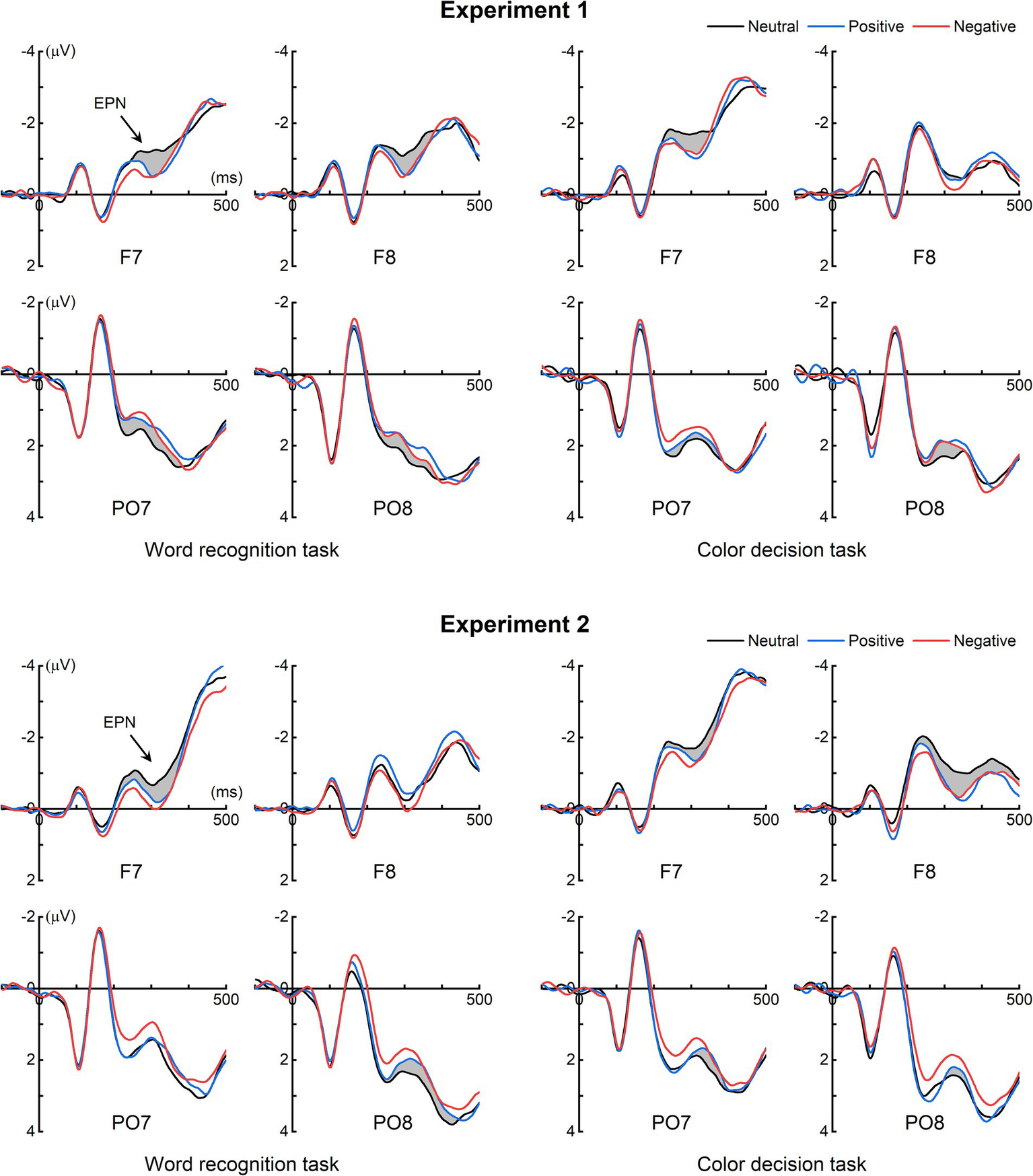
Grand-averaged ERPs. For Experiment 1, in both tasks, emotional words elicited more pronounced negative waves compared to neutral words around 300 ms at the posterior electrode sites, accompanied by enhanced positive waves at the frontal electrode sites. This pattern aligns with the well-established early posterior negativity (EPN) response to emotional stimuli. For Experiment 2, the EPN was evident in the frontal region but less pronounced at the posterior electrode sites.
For both experiments, to elucidate the differences in ERPs between emotional and neutral words, the ERPs elicited by neutral words were subtracted from those elicited by emotional words. The resulting grand-averaged difference ERPs across all 64 recording electrodes are displayed in Figures 3, 4 (top panels). Additionally, the global field power (GFP) of these difference ERPs for each task was computed and is depicted in Figures 3, 4 (middle panels). Moreover, for each task, the ERPs elicited by emotional and neutral words at each electrode underwent repeated-measures two-tailed t-tests across all time points from 50 to 500 ms. The resulting spatiotemporal distribution of significant time points, corrected for false discovery rate (FDR) to account for multiple comparisons, is presented in Figures 3, 4 (bottom panels).
Figure 3

ERP differences between emotional and neutral words (Experiment 1). Top panels: grand-averaged difference ERPs across all 64 recording electrodes, obtained by subtracting ERPs elicited by neutral words from those elicited by emotional words. Middle panels: global field power (GFP) plots representing the computed GFP of the difference ERPs for each task. Bottom panels: spatiotemporal distribution of significant time points resulting from repeated-measures two-tailed t-tests conducted on ERPs elicited by emotional and neutral words at each electrode across time points from 50 to 500 ms.
Figure 4
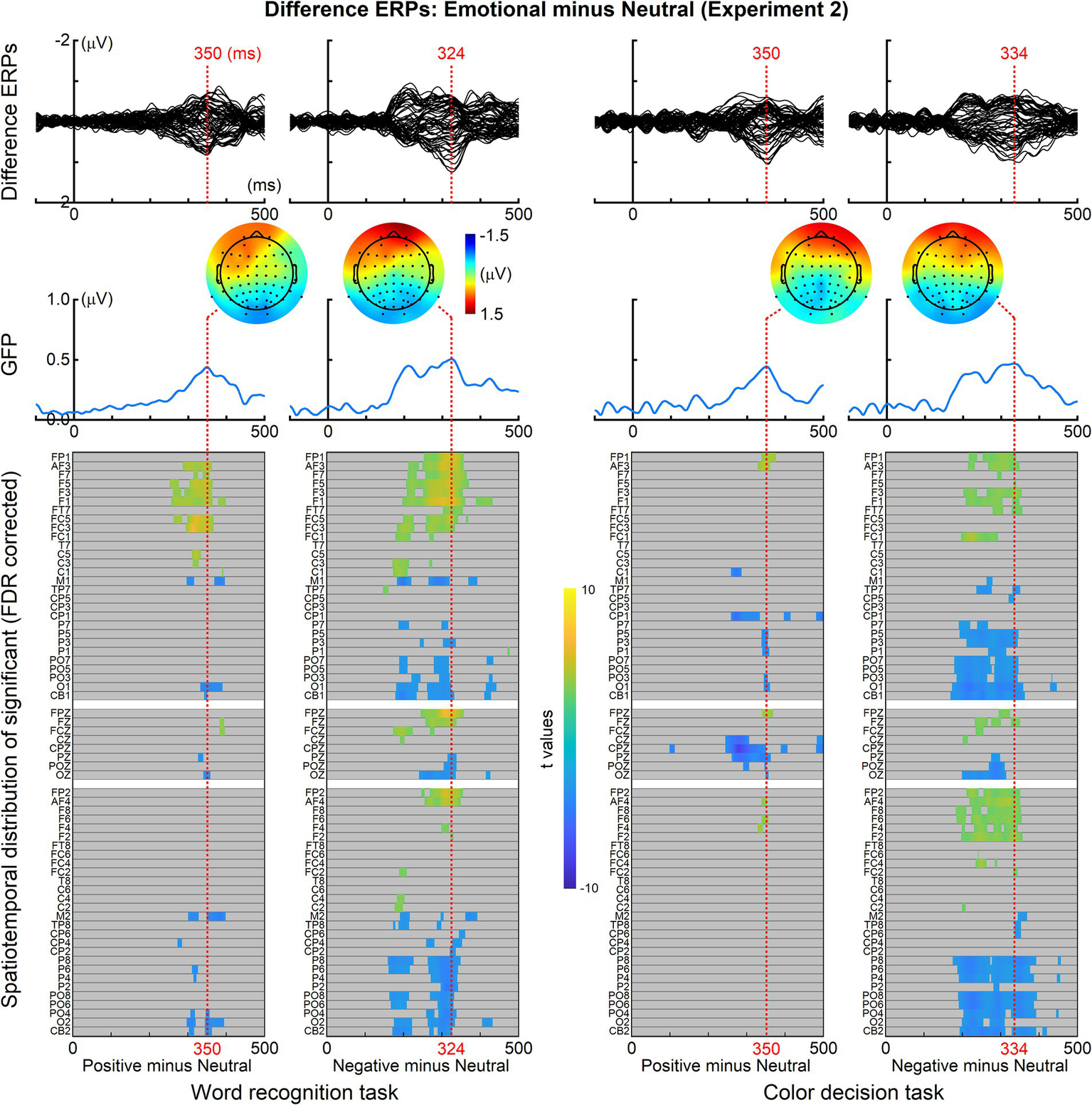
ERP differences between emotional and neutral words (Experiment 2). Top panels: grand-averaged difference ERPs across all 64 recording electrodes, obtained by subtracting ERPs elicited by neutral words from those elicited by emotional words. Middle panels: global field power (GFP) plots representing the computed GFP of the difference ERPs for each task. Bottom panels: spatiotemporal distribution of significant time points resulting from repeated-measures two-tailed t-tests conducted on ERPs elicited by emotional and neutral words at each electrode across time points from 50 to 500 ms.
As depicted in Figure 3 (bottom panels), in Experiment 1, a significant ERP difference was observed around 300 ms between positive and neutral words, as well as between negative and neutral words, in the word recognition task. In contrast, for the color decision task, a significant ERP difference was evident around 300 ms specifically between negative and neutral words. Although no statistically significant difference was detected between the ERPs to positive words and neutral words in the color decision task, a notable difference around 300 ms was apparent in both the ERPs and GFP plots. Moreover, the topographic distribution of the difference ERPs, peaking around 300 ms across all four comparisons, closely mirrors the typical topographic distribution of the EPN response, characterized by positive amplitudes in the frontal region and negative amplitudes in the occipitotemporal area (Kissler et al., 2007, 2009; Schacht and Sommer, 2009b; Bayer et al., 2012b; Chen et al., 2015).
As shown in Figure 4 (bottom panels), in Experiment 2, a significant ERP divergence was evident around 300 ms between positive and neutral words, as well as between negative and neutral words, across both the word recognition and color decision tasks. The topographic distribution of the difference ERPs, peaking around 300 ms for all four comparisons, also aligns with the typical topographic distribution of the EPN response. Notably, the ERP responses to negative words compared to neutral words also showed a statistically significant difference around 220 ms (see bottom panels in Figure 4 and see Supplementary Figure S1 for similar results when comparing negative and positive words). The time course and spatial distribution of the ERP difference around 220 ms align with the ERP signature of accessing lexical orthographic representations (Yu et al., 2022; Huang et al., 2023; Zhang et al., 2023). These results corroborate previous findings on the inhibitory effect of emotional processing on negative words (e.g., Ohman and Mineka, 2001; Estes and Verges, 2008; Grandjean and Scherer, 2008; Scott et al., 2009; Ben-David et al., 2012; Wu and Thierry, 2012; Kuperman et al., 2014). This incidental finding is further discussed in the Supplementary material.
3.3 Source analysis results
For each experiment, we computed the difference ERPs (i.e., EPN response) between emotional and neutral words across the two tasks. These difference ERPs were then grand-averaged across all participants. Subsequently, we identified the sources of the grand-averaged difference ERP at the peak of the GFP, specifically at 314 ms for Experiment 1 and 336 ms for Experiment 2. The findings revealed the left temporal lobe as the likely cortical generator of the difference ERP for both experiments, as depicted in Figure 5.
Figure 5
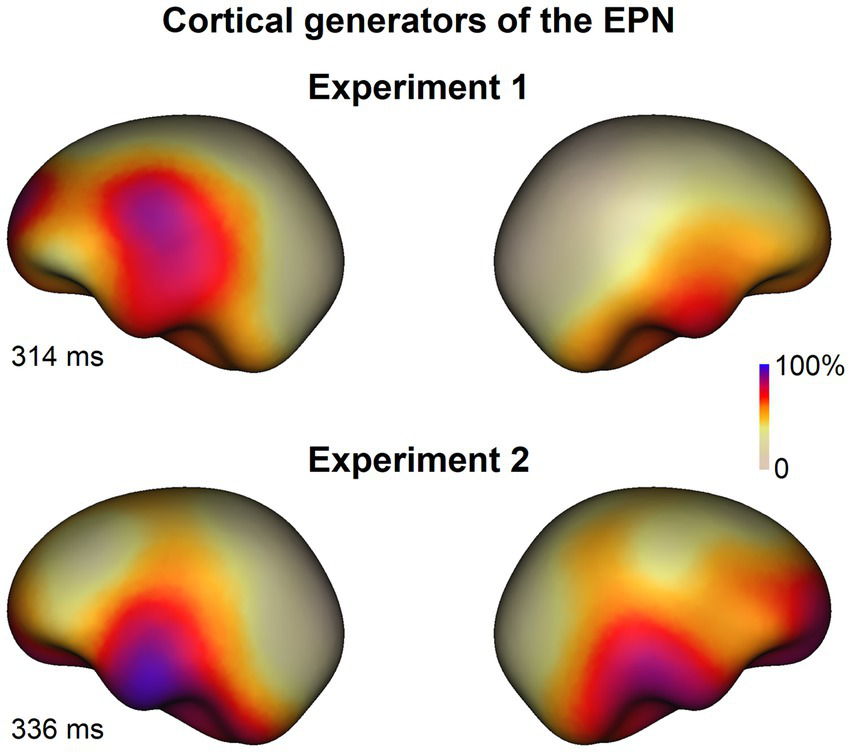
Source analysis results. The left temporal lobe might be the cortical generator of the EPN response for both experiments.
4 Discussion
Decoding emotional cues from diverse sources like faces, images, and visual words is essential for human interaction. A neural correlate of this emotional processing often manifests as the EPN component of ERP. However, there’s limited evidence of the EPN response to Chinese emotional words in prior studies. Given the unique logographic nature of Chinese script and its lexicon rich in compound words, this study aimed to determine whether EPN could be elicited by Chinese one-character monomorphic words in Experiment 1, and by two-character compound words in Experiment 2. Through a data-driven mass univariate analysis, EPN was consistently identified in both experiments. These findings help fill the gap in the literature, as evidence concerning the EPN response to Chinese emotional words is notably scarce, providing valuable insights into the neural mechanisms underlying Chinese emotional word comprehension.
4.1 The EPN response elicited by Chinese emotional words
The current study observed significant differences in brain responses to emotional and neutral stimuli, particularly around 300 ms after word onset, in both Experiment 1 and Experiment 2. We posit that this 300 ms ERP difference represents the EPN component for several reasons: Firstly, the morphology of the difference ERP, including its peak latency (~300 ms) and its topographical distribution (positive amplitude over the frontal scalp area and negative amplitude over the occipitotemporal scalp area) (refer to Figures 3, 4), aligns closely with findings from previous research on the EPN (Kissler et al., 2007, 2009; Schacht and Sommer, 2009b; Chen et al., 2015). Secondly, the observed ERP difference around 300 ms in our study emerged when contrasting emotional stimuli with neutral ones, rather than when comparing positive and negative stimuli. This aligns with established research indicating that the EPN are often observed for positive or negative words relative to neutral ones (e.g., Kissler et al., 2007, 2009; Herbert et al., 2008; Franken et al., 2009; Zhang et al., 2014). Thirdly, the results of our source analysis revealed that the cortical generators of the observed difference ERP in our study are primarily located in the left temporal lobe (see Figure 5). This region is adjacent to the cortical generators of the EPN in the left-hemisphere extrastriate areas, as reported in prior research (Kissler et al., 2007). The slight location discrepancies may stem from the inherent limitations of ERP source analysis methods in pinpointing precise cortical generators. Lastly, the consistent observation of the difference ERP around 300 ms in both experiments, which employed monomorphic and compound words respectively, provides converging evidence that these difference ERPs reflected emotional processing. In short, based on these findings and comparisons with existing literature, we conclude that the ERP difference around 300 ms observed in both Experiment 1 and Experiment 2 is indicative of the EPN component. Thus, the EPN response can be elicited by Chinese emotional words.
The present study used the global average as the reference electrode. In Experiment 1, the EPN was prominent at the occipitotemporal electrode sites, but this was not observed in Experiment 2 (see shaded areas at electrodes PO7 and PO8 in Figure 2). When the ERPs in both experiments were re-referenced to the mean mastoids, the EPN at the occipitotemporal electrode sites was barely detectable in both Experiment 1 and Experiment 2 (refer to Supplementary Figure S2). These findings suggest that the infrequent detection of the EPN response in prior studies likely stems from two factors. Firstly, the utilization of mean mastoids as an offline reference may not effectively reveal the EPN response, given the close proximity of the occipitotemporal electrode sites to the mastoids. Secondly, when Chinese two-character words are utilized as stimuli and the ERP is referenced to the global average, the EPN remains hardly discernible at the occipitotemporal electrode sites (see Figure 2).
The EPN elicited by emotional faces and pictures has been considered indicative of emotional processing (e.g., Junghofer et al., 2001; Schupp et al., 2004a; Kulke, 2019), and its manifestation in implicit tasks (such as the emotional Stroop task) further underscores spontaneous emotional processing. The EPN elicited by words signifies that emotional processing extends to materials with learned emotional significance (Kissler et al., 2007). Additionally, our current findings indicate that emotional processing of visual words, as indexed by the EPN, remains consistent across different writing systems and across both monomorphic and compound words. Therefore, the EPN response could confidently serve as an emotion-related ERP component in future research utilizing both Chinese monomorphic words and compound words as materials. However, careful consideration is warranted when interpreting the EPN response elicited by emotional compound words, as elaborated below.
4.2 The EPN response elicited by emotional compound words
As listed in Table 1, many prior studies have delved into the processing of emotional words using Chinese two-character words as stimuli. However, a crucial aspect often overlooked is the inherent compound nature of Chinese two-character words. A wealth of behavioral and neuroimaging investigations has collectively indicated that compound words are processed concurrently both as a whole unit (whole-word processing) and as a combination of their constituent morphemes (decomposing processing) (for an overview, see Huang et al., 2023). The current study unveiled that the EPN is elicited by compound words (i.e., Chinese two-character words in Experiment 2) as well as monomorphic words (i.e., Chinese one-character words in Experiment 1).
Nevertheless, in this study, many constituent morphemes within the two-character words carry emotional connotations consistent with their corresponding compound words, such as “笑” (meaning smiling) in “笑脸” (meaning smiling face), and “病” (meaning sick) in “病毒” (meaning virus). Consequently, it is unable to discern whether the elicitation of the EPN response is attributed to the holistic word meaning, the meanings of constituent morphemes, or both. Notably, certain two-character words possess emotional connotations, yet their constituent morphemes remain neutral (e.g., “表扬,” meaning praise, where “表” means watch, and “扬” means raise). It remains unclear whether the EPN could be elicited using these semantically opaque compound words. In short, further investigation is needed to elucidate whether the EPN is evoked by the meaning (emotional connotation) of the whole word or by the meanings of constituent morphemes.
4.3 Exploring Chinese emotional word processing with EPN in future research
As previously mentioned, EPN is a valuable tool in emotion research. This study sets the stage for future investigations using EPN as an emotion-related ERP component to delve into the processing of emotional words in Chinese. For instance, researchers could employ EPN to explore cross-language variations in emotion processing, to investigate the understanding of emotional connotations by Chinese L2 learners, and to explore the atypical processing of Chinese emotional words in specific populations. Additionally, EPN’s sensitivity to word meaning, particularly emotional connotations, could help to elucidate the mechanisms underlying Chinese compound word processing. For instance, if subsequent research demonstrates that EPN is elicited by emotional compound words consisting of neutral constituent morphemes, it would provide compelling evidence for the holistic processing of Chinese compound words.
Building upon the present findings, we suggest that future research optimize the use of monomorphic words (Chinese one-character words) as stimuli, as the EPN elicited by compound words (Chinese two-character words) is scarcely discernible at occipitotemporal electrode sites (see Figure 2). Alternatively, researchers can calculate the GFP waveform to evaluate the EPN (e.g., Schacht and Sommer, 2009b; Bayer et al., 2012b). GFP, a reference-independent measure of response strength, permits a comprehensive assessment of the entire electrode set (Lehmann and Skrandies, 1980; Murray et al., 2008). A GFP peak around 300 ms, along with the topographic map at the peak, plays a pivotal role in identifying the EPN. This is because the EPN typically peaks around 300 ms and demonstrates positive amplitude over the frontal scalp area and negative amplitude over the posterior scalp area when applying the global average as the reference electrode.
5 Conclusion
The EPN is an ERP component elicited by emotional connotations from various stimuli, including faces, images, and visual words. It has been extensively utilized as an emotion-related ERP component in numerous studies. The present study reveals that the EPN can be elicited by Chinese emotional words, regardless of whether they are monomorphemic or compound in structure. This suggests that the EPN can reliably serve as an emotion-related ERP component for investigating emotional processing in future studies employing Chinese words as stimuli.
Statements
Data availability statement
The raw data supporting the conclusions of this article will be made available by the authors, without undue reservation.
Ethics statement
The studies involving humans were approved by Ethics Committee of Sichuan University. The studies were conducted in accordance with the local legislation and institutional requirements. Written informed consent for participation in this study was provided by the participants’ legal guardians/next of kin.
Author contributions
KZ: Conceptualization, Data curation, Formal analysis, Funding acquisition, Investigation, Methodology, Project administration, Visualization, Writing – original draft. JL: Formal analysis, Investigation, Writing – review & editing. FG: Formal analysis, Methodology, Supervision, Validation, Visualization, Writing – review & editing.
Funding
The author(s) declare that financial support was received for the research, authorship, and/or publication of this article. This work was supported by the Postdoctoral Fellowship Program of CPSF under Grant Number GZC20231018.
Conflict of interest
The authors declare that the research was conducted in the absence of any commercial or financial relationships that could be construed as a potential conflict of interest.
Publisher’s note
All claims expressed in this article are solely those of the authors and do not necessarily represent those of their affiliated organizations, or those of the publisher, the editors and the reviewers. Any product that may be evaluated in this article, or claim that may be made by its manufacturer, is not guaranteed or endorsed by the publisher.
Supplementary material
The Supplementary material for this article can be found online at: https://www.frontiersin.org/articles/10.3389/fpsyg.2024.1426383/full#supplementary-material
Footnotes
References
1
Aurnhammer C. Delogu F. Brouwer H. Crocker M. W. (2023). The P600 as a continuous index of integration effort. Psychophysiology60:e14302. doi: 10.1111/psyp.14302
2
Bayer M. Schacht A. (2014). Event-related brain responses to emotional words, pictures, and faces — a cross-domain comparison. Front. Psychol.5:1106. doi: 10.3389/fpsyg.2014.01106
3
Bayer M. Sommer W. Schacht A. (2012a). Font size matters--emotion and attention in cortical responses to written words. PLoS One7:e36042. doi: 10.1371/journal.pone.0036042
4
Bayer M. Sommer W. Schacht A. (2012b). P1 and beyond: functional separation of multiple emotion effects in word recognition. Psychophysiology49, 959–969. doi: 10.1111/j.1469-8986.2012.01381.x
5
Ben-David B. M. Chajut E. Algom D. (2012). The pale shades of emotion: a signal detection theory analysis of the emotional Stroop task. Psychology3, 537–541. doi: 10.4236/psych.2012.37079
6
Benjamini Y. Hochberg Y. (2018). Controlling the false discovery rate: a practical and powerful approach to multiple testing. J. Royal Statist. Soc. Series B57, 289–300. doi: 10.1111/j.2517-6161.1995.tb02031.x
7
Bolger D. J. Perfetti C. A. Schneider W. (2005). Cross-cultural effect on the brain revisited: universal structures plus writing system variation. Hum. Brain Mapp.25, 92–104. doi: 10.1002/hbm.20124
8
Bradley M. M. Lang P. J. (1994). Measuring emotion: the self-assessment manikin and the semantic differential. J. Behav. Ther. Exp. Psychiatry25, 49–59. doi: 10.1016/0005-7916(94)90063-9
9
Cai Q. Brysbaert M. (2010). SUBTLEX-CH: Chinese word and character frequencies based on film subtitles. PLoS One5:e10729. doi: 10.1371/journal.pone.0010729
10
Chen P. Lin J. Chen B. Lu C. Guo T. (2015). Processing emotional words in two languages with one brain: ERP and fMRI evidence from Chinese-English bilinguals. Cortex71, 34–48. doi: 10.1016/j.cortex.2015.06.002
11
Chen N. X. Wei P. (2023). Reward history modulates the processing of task-irrelevant emotional faces in a demanding task. Brain Sci.13:874. doi: 10.3390/brainsci13060874
12
Cieślicka A. B. Guerrero B. L. (2023). Emotion word processing in immersed Spanish-English/English-Spanish bilinguals: an ERP study. Languages8:42. doi: 10.3390/languages8010042
13
Citron F. M. (2012). Neural correlates of written emotion word processing: a review of recent electrophysiological and hemodynamic neuroimaging studies. Brain Lang.122, 211–226. doi: 10.1016/j.bandl.2011.12.007
14
Citron F. M. Weekes B. S. Ferstl E. C. (2013). Effects of valence and arousal on written word recognition: time course and ERP correlates. Neurosci. Lett.533, 90–95. doi: 10.1016/j.neulet.2012.10.054
15
Cui Y. Engelmann J. M. Gilbert D. G. Waters A. J. Cinciripini P. M. Robinson J. D. (2019). The impact of nicotine dose and instructed dose on smokers' implicit attitudes to smoking cues: an ERP study. Psychol. Addict. Behav.33, 710–720. doi: 10.1037/adb0000523
16
Cuthbert B. N. Schupp H. T. Bradley M. M. Birbaumer N. Lang P. J. (2000). Brain potentials in affective picture processing: covariation with autonomic arousal and affective report. Biol. Psychol.52, 95–111. doi: 10.1016/S0301-0511(99)00044-7
17
Delaney-Busch N. Wilkie G. Kuperberg G. (2016). Vivid: how valence and arousal influence word processing under different task demands. Cogn. Affect. Behav. Neurosci.16, 415–432. doi: 10.3758/s13415-016-0402-y
18
Delogu F. Brouwer H. Crocker M. W. (2019). Event-related potentials index lexical retrieval (N400) and integration (P600) during language comprehension. Brain Cogn.135:103569. doi: 10.1016/j.bandc.2019.05.007
19
Deweese M. M. Codispoti M. Robinson J. D. Cinciripini P. M. Versace F. (2018). Cigarette cues capture attention of smokers and never-smokers, but for different reasons. Drug Alcohol Depend.185, 50–57. doi: 10.1016/j.drugalcdep.2017.12.010
20
Dominguez-Centeno I. Jurado-Barba R. Sion A. Martínez-Maldonado A. Castillo-Parra G. López-Muñoz F. et al . (2020). Psychophysiological correlates of emotional- and alcohol-related cues processing in offspring of alcohol-dependent patients. Alcohol Alcohol.55, 374–381. doi: 10.1093/alcalc/agaa006
21
Eimer M. Holmes A. (2007). Event-related brain potential correlates of emotional face processing. Neuropsychologia45, 15–31. doi: 10.1016/j.neuropsychologia.2006.04.022
22
El Yagoubi R. Chiarelli V. Mondini S. Perrone G. Danieli M. Semenza C. (2008). Neural correlates of Italian nominal compounds and potential impact of headedness effect: an ERP study. Cogn. Neuropsychol.25, 559–581. doi: 10.1080/02643290801900941
23
Espuny J. Jimenez-Ortega L. Casado P. Fondevila S. Munoz F. Hernandez-Gutierrez D. et al . (2018). Event-related brain potential correlates of words' emotional valence irrespective of arousal and type of task. Neurosci. Lett.670, 83–88. doi: 10.1016/j.neulet.2018.01.050
24
Estes Z. Verges M. (2008). Freeze or flee? Negative stimuli elicit selective responding. Cognition108, 557–565. doi: 10.1016/j.cognition.2008.03.003
25
Etkin A. Egner T. Kalisch R. (2011). Emotional processing in anterior cingulate and medial prefrontal cortex. Trends Cogn. Sci.15, 85–93. doi: 10.1016/j.tics.2010.11.004
26
Fiorentino R. Naito-Billen Y. Bost J. Fund-Reznicek E. (2014). Electrophysiological evidence for the morpheme-based combinatoric processing of English compounds. Cogn. Neuropsychol.31, 123–146. doi: 10.1080/02643294.2013.855633
27
Flaisch T. Stockburger J. Schupp H. T. (2008). Affective prime and target picture processing: an ERP analysis of early and late interference effects. Brain Topogr.20, 183–191. doi: 10.1007/s10548-008-0045-6
28
Franken I. H. Gootjes L. van Strien J. W. (2009). Automatic processing of emotional words during an emotional Stroop task. Neuroreport20, 776–781. doi: 10.1097/WNR.0b013e32832b02fe
29
Friederici A. D. (2004). Event-related brain potential studies in language. Curr. Neurol. Neurosci. Rep.4, 466–470. doi: 10.1007/s11910-004-0070-0
30
Fruhholz S. Jellinghaus A. Herrmann M. (2011). Time course of implicit processing and explicit processing of emotional faces and emotional words. Biol. Psychol.87, 265–274. doi: 10.1016/j.biopsycho.2011.03.008
31
Gao X. Sui X. Li Y. (2023). The role of selective attention in Chinese emotional word processing: evidence from event-related potentials. Neuroreport34, 485–492. doi: 10.1097/WNR.0000000000001914
32
Gibbons H. Kirsten H. Seib-Pfeifer L. E. (2022). Attention to affect 2.0: multiple effects of emotion and attention on event-related potentials of visual word processing in a valence-detection task. Psychophysiology59:e14059. doi: 10.1111/psyp.14059
33
Gonzalez-Villar A. J. Trinanes Y. Zurron M. Carrillo-de-la-Pena M. T. (2014). Brain processing of task-relevant and task-irrelevant emotional words: an ERP study. Cogn. Affect. Behav. Neurosci.14, 939–950. doi: 10.3758/s13415-013-0247-6
34
Grandjean D. Scherer K. R. (2008). Unpacking the cognitive architecture of emotion processes. Emotion8, 341–351. doi: 10.1037/1528-3542.8.3.341
35
Groppe D. M. Urbach T. P. Kutas M. (2011). Mass univariate analysis of event-related brain potentials/fields I: a critical tutorial review. Psychophysiology48, 1711–1725. doi: 10.1111/j.1469-8986.2011.01273.x
36
Gu B. Wang H. Beltrán D. Liu B. Liang T. Wang X. et al . (2021). Embodied processing of disgust in mandarin words: an ERP study. J. Neurolinguistics58:981. doi: 10.1016/j.jneuroling.2020.100981
37
Hämäläinen M. S. Ilmoniemi R. J. (1984). Interpreting measured magnetic fields of the brain: estimates of current distributions. Technical Report TKK-F-A559. Helsinki University of Technology.
38
Hamann S. Canli T. (2004). Individual differences in emotion processing. Curr. Opin. Neurobiol.14, 233–238. doi: 10.1016/j.conb.2004.03.010
39
Herbert C. (2022). Early, emotional and embodied? Processing of emotional words and body words in the native and a second language – evidence from early event-related brain potential modulation and rapid serial visual presentation. Lang. Cogn. Neurosci.38, 1384–1411. doi: 10.1080/23273798.2022.2137210
40
Herbert C. Junghofer M. Kissler J. (2008). Event related potentials to emotional adjectives during reading. Psychophysiology45, 487–498. doi: 10.1111/j.1469-8986.2007.00638.x
41
Hinojosa J. A. Albert J. Lopez-Martin S. Carretie L. (2014). Temporospatial analysis of explicit and implicit processing of negative content during word comprehension. Brain Cogn.87, 109–121. doi: 10.1016/j.bandc.2014.03.008
42
Hinojosa J. A. Herbert C. Kissler J. (2023). Introduction to the special issue: affective neurolinguistics: understanding the interaction of emotion and language in the brain. Lang. Cogn. Neurosci.38, 1339–1347. doi: 10.1080/23273798.2023.2275667
43
Hinojosa J. A. Moreno E. M. Ferré P. (2020). Affective neurolinguistics: towards a framework for reconciling language and emotion. Lang. Cogn. Neurosci.35, 813–839. doi: 10.1080/23273798.2019.1620957
44
Hoid D. Pan D. N. Wang Y. Li X. (2020). Implicit emotion regulation deficits in individuals with high schizotypal traits: an ERP study. Sci. Rep.10:3882. doi: 10.1038/s41598-020-60787-9
45
Huang B. Yang X. Dong S. Gu F. (2023). Visual event-related potentials reveal the early whole-word lexical processing of Chinese two-character words. Neuropsychologia185:108571. doi: 10.1016/j.neuropsychologia.2023.108571
46
Imbir K. K. Duda-Golawska J. Pastwa M. Jankowska M. Zygierewicz J. (2021). Event-related potential correlates of valence, arousal, and subjective significance in processing of an emotional Stroop task. Front. Hum. Neurosci.15:617861. doi: 10.3389/fnhum.2021.617861
47
Jia D. Zhang H. Wang Y. Zhou Z. (2022). Which word makes you feel more negative? “Nausea” or “corpse”. Curr. Psychol.42, 31724–31735. doi: 10.1007/s12144-022-04164-x
48
Junghofer M. Bradley M. M. Elbert T. R. Lang P. J. (2001). Fleeting images: a new look at early emotion discrimination. Psychophysiology38, 175–178. doi: 10.1111/1469-8986.3820175
49
Kim E. Y. Lee S. H. Park G. Kim S. Kim I. Chae J. H. et al . (2013). Gender difference in event related potentials to masked emotional stimuli in the oddball task. Psychiatry Investig.10, 164–172. doi: 10.4306/pi.2013.10.2.164
50
Kissler J. (2020). Affective neurolinguistics: a new field to grow at the intersection of emotion and language? – commentary on Hinojosa et al., 2019. Lang. Cogn. Neurosci.35, 850–857. doi: 10.1080/23273798.2019.1694159
51
Kissler J. Bromberek-Dyzman K. (2020). Mood induction differently affects early neural correlates of evaluative word processing in L1 and L2. Front. Psychol.11:588902. doi: 10.3389/fpsyg.2020.588902
52
Kissler J. Herbert C. Peyk P. Junghofer M. (2007). Buzzwords: early cortical responses to emotional words during reading. Psychol. Sci.18, 475–480. doi: 10.1111/j.1467-9280.2007.01924.x
53
Kissler J. Herbert C. Winkler I. Junghofer M. (2009). Emotion and attention in visual word processing: an ERP study. Biol. Psychol.80, 75–83. doi: 10.1016/j.biopsycho.2008.03.004
54
Ku L. C. Chan S. H. Lai V. T. (2020). Personality traits and emotional word recognition: an ERP study. Cogn. Affect. Behav. Neurosci.20, 371–386. doi: 10.3758/s13415-020-00774-9
55
Kulke L. (2019). Neural mechanisms of overt attention shifts to emotional faces. Neuroscience418, 59–68. doi: 10.1016/j.neuroscience.2019.08.023
56
Kuperberg G. R. (2007). Neural mechanisms of language comprehension: challenges to syntax. Brain Res.1146, 23–49. doi: 10.1016/j.brainres.2006.12.063
57
Kuperman V. Estes Z. Brysbaert M. Warriner A. B. (2014). Emotion and language: valence and arousal affect word recognition. J. Exp. Psychol. Gen.143, 1065–1081. doi: 10.1037/a0035669
58
Kutas M. Federmeier K. D. (2011). Thirty years and counting: finding meaning in the N400 component of the event-related brain potential (ERP). Annu. Rev. Psychol.62, 621–647. doi: 10.1146/annurev.psych.093008.131123
59
Lau E. F. Phillips C. Poeppel D. (2008). A cortical network for semantics: (de)constructing the N400. Nat. Rev. Neurosci.9, 920–933. doi: 10.1038/nrn2532
60
Lavric A. Elchlepp H. Rastle K. (2012). Tracking hierarchical processing in morphological decomposition with brain potentials. J. Exp. Psychol. Hum. Percept. Perform.38, 811–816. doi: 10.1037/a0028960
61
Lehmann D. Skrandies W. (1980). Reference-free identification of components of checkerboard-evoked multichannel potential fields. Electroencephalogr. Clin. Neurophysiol.48, 609–621. doi: 10.1016/0013-4694(80)90419-8
62
Leite J. Carvalho S. Galdo-Alvarez S. Alves J. Sampaio A. Goncalves O. F. (2012). Affective picture modulation: valence, arousal, attention allocation and motivational significance. Int. J. Psychophysiol.83, 375–381. doi: 10.1016/j.ijpsycho.2011.12.005
63
Lexicon of Common Words in Contemporary Chinese (2021). Lexicon of common words in contemporary Chinese [Xiàndài hànyuˇ chángyòngcíbiǎo]. Beijing: The Commercial Press.
64
Lin S. E. Chen H. C. Zhao J. Li S. He S. Weng X. C. (2011). Left-lateralized N170 response to unpronounceable pseudo but not false Chinese characters-the key role of orthography. Neuroscience190, 200–206. doi: 10.1016/j.neuroscience.2011.05.071
65
Liu J. Fan L. Tian L. Li C. Feng W. (2023). The neural mechanisms of explicit and implicit processing of Chinese emotion-label and emotion-laden words: evidence from emotional categorisation and emotional Stroop tasks. Lang. Cogn. Neurosci.38, 1412–1429. doi: 10.1080/23273798.2022.2093389
66
Liu B. Jin Z. Wang Z. Hu Y. (2010a). The interaction between pictures and words: evidence from positivity offset and negativity bias. Exp. Brain Res.201, 141–153. doi: 10.1007/s00221-009-2018-8
67
Liu B. Wang Y. Li X. (2018). Implicit emotion regulation deficits in trait anxiety: an ERP study. Front. Hum. Neurosci.12:382. doi: 10.3389/fnhum.2018.00382
68
Liu B. Xin S. Jin Z. Hu Y. Li Y. (2010b). Emotional facilitation effect in the picture-word interference task: an ERP study. Brain Cogn.72, 289–299. doi: 10.1016/j.bandc.2009.09.013
69
Liu X. Yang Y. Jiang S. Li J. (2018). The facilitating effect of positive emotions during an emotional Stroop task. Neuroreport29, 883–888. doi: 10.1097/WNR.0000000000001048
70
Liu H. Yin H. F. Wu D. X. Xu S. J. (2014). Event-related potentials in response to emotional words in patients with major depressive disorder and healthy controls. Neuropsychobiology70, 36–43. doi: 10.1159/000364829
71
Liu C. Zhang W. T. Tang Y. Y. Mai X. Q. Chen H. C. Tardif T. et al . (2008). The visual word form area: evidence from an fMRI study of implicit processing of Chinese characters. NeuroImage40, 1350–1361. doi: 10.1016/j.neuroimage.2007.10.014
72
Luck S. J. Gaspelin N. (2017). How to get statistically significant effects in any ERP experiment (and why you shouldn't). Psychophysiology54, 146–157. doi: 10.1111/psyp.12639
73
Luo W. Feng W. He W. Wang N. Y. Luo Y. J. (2010). Three stages of facial expression processing: ERP study with rapid serial visual presentation. NeuroImage49, 1857–1867. doi: 10.1016/j.neuroimage.2009.09.018
74
Luo W. Qi Z. (2022). The influence of concreteness on emotional nouns valence processing: an ERP study. Acta Psychol. Sin.54, 111–121. doi: 10.3724/SP.J.1041.2022.00111
75
Murray M. M. Brunet D. Michel C. M. (2008). Topographic ERP analyses: a step-by-step tutorial review. Brain Topogr.20, 249–264. doi: 10.1007/s10548-008-0054-5
76
Naranowicz M. Jankowiak K. Bromberek-Dyzman K. (2022). Mood and gender effects in emotional word processing in unbalanced bilinguals. Int. J. Biling.27, 39–60. doi: 10.1177/13670069221075646
77
Oatley K. Duncan E. (1994). The experience of emotions in everyday life. Cognit. Emot.8, 369–381. doi: 10.1080/02699939408408947
78
Ohman A. Mineka S. (2001). Fears, phobias, and preparedness: toward an evolved module of fear and fear learning. Psychol. Rev.108, 483–522. doi: 10.1037/0033-295X.108.3.483
79
Oldfield R. C. (1971). The assessment and analysis of handedness: the Edinburgh inventory. Neuropsychologia9, 97–113. doi: 10.1016/0028-3932(71)90067-4
80
Olofsson J. K. Nordin S. Sequeira H. Polich J. (2008). Affective picture processing: an integrative review of ERP findings. Biol. Psychol.77, 247–265. doi: 10.1016/j.biopsycho.2007.11.006
81
Palazova M. Mantwill K. Sommer W. Schacht A. (2011). Are effects of emotion in single words non-lexical? Evidence from event-related brain potentials. Neuropsychologia49, 2766–2775. doi: 10.1016/j.neuropsychologia.2011.06.005
82
Palazova M. Sommer W. Schacht A. (2013). Interplay of emotional valence and concreteness in word processing: an event-related potential study with verbs. Brain Lang.125, 264–271. doi: 10.1016/j.bandl.2013.02.008
83
Palomero-Gallagher N. Amunts K. (2022). A short review on emotion processing: a lateralized network of neuronal networks. Brain Struct. Funct.227, 673–684. doi: 10.1007/s00429-021-02331-7
84
Pessoa L. Adolphs R. (2010). Emotion processing and the amygdala: from a 'low road' to 'many roads' of evaluating biological significance. Nat. Rev. Neurosci.11, 773–783. doi: 10.1038/nrn2920
85
Phelps E. A. LeDoux J. E. (2005). Contributions of the amygdala to emotion processing: from animal models to human behavior. Neuron48, 175–187. doi: 10.1016/j.neuron.2005.09.025
86
Pollatsek A. Hyona J. Bertram R. (2000). The role of morphological constituents in reading Finnish compound words. J. Exp. Psychol. Hum. Percept. Perform.26, 820–833. doi: 10.1037/0096-1523.26.2.820
87
Ponz A. Montant M. Liegeois-Chauvel C. Silva C. Braun M. Jacobs A. M. et al . (2014). Emotion processing in words: a test of the neural re-use hypothesis using surface and intracranial EEG. Soc. Cogn. Affect. Neurosci.9, 619–627. doi: 10.1093/scan/nst034
88
Rozenkrants B. Polich J. (2008). Affective ERP processing in a visual oddball task: arousal, valence, and gender. Clin. Neurophysiol.119, 2260–2265. doi: 10.1016/j.clinph.2008.07.213
89
Rueckl J. G. Paz-Alonso P. M. Molfese P. J. Kuo W. J. Bick A. Frost S. J. et al . (2015). Universal brain signature of proficient reading: evidence from four contrasting languages. Proc. Natl. Acad. Sci. USA112, 15510–15515. doi: 10.1073/pnas.1509321112
90
Schacht A. Adler N. Chen P. Guo T. Sommer W. (2012). Association with positive outcome induces early effects in event-related brain potentials. Biol. Psychol.89, 130–136. doi: 10.1016/j.biopsycho.2011.10.001
91
Schacht A. Sommer W. (2009a). Emotions in word and face processing: early and late cortical responses. Brain Cogn.69, 538–550. doi: 10.1016/j.bandc.2008.11.005
92
Schacht A. Sommer W. (2009b). Time course and task dependence of emotion effects in word processing. Cogn. Affect. Behav. Neurosci.9, 28–43. doi: 10.3758/CABN.9.1.28
93
Schmidtke D. Kuperman V. (2019). A paradox of apparent brainless behavior: the time-course of compound word recognition. Cortex116, 250–267. doi: 10.1016/j.cortex.2018.07.003
94
Schreuder R. Baayen R. H. (1995). “Modeling morphological processing,” in Morphological aspects of language processing. Ed. FeldmanL. B. (Hillsdale, NJ, US: Lawrence Erlbaum Associates, Inc), 131–154.
95
Schupp H. T. Flaisch T. Stockburger J. Junghöfer M. (2006). Emotion and attention: event-related brain potential studies. Prog Brain Res.156, 31–51. doi: 10.1016/S0079-6123(06)56002-9
96
Schupp H. T. Junghofer M. Weike A. I. Hamm A. O. (2004a). The selective processing of briefly presented affective pictures: an ERP analysis. Psychophysiology41, 441–449. doi: 10.1111/j.1469-8986.2004.00174.x
97
Schupp H. T. Öhman A. Junghöfer M. Weike A. I. Stockburger J. Hamm A. O. (2004b). The facilitated processing of threatening faces: an ERP analysis. Emotion4, 189–200. doi: 10.1037/1528-3542.4.2.189
98
Scott G. G. O'Donnell P. J. Leuthold H. Sereno S. C. (2009). Early emotion word processing: evidence from event-related potentials. Biol. Psychol.80, 95–104. doi: 10.1016/j.biopsycho.2008.03.010
99
Semenza C. Luzzatti C. (2014). Combining words in the brain: the processing of compound words. Introduction to the special issue. Cogn. Neuropsychol.31, 1–7. doi: 10.1080/02643294.2014.898922
100
Sergerie K. Chochol C. Armony J. L. (2008). The role of the amygdala in emotional processing: a quantitative meta-analysis of functional neuroimaging studies. Neurosci. Biobehav. Rev.32, 811–830. doi: 10.1016/j.neubiorev.2007.12.002
101
Tsang Y. K. Zou Y. (2022). An ERP mega study of Chinese word recognition. Psychophysiology59:e14111. doi: 10.1111/psyp.14111
102
Wang W. S. Y. (1973). The Chinese language. Sci. Am.228, 50–60. doi: 10.1038/scientificamerican0273-50
103
Wang L. Bastiaansen M. (2014). Oscillatory brain dynamics associated with the automatic processing of emotion in words. Brain Lang.137, 120–129. doi: 10.1016/j.bandl.2014.07.011
104
Wang Y. Li X. (2017). Temporal course of implicit emotion regulation during a priming-identify task: an ERP study. Sci. Rep.7:41941. doi: 10.1038/srep41941
105
Wang X. Shangguan C. Lu J. (2019). Time course of emotion effects during emotion-label and emotion-laden word processing. Neurosci. Lett.699, 1–7. doi: 10.1016/j.neulet.2019.01.028
106
Wei Y. Niu Y. Taft M. Carreiras M. (2023). Morphological decomposition in Chinese compound word recognition: electrophysiological evidence. Brain Lang.241:105267. doi: 10.1016/j.bandl.2023.105267
107
Wei P. Wang D. Ji L. (2016). Reward expectation regulates brain responses to task-relevant and task-irrelevant emotional words: ERP evidence. Soc. Cogn. Affect. Neurosci.11, 191–203. doi: 10.1093/scan/nsv097
108
Wieser M. J. Muhlberger A. Kenntner-Mabiala R. Pauli P. (2006). Is emotion processing affected by advancing age? An event-related brain potential study. Brain Res.1096, 138–147. doi: 10.1016/j.brainres.2006.04.028
109
Wu Y. J. Thierry G. (2012). How reading in a second language protects your heart. J. Neurosci.32, 6485–6489. doi: 10.1523/JNEUROSCI.6119-11.2012
110
Wu Y. Tsang Y.-K. Wong A. W.-K. Chen H.-C. (2016). The processing of homographic morphemes in Chinese: an ERP study. Lang. Cogn. Neurosci.32, 102–116. doi: 10.1080/23273798.2016.1227857
111
Wu C. Zhang J. Yuan Z. (2021). Exploring affective priming effect of emotion-label words and emotion-laden words: an event-related potential study. Brain Sci.11:553. doi: 10.3390/brainsci11050553
112
Xu X. Kang C. Guo T. (2019). Brain electrophysiological responses to emotion nouns versus emotionless nouns. J. Neurolinguistics49, 144–154. doi: 10.1016/j.jneuroling.2018.10.003
113
Xu X. Kang C. Sword K. Guo T. (2017). Are emotions abstract or concrete?Exp. Psychol.64, 315–324. doi: 10.1027/1618-3169/a000374
114
Yang J. Zeng J. Meng X. Zhu L. Yuan J. Li H. et al . (2013). Positive words or negative words: whose valence strength are we more sensitive to?Brain Res.1533, 91–104. doi: 10.1016/j.brainres.2013.08.020
115
Yao Z. Wang Z. (2014). Concreteness of positive word contributions to affective priming: an ERP study. Int. J. Psychophysiol.93, 275–282. doi: 10.1016/j.ijpsycho.2014.06.005
116
Yao Z. Yu D. Wang L. Zhu X. Guo J. Wang Z. (2016). Effects of valence and arousal on emotional word processing are modulated by concreteness: Behavioral and ERP evidence from a lexical decision task. Int. J. Psychophysiol.110, 231–242. doi: 10.1016/j.ijpsycho.2016.07.499
117
Yu R. Chen J. Peng Y. Gu F. (2022). Visual event-related potentials reveal the early lexical processing of Chinese characters. Neuropsychologia165:108132. doi: 10.1016/j.neuropsychologia.2021.108132
118
Zhang M. Ge Y. Kang C. Guo T. Peng D. (2018). ERP evidence for the contribution of meaning complexity underlying emotional word processing. J. Neurolinguistics45, 110–118. doi: 10.1016/j.jneuroling.2016.07.002
119
Zhang K. Gu F. Yu H. (2023). Early lexical processing of Chinese one-character words and Mongolian words: a comparative study using event-related potentials. Front. Psychol.13:1061990. doi: 10.3389/fpsyg.2022.1061990
120
Zhang D. He W. Wang T. Luo W. Zhu X. Gu R. et al . (2014). Three stages of emotional word processing: an ERP study with rapid serial visual presentation. Soc. Cogn. Affect. Neurosci.9, 1897–1903. doi: 10.1093/scan/nst188
121
Zhao W. Chen L. Zhou C. Luo W. (2018). Neural correlates of emotion processing in word detection task. Front. Psychol.9:832. doi: 10.3389/fpsyg.2018.00832
Summary
Keywords
emotion processing, Chinese words, early posterior negativity (EPN), event-related potentials (ERPs), affective neurolinguistics
Citation
Zhang K, Li J and Gu F (2024) Processing of emotional connotations in Chinese monomorphic and compound words reflected by the early posterior negativity. Front. Psychol. 15:1426383. doi: 10.3389/fpsyg.2024.1426383
Received
01 May 2024
Accepted
30 July 2024
Published
09 August 2024
Volume
15 - 2024
Edited by
Luís Faísca, University of Algarve, Portugal
Reviewed by
István Czigler, HUN-REN, Hungary
Anoushiravan Zahedi, University of Münster, Germany
Updates
Copyright
© 2024 Zhang, Li and Gu.
This is an open-access article distributed under the terms of the Creative Commons Attribution License (CC BY). The use, distribution or reproduction in other forums is permitted, provided the original author(s) and the copyright owner(s) are credited and that the original publication in this journal is cited, in accordance with accepted academic practice. No use, distribution or reproduction is permitted which does not comply with these terms.
*Correspondence: Feng Gu, fgu@scu.edu.cn
Disclaimer
All claims expressed in this article are solely those of the authors and do not necessarily represent those of their affiliated organizations, or those of the publisher, the editors and the reviewers. Any product that may be evaluated in this article or claim that may be made by its manufacturer is not guaranteed or endorsed by the publisher.