Abstract
Practice is acknowledged as a crucial facilitator for musicians to achieve performance excellence. Despite the rich literature on incorporating musical imagery intentionally to improve one’s practice efficacy, limitations remain in the understanding of voluntary musical imagery (VMI) in the context of musical practice. Therefore, our aims in this review are threefold. First, we enriched the interpretation of VMI in the context of music practice through the lens of embodied cognition. Second, we integrated neuroscientific findings to elucidate how the deliberate use of musical imagery parallels physical practice in effectiveness. Third, we synthesize work on the application of VMI in enhancing musical learning from both theoretical and practical perspectives. By providing an integrated overview of voluntary musical imagery, we highlight gaps in the literature and encourage further research on (1) the impact of embodied experiences on VMI formation, (2) optimal imagery content and ratio combination to establish a personalized intervention protocol for more effective musical pedagogy, and (3) on physiological measures to access VMI effectiveness. Additionally, we highlight the crucial implications of VMI for researchers, performers, and music educators.
1 Introduction
Musicians, defined as individuals with extended periods of musical training (Zhang et al., 2020), are generally aware that achieving performance excellence requires consistent and extensive effort (Clark et al., 2014; Gregg et al., 2008). Among the diverse ways of improving one’s level of performance, efficient practice strategies have been recognized as crucial in facilitating development of musical expertise (Ericsson et al., 1993; Platz et al., 2014; Sloboda et al., 1996). Since the turn of the millennium, the number of studies concerning the effectiveness of music practice has expanded significantly (How et al., 2022; Miksza, 2011). Researchers from diverse disciplines, including but not limited to music education, performance science, music psychology, and neuroscience, have acknowledged the crucial role of efficient practice strategies in enhancing expertise. Among these strategies, imagery-focused approaches have been identified as particularly beneficial (e.g., Driskell et al., 1994; Ericsson, 1998; Macnamara et al., 2014).
Imagery refers to the inner conscious process of representing or recreating multifaced sensory information (e.g., auditory, visuomotor, etc.) in the mind, particularly in the absence of the external stimulus (Cumming and Williams, 2012; Kosslyn et al., 2001). Grounded upon the nature of imagery as a multisensory cognitive process, research has indicated that individuals are capable of mentally visualizing, hearing, feeling, and rehearsing real-world experiences without actual physical actions (Keller, 2012; Wöllner and Williamon, 2007).
Many researchers have investigated the phenomenon of imagery related to music. One common discovery is that individuals, regardless of their level of musical training, can “hear” melodic tunes in their minds initiated spontaneously (e.g., Liikkanen and Jakubowski, 2020). This phenomenon has been termed involuntary musical imagery (INMI; Williamson and Jilka, 2014) or, more colloquially, an “earworm” (Williams, 2015), in which individuals hear music in their mind’s ear persistently and intrusively without additional effort. Interestingly, however, research has also shown that people are capable of intentionally using musical imagery to mentally rehearse specific music features (e.g., pitch, loudness, and timbre; Cotter, 2019), as well as the physical movement required to create the sound (Bailes, 2009; Godøy, 2022; Holmes, 2005). For example, by interviewing four visually impaired and one fully sighted Western classical pianists about their multifaceted mental experience during music learning and performance, Herbst and Van Zyl (2022) discovered that all participants were able to mentally “feel” the visuospatial chord without the keyboard, “recognize” colors via tonality, and experience elicited emotions during the performance and listening.
While deliberately utilizing musical imagery for performance enhancement has garnered considerable interest within the academic community (e.g., Diana, 2016; Hatfield and Lemyre, 2016; Vilnite and Marnauza, 2023), its interpretation and effect in musical practice varies considerably. To date, most research has been conducted in parallel with individual studies addressing specific aspects of the topic, such as improving memorization (Bernardi et al., 2012), enhancing ensemble coordination (Keller and Appel, 2010), refining performance expressivity (Woody, 2002), and controlling music performance anxiety (Hoffman and Hanrahan, 2012). As a result, a number of issues remain, such as the terminology of musicians’ deliberate imagery usage and the relationship between imagined and actual execution. Additionally, the theoretical frameworks and practical efficacy of voluntary imagery usage in musicians’ practice have yet to be comprehensively synthesized (How et al., 2022).
Here, we explore the existing literature to compare and contrast the theoretical exploration and empirical examination of the deliberate usage of musical imagery within the fields of music education, cognitive neuroscience, and psychology studies. Furthermore, we aim to enrich the understanding of voluntary musical imagery in the context of music practice, clarify the neuroscientific mechanisms behind the benefits of deliberate musical imagery in music practice, and synthesize studies on the intentional use of musical imagery to enhance musical learning from both theoretical and practical perspectives. In so doing, we uncover gaps in knowledge and areas for future empirical development and offer insights into imagery guidance for researchers, performers, and music educators.
2 Contextual understanding of voluntary musical imagery
2.1 Musical imagery
Recognized as a complex, multifaceted phenomenon, musical imagery has evolved significantly in scientific examination over the past century (Clark et al., 2012). In early studies, musical imagery was viewed as an inner auditory capacity (Seashore, 1919), via which talented musicians could mentally represent and utilize tones and chords (Hubbard and Stoeckig, 1988) or imagine and reproduce musical sounds and sequences (Janata and Paroo, 2006). In the 1970s, Edwin Gordon introduced the concept of ‘audiation’ to describe this process of mentally recalling or comprehending previous musical-sounding experiences. He emphasized this cognitive skill as a prominent tool for music learning and pedagogy (Gordon, 1999, 2021). Later scholars from the music performance field enriched this auditory-only perspective, proposing that musical imagery is not merely a “tune in the brain” but comprises multimodal characteristics of musical performance (Bailes, 2006, 2007a), such as mentally experiencing the movement required to produce the musical sound (Bernardi et al., 2013), seeing music notations in the mind’s eye (Mongelli et al., 2017), and mentally predicting other performer’s action in musical ensemble cooperation (Keller and Koch, 2008). Grounded upon previous foundational exploration, Keller (2012) has defined musical imagery as:
“a multimodal process by which an individual generates the mental experience of auditory features of musical sounds, and/or visual, proprioceptive, kinesthetic, and tactile properties of music-related movements, that are not (or not yet) necessarily present in the physical world” (p. 206).
Given the high frequency of musical imagery experience among student musicians (Bailes, 2007a), its activation and interpretation in the context of music practice has received increasing scientific interest.
2.2 Involuntary musical imagery and voluntary musical imagery
In terms of typologies of musical imagery, most studies have focused on two significant dimensions (Cotter, 2019; Williams, 2015): involuntary musical imagery (INMI) and voluntary musical imagery (VMI). A handful of studies have considered a third dimension, described variously as “anticipatory imagery” (Keller, 2012; Liikkanen, 2012) or “involuntary but necessary corollaries of musical activity” (Bailes, 2006, p. 174), both referring to the evoked musical consciousness during performance or musical analysis (Bailes, 2006, 2007a, 2009). Given the dominance of INMI and VMI in the literature, it is these two dimensions we focus on in this article.
INMI is proposed as a mental phenomenon in which music spontaneously enters one’s conscious awareness repeatedly without any effort to create or maintain it (Liikkanen and Jakubowski, 2020; Müllensiefen et al., 2014; Williamson et al., 2012). Early studies of how INMI affects skilled musicians can be traced back to Agnew (1922), who examined autobiographic evidence from 10 renowned composers (including Mozart, Schubert, Tchaikovsky, and Robert Schumann). Agnew argued that, although highly individual characteristics of musical thoughts could be distinguished between each composer, the compositional ideas that came to their mind were commonly in the form of INMI (Agnew, 1922).
By employing experience-sampling forms to record student musicians’ inner musical consciousness via phone prompts six times a day for a week, Bailes (2006, 2007a) empirically demonstrated the high frequency of INMI occurrence in music students’ daily routines. Similar results have been demonstrated by Beaty et al. (2013) and Hyman et al. (2013), who further suggest that music students report experiencing INMI more frequently than their non-musical counterparts, indicating a correlation between musical training and the occurrence of INMI. However, the evidence is not uniformly consistent across all studies. Both Liikkanen (2012) and Williamson and Jilka (2014) found that individuals with higher music expertise appear to have a lower frequency of involuntary musical imagery. To further complicate matters, Beaman and Williams (2010) and Müllensiefen et al. (2014) did not find a significant relationship between INMI frequency and musicianship, while Floridou et al. (2015) and McCullough Campbell and Hellmuth Margulis (2015) reported mixed or negative results regarding the impact of musical training on INMI susceptibility. Recently, Liikkanen and Jakubowski (2020) conducted a comprehensive review of the empirical literature related to INMI from multiple viewpoints, including its maintenance, activation, personal differences, and content of representation. Despite INMI being well-evidenced as an essential cognitive component in everyday life circumstances, its influence and causal efficacy in music practice remain to be further explored.
2.3 Meaning of voluntary musical imagery
In contrast to INMI, some researchers have proposed that certain individuals, notably those with musical training, possess a higher capacity to consciously evoke and manipulate musical details without the presence of an external stimulus (e.g., Gregg et al., 2008; Holmes, 2005). For example, a study by Aleman et al. (2000) demonstrated that individuals with over 5 years of musical training possess enhanced musical imagery abilities, enabling them to outperform those with more limited musical training (i.e., less than 2 years) in tasks requiring the mental manipulation of musical and non-musical sounds. Further auditory research has identified specific aspects of musical imagery that skilled musicians can adeptly control mentally. These include reliving and adjusting the musical pitch (Janata and Paroo, 2006), loudness (Bishop et al., 2013), and instrumental timbre (Bailes, 2007b; Crowder, 1989; Halpern et al., 2004). With these capacities, individuals with greater levels of musical training are able to mentally rehearse their repertoire thoroughly before going on stage (Clark and Williamon, 2011; Freymuth, 2004) and mentally practice the music without touching the instrument (e.g., Davidson-Kelly et al., 2015). While the phenomenon of actively representing musical experiences mentally, in the absence of direct stimuli, is widely recognized, the terminology used to describe this process is not consistent across studies, being referred to variously as “voluntary musical imagery,” “volitional musical imagery,” or broadly as “musical imagery.” This inconsistency in terminology leads to confusion about what each term specifically means, complicating efforts to synthesize and compare findings across different studies. Additionally, the specific interpretation of this concept in music practice remains unclear.
For instance, Williams (2015) defined VMI as the “musical experience that was called to mind through the active choice of the person in the absence of direct sensory instigation of that experience” (p. 5), emphasizing the subjective intentionality of musical imagery when musicians employ it for their mental practice or composition. More recently, Godøy (2019, 2022) integrated music theory, phenomenology, and cognitive science to formulate the deliberate initiation and maintenance of musical images in minds as volitional musical imagery. He argues that the intentional control or recreation of musical sound in the mind is triggered by the motions of sound production. This conceptualization emphasizes the role of motor cognition in engagement of musical imagery, where musicians can mentally hear or compose the music by visualizing the performing movements (for more detail, see Küssner et al., 2022).
While Williams (2015) and Godøy (2019, 2022) provide valuable insights into understanding VMI, their interpretations have limitations. Specifically, although Williams highlights the conscious decision to recall musical imagery without sensory input, her definition may overlook the fact that the “music experience” for musicians is derived intensively from the physical sensations and movements during their extensive daily practice. By focusing solely on mental choice, Williams’ definition does not fully account for the role of embodied experience in forming and sustaining vivid musical imagery, such as the tactile feedback from an instrument, muscle memory developed through repetitive practice, and kinesthetic sensations of playing or singing (Steenstrup et al., 2021). This neglect of embodied aspects risks oversimplifying the richness of musicians’ imagery content. Similarly, while Godøy highlights volitional musical imagery as the dynamic interplay between motion imagery and auditory imagery, the focus on motor imagery alone may oversimplify the multi-sensory musical experience integral to musical performance and appreciation. As such, a gap exists that emphasizes the need for an interpretation of VMI that aligns with the unique requirements of musicians.
To deepen our understanding of the deliberate use of musical imagery in the music context, we consider it as voluntary musical imagery and propose a more comprehensive interpretation of musical imagery from the perspective of embodied music cognition in the context of music practice. That is, VMI is not merely an intentional mental representation or recreation of the musical performing experience but also an embodied phenomenon in which cognitive and physical processes are deeply interwoven.
This interpretation of VMI aligns with the foundational principles of embodiment studies. Embodied research indicates that cognitive processes like thinking, perceiving, and understanding are formed by corporal interaction with the real-world environment (Varela et al., 1991; Varela F. J. et al., 2016; Leman and Maes, 2014). In the music context, Leman et al. (2018) describe embodied music cognition as the “cognition in perception” (Leman et al., 2018, p. 748) – that cognitive processing of music, such as learning, recalling, and predicting, are formed by the interaction of our body with music (Dahl et al., 2023; Hashim et al., 2023). From this perspective, music imagery is integrally linked to the perception and bodily experiences of engagement with music (Leman, 2008; Niedenthal et al., 2005; Thompson and Luck, 2012). Music practice exemplifies this embodied perspective (Cox, 2016). For instance, Gebel et al. (2013) investigated the neural auditory-motor loop between trumpeters and pianists with long-term (c. 15 years) training. They found that the degree of auditory to motor cortical activation varied between the two groups of instrumentalists, and the cause of this cognitive processing difference was influenced by the physical and sensory systems developed through their context-specific training. Similarly, Kajihara et al. (2013) examined the influence of musical expertise and pedagogical approaches on auditory-motor coupling. By asking non-musicians, conservatory-trained violinists, and pupils trained with either traditional and Suzuki methods to match pitches with mental finger-numbers, their study illustrated that experienced violinists and learners trained under the Suzuki method demonstrated significant pitch-to-finger mapping accuracy and speed. Their result suggests that the musical auditory-motor coupling ability is not innate but could be shaped by specific embodied pedagogy. These findings reinforce the idea that embodied training experiences profoundly shape skilled musicians’ mental representation (Godøy, 2003).
Wilson (2002) divided embodiment into “online” and “offline” forms. Specifically, the “online” form indicates perceptual activities and cognitive processes that are directly tied to real-world interactions (Leman and Maes, 2014; Niedenthal et al., 2005), such as expressive musical intentions through body gestures (Thompson and Luck, 2012). On the other hand, “offline” embodiment refers to cognitive activities that occur without direct engagement with the environment, such as practice without auditory feedback. From this viewpoint, Jäncke (2012) employed scalp EEG and standardized low-resolution electrical tomography (sLORETA) to examine the dynamics of the auditory-motor system in piano performance. By examining six professional pianists’ performance with and without auditory feedback, they revealed a causative influence from the auditory cortex (AC) to the premotor cortex (PMC). This influence was found to persist significantly in the non-auditory condition, as well as during rest state. These findings revealed that pianists can activate these auditory-motor pathways even in the absence of physical performance. Recently, Klein et al. (2016) used high-density electroencephalography to evaluate whole-brain functional connectivity during resting states in both string players and non-musicians. Their results showed that similar brain regions activated during musical performance remain functionally connected even at rest. These studies demonstrate that intentional mental imagery has the capacity to embody real-world perception and re-experience it mentally without physical involvement.
As such, the understanding of VMI was enriched from two complementary perspectives: the embodiment-imagery and the imagery-embodiment directions. Specifically, the “embodiment-imagery” perspective illustrates the function of VMI as an “offline” simulation of multimodal real-world cognition (Bailes, 2019; Niedenthal et al., 2005). For example, musicians often report physically “feeling” the music even when they are merely imagining it, indicating that VMI involves simulating the physical actions associated with music production (Godøy and Jørgensen, 2001). This engagement suggests that music learners may enhance their understanding and execution of musical pieces by involving not only auditory representations but also motor executions during mental practice (Schiavio et al., 2014). Conversely, the “imagery-embodiment” direction offers insights into how VMI can facilitate physical music practice. By intentionally engaging in VMI, musicians can mentally rehearse their performances, which may reinforce the motor and auditory pathways involved in actual performance. To further advance our comprehension of VMI, we review its neuroscientific exploration and practical application in musicians’ practice routines below.
3 Neuroscientific mechanisms of voluntary musical imagery
Studies of VMI have garnered significant interest among neurocognitive scientists perhaps due to its features of prevalence in musicians’ mental practice and vividness in musical details (Zatorre, 2003; Zatorre and Halpern, 2005). Along with the evolution of neuroscientific technologies, researchers are able to deepen our understanding of VMI beyond behavioral and self-report experiments (Levitin and Grafton, 2016) via a range of experimental tools, such as magnetoencephalography (MEG), electroencephalography (EEG), positron emission tomography (PET), and functional magnetic resonance imaging (fMRI). By employing such technologies, scholars have made valuable contributions to our understanding of VMI in terms of neural activation (e.g., Zatorre et al., 1996), differences compared to music perception (e.g., Herholz et al., 2012) and network correlations in the brain (e.g., Zatorre and Halpern, 2005).
3.1 Neural activation during VMI
Early studies by Zatorre and Halpern (1993) demonstrated that musical imagery activates neural regions involved in auditory perception. Their research on patients with temporal-lobe excisions showed that imagining familiar tunes engages the same neural areas as actually hearing them. Later studies confirmed these results, with findings indicating that the auditory cortex is similarly activated during both mental imagery of music and actual music listening, even without external sound stimuli (Zatorre et al., 1996; Zatorre and Halpern, 2005).
Previous fMRI studies of mental music evaluation tasks, such as pitch judgment (Zatorre et al., 1996), melodic extensions (Halpern, 1999), timbre recognition (Halpern et al., 2004) and tonal accuracy of imagined melodies (Herholz et al., 2008), have revealed that the secondary auditory cortex and the auditory association areas are largely activated and similarly overlapped between auditory imagery and auditory perception (Kosslyn et al., 2001). More recently, Regev et al. (2021) conducted a mapping study comparing the neural response between imagined and perceived music. fMRI scans of 25 participants instructed to deliberately imagine pre-memorized music extracts under tapping, no tapping and listening-only conditions revealed that imagery of musical melodies consistently activated participants’ early and associative auditory cortices. Specifically, the bilateral middle superior temporal plane (mSTP), areas overlapping with early auditory processing loci in Heschl’s gyri, anterior and posterior STP regions, and lateral parts of the right superior temporal gyrus (STG) all reflect the sensory regions activated during actual melody perception. These commonalities of the activation in brain regions reflect the equivalent neural function between VMI and the perception of music (Halpern and Overy, 2019; Levitin and Grafton, 2016).
Neuroscientific studies have identified parallels in brain activation between executing and imagining music performance movements (see Lotze, 2013, for a review). For example, by analyzing fMRI data collected from 12 pianists performing Bartok’s Triolak in a right-hand-only task under live and imagery conditions, Meister et al. (2004) reported that bilateral parietal cortical activations in the supplemental motor area (SMA), premotor areas, the precuneus, and the medial part of Brodmann Area 40 had significant overlap in the two conditions. These findings highlight the rationale of action simulation, where motor imagery functions in an analogous neural mode with motor execution when voluntarily imagining musical movement (Keller, 2012; Lotze, 2013). Later studies found that the right superior parietal lobule (SPL) was highly engaged when performers reported mentally “seeing” their finger action while playing their instrument (Bastepe-Gray et al., 2020; Lotze et al., 2003; Tanaka and Kirino, 2017). Moreover, the SMA, pre-SMA, and premotor cortex (PMC) were found to be actively engaged and particularly crucial for the coordination of imagined performance (Gelding et al., 2019; Halpern, 2001; Halpern et al., 2004; Tanaka and Kirino, 2017; also see Lima et al., 2016 for a review), especially due to their functions of movement generation, control, preparation, anticipation and sequencing arrangements (Tanaka and Kirino, 2017). This overlap of brain regions in both motor execution and imagery implies functionally equivalent possibilities for musicians, where voluntary imagery might reinforce physical practice by engaging the same neural circuits, potentially offering complementary benefits (Driskell et al., 1994).
3.2 Neural correlates of VMI
Recent neuroscience research has revealed that diverse brain networks are activated during conscious musical imagery (Bastepe-Gray et al., 2020; Halpern, 1999; Lotze, 2013; Lotze et al., 2003; Zatorre and Halpern, 2005). For example, Herholz et al. (2012) conducted fMRI examinations on 10 participants ranging from non-musicians to professionals to compare their neural activity while imagining and perceiving familiar tunes with lyrics. Regardless of their music expertise, an extended network, including the prefrontal cortex, supplementary motor area (SMA), intraparietal sulcus, and cerebellum, was activated during such imagery tasks.
Musicians’ engagement with musical imagery has also been explored from a neuroscientific perspective. For instance, Langheim (2002) employed fMRI scans to demonstrate that a network involving the prefrontal cortex, parietal cortex, and lateral cerebellum was activated collectively in string musicians when engaging in intentional musical imagery. This discovery highlights VMI’s capacity to orchestrate the complex spatial and temporal aspects of musical performance, suggesting its critical role in enhancing musical execution through mental practice. Similar research has been conducted with vocalists. For instance, a study by Kleber et al. (2007) with 16 expert classical vocalists revealed that a correlated network encompassing frontal and parietal regions was activated during VMI. Moreover, Kleber et al. (2007) reported that professional singers employed different brain systems for imagined versus overt singing of Italian arias, with imagery involving a broader network of higher-order associative functions and more intense activation in the prefrontal and limbic areas. In light of these findings, it is evident that VMI activates diverse networks in the brain. Moreover, the identification of specific regions activated during imagery tasks further elucidates VMI’s potential mechanisms in supporting functions such as memory retrieval, tonal working memory activation, and mental monitoring (Ding et al., 2019; Herholz et al., 2012; Hubbard, 2010).
Notably, Bastepe-Gray et al. (2020) discovered that the breadth of these networks and the depth of their activation during VMI varies depending on the method of mental representation employed. To investigate this, they conducted fMRI scans on seven oud players who employed three different mental practice strategies: eyes closed, eyes open, and following a musical score, with an eyes-open rest serving as a control. Their findings indicate that, while patterns of activation during VMI are consistent with prior neuroscientific research, the level of cortical activation is influenced by the chosen mental practice strategy. For example, despite all mental rehearsal strategies enhancing internal connectivity of the occipital lobe bilaterally, the strategy of vivid imagery with closed eyes resulted in the most widespread activation in these lobes. Given that different imagery models can trigger sensory and motor neural areas to differing extents, these results underscore the importance of designing context-specific VMI guidance based on a thorough understanding of the brain networks involved (Bastepe-Gray et al., 2020).
3.3 Differences between VMI and music perception
While neuroscientists have explored the overlapping mechanism of imagined and actual perceived music, their inherent differences have also been highlighted. Studies have revealed that the primary auditory cortical regions have limited activation when recalling music consciously compared to music listening and are only engaged when participants imagine familiar songs with no lyrics (Kraemer et al., 2005; Levitin and Grafton, 2016; Regev et al., 2021). Similarly, the primary motor cortex is found to be less involved during imagery than in the actual movement execution (Lotze et al., 1999; Lotze et al., 2003). These different areas of brain activation, between imagining and actually perceiving music or executing movements, highlight differences in cortical processing of internal versus external stimuli.
Additional differences in the sequence of neural activations between listening and imagining music have been proposed. Kosslyn et al. (2001) have stated that “mental imagery occurs when perceptual information is accessed from memory…perception occurs when information is registered directly from the senses” (p. 635). Recent findings by Ding et al. (2019) provide additional evidence supporting differentiated cortical activity patterns during music perception and recall. By analyzing Electrocorticography (ECoG) data from 10 epilepsy patients, their study demonstrated distinct temporal sequences in neural activation. Specifically, during music listening, the initiation of cortical activity progresses from the sensory cortex to the frontal cortex, exemplifying a bottom-up approach. In contrast, music recall involves a reversed sequence, where activation begins in the frontal cortex and moves toward the sensory cortex, reflecting a top-down process. These finding contribute to our understanding of the directional dynamics of neural processing in auditory tasks. Additionally, they reveal that the unique induction mechanism of musical imagery, as a cognitive process, is able to retrieve long-term memory stored previously or reactivate the sensory regions of the brain (Halpern, 1999). Meanwhile, the participation of the frontal cortex also implies that imagining music voluntarily is a higher-level cognitive neural activity that involves multiple regions of the brain (Bastepe-Gray et al., 2020; Centanni et al., 2020).
In summary, extensive research on VMI has uncovered an intricate neural mechanism underpinning musical imagery and perception, delineating the dynamic interplay among cognitive processes involved. Through the utilization of sophisticated neuroimaging techniques, scholars have elucidated the parallel cortical activation contents during music perception and VMI, discovered their constitutional differences, and underscored the critical role of the auditory and motor cortex in a musician’s imagery process. This equivalence in neural functioning provides a solid foundation for the use of VMI during mental practice, which might be integrated into physical practice routines as a personalized protocol, offering musicians an adaptable approach to their unique needs in skill acquisition and performance enhancement.
4 Applications of VMI: theoretical and practice perspectives
4.1 Voluntary musical imagery in musical practice: theory comparison
Building upon the neuroscientific findings concerning the cortical overlap between imagined and actual practice execution, scholars from music psychology and pedagogy have discovered that expert performers, through the mental representation of specific performance details, can facilitate the planning and evaluation of potential actions and enable precise monitoring of and feedback for their performance (e.g., Ericsson, 1998). The theoretical frameworks that utilize VMI in achieving music improvement have focused on two pivotal theories: deliberate practice (DP) and self-regulation learning (SRL).
4.1.1 Deliberate practice theory
Music practice is historically viewed as a structured and deliberate learning process aimed at enhancing musical abilities. Such perspectives are rooted in the seminal exploration of Ericsson et al. (1993). Derived through qualitative and quantitative analysis of the development of selected conservatory violinists, Ericsson and colleagues discovered the acquisition of expert-level excellence was associated with early-start, time-consuming, daily deliberate practice. Unlike general physical training, deliberate practice was defined as knowledge-driven, goal-oriented, and improvement-focused exercises (Ericsson, 1996, 1998; Ericsson and Harwell, 2019; Passarotto et al., 2022). This influential work shaped understanding of how expert-level skills in music are achieved not merely through hours of practice but through engaging in specifically-designed exercises (Mazur and Laguna, 2019; Sloboda et al., 1996). In a later meta-analysis, Platz et al. (2014) identified a strong correlation [rc = 0.61; 95% CI (0.54, 0.67)] between performance improvement and the quality and quantity of practice, further reinforcing the importance of deliberate and effortful practice inputs. More recently, Passarotto et al. (2022) developed the Deliberate Practice in Music Inventory (DPMI), a novel tool that measures the quality of practice across various musical genres and expertise levels quantitatively. The positive results obtained from the DPMI test confirm the broad effectiveness of deliberate practice in substantially enhancing musical expertise.
Individual differences, such as innate capacity or talent (Ericsson and Harwell, 2019; Macnamara et al., 2014), as well as the vividness of mental representation and the ability to manipulate imagery content (Highben and Palmer, 2004), have been argued to contribute to the acquisition of expertise. However, to advance oneself as a self-improving artist, voluntarily imagining the desired performance in vivid detail and aligning it with performance action has been commonly agreed upon as a necessary element of deliberate practice (Ericsson, 1998; Ericsson and Harwell, 2019; Lehmann and Ericsson, 1997). As such, Ericsson (1998) presented a VMI application model that included three specific roles of musical imagery in representing performance (see Figure 1): (a) the imagery of the desired musical sound as the performance goal, (b) the imagery of the motor performance executions, (c) the imagery of the evaluation in terms of the performance (also see Lehmann and Ericsson, 1997).
Figure 1

Imagery-perception loop mediates expert music performance. Adapted from (Ericsson, 1998).
Specifically, the first imagery is the ideal auditory image of the music, representing the performance goal that musicians want to achieve in their practice sessions. The second representation involves motor imagery, focusing on the physical action needed to execute the instrument and meet the performance goals. The third representation entails the real-time assessment of the musician’s current performance compared to the intended goal.
Within this process, VMI is integral to forming the mental content of deliberate practice. It enables both student and expert musicians to mentally simulate musical pieces without external stimuli; musicians thus can ‘hear’ music in the absence of sound (Brodsky et al., 2003; Lotze, 2013). However, the efficacy of this practice depends to a large degree on the vividness with which an individual can imagine the music (Lotze, 2013; Aleman et al., 2000). Moreover, VMI facilitates the mental rehearsal of physical actions necessary for performance, strengthening the engaged neural pathways associated with these movements. This process not only aids in the biological planning of movement sequences but also reduces the physical exertion required in actual performances, thereby enhancing overall musical execution (Keller and Appel, 2010). In comparison to physical practice alone, the application of VMI enables musicians to visualize the expected performance and monitor their ongoing performance mentally (Ericsson, 1998).
4.1.2 Self-regulation learning theory
For decades, self-regulation learning (SRL) theory has been extensively studied and validated by researchers as an effective framework for facilitating musical learning (Leon-Guerrero, 2008; Nielsen, 2001; Schunk and Zimmerman, 2009; Varela et al., 2016). Initially, the concept of SRL was constructed into three key components from a social-cognitive perspective. These include the strategic selection of learning processes, the implementation of strategies aimed at achieving academic goals based on self-efficacy beliefs, and a dedication to academic aspirations (Zimmerman, 1989, 1990).
The early framework of SRL portrayed it as a deliberate, intentional act of acquiring knowledge or skills. This process involves a triadic relationship between the individual, their behavior, and the environment (see Zimmerman, 1989, for more details). Researchers have found that self-regulated learners not only employ various strategies but also understand how these strategies impact their learning outcomes. This understanding underscores that SRL involves a dynamic interaction between cognitive, emotional, and physical elements (Zimmerman, 1990, 2000). Contemporary views of SRL describe it not just as a learning technique, but as a cyclical model of mental self-regulation that supports lifelong learning. This model comprises three phases: the forethought phase, which involves task setting and motivational arousal; the performance phase, which focuses on individual control and ongoing self-monitoring; and the self-reflection phase, which includes evaluations and emotional assessments of the learning process (Panadero, 2017; Zimmerman, 2000). Within these phases, the use of voluntary imagery plays a crucial role in self-control during the performance phase (Figure 2).
Figure 2
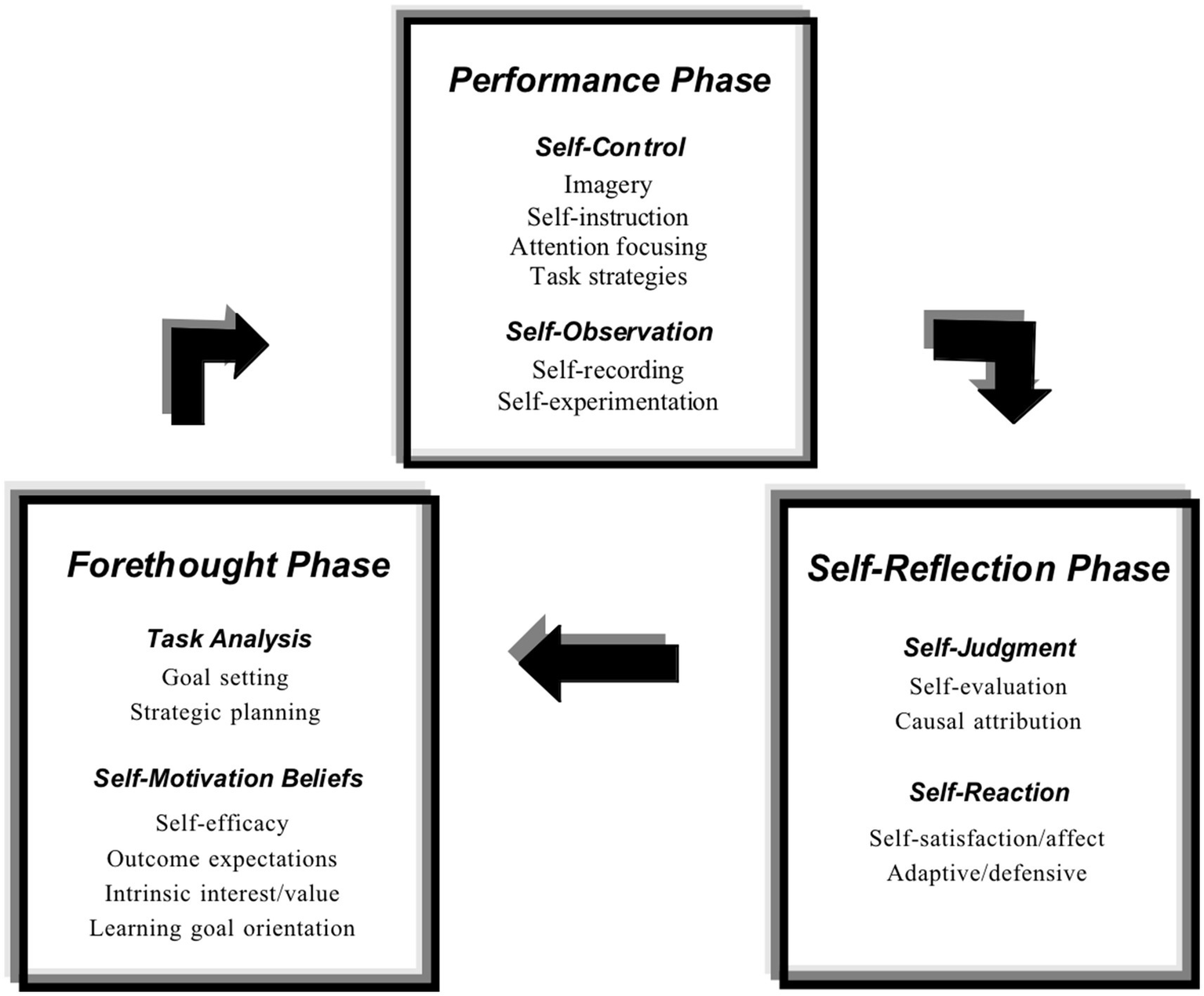
Self-Regulation Process. Adapted from (Zimmerman, 2002).
Zimmerman (2002) describes the application of imagery as a mnemonic strategy. This technique involves mentally linking new knowledge with previous understanding. For instance, when studying the Spanish word “pan” as “bread,” a student may create an image of “bread pan” to enhance comprehension. In this condition, imagery serves as a tool to bridge new information with familiar image concepts, which could positively impact the learning process.
In the context of music practice, Renwick and McPherson (2002) discovered that a clarinetist, while engaging in the SRL cycle to master new pieces, voluntarily visualized her tutor’s performance as a reference to assess her own pitch accuracy during practice. Via an analysis of over 300 surveys from music grade exam instrumental candidates, McCormick and McPherson (2003) suggested that using musical imagery as part of SRL can enhance self-efficacy, which in turn, is likely to improve performance quality. In a related study, Clark and Williamon (2011) conducted a nine-week mental skills training program for conservatory-level students, based on the SRL framework. The program included techniques in mental rehearsal, performance preparation, goal-setting, relaxation, motivation, and arousal control. The students who underwent this training showed notable improvements in self-efficacy, self-awareness, and practice duration compared to those in the control group. Moreover, students who engaged in SRL training reported more frequent and vivid use of imagery in their practice routine and rehearsal (Hatfield, 2016). While these findings underscore the benefits of incorporating intentional musical imagery into SRL, how imagery interacts with the components of SRL and to what extent these improvements are solely attributable to the use of VMI is still unclear.
In essence, while the deliberate use of musical imagery in self-regulated practice is only one part of the broader SRL cycle, its importance cannot be underestimated. As a cognitive strategy, it enhances the integration of new information with existing knowledge. Furthermore, it plays a critical role in managing focus and emotional states, which are crucial for effective and efficient practice (López-Íñiguez and McPherson, 2024; McPherson et al., 2017). Given its significance, future research should focus on optimizing the use of imagery specifically within music practice, leading to more nuanced and effective SRL methodologies tailored to the unique demands of music learners.
4.1.3 Comparative discussion
Despite the theories of DP and SRL being embedded in distinct conceptual grounds, three commonalities are apparent when applied to the context of music practice, particularly in relation to VMI. First, both theoretical models highlight the critical role of VMI in enhancing musicianship by requiring musicians to mentally rehearse complex compositions, improving their execution and deepening their interpretative skills. Second, the emphasis on task-setting and goal-oriented exercises within DP resonates with the strategic execution of learning strategies in SRL. The significance of deliberately employing musical imagery to present or sustain the desired goal/task vividly to assist skill acquisition is highlighted in both (Cotter, 2019). Third, both theories recognize the value of self-monitoring and regulation in the learning process, where the use of VMI enables musicians to assess their performance against desired outcomes, thereby enabling adjustments and improvements.
Despite these commonalities, each theory differs in its primary focus and application. For example, DP is centered around the accumulation of expertise through extensive, effortful practice, with VMI serving as a tool to present and anticipate the performance specifics. On the other hand, SRL presents a more comprehensive learning model that incorporates cognitive, behavioral, and contextual elements. Within this model, VMI is particularly associated with enhancing memorization and regulating emotions. As both theories share a similar commitment to fostering long-term autonomous learning ability (Ericsson, 1998; Zimmerman, 2002), further longitudinal studies illustrating the effects and efficacy regarding musical expertise development in the DP and SRL approaches, especially the role of VMI over the long term, would be of great benefit.
4.2 Voluntary musical imagery in mental practice
4.2.1 Effect of VMI on mental practice
Mental practice (MP) has been well recognized as a means of enhancement that offers extensive benefits for performers in fields like sports (Maring, 1990), music (Coffman, 1990), and surgery (Conlin et al., 2016). In music research, MP refers to the training strategy in which musicians mentally “create or recreate an experience that is similar to a given physical event” (Connolly and Williamon, 2012, p. 224) in the absence of overt muscular motions (Driskell et al., 1994; Highben and Palmer, 2004). This technique has been proven to benefit musicians by enhancing learning efficiency (Coffman, 1990; Lim and Lippman, 1991), increasing practice motivation (Clark and Williamon, 2011), and reducing performance anxiety (Hoffman and Hanrahan, 2012). When engaging in MP, the application of VMI proves crucial. This necessity arises because MP tasks require participants to visualize musical notes and their execution in the mind, a process fundamentally reliant on VMI (e.g., Ross, 1985; Bernardi et al., 2012).
For instance, early research by Rubin-Rabson (1941) identified the beneficial effects of combining mental practice with physical training on music memorization. In this study, participants were tasked with a mental practice section of the piano notes and kept the mental image as vivid as possible. Subsequent research further investigated whether specific imagery content may have an effect on mental practice efficacy. Highben and Palmer (2004) conducted studies on aural and finger sequence discrimination with pianists to assess the impacts of auditory and motor imagery. Their data indicated that, despite individual differences in imagery ability, the auditory aspect of VMI is more crucial for ensuring music memory. Expanding on previous research, Brown and Palmer (2013) studied how VMI influences formally trained pianists’ encoding and retrieval of novel melodies. They found that both auditory and motor imagery improve the recall of pitch accuracy. However, a well-developed auditory imagery capability is particularly effective at enhancing musicians’ accuracy in pitch sequence learning and ensuring consistent temporal control during performance recall. This suggests that auditory imagery should be a primary focus in the development of musical imagery memorization strategies. Moreover, Brown and Palmer (2013) noted that advanced pianists benefit significantly from employing a feed-forward approach using auditory imagery. This strategy involves anticipating and mentally rehearsing the motor sequences necessary for performance, rather than relying solely on feedback from actual auditory inputs during the performance. This proactive use of VMI allows musicians to better prepare and execute their performances (Bernardi et al., 2013; Keller, 2012).
Comparative studies of solely physical practice (PP), MP only, or a combination of both have further highlighted the practical efficacy of VMI. These studies indicate that although PP is the most effective method for learning and memorization, integrating MP into PP can yield comparable effectiveness to PP alone while offering additional advantages. Evidence has suggested that by mentally rehearsing music, trombone students can develop a deeper understanding and more accurate anticipation of the works they are studying (Ross, 1985). This combination approach also enhances the retention of musical notation and performance details (Iorio et al., 2022). Furthermore, incorporating MP into PP optimizes musicians’ practice time and reduces their necessity for extensive physical rehearsal, thereby reducing the risks associated with over-practicing (Bernardi et al., 2012). Additionally, MP enhanced with auditory input, such as background recording (Lim and Lippman, 1991) or verbal singing (Steenstrup et al., 2021), is more effective than MP alone, and dividing imagery content into segments or starting with simple tasks may provide more productive benefits for the advancement of mental practice (Cahn, 2008). It’s worth pointing out that, across all skill levels (i.e., professional and amateur), musicians who engage in some form of practice prove superior to those who do not practice at all (i.e., PP only ≥ MP + PP > MP with recording > MP only > no practice; Ross, 1985; Coffman, 1990; Highben and Palmer, 2004; Bernardi et al., 2012).
Beyond the advancement in music learning, memorizing, and skill acquisition, researchers have shown that employing VMI in music practice offers significant benefits in psychological aspects, including improving focus, minimizing distractions, and enhancing mental toughness (Gregg et al., 2008).
4.2.2 Voluntary musical imagery strategies of mental practice
4.2.2.1 The NBO method
Recently, Davidson-Kelly et al. (2015) conducted a longitudinal study exploring the effects of Nelly Ben-Or’s (NBO) deliberate musical imagery strategy on pianists’ memorization and skill acquisition. Unlike the previous approach of integrating mental practice after physical practice had been established (Rubin-Rabson, 1941), NBO emphasized the early use of VMI to construct a comprehensive performance. This included mentally imagining the music scores, sounds, keyboard layouts, and finger positions before physically engaging with the instrument. Significant findings emerged from this method. Participants reported that the NBO method offered greater clarity and connection with the music by sharpening their focus on the sound and the instrument, improved their learning efficiency, and reduced physical tension. Interestingly, physical practice was not the participants’ top choice (this time ranking seventh out of 12 strategies). In contrast, imagery of the keyboard became the participants’ most favored approach, which represents a notable shift from Highben and Palmer’s (2004) emphasis on auditory imagery. Davidson-Kelly et al. (2015) explained this transfer as being caused by the specific bodily-focused feature of the NBO method. In some way, their different outcome implies the plasticity of a VMI intervention in influencing the different aspects of music learning and enhancement. However, the study also highlighted challenges. The effectiveness of VMI was influenced by the pianists’ existing inner imagery capabilities and their experience with mental practice. Consequently, while the NBO method has shown that VMI can improve musicians’ practice efficiency and have the plasticity to adapt to different needs, further research is required to develop VMI usage guidelines that facilitate musicians’ physical training more adaptively and effectively.
4.2.2.2 The PETTLEP model
The interdisciplinary approach of incorporating sports imagery strategies into music practices has received a great deal of attention in recent years (Gregg et al., 2008; Hays, 2012; Pecen et al., 2016). Wright et al. (2014) discussed the possibility of applying the PETTLEP (Physical, Environment, Task, Timing, Learning, Emotion, and Perspective) model as a VMI framework for musicians to improve performance. Developed by Holmes and Collins (2001), the PETTLEP model serves as an intervention guideline instructing athletes’ mental practice, in which each component is designed to activate the correlated neural area that provides similar effects to the actual movement. Based on the commonalities with imagery tasks in providing efficiency for both musicians and athletes (Driskell et al., 1994), Wright et al. (2014) argued that each element of the PETTLEP model has a corresponding function in musical imagery practice. For instance, the Physical element refers to the deliberate imaging of the performing movements with/without holding instruments; the Environment element indicates the mental imagery of performing in the musical venue; and the Perspective element requires musicians to evaluate their performance via imagery from a first-person or third-person perspective. Compared with previous investigations, Wright et al. (2014) suggested specific content for designing musical imagery interventions under the PETLEP framework. However, the efficacy, optimal combination (i.e., select the elements with needs or all-included), and suitability of each element from the PETTLEP has received limited empirical exploration in musical training.
5 Discussion
By synthesizing existing research on the embodied phenomenon description, neural mechanisms, and practical applications of voluntary musical imagery in music practice, our review has highlighted crucial implications of VMI for researchers, performers, and music educators. However, we discovered significant gaps in previous research on VMI which highlight the need for further research within three critical areas: (1) the impact of embodied experiences on VMI formation, (2) the optimal imagery content and ratio combination to establish a personalized intervention protocol for more effective musical pedagogy, and (3) the measurement from a physiological perspective.
5.1 Exploring the impact of embodied experiences on VMI formation
Upon assessing the definition of VMI from previous literature, we proposed a novel interpretation. This new understanding, situated within an embodied music cognition framework, emphasized the intertwined role of cognition and body in shaping VMI (Godøy and Leman, 2010; Leman and Maes, 2014). However, this perspective also introduces certain limitations that merit further discussion. For instance, while this new interpretation underscores the importance of physical sensations in influencing VMI, direct empirical evidence linking these bodily experiences with musical imagery processes remains scant. This lack of robust data limits our understanding of how physical sensations directly affect the formation and quality of VMI.
To address these gaps, future research should investigate the specific mechanisms through which body sensations interact with musical imagery. One critical question might be: how do different embodied states influence the vividness and accuracy of VMI? For instance, if physical embodiment significantly affects VMI’s application, then inducing a state of physical relaxation (Williamon, 2004) might enhance the vividness and accuracy of musical imagery compared to a state of tension (Holmes and Collins, 2001). Empirical studies could test this prediction by comparing musicians’ VMI usage efficacy under varying physical conditions. Additionally, empirical research could investigate whether musicians’ mastery level, such as physical skills and performance achievement, influences the formation, quality, and sophistication of VMI. This exploration could provide deep insights into the role of embodiment and expertise in shaping VMI across various levels of musical proficiency. For instance, if embodied experience and higher musical achievement significantly impact VMI, we would expect expert musicians with refined techniques and interpretative skills to exhibit more vivid, detailed, and sophisticated VMI than beginners. Investigating this potential bidirectional relationship will deepen our understanding of how VMI and musical expertise influence each other, enhancing practical applications in music education and therapy.
5.2 Optimizing content and protocol for VMI effectiveness enhancement
Despite the recognition of VMI in the development of musical expertise and its multimodal nature during musicians’ mental simulations (Küssner et al., 2022; Keller, 2012), a considerable knowledge gap remains. This gap pertains to our understanding of the content and proportions of various type of VMI in musicians’ practice conditions (Cumming and Eaves, 2018). Specifically, there is insufficient research on how the particular content of imagery (i.e., what is mentally represented) and the engagement degree of various sensory categories (i.e., how much each type of imagery is imagined) impact the effectiveness of VMI. Consequently, music educators, psychologists, and performers may lack clear guidelines for optimizing VMI applications to improve musicians’ learning efficacy.
Therefore, further research is imperative to investigate the commonalities in musicians’ VMI content and to determine the potential individualized multi-model imagery framework that enhances music practice. Such research might raise the question of how to integrate auditory, motor, and visual imagery to maximize learning efficiency and performance quality in musicians. For example, assuming an integration of auditory and motor imagery leads to superior performance outcomes in technical precision and expressive depth, musicians who employ both categories equally could expect to show greater improvements compared to those who focus predominantly on utilizing one kind of imagery. This further investigation could yield crucial insights that enable music educators and performers to most effectively tailor VMI applications to specific practice scenarios. For example, strategies that enhance solo performance preparation may not be equally beneficial for ensemble coordination.
Additionally, the effectiveness of these optimized VMI strategies might vary widely due to individual differences in imagery capabilities and extent of musical training, as seen in previous studies (Davidson-Kelly et al., 2015; Williamon, 2004; Holmes and Collins, 2001). This variability underscores the necessity for the development of a comprehensive VMI intervention protocol, akin to the PETTLEP model but tailored for the music domain. Such a protocol would require collaborative efforts from music educators, psychologists, and performance coaches. As such, future exploration is required to offer tailored guidance for musicians, facilitating mental practice that aligns with their unique learning pace and habits.
5.3 Advancing VMI effectiveness measurement with physiological approaches
While VMI has been shown to have multiple benefits in music practice, including enhancements in self-efficacy, motivation, and anxiety management, the methodologies used to assess these benefits remain limited. Traditional approaches include laboratory-based experiments (e.g., Cahn, 2008), subjective self-reports (e.g., Clark and Williamon, 2011), performance evaluations from external judicators (e.g., Lim and Lippman, 1991) and follow-up interviews (Hatfield, 2016). Although these methods could present the effectiveness of mental imagery via both qualitative and quantitative data, they come with inherent limitations. For instance, laboratory experiments are usually constrained by small sample sizes with simplistic tasks and under researchers’ high control. These elements can lead to experimental settings that deviate markedly from participants’ usual practice environments, potentially affecting the results with unexpected biases (Bernardi et al., 2012). Considering the pivotal role that bodily movements play in manifesting musical cognition and expression (Luck and Toiviainen, 2008), the potential of employing wearable technology (e.g., smartwatches, wristbands, and rings) to monitor physiological markers (such as heart rate, skin temperature, and blood pressure), or the use of unintrusive markerless motion capture solutions, merits attention. Such an approach could provide researchers with objective data reflecting the reality of participants’ engagement with VMI within their familiar environments over extended periods and prompt a novel perspective for understanding musical imagery via physi(ologi)cal correlates.
6 Conclusion
In this review, we defined what voluntary musical imagery is, why it might support musicianship enhancement, and how it might be applied effectively. Our analysis of current studies has broadened the definition of VMI. We propose that VMI is not merely a mental rehearsal of music but an embodied phenomenon where imagery and bodily processes are deeply interconnected. This view is supported by evidence of neural equivalence, showing overlapping and correlated brain activity during the imagination, perception, and physical execution of music. Furthermore, empirical studies that have applied VMI in deliberate practice, self-regulated learning (SRL), and mental practice have demonstrated its utility in enhancing musical practice both mentally and physically. However, limitations within the current body of research on VMI have also been highlighted, such as the lack of empirical data between embodied musical experience and the formation of VMI, the dearth of musicians’ personalized VMI application, and the need for novel objective instruments for measuring VMI’s effectiveness.
Furthermore, this review offers critical insights for music educators, performers, and researchers into the application of VMI. Specifically, educators are encouraged to apply VMI to their teaching, promoting VMI as a complementary technique to physical practice for enhancing learning efficacy. Performers, meanwhile, can leverage VMI for mental preparation, potentially reducing anxiety and improving performance quality. For researchers, the call to action involves adopting more rigorous, unified methods to further unravel VMI’s complexities and its influence on musicianship.
Moreover, VMI’s utility is not confined to formally trained musicians. It offers potential benefits to individuals across various levels of musical engagement, including hobbyists and self-taught musicians. Beyond the music domain, VMI’s applications may extend to other performance-driven fields, such as sports, surgery, and business, where mental rehearsal and imagery are crucial for enhancing skill development and performance outcomes (Maring, 1990; Conlin et al., 2016; Clark and Williamon, 2011).
In conclusion, this literature review contributes analysis to the discourse on Voluntary Musical Imagery (VMI), advocating for its integrated role in enhancing music education and performance.
Statements
Author contributions
CM: Writing – original draft. GL: Supervision, Writing – review & editing.
Funding
The author(s) declare that financial support was received for the research, authorship, and/or publication of this article. This research was supported by the Research Council of Finland [grant nos. 356841 and 346210].
Conflict of interest
The authors declare that the research was conducted in the absence of any commercial or financial relationships that could be construed as a potential conflict of interest.
Publisher’s note
All claims expressed in this article are solely those of the authors and do not necessarily represent those of their affiliated organizations, or those of the publisher, the editors and the reviewers. Any product that may be evaluated in this article, or claim that may be made by its manufacturer, is not guaranteed or endorsed by the publisher.
References
1
Agnew M. (1922). The auditory imagery of great composers. Psychol. Monogr.31, 279–287. doi: 10.1037/h0093171
2
Aleman A. Nieuwenstein M. R. Böcker K. B. E. De Haan E. H. F. (2000). Music training and mental imagery ability. Neuropsychologia38, 1664–1668. doi: 10.1016/S0028-3932(00)00079-8
3
Bailes F. (2006). The use of experience-sampling methods to monitor musical imagery in everyday life. Music. Sci.10, 173–190. doi: 10.1177/102986490601000202
4
Bailes F. (2007a). The prevalence and nature of imagined music in the everyday lives of music students. Psychol. Music35, 555–570. doi: 10.1177/0305735607077834
5
Bailes F. (2007b). Timbre as an elusive component of imagery for music. Empir. Musicol. Rev.2, 21–34. doi: 10.18061/1811/24476
6
Bailes F. (2009). “Translating the musical image: case studies of expert musicians” in Sounds in translation: Intersections of music, technology and society. eds. ChanA.NobleA.. 1st ed (Canberra: ANU Press).
7
Bailes F. (2019). “Musical imagery and the temporality of consciousness” in Music and consciousness 2. ed. BailesF. (Oxford, UK: Oxford University Press), 271–285.
8
Bastepe-Gray S. E. Acer N. Gumus K. Z. Gray J. F. Degirmencioglu L. (2020). Not all imagery is created equal: a functional magnetic resonance imaging study of internally driven and symbol driven musical performance imagery. J. Chem. Neuroanat.104:101748. doi: 10.1016/j.jchemneu.2020.101748
9
Beaman C. P. Williams T. I. (2010). Earworms (stuck song syndrome): towards a natural history of intrusive thoughts. Br. J. Psychol.101, 637–653. doi: 10.1348/000712609X479636
10
Beaty R. E. Burgin C. J. Nusbaum E. C. Kwapil T. R. Hodges D. A. Silvia P. J. (2013). Music to the inner ears: exploring individual differences in musical imagery. Conscious. Cogn.22, 1163–1173. doi: 10.1016/j.concog.2013.07.006
11
Bernardi N. F. De Buglio M. Trimarchi P. D. Chielli A. Bricolo E. (2013). Mental practice promotes motor anticipation: evidence from skilled music performance. Front. Hum. Neurosci.7:451. doi: 10.3389/fnhum.2013.00451
12
Bernardi N. F. Schories A. Jabusch H.-C. Colombo B. Altenmüller E. (2012). Mental practice in music memorization: An ecological-empirical study. Music. Percept.30, 275–290. doi: 10.1525/mp.2012.30.3.275
13
Bishop L. Bailes F. Dean R. T. (2013). Musical expertise and the ability to imagine loudness. PLoS One8:e56052. doi: 10.1371/journal.pone.0056052
14
Brodsky W. Henik A. Rubinstein B.-S. Zorman M. (2003). Auditory imagery from musical notation in expert musicians. Percept. Psychophys.65, 602–612. doi: 10.3758/BF03194586
15
Brown R. M. Palmer C. (2013). Auditory and motor imagery modulate learning in music performance. Front. Hum. Neurosci.7:320. doi: 10.3389/fnhum.2013.00320
16
Cahn D. (2008). The effects of varying ratios of physical and mental practice, and task difficulty on performance of a tonal pattern. Psychol. Music36, 179–191. doi: 10.1177/0305735607085011
17
Centanni T. M. Halpern A. R. Seisler A. R. Wenger M. J. (2020). Context-dependent neural responses to minor notes in frontal and temporal regions distinguish musicians from nonmusicians. Cogn. Affect. Behav. Neurosci.20, 551–564. doi: 10.3758/s13415-020-00785-6
18
Clark T. Lisboa T. Williamon A. (2014). An investigation into musicians’ thoughts and perceptions during performance. Res. Stud. Music Educ.36, 19–37. doi: 10.1177/1321103X14523531
19
Clark T. Williamon A. (2011). Evaluation of a mental skills training program for musicians. J. Appl. Sport Psychol.23, 342–359. doi: 10.1080/10413200.2011.574676
20
Clark T. Williamon A. Aksentijevic A. (2012). “Musical imagery and imagination: the function, measurement, and application of imagery skills for performance” in Musical imaginations: Multidisciplinary perspectives on creativity, performance and perception. eds. HargreavesD.MiellD.MacDonaldR. (Oxford: Oxford University Press).
21
Coffman D. D. (1990). Effects of mental practice, physical practice, and knowledge of results on piano performance. J. Res. Music. Educ.38, 187–196. doi: 10.2307/3345182
22
Conlin A. Lea J. Bance M. Chadha N. Kilty S. Kozak F. et al . (2016). Mental practice in postgraduate training: a randomized controlled trial in mastoidectomy skills. J. Otolaryngol. Head Neck Surg.45:46. doi: 10.1186/s40463-016-0162-2
23
Connolly C. Williamon A. (2012). “Mental skills training” in Musical excellence: Strategies and techniques to enhance performance. ed. WilliamonA. (Oxford: Oxford University Press), 221–245.
24
Cotter K. N. (2019). Mental control in musical imagery: A dual component model. Front. Psychol.10:1904. doi: 10.3389/fpsyg.2019.01904
25
Cox A. (2016). Music and embodied cognition: Listening, moving, feeling, and thinking. Indiana University Press.
26
Crowder R. G. (1989). Imagery for musical timbre. J. Exp. Psychol. Hum. Percept. Perform.15, 472–478. doi: 10.1037//0096-1523.15.3.472
27
Cumming J. Eaves D. L. (2018). The nature, measurement, and development of imagery ability. Imagination, Cognition and Personality, 37, 375–393. doi: 10.1177/0276236617752439
28
Cumming J. Williams S. E. (2012). “The role of imagery in performance” in Handbook of Sport and Performance Psychology. ed. MurphyS. (Oxford: Oxford University Press), 213–232.
29
Dahl S. Stella A. Bjørner T. (2023). Tell me what you see: an exploratory investigation of visual mental imagery evoked by music. Music. Sci.27, 717–740. doi: 10.1177/10298649221124862
30
Davidson-Kelly K. Schaefer R. S. Moran N. Overy K. (2015). “Total inner memory”: deliberate uses of multimodal musical imagery during performance preparation. Psychomusicology: Music, Mind, and Brain25, 83–92. doi: 10.1037/pmu0000091
31
Diana A. (2016). Mental skills training for musicians. International Journal of Music and Performing Arts4, 7–20.
32
Ding Y. Zhang Y. Zhou W. Ling Z. Huang J. Hong B. et al . (2019). Neural correlates of music listening and recall in the human brain. J. Neurosci.39, 8112–8123. doi: 10.1523/JNEUROSCI.1468-18.2019
33
Driskell J. E. Copper C. Moran A. (1994). Does mental practice enhance performance?J. Appl. Psychol.79, 481–492. doi: 10.1037/0021-9010.79.4.481
34
Ericsson K. A. (1996). The road to excellence. New York: Psychology Press.
35
Ericsson K. A. (1998). The scientific study of expert levels of performance: general implications for optimal learning and creativity. High Abil. Stud.9, 75–100. doi: 10.1080/1359813980090106
36
Ericsson K. A. Harwell K. W. (2019). Deliberate practice and proposed limits on the effects of practice on the acquisition of expert performance: why the original definition matters and recommendations for future research. Front. Psychol.10:2396. doi: 10.3389/fpsyg.2019.02396
37
Ericsson K. A. Krampe R. T. Tesch-Römer C. (1993). The role of deliberate practice in the acquisition of expert performance. Psychol. Rev.100, 363–406. doi: 10.1037/0033-295X.100.3.363
38
Floridou G. A. Williamson V. J. Stewart L. Müllensiefen D. (2015). The involuntary musical imagery scale (IMIS). Psychomusicology25, 28–36. doi: 10.1037/pmu0000067
39
Freymuth M. S. (2004). Mental practice and imagery for musicians: A practical guide for optimizing practice time, enhancing performance, and preventing injury. Saint Louis: MMB Music.
40
Gebel B. Braun C. Kaza E. Altenmüller E. Lotze M. (2013). Instrument specific brain activation in sensorimotor and auditory representation in musicians. NeuroImage74, 37–44. doi: 10.1016/j.neuroimage.2013.02.021
41
Gelding R. W. Thompson W. F. Johnson B. W. (2019). Musical imagery depends upon coordination of auditory and sensorimotor brain activity. Sci. Rep.9:16823. doi: 10.1038/s41598-019-53260-9
42
Godøy R. I. (2003). Motor-mimetic music cognition. Leonardo36, 317–319. doi: 10.1162/002409403322258781
43
Godøy R. I. (2019). “Musical shape cognition” in The Oxford handbook of sound and imagination. eds. Grimshaw-AagaardM.Walther-HansenM.KnakkergaardM., vol. 2 (Oxford: Oxford University Press), 236–258.
44
Godøy R. I. (2022). “Intermittent motor control in volitional musical imagery” in Music and mental imagery. eds. KüssnerM. B.TaruffiL.FloridouG. A.WelchG.CrossI.OckelfordA.. 1st ed (London: Routledge), 42–53.
45
Godøy R. I. Jørgensen H. (2001). Musical imagery. New York: Routledge.
46
Godøy R. I. Leman M. (2010). Musical gestures: Sound, movement, and meaning. New York: Routledge.
47
Gordon E. E. (1999). All about Audiation and music aptitudes: Edwin E. Gordon discusses using audiation and music aptitudes as teaching tools to allow students to reach their full music potential. Music. Educ. J.86, 41–44. doi: 10.2307/3399589
48
Gordon E. E. (2021). Learning sequences in music: a contemporary musical learning theory. Chicago: GIA Publications, Inc.
49
Gregg M. J. Clark T. W. Hall C. R. (2008). Seeing the sound: an exploration of the use of mental imagery by classical musicians. Music. Sci.12, 231–247. doi: 10.1177/102986490801200203
50
Halpern A. R. (1999). When that tune runs through your head: a PET investigation of auditory imagery for familiar melodies. Cereb. Cortex9, 697–704. doi: 10.1093/cercor/9.7.697
51
Halpern A. R. (2001). Cerebral substrates of musical imagery. Ann. N. Y. Acad. Sci.930, 179–192. doi: 10.1111/j.1749-6632.2001.tb05733.x
52
Halpern A. A. Overy K. (2019). “Voluntary auditory imagery and music pedagogy” in The Oxford handbook of sound and imagination. eds. Grimshaw-AagaardM.Walther-HansenM.KnakkergaardM., vol. 2 (Oxford: Oxford University Press), 390–407.
53
Halpern A. R. Zatorre R. J. Bouffard M. Johnson J. A. (2004). Behavioral and neural correlates of perceived and imagined musical timbre. Neuropsychologia42, 1281–1292. doi: 10.1016/j.neuropsychologia.2003.12.017
54
Hashim S. Stewart L. Küssner M. B. Omigie D. (2023). Music listening evokes story-like visual imagery with both idiosyncratic and shared content. PLoS One18:e0293412. doi: 10.1371/journal.pone.0293412
55
Hatfield J. L. (2016). Performing at the top of one’s musical game. Front. Psychol.7:1356. doi: 10.3389/fpsyg.2016.01356
56
Hatfield J. L. Lemyre P. N. (2016). Foundations of intervention research in instrumental practice. Front. Psychol.6:2014. doi: 10.3389/fpsyg.2015.02014
57
Hays K. F. (2012). “The psychology of performance in sport and other domains” in The Oxford handbook of sport and performance psychology. ed. MurphyS. (Oxford: Oxford University Press), 24–45.
58
Herbst A. Van Zyl S. (2022). “Multimodal perception in selected visually impaired pianists” in Music and mental imagery. eds. KüssnerM. B.TaruffiL.FloridouG. A.WelchG.CrossI.OckelfordA. (London: Routledge), 255–267.
59
Herholz S. C. Halpern A. R. Zatorre R. J. (2012). Neuronal correlates of perception, imagery, and memory for familiar tunes. J. Cogn. Neurosci.24, 1382–1397. doi: 10.1162/jocn_a_00216
60
Herholz S. C. Lappe C. Knief A. Pantev C. (2008). Neural basis of music imagery and the effect of musical expertise. Eur. J. Neurosci.28, 2352–2360. doi: 10.1111/j.1460-9568.2008.06515.x
61
Highben Z. Palmer C. (2004). Effects of auditory and motor mental practice in memorized piano performance. Bull. Counc. Res. Music. Educ.159, 58–67.
62
Hoffman S. L. Hanrahan S. J. (2012). Mental skills for musicians: managing music performance anxiety and enhancing performance. Sport Exerc. Perform. Psychol.1, 17–28. doi: 10.1037/a0025409
63
Holmes P. (2005). Imagination in practice: a study of the integrated roles of interpretation, imagery and technique in the learning and memorisation processes of two experienced solo performers. Br. J. Music Educ.22, 217–235. doi: 10.1017/S0265051705006613
64
Holmes P. S. Collins D. J. (2001). The PETTLEP approach to motor imagery: a functional equivalence model for sport psychologists. J. Appl. Sport Psychol.13, 60–83. doi: 10.1080/10413200109339004
65
How E. R. Tan L. Miksza P. (2022). A PRISMA review of research on music practice. Music. Sci.26, 675–697. doi: 10.1177/10298649211005531
66
Hubbard T. L. (2010). Auditory imagery: empirical findings. Psychol. Bull.136, 302–329. doi: 10.1037/a0018436
67
Hubbard T. L. Stoeckig K. (1988). Musical imagery: generation of tones and chords. J. Exp. Psychol. Learn. Mem. Cogn.14, 656–667. doi: 10.1037//0278-7393.14.4.656
68
Hyman I. E. Burland N. K. Duskin H. M. Cook M. C. Roy C. M. McGrath J. C. et al . (2013). Going gaga: investigating, creating, and manipulating the song stuck in my head. Appl. Cogn. Psychol.27, 204–215. doi: 10.1002/acp.2897
69
Iorio C. Brattico E. Munk Larsen F. Vuust P. Bonetti L. (2022). The effect of mental practice on music memorization. Psychol. Music50, 230–244. doi: 10.1177/0305735621995234
70
Janata P. Paroo K. (2006). Acuity of auditory images in pitch and time. Percept. Psychophys.68, 829–844. doi: 10.3758/BF03193705
71
Jäncke L. (2012). The dynamic audio–motor system in pianists. Ann. N. Y. Acad. Sci.1252, 246–252. doi: 10.1111/j.1749-6632.2011.06416.x
72
Kajihara T. Verdonschot R. G. Sparks J. Stewart L. (2013). Action-perception coupling in violinists. Front. Hum. Neurosci.7:349. doi: 10.3389/fnhum.2013.00349
73
Keller P. E. (2012). Mental imagery in music performance: underlying mechanisms and potential benefits. Ann. N. Y. Acad. Sci.1252, 206–213. doi: 10.1111/j.1749-6632.2011.06439.x
74
Keller P. E. Appel M. (2010). Individual differences, auditory imagery, and the coordination of body movements and sounds in musical ensembles. Music. Percept.28, 27–46. doi: 10.1525/mp.2010.28.1.27
75
Keller P. E. Koch I. (2008). Action planning in sequential skills: relations to music performance. Q. J. Exp. Psychol.61, 275–291. doi: 10.1080/17470210601160864
76
Kleber B. Birbaumer N. Veit R. Trevorrow T. Lotze M. (2007). Overt and imagined singing of an Italian aria. NeuroImage36, 889–900. doi: 10.1016/j.neuroimage.2007.02.053
77
Klein C. Liem F. Hänggi J. Elmer S. Jäncke L. (2016). The “silent” imprint of musical training. Hum. Brain Mapp.37, 536–546. doi: 10.1002/hbm.23045
78
Kosslyn S. M. Ganis G. Thompson W. L. (2001). Neural foundations of imagery. Nat. Rev. Neurosci.2, 635–642. doi: 10.1038/35090055
79
Kraemer D. J. M. Macrae C. N. Green A. E. Kelley W. M. (2005). Sound of silence activates auditory cortex. Nature434:158. doi: 10.1038/434158a
80
Küssner M. B. Taruffi L. Floridou G. A. Welch G. Cross I. Ockelford A. (2022). Music and mental imagery. 1st Edn. London: Routledge.
81
Langheim F. (2002). Cortical systems associated with covert music rehearsal. NeuroImage16, 901–908. doi: 10.1006/nimg.2002.1144
82
Lehmann A. C. Ericsson K. A. (1997). Research on expert performance and deliberate practice: implications for the education of amateur musicians and music students. Psychomusicology16, 40–58. doi: 10.1037/h0094068
83
Leman M. (2008). Embodied music cognition and mediation technology. Cambridge, Mass: MIT Press.
84
Leman M. Maes P. J. (2014). The role of embodiment in the perception of music. Empir. Musicol. Rev.9, 236–246. doi: 10.18061/emr.v9i3-4.4498
85
Leman M. Maes P.-J. Nijs L. Van Dyck E. (2018). “What is embodied music cognition?” in Springer handbook of systematic musicology. ed. BaderR. (Berlin Heidelberg: Springer), 747–760.
86
Leon-Guerrero A. (2008). Self-regulation strategies used by student musicians during music practice. Music. Educ. Res.10, 91–106. doi: 10.1080/14613800701871439
87
Levitin D. J. Grafton S. T. (2016). Measuring the representational space of music with fMRI: a case study with sting. Neurocase22, 548–557. doi: 10.1080/13554794.2016.1216572
88
Liikkanen L. A. (2012). Musical activities predispose to involuntary musical imagery. Psychol. Music40, 236–256. doi: 10.1177/0305735611406578
89
Liikkanen L. A. Jakubowski K. (2020). Involuntary musical imagery as a component of ordinary music cognition: a review of empirical evidence. Psychon. Bull. Rev.27, 1195–1217. doi: 10.3758/s13423-020-01750-7
90
Lim S. Lippman L. G. (1991). Mental practice and memorization of piano music. J. Gen. Psychol.118, 21–30. doi: 10.1080/00221309.1991.9711130
91
Lima C. F. Krishnan S. Scott S. K. (2016). Roles of supplementary motor areas in auditory processing and auditory imagery. Trends Neurosci.39, 527–542. doi: 10.1016/j.tins.2016.06.003
92
López-Íñiguez G. McPherson G. E. (2024). Using a music microanalysis protocol to enhance instrumental practice. Front. Psychol.15:1368074. doi: 10.3389/fpsyg.2024.1368074
93
Lotze M. (2013). Kinesthetic imagery of musical performance. Front. Hum. Neurosci.7:50096. doi: 10.3389/fnhum.2013.00280
94
Lotze M. Montoya P. Erb M. Hülsmann E. Flor H. Klose U. et al . (1999). Activation of cortical and cerebellar motor areas during executed and imagined hand movements: an fMRI study. J. Cogn. Neurosci.11, 491–501. doi: 10.1162/089892999563553
95
Lotze M. Scheler G. Tan H.-R. M. Braun C. Birbaumer N. (2003). The musician’s brain: functional imaging of amateurs and professionals during performance and imagery. NeuroImage20, 1817–1829. doi: 10.1016/j.neuroimage.2003.07.018
96
Luck G. Toiviainen P. (2008). Exploring relationships between the kinematics of a singer’s body movement and the quality of their voice. J. Interdiscip. Music Stud.2, 173–186.
97
Macnamara B. N. Hambrick D. Z. Oswald F. L. (2014). Deliberate practice and performance in music, games, sports, education, and professions: a meta-analysis. Psychol. Sci.25, 1608–1618. doi: 10.1177/0956797614535810
98
Maring J. R. (1990). Effects of mental practice on rate of skill acquisition. Phys. Ther.70, 165–172. doi: 10.1093/ptj/70.3.165
99
Mazur Z. Laguna M. (2019). The role of affect in practicing a musical instrument: a systematic review of the literature. Psychol. Music47, 848–863. doi: 10.1177/0305735619861831
100
McCormick J. McPherson G. (2003). The role of self-efficacy in a musical performance examination: an exploratory structural equation analysis. Psychol. Music31, 37–51. doi: 10.1177/0305735603031001322
101
McCullough Campbell S. Hellmuth Margulis E. (2015). Catching an earworm through movement. J. New Music Res.44, 347–358. doi: 10.1080/09298215.2015.1084331
102
McPherson G. E. Osborne M. S. Evans P. Miksza P. (2017). Applying self-regulated learning microanalysis to study musicians’ practice. Psychol. Music47, 18–32. doi: 10.1177/0305735617731614
103
Meister I. G. Krings T. Foltys H. Boroojerdi B. Müller M. Töpper R. et al . (2004). Playing piano in the mind—an fMRI study on music imagery and performance in pianists. Cogn. Brain Res.19, 219–228. doi: 10.1016/j.cogbrainres.2003.12.005
104
Miksza P. (2011). A review of research on practicing: summary and synthesis of the extant research with implications for a new theoretical orientation. Bull. Counc. Res. Music. Educ.190, 51–92. doi: 10.5406/bulcouresmusedu.190.0051
105
Mongelli V. Dehaene S. Vinckier F. Peretz I. Bartolomeo P. Cohen L. (2017). Music and words in the visual cortex: the impact of musical expertise. Cortex86, 260–274. doi: 10.1016/j.cortex.2016.05.016
106
Müllensiefen D. Fry J. Jones R. Jilka S. Stewart L. Williamson V. J. (2014). Individual differences predict patterns in spontaneous involuntary musical imagery. Music. Percept.31, 323–338. doi: 10.1525/mp.2014.31.4.323
107
Niedenthal P. M. Barsalou L. W. Winkielman P. Krauth-Gruber S. Ric F. (2005). Embodiment in attitudes, social perception, and emotion. Pers. Soc. Psychol. Rev.9, 184–211. doi: 10.1207/s15327957pspr0903_1
108
Nielsen S. (2001). Self-regulating learning strategies in instrumental music practice. Music. Educ. Res.3, 155–167. doi: 10.1080/14613800120089223
109
Panadero E. (2017). A review of self-regulated learning: six models and four directions for research. Front. Psychol.8:422. doi: 10.3389/fpsyg.2017.00422
110
Passarotto E. Preckel F. Schneider M. Müllensiefen D. (2022). Deliberate practice in music: development and psychometric validation of a standardized measurement instrument. Psychol. Music50, 1637–1655. doi: 10.1177/03057356211065172
111
Pecen E. Collins D. MacNamara Á. (2016). Music of the night: performance practitioner considerations for enhancement work in music. Sport Exerc. Perform. Psychol.5, 377–395. doi: 10.1037/spy0000067
112
Platz F. Kopiez R. Lehmann A. C. Wolf A. (2014). The influence of deliberate practice on musical achievement: a meta-analysis. Front. Psychol.5:646. doi: 10.3389/fpsyg.2014.00646
113
Regev M. Halpern A. R. Owen A. M. Patel A. D. Zatorre R. J. (2021). Mapping specific mental content during musical imagery. Cereb. Cortex31, 3622–3640. doi: 10.1093/cercor/bhab036
114
Renwick J. M. McPherson G. E. (2002). Interest and choice: student-selected repertoire and its effect on practising behaviour. Br. J. Music Educ.19:256. doi: 10.1017/S0265051702000256
115
Ross S. L. (1985). The effectiveness of mental practice in improving the performance of college trombonists. J. Res. Music. Educ.33, 221–230. doi: 10.2307/3345249
116
Rubin-Rabson G. (1941). Studies in the psychology of memorizing piano music. VI: A comparison of two forms of mental rehearsal and keyboard overlearning. J. Edu. Psychol.32, 593–602. doi: 10.1037/h0058481
117
Schiavio A. Menin D. Matyja J. (2014). Music in the flesh: embodied simulation in musical understanding. Psychomusicology24, 340–343. doi: 10.1037/pmu0000052
118
Schunk D. H. Zimmerman B. J. (2009). Self-regulation of learning and performance: Issues and educational applications. 1st Edn. New York: Routledge.
119
Seashore C. E. (1919). “Musical imagery and imagination” in The psychology of musical talent. ed. SeashoreC. E. (New York: Silver, Burdett and Company), 211–235.
120
Sloboda J. A. Davidson J. W. Howe M. J. A. Moore D. G. (1996). The role of practice in the development of performing musicians. Br. J. Psychol.87, 287–309. doi: 10.1111/j.2044-8295.1996.tb02591.x
121
Steenstrup K. Haumann N. T. Kleber B. Camarasa C. Vuust P. Petersen B. (2021). Imagine, sing, play- combined mental, vocal and physical practice improves musical performance. Front. Psychol.12, 757052. doi: 10.3389/fpsyg.2021.757052
122
Tanaka S. Kirino E. (2017). Dynamic reconfiguration of the supplementary motor area network during imagined music performance. Front. Hum. Neurosci.11:302154. doi: 10.3389/fnhum.2017.00606
123
Thompson M. R. Luck G. (2012). Exploring relationships between pianists’ body movements, their expressive intentions, and structural elements of the music. Music. Sci.16, 19–40. doi: 10.1177/1029864911423457
124
Varela W. Abrami P. C. Upitis R. (2016). Self-regulation and music learning: a systematic review. Psychol. Music44, 55–74. doi: 10.1177/0305735614554639
125
Varela F. J. Rosch E. Thompson E. (2016). The embodied mind: Cognitive science and human experience. (Revised edition). Cambridge, MA: MIT Press.
126
Varela F. J. Thompson E. Rosch E. (1991). The embodied mind: Cognitive science and human experience. Cambridge, MA: MIT Press.
127
Vilnite F. M. Marnauza M. (2023). Thinking ahead: the use of mental training in young violinists’ skill development. Music. Educ. Res.25, 545–561. doi: 10.1080/14613808.2023.2272166
128
Williamon A. (2004). Musical excellence: Strategies and techniques to enhance performance. Oxford: Oxford University Press.
129
Williams T. I. (2015). The classification of involuntary musical imagery: the case for earworms. Psychomusicology25, 5–13. doi: 10.1037/pmu0000082
130
Williamson V. J. Jilka S. R. (2014). Experiencing earworms: an interview study of involuntary musical imagery. Psychol. Music42, 653–670. doi: 10.1177/0305735613483848
131
Williamson V. J. Jilka S. R. Fry J. Finkel S. Müllensiefen D. Stewart L. (2012). How do “earworms” start? Classifying the everyday circumstances of involuntary musical imagery. Psychol. Music40, 259–284. doi: 10.1177/0305735611418553
132
Wilson M. (2002). Six views of embodied cognition. Psychon. Bull. Rev.9, 625–636. doi: 10.3758/BF03196322
133
Wöllner C. Williamon A. (2007). An exploratory study of the role of performance feedback and musical imagery in piano playing. Res. Stud. Music Educ.29, 39–54. doi: 10.1177/1321103X07087567
134
Woody R. H. (2002). Emotion, imagery and metaphor in the acquisition of musical performance skill. Music. Educ. Res.4, 213–224. doi: 10.1080/1461380022000011920
135
Wright D. J. Wakefield C. J. Smith D. (2014). Using PETTLEP imagery to improve music performance: a review. Music. Sci.18, 448–463. doi: 10.1177/1029864914537668
136
Zatorre R. J. (2003). Music and the brain. Ann. N. Y. Acad. Sci.999, 4–14. doi: 10.1196/annals.1284.001
137
Zatorre R. J. Halpern A. R. (1993). Effect of unilateral temporal-lobe excision on perception and imagery of songs. Neuropsychologia31, 221–232. doi: 10.1016/0028-3932(93)90086-F
138
Zatorre R. J. Halpern A. R. (2005). Mental concerts: musical imagery and auditory cortex. Neuron47, 9–12. doi: 10.1016/j.neuron.2005.06.013
139
Zatorre R. J. Halpern A. R. Perry D. W. Meyer E. Evans A. C. (1996). Hearing in the mind’s ear: a PET investigation of musical imagery and perception. J. Cogn. Neurosci.8, 29–46. doi: 10.1162/jocn.1996.8.1.29
140
Zhang J. D. Susino M. McPherson G. E. Schubert E. (2020). The definition of a musician in music psychology: a literature review and the six-year rule. Psychol. Music48, 389–409. doi: 10.1177/0305735618804038
141
Zimmerman B. J. (1989). A social cognitive view of self-regulated academic learning. J. Educ. Psychol.81, 329–339. doi: 10.1037/0022-0663.81.3.329
142
Zimmerman B. J. (1990). Self-regulated learning and academic achievement: an overview. Educ. Psychol.25, 3–17. doi: 10.1207/s15326985ep2501_2
143
Zimmerman B. J. (2000). “Attaining self-regulation: a social cognitive perspective” in Handbook of self-regulation. eds. BoekaertsM.PintrichP. R.ZeidnerM. (New York: Academic Press), 13–39.
144
Zimmerman B. J. (2002). Becoming a self-regulated learner: an overview. Theory Pract.41, 64–70. doi: 10.1207/s15430421tip4102_2
Summary
Keywords
music practice, voluntary musical imagery, embodied music cognition, neural activation, functional equivalence, mental practice, practice strategies, PETTLEP model
Citation
Meng C and Luck G (2024) Voluntary musical imagery in music practice: contextual meaning, neuroscientific mechanisms and practical applications. Front. Psychol. 15:1452179. doi: 10.3389/fpsyg.2024.1452179
Received
20 June 2024
Accepted
29 October 2024
Published
11 November 2024
Volume
15 - 2024
Edited by
Graham Frederick Welch, University College London, United Kingdom
Reviewed by
Steven Morrison, Northwestern University, United States
Kristian Steenstrup, The Royal Academy of Music, Denmark
Updates
Copyright
© 2024 Meng and Luck.
This is an open-access article distributed under the terms of the Creative Commons Attribution License (CC BY). The use, distribution or reproduction in other forums is permitted, provided the original author(s) and the copyright owner(s) are credited and that the original publication in this journal is cited, in accordance with accepted academic practice. No use, distribution or reproduction is permitted which does not comply with these terms.
*Correspondence: Chen Meng, chen.c.men@jyu.fi
Disclaimer
All claims expressed in this article are solely those of the authors and do not necessarily represent those of their affiliated organizations, or those of the publisher, the editors and the reviewers. Any product that may be evaluated in this article or claim that may be made by its manufacturer is not guaranteed or endorsed by the publisher.