Abstract
Introduction:
Learning to write is a complex task involving peripheral (e.g., handwriting speed and legibility) and central (e.g., spelling) processes. Coordinating these processes is particularly demanding for novice writers who have not yet automated their handwriting skills. To better support children in developing handwriting, it is crucial to understand the development and interactions of these peripheral and central processes over time.
Methods:
This longitudinal study (n = 363; 49.8% girls) investigated the development and interrelations of handwriting speed (time spent on writing tasks), legibility, and spelling in German-speaking first-grade children (Mage = 7 years) across 12 months. The children were assessed at three time points, spaced 6 months apart, from the beginning of the first grade to the start of the second grade.
Results and discussion:
While performance in all domains of handwriting (time, legibility, and spelling) improved over the school year, these skills were particularly strongly interrelated at the beginning of writing acquisition but became increasingly independent towards the second grade. Surprisingly, the results from the structural equation model showed that the relations between handwriting legibility and time reversed over time: Initially, faster handwriting was associated with more legible handwriting, while with increasing practice a trade-off appeared. Furthermore, when considering cross-lagged paths, the structural equation model revealed that handwriting legibility at the beginning of the first grade significantly predicted subsequent handwriting time and spelling abilities at the end of the school year. In summary, handwriting proficiency stabilizes quickly, while patterns of associations between peripheral and central handwriting processes change across the first year of handwriting instruction.
Introduction
Writing is an essential tool for conveying thoughts and preserving knowledge, involving a sophisticated interplay of cognitive and motor processes. Composing written content requires individuals to convert abstract ideas into words that adhere to spelling rules. At the same time, fine motor control of finger and hand movements is essential for producing legible text. More recently, two facets of writing have been discussed: the central processes, which involve retrieving and manipulating orthographic knowledge for spelling, and the peripheral processes, which cover the motor aspects of letter formation (Afonso and Álvarez, 2019). For novices, such as young children learning to write, both domains are new. Early on, they must simultaneously coordinate the processes of forming legible characters efficiently (peripheral processes) and following phoneme-grapheme rules (central processes; Afonso and Álvarez, 2019). Although children dedicate considerable portions of their school day to writing tasks, there is a scarcity of research focused on how fundamental writing skills, such as spelling, handwriting speed (i.e., time spent on handwriting tasks), and legibility, emerge and interrelate in beginner writers but see Caramia et al. (2020). Understanding these fundamental skills and their interactions is imperative for fostering literacy and education.
Theoretical writing models, such as the Not-so-Simple View of Writing (Berninger and Winn, 2006), posit that transcription skills, such as handwriting and spelling abilities, must become automatic to liberate cognitive resources for higher-order writing tasks like text generation. While this model is widely accepted and supported by diverse research (Berninger et al., 2010; Salas and Silvente, 2020; Valcan et al., 2020), it cannot explain the interrelations between the individual transcription skills (i.e., handwriting and spelling) and how these develop to reach automaticity.
Alternatively, van Galen’s (1991) psychomotor model views writing as a multicomponent task that integrates cognitive, psychomotor, and biophysical processes. Cognitive processes manage idea generation and word retrieval, tapping into long-term memory for spelling rules and letter shapes. Meanwhile, psychomotor processes regulate pen movements, complemented by biophysical mechanisms that adjust pressure and timing, thus ensuring consistency in the written output (e.g., letter shapes). In a hierarchical framework, the result of a higher-level process initiates subsequent, lower-level processes. For instance, novice writers must recall the correct letter sequence from memory (higher order) and convert this into precise motor movements to form this letter sequence on the paper (lower order).
Many studies estimate handwriting proficiency using the alphabet writing task, which measures the speed of recalling and handwriting the letters of the alphabet (e.g., Kim et al., 2013; Valcan et al., 2020). This task necessitates remembering the letters in their correct order and is influenced, among other factors, by a child’s knowledge of the alphabet and the speed at which they can retrieve this information from memory. However, measures of handwriting speed that account for time spent writing in a more naturalistic context are rare yet necessary to better understand the development of handwriting speed (i.e., time), legibility, and spelling, as well as how these aspects interact over time.
Moreover, there is a scarcity of studies investigating handwriting legibility and handwriting time simultaneously (however, see: Gosse et al., 2021; Graham et al., 2011; Karlsdottir and Stefansson, 2002; Rosenblum et al., 2003). Legible handwriting is crucial for readers’ decoding and reading comprehension and affects how teachers view assignments. Neater and more legible handwriting often leads to higher grades, independent of the essay’s content (Graham et al., 2011; Rosenblum et al., 2003). Furthermore, efficient handwriting, that is, quick handwriting (Salas and Silvente, 2020; Valcan et al., 2020), is vital for staying on track with classroom assignments and activities, as in many contexts, more efficient handwriting results in a longer final product (Malpique et al., 2020; Suggate et al., 2018).
Differing from skilled writers, children at the beginning of handwriting acquisition who have not yet automated the skill (Fitjar et al., 2021) must switch their attention between various writing processes (Olive and Kellogg, 2002). Studies in elementary school students show that the fundamental central (e.g., spelling) and peripheral writing processes (e.g., time and legibility) might interact, as the requirements of one skill (e.g., spelling) can influence the other (e.g., time). For example, 8-10-year-old children displayed longer handwriting times when dealing with orthographically irregular words as opposed to orthographically regular ones, suggesting that increased spelling demands require children to reduce their handwriting speed (Kandel and Perret, 2015). Additional evidence of a link between peripheral and central writing processes has been found in research on bilingual children, who exhibit less legible handwriting than their monolingual peers, pointing to a potential connection between spelling complexities and legibility (Caravolas et al., 2020).
The relations between handwriting speed and legibility, however, present varied evidence: Certain studies indicate a positive correlation, with more legible handwriting aligning with faster handwriting, and conversely, less legible handwriting going along with slower handwriting (Fitjar et al., 2022; Maurer, 2023). In contrast, other studies point to a negative correlation, with more legible handwriting being associated with more time spent on handwriting, implying that children slow down their handwriting to enhance precision (Gosse et al., 2021). Some studies even suggest that speed and legibility are distinct, unrelated elements (Duiser et al., 2020; Downing and Caravolas, 2023). These mixed findings point to our fragmented understanding of the development of this trade-off between legibility and handwriting time in novice writers.
To get a comprehensive picture of how central and peripheral processes develop and interact, handwriting time, legibility, and spelling need to be investigated simultaneously. Few studies so far have done this. A recent concurrent study explored these domains in third-, fourth-, and fifth-grade children, concluding that graphomotor skills are more crucial for handwriting legibility, while spelling plays a more significant role in handwriting speed (Downing and Caravolas, 2023). Gosse et al. (2021) confirmed a link between spelling and handwriting speed and found that early spelling proficiency in third grade predicted subsequent handwriting speed, indicating a steeper increase in handwriting speed in children with initially poorer spelling skills. In third grade, a significant negative association was observed between handwriting legibility and time, suggesting that more legible handwriting goes along with slower handwriting. However, no longitudinal relations were identified between handwriting time, legibility, and spelling, possibly due to the well-developed handwriting skills typical in late elementary school. Although speed and spelling tend to improve throughout elementary school (Karlsdottir and Stefansson, 2002; Gosse et al., 2021), handwriting legibility seems to plateau after second grade (Karlsdottir and Stefansson, 2002; Overvelde and Hulstijn, 2011). Research on younger children aged 5–6 years suggests that legibility might support spelling development (Pritchard et al., 2021), yet the long-term dynamic between these writing elements (i.e., time, legibility, and spelling) in novice writers remains elusive.
The present study
This study aims to investigate the development and longitudinal relations between handwriting time, legibility, and spelling in young, novice writers. We assessed children’s handwriting time and legibility three times across the first year of handwriting instruction. Additionally, spelling abilities were assessed twice, at the end of first grade and the beginning of second grade. Based on van Galen’s (1991) psychomotor writing model and prior findings, we anticipate concurrent and longitudinal interrelationships between these writing skills, hypothesizing that more efficient (i.e., less time spent on a handwriting task and thus faster) handwriting correlates with higher spelling accuracy and vice versa. However, uncertainties persist about how handwriting time and legibility interrelate in novice writers (Gosse et al., 2021; Downing and Caravolas, 2023; Maurer, 2023), so we did not formulate any hypothesis.
Methods
Participants
A sample of 363 children (49.8% girls) from diverse urban and rural areas in Switzerland underwent three assessments: at the start of the first grade (T1; M = 7 years, SD = 4.65 months, range = 6 years 3 months to 8 years 2 months), the end of first grade (T2), and at the beginning of the second grade (T3), each assessment being 6 months apart. The majority (86%) were right-handed, and 40% received varied educational support, such as speech and language therapy, psychomotor therapy, special language support for non-native speakers, and occupational therapy, which is common for children needing assistance in meeting learning objectives in Switzerland. Most of the children (75%) spoke German/Swiss-German. All children were taught writing in German. German is a language with low orthographic depth, allowing children to spell the words letter by letter (Seymour et al., 2003). Socioeconomic background was assessed using the International Socio-Economic Index (ISEI; Ganzeboom et al., 1992) based on parental occupations, considering income and education, and varied widely from 14.39 to 88.98 (low-status jobs like waste disposal to high-status professions such as judges). Mothers’ average socioeconomic index was M = 54.60 (SD = 20.05), and fathers’ M = 56.88 (SD = 21.63), both slightly above the European average (Entorf and Minoiu, 2005). Written consent was obtained from the parents, and verbal consent from the children. This study, approved by the Ethics Committee of the Bern University of Teacher Education, was part of a broader research project (Approval No. 19s000201).
Measures
Handwriting time
To assess handwriting time, children copied six words (four six-letter words and two eight-letter words) on a piece of paper, placed on a digitized tablet using a WACOM Inking Pen. Light grey bars of 1 cm in height were printed on the paper to ensure that children wrote in a comparable size. The digitized tablet, connected to a laptop computer, utilized the software CSWin (Mai and Marquardt, 2016) to capture the duration of writing (i.e., handwriting time). Specifically, time in milliseconds was recorded from the first pen contact at the start to its lift-off after completion.
Handwriting legibility
The same six words used for handwriting time assessment were rated for overall legibility (Barnett et al., 2018). A co-author independently rated the recognizability of each letter within a word, determining if it could be identified as this letter in isolation (score 1) or if it could not be identified or could be mistaken for another letter (score 0)—without the context provided by adjacent letters. This global, i.e., holistic evaluation is a standard method in many handwriting legibility studies (see Rosenblum et al., 2003 for review). To accommodate words of varying letter counts, legibility was calculated as the percentage of legible letters per word.
Spelling
Children’s spelling abilities were evaluated using four words of varying difficulty from the Hamburger Writing Test [Hamburger Schreibprobe] (May, 2002), a standardized test for first and second graders. The words were presented orally with accompanying images. Children spelled the words on paper, and accuracy was scored as the percentage of correctly written graphemes for each word. Spelling was assessed at the second (T2; end of first grade) and third (T3; start of second grade) time points but not initially (T1) since children at the start of first grade generally cannot spell.
Data analysis
Initially, a repeated measures ANOVA for the three writing variables across the different assessment points was performed using RStudio Version 4.3.3 and the package Jamovi (The Jamovi Project, 2024). Subsequently, we conducted correlation analyses for the three writing variables across the different assessment points. The analyses utilized the mean handwriting time and the percentage of correct letters (i.e., graphemes) across all words. In the repeated measures ANOVA, generalized Eta squared was employed to estimate effect sizes, with η2 = 0.01 indicating a small effect, η2 = 0.06 a medium effect, and η2 = 0.14 a large effect (Bakeman, 2005; Cohen, 1973).
To investigate the longitudinal relationships among handwriting time, legibility, and spelling abilities, we conducted a cross-lagged structural equation model using MPlus Version 8.7 (Muthén and Muthén, 2017). Full maximum likelihood estimation was used to handle missing data, and we allowed covariances to vary to accommodate shared variances between measures. Criteria for good model fit are defined by an insignificant Chi-square (χ2), CFI > 0.95, RMSEA < 0.08, and SRMR < 0.06 (Hu and Bentler, 1999). As Chi-square is sensitive to sample size (Cheung and Rensvold, 2002; Curran et al., 2002), in larger samples, an appropriate Chi-square can also be defined by χ2/df < 2 (Jöreskog, 1993). Mothers’ and fathers’ socioeconomic backgrounds (measured by ISEI) were not significantly related to any of the writing variables (correlations ranging between r = 0.00 and r = 0.11) and were therefore not further considered in the analyses.
Results
Mean differences in handwriting development
Table 1 shows the descriptive statistics for the handwriting variables across the three measurement points, as well as mean difference tests across the measurement points, as indicated by the results of the repeated measures ANOVA. Performance on all handwriting variables changed significantly across the first and second school years. Post-hoc pairwise comparisons using the Tukey test for handwriting time and handwriting legibility revealed significant changes between the first and second [time: t(312) = 23.78, p < 0.001 legibility: t(307) = 5.39, p < 0.001], the second and the third [time: t(312) = 15.63, p < 0.001; legibility: t(307) = 5.30, p < 0.001], and the first and the third measurement points [time: t(312) = 33.86, p < 0.001; legibility: t(307) = 9.36, p < 0.001]. Table 2 presents correlations between the handwriting variables over the three measurement points.
Table 1
| Measurement | ||||||
|---|---|---|---|---|---|---|
| T1 | T2 | T3 | ||||
| M (SD) | M (SD) | M (SD) | F (df1, df2) | p | Generalized η2 | |
| Handwriting time (in ms) | 29,246.49 (9,161.28) | 17,697.98 (6,367.987) | 13,698.66 (4,899.68) | 757.90 (2, 312) | <0.001 | 0.46 |
| Handwriting legibility (% correct) | 85.96% (10.27%) | 89.00% (8.44%) | 91.58% (7.96%) | 51.78 (2, 307) | <0.001 | 0.06 |
| Spelling (% correct) | - | 79.34% (11.56%) | 82.91% (9.98%) | 67.20 (1, 331) | <0.001 | 0.03 |
Means (M), standard deviations (SD), and repeated measures ANOVA.
Table 2
| 1 | 2 | 3 | 4 | 5 | 6 | 7 | |
|---|---|---|---|---|---|---|---|
| 1. Handwriting time T1 | - | - | - | - | - | - | - |
| 2. Handwriting time T2 | 0.47*** | - | - | - | - | - | - |
| 3. Handwriting time T3 | 0.49*** | 0.66*** | - | - | - | - | - |
| 4. Handwriting legibility T1 | −0.16** | −0.20*** | −0.15** | - | - | - | - |
| 5. Handwriting legibility T2 | −0.15** | −0.04 | −0.07 | 0.41*** | - | - | - |
| 6. Handwriting legibility T3 | −0.14* | −0.01 | 0.08 | 0.39*** | 0.52*** | - | - |
| 7. Spelling T2 | −0.12* | −0.30*** | −0.24*** | 0.34*** | 0.33*** | 0.22*** | - |
| 8. Spelling T3 | −0.12* | −0.28*** | −0.27*** | 0.29*** | 0.39*** | 0.22*** | 0.68*** |
Pearson correlations for the manifest writing variables.
*p < 0.05, **p < 0.01, ***p < 0.001.
Longitudinal trajectories of handwriting development
Longitudinal trajectories of handwriting development were analyzed using a cross-lagged structural equation model, which encompassed handwriting time, legibility, and spelling abilities at three different measurement points. The model fits the data well: χ2(840) = 1244.70, p < 0.001, CFI = 0.94, RMSEA = 0.04, SRMR = 0.05. The Chi-square difference test was significant, with χ2/df = 1.48, which falls within acceptable benchmarks for a reasonable Chi-square value (Jöreskog, 1993). Factor loading variability for the manifest variables on latent constructs at each time point is shown in Table 3. Manifest variables consisted of scores from six written words for handwriting time and legibility and scores from four written words for spelling abilities. All factor loadings surpassed the accepted thresholds (Chin, 1998).
Table 3
| Measurement point | |||
|---|---|---|---|
| T1 | T2 | T3 | |
| λ | λ | λ | |
| Handwriting time (six variables) | 0.78–0.89 | 0.76–0.85 | 0.74–0.84 |
| Handwriting legibility (six variables) | 0.45–0.79 | 0.52–0.66 | 0.51–0.77 |
| Spelling abilities (four variables) | - | 0.49–0.70 | 0.40–0.58 |
Factor loadings of the manifest variables.
Figure 1 presents the standardized path coefficients for the estimated cross-lagged structural equation model. While all paths were estimated, including cross-sectional correlations, only significant paths are depicted in the figure. At the onset of first grade (T1), a negative association was found between handwriting time and legibility (r = −0.23, p < 0.001), suggesting that writers who needed less time tended to write more legibly. In contrast, by the end of first grade (T2; r = 0.17, p = 0.02) and the start of second grade (T3; r = 0.26, p = 0.001), the relationship reversed, and children who spent more time on the handwriting task wrote more legibly.
Figure 1
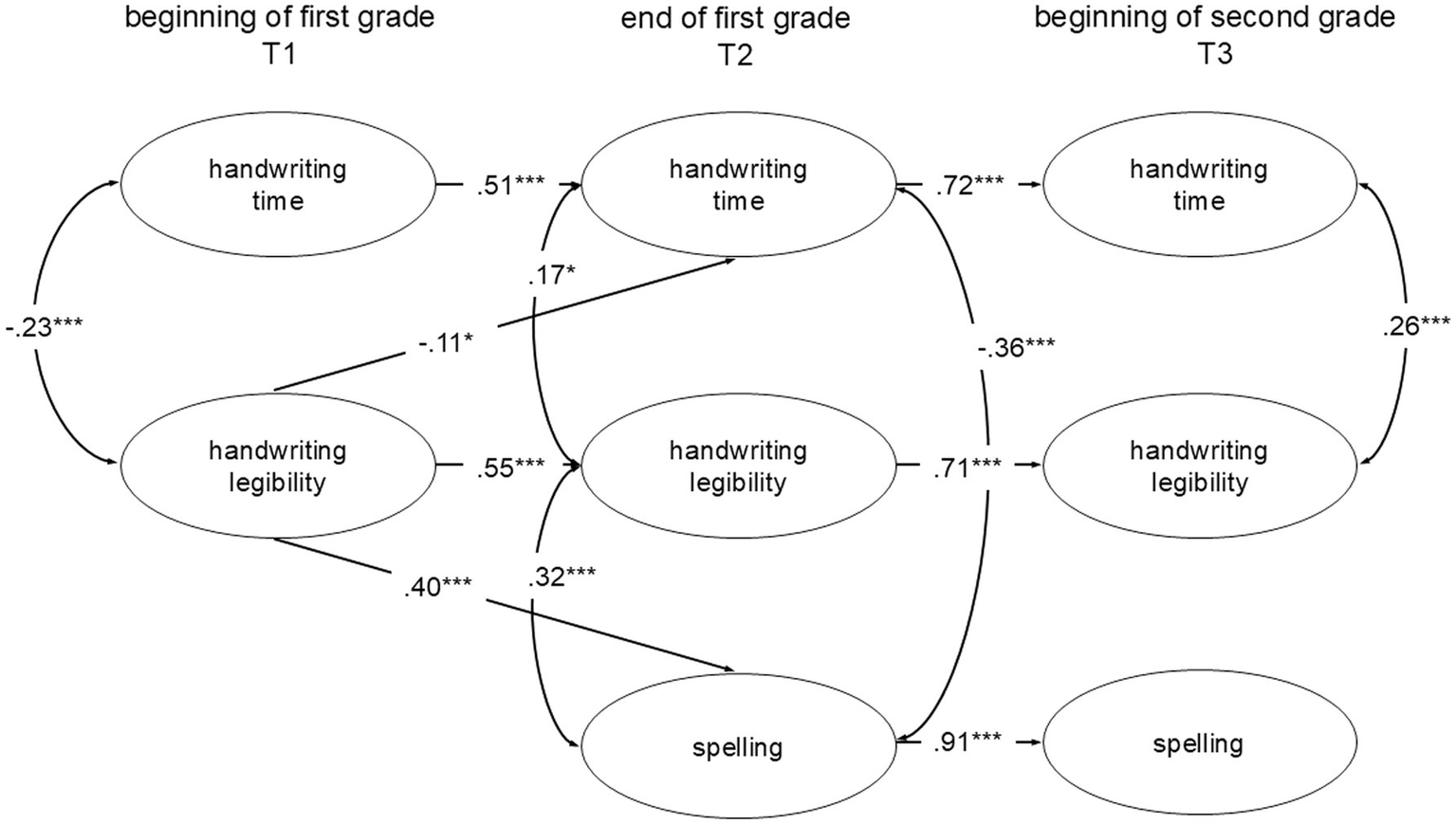
Structural equation model of the peripheral processes (i.e., time and legibility) and central processes (i.e., spelling) across three measurement points. The oval shapes represent latent variables. Only significant paths are shown for clarity (*p < 0.05, **p < 0.01, ***p < 0.001).
Furthermore, handwriting time correlated with spelling abilities at the end of first grade (T2; r = −0.36, p < 0.001), suggesting that children who spent less time on the handwriting task spelled more accurately, but this association was not evident at the beginning of second grade (T3; r = −0.28, p = 0.24). Additionally, legible handwriting was associated with better spelling abilities (T2; r = 0.32, p < 0.001).
From a longitudinal perspective, significant pathways were identified from legibility at the beginning of first grade to both handwriting time (β = 0.11, p = 0.04) and spelling abilities (β = 0.40, p < 0.001) at the end of first grade, indicating that more legible handwriting initially may contribute to later improvements, in both, time and spelling.
Discussion
This study examined both concurrent and longitudinal relations among central (i.e., spelling) and peripheral (i.e., handwriting time and legibility) facets of writing in children during the first year of handwriting instruction. Findings indicated that handwriting time, legibility, and spelling were strongly associated at the start of first grade; as instruction continued, these skills improved and stabilized throughout the first year. Longitudinally, handwriting legibility emerged as a particularly important predictor of subsequent handwriting time and spelling abilities.
At the beginning of first grade, when writing instruction had just started, better legibility was associated with more efficient handwriting (e.g., less time spent on writing task). As children received more practice and instruction, this relationship reversed, and better legibility tended to coincide with longer handwriting times. Initially, children exhibited an overall competence in handwriting that included both legibility and time, which is in line with previous research on beginner writers (Fitjar et al., 2021). However, as instruction progressed, children appeared to place greater emphasis on the coordination of legibility and time, slowing down to improve letter formation accuracy. This balancing act or trade-off between accuracy and speed is commonly seen in more skilled writers, including older children and adults (Gosse et al., 2021; Graham, 2018). By the end of the first grade, children could modulate their writing speed based on the task demands, demonstrating an emerging level of writing proficiency. This finding can also be interpreted by van Galen’s psychomotor model. When children at the beginning of handwriting copy letters and strokes, higher-level processing skills are scarcely involved. However, with expanding letter and vocabulary knowledge, phonological and semantic abilities build an additional processing level, requiring more cognitive resources—which is reflected in a trade-off between legibility and speed.
It is important to note that we only considered handwriting time in terms of time spent on the writing task. However, other aspects of handwriting fluency are relevant to handwriting proficiency (for an overview see Truxius et al., 2024; Gargot et al., 2020). For instance, Fitjar et al. (2022) suggest that the number of velocity peaks could be a more significant indicator of handwriting legibility than time because varied acceleration and deceleration within a single stroke can reduce consistency in letter formation. As such, the relationship between handwriting fluency and legibility may differ from that between handwriting time and legibility. Software applications that can precisely measure indicators of handwriting fluency, such as velocity peaks, provide further insights into the fine motor processes underlying handwriting difficulties or development in handwriting speed and legibility (Paz-Villagrán et al., 2014; Truxius et al., 2024). Nevertheless, the time a child spends on a handwriting task continues to be a significant metric within the educational environment, where in most cases, more efficient handwriting is linked with longer texts and the ability to keep pace with the academic demands and assignments.
Moreover, handwriting legibility was associated with spelling abilities at the end of the first grade, but this association vanished at the beginning of the second grade. This observation is consistent with previous studies that report a relationship between handwriting legibility and spelling in the early stages of writing proficiency, which seems to decrease as children practice and the processes become more independent (Gosse et al., 2021; Pritchard et al., 2021). A similar trend was observed in the relation between handwriting time and spelling. Initially, in the first grade, better spelling abilities corresponded with shorter handwriting time; however, by the second grade, this link was no longer evident. There are at least two possible explanations for the increasing independence of spelling skills from handwriting: Firstly, as handwriting becomes more automated, cognitive resources are liberated for spelling, as postulated by the Not-so-Simple-View of Writing (Berninger and Winn, 2006), resulting in spelling and handwriting time becoming more independent of each other. Secondly, improved spelling abilities may allow children to recall letters from memory more quickly, leading to shorter handwriting time and better legibility. This notion is reinforced by evidence suggesting that phonological awareness and letter knowledge facilitate writing development (Puranik et al., 2011; Frolek Clark and Luze, 2014). Additionally, considering that children with initially lower spelling skills showed more significant improvements in handwriting over time (Gosse et al., 2021), it could be inferred that once children reach a certain level of proficiency in letter retrieval, spelling no longer influences handwriting time and legibility. Consequently, spelling and handwriting skills become independent of each other.
Although the processes become more independent with practice and the writing processes stabilize over time, early handwriting legibility — reflecting the ability to produce letters accurately, which requires fine motor control — predicts later handwriting time and spelling abilities. Since handwriting legibility is associated with fine motor control (Volman et al., 2006; Kaiser et al., 2009) and depends on the consistent formation of letters over time (Di Brina et al., 2008), it plays a critical role in the development of fluent and automatized handwriting. Practicing and internalizing fine motor movements most likely leads to shorter handwriting times. Moreover, as better fine motor skills, particularly graphomotor skills, are linked to better spelling abilities (Dinehart and Manfra, 2013; Maurer et al., 2023), it is not surprising that early handwriting legibility at the onset of handwriting instruction is beneficial to enhancing spelling abilities.
While the findings of this study offer valuable insights into the writing development of young children, it is essential to recognize certain limitations that may affect the interpretation and generalizability of the results. First, considering that children in this study wrote individual words (as opposed to sentences), our assessment was limited to global ratings of words. We did not account for other elements, such as spacing, punctuation, size, and alignment, which are further aspects of legibility. Future research should aim to measure handwriting within a more comprehensive context, like sentences or texts, for a more thorough assessment of handwriting legibility. Secondly, due to the study’s focus on specific central and peripheral writing processes, the role of other potentially relevant lower-level writing processes, such as phonological and semantic processing abilities, remains unknown. A third limitation concerns the assessment of spelling skills, which occurred at only two measurement points, as children could not yet spell words at the onset of the first grade. Consequently, since we could not evaluate spelling skills at the beginning of the first grade, it is likely that the longitudinal relationships might be weaker if prior spelling skills were taken into account.
This study reveals that handwriting time, legibility, and spelling are most closely related at the beginning of handwriting acquisition but become more independent with practice. Handwriting proficiency stabilizes quickly in the first year, though the relations between peripheral and central handwriting processes vary. Notably, there is a trade-off between handwriting time and legibility, which reverses over the first school year.
These findings highlight the complexity of early handwriting and the evolving associations between handwriting processes at the very beginning of learning to write. Future research should explore the dependencies between further writing processes, as suggested by van Galen (1991), to better understand their role in developing automated handwriting.
Statements
Data availability statement
The data and code necessary to reproduce the analyses presented here are publicly accessible at OSF at the following URL: https://osf.io/5tx6d/?view_only=c2f6de9bed7543e5a6ec6dfe7d532d5e.
Ethics statement
The studies involving humans were approved by the Ethics Committee of Bern University of Teacher Education, PHBern (Zentrum für Forschungsförderung, Fabrikstrasse 8, CH-3012 Bern). The studies were conducted in accordance with the local legislation and institutional requirements. Written informed consent for participation in this study was provided by the participants’ legal guardians/next of kin.
Author contributions
LT: Conceptualization, Data curation, Formal analysis, Methodology, Writing – original draft, Writing – review & editing. JSW: Data curation, Funding acquisition, Project administration, Writing – review & editing. MM: Conceptualization, Formal analysis, Methodology, Supervision, Writing – original draft, Writing – review & editing.
Funding
The author(s) declare that financial support was received for the research, authorship, and/or publication of this article. This work was supported by the Swiss National Science Foundation (SNSF) (grant number 189187).
Conflict of interest
The authors declare that the research was conducted in the absence of any commercial or financial relationships that could be construed as a potential conflict of interest.
Publisher’s note
All claims expressed in this article are solely those of the authors and do not necessarily represent those of their affiliated organizations, or those of the publisher, the editors and the reviewers. Any product that may be evaluated in this article, or claim that may be made by its manufacturer, is not guaranteed or endorsed by the publisher.
References
1
Afonso O. Álvarez C. J. (2019). “Measuring writing durations in handwriting research: what do they tell us about the spelling process?” in Spelling and writing words. eds. PerretC.OliveT. (Leiden, Boston: BRILL), 151–162.
2
Bakeman R. (2005). Recommended effect size statistics for repeated measures designs. Behav. Res. Methods37, 379–384. doi: 10.3758/BF03192707
3
Barnett A. L. Prunty M. Rosenblum S. (2018). Development of the handwriting legibility scale (HLS): a preliminary examination of reliability and validity. Res. Dev. Disabil.72, 240–247. doi: 10.1016/j.ridd.2017.11.013
4
Berninger V. W. Abbott R. D. Swanson H. L. Lovitt D. Trivedi P. Lin S.-J. et al . (2010). Relationship of word- and sentence-level working memory to reading and writing in second, fourth, and sixth grade. LSHSS41, 179–193. doi: 10.1044/0161-1461(2009/08-0002)
5
Berninger V. W. Winn W. D. (2006). “Implications of advancements in brain research and technology for writing development, writing instruction, and educational evolution” in Handbook of writing research. eds. MacArthurC.GrahamS.FitzgeraldJ. (New York: Guilford Press), 96–114.
6
Caramia S. Gill A. Ohl A. Schelly D. (2020). Fine motor activities in elementary school children: a replication study. Am. J. Occup. Ther.74:7402345010p1-7402345010p7. doi: 10.5014/ajot.2020.035014
7
Caravolas M. Downing C. Hadden C. L. Wynne C. (2020). Handwriting legibility and its relationship to spelling ability and age: evidence from monolingual and bilingual children. Front. Psychol.11:1097. doi: 10.3389/fpsyg.2020.01097
8
Cheung G. W. Rensvold R. B. (2002). Evaluating goodness-of-fit indexes for testing measurement invariance. Struct. Equ. Model.9, 233–255. doi: 10.1207/S15328007SEM0902_5
9
Chin W. W. (1998). “The partial least squares approach to structural equation modeling” in Modern methods for business research. ed. MarcoulidesG. A. (London: Psychology Press), 295–336.
10
Cohen J. (1973). Eta-squared and partial eta-squared in fixed factor ANOVA designs. Educ. Psychol. Meas.33, 107–112. doi: 10.1177/001316447303300111
11
Curran P. J. Bollen K. A. Paxton P. Kirby J. Chen F. (2002). The noncentral chi-square distribution in misspecified structural equation models: finite sample results from a Monte Carlo simulation. MBR37, 1–36. doi: 10.1207/S15327906MBR3701_01
12
Di Brina C. Niels R. Overvelde A. Levi G. Hulstijn W. (2008). Dynamic time warping: A new method in the study of poor handwriting. Hum. Mov. Sci.27, 242–255. doi: 10.1016/j.humov.2008.02.012
13
Dinehart L. Manfra L. (2013). Associations between low-income children’s fine motor skills in preschool and academic performance in second grade. Early Educ. Dev.24, 138–161. doi: 10.1080/10409289.2011.636729
14
Downing C. Caravolas M. (2023). Handwriting legibility and fluency and their patterns of concurrent relations with spelling, graphomotor, and selective attention skills. J. Exp. Child Psychol.236:105756. doi: 10.1016/j.jecp.2023.105756
15
Duiser I. H. F. Ledebt A. van der Kamp J. Savelsbergh G. J. P. (2020). Persistent handwriting problems are hard to predict: A longitudinal study of the development of handwriting in primary school. Res. Dev. Disabil.97:103551. doi: 10.1016/j.ridd.2019.103551
16
Entorf H. Minoiu N. (2005). What a difference immigration policy makes: a comparison of PISA scores in Europe and traditional countries of immigration. Ger. Econ. Rev.6, 355–376. doi: 10.1111/j.1468-0475.2005.00137.x
17
Fitjar C. L. Rønneberg V. Nottbusch G. Torrance M. (2021). Learning handwriting: factors affecting pen-movement fluency in beginning writers. Front. Psychol.12:663829. doi: 10.3389/fpsyg.2021.663829
18
Fitjar C. L. Rønneberg V. Torrance M. (2022). Assessing handwriting: a method for detailed analysis of letter-formation accuracy and fluency. Read. Writ.37, 291–327. doi: 10.1007/s11145-022-10308-z
19
Frolek Clark G. Luze G. (2014). Predicting handwriting performance in kindergarteners using reading, fine-motor, and visual-motor measures. J. Occup. Ther. Sch. Early Interv.7, 29–44. doi: 10.1080/19411243.2014.898470
20
Ganzeboom H. B. Graaf P. M. De Treiman D. J. (1992). A standard international socio-economic index of occupational status. Soc. Sci. Res.21, 1–56. doi: 10.1016/0049-089X(92)90017-B
21
Gargot T. Asselborn T. Pellerin H. Zammouri I. Anzalone S. Casteran L. et al . (2020). Acquisition of handwriting in children with and without dysgraphia: a computational approach. PLoS One15:e0237575. doi: 10.1371/journal.pone.0237575
22
Gosse C. Parmentier M. van Reybroeck M. (2021). How do spelling, handwriting speed, and handwriting quality develop during primary school? Cross-classified growth curve analysis of children’s writing development. Front. Psychol.12:685681. doi: 10.3389/fpsyg.2021.685681
23
Graham S. (2018). Handwriting instruction: a commentary on five studies. Read. Writ.31, 1367–1377. doi: 10.1007/s11145-018-9854-5
24
Graham S. Harris K. R. Hebert M. (2011). It is more than just the message: presentation effects in scoring writing. EC44, 1–12. doi: 10.1201/b10962-2
25
Hu L. Bentler P. M. (1999). Cutoff criteria for fit indexes in covariance structure analysis: conventional criteria versus new alternatives. Struct. Equ. Model.6, 1–55. doi: 10.1080/10705519909540118
26
Jöreskog K. G. (1993). LISREL 8: Structural equation modeling with the SIMPLIS command language. Lincolnwood, USA: Scientific Software International.
27
Kaiser M. L. Albaret J. M. Doudin P. A. (2009). Relationship between visual-motor integration, eye-hand coordination, and quality of handwriting. J. Occup. Ther. Educ.2, 87–95. doi: 10.1080/19411240903146228
28
Kandel S. Perret C. (2015). How does the interaction between spelling and motor processes build up during writing acquisition?Cognition136, 325–336. doi: 10.1016/j.cognition.2014.11.014
29
Karlsdottir R. Stefansson T. (2002). Problems in developing functional handwriting. Percept. Mot. Skills94, 623–662. doi: 10.2466/pms.2002.94.2.623
30
Kim Y. S. Otaiba S. A. Sidler J. F. Gruelich L. (2013). Language, literacy, attentional behaviors, and instructional quality predictors of written composition for first graders. Early Child. Res. Q.28, 461–469. doi: 10.1016/j.ecresq.2013.01.001
31
Mai N. Marquardt C. (2016). CSWin Version 2016: Bedienungshandbuch. München: MedCom.
32
Malpique A. A. Pino-Pasternak D. Roberto M. S. (2020). Writing and reading performance in year 1 Australian classrooms: associations with handwriting automaticity and writing instruction. Read. Writ.33, 783–805. doi: 10.1007/s11145-019-09994-z
33
Maurer M. N. (2023). Correlates of early handwriting: Differential patterns for girls and boys. Early Educ. Dev.35, 843–858. doi: 10.1080/10409289.2023.2244349
34
Maurer M. N. Truxius L. Sägesser Wyss J. Eckhart M. (2023). From scribbles to script: Graphomotor skills’ impact on spelling in early primary school. Children.10:1886. doi: 10.3390/children10121886
35
May P. (2002). Hamburger Schreib-Probe 1–9 (HSP) [Hamburger Writing Test]: vpm.
36
Muthén L. K. Muthén B. O. (2017). Mplus: statistical analyses with latent variables. User’s guide version 8.3.
37
Olive T. Kellogg R. T. (2002). Concurrent activation of high- and low-level production processes in written composition. Mem. Cogn.30, 594–600. doi: 10.3758/BF03194960
38
Overvelde A. Hulstijn W. (2011). Handwriting development in grade 2 and grade 3 primary school children with normal, at risk, or dysgraphic characteristics. Res. Dev. Disabil.32, 540–548. doi: 10.1016/j.ridd.2010.12.027
39
Paz-Villagrán V. Danna J. Velay J.-L. (2014). Lifts and stops in proficient and dysgraphic handwriting. Hum. Mov. Sci.33, 381–394. doi: 10.1016/j.humov.2013.11.005
40
Pritchard V. E. Malone S. A. Hulme C. (2021). Early handwriting ability predicts the growth of children’s spelling, but not reading, skills. Sci. Stud. Read.25, 304–318. doi: 10.1080/10888438.2020.1778705
41
Puranik C. S. Lonigan C. J. Kim Y.-S. (2011). Contributions of emergent literacy skills to name writing, letter writing, and spelling in preschool children. Early Child. Res. Q.26, 465–474. doi: 10.1016/j.ecresq.2011.03.002
42
Rosenblum S. Weiss P. L. Parush S. (2003). Product and process evaluation of handwriting difficulties. Educ. Psychol. Rev.15, 41–81. doi: 10.1023/A:1021371425220
43
Salas N. Silvente S. (2020). The role of executive functions and transcription skills in writing: a cross-sectional study across 7 years of schooling. Read. Writ.33, 877–905. doi: 10.1007/s11145-019-09979-y
44
Seymour P. H. Aro M. Erskine J. M. Collaboration with COST Action A8 Network (2003). Foundation literacy acquisition in European orthographies. Br. J. Psychol.94, 143–174. doi: 10.1348/000712603321661859
45
Suggate S. Pufke E. Stoeger H. (2018). Do fine motor skills contribute to early reading development?J. Res. Read.41, 1–19. doi: 10.1111/1467-9817.12081
46
The Jamovi Project (2024). Jamovi.
47
Truxius L. Maurer M. N. Sägesser Wyss J. Roebers C. M. (2024). The internal structure of handwriting proficiency in beginning writers. PLoS One19:e0296096. doi: 10.1371/journal.pone.0296096
48
Valcan D. S. Davis H. L. Pino-Pasternak D. Malpique A. A. (2020). Executive functioning as a predictor of children’s mathematics, reading and writing. J. Appl. Dev. Psychol.70:101196. doi: 10.1016/j.appdev.2020.101196
49
Van Galen G. P. (1991). Handwriting: issues for a psychomotor theory. Hum. Mov. Sci.10, 165–191. doi: 10.1016/0167-9457(91)90003-G
50
Volman M. J. M. van Schendel B. M. Jongmans M. J. (2006). Handwriting difficulties in primary school children: A search for underlying mechanisms. AJOT.60, 451–460. doi: 10.5014/ajot.60.4.451
Summary
Keywords
handwriting time, handwriting legibility, spelling, children, development
Citation
Truxius L, Sägesser Wyss J and Maurer MN (2025) Early handwriting development: a longitudinal perspective on handwriting time, legibility, and spelling. Front. Psychol. 15:1466061. doi: 10.3389/fpsyg.2024.1466061
Received
17 July 2024
Accepted
27 November 2024
Published
08 January 2025
Volume
15 - 2024
Edited by
Jun Saiki, Kyoto University, Japan
Reviewed by
Akihiro Kawasaki, Ritsumeikan University, Japan
Katsuo Tamaoka, Shanghai University, China
Updates
Copyright
© 2025 Truxius, Sägesser Wyss and Maurer.
This is an open-access article distributed under the terms of the Creative Commons Attribution License (CC BY). The use, distribution or reproduction in other forums is permitted, provided the original author(s) and the copyright owner(s) are credited and that the original publication in this journal is cited, in accordance with accepted academic practice. No use, distribution or reproduction is permitted which does not comply with these terms.
*Correspondence: Lidia Truxius, lidia.truxius@unibe.ch
†These authors have contributed equally to this work
Disclaimer
All claims expressed in this article are solely those of the authors and do not necessarily represent those of their affiliated organizations, or those of the publisher, the editors and the reviewers. Any product that may be evaluated in this article or claim that may be made by its manufacturer is not guaranteed or endorsed by the publisher.