Abstract
Introduction:
Academic engagement provides opportunities and resources for students to engage in socio-educational interactions and learning. Our study provides an overview of high-impact research in academic engagement and the potential causes of its high valuation in the scientific community.
Methods:
We conducted a mapping review using bibliometric analysis of 1,607 articles indexed in Web of Science, processed mainly by VOSviewer software.
Results:
The publication of selected articles grew exponentially year by year, presenting concentration levels of 1% in authorship, 49% in a single country, and 5% in journals, identified as outstanding Keywords plus® central aspects of academic engagement (classroom-social environment and school engagement), in addition, 6% were in highly cited articles.
Conclusion:
These highly cited articles (6%) are associated with authors with high levels of publication. The most cited current topics relate to the motivation and emotional aspects of academic engagement.
1 Introduction
Engagement is a persistent, pervasive, positive, and satisfying affective-cognitive mental state with work, characterized by vigor, dedication, and absorption (Schaufeli et al., 2022), As an adaptation of engagement, academic engagement is reconceptualized to the academic and social environment of education, with characteristics that provide opportunities and resources for students to engage in academic learning and social interactions (Wang and Hofkens, 2020). Academic engagement with learning processes allows the optimization of academic performance and is an important construct for promoting interest, enjoyment, and psychological wellbeing among students (Medrano et al., 2015). Emotional engagement is essential for academic success and psychological wellbeing, influenced by the fulfillment of psychological needs, social relationships, and supportive environments. Autonomy, competence, and relatedness are key predictors, with studies showing that learning contexts supporting these needs enhance engagement (Park et al., 2012; Shih, 2008).
Thus, academic engagement is of interest to higher education institutions in relation to student dropout and the possibility of it being a significant predictor of early student dropout intentions (Truta et al., 2018). Similarly, Ketonen et al. (2016) identified four latent student profiles (engaged, disengaged, undecided, and alienated) according to engagement with the study: study-related burnout, lack of interest, lack of self-regulation, and uncertainty in career choice. Engaged students received the highest scores, while disengaged and undecided students scored the worst. This reinforces the conclusions of Casuso-Holgado et al. (2013) study on academic engagement and performance, in which, despite gender differences, the grade point average is the academic index most strongly associated with academic engagement. Social factors, including teacher-student relationships and peer support, play a pivotal role. Positive interactions with teachers and a caring school climate promote belonging and engagement, especially for minority and low SES students (Ulmanen et al., 2016; Krauss et al., 2022). One variable that does not appear innocuous for academic engagement is ethno-racial identity; fostering parental cultural socialization in relation to ethno-racial pride could promote academic engagement (Bakth et al., 2022).
It has also been shown that students who feel higher levels of psychological resources are more academically engaged, which has a positive impact on their academic performance (Martínez et al., 2019). Research also highlights the dynamic nature of engagement, where behavioral, cognitive, and emotional components influence each other over time (Hong et al., 2020). Overall, emotional engagement emerges from the interplay of psychological and social dimensions, with supportive environments fostering better academic and emotional outcomes (Park et al., 2012; Shih, 2008; Ulmanen et al., 2016; Krauss et al., 2022).
Academic motivation significantly influences student performance and engagement, with personal self-regulation and perceived parental and teacher support being key (De la Fuente et al., 2017; Simpkins et al., 2020). Motivational profiles, such as confidence and intrinsic motivation, predict academic adjustment (Linnenbrink-Garcia et al., 2018). Active methodologies, such as project-based learning, foster self-regulatory strategies, although they may decrease satisfaction (Galand et al., 2010). In STEM, gender inequalities in support and engagement persist (Patall et al., 2018). Learning goals help prevent disaffection (Valle et al., 2015), while motivational resilience and teacher support are essential for meeting challenges and balancing demands (Skinner et al., 2020; Guvenc, 2015).
Thus, positive emotions build psychological capital and academic engagement in students, thereby improving their academic performance (Carmona-Halty et al., 2021). In addition, fostering skills to understand and consider others’ perspectives, known as social perspective-taking (SPT), is crucial for students’ academic and social development (Kim et al., 2018). According to the temporal perspective theory, how people value the past, present, and future influences their actions. Considering students, only the future temporal perspective (the importance that people place on the future) uniquely predicted academic engagement intention and academic performance (Barnett et al., 2020). Thus, it is key to reinforce students’ psychological security, which is understood as a mental state of feeling safe and supported in the educational environment, because it is a positive predictor of academic performance (Tatiana et al., 2022). In addition, students with high emotional self-efficacy–that is, those who were confident in their ability to manage emotions in the context of learning in a digital society–obtained better academic results (Yu et al., 2022).
Regarding the measurement of academic engagement, although the Utrecht Work Engagement Scale and its three factors: vigor, dedication, and absorption are commonly used (Schaufeli et al., 2022; Barragan-Martin et al., 2021; Ng et al., 2022; Rodríguez-González et al., 2023). By contrast, the study by Wefald and Downey (2009) did not confirm a trifactorial structure and found that engagement and satisfaction were closely related constructs. Thus, the discrepancies in the number and nature of the dimensions that make up academic engagement (Tomas et al., 2022) give openness to other psychometric measurement instruments, such as the University Student Engagement Inventory, (USEI), also trifactorial: (behavioral, emotional, and cognitive) (Assunçao et al., 2020; Sinval et al., 2021; Freiberg-Hoffmann et al., 2022) and the relationship of academic engagement with a number of other constructs: stress and burnout (Gómez et al., 2015), positive emotions, autonomy and self-efficacy (Oriol-Granado et al., 2017), teacher work engagement (Zhang and Yang, 2021), satisfaction and frustration (Buzzai et al., 2021), and self-esteem and motivation (Acosta-Gonzaga, 2023).
Previous bibliometric analyses on academic engagement define it as the interaction between academics and non-academic actors, such as industry, to promote knowledge exchange, cooperation, and the application of research to address societal and technological challenges (Pham et al., 2024; Nast et al., 2025), for example, Abramo and D'Angelo (2022) examine university-industry collaboration in Italy, focusing on factors influencing academics’ willingness to engage. Pham et al. (2024) review the evolution of academic engagement, highlighting technology transfer as a key issue. Lastly, Nast et al. (2025) explore the link between scientists’ interactions with non-academic actors and high-impact research in Spain, finding that renowned scientists are best positioned to leverage these opportunities. But none of these studies focus specifically on the educational settings.
Therefore, in contrast to previous publications (Abramo and D'Angelo, 2022; Pham et al., 2024; Nast et al., 2025), our study aims to provide a worldwide panoramic view of academic engagement research and identify high-impact research on this type of behavior in educational settings. It answers how certain variables are related to high citation counts, depending on the age of the documents, characteristics of their authors, national authorship ascriptions, journals of publication, and open access to these documents. Asking the question, “What are the highest impact mainstream research publications on academic engagement in educational settings?” allows us to identify global research and training benchmarks, providing input to the epistemic community of researchers and educational decision-makers.
2 Methods
Based on a dataset extracted from the Core Collection of Web of Science (WoSCC) on July 15, 2024 (Clarivate, 2023), with the thematic search vector of Academic Engagement [TS = (academic NEAR/0 engagement)], refined by the Web of Science Index: Social Sciences Citation Index (SSCI) or Science Citation Index Expanded (SCI-EXPANDED, SCIE), unrestricted thematically and temporarily. The research process develops a cartographic review, and therefore seeks to characterize the quantity and quality of the literature and other key characteristics, identifying research needs (Grant and Booth, 2009). Using Web of Science-WoS articles (Clarivate, 2023) as a reference, given their recognized quality among researchers worldwide (Serrano et al., 2019). The authors selected the SSCI-WoSCC and SCIE-WoSCC databases because with respect to Scopus, the journals indexed in both WoS databases present a high duplicity of indexing in Scopus. However, Scopus journals, which do not present a double indexing with the SSCI and SCIE bases, have not been considered because “Scopus covers a higher number of journals, but with lower impact (average citations) and limited to recent articles” (Chadegani et al., 2013, p. 24). For the identical reasons we have not considered the Emerging Sources Citation Index (ESCI) of WoSCC. The length of the bases is relevant, Scopus is only 20 years old as a commercial product of Elsevier and ESCI-WoS, is a base created in 2015, which affects the historical citation counts for subsampling (e.g., h-index), given the longitudinal nature of the mapping reviews. Consequently, the analytical procedure of the present study preferred impact to the number of journals. As a document type registered in WoS, we have considered only articles, given that according to Cambridge University Press (2024) they are the most common type of article in the world of periodicals, contain pieces of original research that contribute directly to their field, apply to all disciplines, and are written by experts, for experts, and must meet the highest standards of peer review and scholarly communication. Articles are written by experts, for experts, and must meet the highest standards of peer review and scholarly communication.
The thematic search tag TS performs a simultaneous search on the following fields: title, keywords, author, abstract, and Keywords Plus® and the word proximity operator (NEAR) and simultaneously incorporates both words (Clarivate, 2023). Then, based on the “Guidelines for advancing theory and practice through bibliometric research” (Mukherjee et al., 2022), both performance analysis and science mapping were performed. For performance analysis, the bibliometric laws (Haddow, 2018) of Price (1976), Lotka (1926), and Zipf (1932), and Hirsch (2005) index were used, while science mapping focused on co-authorship analysis using VOSviewer software for co-authorship and co-occurrence analysis, discovering the social relationships of authors, organizations, or countries and thematic relationships between keywords (Van Eck and Waltman, 2010). The independent subsamples for the documents included in each type of analysis are detailed in Table 1. Only the Keywords plus© are sampled in a dependent manner based on the articles selected by the Hirsch index (h-index).
-
Price’s Law allows the analysis of the exponential growth of science (exponential growth adjustment of the annual publication number) as an expression of the critical mass of knowledge that is interesting to study (Price, 1976; Dobrov et al., 1979).
-
Lotka’s Law allows the segregation of authors of high production in a specific subject from those who have an ephemeral step in a particular area of scientific knowledge (a high percentage of authors who only present one or a relatively small number of published papers). To estimate the concentration of authors, the square root is applied to the total number of authors, which is then adjusted according to a discrete number of publications, and the resulting set of authors are called prolific authors (Lotka, 1926; Nicholls, 1988; Tsai, 2013).
-
Bradford’s Law concentrates on journals, mainly in what is known as Bradford’s core, the smallest subset of journals that manage to concentrate on one-third of the total number of documents studied. The subsets that manage to concentrate on the remaining documents according to their increasing order in the number of journals are known as Zones 1 and 2. However, attention has been focused on the Bradford core as a production environment that tends to congregate the most specialized authors, reviewers, and editors in a specific topic of study (Bulik, 1978; Desai et al., 2018).
-
The Hirsch index determines the relative impact of scientific productivity on a corpus of selected articles. It is expressed as the value n of documents, implying that these n documents have obtained n or more citations on a common counting basis for all these (Hirsch, 2005; Crespo and Simoes, 2019). In addition, we studied the relationship between the age of publication and the number of citations and the inclusion of an article in the h-index in relation to: (1) the authorship of one or more prolific authors, (2) the affiliation of one or more authors to a prolific country, (3) publication in a journal specialized in the subject (belonging to the Bradford core), or (4) some form of open access to the article.
-
Regarding these last four items, a nonparametric descriptive statistical analysis was used with the SPSS program. Using the nonparametric Chi-square correlation coefficient (χ2), whose correlation is significant for a p-value at the 0.05 level (ideally 0.01), a case in which a degree of association between two variables is statistically evident (Romero Suárez, 2012; Molina-Arias, 2017).
Table 1
| Phase | Variable | Value (or sample, n) | Unit | Subsampling criteria for inclusion | Subsample included | Documents included | Inclusion rate |
|---|---|---|---|---|---|---|---|
| 1 | Time | 1982–2024 | Year | Period without blanks | 1992–2023 years | 1478 | 0.92 |
| 2 | Authors | 4,667 | Person | Lotka’s Law | 59 authors* | 303 | 0.19 |
| 3 | Place (Affiliation) | 87 | Country /Territory | Prolific authors lower limit | 40 countries** | 1566 | 0.97 |
| 4 | Journals | 522 | Journal | Bradford’s Law | 24 journals | 519 | 0.32 |
| 5 | Documents | 1,607 | Article | Hirsch’s index (h-index) | 92 documents | 92 | 0.06 |
| 6 | Keywords Plus | 2,649 | Words | Zipf’s Law | 35 words | 92 | 0.06 |
Characterization of bibliometric subsampling.
*Database field: author full names, **database field: addresses.
Zipf’s Law refers to the concentration of word usage in the language. Here, the keywords assigned as metadata by WoS or Keywords plus© were used as a basis to study this concentration, highlighting the most used keywords in the set of articles, using the square root over the set of keywords as an estimate. This was then adjusted according to a discrete number of keywords. The resulting set of Keywords plus© is known as outstanding keyword plus (Zipf, 1932; Merediz-Solà and Bariviera, 2019) (Table 1).
3 Results
3.1 Results of scientific production on academic engagement
The 1,607 articles extracted from the WoS Core Collection cover the period 1982–2024; however, only present a continuous full-year record (without years with blank data) between 1992 and 2023. For this period, including 1478 documents, where it is possible to analyze possible exponential growth, R2 was 98%. Thus, according to Price (1976)’s Law, scientific production shows a critical mass of interesting knowledge to be studied. Regarding the research areas - WoS, articles related to 159 research areas are collected, and although a journal (and consequently its articles) can be indexed to several areas simultaneously, we indicate that 840 of 1,607 articles are indexed to the WoS area of Psychology (52%), and 542 of 1,607 articles to the area of Education and Educational Research (34%), adding between both categories, discounting duplicates, 1,240 of 1,607 articles (77%) (Figure 1).
Figure 1

Time series and trend of publications on academic engagement. Blue line is time series and dotted lines is an exponential trend.
This number of articles generated was the work product of 4,667 researchers, but of these authors 4,099 only contributed one article. Thus, Figure 2 shows the contribution levels of these 4,667 authors from 1 to 26 articles with a power fit of 99.5%; according to Lotka (1926)’s Law, the number of prolific authors can be estimated at 68 authors [SQRT (4667) = 68].
Figure 2
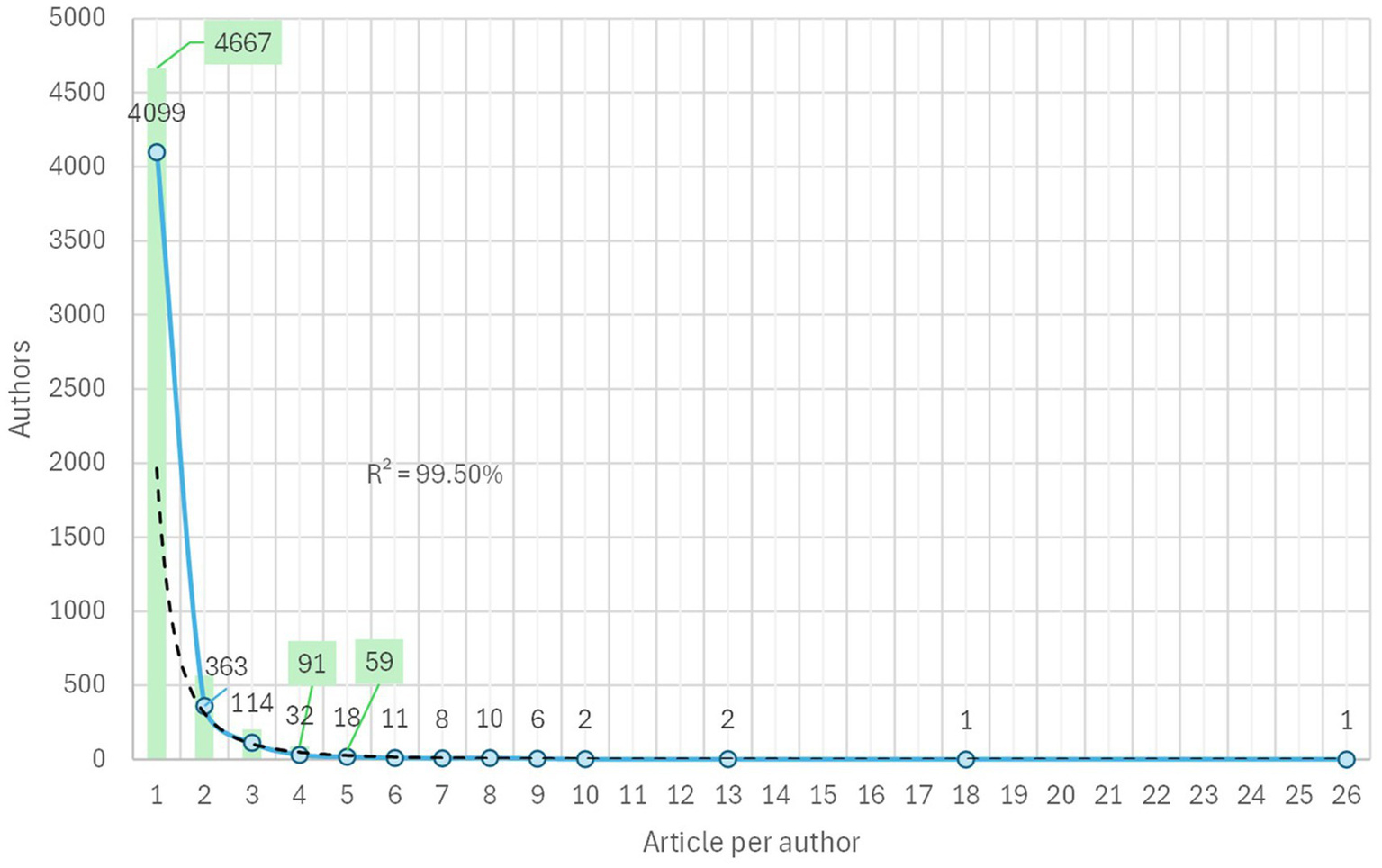
Relationship between authorship and the scientific production level. Blue line is time series and dotted lines is a power fit trend.
From Figure 2, it can be observed that 91 authors had four or more published articles, and 59 authors had five or more published articles and academic engagement; therefore, prolific authors were estimated at 59, equivalent to inclusion of 303 documents (without duplicates). This small group of authors with a high level of production in the subject (five or more articles) maintained co-authorship relationships, as shown in Figure 3. The most prolific author was Dr. Jesús Alfonso D. Datu, an academic from the Faculty of Education, University of Hong Kong, ORCID: https://orcid.org/0000-0002-8790-1113.
Figure 3
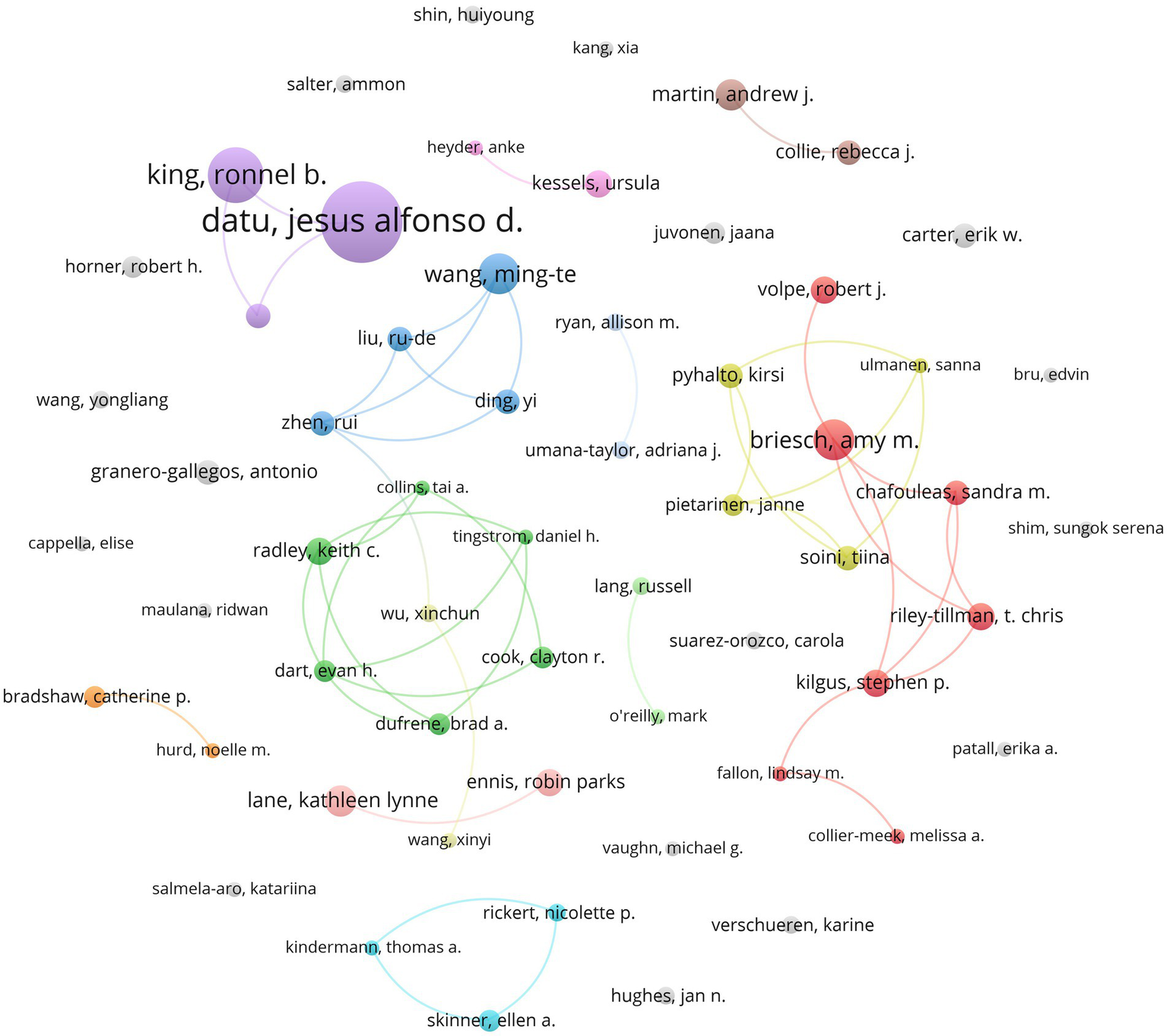
Prolific co-authorship graph (colors indicate same author cluster).
Figure 3 shows that 41 of the 59 authors were grouped into co-authorship teams, with 13 clusters at this level of scientific production, including two triads and seven dyads. All nodes in grey are authors who can be considered solitary authors at this level of production (Table 2).
Table 2
| Cluster | Co-authors (articles) | N | Countries of authors |
|---|---|---|---|
| 1 | Briesch (13), Chafouleas (8), Collier-Meek (5), Fallon (5), Kilgus (9), Riley-Tillman (9), Volpe (9). | 7 | USA |
| 2 | Collins (5), Cook (7), Dart (7), Dufrene (7), Radley (9), Tingstrom (5). | 6 | USA |
| 3 | Ding Y (8), Liu RD (8), Wang MT (13), Zhen (8). | 4 | China, USA |
| 4 | Pietarinen (7), Pyhältö (8), Soini (8), Ulmanen (5). | 4 | Finland |
| 5 | Datu (26), King (18), Valdez (8). | 3 | China (HK), Philippines |
| 6 | Kindermann (5), Rickert (6), Skinner (7). | 3 | USA |
| 7 | Bradshaw (7), Hurd (5). | 2 | USA |
| 8 | Collie (8), Martin (10). | 2 | Australia |
| 9 | Heyder (5), Kessels (9). | 2 | Germany |
| 10 | Ennis (9), Lane (10). | 2 | USA |
| 11 | Lang (6), O’Reilly (5). | 2 | USA |
| 12 | Ryan (6), Umaña-Taylor (6). | 2 | USA |
| 13 | Wang X (5), Wu (6). | 2 | China |
Prolific author clusters and national affiliations.
Under the same level of stringency (five or more published articles), Figure 4 shows the co-authorship at the country level (40 countries). The sizes of the frames represent the volume of production, the arcs represent the co-authorship relationships between countries, and the seven colors divide the countries by their degree of association in terms of co-authorship: red (13 countries), green (10 countries), blue (six countries), yellow (five countries), violet (triad), light blue (dyad), and orange (one country only). The levels of contribution to world knowledge production in academic engagement in the USA (red, 788 articles), China (red, 239 articles), and Spain (yellow, 108 articles) stand out, as well as the strong relationship between the two (red edges) (Table 3).
Figure 4
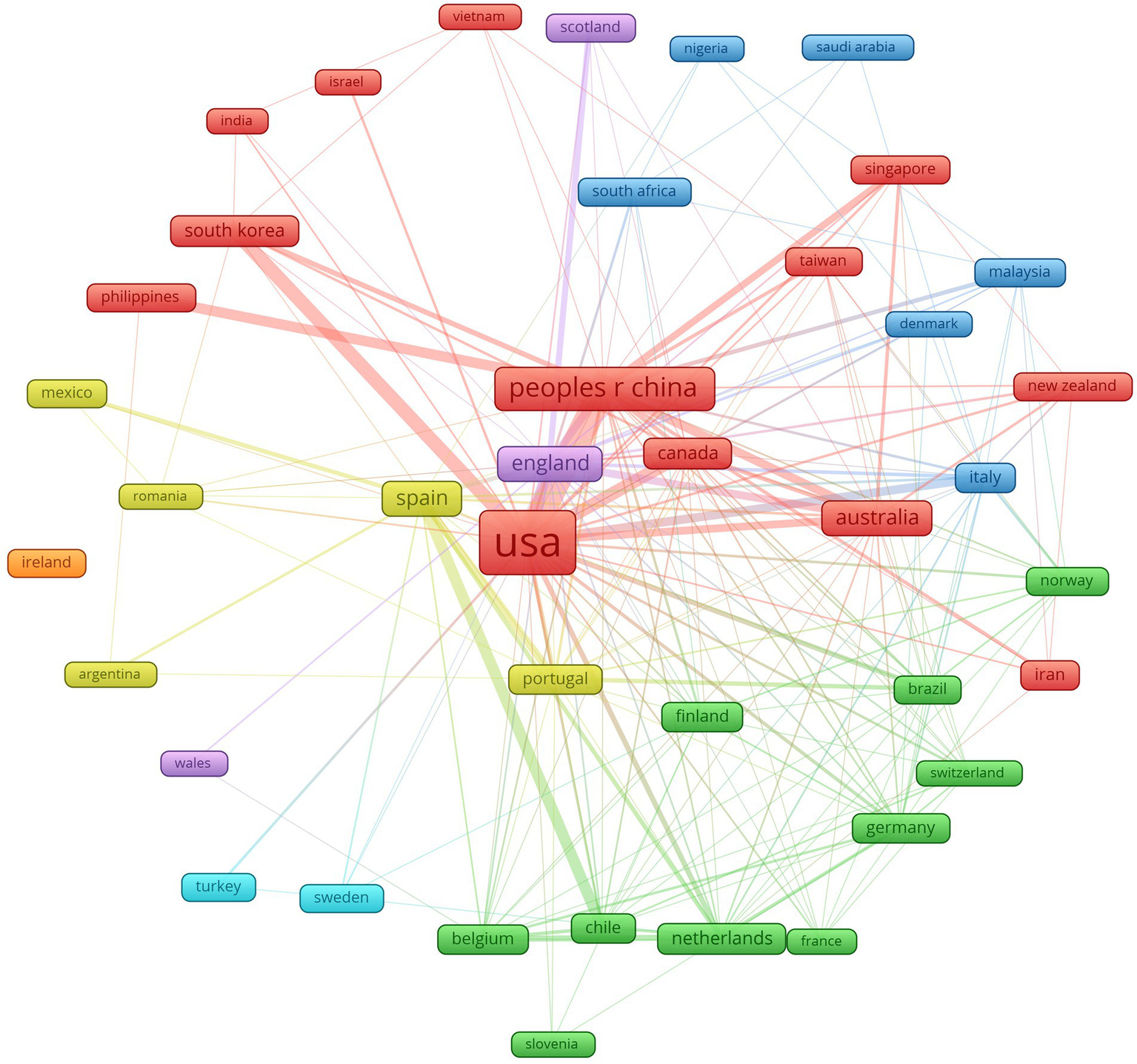
National co-authorship graph (colors indicate same author cluster).
Table 3
| Prolific country | Articles | Citations | Citations per article | % Contribution at 1607 |
|---|---|---|---|---|
| USA | 788 | 31746 | 40 | 49.0% |
| China | 239 | 3865 | 16 | 14.9% |
| Spain | 108 | 1943 | 18 | 6.7% |
| Australia | 98 | 2260 | 23 | 6.1% |
| England | 94 | 3131 | 33 | 5.8% |
Prolific countries according to their contribution to scientific production.
Finally, in relation to the scientific production of academic engagement, it is necessary to note that 24 out of 522 journals accounted for approximately one-third of the 1,607 articles published (519 articles) on this subject between 1982 and 2024 (Table 4).
Table 4
| Journal on nucleus of Bradford | Art. | JIF–WoS (2023) | Best Qx (2023) |
|---|---|---|---|
| Frontiers in Psychology | 70 | 2.6 | Q2 |
| Journal of School Psychology | 37 | 3.8 | Q1 |
| Journal of Youth and Adolescence | 31 | 3.7 | Q1 |
| Psychology in The Schools | 30 | 1.8 | Q3 |
| Current Psychology | 30 | 2.5 | Q2 |
| Journal of Positive Behavior Interventions | 29 | 1.4 | Q3 |
| Educational Psychology | 23 | 3.6 | Q1 |
| Learning and Individual Differences | 22 | 3.8 | Q1 |
| Behavioral Disorders | 22 | 2.1 | Q1 |
| Studies in Higher Education | 21 | 3.7 | Q1 |
| Social Psychology of Education | 20 | 3.2 | Q1 |
| Children and Youth Services Review | 19 | 2.4 | Q1 |
| School Psychology Review | 16 | 3.9 | Q1 |
| Journal of Educational Psychology | 15 | 5.6 | Q1 |
| Sustainability | 15 | 3.3 | Q2 |
| Journal of Applied Developmental Psychology | 15 | 2.2 | Q2 |
| Education and Information Technologies | 15 | 4.8 | Q1 |
| Contemporary Educational Psychology | 14 | 3.9 | Q1 |
| Developmental Psychology | 14 | 3.1 | Q2 |
| Journal of Technology Transfer | 13 | 4.6 | Q1 |
| Revista de Psicodidactica | 12 | 3.8 | Q1 |
| Plos One | 12 | 2.9 | Q1 |
| International Journal of Environmental Research and Public Health | 12 | N.A. | N.A. |
| Journal of Adolescence | 12 | 3.0 | Q2 |
Bradford nucleus journals and their web of science impact characteristics.
3.2 Scientific production impact on academic engagement
With reference to the impact of scientific production, it was possible to determine a subset of 92 articles (5.7%) according to the Hirsch index (h-index), represented by the intercept shown in Figure 5. One article by Furrer and Skinner (2003) stands out, with 1,310 citations in the WoS Core Collection on the date of data extraction.
Figure 5
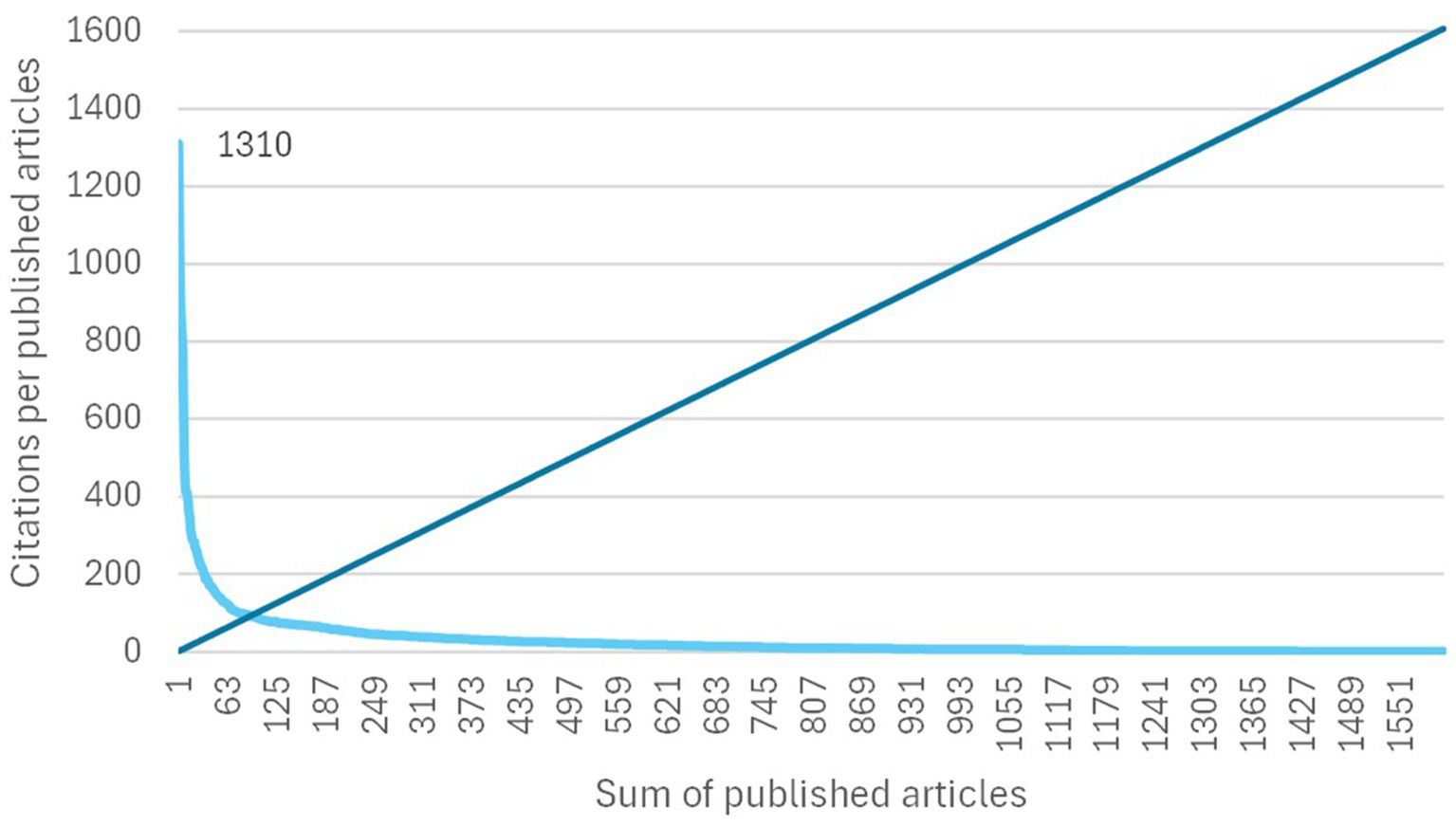
h-Index estimation. Light blue line is time series and blue line is a counting of articles.
In search of an explanation for this high number of citations, a relationship was established between the year of publication and the number of citations within these 92 publications. As shown in Figure 6, the percentage of adjustment (R2) was <5%; therefore, we can conclude that the volume of citations received was not dependent on the age of publication of the document. In addition to the article by Furrer and Skinner (2003) (1,310 citations), another paper by Skinner et al. (2008) stood out, exceeding 1,000 citations.
Figure 6
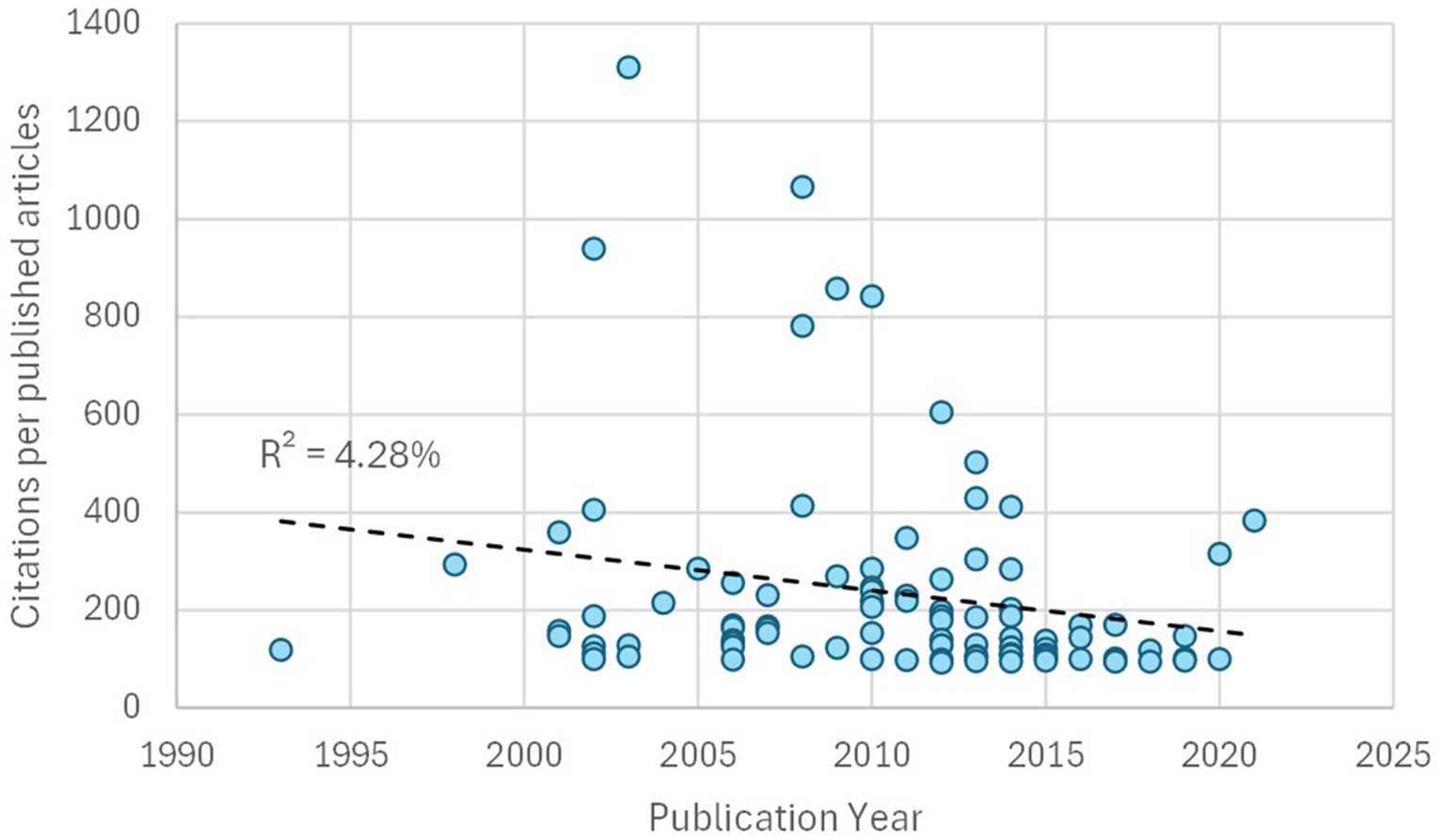
Time of publication and citations of articles in the h-index.
We also explored the possible associations between the inclusion of an article in the h-index with: (1) authorship by one or more prolific authors, (2) affiliation of one or more authors with a prolific country, (3) publication in a journal specializing in the subject (belonging to the Bradford nucleus), or (4) some form of open access to the article. The relationships with the degrees of association are reported in Table 5.
Table 5
| Variables | Asymptotic significance (2-sided) | Degree of freedom | Significant relationship between variables |
|---|---|---|---|
| Prolific authors | 6.948 | 1 | 0.008** |
| Prolific country | 1.541 | 1 | 0.214 |
| Journal on nucleus of Bradford | 0.969 | 1 | 0.325 |
| Open access article | 1.591 | 1 | 0.207 |
Relationship between h-index articles and other variables.
*p ≤ 0.050, **p ≤ 0.010.
There was no evidence to determine the degree of association between the articles included in the h-index and the affiliation of one or more authors to a prolific country, publication in a journal specializing in the subject, or any form of open access to the article. In contrast, there was evidence of an association between an article in the h-index and authorship by one or more prolific authors. Figure 7 shows that the percentage of articles in the h-index doubled from 5 to 10% when they were self-authored by one or more prolific authors. Thus, this result affirms that, for the set of 1,607 articles on academic engagement under study, the only relevant variable for high citation is that the article is by a prolific author in this topic.
Figure 7
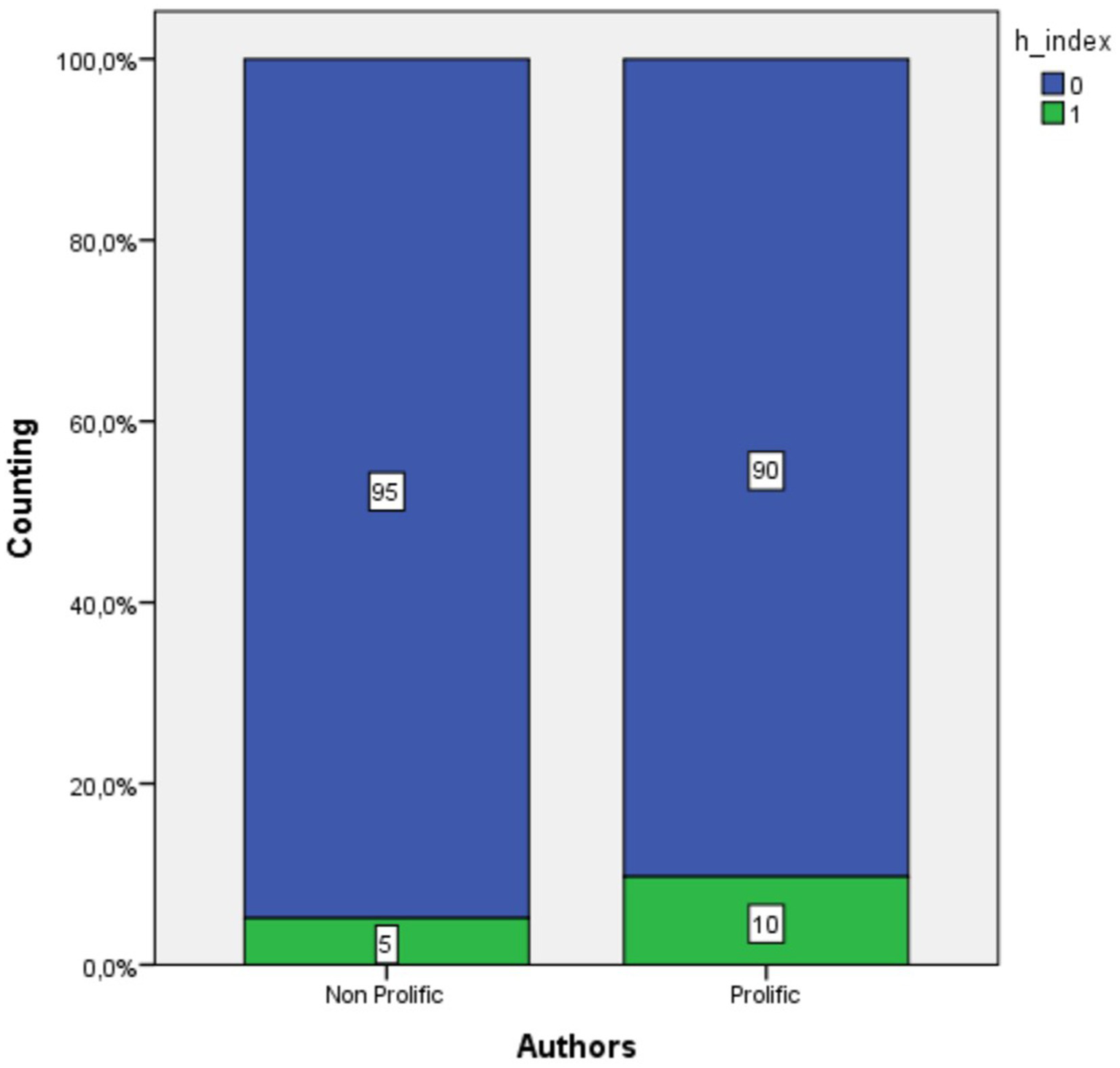
Relation between the proliferation level of authors and h-index inclusion.
Another interesting finding is the most cited topics associated with these 92 articles, which are represented based on the 35 Keywords plus® with the highest number of occurrences. The average number of citations is shown in Figure 8. Identifying only four keywords plus® of very high relevance in academic engagement studies:
-
Teachers with 530 average citations in 5 h-index articles: Skinner et al. (2008), Skinner et al. (2009), Wang and Eccles (2013), Lee and Smith (1993), and Hughes and Coplan (2010),
-
Self with 424 average citations in six articles stand out: Skinner et al. (2008), Skinner et al. (2009), Hughes and Coplan (2010), Middleton (2010), Datu et al. (2016), and Pietarinen et al. (2014),
-
Classroom with 411 average citations in 8 h-index articles: Furrer and Skinner (2003), Jang et al. (2010), Farmer et al. (2011), Gasiewski et al. (2012), Fall and Roberts (2012), Wentzel and Watkins (2002), Tucker et al. (2002), and Engels et al. (2016), and
-
Middle school with 402 average citations in 13 h-index articles: Furrer and Skinner (2003), Skinner et al. (2008), Wang and Eccles (2013), Pietarinen et al. (2014), Farmer et al. (2011), Wang and Degol (2013), Johnson et al. (2001), Wang and Sheikh-Khalil (2014), Wang and Degol (2013), Johnson et al. (2001), Wang and Sheikh-Khalil (2014), Anderson et al. (2004), Schwartz et al. (2006), Suárez-Orozco et al. (2010), Zimmer-Gembeck et al. (2006), and Liu et al. (2018).
Figure 8
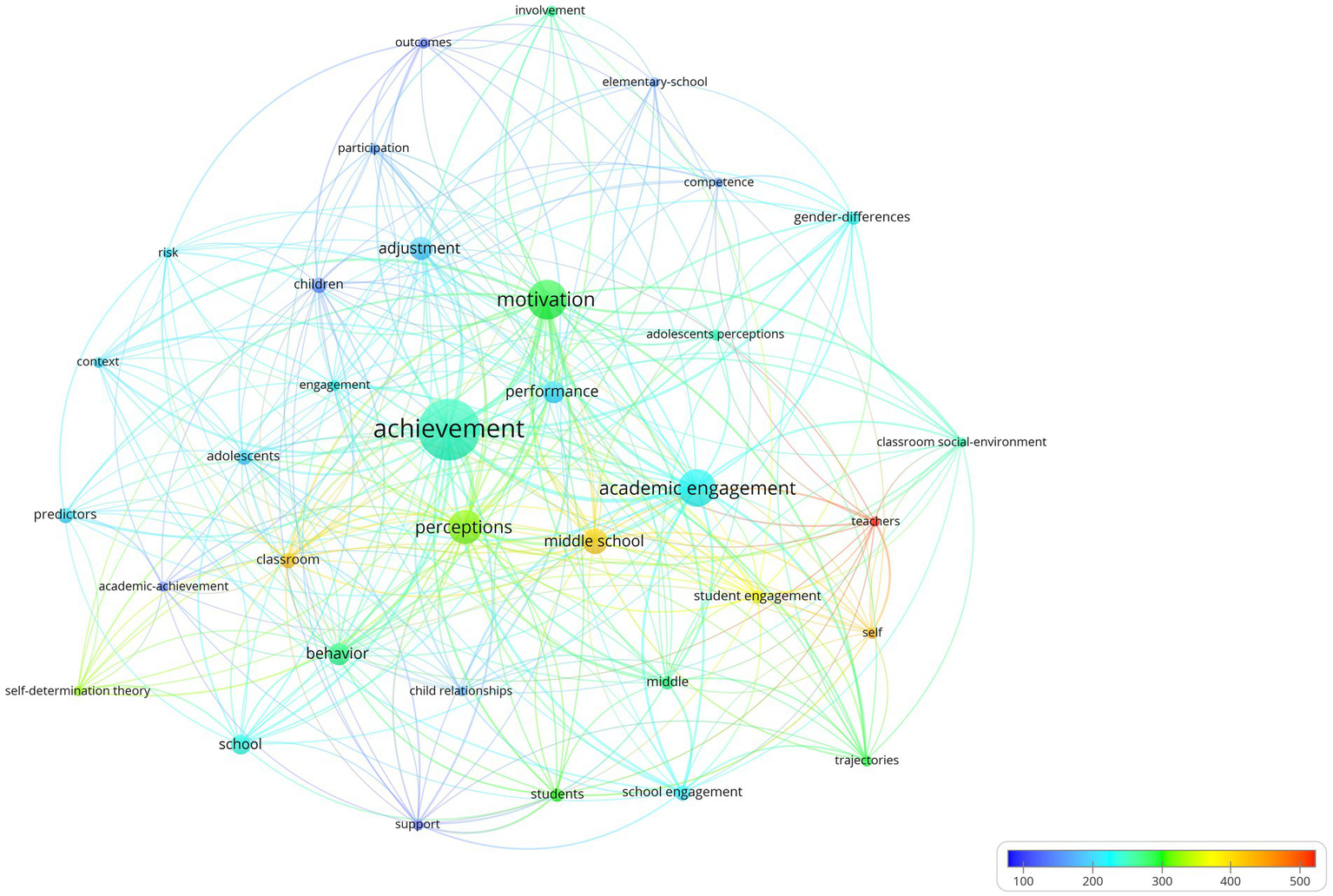
Keywords plus co-occurrence graph: colors indicate average citations.
The finding of these four relevant keywords (Teachers, Self, Classroom, Middle school) will be complemented below with a view of contemporaneity.
Additionally, in Figure 9, the Keywords plus® with more recent average dates were:
-
Classroom social-environment with 2015.00 average publication year in 5 h-index articles: Wang and Eccles (2013), Pietarinen et al. (2014), Wang and Degol (2013), Liu et al. (2018), and Strati et al. (2017),
-
School engagement with 2014.62 average publication year in 8 h-index articles: Skinner et al. (2009), Engels et al. (2016), Liu et al. (2018), Wang and Degol (2014), Hospel and Galand (2016), Wang and Huguley (2012), Rimm-Kaufman et al. (2015), and Vollet et al. (2017).
Figure 9
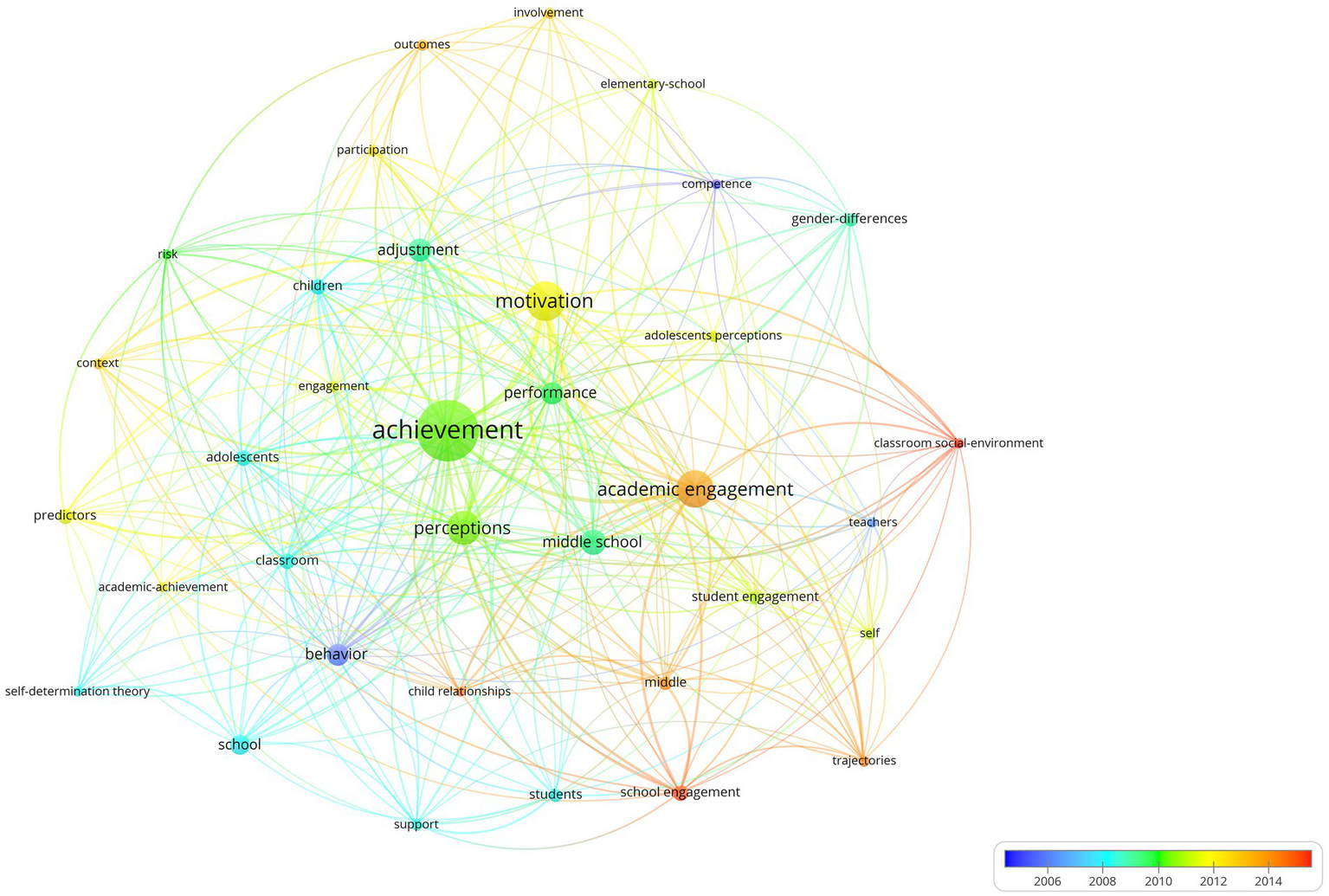
Keywords plus co-occurrence graph: colors indicate average publication years.
Thus, the six articles that intersected the highest number of citations and topical issues were as follows: Skinner et al. (2009), Wang and Degol (2013), Pietarinen et al. (2014), Engels et al. (2016), Wang and Eccles (2013), and Liu et al. (2018), among which we identified the importance of motivation (Skinner et al., 2009; Wang and Degol (2013); Wang and Eccles, 2013), and emotion (Pietarinen et al., 2014; Liu et al., 2018) aspects (Table 6).
Table 6
| Studied topic | Motivation | Emotion | |||
|---|---|---|---|---|---|
| Article | Skinner et al. (2009) | Wang and Eccles (2013) | Wang and Degol (2013) | Liu et al. (2018) | Pietarinen et al. (2014) |
| Prolific author clusters | 6 | 3 | 3 | 3 | 4 |
| Prolific authors (Articles) | Skinner (7), Kindermann (5) | Wang MT (13) | Wang MT (13) | Ding Y (8), Liu RD (8), Zhen (8) | Pyhältö (8), Soini (8), Pietarinen (7) |
| Prolific country | USA | USA | USA | China, USA | No |
| Journal on nucleus of Bradford | No | No | No | Educ. Psychol. | No |
| Open access | No | No | Green Accepted | No | No |
| Web of science index | SSCI, SCIE | SSCI | SSCI | SSCI | SSCI |
| Times cited, WoS Core* | 857 | 502 | 429 | 117 | 142 |
Relevant contemporaneous topics in h-index articles and other variables.
*Extraction data: 15 July 2024.
4 Discussion
From a methodological viewpoint, our mapping review uses fundamental bibliometric laws (Haddow, 2018). Thus, when presenting the temporal evolution of the sample of selected articles, unlike the bibliometric studies on behavior in the educational setting by López-Belmonte et al. (2021), Alcaraz-Garcia (2021), and García-Chitiva (2021), our work uses Price’s Law (1976) to account for the implications of the exponential growth of science. This set of selected articles was obtained from WoS, as well as other bibliometric research on behavioral studies in education (López-Belmonte et al., 2021; Baek and Doleck, 2022; Tiberius and Weyland, 2023). The data was analyzed using VOSviewer (Van Eck and Waltman, 2010), a software commonly used by other similar studies (Tiberius and Weyland, 2023; Dong and Zeb, 2022; Ling et al., 2023).
Regarding our results, (1) the estimation of nucleus journals using Bradford’s Law (Bulik, 1978) allowed us to identify Frontiers in Psychology, International Journal of Environmental Research and Public Health, Plos One, Sustainability, as well as Tiberius and Weyland (2023) and Dong and Zeb (2022) as relevant journals; (2) the estimation of prolific authors led us to consider 1.3% of our total authors (4,667) with five or more published articles, which is comparable to the 1.5% of the total authors (1,505) with four or more published articles used by Tiberius and Weyland (2023); (3) in terms of territorial concentration, our results agree with Baek and Doleck (2022) for USA, China, and Spain, and with Dong and Zeb (2022) for USA, China, Australia, and United Kingdom (England); (4) unlike other articles that report prolific authors and results based on h-index (López-Belmonte et al., 2021; Dong and Zeb, 2022; Ling et al., 2023), our work also identifies the correlation between both sets by means of a chi-square test.
In contrast with other mapping review using bibliometrics on this topic (Pham et al., 2024), we attribute this to the neutrality of our search vector that our results identify as outstanding Keywords plus® central aspects of academic engagement (classroom social environment and school engagement), and the most relevant articles highlight the importance of motivation (Skinner et al., 2009; Wang and Eccles, 2013; Wang and Degol, 2013), and emotion (Pietarinen et al., 2014; Wentzel and Watkins, 2002) aspects. Our results also establish a distance compared to the concept of student engagement, which is usually understood as proximate. Torres-Castro (2024), as in our study, identifies a relevant role in the scientific production of USA, UK, Australia, China and Spain, and highlights psychological and behavioral perspectives as relevant categories of study. Along the same lines, with considerable precision and even greater proximity, our study resembles its findings with two of the main research themes of Aparicio et al. (2021): “Academic, social and personal involvement and environment,” and “Feelings and perspectives,” achieving convergence of both theoretical constructs in these topics.
5 Conclusion
This bibliometric mapping review on high-impact research in academic engagement concludes that the scientific production of researchers has grown at an exponential rate (R2 = 98%). This is a product of the contribution of 1,607 authors from 87 countries, with a co-authorship from the USA of 49%. However, according to Lotka’s law, of the total number of authors, only 59 were estimated as prolific (1.3%), contributing five or more publications on the topic studied, forming 13 co-authorship clusters (including triads and dyads), and highlighting the production level of a researcher affiliated with The University of Hong Kong. Bradford’s law identified 24 of 522 journals (4.6%), accounting for one-third of the published articles. The journal with the highest concentration was Frontiers in Psychology, with 70 papers indexed in the WoS Psychology, Multidisciplinary (JIF-Q2) category.
Regarding the impact of scientific production on academic engagement, the h-index, as a citation impact weighting factor, determined that 92 of 1,607 articles (5.7%) were relevant within the set of articles studied. The citation levels of these 92 articles did not depend on variables such as the age of publication, affiliation of one or more authors with a prolific country, publication in a journal specializing in the subject (belonging to the Bradford core), or having some form of open access to the article. However, this was associated with authorship by one or more prolific authors, as in the recent work of Nast et al. (2025), but in attention to another optic of academic engagement. A clear manifestation of the “Matthew effect” in science, which gives greater visibility and credit to high-profile scientists (Merton, 1968; Teixeira da Silva, 2021).
In addition, the outstanding Keywords plus® of the articles in the h-index, show that the cross between the highest average citations and the most current average years of citation, as relevant topics in the study of academic engagement, are the motivation and emotion aspects.
Knowing which are the highest impact research publications on academic engagement allows us to identify two topics of contemporary relevance in the study of academic engagement, motivation and emotion, as a convergence of five articles of the highest worldwide citation in this field of study. Articles that distinguish themselves thanks to our work as world reference documents for the epistemic community of academic engagement researchers to put them at the center of their studies, and for educational decision makers to see motivational and emotional aspects as relevant knowledge in the teaching of academic engagement.
Finally, as a future line of research, we recommend further empirical investigation of the aspects of academic engagement and their relationship with achievement, motivation, and emotion aspects. Thus, essential questions for future research could be:
-
How does academic engagement influence student achievement?
-
What emotional factors affect the relationship between academic engagement and achievement?
-
How does intrinsic and extrinsic motivation impact academic engagement and performance?
-
How does social support (family, peer, Teacher) modulate students’ engagement and emotions?
-
What differences exist in academic engagement, achievement and emotions according to cultural or socioeconomic context?
-
How does the type of task (individual or group) influence students’ engagement and emotions?
-
What role do self-compassion and self-criticism play in academic engagement and its relationship with achievement?
-
How does academic engagement affect students’ long-term resilience and motivation?
-
How do educational technologies impact students’ academic engagement and emotions?
-
What differences exist in academic engagement, motivation and emotions between different educational levels?
This question set provides a broad overview of how various factors influence academic engagement, emotions, and achievement, underscoring the importance of considering the diverse psychological, social, and cultural elements that shape students’ learning experiences.
Statements
Data availability statement
The original contributions presented in the study are included in the article/Supplementary material, further inquiries can be directed to the corresponding author.
Author contributions
PL-C: Funding acquisition, Conceptualization, Writing – original draft, Writing – review & editing, Project administration, Formal analysis. AV-M: Funding acquisition, Conceptualization, Writing – review & editing, Project administration, Formal analysis, Methodology, Writing – original draft. GS-S: Funding acquisition, Validation, Writing – original draft, Writing – review & editing. MG-M: Funding acquisition, Writing – original draft. JA-S: Supervision, Writing – review & editing.
Funding
The author(s) declare that financial support was received for the research, authorship, and/or publication of this article. This research was funded by the Agencia Nacional de Investigación y Desarrollo (ANID-Chile) (grant no. Fondecyt 1231574) and the Article Processing Charge (APC) was partially funded by Universidad Católica de la Santísima Concepción (Code: APC2024). Additionally, the publication fee (APC) was partially financed by the Universidad Autónoma de Chile (Code: C.C. 456001), Universidad Arturo Prat (Code: APC 2024), Universidad Bernardo O’Higgins (Code: APC2024), and Universidad de Las Américas (Code: APC2024), through the publication incentive fund.
Acknowledgments
The authors would like to thank the Doctoral Program for Research in Teaching and Learning of Experimental and Social Sciences, Mathematics and Physical Activity and Sports at the University of Extremadura (Spain) for providing access to specialized bibliographic materials.
Conflict of interest
The authors declare that the research was conducted in the absence of any commercial or financial relationships that could be construed as a potential conflict of interest.
The author(s) declared that they were an editorial board member of Frontiers, at the time of submission. This had no impact on the peer review process and the final decision.
Generative AI statement
The author(s) declare that no Gen AI was used in the creation of this manuscript.
Publisher’s note
All claims expressed in this article are solely those of the authors and do not necessarily represent those of their affiliated organizations, or those of the publisher, the editors and the reviewers. Any product that may be evaluated in this article, or claim that may be made by its manufacturer, is not guaranteed or endorsed by the publisher.
Supplementary material
The Supplementary material for this article can be found online at: https://www.frontiersin.org/articles/10.3389/fpsyg.2025.1519509/full#supplementary-material
References
1
Abramo G. D'Angelo C. A. (2022). Drivers of academic engagement in public-private research collaboration: an empirical study. J. Technol. Transf.47, 1861–1884. doi: 10.1007/s10961-021-09884-z
2
Acosta-Gonzaga E. (2023). The effects of self-esteem and academic engagement on university students' performance. Behav. Sci.13:348. doi: 10.3390/bs13040348
3
Alcaraz-Garcia S. (2021). Educational research on autism spectrum disorders: a bibliometric analysis. Bordon-Rev. Pedagogia73, 9–29. doi: 10.13042/Bordon.2021.80310
4
Anderson A. R. Christenson S. L. Sinclair M. F. Lehr C. A. (2004). Check & connect: the importance of relationships for promoting engagement with school. J. Sch. Psychol.42, 95–113. doi: 10.1016/j.jsp.2004.01.002
5
Aparicio G. Iturralde T. Maseda A. (2021). A holistic bibliometric overview of the student engagement research field. J. Furth. High. Educ.45, 540–557. doi: 10.1080/0309877X.2020.1795092
6
Assunçao H. Lin S. W. Sit P. S. Cheung K. C. Harju-Luukkainen H. Smith T. et al . (2020). University student engagement inventory (USEI): transcultural validity evidence across four continents. Front. Psychol.10:2796. doi: 10.3389/fpsyg.2019.02796
7
Baek C. Doleck T. (2022). Educational data mining: a bibliometric analysis of an emerging field. IEEE Access10, 31289–31296. doi: 10.1109/ACCESS.2022.3160457
8
Bakth F. N. Hoffman A. J. Schacter H. L. (2022). Investigating the relation between ethnic-racial identity and classroom engagement among Cherokee adolescents: cultural socialization as a moderator. Cult. Divers. Ethn. Minor. Psychol.28, 182–192. doi: 10.1037/cdp0000530
9
Barnett M. Melugin P. Hernandez J. (2020). Time perspective, intended academic engagement, and academic performance. Curr. Psychol.39, 761–767. doi: 10.1007/s12144-017-9771-9
10
Barragan-Martin A. B. Perez-Fuentes M. C. Molero-Jurado M. M. Martos-Martinez A. Simon-Marquez M. M. Sisto M. et al . (2021). Emotional intelligence and academic engagement in adolescents: the mediating role of self-esteem. Psychol. Res. Behav. Manag.14, 307–316. doi: 10.2147/PRBM.S302697
11
Bulik S. (1978). Book use as a Bradford-Zipf phenomenon. C&RL39, 215–219. doi: 10.5860/crl_39_03_215
12
Buzzai C. Sorrenti L. Costa S. Toffle M. E. Filippello P. (2021). The relationship between school-basic psychological need satisfaction and frustration, academic engagement and academic achievement. Sch. Psychol. Int.42, 497–519. doi: 10.1177/01430343211017170
13
Cambridge University Press (2024). Article type definitions. Available at:https://www.cambridge.org/core/open-research/article-type-definitions (Accessed December 15, 2024).
14
Carmona-Halty M. Salanova M. Llorens S. Schaufeli W. B. (2021). Linking positive emotions and academic performance: the mediated role of academic psychological capital and academic engagement. Curr. Psychol.40, 2938–2947. doi: 10.1007/s12144-019-00227-8
15
Casuso-Holgado M. J. Cuesta-Vargas A. I. Moreno-Morales N. Labajos-Manzanares M. T. Barón-López F. J. Vega-Cuesta M. (2013). The association between academic engagement and achievement in health sciences students. BMC Med. Educ.13:33. doi: 10.1186/1472-6920-13-33
16
Chadegani A. A. Salehi H. Yunus M. M. Farhadi H. Fooladi M. Farhadi M. et al . (2013). A comparison between two main academic literature collections: Web of Science and Scopus databases. Asian Soc. Sci.9:5. doi: 10.5539/ass.v9n5p18
17
Clarivate (2023). Web of Science. Available at:https://www.webofknowledge.com/ (Accessed July 15, 2024).
18
Crespo N. Simoes N. (2019). Publication performance through the lens of the h-index: how can we solve the problem of the ties?Soc. Sci. Q.100, 2495–2506. doi: 10.1111/ssqu.12696
19
Datu J. A. D. Valdez J. P. M. King R. B. (2016). Perseverance counts but consistency does not! Validating the short grit scale in a collectivist setting. Curr. Psychol.35, 121–130. doi: 10.1007/s12144-015-9374-2
20
de la Fuente J. Sander P. Martínez-Vicente J. M. Vera M. Garzón A. Fadda S. (2017). Combined effect of levels in personal self-regulation and regulatory teaching on meta-cognitive, on meta-motivational, and on academic achievement variables in undergraduate students. Front. Psychol.8:232. doi: 10.3389/fpsyg.2017.00232
21
Desai N. Veras L. Gosain A. (2018). Using Bradford's law of scattering to identify the core journals of pediatric surgery. J. Surg. Res.229, 90–95. doi: 10.1016/j.jss.2018.03.062
22
Dobrov G. M. Randolph R. H. Rauch W. D. (1979). New options for team research via international computer networks. Scientometrics1, 387–404. doi: 10.1007/BF02016658
23
Dong Y. Zeb S. (2022). Role of higher education system in promoting law abiding behavior among students. Front. Psychol.13:1036991. doi: 10.3389/fpsyg.2022.1036991
24
Engels M. C. Colpin H. Van Leeuwen K. Bijttebier P. Van Den Noortgate W. Claes S. et al . (2016). Behavioral engagement, peer status, and teacher-student relationships in adolescence: a longitudinal study on reciprocal influences. J. Youth Adolesc.45, 1192–1207. doi: 10.1007/s10964-016-0414-5
25
Fall A. M. Roberts G. (2012). High school dropouts: interactions between social context, self-perceptions, school engagement, and student dropout. J. Adolesc.35, 787–798. doi: 10.1016/j.adolescence.2011.11.004
26
Farmer T. W. Lines M. M. Hamm J. V. (2011). Revealing the invisible hand: the role of teachers in children's peer experiences. J. Appl. Dev. Psychol.32, 247–256. doi: 10.1016/j.appdev.2011.04.006
27
Freiberg-Hoffmann A. Romero-Medina A. Curione K. Marôco J. (2022). Cross-cultural adaptation and validation of the university student engagement inventory into Spanish. Rev. Latinoamericana Psicol.54, 187–195. doi: 10.14349/rlp.2022.v54.21
28
Furrer C. Skinner E. (2003). Sense of relatedness as a factor in children's academic engagement and performance. J. Educ. Psychol.95, 148–162. doi: 10.1037/0022-0663.95.1.148
29
Galand B. Raucent B. Frenay M. (2010). Engineering students' self-regulation, study strategies, and motivational believes in traditional and problem-based curricula. Int. J. Eng. Educ.26, 523–534.
30
García-Chitiva M. P. (2021). Collaborative learning in higher education processes mediated by internet. Rev. Electr. Educ.25, 1–19. doi: 10.15359/ree.25-2.23
31
Gasiewski J. A. Eagan M. K. Garcia G. A. Hurtado S. Chang M. J. (2012). From gatekeeping to engagement: a multicontextual, mixed method study of student academic engagement in introductory STEM courses. Res. High. Educ.53, 229–261. doi: 10.1007/s11162-011-9247-y
32
Gómez P. Pérez C. Parra P. Ortiz L. Matus O. Mccoll P. et al . (2015). Academic achievement, engagement and burnout among first year medical students. Rev. Med. Chile143, 930–937. doi: 10.4067/S0034-98872015000700015
33
Grant M. J. Booth A. (2009). A typology of reviews: an analysis of 14 review types and associated methodologies. Health Inf. Libr. J.26, 91–108. doi: 10.1111/j.1471-1842.2009.00848.x
34
Guvenc H. (2015). The relationship between Teachers' motivational support and engagement versus disaffection. Educ. Sci.-Theory Pract.15, 647–657. doi: 10.12738/estp.2015.3.2662
35
Haddow G. (2018). “Bibliometric research” in Research methods. eds. WilliamsonK.JohansonG.. 2nd ed (London: Chandos Publishing), 241–266.
36
Hirsch J. E. (2005). An index to quantify an individual’s scientific research output. Proc. Natl. Acad. Sci. USA102, 16569–16572. doi: 10.1073/pnas.0507655102
37
Hong W. Zhen R. Liu R. D. Wang M. T. Ding Y. Wang J. (2020). The longitudinal linkages among Chinese children's behavioural, cognitive, and emotional engagement within a mathematics context. Educ. Psychol.40, 666–680. doi: 10.1080/01443410.2020.1719981
38
Hospel V. Galand B. (2016). Are both classroom autonomy support and structure equally important for students' engagement? A multilevel analysis. Learn. Instr.41, 1–10. doi: 10.1016/j.learninstruc.2015.09.001
39
Hughes K. Coplan R. J. (2010). Exploring processes linking shyness and academic achievement in childhood. Sch. Psychol. Q.25, 213–222. doi: 10.1037/a0022070
40
Jang H. Reeve J. Deci E. L. (2010). Engaging students in learning activities: it is not autonomy support or structure but autonomy support and structure. J. Educ. Psychol.102, 588–600. doi: 10.1037/a0019682
41
Johnson M. K. Crosnoe R. Elder G. H. (2001). Students' attachment and academic engagement: the role of race and ethnicity. Sociol. Educ.74, 318–340. doi: 10.2307/2673138
42
Ketonen E. E. Haarala-Muhonen A. Hirsto L. Hänninen J. J. Wähälä K. Lonka K. (2016). Am I in the right place? Academic engagement and study success during the first years at university. Learn. Individ. Differ.51, 141–148. doi: 10.1016/j.lindif.2016.08.017
43
Kim H. Y. LaRusso M. D. Hsin L. B. Harbaugh A. G. Selman R. L. Snow C. E. (2018). Social perspective-taking performance: construct, measurement, and relations with academic performance and engagement. J. Appl. Dev. Psychol.57, 24–41. doi: 10.1016/j.appdev.2018.05.005
44
Krauss S. Wong E. J. Y. Zeldin S. Kunasegaran M. Hui J. N. L. Ma'arof A. M. et al . (2022). Positive school climate and emotional engagement: a mixed methods study of Chinese students as Ethnocultural minorities in Malaysian secondary schools. J. Adolesc. Res. Access39, 1154–1192. doi: 10.1177/07435584221107431
45
Lee V. E. Smith J. B. (1993). Effects of school restructuring on the achievement and engagement of middle-grade students. Sociol. Educ.66, 164–187. doi: 10.2307/2112735
46
Ling N. H. Chen C. J. Teh C. S. John D. S. Ch'ng L. C. Lay Y. F. (2023). Global trends of educational data mining in online learning. Int. J. Technol. Educ.6, 656–680. doi: 10.46328/ijte.558
47
Linnenbrink-Garcia L. Wormington S. V. Snyder K. E. Riggsbee J. Perez T. Ben-Eliyahu A. et al . (2018). Multiple pathways to success: an examination of integrative motivational profiles among upper elementary and college students. J. Educ. Psychol.110, 1026–1048. doi: 10.1037/edu0000245
48
Liu R. D. Zhen R. Ding Y. Liu Y. Wang J. Jiang R. H. et al . (2018). Teacher support and math engagement: roles of academic self-efficacy and positive emotions. Educ. Psychol.38, 3–16. doi: 10.1080/01443410.2017.1359238
49
López-Belmonte J. Segura-Robles A. Moreno-Guerrero A. J. Parra-González M. E. (2021). Projection of e-learning in higher education: a study of its scientific production in web of science. Eur. J. Inv. Health Psychol. Educ.11, 20–32. doi: 10.3390/ejihpe11010003
50
Lotka A. J. (1926). The frequency distribution of scientific productivity. J. Wash. Acad. Sci.16, 317–321.
51
Martínez I. M. Youssef-Morgan C. M. Chambel M. J. Marques-Pinto A. (2019). Antecedents of academic performance of university students: academic engagement and psychological capital resources. Educ. Psychol.39, 1047–1067. doi: 10.1080/01443410.2019.1623382
52
Medrano L. A. Moretti L. Ortiz A. (2015). Measure of academic engagement in university students. Revista Iberoamericana Diagnóstico Eval. Psicol.2, 114–124.
53
Merediz-Solà I. Bariviera A. F. (2019). A bibliometric analysis of bitcoin scientific production. Res. Int. Bus. Financ.50, 294–305. doi: 10.1016/j.ribaf.2019.06.008
54
Merton R. K. (1968). The Matthew effect in science. Science159, 56–63.
55
Middleton J. (2010). Sense and the city: exploring the embodied geographies of urban walking. Soc. Cult. Geogr.11, 575–596. doi: 10.1080/14649365.2010.497913
56
Molina-Arias M. (2017). Lectura crítica en pequeñas dosis: What is the real significance of p-value?Pediatría Atención Primaria19, 377–381.
57
Mukherjee D. Lim W. M. Kumar S. Donthu N. (2022). Guidelines for advancing theory and practice through bibliometric research. J. Bus. Res.148, 101–115. doi: 10.1016/j.jbusres.2022.04.042
58
Nast C. Llopis O. Yankova D. D'Este P. (2025). Sourcing insights elsewhere: the positive influence of academic engagement on scientific impact. Technovation139:103112. doi: 10.1016/j.technovation.2024.103112
59
Ng H. T. H. Zhang C. Q. Phipps D. Zhang R. Hamilton K. (2022). Effects of anxiety and sleep on academic engagement among university students. Aust. Psychol.57, 57–64. doi: 10.1080/00050067.2021.1965854
60
Nicholls P. T. (1988). Price's square root law: empirical validity and relation to Lotka's law. Inf. Process. Manag.24, 469–477. doi: 10.1016/0306-4573(88)90049-0
61
Oriol-Granado X. Mendoza-Lira M. Covarrubias-Apablaza C. G. Molina-López V. M. (2017). Positive emotions, autonomy support and academic performance of university students: the mediating role of academic engagement and self-efficacy. Rev. Psic.22, 45–53. doi: 10.1016/S1136-1034(17)30043-6
62
Park S. Holloway S. D. Arendtsz A. Bempechat J. Li J. (2012). What makes students engaged in learning? A time-use study of within- and between-individual predictors of emotional engagement in low-performing high schools. J. Youth Adolesc.41, 390–401. doi: 10.1007/s10964-011-9738-3
63
Patall E. A. Steingut R. R. Freeman J. L. Pituch K. A. Vasquez A. C. (2018). Gender disparities in students' motivational experiences in high school science classrooms. Sci. Educ.102, 951–977. doi: 10.1002/sce.21461
64
Pham H. H. Ta T. N. Luong D. H. Nguyen T. T. Vu H. M. (2024). A bibliometric review of research on academic engagement, 1978–2021. Ind. High. Educ.38, 205–217. doi: 10.1177/09504222231189717
65
Pietarinen J. Soini T. Pyhältö K. (2014). Students' emotional and cognitive engagement as the determinants of well-being and achievement in school. Int. J. Educ. Res.67, 40–51. doi: 10.1016/j.ijer.2014.05.001
66
Price D. (1976). A general theory of bibliometric and other cumulative advantage processes. J. Asso. Inf. Sci.27, 292–306. doi: 10.1002/asi.4630270505
67
Rimm-Kaufman S. E. Baroody A. E. Larsen R. A. A. Curby T. W. Abry T. (2015). To what extent do teacher-student interaction quality and student gender contribute to fifth graders' engagement in mathematics learning?J. Educ. Psychol.107, 170–185. doi: 10.1037/a0037252
68
Rodríguez-González R. Martínez-Santos A. E. de la Fuente N. V. López-Pérez M. E. Fernandez-De-La-Iglesia J. D. (2023). Identifying engagement and associated factors in nursing students: an exploratory study. J. Prof. Nurs.48, 77–83. doi: 10.1016/j.profnurs.2023.06.003
69
Romero Suárez N. (2012). Estadística en la toma de decisiones: el p-valor. Telos14, 439–446.
70
Schaufeli W. B. Martínez I. M. Marques Pinto A. Salanova M. Bakker A. B. (2022). Burnout and engagement in university students. J. Cross-Cult. Psychol.33, 464–481. doi: 10.1177/0022022102033005003
71
Schwartz D. Gorman A. H. Nakamoto J. McKay T. (2006). Popularity, social acceptance, and aggression in adolescent peer groups: links with academic performance and school attendance. Dev. Psychol.42, 1116–1127. doi: 10.1037/0012-1649.42.6.1116
72
Serrano L. Sianes A. Ariza-Montes A. (2019). Using bibliometric methods to shed light on the concept of sustainable tourism. Sustain. For.11:6964. doi: 10.3390/su11246964
73
Shih S. S. (2008). The relation of self-determination and achievement goals to Taiwanese eighth graders' behavioral and emotional engagement in schoolwork. Elem. Sch. J.108, 313–334. doi: 10.1086/528974
74
Simpkins S. D. Liu Y. Y. Hsieh T. Y. Estrella G. (2020). Supporting Latino high school students? Science motivational beliefs and engagement: examining the unique and collective contributions of family, teachers, and friends. Educ. Psychol.40, 409–429. doi: 10.1080/01443410.2019.1661974
75
Sinval J. Casanova J. R. Maroco J. Almeida L. S. (2021). University student engagement inventory (USEI): psychometric properties. Curr. Psychol.40, 1608–1620. doi: 10.1007/s12144-018-0082-6
76
Skinner E. Graham J. P. Brule H. Rickert N. Kindermann T. (2020). I get knocked down but I get up again: integrative frameworks for studying the development of motivational resilience in school. Int. J. Behav. Dev.44, 290–300. doi: 10.1177/0165025420924122
77
Skinner E. A. Kindermann T. A. Furrer C. J. (2009). A motivational perspective on engagement and disaffection: conceptualization and assessment of children's behavioral and emotional participation in academic activities in the classroom. Educ. Psychol. Meas.69, 493–525. doi: 10.1177/0013164408323233
78
Skinner E. Marchand G. Furrer C. Kindermann T. (2008). Engagement and disaffection in the classroom: part of a larger motivational dynamic?J. Educ. Psychol.100, 765–781. doi: 10.1037/a0012840
79
Strati A. D. Schmidt J. A. Maier K. S. (2017). Perceived challenge, teacher support, and teacher obstruction as predictors of student engagement. J. Educ. Psychol.109, 131–147. doi: 10.1037/edu0000108
80
Suárez-Orozco C. Gaytán F. X. Bang H. J. Pakes J. O'Connor E. Rhodes J. (2010). Academic trajectories of newcomer immigrant youth. Dev. Psychol.46, 602–618. doi: 10.1037/a0018201
81
Tatiana B. Kobicheva A. Tokareva E. Mokhorov D. (2022). The relationship between students' psychological security level, academic engagement and performance variables in the digital educational environment. Educ. Inf. Technol.27, 9385–9399. doi: 10.1007/s10639-022-11024-5
82
Teixeira da Silva J. A. (2021). The Matthew effect impacts science and academic publishing by preferentially amplifying citations, metrics and status. Scientometrics126, 5373–5377. doi: 10.1007/s11192-021-03967-2
83
Tiberius V. Weyland M. (2023). Entrepreneurship education or entrepreneurship education? A bibliometric analysis. J. Furth. High. Educ.47, 134–149. doi: 10.1080/0309877X.2022.2100692
84
Tomas J. M. Gutierrez M. Alberola S. Georgieva S. (2022). Psychometric properties of two major approaches to measure school engagement in university students. Curr. Psychol.41, 2654–2667. doi: 10.1007/s12144-020-00769-2
85
Torres-Castro U. E. (2024). Toward a unified framework: the intellectual lineage of student engagement in higher education (1999–2024). Cogent Educ.11:2369002. doi: 10.1080/2331186X.2024.2369002
86
Truta C. Parv L. Topala I. (2018). Academic engagement and intention to drop out: levers for sustainability in higher education. Sustain. For.10:4637. doi: 10.3390/su10124637
87
Tsai H. H. (2013). Knowledge management vs. data mining: research trend, forecast and citation approach. Expert Syst. Appl.40, 3160–3173. doi: 10.1016/j.eswa.2012.12.029
88
Tucker C. M. Zayco R. A. Herman K. C. Reinke W. M. Trujillo M. Carraway K. et al . (2002). Teacher and child variables as predictors of academic engagement among low-income African American children. Psychol. Sch.39, 477–488. doi: 10.1002/pits.10038
89
Ulmanen S. Soini T. Pietarinen J. Pyhältö K. (2016). Students' experiences of the development of emotional engagement. Int. J. Educ. Res.79, 86–96. doi: 10.1016/j.ijer.2016.06.003
90
Valle A. Núñez J. C. Cabanach R. G. Rodríguez S. Rosário P. Inglés C. J. (2015). Motivational profiles as a combination of academic goals in higher education. Educ. Psychol.35, 634–650. doi: 10.1080/01443410.2013.819072
91
Van Eck N. J. Waltman L. (2010). Software survey: VOSviewer, a computer program for bibliometric mapping. Scientometrics84, 523–538. doi: 10.1007/s11192-009-0146-3
92
Vollet J. W. Kindermann T. A. Skinner E. A. (2017). In peer matters, teachers matter: Peer group influences on students' engagement depend on teacher involvement. J. Educ. Psychol.109, 635–652. doi: 10.1037/edu0000172
93
Wang M. T. Degol J. (2013). Motivational pathways to STEM career choices: using expectancy-value perspective to understand individual and gender differences in STEM fields. Dev. Rev.33, 304–340. doi: 10.1016/j.dr.2013.08.001
94
Wang M. T. Degol J. (2014). Staying engaged: knowledge and research needs in student engagement. Child Dev. Perspect.8, 137–143. doi: 10.1111/cdep.12073
95
Wang M. T. Eccles J. S. (2013). School context, achievement motivation, and academic engagement: a longitudinal study of school engagement using a multidimensional perspective. Learn. Instr.28, 12–23. doi: 10.1016/j.learninstruc.2013.04.002
96
Wang M. T. Hofkens T. L. (2020). Beyond classroom academics: a school-wide and multi-contextual perspective on student engagement in school. Adolesc. Res. Rev.5, 419–433. doi: 10.1007/s40894-019-00115-z
97
Wang M. T. Huguley J. P. (2012). Parental racial socialization as a moderator of the effects of racial discrimination on educational success among African American adolescents. Child Dev.83, 1716–1731. doi: 10.1111/j.1467-8624.2012.01808.x
98
Wang M. T. Sheikh-Khalil S. (2014). Does parental involvement matter for student achievement and mental health in high school?Child Dev.85, 610–625. doi: 10.1111/cdev.12153
99
Wefald A. J. Downey R. G. (2009). Construct dimensionality of engagement and its relation with satisfaction. J. Psychol.143, 91–112. doi: 10.3200/JRLP.143.1.91-112
100
Wentzel K. K. Watkins D. E. (2002). Peer relationships and collaborative learning as contexts for academic enablers. Sch. Psychol. Rev.31, 366–377. doi: 10.1080/02796015.2002.12086161
101
Yu J. H. Huang C. Q. He T. Wang X. Z. Zhang L. J. (2022). Investigating students' emotional self-efficacy profiles and their relations to self-regulation, motivation, and academic performance in online learning contexts: a person-centered approach. Educ. Inf. Technol.27, 11715–11740. doi: 10.1007/s10639-022-11099-0
102
Zhang A. Z. Yang Y. (2021). Toward the association between EFL/ESL teachers' work engagement and their students' academic engagement. Front. Psychol.12:739827. doi: 10.3389/fpsyg.2021.739827
103
Zimmer-Gembeck M. J. Chipuer H. M. Hanisch M. Creed P. A. McGregor L. (2006). Relationships at school and stage-environment fit as resources for adolescent engagement and achievement. J. Adolesc.29, 911–933. doi: 10.1016/j.adolescence.2006.04.008
104
Zipf G. (1932). Selected studies of the principle of relative frequency in language. Cambridge: Oxford University Press.
Summary
Keywords
engagement, educational research, behavioral studies, prolific author, h-index
Citation
Loyola-Carrillo P, Vega-Muñoz A, Salazar-Sepúlveda G, Gil-Marín M and Adsuar-Sala J (2025) Studying engagement in educational settings: a mapping review on high-impact academic engagement research. Front. Psychol. 16:1519509. doi: 10.3389/fpsyg.2025.1519509
Received
30 October 2024
Accepted
15 January 2025
Published
31 January 2025
Volume
16 - 2025
Edited by
Gaetana Affuso, University of Campania Luigi Vanvitelli, Italy
Reviewed by
Marwan H. Sallam, Huazhong University of Science and Technology, China
Aparicio G., University of the Basque Country, Spain
Updates
Copyright
© 2025 Loyola-Carrillo, Vega-Muñoz, Salazar-Sepúlveda, Gil-Marín and Adsuar-Sala.
This is an open-access article distributed under the terms of the Creative Commons Attribution License (CC BY). The use, distribution or reproduction in other forums is permitted, provided the original author(s) and the copyright owner(s) are credited and that the original publication in this journal is cited, in accordance with accepted academic practice. No use, distribution or reproduction is permitted which does not comply with these terms.
*Correspondence: Alejandro Vega-Muñoz, alejandro.vega@ucentral.cl
†ORCID: Paola Loyola-Carrillo, orcid.org/0009-0005-9517-2255
Alejandro Vega-Muñoz, orcid.org/0000-0002-9427-2044
Guido Salazar-Sepúlveda, orcid.org/0000-0002-4979-6869
Miseldra Gil-Marín, orcid.org/0000-0003-2553-5020
José Adsuar-Sala, orcid.org/0000-0001-7203-3168
Disclaimer
All claims expressed in this article are solely those of the authors and do not necessarily represent those of their affiliated organizations, or those of the publisher, the editors and the reviewers. Any product that may be evaluated in this article or claim that may be made by its manufacturer is not guaranteed or endorsed by the publisher.