Abstract
Introduction:
The aim of the research is to examine the effect size between organizational cynicism and counterproductive work behaviors, which are within the scope of negative employee attitudes and behaviors in working life, with the systematic review method.
Methods:
The systematic review was conducted in accordance with PRISMA guidelines. EBSCO, Google Scholar, SAGE, Scopus, WILEY and WoS databases were searched by the authors with the keywords “Organizational cynicism, employee cynicism, deviant work behaviors, workplace deviant behavior,” “Counterproductive work behaviors,” “employee’s misbehavior” in English between 2010 and 2024.
Results:
The data set of the research consists of 22 empirical studies conducted in 9 different countries with 7,331 participants. According to the random effects model, the effect size was found 0.482 between organizational cynicism and counterproductive work behaviors. According to this result, a medium and significant effect size and a positive relationship (r = 0.448) between organizational cynicism and counterproductive work behaviors were found.
Discussion:
Organizations should consider that each employee is negatively affected by negative leadership behaviors, unfair and unequal organizational decisions and practices. Therefore, it can be said that equal, fair, supportive attitudes and organizational practices will reduce employees’ organizational cynicism and counterproductive work behaviors and also positively affect their organizational commitment, job performance and organizational citizenship behaviors.
1 Introduction
In today’s business life, organizations employ employees who have different expertise, knowledge, skills and abilities to achieve their organizational goals. Organizations place their members in different positions, tasks and responsibilities at different levels of a hierarchical structure to achieve a collective set of goals and objectives. In this respect, organizations are social systems that require interaction among people (Nassehi, 2005). While creating a balance of authority and responsibility between the abilities of employees and the requirements of the job, the organization considers the personalities, wishes and goals of them (Sabuncuoğlu and Vergiliel Tüz, 2016). Therefore, irrational decisions and practices taken by organizations in some cases can negatively affect employees’ feelings, thoughts, behaviors and attitudes (Nassehi, 2005). In addition to employees’ perceptions of organizational injustice, low organizational trust and low organizational support, various situations such as unethical leadership behaviors of managers and mobbing of employees have been identified as the causes of organizational cynicism (FitzGerald, 2002; Bedük et al., 2017; Akar, 2019; Hussain et al., 2021; Yalçın and Özbaş, 2021). According to Chiaburu et al. (2013), if employees feel that their contracts have been violated, they may think that the organization is not being honest with them. This is a violation of the psychological contract and can lead to a lack of trust to the organization. Role ambiguity in the workplace and the inability to fulfill family responsibilities due to work-related reasons can cause psychological tension and work stress in employees. All these negative workplace experiences can lead to organizational cynicism in employees. Just as there may be cynical individuals in the society for various reasons (injustice, violation of personal rights, etc.), it is also possible to encounter cynical employees in business life. In addition to damaging behaviors such as revenge and retaliation, employees may engage in illegal behavior against the organization or its employees when they feel they are being put in a difficult position by the organization (Spector, 2011; Roxana, 2013; Oliveira et al., 2020). For whatever reason, both organizational cynicism and counterproductive work behaviors cause important economic, psychological and social damage to both the organization and employees (Shahzad and Mahmood, 2012; Robinson and Bennett, 1995; Rayan et al., 2018). The Hawthorne studies of Mayo and his colleagues, which paved the way for the human relations movement in the field of organizational behavior, revealed that organizations do not consist of mechanical systems and drew attention to human capital as the most important element of production (Muldoon, 2017). The Hawthorne studies temporarily shifted academic attention away from the physical work environment and stimulated a literature examining rich human interactions within organizations. Thus, it set the stage for future research into the complex relationships between social dynamics and the physical work environment (Zhong and House, 2012). The psychological, social and cultural structure of human beings is both affects and affected by the organization that constitutes a social system. In addition, changing socioeconomic life, technology, culture of employee, attitudes and behaviors of managers and business life affect employees and organizations. Cultural values can significantly affect employees’ attitudes and feelings toward the organization. Hofstede’s (2011) cultural dimensions (power distance, individualism/collectivism, uncertainty avoidance, etc.) have significant relationships with organizational commitment, citizenship behavior and emotional reactions. These relationships may also extend to negative attitudes such as organizational cynicism. Individualism/collectivism dimension is one of the most determinant cultural factors in organizational behavior differences. This dimension can play an important role in the attitudes and behaviors (e.g., cynicism) that employees develop toward the organization (Taras et al., 2010). There are many studies on organizational cynicism and counterproductive work behaviors in the literature. However, there is no meta-analysis study synthesizing these studies. Therefore, it is important to determine the effect size between organizational cynicism and counterproductive work behaviors and to reveal the relationship between these two phenomena. Each empirical research has a unique nature. For example, even if there are studies on the same subject, different measurement tools, participants with characteristics from different cultures, subcultures even within the same culture, and different organizational cultures can be listed as factors that may affect the studies. Therefore, the meta-analysis method allows synthesizing such differences and reaching inductive results. The purpose of this study is to examine the relationship between organizational cynicism and counterproductive work behaviors through systematic review method. In line with the theoretical framework of the research, organizational cynicism and counterproductive work behaviors are explained below.
1.1 Theoretical background
1.1.1 Organizational cynicism
According to Andersson and Bateman (1997), cynicism can be directed toward a specific object or multiple objects. Cynicism can be defined as both a general and specific attitude characterized by negative feelings, disappointment and distrust toward a person, group, ideology, social custom or institution. Organizational cynicism occurs when employees do not trust their organizations and feel that the organization cannot be trusted (Durrah et al., 2019). If employees feel distrust and injustice toward their organizations, they may change their thoughts, attitudes and behaviors toward the organization and their colleagues. Organizational cynicism is a negative attitude of employees toward their organizations and consists of three dimensions: (1) belief that the organization is dishonest; (2) negative affectivity toward the organization; (3) dismissive and critical behavioral tendencies toward the organization consistent with these beliefs and affect. Cynicism is not a neutral judgment about the organization; it may involve strong emotional reactions (Dean et al., 1998). According to Abraham (2000), organizational cynicism is the negative feelings of employees toward the organization due to the attitudes and behaviors of leaders or managers in cynicism, employees’ negative feelings toward the organization are based on a strong discredit of honesty, fairness and sincerity. The emotional component of cynicism refers to the arousal of strong negative emotions such as humiliation, anger, discomfort and shame. The occurrence of organizational cynicism is based on the belief that the organization lacks honesty. In other words, employees’ perceptions or experiences of dishonest or unfair behavior, insincerity, and their beliefs about the organization can lead to organizational cynicism (Naus et al., 2007). Social exchange theory explains the distrustful, pessimistic (cynical) behavior of people working in an organization. Social Exchange Theory explains that the fundamental nature of human behavior is a subjective interaction with others. It emphasizes that the development of interpersonal relationships is based on the norm of reciprocity (Jiang et al., 2017). Social exchange theory is examined as the conceptual basis of organizational cynicism and based on the argument that organizational cynicism is a result of psychological contract breach (Pfrombeck et al., 2020). Johnson and O’Leary-Kelly (2003) determined that cynicism partially mediates the effects of psychological contract breach on work-related attitudes. McMillan and Albrecht (2010) also found a significant relationship between cynicism and social exchange and emotional commitment. While employees approach the organization with attitudes such as loyalty, labor and commitment, they expect fair treatment, trust and appreciation from the organization in return. When these expectations are not met by the organization, they lose their belief in the sincerity of the organization and develop cynical attitudes (Chiaburu et al., 2013). Therefore, social exchange theory reveals that employees cognitively evaluate organizational practices and attitudes toward themselves in the organizational structure. When employees perceive that they are treated unkindly and badly in the workplace for any reason, they may develop cynical attitudes toward the organization in return. Another approach that explains organizational cynicism behaviors is the job demands-resources (Job demands-R) model. According to Demerouti et al. (2001), job demands are “the physical, psychological, social, or organizational aspects of work that require sustained physical or mental effort and are therefore associated with certain physiological and psychological costs (e.g., stress and exhaustion).” As work demands increase, they can lead to fatigue and health problems in employees. If job demands, such as high work pressure and violent conflicts persist over time, employees’ relationships may deteriorate, health problems may become chronic and work performance may decline. On the other hand, job demands and resources are the initiators of the motivation process. Therefore, they are the most important determinants of employees’ job commitment and organizational commitment (Bakker, 2015). Job resources refer to the physical, psychological, social or organizational aspects of work that promote personal growth, learning and development that are functional for achieving work goals. Autonomy, skill diversity, performance feedback and growth opportunities are examples of job resources (Bakker and Demerouti, 2016). The JD-R model tries to explain two causal processes: the health impairment process and the motivational process. High job demands (such as workload, time pressure, emotional demands) increase the risk of burnout in employees and can lead to negative outcomes such as health complaints or turnover intentions. Job resources (autonomy, social support, performance feedback, and professional development opportunities) play a motivational role in employees, fostering commitment to work and promoting positive organizational outcomes such as performance or organizational commitment. Moreover, while the absence of job resources leads to burnout, job resources can buffer the impact of job demands on burnout (Lesener et al., 2019). While the intensity of job demands can lead to stress, tension, burnout and cynical feelings toward the organization, job resources have the effect of reducing the psychological and physiological costs caused by job demands. Employees with negative attitudes and feelings toward the organization may indicate counterproductive work behaviors in order to cope with this situation or to achieve justice for themselves. Social exchange theory defines relationships between people as interactions in which people have obligations toward each other. Therefore, when employees see positive (or negative) attitudes and behaviors toward them in their organizations, they feel an obligation to show positive (or negative) attitudes and behaviors in return (Evans et al., 2021). Studies examining the relationship between organizational cynicism and counterproductive work behaviors have revealed a significant and positive relationship between these two phenomena (Evans et al., 2010; Ahmed et al., 2013; Shahzad and Mahmood, 2012; Rayan et al., 2018; Ali et al., 2020; Dar et al., 2020).
1.1.2 Counterproductive work behaviors
Counterproductive work behaviors are generally defined as deviant behaviors in the workplace that are contrary to organizational norms. According to Marcus and Schuler (2004), these behaviors include theft, fraud, absenteeism, physical and verbal aggression or drug addiction. Deviant behaviors in the workplace are unethical actions of individuals or groups whose attitudes and actions differ from accepted social standards (Lugosi, 2019). According to Spector and Fox (2002), deviant workplace behaviors are negative and harmful behaviors that violate organizational norms. For example, absenteeism, not doing work properly, physical anger, verbal hostility (humiliation), sabotage and theft. While anger and hostility are directly individual-oriented, not doing things properly or sabotage are organization-oriented. Theft is both individual and organizational oriented behavior. According to Robinson and Bennett (1995), counterproductive work behaviors are taxonomically divided into two groups: organizational and individual behaviors. First, organizational behaviors are minor organizational-oriented behaviors such as leaving work early, taking frequent breaks, deliberately slowing down work, and wasting resources. On the other hand, sabotage, taking bribes and stealing organizational property are classified as major organizational behaviors. Secondly, individual behaviors are those that are considered minor: interpersonal behaviors (favoritism, gossiping about co-workers, blaming co-workers) and major interpersonal behaviors (sexual harassment, verbal harassment, stealing co-workers’ belongings, endangering co-workers). In addition to individual reasons such as personality, genetic factors, family background and social influences, organizational and work-related reasons (perception of injustice, frustration, job satisfaction and work stress) are also suggested to lead employees to such behaviors (Marcus and Schuler, 2004; Agrawal and Pandey, 2021). It can be said that three models stand out in the studies on counterproductive work behaviors. (1) The model that Robinson and Bennett (1995) and Bennett and Robinson (2000) divided into two as organizational deviance (OD) and interpersonal deviance (ID). (2) Spector et al. (2006) five-dimensional model that includes abuse, production deviance, theft, sabotage, and withdrawal; and (3) the more elaborate 11-faceted model proposed by Gruys and Sackett (2003) that includes theft, property damage, information misuse, time and resource misuse, unsafe behaviors, absenteeism, poor work quality, alcohol use, drug use, inappropriate verbal behavior, and inappropriate physical behavior (Marcus et al., 2016). Regarding the antecedents of employees’ counterproductive work behaviors, Zappala et al. (2022) put forward three main ideas. The first main idea is the sociodemographic and personality aspects of perpetrators and victims. Secondly, the effects of organizational contexts on individual deviant behaviors and finally the role of the leader who influences the organizational climate. Hafidz (2012) stated that in general, antecedents of counterproductive work behaviors can be divided into individual (personality, locus of control and values) and situational factors. Ahmed et al. (2013) explained that counterproductive work behaviors are caused by many factors such as psychological contract breach, interactional injustice, cynicism, dissatisfaction, job autonomy, self-control and pay inequality. Bari et al. (2022) and Kobanoğlu and Erdoğan (2022) found that psychological contract breach perceived by employees has a significant positive effect on counterproductive work behaviors. They also found that organizational cynicism has a partial role between psychological contract breach and counterproductive work behaviors. According to social exchange theory, when employees feel exploited, devalued or treated unfairly in their relationships with the organization, they may engage in counterproductive work behaviors as retaliation (Chernyak-Hai and Rabenu, 2018; Kim et al., 2023). The equity theory developed by Adams and Freedman (1976) emphasizes that employees try to strike a balance between what they receive in return for their work activities and their work output. In doing so, employees make comparisons with their coworkers and peers. If what employees receive in return for their work activities is less than their peers, the perception of inequality emerges and employees indicate deliberate behaviors such as slowing down work by reducing work performance, absenteeism, making excuses for not going to work, extending meal breaks and break times at work to compensate for this. Literature on revenge has focused on deviant behaviors in the workplace (e.g., physical violence, bad-mouthing managers or coworkers). However, those who study revenge have also offered an alternative perspective on the genesis of these behaviors. Attention has been drawn to what can be considered the “functional” side of deviant work behaviors. A central assumption of the revenge literature is that these acts redress injustices and reorganize dysfunctional power relations in work organizations. Deviant behaviors in the workplace threaten organizational effectiveness, but the revenge literature suggests that the enactment of these behaviors can serve functional purposes for perpetrators and coworkers (Tepper and Henle, 2011). Although there have been many correlational studies between organizational cynicism and counterproductive work behaviors in the literature in the last 14 years, there is no meta-analysis study that synthesizes these studies. This is the most important reason for conducting this study. Thus, by calculating the effect size between organizational cynicism and counterproductive work behaviors, more effective prediction and analytical evaluations can be made. Therefore, the purpose of this study is to examine the effect size between counterproductive work behaviors and organizational cynicism by meta-analysis method based on the studies conducted between 2010 and 2024. Accordingly, the research question was formulated as follows.
1. What is the effect size and relationship between organizational cynicism and counterproductive work behaviors?
2 Materials and methods
This research was conducted by using the systematic review method. The review was conducted in accordance with the PRISMA guidelines (Moher et al., 2009). Meta-analysis was applied to the studies included in the research. The research was conducted between January-September 2024 through EBSCO, Google Scholar, SAGE, Scopus, WILEY and WoS databases on Akdeniz University web page in line with the inclusion criteria determined jointly by three researchers. English keywords entered into the databases: “organizational cynicism, employee cynicism, deviant work behaviors, workplace deviant behaviors,” “counterproductive work behaviors,” “employee misbehavior,” “employee misbehavior in organizations” were searched with “AND, OR” Boolean operators. The researchers agreed on 6 databases that significantly cover studies in the field of social sciences. The researchers completed the search in 8 months by entering keywords and filtering the databases. The filtering was implemented in several steps. First, databases publishing research reports in the field of social sciences were selected and journals in the fields of organizational behavior, work psychology and business management were marked. In the first search, 1,609 studies were found. A total of 1,539 studies that did not meet the inclusion criteria were excluded by the consensus of the researchers. In the last stage, the researchers completed the screening process by integrating their data. Then, all researchers ensured rigor by checking the appropriateness of the studies they identified among themselves. While evaluating the quality of the studies, attention was considered whether the journals publishing the studies were peer-reviewed and indexed. The remaining 70 studies were entered into the Microsoft Excel program by all three researchers and read one by one. Of these studies, 22 studies that fully met the inclusion criteria were found eligible for the research with the approval of all researchers (Figure 1). The values of these 22 studies were entered into the CMA 3.0 program and analyzed for heterogeneity, effect size and publication bias and the data obtained are presented in the results section.
FIGURE 1

PRISMA flow diagram.
2.1 Eligibility criteria
The inclusion criteria were established by the researchers within a consensus framework. Accordingly, the main motivation for this research is the lack of a study that synthesizes the research on counterproductive work behaviors and organizational cynicism in the last 14 years and the abundance of correlative studies on these issues. In the last 10 years, epidemics and technological developments have significantly changed the working system and organizations. It is thought that these changes may also affect organizational behaviors. Therefore, it is aimed to examine the effect size and the relationship between organizational cynicism and counterproductive work behaviors. In this direction, the researchers included studies conducted between 2010 and 2024 and published electronically in social sciences databases in the inclusion criteria. Apart from these, all researchers accepted the other inclusion criteria stated below.
- Studies published electronically in journals in the field of social sciences between 2010 and 2024,
- Studies published in peer-reviewed and internationally indexed journals,
- Articles written in English,
- Studies examining organizational cynicism and counterproductive work behaviors,
- Studies that collect data using quantitative methods and surveys (face-to-face, e-mail or electronic surveys),
- Studies analyzed with Pearson correlation.
Exclusion Criteria: Unpublished articles, Master’s theses, dissertations, published or unpublished books, book chapters, conference or symposium proceedings are considered gray literature. Among these studies, theses, books and book chapters are excluded because they go through different evaluation and publication processes than articles. Conference and symposium papers are excluded because they are in progress and incomplete. Unpublished studies are excluded due to the possibility of retraction due to various potential errors (such as methodological, incorrect information, high similarity rates).
2.2 Selection and coding variables
The researchers independently read and analyzed the 70 studies that met the potential inclusion criteria and reported to be included in the research. The studies determined to be eligible for the research were independently and blindly entered Microsoft Excel spreadsheets by the researchers. Thus, the reliability of coding was ensured. The compatibility of the coders was checked by comparison, and disagreements were negotiated and corrected by consensus. The Excel spreadsheets were created by the researchers and then merged to a single form set. After the researchers confirmed that the studies met the specified criteria, meta-analysis was conducted on 22 studies. Table 1 shows the characteristics of the included studies (number of studies, authors, study title, quality score, study type, etc.).
TABLE 1
| Checklist items | Points |
|---|---|
| 1. Sampling and representativeness (Sampling method) | |
| Non-probability sampling (including purposive, quota, convenience and snowball sampling) | 0 |
| Probability sampling (including: simple random, systematic, stratified g, cluster, two-stage and multi-stage sampling) | 1 |
| 2. Are the individuals selected to participate in the study likely to be representative of the target population? | |
| No | 0 |
| Yes | 1 |
| 3. Selection bias: Is there a risk of selection bias caused by the inadequate selection of participants | |
| High risk | 0 |
| Low risk | 1 |
| 4. Is the sample size adequate for establishing relationships (assumption of statistical power) | |
| No | 0 |
| Yes | 1 |
| 5. Measurement | |
| How was organizational cynicism measured? | |
| With a standardized scale | 1 |
| Self-labeling without definition of the organizational cynicism concept | 0 |
| 6. Measurement | |
| How was workplace counterproductive work behavior? | |
| Self-labeling without definition of the counterproductive work behavior concept | 0 |
| With a standardized scale | 1 |
| 7. Performance bias: Is there a risk of bias caused by the inadequate measurement of organizational cynicism? | |
| High risk | 0 |
| Low risk | 1 |
| 8. Performance bias: Is there a risk of bias caused by the inadequate measurement of counterproductive work behaviors? | |
| High risk | 0 |
| Low risk | 1 |
| 9. Are the statistical methods appropriate for the study design? | |
| No/Can’t tell | 0 |
| Yes | 1 |
| 10. Were meaningful demographic covariates included? | |
| No | 0 |
| Yes | 1 |
| 11. Were other work factors adjusted for? | |
| No | 0 |
| Yes | 1 |
Checklist for the assessment of the methodological quality of the reviewed studies.
2.3 Data analysis
CMA 3.0 package program was used for the analysis of the research data. Pearson’s correlation values were used to calculate the effect size of organizational cynicism and counterproductive work behaviors studies. Correlation values were first converted into Fisher’s Z scores and then converted back into Pearson’s correlation values. This process is done as sensitive predictions in effect size calculation.
2.4 Evaluating publication bias
In meta-analytic datasets, above a certain level publication bias is examined because it affects the calculated average effect size and causes it to be larger than it should be (Borenstein et al., 2009). Firstly publication bias was analyzed according to Duwal and Tweedie. Accordingly, the normal distribution of the research is slightly left skewed. This left skewness can reach a full normal distribution when 3 more studies are added to the right side of the graph. This result was interpreted as no publication bias in the studies observed between the variables according to Duwal and Tweedie. The funnel plot also supports this assessment. The Classic Fail-Safe N value was also calculated to check for publication bias. For the double-ended Alpha value to exceed 0.05, 9,363 more studies need to be added (Z = 40.49; p = 0.000). The high number of studies that need to be added indicates reliable studies in terms of publication bias. For this reason, it was accepted that there was no publication bias in the research according to the Classic Fail-Safe N value.
2.5 Quality assessment tool
There is no standardized tool for quality assessment of studies in systematic review studies in the field of social sciences. For this reason, the 13-item quality assessment tool used by Nielsen et al. (2016) was adapted and used as 11 items in our study (see Table 1). The researchers performed the quality assessment for each study independently. Then, the quality assessment score given to each study by the researchers was averaged. Thus, it was aimed to make an impartial and objective evaluation in the quality assessment of the studies. The quality assessment results of the studies included in the research are presented in Table 2.
TABLE 2
| Studies number | References | Study title | Quality score | Study type | Publication year | Country | Sample size | Pearson correlation | Scale 1 | Scale 2 |
|---|---|---|---|---|---|---|---|---|---|---|
| 1. | Ali et al., 2022 | “The outcomes of organizational cronyism: a social exchange theory perspective” | 9 | Article | 2022 | Pakistan (Asia) | 170 (M: US, F: US) | 0.577** | Organizational cynicism scale | Counter productive work behavior scale |
| 2. | Ahmed et al., 2024 | “The effect of toxic leadership on workplace deviance: the mediating effect of emotional exhaustion, and the moderating effect of organizational cynicism” | 9 | Article | 2024 | Egypt (Africa) | 243 (M: 74, F: 169) | 0.585*** | Organizational cynicism scale | Workplace deviance scale |
| 3. | Bal, 2020 | “The role of organizational cynicism as a mediator in the relationship between perceived organizational support and counter productive work behavior for public employees” | 10 | Article | 2020 | Türkiye (Europa) | 419 (M: 229, F: 190) | 0.178* | Counterproductive work behavior scale | Organizational cynicism scale |
| 4. | Butt and Yazdani, 2021 | “Influence of workplace incivility on counterproductive work behavior: mediating role of emotional exhaustion, organizational cynicism and the moderating role of psychological capital” | 7 | Article | 2021 | Pakistan (Asia) | 215 (M: 95, F: 120) | 0.517** | Counterproductive work behaviors scale | Organizational cynicism scale |
| 5. | Danaeefard and Boustani, 2016 | “Injustice perceptions and employees misbehavior in the public organization: exploration of mediating role of employee’s cynicism to organization” | 9 | Article | 2016 | Iran (Asia) | 420 (M: 256, F: 164) | 0.508 | Employee’s cynicism scale | Employee’s misbehavior scale |
| 6. | Dar et al., 2020 | “Deviant behavior and organizational justice: mediator test for organizational cynicism- the case of Pakistan” | 6 | Article | 2020 | Pakistan (Asia) | 137 (M: 98, F: 39) | 0.504** | Deviant behavior | Organizational cynicism questionnaire |
| 7. | Eren and Demir, 2023 | “The effect of perceived pay equity on counterproductive work behaviors: the mediating role of organizational cynicism” | 7 | Article | 2023 | Türkiye (Europa) | 252 (M: 136, F: 116) | 0.365** | Organizational cynicism scale | Counter productive work behavior scale |
| 8. | Evans et al., 2010 | “The impact of perceived corporate citizenship on organizational cynicism, ocb, and employee deviance” | 6 | Article | 2011 | United States (America) | 188 (M: 92, F: 96) | 0.38*** | Organizational cynicism scale | Employee deviance scale |
| 9. | Evans et al., 2021 | “The role of organizational cynicism and conscientiousness in the relationship between ethical leadership and deviance” | 7 | Article | 2021 | United States (America) | 277 (M: 148, F: 129) | 0.25 | Organizational cynicism scale | Workplace deviance |
| 10. | Griep et al., 2023 | “Perceived identity threat and organizational cynicism in the recursive relationship between psychological contract breach and counterproductive work behavior” | 5 | Article | 2023 | Belgium (Europa) | 386 (M: 105, F: 281) | 0.65*** | Counter productive work behavior scale | Organizational cynicism scale |
| 11. | Jiang et al., 2017 | “The relationship between authoritarian leadership and employees’ deviant workplace behaviors: the mediating effects of psychological contract violation and organizational cynicism” | 9 | Article | 2017 | China (Asia) | 391 (M: 271, F: 120) | 0.37** | Deviant workplace behaviors questionnaire | Organizational cynicism questionnaire |
| 12. | Kim and Jo, 2024 | “An examination of the effects of job insecurity on counterproductive work behavior through organizational cynicism: moderating roles of perceived organizational support and quality of leader-member exchange” | 9 | Article | 2022 | South Korea (Asia) | 296 (M: 119, F: 177) | 0.43** | Organizational cynicism scale | Counterproductive work behavior checklist |
| 13. | Li and Chen, 2018 | “The relationship between psychological contract breach and employees’ counterproductive work behaviors: the mediating effect of organizational cynicism and work alienation” | 10 | Article | 2018 | China (Asia) | 484 (M: 417, F: 77) | 0.30*** | Counterproductive work behaviors scale | Organizational cynicism questionnaire |
| 14. | Naseer et al., 2021 | “When and why organizational cynicism leads to CWBs” | 6 | Article | 2021 | Pakistan (Asia) | 181 (M: 98, F: 83) | 0.38** | Organizational cynicism | Counterproductive work behaviors scale |
| 15. | Nemr and Liu, 2021 | “Organizational cynicism as a moderator variable between ethical leadership and counterwork productive behaviors” | 10 | Article | 2021 | Egypt (Africa) | 400 (M: 244, F: 156) | 0.312 | Counterproductive work behaviors scale | Organizational cynicism scale |
| 16. | Peng et al., 2021 | “Older and less deviant? The paths through emotional labor and organizational cynicism” | 9 | Article | 2021 | China (Asia) | 681 (M: 276, F: 405) | 0.27 | Workplace deviance scale | Organizational cynicism scale |
| 17. | Rayan et al., 2018 | “Organizational cynicism and counterproductive work behaviors: an empirical study” | 9 | Article | 2018 | Egypt (Africa) | 327 (M: US, F: US) | 0.386** | Counterproductive work behaviors scale | Organizational cynicism scale |
| 18. | Safdar et al., 2022 | “Examination of the relationship between organization cynicism and employees workplace behaviors: modeling Islamic (servant) leadership as a moderator” | 7 | Article | 2022 | Pakistan (Asia) | 280 (M: US, F: US) | 0.363** | Organizational cynicism scale | Workplace deviance behavior scale |
| 19. | Saad Saleh Ali and Abdelwahab Ibrahim Elsayed, 2022 | “Correlation between organizational cynicism and counterproductive work behaviors among nurses” | 9 | Article | 2022 | Egypt (Africa) | 550 (M: 135, F: 415) | 0.633* | Organizational cynicism scale | Counterproductive behaviors scale |
| 20. | Shahzad and Mahmood, 2012 | “The mediating - moderating model of organizational cynicism and workplace deviant behavior: evidence from banking sector in Pakistan” | 7 | Article | 2012 | Pakistan (Asia) | 332 (M: 210, F: 122) | 0.817** | Organizational cynicism scale | Workplace deviant behavior scale |
| 21. | Tong et al., 2020 | “The interplay of low identification, psychological detachment, and cynicism for predicting counterproductive work behavior” | 6 | Article | 2020 | China (Asia) | 382 (M: 162, F: 220) | 0.49*** | Counterproductive work behaviors scale | Cynicism maslach burnout inventory |
| 22. | Ugwu et al., 2023 | “Mediating roles of employee cynicism and workplace ostracism on the relationship between perceived organizational politics and counterproductive work behavior” | 10 | Article | 2023 | Nigeria (Africa) | 794 (M: US, F: US) | 0.232 | Organizational cynicism scale | Counterproductive work behaviors scale |
Summary of study characteristics.
*p < 0.05, **p < 0.01, ***p < 0.001.
3 Results
Some studies were excluded from the Prisma flow diagram because they applied a different analysis than Pearson’s correlation (Abdi et al., 2016; Afghan et al., 2018; Murad et al., 2021; Sönmez et al., 2024) or one of them were repetitions of a Ph.D. thesis (Bal, 2021).
Table 2 presents the details of the studies included in the research. Accordingly, the studies were conducted in 9 different countries. It is seen that 22 of the studies are research articles. The total number of participants in the studies was 7,331.
3.1 Effect size and heterogeneity test
The effect size and heterogeneity test results of the studies conducted with organizational cynicism and counterproductive work behaviors variables according to the random effects model are presented in Table 3.
TABLE 3
| Variables | Model | n | Total sample | 95% | Heterogeneity test | ||||||||
|---|---|---|---|---|---|---|---|---|---|---|---|---|---|
| Average effect size | R | SD | LL | UL | p | Q | df | p | I 2 | ||||
| OC1 and CWBs2 | Random | 22 | 7,331 | 0.482 | 0.448 | 0.017 | 0.386 | 0.578 | 0.00 | 382.554 | 21 | 0.00 | 94.511 |
Effect size and heterogeneity test results.
1Organizational cynicism. 2Counterproductive work behaviors.
In Table 3, heterogeneity values are calculated as Q = 382.554 for 21 degrees of freedom. In the Chi-square table, the cut-off value for 21 degrees of freedom at 0.05 confidence level is 32.621. The calculated Q-value is considerably higher than the value in the Chi-square table. Thus, the assumption that the data are heterogeneously distributed is accepted. In addition, according to the I2 value, a high heterogeneity of 94.511% was found between the variables. Therefore, the random effects model was used in the research. Cohen’s d effect size classification was used in the interpretation of effect sizes. According to Cohen’s d effect size values between 0.10 and 0.29 refer to a small effect size, between 0.30 and 0.49 refer to a medium effect size, and 0.50 and above refer to a large effect size (Dinçer, 2014). The average effect size of the random effects model is 0.482. The calculated effect size is at medium level and statistically significant (p < 0.001). Moreover, there is a positive relationship between organizational cynicism and counterproductive work behaviors (r = 0.448). Subgroup analyses were also conducted to explore possible moderators. Three different groups were determined for this purpose. The first one is the sample size. The sample size of the studies was coded in 2 groups (0–250 and 251 +). The effect size of 4 studies with a sample size between 0 and 250 was calculated as 0.502 (SD = 0.122), and the effect size of 18 studies with a sample size of 251 + was calculated as 0.477 (SD = 0.056). No significant differentiation was found between these two groups (Q = 0.035; df = 1; p = 0.851). Secondly, the continent variable was used. The studies were coded in four different continents (Asia, Europe, Africa and America). The average effect size of 12 studies in Asia was 0.519 (SD = 0.072), the average effect size of 3 studies in Europe was 0.446 (SD = 0.144), the average effect size of 5 studies in Africa was 0.475 (SD = 0.111) and the average effect size of 2 studies in the America was 0.327 (SD = 0.178). After the comparison, no significant difference was found (Q = 1.088; df = 2; p = 0.78). Finally, the power distance score, one of the dimensions of Hofstede’s Theory of Culture, was used and the countries scoring between 0 and 60 points and the countries scoring 61 + points were coded. The average effect size of the 10 studies with a power distance score between 0 and 60 points was 0.540 (SD = 0.073), and the average effect size of the 12 studies with 61 + points was 0.435 (SD = 0.066). As a result of the comparison no significant difference was found (Q = 1.135; df = 1; p = 0.287).
Figure 2 shows the effect size value, standard errors, upper and lower bounds according to 95% confidence intervals and CI values for each study in Fisher’s Z random effects model. The black squares in the figure indicate the estimated effect size of each study. The length of the horizontal lines in the center of the squares indicates the confidence interval of the related studies. A short horizontal line through the center of the squares means that the precision is high and the confidence interval is narrow. Longer lines indicate low precision and wide confidence intervals. The diamond symbol at the bottom of the figure indicates the overall effect size and confidence interval. The width of the diamond indicates the confidence interval of the effect size and the height of the diamond indicates the risk ratio or odds ratio (Benligül et al., 2022).
FIGURE 2
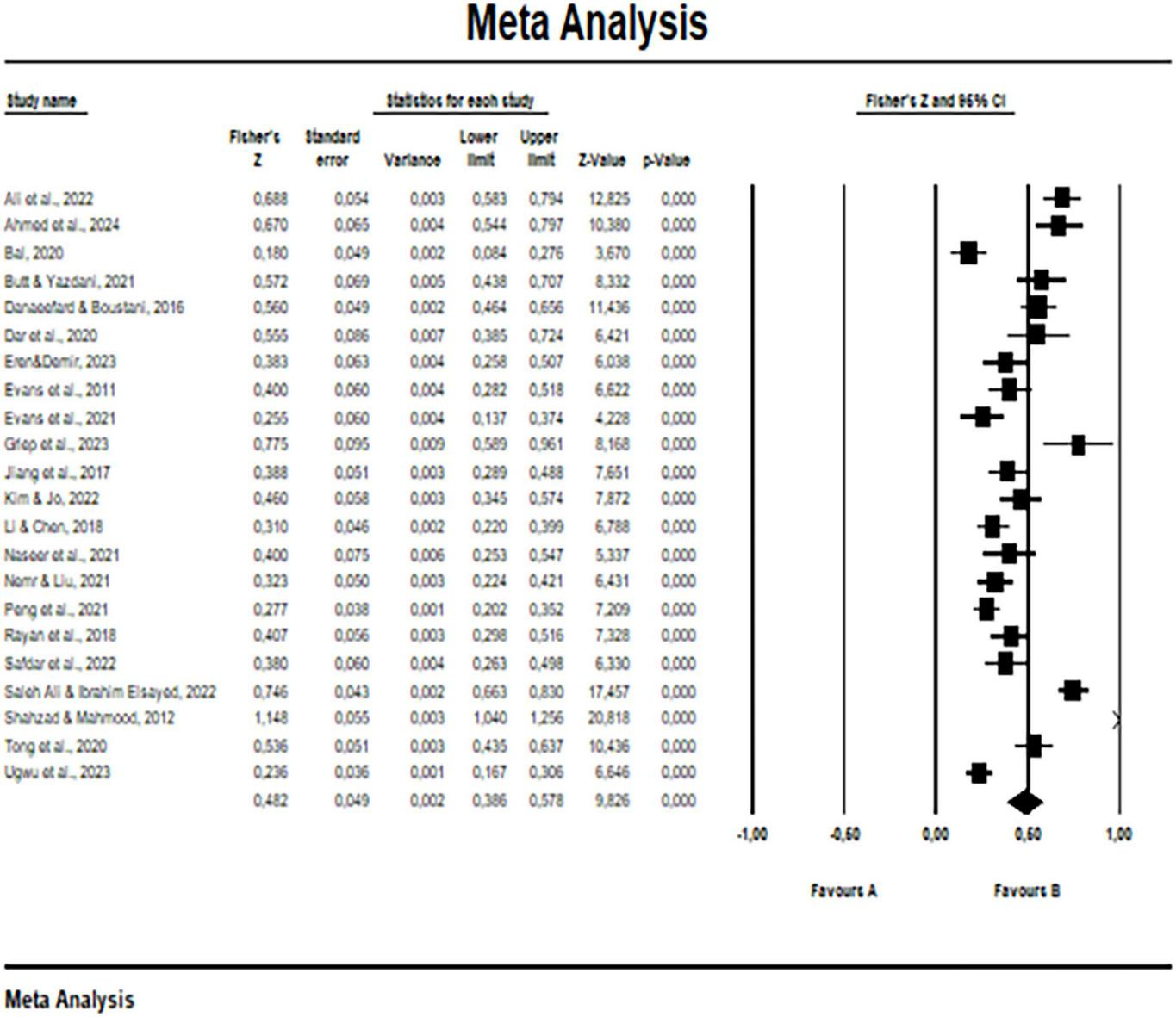
Effect size and 95% CI.
4 Discussion
As a result of the research, it was determined that there is a significant, positive relationship between organizational cynicism and counterproductive work behaviors and a medium effect size. This result is in parallel with the literature (Ahmed et al., 2013; Mathur et al., 2013; Abdi et al., 2016; Hussain and Malik, 2019; Oliveira et al., 2020; Sen et al., 2022; Loh and Azalea, 2023). Social exchange theory argues that interpersonal relationships are based on mutual norms. Therefore, considering that both organizational cynicism and counterproductive work behaviors are based on employee-manager, employee-employee or employee-customer relationships in organizations, it can be argued that these relationships are incompatible or unfair. Especially as the perception of organizational injustice increases, cynical attitudes and behaviors may emerge in employees toward the organization. Similarly, as stated in Adams and Freedman (1976) equity theory, employees’ perception of injustice arises when the output they receive in return for their labor is less than their labor. To compensate, employees may deliberately slow down, miss work, be absent, or take longer rest and meal breaks. These behaviors of the employees fit the minor behaviors in Robinson and Bennett’s (1995) binary taxonomic classification of counterproductive work behaviors. Therefore, it can be said that the research results supports both the social exchange theory and Adams and Freedman’s equity theory. The job demands resources model emphasizes that high levels of job demand from employees play a stressor role and cause tension, thus making employees more cynical and this continues as a cycle. Although job resources play a motivating role on employees, high job demands can create pressure on employees. Stress and pressure on employees can lead them to dysfunctional behaviors or revenge-type behaviors. Organizations can manage the high job demands on their employees through fair and equal workload practices, flexible working hours, and encouraging greater participation in work-related decisions.
Employees’ perception of fairness plays an important role in the emergence of organizational cynicism and counterproductive work behaviors. However, inter-employee relations, attitudes and behaviors of leaders or managers, organizational support and organizational culture may also be other determining factors. Leadership behaviors and organizational climate in the organization should also be taken into consideration in the formation of organizational cynicism and counterproductive work behaviors (Dobbs, 2014; Polatcan and Titrek, 2014; Puni et al., 2016; Huang et al., 2021; Murad et al., 2021). Moreover, toxic organizational structure, lack of organizational support, inconsistent organizational practices, and workplace dynamics can also lead to cynical feelings toward the organization and counterproductive work behaviors among employees (Eigenstetter et al., 2007; Adıgüzel and Okçu, 2021; Kim, 2021). Additionally, the decreased self-esteem of cynical individuals and their increased sensitivity to psychological contract breaches may encourage them to engage in counterproductive work behaviors (Ahmed and Zhang, 2024). Like the snowball mechanism, the perception of psychological contract breach for cynical individuals may play a triggering role for counterproductive work behaviors (Griep and Vantilborgh (2018). All these results and the research reveal that there is a significant relationship between organizational cynicism and counterproductive work behaviors. It shows that factors such as psychological contract breach, workplace incivility, discrimination, exclusion and perception of injustice may also play a role in the relationship between organizational cynicism and counterproductive work behaviors. Furthermore, firstly organizational justice, and organizational climate, organizational support, organizational culture, organizational politics and leadership styles are important and effective factors. The findings of the research indicate that cynical employees in organizations may engage in counterproductive work behaviors. Counterproductive work behaviors pose a threat to organizations, other employees and customers. For this reason, managers and leaders can take measures against the factors that reveal cynicism in their employees by considering organizational dynamics. For this purpose, managers can communicate directly with their employees by implementing an open-door policy, listening to employees’ opinions and suggestions, making ethical, egalitarian and fair decisions, and promoting organizational welfare.
5 Conclusion
The research found that there is a significant and positive relationship between organizational cynicism and counterproductive work behaviors, and the effect size is at medium level. In this relationship, it can be said that as employees’ perception of organizational cynicism increases, they tend to engage in counterproductive work behaviors more like a cycle. Organizational cynicism is generally associated with cynical attitudes of employees toward the organization. Counterproductive work behaviors can be a result of organizational cynicism, workplace incivility or psychological contract violation, as well as factors related to individual or interpersonal relationships. In this sense, organizational cynicism is one of the important factors that trigger counterproductive work behaviors for employees. Risk factors for the emergence of both cynicism and counterproductive work behaviors in organizations may include perceptions of organizational injustice, organizational culture, organizational climate, experiencing negative emotions, burnout, workplace incivility, work stress, high job demands, exclusion, unethical leadership styles, and unsupportive toxic organizational structures (Kwak, 2016; Zaghini et al., 2016; Jiang et al., 2017; De Clercq et al., 2019; Aydın Küçük, 2019; Naseer et al., 2021; Prajogo et al., 2020; Tutar et al., 2021; Saifullah and Javed, 2023).
5.1 Implications for the theory and practice
The two main antecedents of organizational cynicism are personality and organizational factors. Personality characteristics include gender, value judgments, habits, attitudes and education level. Organizational factors include changes at work, organizational justice, organizational support, organizational policies and practices, and relationships with leaders (Chiaburu et al., 2013; Evans et al., 2021; Polatcan and Titrek, 2014; Brandes, 1997, James, 2005; Kim et al., 2019). And it can be said that all these antecedents are factors that affect employees’ productivity, job satisfaction and organizational commitment (Khan et al., 2016; Yaşar and Özdemir, 2016; Wicaksono and Muafi, 2021). Antecedents of counterproductive work behaviors generally stand out as individual and situational factors (Spector, 2011; Oliveira et al., 2020; Yang and Diefendorff, 2009; Bolton et al., 2010; Scott and Judge, 2013). It can be argued that the emergence of organizational cynicism theoretically constitutes one of the reasons for counterproductive work behaviors in organizations. Job demands (time pressure, conflicts, excessive labor inspection) may cause stress, anxiety, tension and burnout over time. These can lead to negative feelings toward work and organization, cynical attitudes and counterproductive work behaviors. Similarly, when employees believe that the organization and managers do not treat them fairly and that organizational resources are not allocated equally and fairly, they may engage in counterproductive work behaviors to ensure equality and fairness. The results of this research reveal that organizational cynicism and counterproductive work behaviors are important problems for both organizations and employees in today’s working life and may be a problem in the future. Therefore, these are important factors that can be effective in decreasing the productivity and performance of organizations and employees. Regarding the practical implications of the research, it can be suggested that leaders and managers should improve communication and transparency in order to reduce organizational cynicism and counterproductive work behaviors. In addition, it can be said that creating a healthy, supportive, fair and ethical organizational climate in organizations is also very important. Furthermore, it can be said that organizations should show equal, fair attitudes and behaviors to employees, create opportunities for employees to gain autonomy over work when necessary, and provide social support among employees. Today’s organizational structures are composed of employees from different cultures. Organizations should consider that these differences may lead to differences in employees’ thoughts, feelings, behaviors, attitudes and values. This research, which synthesizes studies conducted in 4 continents and 9 countries, reveals a generalizable result between organizational cynicism and counterproductive work behaviors. Organizations can take various measures to reduce organizational cynicism. For this purpose, a participatory and fair organizational culture can be created. The organization should be open and honest in communicating with employees, this can prevent employees’ negative feelings and attitudes toward the organization. To control anger and stress, which underlie organizational cynicism and counterproductive work behaviors, organizations should provide regular stress and anger prevention and management training to their employees. Employees should be treated fairly, because counterproductive work behaviors and organizational cynicism are often a reaction to employees’ unfair attitude toward organizational justice. Especially managers and Human Resources (HR) specialists who develop organizational policies are influential on employees in this process. Managers can directly affect their employees’ working environment and indirectly affect their well-being and job performance (Bakker and Demerouti, 2016). Managers should take care to distribute resources such as promotions and rewards equally and transparently according to performance. Employees should be included in decision-making processes Managers should give importance to respect and human approach in their communication with employees. While addressing the main causes of organizational cynicism, HR professionals can implement various strategies to reduce counterproductive work behaviors. These are: 1. Providing honest and timely information to employees. 2. Providing realistic information to employees during recruitment and orientation processes, 3. Developing an HR policy that is sensitive to psychological contract breaches, 4. Establishing employee support programs (such as psychological counseling and stress management), 5. Following a zero-tolerance policy for unethical behavior. In line with these results, organizations should take into account that every employee is affected by negative attitudes, situations, policies, practices and conditions. Therefore, it should be considered that fair, supportive, developmental, transparent, democratic attitudes and organizational practices, ethical and democratic leadership styles will create a healthy organizational structure. If these can be meticulously realized in organizations, employees’ commitment to the organization, job performance and trust in the organization can be positively affected.
5.2 Limitations and future directions
In line with the inclusion criteria, the study data covers the period between 2010 and 2024. Therefore, the study is limited to the period examined, the studies accessed, the databases, the articles written in English, the method used in these studies (Pearson correlation analysis) and the accessibility of the journals (electronic). In this study, meta-analysis was conducted on correlation values, so deterministic results in correlational studies are limited. Therefore, future studies may include experimental and longitudinal research. Potential areas for further research: Sector-specific differences in the relationship between organizational cynicism and counterproductive work behaviors, possible mediating variables (workplace incivility, nepotism, psychological contract breach, job insecurity, ethical leadership, organizational climate) can be examined. In addition, specific variables that may have an impact on organizational cynicism and counterproductive work behaviors can be examined through meta-analysis. In addition, the effects of flexible work arrangements (such as part-time working, online working, compressed work week) and leadership styles on organizational cynicism and counterproductive work behaviors can also be investigated.
Statements
Data availability statement
The datasets presented in this study can be found in online repositories. The names of the repository/repositories and accession number(s) can be found at: https://drive.google.com/dri ve/folders/1b8AVSncGmPC0Ajbkb5NTdJoAicIY-HOm?usp=drive _link.
Author contributions
AÇ: Conceptualization, Data curation, Formal analysis, Funding acquisition, Investigation, Methodology, Project administration, Resources, Supervision, Validation, Visualization, Writing – original draft, Writing – review & editing. ŞD: Conceptualization, Data curation, Formal analysis, Funding acquisition, Investigation, Methodology, Writing – original draft, Writing – review & editing. BU: Data curation, Formal Analysis, Funding acquisition, Investigation, Methodology, Writing – original draft, Writing – review & editing.
Funding
The author(s) declare that no financial support was received for the research and/or publication of this article.
Conflict of interest
The authors declare that the research was conducted in the absence of any commercial or financial relationships that could be construed as a potential conflict of interest.
Generative AI statement
The authors declare that no Generative AI was used in the creation of this manuscript.
Any alternative text (alt text) provided alongside figures in this article has been generated by Frontiers with the support of artificial intelligence and reasonable efforts have been made to ensure accuracy, including review by the authors wherever possible. If you identify any issues, please contact us.
Publisher’s note
All claims expressed in this article are solely those of the authors and do not necessarily represent those of their affiliated organizations, or those of the publisher, the editors and the reviewers. Any product that may be evaluated in this article, or claim that may be made by its manufacturer, is not guaranteed or endorsed by the publisher.
Supplementary material
The Supplementary Material for this article can be found online at: https://www.frontiersin.org/articles/10.3389/fpsyg.2025.1529798/full#supplementary-material
References
1
Abdi P. Delkhah J. Kheirgoo M. (2016). Counterproductive behaviors in state hospitals: a review of the role of organizational cynicism and injustice.Mediterranean J. Soc. Sci.7196–207. 10.5901/mjss.2016.v7n4S1p196
2
Abraham R. (2000). Organizational cynicism: bases and consequences.Genet. Soc. General Psychol. Monogr.126269–292.
3
Adams J. S. Freedman S. (1976). Equity theory revisited: Comments and annotated bibliography.Adv. Exp. Soc. Psychol.943–90. 10.1016/S0065-2601(08)60058-1
4
Adıgüzel Z. G. Okçu V. (2021). Investigation of the relationship between perceived organizational climate and teachers’ levels of organizational creativity and organizational cynicism.Eur. J. Educ. Stud.825–41. 10.46827/ejes.v8i3.3610
5
Afghan P. E. Arry H. Arry B. Saudi M. M. Sinaga H. O. C. (2018). Impact of distributive and procedural justice on turnover intention and counterproductive work behavior: mediating role of organizational cynicism.J. Fundament. Appl. Sci.101651–1678. 10.4314/jfas.v10i6s.134
6
Agrawal A. Pandey A. (2021). Types, antecedents & outcomes of organizational dysfunctional behaviors-A review.Indian J. Indust. Relat.57239–252.
7
Ahmed A. K. Atta M. H. R. El-Monshed A. H. Mohamed A. I. (2024). The effect of toxic leadership on workplace deviance: the mediating effect of emotional exhaustion, and the moderating effect of organizational cynicism.BMC Nurs.23:669–683. 10.1186/s12912-024-02308-x
8
Ahmed M. A. O. Zhang J. (2024). Investigating the effect of psychological contract breach on counterproductive work behavior: the mediating role of organizational cynicism.Hum. Syst. Manage.43263–280. 10.3233/HSM-230010
9
Ahmed W. Kiyani A. Hashmi S. H. (2013). The study on organizational cynicism, organizational injustice & breach of psychological contract as the determinants of deviant work behavior.Actual Probl. Econ.145–154.
10
Akar H. (2019). A meta-analytic review on the causes and consequences of organizational cynicism.Int. Online J. Educ. Sci.11149–164. 10.15345/iojes.2019.02.010
11
Ali S. A. Sair S. A. Mehta A. M. Naqvi F. N. Saleem H. (2020). Impact of organizational cynicism and abusive supervisor behavior on work place deviance.Acad. Strategic Manage. J.191–10.
12
Ali S. Shahzad F. Hussain I. Yongjian P. Khan M. M. Iqbal Z. (2022). The outcomes of organizational cronyism: a social exchange theory perspective.Front. Psychol.13:1–9. 10.3389/fpsyg.2022.805262
13
Andersson L. M. Bateman T. S. (1997). Cynicism in the workplace: Some causes and effects.J. Organ. Behav.18449–469.
14
Aydın Küçük B. (2019). The Impacts of Toxic Organizational Climate, Narcissistic Leader and Workplace Envy on Individual Outcomes of Counterproductive Work Behavior, Work Exhaustion and Contextual Performance: the Roles of Perceived Self-Es6teem and Self-Control.Eğitim: Marmara University.
15
Bakker A. B. (2015). A job demands–resources approach to public service motivation.Public Admin. Revi.75723–732. 10.1111/puar.12388
16
Bakker A. B. Demerouti E. (2016). Job demands–resources theory: taking stock and looking forward.J. Occupat. Health Psychol.22:273. 10.1037/ocp0000056
17
Bal T. (2020). The role of organizational cynicism as a mediator in the relationship between perceived organizational support and counter productive work behavior for public employees.Sosyal Güvenlik Dergisi10145–164. 10.32331/sgd.753051
18
Bal T. (2021). The examination of perceived organizational support (POS), organizational cynicism and counter productive work behavior (CWB) in public employees: intergroup gap analysis.Sosyal Güvence Dergisi.11321–357. 10.21441/sosyalguvence.948483
19
Bari M. W. Qurrah-Tul-Ain, Abrar M. Fanchen M. (2022). Employees’ responses to psychological contract breach: The mediating role of organizational cynicism.Econ. Indust. Democ.43810–829. 10.1177/0143831X20958478
20
Bedük A. Eryeşil K. Altınışık G. D. (2017). The relationship between mobbing and organizational cynicism: an empirical study.J. Hum. Sci.143167–3176. 10.14687/jhs.v14i3.4805
21
Benligül E. M. Bektaş M. Arslan G. (2022). Meta-analizi anlamak ve yorumlamak: Hemşireler için öneriler.Dokuz Eylül Üniversitesi Hemşirelik Fakültesi Elektronik Dergisi1586–98. 10.46483/deuhfed.872337
22
Bennett R. J. Robinson S. L. (2000). Development of a measure of workplace deviance.J. Appl. Psychol.85349–360. 10.1037/0021-9010.85.3.349
23
Bolton L. R. Becker L. K. Barber L. K. (2010). Big Five trait predictors of differential counterproductive work behavior dimensions.Pers. Individ. Differ.49:537541. 10.1016/j.paid.2010.03.047
24
Borenstein M. Hedges L. V. Higgins J. P. T. Rothstein H. R. (2009). Introduction to Metaanalysis.West Sussex-UK: John Wiley & Sons Ltd.
25
Brandes P. M. (1997). Organizational Cynicism: Its Nature, Antecedents, and Consequences.Cincinnati: University of Cincinnati.
26
Butt S. Yazdani N. (2021). Influence of workplace incivility on counterproductive work behavior: mediating role of emotional exhaustion, organizational cynicism and the moderating role of psychological capital.Pak. J. Commerce Soc. Sci.15378–404.
27
Chernyak-Hai L. Rabenu E. (2018). The new era workplace relationships: is social exchange theory still relevant?Indust. Organ. Psychol.11456–481. 10.1017/iop.2018.5
28
Chiaburu D. S. Peng A. C. Oh I. S. Banks G. C. Lomeli L. C. (2013). Antecedents and consequences of employee organizational cynicism: a meta-analysis.J. Vocat. Behav.83181–197. 10.1016/j.jvb.2013.03.007
29
Danaeefard H. Boustani H. R. (2016). Injustice perceptions and employees misbehavior in the public organization: Exploration of mediating role of employee’s cynicism to organization.Int. J. Hum. Capital Urban Manage.19–18. 10.7508/ijhcum.2016.01.002
30
Dar N. Khan S. Rauf A. (2020). Deviant behavior and organizational justice: mediator test for organizational cynicism- The case of Pakistan.Asian J. Econ. Finance2333–347.
31
De Clercq D. Haq I. U. Azeem M. U. (2019). Time-related work stress and counterproductive work behavior: invigorating roles of deviant personality traits.Pers. Rev.481756–1781. 10.1108/PR-07-2018-0241
32
Dean J. W. Jr. Brandes P. Dharwadkar R. (1998). Organizational cynicism.Acad. Manage. Rev.23341–352. 10.5465/amr.1998.533230
33
Demerouti E. Bakker A. B. Nachreiner F. Schaufeli W. B. (2001). The job demands resources model of burnout.J. Appl. Psychol.86499–512. 10.1037/0021-9010.86.3.499
34
Dinçer S. (2014). Eğitim Bilimlerinde Uygulamalı Meta-Analiz.Ankara: Pegem Akademi Yayıncılık, 2014.
35
Dobbs J. M. (2014). The Relationship between Perceived Toxic Leadership Styles, Leader Effectiveness, and Organizational Cynicism.San Diego, CA: University of San Diego.
36
Durrah O. Chaudhary M. Gharib M. (2019). Organizational cynicism and its impact on organizational pride in industrial organizations.Int. J. Environ. Res. Public Health161–16. 10.3390/ijerph16071203
37
Eigenstetter M. Dobiasch S. Trimpop R. (2007). Commitment and counterproductive work behavior as correlates of ethical climate in organizations.J. Monatsschrift für Kriminologie Strafrechtsreform.90224–244. 10.1515/mks-2007-902-312
38
Eren G. Demir R. (2023). The effect of perceived pay equity on counterproductive work behaviors: the mediating role of organizational cynicism.Ege Acad. Rev.23219–236. 10.21121/eab.1103337
39
Evans W. R. Davis W. D. Neely A. (2021). The role of organizational cynicism and conscientiousness in the relationship between ethical leadership and deviance.J. Manage. Issues3349–68.
40
Evans W. R. Goodman J. M. Davis W. D. (2010). The impact of perceived corporate citizenship on organizational cynicism, OCB, and employee deviance.Hum. Perform.2479–97. 10.1080/08959285.2010.530632
41
FitzGerald M. R. (2002). Organizational Cynicism: Its Relationship to Perceived Organizational Injustice and Explanatory Style.Cincinnati: University of Cincinnati.
42
Griep Y. Vantilborgh T. (2018). Reciprocal effects of psychological contract breach on counterproductive and organizational citizenship behaviors: the role of time.J. Vocat. Behav.104141–153. 10.1016/j.jvb.2017.10.013
43
Griep Y. Hansen S. D. Kraak J. M. (2023). Perceived identity threat and organizational cynicism in the recursive relationship between psychological contract breach and counterproductive work behavior.Econ. Indust. Democracy44351–384. 10.1177/0143831X211070326
44
Gruys M. L. Sackett P. R. (2003). Investigating the dimensionality of counterproductive work behavior.Int. J. Select. Assess.1130–42. 10.1111/1468-2389.00224
45
Hafidz S. W. M. (2012). Individual differences as antecedents of counterproductive work behaviour.Asian Soc. Sci.8220–226. 10.5539/ass.v8n13p220
46
Hofstede G. (2011). Dimensionalizing cultures: the hofstede model in context.Online Read. Psychol. Cult.21–26. 10.9707/2307-0919.1014
47
Huang S. Y. Li M. W. Chang T. W. (2021). Transformational leadership, ethical leadership, and participative leadership in predicting counterproductive work behaviors: evidence from financial technology firms.Front. Psychol.12:658727. 10.3389/fpsyg.2021.658727
48
Hussain A. Malik M. S. (2019). Influence of cynicism and counterproductive work behavior (CWB) with the mediating effect of org based self-esteem.Int. J. Human. Soc. Stud.7185–192. 10.24940/theijhss/2019/v7/i9/HS1909-054
49
Hussain S. Rabbani S. Kamal N. (2021). The organizational justice-organizational cynicism relationship: moderating role of islamic work ethics.J. Workplace Behav.266–77. 10.1016/j.apmrv.2021.03.005
50
James M. S. (2005). Antecedents and Consequences of Cynicism in Organizations: An Examination of The Potential Positive and Negative Effects on School Systems.Florida: The Florida State University.
51
Jiang H. Chen Y. Sun P. Yang J. (2017). The relationship between authoritarian leadership and employees’ deviant workplace behaviors: The mediating effects of psychological contract violation and organizational cynicism.Front. Psychol.8:732. 10.3389/fpsyg.2017.00732
52
Johnson J. L. O’Leary-Kelly A. M. (2003). The effects of psychological contract breach and organizational cynicism: not all social exchange violations are created equal.J. Organ. Behav.24627–647. 10.1002/job.207
53
Khan R. Naseem A. Masood S. A. (2016). Effect of continuance commitment and organizational cynicism on employee satisfaction in engineering organizations.Int. J. Innovat. Manage. Technol.7141–146. 10.18178/ijimt.2016.7.4.661
54
Kim J. (2021). The effect of cynicism on supportive climate and organizational effectiveness.J. Converge. Cult. Technol.7111–116. 10.17703/JCCT.2021.7.1.111
55
Kim S. M. Jo S. J. (2024). An examination of the effects of job insecurity on counterproductive work behavior through organizational cynicism: moderating roles of perceived organizational support and quality of leader-member exchange.Psychol. Rep.127957–993. 10.1177/00332941221129135
56
Kim S. Jung K. Noh G. Kang L. K. (2019). What makes employees cynical in public organizations? Antecedents of organizational cynicism.Soc. Behav. Pers.471–10. 10.2224/sbp.8011
57
Kim Y. Cohen T. R. Panter A. T. (2023). Workplace mistreatment and employee deviance: An investigation of the reciprocal relationship between hostile work environments and harmful work behaviors.Group Organ. Manage.481173–1202. 10.1177/10596011231151747
58
Kobanoğlu M. S. Erdoğan S. U. (2022). Psikolojik sözleşme ihlalinin üretkenlik karşıtı iş davranışlarına etkisinde örgütsel sinizmin aracı rolü.İktisat İşletme ve Uluslararası İlişkiler Dergisi1179–194. 10.58654/jebi.1205706
59
Kwak A. (2016). The Relationships of Organizational Injustice With Employee Burnout And Counterproductive Work Behaviors: Equity Sensitivity As A Moderator.Michigan: Central Michigan University.
60
Lesener T. Gusy B. Wolter C. (2019). The job demands-resources model: a meta-analytic review of longitudinal studies.Work Stress3376–103. 10.1080/02678373.2018.1529065
61
Li S. Chen Y. (2018). The relationship between psychological contract breach and employees’ counterproductive work behaviors: the mediating effect of organizational cynicism and work alienation.Front. Psychol.9:1273. 10.3389/fpsyg.2018.01273
62
Loh A. Azalea A. (2023). Constraints, conflict and counterproductive work behavior: organizational cynicism as a mediator.J. Psikol. Malaysia3726–40.
63
Lugosi P. (2019). Deviance, deviant behaviour and hospitality management: sources, forms and drivers.Tour. Manage.7481–98. 10.1016/j.tourman.2019.02.014
64
Marcus B. Schuler H. (2004). Antecedents of counterproductive behavior at work: a general perspective.J. Appl. Psychol.89647–660. 10.1037/0021-9010.89.4.647
65
Marcus B. Taylor O. A. Hastings S. E. Sturm A. Weigelt O. (2016). The structure of counterproductive work behavior: a review, a structural meta-analysis, and a primary study.J. Manage.42203–233. 10.1177/0149206313503019
66
Mathur G. Nathani N. Dubey S. (2013). Perceived organizational politics, organizational justice, cynicism and OCB: a demographic study of academicians.Rev. HRM261–73.
67
McMillan K. Albrecht S. (2010). Measuring social exchange constructs in organizations.Commun. Methods Meas.3201–220. 10.1080/19312450903378909
68
Moher D. Liberati A. Tetzlaff J. Altman D. (2009). Preferred reporting items for systematic reviews and meta-analyses: the PRISMA statement.Ann. Intern. Med.151264–269. 10.1016/j.ijsu.2010.02.007
69
Muldoon J. (2017). The Hawthorne studies: an analysis of critical perspectives, 1936-1958.J. Manage. Hist.2374–94. 10.1108/JMH-09-2016-0052
70
Murad M. Jiatong W. Shahzad F. Syed N. (2021). The influence of despotic leadership on counterproductive work behavior among police personnel: Role of emotional exhaustion and organizational cynicism.J. Police Crim. Psychol.36603–615. 10.1007/s11896-021-09470-x
71
Naseer S. Raja U. Syed F. Baig M. U. A. (2021). When and why organizational cynicism leads to CWBs. Pers. Rev. 50, 90–107. 10.1108/PR-09-2019-0480
72
Nassehi A. (2005). Organizations as decision machines: Niklas Luhmann’s theory of organized social systems.Sociol. Rev.53178–191. 10.1111/j.1467-954X.2005.00549.x
73
Naus F. Van Iterson A. Roe R. (2007). Organizational cynicism: extending the exit, voice, loyalty, and neglect model of employees’ responses to adverse conditions in the workplace.Hum. Relat.60683–718. 10.1177/0018726707079198
74
Nemr M. A. A. Liu Y. (2021). Organizational cynicism as a moderator variable between ethical leadership and counterwork productive behaviors.Corp. Board1730–38. 10.22495/cbv17i1art3
75
Nielsen M. B. Indregard A. M. R. Øverland S. (2016). Workplace bullying and sickness absence: a systematic review and meta-analysis of the research literature.Scand. J. Work Environ. Health42359–370. 10.5271/sjweh.3579
76
Oliveira L. B. D. Moreno Junior V. D. A. Gonçalves R. C. (2020). Individual and situational antecedents of counterproductive work behaviors.BAR-Braz. Admin. Rev.17:121. 10.1590/1807-7692bar2020190126
77
Peng Y. Ma J. Zhang W. Jex S. (2021). Older and less deviant? The paths through emotional labor and organizational cynicism.Work Aging Retirement.720–30. 10.1093/workar/waaa017
78
Pfrombeck J. Doden W. Grote G. Feierabend A. (2020). A study of organizational cynicism and how it is affected by social exchange relationships at work.J. Occupat. Organ. Psychol.93578–604. 10.1111/joop.12306
79
Polatcan M. Titrek O. (2014). The relationship between leadership behaviors of school principals and their organizational cynicism attitudes.Proc. Soc. Behav. Sci.1411291–1303. 10.1016/j.sbspro.2014.05.222
80
Prajogo W. Kusumawati H. Wijaya N. H. S. (2020). Organizational culture as determinant of employee-based antecedents to organizational cynicism.Human. Soc. Sci. Rev.8881–886. 10.18510/hssr.2020.81105
81
Puni A. Agyemang C. B. Asamoah E. S. (2016). Leadership styles, employee turnover intentions and counterproductive work behaviours.Int. J. Innovat. Res. Dev.51–7.
82
Rayan A. R. Aly N. A. Abdelgalel A. M. (2018). Organizational cynicism and counterproductive work behaviors: an empirical study.Eur. J. Bus. Manage.1070–79.
83
Robinson S. L. Bennett R. J. (1995). A typology of deviant workplace behaviors: a multidimensional scaling study.Acad. Manage. J.38555–572.
84
Roxana A. C. (2013). Antecedents and mediators of employees’ counterproductive work behavior and intentions to quit.Proc. Soc. Behav. Sci.84219–224. 10.1016/j.sbspro.2013.06.538
85
Saad Saleh Ali M. Abdelwahab Ibrahim Elsayed A. (2022). Correlation between organizational cynicism and counterproductive work behaviors among nurses.Egypt. J. Health Care131601–1614. 10.21608/EJHC.2022.247319
86
Sabuncuoğlu Z. Vergiliel Tüz M. (2016). Örgütsel Davranış.Bursa: Aktüel Yayıncılık.
87
Safdar T. Shafiq M. Abbas S. K. Arif S. (2022). Examination of the relationship between organization cynicism and employees workplace behaviors.J. Posit. Sch. Psychol.612060–12074.
88
Saifullah A. K. Javed A. (2023). Workplace ostracism and counterproductive work behaviours: a moderated mediation analysis of organizational cynicism and emotional intelligence in the educational sector.Int. J. Contemp. Issues Soc. Sci.2251–263.
89
Scott B. A. Judge T. A. (2013). Beauty, personality, and affect as antecedents of counterproductive work behavior receipt.Hum. Perform.2693–113. 10.1080/08959285.2013.765876
90
Sen C. Mert I. S. Abubakar A. M. (2022). The nexus among perceived organizational support, organizational justice and cynicism.Int. J. Organ. Anal.301379–1396. 10.1108/IJOA-11-2020-2488
91
Shahzad A. Mahmood Z. (2012). The mediating-moderating model of organizational cynicism and workplace deviant behavior: Evidence from banking sector in Pakistan.Middle-East J. Sci. Res.12580–588. 10.5829/idosi.mejsr.2012.12.5.1612
92
Sönmez A. N. Erol K. Tuğba H. (2024). Effects of conflict culture and gossip on employee wellbeing and counterproductive work behavior: organizational cynicism as a mediator.J. Manage. Labor835–48.
93
Spector P. E. (2011). The relationship of personality to counterproductive work behavior (CWB): an integration of perspectives.Hum. Resour. Manage. Rev.21342–352. 10.1016/j.hrmr.2010.10.002
94
Spector P. E. Fox S. (2002). An emotion-centered model of voluntary work behavior: Some parallels between counterproductive work behavior and organizational citizenship behavior.Hum. Resour. Manage. Rev.12269–292. 10.1016/S10534822(02)00049-9
95
Spector P. E. Fox S. Penney L. M. Bruursema K. Goh A. Kessler S. (2006). The dimensionality of counterproductivity: are all counterproductive behaviors created equal?J. Vocat. Behav.68446–460. 10.1016/j.jvb.2005.10.005
96
Taras V. Steel P. Kirkman B. (2010). Examining the impact of culture’s consequences: a three-decade, multilevel, meta-analytic review of Hofstede’s cultural value dimensions.J. Appl. Psychol.95405–439. 10.1037/a0018938
97
Tepper B. J. Henle C. A. (2011). A case for recognizing distinctions among constructs that capture interpersonal mistreatment in work organizations.J. Organ. Behav.32487–498. 10.1002/job.688
98
Tong J. Chong S. Chen J. Johnson R. E. Ren X. (2020). The interplay of low identification, psychological detachment, and cynicism for predicting counterproductive work behaviour.Appl. Psychol.6959–92. 10.1111/apps.12187
99
Tutar H. Tuzcuoğlu F. Sarkhanov T. (2021). The mediating role of organizational cynicism in the relationship between workplace incivility and organizational silence.TEM J.10563–572. 10.18421/TEM102-11
100
Ugwu F. Nwali A. C. Ugwu L. E. Okafor C. O. Ozurumba K. C. Onyishi I. E. (2023). Mediating roles of employee cynicism and workplace ostracism on the relationship between perceived organizational politics and counterproductive work behavior.Career Dev. Int.28314–332. 10.1108/CDI-07-2022-0208
101
Wicaksono P. B. W. Muafi M. (2021). The effect of transformational leadership and organizational culture on organizational commitment in mediating organizational cynicism.JBMP Jurnal Bisnis, Manajemen dan Perbankan.7203–218. 10.21070/jbmp.v7vi2.1525
102
Yalçın S. Özbaş M. (2021). Investigation of the organizational justice, perceived organizational support and organizational cynicism perceptions of academicians.Eur. J. Educ. Stud.866–83. 10.46827/ejes.v8i12.4012
103
Yang J. Diefendorff J. M. (2009). The relations of daily counterproductive workplace behavior with emotions, situational antecedents, and personality moderators: a diary study in Hong Kong.Pers. Psychol.62259–295. 10.1111/j.17446570.2009.01138.x
104
Yaşar O. Özdemir A. (2016). The relationship of organizational cynicism, burnout, and organizational commitment: a study on middle school teachers.Eur. Acad. Sci. Eur. Bus. Econ. J.650–61. 10.17740/eas.econ.2016.V6-05
105
Zaghini F. Fida R. Caruso R. Kangasniemi M. Sili A. (2016). What is behind counterproductive work behaviors in the nursing profession? A systematic review.J. Clin. Res. Bioethics71–7. 10.4172/2155-9627.1000277
106
Zappala S. Sbaa M. Y. Kamneva E. V. Zhigun L. A. Korobanova Z. V. Chub A. A. (2022). Current approaches, typologies and predictors of deviant work behaviors: a scoping review of reviews.Front. Psychol.12:674066. 10.3389/fpsyg.2021.674066
107
Zhong C. B. House J. (2012). Hawthorne revisited: organizational implications of the physical work environment.Res. Organ. Behav.323–22. 10.1016/j.riob.2012.10.004
Summary
Keywords
work life, organizational behaviors, organizational cynicism, counterproductive work behaviors, meta-analysis
Citation
Çivilidağ A, Durmaz Ş and Uslu B (2025) Investigation of the relationship between organizational cynicism and counterproductive work behaviors: a systematic review and meta-analysis. Front. Psychol. 16:1529798. doi: 10.3389/fpsyg.2025.1529798
Received
17 November 2024
Accepted
30 October 2025
Published
26 November 2025
Volume
16 - 2025
Edited by
Majid Murad, Guangzhou University, China
Reviewed by
Kubilay Gok, Winona State University, United States
Aleksandra Batuchina, SMK University of Applied Social Sciences, Lithuania
Updates
Copyright
© 2025 Çivilidağ, Durmaz and Uslu.
This is an open-access article distributed under the terms of the Creative Commons Attribution License (CC BY). The use, distribution or reproduction in other forums is permitted, provided the original author(s) and the copyright owner(s) are credited and that the original publication in this journal is cited, in accordance with accepted academic practice. No use, distribution or reproduction is permitted which does not comply with these terms.
*Correspondence: Şerife Durmaz, serifedurmaz@akdeniz.edu.tr
Disclaimer
All claims expressed in this article are solely those of the authors and do not necessarily represent those of their affiliated organizations, or those of the publisher, the editors and the reviewers. Any product that may be evaluated in this article or claim that may be made by its manufacturer is not guaranteed or endorsed by the publisher.