Abstract
Introduction:
Although the impact of learning interest on academic performance has been extensively studied, the chain-mediated mechanism by which medical students’mathematics learning interest influences competence through teacher-student relationships and self-efficacy remains underexplored. Empirical evidence utilizing multi-mediation models to test indirect effects is particularly lacking.
Methods:
This study investigated 806 Chinese medical students, assessing problem-solving ability using PISA mathematics items and examining the chain-mediated pathway of teacher-student relationships and mathematics self-efficacy via structural equation modeling (SEM) and bias-corrected bootstrap methods. After controlling for major, grade, and residence.
Results:
The results demonstrated: (1) The direct effect of mathematics learning interest on problem-solving ability was non-significant (effect size = 0.0101, 95% CI [-0.0144, 0.0346]); (2) The independent mediating effect of teacher-student relationships was non-significant (effect size = 0.0083, 95% CI [-0.0114, 0.0196]); (3) The independent mediating effect of mathematics self-efficacy was significant (effect size = 0.0140, 95% CI [0.0003, 0.0286], contribution rate = 40.79%); (4) The chain-mediated pathway of teacher-student relationships → self-efficacy reached significance (effect size = 0.0020, 95% CI [0.0003, 0.0048], contribution rate = 5.68%). The total mediation effect accounted for 70.66% of the total effect.
Discussion:
These findings confirm that self-efficacy serves as the critical mechanism translating medical students’ mathematics interest into competence. We recommend enhancing self-efficacy through clinical scenario-based simulation tasks and stepwise training programs, providing theoretical foundations for reforming medical mathematics curricula.
1 Introduction
The escalating demands on medical practitioners have brought mathematical literacy into increasing focus within medical education as an indispensable competency for medical students. Contemporary medical education is no longer confined to traditional biomedical knowledge but has shifted toward emphasizing interdisciplinary competencies, particularly the cultivation of mathematical literacy. The growing need for precise and quantitative analysis in modern medicine underscores an urgent demand for professionals with advanced mathematical literacy in future healthcare landscapes (Anderson and Giordano, 2013). A society’s innovative capacity hinges on its ability to attract talent into Science, Technology, Engineering, Mathematics, and Medicine (STEMM) fields. Interdisciplinary professionals integrating medicine and mathematics are poised to play pivotal roles in the era of artificial intelligence (AI) (Stoeger et al., 2024). Equipped with robust medical expertise, clinical experience, and proficiency in mathematical analysis, data modeling, and algorithmic development, these individuals can extract actionable insights from vast medical datasets, develop accurate disease prediction models, and design personalized treatment plans (Dhillon et al., 2022). Driven by AI advancements, the demand for such interdisciplinary talent will continue to rise, positioning them as key drivers of healthcare innovation and optimization.
Problem-solving ability serves as a core manifestation of mathematical literacy. Prior research indicates that the formation of mathematical literacy originates in early education and is influenced by multiple factors, including parental attitudes toward mathematics, teacher support, mathematics self-efficacy, and learning interest (Cheung et al., 2024; Denner et al., 2019; Jung et al., 2023; Viljaranta et al., 2014). However, existing studies predominantly focus on preschool and K-12 populations (Denner et al., 2019; Fisher et al., 2012; Sankalaite et al., 2023), leaving a significant gap in understanding mathematical literacy among university students, particularly medical students. This oversight is critical, as medical practice increasingly relies on advanced mathematical skills—from clinical drug dosage calculations and epidemiological statistical analyses to algorithmic applications in medical imaging (Goldstein et al., 2024; Liu et al., 2023). Despite STEMM disciplines emphasizing the intersection of mathematics and medicine, empirical investigations into the mechanisms and influencing factors of mathematical competency development in medical education remain scarce.
Targeting medical students, this study addresses two key questions: (1) the current status of mathematical problem-solving ability among medical students; and (2) how learning interest, teacher-student relationships, and self-efficacy collectively influence mathematical competency through chain-mediated effects. By shifting the research focus from younger learners to higher education populations within medical contexts, this study aims to bridge the gap in empirical literature on university-level mathematical literacy while providing evidence-based pathways for optimizing medical curricula.
1.1 Relationships among learning interest, teacher-student relationships, self-efficacy, and mathematical problem-solving ability
Research suggests that the reciprocal relationship between mathematical interest and competence may emerge as early as preschool, with learning interest shaping mathematical abilities during formative developmental stages (Fisher et al., 2012). Preschoolers’ mathematical interest, emotional skills, and pre-school mathematical competencies are intercorrelated (Doctoroff et al., 2016). In primary education, mathematical interest remains predictive of academic performance (Brumm and Rathgeb-Schnierer, 2023), while middle school studies from a social-cognitive perspective confirm its enduring influence on achievement outcomes (Petersen and Hyde, 2017). By high school, mathematical interest fosters advanced cognitive strategies that enhance academic performance (Yu and Singh, 2018). However, given the highly specialized and practice-oriented nature of mathematical applications in medical education, the mechanisms through which learning interest influences medical students’ problem-solving abilities remain unexplored. Thus, we propose:
Hypothesis 1 (H1): Mathematics learning interest positively predicts medical students’ mathematical problem-solving ability in higher education.
Regarding teacher-student relationships, active classroom engagement and responsive teacher-student interactions have been shown to enhance educators’ job satisfaction and instructional efficacy, indirectly improving academic outcomes (Holzberger et al., 2013). We therefore posit:
Hypothesis 2 (H2): Teacher-student relationships positively predict mathematical problem-solving ability.
Self-efficacy frequently mediates learning outcomes. Empirical studies demonstrate its role in boosting classroom participation (Jung et al., 2023) and mathematical achievement (Yang et al., 2021), leading to:
Hypothesis 3 (H3): Mathematics self-efficacy positively predicts medical students’ problem-solving ability.
1.2 Interplay among learning interest, teacher-student relationships, and self-efficacy
The direct influence of learning interest on teacher-student relationships is well-documented. Positive emotional engagement in team settings facilitates collaborative interactions and task completion (Warwas et al., 2009), implying that intrinsic motivation and interest strengthen interpersonal dynamics. Consequently, heightened learning interest fosters supportive teacher-student relationships (Huang et al., 2022), prompting:
Hypothesis 4 (H4): Mathematics learning interest positively predicts teacher-student relationships.
Learning interest drives self-efficacy development. From the Social Cognitive Career Theory (SCCT) perspective, self-efficacy shapes occupational attitudes and interests, with both constructs forming core components of professional identity (Armstrong and Vogel, 2009). Medical students’ learning interest enhances intrinsic motivation, thereby elevating academic engagement (Pelaccia and Viau, 2017). We hypothesize:
Hypothesis 5 (H5): Mathematics learning interest positively predicts self-efficacy.
Situational expectancy-value and control-value theories further indicate that teacher-student interactions modulate students’ perceived support, enabling educators to reinforce the value of learning interests and mitigate negative emotions in mathematics (Rubach et al., 2023). Supportive relationships amplify self-efficacy by fostering motivational resilience (Fasce et al., 2016), leading to:
Hypothesis 6 (H6): Teacher-student relationships positively predict self-efficacy.
1.3 Chain-mediated roles of teacher-student relationships and self-efficacy
In the context of medical education, teacher-student relationships and self-efficacy are theorized to mediate the link between learning interest and problem-solving ability. Positive teacher-student relationships create a low-stress, supportive learning environment that bolsters students’ confidence in mathematics. Analyses of PISA data reveal that such relationships predict mathematical achievement by enhancing interest and self-efficacy (You et al., 2021), with academic self-efficacy further driving performance through perseverance and goal-oriented behaviors (Tosto et al., 2016).
Self-efficacy critically shapes problem-solving competence by regulating learners’ emotional states [e.g., reducing anxiety (Wang et al., 2024)] and sustaining scientific curiosity (Cordero et al., 2010). Students with high self-efficacy exhibit greater persistence, employ metacognitive strategies, and explore diverse solutions when confronted with mathematical challenges (Ten Braak et al., 2022). Integrating these mechanisms, we propose:
Hypothesis 7 (H7): Teacher-student relationships mediate the effect of mathematics learning interest on problem-solving ability.
Hypothesis 8 (H8): Self-efficacy mediates the effect of mathematics learning interest on problem-solving ability.
Hypothesis 9 (H9): A chain-mediated pathway (learning interest → teacher-student relationships → self-efficacy) explains the relationship between learning interest and problem-solving ability.
2 Materials and methods
2.1 Participants
This study employed a randomized sampling method to distribute anonymous questionnaires at a medical university in Shandong Province, China. A total of 853 questionnaires were issued, with 806 valid responses retained, yielding a valid response rate of 94.49%. The final sample comprised 288 male students (35.7%) and 518 female students (64.3%). In terms of academic standing, 752 participants were first-year students (93.3%) and 54 were second-year students (6.7%).
2.2 Measures
This study employed a self-designed questionnaire consisting of two parts: a mathematical problem-solving ability test and a survey on factors influencing medical students’ mathematical competence. The ability test section included four publicly available PISA mathematical literacy test questions (e.g., shopping discount calculations and transportation route optimization). Questions 1–2 were selected from “occupational context” items to assess multi-step calculations and quantitative reasoning, while questions 3–4 were drawn from “social context” items requiring mathematical modeling to solve complex problems. All questions were categorized as PISA Level 4–5 (top 20% proficiency level for 15-year-olds). Scoring followed a binary system: fully correct answers received 0.5 points, with incorrect or incomplete responses awarded zero points. Questionnaire validity was ensured through dual verification, with item content rigorously aligned with the PISA “mathematization processes” competency framework.
The survey on factors influencing medical students’ mathematical problem-solving ability comprised 22 items adapted from existing literature. Part 1 collected demographic information (gender, grade, residence, and major) through four questions. Part 2 measured three dimensions of mathematical competence—learning interest, self-efficacy, and teacher-student relationships—using 18 items. Each item adopted a 5-point Likert scale, scored from 0.5 to 2.5 points to enhance response differentiation (Bu et al., 2023).
2.3 Reliability and validity of the questionnaire
To reduce potential response bias in self-reported data, this study implemented three measures: anonymous responses, randomized item sequencing, and attention-check questions (reverse-scored items), leading to the exclusion of 5.5% invalid questionnaires. Reliability analysis demonstrated strong internal consistency, with an overall Cronbach’s α coefficient of 0.919. Subscale coefficients were 0.801 for self-efficacy, 0.855 for learning interest, and 0.876 for teacher-student relationships (mean α = 0.844). Validity was verified through exploratory factor analysis (EFA). The Kaiser-Meyer-Olkin (KMO) measure reached 0.916, and Bartlett’s test of sphericity yielded χ2 = 11,246.7 (p < 0.001), confirming sampling adequacy. The cumulative variance explained was 66.29%, with factor loadings aligning closely with the predefined dimensions: Factor 1 (self-efficacy: loadings 0.72–0.89) explained 30.53% variance; Factor 2 (teacher-student relationships: loadings 0.65–0.83) accounted for 13.08%; Factor 3 (learning interest: loadings 0.61–0.79) contributed 9.04%. The remaining four factors each explained <5% variance (reflecting measurement error variability), but all cross-loadings remained below 0.40, confirming the structural validity of the hypothesized three-dimensional framework and the questionnaire’s robust psychometric quality.
2.4 Statistical analysis
Data analysis was conducted using SPSS v29.0 for descriptive statistics and Spearman’s rank-order correlation with a two-tailed significance threshold of α = 0.05. A serial mediation model was constructed via Model 6 in Hayes’ PROCESS macro v4.2 for SPSS. To evaluate the practical significance of findings, this study reported standardized regression coefficients and 95% confidence intervals (CIs). Additionally, Cohen’s d effect sizes were calculated, interpreted using Cohen’s (1988) heuristic benchmarks: d = 0.20–0.50 (small), 0.50–0.80 (medium), and > 0.80 (large). Notably, Cohen emphasized these thresholds as “conventional reference points,” and recent scholarship has cautioned against their uncritical application across contexts (Panjeh et al., 2023).
3 Results
3.1 CMB test
Common method bias (CMB) was tested using Harman’s single-factor test. Results showed 7 factors with eigenvalues greater than 1, with the first factor explaining 30.529% of variance—below the 40% critical threshold—indicating no significant common method bias. Potential biases (e.g., systematically inflated self-efficacy scores or elevated correlations due to uniform scoring formats) were mitigated by: (1) combining Likert scales with objective calculation tasks, (2) including reverse-scored items, and (3) enforcing anonymous responses. While CMB might modestly inflate correlation magnitudes, the clear differentiation of factor loadings and strong alignment between empirical data and theoretical dimensions support the robustness of core conclusions.
3.2 Distribution of the surveyed sample and variable control
In the surveyed sample, grade level, geographic residence, and academic major were included as control variables in subsequent regression and mediation analyses. Gender distribution showed 35.73% male and 64.27% female participants, with a higher proportion of females. First-year undergraduates accounted for 93.30% of the sample, reflecting a deliberate focus on first-year medical students. Geographic residence distribution was predominantly rural (335 participants), followed by cities (273 participants) and towns (198 participants). Academic majors were represented in descending order as Clinical Medicine, Biomedical Engineering, Medical Imaging, Health Administration, Anesthesiology, Emergency Management, Labor and Social Security, and Public Health. The skewed distributions of grade levels and majors (e.g., overrepresentation of first-year students and specific disciplines) may confound the relationship between academic interests and competencies due to variations in curricular intensity, requiring statistical control.
3.3 Significance of difference test
On the gender dimension, no significant differences were observed in scores for mathematical self-efficacy, mathematical learning interest, teacher-student relationships, or mathematical problem-solving ability. On the grade dimension, no significant differences were found for mathematical self-efficacy, mathematical learning interest, or teacher-student relationships, but first-year students scored higher than second-year students in mathematical problem-solving ability (p < 0.05). On the residence dimension, no significant differences emerged for mathematical self-efficacy, but medical students from towns scored higher than those from cities and rural areas in mathematical learning interest (p < 0.05), while urban medical students scored higher than those from towns and rural areas in teacher-student relationships (p < 0.05). On the major dimension, no significant differences existed for mathematical self-efficacy, but Emergency Management majors outperformed other disciplines in mathematical learning interest and teacher-student relationships (p < 0.05), and Anesthesiology majors scored higher than others in mathematical problem-solving ability (p < 0.05) (see Table 1).
Table 1
| Variables | Mathematical self-efficacy | Interest in mathematics learning | Teacher-student relationship | Mathematical problem solving ability | ||||||||||||
|---|---|---|---|---|---|---|---|---|---|---|---|---|---|---|---|---|
| M | SD | t (F) | P | M | SD | t (F) | P | M | SD | t (F) | P | M | SD | t (F) | P | |
| Gender | 0.41 | 0.52 | 0.07 | 0.79 | 1.49 | 0.22 | 0.57 | 0.45 | ||||||||
| Female | 11.13 | 2.41 | 10.26 | 2.54 | 12.76 | 1.81 | 1.36 | 0.71 | ||||||||
| Male | 11.25 | 2.79 | 10.21 | 2.96 | 12.58 | 2.14 | 1.40 | 0.73 | ||||||||
| Grade | 0.10 | 0.75 | 0.01 | 0.92 | 0.30 | 0.58 | 6.96 | <0.05 | ||||||||
| Freshman | 11.16 | 2.55 | 10.24 | 2.69 | 12.70 | 1.93 | 1.39 | 0.71 | ||||||||
| Sophomore | 11.28 | 2.54 | 10.28 | 2.77 | 12.56 | 2.03 | 1.13 | 0.78 | ||||||||
| Residence | 0.13 | 0.89 | 3.54 | <0.05 | 3.20 | <0.05 | 1.83 | 0.16 | ||||||||
| Urban | 11.22 | 2.66 | 9.91 | 2.86 | 12.93 | 1.93 | 1.34 | 0.74 | ||||||||
| Township | 11.20 | 2.30 | 10.54 | 2.61 | 12.60 | 1.80 | 1.46 | 0.70 | ||||||||
| Rural | 11.12 | 2.60 | 10.34 | 2.59 | 12.56 | 1.99 | 1.36 | 0.71 | ||||||||
| Profession | 1.11 | 0.35 | 3.60 | <0.05 | 2.06 | <0.05 | 3.36 | <0.05 | ||||||||
| Clinical medicine | 11.12 | 2.72 | 9.66 | 2.94 | 12.89 | 1.75 | 1.47 | 0.69 | ||||||||
| Anesthesiology | 10.83 | 2.87 | 10.10 | 2.65 | 12.93 | 1.70 | 1.57 | 0.56 | ||||||||
| Medical imaging | 10.97 | 2.52 | 10.29 | 2.69 | 12.66 | 2.20 | 1.41 | 0.68 | ||||||||
| Public health | 10.83 | 2.13 | 9.65 | 2.35 | 12.00 | 1.35 | 1.22 | 0.67 | ||||||||
| Health service management | 11.46 | 2.33 | 10.61 | 2.28 | 12.72 | 1.73 | 1.11 | 0.85 | ||||||||
| Emergency management | 12.19 | 2.32 | 11.42 | 2.55 | 13.35 | 1.57 | 1.31 | 0.79 | ||||||||
| Labor security | 11.49 | 2.43 | 10.46 | 2.01 | 12.80 | 2.50 | 1.17 | 0.78 | ||||||||
| Biomedical engineering | 11.18 | 2.43 | 10.63 | 2.69 | 12.43 | 2.06 | 1.35 | 0.71 | ||||||||
Results of significance of difference test.
3.4 Correlation analysis
Normality tests (Kolmogorov–Smirnov: D = 0.135–0.324; Shapiro–Wilk: W = 0.750–0.949; all p < 0.001) revealed significant deviations from normal distribution across all variables, thus justifying the use of Spearman’s rank-order correlation analysis. Correlation analysis revealed significantly positive correlations between medical students’ mathematical problem-solving ability and self-efficacy, learning interest, and teacher-student relationships (see Table 2). Specifically, the correlation coefficients between problem-solving ability and self-efficacy, learning interest, and teacher-student relationships were 0.142, 0.113, and 0.132, respectively. While statistically significant (p < 0.01), the small magnitude of these coefficients may reflect the context-specific nature of medical mathematics and the overall low performance in problem-solving ability (mean score = 1.38), which likely limited the strength of associations. In contrast, stronger correlations were observed: self-efficacy correlated with learning interest (r = 0.629) and teacher-student relationships (r = 0.419), while learning interest correlated with teacher-student relationships (r = 0.429), all with p < 0.01.
Table 2
| Variables | Score (x̄ ± s) | Learning interest | Teacher-student relationship | Self-efficacy | Math problem solving ability |
|---|---|---|---|---|---|
| Learning interest | 10.24 ± 2.69 | 1.000 | |||
| Teacher-student relationship | 12.69 ± 1.93 | 0.429** | 1.000 | ||
| self-efficacy | 11.17 ± 2.55 | 0.629** | 0.419** | 1.000 | |
| Mathematical problem solving ability | 1.38 ± 0.717 | 0.113** | 0.132** | 0.142** | 1.000 |
Results of correlation analysis.
** p < 0.01.
3.5 Mediation analysis
Using mathematical learning interest as the independent variable (X), mathematical problem-solving ability as the dependent variable (Y), and teacher-student relationships (M1) and mathematical self-efficacy (M2) as mediator variables, the analysis revealed the following: The total effect of learning interest on problem-solving ability was 0.034 (p < 0.001), with a 95% confidence interval of [0.016, 0.053] calculated via bootstrapping (5,000 samples), indicating that a 1-standard-deviation increase in learning interest corresponds to a 0.034-SD improvement in problem-solving ability (Cohen’s d = 0.12, small effect). The direct effect of learning interest on problem-solving ability was nonsignificant [β = 0.010, p > 0.05, 95% CI (−0.014, 0.035)]. For the teacher-student relationship (M1) mediation path (learning interest → teacher-student relationships → problem-solving ability), learning interest positively predicted teacher-student relationships (β = 0.328, p < 0.001), but the latter’s predictive effect on problem-solving ability was nonsignificant (β = 0.025, p > 0.05), yielding a nonsignificant indirect effect of 0.008 [95% CI (−0.011, 0.020)]. For the self-efficacy (M2) mediation path (learning interest → self-efficacy → problem-solving ability), learning interest positively predicted self-efficacy (β = 0.533, p < 0.001), and self-efficacy significantly predicted problem-solving ability (β = 0.026, p < 0.05), with an indirect effect of 0.014 [95% CI (0.0003, 0.029), Cohen’s d = 0.18, small effect]. For the chained mediation path (learning interest → teacher-student relationships → self-efficacy → problem-solving ability), teacher-student relationships positively predicted self-efficacy (β = 0.227, p < 0.001), with a chained indirect effect of 0.002 [95% CI (0.0003, 0.005), Cohen’s d = 0.04, small effect]. Detailed paths are shown in Figure 1, and results are summarized in Tables 3, 4.
Figure 1
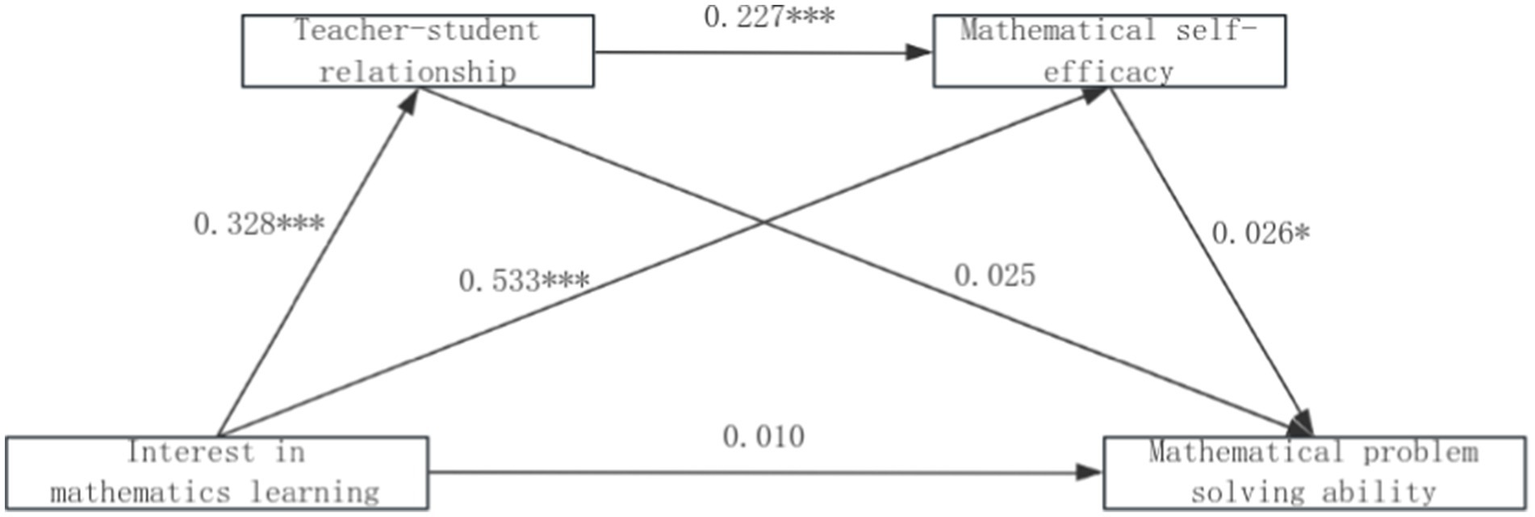
The mediating effect of self-efficacy and teacher-student relationship.
Table 3
| Dependent variable | Independent variable | Bias regression coefficient | R | R2 | p | |||
|---|---|---|---|---|---|---|---|---|
| β | SE | t | p | |||||
| Teacher-student relationship | Constant | 10.167 | 0.372 | 27.307 | <0.001 | 0.464 | 0.216 | <0.001 |
| Interest in mathematics learning | 0.328 | 0.023 | 14.408 | <0.001 | ||||
| Grade | −0.006 | 0.244 | −0.027 | 0.979 | ||||
| Place of residence | −0.205 | 0.071 | −2.896 | 0.004 | ||||
| Profession | −0.056 | 0.013 | −4.441 | <0.001 | ||||
| Self-efficacy | Constant | 2.986 | 0.584 | 5.114 | <0.001 | 0.653 | 0.426 | <0.001 |
| Teacher-student relationship | 0.227 | 0.040 | 5.682 | <0.001 | ||||
| Learning interest | 0.533 | 0.029 | 18.511 | <0.001 | ||||
| Grade | 0.182 | 0.275 | 0.660 | 0.509 | ||||
| Place of residence | −0.101 | 0.080 | −1.261 | 0.208 | ||||
| Profession | −0.019 | 0.014 | −1.346 | 0.179 | ||||
| Mathematical problem solving ability | Constant | 0.949 | 0.215 | 4.408 | <0.001 | 0.211 | 0.044 | <0.001 |
| Teacher-student relationship | 0.025 | 0.015 | 1.721 | 0.086 | ||||
| Self-efficacy | 0.026 | 0.013 | 2.053 | <0.05 | ||||
| Learning interest | 0.010 | 0.012 | 0.808 | 0.419 | ||||
| Grade | −0.230 | 0.100 | −2.296 | <0.05 | ||||
| Place of residence | 0.026 | 0.029 | 0.898 | 0.370 | ||||
| Profession | −0.014 | 0.005 | −2.742 | 0.006 | ||||
Results of mediation analysis.
Table 4
| Path | Estimate | Boot S.E | Upper CI | Lower CI | Proportion |
|---|---|---|---|---|---|
| Ind1 Interest in learning → Relationship between teachers and students → ability to solve math problems | 0.0083 | 0.0053 | 0.0196 | −0.0114 | 24.19 |
| Ind2 Learning interest → Self-efficacy → ability to solve math problems | 0.0140 | 0.0072 | 0.0286 | 0.0003 | 40.79 |
| Ind3 Learning interest → teacher-student relationship → Self-efficacy → ability to solve math problems | 0.0020 | 0.0011 | 0.0048 | 0.0003 | 5.68 |
| Total mediating effect | 0.0243 | 0.0088 | 0.0439 | 0.0080 | 70.66 |
| Direct effect | 0.0101 | 0.0125 | 0.0346 | −0.0144 | 29.34 |
| Total effect | 0.0344 | 0.0093 | 0.0528 | 0.0161 | 100 |
Results of significance test.
The total indirect effect (0.0243) accounted for 70.66% of the total effect. The nonsignificant standalone mediation via teacher-student relationships suggests that isolated improvements in teacher-student interactions have limited impact on medical mathematics competency unless integrated with clinical-contextualized teaching to activate cognitive support mechanisms. The self-efficacy mediation path was significant, explaining 40.79% of the total effect. The chained mediation path (teacher-student relationships → self-efficacy) explained 5.68%, highlighting the potential of leveraging “teacher-student support → self-efficacy” as an educational enhancer. Overall, self-efficacy is the key mediator linking learning interest to mathematical competency, whereas the weak effects of teacher-student relationships and the chained path suggest prioritizing self-efficacy over isolated relational improvements.
Academic major significantly negatively predicted both teacher-student relationships (β = −0.056, p < 0.001) and problem-solving ability (β = −0.014, p = 0.006), reflecting that high-intensity training in mainstream disciplines (e.g., Clinical Medicine) generally suppresses relational and mathematical development. However, disciplinary heterogeneity exists: Emergency Management majors exhibited superior teacher-student relationships and learning interest due to integrated mathematical modeling curricula, while Anesthesiology excelled in problem-solving ability owing to explicit mathematical applications (e.g., pharmacokinetic calculations). These findings indicate that the overall negative trend across medical disciplines may be moderated by subject-specific differences (see Table 3).
4 Discussion
4.1 The effects of students’ mathematical learning interest, teacher-student relationships, and self-efficacy on their mathematical problem-solving ability
This study found that Hypotheses 1 and 2 were unsupported, while Hypotheses 3, 4, 5, and 6 were supported—that is, neither college students’ mathematical learning interest nor teacher-student relationships directly predicted mathematical problem-solving ability. On one hand, interest reflects a trait-like preference for work activities, environments, or outcomes, which drives goal-oriented behaviors (Hyland et al., 2022). When students exhibit strong interest in mathematics, they are more likely to engage in proactive learning, exploration, and conceptual understanding, fostering not only deeper knowledge acquisition but also innovative thinking in problem-solving. Prior research indicates that interest exerts a stronger influence on mathematical performance compared to physics, chemistry, or biology (Jansen et al., 2016). Conversely, students lacking mathematical interest often struggle with motivation, leading to difficulties, disengagement, and reduced learning efficacy (Merrick and Maher, 2009). However, this study’s focus on medical students introduces a critical distinction: mathematics in medical curricula serves as a tool rather than a core discipline, potentially diluting interest’s direct effects due to confounding from professionally oriented motivations (Machalow et al., 2022). After controlling for grade, residential environment, and major-related variables, the direct effect of mathematical interest on problem-solving ability became nonsignificant. While academic interest is known to positively influence achievement through enhanced effort and persistence—with stronger interest-achievement linkages in natural sciences (Jansen et al., 2016)—mathematics in medical education is often perceived as a “service discipline,” where clinical motivations may weaken its interest-ability association via motivational filtering (Sun et al., 2024). For example, medical students’ academic interest shows minimal impact on medical academic performance (Wu et al., 2019), and in psychology, initial personal interest fails to predict undergraduates’ grades (Harackiewicz et al., 2008). This study expands the scope of interest-achievement research, suggesting that disciplinary attributes may moderate interest-ability relationships, with implications for medical curriculum integration.
Additionally, aligned with the expectancy-value model, medical students’ mathematical motivations are dominated by career goal commitments. Even with positive teacher-student relationships, if students perceive mathematics as minimally relevant to future clinical practice, intrinsic motivation becomes suppressed by motivational filtering, blocking the direct translation of relational support into mathematical competency (Wu et al., 2020).
4.2 Mediating roles of teacher-student relationships and self-efficacy in the relationship between students’ interest in mathematics and problem-solving abilities
This study found that teacher-student relationships did not exhibit a significant independent mediating role in the relationship between college students’ mathematical learning interest and problem-solving ability, thus Hypothesis 7 was unsupported. While prior research indicates that learning interest significantly positively predicts teacher-student relationships (Kwok et al., 2022)—a bidirectional interaction where both participants influence each other’s cognition, emotions, motivations, and behaviors (Korthagen et al., 2014; Holen et al., 2018). Such relationships in medical education are predominantly centered on clinical skills rather than mathematics, likely weakening their mediating role in mathematical competency (Wei and Cheng, 2022). Academic achievement ultimately requires students’ own efforts; for instance, studies analyzing the mediating role of self-efficacy in the relationship between proactive personality and academic performance among college athletes found that proactive personality enhances grades only through self-efficacy (Li et al., 2022). This explains why teacher-student relationships alone cannot directly predict problem-solving ability and must operate via self-efficacy’s mediation.
The study confirmed that mathematical self-efficacy serves as a significant independent mediator between learning interest and problem-solving ability, supporting Hypothesis 8. Learning interest exerted a stronger indirect effect on problem-solving ability through self-efficacy alone compared to the chained mediation via teacher-student relationships. Strong mathematical self-efficacy correlates closely with problem-solving ability (Arens et al., 2022), as students with high self-efficacy typically possess superior mathematical thinking skills, foundational knowledge, confidence (Guo et al., 2023), well-being (Datu and Mateo, 2020), and academic efficiency. This finding identifies a low-cost intervention target for medical education: short-term cognitive-behavioral training to enhance self-efficacy may be more feasible and impactful than restructuring teacher-student dynamics (Ashraf et al., 2024).
The study also validated Hypothesis 9, demonstrating a chained mediation effect (learning interest → teacher-student relationships → self-efficacy → problem-solving ability). Strong learning interest fosters teacher-student interactions, which in turn boost self-efficacy—a critical predictor of academic achievement (Wei et al., 2022). Even in hybrid learning environments, teacher support remains pivotal for elevating self-efficacy (Weber and Harzer, 2022).
In summary, medical students’ learning interest enhances problem-solving ability exclusively through self-efficacy, with both the independent mediation of self-efficacy (β = 0.014, 95% CI [0.0003, 0.029]) and the chained mediation (teacher-student relationships → self-efficacy) exerting significant positive effects. By focusing on medical students, this study expands the scope of research on learning interest and academic performance, revealing that mathematical learning interest cannot directly improve problem-solving ability but requires the amplification of mathematical self-efficacy.
5 Limitations and directions for future research
First, this study focused on medical college students, a group with distinct professional orientations that may inherently exhibit lower mathematical learning interest. Medical curricula prioritize biomedical knowledge and clinical skills, relegating mathematics to a peripheral role as a foundational discipline. This structural emphasis likely diminishes students’ awareness of mathematics’ importance, thereby dampening their interest and motivation. Notably, the sample was limited to medical schools in eastern urban comprehensive universities, excluding rural medical colleges and specialized vocational institutions, and failed to report participants’ socioeconomic status—factors that may constrain the generalizability of findings. Future research must expand the scope to include students from diverse majors, institutions (urban vs. rural, comprehensive vs. vocational), and socioeconomic backgrounds to strengthen external validity.
Second, the measurement of medical students’ mathematical problem-solving ability relied on PISA (Programme for International Student Assessment) test items, administered under timed conditions with explicit prohibitions against internet use. However, pre-existing familiarity with PISA questions among some students (due to prior exposure) and the mismatch between PISA’s general mathematics focus and medical students’ need for clinical-contextualized mathematical application may have introduced measurement bias. Future studies should develop tailored assessment tools that align with medical education’s unique demands, such as clinical pharmacokinetics or epidemiological modeling tasks, to more accurately capture medical students’ domain-specific mathematical competencies.
Third, as a cross-sectional study targeting first-year medical students at an academic transition point (post-high school), this research cannot address potential temporal dynamics in mathematical interest and ability. Longitudinal designs are critical to explore: (1) how mathematical interest and problem-solving skills evolve across medical training stages (e.g., from foundational coursework in Year 1 to clinical rotations in Year 5), and (2) whether interventions such as self-efficacy training programs or teacher-student relationship enhancements differentially impact clinical mathematical competency through randomized controlled trials.
6 Practical implications
Despite these limitations, our findings retain significant practical and academic value. College students with stronger mathematical problem-solving abilities within discipline-specific learning contexts consistently demonstrate higher mathematical literacy. This study empirically confirms that medical students’ mathematical learning interest enhances problem-solving ability by improving teacher-student relationships and strengthening self-efficacy, thereby fostering holistic mathematical literacy development. To operationalize these insights, we recommend that medical educators embed clinical mathematical cases (e.g., drug dosage calculations, epidemiological modeling) into curricula to activate instrumental interest, adopt task decomposition methods in teaching to progressively build self-efficacy, and establish a dual-mentor feedback mechanism (mathematics instructors assessing logical rigor, clinical mentors evaluating application validity) to synergistically reinforce the mediating role of teacher-student relationships. Additionally, policymakers should integrate self-efficacy into medical students’ core competency assessments and provide cognitive behavioral therapy (CBT)-based interventions for low-efficacy students, offering novel pathways for higher education mathematics reform and competency cultivation.
Statements
Data availability statement
The raw data supporting the conclusions of this article will be made available by the authors, without undue reservation.
Author contributions
LY: Writing – original draft, Writing – review & editing. JC: Investigation, Writing – review & editing. YZ: Conceptualization, Formal analysis, Writing – review & editing.
Funding
The author(s) declare that financial support was received for the research and/or publication of this article. This study was supported by the Higher Education Scientific Research Planning Project of the Chinese Association of Higher Education (22SX0419).
Conflict of interest
The authors declare that the research was conducted in the absence of any commercial or financial relationships that could be construed as a potential conflict of interest.
Generative AI statement
The authors declare that no Gen AI was used in the creation of this manuscript.
Publisher’s note
All claims expressed in this article are solely those of the authors and do not necessarily represent those of their affiliated organizations, or those of the publisher, the editors and the reviewers. Any product that may be evaluated in this article, or claim that may be made by its manufacturer, is not guaranteed or endorsed by the publisher.
References
1
Anderson M. A. Giordano J. (2013). Aequilibrium prudentis: on the necessity for ethics and policy studies in the scientific and technological education of medical professionals. BMC Med. Educ.13:58. doi: 10.1186/1472-6920-13-58
2
Arens A. K. Frenzel A. C. Goetz T. (2022). Self-concept and self-efficacy in math: longitudinal interrelations and reciprocal linkages with achievement. J. Exp. Educ.90, 615–633. doi: 10.1080/00220973.2020.1786347
3
Armstrong P. I. Vogel D. L. (2009). Interpreting the interest–efficacy association from a Riasec perspective. J. Couns. Psychol.56, 392–407. doi: 10.1037/a0016407
4
Ashraf M. A. Tsegay S. M. Gull N. Saeed M. Dawood H. (2024). The role of blended learning in improving medical students’ academic performance: evidence from Pakistan. Front. Med.11:1425659. doi: 10.3389/fmed.2024.1425659
5
Brumm L. Rathgeb-Schnierer E. (2023). The relationship between accuracy in numerosity estimation, math achievement, and math interest in primary school students. Front. Psychol.14:1146458. doi: 10.3389/fpsyg.2023.1146458
6
Bu Q. Yan N. Shen X. Wang W. (2023). The relationship between uncertainty stress and mobile phone addiction in medical students: the chain mediating effect of social anxiety and depression. Modern Prev. Med.50, 2791–2795+2803. doi: 10.20043/j.cnki.Mpm.202302126
7
Cheung S. K. Ho A. P. L. Kum B. H. C. Chan W. W. L. (2024). Parents’ attitudes towards helping children learn math: how do they matter for early math competence?Eur. J. Psychol. Educ.39, 2953–2968. doi: 10.1007/s10212-024-00863-0
8
Cordero E. D. Porter S. H. Israel T. Brown M. T. (2010). Math and science pursuits: a self-efficacy intervention comparison study. J. Career Assess.18, 362–375. doi: 10.1177/1069072710374572
9
Datu J. A. D. Mateo N. J. (2020). Character strengths, academic self-efficacy, and well-being outcomes in the Philippines: a longitudinal study. Child Youth Serv. Rev.119:105649. doi: 10.1016/j.childyouth.2020.105649
10
Denner J. Valdes O. Dickson D. J. Laursen B. (2019). Math interest and self-concept among Latino/a students: reciprocal influences across the transition to middle school. J. Adolesc.75, 22–36. doi: 10.1016/j.adolescence.2019.06.015
11
Dhillon S. K. Ganggayah M. D. Sinnadurai S. Lio P. Taib N. A. (2022). Theory and practice of integrating machine learning and conventional statistics in medical data analysis. Diagnostics (Basel)12:2526. doi: 10.3390/diagnostics12102526
12
Doctoroff G. L. Fisher P. H. Burrows B. M. Edman M. T. (2016). Preschool children’s interest, social–emotional skills, and emergent mathematics skills. Psychol. Sch.53, 390–403. doi: 10.1002/pits.21912
13
Fasce H. E. Ortega B. J. Ibáñez G. P. Márquez U. C. Pérez C. V. Bustamante D. C. et al . (2016). Motivation and self-directed learning among medical students. Rev. Med. Chile144, 664–670. doi: 10.4067/S0034-98872016000500016
14
Fisher P. H. Dobbs-Oates J. Doctoroff G. L. Arnold D. H. (2012). Early math interest and the development of math skills. J. Educ. Psychol.104, 673–681. doi: 10.1037/a0027756
15
Goldstein C. Woods N. Mackinnon R. Fazelzad R. Gill B. Giuliani M. E. et al . (2024). Numeracy education for health care providers: a scoping review. J. Contin. Educ. Health Prof.44, 35–43. doi: 10.1097/Ceh.0000000000000504
16
Guo S. Li T. Xue B. Yang X. (2023). Horticultural activities participation and college students’ positive mental characters: mediating role of academic self-efficacy. Horticulturae9:334. doi: 10.3390/horticulturae9030334
17
Harackiewicz J. M. Durik A. M. Barron K. E. Linnenbrink-Garcia L. Tauer J. M. (2008). The role of achievement goals in the development of interest: reciprocal relations between achievement goals, interest, and performance. J. Educ. Psychol.100, 105–122. doi: 10.1037/0022-0663.100.1.105
18
Holen S. Waaktaar T. Sagatun Å. (2018). A chance lost in the prevention of school dropout? Teacher-student relationships mediate the effect of mental health problems on noncompletion of upper-secondary school. Scand. J. Educ. Res.62, 737–753. doi: 10.1080/00313831.2017.1306801
19
Holzberger D. Philipp A. Kunter M. (2013). How teachers’ self-efficacy is related to instructional quality: a longitudinal analysis. J. Educ. Psychol.105, 774–786. doi: 10.1037/a0032198
20
Huang J. Siu C. T.-S. Cheung H. (2022). Longitudinal relations among teacher-student closeness, cognitive flexibility, intrinsic reading motivation, and reading achievement. Early Child. Res. Q.61, 179–189. doi: 10.1016/j.ecresq.2022.07.009
21
Hyland W. E. Hoff K. A. Rounds J. (2022). Interest-ability profiles: an integrative approach to knowledge acquisition. J. Intelligence10:43. doi: 10.3390/jintelligence10030043
22
Jansen M. Lüdtke O. Schroeders U. (2016). Evidence for a positive relation between interest and achievement: examining between-person and within-person variation in five domains. Contemp. Educ. Psychol.46, 116–127. doi: 10.1016/j.cedpsych.2016.05.004
23
Jung Y. Lim S. A. Fan L. (2023). Teacher’s factors affecting students’ math class engagement: the mediating effect of math self-efficacy. Educ. Psychol.43, 929–946. doi: 10.1080/01443410.2023.2267809
24
Korthagen F. A. J. Attema- Noordewier S. Zwart R. C. (2014). Teacher–student contact: exploring a basic but complicated concept. Teach. Teach. Educ.40, 22–32. doi: 10.1016/j.tate.2014.01.006
25
Kwok M. L. J. Kwong R. Wong M. (2022). How to facilitate motivational regulation strategies: perspectives on teacher humility and teacher-student relationship. Comput. Educ.191:104645. doi: 10.1016/j.compedu.2022.104645
26
Li X. Liu M. Yu H. Zhang Z. He Z. (2022). The influence of sports on proactive personality and academic achievement of college students: the role of self-efficacy. Front. Psychol.13:943347. doi: 10.3389/fpsyg.2022.943347
27
Liu Y. K. Wu R. Z. Yang A. M. (2023). Research on medical problems based on mathematical models. Mathematics11:2842. doi: 10.3390/math11132842
28
Machalow R. Goldsmith-Markey L. T. Remillard J. T. (2022). Critical moments: pre-service mathematics teachers’ narrative arcs and mathematical orientations over 20 years. J. Math. Teach. Educ.25, 35–61. doi: 10.1007/s10857-020-09479-9
29
Merrick K. Maher M. L. (2009). Motivated learning from interesting events: adaptive, multitask learning agents for complex environments. Adapt. Behav.17, 7–27. doi: 10.1177/1059712308100236
30
Panjeh S. Nordahl-Hansen A. Cogo-Moreira H. (2023). Establishing new cutoffs for Cohen’s d: an application using known effect sizes from trials for improving sleep quality on composite mental health. Int. J. Methods Psychiatr. Res.32:e1969. doi: 10.1002/mpr.1969
31
Pelaccia T. Viau R. (2017). Motivation in medical education. Med. Teach.39, 136–140. doi: 10.1080/0142159X.2016.1248924
32
Petersen J. L. Hyde J. S. (2017). Trajectories of self-perceived math ability, utility value and interest across middle school as predictors of high school math performance. Educ. Psychol.37, 438–456. doi: 10.1080/01443410.2015.1076765
33
Rubach C. Dicke A.-L. Safavian N. Eccles J. S. (2023). Classroom transmission processes between teacher support, interest value and negative affect: an investigation guided by situated expectancy-value theory and control-value theory. Motiv. Emot.47, 575–594. doi: 10.1007/s11031-023-10013-6
34
Sankalaite S. Huizinga M. Warreyn P. Dewandeleer J. Baeyens D. (2023). The association between working memory, teacher-student relationship, and academic performance in primary school children. Front. Psychol.14:1240741. doi: 10.3389/fpsyg.2023.1240741
35
Stoeger H. Luo L. Ziegler A. (2024). Attracting and developing Stemm talent toward excellence and innovation. Ann. N. Y. Acad. Sci.1533, 89–98. doi: 10.1111/nyas.15108
36
Sun J. J. Liu T. Li H. (2024). Study on the status and problems of teaching system of “medical advanced mathematics”: data based on a research of 11 universities in China. BMC Med. Educ.24:36. doi: 10.1186/s12909-023-05012-7
37
Ten Braak D. Lenes R. Purpura D. J. Schmitt S. A. Størksen I. (2022). Why do early mathematics skills predict later mathematics and reading achievement? The role of executive function. J. Exp. Child Psychol.214:105306. doi: 10.1016/j.jecp.2021.105306
38
Tosto M. G. Asbury K. Mazzocco M. M. M. Petrill S. A. Kovas Y. (2016). From classroom environment to mathematics achievement: the mediating role of self-perceived ability and subject interest. Learn. Individ. Differ.50, 260–269. doi: 10.1016/j.lindif.2016.07.009
39
Viljaranta J. Tolvanen A. Aunola K. Nurmi J.-E. (2014). The developmental dynamics between interest, self-concept of ability, and academic performance. Scand. J. Educ. Res.58, 734–756. doi: 10.1080/00313831.2014.904419
40
Wang C. Xu Q. Fei W.-Q. (2024). The effect of student-perceived teacher support on math anxiety: chain mediation of teacher–student relationship and math self-efficacy. Front. Psychol.15:1333012. doi: 10.3389/fpsyg.2024.1333012
41
Warwas J. Nagy G. Watermann R. Hasselhorn M. (2009). The relations of vocational interests and mathematical literacy: on the predictive power of interest profiles. J. Career Assess.17, 417–438. doi: 10.1177/1069072709339284
42
Weber M. Harzer C. (2022). Relations between character strengths, school satisfaction, enjoyment of learning, academic self-efficacy, and school achievement: an examination of various aspects of positive schooling. Front. Psychol.13:826960. doi: 10.3389/fpsyg.2022.826960
43
Wei W. Cheng L. (2022). Exploring the relationships between teacher-led and learner-led mobile learning activities and their impacts on teacher evaluation results. Technol. Pedagog. Educ.31, 247–259. doi: 10.1080/1475939X.2021.2010591
44
Wei Y. Shi Y. Macleod J. Yang H. H. (2022). Exploring the factors that influence college students’ academic self-efficacy in blended learning: a study from the personal, interpersonal, and environmental perspectives. SAGE Open12:21582440221104815. doi: 10.1177/21582440221104815
45
Wu H. B. Pei L. S. Li S. Jiang C. (2020). Medical career expectations of academically talented high school students: a nationwide cross-sectional study in China. BMC Med. Educ.20:166. doi: 10.1186/s12909-020-02083-8
46
Wu H. Zheng J. Li S. Guo J. (2019). Does academic interest play a more important role in medical sciences than in other disciplines? A nationwide cross-sectional study in China. BMC Med. Educ.19:301. doi: 10.1186/s12909-019-1737-1
47
Yang Y. Li G. Su Z. Yuan Y. (2021). Teacher’s emotional support and math performance: the chain mediating effect of academic self-efficacy and math behavioral engagement. Front. Psychol.12:651608. doi: 10.3389/fpsyg.2021.651608
48
You S. Kim E. K. Lim S. A. Dang M. (2021). Student and teacher characteristics on student math achievement. J. Pac. Rim Psychol.15:1834490921991428. doi: 10.1177/1834490921991428
49
Yu R. Singh K. (2018). Teacher support, instructional practices, student motivation, and mathematics achievement in high school. J. Educ. Res.111, 81–94. doi: 10.1080/00220671.2016.1204260
Summary
Keywords
medical students, mathematical problem-solving ability, learning interest, teacher-student relationship, self-efficacy
Citation
Yang L, Cui J and Zhang Y (2025) The relationship between medical students’ interest in learning and their ability to solve mathematical problems: the chain-mediating role of teacher-student relationship and self-efficacy. Front. Psychol. 16:1531262. doi: 10.3389/fpsyg.2025.1531262
Received
20 November 2024
Accepted
03 March 2025
Published
12 March 2025
Volume
16 - 2025
Edited by
Francis Thaise A. Cimene, University of Science and Technology of Southern Philippines, Philippines
Reviewed by
Ralph Vendel Musni, University of Science and Technology of Southern Philippines, Philippines
Michelle Gay Atay, Capitol University, Philippines
Updates
Copyright
© 2025 Yang, Cui and Zhang.
This is an open-access article distributed under the terms of the Creative Commons Attribution License (CC BY). The use, distribution or reproduction in other forums is permitted, provided the original author(s) and the copyright owner(s) are credited and that the original publication in this journal is cited, in accordance with accepted academic practice. No use, distribution or reproduction is permitted which does not comply with these terms.
*Correspondence: Li Yang, helloyangli@163.com
Disclaimer
All claims expressed in this article are solely those of the authors and do not necessarily represent those of their affiliated organizations, or those of the publisher, the editors and the reviewers. Any product that may be evaluated in this article or claim that may be made by its manufacturer is not guaranteed or endorsed by the publisher.