Abstract
Introduction:
The use of Generative Artificial Intelligence (GenAI) in foreign language education is also a paradigm shift; however, psychological factors that affect its adoption are not well understood. While established models such as the Unified Theory of Acceptance and Use of Technology 2 (UTAUT2) describe technology adoption in general, they often fail to capture the unique emotional and cognitive reactions triggered by AI.
Methods:
This paper thus presents an important construct to explain the special emotional and cognitive reactions triggered by the learning of human-AI collaboration: AI anxiety. Structural equation modeling (SEM) was used to analyze survey data (N = 632), and sentiment analysis was used for online reviews.
Results:
The results indicate that Performance Expectancy, Effort Expectancy, and Social Influence positively affect Behavioral Intention. On the other hand, AI Anxiety and Habit significantly negatively affect Behavioral Intention. Sentiment analysis supported these findings, demonstrating positive public sentiment and anxiety and complexity associated with adopting decision-making.
Discussion:
The research shows that integrating GenAI into learning is not a functional interaction but a complex psychological interaction. The implications of this research are important for people developing technologically sophisticated yet psychologically attuned AI tools.
Introduction
What if your personal tutor was available around the clock, could create a conversation on any subject you could think of, and never lost her or his temper? This is no longer science fiction fantasy, but the reality of GenAI in foreign language education. AI tutoring, such as DeepSeek, is a fast-emerging reality in global education (Guo et al., 2025; Liu et al., 2024). It is argued, for instance, that how a system presents itself, mimics (real-time feedback) and engages (affect) make personalization possible, which can compensate for the difficulties that arise from human teaching (lack of proper pronunciation, engagement, motivation, etc.). The revolution can be quantified as a recent search in the Web of Science Core Collection, which returns 1,538 scholarly records containing the string “GenAI language learning,” which shows an exponentially increased attention in the literature to this topic. As shown in Figure 1, created using VOSviewer, bibliometric mapping reveals three major research clusters, model development, social applications, and educational integration, in which the most common co-occurring keywords relate to student engagement and teacher adoption. The evidence is clear: GenAI is no longer an add-on classroom tool-it is redefining the very concept of what it means to teach and learn a language.
Figure 1
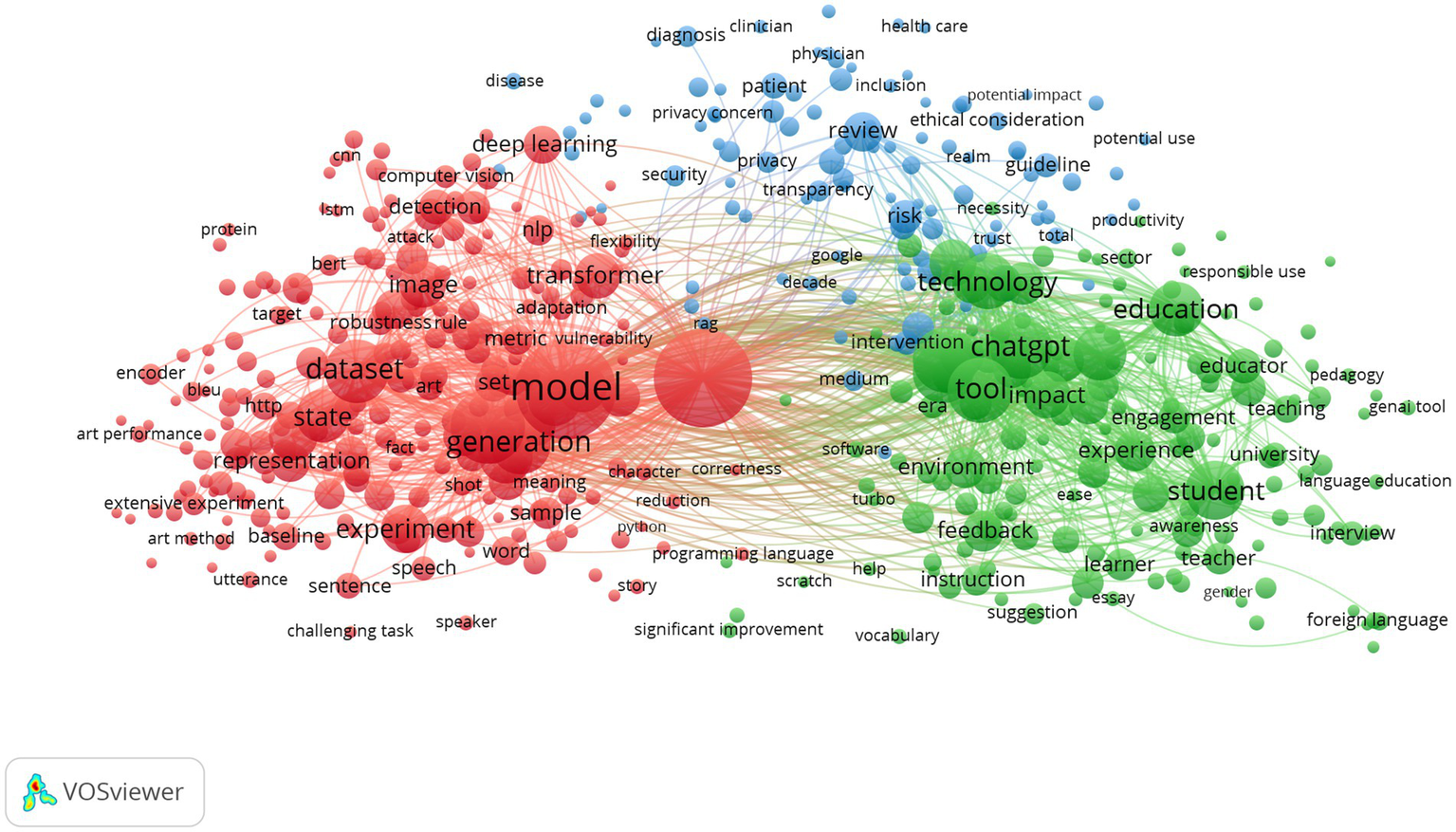
Keywords with the greatest total link strength.
Despite increasing interest, there is a lack of in-depth research on the motivational and psychological barriers that ultimately govern the acceptance of GenAI in foreign language education. As good as UTAUT2 is for technology adoption in general, the traditional model struggles to conceptualize the role of these psychological dynamics in educators’ and learners’ decision-making processes regarding acceptance or rejection of an AI collaborator. This paper proposes an expanded UTAUT2 model that incorporates the important dimension of AI anxiety to address this gap. By assessing users’ behavioral intentions and affective responses, as well as the perceived alignment of AI competencies and human-centered classroom responsibilities, this study provides a novel insight into the psychological transaction that is the central mechanism of human–AI collaboration in education. The following two fundamental questions guide the research:
RQ1. What psychological factors drive or hinder the adoption of GenAI in foreign language education?
RQ2. How does the public perceive GenAI tools like DeepSeek?
Theoretical framework
The present research will be based on an extended UTAUT2 model, in which AI anxiety is treated as the simplest psychological factor. While UTAUT2 traditionally emphasizes behavioral predictors of technology use (Venkatesh et al., 2012), we redefine its constructs in terms of psychological theories to better capture the cognitive, motivational, and emotional processes underlying GenAI acceptance. The fact that AI anxiety is treated as an independent psychological concept reflects an emotional attachment to technology adoption, i.e., the fear, uneasiness, and techno-phobia that may be present among teachers and students when interacting with more autonomous systems. There are diverse causes of this fear: fear of technological substitution, algorithmic opacity, and a sense of threat to professional identity. The suggested theoretical integration provides a more detailed explanation of the communication between cognitive assessment and emotional responses to ascertain behavioral intentions to use GenAI in the teaching of foreign languages, thereby bridging a gap in core psychological interactions between humans and artificial intelligence in the learning process.
Research model and hypotheses
AI anxiety (AA)
The conceptualization of AI Anxiety as a feeling of fear or apprehension about the use of AI systems is a key determinant of technological adoption, especially in the subtle sphere of foreign language learning (Heinssen et al., 1987; Johnson and Verdicchio, 2017). Based on the literature about computer anxiety, AA in this respect goes beyond the general technophobia into the realm of fears of excessive dependency, the concern about the message of the AI as accurate and culturally sensitive, as well as the feeling that the humanistic and interactive essence of the learning of the language is under threat. There is also substantial literature that views AA as an essential obstacle to the implementation of educational technologies, especially in the field of foreign languages (Abu-Rayyash, 2024; Saehu and Hkikmat, 2025). AA can be conceptualized as an emotional reaction to fear of AI systems, but it goes beyond general technophobia to encompass specific fears related to learning (Rathakrishnan et al., 2024; Zhai et al., 2024). They are the fear of over-reliance as an impediment to personal mastery, fears about the validity and cultural sensitivity of AI-generated content, and a sense of the danger to the humanistic, interactive essence of language acquisition (Zhi and Wang, 2024; Zhou and Hou, 2024). In this view, the overall finding is that an increase in AA is associated with decreases in Perceived Ease of Use and Usefulness, and thus a decrease in Behavioral Intention (BI) to use AI tools.
However, empirical evidence demonstrates that contradictory results indicate the complexity of AA. Against the perception of AA as unavoidably inhibitory, an alternative body of research proposes that an intermediate amount of AA is not only potentially helpful but will produce a state of productive struggle that will encourage learners to be more critical and reflective in their learning process, increasing their levels of engagement and metalinguistic awareness (Elmoon, 2025; Lachance and Honigsfeld, 2022). Another controversial issue is which users are most affected. Whereas there is a school of thought that AA is highest among low-proficiency learners who feel vulnerable to the technology (Qiao and Zhao, 2023), other studies have shown that advanced users have significantly higher levels of AA because of their increased capacity to detect the subtle mistakes of AI and other limits on ethics, which forms a U-shaped debate on the proficiency of the users (Frenkenberg and Hochman, 2025). Thus, the first significant gap is the need to replace AI Anxiety as a key construct with an extended UTAUT2 model to comprehensively describe user behavior regarding Generative AI in the international language learning context.
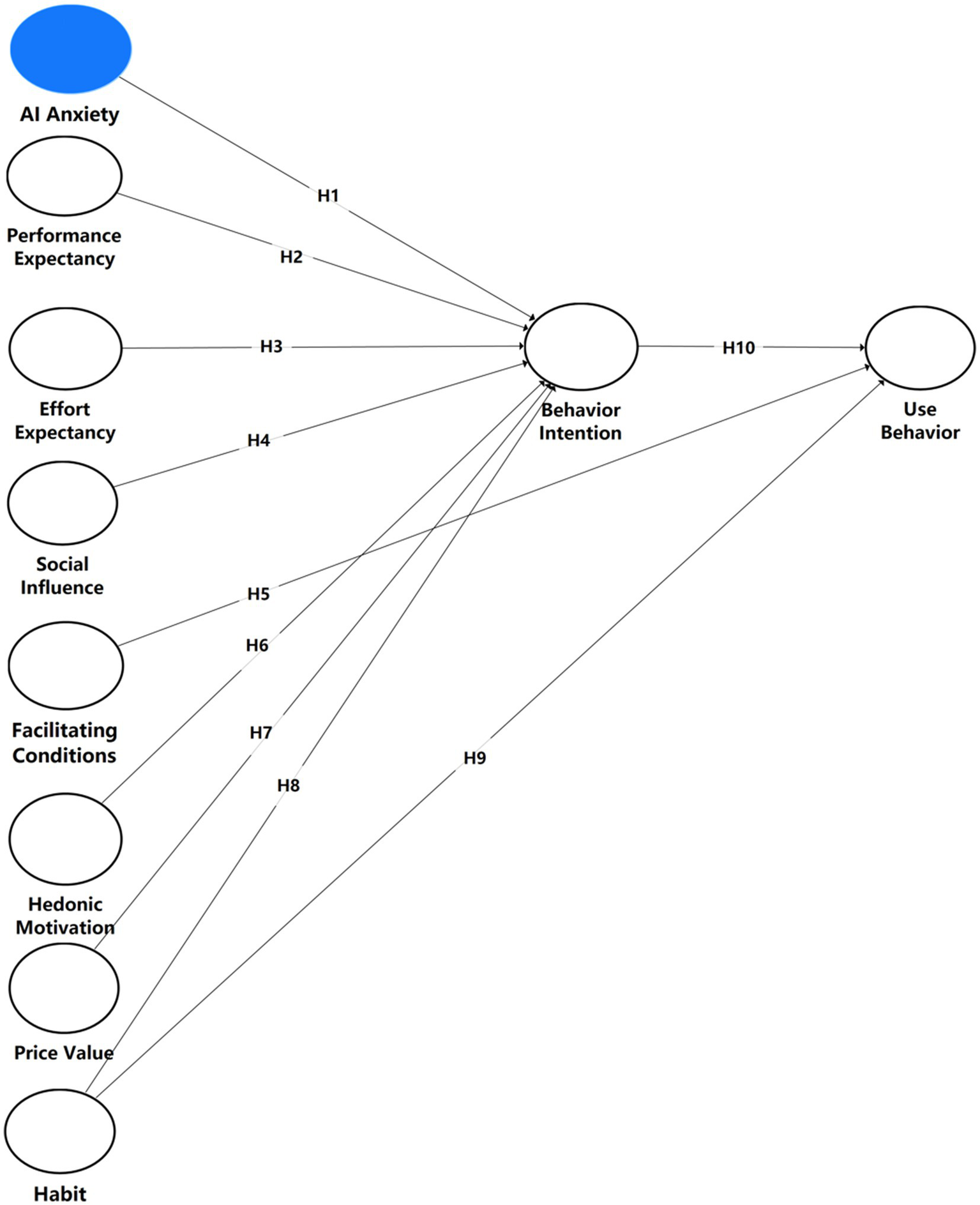
H1: AI Anxiety will exert a significant negative influence on BI when students use DeepSeek in foreign language education.
Performance expectancy (PE) and effort expectancy (EE)
PE is the belief that technology applications enhance performance in academic or professional settings (Venkatesh et al., 2003). The educational motive for PE is a primary factor in determining how students and educators will adopt AI-powered instructional tools in their classrooms (Rahiman and Kodikal, 2024). AI adaptive learning systems, automated tutoring and assessment systems enhance learning outcomes and student engagement, and strengthen the impact of PE on BI (Miller et al., 2025; Shoaib et al., 2024). EE directly affects technology adoption, especially in digital education platforms that require intuitive interfaces and minimal mental effort to keep students engaged in the learning process (Al-kfairy et al., 2024). Students have shown greater intent to use educational technologies they see as embedded in their existing systems and easy to use, according to Ayanwale and Ndlovu (2024). PE and perceived usefulness have a positive predictive impact on acceptance. However, this relationship is influenced to varying degrees by factors such as users’ digital capabilities and experience with AI learning tools. This research builds on existing work by analyzing the relationships among PE and EE factors, the adoption of the DeepSeek model in education, and a current literature gap on AI use in personalized automatic learning environments.
H2: PE will positively and significantly predict BI when students use DeepSeek in foreign language education.
H3: EE will positively and significantly predict BI when students use DeepSeek in foreign language education.
Social influence (SI) and facilitating conditions (FC)
Through the use of AI-based educational technologies, users experience behavioral change, which is dependent on two major factors: SI and FC. Influences on the adoption of educational tools are driven by the amount of support from key persons such as peers, educators, and institutions (Venkatesh et al., 2003). Peer and Institutional support in the adoption of AI-based tutoring systems: Chatterjee et al. (2024) and Farhi (2024) found results similar to those of previous research on peer and institutional support. SI’s impact on decision-making depends on the factors that dominate the procedure, such as autonomy and self-efficacy (Milicevic et al., 2024). FC, such as institutional and technical assistance, is important in the adoption of AI in education. Bhat et al. (2024) demonstrate that teachers using ChatGPT for curriculum development have improved learning outcomes, though this effect is not consistent without appropriate infrastructure, information technology support, and training. Many studies have shown that the FC indicator has excellent predictive ability in the implementation of adoption processes. The extent of this issue’s influence depends on users’ digital experience with such systems (Erdem and Çelik, 2024).
H4: SI will positively and significantly predict BI when students use DeepSeek in foreign language education.
H5: FC will positively and significantly predict UB when students use DeepSeek in foreign language education.
Hedonic motivation (HM) and price value (PV)
Students adopt educational technology for hedonic reasons, as it provides them with internal pleasure (Kaczmarek, 2017). Through AI technology-based enjoyable experiences, student motivation increases, leading to their regular adoption of AI education systems (Chiu et al., 2024). Scientific evidence indicates that students continue to use educational technology when it is interesting to them (Abedi et al., 2024). Students evaluate the acceptance of AI-driven learning tools using PV, which represents their assessment of the benefits and costs of adopting the technology (Monroe, 2012). Student acceptance of AI-enhanced platforms in online education and adaptive learning systems significantly increaseswhen they are perceived as having high educational value at acceptable costs, according to studies by Abderrezzaq and Fatima (2024). The research examines the HM and PV factors to understand student acceptance of DeepSeek AI in educational settings.
H6: HM will positively and significantly predict BI when students use DeepSeek in foreign language education.
H7: PV will positively and significantly predict BI when students use DeepSeek in foreign language education.
Habit (HB)
Habit refers to behavioral patterns learned through automaticity, repetition, and repetition, which play an important role in the implementation of educational technology (Mixon, 1980). The study establishes a habit as an unconscious behavior when a user turns to AI-based learning machines like DeepSeek through an intuitive set of behaviors. Studies have demonstrated that habit plays a significant role in the adoption of technology, particularly in students’ use of e-learning programs and digital learning models. In an examination of the use of AI-powered tutoring systems, Han et al. (2024) showed that students who use such systems more organically are more likely to maintain their use, and the same was found by Maheshwari (2024) for mobile learning applications. Research shows that habits may encourage users to engage in activities. However, they may also hinder users’ adaptation to new system functions or new ways of learning within a short period of time (Sembiring et al., 2024). The overuse of AI educational tools diminishes students’ critical thinking and self-regulated learning skills, thereby impeding their ability to evaluate content (Yusuf et al., 2024). Resolving this AI learning paradox is very important to ensure that AI education systems deliver maximum value, as it affects whether repeating a way of doing something helps students learn better or hurts cognitive and learning development.
H8: Habits will negatively and significantly predict BI when students use DeepSeek in foreign language education.
H9: Habits will negatively and significantly predict UB when students use DeepSeek in foreign language education.
Behavioral intention (BI)
BI is the individual’s willingness to try a particular behavior (Venkatesh et al., 2003). BI is essential in determining students’ adoption decisions for AI-based educational systems. According to research papers, BI has a significant role in the technological adoption in education (Dangelico et al., 2024; Hemdan and Zhang, 2024). Different graduate students at different stages of their journey have varying levels of BI, as reflected in their views towards the EE and SI factors in digital learning environments (Tian et al., 2024). Research evidence proves that BI is a prediction tool for adopting educational technology. The effect of building individual technology competence on student retention for AI-based learning models in tailored, individualized educational contexts warrants further research (Sasidharan and Venkatakrishnan, 2024). AI deployment in education must address this research gap to ensure optimal implementation of AI systems in academic environments. The final research model is presented in Figure 2.
Figure 2
Proposed research model.
H10: BI will positively and significantly predict UB when students use DeepSeek in foreign language education.
Sentiment analysis in educational technology
By combining PLS-SEM with sentiment analysis, the validity of the conclusions is further strengthened, revealing how users feel about the technology. Sentiment analysis has proven to be an important method for assessing public attitudes toward educational AI technologies, although people express both hopefulness and concerns about ethical dilemmas and technical confidence (Adeshola and Adepoju, 2024; Mahmoud, 2024). AI sentiment analysis tools help identify students’ preferred teaching methods, as they favor clear, interactive educational methods (Alvarez-alvarez and Falcon, 2023). A sentiment analysis of students’ online learning experiences reveals a mix of positive and negative feedback that acknowledges the flexibility of digital platforms yet emphasizes engagement difficulties and high student attrition (Chen et al., 2024; Saneinia et al., 2024). Therefore, this research also delved into the acceptance of the DeepSeek AI model in educational environments by analyzing public opinion and perceived benefits.
Methodology
This research is designed as a mixed-methods research, involving survey data (based on SEM) and sentiment analysis of online discussions. The main application of this integration is triangulation: the survey captures causal relations and users’ perceptions in controlled conditions, while sentiment analysis provides external validation and confirms the emergent themes and the real-life sentiment orientation of people after the communication.
Survey data collection and SEM analysis
A self-administered questionnaire is added as a complement to the sentiment data to deliver more insight into the user’s attitudes and experiences. The study subjects were selected from diverse backgrounds, as shown in Table 1. Ethical approval was sought to preserve the integrity of the research process during data collection. The survey period on Questionnaire Star was October 26, 2024, to January 29, 2025, and the survey was conducted using convenience sampling methods, both online and offline. Social media platforms such as Weibo, Reddit, Twitter, and WeChat were used to enhance the recruiting process, and participants were paid upon completing the survey. The study started with 693 responses, of which 62 were ineligible, leaving 632 for final analysis (91.07% response rate). The bilingual questionnaire, translated from English to Chinese, was piloted and split into two parts: demographic information and 31 items for 10 sets of constructs (e.g., AA and PE) from existing scales, using a five-point Likert scale. Data analysis utilized PLS-SEM via SmartPLS 4.1.0.8, evaluating the model’s predictive capabilities to explore AI-powered tool adoption dynamics.
Table 1
| Variables | Frequency | Percentage (%) |
|---|---|---|
| Age | ||
| Under 20 | 94 | 14.87 |
| 20–29 | 327 | 51.74 |
| 30–49 | 175 | 27.69 |
| Above 50 | 36 | 5.70 |
| Gender | ||
| Male | 208 | 32.91 |
| Female | 424 | 67.09 |
| Educational level | ||
| Undergraduate | 359 | 56.80 |
| Master’s | 182 | 28.80 |
| Ph.D./Doctorate | 60 | 9.49 |
| Other | 31 | 4.91 |
| Experience | ||
| Less than 2 years | 60 | 9.49 |
| 2–5 years | 221 | 34.97 |
| 6–10 years | 251 | 39.72 |
| More than 10 years | 100 | 15.82 |
| Total | 632 | 100 |
The profile of the participants.
Sentiment analysis for triangulation and contextualization
To contextualize the quantitative relationships identified by the SEM model, a sentiment analysis was performed on 39,310 online reviews and discussions concerning DeepSeek. The main aim of this analysis was to conduct a real-world validity test, using the population’s qualitative sentiment to aid interpretation of the statistical results. In particular, popular keywords and changes in sentiment in unstructured text data provide convincing evidence for the significance or non-significance of the structural paths. Cleaning, tokenization, and sentiment labeling of data were carried out using the NLTK and TextBlob libraries with the help of the data scraped between the date of model launch (January 20, 2025) and October 25, 2025 (see Supplementary material: ‘sentiment analysis’ and ‘web scrape’). This dataset, focused on public discourse around key AI advancements, was filtered using prominent keywords such as “app,” “good,” “ChatGPT,” and “deepseek.” The resulting analysis, shown in Figure 3, reveals the dominance of terms such as “good” and “app” in the online conversation.
Figure 3
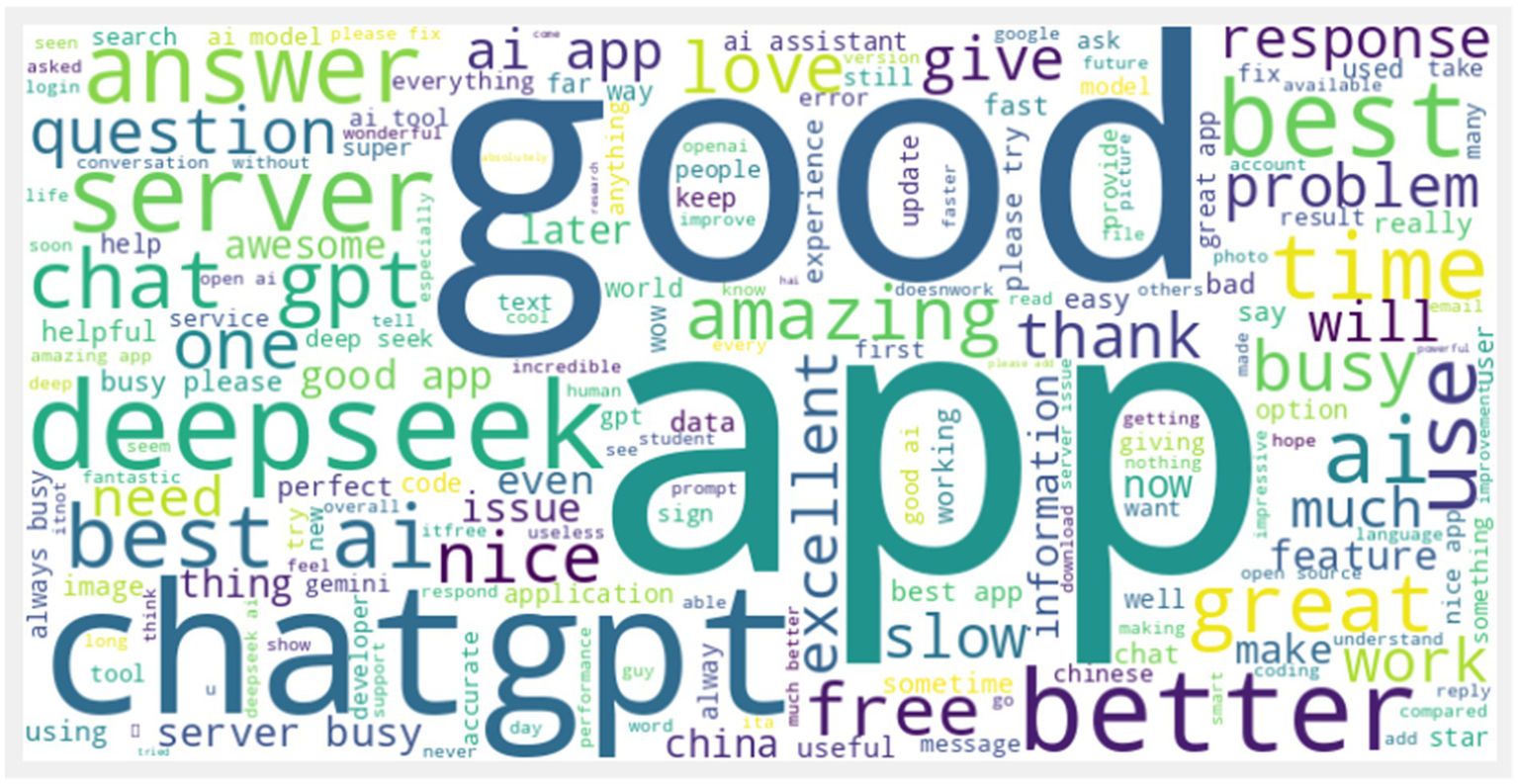
DeepSeek AI cloud.
Results
Questionnaire survey findings
The outer measurement model for reliability and validity
The researchers conducted comprehensive experiments with the reflective measurement model, which is used in educational institutions to support AI-based tools. The PLS-SEM algorithm was used to examine indicator loadings in accordance with the guidelines. Sarstedt et al. (2014) further argue that the constructs explained a substantial amount of variance, as the factor loadings exceeded 0.70. The values of AA2 (0.691), EE1 (0.619), and HM3 (0.689) were observed and retained, as the overall reliability and validity indicators attained acceptable levels (Table 2). Each indicator showed high levels of statistical reliability (p = 0.05) and above 0.70 (Chin, 1998). Cronbach’s alpha and composite reliability (CR) were used to assess internal consistency. The internal consistency of all constructs was above 0.70, as determined according to Hair et al. (2019). Convergent validity was successfully tested, as the Average Variance Extracted (AVE) values exceeded 0.50, thereby confirming the sufficient consistency of the constructs. The complexity of the analysis approach ensures the validity of the research results, enabling the study of the interaction between human and AI tools in language education.
Table 2
| Constructs | Item | Factor loading | Cronbach’s alpha | Composite reliability (CR) | Average variance extracted (AVE) |
|---|---|---|---|---|---|
| AA | AA1 | 0.745* | 0.785 | 0.858 | 0.604 |
| AA2 | 0.691* | ||||
| AA3 | 0.904* | ||||
| AA4 | 0.752* | ||||
| BI | BI1 | 0.930* | 0.918 | 0.948 | 0.858 |
| BI2 | 0.918* | ||||
| BI3 | 0.930* | ||||
| EE | EE1 | 0.619* | 0.810 | 0.891 | 0.738 |
| EE2 | 0.962* | ||||
| EE3 | 0.951* | ||||
| FC | FC1 | 0.914* | 0.894 | 0.934 | 0.825 |
| FC2 | 0.920* | ||||
| FC3 | 0.890* | ||||
| HB | HB1 | 0.943* | 0.923 | 0.951 | 0.867 |
| HB2 | 0.913* | ||||
| HB3 | 0.937* | ||||
| HM | HM1 | 0.993* | 0.874 | 0.890 | 0.733 |
| HM2 | 0.860* | ||||
| HM3 | 0.689* | ||||
| PE | PE1 | 0.728* | 0.710 | 0.839 | 0.636 |
| PE2 | 0.879* | ||||
| PE3 | 0.778* | ||||
| PV | PV1 | 0.894* | 0.900 | 0.937 | 0.833 |
| PV2 | 0.916* | ||||
| PV3 | 0.928* | ||||
| SI | SI1 | 0.870* | 0.879 | 0.925 | 0.805 |
| SI2 | 0.917* | ||||
| SI3 | 0.905* | ||||
| UB | UB1 | 0.902* | 0.887 | 0.929 | 0.814 |
| UB2 | 0.907* | ||||
| UB3 | 0.897* |
Reliability and convergent validity of the measurement model.
*p < 0.05.
Moreover, the Fornell–Larcker criterion was used to assess discriminant validity in the course of researching AI-based tools for adoption in education. This method of discriminating validity can be validated by comparing the construct AVE square root with construct correlations (Fornell and Larcker, 1981). As shown in Table 3, the bolded diagonal values are the square roots of the AVEs and indicate that they are higher than other construct correlations. BI AVE square root value is 0.926, but at the same time, its correlation with EE is 0.186 and FC is 0.310. The findings reveal that each construct has stronger relations with the measurement variables than the other constructs, thereby confirming discriminant validity (Chin, 1998). Nevertheless, some scholars have argued that the Fornell–Larcker criterion yields higher factor loadings, thereby falsifying the structural relationships in models that employ variance-based SEM techniques (Henseler et al., 2015). The authors do not ignore these concerns; their importance demanded the analysis provided to demonstrate that they were robust enough to justify the study’s findings.
Table 3
| Constructs | Correlation of the constructs | |||||||||
|---|---|---|---|---|---|---|---|---|---|---|
| AA | BI | EE | FC | HB | HM | PE | PV | SI | UB | |
| AA | 0.777 | |||||||||
| BI | −0.202 | 0.926 | ||||||||
| EE | −0.072 | 0.186 | 0.859 | |||||||
| FC | 0.013 | 0.310 | −0.056 | 0.908 | ||||||
| HB | 0.260 | −0.498 | −0.180 | −0.222 | 0.931 | |||||
| HM | 0.045 | 0.033 | −0.094 | 0.022 | 0.070 | 0.856 | ||||
| PE | −0.013 | 0.186 | −0.066 | 0.061 | −0.045 | 0.042 | 0.797 | |||
| PV | 0.018 | 0.453 | 0.095 | 0.118 | −0.332 | 0.039 | 0.128 | 0.913 | ||
| SI | −0.129 | 0.484 | 0.069 | 0.090 | −0.286 | 0.049 | 0.079 | 0.324 | 0.897 | |
| UB | −0.148 | 0.533 | 0.202 | 0.447 | −0.358 | −0.043 | −0.044 | 0.205 | 0.133 | 0.902 |
Fornell–Larcker test of discriminant validity.
Heterotrait–Monotrait ratio (HTMT) is used to check for the discriminant validity of the construct. The overall HTMT values are below the cut-off value of 0.85 (Table 4), suggesting differences among the constructs (Henseler et al., 2015). The fact that this model is conformant offers evidence of discriminant validity and indicates that all constructs are based on their respective, unique dimensions, with minimal overlap. The strength of this isolation was critical to models investigating the factors influencing the uptake of GenAI models, such as Deepseek, in foreign language classrooms. The utility of the HTMT analysis is to improve the model’s reliability, ensuring that each construct captures what it is intended to capture and, thus, providing meaningful information about the adoption process.
Table 4
| Constructs | AA | BI | EE | FC | HB | HM | PE | PV | SI | UB |
|---|---|---|---|---|---|---|---|---|---|---|
| AA | ||||||||||
| BI | 0.222 | |||||||||
| EE | 0.084 | 0.215 | ||||||||
| FC | 0.092 | 0.336 | 0.083 | |||||||
| HB | 0.318 | 0.535 | 0.199 | 0.245 | ||||||
| HM | 0.128 | 0.024 | 0.119 | 0.075 | 0.118 | |||||
| PE | 0.176 | 0.230 | 0.104 | 0.118 | 0.064 | 0.046 | ||||
| PV | 0.082 | 0.491 | 0.113 | 0.129 | 0.364 | 0.053 | 0.157 | |||
| SI | 0.136 | 0.536 | 0.086 | 0.101 | 0.316 | 0.065 | 0.104 | 0.364 | ||
| UB | 0.179 | 0.579 | 0.223 | 0.490 | 0.388 | 0.051 | 0.092 | 0.222 | 0.148 |
Heterotrait–Monotrait Ratio (HTMT) of discriminant validity.
The (inner) structural model analysis
The research evaluated relationships between variables through structural model analysis following the completion of measurement model reliability and validity assessment. The evaluation process began by analyzing the coefficient of determination (R2) to assess how well the independent variables explain variation in the dependent variable (Shmueli and Koppius, 2011). The guidelines by Chin (1998) indicate that R2 values between 0.67 and 0.33 represent substantial explanatory power, while values between 0.33 and 0.19 indicate moderate and weak explanatory power, respectively. The explanatory power of BI reached 0.454 in this research, and UB achieved 0.379, indicating substantial strength. Using AI-powered language-learning tools, the model successfully predicts 45.4% of users’ BI and 37.9% of their UB behavior. The model fit indices demonstrate a good fit according to Henseler et al. (2016a,b), as the standardized root mean square residual (SRMR) value (0.055) is below 0.08. The findings from PLS-SEM demonstrate that this model successfully predicts user actions regarding AI-powered educational technology and their behavioral intentions towards it.
The statistical tests confirmed the significance of 9 of the 10 proposed paths in the study. The analysis demonstrates that AA negatively predicts BI (β = −0.085, p = 0.004), thus validating H1. Similarly, PE significantly impacts BI (β = 0.123, p < 0.001), supporting H2. EE also positively affects BI (β = 0.096, p = 0.002), confirming H3. SI was found to be a strong positive predictor of BI (β = 0.295, p < 0.001), confirming H4. The research confirmed H5 through the positive relationship between FC and UB (β = 0.305, p < 0.001). However, HM did not substantially impact BI (β = 0.037, p = 0.240), leading to the rejection of H6. The study demonstrates that PV positively affects BI (β = 0.235, p < 0.001), validating H7. The results show that HB negatively influences both BI (β = −0.293, p < 0.001) and UB (β = −0.095, p = 0.006), confirming both H8 and H9. Finally, BI was found to directly impact UB with high statistical significance (β = 0.391, p < 0.001), supporting H10. Table 5 and Figure 4 presents the final established model.
Table 5
| No. | Path | Path coefficient | Confidence interval | T statistics | p-values | Results | |
|---|---|---|---|---|---|---|---|
| 2.5% | 97.5% | ||||||
| H1 | AA → BI | −0.085 | −0.140 | −0.023 | 2.866 | 0.004 | Accepted |
| H2 | PE → BI | 0.123 | 0.064 | 0.170 | 4.516 | 0.000 | Accepted |
| H3 | EE → BI | 0.096 | 0.042 | 0.166 | 3.084 | 0.002 | Accepted |
| H4 | SI → BI | 0.295 | 0.214 | 0.363 | 8.158 | 0.000 | Accepted |
| H5 | FC → UB | 0.305 | 0.236 | 0.360 | 9.494 | 0.000 | Accepted |
| H6 | HM → BI | 0.037 | −0.041 | 0.089 | 1.176 | 0.240 | Rejected |
| H7 | PV → BI | 0.235 | 0.174 | 0.297 | 4.516 | 0.000 | Accepted |
| H8 | HB → BI | −0.293 | −0.354 | −0.228 | 9.087 | 0.000 | Accepted |
| H9 | HB → UB | −0.095 | −0.158 | −0.025 | 2.775 | 0.006 | Accepted |
| H10 | BI → UB | 0.391 | 0.329 | 0.454 | 12.229 | 0.000 | Accepted |
The results of hypothesis testing.
Figure 4
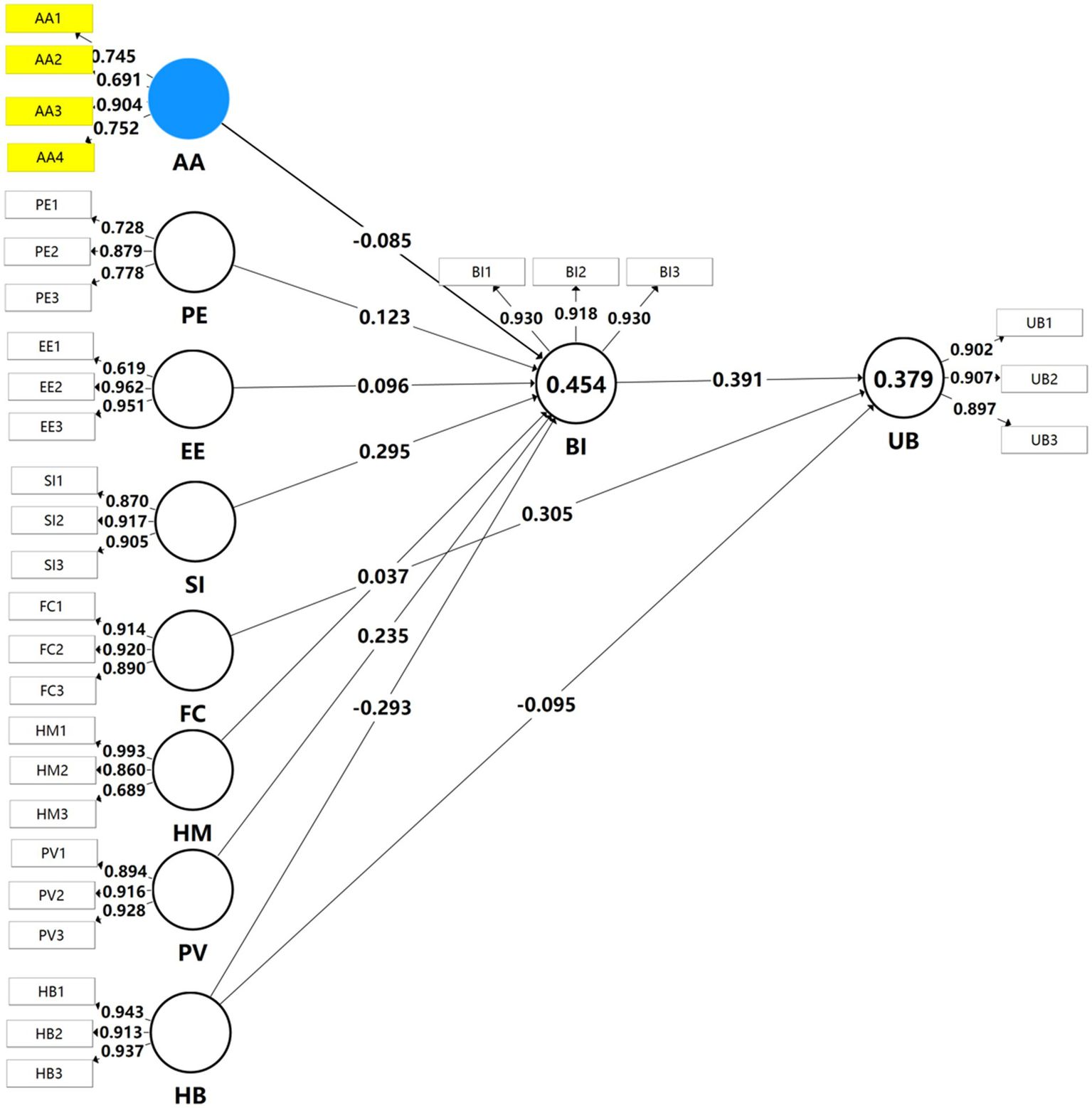
The established PLS-SEM.
Mediating analysis
The mediation analysis results in Table 6 reveal significant indirect effects on UB through BI, with EE (β = 0.038, 95% CI [0.016, 0.065]), HB (β = −0.115, 95% CI [−0.144, −0.088]), PE (β = 0.048, 95% CI [0.027, 0.068]), PV (β = 0.092, 95% CI [0.061, 0.130]), and SI (β = 0.115, 95% CI [0.087, 0.151]) all exhibiting statistically significant mediation paths (p < 0.01). Furthermore, a significant adverse indirect effect was found for AA (β = −0.033, 95% CI [−0.057, −0.012], p < 0.01). Results support the view that the influence of BI on UB is a complex phenomenon: While EE, PE, PV, and SI have a positive effect on UB, BI also negatively affects UB by incorporating the effects of HB and AA. The findings highlight BI as an important mediator of UB, and SI demonstrated the most substantial positive indirect effect.
Table 6
| Path | Indirect effect | Standard deviation (STDEV) | Confidence interval | T statistics | p-values | |
|---|---|---|---|---|---|---|
| 2.5% | 97.5% | |||||
| AA → BI → UB | −0.033 | 0.012 | −0.057 | −0.012 | 2.717 | 0.007 |
| EE → BI → UB | 0.038 | 0.013 | 0.016 | 0.065 | 2.973 | 0.003 |
| HB → BI → UB | −0.115 | 0.014 | −0.144 | −0.088 | 8.246 | 0.000 |
| PE → BI → UB | 0.048 | 0.011 | 0.027 | 0.068 | 4.523 | 0.000 |
| PV → BI → UB | 0.092 | 0.017 | 0.061 | 0.130 | 5.336 | 0.000 |
| SI → BI → UB | 0.115 | 0.016 | 0.087 | 0.151 | 7.073 | 0.000 |
Significant mediating effects of the research model.
Sentiment analysis findings
Though SEM analysis can quantitatively establish the structural relationships between constructs, sentiment analysis provides a critical qualitative basis for understanding them. The very high rating (68.1%) for AI tools such as DeepSeek could have contributed to the strong positive effect of PE, SI, and in the SEM model. On the other hand, negative sentiment (11.0%) and neutral attitude (20.9%) are triangulated with negative correlations with anxiety and habit, as shown in Figure 5. These results imply that users’ fears and pre-conceived patterns of behavior are barriers to take-up that must be considered. More importantly, the sentiment analysis goes beyond the binary positive–negative framing of the choices to show the complex subjective space of adoption choices, where even positive users are ambivalent. This combination of subjective user attitudes and the results of the structural models gives the impression of how subjective user attitudes complement the latter, which would not provide such a detailed account of the dynamics of adoption.
Figure 5
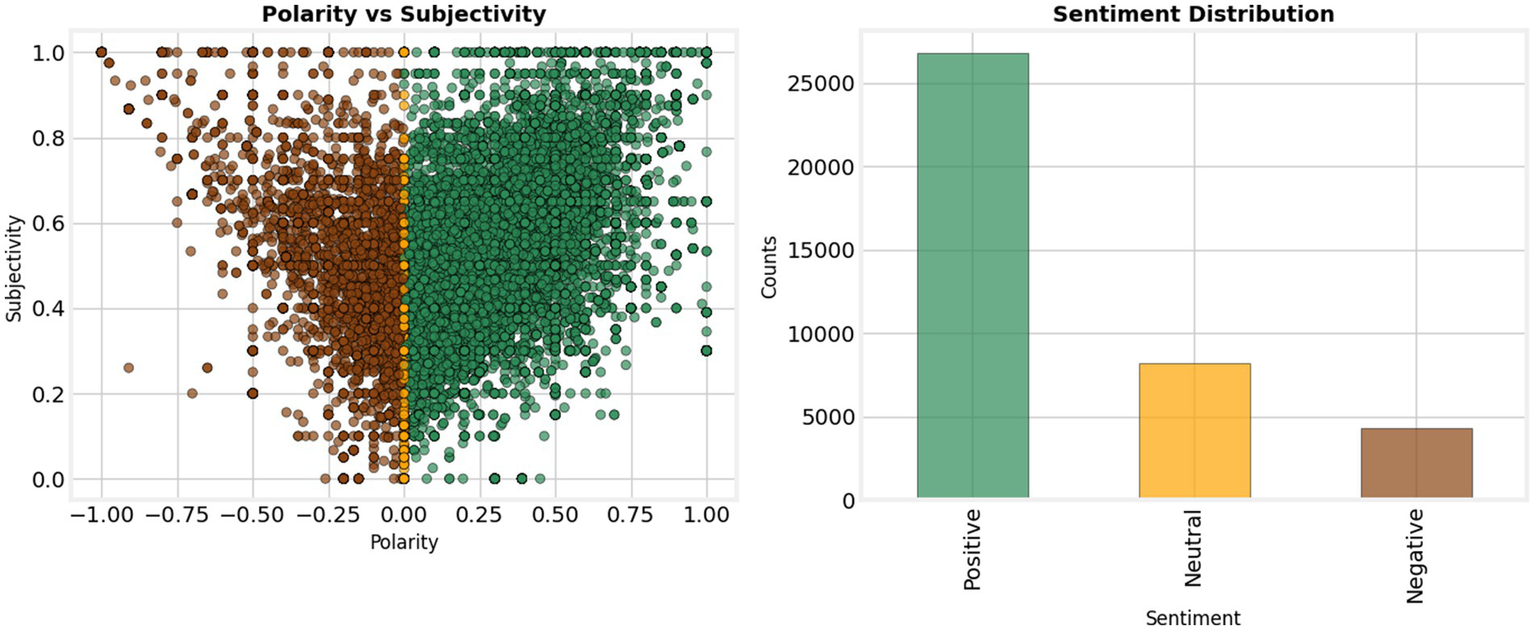
Sentiment distribution and polarity-subjectivity relationship in text data.
Discussion
The results of the extended UTAUT2 model were validated empirically and provide granular and more data-driven psychological insights regarding GenAI adoption in foreign language education. The strong measurement and structural models confirmed that important constructs especially SI and PE are good positive predictors of BI and BI has a good predictive relationship with usage behavior. However, the negative trajectories that emerged (habit and anxiety) and the non-significant HM effect suggest a complex adoption profile that is beyond technological convenience. These findings pave the way for a more general discourse on the entangled flock of the user’s psychology, teaching practice and the accelerated adoption of intelligent technologies in the contemporary teaching setting, in the context of complementary sentiment analysis, which points to a generally positive attitude towards the user, but with nuances.
Key psychological drivers of GenAI adoption
AI Anxiety was found to be a strong negative antecedent of BI. While recent discussions in the literature on AI anxiety have conceptualised anxiety in terms of technophobia, this finding has important implications. It is consistent with literature suggesting that AI anxiety is a multidimensional concept rooted in perceived job loss, algorithmic black boxes, and the loss of human agency (Kim J. J. H. et al., 2025; Li and Huang, 2020; Zhan et al., 2024). The predominant negative channel shows that, for education experts, perceived risks of GenAI use (undervaluing pedagogical skills and leading to an overreliance on untrustworthy systems) outweigh its usefulness, hindering adoption. This conclusion abandons optimistic, technological-deterministic narratives in the literature on the adoption of educational technology, rooted in PE, and rejects the overwhelming role of radical psychological discomfort. This is particularly so for the discipline of foreign languages teaching, whose close relationship to human communication and cultural subtlety is threatened by the loss of some pedagogical or formative functions to a ‘black box’ algorithm.
Although social Influence has been validated as a powerful theoretical construct, it needs to be critically examined in relation to its operationalisation and its underlying theory. The results supported SI as the behavioral variable affecting adopter behavior, similar to research on the AI tutoring system and the Massive Open Online Course (MOOC) (Al-Abdullatif et al., 2023). While the result is consistent with the original UTAUT proposition, the opinions of significant others do affect people; the complexity of Influence may be blurred in technologically novel areas of education, such as GenAI. Even if the coefficient of path is significant, it does not necessarily mean the individual is normatively compliant. Still, one may be picking up something more subtle: “informational social influence,” in which, in the face of substantial certainty about the pedagogical quality and ethical implications of AI, educators look to the advice of their peers and institutional authorities as heuristics for quality and legitimacy. The result is counterintuitive on a prima facie basis, in that the power of SI is not related to passive conformity, but is the product of an active, cognitive process of eliminating uncertainty in an emergent domain. Moreover, the finding constitutes an important counterargument to a growing literature finding that SI is a weaker predictor of individual, voluntary technologies, and implies a more substantial effect due to the high-stakes, collaborative nature of educational settings.
Habit exerts a paradoxical, counterintuitive influence within the extended UTAUT2 model, as these findings reveal a significant negative impact on both behavioral intention and use behavior. The rationale for this discrepancy may be in the novel and cognitively demanding nature of GenAI tools in an educational context, rather than inducing automaticity, the initial creation of a “habit” may be a conscious, effortful coping strategy that users consciously associate with the cognitive load and potential anxiety associated with mastering a cognitively complex new technology. As a result, this measured “habit” could be a proxy for the disruption to established learning routines and, thus, psychological reactance to complete adoption. This appears to imply that, at least with transformative technologies such as GenAI, the way habit is facilitative may be reversed in the early phases of adoption, in which its presence is indicative not of ease of use but of a conscious effort to incorporate the technology into one’s pedagogical or learning workflow.
Performance Expectancy was identified as a significant but relatively weak predictor of BI in this research, raising questions about the critical engagement with the literature. While the outcome supports the fundamental UTAUT2 result that P.U. is a driver of technology adoption (Chun and Yunus, 2023; Kim S. et al., 2025; Malarvizhi et al., 2022), the relatively low beta coefficient indicates a more complex picture for GenAI in L.L. This reduced impact may call into question the universal dominance of PE, suggesting that in the case of advanced, generative technologies its impact may be influenced or even replaced by other psychological factors, such as a “fear of deskilling” human language or doubts in the reliability of the given technology in terms of culturally and grammatically correct answers. This mediated effect could relate to the task itself; while learners will be able to see the potential of GenAI to be efficient (instant translation, grammar correction), they might also be sceptical of GAn’s pedagogical aims in terms of building up deep and nuanced communicative competence (much less than more deterministic tools such as grammar checkers, or digital flashcards). Thus, our findings is a critical addition to the literature in that it argues that the performance benefits precipitated through GenAI are offset by a more nuanced set of evaluative criteria by adopters of GenAI in educational contexts.
Non-significant factors
Hedonic Motivation addresses a complex adoption that is beyond the technology’s usefulness; its irrelevance to BI, as applied to GenAI in learning a foreign language, warrants critical attention and should be compared with the current literature. This is possibly because the task and user perception are as they are; compared to casual technologies, GenAI adoption for structured learning is likely framed by learners as a “serious” instrumental aid for proficiency, and hedonic benefits are dominated by Utilitarian constructs such as PE and PV. Moreover, as GenAI is still in its early integration stage, initial user interactions may not be about cognitive load and novelty exploration but about fun, and hedonic factors may be inseparable from good, personalized learning outcomes, which can lead to the loss of statistical significance of HM when you control for other powerful predictors in the model.
Mediating factors
Mediating analysis shows BI to be a key, but incomplete, explanatory mechanism in the adoption of GenAI for language learning, which forces a critical re-examination of the sufficiency of the UTAUT2 framework. While the significant positive indirect effects of PE, EE, and SI via BI are consistent with the canonical postulations of UTAUT2 (Liu et al., 2025; Pilotti et al., 2025), the intense negative mediation by habit and anxiety reveals a more complex psychological picture. The negative strong path for HB paradoxically implies that established learning routines may actively prevent the formation of intentions to adopt innovative GenAI tools. This finding challenges the often linear, optimistic assumptions of models of technology adoption and resonates with the literature on cognitive inertia in educational contexts (Sackstein et al., 2023). Similarly, the negative mediation of AA highlights the fact that the adverse effect of anxiety acts to a large degree by inhibiting the very intention to engage, which is often ignored in broader correlational research. However, the fact that these mediators, although important, are not responsible for the full extent of the relations (as direct effects likely remain) suggests that BI is a partial mediator and that other factors (not measured in the research, e.g., prior experience, specific pedagogical design) may exert direct influences on usage behavior.
Sentiment analysis: public perception of GenAI
Results from public sentiment analysis show widespread positive attitudes toward DeepSeek GenAI tools, as societal expressions indicate expectations that these tools will provide educational value consistent with survey findings on usefulness. A significant number of neutral and negative comments about the tool point to ongoing issues in the ethics of algorithmic bias and overutilization, as broader critiques found in Calvo et al. (2020). Two-sided public reception of AI reflects the necessity of responsible implementation of next-generation AI development and overcoming existing skepticism. In the long run, language education will adopt GenAI as developers devise ways to ensure continuous innovation and establish ethical standards that build trust between learners and educators.
Theoretical contributions
This article makes an important theoretical contribution by empirically demonstrating that AI Anxiety is a critical, direct negative predictor of BI in the adoption of GenAI in foreign language education, thereby extending the scope of UTAUT2. Whereas current models of technology acceptance center on enabling or facilitating constructs, this research is theoretically important because it shows that an AI-specific emotional barrier, AI-anxiety, is a strong and unique barrier to adoption, distinct from other constructs such as habit, performance expectancy, etc. It confirms a significant negative path from AA to BI and a significant adverse indirect effect from AA to BI on use behavior, thus providing strong empirical support for treating emotional apprehensions as a key determinant, alongside cognitive and social influences, in the adoption model of advanced AI technologies. This makes AI anxiety not just a peripheral concern but a central theoretical construct that must be considered to fully understand and anticipate users’ acceptance of AI in educational settings where complex AI tools are used.
Pedagogical implications
Based on the solid results of this extended UTAUT2 model analysis, we can draw several important pedagogical implications for incorporating GenAI into the teaching of foreign languages. The substantial positive impact of PE, EE, and, in particular, SI on BI also underscores the importance of instructors not only showing how GenAI tools effectively improve learning outcomes and are easy to use, but also consciously creating a positive normative environment for adoption. This can be done by securing faculty-wide buy-in, running successful peer implementations through workshops, and forming communities of practice to build momentum. On the other hand, the strong adverse effect of Anxiety and Habit suggests that pedagogical interventions need to be proactive to counter resistance, by planning low-stakes scaffolded activities to build familiarity and demystify the technology to lessen anxiety, and to show them how to incorporate these new tools into, or replace, their old study practices. Since FC was one of the direct promoters of UB, institutions must build robust technological infrastructure and provide readily available support. In conclusion, these findings promote a holistic approach to tool adoption that pairs messengers of persuasive communication about the tool’s value with hands-on training and robust institutional support to ease psychological barriers and align with institutional culture for technology innovation in the language classroom.
Practically, the results will illustrate global knowledge of artificial intelligence technology adoption behavior that transcends regional boundaries in foreign language teaching, which will undergo a fundamental change once Artificial General Intelligence is realized, enabling the generation of personalized, flexible content. The deployment of DeepSeek requires integrating DeepSeek into the system and understanding user and public acceptance, as well as the influence of the adoption process. The research reveals that institutions and policy-makers need to adopt strategies to boost user trust in the system by introducing peer-based recommendation policies and low-cost implementation programs. AI systems require long-term success predicated on three key factors: open functions, improved data security, and the absolute trustworthiness of each sequence of processes. The achievement of a possible AGI depends on society overcoming existing ethical challenges and institutional barriers; otherwise, it will exacerbate inequality in its education system.
Ethical implications
The ethical implications of this study on the psychological determinants of GenAI adoption in foreign language education include responsible use, data privacy, and potential impact on human roles of learning and teaching. While the extended UTAUT2 model is an effective predictor of user behavior towards artificial intelligence-powered educational tools, there are ethical concerns associated with data collection and analysis involving participants using survey instruments, such as the importance of informed consent and the protection of individual information. Furthermore, the use of GenAI in language learning also raises questions about academic integrity, overreliance on automated systems, and the role of human educators. As the implementation of biased algorithms or unequal access to technology could worsen existing educational inequalities, it is important to ensure fairness, transparency, and accountability in the use of AI in education. Therefore, although the research will add to the knowledge base on the adoption of GenAI, the study highlights the ethical need to balance technological innovation and human agency, privacy, and equitable access in education.
Conclusion
Major findings
According to this extended UTAUT2 analysis, the behavioral intention to adopt GenAI to learn foreign languages is significantly and positively influenced by SI, PE, and EE. In contrast, anxiety, as well as existing learning habits, end up having significant negative influences. The model shows a significant predictive power. 45.4% of the variance in BI and 37.9% of the variance in UB are explained. 45.4% of the variance in behavioral intention and 37.9% of the variance in use behavior were explained, with behavioral intention as an important mediator between the psychological determinants and actual use. The rejection of the hedonic motivation hypothesis implies that the major driver of adoption is utilitarian rather than hedonic. Importantly, sentiment analysis is used to triangulate these quantitative findings, indicating that despite a generally positive attitude towards AI tools, underlying apprehensions and well-established behavioral patterns, complex dynamics of adoption exist that go beyond acceptance-rejection binaries.
Limitations
The important insights into the predictors of GenAI acceptance in language learning from a psychological perspective can prompt us to reflect on several research limitations. First, online recruitment has used Weibo in addition to Reddit, Twitter, and WeChat to recruit participants, which can introduce self-selection bias, as the results of assessments are skewed toward the technology-savvy who adopt AI recruitment. Second, including participants from diverse backgrounds and underrepresented groups would also improve the generalizability of research findings. Third, the horizontal research methodology has its shortcomings when it comes to determining cause and effect, as the behavior change can only be measured by following groups over a long period of time. Also, the sentiment analysis approach was based on Twitter content and did not directly include contributions from educators and learners; qualitative interview data were required for a more granular analysis.
Future research directions
Future studies require improving the current research through three means: observing changes in user behavior and acceptance trends over time, increasing their geographical reach to include diverse populations and demographic areas, and implementing qualitative research tools to deepen understanding of user interactions. Future AI research needs to analyze morality in data protection alongside algorithmic discrimination and the equality of educational resources to help establish moral AI regulations. Understanding teacher training needs, institutional support, and curriculum models for AI adoption will help to offer practical guidance to authorities and teaching personnel. Researching the operation of different AI models across various educational settings would yield practical methods for improving AI integration across multiple learning settings. As GenAI continues to evolve, interdisciplinary collaboration will be key to realizing its potential in classrooms around the world equitably and effectively.
Statements
Data availability statement
The original contributions presented in the study are included in the article/Supplementary material, further inquiries can be directed to the corresponding author. Materials related to the article can be graciously accessed through the following link: https://osf.io/tascq/overview?view_only=0df888ec9dbc4be8b18a0db831719c69.
Ethics statement
The study was approved by the Ethical Committee for School of Foreign Studies Northeastern University at Qinhuangdao on January 16, 2025 (No. WY20250225). All procedures performed in the studies involving human participants were in accordance with the ethical standards of the institutional and/or national research committee and with the 1964 Helsinki Declaration and its later amendments or comparable ethical standards. Written informed consent for participation in this study was provided by the participants’ legal guardians/next of kin. Written informed consent was obtained from the minor(s)’ legal guardian/next of kin for the publication of any potentially identifiable images or data included in this article.
Author contributions
HW: Conceptualization, Methodology, Formal analysis, Investigation, Visualization, Software, Data curation, Resources, Funding acquisition, Writing – original draft. TL: Validation, Writing – review & editing, Funding acquisition, Supervision, Project administration.
Funding
The author(s) declare that financial support was received for the research and/or publication of this article. This work is supported by the Fundamental Research Funds for the Central Universities (N2523036), the Humanities and Social Sciences Research Projects of Ministry of Education in China (21YJCZH091), the Science Research Project of Hebei Higher Education Institutions (QN2026503), and the Liaoning Economic and Social Development Research Project of the Provincial Federation of Social Sciences (2026lslqnkt-035).
Conflict of interest
The authors declare that the research was conducted in the absence of any commercial or financial relationships that could be construed as a potential conflict of interest.
Generative AI statement
The authors declare that no Gen AI was used in the creation of this manuscript.
Any alternative text (alt text) provided alongside figures in this article has been generated by Frontiers with the support of artificial intelligence and reasonable efforts have been made to ensure accuracy, including review by the authors wherever possible. If you identify any issues, please contact us.
Publisher’s note
All claims expressed in this article are solely those of the authors and do not necessarily represent those of their affiliated organizations, or those of the publisher, the editors and the reviewers. Any product that may be evaluated in this article, or claim that may be made by its manufacturer, is not guaranteed or endorsed by the publisher.
Supplementary material
The Supplementary material for this article can be found online at: https://www.frontiersin.org/articles/10.3389/fpsyg.2025.1622926/full#supplementary-material
References
1
Abderrezzaq B. Fatima D. (2024). Artificial intelligence technologies and their significance in enhancing the quality of adaptive e-learning. J. Sci. Knowl. Horiz.4, 30–47. doi: 10.34118/jskp.v4i02.4007
2
Abedi E. A. Prestridge S. Hodge S. (2024). Teachers’ beliefs about technology integration in Ghana: a qualitative study of teachers’, headteachers’ and education officials’ perceptions. Educ. Inf. Technol.29, 5857–5877. doi: 10.1007/s10639-023-12049-0
3
Abu-Rayyash H. (2024). AI meets comedy: viewers' reactions to GPT-4 generated humor translation. Ampersand12:100162. doi: 10.1016/j.amper.2023.100162
4
Adeshola I. Adepoju A. P. (2024). The opportunities and challenges of ChatGPT in education. Interact. Learn. Environ.32, 6159–6172. doi: 10.1080/10494820.2023.2253858
5
Al-Abdullatif A. M. Al-Dokhny A. A. Drwish A. M. (2023). Implementing the Bashayer chatbot in Saudi higher education: measuring the influence on students' motivation and learning strategies. Front. Psychol.14:1129070. doi: 10.3389/fpsyg.2023.1129070,
6
Al-kfairy M. Ahmed S. Khalil A. (2024). Factors impacting users’ willingness to adopt and utilize the metaverse in education: a systematic review. Comput. Hum. Behav. Rep.15:100459. doi: 10.1016/j.chbr.2024.100459
7
Alvarez-alvarez C. Falcon S. (2023). Students' preferences with university teaching practices: analysis of testimonials with artificial intelligence. ETR&D71, 1709–1724. doi: 10.1007/s11423-023-10239-8
8
Ayanwale M. A. Ndlovu M. (2024). Investigating factors of students' behavioral intentions to adopt chatbot technologies in higher education: perspective from expanded diffusion theory of innovation. Comput. Hum. Behav. Rep.14:100396. doi: 10.1016/j.chbr.2024.100396
9
Bhat M. A. Tiwari C. K. Bhaskar P. Khan S. T. (2024). Examining ChatGPT adoption among educators in higher educational institutions using extended UTAUT model. J. Inf. Commun. Ethics Soc.22, 331–353. doi: 10.1108/jices-03-2024-0033
10
Calvo R. A. Peters D. Vold K. Ryan R. M. (2020). “Supporting human autonomy in AI systems: a framework for ethical enquiry” in Ethics of digital well-being: A multidisciplinary approach. eds. BurrC.FloridiL. (Cham: Springer International Publishing), 31–54.
11
Chatterjee S. Chaudhari R. Kumar A. Schiavone F. (2024). Emergence of social robot technology and its friction-free diffusion in society: from engineering aesthetics and compatibility perspective. IEEE Trans. Eng. Manag.71, 13179–13190. doi: 10.1109/tem.2023.3324149
12
Chen J. Wang R. Q. Fang B. Zuo C. (2024). Fine-grained aspect-based opinion mining on online course reviews for feedback analysis. Interact. Learn. Environ.32, 4380–4395. doi: 10.1080/10494820.2023.2198576
13
Chin W. W. (1998). The partial least squares approach to structural equation modeling. In Modern methods for business research (pp. 295–336). New York: Lawrence Erlbaum Associates Publishers. Original work published In G. A. Marcoulides (Ed.).
14
Chiu T. K. F. Moorhouse B. L. Chai C. S. Ismailov M. (2024). Teacher support and student motivation to learn with artificial intelligence (AI) based chatbot. Interact. Learn. Environ.32, 3240–3256. doi: 10.1080/10494820.2023.2172044
15
Chun T. W. Yunus M. M. (2023). Factors affecting Malaysian ESL teachers' behavioral intentions for technology use in the post-COVID-19 era. Front. Psychol.14:1127272. doi: 10.3389/fpsyg.2023.1127272,
16
Dangelico R. M. Ceccarelli G. Fraccascia L. (2024). Consumer behavioral intention toward sustainable biscuits: an extension of the theory of planned behavior with product familiarity and perceived value. Bus. Strat. Environ.33, 5681–5702. doi: 10.1002/bse.3774
17
Elmoon A. (2025). AI in the classroom: evaluating the effectiveness of intelligent tutoring systems for multilingual learners in secondary education. ASRC Procedia1, 532–563. doi: 10.63125/gcq1qr39
18
Erdem I. K. Çelik K. (2024). Why do people use mobile food ordering apps?: extended UTAUT2. Upravlenets15, 99–119. doi: 10.29141/2218-5003-2024-15-3-7
19
Farhi F. (2024). Examining the factors fostering metaverse experience browser acceptance under unified theory of acceptance and use of technology (UTAUT). J. Infrastruct. Policy Dev.8:2594. doi: 10.24294/jipd.v8i3.2594
20
Fornell C. Larcker D. F. (1981). Evaluating structural equation models with unobservable variables and measurement error. J. Mark. Res.18, 39–50. doi: 10.2307/3151312
21
Frenkenberg A. Hochman G. (2025). It’s scary to use it, it’s scary to refuse it: the psychological dimensions of AI adoption—anxiety, motives, and dependency. Systems13:82. doi: 10.3390/systems13020082
22
Guo D. Yang D. Zhang H. Song J. Zhang R. Xu R. et al . (2025). Deepseek-r1: incentivizing reasoning capability in LLMs via reinforcement learning. arXiv. doi: 10.48550/arXiv.2501.12948
23
Hair J. F. Risher J. J. Sarstedt M. Ringle C. M. (2019). When to use and how to report the results of PLS-SEM. Eur. Bus. Rev.31, 2–24. doi: 10.1108/ebr-11-2018-0203
24
Han J. Liu G. Liu X. Yang Y. Quan W. Chen Y. (2024). Continue using or gathering dust? A mixed method research on the factors influencing the continuous use intention for an AI-powered adaptive learning system for rural middle school students. Heliyon10:e33251. doi: 10.1016/j.heliyon.2024.e33251,
25
Heinssen R. K. Glass C. R. Knight L. A. (1987). Assessing computer anxiety: development and validation of the computer anxiety rating scale. Comput. Hum. Behav.3, 49–59. doi: 10.1016/0747-5632(87)90010-0
26
Hemdan W. Zhang J. (2024). Investors' intention toward green investment: an extension of the theory of planned behavior. Int. J. Emerg. Mark. doi: 10.1108/ijoem-06-2023-0874
27
Henseler J. Hubona G. Ray P. A. (2016a). Using PLS path modeling in new technology research: updated guidelines. Ind. Manag. Data Syst.116, 2–20. doi: 10.1108/imds-09-2015-0382
28
Henseler J. Ringle C. M. Sarstedt M. (2015). A new criterion for assessing discriminant validity in variance-based structural equation modeling. J. Acad. Mark. Sci.43, 115–135. doi: 10.1007/s11747-014-0403-8
29
Henseler J. Ringle C. M. Sarstedt M. (2016b). Testing measurement invariance of composites using partial least squares. Int. Mark. Rev.33, 405–431. doi: 10.1108/imr-09-2014-0304
30
Johnson D. G. Verdicchio M. (2017). Ai anxiety. J. Assoc. Inf. Sci. Technol.68, 2267–2270. doi: 10.1002/asi.23867
31
Kaczmarek L. D. (2017). “Hedonic motivation” in Encyclopedia of personality and individual differences. eds. Zeigler-HillV.ShackelfordT. K. (Springer: Springer International Publishing), 1–3.
32
Kim S. Jeong Y. Jung Y. (2025). Unveiling the power of social influence: how functional, emotional, and social values drive Pilates participation through an extended TPB model. Front. Psychol.16:1453874. doi: 10.3389/fpsyg.2025.1453874,
33
Kim J. J. H. Soh J. Kadkol S. Solomon I. Yeh H. Srivatsa A. V. et al . (2025). AI anxiety: a comprehensive analysis of psychological factors and interventions. AI Ethics5, 3993–4009. doi: 10.1007/s43681-025-00686-9
34
Lachance J. Honigsfeld A. (2022). Collaboration and co-teaching for dual language learners: Transforming programs for multilingualism and equity. California: SAGE Publications.
35
Li J. Huang J.-S. (2020). Dimensions of artificial intelligence anxiety based on the integrated fear acquisition theory. Technol. Soc.63:101410. doi: 10.1016/j.techsoc.2020.101410
36
Liu A. Feng B. Xue B. Wang B. Wu B. Lu C. et al . (2024). Deepseek-v3 technical report. arXiv. doi: 10.48550/arXiv.2412.19437
37
Liu L. Yang Y. Liu H. Chen S. Shang Y. Song Y. (2025). The effect of social support on college students’ sports anomie behavior: the mediating role of self-efficacy and attitude’s regulating role in sports normative behavior. Front. Psychol.16:1662985. doi: 10.3389/fpsyg.2025.1662985
38
Maheshwari G. (2024). Factors influencing students' intention to adopt and use ChatGPT in higher education: a study in the Vietnamese context. Educ. Inf. Technol.29, 12167–12195. doi: 10.1007/s10639-023-12333-z
39
Mahmoud A. B. (2024). Exploring the public's beliefs, emotions and sentiments towards the adoption of the metaverse in education: a qualitative inquiry using big data. Br. Educ. Res. J.50, 2320–2341. doi: 10.1002/berj.4026
40
Malarvizhi C. A. Al Mamun A. Jayashree S. Naznen F. Abir T. (2022). Predicting the intention and adoption of near field communication Mobile payment. Front. Psychol.13:870793. doi: 10.3389/fpsyg.2022.870793,
41
Milicevic N. Kalas B. Djokic N. Malcic B. Djokic I. (2024). Students' intention toward artificial intelligence in the context of digital transformation. Sustainability16:Article 3554. doi: 10.3390/su16093554,
42
Miller J. C. Miranda J. P. P. Tolentino J. C. G. (2025). “Artificial intelligence in physical education: a review” in Global innovations in physical education and health. ed. GarciaM. B. (Hershey, PA, USA: IGI Global), 37–60.
43
Mixon D. (1980). The place of habit in the control of action*. J. Theory Soc. Behav.10, 169–186. doi: 10.1111/j.1468-5914.1980.tb00014.x
44
Monroe K. B. (2012). “Price and customers’ perceptions of value” in Visionary pricing: Reflections and advances in honor of Dan Nimer. ed. SmithG. E., vol. 19 (Bingley, UK: Emerald Group Publishing Limited), 129–152.
45
Pilotti M. Alzahid D. Faisal N. Waked A. El-Moussa O. J. (2025). Do memory concerns and self-efficacy predict academic performance in undergraduate students with memorization practice? [original research]. Front. Psychol.16:1515533. doi: 10.3389/fpsyg.2025.1515533
46
Qiao H. Zhao A. (2023). Artificial intelligence-based language learning: illuminating the impact on speaking skills and self-regulation in Chinese EFL context [original research]. Front. Psychol.14. doi: 10.3389/fpsyg.2023.1255594
47
Rahiman H. U. Kodikal R. (2024). Revolutionizing education: artificial intelligence empowered learning in higher education. Cogent Educ.11:2293431. doi: 10.1080/2331186X.2023.2293431
48
Rathakrishnan T. Kumar T. B. J. Tsen M. K. Leong M. K. Yaacob A. (2024). “AI tools: anxiety to achievement - unveiling the psychological dynamics of technology adoption” in Transdisciplinary teaching and technological integration for improved learning: Case studies and practical approaches. eds. KumarR.OngE. T.AnggoroS.TohT. L.FukuiM. (Hershey, PA, USA: IGI Global Scientific Publishing), 42–65.
49
Sackstein S. Matthee M. Weilbach L. (2023). Theories and models employed to understand the use of technology in education: a hermeneutic literature review. Educ. Inf. Technol.28, 5041–5081. doi: 10.1007/s10639-022-11345-5
50
Saehu A. Hkikmat M. M. (2025). “The quality and accuracy of AI-generated translation in translating communication-based topics: bringing translation quality assessments into practices” in Role of AI in translation and interpretation. ed. AqadM. H. (Hershey, PA, USA: IGI Global Scientific Publishing), 237–266.
51
Saneinia S. Zhai X. S. Zhou R. T. Gholizadeh A. Wu R. H. Zhu S. L. (2024). Beyond virtual boundaries: the intersection of the metaverse technologies, tourism, and lifelong learning in China's digital discourse. Humanit. Soc. Sci. Commun.11:1287. doi: 10.1057/s41599-024-03624-y
52
Sarstedt M. Ringle C. M. Smith D. Reams R. Hair J. F. (2014). Partial least squares structural equation modeling (PLS-SEM): a useful tool for family business researchers. J. Fam. Bus. Strat.5, 105–115. doi: 10.1016/j.jfbs.2014.01.002
53
Sasidharan A. Venkatakrishnan S. (2024). Intension to use mobile banking: an integration of theory of planned behaviour (TPB) and technology acceptance model (TAM). Ksi̇i Trans. Internet Inf. Syst.18, 1059–1074. doi: 10.3837/tiis.2024.04.013
54
Sembiring I. Rahardja U. Manongga D. Aini Q. Wahab A. (2024). Enhancing AIKU adoption: insights from the role of habit in behavior intention. Aptisi Transactions on Technopreneurship (ATT)6, 84–108. doi: 10.34306/att.v6i1.364
55
Shmueli G. Koppius O. R. (2011). Predictive analytics in information systems research. MIS Q.35, 553–572. doi: 10.2307/23042796
56
Shoaib M. Sayed N. Singh J. Shafi J. Khan S. Ali F. (2024). AI student success predictor: enhancing personalized learning in campus management systems. Comput. Hum. Behav.158:108301. doi: 10.1016/j.chb.2024.108301
57
Tian W. Ge J. Zhao Y. Zheng X. (2024). AI Chatbots in Chinese higher education: adoption, perception, and influence among graduate students—an integrated analysis utilizing UTAUT and ECM models. Front. Psychol.15:1268549. doi: 10.3389/fpsyg.2024.1268549,
58
Venkatesh V. Morris M. G. Davis G. B. Davis F. D. (2003). User acceptance of information technology: toward a unified view. MIS Q.27, 425–478. doi: 10.2307/30036540
59
Venkatesh V. Thong J. Y. L. Xu X. (2012). Consumer acceptance and use of information technology: extending the unified theory of acceptance and use of technology. MIS Q.36, 157–178. doi: 10.2307/41410412
60
Yusuf A. Bello S. Pervin N. Tukur A. K. (2024). Implementing a proposed framework for enhancing critical thinking skills in synthesizing AI-generated texts. Think. Skills Creat.53:101619. doi: 10.1016/j.tsc.2024.101619
61
Zhai C. Wibowo S. Li L. D. (2024). The effects of over-reliance on AI dialogue systems on students' cognitive abilities: a systematic review. Smart Learn. Environ.11:28. doi: 10.1186/s40561-024-00316-7
62
Zhan E. S. Molina M. D. Rheu M. Peng W. (2024). What is there to fear? Understanding multi-dimensional fear of AI from a technological affordance perspective. Int. J. Hum. Comput. Interact.40, 7127–7144. doi: 10.1080/10447318.2023.2261731
63
Zhi R. Wang Y. (2024). On the relationship between EFL students' attitudes toward artificial intelligence, teachers' immediacy and teacher-student rapport, and their willingness to communicate. System124:103341. doi: 10.1016/j.system.2024.103341
64
Zhou C. Hou F. (2024). Can AI empower L2 education? Exploring its influence on the behavioural, cognitive and emotional engagement of EFL teachers and language learners. Eur. J. Educ.59:e12750. doi: 10.1111/ejed.12750
Summary
Keywords
GenAI adoption, foreign language education, UTAUT2, AI anxiety, sentiment analysis, technology adoption, psychological determinants
Citation
Wang H and Liu T (2026) Psychological determinants of GenAI adoption for foreign language education: an extended UTAUT2 model and sentiment analysis approach. Front. Psychol. 16:1622926. doi: 10.3389/fpsyg.2025.1622926
Received
05 May 2025
Revised
30 October 2025
Accepted
18 November 2025
Published
09 January 2026
Volume
16 - 2025
Edited by
Antonino Ferraro, Pegaso University, Italy
Reviewed by
Antonio Sarasa-Cabezuelo, Complutense University of Madrid, Spain
Nattaporn Thongsri, Prince of Songkla University, Thailand
Updates
Copyright
© 2026 Wang and Liu.
This is an open-access article distributed under the terms of the Creative Commons Attribution License (CC BY). The use, distribution or reproduction in other forums is permitted, provided the original author(s) and the copyright owner(s) are credited and that the original publication in this journal is cited, in accordance with accepted academic practice. No use, distribution or reproduction is permitted which does not comply with these terms.
*Correspondence: Tian Liu, liutian@neuq.edu.cn
Disclaimer
All claims expressed in this article are solely those of the authors and do not necessarily represent those of their affiliated organizations, or those of the publisher, the editors and the reviewers. Any product that may be evaluated in this article or claim that may be made by its manufacturer is not guaranteed or endorsed by the publisher.