Abstract
Background:
School psychological capital (PsyCap), the positive psychological state or psychological resources displayed within school contexts, has been shown to correlate positively with achievement emotions, engagement, and subjective well-being. Few studies, however, have investigated whether achievement emotions mediate the association between school PsyCap and behavioral engagement.
Methods:
This study aimed to investigate the emotional underpinnings linking students’ school PsyCap to their behavioral engagement in mathematics classrooms. Self-report data on mathematics-related PsyCap resources, enjoyment, anxiety, and behavioral engagement were collected from 1135 Chinese secondary school students aged 12–15 years (Mage = 13.15, SD = 0.75). Having controlled for prior achievement and gender, structural equation modeling (SEM) was used to explore the potential mediating effect of academic enjoyment and anxiety in the relationship between school PsyCap on behavioral engagement.
Results:
The findings revealed that higher levels of school PsyCap and positive emotional experiences were positively correlated with greater behavioral engagement in mathematics learning. Conversely, negative emotions were negatively associated with engagement. SEM analyses indicated that achievement emotions (enjoyment and anxiety) partially mediated the association between school PsyCap and behavioral engagement.
Conclusion:
Students with higher levels of school PsyCap exhibited greater positive achievement emotions and lower levels of negative emotion in mathematics classes, which, in turn, were associated with higher levels of behavioral engagement. These findings highlight the importance of fostering students’ school PsyCap to enhance their emotional well-being and engagement in mathematics learning.
1 Introduction
The present study focused on how school PsyCap, defined as students’ positive psychological state and resources, influences behavioral engagement through academic enjoyment and anxiety. Prior research has demonstrated that school PsyCap positively impacts achievement emotions, engagement, and subjective well-being (Carmona-Halty et al., 2019; Kang et al., 2021; King et al., 2020; Li et al., 2014; Siu et al., 2014). Research has also shown the school PsyCap was positively correlated with academic performance (Datu et al., 2018; Luthans et al., 2012). However, limited attention has been directed toward understanding the mediation mechanism between school PsyCap and behavioral engagement, particularly within the context of mathematics education. Therefore, this study endeavored to investigate the association between school PsyCap and behavioral engagement in the context of mathematics classrooms, with a focus on elucidating the emotional mechanisms that underpin this relationship.
1.1 School psychological capital
School psychological capital refers to an individual’s positive psychological state or psychological resources that arise from endorsing four psychological capacities: hope, optimism, resilience, and self-efficacy (Luthans et al., 2004). Since PsyCap was first introduced from the industrial-organizational context to the educational domain, this construct has been hotly discussed (Carmona-Halty et al., 2019; Kang et al., 2025; Vîrgă et al., 2022). However, the measurement of school PsyCap was controversial, given that this construct was established based on the synchronicity of the academic community (Kang et al., 2021). For example, the unidimensional model regarded school PsyCap as an omnibus construct, and the value of this construct was calculated by summing up and averaging the value of each item (Li et al., 2014). In comparison, the four-factor model treats the four individual components as observational variables (Carmona-Halty et al., 2021; Datu and Valdez, 2016). Recently, the hierarchical model (or second-order model) that views both school PsyCap and its four components as latent variables has begun to gain support from scholars (Datu et al., 2018; Kang et al., 2021; King et al., 2020; King and Caleon, 2021).
Hope, self-efficacy, resilience, and optimism or the “HERO” within (e.g., see Luthans, 2012) were the four psychological resources that constitute PsyCap, each of which has been extensively discussed in educational literature. Hope pertains to the goal-related thinking orientation characterized by three components: goals, pathway, and agency (Snyder, 2000). Existing studies have shown that hope positively predicted key learning-related outcomes, including academic performance (Buckelew et al., 2008; Day et al., 2010; Marques et al., 2011; Snyder et al., 2002), emotional well-being (Ciarrochi et al., 2007), behavioral engagement (Chen et al., 2020; van Ryzin, 2011), and psychological adjustment (Du and King, 2013). Self-efficacy (or academic confidence) refers to an individual’s judgment of his or her ability to complete challenging tasks (Urdan and Schoenfelder, 2006). A considerable number of studies showed that self-efficacy is positively correlated with different indices of optimal functioning such as motivation and learning (Linnenbrink and Pintrich, 2003; Van Dinther et al., 2011), academic performance, and learning-related emotions (Putwain et al., 2013), course satisfaction (Doménech-Betoret et al., 2017), mental well-being (Andretta and McKay, 2020), and engagement (Lin, 2021; Simón et al., 2024). Besides, self-efficacy has also been found to positively correlate with life satisfaction and moderate the relationship between stress and life satisfaction (Moksnes et al., 2019). Resilience is an individual’s ability to sustain and bounce back when facing problems and adversities (Martin and Marsh, 2006). Those high in resilience would see adversities as challenges rather than threats (Symes et al., 2015). The positive effect of resilience on crucial indices of school functioning has also been extensively verified (Allan et al., 2014; Ayala and Manzano, 2018; Kotzé and Kleynhans, 2013). For example, García-Izquierdo et al. (2018) documented that resilience positively correlated with psychological health and moderated between burnout and psychological health in a sample of sophomore nursing students. Moreover, the predictive effects of resilience on academic performance (Ayyash-Abdo et al., 2016; Cai and Meng, 2025), academic satisfaction (Meneghel et al., 2019), emotional engagement (Kim et al., 2021), and psychological well-being (Voon et al., 2021) were also confirmed. Optimism pertains to an individual’s expectation of positive outcomes in their endeavors. Researchers have found that optimism positively affects academic achievement and psychological well-being. For example, in a study among high school students, Hoy et al. (2006) documented that academic optimism was positively correlated with student achievement. Taking undergraduate students as participants, Vizoso et al. (2019) reported that optimism positively affected academic performance by mitigating academic burnout. In another study with undergraduate women, Augusto-Landa et al. (2011) observed that optimism was positively associated with all dimensions of psychological well-being. Similarly, the predictive effects of optimism on engagement (Geers et al., 2009) and psychological well-being (Krok, 2015) were also confirmed.
The predictive effect of school PsyCap has also been recognized within educational contexts. For example, Siu et al. (2014) documented that PsyCap predicts school engagement directly or indirectly via intrinsic motivation among university students in Hong Kong. Similarly, in a study conducted among Filipino high school students, school PsyCap positively correlates with academic motivation, engagement, achievement, and well-being (Datu et al., 2018; Datu and Valdez, 2016). In line with these findings, research involving Chilean high school students supported the positive association between PsyCap and academic performance (Carmona-Halty et al., 2019, 2021; Carmona–Halty et al., 2019).
Based on the above review, it is evident that both school PsyCap and its four components demonstrate a positive correlation with academic engagement. However, relatively few studies have been conducted to explore the mechanism between school PsyCap and academic engagement, especially in a Mainland Chinese context. An exception was the work of King et al. (2020), who demonstrated that positive emotions partially mediate the relationship between school PsyCap and academic engagement in a sample of 71 Hong Kong secondary school students. One key limitation of this study was that it ignored the domain-specificity of emotions and academic engagement in the school context (Goetz et al., 2007; Green et al., 2007). In addition, both positive and negative achievement emotions would be experienced in the subject-related learning process (e.g., Lichtenfeld et al., 2012; Pekrun, 2006; Raccanello et al., 2013), however, only positive emotions have been shown to mediate the relationship between school PsyCap and academic engagement in their study (King et al., 2020). The present study aimed to extend this research using mathematics-related data to investigate the emotional connections (both positive and negative achievement emotions) between school PsyCap and behavioral engagement in the context of mathematics classrooms.
1.2 Achievement emotions
Achievement emotions, which refer to discipline-related emotions that are closely related to achievement activities or achievement outcomes (Pekrun, 2006), have drawn a growing number of educational researchers’ attention as their ubiquity and their considerable influence on learning and achievement (Pekrun and Stephens, 2010; Putwain et al., 2022; Villavicencio and Bernardo, 2016). For example, King and Gaerlan (2014) investigated the consequence of achievement emotions. They found that achievement emotions had a predictive effect on engagement and, thus, academic achievement in a sample of Filipino university students. Furthermore, the beneficial effects of positive emotions on self-efficacy, self-regulation, achievement (Villavicencio and Bernardo, 2016), intrinsic motivation and engagement (Oriol et al., 2016), coping strategies (Vierhaus et al., 2016), and learning satisfaction (Lee et al., 2021) were also confirmed.
Through a series of qualitative and quantitative studies, Pekrun et al. (2002) identified nine emotions that students most commonly experienced (i.e., enjoyment, pride, hope, relief, anxiety, boredom, hopelessness, anger, and shame) in their learning experiences. Valence, activation, and object focus are the three dimensions for assessing achievement emotions (Pekrun, 2006; Pekrun et al., 2002). According to this classification criteria, every achievement emotion can be concluded by three dimensions: valence–positive versus negative, activation–activated versus deactivated, and object focus–activity-related versus outcome-related. Concerning these three dimensions, enjoyment, for example, can be described as a positive activity-related emotion that facilitates activation.
According to the control-value theory (CVT) of achievement emotions (Pekrun, 2006), students’ achievement-related controllability and value that are experienced at school are the two most essential antecedents of their achievement emotions (Pekrun, 2006; Pekrun and Stephens, 2010). The learning environment, including environmental, situational, and individual information, plays a vital role in the arousal of achievement emotions (Forsblom et al., 2021). Previous studies concentrated mainly on the influence of environmental and situational factors on achievement emotions (e.g., Clem et al., 2021; Forsblom et al., 2021; Westphal et al., 2018), however, the impact of individual factors on achievement emotions was relatively unexplored (for exceptions, see Kang and Wu, 2021).
1.3 Behavioral engagement
As one subtype of academic engagement (including behavioral, affective, and cognitive) (e.g., Archambault et al., 2009; Ben-Eliyahu et al., 2018), behavioral engagement refers to students’ intensity of involvement within both academic or non-academic activities in the school context (Ben-Eliyahu et al., 2018; Chen et al., 2020). These three subtypes differ in connotation but are concurrently interrelated (Fredricks et al., 2004). Among them, behavioral engagement has been the most tremendously studied in connection with achievement-related outcomes, partly because students’ behavioral engagement can be observed in learning-related situations regarding participation and interest in academic tasks, following teacher instructions, and persistence and inhibition toward academic tasks (Chen et al., 2020; Darensbourg and Blake, 2013; Gregory et al., 2014). In addition, behavioral engagement demonstrated a more substantial predictive effect on school achievement than the other two subtypes of academic engagement. In a sample of high school students in Quebec, Archambault et al. (2009) found that only behavioral engagement was significantly correlated with dropout, while affective and cognitive engagement was not. During the primary grades, Ladd and Dinella (2009) found that the predictive contribution of behavioral engagement to long-term achievement was more potent than emotional engagement. Similarly, Wang et al. (2012) compared the contribution of these three types of engagement to academic performance and educational aspiration in a sample of African-American and European-American students in grades seven through eleven. They found that emotional engagement can only contribute to academic performance via behavioral or cognitive engagement. Furthermore, the present study was concerned with the participation dimension of academic engagement in the context of the mathematics classroom, so the key constructs referring to classroom activities–namely, behavioral engagement were chosen (e.g., Hospel et al., 2016).
Behavioral engagement was believed to affect a diverse set of desired learning-related outcomes positively. For instance, Wang and Pomerantz (2009) documented that students’ continuous behavioral engagement contributed to their school performance in a sample of American and Chinese secondary school students. In the same vein, the robust predictions of behavioral engagement on school graduation (Kieffer et al., 2013), interpersonal relationships (i.e., peer relation and teacher-student relations) (Engels et al., 2016), and student retention (Sengupta and Williams, 2021) were also confirmed. Given the self-determination theory, students’ school engagement was seen as manifesting their inner motivational resources (Reeve and Halusic, 2009; Skinner et al., 2009; Skinner and Pitzer, 2012). It plays a positive role in predicting various achievement-related outcomes.
1.4 The present study
To explore the emotional connection between school PsyCap and behavioral engagement, the present study examined how school PsyCap influences enjoyment and anxiety and how these two achievement emotions, in turn, affect behavioral engagement in a sample of Chinese secondary school students in the mathematics classroom context (see Figure 1 for the mediational model). Building on the literature review, the present study posited that variability in students’ school PsyCap would lead to differential experiences of achievement emotions in the learning environment. For example, in a sample of Chinese secondary school students, Kang and Wu (2021) found that students with higher levels of school PsyCap tend to experience more positive achievement emotions (i.e., enjoyment, hope, and pride) and fewer negative emotions (i.e., anxiety, anger, shame, boredom, and hopelessness) in mathematics learning. Furthermore, the significant association between achievement emotions and academic engagement has also been demonstrated in a large body of literature (e.g., Carmona-Halty et al., 2021; King et al., 2020; King and Gaerlan, 2014; Oriol et al., 2016). Collectively, the present study posited that achievement emotions (i.e., enjoyment and anxiety) mediate the association between school PsyCap and behavioral engagement. The present study contributes to literature mainly by testing the following three hypotheses:
FIGURE 1
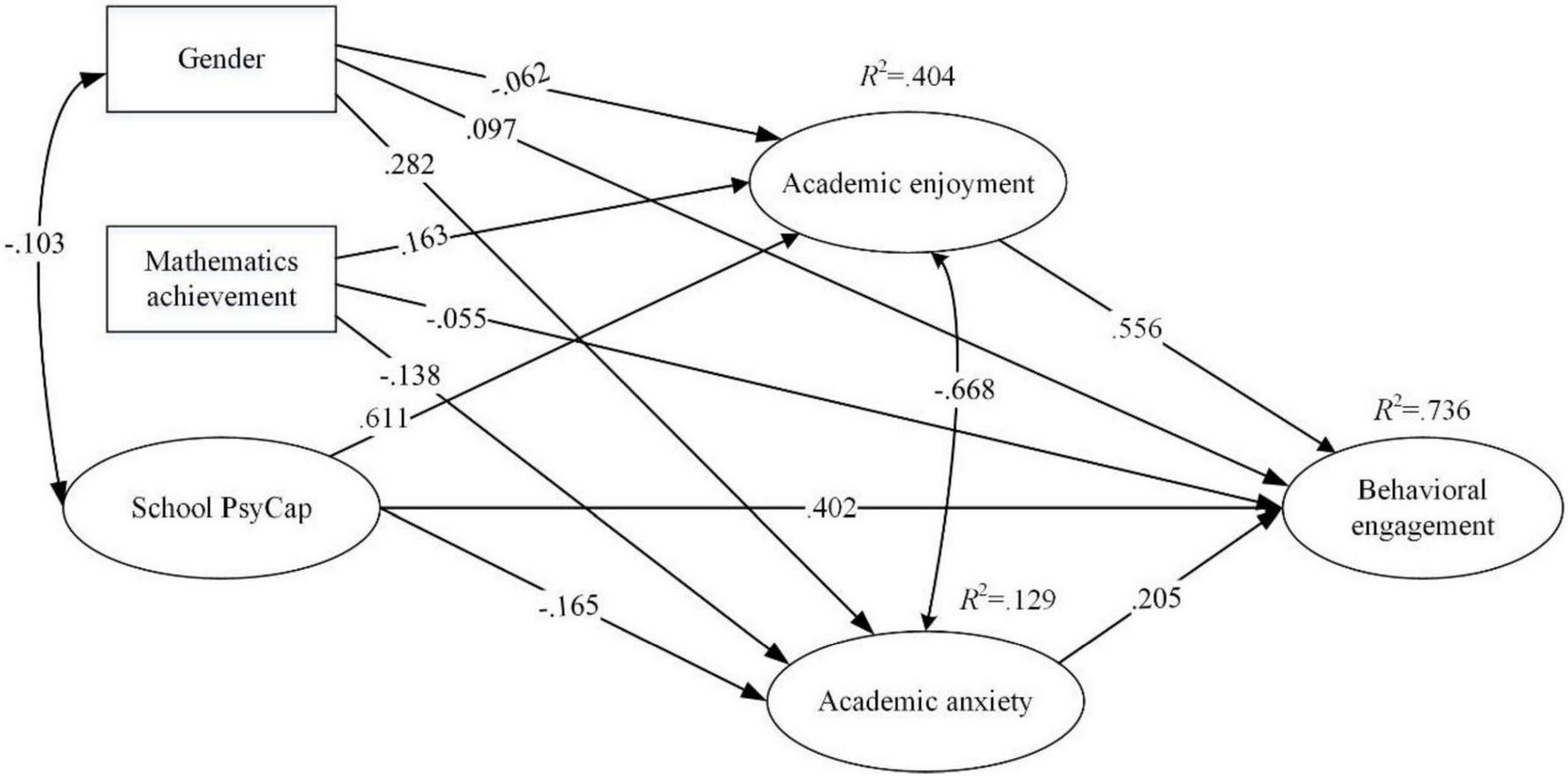
The relation between school PsyCap, academic enjoyment, academic anxiety and behavioral engagement. All the correlations and path coefficients shown in the figure are standardized and statistically significant (p < 0.05).
H1. Students’ school PsyCap will be significantly correlated with their positive and negative achievement emotions in mathematics learning.
H2. Students’ school PsyCap would be positively correlated with their behavioral engagement within the mathematics classroom.
H3. Achievement emotions–both negative and positive–serve as mediators in the relationship between school PsyCap and behavioral engagement.
2 Materials and methods
2.1 Participants and procedures
One thousand one hundred thirty-five participants from two secondary schools took part in the present study, comprising seventh graders (N = 557) and eighth graders (N = 578). The two secondary schools are in two towns in Xishuangbanna Dai Autonomous Prefecture, the extreme southwestern border of Yunnan Province, China. The mean age of participants was 13.15 years (SD = 0.75), with 574 (50.6%) males and 561 (49.4%) females. When students were invited to participate in this survey, permission was sought from students, administrators, teachers, and parents. After these consents were obtained, participants completed the questionnaire under the guidance of their headteacher. Throughout the data collection process, students were informed that their participation was voluntary, and refusal to participate would not affect their academic standing or relationships within the school.
2.2 Measures
2.2.1 School psychological capital scale
The 15-item Chinese version of the school PsyCap scale adapted from King and Caleon’s (2021) English version was initially applied to measure the PsyCap of secondary school students in Singapore. The validity of the Chinese version of the school PsyCap scale has been verified among Chinese university students (Kang et al., 2021) and Chinese secondary school students (Kang and Wu, 2021). Consistent with existing literature (Datu et al., 2018; Kang et al., 2021; Kang and Wu, 2021; King et al., 2020; King and Caleon, 2021), a 15-item school PsyCap scale was adopted to measure the level of school PsyCap of students. Besides, the school PsyCap was viewed as a second-order construct underpinned by its four first-order components (i.e., hope, self-efficacy, resilience, and optimism). Precisely, hope was measured by four items (e.g., “I expect the best during uncertain times at school”) with a reliability of 0.68. Self-efficacy was measured by four items (e.g., “I feel confident that I can learn what is taught in school”) with a reliability of 0.68. The reliability of resilience (Cronbach’s α = 0.80) and optimism (Cronbach’s α = 0.61) was also acceptable. Four items measured resilience, and optimism was measured by three items, with example items being “I don’t let study stress get on top of me” (resilience) and “I am optimistic about my future in school” (optimism). The school PsyCap was rated on a five-point Likert scale ranging from 1 (strongly disagree) to 5 (strongly agree). Internal consistency of school PsyCap was estimated as Cronbach’s α = 0.97, indicating that the school PsyCap scale demonstrated good reliability.
2.2.2 Mathematics class-related achievement emotions scale
Participants were asked to rate items adapted from Pekrun et al.’s (2011) achievement emotions questionnaire-mathematics (AEQ-M) on whether the statements fit their mathematics class-related achievement emotions. First, students’ enjoyment of their mathematics class was measured by asking them how they felt about attending mathematics classes. Participants responded to the four-item mathematics class-related enjoyment scale (e.g., “I look forward to my mathematics class” and “I enjoy my mathematics class”) on a five-point scale (1 = strongly disagree, 5 = strongly agree). A higher score indicated a more fantastic endorsement of the enjoyment construct. The reliability and validity of the enjoyment subscale in the mathematics context have been verified in existing literature, including secondary school students in China (e.g., Chen and Brown, 2018; Kang and Wu, 2021), and the internal consistency for the present study was good with Cronbach’s α = 0.83.
Second, participants’ mathematics class-related anxiety was measured by four items adapted from AEQ-M (Pekrun et al., 2011). Exemplar items include “I feel anxious in mathematics class” and “I worry that I cannot follow what is being taught in math class.” Participants rated their level of agreement on the four items of anxiety scale using a five-point scale from 1 (strongly disagree) to 5 (strongly agree). A high score indicates higher levels of anxiety. The reliability and validity of the mathematics class-related anxiety subscale have also been established in prior studies, including secondary school students in China (e.g., Kang and Wu, 2021; Lin et al., 2020), and the internal consistency of the anxiety subscale was also acceptable for the present study (Cronbach’s α = 0.66).
2.2.3 Behavioral engagement scale
The behavioral engagement was assessed using four items adapted and adjusted from the Engagement vs. Dissatisfaction with Learning Questionnaire developed by Skinner et al. (2009). All items were modified and adapted to be specific to mathematics lessons or activities (e.g., “In mathematics class, I work as hard as I can”). The four items were answered on a five-point scale (1 = strongly disagree, 5 = strongly agree) such that a high value represents higher levels of behavioral participation in mathematics classes. The reliability and validity of this construct have been proved in existing literature (e.g., King and Ganotice, 2015; Putwain et al., 2018; Skinner and Chi, 2012), and the internal consistency of behavioral engagement construct in the present study was good (Cronbach’s α = 0.78).
2.2.4 Covariates
Gender and prior mathematics achievement were included as covariates in the analysis. First, previous studies suggested that students’ academic engagement demonstrates gender bias, which would cause gender gaps in their levels of mathematics-related learning activities (Kessels et al., 2014; Loh, 2019; Moss-Racusin et al., 2018). For example, Nosek and Smyth (2011) reported that the mathematics-gender stereotype contributed to sex gaps in engagement and achievement in mathematics, predicting that female students would be more harmful, engage less, and gain worse grades in mathematics. The reciprocal relationship between mathematics-related behavioral engagement and academic achievement (Wang et al., 2019) indicated that the analysis should control prior achievement. Prior mathematics achievement was represented by students’ mathematics scores in the latest final examination. This exam was developed by the Education Committee of the Xishuangbanna Dai Autonomous Prefecture and administered as the final exam for all secondary school students in Xishuangbanna Dai Autonomous Prefecture in the first semester of the 2020–2021 academic year. Since gender and prior mathematics achievement have been proven to be associated with students’ mathematics-related behavioral engagement, these variables were controlled as covariates.
2.2.5 Data analysis
The data analysis in the present study comprises five sequential steps. First, the complete information maximum likelihood (FIML) method, conducted in Mplus 8.3 (Muthén and Muthén, 2017), was used to handle the missing data given that FIML would produce trustworthy and unbiased estimates (Nicholson et al., 2017). FIML has also been demonstrated as a viable method for handling missing values (Schlomer et al., 2010). Second, preliminary analysis, including descriptive statistics, bivariate correlations, and internal consistency reliability were conducted to provide basic demographic and variable-specific information (see Table 1). Third, confirmatory factor analysis (CFA) was conducted on the four scales mentioned above (i.e., school PsyCap scale, enjoyment subscale, anxiety subscale, and behavioral engagement scale) to establish construct validity. Fourth, a latent structural equation model (SEM) was applied to examine the relationships among these variables. The hypothesized model posited that school PsyCap (exogenous latent variable) would influence behavioral engagement (endogenous latent variable) through the mediators of academic enjoyment and anxiety (latent variables). Gender and prior mathematics achievement (observed variables) were included as covariates, given their documented associations with achievement emotions (e.g., Pekrun et al., 2017) and behavioral engagement (e.g., Wang et al., 2019) and that gender also result in differences in achievement emotions (Erturan and Jansen, 2015) and behavioral engagement (Nosek and Smyth, 2011). Finally, a bootstrapping procedure with 2,000 samples was employed to test the mediation effects (MacKinnon et al., 2004).
TABLE 1
| Variables | 1 | 2 | 3 | 4 | 5 | 6 |
| 1. School PsyCap | – | |||||
| 2. Math class-related enjoyment | 0.540** | – | ||||
| 3. Math class-related anxiety | −0.127** | −0.254** | – | |||
| 4. Behavioral engagement | 0.592** | 0.612** | −0.045 | – | ||
| 5. Gender | −0.085** | −0.108** | 0.225** | 0.046 | – | |
| 6. Mathematics achievement | 0.239** | 0.370** | −0.153** | 0.290** | 0.028 | – |
| Mean | 3.23 | 3.041 | 3.206 | 3.403 | 1.490 | 0.000 |
| SD | 0.595 | 0.798 | 0.766 | 0.736 | 0.500 | 0.999 |
| Cronbach’s α | 0.97 | 0.83 | 0.66 | 0.78 | – | – |
Descriptive statistics, bivariate correlations, and internal reliability for key variables.
Mathematics achievement was standardized z-scores.
** p < 0.01.
3 Results
3.1 Common method bias
This empirical study was based on participants’ self-reported data. Therefore, it is necessary to address common method bias before conducting the data analysis. To eliminate the potential common method bias, Harman’s single-factor test was employed (Podsakoff et al., 2003). The single-factor confirmatory factor analysis yielded a poor model fit: χ2 (324) = 2695.213, p < 0.001, RMSEA = 0.083, CFI = 0.750, TLI = 0.730, SRMR = 0.070. The findings demonstrate that common method bias was not expected to substantially impact the data analysis results.
3.2 Preliminary analysis
Table 1 presents the descriptive statistics and correlation coefficients among the study variables. In the analysis, school PsyCap was designated as the independent variable, while mathematics enjoyment and anxiety were viewed as mediators and behavioral engagement in mathematics classes as the dependent variable. Besides, gender and prior mathematics achievement were included as covariates.
3.3 Confirmatory factor analysis
Table 2 presents the goodness of fit indexes from CFAs of the study variables. Traditionally, the excellent and adequate cutoff values for model fit indexes were: (1) comparative fit index (CFI) and Tucker-Lewis index (TLI) are greater than or equal to 0.95 and 0.90, respectively; (2) the root mean square error of approximation (RMSEA) are less than or equal to 0.06 and 0.08, respectively; and (3) the values of standardized root mean square residual (SRMR) are less than or equal to 0.08 and 0.10, respectively (Chen, 2007; Hu and Bentler, 1999). Accordingly, the results indicated that a good model fit for all latent constructs was supported based on the conventional criterion of cutoff values.
TABLE 2
| Variables | χ2 | df | CFI | TLI | RMSEA | SRMR |
| 1. School PsyCap | 406.672 | 86 | 0.936 | 0.922 | 0.061 | 0.036 |
| 2. Math class-related enjoyment | 10.099 | 2 | 0.994 | 0.983 | 0.063 | 0.013 |
| 3. Math class-related anxiety | 6.429 | 2 | 0.991 | 0.974 | 0.047 | 0.015 |
| 4. Behavioral engagement | 13.097 | 2 | 0.990 | 0.969 | 0.074 | 0.017 |
Confirmatory factor analysis (CFA) results of the four key variables.
3.4 Testing the hypothesized model
First, the associations among school PsyCap, behavioral engagement, and two covariates (i.e., gender and prior mathematics achievement) were tested. Results indicated good model fits, with χ2 (182) = 656.533, CFI = 0.930, TLI = 0.920, RMSEA = 0.051 and SRMR = 0.047. Significant associations between school PsyCap (β = 0.713, SE = 0.023 and p < 0.001) and behavioral engagement as well as gender (β = 0.122, SE = 0.028 and p < 0.001) and behavioral engagement were identified.
Second, the two mediators (i.e., academic enjoyment and anxiety) were added into the model. Results showed that the mediation model also has good model fits, with χ2 (362) = 1197.468, CFI = 0.914, TLI = 0.904, RMSEA = 0.048 and SRMR = 0.057 (Figure 1). Path one (school PsyCap → academic enjoyment → behavioral engagement) was significant (β = 0.339, SE = 0.030 and p < 0.001) for the 95% bootstrap bias-corrected confidence interval (BCa 95% CIs [0.285, 0.403]) did not contain zero. Path two (school PsyCap → academic anxiety → behavioral engagement) was also significant (β = −0.034, SE = 0.013 and p < 0.05) as (BCa 95% CIs [−0.065, −0.013]) did not contain zero. The significance of Path one and Path two indicated that academic enjoyment and anxiety mediate the relationship between school PsyCap and behavioral engagement. The association between school PsyCap and behavioral engagement, after taking mediators into consideration, decreased from β = 0.713 and p < 0.001 to β = 0.402 and p < 0.001, which revealed that academic enjoyment and anxiety act as partial mediators. Altogether, the indirect effect accounted for 48.1% of the link between school PsyCap and behavioral engagement, with a stronger link via academic enjoyment (43.7%) than via academic anxiety (4.4%), which could also be drawn from the small mediation of academic anxiety (β = 0.034).
Regarding the observed variables, results indicated prior mathematics achievement related positively to academic enjoyment (β = 0.163 and p < 0.001) and their behavioral engagement (β = −0.055 and p < 0.05) and negatively to academic anxiety (β = −0.138 and p < 0.001). Furthermore, the significant negative correlation between gender (male = 1 and female = 2) and academic enjoyment (β = −0.062 and p < 0.05) suggested that female students were less likely to take delight in mathematics lessons. While the significant positive correlation between gender and academic anxiety (β = 0.282 and p < 0.001) and behavioral engagement (β = 0.097 and p < 0.01) meant that female students were more engaged and anxious in mathematics classes.
4 Discussion
The present study investigated the emotional mechanisms linking school PsyCap to behavioral engagement in mathematics among secondary school students. A sample of Chinese seventh and eighth-grade students aged 12–15 years was surveyed to explore these associations. Controlling gender and prior mathematics achievement, SEM revealed that both positive and negative achievement emotions served as mediators in the relationship between school PsyCap and behavioral engagement. Supporting Hypothesis 1, higher levels of school PsyCap were positively correlated with academic enjoyment and negatively correlated with academic anxiety. In line with Hypothesis 2, the direct positive correlation between school PsyCap and behavioral engagement was also proved. Furthermore, findings aligned with Hypothesis 3, demonstrating that academic enjoyment and anxiety mediated the association between school PsyCap and behavioral engagement, accounting for a mediating effect of 48.1%. These findings highlight the importance of emotional factors in psychological pathways through which school resources influence student engagement in mathematics learning context.
School PsyCap is conceptualized as a promoter of students’ control appraisals, which in turn benefit the generation of achievement emotions (Kang and Wu, 2021; King and Caleon, 2021; Luthans and Youssef-Morgan, 2017). According to the CVT, control and value appraisals are the two proximal determinants of achievement emotions, while other distal antecedents (e.g., school PsyCap) act first on control or value appraisals and then on achievement emotions (Pekrun et al., 2011; Pekrun and Stephens, 2010). Thus, it is reasonable to expect that school PsyCap would be positively correlated with positive achievement emotions, such as academic enjoyment, and negative correlated with negative achievement emotions, such as academic anxiety. However, existing literature on school PsyCap was mainly conducted in Western contexts (e.g., Carmona-Halty et al., 2019, 2021), and only its correlation with positive emotions rather than negative emotions were discussed (Carmona–Halty et al., 2019; King et al., 2020). The present study advances the field by providing a more comprehensive examination of the relationship between school PsyCap and achievement emotions, explicitly incorporating negative emotions such as academic anxiety alongside positive ones. Comparison of the mediating effects revealed that the indirect influence of academic enjoyment on the relationship between school PsyCap and behavioral engagement (43.7%) was substantially greater than that of academic anxiety (4.4%). One possible explanation is that, with in Confucian heritage culture (CHC), positive emotions such as academic enjoyment are prioritized and reinforced, whereas negative emotions like academic anxiety are comparatively less emphasized (Pu, 2009). In the CHC context, virtues such as harmony, benevolence, and sincerity are highly valued (Ho, 2017; Shusterman, 2009), which to some extent facilitate the expression of positive emotions, such as academic enjoyment, while suppressing the outward manifestation of negative emotions like academic anxiety.
Multiple studies have evidenced that school PsyCap bolsters academic engagement among secondary school and college students (Kang et al., 2021; King et al., 2020; King and Caleon, 2021). Unlike previous research (e.g., You, 2016), the present study controlled for potential confounding variables such as gender and prior academic achievement to more accurately examine the relationship between school PsyCap and behavioral engagement. By accounting for these covariates, this study aimed to clarify the association between school PsyCap and behavioral engagement. However, beyond gender and prior mathematics achievement, additional factors such as socioeconomic status, age, parental involvement, and classroom environment may also influence the model structure by introducing potential biases in behavioral engagement or achievement emotions (Brumariu et al., 2023; Chen et al., 2021; Fiskerstrand, 2022; Mohammad Hosseini et al., 2022). While the present study contributes to existing research, future studies are advised to endeavor to control a broader range of variables to more comprehensively delineate the relationships among school PsyCap, achievement emotions, and academic engagement.
The primary purpose of the present study was to inspect whether achievement emotions mediated the relationships between school PsyCap and behavioral engagement in the mathematics context. Building on King et al. (2020) work, this study found that school PsyCap can affect behavioral engagement via both positive achievement emotion (i.e., academic enjoyment) and negative achievement emotion (i.e., academic anxiety). First, few studies have explored the emotional connection between school PsyCap and behavioral engagement (King et al., 2020, is an exception). Second, students experience both positive and negative achievement emotions in the learning process (Pekrun, 2006; Pekrun et al., 2011; Vierhaus et al., 2016; Westphal et al., 2018). However, in King et al.’s (2020) study, only the mediating effect of positive emotions have been confirmed. One possible reason is that their study was based on a sample of only 71 participants (King et al., 2020), and that small sample sizes might lead to mediating effect bias (MacKinnon et al., 2004). Third, King et al. (2020) did not control for prior academic achievement and the domain specificity of achievement emotions and behavioral engagement were also ignored. Thus, this is no way to determine whether school PsyCap offers incremental benefits over prior achievement in behavioral engagement. By controlling for gender and prior mathematics achievement and limiting the present study to the mathematics classroom context, it can be confidently concluded that the predictive power of school PsyCap on behavioral engagement is not an artifact of prior achievement. Furthermore, this study extended the investigation that school PsyCap, being a force “drives students to higher levels of flourishing” (King and Caleon, 2021, p.362), promotes behavioral engagement via a broader range of emotional mediators than in previous studies.
4.1 Theoretical implications
The present study simultaneously considered the antecedents and consequences of achievement emotions, thereby providing empirical support for the control-value theory and establishing an integrative framework for the comprehensive analysis of achievement emotions. The content of the CVT comprises two parts: on the one hand, control and value appraisals are the proximal antecedents of achievement emotions; other proximal antecedents of achievement emotions (e.g., school PsyCap) influence achievement emotions indirectly through control and value appraisals (Kang et al., 2025; Pekrun, 2006, 2019). On the other hand, achievement emotions have a significant impact on academic outcomes, including academic engagement, learning motivation, and academic performance (Earl et al., 2024; Kang and Wu, 2022a; Muwonge et al., 2018). In contrast to prior research that has primarily focused on either the antecedents or the consequences of achievement emotions (Kang and Wu, 2022b; Wu and Yu, 2022), the present study adopted an integrative approach by examining both aspects concurrently. This study proposed the “school PsyCap → achievement emotions → academic engagement” model, thereby facilitating a more comprehensive perspective for understanding achievement emotions.
4.2 Educational implications
This study contributes to the body of literature (Carmona–Halty et al., 2019; Datu et al., 2018; Datu and Valdez, 2016; Kang et al., 2021; King et al., 2020; Siu et al., 2014), suggesting that school PsyCap is adaptive for students’ behavioral engagement via the emotional mediators of academic enjoyment and anxiety. Teachers can implement a variety of measures to improve the level of their students’ school PsyCap. Given that the four higher-order core factors of school PsyCap (i.e., hope, self-efficacy, resilience, and optimism) are open to development, intervention training programs such as expanding students’ personal resources to facilitate them to overcome learning obstacles, setting up stepwise techniques and timelines to help students achieve their learning goals, identifying learning obstacles in advance and proposing corresponding solutions to increase students’ expectations for academic success are the effective ways for teachers to develop their students’ school PsyCap (see Luthans et al., 2010). Second, teachers are recommended to create a cooperative classroom atmosphere and to give full play to the roles of study groups and peer leaders as students’ self-confidence can be effectively boosted (Luthans et al., 2014), and thus the level of their school PsyCap was raised. Third, group-based acceptance and commitment therapy, which emphasizes mindfulness, acceptance, values, and cognitive defusion, has also been shown to boost adolescent students’ PsyCap (Fang and Ding, 2020). This indicates that teachers can help by creating a therapeutic classroom climate in which students’ PsyCap level is improved. Fourth, compared to their male counterparts, female students exhibited greater behavioral engagement in the mathematics classrooms. However, female mathematics learners experienced lower levels of enjoyment and higher levels of anxiety, suggesting that mathematics educators should provide greater support and care for female students to help mitigate their negative emotional experiences. Fifth, the mediating influence of academic enjoyment in the relationship between school PsyCap and behavioral engagement was remarkably pronounced than that of academic anxiety. Mathematics educators are suggested to prioritize strategies aimed at fostering students’ positive emotional experiences in learning mathematics, rather than exclusively focusing on the reduction or remediation of negative emotions. This proposition is consistent with the principles of the positive psychology movement within educational contexts. Mathematics educators could significantly enhance students’ positive emotional experiences by providing increased attention and care, fostering harmonious teacher-student relationships, and offering timely academic and emotional support. Such interventions are likely to exert a substantial positive influence on academic outcomes, such as academic engagement.
4.3 Limitations and directions for future research
This empirical study investigated the emotional connections of school PsyCap with behavioral engagement in mathematics classrooms of Chinese secondary school students, covering both positive and negative achievement emotions. Nevertheless, four potential limitations need to be acknowledged. First, only gender and prior academic achievement were controlled for in the present study, and it is suggested that more possible covariates should be considered in future studies. Family obligations (King and Ganotice, 2015), interpersonal relationships (Collie et al., 2016), family socioeconomic status (Chen et al., 2021) and classroom social climate (Mohammad Hosseini et al., 2022), for example, have also been shown to have an impact on the levels of behavioral engagement, indicating that future studies could deepen the understanding of the linkage between school PsyCap and behavioral engagement by way of controlling more antecedents of behavioral engagement. Second, a rigorous causal relationship between school PsyCap and behavioral engagement could not be determined because of the cross-sectional design of the present study. A longitudinal design is suggested to establish causality between these two constructs. Third, the data in the present study were all self-reported by the participants. Although common method bias has been addressed, future research is recommended to collect data from a broader range of resources, such as participants’ parents, teachers, and peers, to overcome the potential response bias effect (Conway and Lance, 2010). Fourth, although the Cronbach’s alpha values for academic anxiety, optimism, and self-efficacy were acceptable, they were not considered good. Thus, future research is recommended to undertake item refinement to enhance the reliability of these scales.
5 Conclusion
The present study demonstrated in a sample of 1135 Chinese secondary school students aged 12–15 years that school PsyCap predicts behavioral engagement via both positive and negative achievement emotions (i.e., academic enjoyment and anxiety). After controlling gender and prior mathematics achievement, students with a high level of school PsyCap showed higher positive achievement emotion and lower negative emotion in mathematics classes and subsequently showed more positive classroom engagement than students with a low level of school PsyCap. The school PsyCap level of students can be improved by teachers promoting intervention training programs and acceptance and commitment therapy, and that the classroom climate is therapeutic and cooperative.
Statements
Data availability statement
The raw data supporting the conclusions of this article will be made available by the authors, without undue reservation.
Ethics statement
The studies involving humans were approved by the Human Research Ethics Committee of Guangzhou University (Reference No. [2023]133). The studies were conducted in accordance with the local legislation and institutional requirements. Written informed consent for participation in this study was provided by the participants’ legal guardians/next of kin.
Author contributions
XK: Conceptualization, Methodology, Writing – original draft, Formal analysis. SZ: Investigation, Supervision, Writing – review & editing, Conceptualization. YW: Validation, Writing – review & editing, Project administration, Data curation.
Funding
The author(s) declare that financial support was received for the research and/or publication of this article. This work was supported by the 2024 Guangdong Provincial Educational Science Planning Project (Higher Education Special Program) (grant number: 2024GXJK660) and “Research and Practice on the Training Model of New Mathematics Teacher Education Talent to Meet Social Needs” and “Mechanism Research on the Role of Generative Artificial Intelligence in Enhancing the Teaching Competency of Primary and Secondary School Mathematics Teachers,” a University Research Project supported by the Guangzhou Municipal Education Bureau (grant number: 2024312376).
Conflict of interest
The authors declare that the research was conducted in the absence of any commercial or financial relationships that could be construed as a potential conflict of interest.
Generative AI statement
The author(s) declare that no Generative AI was used in the creation of this manuscript.
Any alternative text (alt text) provided alongside figures in this article has been generated by Frontiers with the support of artificial intelligence and reasonable efforts have been made to ensure accuracy, including review by the authors wherever possible. If you identify any issues, please contact us.
Publisher’s note
All claims expressed in this article are solely those of the authors and do not necessarily represent those of their affiliated organizations, or those of the publisher, the editors and the reviewers. Any product that may be evaluated in this article, or claim that may be made by its manufacturer, is not guaranteed or endorsed by the publisher.
References
1
Allan J. F. McKenna J. Dominey S. (2014). Degrees of resilience: Profiling psychological resilience and prospective academic achievement in university inductees.Br. J. Guidance Counsell.429–25. 10.1080/03069885.2013.793784
2
Andretta J. R. McKay M. T. (2020). Self-efficacy and well-being in adolescents: A comparative study using variable and person-centered analyses.Children Youth Serv. Rev.118:105374. 10.1016/j.childyouth.2020.105374
3
Archambault I. Janosz M. Morizot J. Pagani L. (2009). Adolescent behavioral, affective, and cognitive engagement in school: Relationship to dropout.J. School Health79408–415. 10.1111/j.1746-1561.2009.00428.x
4
Augusto-Landa J. M. Pulido-Martos M. Lopez-Zafra E. (2011). Does perceived emotional intelligence and optimism/pessimism predict psychological well-being?J. Happiness Stud.12463–474. 10.1007/s10902-010-9209-7
5
Ayala J. C. Manzano G. (2018). Academic performance of first-year university students: The influence of resilience and engagement.High. Educ. Res. Dev.371321–1335. 10.1080/07294360.2018.1502258
6
Ayyash-Abdo H. Sanchez-Ruiz M. J. Barbari M. L. (2016). Resiliency predicts academic performance of Lebanese adolescents over demographic variables and hope.Learn. Individ. Dif.489–16. 10.1016/j.lindif.2016.04.005
7
Ben-Eliyahu A. Moore D. Dorph R. Schunn C. D. (2018). Investigating the multidimensionality of engagement: Affective, behavioral, and cognitive engagement across science activities and contexts.Contemp. Educ. Psychol.5387–105. 10.1016/j.cedpsych.2018.01.002
8
Brumariu L. E. Waslin S. M. Gastelle M. Kochendorfer L. B. Kerns K. A. (2023). Anxiety, academic achievement, and academic self-concept: Meta-analytic syntheses of their relations across developmental periods.Dev. Psychopathol.351597–1613. 10.1017/S0954579422000323
9
Buckelew S. P. Crittendon R. S. Butkovic J. D. Price K. B. Hurst M. (2008). Hope as a predictor of academic performance.Psychol. Rep.103411–414. 10.2466/PR0.103.2.411-414
10
Cai Z. Meng Q. (2025). Academic resilience and academic performance of university students: The mediating role of teacher support.Front. Psychol.16:1463643. 10.3389/fpsyg.2025.1463643
11
Carmona-Halty M. Salanova M. Llorens S. Schaufeli W. B. (2021). Linking positive emotions and academic performance: The mediated role of academic psychological capital and academic engagement.Curr. Psychol.402938–2947. 10.1007/s12144-019-00227-8
12
Carmona–Halty M. Salanova M. Llorens S. Schaufeli W. B. (2019). How psychological capital mediates between study-related positive emotions and academic performance.J. Happiness Stud.20605–617. 10.1007/s10902-018-9963-5
13
Carmona-Halty M. Schaufeli W. B. Salanova M. (2019). Good relationships, good performance: The mediating role of psychological capital - A three-wave study among students.Front. Psychol.10:306. 10.3389/fpsyg.2019.00306
14
Chen F. F. (2007). Sensitivity of goodness of fit indexes to lack of measurement invariance.Struct. Equ. Model. Multidiscipl. J.14464–504. 10.1080/10705510701301834
15
Chen J. J. Jiang T. N. Liu M. F. (2021). Family socioeconomic status and learning engagement in Chinese adolescents: The multiple mediating roles of resilience and future orientation.Front. Psychol.12:714346. 10.3389/fpsyg.2021.714346
16
Chen J. Brown G. T. L. (2018). Chinese secondary school students’ conceptions of assessment and achievement emotions: Endorsed purposes lead to positive and negative feelings.Asia Pac. J. Educ.3891–109. 10.1080/02188791.2018.1423951
17
Chen J. Huebner E. S. Tian L. (2020). Longitudinal relations between hope and academic achievement in elementary school students: Behavioral engagement as a mediator.Learn. Individ. Dif.78:101824. 10.1016/j.lindif.2020.101824
18
Ciarrochi J. Heaven P. C. L. Davies F. (2007). The impact of hope, self-esteem, and attributional style on adolescents’ school grades and emotional well-being: A longitudinal study.J. Res. Pers.411161–1178. 10.1016/j.jrp.2007.02.001
19
Clem A. L. Rudasill K. M. Hirvonen R. Aunola K. Kiuru N. (2021). The roles of teacher-student relationship quality and self-concept of ability in adolescents’ achievement emotions: Temperament as a moderator.Eur. J. Psychol. Educ.36263–286. 10.1007/s10212-020-00473-6
20
Collie R. J. Martin A. J. Papworth B. Ginns P. (2016). Students’ interpersonal relationships, personal best (PB) goals, and academic engagement.Learn. Individ. Dif.4565–76. 10.1016/j.lindif.2015.12.002
21
Conway J. M. Lance C. E. (2010). What reviewers should expect from authors regarding common method bias in organizational research.J. Bus. Psychol.25325–334. 10.1007/s10869-010-9181-6
22
Darensbourg A. M. Blake J. J. (2013). Predictors of achievement in African American students at risk for academic failure: The role of achievement values and behavioral engagement.Psychol. Schools501044–1059. 10.1002/pits.21730
23
Datu J. A. D. Valdez J. P. M. (2016). Psychological capital predicts academic engagement and well-being in Filipino high school students.Asia Pac. Educ. Res.25399–405. 10.1007/s40299-015-0254-1
24
Datu J. A. D. King R. B. Valdez J. P. M. (2018). Psychological capital bolsters motivation, engagement, and achievement: Cross-sectional and longitudinal studies.J. Positive Psychol.13260–270. 10.1080/17439760.2016.1257056
25
Day L. Hanson K. Maltby J. Proctor C. Wood A. (2010). Hope uniquely predicts objective academic achievement above intelligence, personality, and previous academic achievement.J. Res. Pers.44550–553. 10.1016/j.jrp.2010.05.009
26
Doménech-Betoret F. Abellán-Roselló L. Gómez-Artiga A. (2017). Self-efficacy, satisfaction, and academic achievement: The mediator role of students’ expectancy-value beliefs.Front. Psychol.8:1193. 10.3389/fpsyg.2017.01193
27
Du H. King R. B. (2013). Placing hope in self and others: Exploring the relationships among self-construals, locus of hope, and adjustment.Pers. Individ. Dif.54332–337. 10.1016/j.paid.2012.09.015
28
Earl S. R. Bishop D. Miller K. Davison E. Pickerell L. (2024). First-year students’ achievement emotions at university: A cluster analytic approach to understand variability in attendance and attainment.Br. J. Educ. Psychol.94367–386. 10.1111/bjep.12650
29
Engels M. C. Colpin H. Van Leeuwen K. Bijttebier P. Van Den Noortgate W. Claes S. et al (2016). Behavioral engagement, peer status, and teacher–student relationships in adolescence: A longitudinal study on reciprocal influences.J. Youth Adolesc.451192–1207. 10.1007/s10964-016-0414-5
30
Erturan S. Jansen B. (2015). An investigation of boys’ and girls’ emotional experience of math, their math performance, and the relation between these variables.Eur. J. Psychol. Educ.30421–435. 10.1007/s10212-015-0248-7
31
Fang S. Ding D. (2020). The efficacy of group-based acceptance and commitment therapy on psychological capital and school engagement: A pilot study among Chinese adolescents.J. Contextual Behav. Sci.16134–143. 10.1016/j.jcbs.2020.04.005
32
Fiskerstrand A. (2022). Literature review – Parent involvement and mathematic outcome.Educ. Res. Rev.37:100458. 10.1016/j.edurev.2022.100458
33
Forsblom L. Peixoto F. Mata L. (2021). Perceived classroom support: Longitudinal effects on students’ achievement emotions.Learn. Individ. Dif.85:101959. 10.1016/j.lindif.2020.101959
34
Fredricks J. A. Blumenfeld P. C. Paris A. H. (2004). School engagement: Potential of the concept, state of the evidence.Rev. Educ. Res.7459–109. 10.3102/00346543074001059
35
García-Izquierdo M. Ríos-Risquez M. I. Carrillo-García C. Sabuco-Tebar E. (2018). The moderating role of resilience in the relationship between academic burnout and the perception of psychological health in nursing students.Educ. Psychol.381068–1079. 10.1080/01443410.2017.1383073
36
Geers A. L. Wellman J. A. Lassiter G. D. (2009). Dispositional optimism and engagement: The moderating influence of goal prioritization.J. Pers. Soc. Psychol.96913–932. 10.1037/a0014830
37
Goetz T. Frenzel A. C. Pekrun R. Hall N. C. Lüdtke O. (2007). Between and within-domain relations of students’ academic emotions.J. Educ. Psychol.99715–733. 10.1037/0022-0663.99.4.715
38
Green J. Martin A. J. Marsh H. W. (2007). Motivation and engagement in English, mathematics and science high school subjects: Towards an understanding of multidimensional domain specificity.Learn. Individ. Dif.17269–279. 10.1016/j.lindif.2006.12.003
39
Gregory A. Allen J. P. Mikami A. Y. Hafen C. A. Pianta R. C. (2014). Effects of a professional development program on behavioral engagement of students in middle and high school.Psychol. Schools51143–163. 10.1002/pits.21741
40
Ho L.-C. (2017). Social harmony and diversity: The affordances and constraints of harmony as an educational goal.Teach. College Rec.1191–30. 10.1177/016146811711900406
41
Hospel V. Galand B. Janosz M. (2016). Multidimensionality of behavioural engagement: Empirical support and implications.Int. J. Educ. Res.7737–49. 10.1016/j.ijer.2016.02.007
42
Hoy W. K. Tarter C. J. Woolfolk Hoy A. (2006). Academic optimism of schools: A force for student achievement.Am. Educ. Res. J.43425–446. 10.3102/00028312043003425
43
Hu L. T. Bentler P. M. (1999). Cutoff criteria for fit indexes in covariance structure analysis: Conventional criteria versus new alternatives.Struct. Equ. Model. A Multidiscipl. J.61–55. 10.1080/10705519909540118
44
Kang X. Wu Y. (2021). Investigating the linkage between school psychological capital and achievement emotions in secondary school mathematics.Asia Pacific Educ. Res.31739–748. 10.1007/s40299-021-00623-4
45
Kang X. Wu Y. (2022a). Academic enjoyment, behavioral engagement, self-concept, organizational strategy and achievement in EFL setting: A multiple mediation analysis.PLoS One17:e0267405. 10.1371/journal.pone.0267405
46
Kang X. Wu Y. (2022b). Investigating the linkage between school psychological capital and achievement emotions in secondary school mathematics.Asia Pacific Educ. Res.31739–748. 10.1007/s40299-021-00623-4
47
Kang X. She J. Wu Y. (2025). Psychological capital, cognitive appraisals, and achievement emotions in mathematics: Exploring mediation pathways.Psychol. Schools622250–2263. 10.1002/pits.23462
48
Kang X. Wu Y. Li L. (2021). Validation and prediction of the school psychological capital among Chinese college students.Front. Psychol.12:697703. 10.3389/fpsyg.2021.697703
49
Kessels U. Heyder A. Latsch M. Hannover B. (2014). How gender differences in academic engagement relate to students’ gender identity.Educ. Res.56220–229. 10.1080/00131881.2014.898916
50
Kieffer M. J. Marinell W. H. Neugebauer S. R. (2013). Navigating into, through, and beyond the middle grades: The role of middle grades attendance in staying on track for high school graduation.J. School Psychol.52549–565. 10.1016/j.jsp.2014.09.002
51
Kim S. J. Lee J. Song J. H. Lee Y. (2021). The reciprocal relationship between academic resilience and emotional engagement of students and the effects of participating in the Educational welfare priority support project in Korea: Autoregressive cross-lagged modeling.Int. J. Educ. Res.109:101802. 10.1016/j.ijer.2021.101802
52
King R. B. Caleon I. S. (2021). School psychological capital: Instrument development, validation, and prediction.Child Indicators Res.14341–367. 10.1007/s12187-020-09757-1
53
King R. B. Gaerlan M. J. M. (2014). High self-control predicts more positive emotions, better engagement, and higher achievement in school.Eur. J. Psychol. Educ.2981–100. 10.1007/s10212-013-0188-z
54
King R. B. Ganotice F. A. (2015). Does family obligation matter for students’ motivation, engagement, and well-being?: It depends on your self-construal.Pers. Individ. Dif.86243–248. 10.1016/j.paid.2015.06.027
55
King R. B. Pitliya R. J. Datu J. A. (2020). Psychological capital drives optimal engagement via positive emotions in work and school contexts.Asian J. Soc. Psychol.23457–468. 10.1111/ajsp.12421
56
Kotzé M. Kleynhans R. (2013). Psychological well-being and resilience as predictors of first-year students’ academic performance.J. Psychol. Africa2351–59. 10.1080/14330237.2013.10820593
57
Krok D. (2015). The mediating role of optimism in the relations between sense of coherence, subjective and psychological well-being among late adolescents.Pers. Individ. Dif.85134–139. 10.1016/j.paid.2015.05.006
58
Ladd G. W. Dinella L. M. (2009). Continuity and change in early school engagement: Predictive of children’s achievement trajectories from first to eighth grade?J. Educ. Psychol.101190–206. 10.1037/a0013153
59
Lee M. Na H. M. Kim B. Kim S. Y. Park J. Choi J. Y. (2021). Mediating effects of achievement emotions between peer support and learning satisfaction in graduate nursing students.Nurse Educ. Pract.52:103003. 10.1016/j.nepr.2021.103003
60
Li B. Ma H. Guo Y. Xu F. Yu F. Zhou Z. (2014). Positive psychological capital: A new approach to social support and subjective well-being.Soc. Behav. Pers.42135–144. 10.2224/sbp.2014.42.1.135
61
Lichtenfeld S. Pekrun R. Stupnisky R. H. Reiss K. Murayama K. (2012). Measuring students’ emotions in the early years: The Achievement emotions questionnaire-elementary school (AEQ-ES).Learn. Individ. Dif.22190–201. 10.1016/j.lindif.2011.04.009
62
Lin T.-J. (2021). Multi-dimensional explorations into the relationships between high school students’ science learning self-efficacy and engagement.Int. J. Sci. Educ.431193–1207. 10.1080/09500693.2021.1904523
63
Lin W. Yin H. Han J. Han J. (2020). Teacher-student interaction and Chinese students’ mathematics learning outcomes: The mediation of mathematics achievement emotions.Int. J. Environ. Res. Public Health171–17. 10.3390/ijerph17134742
64
Linnenbrink E. A. Pintrich P. R. (2003). The role of self-efficacy beliefs in student engagement and learning in the classroom.Read. Writ. Quart.19119–137. 10.1080/10573560308223
65
Loh E. K. Y. (2019). What we know about expectancy-value theory, and how it helps to design a sustained motivating learning environment.System86:102119. 10.1016/j.system.2019.102119
66
Luthans B. C. Luthans K. W. Avey J. B. (2014). Building the leaders of tomorrow: The development of academic psychological capital.J. Leadersh. Organ. Stud.21191–199. 10.1177/1548051813517003
67
Luthans B. C. Luthans K. W. Jensen S. M. (2012). The impact of business school students’ psychological capital on academic performance.J. Educ. Bus.87253–259. 10.1080/08832323.2011.609844
68
Luthans F. (2012). Psychological capital: Implications for HRD, retrospective analysis, and future directions.Hum. Resour. Dev. Quart.231–8. 10.1002/hrdq
69
Luthans F. Youssef-Morgan C. M. (2017). Psychological capital: An evidence-based positive approach.Annu. Rev. Organ. Psychol. Organ. Behav.4339–366. 10.1146/annurev-orgpsych-032516-113324
70
Luthans F. Avey J. B. Avolio B. J. Peterson S. J. (2010). The development and resulting performance impact of positive psychological capital.Hum. Resour. Dev. Quart.2141–66. 10.1002/hrdq.20034
71
Luthans F. Luthans K. W. Luthans B. C. (2004). Positive psychological capital: Beyond human and social capital.Bus. Horizons4745–50. 10.1016/j.bushor.2003.11.007
72
MacKinnon D. P. Lockwood C. M. Williams J. (2004). Condidence limits for the indirect effect: Distribution of the product and resampling methods.Multivariate Behav. Res.3999–128. 10.1207/s15327906mbr3901_4
73
Marques S. C. Pais-Ribeiro J. L. Lopez S. J. (2011). The role of positive psychology constructs in predicting mental health and academic achievement in children and adolescents: A two-year longitudinal study.J. Happiness Stud.121049–1062. 10.1007/s10902-010-9244-4
74
Martin A. J. Marsh H. W. (2006). Academic resilience and its psychological and educational correlates: A construct validity approach.Psychol. Schools43267–281. 10.1002/pits.20149
75
Meneghel I. Martínez I. M. Salanova M. de Witte H. (2019). Promoting academic satisfaction and performance: Building academic resilience through coping strategies.Psychol. Schools56875–890. 10.1002/pits.22253
76
Mohammad Hosseini H. Fathi J. Derakhshesh A. Mehraein S. (2022). A model of classroom social climate, foreign language enjoyment, and student engagement among English as a foreign language learners.Front. Psychol.13:933842. 10.3389/fpsyg.2022.933842
77
Moksnes U. K. Eilertsen M. E. B. Ringdal R. Bjørnsen H. N. Rannestad T. (2019). Life satisfaction in association with self-efficacy and stressor experience in adolescents – self-efficacy as a potential moderator.Scand. J. Caring Sci.33222–230. 10.1111/scs.12624
78
Moss-Racusin C. A. Sanzari C. Caluori N. Rabasco H. (2018). Gender bias produces gender gaps in STEM engagement.Sex Roles79651–670. 10.1007/s11199-018-0902-z
79
Muthén L. K. Muthén B. O. (2017). Mplus user’s guide.Los Angeles, CA: Muthén & Muthén.
80
Muwonge C. M. Ssenyonga J. Kwarikunda D. (2018). Cognitive appraisals, achievement emotions, and motivation towards learning mathematics among lower secondary students.Afr. J. Res. Math., Sci. Technol. Educ.22243–253. 10.1080/18117295.2018.1487907
81
Nicholson J. S. Deboeck P. R. Howard W. (2017). Attrition in developmental psychology: A review of modern missing data reporting and practices.Int. J. Behav. Dev.41143–153. 10.1177/0165025415618275
82
Nosek B. A. Smyth F. L. (2011). Implicit social cognitions predict sex differences in math engagement and achievement.Am. Educ. Res. J.481125–1156. 10.3102/0002831211410683
83
Oriol X. Amutio A. Mendoza M. Da Costa S. Miranda R. (2016). Emotional creativity as predictor of intrinsic motivation and academic engagement in university students: The mediating role of positive emotions.Front. Psychol.7:1243. 10.3389/fpsyg.2016.01243
84
Pekrun R. (2006). The control-value theory of achievement emotions: Assumptions, corollaries, and implications for educational research and practice.Educ. Psychol. Rev.18315–341. 10.1007/s10648-006-9029-9
85
Pekrun R. (2019). “Achievement emotions: A control-value theory perspective,” in Emotions in late modernity, edsPatulnyR.BellocchiA.OlsonR. E.KhoranaS.McKenzieJ.PeterieM. (Milton Park: Routledge), 142–157.
86
Pekrun R. Stephens E. J. (2010). Achievement emotions: A control-value approach.Soc. Pers. Psychol. Compass4238–255. 10.1111/j.1751-9004.2010.00259.x
87
Pekrun R. Goetz T. Frenzel A. C. Barchfeld P. Perry R. P. (2011). Measuring emotions in students’ learning and performance: The Achievement emotions questionnaire (AEQ).Contemp. Educ. Psychol.3636–48. 10.1016/j.cedpsych.2010.10.002
88
Pekrun R. Goetz T. Titz W. Perry R. P. (2002). Academic emotions in students’ self-regulated learning and achievement: A program of qualitative and quantitative research.Educ. Psychol.3791–105. 10.1207/S15326985EP3702_4
89
Pekrun R. Lichtenfeld S. Marsh H. W. Murayama K. Goetz T. (2017). Achievement emotions and academic performance: Longitudinal models of reciprocal effects.Child Dev.881653–1670. 10.1111/cdev.12704
90
Podsakoff P. M. MacKenzie S. B. Lee J. Y. Podsakoff N. P. (2003). Common method biases in behavioral research: A critical review of the literature and recommended remedies.J. Appl. Psychol.88879–903. 10.1037/0021-9010.88.5.879
91
Pu P. (2009). An accommodation of anxiety and joy:The humanistic spirit of China.Contemp. Chinese Thought4083–112. 10.2753/CSP1097-1467400407
92
Putwain D. W. Symes W. Nicholson L. J. Becker S. (2018). Achievement goals, behavioural engagement, and mathematics achievement: A mediational analysis.Learn. Individ. Dif.6812–19. 10.1016/j.lindif.2018.09.006
93
Putwain D. W. Wood P. Pekrun R. (2022). Achievement emotions and academic achievement: Reciprocal relations and the moderating influence on academic buoyancy.J. Educ. Psychol.114108–126. 10.1037/edu0000637
94
Putwain D. Sander P. Larkin D. (2013). Academic self-efficacy in study-related skills and behaviours: Relations with learning-related emotions and academic success.Br. J. Educ. Psychol.83633–650. 10.1111/j.2044-8279.2012.02084.x
95
Raccanello D. Brondino M. De Bernardi B. (2013). Achievement emotions in elementary, middle, and high school: How do students feel about specific contexts in terms of settings and subject-domains?Scand. J. Psychol.54477–484. 10.1111/sjop.12079
96
Reeve J. Halusic M. (2009). How K-12 teachers can put self-determination theory principles into practice.Theory Res. Educ.7145–154. 10.1177/1477878509104319
97
Schlomer G. L. Bauman S. Card N. A. (2010). Best practices for missing data management in counseling psychology.J. Counseling Psychol.571–10. 10.1037/a0018082
98
Sengupta A. Williams S. (2021). Can an engagement platform persuade students to stay? Applying behavioral models for retention.Int. J. Hum. Comput. Interaction371016–1027. 10.1080/10447318.2020.1861801
99
Shusterman R. (2009). Pragmatist aesthetics and confucianism.J. Aesthetic Educ.4318–29. 10.2307/40263702
100
Simón E. J. L. Puerta J. G. Malagón M. C. G. Gijón M. K. (2024). Influence of self-efficacy, anxiety and psychological well-being on academic engagement during university education.Educ. Sci.14:1367. 10.3390/educsci14121367
101
Siu O. L. Bakker A. B. Jiang X. (2014). Psychological capital among university students: Relationships with study engagement and intrinsic motivation.J. Happiness Stud.15979–994. 10.1007/s10902-013-9459-2
102
Skinner E. A. Chi U. (2012). Intrinsic motivation and engagement as “active ingredients” in garden-based education: Examining models and measures derived from self-determination theory.J. Environ. Educ.4316–36. 10.1080/00958964.2011.596856
103
Skinner E. A. Pitzer J. R. (2012). “Developmental dynamics of student engagement, coping, and everyday resilience,” in Handbook of research on student engagement, edsChristensonS. L.WylieC.ReschlyA. L. (Berlin: Springer), 21–44.
104
Skinner E. A. Kindermann T. A. Furrer C. J. (2009). A motivational perspective on engagement and disaffection: Conceptualization and assessment of children’s behavioral and emotional participation in academic activities in the classroom.Educ. Psychol. Meas.69493–525. 10.1177/0013164408323233
105
Snyder C. R. (2000). Handbook of hope: Theory, measures, and applications.Cambridge, MA: Academic Press.
106
Snyder C. R. Shorey H. S. Cheavens J. Pulvers K. M. Adams V. H. Wiklund C. (2002). Hope and academic success in college.J. Educ. Psychol.94820–826. 10.1037/0022-0663.94.4.820
107
Symes W. Putwain D. W. Remedios R. (2015). The enabling and protective role of academic buoyancy in the appraisal of fear appeals used prior to high stakes examinations.School Psychol. Int.36605–619. 10.1177/0143034315610622
108
Urdan T. Schoenfelder E. (2006). Classroom effects on student motivation: Goal structures, social relationships, and competence beliefs.J. School Psychol.44331–349. 10.1016/j.jsp.2006.04.003
109
Van Dinther M. Dochy F. Segers M. (2011). Factors affecting students’ self-efficacy in higher education.Educ. Res. Rev.695–108. 10.1016/j.edurev.2010.10.003
110
van Ryzin M. J. (2011). Protective factors at school: Reciprocal effects among adolescents’ perceptions of the school environment, engagement in learning, and hope.J. Youth Adolesc.401568–1580. 10.1007/s10964-011-9637-7
111
Vierhaus M. Lohaus A. Wild E. (2016). The development of achievement emotions and coping/emotion regulation from primary to secondary school.Learn. Instruct.4212–21. 10.1016/j.learninstruc.2015.11.002
112
Villavicencio F. T. Bernardo A. B. I. (2016). Beyond math anxiety: Positive emotions predict mathematics achievement, self-regulation, and self-efficacy.Asia Pacific Educ. Res.25415–422. 10.1007/s40299-015-0251-4
113
Vîrgă D. Pattusamy M. Kumar D. P. (2022). How psychological capital is related to academic performance, burnout, and boredom? The mediating role of study engagement.Curr. Psychol.416731–6743. 10.1007/s12144-020-01162-9
114
Vizoso C. Arias-Gundín O. Rodríguez C. (2019). Exploring coping and optimism as predictors of academic burnout and performance among university students.Educ. Psychol.39768–783. 10.1080/01443410.2018.1545996
115
Voon S. P. Lau P. L. Leong K. E. Jaafar J. L. S. (2021). Self-compassion and psychological well-being among Malaysian counselors: The mediating role of resilience.Asia Pacific Educ. Res.31475–488. 10.1007/s40299-021-00590-w
116
Wang M. Te Eccles J. S. (2012). Adolescent behavioral, emotional, and cognitive engagement trajectories in school and their differential relations to educational success.J. Res. Adolesc.2231–39. 10.1111/j.1532-7795.2011.00753.x
117
Wang Q. Pomerantz E. M. (2009). The motivational landscape of early adolescence in the United States and China: A longitudinal investigation.Child Dev.801272–1287. 10.1111/j.1467-8624.2009.01331.x
118
Wang Y. Tian L. Scott Huebner E. (2019). Basic psychological needs satisfaction at school, behavioral school engagement, and academic achievement: Longitudinal reciprocal relations among elementary school students.Contemp. Educ. Psychol.56130–139. 10.1016/j.cedpsych.2019.01.003
119
Westphal A. Kretschmann J. Gronostaj A. Vock M. (2018). More enjoyment, less anxiety and boredom: How achievement emotions relate to academic self-concept and teachers’ diagnostic skills.Learn. Individ. Dif.62108–117. 10.1016/j.lindif.2018.01.016
120
Wu R. Yu Z. (2022). Exploring the effects of achievement emotions on online learning outcomes: A systematic review.Front. Psychol.13:977931. 10.3389/fpsyg.2022.977931
121
You J. W. (2016). The relationship among college students’ psychological capital, learning empowerment, and engagement.Learn. Individ. Dif.4917–24. 10.1016/j.lindif.2016.05.001
Summary
Keywords
school psychological capital, academic enjoyment, academic anxiety, behavioral engagement, secondary school students, structural equation modeling
Citation
Kang X, Zhang S and Wu Y (2025) The effects of school psychological capital and achievement emotions on behavioral engagement of Chinese secondary mathematics learners: a structural equation modeling approach. Front. Psychol. 16:1646461. doi: 10.3389/fpsyg.2025.1646461
Received
13 June 2025
Accepted
17 September 2025
Published
29 September 2025
Volume
16 - 2025
Edited by
Antonio P. Gutierrez de Blume, Georgia Southern University, United States
Reviewed by
Olajumoke Olayemi Salami, University of Johannesburg, South Africa
Siyu Zuo, Beijing Normal University, China
Updates
Copyright
© 2025 Kang, Zhang and Wu.
This is an open-access article distributed under the terms of the Creative Commons Attribution License (CC BY). The use, distribution or reproduction in other forums is permitted, provided the original author(s) and the copyright owner(s) are credited and that the original publication in this journal is cited, in accordance with accepted academic practice. No use, distribution or reproduction is permitted which does not comply with these terms.
*Correspondence: Shuqing Zhang, zhangsq0225@126.com
Disclaimer
All claims expressed in this article are solely those of the authors and do not necessarily represent those of their affiliated organizations, or those of the publisher, the editors and the reviewers. Any product that may be evaluated in this article or claim that may be made by its manufacturer is not guaranteed or endorsed by the publisher.