Abstract
The present study tested a comprehensive model in which five social, emotional, and behavioral (SEB) skill domains (self-management, social engagement, cooperation, emotional resilience, and innovation; also known as “soft skills”) were associated with academic achievement and satisfaction directly and through the mediation of academic self-efficacy and self-regulated learning (SRL) strategies. The participants were 319 undergraduate students (mean age = 22.74, SD = 4.68; 255 females) from Spain, Italy, and Israel. Self-report questionnaires were administered for this study. Our results showed that academic self-efficacy and SRL significantly mediated the relationships between self-management and social engagement skills with academic achievement, after controlling for sex, age, year of study, and nationality. Academic self-efficacy uniquely mediated the relationship between SEB skills and academic achievement and satisfaction. Fostering socio-emotional skills can benefit students during higher education and lead to positive perceptions of themselves as competent and self-regulated learners, which can lead to greater academic satisfaction and achievement.
1 Introduction
Decades of research on academic achievement and satisfaction have sought to identify the individual differences that predict these outcomes and develop tools and strategies to help higher education students reach their educational goals and succeed in their studies (Ben-Eliyahu, 2019; Kryshko et al., 2023). Academic learning is a complex phenomenon, and students must rely on a range of personal characteristics, including cognitive abilities, study strategies, and motivational beliefs, to overcome learning challenges (Casali and Meneghetti, 2023; Mega et al., 2014; Richardson et al., 2012; Russell et al., 2022).
In recent years, more attention has been given to the role of general soft skills and personal competencies that support students in approaching complex challenges, not only during their studies but also in their future careers (Casali et al., 2024; Park et al., 2017; Soto et al., 2022b). These skills have been given various names, such as soft skills, life skills, character skills, or social–emotional skills (Napolitano et al., 2021). Their importance in the educational context has been widely recognized by various national and international institutions, including the World Economic Forum (2016) and the OECD (2015, 2021). However, research on skills and competencies has been hindered by the presence of multiple theoretical frameworks and the lack of well-defined instruments to measure them (Duckworth and Yeager, 2015; Napolitano et al., 2021). Moreover, to date, only a few studies have examined the contribution of skills and competencies alongside core motivational and metacognitive factors, such as study strategies and academic self-efficacy (Casali and Meneghetti, 2023; Feraco et al., 2022a, 2025).
Therefore, the present study aimed to examine the relations between five skill domains derived from the recent Social, Emotional, and Behavioral (SEB) skills framework (Soto et al., 2022a), academic self-efficacy and self-regulated learning (SRL) strategies (Bandura, 2012; Casali and Meneghetti, 2023), and their role as predictors of academic achievement (in terms of average grades), and academic satisfaction (i.e., students’ subjective evaluation of the quality of their university lives; Casali et al., 2024; Huebner et al., 2012). The study aims to provide a more comprehensive view of learning in higher education and highlight how SEB skills, along with other study-related factors, contribute to student achievement and satisfaction.
2 Theoretical background
2.1 What leads to academic success?
Contemporary models of successful academic learning (Ben-Eliyahu, 2019; Collie and Martin, 2024; Wang et al., 2019) emphasize the role of individual characteristics in promoting students’ learning and adjustment. In particular, motivational and metacognitive factors (such as academic self-efficacy, intrinsic motivation, goal orientation, and SRL) have been widely studied as key antecedents of students’ academic achievement, satisfaction, and well-being (Ben-Eliyahu, 2019; Casali and Meneghetti, 2023; Feraco et al., 2022a,b; Richardson et al., 2012).
Among these factors, academic self-efficacy and self-regulated learning (SRL) have received particular attention (Casali et al., 2024; Mega et al., 2014). SRL is a multidimensional construct that emphasizes the active role of the learners and their control over the use of learning strategies (Mega et al., 2014; Panadero, 2017; Theobald, 2021; Zimmerman, 2000). Self-regulated students are aware of task requirements and their own needs to optimize their learning experience. They are aware of the strategies that can lead to optimal learning and know how to apply them to enhance their performance (Mega et al., 2014; Theobald, 2021). SRL is associated with other important study-related factors, such as learning goals, theories of intelligence, and academic self-efficacy (Casali et al., 2022; Mega et al., 2014). Ultimately, students who deploy better SRL strategies also obtain higher grades (Casali et al., 2022; Richardson et al., 2012).
Self-efficacy refers to people’s beliefs regarding their ability to meet desired outcomes, influence events related to their lives, or achieve goals (Bandura, 1982, 2012). Academic self-efficacy reflects an individual’s confidence in their ability to succeed academically and meet their learning requirements (Bandura, 1982, 2018; García-Ros et al., 2023; Mega et al., 2014). Various studies, including meta-analytic research, have shown that academic self-efficacy is strongly associated with academic achievement (Al-Abyadh and Abdel Azeem, 2022; Basileo et al., 2024; Høigaard et al., 2015; Richardson et al., 2012), such that students who believe they can succeed in their studies are also the ones who achieve academic success. Academic self-efficacy seems to be important not only for academic achievement, but also for students’ psychological well-being (Casali et al., 2022, 2024; Feraco et al., 2022a,b; Sharabi et al., 2016; Sharabi, 2024). In particular, academic self-efficacy is positively associated with academic satisfaction (Casali et al., 2024): Students who feel more capable of achieving their academic goals are also more satisfied with their academic path.
While much of the existing research has focused on these study-related factors, recent approaches call for a broader view of what supports students’ success. In particular, general life skills—often referred to as soft skills—are gaining attention as complementary resources that can influence both academic and non-academic outcomes (Collie and Martin, 2024; Soto et al., 2022b). These skills may interact with traditional motivational and metacognitive factors to shape how students cope with challenges and pursue their goals during university (Casali and Meneghetti, 2023). The present study builds on this perspective, examining how soft skills contribute to student success alongside well-established study-related factors.
2.2 Soft skills and educational outcomes
Recently, greater attention has been given to the role of general individual skills on educational outcomes. Multiple theoretical frameworks consider personal competencies as resources that support students in navigating learning tasks (Ben-Eliyahu, 2019; Collie and Martin, 2024; Wang et al., 2019). For example, the integrated Self-Regulated Learning (iSRL) model (Ben-Eliyahu, 2019) includes personal skills, along with classical motivational and metacognitive factors, among the individual factors that promote learning achievement. The Integrative Development-in-Sociocultural Context Model (Wang et al., 2019) and the Social–Emotional Flourishing Framework (Collie and Martin, 2024) also posit that social, emotional, and cognitive skills are fundamental personal antecedents of students’ motivation, engagement, and educational outcomes.
Previous empirical works (Casali et al., 2024; Feraco et al., 2022a,b) have used the term soft skills to describe the malleable competencies that enable people to interact effectively with others and achieve their personal goals (Feraco et al., 2022a; Robles, 2012). These skills represent an individual’s capacity to respond appropriately in diverse situations in ways that align with the demands of the situation (Soto et al., 2022a). Feraco et al. (2022a,b) have explored the associations between soft skills and educational outcomes in secondary school students. They observed that six soft skills derived from the World Economic Forum (2016) framework—adaptability, curiosity, perseverance, social awareness, initiative, and leadership—can be combined into a unique “soft skill” second-order factor that is positively associated with SRL strategies, academic motivation, general life satisfaction, and positive emotions towards school. The authors observed that the contribution of soft skills to academic achievement may not be direct but mediated by SRL, academic motivation, and emotions toward school. Indeed, soft skills are considered domain-general abilities (i.e., abilities relevant across multiple life contexts) that, although not specific to educational settings, can support domain-specific factors (e.g., motivational and metacognitive processes) in school and higher education. In another study, soft skills were indirectly related to arithmetic performance through the mediation of achievement emotions and academic motivation, suggesting that these skills may be important not only for general achievement but also for specific subjects (Feraco et al., 2024b). Moving to the higher education context, Casali et al. (2024) explored the contribution of five soft skills (i.e., creativity, critical thinking, curiosity, perseverance, and social intelligence) to university students’ achievement, and academic and life satisfaction, showing that both critical thinking and curiosity were positively associated with academic satisfaction, even after accounting for other study-related factors (i.e., academic self-efficacy, SRL strategies, learning goals).
These preliminary studies suggest that skills and competencies can play a role in students’ achievements and satisfaction. More interestingly, the association between soft skills and student outcomes may not be direct but mediated by motivational and metacognitive factors (Casali and Meneghetti, 2023; Feraco et al., 2022a,b). These skills can help students engage positively in learning activities and find functional strategies to cope with academic demands, which in turn has a positive impact on their achievement and satisfaction. However, a main limitation of these studies is that they have focused on specific skills without considering a more comprehensive theoretical framework of soft skills.
2.3 Social, emotional, and behavioral skills: a new theoretical framework for soft skills
Research on the role of skills and competences in the educational context is characterized by the presence of different theoretical frameworks and a lack of agreement on the best way to measure these skills (Duckworth and Yeager, 2015; Napolitano et al., 2021). For this reason, the adoption of an integrative framework of skills and competencies is fundamental to increase evidence on the associations between skills, motivational and metacognitive factors, and educational outcomes (Napolitano et al., 2021). The new Social, Emotional, and Behavioral (SEB) skills framework proposed by Soto et al. (2021, 2022b) identifies core skills crucial not only for the academic domain but for everyday life situations. In this model, SEB skills are defined as people’s functional capacities to maintain social relationships, regulate emotions, manage goal-directed behaviors, and learn from experience (Napolitano et al., 2021; Soto et al., 2021; Soto et al., 2022a). Drawing from the Big Five personality traits (McCrae and Costa, 1989), SEB skills have been organized into five broad domains. The Self-Management domain (associated with Conscientiousness) refers to the capacities to effectively pursue goals and complete tasks (e.g., time management). Social Engagement skills (associated with Extraversion) include the capacities used to actively engage with other people (e.g., leading a group of people). Cooperation skills (associated with Agreeableness) are involved in maintaining positive social relationships (e.g., understanding how other people feel). Emotion Resilience skills (associated with Neuroticism) are used to regulate emotions and moods (e.g., manage anxiety). Finally, Innovation (associated with Openness) is related to those capacities used to engage with novel ideas and experiences (e.g., coming up with new ideas).
While SEB skills and Big Five personality traits are conceptually related, there are also important theoretical differences between these two constructs. While personality traits represent how an individual tends to feel, think, and behave across different situations, skills represent how an individual is capable of feeling, thinking, and behaving when the situation calls for it (Soto et al., 2022a). For example, some students may be introverted and prefer to study alone, but they also possess effective social and teamwork skills, enabling them to collaborate effectively with other students.
To assess SEB skills, a new self-report inventory was developed - the Behavioral, Emotional, and Social Skills Inventory (BESSI). The SEB skills framework and the BESSI have demonstrated optimal psychometric properties not only in their original versions (Sewell et al., 2024; Soto et al., 2022a) but also in their adaptations to other languages (Feraco et al., 2024a; Lechner et al., 2022; Postigo et al., 2024), supporting the cross-cultural validity of this framework.
The five SEB skill domains are associated with important individual characteristics such as general self-efficacy and emotional regulation strategies (Feraco et al., 2024a), as well as life outcomes, including prosocial behaviors, volunteering, social relationships, life satisfaction, and career adaptability (Breil et al., 2022; Pellegrino et al., 2025; Sewell et al., 2023; Soto et al., 2022b). With regard to academic outcomes, self-management skills have been associated to academic engagement and school grades in high school students (Soto et al., 2022b).
While it is clear that SEB skills can contribute to students’ success and well-being (Sewell et al., 2023), the mechanisms through which SEB skills influence students’ outcomes are somewhat less understood. Following previous works (Casali and Meneghetti, 2023; Feraco et al., 2022a,b), it is possible that considering SEB skills in conjunction with study-related factors (e.g., SRL and academic self-efficacy) might aid in understanding the relationship between SEB skills and students’ outcomes. A recent study (Feraco et al., 2025) in high school students has highlighted that SEB skills are positively associated with motivational and metacognitive study-related factors (e.g., SRL strategies and academic self-efficacy). Moreover, the associations between SEB skills and academic outcomes were primarily mediated by study-related factors. In other words, students with higher SEB skills tend to have higher self-efficacy and use more effective learning strategies, which can lead to better academic achievement.
To date, no study has explored the joint role of SEB skills, SRL strategies, and academic self-efficacy in explaining academic achievement and satisfaction in higher education students. The present study attempts to address this gap in the literature.
2.4 Research hypothesis
Drawing from previous research on the relation between soft skills, study-related factors, and student outcomes (Casali et al., 2024; Feraco et al., 2022a,b, 2025; Mega et al., 2014; Richardson et al., 2012; Soto et al., 2022b), the present study aims to build upon previous studies that considered soft skills as individual antecedents of motivational and metacognitive factors in high school (Feraco et al., 2022a,b) and university students (Casali and Meneghetti, 2023) by adopting the recent SEB skills framework (Soto et al., 2022a), which provides a comprehensive model of skills and competencies that allows distinguishing the specific contribution of each skill domain. More specifically, we hypothesized that the association between the five SEB skills domains with academic outcomes (i.e., academic achievement and satisfaction) would be explained, at least in part, by the association between SEB skills and study-related factors (i.e., academic self-efficacy and SRL).
As no previous studies had examined the relationship between SEB skill domains, academic self-efficacy, and SRL in higher education students, most of the associations were considered exploratory. However, in light of existing research (Casali et al., 2024; Feraco et al., 2025; Soto et al., 2022b), the following associations were hypothesized:
-
A significant positive direct association of innovation and emotional resilience skills with academic satisfaction (Soto et al., 2022b).
-
A significant indirect (through academic self-efficacy and SRL) association of self-management skills with academic achievement, as well as with academic satisfaction (Al-Abyadh and Abdel Azeem, 2022; Basileo et al., 2024; Casali et al., 2024; Feraco et al., 2022a, 2025; Lin et al., 2025).
-
A significant indirect (through academic self-efficacy) association of innovation skills with academic achievement (Al-Abyadh et al., 2022; Basileo et al., 2024; Feraco et al., 2025; Lin et al., 2025).
3 Method
3.1 Participants
The sample consisted of 319 undergraduate students (average age = 22.74, SD = 4.68) from three countries: 128 from Spain (40.13%), 65 from Italy (20.38%), and 126 from Israel (39.50%). Of these, 255 participants were female (79.94%) and 64 participants were male (20.06%). Of the total, 111 (34.80%) participants were first-year students, 83 (26.02%) were second-year students, 100 were third-year students (31.35%), and 25 were fourth-year students (7.84%). Of the students, 161 (50.47%) reported studying education, 74 (23.20%) were in life sciences and psychology, 68 (21.32%) in hard sciences and engineering, and 15 (4.70%) in the humanities. One student did not report the field of study.
A one-way ANOVA indicated significant differences between the groups in terms of age, F(2, 316) = 52.19, p < 0.001. Bonferroni post-hoc analyses revealed that students from Israel were significantly older (Mage = 25.45, SDage = 4.56) than students from Italy (Mage = 22.37, SDage = 3.09) and Spain (Mage = 20.25, SDage = 3.99), and students from Italy were significantly older than students from Spain. No significant differences were found in terms of sex, F(2, 316) = 1.02, p = 0.36.
3.2 Materials
Participants completed some introductory demographic questions about age, sex, year of course, and field of study. For all self-reported measures, responses were given on a five-point Likert scale to reduce participants’ cognitive burden and ensure higher data quality. All the instruments employed have previously been administered in this format in prior studies (e.g., Casali et al., 2024; Feraco et al., 2024a). The reliability of the questionnaires was assessed with Cronbach’s α and McDonald’s ω using the semTools package (Jorgensen et al., 2025; see Table 1). For all questionnaires, reliability indices were also calculated separately for each country to verify that reliability was adequate within each sample. Full results are provided in Supplementary Table S1.
Table 1
| Variable | Mean | SD | Skewness | Kurtosis | α | ω |
|---|---|---|---|---|---|---|
| Age | 22.74 | 4.68 | 2.79 | 14.29 | – | |
| Year of study | 2.12 | 0.98 | 0.25 | 1.86 | – | |
| Self-management | 3.58 | 0.76 | −0.05 | 2.56 | 0.83 | 0.78 |
| Innovation | 3.50 | 0.75 | 0.10 | 2.38 | 0.75 | 0.71 |
| Cooperation | 3.99 | 0.65 | −0.60 | 3.68 | 0.81 | 0.77 |
| Social engagement | 3.44 | 0.78 | −0.04 | 2.60 | 0.76 | 0.73 |
| Emotional resilience | 3.41 | 0.82 | −0.07 | 2.59 | 0.82 | 0.79 |
| Self-regulated learning | 3.50 | 0.39 | −0.13 | 3.29 | 0.74 | 0.70 |
| Academic self-efficacy | 3.84 | 0.58 | −0.51 | 3.69 | 0.84 | 0.79 |
| Academic satisfaction | 3.51 | 0.82 | −0.35 | 3.08 | 0.92 | 0.90 |
| Achievement | 3.34 | 0.93 | −0.50 | 3.42 | - | |
Descriptive statistics of all the variables included in the study.
3.2.1 Academic satisfaction
This measure was adapted from the Multidimensional Students’ Life Satisfaction Scale (MSLSS)—Short Form—School subscale (Huebner et al., 2012). The questionnaire contained five items evaluating satisfaction with university life (e.g., “I enjoy being at the university”).
3.2.2 Social, emotional, and behavioral skills
The BESSI-20 (Soto et al., 2022a; Sewell et al., 2024) is designed to measure five SEB domains: Self-management skills (e.g., “Work toward my goals”), social engagement skills (e.g., “Lead a group of people”), cooperation skills (e.g., “Understand how other people feel”), emotional resilience skills (e.g., “Calm down when I’m feeling anxious”), and innovation skills (e.g., “Understand abstract ideas”). Participants rated their ability to perform a behavior, thought, or feeling described in each item on a 5-point Likert scale (from 1 = not at all well to 5 = exceptionally well). The dependent variable is computed by averaging the scores, differentiated by the five domains.
3.2.3 Academic self-efficacy questionnaire
This questionnaire (De Beni et al., 2014) consisted of five items measuring the belief that one can succeed in studying (e.g., “How do you rate your study skills?”) on a 5-point Likert scale (from 1 = poor to 5 = excellent).
3.2.4 Self-regulated learning questionnaire
The short form of the Self-Regulated Learning Questionnaire (Casali et al., 2024; De Beni et al., 2014) involved 20 items assessing five SRL strategies (four items each): organization, elaboration, self-evaluation, preparing for exams, and metacognition (e.g., “I try to anticipate what kind of exam awaits me,” “When studying, I try to present the contents in my own words”). Seven items were reversed to calculate overall scores.
3.2.5 Demographics and grades
The questionnaire was developed for the current study and included 14 open-ended and multiple-choice questions that referred to demographic information (e.g., sex, age, and nationality), and questions regarding participants’ studies (e.g., degree, year of study, field of study). Participants were instructed to provide their current average grades and encouraged to consult their official online academic records when reporting their grades. Grades were self-reported due to privacy regulations and the anonymity required by the ethics boards in each country. Nevertheless, prior research has shown strong correlations between self-reported and actual grades in similar contexts (e.g., Sanchez and Buddin, 2016; Sticca et al., 2017), and the anonymity of participation may have further reduced potential social desirability bias (Gnambs and Kaspar, 2015). The grades in the three countries follow different ranges: the Spanish education system uses a 10-point scale where 5 is a pass, the Italian system uses a 30-point scale where 18 is a pass, and the Israeli education system uses a 100-point scale where 60 is a pass. Grades of all three countries were converted to a 5-point scale from 1 (base level) to 5 (excellent), according to the European Credit Transfer System (ECTS) tables and grading scales, which are used to facilitate the transfer of academic results (grades) between different national assessment systems. The values used for the conversion are reported in Supplementary Table S2. To assess the validity of this conversion, we calculated Spearman’s rank correlations between the original raw grades and the converted grades within each country. The correlations were rs = 0.94 for Spain, rs = 0.92 for Italy, and rs = 0.84 for Israel, indicating that the relative ranking of students’ achievement was largely preserved.
3.3 Procedure
Approval to conduct the current study was obtained from the ethical review board of the authors’ institution in each country. All questionnaires were already validated in the Italian language (Feraco et al., 2024a; De Beni et al., 2014). The academic self-efficacy and the SRL questionnaires were translated from the Italian version to English and then to Spanish and Hebrew by a back-and-forth translation procedure, and the BESSI was translated from English to Spanish, and Hebrew by back-and-forth translation. Research experts in the educational and psychology fields were involved in the translation process in each country. Any controversies or doubts regarding item formulation were discussed collectively to ensure that the questionnaires were adapted to each cultural context while preserving their original meaning. We selected instruments whose items have been widely used in the literature on these topics across different national contexts to minimize the risk of cultural bias. For example, although recent, the BESSI has already been validated in multiple cultural contexts, including Italy (Feraco et al., 2024a) and Spain (Postigo et al., 2024). The MSLSS has also demonstrated cross-cultural validity in previous studies (e.g., Jiang et al., 2021). The questionnaires on academic self-efficacy and SRL strategies align with common operationalizations of these constructs that are widely adopted in the international literature (Fong et al., 2021; Richardson et al., 2012). Taken together, these steps increase the likelihood of the instruments being appropriate for use in all three participating countries.
The study is the product of a long academic acquaintance that gave rise to this research collaboration. The study was conducted in the second semester of the academic year 2023 (from March to June). Each co-researcher collected the data in their own country. The students were recruited primarily through an online survey circulated via social media and academic digital platforms. The first page of the survey contained the informed consent form, and the beginning of the survey constituted the provision of consent. It was made clear to participants that participation in the study was voluntary and anonymous and that the study adhered to all ethical guidelines. Questionnaires were administered in the order presented above.
3.4 Data analysis
All analyses were conducted using the lavaan package (Rosseel, 2012) in R (R Core Team, 2024). Preliminary analyses included descriptive statistics and Pearson correlations to assess bivariate associations among all the variables.
We then fitted a saturated path model in which SEB skills predicted self-regulated learning and academic self-efficacy, and in which SEB skills, self-regulated learning, and academic self-efficacy jointly predicted academic satisfaction and achievement. Sex, age, year of study, and nationality (dummy variable) were included in the model as control variables, to account for potential sample differences and ensure they did not confound the associations tested in the path analysis. All the indirect associations between SEB skills and student outcomes (through self-regulated learning and academic self-efficacy) were also calculated. We used maximum likelihood estimation with 5,000 bootstrap samples to obtain robust standard errors (Beaujean, 2014). Effect sizes were quantified as standardized path coefficients (β) for direct and indirect associations, with 95% confidence intervals, and as R2 values for each endogenous variable.
4 Results
4.1 Preliminary analyses
Descriptive statistics are reported in Table 1. To examine the bivariate associations between all variables, Pearson correlation analyses were conducted. As presented in Table 2, significant positive relationships were found between all research variables.
Table 2
| Variable | 1 | 2 | 3 | 4 | 5 | 6 | 7 | 8 | 9 | 10 |
|---|---|---|---|---|---|---|---|---|---|---|
| 1. Age | ||||||||||
| 2. Year of study | 0.37 *** | |||||||||
| 3. Self-management | 0.24*** | 0.07 | ||||||||
| 4. Innovation | 0.30*** | 0.15** | 0.49*** | |||||||
| 5. Cooperation | 0.23*** | 0.07 | 0.41*** | 0.47*** | ||||||
| 6. Social Engagement | 0.22*** | 0.10 | 0.50*** | 0.52*** | 0.61*** | |||||
| 7. Emotional Resilience | 0.23*** | 0.08 | 0.46*** | 0.55*** | 0.61*** | 0.47*** | ||||
| 8. SRL | −0.02 | 0.00 | 0.43*** | 0.32*** | 0.22*** | 0.34*** | 0.23*** | |||
| 9. Self-efficacy | 0.14* | 0.05 | 0.60*** | 0.40*** | 0.41*** | 0.51*** | 0.39*** | 0.47*** | ||
| 10. AS | 0.06 | −0.12* | 0.32*** | 0.33*** | 0.29*** | 0.34*** | 0.27*** | 0.33*** | 0.42*** | |
| 11. Achievement | 0.25*** | 0.15** | 0.41*** | 0.24*** | 0.30*** | 0.33*** | 0.26*** | 0.28*** | 0.51*** | 0.14* |
Correlation matrix (Pearson’s r) with all the variables involved in the study.
SRL, Self-regulated learning; AS, Academic satisfaction. *p < 0.05, **p < 0.01, ***p < 0.001.
4.2 Path analysis: direct associations
To assess the direct and indirect (through self-regulated learning and academic self-efficacy) associations between SEB skills (independent variables) and academic achievement and satisfaction (dependent variables), a path analysis was conducted. The model explained 43% of the variance for academic self-efficacy, 31% for SRL strategies, 32% for academic satisfaction, and 41% for grades. Standardized residual variances for all endogenous variables are reported in Supplementary Table S3.
Results of the fitted model are detailed in Figure 1 and Tables 3, 4. Regarding direct associations, results showed that self-management skills were positively associated with SRL (β = 0.40, p < 0.001) and academic self-efficacy (β = 0.43, p < 0.001). Moreover, social engagement skills were positively associated with SRL strategies (β = 0.19, p < 0.01) and academic self-efficacy (β = 0.22, p < 0.001). However, no significant direct association was found between SEB skills and academic satisfaction and achievement. Academic self-efficacy was positively associated with both academic satisfaction (β = 0.24, p < 0.001) and achievement (β = 0.36, p < 0.001). Finally, SRL strategies were positively associated with academic achievement (β = 0.16, p < 0.001).
Figure 1
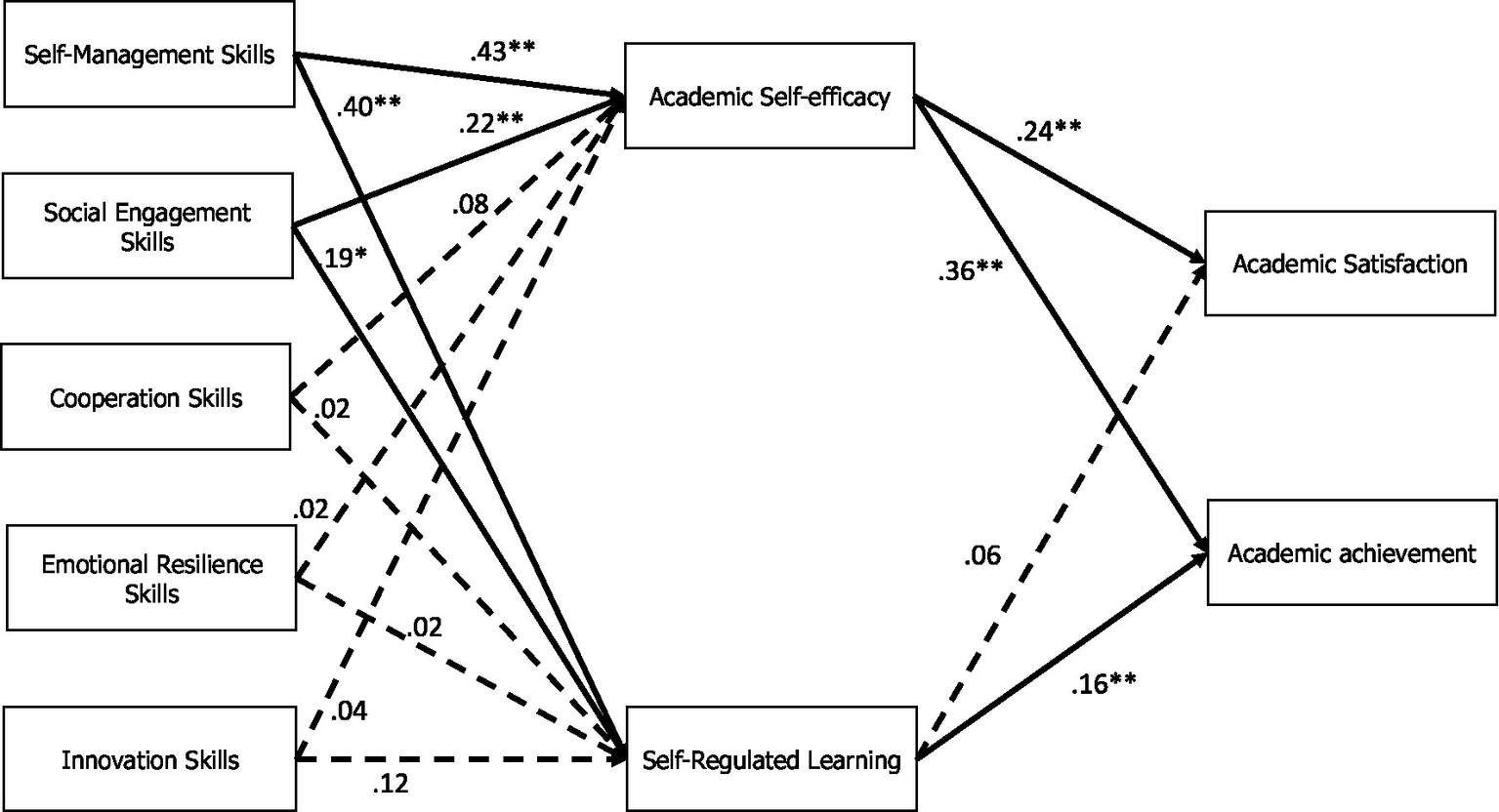
Fitted path analysis illustrating the relationship between behavioral, emotional, and social skills and academic achievements, mediated by academic self-efficacy and self-regulated learning. For the sake of readability, in this figure direct associations between SEB skills and academic outcomes (achievement and satisfaction) and residual variances are not reported.
Table 3
| Independent variable | Dependent variable | β | p-value | 95% CI | |
|---|---|---|---|---|---|
| Sex | → | ASE | 0.00 | 0.94 | [−0.10; 0.09] |
| → | SRL | −0.01 | 0.90 | [−0.11; 0.10] | |
| → | AS | 0.02 | 0.73 | [−0.08; 0.11] | |
| → | Achievement | −0.09 | 0.06 | [−0.19; 0.01] | |
| Age | → | ASE | −0.05 | 0.35 | [−0.14; 0.05] |
| → | SRL | −0.06 | 0.34 | [−0.20; 0.07] | |
| → | AS | 0.09 | 0.11 | [−0.02; 0.20] | |
| → | Achievement | 0.03 | 0.63 | [−0.10; 0.17] | |
| Year of study | → | ASE | 0.03 | 0.61 | [−0.08; 0.13] |
| → | SRL | 0.05 | 0.44 | [−0.07; 0.17] | |
| → | AS | −0.07 | 0.21 | [−0.17; 0.04] | |
| → | Achievement | 0.05 | 0.36 | [−0.05; 0.15] | |
| Italy (dummy variable) | → | ASE | −0.04 | 0.56 | [−0.17; 0.09] |
| → | SRL | 0.23 | < 0.001 | [0.11; 0.36] | |
| → | AS | 0.04 | 0.49 | [−0.08; 0.16] | |
| → | Achievement | −0.32 | < 0.001 | [−0.44; −0.20] | |
| Spain (dummy variable) | → | ASE | 0.03 | 0.62 | [−0.09; 0.16] |
| → | SRL | 0.34 | < 0.001 | [0.21; 0.46] | |
| → | AS | 0.33 | < 0.001 | [0.21; 0.46] | |
| → | Achievement | −0.40 | < 0.001 | [−0.52; −0.27] | |
| Self-management | → | ASE | 0.43 | < 0.001 | [0.33; 0.54] |
| → | SRL | 0.40 | < 0.001 | [0.29; 0.50] | |
| → | AS | 0.07 | 0.35 | [−0.07; 0.20] | |
| → | Achievement | 0.02 | 0.71 | [−0.09; 0.13] | |
| Innovation | → | ASE | 0.04 | 0.48 | [−0.08; 0.16] |
| → | SRL | 0.12 | 0.06 | [−0.01; 0.24] | |
| → | AS | 0.15 | 0.05 | [−0.00; 0.29] | |
| → | Achievement | −0.04 | 0.51 | [−0.16; 0.08] | |
| Cooperation | → | ASE | 0.08 | 0.27 | [−0.06; 0.21] |
| → | SRL | 0.02 | 0.78 | [−0.12; 0.16] | |
| → | AS | 0.10 | 0.14 | [−0.03; 0.23] | |
| → | Achievement | −0.02 | 0.78 | [−0.14; 0.10] | |
| Social engagement | → | ASE | 0.22 | < 0.001 | [0.09; 0.35] |
| → | SRL | 0.19 | 0.001 | [0.06; 0.31] | |
| → | AS | 0.09 | 0.23 | [−0.06; 0.24] | |
| → | Achievement | −0.02 | 0.78 | [−0.15; 0.12] | |
| Emotional resilience | → | ASE | 0.02 | 0.74 | [−0.11; 0.15] |
| → | SRL | 0.02 | 0.77 | [−0.12; 0.16] | |
| → | AS | 0.00 | 0.95 | [−0.12; 0.13] | |
| → | Achievement | −0.05 | 0.41 | [−0.18; 0.07] | |
| Academic self-efficacy | → | AS | 0.24 | < 0.001 | [0.11; 0.38] |
| → | Achievement | 0.36 | < 0.001 | [0.26; 0.46] | |
| Self-regulated learning | → | AS | 0.06 | 0.29 | [−0.05; 0.17] |
| → | Achievement | 0.16 | < 0.001 | [0.07; 0.26] |
Results of the path analysis model: direct associations.
ASE, academic self-efficacy; SRL, SRL strategies; AS, academic satisfaction; β, standardized coefficient; CI, confidence interval.
Table 4
| Independent variable | Mediator | Dependent variable | β | p-value | 95% CI |
|---|---|---|---|---|---|
| Self-management → | ASE → | AS | 0.11 | < 0.001 | [0.04; 0.17] |
| ASE → | Achievement | 0.16 | < 0.001 | [0.10; 0.21] | |
| SRL → | AS | 0.02 | 0.29 | [−0.02; 0.07] | |
| SRL → | Achievement | 0.06 | 0.003 | [0.02; 0.11] | |
| Innovation → | ASE → | AS | 0.01 | 0.48 | [−0.02; 0.04] |
| ASE → | Achievement | 0.02 | 0.48 | [−0.03; 0.06] | |
| SRL → | AS | 0.01 | 0.34 | [−0.01; 0.02] | |
| SRL → | Achievement | 0.02 | 0.12 | [−0.00; 0.04] | |
| Cooperation → | ASE → | AS | 0.02 | 0.29 | [−0.02; 0.05] |
| ASE → | Achievement | 0.03 | 0.27 | [−0.02; 0.07] | |
| SRL → | AS | 0.00 | 0.79 | [−0.01; 0.01] | |
| SRL → | Achievement | 0.00 | 0.78 | [−0.02; 0.03] | |
| Social Engagement → | ASE → | AS | 0.05 | 0.02 | [0.01; 0.10] |
| ASE → | Achievement | 0.08 | 0.004 | [0.03; 0.13] | |
| SRL → | AS | 0.01 | 0.33 | [−0.01; 0.03] | |
| SRL → | Achievement | 0.03 | 0.03 | [0.00; 0.06] | |
| Emotional Resilience → | ASE → | AS | 0.01 | 0.74 | [−0.03; 0.04] |
| ASE → | Achievement | 0.01 | 0.74 | [−0.04; 0.05] | |
| SRL → | AS | 0.00 | 0.78 | [−0.01; 0.01] | |
| SRL → | Achievement | 0.00 | 0.77 | [−0.02; 0.03] |
Results of the path analysis model: indirect associations.
ASE, academic self-efficacy; SRL, SRL strategies; AS, academic satisfaction; β, standardized coefficient; CI, confidence interval.
4.3 Path analysis: indirect associations
As for the indirect associations, results showed that self-management and social engagement skills were positively associated with academic achievement through the mediation of SRL (self-management: β = 0.06, p < 0.01; social engagement: β = 0.03, p < 0.05) and academic self-efficacy (self-management: β = 0.06, p < 0.01; social engagement: β = 0.03, p < 0.05), and with academic satisfaction through the mediation of academic self-efficacy.
5 Discussion
Research on higher education students has attempted to identify key individual factors associated with academic achievement and satisfaction (Casali et al., 2024; Richardson et al., 2012). Recently, researchers have identified soft skills as individual competencies that could support students throughout their academic journey (Casali and Meneghetti, 2023). The present study proposed a comprehensive model in which five SEB domains (self-management, social engagement, cooperation, emotional resilience, and innovation; Soto et al., 2021) were associated with achievement and academic satisfaction through the mediation of two study-related factors - academic self-efficacy and SRL (García-Ros et al., 2023; Mega et al., 2014; Theobald, 2021). The study was conducted in a sample of higher education students from Spain, Italy, and Israel.
Overall, the study’s findings support previous literature regarding the influence of study-related factors on academic success and satisfaction (Casali and Meneghetti, 2023; Diseth et al., 2012; Richardson et al., 2012). In particular, self-management and social engagement skills were indirectly associated with academic satisfaction through academic self-efficacy and with academic achievement through self-efficacy and SRL. These findings highlight the importance of considering the interplay between SEB skills and study-related factors in promoting student success and satisfaction.
5.1 Direct association between SEB skills, academic self-efficacy, SRL, and academic outcomes
As a first step, the direct associations of SEB skills, academic self-efficacy, and SRL on academic achievement and satisfaction were tested. Our results indicated that SEB skills were not directly associated with academic achievement and satisfaction. These findings are in line with previous research on soft skills, which highlighted that skills may not have a direct impact on educational outcomes, but their effect may be mediated by other individual factors, such as motivational and metacognitive study-related factors (Casali and Meneghetti, 2023; Feraco et al., 2022a,b).
Although our hypothesis predicting a significant positive direct association between innovation skills, emotional resilience, and academic satisfaction was not supported by the path analysis model, the bivariate correlations indicated that these skills were positively related to this outcome, consistent with previous research (Soto et al., 2022b). This finding suggests that innovation and emotional resilience remain relevant, although other domains (i.e., self-management and social engagement) may play a larger role in explaining variability in academic satisfaction.
A significant relationship between academic self-efficacy and academic achievement and satisfaction was found (Casali et al., 2024; Høigaard et al., 2015; Lee et al., 2022). Students who perceived themselves as more capable of meeting academic demands also reported higher levels of academic satisfaction and better achievement. Academic self-efficacy is one of the most important intraindividual antecedents of academic outcomes in higher education (Bandura, 1982, 2012; Casali et al., 2024; Richardson et al., 2012) and one of the most powerful motivational resources that drive individuals to engage, persevere, and accomplish goals in various domains (Lee et al., 2022). SRL was significantly associated only with achievement: students who reported using functional SRL strategies more often also reported higher grades (Casali et al., 2022; Richardson et al., 2012).
5.2 SEB skills, study-related factors, and academic outcomes: indirect associations
In line with previous studies (Casali and Meneghetti, 2023; Feraco et al., 2022a,b), we expected that the associations between SEB skills and academic outcomes would be partly explained by the associations between SEB skills and study-related factors. The results confirmed an indirect association between self-management and social engagement skills with academic satisfaction through academic self-efficacy: higher levels of reported self-management and social engagement skills were positively related to higher academic self-efficacy, which in turn, was related to higher academic satisfaction. Self-management skills include the abilities to set goals, manage time and tasks, and be persistent in achieving goals (Napolitano et al., 2021). Thus, students with higher self-management skills may perceive themselves as more capable of organizing their academic activities, managing daily study routines, and achieving their desired academic goals (Mega et al., 2014; Theobald, 2021). In addition, social engagement skills include the ability to initiate conversations with others and express personal opinions. Since active engagement with peers and instructors is an integral part of the college experience (Reeve et al., 2022), students who perceive themselves as more socially proficient may also perceive themselves as more academically competent. The development of social engagement skills may enhance students’ sense of academic competence, as they are better capable of seeking assistance from their peers when required (Dueñas et al., 2021), expressing opinions during lessons, asking questions, and expressing their preferences regarding learning conditions with the academic staff (Reeve et al., 2022).
Finally, self-management and social engagement skills were indirectly associated with academic achievement through academic self-efficacy and SRL. Students who reported higher self-management and social engagement skills also reported higher academic self-efficacy and the use of more functional SRL strategies. These students may use their general self-management skills to organize their study routines and identify the most functional learning strategies (Feraco et al., 2025). Moreover, they may benefit from their peer support in navigating study-related challenges (Napolitano et al., 2021). This, in turn, can help students achieve better grades (Feraco et al., 2025; Mega et al., 2014; Wang et al., 2019).
Our hypothesis predicting an indirect association between innovation skills and academic achievement via academic self-efficacy was not supported by the path analysis model. Nonetheless, significant correlations emerged both between innovation skills and self-efficacy, and between self-efficacy and achievement, aligning with previous research (Basileo et al., 2024; Feraco et al., 2025). This pattern suggests that although innovation skills relate to self-efficacy and achievement, other SEB skill domains may be more central in accounting for variability in these outcomes.
Taken together, our findings confirm that self-management and social engagement skill domains may represent domain-general individual capacities that can support students academically (Casali and Meneghetti, 2023; Feraco et al., 2022a, 2025; Wang et al., 2019). They suggest that when working with higher education students, it may be important to consider not only study-related factors but also general individual characteristics that could contribute to their success at university (Casali et al., 2024).
5.3 Implications for theory and practice
The results of the study have several theoretical and practical implications. From a theoretical perspective, they underline that students’ success in higher education is not only associated with motivation and metacognitive factors but also with domain-general SEB skills, that are important in the academic context and beyond (Casali and Meneghetti, 2023; Soto et al., 2022b). In addition, the recent SEB skills framework (Soto et al., 2022a) appears to be a solid theoretical model for exploring the specific contribution of different skill domains, as each may have different associations with study-related factors and educational outcomes.
The present study also holds important practical implications. Typically, higher education institutions organize activities designed to enhance only study-related skills, such as SRL strategies (Pellegrino et al., 2023). However, the present study suggests that a more comprehensive approach to learning processes and students’ well-being may include the promotion of a wider range of SEB skills. Promoting these skills aims to equip students with the competencies necessary to adapt to the academic environment and navigate potential academic challenges. At the same time, these skills are considered fundamental in various careers, so it should be an important goal of higher education institutions to prepare students for the transition to work by fostering these competencies (Feraco et al., 2022a; Napolitano et al., 2021).
5.4 Limitations and future directions
The current study is subject to certain limitations. Primarily, the study relied on student self-report of their grades, which were not directly verified. Future studies could verify grades through official academic records to further strengthen the robustness of the findings.
Secondly, due to the relatively small sample sizes in each country, it was not feasible to test the invariance of the path model, the measurement invariance of the questionnaires, or the potential moderating effects of nationality. To mitigate this limitation, nationality was controlled for in the path analysis model. Future research should examine both measurement and structural invariance, and compare the role of SEB skills in academic achievement and satisfaction across different cultural contexts to identify possible patterns of relations specific to each context.
Another limitation is that our study employed a cross-sectional design, which precludes the possibility of inferring causal relationships between the variables. Future research should use longitudinal or experimental designs to collect more evidence on the causal associations between these variables.
Our sample included a majority of female participants and undergraduate students from the field of education sciences, life sciences, and psychology, a pattern also observed in studies using similar recruitment approaches (e.g., Casali and Meneghetti, 2023). In addition, there were age differences across the three nations. To enhance the generalizability of our findings, future research should aim for a more diversified sample, for example by employing stratified sampling strategies.
In our study, emotional resilience, innovation, and cooperation skills showed positive correlations with academic satisfaction and achievement but were not significant predictors in the path analysis model. This discrepancy may reflect the stronger role of self-management and social engagement domains, which likely account for a larger share of the variability in satisfaction and achievement. Nonetheless, emotional resilience, innovation, and cooperation skills may still be relevant for other important academic outcomes, such as coping with stress and challenges (Fiorilli et al., 2022) and positive participation in group activities (Poort et al., 2022). Future research should therefore consider a broader range of outcomes to clarify the role of these skills in higher education.
Finally, given the pivotal role that SEB skills may play in supporting higher education students, it would be relevant to investigate their importance for students facing specific learning challenges, for example, students with specific learning disorders and attention deficit hyperactivity disorder (Casali et al., 2024).
6 Conclusion
The present study proposed a comprehensive model in which five SEB skill domains are associated with achievement and academic satisfaction directly and through the mediation of two study-related factors – academic self-efficacy and SRL. We hypothesized an indirect association of self-management skills with academic achievement as satisfaction trough self-efficacy and SRL. Moreover, we expected a significant indirect association of innovation skills with academic achievement. Finally, we expected positive associations between innovation and emotional resilience skills with academic satisfaction. The results confirmed our hypothesis that self-management would be positively associated with academic achievement through the mediation of SRL and academic self-efficacy, and with academic satisfaction through the mediation of self-efficacy. Additionally, social engagement skills showed a similar pattern of mediated associations. However, no significant direct associations were found between SEB skills and either academic satisfaction or academic achievement. The results suggest that students who believe they possess some social, emotional, and behavioral skills that can be beneficial during their studies (such as self-management skills and social engagement), perceive themselves as more competent and self-regulated learners. This perception may lead to better academic results and greater satisfaction with their academic pursuits.
Statements
Data availability statement
The raw data supporting the conclusions of this article will be made available by the authors, without undue reservation.
Ethics statement
The studies involving humans were approved by Ethical Committee of the University of Oviedo, University of Padova, and Kibbutzim College of Education, Technology and the Arts. The studies were conducted in accordance with the local legislation and institutional requirements. The participants provided their written informed consent to participate in this study.
Author contributions
AS: Investigation, Funding acquisition, Conceptualization, Writing – review & editing, Data curation, Writing – original draft. BC: Methodology, Conceptualization, Writing – review & editing, Supervision, Investigation. MC: Investigation, Data curation, Conceptualization, Writing – review & editing, Methodology. CR: Investigation, Writing – review & editing, Conceptualization, Supervision. GP: Writing – review & editing, Methodology, Formal analysis, Writing – original draft, Conceptualization, Visualization, Data curation, Software.
Funding
The author(s) declare that financial support was received for the research and/or publication of this article. This study was conducted with the support of the Fund for Applied Research at the MOFET Institute, Tel Aviv, Israel. Open Access funding provided by Università degli Studi di Padova | University of Padua, Open Science Committee.
Conflict of interest
The authors declare that the research was conducted in the absence of any commercial or financial relationships that could be construed as a potential conflict of interest.
Generative AI statement
The authors declare that no Gen AI was used in the creation of this manuscript.
Any alternative text (alt text) provided alongside figures in this article has been generated by Frontiers with the support of artificial intelligence and reasonable efforts have been made to ensure accuracy, including review by the authors wherever possible. If you identify any issues, please contact us.
Publisher’s note
All claims expressed in this article are solely those of the authors and do not necessarily represent those of their affiliated organizations, or those of the publisher, the editors and the reviewers. Any product that may be evaluated in this article, or claim that may be made by its manufacturer, is not guaranteed or endorsed by the publisher.
Supplementary material
The Supplementary material for this article can be found online at: https://www.frontiersin.org/articles/10.3389/fpsyg.2025.1653072/full#supplementary-material
References
1
Al-Abyadh M. H. A. Abdel Azeem H. A. H. (2022). Academic achievement: influences of university students’ self-management and perceived self-efficacy. J. Intelligence10:55. doi: 10.3390/jintelligence10030055
2
Bandura A. (1982). Self-efficacy mechanism in human agency. Am. Psychol.37, 122–147. doi: 10.1037/0003-066X.37.2.122
3
Bandura A. (2012). On the functional properties of perceived self-efficacy revisited. J. Manage38, 9–44. doi: 10.1177/0149206311410606
4
Bandura A. (2018). Toward a psychology of human agency: pathways and reflections. Perspect. Psychol. Sci.13, 130–136. doi: 10.1177/1745691617699280
5
Basileo L. D. Otto B. Lyons M. Vannini N. Toth M. D. (2024). The role of self-efficacy, motivation, and perceived support of students’ basic psychological needs in academic achievement. Front. Educ.9:1385442. doi: 10.3389/feduc.2024.1385442
6
Beaujean A. A. (2014). Latent variable modeling using R: A step by step guide. New York: Routledge/Taylor & Francis Group.
7
Ben-Eliyahu A. (2019). Academic emotional learning: a critical component of self-regulated learning in the emotional learning cycle. Educ. Psychol.54, 84–105. doi: 10.1080/00461520.2019.1582345
8
Breil S. M. Mielke I. Ahrens H. Geldmacher T. Sensmeier J. Marschall B. et al . (2022). Predicting actual social skill expression from personality and skill self-concepts. J. Intelligence10:48. doi: 10.3390/jintelligence10030048
9
Casali N. Ghisi M. Meneghetti C. (2022). The role of general and study-related intraindividual factors on academic learning outcomes under COVID-19: a cross-sectional and longitudinal analysis. Educ. Sci.12:101. doi: 10.3390/educsci12020101
10
Casali N. Meneghetti C. (2023). Soft skills and study-related factors: direct and indirect associations with academic achievement and general distress in university students. Educ. Sci.13:612. doi: 10.3390/educsci13060612
11
Casali N. Meneghetti C. Tinti C. Re A. M. Sini B. Passolunghi M. C. et al . (2024). Academic achievement and satisfaction among university students with specific learning disabilities: the roles of soft skills and study-related factors. J. Learn. Disabil.57, 16–29. doi: 10.1177/00222194221150786
12
Collie R. J. Martin A. J. (2024). The academic and social-emotional flourishing framework. Learn. Individ. Differ.114:102523. doi: 10.1016/j.lindif.2024.102523
13
De Beni R. Zamperlin C. Meneghetti C. Cornoldi C. Fabris M. De Min Tona G. et al . (2014). Amos: abilità e motivazione allo studio: prove di valutazione e orientamento per la scuola secondaria di secondo grado e l’università. Trento: Erickson.
14
Diseth Å. Danielsen A. G. Samdal O. (2012). A path analysis of basic need support, self-efficacy, achievement goals, life satisfaction and academic achievement level among secondary school students. Educ. Psychol.32, 335–354. doi: 10.1080/01443410.2012.657159
15
Duckworth A. L. Yeager D. S. (2015). Measurement matters: assessing personal qualities other than cognitive ability for educational purposes. Educ. Res.44, 237–251. doi: 10.3102/0013189X15584327
16
Dueñas J.-M. Camarero-Figuerola M. Castarlenas E. (2021). Academic help-seeking attitudes, and their relationship with emotional variables. Sustainability13:6120. doi: 10.3390/su13116120
17
Feraco T. Bonelli R. Da Re L. Meneghetti C. (2025). Soft skills in high schools: integrating self-regulated learning and social, emotional, and behavioral skills frameworks. PsyArXiv [Preprint]. doi: 10.31234/osf.io/w5tnr_v2
18
Feraco T. Casali N. Pellegrino G. Soto C. J. Napolitano C. M. Carretti B. et al . (2024a). The Italian behavioral, emotional, and social skills inventory (BESSI-I). J. Pers. Assess.106, 750–764. doi: 10.1080/00223891.2024.2335912
19
Feraco T. Mammarella I. C. Meneghetti C. (2024b). The relation between soft skills and arithmetic performance. J. Exp. Educ.2024, 1–20. doi: 10.1080/00220973.2024.2364621
20
Feraco T. Resnati D. Fregonese D. Spoto A. Meneghetti C. (2022a). An integrated model of school students’ academic achievement and life satisfaction. Linking soft skills, extracurricular activities, self-regulated learning, motivation, and emotions. Eur. J. Psychol. Educ.38, 109–130. doi: 10.1007/s10212-022-00601-4
21
Feraco T. Resnati D. Fregonese D. Spoto A. Meneghetti C. (2022b). Soft skills and extracurricular activities sustain motivation and self-regulated learning at school. J. Exp. Educ.90, 550–569. doi: 10.1080/00220973.2021.1873090
22
Fiorilli C. Barni D. Russo C. Marchetti V. Angelini G. Romano L. (2022). Students’ burnout at university: the role of gender and worker status. IJERPH19:11341. doi: 10.3390/ijerph191811341
23
Fong C. J. Krou M. R. Johnston-Ashton K. Hoff M. A. Lin S. Gonzales C. (2021). LASSI’S great adventure: a meta-analysis of the learning and study strategies inventory and academic outcomes. Educ. Res. Rev.34:100407. doi: 10.1016/j.edurev.2021.100407
24
García-Ros R. Pérez-González F. Tomás J. M. Sancho P. (2023). Effects of self-regulated learning and procrastination on academic stress, subjective well-being, and academic achievement in secondary education. Curr. Psychol.42, 26602–26616. doi: 10.1007/s12144-022-03759-8
25
Gnambs T. Kaspar K. (2015). Disclosure of sensitive behaviors across self-administered survey modes: a meta-analysis. Behav. Res.47, 1237–1259. doi: 10.3758/s13428-014-0533-4
26
Høigaard R. Kovač V. B. Øverby N. C. Haugen T. (2015). Academic self-efficacy mediates the effects of school psychological climate on academic achievement. Sch. Psychol. Q.30, 64–74. doi: 10.1037/spq0000056
27
Huebner E. S. Zullig K. J. Saha R. (2012). Factor structure and reliability of an abbreviated version of the multidimensional students’ life satisfaction scale. Child. Ind.5, 651–657. doi: 10.1007/s12187-012-9140-z
28
Jiang X. Fang L. Stith B. R. Liu R. Huebner E. S. (2021). A cross-cultural evaluation of the students’ life satisfaction scale in Chinese and American adolescents. Curr. Psychol.40, 2552–2560. doi: 10.1007/s12144-019-00188-y
29
Jorgensen T. D. Pornprasertmanit S. Schoemann A. M. Rosseel Y. (2025) semTools: Useful tools for structural equation modeling. R package version 0.5–7 Available online at: https://CRAN.R-project.org/package=semTools
30
Kryshko O. Fleischer J. Grunschel C. Leutner D. (2023). University students’ self-efficacy for motivational regulation, use of motivational regulation strategies, and satisfaction with academic studies: exploring between-person and within-person associations. J. Educ. Psychol.115, 571–588. doi: 10.1037/edu0000785
31
Lechner C. M. Knopf T. Napolitano C. M. Rammstedt B. Roberts B. W. Soto C. J. et al . (2022). The behavioral, emotional, and social skills inventory (BESSI): psychometric properties of a German-language adaptation, temporal stabilities of the skills, and associations with personality and intelligence. J. Intelligence10:63. doi: 10.3390/jintelligence10030063
32
Lee J. Lee H. J. Bong M. (2022). Boosting children’s math self-efficacy by enriching their growth mindsets and gender-fair beliefs. Theor. Pract.61, 35–48. doi: 10.1080/00405841.2021.1932156
33
Lin Y. Wang X. Zhang X. Hu H. Liu L. Pang K. et al . (2025). The impact of undergraduate nursing students’ time management disposition on innovative behavior: the chain mediating role of academic self-efficacy and flow experience. Front. Psychol.16:1447121. doi: 10.3389/fpsyg.2025.1447121
34
McCrae R. R. Costa P. T. (1989). The structure of interpersonal traits: Wiggins’s circumplex and the five-factor model. J. Pers. Soc. Psychol.56, 586–595. doi: 10.1037/0022-3514.56.4.586
35
Mega C. Ronconi L. De Beni R. (2014). What makes a good student? How emotions, self-regulated learning, and motivation contribute to academic achievement. J. Educ. Psychol.106, 121–131. doi: 10.1037/a0033546
36
Napolitano C. M. Sewell M. N. Yoon H. J. Soto C. J. Roberts B. (2021). Social, emotional, and behavioral skills: an integrative model of the skills associated with success during adolescence and across the life span. Front. Educ.6:679561. doi: 10.3389/feduc.2021.679561
37
OECD (2015). Skills for Social Progress: The Power of Social and Emotional Skills. Paris: OECD.
38
OECD (2021). Beyond academic learning: First results from the survey of social and emotional skills 2019. Paris: OECD.
39
Panadero E. (2017). A review of self-regulated learning: six models and four directions for research. Front. Psychol.8:422. doi: 10.3389/fpsyg.2017.00422
40
Park D. Tsukayama E. Goodwin G. P. Patrick S. Duckworth A. L. (2017). A tripartite taxonomy of character: evidence for intrapersonal, interpersonal, and intellectual competencies in children. Contemp. Educ. Psychol.48, 16–27. doi: 10.1016/j.cedpsych.2016.08.001
41
Pellegrino G. Casali N. Meneghetti C. Tinti C. Anna M. R. Sini B. et al . (2023). Universal and specific services for university students with specific learning disabilities: the relation to study approach, academic achievement, and satisfaction. Learn. Disabil. Res. Pract.38, 274–284. doi: 10.1111/ldrp.12323
42
Pellegrino G. Feraco T. Meneghetti C. Carretti B. (2025). Ready for what’s next? The associations between social, emotional, and behavioral skills and career adaptability in high school students. J. Adolesc.97:jad.12486. doi: 10.1002/jad.12486
43
Poort I. Jansen E. Hofman A. (2022). Does the group matter? Effects of trust, cultural diversity, and group formation on engagement in group work in higher education. High. Educ. Res. Dev.41, 511–526. doi: 10.1080/07294360.2020.1839024
44
Postigo Á. González-Nuevo C. García-Fernández J. García-Cueto E. Soto C. J. Napolitano C. M. et al . (2024). The behavioral, emotional, and social skills inventory: a Spanish adaptation and further validation in adult population. Assessment31, 1525–1547. doi: 10.1177/10731911231225197
45
R Core Team (2024). R: A language and environment for statistical Computing_. Vienna, Austria: R Foundation for Statistical Computing.
46
Reeve J. Jang H.-R. Shin S. H. Ahn J. S. Matos L. Gargurevich R. (2022). When students show some initiative: two experiments on the benefits of greater agentic engagement. Learn. Instr.80:101564. doi: 10.1016/j.learninstruc.2021.101564
47
Richardson M. Abraham C. Bond R. (2012). Psychological correlates of university students’ academic performance: a systematic review and meta-analysis. Psychol. Bull.138, 353–387. doi: 10.1037/a0026838
48
Robles M. M. (2012). Executive perceptions of the top 10 soft skills needed in today’s workplace. Bus. Commun. Q.75, 453–465. doi: 10.1177/1080569912460400
49
Rosseel Y. (2012). Lavaan: an R package for structural equation modeling. J. Stat. Soft.48:i02. doi: 10.18637/jss.v048.i02
50
Russell J. M. Baik C. Ryan A. T. Molloy E. (2022). Fostering self-regulated learning in higher education: making self-regulation visible. Acta Learn. High. Educ.23, 97–113. doi: 10.1177/1469787420982378
51
Sanchez E. I. Buddin R. (2016). How Accurate are Self-Reported High School Courses, Course Grades, and Grade Point Average (ACT Research Report 2016–3). Iowa City: ACT. Available online at: https://www.act.org/content/dam/act/unsecured/documents/5269-research-report-how-accurate-are-self-reported-hs-courses.pdf (Accessed August 12, 2025).
52
Sewell M. N. Napolitano C. M. Roberts B. W. Soto C. J. Yoon H. J. (2023). The social, emotional, and behavioral skill antecedents to college students’ volunteering during the COVID -19 pandemic. J. Res. Adolesc.33, 618–631. doi: 10.1111/jora.12830
53
Sewell M. N. Yoon H. J. Lechner C. M. Napolitano C. M. Rammstedt B. Roberts B. W. et al . (2024). Assessing social, emotional, and behavioral skills in just a few minutes: 96-, 45-, and 20-item short forms of the BESSI. Assessment32:10731911241256434. doi: 10.1177/10731911241256434
54
Sharabi A. Shelach Inbar O. (2024). Positive distance learning perception, personal resources, and loneliness among higher education students with ADHD and/or SLD. Learn. Disabil. Res. Pract.:09388982241247580. doi: 10.1177/09388982241247580
55
Sharabi A. Sade S. Margalit M. (2016). Virtual connections, personal resources, loneliness, and academic self-efficacy among college students with and without LD. Eur. J. Spec. Needs Educ.31, 376–390. doi: 10.1080/08856257.2016.1141542
56
Soto C. J. Napolitano C. M. Roberts B. W. (2021). Taking skills seriously: toward an integrative model and agenda for social, emotional, and behavioral skills. Curr. Dir. Psychol. Sci.30, 26–33. doi: 10.1177/0963721420978613
57
Soto C. J. Napolitano C. M. Sewell M. N. Yoon H. J. Roberts B. W. (2022a). An integrative framework for conceptualizing and assessing social, emotional, and behavioral skills: the BESSI. J. Pers. Soc. Psychol.123, 192–222. doi: 10.1037/pspp0000401
58
Soto C. J. Napolitano C. M. Sewell M. N. Yoon H. J. Roberts B. W. (2022b). Going beyond traits: social, emotional, and behavioral skills matter for adolescents’ success. Soc. Psychol. Personal. Sci.15, 33–45. doi: 10.1177/19485506221127483
59
Sticca F. Goetz T. Bieg M. Hall N. C. Eberle F. Haag L. (2017). Examining the accuracy of students’ self-reported academic grades from a correlational and a discrepancy perspective: evidence from a longitudinal study. PLoS One12:e0187367. doi: 10.1371/journal.pone.0187367
60
Theobald M. (2021). Self-regulated learning training programs enhance university students’ academic performance, self-regulated learning strategies, and motivation: a meta-analysis. Contemp. Educ. Psychol.66:101976. doi: 10.1016/j.cedpsych.2021.101976
61
Wang M.-T. Degol J. L. Henry D. A. (2019). An integrative development-in-sociocultural-context model for children’s engagement in learning. Am. Psychol.74, 1086–1102. doi: 10.1037/amp0000522
62
World Economic Forum (2016) New vision for education. Geneva: Fostering social and emotional learning through technology.
63
Zimmerman B. J. (2000). Attaining Self-Regulation: A Social Cognitive Perspective. In M. Boekaerts, P. R. Pintrich, & M. Zeidner (Eds.), Handbook of Self-Regulation (pp. 13-39). San Diego, CA: Academic Press.
Summary
Keywords
academic self-efficacy, academic satisfaction, self-regulated learning, soft skills, higher education
Citation
Sharabi A, Carretti B, Cueli M, Rodríguez C and Pellegrino G (2025) Undergraduates’ achievement and satisfaction: the role of study-related factors and soft skills. Front. Psychol. 16:1653072. doi: 10.3389/fpsyg.2025.1653072
Received
24 June 2025
Accepted
17 September 2025
Published
08 October 2025
Volume
16 - 2025
Edited by
Evely Boruchovitch, State University of Campinas, Brazil
Reviewed by
Carol Nash, University of Toronto, Canada
Huajie Shen, Fujian University of Technology, China
Updates
Copyright
© 2025 Sharabi, Carretti, Cueli, Rodríguez and Pellegrino.
This is an open-access article distributed under the terms of the Creative Commons Attribution License (CC BY). The use, distribution or reproduction in other forums is permitted, provided the original author(s) and the copyright owner(s) are credited and that the original publication in this journal is cited, in accordance with accepted academic practice. No use, distribution or reproduction is permitted which does not comply with these terms.
*Correspondence: Adi Sharabi, adi.sharabi@smkb.ac.il; Gerardo Pellegrino, gerardo.pellegrino@phd.unipd.it
†ORCID: Adi Sharabi, https://orcid.org/0000-0002-7998-1344
Barbara Carretti, https://orcid.org/0000-0001-5147-7544
Marisol Cueli, https://orcid.org/0000-0002-4662-0534
Celestino Rodríguez, https://orcid.org/0000-0003-4137-4503
Gerardo Pellegrino, https://orcid.org/0000-0001-7032-9774
Disclaimer
All claims expressed in this article are solely those of the authors and do not necessarily represent those of their affiliated organizations, or those of the publisher, the editors and the reviewers. Any product that may be evaluated in this article or claim that may be made by its manufacturer is not guaranteed or endorsed by the publisher.