Abstract
Introduction:
To investigate the influence of place attachment on pro-environmental behavioral intentions and the mediating role of nature connectedness.
Methods:
Study 1 employed a questionnaire survey method with 1,019 university students as research participants. Study 2 recruited 160 participants and used an experimental method to manipulate place attachment to examine its effects on nature connectedness and pro-environmental behavioral intentions.
Results:
The results of both studies consistently demonstrated that place attachment positively predicts pro-environmental behavioral intentions and nature connectedness partially mediates the relationship between place attachment and pro-environmental behavioral intentions. Specifically, place attachment not only directly promotes pro-environmental behavioral intentions but also indirectly facilitates such intentions through nature connectedness.
Discussion:
These findings indicate that fostering place attachment and a sense of connectedness to nature may serve as effective pathways for encouraging individuals to engage in more pro-environmental behaviors. This provides empirical evidence to inform the design of relevant interventions and the formulation of environmental policies.
1 Introduction
Due to the threats posed by global warming and the increasing frequency of extreme climate-related disasters, the Earth’s ecological environment is deteriorating at an unprecedented scale and pace. This process has directly or indirectly caused hundreds of species to face the risk of extinction, as well as economic damages exceeding billions of dollars (IPCC, 2021). As environmental degradation accelerates, although people have gradually become aware of the environmental crisis, but most individuals still do not engage in pro-environmental behaviors (Finger, 1994; Halpenny, 2010). Therefore, changing human behavioral patterns is essential for mitigating environmental deterioration (Poškus and Žukauskiene, 2017). Identifying ways to encourage individuals to adopt more pro-environmental behaviors has become a critical research and societal priority. While previous research has established a positive relationship between place attachment and pro-environmental behavior (Daryanto and Song, 2021; Scannell and Gifford, 2010a,b), several important gaps remain. First, most studies have focused on direct relationships with limited attention to underlying psychological mechanisms (Ramkissoon et al., 2013). Second, existing evidence is predominantly derived from North American countries characterized by individualistic cultural contexts (Ariccio et al., 2021; Halpenny, 2010), whereas validation within collectivistic cultures remains limited. Third, experimental evidence for causal relationships remains scarce, as most studies rely on correlational designs. Place attachment refers to the bond formed between individuals and important places (Lewicka, 2011; Scannell and Gifford, 2017a). According to interdependence theory (Kelley and Thibaut, 1978; Davis et al., 2009), people who develop attachment to specific places are personally affected when these places are harmed. The interdependent person-place relationship may motivate individuals to adopt more pro-environmental behaviors to protect the places to which they are attached (Scannell and Gifford, 2010b).
Furthermore, the internal mechanisms through which place attachment influences pro-environmental behavioral intentions have not been sufficiently discussed. Previous scholars have separately explored this from cognitive (Barbaro et al., 2015; Hernandez et al., 2010; Lee and Lee, 2017; Valizadeh et al., 2020) and affective perspectives (Jiao et al., 2023; Wang and Wu, 2015), with the limited investigation into composite psychological variables. Nature connectedness reflects the close relationship between humans and nature (Kals et al., 1999), encompassing both the cognitive closeness to nature and emotional attachment to it (Li et al., 2018). Existing research indicates that nature connectedness is not only a psychological consequence triggered by place attachment (Scannell and Gifford, 2017b) but also viewed as a source of hope for improving human’s pro-environmental behavior (Scannell and Gifford, 2010b; Zhou et al., 2023). Based on a review of relevant literature, the present study aims to verify the influence of place attachment on pro-environmental behavioral intentions and explore nature connectedness as a psychological mechanism mediating the relationship between the two.
1.1 Place attachment and pro-environmental behavioral intentions
To establish the theoretical foundation for our hypotheses, we first examine the relationship between place attachment and pro-environmental behavioral intentions. According to place attachment theory (Bowlby, 1969; Lewicka, 2011; Tuan, 1977), individuals with higher levels of place attachment demonstrate long-term, positive emotional connections and a willingness to protect places. Researchers consider place attachment to be a powerful predictor of pro-environmental behavioral intentions (Scannell and Gifford, 2010b; Zhang et al., 2014; Zhou et al., 2023). Empirical studies have provided supportive evidence, with relevant research indicating that place attachment is significantly positively correlated with pro-environmental behavioral intentions (Ramkissoon et al., 2013), adolescents with higher degrees of place attachment are more inclined to exhibit pro-environmental behaviors (Vaske and Kobrin, 2001), and surveys of different populations have found positive predictive effects of place attachment on pro-environmental behavior, such as among tourists (Cheng and Wu, 2015) and residents (Song and Soopramanien, 2019; Walker and Ryan, 2008). Furthermore, laboratory research has found that after experimental manipulation to activate subjects’ place attachment, the pro-environmental behavioral intentions of the attachment group increased compared to the control group (Jiao et al., 2023). However, research on the influence of place attachment on pro-environmental behavioral intentions has primarily focused on individualistic cultural contexts, lacking evidence from collectivistic cultural backgrounds (Daryanto and Song, 2021). Therefore, the present study aims to replicate previous findings within a collectivistic cultural context in order to obtain relatively stable results. Based on interdependence theory and existing empirical evidence (Scannell and Gifford, 2010b; Zhang et al., 2014), we propose Hypothesis 1: place attachment is positively associated with pro-environmental behavioral intentions.
1.2 The mediating role of nature connectedness
According to the biophilia hypothesis (Wilson, 1984), individuals have an innate preference for and affiliation with natural environments. This preference can be approximately expressed as a preference for natural environments over built environments (Mangone et al., 2017) or as time spent in nature (Chen et al., 2018). For places to which people are attached, whether residential areas (Crompton, 2001; Meidenbauer et al., 2019) or tourist destinations (Fleischer, 2012), individuals tend to interact more with nature. Compared to indirect experiences, direct contact between humans and nature is a more effective pathway to promoting nature connectedness (Li et al., 2018). Relevant research indicates that place attachment is significantly positively correlated with nature connectedness (Wilkie and Trotter, 2022); laboratory studies have found that place attachment positively predicts the attractiveness of natural environments to subjects (Kaltenborn and Bjerke, 2002); a longitudinal study also showed that compared to urban or indoor environments, subjects reported the highest levels of place attachment to parks, beaches, and other natural environments (Korpela et al., 2009); evidence from cognitive neuroscience demonstrates that place attachment induces activity in individuals’ amygdala and medial prefrontal cortex (mPFC), which is highly correlated with positive cognitive perceptions and emotions related to places (Gatersleben et al., 2020).
Moreover, nature connectedness may not only be a psychological consequence of place attachment but also an antecedent variable that further triggers pro-environmental behavioral intentions. Nature connectedness is likely to promote pro-environmental behavioral intentions (Hinds and Sparks, 2008; Whitburn et al., 2020; Zhou et al., 2023). The ecological self-theory (Naess, 1985) suggests that when people recognize nature as part of themselves, they form an ecological view that equates harming nature with harming themselves, thereby motivating them to protect nature (Yang et al., 2017). Empirical research provides supporting evidence: people who have established close relationships with nature in the past and have more positive memories of such experiences are more committed to pro-environmental behaviors (Kaffashi et al., 2015; Nisbet et al., 2009); people living in green buildings (e.g., with higher air quality, more natural light, and larger areas of vegetation) more easily establish place attachment and are consequently more inclined to engage in pro-environmental behaviors (Cole et al., 2021). Based on the above, we propose Hypothesis 2 of the present study: nature connectedness mediates the relationship between place attachment and pro-environmental behavioral intentions.
2 Study 1
2.1 Participants
As part of this research, we adopted a survey-based methodological approach to investigate the associations among place attachment, nature connectedness, and pro-environmental behavior intentions. Data were collected offline at a university located in Guangxi Province, China. Throughout the data collection process, we adhered to the principle of voluntary participation and recruited respondents through random sampling on campus. After obtaining informed consent, participants completed the questionnaire via an online survey platform using their mobile phones. All data were collected within a single working day to minimize potential temporal confounds. Questionnaires were distributed to 1,091 students, and 1,019 valid responses were collected, yielding an effective response rate of 93.4%. Among the participants, were male (22.7%) and 788 were female (77.3%); 278 were from urban areas (27.3%), and 741 were from rural areas (72.7%). The average age of participants was 20.58 years (SD = 2.84).
2.2 Measures
2.2.1 Place attachment scale
The place attachment scale from Williams and Vaske (2003) was used, with participants reporting their place attachment to their current city of residence. The scale consists of 12 items encompassing two dimensions: place identity (e.g., I feel “X” is a part of me), and place dependence (e.g., “X” is the best place for what I like to do), Where “X” refers to the place of residence of the research subject. The scale employs a 7-point Likert scale, with ratings ranging from 1 (strongly disagree) to 7 (strongly agree). Higher scores indicate stronger place attachment to the current city of residence. In the present study, the Cronbach’s α coefficient for the scale was 0.91, with the place identity dimension having a Cronbach’s α coefficient of 0.94 and the place dependence dimension having a Cronbach’s α coefficient of 0.94 (Supplementary Appendix).
2.2.2 Nature connectedness scale
The Chinese version of the nature connectedness scale revised by Li and Wu (2016) was adopted (e.g., I often feel a sense of oneness with the natural world around me.). This scale was originally developed by Mayer and Frantz (2004) and consists of 14 items rated on a 5-point Likert scale, with scores ranging from 1 (strongly disagree) to 5 (strongly agree). Higher scores indicate higher levels of connectedness with nature. In the present study, the Cronbach’s α coefficient for this scale was 0.85 (Supplementary Appendix).
2.2.3 Pro-environmental behavior scale
The pro-environmental behavior scale supplementarily revised by Liu and Wu (2013) was used. It comprises 12 items covering two dimensions: public domain (e.g., Publicly expressing support for environmental protection, such as speeches, writing papers, etc.) and private domain behaviors (e.g., When there is no one in the room, leave the room and turn off the lights or fan actively). A Likert 5-point scoring system was employed, with higher scores indicating stronger pro-environmental behavioral intentions. In the present study, the Cronbach’s α coefficient for this scale was 0.86 (Supplementary Appendix).
2.3 Results
We first conducted descriptive statistics and correlation analyses of the major variables using SPSS 26.0. Subsequently, we employed the PROCESS macro (version 4.2) developed by Hayes (2017) to examine the mediating effects. Specifically, Model 4 from Hayes’ standard templates was selected to test the proposed mediation model, in which place attachment was entered as the independent variable, nature connectedness as the mediator, and pro-environmental behavioral intention as the dependent variable.
2.3.1 Common method bias test
The present study collected data using questionnaires, which may be affected by common method bias. To minimize common method bias as much as possible, Harman’s single-factor test was used for post-statistical control. The results showed that there were 5 factors with eigenvalues greater than 1 without rotation, and the maximum explanatory rate of the first common factor was 32.92%, which is less than 40%. This indicates that there was no serious common method bias problem in the present study.
2.3.2 Descriptive statistics and correlation analysis
The distributions of major variables across demographic characteristics are illustrated in the Figures 1, 2. Participants from urban (M = 4.06) and rural areas (M = 4.36) differed significantly in place attachment (p < 0.001). Significant differences were also observed in PEBI between urban (M = 3.54) and rural participants (M = 3.64; p = 0.046), whereas nature connectedness did not differ significantly between the two groups. Furthermore, male (M = 3.49) and female (M = 3.64) participants differed significantly in PEBI (p = 0.005), while no significant gender differences were found for place attachment or nature connectedness.
FIGURE 1

Distribution of main variables in urban/rural areas. PA, place attachment; NC, nature connectedness; PEBI, pro environmental behavioral intension. *p < 0.05, **p < 0.01, ***, p < 0.001.
FIGURE 2
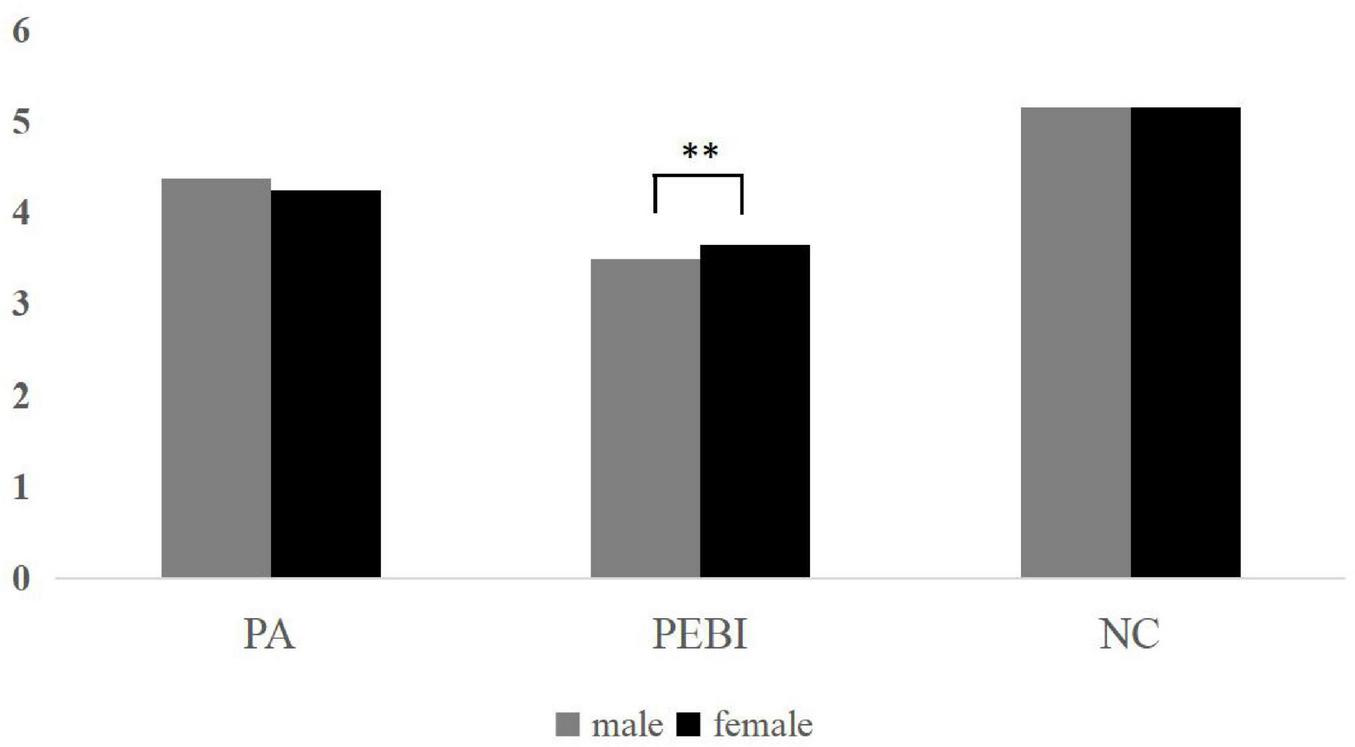
Distribution of main variables in male/female areas. PA, place attachment; NC, nature connectedness; PEBI, pro environmental behavioral intension. *p < 0.05, **p < 0.01, *** p < 0.001.
The descriptive statistics and correlations among variables are shown in Table 1: place attachment was significantly positively correlated with nature connectedness (r = 0.33, p < 0.001) and pro-environmental behavioral intentions (r = 0.36, p < 0.001); nature connectedness was significantly positively correlated with pro-environmental behavioral intentions (r = 0.51, p < 0.001).
TABLE 1
| Variables | M | SD | 1 | 2 | 3 | 4 | 5 |
|---|---|---|---|---|---|---|---|
| 1. Age | 20.58 | 2.84 | – | – | – | – | |
| 2. Gender | – | – | 0.08* | ||||
| 3. Residence | – | – | 0.07* | 0.03 | |||
| 4. Place attachment | 4.28 | 1.12 | 0.03 | −0.07* | −0.12*** | ||
| 5. Nature connectedness | 5.16 | 0.89 | 0.03 | 0.08* | 0.01 | 0.33*** | – |
| 6. PEBI | 3.61 | 0.66 | 0.01 | −0.09* | −0.06 | 0.36*** | 0.51*** |
Description of variables and correlation analysis.
*p < 0.05,
***p < 0.001, PEBI, pro-environmental behavioral intentions.
2.3.3 Mediating effect of nature connectedness
The PROCESS macro in SPSS using Model 4 was employed for mediating effect analysis, controlling for age, gender, and family origin. With place attachment as the independent variable and pro-environmental behavioral intentions as the dependent variable, after introducing nature connectedness into the model, the results shown in Table 2 indicate that place attachment significantly predicted pro-environmental behavioral intentions (95% CI = [0.08, 0.19]) and nature connectedness (95% CI = [0.38, 0.48]), and nature connectedness positively predicted pro-environmental behavioral intentions (95% CI = [0.48, 0.60]).
TABLE 2
| Predictive variables | Nature connectedness | Pro-environmental behavioral intentions | ||||
|---|---|---|---|---|---|---|
| β | t | 95% CI | β | t | 95% CI | |
| Place attachment | 0.43 | 17.11*** | [0.38, 0.48] | 0.13 | 4.55*** | [0.08, 0.19] |
| Nature connectedness | 0.54 | 16.99*** | [0.48, 0.60] | |||
| R 2 | 0.22 | 0.34 | ||||
| F | 73.30*** | 102.46*** | ||||
Mediation analysis in Study 1.
***p < 0.001.
The bootstrap 95% confidence intervals for both the direct effect of place attachment on pro-environmental behavioral intentions and the mediating effect of nature connectedness did not contain 0, as shown in Table 3. The direct effect (0.23) accounted for 64% of the total effect (0.36), while the mediating effect (0.13) accounted for 36% of the total effect (0.36).
TABLE 3
| Effect type | Effect value | Standard error | Lower limit | Upper limit | Relative effect value |
|---|---|---|---|---|---|
| Total effect | 0.36 | 0.03 | 0.31 | 0.42 | 100% |
| Direct effect | 0.23 | 0.03 | 0.08 | 0.19 | 64% |
| Mediating effect | 0.13 | 0.02 | 0.20 | 0.27 | 36% |
Decomposition of total effect, direct effect, and mediating effect.
These results indicate that place attachment not only has a direct predictive effect on individuals’ pro-environmental behavioral intentions but also indirectly predicts pro-environmental behavioral intentions through nature connectedness, providing support for Hypothesis 1 and Hypothesis 2.
2.4 Summary
Study 1 used a questionnaire method to confirm the correlation between place attachment and pro-environmental behavioral intentions, as well as the mediating role of nature connectedness. However, correlational research makes it difficult to infer causal relationships among variables (Rottman and Hastie, 2014). Therefore, to address these limitations to some extent and better reveal the causal relationships of place attachment’s influence on pro-environmental behavioral intentions and its internal mechanisms, Study 2 will employ an experimental method to manipulate participants’ place attachment.
3 Study 2
Study 2 explored whether place attachment has the same predictive effect on pro-environmental behavioral intentions and whether nature connectedness mediates the relationship between place attachment and pro-environmental behavioral intentions by experimentally manipulating participants’ place attachment. The present study expected that participants in the attachment condition (compared to the control group) would report higher levels of pro-environmental behavioral intentions. While Study 2 employed a different pro-environmental behavior scale [adapted from Tonge et al. (2015)] compared to Study 1 (Liu and Wu, 2013), both scales assess behavioral intentions rather than actual behaviors and cover similar domains of environmental action. This approach allows us to examine the robustness of our findings across different operationalizations of the construct.
3.1 Participants
G*Power 3.1 software was used to calculate the required sample size for the experiment. At a significance level of α = 0.05 and with a medium effect size, a total sample size of at least 146 participants was needed to achieve a statistical power of 0.85. A total of 160 participants were recruited from a university in Guangxi, including 68 males and 92 females, who were randomly assigned to groups. The mean age of participants was 23.68 years (SD = 8.89). Among them, 80 were assigned to the place attachment group and 80 to the control group. Prior to the manipulation, random assignment ensured that participants in the place attachment and non-attachment conditions were initially equivalent in key demographic variables and baseline environmental attitudes, supporting the internal validity of the comparison.
3.2 Experimental design and procedure
The present study employed a single-factor, between-subjects experimental design. Place attachment (attachment vs. control) served as the independent variable, nature connectedness as the mediator, and pro-environmental behavioral intention as the dependent variable. Consistent with previous research, we adopted an adapted imagery paradigm combined with a written reflection task to manipulate participants’ levels of place attachment (Ariccio et al., 2021; Jiao et al., 2023; Scannell and Gifford, 2017b). To ensure procedural clarity and replicability, all participants received standardized instructions prior to completing the imagine task. They were informed that they would spend 5 min imagining and writing about a specific place based on the provided guidelines. In the attachment condition, participants were instructed to recall a place that held strong positive emotional significance and to describe (1) the name of the place, (2) its meaningful features or characteristics, and (3) the positive psychological experiences associated with being in that place (minimum 20 words). One representative response noted:
“My hometown county, where I spent most of my childhood holidays. It also holds memories of my 6 years of secondary school. Every time I return, I feel a profound sense of stability; it is the place where I truly feel I belong.”
In contrast, participants assigned to the control condition were asked to imagine and write only the name or location of an ordinary, emotionally neutral place. A representative response stated: “An ordinary road near my home. It is a busy city street with heavy traffic and many people. Tall buildings and loud crowds are everywhere.”
3.2.1 Experimental manipulation and verification materials
In the present study, different instructions were used for the attachment condition (e.g., “In our lives, there are some places that are distinct from other physical spaces and have specific meaning to us. Please imagine a place that has positive meaning and emotional connection for you, …”) and the non-attachment condition (e.g., “In our lives, there are some places that are distinct from other physical spaces and have specific meaning to us. Another part of places are just ordinary geographical spaces. Please randomly imagine a place that is very ordinary to you, …”). Following the imagine task, participants completed four manipulation-check items (e.g., “At this moment, I feel a strong sense of identification with this place”), demonstrating acceptable internal consistency (Cronbach’s α = 0.80). Participants then completed the nature connectedness scale and the pro-environmental behavioral intention scale, followed by demographic questions regarding gender, age, and place of residence.
3.2.2 Nature connectedness measurement
Nature connectedness was measured using the same scale as in Study 1. The scale assesses individuals’ subjective sense of connection, belonging, and emotional closeness to the natural world (e.g., I often feel a sense of oneness with the natural world around me). Participants rated items on a 7-point Likert scale (1 = strongly disagree, 7 = strongly agree). Higher scores indicated higher perceived connectedness with nature. In the present study, Cronbach’s α for this scale was 0.80, indicating good internal consistency.
3.2.3 Pro-environmental behavioral intentions measurement
In the present study, the pro-environmental behavior scale was adapted from previous research (Tonge et al., 2015) to assess participants’ pro-environmental intentions. It comprised a total of 9 items across two dimensions. Four items were used to measure the behaviors that the subjects themselves would do (e.g., Learn more about this place natural environment), Five items measured subjects’ intention to engage in protective behavior (e.g., Work as a volunteer on conservation projects in this area), A 5-point scoring system was used (1 = strongly disagree, 5 = strongly agree), with higher scores indicating stronger pro-environmental behavioral intentions. In the present study, Cronbach’s α for this scale was 0.86.
3.3 Results
3.3.1 Manipulation check for place attachment and main effect test
Participants in the place attachment group were coded as 1, and those in the control group were coded as 0. Independent samples t-test was used to examine the effectiveness of the place attachment manipulation. The results shown in the table below indicate that the place attachment reported by the experimental group (3.93 ± 0.59) was significantly higher than that of the control group (2.99 ± 0.86), (t(160) = 7.96, p < 0.001, Cohen’s d = 1.27, 95% CI [0.79, 1.31]), suggesting that the manipulation of place attachment was effective.
Participants in the attachment condition (vs. control group) reported higher levels of nature connectedness (t(160) = 2.59, p < 0.05, Cohen’s d = 0.41, 95% CI = [0.10, 0.71]) and higher pro-environmental behavioral intentions (t(160) = 2.05, p < 0.05, Cohen’s d = 0.33, 95% CI = [0.02, 0.62]).
3.3.2 Mediation effect test
SPSS 26.0 software and the PROCESS v4.2 macro program developed by Hayes (2017) were used for data analysis, with Model 4 from Hayes’ typical models selected to test the mediating role of nature connectedness in the relationship between place attachment and pro-environmental behavioral intentions. The results (see Figure 3) showed that the direct effect of place attachment on pro-environmental behavioral intentions was significant (β = 0.23, t = 3.40, 95% CI = [0.08, 0.39]), and the mediating effect of nature connectedness between place attachment and pro-environmental behavioral intentions was also significant (β = 0.20, 95% CI = [0.09, 0.32]). The direct effect (0.20) and the mediating effect (0.14) accounted for 58.82% and 41.18% of the total effect (0.41), respectively. This indicates that nature connectedness mediated the relationship between place attachment and pro-environmental behavioral intentions.
FIGURE 3
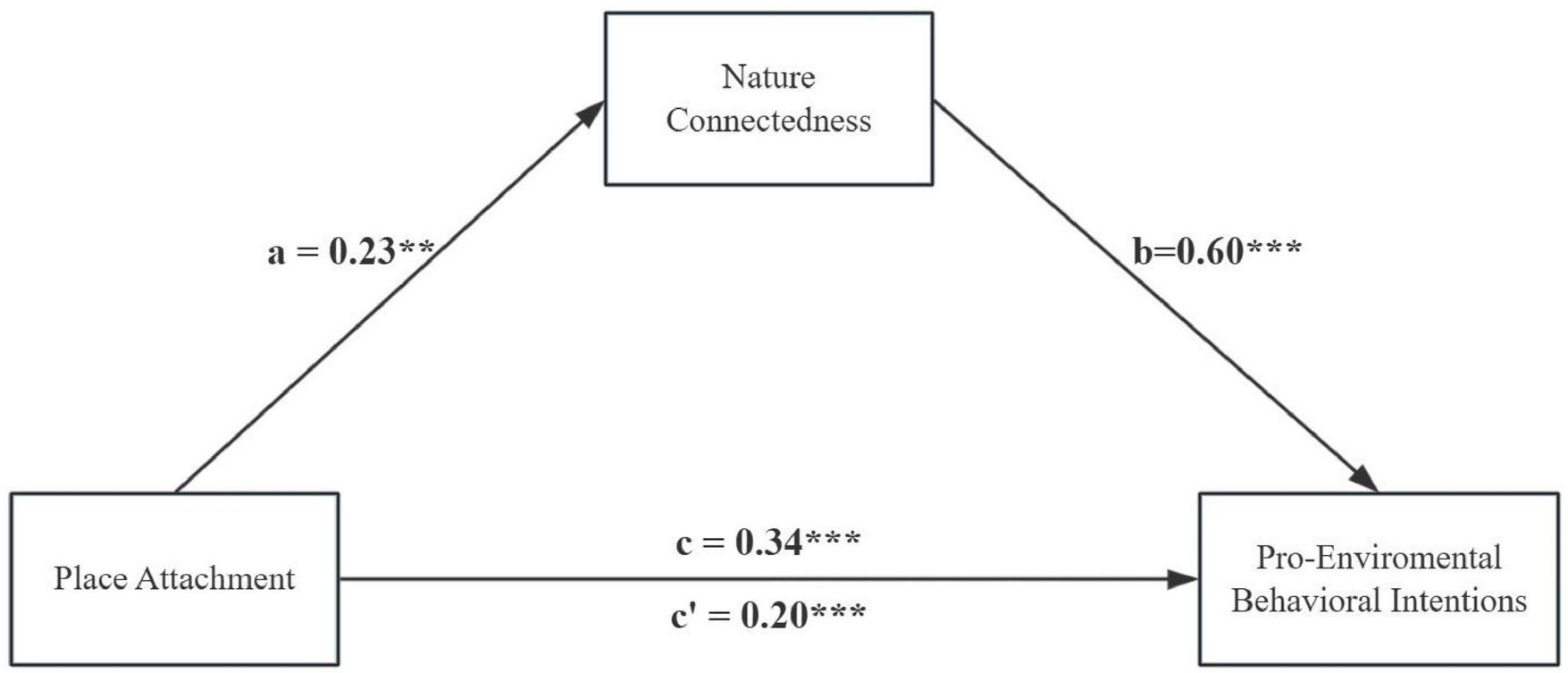
The mediation effect of nature connectedness. **p < 0.01, ***p < 0.001.
3.4 Summary
Study 2 manipulated place attachment using an adapted imagination paradigm and writing task, providing stronger causal evidence for the relationships among place attachment, nature connectedness, and pro-environmental behavioral intentions. The results revealed that participants in the place attachment condition self-reported more pro-environmental behavioral intentions than those in the non-attachment condition, indicating that place attachment has a positive influence on pro-environmental behavioral intentions, and nature connectedness plays a partial mediating role in this relationship.
4 General discussion
4.1 The impact of place attachment on pro-environmental behavioral intentions
The present study investigated whether and how place attachment influences individuals’ pro-environmental behavioral intentions. Previous studies have demonstrated that place attachment can function as a stable trait (Williams and Vaske, 2003), and it can also be experimentally manipulated as state place attachment (Jiao et al., 2023). Through two progressive studies, the present research measured participants’ trait place attachment (Study 1) and manipulated state place attachment (Study 2), yielding relatively robust and consistent results. Study 1 measured place attachment as a disposition (i.e., place identity and place dependence), Study 2 examined state place attachment (“in this moment”). This distinction has theoretical implications: trait measures capture individuals’ stable bonds with meaningful places, whereas state induction reflects momentary feelings of connection elicited by situational cues. The findings of Study 2 demonstrate that even short-term, situationally induced place attachment can enhance pro-environmental behavioral intentions, and nature connectedness partially mediates this effect. This addresses, to some extent, the call by earlier scholars for empirical research on the impact of increased place attachment on pro-environmental behavioral intentions (Scannell and Gifford, 2017a) and validates previous findings in a collectivistic cultural context. This finding is consistent with previous research results (Jiao et al., 2023) and earlier place attachment theory (Relph, 1976), which suggests that the attachment people establish to places motivates them to develop intentions to protect these places. According to the tripartite framework of place attachment (Scannell and Gifford, 2010a), the three dimensions of this framework include: (1) the person/culture dimension, with the present study focusing on place attachment among Chinese participants in a collectivistic cultural background. In collectivistic cultures such as China, place attachment may be strengthened through shared family histories and community ties that span generations (Hwang, 2001). Unlike individualistic cultures where place attachment often reflects personal identity and autonomy, collectivistic place attachment may be more intertwined with family obligations and community harmony, potentially creating stronger motivations for environmental protection of shared spaces; (2) the place dimension, where “place” not only has a social dimension but is also a tangible, real physical environment (Kaltenborn, 1997). Previous research linking people’s emotional bonds to the physical attributes of place has been very scarce (Lewicka, 2011). The present study explicitly incorporates the physical environmental characteristics of places–specifically, natural features–into the examination of person–place relationships. Although the experimental paradigm was primarily designed to manipulate place attachment rather than to measure physical characteristics directly, participants’ imagination-task responses (Study 2) revealed that natural elements were frequently and spontaneously referenced in descriptions of meaningful places. For instance, participants in the attachment condition commonly described natural attributes such as trees, riversides, lakeside paths, mountains, seasonal vegetation, and specific natural sensory qualities (e.g., breeze, sunlight, sounds of water or leaves). These naturally emerging descriptions suggest that, for many individuals, significant places are closely intertwined with natural environmental features; (3) the psychological process dimension, including behavioral motivations to protect places, love for nature, and specific types of behaviors (e.g., pro-environmental behaviors), which to some extent supplements and enriches the literature in related fields.
4.2 The mediating role of nature connectedness
The results of both studies consistently demonstrate that nature connectedness partially mediates the relationship between place attachment and pro-environmental behavioral intentions. Attention Restoration Theory (Kaplan, 1995) suggests that natural environments facilitate the restoration of psychological resources, and these positive emotional experiences may be triggered by individuals’ emotional bonds with specific places (Scannell and Gifford, 2017a; Yoshida et al., 2022), thereby contributing to understanding individuals’ preferences for interacting with nature and why they make pro-environmental behavioral choices (Zhou et al., 2023). Research indicates that place attachment is an antecedent variable for perceiving the restorativeness of natural environments (Liu et al., 2020).
Recent laboratory studies have also found that natural environments provide numerous benefits to people, such as enhancing authenticity (Yang et al., 2024), reducing stress (Korpilo et al., 2024), improving mood (Coventry et al., 2021), and promoting psychological health and well-being (Yang et al., 2022). These findings help us understand the altruistic mechanisms, such as pro-environmental behaviors, triggered by nature. The mediation of nature connectedness in the effect of place attachment on pro-environmental behavioral intentions suggests that in daily life, we should guide people to establish emotional attachments to their locations by, for example, improving the physical environment of places, constructing place landmarks, collective meanings, and spatial memories (Stedman, 2002), thereby increasing people’s emotional connection to places and promoting individuals’ pro-environmental behavioral intentions. We can also enhance people’s nature connectedness through increasing green landscapes and incorporating more environmentally friendly designs, which is conducive to improving pro-environmental behavioral intentions in the context of place attachment.
5 Limitations and future directions
Our study provides empirical support for the promotion of pro-environmental behavioral intentions by place attachment and its internal mechanisms through two progressive studies, offering certain insights while acknowledging limitations. People’s levels of place attachment may change over time (Li and McKercher, 2016). Future research could attempt to adopt longitudinal research methods to explore the long-term effects of place attachment on pro-environmental behavior. In addition, the present study measured pro-environmental behavioral intentions through self-report measures, which may be subject to unavoidable social desirability bias (Kormos and Gifford, 2014). Previous scholars have pointed out that behavioral intentions do not always shape individual behavior (Li et al., 2019).
Future research could consider using computer experiments (PEBT) or field observations to measure pro-environmental behavior (Lange et al., 2018; Lange and Dewitte, 2019). Finally, the samples selected for the present study were all Chinese participants with collectivistic cultural backgrounds. Caution should be exercised when generalizing the conclusions of The present study to other samples or cultural contexts. Future research could consider conducting cross-cultural studies.
Statements
Data availability statement
The original contributions presented in this study are included in this article/Supplementary material, further inquiries can be directed to the corresponding author.
Ethics statement
The studies involving humans were approved by Human Ethics Committee of Guangxi Normal University. The studies were conducted in accordance with the local legislation and institutional requirements. The participants provided their written informed consent to participate in this study. Written informed consent was obtained from the individual(s) for the publication of any potentially identifiable images or data included in this article.
Author contributions
BC: Resources, Investigation, Writing – review & editing, Funding acquisition, Conceptualization. HS: Formal analysis, Writing – original draft, Investigation. YWei: Writing – review & editing. JF: Investigation, Writing – review & editing, Validation, Data curation. YWen: Resources, Validation, Writing – review & editing.
Funding
The author(s) declared that financial support was received for this work and/or its publication. This work was supported by the National Natural Science Foundation of China (Project approval number: 62467001).
Conflict of interest
The author(s) declared that this work was conducted in the absence of any commercial or financial relationships that could be construed as a potential conflict of interest.
Generative AI statement
The author(s) declared that generative AI was not used in the creation of this manuscript.
Any alternative text (alt text) provided alongside figures in this article has been generated by Frontiers with the support of artificial intelligence and reasonable efforts have been made to ensure accuracy, including review by the authors wherever possible. If you identify any issues, please contact us.
Publisher’s note
All claims expressed in this article are solely those of the authors and do not necessarily represent those of their affiliated organizations, or those of the publisher, the editors and the reviewers. Any product that may be evaluated in this article, or claim that may be made by its manufacturer, is not guaranteed or endorsed by the publisher.
Supplementary material
The Supplementary Material for this article can be found online at: https://www.frontiersin.org/articles/10.3389/fpsyg.2025.1678177/full#supplementary-material
References
1
Ariccio S. Lema-Blanco I. Bonaiuto M. (2021). Place attachment satisfies psychological needs in the context of environmental risk coping: Experimental evidence of a link between self-determination theory and person-place relationship effects.J. Environ. Ment. Psychol.78:101716. 10.1016/j.jenvp.2021.101716
2
Barbaro N. Pickett S. M. Parkhill M. R. (2015). Environmental attitudes mediate the link between need for cognition and pro-environmental goal choice.Pers. Individ. Dif.75220–223. 10.1016/j.paid.2014.11.032
3
Bowlby J. (1969). Attachment: Volume 1 of attachment and loss.London: The Tavistock Institute of Humans Relations.
4
Chen M. Xue S. Shi Y. (2018). Leisure activities and leisure motivations of Chinese residents.PLoS One13:e0206740. 10.1371/journal.pone.0206740
5
Cheng T. M. Wu H. C. (2015). How do environmental knowledge, environmental sensitivity, and place attachment affect environmentally responsible behavior? An integrated approach for sustainable island tourism. J. Sustain. Tour.23, 557–576. 10.1080/09669582.2014.965177
6
Cole L. B. Coleman S. Scannell L. (2021). Place attachment in green buildings: Making the connections.J. Environ. Psychol.74:101558. 10.1016/j.jenvp.2021.101558
7
Coventry P. A. Brown J. E. Pervin J. Brabyn S. Pateman R. Breedvelt J. et al (2021). Nature-based outdoor activities for mental and physical health: Systematic review and meta-analysis.SSM Popul. Health16:100934. 10.1016/j.ssmph.2021.100934
8
Crompton J. L. (2001). The impact of parks on property values: A review of the empirical evidence.J. Leis. Res.331–31. 10.1080/00222216.2001
9
Daryanto A. Song Z. (2021). A meta-analysis of the relationship between place attachment and pro-environmental behaviour.J. Bus. Res.123208–219. 10.1016/j.jbusres.2020.09.045
10
Davis J. L. Green J. D. Reed A. (2009). Interdependence with the environment: Commitment, interconnectedness, and environmental behavior.J. Environ. Psychol.29173–180. 10.1016/j.jenvp.2008.11.001
11
Finger M. (1994). From knowledge to action? Exploring the relationships between environmental experiences, learning, and behavior.J. Soc. Issues50141–160. 10.1111/j.1540-4560.1994.tb02424.x
12
Fleischer A. (2012). A room with a view—A valuation of the Mediterranean Sea view.Tour. Manag.33598–602. 10.1016/j.tourman.2011.06.016
13
Gatersleben B. Wyles K. J. Myers A. Opitz B. (2020). Why are places so special? Uncovering how our brain reacts to meaningful places.Landsc. Urban Plan.197:103758. 10.1016/j.landurbplan.2020.103758
14
Halpenny E. A. (2010). Pro-environmental behaviours and park visitors: The effect of place attachment.J. Environ. Psychol.30409–421. 10.1016/j.jenvp.2010.04.006
15
Hayes A. F. (2017). Introduction to mediation, moderation, and conditional process analysis: A regression-based approach.New York, NY: Guilford publications.
16
Hernandez B. Martin A. M. Ruiz C. del Carmen Hidalgo M. (2010). The role of place identity and place attachment in breaking environmental protection laws.J. Environ. Psychol.30281–288. 10.1016/j.jenvp.2010.01.009
17
Hinds J. Sparks P. (2008). Engaging with the natural environment: The role of affective connection and identity.J. Environ. Psychol.28109–120. 10.1016/j.jenvp.2007.11.001
18
Hwang K. K. (2001). The deep structure of Confucianism: A social psychological approach.Asian Philos.11179–204. 10.1080/09552360120116928
19
IPCC (2021). “Climate change 2021: The physical science basis,” in Proceedings of the contribution of working group I to the sixth assessment report of the intergovernmental panel on climate change, edsConnorsS. L.PeanC.BergerS.CaudN.ChenY.GoldfarbL.et al (Cambridge: Cambridge University Press).
20
Jiao L. Ren Z. Guo Z. Gao S. Xu Y. (2023). Individual differences in place attachment and pro-environmental behavior: Pride as an emotional tie.Pers. Individ. Dif.214:112357. 10.1016/j.paid.2023.112357
21
Kaffashi S. Yacob M. R. Clark M. S. Radam A. Mamat M. F. (2015). Exploring visitors’ willingness to pay to generate revenues for managing the National Elephant Conservation Center in Malaysia.For. Policy Econ.569–19. 10.1016/j.forpol.2015.03.004
22
Kals E. Schumacher D. Montada L. (1999). Emotional affinity toward nature as a motivational basis to protect nature.Environ. Behav.31178–202. 10.1177/00139169921972056
23
Kaltenborn B. P. (1997). Nature of place attachment: A study among recreation homeowners in Southern Norway.Leis. Sci.19175–189. 10.1080/01490409709512248
24
Kaltenborn B. P. Bjerke T. (2002). Associations between landscape preferences and place attachment: A study in Røros, Southern Norway.Landsc. Res.27381–396. 10.1080/0142639022000023943
25
Kaplan S. (1995). The restorative benefits of nature: Toward an integrative framework.J. Environ. Psychol.15169–182. 10.1016/0272-4944(95)90001-2
26
Kelley H. H. Thibaut J. (1978). Interpersonal relations: A theory of interdependence.New York, NY: Wiley.
27
Kormos C. Gifford R. (2014). The validity of self-report measures of proenvironmental behavior: A meta-analytic review.J. Environ. Psychol.40359–371. 10.1016/j.jenvp.2014.09.003
28
Korpela K. M. Ylén M. Tyrväinen L. Silvennoinen H. (2009). Stability of self-reported favourite places and place attachment over a 10-month period.J. Environ. Psychol.2995–100. 10.1016/j.jenvp.2008.05.008
29
Korpilo S. Nyberg E. Vierikko K. Ojala A. Kaseva J. Lehtimäki J. et al (2024). Landscape and soundscape quality promote stress recovery in nearby urban nature: A multisensory field experiment.Urban For. Urban Green.95:128286. 10.1016/j.ufug.2024.128286
30
Lange F. Dewitte S. (2019). Measuring pro-environmental behavior: Review and recommendations.J. Environ. Psychol.6392–100. 10.1016/j.jenvp.2019.04.009
31
Lange F. Steinke A. Dewitte S. (2018). The pro-environmental behavior task: A laboratory measure of actual pro-environmental behavior.J. Environ. Psychol.5646–54. 10.1016/j.jenvp.2018.02.007
32
Lee D. Lee J. H. (2017). A structural relationship between place attachment and intention to conserve landscapes–a case study of Harz National Park in Germany.J. Mt. Sci.14998–1007. 10.1007/s11629-017-4366-3
33
Lewicka M. (2011). Place attachment: How far have we come in the last 40 years?J. Environ. Psychol.31207–230. 10.1016/j.jenvp.2010.10.001
34
Li D. Zhao L. Ma S. Shao S. Zhang L. (2019). What influences an individual’s pro-environmental behavior? A literature review.Resour. Conserv. Recycl.14628–34. 10.1016/j.resconrec.2019.03.024
35
Li N. Wu J. P. (2016). Revise of the connectedness to nature scale and its reliability and validity.China J. Health Psychol.241347–1350. 10.13342/j.cnki.cjhp.2016.09.018
36
Li T. E. McKercher B. (2016). Effects of place attachment on home return travel: A spatial perspective.Tour. Geogr.18359–376. 10.1080/14616688.2016.1196238
37
Li Y. M. Li J. Wu F. H. (2018). Connectedness to nature: Conceptualization, measurements and promotion.Psychol. Dev. Educ.34120–127. 10.16187/j.cnki.issn1001-4918.2018.01.15
38
Liu Q. Wu Y. Xiao Y. Fu W. Zhuo Z. van den Bosch C. C. K. et al (2020). More meaningful, more restorative? Linking local landscape characteristics and place attachment to restorative perceptions of urban park visitors.Landsc. Urban Plan.197:103763. 10.1016/j.landurbplan.2020.103763
39
Liu X. W. Wu J. P. (2013). Environmental values and pro-environmental behaviors of college students: Mediating role of environmental concern.Stud. Psychol. Behav.11780–785.
40
Mangone G. Capaldi C. A. Van Allen Z. M. Luscuere P. G. (2017). Bringing nature to work: Preferences and perceptions of constructed indoor and natural outdoor workspaces.Urban For. Urban Green.231–12. 10.1016/j.ufug.2017.02.009
41
Mayer F. Frantz C. M. (2004). The connectedness to nature scale: A measure of individuals’ feeling in community with nature.J. Environ. Psychol.24503–515. 10.1016/j.jenvp.2004.10.001
42
Meidenbauer K. L. Stenfors C. U. Young J. Layden E. A. Schertz K. E. Kardan O. et al (2019). The gradual development of the preference for natural environments.J. Environ. Psychol.65:101328. 10.1016/j.jenvp.2019.101328
43
Naess A. (1985). Identification as a source of deep ecological attitudes. Deep Ecol.256:261.
44
Nisbet E. K. Zelenski J. M. Murphy S. A. (2009). The nature relatedness scale: Linking individuals’ connection with nature to environmental concern and behavior.Environ. Behav.41715–740. 10.1177/0013916508318748
45
Poškus M. S. Žukauskiene R. (2017). Predicting adolescents’ recycling behavior among different big five personality types. J. Environ. Psychol.54, 57–64. 10.1016/j.jenvp.2017.10.003
46
Ramkissoon H. Smith L. D. G. Weiler B. (2013). Testing the dimensionality of place attachment and its relationships with place satisfaction and pro-environmental behaviours: A structural equation modelling approach.Tour. Manag.36552–566. 10.1016/j.tourman.2012.09.003
47
Relph E. (1976). Place and placelessness, Vol. 67. London: Pion, 45.
48
Rottman B. M. Hastie R. (2014). Reasoning about causal relationships: Inferences on causal networks.Psychol. Bull.140109–139. 10.1037/a0031903
49
Scannell L. Gifford R. (2010a). Defining place attachment: A tripartite organizing framework.J. Environ. Psychol.301–10. 10.1016/j.jenvp.2009.09.006
50
Scannell L. Gifford R. (2010b). The relations between natural and civic place attachment and pro-environmental behavior.J. Environ. Psychol.30289–297. 10.1016/j.jenvp.2010.01.010
51
Scannell L. Gifford R. (2017a). Place attachment enhances psychological need satisfaction.Environ. Behav.49359–389. 10.1177/0013916516637648
52
Scannell L. Gifford R. (2017b). The experienced psychological benefits of place attachment.J. Environ. Psychol.51256–269. 10.1016/j.jenvp.2017.04.001
53
Song Z. Soopramanien D. (2019). Types of place attachment and pro-environmental behaviors of urban residents in Beijing.Cities84112–120. 10.1016/j.cities.2018.07.012
54
Stedman R. C. (2002). Toward a social psychology of place: Predicting behavior from place-based cognitions, attitude, and identity.Environ. Behav.34561–581. 10.1177/0013916502034005001
55
Tonge J. Ryan M. M. Moore S. A. Beckley L. E. (2015). The effect of place attachment on pro-environment behavioral intentions of visitors to coastal natural area tourist destinations.J. Travel Res.54730–743. 10.1177/0047287514533010
56
Tuan Y. F. (1977). Space and place: The perspective of experience.Minneapolis, MN: University of Minnesota Press.
57
Valizadeh N. Bijani M. Karimi H. Naeimi A. Hayati D. Azadi H. (2020). The effects of farmers’ place attachment and identity on water conservation moral norms and intention.Water Res.185:116131. 10.1016/j.watres.2020.116131
58
Vaske J. J. Kobrin K. C. (2001). Place attachment and environmentally responsible behavior.J. Environ. Educ.3216–21. 10.1080/00958960109598658
59
Walker A. J. Ryan R. L. (2008). Place attachment and landscape preservation in rural New England: A Maine case study.Landsc. Urban Plan.86141–152. 10.1016/j.landurbplan.2008.02.001
60
Wang J. M. Wu L. C. (2015). The categories, dimensions and mechanisms of emotions in the studies of pro-environmental behavior.Adv. Psychol. Sci.232153–2166. 10.3724/SP.J.1042.2015.02153
61
Whitburn J. Linklater W. Abrahamse W. (2020). Meta-analysis of human connection to nature and proenvironmental behavior.Conserv. Biol.34180–193. 10.1111/cobi.13381
62
Wilkie S. Trotter H. (2022). Pro-environmental attitudes, pro-environmental behaviours and nature-relatedness: Differences based on place preference.Eur. Rev. Appl. Psychol.72:100705. 10.1016/j.erap.2021.100705
63
Williams D. R. Vaske J. J. (2003). The measurement of place attachment: Validity and generalizability of a psychometric approach.For. Sci.49830–840. 10.1093/forestscience/49.6.830
64
Wilson E. O. (1984). Biophilia.Cambridge, MA: Harvard University Press.
65
Yang Y. Cai H. Yang Z. Zhao X. Li M. Han R. et al (2022). Why does nature enhance psychological well-being? A self-determination account.J. Environ. Psychol.83:101872. 10.1016/j.jenvp.2022.101872
66
Yang Y. Geng L. N. Xiang P. Zhang J. Zhu L. F. (2017). Nature connectedness: It’s concept, measurement, function and intervention.Adv. Psychol. Sci.251360–1374. 10.3724/SP.J.1042.2017.01360
67
Yang Y. Sedikides C. Wang Y. Cai H. (2024). Nature nurtures authenticity: Mechanisms and consequences.J. Pers. Soc. Psychol.12679–104. 10.1037/pspi0000432
68
Yoshida Y. Matsuda H. Fukushi K. Takeuchi K. Watanabe R. (2022). The missing intangibles: Nature’s contributions to human wellbeing through place attachment and social capital.Sustain. Sci.17809–822. 10.1007/s11625-021-01067-x
69
Zhang Y. Zhang H. L. Zhang J. Cheng S. (2014). Predicting residents’ pro-environmental behaviors at tourist sites: The role of awareness of disaster’s consequences, values, and place attachment.J. Environ. Psychol.40131–146. 10.1016/j.jenvp.2014.06.001
70
Zhou B. Wang L. Huang S. Xiong Q. (2023). Impact of perceived environmental restorativeness on tourists pro-environmental behavior: Examining the mediation of place attachment and the moderation of ecocentrism. J. Hosp. Tour. Manag.56, 398–409. 10.1016/j.jhtm.2023.08.006
Summary
Keywords
place attachment, nature connectedness, pro-environmental behavioral intentions, mediation model, questionnaire investigation, experimental manipulation
Citation
Chang B, Sheng H, Wei Y, Fang J and Wen Y (2026) The relationship between place attachment and pro-environmental behavioral intentions: the mediating role of nature connectedness. Front. Psychol. 16:1678177. doi: 10.3389/fpsyg.2025.1678177
Received
02 August 2025
Revised
25 November 2025
Accepted
09 December 2025
Published
12 January 2026
Volume
16 - 2025
Edited by
Bernardo Hernández, University of La Laguna, Spain
Reviewed by
Debbrota Mallick, University of Georgia, United States
Maricela Irepan Aguilar, National Autonomous University of Mexico, Mexico
Updates
Copyright
© 2026 Chang, Sheng, Wei, Fang and Wen.
This is an open-access article distributed under the terms of the Creative Commons Attribution License (CC BY). The use, distribution or reproduction in other forums is permitted, provided the original author(s) and the copyright owner(s) are credited and that the original publication in this journal is cited, in accordance with accepted academic practice. No use, distribution or reproduction is permitted which does not comply with these terms.
*Correspondence: Jiandong Fang, bdjs2004@163.comYaping Wen, 318569540@qq.com
ORCID: Yanhan Wei, orcid.org/0009-0009-2055-7336
Disclaimer
All claims expressed in this article are solely those of the authors and do not necessarily represent those of their affiliated organizations, or those of the publisher, the editors and the reviewers. Any product that may be evaluated in this article or claim that may be made by its manufacturer is not guaranteed or endorsed by the publisher.