Abstract
Introduction:
Teacher emotion regulation is increasingly recognized as a critical determinant of instructional quality, professional well-being, and student success, particularly in English as a Foreign Language (EFL) contexts where linguistic challenges, sociocultural diversity, and high emotional labor intensify classroom demands. However, a comprehensive synthesis of the evidence linking these strategies to multi-level outcomes (teacher, student, and institutional) remains lacking. This systematic review synthesized findings from 165 peer-reviewed studies published between 1998 and 2025 to examine how emotion regulation strategies influence teacher well-being, professional development, and student engagement.
Methods:
Literature searches were conducted following PRISMA 2020 guidelines and guided by PICOS criteria to ensure transparency, comprehensiveness, and replicability. Searches were performed in Scopus, Web of Science, ERIC, and PsycINFO, supplemented by hand-searching reference lists. The included studies employed quantitative, qualitative, and mixed-method designs and were analyzed using a combination of thematic analysis and content analysis. Coding reliability was established through double-coding of 25% of the studies, yielding strong inter-rater agreement (κ = 0.78).
Results:
Three major thematic patterns emerged. First, adaptive strategies, including cognitive reappraisal, mindfulness, attentional deployment, and relational regulation, were consistently associated with reduced stress, enhanced resilience, improved classroom management, and positive teacher–student interactions, whereas maladaptive strategies, such as suppression and rumination, predicted burnout and reduced instructional quality. A predominant finding across quantitative studies was a significant positive correlation between adaptive regulation and teacher self-efficacy. Second, professional development interventions—structured workshops, reflective journaling, and peer coaching—enhanced teachers’ emotional competence, self-efficacy, and professional identity formation. Third, teacher emotion regulation significantly influenced student engagement, motivation, participation, classroom emotional climate, and language achievement. Cross-theme synthesis revealed cascading effects, showing that adaptive regulation promotes teacher well-being, which in turn supports student learning and professional development.
Discussion:
These findings underscore the importance of embedding emotion regulation training into teacher education programs, institutional policies, and reflective practice, establishing it not merely as a personal coping mechanism but as a foundational professional competency with direct implications for instructional quality and student outcomes. Future longitudinal and culturally contextualized research is needed to further elucidate these cascading mechanisms, ultimately informing more effective supports for teachers and learners in linguistically diverse classrooms.
Introduction
Emotions have become central to learning, influencing attention, motivation, memory, and classroom interactions. In English as a Foreign Language (EFL) contexts, emotional experiences have been particularly critical, as teachers and learners navigated complex affective landscapes that shape classroom climate, engagement, and achievement (Dewaele and Li, 2022; MacIntyre and Gregersen, 2012; Pekrun and Perry, 2014). Over the past decades, research has consistently demonstrated that teachers’ ability to recognize and understand both their own emotions and those of their students has profoundly affected instructional effectiveness, classroom interactions, and learner outcomes (Gross, 2015; Gross and John, 2003; Brackett and Rivers, 2014; Jacobs and Gross, 2014; Abdullaeva et al., 2024). By identifying emotional cues, teachers could anticipate students’ reactions, respond constructively to challenges, and sustain their professional well-being, which in turn has promoted learners’ cognitive engagement and affective involvement (Akbari et al., 2017; Chen and Tang, 2024; Han et al., 2024; Su and Lee, 2024).
Teacher self-efficacy has played a pivotal role in shaping these emotional dynamics. Educators with high self-efficacy experienced greater confidence, positive affect, and resilience, enabling them to persist through challenges and foster constructive teacher–student interactions (Fathi et al., 2021; Solhi et al., 2024; Thumvichit, 2023, 2025). Mechanistically, self-efficacious teachers appraised stressors adaptively, regulated negative affect, and maintained attentional focus, which enhanced instructional quality. In contrast, educators with lower self-efficacy were more susceptible to heightened stress, negative emotions, and emotional exhaustion, potentially leading to burnout and reduced pedagogical effectiveness (Chang, 2020; Li and Lv, 2022; Li and Akram, 2023). These findings highlight the intricate interplay between perceived competence, emotional awareness, and classroom outcomes, underscoring the importance of fostering both teacher well-being and emotional literacy in professional development initiatives.
Learner emotions have been equally consequential in EFL contexts. Positive emotional experiences, such as enjoyment, interest, pride, hope, and confidence, acted as catalysts for intrinsic motivation, sustained engagement, cognitive flexibility, and active participation in language learning tasks (Frenzel et al., 2009; Zhang et al., 2024; MacIntyre and Gregersen, 2012). Enjoyment, for instance, broadened attention and promoted creative language use, while interest and confidence encouraged learners to persist through challenging communicative tasks. Conversely, negative emotions—including anxiety, frustration, boredom, embarrassment, anger, and sadness—narrowed attention, reduced cognitive processing, impaired memory consolidation, and hindered language acquisition (Akram and Oteir, 2025; Abdullaeva et al., 2024; Gloria and Mbato, 2024). Importantly, some moderate negative emotions, such as manageable anxiety or frustration, signaled challenges that prompted strategic problem-solving and deeper engagement if effectively recognized and addressed. These affective experiences were shaped not only by individual learner characteristics but also by teacher behavior, peer interactions, classroom norms, and broader institutional and cultural factors (Li and Akram, 2023; Yeager et al., 2022; Xiao et al., 2024; Yang and Zhao, 2024; Namaziandost et al., 2025).
Technological integration in EFL classrooms introduced additional emotional dimensions. Digital platforms provided real-time feedback, enabled personalized learning, and facilitated reflective practice, supporting both teacher and learner emotion regulation. However, these platforms also introduced cognitive overload, technostress, and disengagement, which could amplify negative emotional states if not carefully managed (Xin and Derakhshan, 2025; Qu and Wang, 2024; Zhang and Wang, 2024). Recognizing and categorizing these emotional experiences enabled educators to design instructional approaches that mitigate negative affect, amplify positive engagement, and sustain productive classroom climates (Abdullaeva et al., 2024; Solhi et al., 2024).
For clarity, emotions in EFL contexts are broadly classified as positive or negative, reflecting their influence on motivation, participation, and learning outcomes (Boekaerts and Pekrun, 2015). Positive emotions—including enjoyment, pride, interest, relief, gratitude, hope, and confidence—enhance engagement, cognitive flexibility, and collaborative learning. Negative emotions—including anxiety, frustration, boredom, confusion, embarrassment, anger, and sadness—can disrupt attention, reduce persistence, and impede language acquisition. Recognizing these emotions has been foundational for understanding the affective landscape of EFL classrooms and served as a prelude to discussions of emotion regulation strategies. These categories are summarized in Table 1.
Table 1
| Emotion type | Examples |
|---|---|
| Positive emotions | Enjoyment, pride, interest, relief, gratitude, hope, confidence |
| Negative emotions | Anxiety, frustration, boredom, confusion, embarrassment, anger, sadness |
Emotions recognized in EFL classrooms.
Emotions commonly recognized in EFL classrooms and their classification as positive or negative. Recognition of these emotions informs tailored teacher emotion regulation strategies and the creation of supportive classroom climates.
Beyond simple categorization, it is important to consider the functional and experiential significance of these affective states. Positive emotions serve as catalysts for motivation, cognitive engagement, and risk-taking, fostering a sense of safety that encourages active participation in communicative tasks and collaborative learning. They enhance teacher–student rapport, peer interaction, and overall classroom climate. Conversely, negative emotions may constrain attention, undermine motivation, and impede cognitive flexibility. When moderate, they function as informative signals that stimulate adaptive problem-solving and deeper engagement. The dynamic interplay of positive and negative emotions highlights the complexity of affective experiences in EFL classrooms, where both sets coexist and influence learning outcomes (Table 2).
Table 2
| Dimension | Positive emotions | Negative emotions | Classroom significance |
|---|---|---|---|
| Motivational | Interest, hope, confidence | Anxiety, frustration | Influences learners’ intrinsic motivation and persistence |
| Cognitive/learning | Enjoyment, curiosity | Confusion, boredom | Affects attention, comprehension, and strategy use |
| Social/relational | Pride, gratitude | Embarrassment, anger | Shapes teacher–student and peer interactions |
| Emotional well-being | Relief, joy | Sadness, frustration | Impacts overall classroom climate and engagement |
Conceptual categorization of emotions in EFL classrooms.
Conceptual categorization of positive and negative emotions in EFL classrooms, showing their functional significance in motivation, cognition, social interaction, and well-being. This framework informs the subsequent discussion of emotion regulation strategies.
Understanding emotional patterns has provided the foundation for selecting appropriate Emotion Regulation Strategies (ERS), making classification not only descriptive but functionally necessary. This conceptual framework has provided a foundation for understanding how teachers can intentionally influence affective experiences to enhance learning outcomes. By linking emotions to motivational, cognitive, social, and well-being dimensions, educators have gained insight into the specific roles that positive and negative emotions have played in shaping engagement, participation, and achievement. This framework has established a natural bridge to emotion regulation strategies (ERS), as teachers’ ability to recognize, interpret, and respond to these emotional patterns has determined the effectiveness of their pedagogical interventions. While this section focuses on classification and functional significance rather than detailed strategies, it has emphasized the interdependence between emotion recognition, classroom climate, and learning processes. Conceptually, ERS represent the methods teachers employ to manage their own and students’ emotional experiences, optimizing positive affect while mitigating negative influences (Wang Y. et al., 2025). Understanding the functional significance of each emotion has informed strategy selection, aligning interventions with desired learning and well-being outcomes. Moreover, this framework has highlighted the role of teacher emotional intelligence in effectively implementing ERS, enabling educators to model adaptive responses, support students’ emotional regulation, and foster resilient, motivated, and engaged learners.
Conceptual framework
Teacher emotion regulation strategies
Teacher Emotion Regulation (TER) has represented a multifaceted construct essential for effective teaching, professional development, and classroom climate, particularly in English as a Foreign Language (EFL) contexts (Abdullaeva et al., 2024; Akbari et al., 2017). TER has encompassed cognitive, affective, and interpersonal strategies that have allowed educators to navigate the complex emotional dynamics inherent in classrooms, balancing internal stressors, external demands, and diverse student needs.
Cognitive strategies, such as reappraisal, involved reframing potentially stressful or negative classroom events to reduce their emotional impact. This mechanism enabled teachers to maintain engagement, clarity, and responsiveness under challenging conditions, which positively affected classroom climate and fostered student learning. By altering perception rather than suppressing feelings, cognitive reappraisal strengthened teachers’ problem-solving capacity, encouraged adaptive reflection, and allowed for constructive responses to classroom difficulties (Gross, 1998; Gross and John, 2003; Li and Lv, 2022).
Affective strategies, including mindfulness and emotional awareness, enhanced teachers’ capacity for sustained attention, nonjudgmental observation, and acceptance of emotional experiences (Fu et al., 2023; Zhang and Fathi, 2024). Through these mechanisms, teachers reduced automatic stress responses, cultivated emotional resilience, and improved reflective practice, allowing for more consistent engagement with learners. Maladaptive affective strategies, such as rumination or avoidance, operated in contrast: by excessively focusing on negative experiences or withdrawing from stressors, these strategies intensified emotional reactivity, hindered cognitive flexibility, and compromised instructional effectiveness (Chang, 2020; Fan and Xie, 2025).
Interpersonal regulation strategies complemented internal mechanisms by emphasizing relational and social dynamics within the classroom. Emotional coaching, for instance, involved guiding students’ understanding and management of their emotions. This mechanism fostered relational trust, enhanced student emotional literacy, and created a climate of mutual respect and cooperation (Gkonou and Miller, 2023; Wang and Ye, 2021). Peer support mechanisms allowed teachers to share challenges and resources with colleagues, buffering stress, reinforcing adaptive coping strategies, and sustaining professional identity (Han et al., 2024; Zhang and Derakhshan, 2025). These interpersonal strategies were especially crucial in multicultural or multilingual classrooms, where cultural norms of emotional expression varied and misalignment could disrupt learning engagement and relational cohesion (Ekanayake, 2024; Han et al., 2024).
Teacher well-being was intricately linked to the effectiveness of TER. Emotional, psychological, and occupational dimensions of well-being were directly influenced by the degree to which teachers employed adaptive regulation strategies (Li and Akram, 2023; Zhang et al., 2025; Wang Y. et al., 2025). Mechanistically, strategies such as reappraisal and mindfulness buffered physiological stress responses, promoted reflective and metacognitive processing, and reinforced self-efficacy beliefs, which collectively reduced the risk of burnout and fostered sustained professional engagement (Afzali and Soltani, 2021; Greenier et al., 2021; Liu et al., 2025). Adaptive TER also strengthened professional identity by integrating emotional awareness into pedagogical practice, enhancing teachers’ capacity to interpret classroom challenges constructively and respond with confidence. Conversely, reliance on maladaptive strategies disrupted these mechanisms, intensifying stress, narrowing attention, and undermining relational and instructional effectiveness (Arabmofrad and Shakki, 2025; Thumvichit, 2023).
TER directly impacted student engagement and learning outcomes through both emotional contagion and modeled regulation. Adaptive strategies, such as cognitive reappraisal, emotional coaching, and interpersonal regulation, created supportive classroom climates that enhanced intrinsic motivation, persistence, collaboration, and metacognitive strategy use (Frenzel et al., 2009; Wang et al., 2022). These mechanisms operated by transmitting regulated emotional cues, modeling adaptive coping, and fostering relational trust. In contrast, maladaptive strategies such as suppression or rumination could convey stress or frustration to students, leading to disengagement, reduced motivation, and lower achievement (Chang, 2020; Zhao and Wang, 2024). Cultural and contextual factors moderated these effects: in multilingual or cross-cultural classrooms, the efficacy of specific TER strategies depended on alignment with students’ cultural expectations for emotional expression, emphasizing the need for culturally responsive regulation practices (Han et al., 2024; Ekanayake, 2024).
In sum, TER represented an interconnected system where cognitive, affective, and interpersonal strategies influenced both teacher well-being and student outcomes (Boekaerts and Pekrun, 2015). Adaptive strategies leveraged mechanisms of reappraisal, mindfulness, and emotional coaching to strengthen resilience, reflective practice, and classroom climate, while maladaptive strategies such as suppression and rumination disrupted these processes. Empirical evidence emphasized that TER was embedded within relational and cultural contexts, shaping the effectiveness of regulation strategies and highlighting the importance of integrating these competencies into teacher training and professional development programs. Tables 3–5 collectively provided a clear visualization of the mechanisms, effects, and outcomes, offering a robust foundation for both research and applied pedagogical frameworks.
Table 3
| Type | Strategy | Description | Effect on teachers/students |
|---|---|---|---|
| Cognitive | Reappraisal | Reframing negative situations | Reduced stress, enhanced engagement |
| Affective | Mindfulness | Nonjudgmental emotional awareness | Increased resilience, reflective practice |
| Cognitive | Expressive suppression | Inhibiting emotional expression | Increased burnout, reduced rapport |
| Affective | Rumination | Repetitive focus on negative emotions | Heightened stress, reduced cognitive performance |
| Interpersonal | Emotional coaching | Guiding students’ emotional understanding | Strengthened teacher-student relationships |
| Interpersonal | Peer support | Sharing challenges with colleagues | Enhanced resilience, reduced isolation |
Cognitive, affective, and interpersonal TER strategies.
Illustrates how TER strategies operated across cognitive, affective, and interpersonal dimensions, highlighting mechanisms that promoted adaptive outcomes (reappraisal, mindfulness, coaching) or increased maladaptive risk (suppression, rumination). The table contextualizes the pathways through which emotional management translated into both teacher well-being and student engagement.
Table 4
| Well-being dimension | Adaptive TER effect | Maladaptive TER effect |
|---|---|---|
| Emotional resilience | Increased recovery from stress | Heightened emotional exhaustion |
| Job satisfaction | Improved satisfaction and engagement | Reduced motivation and commitment |
| Professional identity | Strengthened teaching self-concept | Weakening of professional self-efficacy |
| Reflective practice | Enhanced critical reflection and adaptability | Limited reflective capacity |
| Burnout risk | Decreased burnout incidence | Increased emotional exhaustion |
TER and teacher well-being outcomes.
Underscores the mechanisms by which TER strategies affected teacher well-being. Adaptive strategies bolstered recovery, reflection, and identity consolidation, while maladaptive strategies exacerbated stress and professional disengagement. Understanding these mechanisms informed targeted professional development interventions.
Table 5
| Student outcome | Adaptive TER effect | Maladaptive TER effect |
|---|---|---|
| Engagement | Increased participation and attention | Reduced involvement |
| Motivation | Strengthened intrinsic motivation | Decreased willingness to learn |
| Academic achievement | Higher grades and task completion | Lower performance and engagement |
| Emotional resilience | Improved coping with setbacks | Increased frustration and anxiety |
| Classroom climate | Positive, supportive environment | Tension and conflict |
TER impact on student engagement and learning outcomes.
Summarizes the downstream effects of TER on learners. Adaptive strategies fostered engagement, resilience, and academic achievement through mechanisms of emotional modeling, relational trust, and supportive climate creation, whereas maladaptive strategies disrupted these processes.
Methods
Research design
This study employed a systematic review design to synthesize empirical and conceptual evidence on teacher emotion regulation (TER) in English as a Foreign Language (EFL) contexts. A systematic review approach was selected due to its ability to provide a transparent, reproducible, and comprehensive synthesis of both qualitative and quantitative studies, as well as conceptual literature, thereby allowing a thorough understanding of TER mechanisms, strategies, and outcomes. The review followed PRISMA guidelines to ensure clarity, replicability, and methodological rigor, and employed PICOS framework criteria (Population, Intervention/Phenomenon, Context, Outcomes, Study Design) to frame inclusion decisions systematically. This design facilitated the identification, analysis, and integration of 165 peer-reviewed studies published between 1998 and 2025, spanning diverse cultural, institutional, and pedagogical contexts within EFL education. The systematic review aimed to address three interconnected research objectives: (1) to examine the types and functions of TER strategies employed by EFL teachers, (2) to investigate the effects of TER on teacher well-being and professional development, and (3) to evaluate the implications of TER for student engagement, motivation, and learning outcomes. By integrating studies from a wide temporal range and methodological diversity, the review provided a holistic perspective on the interplay between teacher emotions, regulation strategies, and educational outcomes. This review was not preregistered in PROSPERO or any other registry due to the exploratory scope of the topic; however, every methodological decision and selection step adhered strictly to PRISMA 2020 reporting standards.
Literature search and screening
The literature search was conducted using a combination of databases such as Scopus, Web of Science Core Collection, ERIC, PsycINFO, ScienceDirect, PubMed, and Google Scholar. Searches were carried out between January 5 and March 28, 2024. Search terms were designed to capture a broad spectrum of relevant studies in the full Boolean search string: (“teacher emotion regulation” OR “emotion regulation” OR “emotional labor” OR “emotional intelligence” OR “emotion management”) AND (“EFL” OR “English as a Foreign Language” OR “TESOL” OR “ESL” OR “ELT”) applied to titles, abstracts, and keywords. The initial search yielded 1,270 records, all of which were screened for relevance to the research questions. Duplicates were removed, resulting in 1,030 unique records. Title and abstract screening excluded studies that did not meet inclusion criteria, narrowing the sample to 512 full-text articles for further assessment. This systematic review focused on studies addressing teacher emotion regulation, emotional intelligence, or emotional labor as central constructs, with attention to outcomes including teacher well-being, professional development, classroom practice, and student engagement. After applying eligibility criteria, 347 studies were excluded for non-relevance, methodological limitations, or inaccessibility. The final sample consisted of 165 peer-reviewed studies that met all inclusion criteria. Inter-rater reliability for inclusion decisions was assessed on a subset of records, yielding substantial agreement (Cohen’s κ = 0.78), and discrepancies were resolved through consensus. The systematic selection process was summarized in Table 6 and illustrated in the PRISMA flow diagram (Figure 1).
Table 6
| PRISMA stage | Number of records |
|---|---|
| Records identified through database searching | 1,270 |
| Records after duplicates removed | 1,030 |
| Records screened (titles and abstracts) | 1,030 |
| Full-text articles assessed for eligibility | 512 |
| Studies included in final synthesis | 165 |
PRISMA summary.
PRISMA summary of the study selection process, detailing the number of records identified, screened, assessed for eligibility, and included in the final synthesis.
Figure 1

PRISMA flow diagram.
This process has ensured that the synthesis reflected evidence regarding TER strategies, teacher well-being, and student outcomes in EFL contexts.
Eligibility criteria
Grey literature (including theses, unpublished manuscripts, policy papers, and non-peer-reviewed conference proceedings) was excluded intentionally to ensure that all included studies met minimum quality and peer-review standards. The exclusion of non-English publications was based on feasibility constraints and may have introduced language bias, which has been acknowledged as a limitation of the review. Studies were included if they focused on pre-service or in-service EFL teachers and examined emotion regulation, emotional intelligence, emotional labor, or related constructs as a central aspect of the research. Eligible studies addressed outcomes such as teacher well-being, professional development, instructional practice, student engagement, or classroom outcomes. Only peer-reviewed, English-language publications were considered. Studies were excluded if they focused solely on students, addressed teacher emotion peripherally, or consisted of unpublished dissertations, conference abstracts, or reports lacking methodological transparency. Single-case studies were included only when they offered significant theoretical or methodological insights. These criteria ensured that the review remained conceptually focused, methodologically rigorous, and relevant to EFL teaching practice.
Quality appraisal
All included studies underwent formal methodological appraisal to assess rigor, credibility, and analytic weight. Given the diversity of study designs, appraisal criteria were adapted accordingly. To ensure consistency, specific methodological appraisal tools were applied based on study type: CASP for qualitative studies, MMAT (Mixed Methods Appraisal Tool) for mixed-methods research, and STROBE criteria for observational quantitative designs. Conceptual papers were evaluated using a customized framework adapted from established theoretical review methodologies. Quantitative studies were evaluated for sampling adequacy, measurement validity, statistical rigor, and alignment between design and reported outcomes. Qualitative and mixed-methods studies were assessed using established criteria for credibility, transferability, dependability, and confirmability, whereas conceptual or theoretical studies were evaluated for analytical coherence, theoretical relevance, and citation accuracy. A scoring matrix was applied to enable comparability across studies. Inter-rater reliability was calculated for 25% of the appraised studies, yielding substantial agreement (Cohen’s κ = 0.78). No studies were excluded solely due to methodological limitations; rather, appraisal outcomes informed interpretive weighting during synthesis. NVivo-linked annotations were used to document appraisal decisions, ensuring transparency in weighting evidence. To assess confidence in synthesized findings, the GRADE-CERQual approach was applied, considering methodological limitations, coherence, adequacy, and relevance of evidence.
Data extraction
Data extraction was performed using a structured matrix capturing bibliographic information, study aims, theoretical frameworks, participant characteristics, methods, instruments, key findings, and reported implications. Differences in terminology or operationalization—such as emotional labor, affective self-management, and emotional intelligence—were explicitly documented to maintain conceptual consistency. The extraction sheet was piloted on five randomly selected studies, resulting in minor adjustments to improve clarity, category relevance, and coding consistency. Data were managed using Microsoft Excel and NVivo 14, ensuring systematic documentation and traceability. Effect sizes were not calculated because the included studies were predominantly qualitative, observational, self-report, or conceptual and therefore did not provide comparable statistical metrics. Accordingly, a quantitative meta-analysis was not feasible. The distribution of studies across thematic categories was presented in Table 7. Data extraction was conducted independently by two reviewers, and disagreements regarding coding or classification were resolved through discussion; when consensus was not possible, a third reviewer adjudicated the final decision.
Table 7
Key Literature Overview by Theme
Summary of the number of studies, publication year range, and selected authors for each thematic domain included in the systematic review.
Data analysis
The synthesis employed a combination of Thematic Analysis (TA) and Qualitative Content Analysis (CA), allowing both interpretive depth and structured quantification. TA followed Braun and Clarke’s (2006) six-stage framework, beginning with repeated familiarization with extracted data, including coding notes and memos to capture early interpretations, contradictions, and emergent gaps. Initial coding integrated deductive codes drawn from theoretical frameworks—Gross’s Process Model of Emotion Regulation, Hochschild’s Emotional Labor Theory, and Pekrun’s Control-Value Theory—alongside inductive codes capturing emerging constructs such as intercultural emotional positioning, pedagogical authenticity, and identity alignment. Provisional codes were iteratively grouped into thematic clusters, reviewed for coherence and distinctiveness, and finalized with operationalized definitions to ensure clarity and consistency across the dataset. Researcher positionality was acknowledged throughout the analytic process, and coding decisions were discussed collaboratively to minimize interpretive bias and enhance analytic transparency. Intercoder reliability for thematic categories was calculated on 20% of the dataset using NVivo’s coding comparison function, resulting in Cohen’s κ = 0.81, indicating substantial agreement. CA complemented TA by systematically enumerating the frequency and occurrence of emotion regulation strategies, outcomes, and associated patterns. This integration enabled the identification of adaptive versus maladaptive strategy use, links to teacher well-being and professional development, and cascading effects on student engagement and learning. Examples of coding have included mapping strategies such as cognitive reappraisal, mindfulness, and expressive suppression to specific teacher and student outcomes, allowing both conceptual interpretation and structured synthesis.
Integration of findings
TA and CA results have been integrated to provide a comprehensive picture of TER functioning in EFL classrooms. Table 8 emphasizes mechanisms for professional support, resilience, and teaching efficacy, while Table 9 highlights how adaptive and maladaptive strategies shape classroom climate, participation, and learning outcomes. Tables 9, 10 summarize the functions of emotion regulation strategies for teacher well-being, professional development, and student engagement.
Table 8
| Function | Description | Impact |
|---|---|---|
| Mindfulness and reflective practice | Teachers have cultivated awareness of emotions and teaching practice | Enhances coping, emotional balance, teaching efficacy |
| Professional training | Workshops, coaching, structured training | Improves ERS usage, self-efficacy, job satisfaction |
| Social support and collaboration | Interaction with peers, mentors, institutions | Reduces burnout, builds resilience |
| Work engagement/job satisfaction | Integration of ERS and professional skills | Boosts teacher engagement and efficacy |
| Resilience development | Recovery from setbacks and challenges | Reduces stress, supports continued engagement |
Teacher well-being and professional development ER functions.
Overview of teacher well-being and professional development functions of emotion regulation strategies, describing mechanisms and reported impacts on teachers.
Table 9
| Function | Description | Impact |
|---|---|---|
| Emotional support/scaffolding | Teachers have modelled adaptive ER, provided emotional support | Increases student motivation, participation, learning outcomes |
| Positive classroom climate | Supportive learning environment via teacher ER | Enhances student engagement, collaboration, self-efficacy |
| Teacher-student interaction | Adaptive ER has been used in managing emotions in teaching | Reduces conflict, strengthens relational quality, improves learning |
| Motivation and participation | Encouraging student involvement through modelling | Boosts engagement and learning outcomes |
Student engagement and learning outcomes ER functions.
Summary of the effects of teacher emotion regulation strategies on student engagement, learning outcomes, and classroom climate in EFL contexts.
Table 10
| Strategy type | Number of studies | Key outcomes |
|---|---|---|
| Cognitive reappraisal | 58 | Lower stress, higher engagement |
| Mindfulness/reflective practice | 42 | Improved attentional control, self-awareness |
| Relational regulation | 35 | Increased peer support, trust |
| Suppression | 25 | Higher burnout, lower engagement |
| Rumination | 15 | Elevated stress, classroom disruption |
Distribution of teacher emotion regulation strategies in EFL contexts.
Number of studies reporting each teacher emotion regulation strategy and associated professional and pedagogical outcomes.
Trustworthiness and rigor
Rigor has been enhanced through reflexivity, transparent reporting, and iterative validation. All coding and thematic development have been documented using an audit trail, and triangulation has been achieved by cross-referencing qualitative, quantitative, and conceptual studies. Analytical dependability was reinforced through repeated comparison of coded segments and thematic interpretations. Although no primary data were collected, ethical principles—including accurate interpretation, citation fidelity, and methodological transparency—have been strictly observed. This systematic review, combining 165 studies over 27 years, integrated methodological rigor, conceptual depth, and empirical breadth to provide a robust synthesis of TER in EFL contexts. The PRISMA 2020 checklist and the full eligibility screening sheet have been included to enhance transparency and reproducibility. Because the study relied exclusively on previously published research, no ethical approval was required. The integration of tables, coding explanations, and detailed appraisal has strengthened the replicability, credibility, and theoretical grounding of the study, providing a foundation for future research, teacher training, and policy recommendations (Tables 11–13).
Table 11
| Intervention type | Number of studies | Mechanism/effect on teachers |
|---|---|---|
| Mindfulness workshops | 21 | Improves attentional control, emotional regulation |
| Reflective journaling | 15 | Strengthens self-efficacy, metacognitive awareness |
| Peer coaching/mentorship | 14 | Enhances relational support, reduces isolation |
| TER-focused PD programs | 30 | Improves strategy implementation, professional identity |
Teacher well-being and professional development interventions.
Intervention types, number of studies, and their reported mechanisms/effects on teacher.
Table 12
| Student outcome | Adaptive TER effect | Maladaptive TER effect |
|---|---|---|
| Engagement | Increased participation and attention | Reduced involvement |
| Motivation | Strengthened intrinsic motivation | Decreased willingness to learn |
| Academic achievement | Higher grades and task completion | Lower performance and engagement |
| Emotional resilience | Improved coping with setbacks | Increased frustration and anxiety |
| Classroom climate | Positive, supportive environment | Tension and conflict |
Teacher emotion regulation effects on student engagement and learning.
Comparison of adaptive and maladaptive teacher emotion regulation effects on student engagement, motivation, academic achievement, emotional resilience, and classroom climate.
Table 13
| Intervention | Description | Key outcomes |
|---|---|---|
| Mindfulness workshop | Structured workshops on mindfulness and attention regulation | Reduced stress, improved resilience |
| Reflective journaling | Guided reflection on teaching experiences and emotions | Enhanced self-efficacy, metacognitive awareness |
| Peer coaching | Collaborative ERS support and mentoring | Improved relational regulation, peer networks |
| Integrated TER training | Combination of mindfulness, reflection, and coaching | Reduced burnout, professional satisfaction |
Professional development interventions supporting teacher well-being.
Results
This systematic review has synthesized evidence from 165 peer-reviewed studies published between 1998 and 2025, encompassing diverse English as a Foreign Language (EFL) contexts. The included studies investigated teacher emotion regulation strategies (TER), teacher well-being and professional development, and the impact of TER on student engagement and learning outcomes. Methodologically, the dataset comprised quantitative studies (n = 85), qualitative studies (n = 50), and mixed-methods research (n = 30), with sample sizes ranging from 12 to 1,200 participants. For conceptual clarity, all studies have been classified into three thematic domains: (1) Teacher Emotion Regulation Strategies, (2) Teacher Well-Being and Professional Development, and (3) Impact of TER on Student Engagement and Learning Outcomes. This thematic organization has facilitated transparent mapping of each study’s contribution, enabling pattern recognition across varied educational, cultural, and methodological contexts. Tables accompanying each theme have summarized study focus, design, sample characteristics, and key outcomes, enhancing interpretability and traceability.
Theme 1: teacher emotion regulation strategies
Across the literature, adaptive emotion regulation strategies consistently emerged as central to teachers’ professional functioning and instructional effectiveness. Cognitive reappraisal was the most frequently investigated strategy, appearing in 58 studies (Gross, 1998; Gross and John, 2003; Li and Lv, 2022). Teachers employing reappraisal reported lower stress, higher engagement, and more positive interactions with students. Cognitive reappraisal operates by reframing potentially negative classroom events, thereby reducing emotional intensity and enabling teachers to maintain professional composure, instructional clarity, and relational responsiveness. Mindfulness and reflective practices, examined in 42 studies, have been consistently linked to enhanced attentional control, emotional self-awareness, and classroom presence (Abdullaeva et al., 2024; Zhang and Fathi, 2024). Mindfulness interventions have supported teachers in managing moment-to-moment emotional fluctuations, promoting sustained focus, and providing students with adaptive emotional modeling. Relational and interpersonal strategies—including social support, peer coaching, and mentoring—were reported in 35 studies (Akbari et al., 2017; Wang and Ye, 2021). These strategies have fostered collaborative coping, strengthened professional networks, and built trust, which in turn buffered against stress and promoted adaptive classroom climates.
In contrast, maladaptive strategies—notably expressive suppression and rumination—were consistently associated with negative professional outcomes across 40 studies (Chang, 2020; Thumvichit, 2023; Fan and Xie, 2025). Teachers habitually engaging in suppression reported elevated burnout, reduced authenticity, and weakened teacher-student relational quality. Rumination amplified stress, cognitive overload, and instructional disruption. These findings have underscored the importance of promoting adaptive strategies through structured teacher training and professional development interventions.
Adaptive strategies have mediated the impact of classroom stressors on instructional quality, while maladaptive strategies have amplified negative emotional and pedagogical effects. The evidence strongly supported the integration of adaptive TER strategies into professional development curricula.
Theme 2: teacher well-being and professional development
Evidence from 80 studies emphasized the protective and facilitative role of adaptive TER strategies in promoting teacher well-being and professional growth. Teachers employing adaptive strategies reported lower occupational stress, reduced burnout, and greater job satisfaction (Afzali and Soltani, 2021; Greenier et al., 2021; Liu et al., 2025). Professional development programs that explicitly targeted TER were associated with enhanced reflective practice, instructional flexibility, and self-efficacy (Li and Akram, 2023; Ma et al., 2023). Mindfulness workshops, reported in 21 studies, enhanced attentional control, emotional awareness, and recovery from stress (Greenier et al., 2021; Abdullaeva et al., 2024). Teachers developed greater capacity to regulate emotional responses to challenging classroom interactions, thus modeling adaptive behaviors for students. Reflective journaling, included in 15 studies, promoted metacognitive awareness, improved self-efficacy, and strengthened the integration of emotional and instructional decision-making (Liu et al., 2025; Ma, 2023). Peer coaching and mentorship, reported in 14 studies, reinforced relational regulation, facilitated collaborative problem-solving, and reduced professional isolation (Akbari et al., 2017; Wang and Ye, 2021).
Contextual factors—including institutional support, cultural norms, and workload—moderated intervention effectiveness. Supportive environments enabled teachers to apply TER strategies consistently, while high workloads or culturally restrictive norms limited opportunities for reflective practice and peer collaboration. The reviewed studies have demonstrate that adaptive TER strategies operated through mechanisms such as enhanced emotional awareness, cognitive flexibility, relational support, and stress modulation, which collectively sustained professional resilience and efficacy.
Theme 3: impact of TER strategies on student engagement and learning outcomes
Fifty studies examined how teacher emotion regulation influences student motivation, engagement, and academic achievement. Adaptive strategies, particularly cognitive reappraisal, mindfulness, and relational regulation, have been consistently associated with increased student participation, intrinsic motivation, and academic performance (Feng and Hong, 2022; Li and Lv, 2022; Zhang et al., 2024). A key mechanism identified across studies has been positive emotional transmission, wherein teachers’ regulated emotional expressions have fostered student engagement, cooperative behavior, and persistence in challenging tasks. Conversely, maladaptive strategies, including suppression and rumination, were linked to reduced student engagement, lower academic performance, and negative classroom climates (Chang, 2020; Zhao and Wang, 2024). Students in classrooms led by teachers who habitually suppressed emotions demonstrated lower participation, weaker collaboration, and impaired self-regulation. Contextual moderators—including classroom composition, cultural expectations, and student language proficiency—further influenced the effectiveness of TER strategies. Qualitative studies elaborated on mechanisms such as modeling, scaffolding, and relational trust.
Cross-theme integration
Synthesis across the three thematic domains have revealed several overarching insights. First, interdependence of TER, teacher well-being, and student outcomes has been evident: adaptive strategies enhanced teacher resilience, reduce stress, and improved instructional quality, which in turn, promoted student engagement and learning outcomes. Second, structured professional development programs explicitly targeting TER—such as mindfulness workshops, reflective journaling, and peer coaching—strengthened teachers’ capacity to implement adaptive strategies, thereby sustaining engagement and reducing burnout. Third, contextual moderators—including institutional support, cultural norms, classroom composition, and workload—significantly shaped the selection and effectiveness of TER strategies, highlighting the importance of context-sensitive professional development. Fourth, maladaptive strategies consistently presented risks to both teachers and students, underscoring the necessity for targeted interventions to mitigate suppression, rumination, and avoidance.
Finally, the integration of findings from 165 studies supported the development of a conceptual framework linking TER strategies to their functional roles and outcomes. Figure 2 illustrated how adaptive strategies (e.g., cognitive reappraisal, mindfulness, problem-solving, positive reframing) and maladaptive strategies (e.g., suppression, rumination, avoidance, catastrophizing) have functioned to influence psychological, pedagogical, and relational outcomes. Directional arrows indicated that adaptive strategies were more strongly associated with positive academic and affective outcomes, whereas maladaptive strategies predicted burnout, disengagement, and negative learning environments. This framework provided a coherent analytical summary, facilitated future empirical validation, and guided intervention design for teacher training programs.
Figure 2
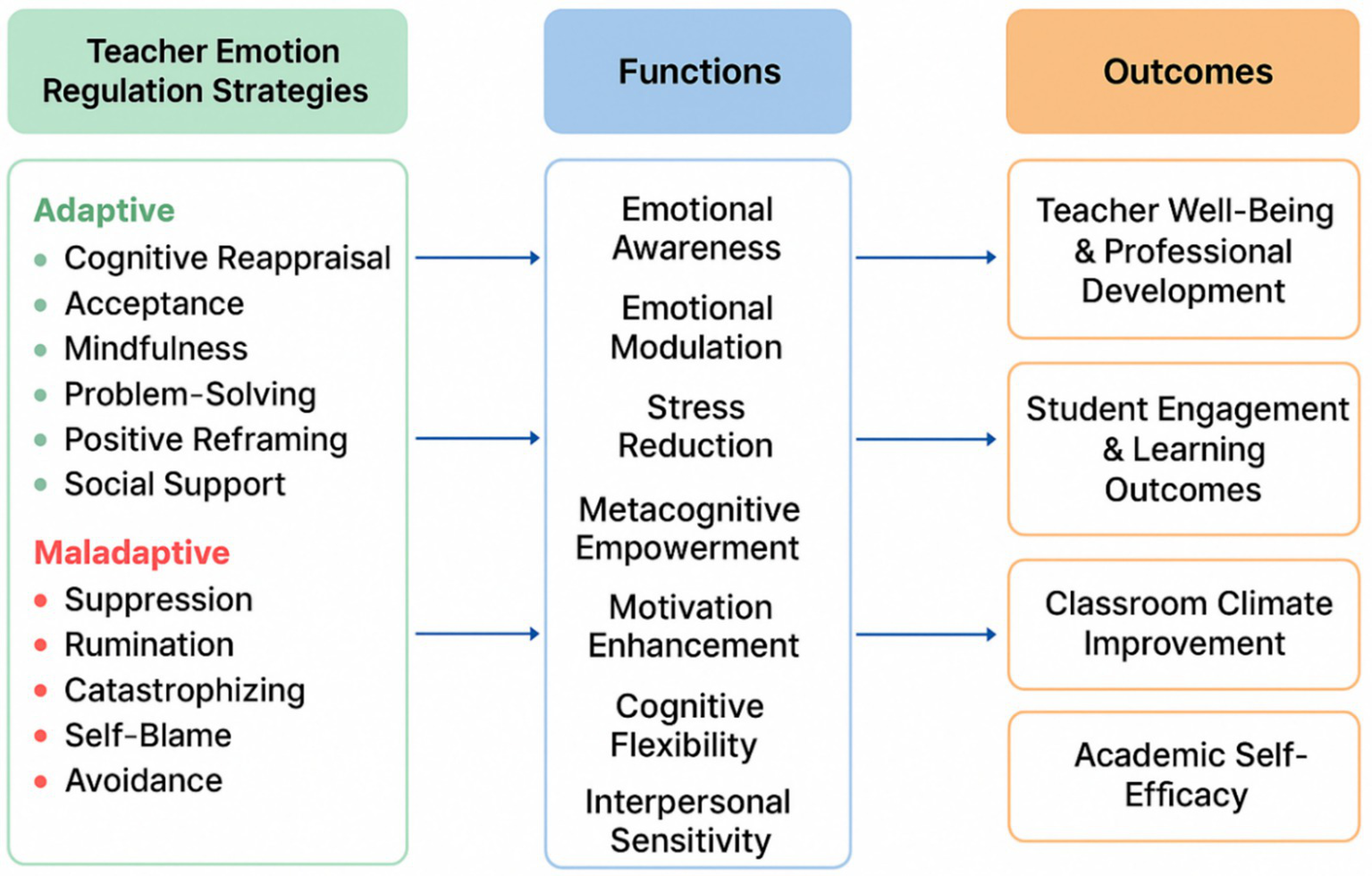
Conceptual framework of TER strategies, functions, and outcomes. The model represents the cyclical influence of teacher emotion regulation. The left column lists commonly identified adaptive and maladaptive strategies. The middle column demonstrates their functional roles—such as emotional awareness, cognitive flexibility, stress modulation, and interpersonal communication. The right column represents empirically supported outcomes, including teacher well-being, instructional effectiveness, classroom climate, and student engagement.
Discussion
The review provides a comprehensive account of how emotional processes intersect with pedagogical effectiveness, professional resilience, and learner outcomes across diverse cultural, linguistic, and institutional settings.
Teacher emotion regulation strategies
The review consistently indicates that adaptive TER strategies, particularly cognitive reappraisal, mindfulness, and relational regulation, have been foundational to professional competence and instructional effectiveness. Cognitive reappraisal allows teachers to reframe potentially stressful classroom events, thereby reducing negative affect and enhancing resilience. Teachers employing cognitive reappraisal demonstrate higher classroom engagement, authentic interactions with students, and effective management of high-stakes instructional environments (Gross, 1998, 1999, 2014, 2015, 2024; Li and Lv, 2022). Mechanistically, reappraisal strengthens executive control and emotional clarity, enabling teachers to maintain attention and responsiveness despite situational stressors.
Mindfulness-based strategies—including reflective practice, attentional focusing, and moment-to-moment awareness—have consistently supported emotional clarity, stress mitigation, and instructional presence (Abdullaeva et al., 2024; Zhang and Fathi, 2024). These strategies also facilitate positive emotional transmission, whereby teachers model adaptive emotional responses, fostering similar regulation in students. Relational strategies, such as seeking social support, peer coaching, and mentoring, address the interpersonal dimensions of teaching. Teachers using these approaches report strengthened collegial networks, enhanced professional identity, and improved classroom climate (Akbari et al., 2017; Wang and Ye, 2021). In multilingual and multicultural contexts, relational regulation additionally promotes cross-cultural understanding and reinforced student trust, enhancing engagement and collaborative learning.
In contrast, maladaptive strategies—including expressive suppression, rumination, and avoidance—consistently predict adverse outcomes. Teachers employing these strategies experience heightened stress, burnout, and emotional exhaustion, while their classrooms demonstrate reduced student engagement, lower motivation, and negative emotional climates (Chang, 2020; Fan and Xie, 2025; Thumvichit, 2023). Suppression diminishes the authenticity of teacher-student interactions and undermined relational trust, while rumination increases cognitive load and reduced instructional responsiveness. Collectively, these findings underscore that adaptive TER operates through interconnected pathways of emotional, cognitive, and relational regulation, whereas maladaptive strategies disrupt these processes and compromise both teacher well-being and classroom quality.
Teacher well-being and professional development
Teacher well-being emerges as both an outcome and mediator of effective emotion regulation. Adaptive TER strategies have correlated with reduced occupational stress, lower burnout, increased job satisfaction, and greater professional commitment (Afzali and Soltani, 2021; Greenier et al., 2021; Liu et al., 2025). Teachers employing reappraisal, mindfulness, and relational strategies report improved psychological resilience, greater adaptability in instructional practices, and enhanced coping with workplace demands.
Professional development programs targeting TER—such as mindfulness workshops, reflective journaling, peer coaching, and integrated TER curricula—significantly enhance teacher well-being and instructional competence. Structured training facilitates adaptive coping, metacognitive awareness, and effective ERS implementation, enabling teachers to maintain engagement under stress and model positive emotional behaviors for students. Contextual moderators, including institutional support, workload management, mentoring availability, and cultural norms, influence the extent to which teachers adopt and sustained adaptive strategies. Supportive environments and collaborative professional communities facilitate higher fidelity implementation, while high-stress or resource-constrained settings attenuate these benefits.
Mechanistically, these interventions operate through complementary pathways: mindfulness enhances attentional control and stress recovery; reflective journaling fosters self-awareness and metacognitive insight; peer coaching strengthens relational networks and social–emotional scaffolding. Together, these mechanisms support professional efficacy, mitigated burnout, and sustain engagement.
Impact of TER strategies on student engagement and learning outcomes
TER exert cascading effects on student engagement, motivation, and academic achievement. Adaptive strategies—particularly cognitive reappraisal, mindfulness, and relational regulation—have consistently correlated with positive student outcomes across diverse EFL contexts. Teachers modelling effective ERS foster emotionally supportive classroom climates, encouraged self-regulation, and enhanced intrinsic motivation. Maladaptive strategies, including suppression and rumination, are associated with reduced engagement, lower achievement, diminished collaboration, and impaired self-regulation. Contextual moderators, such as cultural norms, classroom hierarchies, and student language proficiency, shape the effectiveness of ERS and the nature of student engagement. Culturally responsive emotion regulation strategies further enhance trust, motivation, and engagement in multilingual classrooms. Quantitative analyses illuminate nuanced mechanisms through which teachers’ adaptive regulation foster supportive learning environments.
Cross-theme integration
The synthesis highlights a dynamic, interdependent system in which TER, teacher well-being, and student outcomes mutually reinforce one another. Adaptive TER strategies improve teacher resilience and professional competence, creating positive classroom climates conducive to student engagement and learning. Professional development enhances adoption and sustainability of adaptive strategies, while contextual moderators—including institutional support and cultural norms—shape effectiveness. Conversely, maladaptive strategies consistently disrupt this system, underscoring the necessity of targeted interventions to mitigate negative patterns and support sustainable teaching practices (Figure 3).
Figure 3
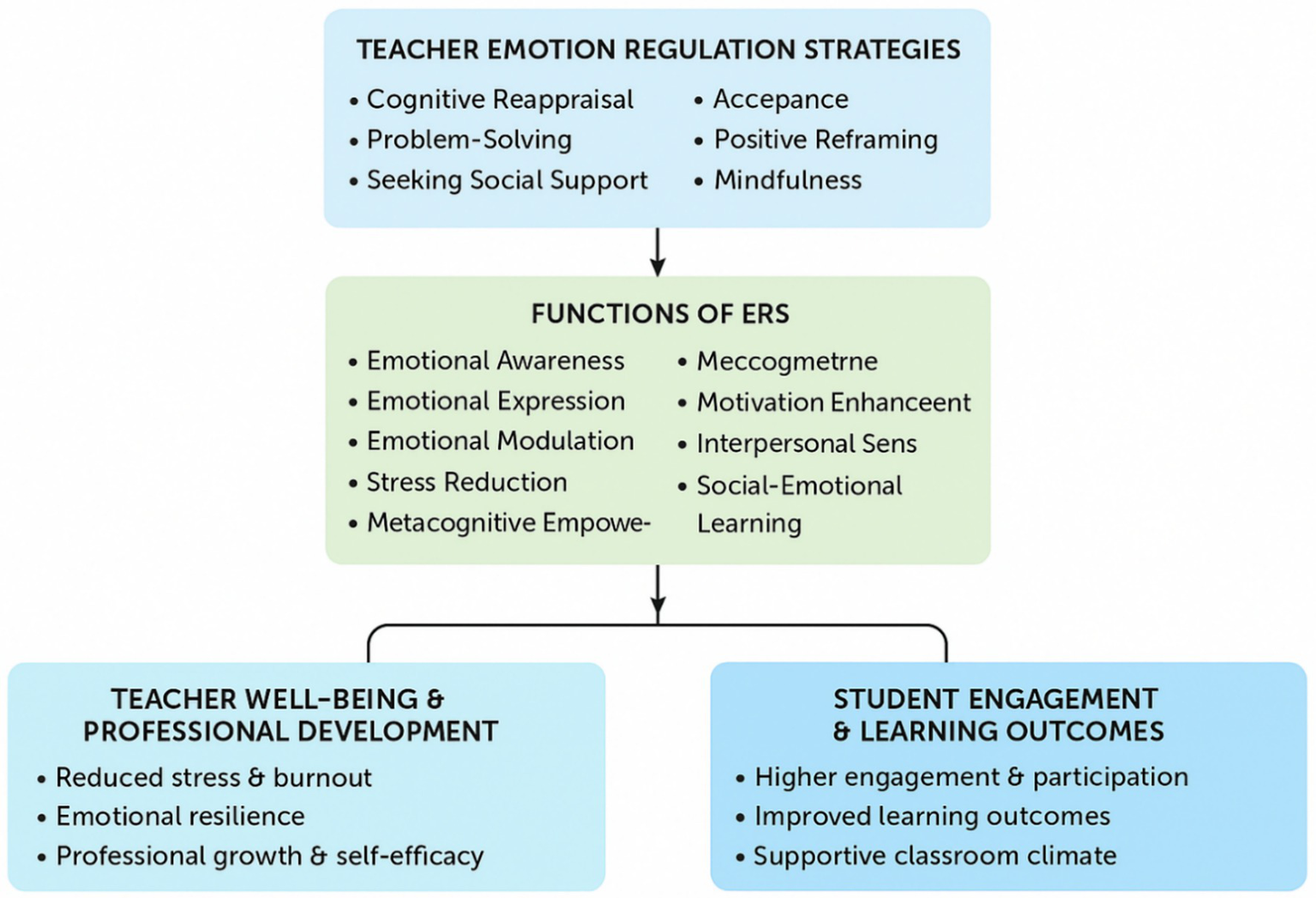
Conceptual framework of TER strategies, their functions, and outcomes in EFL contexts. This figure illustrates the relationship between adaptive and maladaptive TER strategies, the cognitive and emotional functions they serve, and subsequent outcomes on teacher well-being, professional development, student engagement, classroom climate, and academic self-efficacy. Adaptive strategies (e.g., cognitive reappraisal, mindfulness, social support) enhance emotional awareness, modulation, stress reduction, metacognition, motivation, cognitive flexibility, and interpersonal sensitivity, resulting in positive professional and student outcomes. Maladaptive strategies (e.g., suppression, rumination, self-blame) impede these processes and negatively impact teaching and learning.
Implications for practice
The findings suggest several actionable recommendations. Teacher education programs should integrate TER-focused modules emphasizing cognitive reappraisal, mindfulness, and relational regulation. Structured interventions—such as workshops, reflective journaling, and peer coaching—provide experiential learning opportunities for applying ERS in authentic classrooms. Educational institutions should ensure organizational support, including manageable workloads, mentoring structures, collaborative networks, and culturally sensitive policies. Teachers’ modeling of adaptive TER directly influences student engagement and achievement, highlighting the pedagogical value of explicit emotional competence development in both pre-service and in-service programs. Future research should prioritize longitudinal designs to evaluate sustained effects, experimental and mixed-method approaches to identify causal pathways, and the role of emerging technologies—including AI-assisted simulations and blended learning platforms—in enhancing TER in diverse contexts.
Limitations
Despite its breadth, this review has limitations. The included studies employed heterogeneous methodologies, measurement tools, and reporting standards, precluding meta-analytic aggregation. Most interventions assessed short-term outcomes, leaving long-term impacts of TER on teacher well-being and student achievement underexplored. Although multiple geographic regions were represented, under-resourced or underrepresented EFL contexts may have been insufficiently captured, limiting generalizability. Variability in classroom structures, student populations, institutional policies, and professional development programs introduced heterogeneity, complicating cross-study synthesis. Future research should employ longitudinal and experimental designs, standardized measures, and culturally diverse samples to strengthen the evidence base for adaptive TER interventions.
Conclusion
This review demonstrates that teacher emotion regulation is foundational to effective EFL instruction, professional well-being, and student learning. Adaptive strategies—including cognitive reappraisal, mindfulness, and relational regulation—have consistently fostered teacher resilience, instructional effectiveness, and emotionally supportive classroom climates. In contrast, maladaptive strategies, such as expressive suppression, rumination, and avoidance, undermine professional efficacy and reduce student engagement. Professional development programs, institutional support, and culturally responsive practices amplify the benefits of TER, creating a positive feedback loop that supports both teacher and student outcomes. Cultivating adaptive TER enables teachers to enhance professional competence while fostering enriched, engaging, and supportive learning environments, reflecting the dual pedagogical and emotional benefits of emotion regulation.
Statements
Data availability statement
The raw data supporting the conclusions of this article will be made available by the authors, without undue reservation.
Author contributions
GX: Conceptualization, Data curation, Formal analysis, Funding acquisition, Investigation, Methodology, Project administration, Resources, Software, Supervision, Validation, Visualization, Writing – original draft, Writing – review & editing. FH: Conceptualization, Data curation, Formal analysis, Funding acquisition, Investigation, Methodology, Project administration, Resources, Software, Supervision, Validation, Visualization, Writing – original draft, Writing – review & editing. HT: Writing – original draft, Resources, Writing – review & editing.
Funding
The author(s) declared that financial support was not received for this work and/or its publication.
Acknowledgments
The authors express their sincere gratitude to colleagues and students for their support in collecting databases and resources essential to this review.
Conflict of interest
The author(s) declared that this work was conducted in the absence of any commercial or financial relationships that could be construed as a potential conflict of interest.
Generative AI statement
The author(s) declared that Generative AI was not used in the creation of this manuscript.
Any alternative text (alt text) provided alongside figures in this article has been generated by Frontiers with the support of artificial intelligence and reasonable efforts have been made to ensure accuracy, including review by the authors wherever possible. If you identify any issues, please contact us.
Publisher’s note
All claims expressed in this article are solely those of the authors and do not necessarily represent those of their affiliated organizations, or those of the publisher, the editors and the reviewers. Any product that may be evaluated in this article, or claim that may be made by its manufacturer, is not guaranteed or endorsed by the publisher.
References
1
Abdullaeva B. S. Abdullaev D. Rakhmatova F. A. (2024). Uncovering the impacts of technology literacies and acceptance on emotion regulation, resilience, willingness to communicate, and enjoyment in intelligent computer-assisted language learning. Lang. Test. Asia14:40.
2
Afzali M. Soltani S. (2021). Self-efficacy and emotional regulation as predictors of teacher burnout among EFL teachers: a structural modeling approach. Int. J. English Language Literature Studies10, 55–70.
3
Agus A. H. Baharun H. Rahmatillah A. N. (2025). The influence of principal's service quality and teachers' self-concept on emotional regulation in preschool teachers. Child Educ. J.7, 26–35.
4
Akbari R. Samar R. G. Kiany G. R. (2017). A qualitative study of EFL teachers’ emotion regulation behavior in the classroom. Theory Pract. Lang. Stud.7, 311–321. doi: 10.17507/tpls.0704.10
5
Akram H. Oteir I. N. (2025). A longitudinal analysis of physical exercise in shaping language learners’ emotional well-being: a comparative analysis between L1 and L2 students. BMC Psychology13:44. doi: 10.1186/s40359-024-02338-9,
6
Aldrup K. Carstensen B. Klusmann U. (2024). The role of teachers’ emotion regulation in teaching effectiveness: a systematic review integrating four lines of research. Educ. Psychol.59, 89–110. doi: 10.1080/00461520.2023.2282446
7
Aldrup K. Carstensen B. Köller M. M. Klusmann U. (2020). Measuring teachers’ social-emotional competence: development and validation of a situational judgment test. Front. Psychol.11:892. doi: 10.3389/fpsyg.2020.00892,
8
Aliakbari M. Farhadi S. (2024). Emotional management of adult EFL learners in higher education. Interdisciplinary Studies English Language Teaching2, 175–189.
9
Alzaanin E. I. (2024). Capturing the emotional experiences of English as a foreign language university teachers: a critical perspective. Lang. Teach. Res.28, 931–947. doi: 10.1177/13621688211012863
10
Amini Farsani M. Oroomieh D. Ramezanpour K. (2024). Exploring emotion regulation strategies in an EFL argumentative writing course: the case of Iranian MA students in TEFL. Curr. Psychol.43, 36884–36896. doi: 10.1007/s12144-024-07081-3
11
Amirian S. M. R. Rezaee F. Boroumand M. (2025). Predicting teacher well-being through teacher leadership and collective teacher efficacy. Language Teaching Research Quarterly49, 269–286. doi: 10.32038/ltrq.2025.49.14
12
Arabmofrad A. Shakki F. (2025). The interplay between EFL teachers' self-efficacy, emotion regulation, and perceived professional success. Revista Internacional de Didáctica de las Lenguas Extranjeras44, 161–183.
13
Atmaca Ç. Rızaoğlu F. Türkdoğan T. Yaylı D. (2020). An emotion-focused approach in predicting teacher burnout and job satisfaction. Teach. Teach. Educ.90:103025. doi: 10.1016/j.tate.2020.103025
14
Azari Noughabi M. Fekri N. Kazemkhah Hasankiadeh F. (2022). The contribution of psychological wellbeing and emotion-regulation to foreign language teaching enjoyment. Front. Psychol.13:889133. doi: 10.3389/fpsyg.2022.889133,
15
Bazadough D. S. Sulaiman B. A. (2023). Emotional regulation and its relationship to self-efficacy among academic leaders in Amman Arab University. J. Namib. Stud. Hist. Polit. Cult.33.
16
Bellocchi A. (2019). Early career science teacher experiences of social bonds and emotion management. J. Res. Sci. Teach.56, 322–347. doi: 10.1002/tea.21520
17
Bielak J. Mystkowska-Wiertelak A. (2022). Language teachers’ interpersonal learner-directed emotion-regulation strategies. Lang. Teach. Res.26, 1082–1105. doi: 10.1177/1362168820912352
18
Bing H. Sadjadi B. Afzali M. Fathi J. (2022). Self-efficacy and emotion regulation as predictors of teacher burnout among English as a foreign language teachers: a structural equation modeling approach. Front. Psychol.13:900417. doi: 10.3389/fpsyg.2022.900417,
19
Boekaerts M. Pekrun R. (2015). “Emotions and emotion regulation in academic settings” in Handbook of Educational Psychology (Routledge), 90–104.
20
Brackett M. A. Rivers S. E. (2014). “Transforming students' lives with social and emotional learning” in Handbook of emotions in education. eds. JacobsS. E.GrossJ. J. (Taylor & Francis).
21
Braun V. Clarke V. (2006). Using thematic analysis in psychology. Qualitative Research in Psychology3, 77–101.
22
Chahkandi F. Rasekh A. E. (2016). Efficacious EFL teachers' goals and strategies for emotion management: the role of culture in focus. Iran. J. Applied Linguistics19, 35–72. doi: 10.18869/acadpub.ijal.19.1.35,
23
Chang M. L. (2020). Emotion display rules, emotion regulation, and teacher burnout. Front. Educ.5:90. doi: 10.3389/feduc.2020.00090
24
Chang M. L. Taxer J. (2021). Teacher emotion regulation strategies in response to classroom misbehavior. Teach. Teach.27, 353–369. doi: 10.1080/13540602.2020.1740198
25
Chen C. Chen W. (2025). Exploring supervisors’ emotion regulation strategies in undergraduate thesis supervision. Asia Pac. Educ. Res., 1–13. doi: 10.1007/s40299-025-01030-9,
26
Chen S. Tang L. (2024). EFL teachers’ engagement: the impact of well-being and emotion regulation. Heliyon10:e27338. doi: 10.1016/j.heliyon.2024.e27338,
27
Cheng P. Y. Z. Liu H. (2024). A structural model of EFL teachers’ physical activity, emotion regulation, and competence for online teaching. BMC Psychology12:252. doi: 10.1186/s40359-024-01753-2,
28
Cirkveni M. Hocenski-Dreiseidl M. Katavić-Čaušić S. (2024). Proactivity as a predictor of ESP students’ use of language learning strategies during the COVID-19 pandemic. J. Teach. Engl. Specif. Acad. Purp., 619–637.
29
Darling-Hammond L. Flook L. Cook-Harvey C. Barron B. Osher D. (2020). Implications for educational practice of the science of learning and development. Appl. Dev. Sci.24, 97–140. doi: 10.1080/10888691.2018.1537791
30
Deng J. Heydarnejad T. Farhangi F. (2022). Delving into the relationship between teacher emotion regulation, self-efficacy, engagement, and anger: a focus on English as a foreign language teachers. Front. Psychol.13:948516.
31
Derakhshan A. Fathi J. (2024). The interplay between perceived teacher support, self-regulation, and psychological well-being among EFL students. Iran. J. Lang. Teach. Res.12, 113–138. doi: 10.30466/ijltr.2024.121579
32
Derakhshan A. Wang Y. Ghiasvand F. (2024). “I never make a permanent decision based on a temporary emotion”: unveiling EFL teachers’ perspectives about emotions in assessment. Appl. Linguist. Rev.15, 2659–2684. doi: 10.1515/applirev-2023-0089
33
Dewaele J. M. Li C. (2022). Foreign language enjoyment and anxiety: associations with general and domain-specific English achievement. Chin. J. Appl. Linguist.45, 32–48. doi: 10.1515/CJAL-2022-0104
34
Ding L. (2024). Exploring the causes, consequences, and solutions of Chinese EFL teachers' psychological ill-being: a qualitative investigation. Eur. J. Educ.59:e12739. doi: 10.1111/ejed.12739
35
Donyadideh S. Haratyan F. (2018). The impact of English literature (story reading) on ESP learners' emotion regulation. Iran. J. Learn. Memory1, 71–78.
36
Dumančić D. (2018). Investigating boredom among EFL teachers. ExELL6, 57–80. doi: 10.2478/exell-2019-0006
37
Eginli I. Mutlu A. K. (2022). The contribution of perceived collective efficacy beliefs and interpersonal emotion regulation to Turkish EFL teachers’ job stress. Eur. J. Engl. Lang. Teach.7.
38
Ekanayake K. (2024). Teachers' emotion regulation strategies in multicultural classrooms: Insights from Finnish teachers. Master’s thesis, University of Oulu
39
Fan J. Wang Y. (2022). English as a foreign language teachers' professional success in the Chinese context: the effects of well-being and emotion regulation. Front. Psychol.13:899654. doi: 10.3389/fpsyg.2022.952503,
40
Fan Y. Xie Z. (2025). Exploring Chinese EFL student teachers' emotions and emotion-regulation strategies in receiving peer feedback on microteaching. System129:103589. doi: 10.1016/j.system.2024.103589
41
Fathi J. Derakhshan A. (2019). Teacher self-efficacy and emotional regulation as predictors of teaching stress: an investigation of Iranian English language teachers. Teach. Eng. Lang. Multimedia26, 87–100.
42
Fathi J. Derakhshan A. Shirkhani S. (2021). Teacher self-efficacy and emotion regulation in EFL classrooms. Innov. Lang. Learn. Teach.15, 210–223.
43
Fathi J. Greenier V. Derakhshan A. (2021). Self-efficacy, reflection, and burnout among Iranian EFL teachers: the mediating role of emotion regulation. Iran. J. Lang. Teach. Res.9, 13–37. doi: 10.30466/ijltr.2021.121043
44
Feng E. Hong G. (2022). Engagement mediates the relationship between emotion and achievement of Chinese EFL learners. Front. Psychol.13:895594. doi: 10.3389/fpsyg.2022.895594,
45
Frenzel A. C. Goetz T. Lüdtke O. Pekrun R. Sutton R. E. (2009). Emotional transmission in the classroom: exploring the relationship between teacher and student enjoyment. J. Educ. Psychol.101, 705–716. doi: 10.1037/a0014695
46
Fried L. Chapman E. (2012). An investigation into the capacity of student motivation and emotion regulation strategies to predict engagement and resilience in the middle school classroom. Aust. Educ. Res.39, 295–311. doi: 10.1007/s13384-011-0049-1
47
Fu F. Haratyan F. Yanling Z. (2023). A comparative review of research on mindfulness in pre/post COVID-19 education. British J. Educ.11, 1–2.
48
Fuentes Vilugrón G. Sandoval-Obando E. (2024). Difficulties among teachers' emotional regulation: analysis for the development of student well-being in Chilean schools. Behav. Sci.14:749.
49
Galea E. (2024). Advancing AI-driven pedagogy through the regulation of emotions: a vision for school practitioners. Italian J. Health Educ. Sport Inclusive Didactics8.
50
Gkonou C. Miller E. R. (2023). Relationality in language teacher emotion regulation: regulating emotions through, with and for others. System115:103046. doi: 10.1016/j.system.2023.103046
51
Gloria G. Mbato C. L. (2024). EFL novice teachers’ emotion regulation in Indonesian primary and secondary schools: emotional labor. Project7, 403–419.
52
Greenier V. Derakhshan A. Fathi J. (2021). Emotion regulation and psychological well-being in teacher work engagement: a case of British and Iranian English language teachers. System97:102446. doi: 10.1016/j.system.2020.102446
53
Gross J. J. (1998). The emerging field of emotion regulation: an integrative review. Rev. Gen. Psychol.2, 271–299. doi: 10.1037/1089-2680.2.3.271
54
Gross J. J. (1999). Emotion regulation: past, present, future. Cognit. Emot.12, 345–370.
55
Gross J. J. (2014). Handbook of emotion regulation. 2nd Edn: Guilford Press.
56
Gross J. J. (2015). Emotion regulation: current status and future prospects. Psychol. Inq.26, 1–26. doi: 10.1080/1047840X.2014.940781
57
Gross J. J. (2024). Conceptual foundations of emotion regulation. Am. Psychol psycnet.apa.org
58
Gross J. J. John O. P. (2003). Individual differences in two emotion regulation processes: implications for affect, relationships, and well-being. J. Pers. Soc. Psychol.85, 348–362. doi: 10.1037/0022-3514.85.2.348,
59
Gu H. Mao Y. Wang Q. (2022). Exploring EFL teachers’ emotions and the impact on their sustainable professional development in livestream teaching: a Chinese case study. Sustainability14:8264. doi: 10.3390/su14148264
60
Hahm K. (2025). Teacher emotions and emotion regulation: a qualitative study with Korean EFL high school teachers in Korea. Language Teaching 기독교교육정보85, 387–435.
61
Han J. Geng X. (2025). Modelling the interplay between university foreign language teachers’ interpersonal emotion regulation and psychological well-being. Asia Pac. Educ. Res., 1–10. doi: 10.1007/s40299-024-00965-9,
62
Han Y. Wei R. Wang J. (2023). An ecological examination of teacher emotions in an EFL context. Front. Psychol.14:1245678. doi: 10.3389/fpsyg.2023.1058046,
63
Han L. Zhang J. (2025). Identity tension and emotion regulation: a case study of Chinese novice EFL teachers. Asia-Pac. J. Second Foreign Lang. Educ.10:12. doi: 10.1186/s40862-025-00319-y
64
Han J. Zhuang H. Jin L. Xue L. (2024). ‘Round outside and square inside’: language teachers’ emotion regulation strategies in crosscultural teaching contexts. J. Multiling. Multicult. Dev., 1–16. doi: 10.1080/01434632.2024.2410397
65
Hao P. N. Tam T. T. T. (2025). “Resilience fosters sustainability!”: Exploring Vietnamese pre-service EFL teachers’ emotional experiences in a school-based teaching practicum from the lens of Resilience Theory” Educational Point, 2:e118.
66
Haratyān F. Yanling Z. (2022). Emotion regulation in education in the chaotic era of the COVID-19 pandemic. Conference proceeding, 43rd Portugal International Conference on Education, Literature, Humanities, and Social Sciences. DIRPUB.
67
Harbin A. N. (2021). Exploring the relationship between leader identity and emotional resilience in teachers: A mixed methods approach (doctoral thesis, University of Central Arkansas)
68
Harley J. M. Pekrun R. Taxer J. L. Gross J. J. (2019). Emotion regulation in achievement situations: an integrated model. Educ. Psychol.54, 106–126. doi: 10.1080/00461520.2019.1587297
69
Helsper A. DeShon L. Boylan L. E. Galliher J. Rubenstein L. D. (2025). Under pressure: gifted students’ vulnerabilities, stressors, and coping mechanisms within a high achieving high school. Behavioral Sciences15:235. doi: 10.3390/bs15020235,
70
Heng R. Cheng Q. Pu L. Tang Q. (2024). Pre-service EFL teachers' emotional experiences, emotion regulation strategies, and influencing factors in research: a Chinese case study. Heliyon10:e29567.
71
Hoffmann J. D. Brackett M. A. Bailey C. S. Willner C. J. (2020). Teaching emotion regulation in schools: translating research into practice with the RULER approach to social and emotional learning. Emotion20, 105–109. doi: 10.1037/emo0000649,
72
Hu Y. (2023). Examining the effects of teacher self-compassion, emotion regulation, and emotional labor strategies as predictors of teacher resilience in EFL context. Front. Psychol.14:1190837. doi: 10.3389/fpsyg.2023.1190837,
73
Isaee H. Barjesteh H. (2025). The relation between Iranian EFL learners' perception of teacher enthusiasm and their engagement in the context of second-language classrooms. Appl. Lang. Studies3, 74–102.
74
Ismail S. M. Patra I. Yang H. Ajanil B. (2023). Language teacher psychological well-being: an insight into the impacts of emotion regulation, reflective teaching, self-efficacy, and identity in an EFL context. Asia-Pac. J. Second Foreign Lang. Educ.8:44. doi: 10.1186/s40862-023-00215-3
75
Jabbari N. Zarrinabadi N. Amini F. (2025). Grit as the predictor of flow and buoyancy among Duolingo multiple language learners: the mediating roles of perceived competence and competitiveness. J. Multiling. Multicult. Dev.
76
Jacobs S. E. Gross J. J. (2014). “Emotion regulation in education: conceptual foundations, current applications, and future directions” in International handbook of emotions in education, 183–201.
77
Jiang Y. Dewaele J. M. (2019). How unique is the foreign language classroom enjoyment and anxiety of Chinese EFL learners. System82, 13–25. doi: 10.1016/j.system.2019.02.017
78
Karimi M. N. Hashemi M. R. Oghyanous P. A. (2022). L2 learners' understanding of achievement emotions and emotion regulation strategies: contributions of a longitudinal emotion regulation initiative. TESL-EJ26:2.
79
Khammat A. H. (2022). Investigating the relationships of Iraqi EFL teachers' emotion regulation, resilience, and psychological well-being. Jostarhaye Zabani: Modares University.
80
Khasawneh M. A. S. Aladini A. Assi S. A. Ajanil B. (2025). Portfolio assessment in AI enhanced learning environments: a pathway to emotion regulation, mindfulness, and language learning attitudes. Lang. Test. Asia15:45.
81
Kim Y. Kim T. Y. (2018). Korean EFL teachers’ emotional labor: an exploratory study. Engl. Lang. Teach.30, 21–41.
82
Kim T. Y. Kim Y. Kim J. Y. (2018). A qualitative inquiry on EFL learning demotivation and resilience: a study of primary and secondary EFL students in South Korea. Asia-Pac. Educ. Res.27, 55–64. doi: 10.1007/s40299-017-0365-y
83
Kitayoka K. (2021). An empirical study of classroom enjoyment and negative emotions: a model of the use of authentic materials in the Japanese EFL context. Teach. Eng. Multimedia26, 87–100.
84
Le T. T. Pham T. T. (2024). Emotional maturity in EFL teaching: exploring Vietnamese teachers’ perceptions and its impact on student learning outcomes. Ampersand13:100183. doi: 10.1016/j.amper.2024.100183
85
Le T. T. Pham T. T. Hua H. H. (2024). Vietnamese EFL teachers’ insights into the impact of their emotional maturity on students' engagement. J. Contemp. Lang. Res.3, 44–52. doi: 10.58803/jclr.v3i2.99
86
Lee J. S. (2022). The role of grit and classroom enjoyment in EFL learners’ willingness to communicate. J. Multiling. Multicult. Dev.43, 452–468. doi: 10.1080/01434632.2020.1746319
87
Lee J. J. Ok C. (2012). Reducing burnout and enhancing job satisfaction: critical role of hotel employees’ emotional intelligence and emotional labor. Int. J. Hosp. Manag.31, 1101–1112.
88
Li C. (2020). A positive psychology perspective on Chinese EFL students’ trait emotional intelligence, foreign language enjoyment, and EFL learning achievement. J. Multiling. Multicult. Dev.41, 246–263. doi: 10.1080/01434632.2019.1614187
89
Li H. (2023). Investigating the effects of emotion regulation and creativity on Chinese EFL teachers' burnout in online classes. Porta Linguarum, 2023, 177–193.
90
Li L. (2025). Burnout among Chinese EFL university instructors: a mixed-methods exploration of school climate, job demands, and emotion regulation. Front. Psychol.16. doi: 10.3389/fpsyg.2025.1549466,
91
Li C. Akram M. (2023). Teacher and learner emotions in multilingual EFL classrooms: a comparative study. Lang. Teach. Res.27, 345–367.
92
Li S. Akram H. (2023). Do emotional regulation behaviors matter in EFL teachers' professional development? A process model approach. Porta Linguarum9, 273–291.
93
Li C. Dewaele J. M. Hu Y. (2023). Foreign language learning boredom: conceptualization and measurement. Appl. Linguist. Rev.14, 223–249. doi: 10.1515/applirev-2020-0124
94
Li C. Dewaele J. M. Jiang G. (2020). The complex relationship between classroom emotions and EFL achievement in China. Appl. Linguist. Rev.11, 485–510. doi: 10.1515/applirev-2018-0043
95
Li M. Heydarnejad T. Azizi Z. Rezaei Gashti Z. (2022). Modeling the role of emotion regulation and critical thinking in immunity in higher education. Front. Psychol.13:1005071. doi: 10.3389/fpsyg.2022.1005071,
96
Li L. Lv L. (2022). The impact of Chinese EFL teachers’ emotion regulation and resilience on their success. Front. Psychol.13:898114. doi: 10.3389/fpsyg.2022.898114,
97
Li Y. Zhang L. (2024). Exploring the relationships among teacher–student dynamics, learning enjoyment, and burnout in EFL students: the role of emotional intelligence. Front. Psychol.14:1329400. doi: 10.3389/fpsyg.2023.1329400,
98
Liu H. Chu W. (2022). EFL teachers’ emotional intelligence and self-efficacy as predictors of their emotional labor strategies. Front. Psychol.13:830987.
99
Liu H. Li Y. Liu B. (2023). Exploring the relationship between emotional intelligence and emotion regulation: evidence from junior high school EFL teachers in China. In Forum for linguistic studies (Transferred, 5, 1641–1641
100
Liu H. Liu B. Zhou X. (2024). Exploring the mediating role of EFL teachers' emotion regulation in the relationship between emotional intelligence and resilience. Int. J. Appl. Linguist.17:6785987.
101
Liu G. Z. Namaziandost E. Rezai A. Heydarnejad T. (2025). Unveiling the influence of emotion regulation on job satisfaction, job effectiveness, and psychological well-being in Iranian university EFL teachers: a SEM analysis. Int. J. Appl. Linguist.35, 729–744. doi: 10.1111/ijal.12654
102
Lu L. Wang C. Wang Y. (2024). The contribution of teacher self-efficacy, resilience, and emotion regulation to teachers' well-being: technology-enhanced teaching context. Eur. J. Educ.59:e12755. doi: 10.1111/ejed.12755
103
Ma Y. (2023). A Lenz into the predictive power of language teacher emotion regulation and self-evaluation on L2 grit, teaching style preferences, and work engagement: a case of Chinese EFL instructors. BMC Psychol.11:330. doi: 10.1186/s40359-023-01356-3,
104
Ma P. Zhang L. Dong H. Yu J. (2023). The relationships between teachers’ emotional labor and display rules, trait emotions, exhaustion, and classroom emotional climate. Front. Psychol.14:957856. doi: 10.3389/fpsyg.2023.957856,
105
MacIntyre P. Gregersen T. (2012). EmOtions that facilitate language learning: The positive-broadening power of the imagination. 2, pp. 193–213.
106
Mai X. 2025. Montessori preschool teachers' perceived efficacy and experience in teaching and modeling emotion regulation: An exploratory method study (Doctoral dissertation, Regent University).
107
Martinović A. Dumančić D. (2022). Can teach and prosper? EFL teachers' attitudes, well-being, and coping strategies in an online setting. ExELL10, 90–130. doi: 10.2478/exell-2023-0002
108
Melo I. L. R. (2024). Emotional regulation in English teaching. Faculdade de Línguas Estrangeiras (FALEST). Universidade Federal do Pará, campus Bragança ufpa.br. Available online at: https://bdm.ufpa.br/server/api/core/bitstreams/b93573b9-e832-4961-bbe8-48ded53f4451/content
109
Meşe E. Mede E. (2024). The emotion regulation antecedents of tertiary EFL instructors and their use of reappraisal and suppression. Teach. Teach. Educ.150:104732. doi: 10.1016/j.tate.2024.104732
110
Mikolajczak M. Gross J. J. Roskam I. (2019). Parental burnout: What is it, and why does it matter?Clin. Psychol. Sci.7, 1319–1329. doi: 10.1177/2167702619858430
111
Mohammad Hosseinpur R. Maleki R. Adel Nasir Z. A. S. (2025). Exploring self-efficacy and emotion regulation as predictors of Iraqi EFL teachers’ burnout. J. Eng. Specific Purposes Praxis2, 81–98.
112
Morris S. King J. (2018). Teacher frustration and emotion regulation in university language teaching. Chin. J. Appl. Linguist.41, 433–452. doi: 10.1515/cjal-2018-0032
113
Morris S. King J. (2020). Emotion regulation among university EFL teachers in Japan: the dynamic interplay between context and emotional behaviour. In GkonouC.DewaeleJ.KingJ. (Eds.), The emotional rollercoaster of language teaching bristol, blue ridge summit: multilingual matters, (pp. 193–210). doi: 10.21832/9781788928342-015
114
Morris S. King J. (2023). University language teachers’ contextually dependent uses of instrumental emotion regulation. System116:103080. doi: 10.1016/j.system.2023.103080
115
Muehlbacher F. Hagenauer G. Keller M. M. (2022). Teachers’ emotion regulation in the team-taught classroom: Insights into teachers’ perspectives on how to regulate and communicate emotions with regard to the team teaching partner. In Frontiers in education, Frontiers Media SA, 7:787224.
116
Mutlu A. K. Solhi M. (2024). Unveiling the interplay between EFL teachers’ cognitive flexibility, emotion regulation, and foreign language teaching anxiety: a structural equation modeling approach. Learn. Motiv.87:102022. doi: 10.1016/j.lmot.2024.102022
117
Namaziandost E. Rezai A. (2024). Interplay of academic emotion regulation, academic mindfulness, L2 learning experience, academic motivation, and learner autonomy in intelligent computer-assisted language learning: a study of EFL learners. System125:103419. doi: 10.1016/j.system.2024.103419
118
Namaziandost E. Rezai A. Kargar Behbahani H. Heydarnejad T. (2025). Role of academic emotion regulation and self-compassion in EFL learners’ academic motivation, growth mindset, and psychological wellness: insights from self-determination theory. Psychol. Stud.70, 84–101. doi: 10.1007/s12646-024-00817-y,
119
Ngo T. C. T. (2024). Novice EFL teachers’ belief and emotional regulation in response to students’ misbehaviors in the classrooms. Int. J. Lang. Instr.3, 20–45. doi: 10.54855/ijli.24342
120
Nur S. Korompot C. A. Mahmud M. (2023). Navigating through religious discourses in EFL teaching: teachers’ motivational and emotional complexities. Issues Educ. Res.33, 1478–1494.
121
Olí M. Valente S. (2025). The dynamics of self-regulated learning and emotional regulation in the educational path: a theoretical review. Creat. Educ.16, 632–650.
122
Opare-Kumi J. (2024). Promoting mental health and educational success among young people in the global south (doctoral dissertation, University of Oxford)
123
Pekrun R. (2006). The control-value theory of achievement emotions: assumptions, corollaries, and implications for educational research and practice. Educ. Psychol. Rev.18, 315–341. doi: 10.1007/s10648-006-9029-9
124
Pekrun R. Perry R. P. (2014). “Control-value theory of achievement emotions” in International handbook of emotions in education. eds. PekrunR.Linnenbrink-GarciaL. (Routledge), 120–141.
125
Pepping N. (2025). Regulating emotions after brain injury: Measurement and intervention (doctoral thesis, University of Western Australia)
126
Phillips C. (2024). Social-emotional learning introduction handbook for upper elementary teachers. California State University. Doctoral thesis
127
Qu J. Wang Y. (2024). Modelling the interaction between EFL teachers' personality traits, emotion regulation strategies, and teachers' depression: a structural equation approach. Eur. J. Educ.49:e12727.
128
Reidel M. Salinas C. (2024). If students don’t feel it, they won’t learn it: early career secondary social studies educators plan for emotional engagement. J. Soc. Stud. Res.48, 87–101. doi: 10.1177/23522798231219967
129
Resnik P. Dewaele J.-M. (2020). Trait emotional intelligence, positive and negative emotions in first and foreign language classes: a mixed-methods approach. System94:102324. doi: 10.1016/j.system.2020.102324
130
Resnik P. Dewaele J. M. (2023). Learner emotions, autonomy and trait emotional intelligence in ‘in person’ versus emergency remote English foreign language teaching in Europe. Appl. Linguist. Rev.14, 473–501. doi: 10.1515/applirev-2020-0096
131
Rezai A. Soyoof A. Reynolds B. L. (2024). Disclosing the correlation between using ChatGPT and well-being in EFL learners: considering the mediating role of emotion regulation. Eur. J. Educ.59:e12752. doi: 10.1111/ejed.12752
132
Sadoughi M. Hejazi S. Y. Khajavy G. H. (2024). Protecting language teachers from burnout: the roles of teaching mindset, teaching grit, and emotion regulation. Lang. Teach. Res.13621688241238350. doi: 10.1177/13621688241238350,
133
Sahib A. Chen J. Cárdenas D. Calear A. L. Wilson C. (2024). Emotion regulation mediates the relation between intolerance of uncertainty and emotion difficulties: a longitudinal investigation. J. Affect. Disord.364, 194–204. doi: 10.1016/j.jad.2024.08.056,
134
Shafiee Rad H. Hashemian M. (2023). Role of hedonic and eudaimonic well-being in second language learners’ trait emotional intelligence and emotion regulation. Eur. J. Psychol. Educ.38, 1619–1641. doi: 10.1007/s10212-022-00663-4
135
Shi Y. Cheng Q. Wei Y. Liang Y. Zhu K. (2025). Effects of peer and teacher support on students’ creative thinking: emotional intelligence as a mediator and emotion regulation strategy as a moderator. J. Intelligence13:53. doi: 10.3390/jintelligence13050053,
136
Shi H. Sun W. (2025). Exploring emotional regulation, well-being, and academic engagement: a comparative study among Chinese high school and college EFL learners. J. Appl. Dev. Psychol.98:101773. doi: 10.1016/j.appdev.2025.101773
137
Solhi M. Ünsal Görkemoğlu B. Azari Noughabi M. Atay D. (2024). Do well-being and emotion regulation predict L2 teacher grit?TESOL16:1446257.
138
Songhori M. H. Izadi F. Jahantighi E. Bahremand A. (2024). “EFL teachers' emotions and emotion regulation strategies in online teaching during the COVID-19 pandemic” in Access, equity and engagement in online learning in TESOL, 63–79.
139
Su Y. Guo H. (2024). Unpacking EFL learners’ emotions and emotion regulation strategies in digital collaborative academic reading projects: an integrated approach of vignette methodology and interview analysis. J. Engl. Acad. Purp.71:101404. doi: 10.1016/j.jeap.2024.101404
140
Su X. Lee I. (2024). Emotion regulation of EFL teachers in blended classroom assessment. Asia Pac. Educ. Res.33, 649–658. doi: 10.1007/s40299-023-00761-x
141
Sun Y. Yin H. (2024). Framing the theoretical perspectives on emotion regulation: a Habermasian typology and its implications for educational research. Soc. Psychol. Educ.27, 1117–1141. doi: 10.1007/s11218-023-09855-2
142
Tajabadi H. Meihami H. (2024). “The more, the merrier; the more ideas, the better feeling”: examining the role of creativity in regulating emotions among EFL teachers. Open Educ. Stud.6:20240007. doi: 10.1515/edu-2024-0007
143
Tamir M. Ito A. Miyamoto Y. Chentsova-Dutton Y. Choi J. H. Cieciuch J. et al . (2024). Emotion regulation strategies and psychological health across cultures. Am. Psychol.79, 748–764. doi: 10.1037/amp0001237,
144
Thumvichit A. (2023). Understanding emotion-regulation among foreign language teachers in response to classroom stressors: findings from a Q methodology study. Soc. Psychol. Educ.16:14678957.
145
Thumvichit A. (2025). Tesol teacher educators' emotion regulation in times of transformation: AQ methodological analysis of divergent responses to emerging technologies. TESOL Q.
146
Thuỳ N. T. C. (2024). EFL lecturer’s negative emotion regulation in the classrooms: a case study at a university in Vietnam. Hue Univ. J. Sci. Soc. Sci. Humanit.133, 5–22. doi: 10.26459/hueunijssh.v133i6B.7477
147
Tsujimoto M. Saito T. Matsuzaki Y. Kawashima R. (2024). Role of positive and negative emotion regulation in well-being and health: the interplay between positive and negative emotion regulation abilities is linked to mental and physical health. J. Happiness Stud.25:25. doi: 10.1007/s10902-024-00714-1
148
Vogl P. Methlagl M. Hanfstingl B. (2025). A systematic review of strategies, contexts and outcomes of emotion regulation in teaching. Discover Psychol.5, 1–29.
149
Wang Y. Derakhshan A. Solhi M. (2025). Dispositions toward loving pedagogy, emotion regulation, and self-efficacy as predictors of EFL teachers’ work engagement: a multinational study. Lang. Teach. Res.13621688251353132. doi: 10.1177/13621688251353132,
150
Wang Q. Gao Y. Wang X. (2024). The relationships between burnout, job satisfaction, and emotion regulation among foreign language teachers: a meta-analytic review. Acta Psychol.250:104545. doi: 10.1016/j.actpsy.2024.104545,
151
Wang Y. He L. Wang Q. Y. (2025). The predictive power of teaching self-efficacy and emotion regulation on work engagement for EFL teachers in higher education. Front. Psychol.16:1446257. doi: 10.3389/fpsyg.2025.1446257,
152
Wang S. Li X. Lu J. Yu M. (2022). Perceived teacher empathy and teenagers’ positive academic emotions: the mediating effect of interpersonal emotion regulation. School Psychol. Int.43, 443–459. doi: 10.1177/01430343221113004
153
Wang F. Ye Z. (2021). On the role of EFL/ESL teachers' emotion regulation in students' academic engagement. Front. Psychol.12:758860. doi: 10.3389/fpsyg.2021.758860,
154
Wang Y. Zai F. Zhou X. (2025). The impact of emotion regulation strategies on teachers’ well-being and positive emotions: a meta-analysis. Behavioral Sciences15:342. doi: 10.3390/bs15030342,
155
Wu H. Wang Y. Wang Y. (2023). What do we know about L2 teachers’ emotion regulation? A bibliometric analysis of the pertinent literature. Forum Linguist. Stud.5, 2012–2012.
156
Xiao H. Suwanarak K. (2024). EFL teachers’ emotions toward online merge offline teaching mode in university. Theory Practice Language Studies14, 1001–1010.
157
Xiao J. Tian G. (2023). “Sailing together in the storm”: Chinese EFL teachers’ trajectory of interpersonal emotion regulation towards well-being. Sustainability15:6125. doi: 10.3390/su15076125
158
Xiao T. Yi S. Akhter S. (2024). AI-supported online language learning: learners’ self-esteem, cognitive emotion regulation, academic enjoyment, and language success. Int. Rev. Res. Open Distrib. Learn.25, 77–96. doi: 10.19173/irrodl.v25i3.7666
159
Xin Z. Derakhshan A. (2025). From excitement to anxiety: exploring English as a foreign language learners' emotional experiences in the artificial intelligence powered classrooms. Eur. J. Educ.60:e12845. doi: 10.1111/ejed.12845
160
Yang C. Wei M. Liu Q. (2025). Intersections between cognitive-emotion regulation, critical thinking and academic resilience with academic motivation and autonomy in EFL learners: contributions of AI mediated learning environments. Br. Educ. Res. J.122:78843.
161
Yang L. Zhao S. (2024). AI-induced emotions in L2 education: exploring EFL students’ perceived emotions and regulation strategies. Comput. Hum. Behav.159:108337. doi: 10.1016/j.chb.2024.108337
162
Yeager D. S. Bryan C. J. Gross J. J. Murray J. S. Krettek Cobb D. HF Santos P. et al . (2022). A synergistic mindsets intervention protects adolescents from stress. Nature607, 512–520. doi: 10.1038/s41586-022-04907-7,
163
Yu X. Ying T. (2024). Under the surface of teacher occupational wellness and effectiveness in higher education: a look into the mediator roles of work passion and emotion regulation via SEM analysis. BMC Psychology12, 166–185. doi: 10.1186/s40359-024-01656-2,
164
Yüksel H. G. Solhi M. Özcan E. Giritlioğlu N. B. (2025). The associations between EFL learners’ L2 class belongingness, emotion regulation strategies, and perceived L2 proficiency in an online learning context. Lang. Learn. J.53, 306–322. doi: 10.1080/09571736.2024.2403463
165
Zhang F. Derakhshan A. (2025). On the role of academic buoyancy and interpersonal emotion regulation in predicting Chinese EFL teachers’ psychological well-being. Int. J. Educ. Res.133:102722. doi: 10.1016/j.ijer.2025.102722
166
Zhang L. J. Fathi J. (2024). The mediating role of mindfulness and emotion regulation in the relationship between teacher self-compassion and work engagement among EFL teachers: a serial mediation model. System125:103433. doi: 10.1016/j.system.2024.103433
167
Zhang L. J. Fathi J. Naderi M. (2025). A cross-lagged panel analysis of self-efficacy, teacher grit, teaching enjoyment, and work engagement among foreign language teachers. J. Multiling. Multicult. Dev.46, 1714–1732. doi: 10.1080/01434632.2023.2248064
168
Zhang J. Ge Y. Du J. Hu Z. (2025). The investigation of EFL teachers' cognitive emotion regulation, pedagogical beliefs, pedagogical practices, and their engagement across the curriculum. Acta Psychol.252:104673. doi: 10.1016/j.actpsy.2024.104673,
169
Zhang Y. Hu Y. Yu M. (2024). Exploring emotional support and engagement in adolescent EFL learning: the mediating role of emotion regulation strategies. Lang. Teach. Res.13621688241266184. doi: 10.1177/13621688241266184,
170
Zhang X. Wang Y. (2024). Chinese EFL teachers’ perceptions of positive emotionality and emotion regulation strategies: a qualitative study. Asia Pac. Educ. Res., 1–10.
171
Zhao H. (2021). Positive emotion regulations among English as a foreign language teachers during COVID 19. Front. Psychol.12:807541. doi: 10.3389/fpsyg.2021.807541,
172
Zhao X. Wang Y. (2024). EFL teachers’ perceptions of emotional exhaustion and associated regulation strategies: a phenomenological analysis. Innov. Lang. Learn. Teach.18, 1–15. doi: 10.1080/17501229.2024.2391377,
173
Zhi R. Derakhshan A. (2024). Modelling the interplay between resilience, emotion regulation and psychological well-being among Chinese English language teachers: the mediating role of self-efficacy beliefs. Eur. J. Educ.59:e12643. doi: 10.1111/ejed.12643
174
Zuo M. (2025). Navigating for positive group dynamics through emotion regulation: a multimodal conversation analysis on teacher discussions in Chinese EFL curriculum development. Asia Pac. Educ. Res.34.
Summary
Keywords
systematic review, EFL education, teacher emotion regulation, teacher well-being, student engagement, learning outcome, professional development
Citation
Xu G, Haratyan F and Tian H (2026) A 2025 systematic review of teacher emotion regulation and well-being: implications for student engagement, learning outcomes, and professional development in EFL contexts. Front. Psychol. 16:1715266. doi: 10.3389/fpsyg.2025.1715266
Received
29 September 2025
Revised
07 December 2025
Accepted
17 December 2025
Published
26 January 2026
Volume
16 - 2025
Edited by
Dario Paez, Andres Bello University, Chile
Reviewed by
Zdena Kralova, Constantine the Philosopher University, Slovakia
Jie Zhang, Nanjing University of Chinese Medicine, China
Updates
Copyright
© 2026 Xu, Haratyan and Tian.
This is an open-access article distributed under the terms of the Creative Commons Attribution License (CC BY). The use, distribution or reproduction in other forums is permitted, provided the original author(s) and the copyright owner(s) are credited and that the original publication in this journal is cited, in accordance with accepted academic practice. No use, distribution or reproduction is permitted which does not comply with these terms.
*Correspondence: Guohong Xu, angelxgh@zjnu.edu.cn; Farzaneh Haratyan, haratyan@gmail.com; haratyan@jisu.edu.cn
ORCID: Farzaneh Haratyan, orcid.org/0009-0007-0939-3452
Disclaimer
All claims expressed in this article are solely those of the authors and do not necessarily represent those of their affiliated organizations, or those of the publisher, the editors and the reviewers. Any product that may be evaluated in this article or claim that may be made by its manufacturer is not guaranteed or endorsed by the publisher.