Abstract
Objective:
Although the beneficial impact of motivational climate on adolescent sport participation is well-established, key questions remain unresolved regarding its hierarchical mechanism and the relative efficacy across climate types. This study applies a meta-analytic approach to reveal the deep structural mechanism of motivational climate to guide theoretical improvement and provide empirical support for optimal implementation in physical education.
Methods:
Following PRISMA 2020 guidelines, we systematically searched the Web of Science and CNKI databases for studies published between 2015 and 2025. The methodological quality of the included studies was assessed using JBI critical appraisal tools. A total of 177 studies, yielding 334 independent effect sizes, were included in the final analysis. A random-effects model was used to conduct the main meta-analysis, moderator analyses, and publication bias tests.
Results:
The meta-analysis revealed a moderate overall positive association between motivational climate and youth outcomes (r = 0.31), indicating that the social environment is a meaningful pedagogical lever for enhancing student experiences. However, the substantial heterogeneity (I2 = 98.45%) foreshadows that this influence is not uniform, but rather varies structurally depending on whether the outcome is psychological or behavioral. Moderator analysis provided strong evidence for a hierarchical pathway: the effect was largest on “motivation and cognition” (r = 0.42), attenuated for “behavioral & engagement” (r = 0.26), and was weakest for “performance and health” (r = 0.19). While the “Others” category, comprising emerging climate models, showed a particularly strong association (r = 0.43). The moderating effect of publication year was not statistically significant. No significant publication bias was found (Egger's test, p = 0.91).
Conclusion:
The pattern of association between motivational climate and adolescent outcomes is consistent with a psychological-to-behavioral hierarchical model. This underscores motivational climate as a key “psychological architect” that influences longer-term behavior and performance indirectly through internal psychological states. The study highlights aspects of this motivational climate by not only demonstrating its positive influence, but also unmasking its structural pathways and offering us promising climate models with some educational significance.
Systematic review registration:
https://www.crd.york.ac.uk/PROSPERO/view/CRD420251155621, identifier: CRD420251155621.
1 Introduction
Promoting ongoing engagement of young people in physical activity is an important public health objective, and the motivational atmosphere provided by coaches and teachers is thought to be an important factor of success (Ntoumanis, 2001). Motivational climate is defined as the social-psychological environment formed by significant others such as teachers, coaches, and peers. It exerts a strong motivational influence on individuals through situational goals, feedback behaviors, and interpersonal styles of interaction (Duda and Appleton, 2016).
Based on achievement goal theory and self-determination theory, motivational climate is primarily categorized into “task-oriented/mastery climate” and “performance-oriented/outcome climate,” and the emerging “empowering climate” in recent years (Duda and Ntoumanis, 2005). These theories all emphasize the mechanisms by which people's motivational regulation, self-efficacy, tendency to attribute, and wellbeing are influenced by their surrounding environment. Empirical evidence shows that mastery or empowering climates are often associated with higher intrinsic motivation, long-term physical activity practice, lower levels of anxiety, and higher levels of psychological wellbeing (Reinboth and Duda, 2004). In contrast, performance climates are possibly associated with harmful results such as stress, burnout, and antisocial behaviors (Bartholomew et al., 2011). However, research evidence is not entirely united to this day yet. This lack of consensus creates confusion for practitioners and complicates the development of evidence-based coaching and teaching interventions. This gap is particularly critical in school contexts, where recent syntheses emphasize that structured, evidence-based climates are pivotal for fostering socio-emotional intelligence and positive student development (Baena Extremera et al., 2025). However, without a clear understanding of the underlying mechanisms, translating these goals into practice remains difficult. There is some research that reports the coexistence of both task-oriented and performance-oriented climates under different cultural or teaching contexts (Murcia et al., 2007), and some intervention research reflects that short-term effects of motivational climate intervention may not become stable in a long run (Sevil-Serrano et al., 2020).
In order to address these inconsistencies, and offer a more in-depth illumination of the evidence, this meta-analysis seeks to systematically unpack the structural pathways of motivational climate's effects on youth sport outcomes. However, a simple correlation is insufficient to understand the mechanism. Drawing from Self-Determination Theory (Ryan and Deci, 2000), we propose an a priori hierarchical model of influence. Theoretically, motivational climate acts as an external social-contextual factor that does not directly dictate behavior; rather, it first impacts an individual's internal psychological states (e.g., need satisfaction, motivation). These internalized states then serve as the proximal drivers for external behavioral engagement and subsequent performance. Therefore, we hypothesize a “diminishing hierarchy” of effects: the association between climate and outcomes will be strongest at the internal psychological level and systematically attenuate as the outcomes become more distal (i.e., behavioral and performance indicators). This study aims to empirically test this theoretical hierarchy through meta-analytic evidence. Specifically, we will ask three questions: First, does the climate effect yield a hierarchical pathway stemming from internal psychological states to external behaviors? Second, is there an establishment of a robust efficacy hierarchy of different climate types? Third, what temporal pattern exists for reported effects across the past decade? When answering these questions, this study will move beyond simply affirming the climate's positive impact, to explicating is core processes and setting a clear evidence base for future research and practice.
2 Data source and methods
2.1 Eligibility criteria and study selection
To ensure the rigorous selection of studies, specific inclusion and exclusion criteria were established. The inclusion criteria were as follows: (1) The study must explicitly investigate “motivational climate” as a socio-psychological environment; (2) The research must be grounded in or related to theoretical frameworks such as achievement goal theory, self-determination theory, or caring climate theory; (3) The motivational climate must be constructed by “others,” including coaches, teachers, parents, peers, or teams as a whole; (4) The study must be conducted within the domain of physical activity or physical education; (5) The study must measure and report at least one quantifiable outcome variable, which can be categorized into motivation, behavior, emotional, or cognitive responses, and the data must be available; (6) The study must be a quantitative empirical study, such as an experimental, cross-sectional, or longitudinal study.
The exclusion criteria were as follows: (1) The study does not focus on motivational climate or defines “climate” in ways inconsistent with the construct examined in this research; (2) The research setting is not within physical activity or physical education contexts; (3) The study population does not consist of adolescents; (4) The study is purely qualitative, a literature review, a theoretical or opinion article, or lacks sufficient quantitative data (e.g., means, standard deviations, correlation coefficients) to calculate effect sizes; (5) The article is not peer-reviewed, such as conference abstracts or theses; (6) The language of the publication is neither English nor Chinese, or the full text is inaccessible for evaluation.
Based on these criteria, the parameters for this review were structured according to the PICOS model (Population, Intervention, Comparison, Outcomes, and Study Design) as outlined in Table 1.
Table 1
| Criteria | Description |
|---|---|
| Population | Adolescents participating in physical activity or physical education contexts. |
| Intervention/exposure | Exposure to a motivational climate created by significant others (e.g., coaches, teachers, peers). |
| Comparison | Different types of motivational climates (e.g., Task-Oriented vs. Performance-Oriented) or implicit comparison to neutral climates. |
| Outcomes | Any quantifiable outcome related to motivation, cognition, emotion, behavior, sport performance, or health. |
| Study design | Quantitative empirical studies, including experimental, cross-sectional, or longitudinal designs. |
PICOS criteria for study inclusion.
2.2 Search strategy
The literature search was independently conducted by the first author and the corresponding author in strict accordance with the PRISMA 2020 Statement (Page et al., 2021). The protocol for this systematic review was registered in the International Prospective Register of PROSPERO, registration number CRD420251155621 (25 September 2025). Relevant studies were retrieved using computer-based searches of the Web of Science and CNKI databases. The search terms included: TS = (“motivational climate” OR “caring climate” OR “autonomy support”) AND (“physical education” OR “sport” OR “exercise”) AND (“adolescent” OR “youth” OR “student”). The search covered literature published between 2015 and 2025 and was systematically carried out by two researchers using a combination of subject terms and free-text keywords. Detailed search formulas in Appendix A.
2.3 Literature selection
After initial screening based on the predefined inclusion and exclusion criteria, the first author and the corresponding author independently extracted data using a standardized Data Extraction Form, with all entries cross-checked. Disagreements were resolved through discussion or consultation with relevant experts. The extracted information included basic publication details (title, authors, publication year), study population, research setting, study type, core constructs, control group information, outcome variables, study design, and data availability.
2.4 Risk of bias assessment
Two independent reviewers assessed the methodological quality and risk of bias of each study included in this review utilizing the relevant Joanna Briggs Institute (JBI) critical appraisal checklist based on study design. Disagreement regarding assignment of the assessors' ratings was resolved by consensus. Based on percentage of criteria met, studies were assigned a low (≥70%), moderate (50–69%), or high (<50%) risk of bias rating. The risk of bias rating was intended to be used as a potential moderator in subgroup analysis to examine heterogeneity.
2.5 Statistical analysis
Selected publications on the impact of motivational climate on adolescents in physical activity contexts were subjected to a number of statistical procedures using R software. Such procedures included main effect analysis, heterogeneity testing, moderator effect analysis (subgroup analysis using independent and dependent variables and meta-regression), main effect analysis and heterogeneity testing. Random-effects meta-analysis was performed first to obtain pooled average effect size and corresponding confidence interval for judging overall strength of association between motivational climate and disparate outcomes. Thereafter, an assessment of effect sizes' consistency was performed using I2 statistic. Heterogeneity testing was performed if I2 was too large. It involved meta-regression using publication year as a covariate and subgroup analysis using independent and dependent variables to investigate possible origins of heterogeneity. Finally, robustness of results was also determined using publication bias assessment.
Different statistical measures were reported to present results. For simplicity and to make it possible to conduct subsequent analyses, all reported measures were converted to a common effect size, r. Used was the transformation formula r = 0.98 × β + 0.05 × λ (Peterson and Brown, 2005).
We selected this transformation to maximize data inclusion, as a significant proportion of recent high-quality research in this field employs regression or structural equation modeling (SEM). Excluding these studies would result in a substantial loss of data and potential selection bias. Following the recommendations for clarity in descriptive statistical reporting (Ibáñez-López et al., 2024), we ensured that all effect size distributions and forest plots were presented with maximum transparency.
All effect sizes were converted to r before applying Fisher's r-to-z transformation for obtaining increased statistical stability and generating about normally distributed z values with the formula Z = 0.5 × ln[(1 + r)/(1 – r)] (Borenstein et al., 2009). Those z values were subsequently used for calculation of weighted averages.
Common coding was also applied because different studies used separate and distinct labels for independent variables. Concepts originating or having direct associations with self-determination theory were put together in the category of “Autonomy/Empowerment-Supportive Climate.” “Task/Mastery-Oriented Climate” was applied to categorize constructs like “task-involved,” “mastery-oriented,” and “learning-oriented” originating in achievement goal theory. Terms like “ego-involved” and “performance-oriented” were included in the category of “Performance/Ego-Involved Climate.” A category for intervention designs specifically used was also built under the term of “Intervention Study.” Effects of variation of effect sizes through motivational climate theoretical frameworks are made easier by applying this kind of coding method.
3 Results
3.1 Literature screening process
The PRISMA flow diagram (Figure 1) summarizes the process for the literature search and selection. After searching the databases, there were a total of 1,407 records. Following the removal of duplicates, 1,179 records were screened by titles and abstracts with 890 excluded. The remaining 289 articles were obtained to assess eligibility. After retrieval, 111 articles were excluded for not meeting the inclusion criteria. The final total included in the meta-analysis was 177 studies (Girard et al., 2019; Guo et al., 2022; Kokkonen et al., 2019; Kim et al., 2025; Kröske, 2017; Castro-Sánchez et al., 2020; Borrego et al., 2021; Zach et al., 2020; Kipp and Weiss, 2015; Brisimis et al., 2022; Jakobsen, 2023; Pop et al., 2022; Ortega et al., 2018; Extremera et al., 2015; Huhtiniemi et al., 2022; Wagnsson et al., 2016; Espinoza Gutiérrez et al., 2024; Stanger et al., 2018; Kavussanu and Ring, 2021; Pineda-Espejel et al., 2021; Coutinho et al., 2024; Chu et al., 2021; Marcelino, 2025; Coudevylle et al., 2015; Pulido et al., 2020; Gaudreau et al., 2016; McLaren et al., 2017; Habeeb et al., 2023; McKay et al., 2025; Morales-Sánchez et al., 2022; Vallerand, 2000; Abós et al., 2017; McLaren et al., 2015; Jaakkola et al., 2016, 2017; Balaguer et al., 2018; Xu et al., 2025; Hogue et al., 2019; Castro-Sánchez et al., 2018; Çaglar et al., 2017; Ulaş et al., 2020; Cruz Feliu et al., 2016; Tristán et al., 2021; Breiger et al., 2015; Hancox et al., 2017; Bengoechea et al., 2017; Danioni et al., 2021; Zhang et al., 2024; Bugten et al., 2025; Morales-Sánchez et al., 2020; Deng et al., 2023; Bolter and Kipp, 2018; Zarrett et al., 2015; Gómez-López et al., 2024; Gustafsson et al., 2016; Alesi et al., 2019; Grastén, 2016; Castro-Sánchez et al., 2019a; Guo et al., 2021; Cheon et al., 2022; Kokkonen et al., 2020; Méndez-Giménez et al., 2018; Gómez-López et al., 2020; Martin and Horn, 2025; Castro-Sánchez et al., 2019c; Sukys et al., 2020; Ettekal et al., 2016; Rodrigues et al., 2024; Marjanović et al., 2019; Lindell-Postigo et al., 2023; Hauser et al., 2024; Cheon et al., 2023; Kim et al., 2016; Ruiz et al., 2017; Castillo-Jiménez et al., 2022; Jang et al., 2020; Wu et al., 2021; Moreno-Rosa et al., 2024; Wang et al., 2021; Ada et al., 2021; Raimundi et al., 2023; Mosqueda et al., 2019; Kipp and Bolter, 2024; Shen, 2015; Morela et al., 2017; Gil-Arias et al., 2020; Castro-Sánchez et al., 2019d; Durdubas et al., 2020; Theodosiou et al., 2021; Flores-Piñero et al., 2024; Elsborg et al., 2023; Cecchini et al., 2019; Buch et al., 2016; Chan et al., 2025; Bortoli et al., 2017; Weeldenburg et al., 2022; Into et al., 2020; Weltevreden et al., 2018; Tamminen et al., 2016; Morela et al., 2021; Álvarez et al., 2019; Rodrigues et al., 2022; Kristensen et al., 2025; Milton et al., 2025; Allami et al., 2022; Mossman et al., 2021; Castillo et al., 2020; Leyton-Román et al., 2020; Lis Velado and Carriedo Cayón, 2019; Gjesdal et al., 2019a,b; Gråstén et al., 2018; Rodrigues et al., 2020; Jiang et al., 2025; Kromerova-Dubinskiene and Sukys, 2020; Nordin-Bates et al., 2016; Castro-Sánchez et al., 2019b; Baena-Extremera et al., 2015; Girard et al., 2022; Battista et al., 2019; Leo et al., 2015; Bortoli et al., 2015; Sánchez Martín et al., 2024; Erickson and Côté, 2016; Zheng et al., 2023; Smith et al., 2016; Davies et al., 2016; Fabra et al., 2021; González et al., 2024; Wang and Zhong, 2025; Saldanha et al., 2020; Granero-Gallegos et al., 2017; Hogue et al., 2017; Wang et al., 2016; Thibodeaux and Winsler, 2022; Bae, 2023; Valero-Valenzuela et al., 2024; Danioni and Barni, 2019; Borghouts et al., 2023; Girard and De Guise, 2024; Silva et al., 2025; Chiva-Bartoll et al., 2018; Rillo-Albert et al., 2021; Nielsen et al., 2024; Park et al., 2019; Zarrett et al., 2021; Pons et al., 2023; Warburton, 2017; Monteiro et al., 2018; Cheon et al., 2019; Gardner et al., 2016; Garcia-Gonzalez et al., 2017; Reverberi et al., 2020; Byrd and Martin, 2016; Baena Extremera et al., 2025; Maldonado et al., 2019; Smith et al., 2015; Zanatta et al., 2018; Gredin et al., 2022; Elbe et al., 2018; Riley et al., 2017; Varga and Révész, 2023; Agans et al., 2018; Gürpinar et al., 2023; Gano-Overway et al., 2017; Chang et al., 2017; McLaren et al., 2024; García-González et al., 2019; González-Hernández et al., 2023; Gómez-López et al., 2019b,c,a; Morela et al., 2019; Curran et al., 2015; Chen et al., 2020; Iwasaki and Fry, 2016; Hogue, 2024; Chamberlin et al., 2017; Hall et al., 2017.).
Figure 1
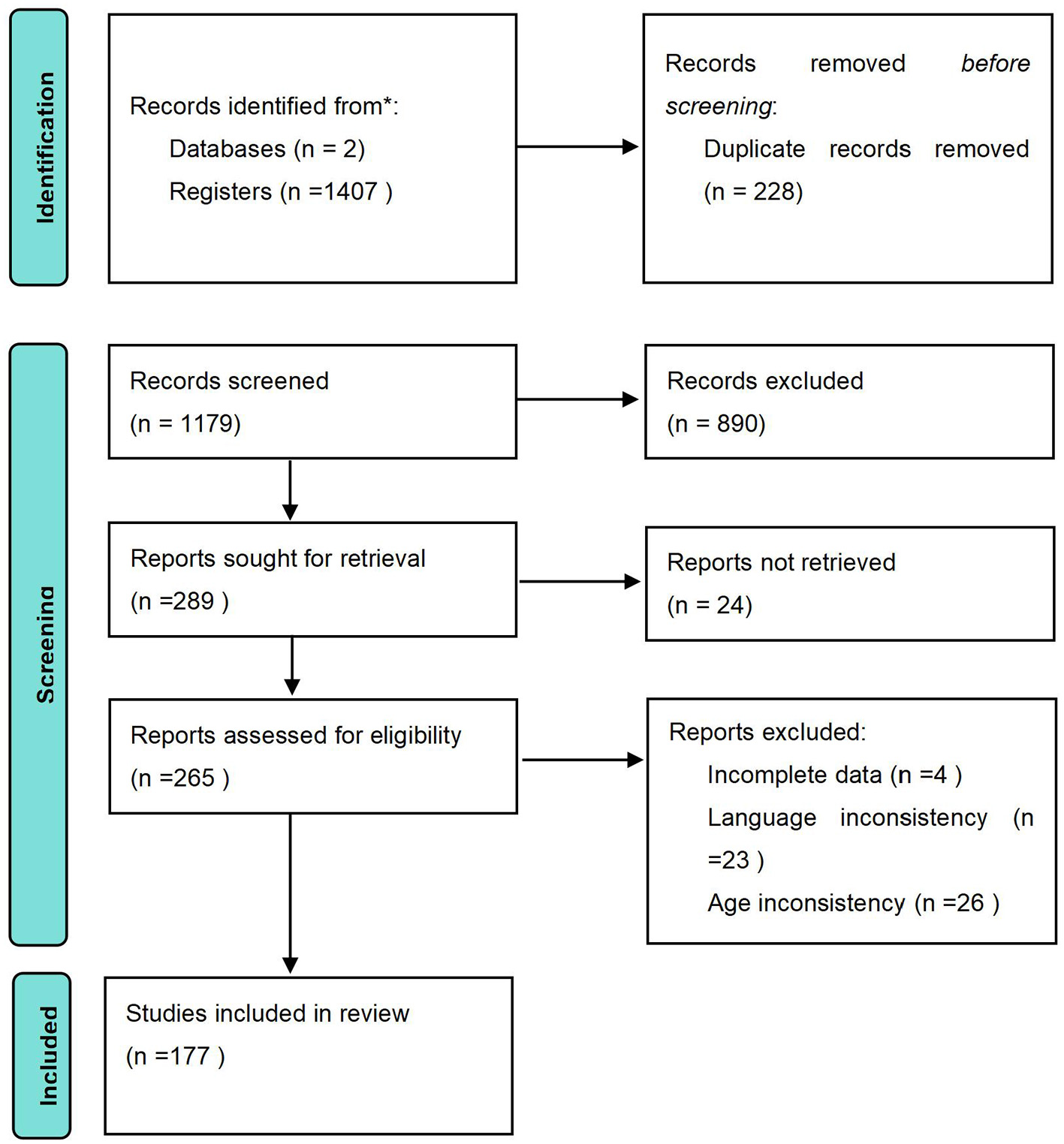
Literature screening process.
3.2 Characteristics of included studies
The meta-analysis was based on 177 studies from 2015 to 2025. The studies included many tens of thousands of people, in sample sizes ranging from 50 to 8,000, mostly from North America and Europe, with a cross-sectional design. The detailed characteristics of each included study are presented in Appendix B.
3.3 Risk of bias assessment
All 177 of the included studies were assessed in methodological quality and risk of bias using the relevant JBI critical appraisal tools. As for the results, the overall quality of the evidence base was found to be high. Specifically, 139 studies (78.1%) were assessed as having a low risk of bias, 37 studies (21.3%) were assessed as having a moderate risk of bias, and 1 study (0.6%) was assessed as having a high risk of bias. No studies were eliminated from analysis based on assessment of methodological quality. Individual ratings and assessment for methodological quality for each included study can be found in Appendix C.
3.4 Main effect of motivational climate
The random effects meta-analysis included 334 effect sizes from the 177 studies that were included in the analysis, which showed a significant, medium overall effect of motivational climate to youth outcomes. The overall effect size was r = 0.31 [95% CI [0.28, 0.34], p < 0.001].
Nonetheless, there was also an extreme level of heterogeneity among the studies, indicated by both Cochran's Q-test [Q(333) = 25,221.58, p < 0.001] and the I2 (I2 = 98.45%). Such evidence of heterogeneity warrants further moderator analyses to investigate sources of this variance.
3.5 Analysis of moderators
Due to the clear heterogeneity observed in the primary analysis, we completed several pre-specified moderator analyses to assess the sources of variance. Specifically, we tested three moderators: (1) type of outcome variable to examine the hierarchical effects model; (2) type of motivational climate to test their relative efficacy; and (3) year of publication to examine any temporal trends.
3.5.1 The moderating effect of outcome variable type: evidence from a hierarchical effects model
To evaluate whether there is a hierarchical path in the influence of motivational climate, we assessed it in sub-group analyses based on the type of outcome variable. The results revealed a clear and statistically significant hierarchical decreasing pattern [QM(4) = 18.44, p = 0.001] that provided strong support for our primary hypothesis.
As shown in Figure 2 and Table 2, the overall effect size for Motivation & Cognition is the highest (r = 0.42), and as the effect is transmitted externally, the effect diminishes. The overall effect size for Emotion & Wellbeing is moderate (r = 0.27) and even further reduces in effect when this influence applies to Behavioral & Engagement (r = 0.26) before the overall effect reaches its weakest level in Performance & Health (r = 0.19).
Figure 2
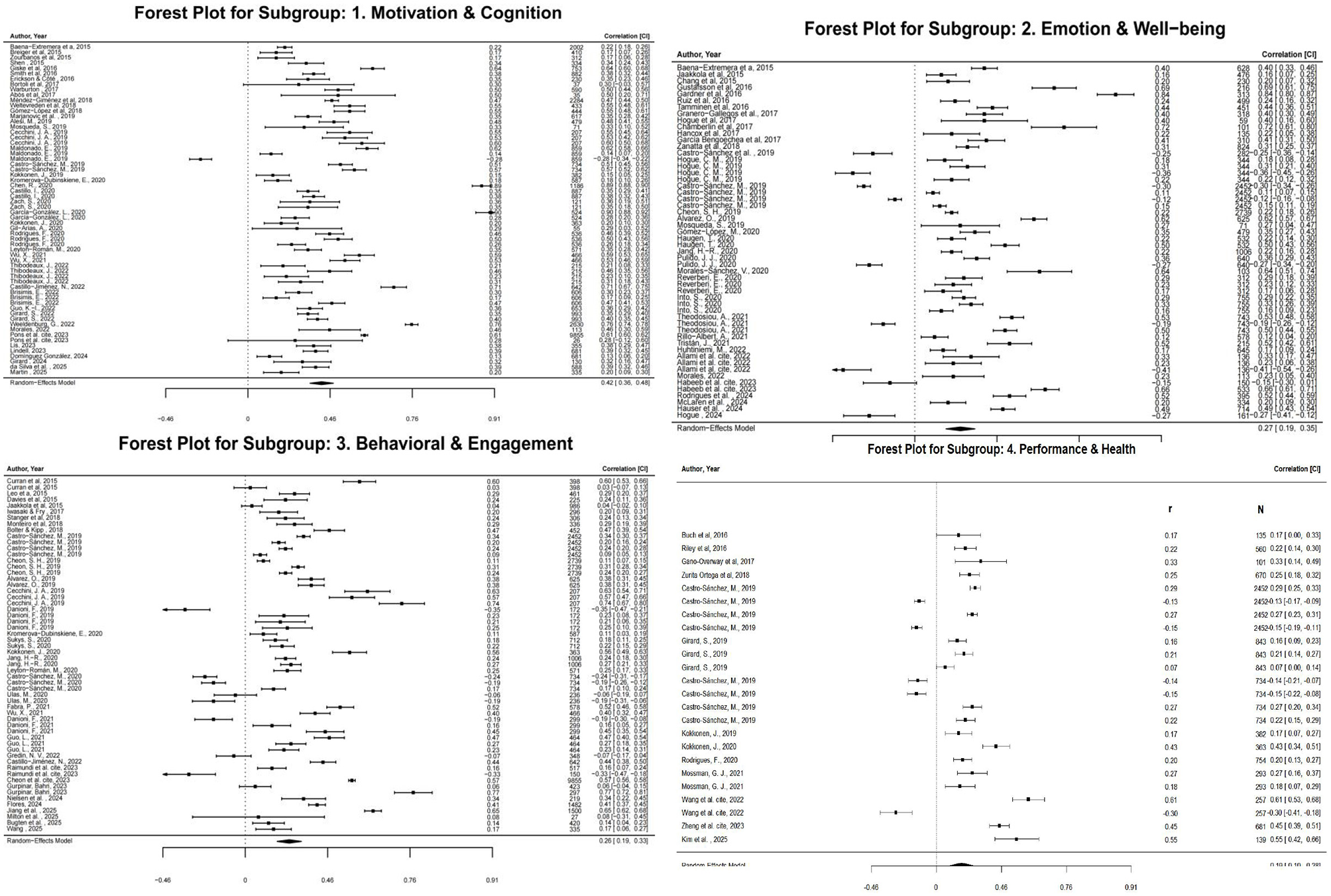
Forest plot.
Table 2
| Subgroup (dependent variable) | Number of studies | Average effect size (r) | 95% confidence intervals (CI) | Interpretation of results |
|---|---|---|---|---|
| Motivation and cognition | 62 | 0.42 | [0.37, 0.52] | High strength |
| Emotion and Wellbeing | 54 | 0.27 | [0.20, 0.34] | Moderate |
| Behavioral and engagement | 58 | 0.26 | [0.19, 0.33] | Medium to weak |
| Performance and health | 24 | 0.19 | [0.07, 0.30] | Weak strength |
Subgroup analysis of dependent variables.
3.5.2 Subgroup analysis by motivational climate type
A subgroup analysis was conducted to compare the efficacy of different types of motivational climates. The results, detailed in Table 3, indicated that the type of motivational climate was a significant moderator of the overall effect size [QM(df = 4) = 15.93, p = 0.0031].
Table 3
| Subgroup (independent variable) | Average effect size (r) | 95% confidence intervals (CI) | p-value |
|---|---|---|---|
| Others | 0.43 | [0.33, 0.42] | <0.001 |
| Autonomy/empowerment/ supportive climate | 0.31 | [0.23, 0.37] | <0.001 |
| Task/mastery-oriented climate | 0.27 | [0.22, 0.32] | <0.001 |
| Performance/ego-involved climate | 0.17 | [0.04, 0.30] | 0.0093 |
| Intervention studies | 0.22 | [0.07, 0.35] | 0.0025 |
Subgroup analysis of independent variables.
As shown in Table 3, four of the five subgroups yielded statistically significant positive effect sizes. The “Others” category, which primarily included “Caring” and “Transformational Leadership” climates, demonstrated the largest pooled effect size at r = 0.43 [95% CI [0.33, 0.42]]. This was followed by the “Autonomy/Empowerment/Supportive Climate” [r = 0.31, 95% CI [0.23, 0.37]], the “Task/Mastery-Oriented Climate” [r = 0.27, 95% CI [0.20, 0.32]]. Notably, both the “Intervention Studies” subgroup [r =0 .22, 95% CI [0.07, 0.35]] and the “Performance/Ego-Involved Climate” subgroup [r = 0.17, 95% CI [0.04, 0.30]] also produced statistically significant positive effects.
3.5.3 Meta-regression with publication year
To assess the temporal trend of results, a meta-regression was assessed with publication year specified as a moderator. The moderating effect of publication year was not statistically significant [QM(1) = 1.12, p = 0.29]. Publication year only reference a minor degree of heterogeneity (R2 = 0.10%). The bubble plot demonstrating this non-significant trend is shown in Figure 3.
Figure 3
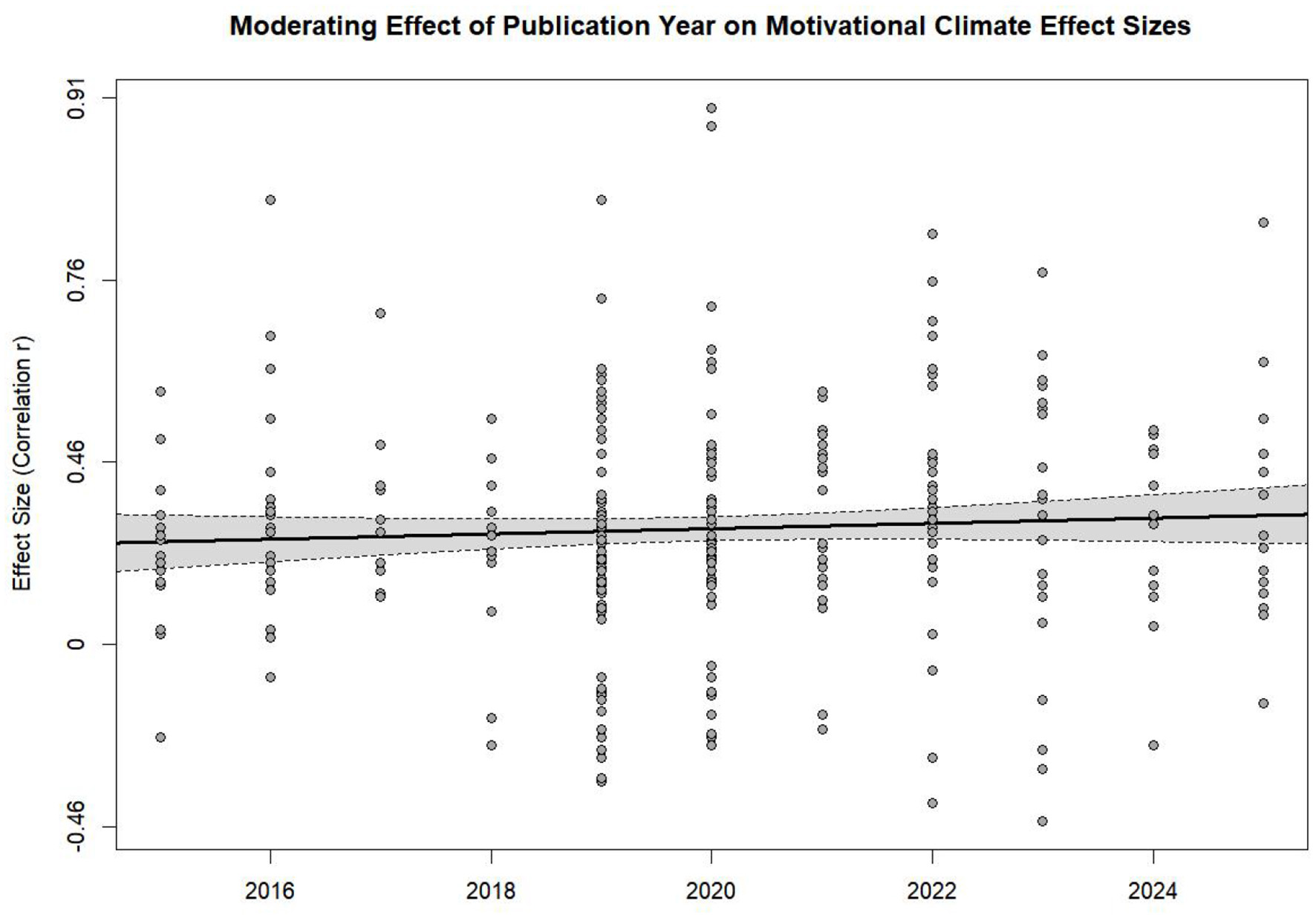
Bubble plot.
3.5.4 Sensitivity analysis by study design
To further assess the robustness of our findings, a sensitivity analysis was conducted to examine whether the overall effect was moderated by study design. Studies were categorized as Cross-Sectional (k = 313), Experimental (k = 9), or Longitudinal (k = 12). The results of the subgroup analysis indicated that study design was not a statistically significant moderator of the overall effect size [QM(2)=0.23, p = 0.89]. The estimated effect sizes for Cross-Sectional (r = 0.31), Experimental (r = 0.30), and Longitudinal (r = 0.27) designs were highly comparable. This finding suggests that the pooled effect of motivational climate is robust and not disproportionately influenced by a specific study design, despite the high heterogeneity present in the overall analysis. When excluding all β-based estimates and analyzing only studies reporting direct correlation coefficients (r), the pooled effect size remained highly stable (r =0.32). This indicates that the inclusion of converted regression coefficients did not artificially skew the overall results.
The RVE model yielded a pooled effect size of r = 0.31 (p < 0.001), which is identical to the result from the standard random-effects model. Although the confidence intervals were slightly wider as expected [95% CI [0.26, 0.36]], the statistical significance and magnitude of the effect remained unchanged. This confirms that the hierarchical dependency structure of the data did not compromise the validity of the main conclusions.
3.6 Assessment of publication bias
To make a comprehensive examination of publication bias given high heterogeneity (I2 = 98.45%) involved consideration of several methods. First, a contour-enhanced funnel plot (Figure 4) produced showed symmetrically-distributed studies, consistent with Egger's test for bias (z = 0.11, p = 0.91), which showed no significant bias. In addition, a trim-and-fill analysis suggested that zero studies were missing due to publication bias. Taken together, these converging pieces of evidence suggest that publication bias is not likely to be a meaningful concern in this meta-analysis.
Figure 4
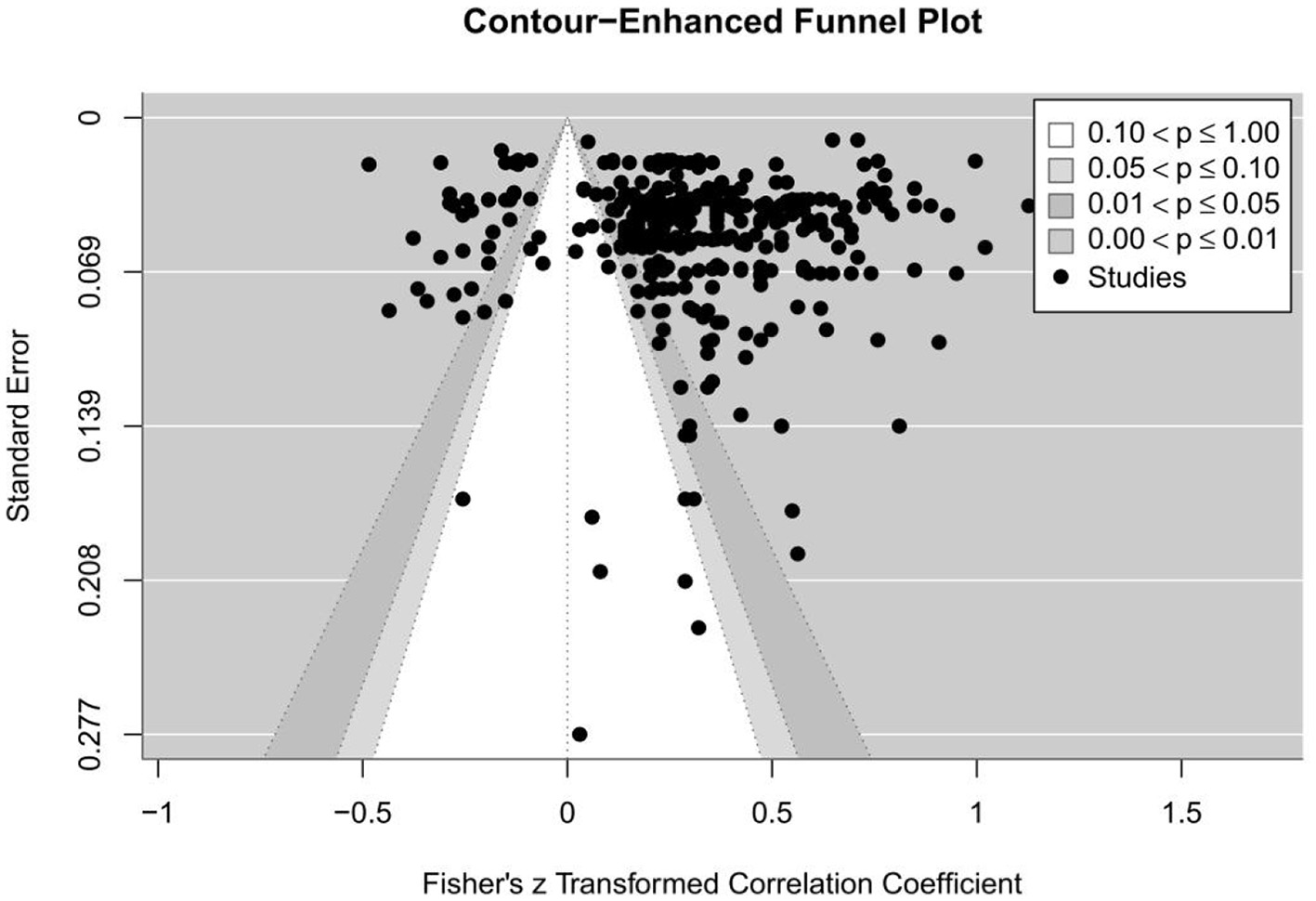
Contour-enhanced funnel plot.
3.7 Influence diagnostics and robustness check
To determine how robust the pooled estimate was, we conducted a leave-one-out influence analysis. The influence diagnosis results (see Appendix Figure 5 for detailed plots) revealed that no individual study had an excessive influence on the pooled effect size. For each of the studies considered in isolation, the pooled estimate retained stability and the 95% confidence interval never included zero. Overall, these findings suggest that the findings aren't specifically dependent on any one study.
To test the robustness of the main findings again, including only the 139 studies assessed as having a low risk of bias, which comprised 267 effect sizes. The random-effects meta-analysis on this high-quality subset yielded a pooled effect size of r = 0.31 [95% CI [0.28, 0.35], p < 0.001]. This result is highly consistent with the overall effect size calculated from the full sample (r = 0.31).
To further corroborate these findings given the high heterogeneity (I2 > 98%) which can distort funnel plot symmetry, we conducted a p-curve analysis (Simonsohn et al., 2014). The p-curve included only statistically significant effect sizes (p < 0.05) and demonstrated a significantly right-skewed distribution, indicating strong evidential value (Continuous test: Z = −12.4], p < 0.001). This suggests that the observed effect is not merely an artifact of selective reporting.
Caveat: Despite these converging lines of evidence (Egger's test, Trim-and-Fill, and p-curve), interpretations regarding publication bias should be made with caution. The extreme heterogeneity observed in this meta-analysis implies that asymmetry in the funnel plot could partially stem from methodological diversity (e.g., small-study effects) rather than bias alone.
4 Discussions
The main conclusion from this meta-analysis is the considerable support for a hierarchical influence of motivational climate on youth sport outcomes. Specifically, we observed that climate effects were largest for internal psychological variables (e.g., Motivation and Cognition; r = 0.42, Emotion and Wellbeing; r = 0.27) and systematically decreased for Behavioral and Engagement (r = 0.26), and least for longer-term, distal outcomes like performance and health (r = 0.19). Furthermore, we also observed a clear effectiveness hierarchy, such that autonomy-supportive individual and task-orientation climates appeared to have stronger effects than performance-orientation climates. The effect of publication year as a moderator did not appear to be significant.
The aforementioned pattern of diminishing effect sizes provides a powerful rationale for the inconsistent findings and significant heterogeneity observed in prior studies. The above pattern also strongly suggests that the motivational climate is not a direct determinant of adolescents' external performance. This pattern strongly suggests that motivational climate functions not as a direct determinant of external performance, but as a “psychological architect” (see Figure 5). As illustrated in the conceptual model, the climate first constructs the internal psychological foundation—shaping cognitions and satisfying basic needs—which then translates into observable behavior. This hierarchical finding aligns empirically with the motivational mediation mechanisms proposed in Self-Determination Theory (Ryan and Deci, 2000) 1 and validated in physical education contexts by Standage et al. (2003). These foundational studies posit that social-contextual factors (i.e., climate) do not directly cause behavior; rather, their influence is fully mediated by the satisfaction of basic psychological needs and autonomous motivation. Our meta-analytic results provide large-scale quantitative verification of this theoretical sequence, confirming that the “architectural work” of the climate happens internally before it manifests externally.
Figure 5
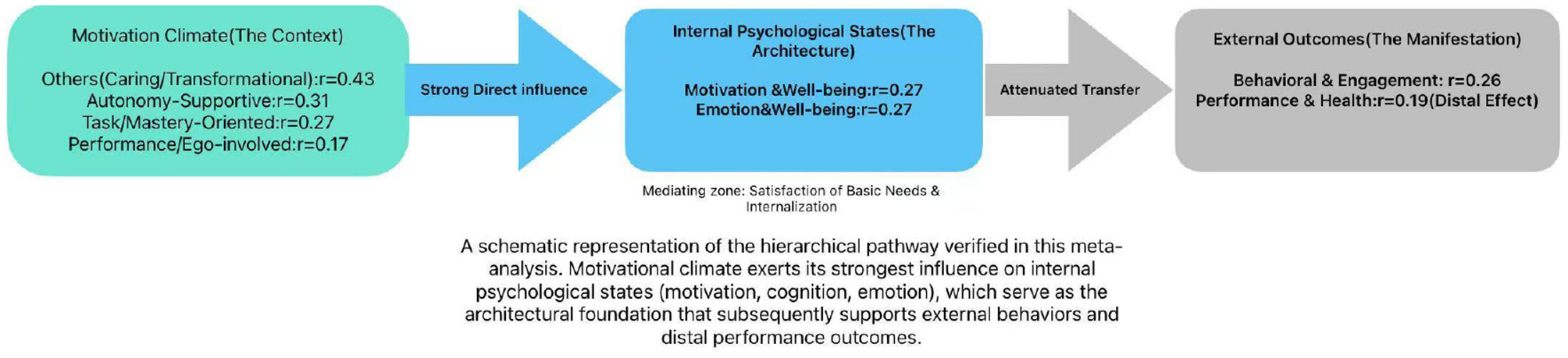
The “psychological architect” model.
4.1 Revealing the influence pathway: a hierarchical effect model of motivational climate's action on youth sport outcomes
Moderation analysis constructs a “psychology-behavior-performance” hierarchical effect model of motivational climate's action on youth sport outcomes. The results indicated that the overall effect of motivational climate on “motivation and cognition” (r = 0.42) was much larger than its effect on “Emotion and Wellbeing” (r = 0.27), followed by its effect on “Behavioral Performance” (r = 0.26), and its effect on “Performance and Health” was relatively weak (r = 0.19). This order of magnitude gradation in effect sizes shows that the influence of motivational climate is indirect. It influences individuals through shaping individuals' psychological cognitions and further internalizing variables such as motivation and self-efficacy, which in turn cause behavioral transformation and finally lead to performance, rather than influencing individuals through targeting external performance directly. This hierarchical attenuation is not merely statistical but holds profound practical implications. Following recent guidance on interpreting effect sizes in educational practice (Rodríguez-Sabiote et al., 2025), we can quantify this “cascade” in terms of explained variance (R2).
Psychological Level (r = 0.42, R2≈18%): A positive climate explains a substantial portion of students' internal states. In practice, this means that when a teacher shifts from a controlling to an autonomy-supportive style, the most immediate and visible impact is on students' confidence and enjoyment.
Behavioral Level (r = 0.26, R2≈7%): The influence on actual engagement (e.g., attendance, intensity) is moderate. This suggests that while climate fuels the “will” to participate, other constraints (e.g., skill level, logistics) also play a role.
Performance Level (r = 0.19, R2≈4%): The impact on objective performance (e.g., winning, fitness scores) is the weakest.
The finding is highly consistent with the internal logic of Self-Determination Theory (SDT) and Achievement Goal Theory (AGT). These two theories hold that the environment first acts on individuals' basic psychological needs and cognitive appraisals (perceived competence, goal orientation), and the changes in individuals' internal psychological states are the basis for subsequent changes in emotion, behavior, and finally, performance. The hierarchical effect model supports both theories. That is, motivational climate is like an “architect of psychology” rather than an “enhancer of performance” in sports activities. In the future, physical educators should focus on assessing psychological indicators such as students' motivation, confidence, and wellbeing when evaluating the effectiveness of their teaching climate, because these indicators are the basis for achieving long-term positive behavioral outcomes.
4.2 The hierarchy of efficacy: the relative importance of the types of motivational climate
This meta-analysis also establishes a clear efficacy hierarchy among different types of motivational climates. The results indicated that the type of motivational climate was a significant moderator of the overall effect size [QM(4) = 15.93, p = 0.0031]. Consistent with foundational theories, climates emphasizing autonomy and personal mastery yielded larger positive effects than those centered on social comparison. Specifically, “Autonomy/Supportive” (r = 0.31) and “Task/Mastery” (r = 0.27) climates produced stronger associations with positive outcomes than the “Performance/Ego” climate (r = 0.17). This provides robust, large-scale evidence that practitioners should focus on fostering an atmosphere of self-improvement and empowerment over one based heavily on normative success.
A finding of particular interest was the robust effect size associated with the “Others” classification (r = 0.43), which largely consisted of “Caring” and “Transformational Leadership” climates. Despite being less frequently studied than the traditional Task/Ego dichotomy, their superior efficacy suggests they may offer a more holistic support system for youth. The potency of a “Caring Climate” likely stems from its unique capacity to satisfy the need for relatedness. unlike standard task-oriented climates that focus on skill mastery, a caring climate emphasizes interpersonal safety, mutual respect, and the sense of being valued as a person rather than just an athlete. This deep sense of belonging reduces social anxiety and fear of failure, creating a secure psychological base that fosters intrinsic motivation. Similarly, “Transformational Leadership” appears to exert a “multi-need” effect. By offering “inspirational motivation” and “individualized consideration,” this climate not only clarifies the path to success (enhancing competence) but also aligns team goals with personal values (supporting autonomy). Consequently, these relational and inspirational models arguably provide a more comprehensive “nutrient” profile for adolescent psychological needs than climates that focus solely on task structure.
Interestingly and contrary to some preconceptions, the “Intervention Studies” sub-category also produced a statistically significant positive effect (r =0.22; p = 0.0025). This finding is promising in that it indicates that a structured program that aims to alter the motivational climate in youth sport settings can have a meaningful positive effect despite the methodological cumbersomeness of the interrupted case-study designs (e.g., timing of week's assignment, fidelity of instructor's implementation, limited sensitivity of instruments).
4.3 The moderating role of publication year
While a non-significant finding is important to note, this finding implies that there had not been simple linear trend in the relationship of motivational climate and positive outcomes over the past 10 years. More importantly, this finding suggests that the large heterogeneity in this research area is not simply explained by methodological advances or trends over time. Conversely, the findings of this meta-regression suggest that the substantive theoretical moderators, such as the hierarchical nature of the outcomes and the specific type of climate, are the main contributors to the observed variance in the literature. Thus, these findings suggest that the general findings in this area of research are relatively stable, and to understand differences across studies, one must look to deeper theoretical meanings rather than simply holding the publication year constant.
4.4 From consensus to practice: the “silent stage” of pedagogy
The findings offer a resolution to the historical lack of consensus regarding climate interventions. Previous inconsistencies may have stemmed from measuring outcomes at different levels of the hierarchy without accounting for the “psychological lag.” The hierarchical model suggests that the effects of a positive climate are not immediately visible in behavior. For practitioners and PE teachers, this implies a critical shift in expectation: The absence of immediate behavioral improvement (e.g., higher physical activity levels) does not indicate intervention failure. Instead, educators should focus on the “Silent Stage”—cultivating the internal psychological architecture (motivation and wellbeing). Once these internal bases are solidified, behavioral engagement is likely to follow as a natural downstream consequence. Therefore, assessment of teaching effectiveness should prioritize psychological indicators over immediate performance metrics.
To operationalize these findings, professional development for coaches and teachers must evolve beyond technical instruction. Recent empirical evidence confirms that targeted SDT-based training programs can successfully equip educators with the specific behavioral strategies needed to foster inclusive, autonomy-supportive climates (Ocete et al., 2025). Furthermore, training should explicitly educate practitioners on the motivational mechanisms at play; understanding how teaching styles mediate basic psychological needs is crucial for maximizing their impact on students' academic self-concept and intrinsic motivation (Espinoza Gutiérrez et al., 2024).
4.5 Differences in situations under different roles
Climate effects may vary by context. Analysis revealed that the “Others” category—which heavily features Caring and Peer-initiated climates—yielded the strongest effects (r = 0.43). This challenges the traditional “Coach-Centric” model of sports motivation. Contextually, this suggests a functional differentiation: Coaches & Teachers (Structured Context): Often focus on Task/Mastery climates (r = 0.27) to build competence and skill structure. Peers & Social Environment (Relational Context): Likely drive the Caring/Transformational effects (r = 0.43) by satisfying the need for relatedness and emotional safety. This implies that a “Task-Oriented” class alone is insufficient. A truly effective ecosystem requires integrating the structural guidance of teachers with the relational warmth of a caring peer climate. Future interventions should thus move beyond the “teacher-student” dyad to engineer the broader social network of the youth athlete.
4.6 Limitations and future directions
The main limitation of this meta-analysis is extreme heterogeneity (I2 > 98%) combined with a standard random-effects model that omits the dependent structure of the effect sizes. Many of the effect sizes included above are from the same primary studies (i.e., multiple outcomes taken from the same sample). We treat these effect sizes in the analysis as independent, however, this is a poor model and can lead to estimates of the pooled estimates that are biased and confidence intervals that are underestimated. Future studies should strive to improve upon this limitation by using a more sophisticated model, like multilevel meta-analysis or robust variance estimation (RVE), that considers dependent effect sizes.
Secondly, although the re-categorization of motivational climates and outcome variables was necessary in this analysis, it is still an unavoidable simplification. For instance, the broader “Others” category represented a number of specific climate types and outcomes that could not have effect sizes calculated or were too diverse to synthesize. Future research could benefit from more primary studies that consider the nuances around these constructs, for instance, around the “caring” climate so we can undertake more specific meta-analytic inquiry.
Although the “Others” category (Caring/Transformational) demonstrated the strongest association with positive outcomes (r = 0.43), interpretations should be tempered by the relative scarcity of empirical data. Specifically, this subgroup represented a smaller portion of the total pool (k = 25) compared to the extensive literature on Task/Mastery-Oriented climates (k = 94). Furthermore, existing studies on these emerging climates are predominantly cross-sectional and concentrated in Western educational contexts. This geographical and methodological homogeneity limits our ability to generalize their efficacy across diverse cultural settings or to assert causal directionality. Therefore, a critical gap remains: Future scholarship must move beyond correlational validation and employ longitudinal or intervention-based designs to rigorously test whether Caring and Transformational climates can be systematically implemented to enhance youth engagement over time.
Lastly, it is crucial to interpret the hierarchical model as a pattern of association rather than a confirmed causal mechanism. Therefore, future research should strive to use longitudinal and experimental high quality designs to better explicitly foreground the long-term causative roles of motivational climate. Such studies would also be important to contribute even more effective intervention action and high degree of replication to stimulate more theoretical understanding and theory into practice in physical education lesson contexts.
5 Conclusion
This meta-analysis confirms a consistent positive association between motivational climate and positive youth sport outcomes. The primary contribution of this study is in providing strong support for a psychology-behavior-performance hierarchical effect model. This model indicates that the climate's association with positive outcomes is graded, beginning with a strong association with internal psychological states that attenuates for external behaviors and performance. This finding positions the motivational climate as a crucial “psychological architect” rather than a direct performance enhancer. In addition, the results provide a clear ordering of the strength of associations, with autonomy-supportive and task-oriented climates associating stronger with positive outcomes than performance-oriented climates and highlighting the important, if often overlooked opportunities for caring and transformational leadership climates. This adds further clarity to both the theoretical implications and the degree of certainty to evidence-informed recommendations for practice for those practitioners working with young people in sport and physical education for positive development.
Statements
Data availability statement
The original contributions presented in the study are included in the article/Supplementary material, further inquiries can be directed to the corresponding author.
Author contributions
YG: Conceptualization, Data curation, Formal analysis, Funding acquisition, Investigation, Methodology, Project administration, Resources, Software, Supervision, Validation, Visualization, Writing – original draft, Writing – review & editing. LC: Data curation, Formal analysis, Methodology, Supervision, Validation, Writing – original draft, Writing – review & editing.
Funding
The author(s) declared that financial support was not received for this work and/or its publication.
Conflict of interest
The author(s) declared that this work was conducted in the absence of any commercial or financial relationships that could be construed as a potential conflict of interest.
Generative AI statement
The author(s) declared that generative AI was not used in the creation of this manuscript.
Any alternative text (alt text) provided alongside figures in this article has been generated by Frontiers with the support of artificial intelligence and reasonable efforts have been made to ensure accuracy, including review by the authors wherever possible. If you identify any issues, please contact us.
Publisher’s note
All claims expressed in this article are solely those of the authors and do not necessarily represent those of their affiliated organizations, or those of the publisher, the editors and the reviewers. Any product that may be evaluated in this article, or claim that may be made by its manufacturer, is not guaranteed or endorsed by the publisher.
Supplementary material
The Supplementary Material for this article can be found online at: https://www.frontiersin.org/articles/10.3389/fpsyg.2025.1716745/full#supplementary-material
References
1
Abós Á. Sevil J. García-González L. Julián J. A. Abarca-Sos A. (2017). Improving students' predisposition towards physical education by optimizing their motivational processes in an acrosport unit. Eur. Phys. Educ. Rev.23, 444–460. doi: 10.1177/1356336X16654390
2
Ada E. N. Serin A. H. Pehlivan Z. Çepikkurt F. Ahmad H. Kazak Z. (2021). The mediator role of sport competence and physical condition in the motivational climate and personal-social responsibility in physical education. SAGE Open11:21582440211059175. doi: 10.1177/21582440211059175
3
Agans J. P. Su S. Ettekal A. V. (2018). Peer motivational climate and character development: testing a practitioner-developed youth sport model. J. Adolesc.62, 108–115. doi: 10.1016/j.adolescence.2017.11.008
4
Alesi M. Gómez-López M. Chicau Borrego C. Monteiro D. Granero-Gallegos A. (2019). Effects of a motivational climate on psychological needs satisfaction, motivation and commitment in teen handball players. Int. J. Environ. Res. Public Health16:2702. doi: 10.3390/ijerph16152702
5
Allami F. B. M. Ishak M. Hussin F. Sin I. Don Y. Fauzee M. S. O. (2022). Preferred leadership styles of physical education teachers and relationship with athletes' satisfaction. Int. J. Instruct.15, 393–416. doi: 10.29333/iji.2022.15222a
6
Álvarez O. Castillo I. Molina-García V. Tomás I. (2019). Transformational leadership, task-involving climate, and their implications in male junior soccer players: a multilevel approach. Int. J. Environ. Res. Public Health16:3649. doi: 10.3390/ijerph16193649
7
Bae J. (2023). Sport commitment in student-athletes: examining the role of perceived autonomy support, a caring climate, and basic psychological needs. Korean J. Sport Sci.34, 050–060. doi: 10.24985/kjss.2023.34.1.50
8
Baena Extremera A. Hueso López C. Sánchez Fuentes J. A. Isidori E. Ortiz-Camacho M. M. (2025). Development of Emotional Intelligence in Primary Education through Physical Ed (2025). Development of emotional intelligence in primary education through physical education: a systematic review. Espiral Cuadernos del Profesorado18, 30–48. doi: 10.25115/ecp.v18i38.10114
9
Baena-Extremera A. Gómez-López M. Granero-Gallegos A. Ortiz-Camacho M. d. M. (2015). Predicting satisfaction in physical education from motivational climate and self-determined motivation. J. Teach. Phys. Educ.34, 210–224. doi: 10.1123/jtpe.2013-0165
10
Balaguer I. Castillo I. Cuevas R. Atienza F. (2018). The importance of coaches' autonomy support in the leisure experience and well-being of young footballers. Front. Psychol.9:840. doi: 10.3389/fpsyg.2018.00840
11
Bartholomew K. J. Ntoumanis N. Ryan R. M. Bosch J. A. Thøgersen-Ntoumani C. (2011). Self-determination theory and diminished functioning: the role of interpersonal control and psychological need thwarting. Pers. Soc. Psychol. Bull.37, 1459–1473. doi: 10.1177/0146167211413125
12
Battista R. D. Robazza C. Bertollo M. Bortoli L. Ruiz M. C. Vitali F. (2019). Student intention to engage in leisure-time physical activity: the interplay of task-involving climate, competence need satisfaction and psychobiosocial states in physical education. Eur. Phys. Educ. Rev.25, 761–777. doi: 10.1177/1356336X18770665
13
Bengoechea E. G. Wilson P. M. Dunn S. (2017). From liability to challenge: complex environments are associated with favorable psychosocial outcomes in adolescent sport participants. J. Adolesc.58, 74–83. doi: 10.1016/j.adolescence.2017.05.004
14
Bolter N. D. Kipp L. E. (2018). Sportspersonship coaching behaviours, relatedness need satisfaction, and early adolescent athletes' prosocial and antisocial behaviour. Int. J. Sport Exerc. Psychol.16, 20–35. doi: 10.1080/1612197X.2016.1142461
15
Borenstein M. Hedges L. V. Higgins J. P. T. Rothstein H. R. (2009). Introduction to Meta-Analysis. Chichester: Wiley. doi: 10.1002/9780470743386
16
Borghouts L. Slingerland M. Weeldenburg G. Eijk B. v. D. Laurijssens S. Remmers T. et al . (2023). Effectiveness of a lesson study intervention on teacher behaviour and student motivation in physical education lessons. Phys. Educ. Sport Pedag.28, 121–138. doi: 10.1080/17408989.2021.1958175
17
Borrego C. C. Miguel M. Teixeira E. Silva C. Monteiro D. Benson A. J. (2021). Disentangling the effects of ego and task-involving climate perceptions on cohesion in youth sport. Sport Exerc. Perform. Psychol.10:558. doi: 10.1037/spy0000270
18
Bortoli L. Bertollo M. Filho E. di Fronso S. Robazza C. (2017). Implementing the TARGET model in physical education: effects on perceived psychobiosocial and motivational states in girls. Front. Psychol.8:1517. doi: 10.3389/fpsyg.2017.01517
19
Bortoli L. Bertollo M. Vitali F. Filho E. Robazza C. (2015). The effects of motivational climate interventions on psychobiosocial states in high school physical education. Res. Q. Exerc. Sport86, 196–204. doi: 10.1080/02701367.2014.999189
20
Breiger J. Smith R. E. Smoll F. Cumming S. P. (2015). Winning, motivational climate, and young athletes' competitive experiences: some notable sex differences. Int. J. Sports Sci. Coach.10, 395–411. doi: 10.1260/1747-9541.10.2-3.395
21
Brisimis E. Krommidas C. Syrmpas I. Karamitrou A. Hatzigeorgiadis A. Comoutos N. (2022). Motivational climate, basic psychological needs, and students' self-talk in physical education. Phys. Educ.79, 280–304. doi: 10.18666/TPE-2022-V79-I3-10851
22
Buch R. Nerstad C. G. Aandstad A. Säfvenbom R. (2016). Exploring the interplay between the motivational climate and goal orientation in predicting maximal oxygen uptake. J. Sports Sci.34, 267–277. doi: 10.1080/02640414.2015.1048522
23
Bugten J. B. Haugen T. Ivarsson A. Knight C. J. Ommundsen Y. Spencer M. R. et al . (2025). Daily measures of sport enjoyment, social interaction, and attendance among female adolescent handball players. Psychol. Sport Exerc.79:102852. doi: 10.1016/j.psychsport.2025.102852
24
Byrd B. Martin J. J. (2016). The relationships among youth running programs' multidimensional climates and social responsibility and belonging. J. Clin. Sport Psychol.10, 19–31. doi: 10.1123/jcsp.2015-0014
25
Çaglar E. Aşçi F. H. Uygurtaş M. (2017). Roles of perceived motivational climates created by coach, peer, and parent on dispositional flow in young athletes. Percept. Mot. Skills124, 462–476. doi: 10.1177/0031512516689404
26
Castillo I. Molina-García J. Estevan I. Queralt A. Álvarez O. (2020). Transformational teaching in physical education and students' leisure-time physical activity: the mediating role of learning climate, passion and self-determined motivation. Int. J. Environ. Res. Public Health17:4844. doi: 10.3390/ijerph17134844
27
Castillo-Jiménez N. López-Walle J. M. Tomás I. Tristán J. Duda J. L. Balaguer I. (2022). Empowering and disempowering motivational climates, mediating psychological processes, and future intentions of sport participation. Int. J. Environ. Res. Public Health19:896. doi: 10.3390/ijerph19020896
28
Castro-Sánchez M. Lara-Sánchez A. J. García-Mármol E. Chacón-Cuberos R. (2020). Motivational climate is associated with use of video games and violence in schoolchildren: a structural equation model according to healthy behaviors. Int. J. Environ. Res. Public Health17:1272. doi: 10.3390/ijerph17041272
29
Castro-Sánchez M. Zurita-Ortega F. Chacón-Cuberos R. López-Gutiérrez C. J. Zafra-Santos E. (2018). Emotional intelligence, motivational climate and levels of anxiety in athletes from different categories of sports: analysis through structural equations. Int. J. Environ. Res. Public Health15:894. doi: 10.3390/ijerph15050894
30
Castro-Sánchez M. Zurita-Ortega F. García-Marmol E. Chacón-Cuberos R. (2019a). Motivational climate in sport is associated with life stress levels, academic performance and physical activity engagement of adolescents. Int. J. Environ. Res. Public Health16:1198. doi: 10.3390/ijerph16071198
31
Castro-Sánchez M. Zurita-Ortega F. García-Marmol E. Chacón-Cuberos R. (2019b). Motivational climate towards the practice of physical activity, self-concept, and healthy factors in the school environment. Sustainability11:999. doi: 10.3390/su11040999
32
Castro-Sánchez M. Zurita-Ortega F. Pérez-Turpin J. A. Cachón-Zagalaz J. Cofre-Bolados C. Suarez-Llorca C. et al . (2019c). Physical activity in natural environments is associated with motivational climate and the prevention of harmful habits: structural equation analysis. Front. Psychol.10:1113. doi: 10.3389/fpsyg.2019.01113
33
Castro-Sánchez M. Zurita-Ortega F. Ubago-Jiménez J. L. González-Valero G. Chacón-Cuberos R. (2019d). Relationships between anxiety, emotional intelligence, and motivational climate among adolescent football players. Sports7:34. doi: 10.3390/sports7020034
34
Cecchini J. A. Carriedo A. Méndez-Giménez A. (2019). Testing a circular, feedback model in physical education from self-determination theory. J. Educ. Res.112, 473–482. doi: 10.1080/00220671.2018.1555788
35
Chamberlin J. M. Fry M. D. Iwasaki S. (2017). High school athletes' perceptions of the motivational climate in their off-season training programs. J. Strength Condit. Res.31, 736–742. doi: 10.1519/JSC.0000000000001533
36
Chan M. Si Hui Regina L. Koon Teck K. (2025). The 4Cs in youth sport: investigating psychometric multidimensionality, measurement invariance and criterion-related validity. Int. J. Sport Exerc. Psychol. 1–21. doi: 10.1080/1612197X.2025.2456922
37
Chang W. H. Chi L. Lin S. H. Ye Y. C. (2017). Psychometric properties of the Acceptance and Action Questionnaire–II for Taiwanese college students and elite athletes. Curr. Psychol.36, 147–156. doi: 10.1007/s12144-015-9395-x
38
Chen R. Wang L. Wang B. Zhou Y. (2020). Motivational climate, need satisfaction, self-determined motivation, and physical activity of students in secondary school physical education in China. BMC Public Health20:1681. doi: 10.1186/s12889-020-09750-x
39
Cheon S. H. Reeve J. Marsh H. W. (2023). Autonomy-supportive teaching enhances prosocial and reduces antisocial behavior via classroom climate and psychological needs: a multilevel randomized control intervention. J. Sport Exerc. Psychol.45, 26–40. doi: 10.1123/jsep.2021-0337
40
Cheon S. H. Reeve J. Marsh H. W. Song Y. (2022). Intervention-enabled autonomy-supportive teaching improves the PE classroom climate to reduce antisocial behavior. Psychol. Sport Exerc.60:102174. doi: 10.1016/j.psychsport.2022.102174
41
Cheon S. H. Reeve J. Ntoumanis N. (2019). An intervention to help teachers establish a prosocial peer climate in physical education. Learn. Instruct.64:101223. doi: 10.1016/j.learninstruc.2019.101223
42
Chiva-Bartoll Ó. Salvador-García C. Ruiz-Montero P. J. (2018). Teaching games for understanding and cooperative learning: can their hybridization increase motivational climate among physical education students?Croatian J. Educ.20:2827. doi: 10.15516/cje.v20i2.2827
43
Chu T. L. Zhang X. Lee J. Zhang T. (2021). Perceived coach-created environment directly predicts high school athletes' physical activity during sport. Int. J. Sports Sci. Coach.16, 70–80. doi: 10.1177/1747954120959733
44
Coudevylle G. R. Sinnapah S. Charles-Charlery C. Baillot M. Hue O. (2015). Impact of motivational climates on claimed self-handicapping strategies: illustration in tropical environment. J. Appl. Sport Psychol.27, 384–397. doi: 10.1080/10413200.2015.1014975
45
Coutinho P. Bessa C. Dias C. Mesquita I. Fonseca A. M. (2024). Unveiling players' perceptions of mother-and father-initiated motivational climates and fear of failure in youth male team sports. Sports12:244. doi: 10.3390/sports12090244
46
Cruz Feliu J. Mora À. Sousa C. D. P. Alcaraz Garcia S. (2016). Effects of an individualized program on coaches' observed and perceived behavior. Rev. Psicol. Deporte25, 137–144.
47
Curran T. Hill A. P. Hall H. K. Jowett G. E. (2015). Relationships between the coach-created motivational climate and athlete engagement in youth sport. J. Sport Exerc. Psychol.37, 193–198. doi: 10.1123/jsep.2014-0203
48
Danioni F. Barni D. (2019). Parents' sport socialization values, perceived motivational climate and adolescents' antisocial behaviors. Europe's J. Psychol.15:754. doi: 10.5964/ejop.v15i4.1598
49
Danioni F. Regalia C. Kavussanu M. Barni D. (2021). “My teammates think it is alright to fight to protect friends”: collective moral disengagement in team sports. Int. J. Sport Exerc. Psychol.19, 598–612. doi: 10.1080/1612197X.2021.1891119
50
Davies M. J. Stellino M. B. Nichols B. A. Coleman L. M. (2016). Other-initiated motivational climate and youth hockey players' good and poor sport behaviors. J. Appl. Sport Psychol.28, 78–96. doi: 10.1080/10413200.2015.1071297
51
Deng A. Zarrett N. Sweeney A. M. Moon J. (2023). The influence of social support, social affiliation and intrinsic motivation for increasing underserved youth's physical activity: a social climate-based intervention study. J. Sports Sci.41, 502–511. doi: 10.1080/02640414.2023.2225020
52
Duda J. L. Appleton P. R. (2016). “Empowering and disempowering coaching climates: conceptualization, measurement considerations, and intervention implications,” in The Oxford Handbook of Sport and Performance Psychology, ed. S, M. Murphy (Oxford: Oxford University Press), 207–227. doi: 10.1016/B978-0-12-803634-1.00017-0
53
Duda J. L. Ntoumanis N. (2005). “After-school sport for children: Implications of a task-involving motivational climate,” in Organized Activities as Contexts of Development, eds. J. L. Mahoney, R. W. Larson, J. S. Eccles (Mahwah: Lawrence Erlbaum Associates), 311–330.
54
Durdubas D. Martin L. J. Koruc Z. A. (2020). season-long goal-setting intervention for elite youth basketball teams. J. Appl. Sport Psychol.32, 529–545. doi: 10.1080/10413200.2019.1593258
55
Elbe A. M. Morela E. Hatzigeorgiadis A. Ries F. Kouli O. Sanchez X. (2018). Acculturation through sport: different contexts different meanings. Int. J. Sport Exerc. Psychol.16, 178–190. doi: 10.1080/1612197X.2016.1187654
56
Elsborg P. Appleton P. R. Pons J. Wikman J. M. Bentsen P. Nielsen G. (2023). Factorial validity, predictive validity and measurement invariance of the Danish version of the coach-created Empowering Disempowering Motivational Climate Questionnaire (EDMCQ-C). J. Sports Sci.41, 715–726. doi: 10.1080/02640414.2023.2230707
57
Erickson K. Côté J. A. (2016). season-long examination of the intervention tone of coach–athlete interactions and athlete development in youth sport. Psychol. Sport Exerc.22, 264–272. doi: 10.1016/j.psychsport.2015.08.006
58
Espinoza Gutiérrez R. Fernández Baños R. Calleja Núñez J. J. Granero Gallegos A. (2024). Effect of Teaching Style on Academic Self-Concept in Mexican University Students of Physical Education: Multiple Mediation of Basic Psychological Needs and Motivation. Espiral. Cuadernos Del Profesorado17, 46–61. doi: 10.25115/ecp.v17i36.10087
59
Ettekal A. V. Ferris K. A. Batanova M. Syer T. (2016). Adolescent athletes' perceptions of the peer-motivational climate in sport: do they matter for empathic concern?. Res. Hum. Dev.13, 142–156. doi: 10.1080/15427609.2016.1175854
60
Extremera A. B. Granero-Gallegos A. Bracho-Amador C. Pérez-Quero F. J. (2015). Prediction of social goals according to the experience of physical education teachers. Stud. Psychol.57:215. doi: 10.21909/sp.2015.03.695
61
Fabra P. Castillo I. González-García L. Balaguer I. Duda J. L. (2021). Changes in drop out intentions: implications of the motivational climate, goal orientations and aspects of self-worth across a youth sport season. Sustainability13:13850. doi: 10.3390/su132413850
62
Flores-Piñero M. C. Gónzalez-Hernández J. Valdivia-Moral P. (2024). Teaching action and altruistic behaviour in Physical Education classes. Predictive analysis applying the 3 × 2 motivational climate model. Rev. Española Pedagogía82:18. doi: 10.22550/2174-0909.4087
63
Gano-Overway L. A. Steele E. Boyce B. A. Whaley D. (2017). Exploring relationships between the coach-initiated motivational climate and psychological coping skills over the high school American football season. Int. J. Sports Sci. Coach.12, 790–794. doi: 10.1177/1747954117738873
64
Garcia-Gonzalez L. Sevil J. Aibar A. Murillo B. Julian J. A. (2017). Effectiveness of ‘TARGET'strategies on perceived motivational climate in physical education. South Afr. J. Res. Sport Phys. Educ. Recreat.39, 15–28.
65
García-González L. Sevil-Serrano J. Abós A. Aelterman N. Haerens L. (2019). The role of task and ego-oriented climate in explaining students' bright and dark motivational experiences in Physical Education. Phys. Educ. Sport Pedag.24, 344–358. doi: 10.1080/17408989.2019.1592145
66
Gardner L. A. Magee C. A. Vella S. A. (2016). Social climate profiles in adolescent sports: associations with enjoyment and intention to continue. J. Adolesc.52, 112–123. doi: 10.1016/j.adolescence.2016.08.003
67
Gaudreau P. Morinville A. Gareau A. Verner-Filion J. Green-Demers I. Franche V. (2016). Autonomy support from parents and coaches: synergistic or compensatory effects on sport-related outcomes of adolescent-athletes?Psychol. Sport Exerc.25, 89–99. doi: 10.1016/j.psychsport.2016.04.006
68
Gil-Arias A. Villar F. D. Claver F. Práxedes A. Harvey S. (2020). Autonomy support, motivational climate, enjoyment and perceived competence in physical education: impact of a hybrid teaching games for understanding/sport education unit. Eur. Phys. Educ. Rev.26, 36–53. doi: 10.1177/1356336X18816997
69
Girard S. De Guise A. A. (2024). Effects of the Learning how to motivate training on pupils' motivation and engagement during pre-service physical education teachers' internship. Front. Educ. 9:1397043. doi: 10.3389/feduc.2024.1397043
70
Girard S. Lemoyne J. Blais D. St-Amand J. (2022). An analysis of mechanisms underlying social goals in physical education: a comparison between ordinary and special classes. Phys. Educ. Sport Pedag.27, 320–337. doi: 10.1080/17408989.2021.1879767
71
Girard S. St-Amand J. Chouinard R. (2019). Motivational climate in physical education, achievement motivation, and physical activity: a latent interaction model. J. Teach. Phys. Educ.38, 305–315. doi: 10.1123/jtpe.2018-0163
72
Gjesdal S. Haug E. M. Ommundsen Y. (2019a). A conditional process analysis of the coach-created mastery climate, task goal orientation, and competence satisfaction in youth soccer: the moderating role of controlling coach behavior. J. Appl. Sport Psychol.31, 203–217. doi: 10.1080/10413200.2017.1413690
73
Gjesdal S. Stenling A. Solstad B. E. Ommundsen Y. (2019b). A study of coach-team perceptual distance concerning the coach-created motivational climate in youth sport. Scand. J. Med. Sci. Sports29, 132–143. doi: 10.1111/sms.13306
74
Gómez-López M. Chicau Borrego C. Marques da Silva C. Granero-Gallegos A. González-Hernández J. (2020). Effects of motivational climate on fear of failure and anxiety in teen handball players. Int. J. Environ. Res. Public Health17:592. doi: 10.3390/ijerph17020592
75
Gómez-López M. Manzano-Sánchez D. Merino-Barrero J. A. Valero-Valenzuela A. (2019a). The importance of the coach in predicting implicit beliefs about skill and beliefs about the causes of success in handball players. Int. J. Environ. Res. Public Health16:78. doi: 10.3390/ijerph16010078
76
Gómez-López M. Manzano-Sánchez D. Valero-Valenzuela A. Merino-Barrero J. A. (2019b). A cluster analysis of high-performance handball players' perceived motivational climate: implications on motivation, implicit beliefs of ability and intention to be physically active. Int. J. Sports Sci. Coach.14, 541–551. doi: 10.1177/1747954119861855
77
Gómez-López M. Ruiz-Sánchez V. Granero-Gallegos A. (2019c). Analysis of the prediction of motivational climate in handball players' fear of failure. Int. J. Environ. Res. Public Health16:344. doi: 10.3390/ijerph16030344
78
Gómez-López M. Valero-Valenzuela A. Manzano-Sánchez D. González-Hernández J. (2024). Fear of failure and perception of the motivational climate under the coach pressure. Int. J. Sports Sci. Coach.19, 933–943. doi: 10.1177/17479541231223652
79
González J. A. D. García C. S. Sánchez V. M. Mendo A. H. Garrido R. E. R. (2024). Empowering and disempowering climate generated by coaches is associated with negative coping control and attentional control in football players: the mediating role of self-confidence and competitive anxiety. Int. J. Sports Sci. Coach.19, 2249–2260. doi: 10.1177/17479541241269315
80
González-Hernández J. Gómez-López M. Manzano-Sánchez D. Valero-Valenzuela A. (2023). Motivated and without fear of failure: the strength of Basic Psychological Needs in youth spanish athletes in team sports. J. Hum. Kinet.87:235. doi: 10.5114/jhk/162449
81
Gråstén A. Forsman H. Watt A. (2018). The associations and development of motivational climate, achievement goals, and physical functional skills in young floorball players. Int. J. Sports Sci. Coach.13, 958–967. doi: 10.1177/1747954118787656
82
Granero-Gallegos A. Gómez-López M. Rodríguez-Suárez N. Abraldes J. A. Alesi M. Bianco A. (2017). Importance of the motivational climate in goal, enjoyment, and the causes of success in handball players. Front. Psychol.8:2081. doi: 10.3389/fpsyg.2017.02081
83
Grastén Å. (2016). Testing the model of motivational climate, goal orientations, expectancy beliefs, task values in school physical education, and associated links to light-to vigorous-intensity physical activity. Int. J. Sport Psychol.47, 408–427. doi: 10.7352/IJSP-2016.47.408
84
Gredin N. V. Back J. Johnson U. Svedberg P. Stenling A. Solstad B. E. et al . (2022). Exploring psychosocial risk factors for dropout in adolescent female soccer. Sci. Med. Football6, 668–674. doi: 10.1080/24733938.2022.2088843
85
Guo K. Ma Q. Yao S. Liu C. Hui Z. Chen H. et al . (2022). The relationship between empowering motivational climate in physical education and social adaptation of senior high school students: an analysis of chain mediating effect. Front. Psychol.13:854279. doi: 10.3389/fpsyg.2022.854279
86
Guo L. Liang W. Baker J. S. Mao Z. X. (2021). Perceived motivational climates and doping intention in adolescent athletes: the mediating role of moral disengagement and sportspersonship. Front. Psychol.12:611636. doi: 10.3389/fpsyg.2021.611636
87
Gürpinar B. Sari I. Yildirim H. (2023). Perceived coach-created empowering and disempowering motivational climate and moral behaviour in sport: mediating role of moral disengagement. J. Sports Sci., 41, 820–832. doi: 10.1080/02640414.2023.2240614
88
Gustafsson H. Hill A. P. Stenling A. Wagnsson S. (2016). Profiles of perfectionism, parental climate, and burnout among competitive junior athletes. Scand. J. Med. Sci. Sports26, 1256–1264. doi: 10.1111/sms.12553
89
Habeeb C. M. Barbee J. Raedeke T. D. (2023). Association of parent, coach, and peer motivational climate with high school athlete burnout and engagement: comparing mediation and moderation models. Psychol. Sport Exerc.68:102471. doi: 10.1016/j.psychsport.2023.102471
90
Hall M. S. Newton M. Podlog L. Baucom B. R. Newland A. (2017). Perceptions of the social psychological climate and sport commitment in adolescent athletes: a multilevel analysis. J. Appl. Sport Psychol.29, 75–87. doi: 10.1080/10413200.2016.1174906
91
Hancox J. E. Quested E. Ntoumanis N. Duda J. L. (2017). Teacher-created social environment, basic psychological needs, and dancers' affective states during class: a diary study. Pers. Individ. Dif.115, 137–143. doi: 10.1016/j.paid.2016.03.033
92
Hauser L. L. Höner O. Wachsmuth S. (2024). Links between environmental features and developmental outcomes of elite youth athletes: a cross-sectional study within the German talent pathway. Psychol. Sport Exerc.71:102569. doi: 10.1016/j.psychsport.2023.102569
93
Hogue C. M. (2024). Caring coaching climates emerge as key factor in promoting high school athletes' well-being and motivation, complimented by a task-involving climate. Int. J. Sport Exerc. Psychol. 1–19. doi: 10.1080/1612197X.2024.2437481
94
Hogue C. M. Fry M. D. Fry A. C. (2017). The differential impact of motivational climate on adolescents' psychological and physiological stress responses. Psychol. Sport Exerc.30, 118–127. doi: 10.1016/j.psychsport.2017.02.004
95
Hogue C. M. Fry M. D. Iwasaki S. (2019). The impact of the perceived motivational climate in physical education classes on adolescent greater life stress, coping appraisals, and experience of shame. Sport Exerc. Perform. Psychol.8:273. doi: 10.1037/spy0000153
96
Huhtiniemi M. Sääkslahti A. Tolvanen A. Jaakkola T. Watt A. (2022). The relationships among motivational climate, perceived competence, physical performance, and affects during physical education fitness testing lessons. Eur. Phys. Educ. Rev.28, 594–612. doi: 10.1177/1356336X211063568
97
Ibáñez-López F. J. Rubio-Aparicio M. Plana M. P. Sánchez-Martín M. (2024). Descriptive statistics and graphs tutorial to help you succeed in data analysis [Tutorial de estadísticos descriptivos y gráficos para triunfar con tu análisis de datos]. Espiral. Cuadernos del Profesorado17, 88–99. doi: 10.25115/ecp.v17i36.9570
98
Into S. Perttula V. M. Aunola K. Sorkkila M. Ryba T. V. (2020). Relationship between coaching climates and student-athletes' symptoms of burnout in school and sports. Sport Exerc. Perform. Psychol.9:341. doi: 10.1037/spy0000180
99
Iwasaki S. Fry M. D. (2016). Female adolescent soccer players' perceived motivational climate, goal orientations, and mindful engagement. Psychol. Sport Exerc.27, 222–231. doi: 10.1016/j.psychsport.2016.09.002
100
Jaakkola T. Liukkonen J. Yli-Piipari S. Barkoukis V. (2017). Relationships among perceived motivational climate, motivational regulations, enjoyment, and PA participation among Finnish physical education students. Int. J. Sport Exerc. Psychol.15, 273–290. doi: 10.1080/1612197X.2015.1100209
101
Jaakkola T. Ntoumanis N. Liukkonen J. (2016). Motivational climate, goal orientation, perceived sport ability, and enjoyment within F innish junior ice hockey players. Scand. J. Med. Sci. Sports26, 109–115. doi: 10.1111/sms.12410
102
Jakobsen A. M. (2023). How can autonomy support from a coach, basic psychological needs, and the psychological climate explain ego and task involvement?. Int. J. Environ. Res. Public Health20:6977. doi: 10.3390/ijerph20216977
103
Jang H. R. Reeve J. Cheon S. H. Song Y. G. (2020). Dual processes to explain longitudinal gains in physical education students' prosocial and antisocial behavior: need satisfaction from autonomy support and need frustration from interpersonal control. Sport Exerc. Perform. Psychol.9:471. doi: 10.1037/spy0000168
104
Jiang C. Razak N. A. Rasyid N. M. (2025). Need-supportive coaching and engagement in Chinese high school football players: a serial mediation model. Front. Psychol.15:1466985. doi: 10.3389/fpsyg.2024.1466985
105
Kavussanu M. Ring C. (2021). Bracketed morality in adolescent football players: a tale of two contexts. Psychol. Sport Exerc.53:101835. doi: 10.1016/j.psychsport.2020.101835
106
Kim D. S. Jin H. Bae J. (2025). Role of parenting attitudes and basic psychological needs in life skills development and transfer among Korean student-athletes. Sci. Rep.15, 1–11. doi: 10.1038/s41598-025-85944-w
107
Kim T. Cha J. Cha K. Kim K. (2016). A Study Of factors influencing the attitudes and dispositions of doping in elite golf players. J. Dig. Converg.14, 527–536. doi: 10.14400/JDC.2016.14.8.527
108
Kipp L. E. Bolter N. D. (2024). Motivational climate dimensions predict youth soccer players' psychosocial well-being over time. Psychol. Sport Exerc.70:102518. doi: 10.1016/j.psychsport.2023.102518
109
Kipp L. E. Weiss M. R. (2015). Social predictors of psychological need satisfaction and well-being among female adolescent gymnasts: a longitudinal analysis. Sport Exerc. Perform. Psychol.4:153. doi: 10.1037/spy0000033
110
Kokkonen J. Gråstén A. Quay J. Kokkonen M. (2020). Contribution of motivational climates and social competence in physical education on overall physical activity: a self-determination theory approach with a creative physical education twist. Int. J. Environ. Res. Public Health17:5885. doi: 10.3390/ijerph17165885
111
Kokkonen J. Yli-Piipari S. Kokkonen M. Quay J. (2019). Effectiveness of a creative physical education intervention on elementary school students' leisure-time physical activity motivation and overall physical activity in Finland. Eur. Phys. Educ. Rev.25, 796–815. doi: 10.1177/1356336X18775009
112
Kristensen J. Å. Kavussanu M. Ommundsen Y. (2025). Perceived motivational climate, doping attitudes, and doping temptation among elite adolescent athletes: the moderating role of perfectionism. Eur. J. Sport Sci.25:e12244. doi: 10.1002/ejsc.12244
113
Kromerova-Dubinskiene E. Sukys S. (2020). Validation of the lithuanian version of the perceived parental success standards in sport scale (PPSSS). Baltic J. Health Phys. Activity12:7. doi: 10.29359/BJHPA.12.1.07
114
Kröske B. (2017). Prediction model for alcohol consumption in young football players in Germany. Zeitschrift für Gesundheitspsychologie. doi: 10.1026/0943-8149/a000168
115
Leo F. M. Sánchez-Miguel P. A. Sánchez-Oliva D. Amado D. García-Calvo T. (2015). Motivational climate created by other significant actors and antisocial behaviors in youth sport. Kinesiology47, 3–10.
116
Leyton-Román M. González-Vélez J. J. L. Batista M. Jiménez-Castuera R. (2020). Predictive model for amotivation and discipline in physical education students based on teaching–learning styles. Sustainability13:187. doi: 10.3390/su13010187
117
Lindell-Postigo D. Zurita-Ortega F. Melguizo-Ibáñez E. González-Valero G. Ortiz-Franco M. Ubago-Jiménez J. L. (2023). Effectiveness of a judo intervention programme on the psychosocial area in secondary school education students. Sports11:140. doi: 10.3390/sports11080140
118
Lis Velado P. Carriedo Cayón A. (2019). Effects of a football competition based on the Brave League on fair play, goal orientation, effort and pressure-tension on primary school students. Sport Tk. Revista Euroamericana de Ciencias del Deporte.
119
Maldonado E. Zamarripa J. Ruiz-Juan F. Pacheco R. Delgado M. (2019). Teacher autonomy support in physical education classes as a predictor of motivation and concentration in Mexican students. Front. Psychol.10:2834. doi: 10.3389/fpsyg.2019.02834
120
Marcelino R. (2025). Beyond winning in physical education: the role of continuing professional development in fostering a learning-focused climate. Br. Educ. Res. J. doi: 10.1002/berj.4183
121
Marjanović M. Comoutos N. Papaioannou A. (2019). The relationships between perceived motivational climate, achievement goals and self-talk in physical education: testing the mediating role of achievement goals and self-talk. Motiv. Emot.43, 592–609. doi: 10.1007/s11031-019-09760-2
122
Martin E. M. Horn T. S. (2025). Guiding growth: the influence of coach-created climate on passion, athletic identity, and perfectionism in teen female athletes. Int. J. Sport Exerc. Psychol. 1–20. doi: 10.1080/1612197X.2025.2481420
123
McKay M. T. Donnelly P. Lane A. Horgan P. (2025). Factors which influence young people's experience of gaelic games. A secondary analysis of results from a large cross-sectional national study. Curr. Psychol. 1–11. doi: 10.1007/s12144-025-07505-8
124
McLaren C. D. Eys M. A. Murray R. A. A. (2015). coach-initiated motivational climate intervention and athletes' perceptions of group cohesion in youth sport. Sport Exerc. Perform. Psychol.4:113. doi: 10.1037/spy0000026
125
McLaren C. D. Newland A. Eys M. Newton M. (2017). Peer-initiated motivational climate and group cohesion in youth sport. J. Appl. Sport Psychol.29, 88–100. doi: 10.1080/10413200.2016.1190423
126
McLaren C. D. Shanmugaratnam A. Bruner M. W. (2024). Peer-initiated motivational climate, mental health and adherence in competitive youth sport. Int. J. Sports Sci. Coach.19, 851–856. doi: 10.1177/17479541231179879
127
Méndez-Giménez A. Cecchini-Estrada J. A. Méndez-Alonso D. Prieto-Saborit J. A. Fernández-Río J. (2018). Effect of 3x2 achievement goals and classroom goal structures on self-determined motivation: a multilevel analysis in secondary education. Anales Psicol.34, 52–62. doi: 10.6018/analesps.34.1.262131
128
Milton D. Appleton P. R. Quested E. Bryant A. Duda J. L. (2025). Examining the mediating role of motivation in the relationships between teacher-created motivational climates and quality of engagement in secondary school physical education. PLoS ONE20:e0316729. doi: 10.1371/journal.pone.0316729
129
Monteiro D. Teixeira D. S. Travassos B. Duarte-Mendes P. Moutão J. Machado S. et al . (2018). Perceived effort in football athletes: the role of achievement goal theory and self-determination theory. Front. Psychol.9:1575. doi: 10.3389/fpsyg.2018.01575
130
Morales-Sánchez V. Crespillo-Jurado M. Jiménez-López D. Morillo-Baro J. P. Hernández-Mendo A. Reigal R. E. (2020). Relationships between controlling interpersonal coaching style, basic psychological need thwarting, and burnout, in adolescent soccer players. Int. J. Environ. Res. Public Health17:4909. doi: 10.3390/ijerph17134909
131
Morales-Sánchez V. Hernández-Mendo A. Reigal R. E. Caballero-Cerbán M. Postigo-Martín C. Morillo-Baro J. P. (2022). Perceived motivational climate determines self-confidence and precompetitive anxiety in young soccer players: analysis by gender. Sustainability14:15673. doi: 10.3390/su142315673
132
Morela E. Elbe A. Theodorakis Y. Hatzigeorgiadis A. (2019). Sport participation and acculturative stress of young migrants in Greece: the role of sport motivational environment. Int. J. Intercult. Relat.71, 24–30. doi: 10.1016/j.ijintrel.2019.04.003
133
Morela E. Hatzigeorgiadis A. Sanchez X. Papaioannou A. Elbe A. (2017). Empowering youth sport and acculturation: examining the hosts' perspective in Greek adolescents. Psychol. Sport Exerc.30, 226–235. doi: 10.1016/j.psychsport.2017.03.007
134
Morela E. Hatzigeorgiadis A. Theodorakis Y. Goudas M. Elbe A. M. (2021). Youth sport motivational climate and attitudes toward migrants' acculturation: the role of empathy and altruism. J. Appl. Soc. Psychol.51, 32–41. doi: 10.1111/jasp.12713
135
Murcia J. A. M. Cervelló E. Martínez-Camacho A. (2007). Goal orientations, motivational climate and flow in adolescent athletes: a test of a hierarchical model. Psychol. Sport Exerc.8, 545–566.
136
Moreno-Rosa G. López-Gutiérrez C. J. Castro-Sánchez M. (2024). Association between motivational climate, emotional intelligence, and bicycle use in schoolchildren. Appl. Sci.14:8206. doi: 10.3390/app14188206
137
Mosqueda S. López-Walle J. M. Gutiérrez-García P. García-Verazaluce J. Tristán J. (2019). Autonomous motivation as a mediator between an empowering climate and enjoyment in male volleyball players. Sports7:153. doi: 10.3390/sports7060153
138
Mossman G. J. Robertson C. Williamson B. Cronin L. (2021). Coaches, parents, or peers: who has the greatest influence on sports participants' life skills development?J. Sports Sci.39, 2475–2484. doi: 10.1080/02640414.2021.1939980
139
Nielsen G. Wikman J. M. Appleton P. R. Bentsen P. Elsborg P. (2024). Predicting adolescents' continuation in club sports: a prospective cohort study of the importance of personal and contextual motivational factors in five sports in Denmark. Scand. J. Med. Sci. Sports34:e14616. doi: 10.1111/sms.14616
140
Nordin-Bates S. M. Schwarz J. F. Quested E. Cumming J. Aujla I. J. Redding E. (2016). Within-and between-person predictors of disordered eating attitudes among male and female dancers: findings from the UK Centres for Advanced Training. Psychol. Sport Exerc.27, 101–111. doi: 10.1016/j.psychsport.2016.07.004
141
Ntoumanis N. (2001). A self-determination approach to the understanding of motivation in physical education. Br. J. Educ. Psychol.71, 225–242. doi: 10.1348/000709901158497
142
Ocete C. González-Peño A. Gutiérrez-Suárez A. Franco E. (2025). The effects of an SDT-based training program on teaching styles adapted to inclusive physical education: does previous contact with students with intellectual disabilities matter?. Espiral. Cuadernos Profesorado18, 1–14. doi: 10.25115/ecp.v18i37.10242
143
Ortega F. Z. Muros J. J. Sánchez M. C. Cuberos R. C. Zagalaz J. C. Bolados C. C. et al . (2018). Analysis of the psychometric properties of perceived motivational climate in sport questionnaire and its relationship to physical activity and gender using structural equation modelling. Sustainability10:632. doi: 10.3390/su10030632
144
Page M. J. McKenzie J. E. Bossuyt P. M. Boutron I. Hoffmann T. C. Mulrow C. D. et al . (2021). The PRISMA 2020 statement: an updated guideline for reporting systematic reviews. BMJ372:n71. doi: 10.1136/bmj.n71
145
Park J. Choi H. Kim T. (2019). The investigation of influencing factors to attitude toward doping in Korean athletic players. J. Dig. Converg.17, 391–398.
146
Peterson R. A. Brown S. P. (2005). On the use of beta coefficients in meta-analysis. J. Appl. Psychol.90, 175–181. doi: 10.1037/0021-9010.90.1.175
147
Pineda-Espejel H. A. Trejo M. León J. Núñez J. L. Morquecho-Sánchez R. Morales-Sánchez V. (2021). Motivational context and perfectionism traits in pediatric sports. Sustainability13:11639. doi: 10.3390/su132111639
148
Pons J. Ramis Y. Torregrossa M. Sarrazin P. Maltagliati S. Krommidas C. et al . (2023). Physical education motivational climate, on the achievement goals, and intrinsic motivation of students: a multilevel approach. Int. J. Sport Exerc. Psychol. 1–16. doi: 10.1080/1612197X.2023.2224841
149
Pop R. M. Grosu V. T. Grosu E. F. Zadic A. Mâţă L. Dobrescu T. (2022). The effects of small-sided games and behavioral interventions on the physical and motivational outcomes of youth soccer players. Int. J. Environ. Res. Public Health19:14141. doi: 10.3390/ijerph192114141
150
Pulido J. J. García-Calvo T. Sánchez-Oliva D. Leo F. M. Figueiredo A. J. Sarmento H. (2020). Perceived coach interpersonal style and basic psychological needs as antecedents of athlete-perceived coaching competency and satisfaction with the coach: a multi-level analysis. Sport Exerc. Perform. Psychol.9:16. doi: 10.1037/spy0000165
151
Raimundi M. J. Pérez-Gaido M. Corti J. F. Alvarez O. Castillo I. (2023). Which assessment of coach-created motivational climate better predicts young athletes' engagement over a season? Athletes' perceptions and match observations do. Sustainability15:5179. doi: 10.3390/su15065179
152
Reinboth M. Duda J. L. (2004). The motivational climate, perceived ability, and athletes' psychological and physical well-being. Sport Psychol.18, 237–251. doi: 10.1123/tsp.18.3.237
153
Reverberi E. D'Angelo C. Littlewood M. A. Gozzoli C. F. (2020). Youth football players' psychological well-being: the key role of relationships. Front. Psychol.11:567776. doi: 10.3389/fpsyg.2020.567776
154
Riley A. Anderson-Butcher D. Logan J. Newman T. J. Davis J. (2017). Staff practices and social skill outcomes in a sport-based youth program. J. Appl. Sport Psychol.29, 59–74. doi: 10.1080/10413200.2016.1179700
155
Rillo-Albert A. Lavega-Burgués P. Prat Q. Costes A. Muñoz-Arroyave V. Sáez de Ocáriz U. (2021). The transformation of conflicts into relational well-being in physical education: GIAM model. Int. J. Environ. Res. Public Health18:1071. doi: 10.3390/ijerph18031071
156
Rodrigues F. Cid L. Monteiro D. Teixeira D. (2022). Understanding motivational climates in physical education classes: how students perceive learning and performance-oriented climates by teachers and peers. Curr. Psychol.41, 5298–5306. doi: 10.1007/s12144-020-01047-x
157
Rodrigues F. Monteiro D. Matos R. Jacinto M. Antunes R. Amaro N. (2024). Exploring the dynamics of athletes' enjoyment and self-determined motivation, and of the motivational climate in youth football: a longitudinal perspective. Percept. Mot. Skills131, 551–567. doi: 10.1177/00315125231222152
158
Rodrigues F. Monteiro D. Teixeira D. S. Cid L. (2020). The relationship between teachers and peers' motivational climates, needs satisfaction, and physical education grades: an AGT and SDT approach. Int. J. Environ. Res. Public Health17:6145. doi: 10.3390/ijerph17176145
159
Rodríguez-Sabiote C. Vázquez L. M. López-López J. A. Sánchez-Martín M. (2025). El tamaño del efecto como alternativa a las pruebas de significación estadística. Un ejemplo práctico con JASP: Effect size as an alternative to statistical significance testing. A practical example with JASP. Espiral. Cuadernos Profesorado18, 129–141. doi: 10.25115/ecp.v18i38.10234
160
Ruiz M. C. Haapanen S. Tolvanen A. Robazza C. Duda J. L. (2017). Predicting athletes' functional and dysfunctional emotions: the role of the motivational climate and motivation regulations. J. Sports Sci.35, 1598–1606. doi: 10.1080/02640414.2016.1225975
161
Ryan R. M. Deci E. L. (2000). Self-determination theory and the facilitation of intrinsic motivation, social development, and well-being. Am. Psychol.55, 68–78. doi: 10.1037/0003-066X.55.1.68
162
Saldanha R. P. Barbosa M. L. L. Balbinotti M. A. A. Balbinotti C. A. A. (2020). Values and attitudes in social sport: a test of the explanatory model of values and attitudes of sport. RUA doi: 10.14198/jhse.2020.15.Proc1.07
163
Sánchez Martín M. Olmedo Moreno E. M. Gutiérrez Sánchez M. Navarro-Mateu F. (2024). EQUATOR-Network: a roadmap to improve the quality and transparency of research reporting [EQUATOR-Network: una hoja de ruta para mejorar la calidad y transparencia de la investigación]. Espiral. Cuadernos del Profesorado 17. doi: 10.25115/ecp.v17i35.9529
164
Sevil-Serrano J. Abós Á. Aibar Solana A. Simón-Montañés L. García-González L. (2020). The role of physical education teachers' motivating and demotivating styles in students' achievement goals and behavioral engagement. Int. J. Environ. Res. Public Health17:51.
165
Shen B. (2015). Gender differences in the relationship between teacher autonomy support and amotivation in physical education. Sex Roles72, 163–172. doi: 10.1007/s11199-015-0448-2
166
Silva S. M. Dias C. S. Fonseca A. Felton L. (2025). Mental toughness in elite adolescent football players: exploring the role of motivational climate and coach-athlete relationships. Int. J. Sports Sci. Coach. 17479541251320543. doi: 10.1177/17479541251320543
167
Simonsohn U. Nelson L. D. Simmons J. P. (2014). P-curve: a key to the file-drawer. J. Exp. Psychol.: Gen.143:534. doi: 10.1037/a0033242
168
Smith N. Tessier D. Sarrazin P. Tzioumakis Y. Papaioannou A. Fabra P. et al . (2016). The relationship between observed and perceived assessments of the coach-created motivational environment and links to athlete motivation. Psychol. Sport Exerc.23, 51–63. doi: 10.1016/j.psychsport.2015.11.001
169
Smith N. Tessier D. Tzioumakis Y. Quested E. Appleton P. Sarrazin P. et al . (2015). Development and validation of the multidimensional motivational climate observation system. J. Sport Exerc. Psychol.37, 4–22. doi: 10.1123/jsep.2014-0059
170
Standage M. Duda J. L. Ntoumanis N. A. (2003). model of contextual motivation in physical education: using constructs from self-determination and achievement goal theories to predict physical activity intentions. J. Educ. Psychol.95:97. doi: 10.1037/0022-0663.95.1.97
171
Stanger N. Backhouse S. H. Jennings A. McKenna J. (2018). Linking motivational climate with moral behavior in youth sport: the role of social support, perspective taking, and moral disengagement. Sport Exerc. Perform. Psychol.7:392. doi: 10.1037/spy0000122
172
Sukys S. Kromerova-Dubinskiene E. Appleton P. R. (2020). Validation of the lithuanian version of the coach-created empowering and disempowering motivational climate questionnaire (EDMCQ-C). Int. J. Environ. Res. Public Health17:3487. doi: 10.3390/ijerph17103487
173
Tamminen K. A. Gaudreau P. McEwen C. E. Crocker P. R. (2016). Interpersonal emotion regulation among adolescent athletes: a Bayesian multilevel model predicting sport enjoyment and commitment. J. Sport Exerc. Psychol.38, 541–555. doi: 10.1123/jsep.2015-0189
174
Theodosiou A. Gerani C. Barkoukis V. Tsigilis N. Drakou A. Williams S. et al . (2021). Motivation and well-being in school physical education: a cross-national study of self determination theory. Int. J. Sport Psychol.52, 213–232.
175
Thibodeaux J. Winsler A. (2022). Stay positive: Self-talk in relation to motivational climate, goal orientation, and self-talk encouragement in tennis. Res. Q. Exerc. Sport93, 769–780. doi: 10.1080/02701367.2021.1918323
176
Tristán J. Ríos-Escobedo R. M. López-Walle J. M. Zamarripa J. Narváez M. A. Alvarez O. (2021). Coaches' corrective feedback, psychological needs, and subjective vitality in Mexican soccer players. Front. Psychol.11:631586. doi: 10.3389/fpsyg.2020.631586
177
Ulaş M. Senel E. Karafil A. Y. (2020). Triadic relationships between sportspersonship orientation, perception of coach's sportsperson behavior and acceptance of cheating: theoretical approach to reduce cheating behavior of young football players. Int. J. Appl. Exerc. Physiol.9, 182–194.
178
Valero-Valenzuela A. Gómez-López M. González-Hernández J. Manzano-Sánchez D. (2024). Motivational climate, satisfaction of basic psychological needs and fear of failure in young athletes. Differences and consistencies in team sports. Stud. Psychol.66, 223–236. doi: 10.31577/sp.2024.03.902
179
Vallerand R. J. (2000). Deci and Ryan's self-determination theory: A view from the hierarchical model of intrinsic and extrinsic motivation. Psychol. Inq.11, 312–318.
180
Varga A. Révész L. (2023). Impact of applying information and communication technology tools in physical education classes[C]//Informatics. MDPI10:20. doi: 10.3390/informatics10010020
181
Wagnsson S. Stenling A. Gustafsson H. Augustsson C. (2016). Swedish youth football players' attitudes towards moral decision in sport as predicted by the parent-initiated motivational climate. Psychol. Sport Exerc.25, 110–114. doi: 10.1016/j.psychsport.2016.05.003
182
Wang J. C. K. Morin A. J. S. Liu W. C. Chian L. K. (2016). Predicting physical activity intention and behaviour using achievement goal theory: a person-centred analysis. Psychol. Sport Exerc.23, 13–20. doi: 10.1016/j.psychsport.2015.10.004
183
Wang Q. Zhong J. (2025). The impact of coach and parent-created motivational climate on moral behaviours of Chinese student-athletes: examining the independent and interactive effects. Int. J. Sport Exerc. Psychol.23, 397–414. doi: 10.1080/1612197X.2024.2325571
184
Wang Q. Y. Lim T. Bae J. (2021). The structural relationship among perceived positive and negative parenting attitude, life skills, and transfer of Chinese student-athletes. Res. Sq. [Preprint]. doi: 10.21203/rs.3.rs-952083/v1
185
Warburton V. E. (2017). Peer and teacher influences on the motivational climate in physical education: a longitudinal perspective on achievement goal adoption. Contemp. Educ. Psychol.51, 303–314. doi: 10.1016/j.cedpsych.2017.08.001
186
Weeldenburg G. Borghouts L. Laak T. V. Remmers T. Slingerland M. Vos S. (2022). TARGETing secondary school students' motivation towards physical education: the role of student-perceived mastery climate teaching strategies. PLoS ONE17:e0274964. doi: 10.1371/journal.pone.0274964
187
Weltevreden G. M. van Hooft E. A. J. van Vianen A. E. M. (2018). Parental behavior and adolescent's achievement goals in sport. Psychol. Sport Exerc.39, 122–131. doi: 10.1016/j.psychsport.2018.08.004
188
Wu X. Gai X. Yu T. Yu H. Zhang Y. (2021). Perceived motivational climate and stages of exercise behavior change: mediating roles of motivation within and beyond physical education class. Front. Psychol.12:737461. doi: 10.3389/fpsyg.2021.737461
189
Xu C. Fry M. D. Long H. (2025). Extraversion as a personality dimension moderating the relationship between caring climate and athletes' relationships with teammates. Psychol. Sport Exerc.79:102860. doi: 10.1016/j.psychsport.2025.102860
190
Zach S. Cohen R. Arnon M. (2020). Motivational climate in physical education classes: is it really determined by the instructional model. Phys. Educ.77, 426–446. doi: 10.18666/TPE-2020-V77-I2-9855
191
Zanatta T. Rottensteiner C. Konttinen N. Lochbaum M. (2018). Individual motivations, motivational climate, enjoyment, and physical competence perceptions in finnish team sport athletes: a prospective and retrospective study. Sports6:165. doi: 10.3390/sports6040165
192
Zarrett N. Law L. H. Wilson D. K. Abraczinskas M. Taylor S. Cook B. S. et al . (2021). Connect through PLAY: a randomized-controlled trial in afterschool programs to increase adolescents' physical activity. J. Behav. Med.44, 379–391. doi: 10.1007/s10865-021-00206-0
193
Zarrett N. Sorensen C. Cook B. S. (2015). Physical and social-motivational contextual correlates of youth physical activity in underresourced afterschool programs. Health Educ. Behav.42, 518–529. doi: 10.1177/1090198114564502
194
Zhang Q. Sun Y. Fan E. Deng W. (2024). Revision and validation of the “Motivational Climate in Physical Education Scale”(MCPES) in Chinese educational context. Sci. Rep.14:25799. doi: 10.1038/s41598-024-76803-1
195
Zheng S. Ji X. Cheng L. Xu J. Cronin L. D. (2023). Perceptions of the motivational climate, basic psychological needs, and life skills development in Chinese physical education students. Front. Psychol.14:1232849. doi: 10.3389/fpsyg.2023.1232849
Summary
Keywords
meta-analysis, motivational climate, adolescents, physical activity, physical education class
Citation
Gu Y and Cheng L (2026) A systematic review and meta-analysis of motivational climate and youth sport outcomes: examining a hierarchical effects model. Front. Psychol. 16:1716745. doi: 10.3389/fpsyg.2025.1716745
Received
30 September 2025
Accepted
02 December 2025
Published
08 January 2026
Volume
16 - 2025
Edited by
Kylie Moulds, University of Canberra, Australia
Reviewed by
Gines David López García, University of Almeria, Spain
Matthieu Stioui, Faculté des Sciences du Sport, Université de Strasbourg, France
Updates
Copyright
© 2026 Gu and Cheng.
This is an open-access article distributed under the terms of the Creative Commons Attribution License (CC BY). The use, distribution or reproduction in other forums is permitted, provided the original author(s) and the copyright owner(s) are credited and that the original publication in this journal is cited, in accordance with accepted academic practice. No use, distribution or reproduction is permitted which does not comply with these terms.
*Correspondence: Long Cheng, cheng@henu.edu.cn
Disclaimer
All claims expressed in this article are solely those of the authors and do not necessarily represent those of their affiliated organizations, or those of the publisher, the editors and the reviewers. Any product that may be evaluated in this article or claim that may be made by its manufacturer is not guaranteed or endorsed by the publisher.