Abstract
Aims:
The aim of this study is to identify psychological wellbeing profiles based on the variables of tolerance, patience, compassion satisfaction, and psychological flexibility within the context of Türkiye sample, and to examine whether these profiles differ across demographic subgroups.
Sample:
The study was conducted with N = 513 voluntary participants living in Türkiye.
Method:
Data were collected using the Patience Scale, Compassion Satisfaction Scale, Tolerance Scale, Psychological Flexibility Scale, and Psychological Well-Being Scale. The construct validity of the scales was tested through confirmatory factor analysis (CFA), and the fit indices were found to be at acceptable levels. Internal consistency was confirmed using Cronbach’s alpha coefficients. Latent profile analysis (LPA) was used to identify distinct psychological profiles. The relationship between participant profiles and socio-demographic variables was examined using the chi-square test.
Results:
Considering parsimony and theoretical interpretability, a three-cluster solution was selected as the final model. The profiles corresponded to high, moderate, and low levels across all indicators and were labeled as “High,” “Moderate,” and “Low Psychological Well-Being and Psychological Resources.” Correlations among the variables were generally found to be moderately positive. After considering demographic variables, it was found that profiles with higher psychological wellbeing and psychological resources were associated with being female, married, and having a high level of education.
Conclusion:
Overall, the findings suggest that psychological wellbeing in Türkiye sample can be better understood through heterogeneous subgroups and provide insights for the design of culturally sensitive interventions and programs.
1 Introduction
In recent years, positive psychology and the effects of its concepts on mental health have attracted attention. Psychological wellbeing is one of the most prominent of these concepts, and many studies have been conducted on it. In contrast to subjective wellbeing, psychological wellbeing emphasizes the euodynamic aspect of wellbeing (Keyes et al., 2002). The theoretical framework of psychological wellbeing considers the concept as six basic components and these components are autonomy, environmental mastery, personal growth, positive relationships with others, purpose in life and self-acceptance (Ryff and Keyes, 1995). Psychological wellbeing shows positive relationships with many positive mental health indicators such as resilience (Maor et al., 2022), gratitude (Li et al., 2024), mindfulness, self-compassion (Leung et al., 2024). However, studies on the structure of psychological wellbeing are being carried out in different cultures and samples, both in terms of the aforementioned and other psychological characteristics. In fact, these studies aim to understand the structure of psychological wellbeing in more detail and to evaluate Ryff’s model (Van Dierendonck and Lam, 2023). In this context, the goal of this study is to contribute to the existing literature on psychological wellbeing by examining psychological resources, such as tolerance, patience, compassion satisfaction, and cognitive flexibility, in Türkiye sample.
It is understood that many characteristics related to psychological wellbeing have been examined in studies conducted in Türkiye. Among these, especially cognitive flexibility (Cırcır and Tagay, 2024), stress, depression (Ceri and Cicek, 2021), resilience and life satisfaction (Akbayram and Keten, 2024), and issues related to work and job satisfaction (Tatlıcıoğlu et al., 2024) stand out. In the current study, the relationship between psychological wellbeing and tolerance, patience, compassion satisfaction and psychological flexibility will be examined. Tolerance, patience, and compassion are stated as centuries-old root values in Türkiye culture and are highly valued today (Sezgin and Biçer, 2006; Soyuçok, 2022; Yıldırım and Demirel, 2019). In addition, psychological flexibility, which is considered a relatively new concept in the positive psychology literature, has attracted attention in Türkiye in recent years. When the literature in Türkiye is examined, it is understood that there is a limited number of studies on the relationship between these four traits and psychological wellbeing. For all these reasons, it is important to examine the relationship between these traits and psychological wellbeing in Türkiye. On the other hand, studies have found positive correlations between psychological wellbeing and these traits; tolerance (Bourne et al., 2022; To et al., 2017), patience (Özbay et al., 2024; Turan and Yuce, 2022), compassion satisfaction (Martin-Cuellar et al., 2019) and psychological flexibility (Atasoy Güllü, 2023; Çelik Erdemir, 2024). In this context, it can be argued that supporting the theoretical basis of psychological wellbeing with findings from different samples is important and will contribute to the international literature. Indeed, it is still necessary to support it with different cultures and samples (Van Dierendonck and Lam, 2023). Furthermore, considering these traits alongside psychological wellbeing in the context of individual profiles is thought to significantly contribute to psychological wellbeing literature.
Tolerance is positively related to psychological wellbeing (Bourne et al., 2022; Gündüz and Çağırga, 2023; Yuksel, 2022). A family environment that is tolerant and supportive of the individual’s autonomy contributes to psychological wellbeing (To et al., 2017). Tolerance is refers to respect for differences (Corneo and Jeanne, 2009). Therefore, tolerance involves genuinely positive responses to multiculturalism, diversity and the practices of others (Carew and Shakespeare, 2024). Tolerance can encourage people to live together peacefully and contribute to self-realization. On the other hand, intolerance can prevent the emergence of different talents and tendencies and can be discouraging. An individual is tolerant only to the extent that he or she can respect different characteristics in others in addition to his or her own, and an intolerant person can be indifferent and disrespectful toward other characteristics and lifestyles (Corneo and Jeanne, 2009). It is important to understand the framework of tolerance. For example, tolerance can be shown toward groups linked by religion, belief or ideology. In this case, tolerance refers to the practices of these groups or what they stand for. However, people may also tolerate different practices of friends or family members. Tolerance is an indispensable condition for living with difference (Verkuyten et al., 2022). Research has shown that increased tolerance is associated with an increase in the benevolence of the impersonal world and the general meaningfulness of the world (Galina, 2013). Tolerance plays a moderating role in the relationship between mindfulness and subjective wellbeing (Xu et al., 2016). Also there is a positive relationship between distress tolerance and spiritual wellbeing (Motahari and Torkan, 2025). In addition, tolerance is positively related to patience (Turan and Yuce, 2022). Patience, along with tolerance, is positively related to psychological wellbeing (Özbay et al., 2024).
Patience, as an important determinant of subjective wellbeing (Pfann and Pfann, 2024; Le Pargneux and Zeitoun, 2022), supports individual wellbeing and predicts both hedonic and eudaimonic wellbeing (Schnitker, 2012). Although it is not included in the classification of character strengths and virtues (Peterson and Seligman, 2004), alternative approaches consider patience as a virtue based on empirical results (Lavelock, 2016; Schnitker, 2012). A virtue with more than a thousand years of history, patience is found in the sacred texts of Islam, Christianity and Buddhism (Sweeny, 2024). Today, as in the past, the importance of patience as a virtue or personal trait that supports human development and wellbeing continues to be emphasized (Pianalto, 2016; Schnitker and Emmons, 2007). In its most basic sense, patience is defined as a person’s tendency to wait calmly and serenely in the face of frustration, distress, or pain (Schnitker, 2012). In other words, it is an individual’s willingness to delay gratification (Pfann and Pfann, 2024). In life, individuals often make decisions based on present and future benefits. In most natural situations, waiting for the greater option to come later provides the best long-term outcome. In such situations, the ability to wait for later but greater reward is called patience (Stevens and Stephens, 2008). Patience can be assessed according to life domains, such as patience with life challenges, interpersonal patience, and patience with daily problems (Schnitker, 2012), or as a construct consisting of different components, such as transcendence, forbearance, acceptance, persistence, and delay (Khormaei et al., 2015). Patience can occur in different circumstances and time frames. For example, it may or may not be exhibited in a daily routine such as waiting in traffic, as well as in longer and more challenging situations such as parenting or coping with a serious illness. Although it usually involves a time or waiting component, it can also occur in situations that are not time oriented, such as dealing with a difficult person (Schnitker, 2012). In addition, one of the most important academic and social skills is to take time and strategically exercise patience. In this case, it is said that slowing down is a productive process. In this regard, patience itself is a skill to be learned as a productive learning tool (Roberts, 2013). Patience is positively associated with life satisfaction (Schnitker, 2012; Le Pargneux and Zeitoun, 2022) and wellbeing (Ratchford and Schnitker, 2024). Additionally, negatively associated with depression (Schnitker, 2012), loneliness, stress, anksiety (Ratchford and Schnitker, 2024). Furthermore, positive relationships have been found between patience and positive affect and negative relationships between patience and negative affect (Le Pargneux and Zeitoun, 2022).
Compassion is another psychological trait that is positively associated with positive affect and health indicators and negatively associated with mental distress (Peixoto and Cunha, 2024). One of these positive health indicators is psychological wellbeing. There is a positive correlation between compassion and psychological wellbeing (Sak et al., 2024). Compassion is defined as “an orientation of mind that recognizes suffering and the universality of suffering in human experience and has the capacity to respond to it with kindness, empathy, equanimity and patience” (Feldman and Kuyken, 2011). One study found that compassion has three components. Although these components were identified in different structures, they were classified as noticing, feeling, and responding. Noticing is defined as being aware of an individual’s pain and accepting it cognitively. Feeling is defined as responding emotionally. Responding is defined as being willing to take action to reduce the pain (Kanov et al., 2004). In another definition that defines compassion as cognitive, emotional and behavioral consisting of five components. These components are; “recognizing suffering, understanding the universality of suffering in human experience, feeling empathy for the person suffering and connecting with the distress, tolerating uncomfortable feelings aroused in response to the suffering person so remaining open to and accepting of the person suffering and motivation to act/acting to alleviate suffering.” (Strauss et al., 2016). Compassion satisfaction is defined as a state of sincere satisfaction that an individual feels as a result of compassionate behavior (Stamm, 2002). There are high positive relationships between compassion satisfaction and psychological wellbeing (Martin-Cuellar et al., 2019). Also there are positive relationships between compassion satisfaction and mindfulness (Li et al., 2025), health and wellbeing and demands at work domain (Nadarajan et al., 2025), and resilience (Liu et al., 2025). Additionally, psychological flexibility is another mental health indicator that is positively associated with compassion satisfaction (Garner and Golijani-Moghaddam, 2021).
Psychological flexibility is also an important determinant of psychological wellbeing (Imani et al., 2017; Karadeniz-Özgeniş, 2024). Psychological flexibility significantly explains psychological wellbeing, is effective in identifying individuals at risk of low psychological wellbeing (Guerrini Usubini et al., 2021), and shows an empirically distinct structure from distress (Landi et al., 2021). Psychological flexibility, as one of the main components of mental health, is closely related to resilience and includes many interpersonal and intrapersonal skills (Guerrini Usubini et al., 2021; Kashdan and Rottenberg, 2010). On the other hand, high psychological flexibility is associated with high psychological wellbeing (Atasoy Güllü, 2023; Çelik Erdemir, 2024; Maor et al., 2022) and psychological flexibility has a mediating effect on the effect of positive childhood experiences on subjective wellbeing (Yıldırım, 2023). Individuals with high levels of mindfulness and psychological flexibility tend to have higher psychological wellbeing (Öcel, 2017). Moreover, psychological rigidity negatively predicts psychological wellbeing and as psychological flexibility decreases, psychological wellbeing also decreases (Dalkılınç, 2024). In addition, studies show that psychological flexibility is a moderator of negative effects on learned helplessness and depressive symptoms (Trindade et al., 2020). According to the model of psychological flexibility that forms the basis of acceptance and commitment therapy (ACT), six basic interrelated components are used to increase psychological flexibility. These components are acceptance, defusion, contact with the present moment, self as context, values, and committed action (Hayes, 2004; Hayes et al., 2006). In contrast to psychological flexibility, the main characteristics of psychological rigidity include an inability to adapt to challenging situations or contexts (Waldeck et al., 2021). Similar to psychological flexibility, psychological rigidity consists of six components. These components are weak self-knowledge, experiential avoidance, cognitive fusion, attachment to the conceptualized self, avoidant persistence, and lack of value clarity (Hayes et al., 2006). Psychological flexibility and rigidity are independently related to both hedonic and eudaimonic wellbeing. Accordingly, psychological flexibility and rigidity affect both subjective and psychological wellbeing, and it is recommended to increase the number of studies that address psychological flexibility together with psychological flexibility in order to learn more about the nature of psychological wellbeing (Howell and Demuynck, 2021).
It is considered important to continue research on psychological wellbeing, which is one of the main indicators of mental health. This will contribute to a more detailed understanding of the nature of psychological wellbeing, in addition to evaluations of the psychological wellbeing model. In this context, studies in different cultures and samples are recommended and these studies are expected to strengthen the literature by evaluating Ryff’s model (Van Dierendonck and Lam, 2023). Indeed, this study aims to identify the latent profiles of individuals within Türkiye sample based on the variables of tolerance, patience, compassion satisfaction, and psychological flexibility, which may be associated with psychological wellbeing. In doing so, it seeks to contribute to the literature from different culture and sample. Accordingly, the main objective of the research is to reveal distinct psychological wellbeing profiles that emerge from the combination of tolerance, patience, compassion satisfaction, and psychological flexibility, and to examine whether these profiles differ significantly across subgroups of the sample in terms of gender, marital status, employment status, and educational level.
Research question 1: What psychological wellbeing profiles emerge in Türkiye sample based on the variables of tolerance, patience, compassion satisfaction, and psychological flexibility?
Research question 2: Do the identified psychological wellbeing profiles show statistically significant differences among the subgroups of the sample (gender, marital status, employment status, educational level)?
2 Materials and methods
2.1 Participants
In this study, maximum variation sampling, a type of purposive sampling method, was employed. This approach was chosen to ensure diversity among participants in terms of gender, age, marital status, educational background, and employment status, with the aim of examining psychological wellbeing across various socio-demographic contexts (Gliner et al., 2011). A total of 513 voluntary participants, all residing in Türkiye and raised within Turkish culture, took part in the study. Participants were informed about the purpose of the research and voluntarily completed the online survey. Participants were informed about the purpose of the research and voluntarily completed the online survey. The data were collected online via Google Forms. This method was primarily chosen to prevent paper and pencil waste and to facilitate the participation process. Participants voluntarily took part in the study through social networks and digital channels. Recruitment was conducted through social networks and digital communication channels, without relying on any institutional affiliation or fixed sampling frame. This strategy enabled the collection of a demographically diverse sample. Of the participants, 71.7% were female and 28.3% were male. The age range extended from 18 to over 40 years, and further demographic breakdowns are provided in Table 1.
TABLE 1
| Variable | Level | Frequency | Percentage |
|---|---|---|---|
| Gender | Female | 368 | 71.7 |
| Male | 145 | 28.3 | |
| Total | 513 | 100 | |
| Marital status | Married | 175 | 34.1 |
| Divorced | 13 | 2.5 | |
| Single | 325 | 63.4 | |
| Total | 513 | 100 | |
| Education level | High school or below | 42 | 8.3 |
| University | 394 | 76.8 | |
| Postgraduate | 77 | 15 | |
| Total | 513 | 100 | |
| Employment status | Employed | 263 | 51.3 |
| Unemployed | 250 | 48.7 | |
| Total | 513 | 100 |
Demographic distribution of the sample.
However, certain imbalances were observed in the sample distribution. For instance, female participants were more willing to participate in the study, whereas male participants appeared more hesitant. This pattern may reflect broader sociocultural dynamics influencing voluntary participation in psychological research. Similarly, the educational level of the sample skewed toward individuals with higher education, particularly university graduates. This tendency may be related to the nature of the study, which was conducted online and addressed psychological concepts that are generally more accessible or appealing to individuals with greater academic exposure. Therefore, while the sample reflects a range of demographic characteristics, the overrepresentation of certain subgroups may limit the generalizability of the findings. These aspects are acknowledged and discussed in the limitations section.
3 Measures
3.1 Tolerance Scale
The Tolerance Scale was developed by Demirci and Ekşi (2018) with a sample from Türkiye. The scale comprises 6 items and has a unidimensional structure. Items are rated on a five-point Likert scale ranging from “not suitable for me at all (1)” to “completely suitable for me (5).” There are no reverse-coded items in the scale. The minimum score is 6 and the maximum is 30. Higher scores on the Tolerance Scale indicate a higher tendency toward tolerant attitudes and behaviors, such as accepting different perspectives, being patient with others, and showing understanding in interpersonal interactions. Conversely, lower scores suggest lower levels of tolerance and greater difficulty in accepting differences. The scale measures tolerance as a single construct and does not include subdimensions. In this study, confirmatory factor analysis supported the unidimensional structure (χ2/df = 3.01, RMSEA = 0.06, GFI = 0.98, CFI = 0.98, NFI = 0.98, IFI = 0.98, SRMR = 0.03). The Cronbach’s alpha coefficient was 0.84, indicating high internal consistency.
3.2 Compassion Satisfaction Scale
The Compassion Satisfaction Scale was developed by Nas and Sak (2021). The scale consists of 12 items and has a unidimensional structure. Items are rated on a five-point Likert scale, ranging from “never (1)” to “always (5).” There are no reverse-scored items. The total score ranges from 12 to 60. Higher scores on the scale indicate a greater sense of satisfaction and fulfillment that individuals experience from helping others, expressing kindness, and engaging in compassionate behavior. These scores reflect a person’s internal positive response to performing supportive and caring acts. Lower scores suggest a lower level of satisfaction derived from such actions. Confirmatory factor analysis conducted in this study indicated that the unidimensional model provided a good fit to the data: χ2/df = 4.44, RMSEA = 0.08, GFI = 0.93, CFI = 0.97, NFI = 0.96, IFI = 0.97, SRMR = 0.02. In this study, the Cronbach’s alpha coefficient for the scale was found to be 0.70.
3.3 Patience Scale
The Patience Scale was developed by Schnitker (2012), and its adaptation to Turkish culture was conducted by Eliüşük and Arslan (2016). The scale consists of 11 items measuring patience across three dimensions: “patience in daily life” (3 items), “patience in the face of life hardships” (3 items), and “interpersonal patience” (5 items). Responses are given on a 7-point Likert scale ranging from “not at all like me (1)” to “exactly like me (7).” All items are positively worded. Higher scores on each subscale and the total scale indicate greater patience, including tolerance for waiting, coping with difficulties calmly, and maintaining composure in interpersonal challenges. Lower scores suggest a lower ability to manage frustration or wait without distress. Confirmatory factor analysis conducted in this study showed that the three-dimensional model provided a good fit to the data: χ2/df = 3.52, RMSEA = 0.07, GFI = 0.94, CFI = 0.96, NFI = 0.94, IFI = 0.96, SRMR = 0.04. In this study, the Cronbach’s alpha coefficient for the scale was found to be 0.85.
3.4 Psychological Flexibility Scale
The Psychological Flexibility Scale was developed by Francis et al. (2016), and its adaptation to Turkish culture was carried out by Karakuş and Akbay (2020). The scale aims to measure an individual’s ability to act in line with personal values even when facing difficult or distressing experiences. It consists of 28 items rated on a seven-point Likert scale ranging from “strongly disagree (1)” to “strongly agree (7).” The scale is structured around five theoretical subdimensions of psychological flexibility. These include the ability to identify and act in accordance with personal values (values and value-driven action), the capacity to focus attention on the present moment (being present), the willingness to accept thoughts and emotions without trying to change them (acceptance), the perception of the self in a flexible and context-sensitive way (self-as-context), and the ability to relate to thoughts in a more detached and flexible manner (defusion). Several items are reverse-scored: items 2, 3, 5, 6, 8, 14, 18, 20, 22, 23, 24, and 25. Higher scores on the scale indicate greater psychological flexibility, reflecting the individual’s capacity to accept inner experiences, stay present, and behave according to values. Lower scores reflect greater inflexibility and a tendency to avoid or suppress internal experiences in response to distress. The possible total score ranges from 28 to 196. Confirmatory factor analysis conducted in this study indicated that the five-dimensional model provided a good fit to the data: χ2/df = 2.53, RMSEA = 0.06, GFI = 0.90, CFI = 0.92, NFI = 0.90, IFI = 0.92, SRMR = 0.06. In this study, the Cronbach’s alpha coefficient for the scale was found to be 0.87.
3.5 Psychological Well-Being Scale
The Psychological Well-Being Scale (P-WBS) was developed by Diener et al. (2009), and its adaptation to Turkish culture was conducted by Telef (2013). The scale consists of eight positively worded items and is designed to assess an individual’s psychological wellbeing. It uses a seven-point Likert scale ranging from “strongly disagree (1)” to “strongly agree (7).” Total scores range from 8 to 56. Higher scores on the scale indicate that the individual possesses a high level of psychological resources such as self-respect, optimism, a sense of purpose and meaning in life, and the ability to form rewarding relationships and contribute to others’ happiness. Lower scores may reflect lower levels of these psychological strengths and a reduced sense of wellbeing. The scale has a unidimensional structure and offers a general assessment of psychological wellbeing across several domains. Confirmatory factor analysis conducted in this study indicated that the unidimensional model provided a good fit to the data: χ2/df = 3.27, RMSEA = 0.06, GFI = 0.98, CFI = 0.98, NFI = 0.97, IFI = 0.98, SRMR = 0.03. In this study, the Cronbach’s alpha coefficient for the scale was found to be 0.86.
4 Data analysis
The aim of this study is to identify psychological wellbeing profiles based on the variables of tolerance, compassion satisfaction, psychological flexibility, and patience within the context of Turkish culture, and to examine whether these profiles differ significantly across demographic subgroups in terms of gender, marital status, employment status, educational level, and age. Data for the study were collected using the Patience Scale, Compassion Satisfaction Scale, Tolerance Scale, Psychological Flexibility Scale, and Psychological Well-Being Scale. These scales are well-established measurement tools that have been used in various studies within the Turkish cultural context. Nevertheless, to verify the validity of these scales in the current study sample, confirmatory factor analysis (CFA) was conducted. Additionally, the reliability of the data obtained through the scales was evaluated by calculating the Cronbach’s alpha coefficient. In the literature, CFA results are typically interpreted based on indices such as χ2/df, RMSEA, GFI, CFI, NFI, IFI, and SRMR. According to these indices, χ2/df values below 5 (Wheaton et al., 1977), RMSEA values below 0.08 [48], and GFI, CFI, NFI, IFI, and AGFI values of 0.90 or above (Hooper et al., 2008; Bentler, 1995) are considered indicative of good model-data fit. Similarly, SRMR values below 0.08 (Hu and Bentler, 1999) are also regarded as acceptable. In this study, the model fit of the scales was evaluated based on these indices. The reliability coefficient for the scale data was calculated using Cronbach’s alpha. A Cronbach’s alpha coefficient of 0.70 or above is considered sufficient for internal consistency (Bland and Altman, 1997).
After completing the validity and reliability analyses of the scales used in the study, a latent profile analysis (LPA) was conducted in line with the main aim of the research. The LPA aimed to identify latent (hidden) subgroups of individuals who exhibit similar characteristics based on their levels of tolerance, compassion satisfaction, psychological flexibility, and patience, and to define these groups in terms of their psychological wellbeing levels. The analysis was carried out using the Latent Gold 6.0 software.
To evaluate model fit, the following criteria were considered: Bayesian information criterion (BIC), Akaike information criterion (AIC), entropy, classification error (Class. Err), and the number of parameters (Npar). The values obtained for each model are presented in Table 2. Decreases in BIC and AIC values indicate better model fit, while an entropy value close to or above 0.80 supports the reliability of the classification. In addition, the balance of class sizes (percentage distributions) was also taken into account when selecting the optimal model. Based on these criteria, the most appropriate latent profile structure was determined for the study.
TABLE 2
| Model | BIC | AIC | Entropy | Classification error | Number of parameters | Class size |
|---|---|---|---|---|---|---|
| 1-Cluster | 7,336, 5,526 | 7,294, 1,498 | 1.0000 | 0.0000 | 10 | 100% |
| 2-Cluster | 6,568, 4,784 | 6,479, 4,326 | 0.8237 | 0.0483 | 21 | 55%, 45% |
| 3-Cluster | 6,201, 5,751 | 6,065, 8,863 | 0.7887 | 0.0813 | 32 | 52%, 35%, 13% |
| 4-Cluster | 6,047, 5,391 | 5,865, 2,073 | 0.8006 | 0.0910 | 43 | 40%, 33%, 22%, 5% |
| 5-Cluster | 6,023, 0259 | 5,794, 0510 | 0.7789 | 0.1258 | 54 | 32%, 29%, 21%, 12%, 6% |
| 6-Cluster | 5,990, 2,623 | 5,714, 6,444 | 0.7908 | 0.1310 | 65 | 28%, 28%, 20%, 13%, 6%, 6% |
Comparative model fit indices for latent profile analysis (LPA).
To examine whether the profiles identified through LPA differed according to demographic variables, chi-square independence tests (χ2) were conducted. This test was applied to both binary categorical variables (gender, employment status) and variables with more than two categories (marital status and educational level). When cell frequencies were low, categories were merged or alternative methods (e.g., Fisher’s Exact Test) were employed to ensure statistical validity.
The validity and reliability analyses were performed using SPSS 20.0 and AMOS 24.0, while the latent profile analysis was conducted with Latent Gold 6.0.
5 Findings
The mean and standard deviation values of the variables of tolerance, compassion satisfaction, psychological flexibility, patience, and psychological wellbeing, as well as the correlation coefficients showing the relationships between these variables, are presented in Table 3. The strongest relationship was observed between tolerance and patience (r = 0.689), while the weakest relationship was found between compassion satisfaction and psychological flexibility (r = 0.269). The results indicate that there is generally a moderate positive relationship between the variables, and the variables exhibit consistent relationships with one another.
TABLE 3
| Variable | Patience | Tolerance | Compassion satisfaction | Psychological flexibility | Mean | SD | Min | Max |
|---|---|---|---|---|---|---|---|---|
| Patience | – | 40.49 | 7.94 | 11 | 77 | |||
| Tolerance | 0.689*** | – | 24.10 | 4.37 | 6 | 30 | ||
| Compassion satisfaction | 0.440*** | 0.502*** | – | 53.86 | 8.37 | 12 | 60 | |
| Psychological flexibility | 0.475*** | 0.342*** | 0.269*** | – | 128.15 | 17.21 | 28 | 196 |
| Psychological wellbeing | 0.429*** | 0.413*** | 0.454*** | 0.507*** | 41.85 | 8.15 | 8 | 56 |
Descriptive statistics and correlation coefficients for the variables.
N = 513. All correlations are Pearson coefficients (1-tailed).
***p < 0.001. Minimum and maximum values are based on theoretical scale ranges.
After examining the relationships among the variables, latent profile analysis (LPA) was conducted on five psychosocial variables — psychological wellbeing, patience, psychological flexibility, compassion satisfaction, and tolerance. Models with one to six latent classes were compared using LPA. As shown in Table 2, the BIC and AIC values decreased as the number of classes increased. However, model interpretability and balance in class sizes were also taken into consideration. Although the four-class solution (BIC = 6,047.54; AIC = 5,865.21; Entropy = 0.80) appeared statistically adequate, the final class contained only 5% of participants, which reduced the stability of the model. In the five- and six-class models, class size imbalance increased, and classification error also rose. In contrast, the three-class model (BIC = 6,201.58; AIC = 6,065.88; Entropy = 0.79; Classification Error = 0.08) provided a statistically satisfactory fit and yielded three meaningful and interpretable profiles, representing 52, 35, and 13% of the sample, respectively. Therefore, considering parsimony and theoretical interpretability, the three-class solution was selected as the final model.
As a result of the analysis, the three-class solution was examined in more detail, and the profiles were labeled accordingly (see Figure 1). The first profile, comprising more than half of the sample, consisted of participants who exhibited moderate scores across all variables; this group was labeled “Moderate Psychological Well-Being and Psychological Resources.” The second profile included participants who displayed high scores on all dimensions, with particularly high levels of compassion satisfaction and psychological wellbeing; this group was defined as “High Psychological Well-Being and Psychological Resources.” The third profile consisted of participants who showed low scores on all indicators and could be considered a psychologically at-risk group; this group was labeled “Low Psychological Well-Being and Psychological Resources.” This three-profile structure demonstrates that participants can be meaningfully distinguished based on their psychosocial characteristics, and that latent profile analysis (LPA) effectively identifies heterogeneous subgroups in terms of psychological wellbeing levels.
FIGURE 1
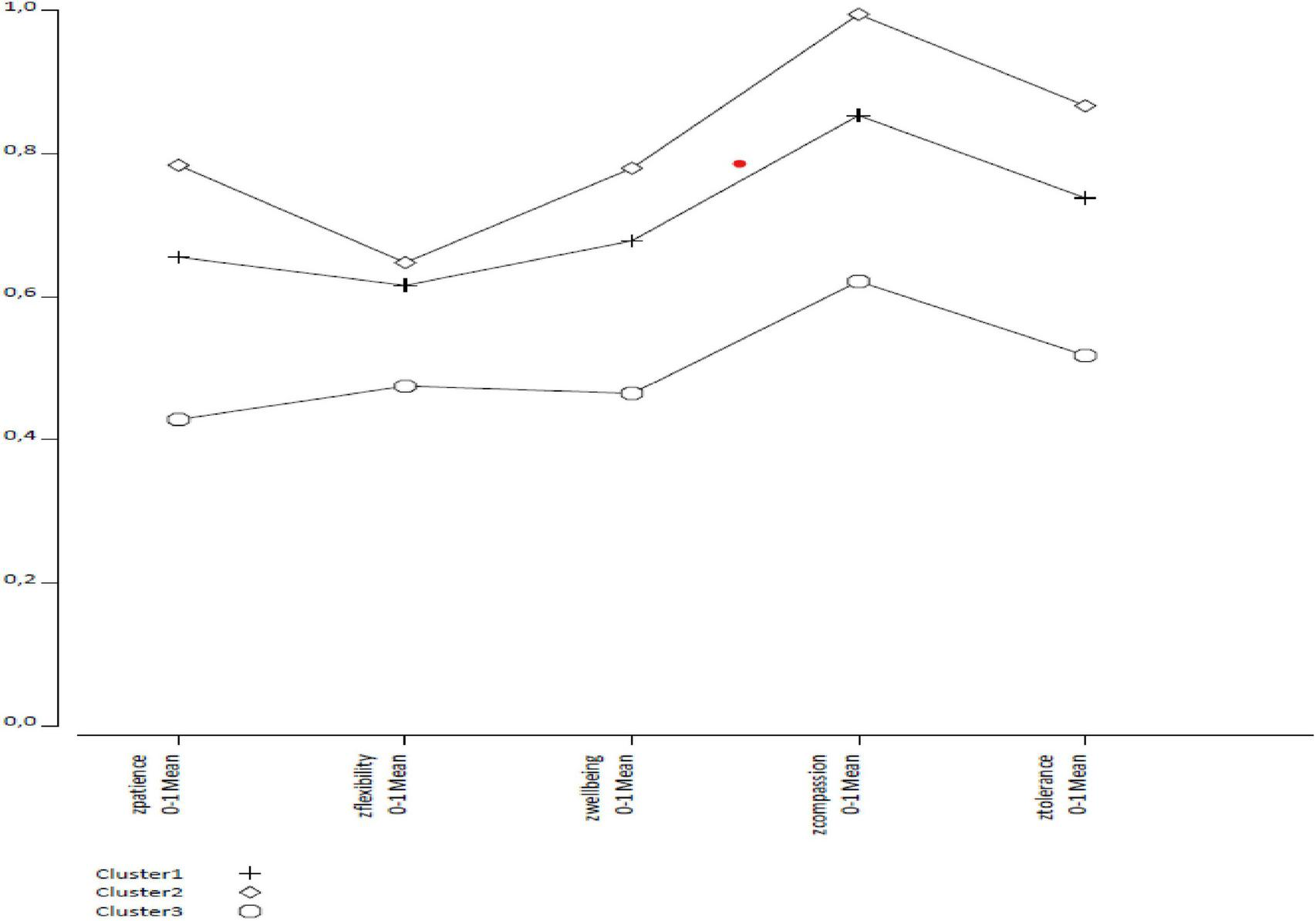
Profile-based mean values of psychological wellbeing and psychological resources variables according to latent profile analysis.
Finally, the study examined whether the psychological wellbeing profiles identified through latent profile analysis (LPA) differed significantly across the demographic subgroups of the sample (gender, marital status, employment status, and educational level). For this purpose, chi-square tests were conducted for variables with two categories (gender, employment status) to evaluate whether the distributions of the profiles differed statistically across these variables. For variables with more than two categories (marital status and educational level), chi-square test results were again examined, and class frequencies were compared to test for significant differences. The results of the analysis revealed that psychological wellbeing profiles differed significantly according to certain demographic variables. The findings are presented in Table 4.
TABLE 4
| Variable | Level | Moderate psychological wellbeing and psychological resources (%) 1 |
High psychological wellbeing and psychological resources (%) 2 |
Low psychological wellbeing and psychological resources (%) 3 |
χ2 | SD | P |
|---|---|---|---|---|---|---|---|
| Gender | Male | 46.9% | 31.7% | 21.4% | 6.04 | 2 | 0.049 |
| Female | 50.8% | 36.4% | 12.8% | ||||
| Marital status | Single | 50.2% | 30.8% | 19.1% | 15.82 | 4 | 0.003 |
| Divorced | 38.5% | 38.5% | 23.1% | ||||
| Married | 49.7% | 35.1% | 15.2% | ||||
| Educational level | High School | 21.4% | 45.2% | 33.3% | 29.49 | 4 | < 0.001 |
| University | 50.5% | 33.5% | 16.0% | ||||
| Postgraduate | 61.0% | 37.7% | 1.3% | ||||
| Employment status | Employed | 52.5% | 34.6% | 12.9% | 2.71 | 2 | 0.258 |
| Unemployed | 49.7% | 35.1% | 15.2% |
Chi-square test results regarding the relationship between individual characteristics and latent profiles.
According to the chi-square independence test results, levels of psychological wellbeing and psychological resources differed significantly across gender, marital status, and educational level. From the perspective of gender, the proportion of women in the moderate psychological wellbeing profile (50.8%) was higher than that of men (46.9%). In contrast, men were more likely to fall into the low-level group (21.4%) (χ2 = 6.04, p = 0.049). Regarding marital status, married individuals showed a more balanced distribution across the high (35.1%) and moderate (49.7%) levels; this indicates that, compared to single individuals (30.8% and 50.2%, respectively), married participants generally exhibited higher levels of psychological wellbeing (χ2 = 15.82, p = 0.003). In terms of educational level, participants with postgraduate (61.0%) and university (50.5%) degrees were much more likely to belong to the moderate psychological wellbeing profile compared to high school graduates (21.4%) (χ2 = 29.49, p < 0.001). In contrast, no significant difference was observed between groups in terms of employment status (χ2 = 2.71, p = 0.258). Overall, these findings suggest that women, married individuals, and those with higher educational attainment tend to be more advantaged in terms of psychological wellbeing and psychological resources.
6 Conclusion and discussion
In this study, different psychological wellbeing profiles emerging from the combination of tolerance, patience, compassion satisfaction, and psychological flexibility in Türkiye sample were examined. We also examined whether the identified psychological wellbeing profiles differed among subgroups based on gender, marital status, employment status, and education level. The results indicate that psychological wellbeing is positively related to all other traits. Furthermore in the context of the first research question of the study, three profiles were identified: (1) moderate psychological wellbeing and psychological resources (52%), (2) high psychological wellbeing and psychological resources (35%), (3) low psychological wellbeing and psychological resources (13%). Furthermore, in regard to the second research question, levels of psychological wellbeing and psychological resources differ according to gender, marital status, and level of education. Women exhibit significantly higher levels of moderate and high psychological wellbeing and psychological resources than men. Married individuals also exhibit higher levels of psychological wellbeing and resources than single individuals. Additionally, high school graduates have lower levels of psychological wellbeing and resources than undergraduate and graduate students. There is no significant difference by employment status.
The current study found that all these psychological traits were positively correlated with each other. This finding is supported by the literature (Dalkılınç, 2024; Maor et al., 2022; Le Pargneux and Zeitoun, 2022; Martin-Cuellar et al., 2019; Özbay et al., 2024). However, most participants fall into the first profile, which indicates moderate levels of psychological well-being and psychological resources. Similar findings have emerged from studies conducted with different samples, indicating that the majority of participants exhibit moderate levels of positive mental health indicators (Ceri and Cicek, 2021; Kiye et al., 2024; Liu et al., 2025; Nadarajan et al., 2025). In addition, this study shows that people with moderate levels of psychological wellbeing and psychological resources are mostly women and highly educated individuals. While some studies in the literature are consistent with this finding regarding psychological wellbeing and gender (Gündüz and Çağırga, 2023; Sak et al., 2024; Yuksel, 2022), others show no difference (Ceri and Cicek, 2021; Polat, 2024). This result in this sample may be related to the fact that psychological wellbeing can be explained by many different conditions and characteristics. On the other hand, the fact that people with higher levels of education mostly fit this profile may be related to the idea that, as one’s level of education increases, one has a more exploratory attitude toward oneself and realizes one’s internal and external resources in greater detail. Additionally, there are also studies showing that education level does not make a difference for psychological wellbeing and other psychological traits (Kiye et al., 2024; Sak et al., 2024). These different results may highlight the need for further research into the nature of psychological wellbeing.
A significant proportion of participants in the second profile exhibit high psychological well-being and psychological resources. Although this group is smaller than the first group, it still includes more than one-third of the participants. Research supports this finding, showing that high psychological wellbeing is associated with high psychological resources (Atasoy Güllü, 2023; Çelik Erdemir, 2024; Maor et al., 2022; Mendes et al., 2023). It was also found that individuals with this profile were female, highly educated, and married. These results are consistent with previous studies (Gündüz and Çağırga, 2023; Sak et al., 2024). Family life satisfaction is an important indicator of psychological wellbeing (Kiye and Demir, 2025) the higher satisfaction of married individuals may increase their overall wellbeing. In addition to these results, studies have shown that being female (Ceri and Cicek, 2021) or highly educated and married (Kiye et al., 2024) does not significantly impact psychological wellbeing. This may indicate the need for further, more detailed research on the psychological wellbeing model, as previously mentioned.
The third profile, low psychological wellbeing and psychological resources, comprises a relatively small proportion of participants compared to the other groups. However, due to low psychological wellbeing and psychological resources, individuals in this profile may be considered a risk group. In fact, it is understood from the literature that those with low levels of psychological wellbeing and psychological resources are individuals in the risk group, such as immigrants (Coşkun and Kiye, 2025). Research shows that psychological wellbeing and other psychological resources are negatively associated with depression (Engüzel, 2024; Schnitker, 2012), doomscrolling (Kiye et al., 2024), as well as with loneliness, stress, and anxiety (Ratchford and Schnitker, 2024), psychological distress (Peixoto and Cunha, 2024). Additionally, positive correlations have been found between these psychological traits and positive affect, while negative correlations have been found with negative affect (Le Pargneux and Zeitoun, 2022; Peixoto and Cunha, 2024). These results indicate that preventive interventions are necessary for individuals with this profile. It was also found that most of those in this profile were male, had a low level of education, and were single. Based on these results, it is crucial to develop intervention programs for unmarried men with low levels of education. Including modules that incorporate characteristics such as tolerance, patience, compassion, satisfaction, and psychological flexibility can increase the effectiveness of interventions designed to improve the psychological wellbeing of this group.
In conclusion these findings, observed in a different sample, significantly contribute to the literature on psychological wellbeing. In the Türkiye sample, individuals with high wellbeing were found to have higher levels of tolerance, patience, compassion, contentment, and flexibility. While most participants had moderate to high levels of psychological wellbeing and other psychological resources, a smaller minority had lower levels of these resources. Additionally, it was determined that 13% of the participants were individuals with low psychological wellbeing and resources. Most of these participants were single men with low education levels. The importance of developing intervention programs to address this issue was emphasized.
6.1 Limitations and recommendations
This study examines the relationship between psychological wellbeing and four psychological traits: psychological flexibility, compassion satisfaction, tolerance, and patience. In accordance with the principle of scientific transparency, the study’s limitations are outlined below.
First, the study employed a cross-sectional and correlational design, which does not allow for causal inferences between variables. To obtain more detailed results, further research should be conducted in the form of longitudinal studies.
Second, the study relied exclusively on self-reported instruments, which may introduce various sources of bias such as social desirability or common method variance. Although these instruments have previously demonstrated acceptable psychometric properties in Türkiye samples, the use of a single data source and format raises the possibility of inflated correlations due to method variance. Future studies could benefit from incorporating procedural remedies such as temporal separation of measurement, use of different response formats, or multi-source data collection, as recommended by Podsakoff et al. (2003). Additionally, given the subjective and introspective nature of the psychological traits assessed in this study (e.g., psychological flexibility, compassion satisfaction, tolerance), self-report instruments are widely considered valid and appropriate tools in behavioral and psychological research. Moreover, previous research has demonstrated that self-ratings can reflect valid internal states, despite occasional bias (MacIntyre et al., 1997).
Third, the study utilized a maximum variation sampling method to ensure demographic diversity in terms of gender, age, marital status, education level, and employment status. Additionally, since this research was conducted on social media, the sample may be biased because not all segments of society use social media equally. However, since participation was voluntary, some subgroups were more inclined to participate than others. The participants in this study were predominantly female and highly educated. This is an important detail that should not be overlooked. As a result, certain demographic groups may be overrepresented or underrepresented in the sample, which requires careful interpretation regarding the generalizability of the findings.
Fourth high correlations between some variables (e.g., patience and tolerance) were observed, which is common in social science research due to the overlapping nature of psychological constructs. This should be considered when interpreting the findings.
These limitations are not intended to undermine the validity of the study, but rather to provide context and guide future research. Within the scope of its sample and model, the current study offers strong and meaningful contributions to understanding psychological wellbeing in a culturally relevant framework.
Statements
Data availability statement
The original contributions presented in this study are included in this article/supplementary material, further inquiries can be directed to the corresponding author.
Ethics statement
The studies involving humans were approved by the Muş Alparslan University Scientific Research and Publication Ethics Committee. The studies were conducted in accordance with the local legislation and institutional requirements. The participants provided their written informed consent to participate in this study.
Author contributions
SK: Writing – original draft, Writing – review & editing.
Funding
The author(s) declared that financial support was not received for this work and/or its publication.
Conflict of interest
The author(s) declared that this work was conducted in the absence of any commercial or financial relationships that could be construed as a potential conflict of interest.
Generative AI statement
The author(s) declared that generative AI was not used in the creation of this manuscript.
Any alternative text (alt text) provided alongside figures in this article has been generated by Frontiers with the support of artificial intelligence and reasonable efforts have been made to ensure accuracy, including review by the authors wherever possible. If you identify any issues, please contact us.
Publisher’s note
All claims expressed in this article are solely those of the authors and do not necessarily represent those of their affiliated organizations, or those of the publisher, the editors and the reviewers. Any product that may be evaluated in this article, or claim that may be made by its manufacturer, is not guaranteed or endorsed by the publisher.
References
1
Akbayram H. T. Keten H. S. (2024). The relationship between religion, spirituality, psychological well-being, psychological resilience, life satisfaction of medical students in the Gaziantep. Turkey.J. Rel. Health632847–2859. 10.1007/s10943-024-02027-2
2
Atasoy Güllü Z. (2023). Mutluluğa aşırı değer verme ve psikolojik iyi oluş arasındaki ilişkide psikolojik esnekliğin aracı rolü.İstanbul: İstanbul Kent University/Institute of Postgraduate Education/Department of Psychology/Division of Clinical Psychology.
3
Bentler P. M. (1995). EQS structural equations program manual, Vol. 6. Encino, CA: Multivariate Software.
4
Bland J. M. Altman D. G. (1997). Statistics notes: Cronbach’s alpha.Br. Med. J.314570–572. 10.1136/bmj.314.7080.572
5
Bourne P. A. Powell C. Jamieson J. Stultz S. Williams K. Fallah J. et al (2022). Does tolerance ınfluence people’s psychological well-being during the coronavirus disease 2019 (COVID-19) pandemic.Intern. J. Curr. Res. Med. Med. Sci.51–12.
6
Carew M. T. Shakespeare T. (2024). Beyond disability stigma: Examining tolerance and ıntolerance toward disability ıssues.Scand. J. Disabil. Res.26450–463. 10.16993/sjdr.1145
7
Çelik Erdemir B. (2024). Ergenlerde öznel iyi oluş ve psikolojik esneklik arasındaki ilişkinin farklı sosyodemografik değişkenler açısından incelenmesi.Unpublished Master’s Thesis, İstanbul: İstanbul Nişantaşı University/Institute of Postgraduate Education/Department of Psychology/Department of Psychology.
8
Ceri V. Cicek I. (2021). Psychological well-being, depression and stress during COVID-19 pandemic in Turkey: A comparative study of healthcare professionals and non-healthcare professionals.Psychol. Health Med.2685–97. 10.1080/13548506.2020.1859566
9
Cırcır O. Tagay Ö (2024). The relationships between cognitive flexibility, perfectionism, optimism, self-compassion and psychological well-being: A mixed study.Curr. Psychol.4319830–19846. 10.1007/s12144-024-05775-2
10
Corneo G. Jeanne O. (2009). A theory of tolerance.J. Public Econ.93691–702. 10.1016/j.jpubeco.2009.02.005
11
Coşkun F. Kiye S. (2025). Mental health profiles of migrants: A latent profile analysis of life satisfaction, psychological well-being, resilience and risk indicators.Front. Psychol.16:1643759. 10.3389/fpsyg.2025.1643759
12
Dalkılınç G. (2024). Psikolojik iyi oluşun belirsizliğe tahammülsüzlük, kendini sabotaj ve psikolojik esneklik açısından incelenmesi.Unpublished Master’s Thesis, İstanbul: İstanbul University-Cerrahpaşa/Institute of Postgraduate Education/Department of Educational Sciences/Department of Guidance and Psychological Counselling.
13
Demirci İ Ekşi H. (2018). Keep calm and be happy: A mixed method study from character strengths to well-being.Educ. Sci. Theory Pract.18279–330. 10.12738/estp.2018.2.0799
14
Diener E. Wirtz D. Tov W. Kim-Prieto C. Choi D. Oishi S. et al (2009). “New measures of well-being: Flourishing and positive and negative feelings,” in Assessing well-being: The collected works of Ed Diener, ed.DienerE. (Berlin: Springer Science Business Media), 247–266. 10.1007/978-90-481-2354-4_12
15
Eliüşük A. Arslan C. (2016). Sabır ölçeğinin türkçeye uyarlanmasi: Geçerlilik ve güvenirlik çalişmalari.Değerler Eğitimi Dergisi1467–86.
16
Engüzel T. (2024). Çocukluk çağı travmaları ile depresyon ve yaygın anksiyete belirtileri arasındaki ilişkide öz eleştirel ruminasyon, psikolojik esneklik ve algılanan stresin aracı rolü.Unpublished Master’s Thesis, Ýzmir: Dokuz Eylül University/Institute of Social Sciences/Department of Psychology/Division of Clinical Psychology.
17
Feldman C. Kuyken W. (2011). Compassion in the landscape of suffering.Contemp. Buddhism12143–155. 10.1080/14639947.2011.564831
18
Francis A. W. Dawson D. L. Golijani-Moghaddam N. (2016). The development and validation of the Comprehensive assessment of Acceptance and Commitment Therapy processes (CompACT).J. Contextual Behav. Sci.5134–145. 10.1016/j.jcbs.2016.05.003
19
Galina K. (2013). Basic assumptions as predictors of interpersonal tolerance and ethnic identity in psychology students.Procedia-Soc. Behav. Sci.86511–517. 10.1016/j.sbspro.2013.08.606
20
Garner E. V. Golijani-Moghaddam N. (2021). Relationship between psychological flexibility and work-related quality of life for healthcare professionals: A systematic review and meta-analysis.J. Contextual Behav. Sci.2198–112. 10.1016/j.jcbs.2021.06.007
21
Gliner J. A. Morgan G. A. Leech N. L. (2011). Research methods in applied settings: An integrated approach to design and analysis.England: Routledge.
22
Guerrini Usubini A. Varallo G. Granese V. Cattivelli R. Consoli S. Bastoni I. et al (2021). The impact of psychological flexibility on psychological well-being in adults with obesity.Front. Psychol.12:636933. 10.3389/fpsyg.2021.636933
23
Gündüz Y. Çağırga T. (2023). Öğretmenlerin tolerans düzeyi ile psikolojik iyi oluşları arasındaki ilişki.Sinop Üniv. Sosyal Bilimler Dergisi7997–1028. 10.30561/sinopusd.1257148
24
Hayes S. C. (2004). Acceptance and commitment therapy, relational frame theory, and the third wave of behavioral and cognitive therapies.Behav. Therapy35639–665. 10.1016/S0005-7894(04)80013-3
25
Hayes S. C. Luoma J. B. Bond F. W. Masuda A. Lillis J. (2006). Acceptance and commitment therapy: Model, processes and outcomes.Behav. Res. Therapy441–25. 10.1016/j.brat.2005.06.006
26
Hooper D. Coughlan J. Mullen M. (2008). “Evaluating model fit: A synthesis of the structural equation modelling literature,” in Proceedings of the 7th European conference on research methodology for business and management studies, (Berlin: Scienceopen.com).
27
Howell A. J. Demuynck K. M. (2021). Psychological flexibility and psychological inflexibility are independently associated with both hedonic and eudaimonic well-being.J. Contextual Behav. Sci.20163–171. 10.1016/j.jcbs.2021.04.002
28
Hu L. T. Bentler P. M. (1999). Cutoff criteria for fit indexes in covariance structure analysis: Conventional criteria versus new alternatives.Struct. Equat. Model. A Multidiscipl. J.61–55. 10.1080/10705519909540118
29
Imani M. Karimi J. Behbahani M. Omidi A. (2017). Role of mindfulness, psychological flexibility and integrative self-knowledge on psychological well-being among the university students.Feyz J. Kashan Univ. Med. Sci.21171–178. 10.1186/s12913-016-1423-5
30
Kanov J. M. Maitlis S. Worline M. C. Dutton J. E. Frost P. J. Lilius J. M. (2004). Compassion in organizational life.Am. Behav. Sci.47808–827. 10.1177/0002764203260211
31
Karadeniz-Özgeniş S. (2024). Geç ergenlikte bağlanma stilleri ve psikolojik iyi oluş ilişkisinde öz-şefkat ve psikolojik esnekliğin aracı rolü.Unpublished Master’s Thesis, Trabzon: Trabzon University/Graduate School of Education/Department of Educational Sciences/Department of Guidance and Psychological Counselling.
32
Karakuş S. Akbay S. E. (2020). Psikolojik esneklik ölçeği: Uyarlama, geçerlik ve güvenirlik çalışması.Mersin Üniv. Eğitim Fakültesi Dergisi1632–43. 10.17860/mersinefd.665406
33
Kashdan T. B. Rottenberg J. (2010). Psychological flexibility as a fundamental aspect of health.Clin. Psychol. Rev.30865–878. cpr.2010.03.001 10.1016/j
34
Keyes C. L. M. Shmotkin D. Ryff C. (2002). Optimizing well-being: The empirical encounter of two traditions.J. Personal. Soc. Psychol.821007–1022. 10.1037/0022-3514.82.6.1007
35
Khormaei F. Farmani A. Soltani E. (2015). The Patience Scale: Instrument development and estimates of psychometric properties.Educ. Measurem.11783–99. 10.22054/jem.2015.324
36
Kiye S. Demir E. (2025). Cognitive flexibility and psychological well-being as predictors of family life satisfaction among emerging adults.J. Uludag Univ. Faculty Educ.38554–575. 10.19171/uefad.1599771
37
Kiye S. Dogan B. G. Coşkun F. (2024). Latent profile analysis of earthquake victims: doomscrolling, psychological well-being, emotion regulation and resilience.Curr. Psychol.4333867–33877. 10.1007/s12144-024-06904-7
38
Landi G. Pakenham K. I. Crocetti E. Grandi S. Tossani E. (2021). The multidimensional psychological flexibility ınventory (MPFI): Discriminant validity of psychological flexibility with distress.J. Contextual Behav. Sci.2122–29. 10.1016/j.jcbs.2021.05.004
39
Lavelock C. R. (2016). Good things come to those who (peacefully) wait: Toward a theory of patience.Doctoral dissertation, Richmond, VA: Commonwealth University.
40
Le Pargneux A. Zeitoun H. (2022). Patience and subjective well-being.Appl. Econ. Lett.301923–1929. 10.1080/13504851.2022.2083566
41
Leung T. Y. Lam C. B. Chung K. K. H. (2024). Self-compassion mediates the associations of mindfulness with physical, psychological, and occupational well-being among Chinese kindergarten teachers.Early Childhood Educ. J.1–10. 10.1007/s10643-024-01819-1
42
Li A. C. Chio F. H. Mak W. W. Fong T. H. Chan S. H. Tran Y. H. R. et al (2025). Compassion fatigue, compassion satisfaction and mindfulness among healthcare professionals: A meta-analysis of correlational studies and randomized controlled trials.Soc. Sci. Med.367:117749. 10.1016/j.socscimed.2025.117749
43
Li Q. Liu M. Wang H. Chen Y. Fu Z. (2024). Longitudinal associations of gratitude with subjective well-being and psychological well-being: A two-wave study.Appl. Res. Qual. Life20217–233. 10.1007/s11482-024-10406-w
44
Liu S. Han H. Athurupana R. Yang T. (2025). Compassion fatigue and compassion satisfaction among nurses/midwives caring parents with pregnancy loss or infertility: A cross-sectional study.Front. Public Health13:1668647. 10.3389/fpubh.2025.1668647
45
MacIntyre P. D. Noels K. A. Clément R. (1997). Biases in self-ratings of second language proficiency: The role of language anxiety.Lang. Learn.47265–287. 10.1111/0023-8333.81997008
46
Maor M. Zukerman G. Amit N. Richard T. Ben-Itzhak S. (2022). Psychological well-being and adjustment among type 2 diabetes patients: The role of psychological flexibility.Psychol. Health Med.271456–1467. 10.1080/13548506.2021.1887500
47
Martin-Cuellar A. Lardier D. T. Atencio D. J. (2019). Therapist mindfulness and subjective vitality: The role of psychological wellbeing and compassion satisfaction.J. Mental Health30113–120. 10.1080/09638237.2019.1644491
48
Mendes A. L. Canavarro M. C. Ferreira C. (2023). The roles of self-compassion and psychological flexibility in the psychological well-being of adolescent girls.Curr. Psychol.4212604–12613. 10.1007/s12144-021-02438-4
49
Motahari N. Torkan H. (2025). The relationship between loneliness, distress tolerance, and resilience with spiritual well-being among older adults residing in nursing homes.Aging Psychol.11230–213. 10.22126/jap.2025.11836.1840
50
Nadarajan S. S. Chui P. L. Lee W. L. Zaini N. H. (2025). Factors influencing compassion satisfaction and compassion fatigue among nurses: A study in a tertiary hospital.BMC Nurs.24:93. 10.1186/s12912-025-02736-3
51
Nas E. Sak R. (2021). Merhamet doyumu ölçeğinin geliştirilmesi.Elektronik Sosyal Bilimler Dergisi202019–2036. 10.17755/esosder.910301
52
Öcel H. (2017). Meme kanseri tanısı almış çalışan kadınlarda damgalanma ve bilinçli farkındalık ile psikolojik iyi oluş arasındaki ilişkiler: Psikolojik esnekliğin düzenleyici rolü.Türk Psikoloji Dergisi32116–133.
53
Özbay A. Demirci Seyrek Ö Söylemez N. E. (2024). Examining the relationship between positive thinking skills and patience tendency in women.Psychol. Rep.10.1177/00332941241299783[Epub ahead of print].
54
Peixoto M. M. Cunha O. (2024). Life satisfaction, psychological distress, compassion satisfaction and resilience: When the pleasure of helping others protects veterinary staff from emotional suffering.Vet. Res. Commun.483489–3498. 10.1007/s11259-024-10510-0
55
Peterson C. Seligman M. E. (2004). Character strengths and virtues: A handbook and classification.Oxford: Oxford University Press.
56
Pfann F. Pfann G. (2024). On patience and trust.Appl. Econ. Lett.322836–2842. 10.1080/13504851.2024.2349779
57
Pianalto M. (2016). On patience: Reclaiming a foundational virtue.Lanham, MD: Rowman & Littlefield.
58
Podsakoff P. M. MacKenzie S. B. Lee J. Y. Podsakoff N. P. (2003). Common method biases in behavioral research: A critical review of the literature and recommended remedies.J. Appl. Psychol.88879–903. 10.1037/0021-9010.88.5.879
59
Polat F. Ç (2024). Yurtlarda kalan üniversite öğrencilerinin fiziksel aktivite ile psikolojik iyi oluş düzeyleri: Adana örneği.Gençlik Araştırmaları Dergisi121–21. 10.52528/genclikarastirmalari.1321358
60
Ratchford J. L. Schnitker S. A. (2024). Virtue in pursuit of goals: A goals-based approach to patience measurement.J. Personal. Assess.106181–195. 10.1080/00223891.2023.2219846
61
Roberts J. L. (2013). The power of patience.Harvard Magazine11640–43.
62
Ryff C. D. Keyes C. L. M. (1995). The structure of psychological well-being revisited.J. Personal. Soc. Psychol.69719–727. 10.1037//0022-3514.69.4.719
63
Sak R. Skutil M. Şahin-Sak İT. Zikl P. Nas E. Herynková M. (2024). Czech and Turkish preschool teachers’ compassion and psychological well-being.Early Childhood Educ. J.521165–1179. 10.1007/s10643-023-01505-8
64
Schnitker S. A. (2012). An examination of patience and well-being.J. Positive Psychol.7263–280. 10.1080/17439760.2012.697185
65
Schnitker S. A. Emmons R. A. (2007). Patience as a virtue: Religious and psychological perspectives.Res. Soc. Sci. Study Rel.18177–207. 10.1163/ej.9789004158511.i-301.69
66
Sezgin O. Biçer R. (2006). Foundations of tolerance in turkish culture.Eur. Legacy11405–415. 10.1080/10848770600766128
67
Soyuçok M. (2022). Kök değerlerin kökenleri: Bir Divanü Lûgat-it Türk incelemesi.Folklor Akademi Dergisi5101–113. 10.55666/folklor.1079659
68
Stamm B. H. (2002). “Measuring compassion satisfaction as well as fatigue: Developmental history of the compassion satisfaction and fatigue test,” in Treating compassion fatigue, ed.FigleyC. R. (New York, NY: Brunner-Routledge), 107–119.
69
Stevens J. R. Stephens D. W. (2008). Patience.Curr. Biol.18R11–R12. 10.1016/j.cub.2007.11.021
70
Strauss C. Taylor B. L. Gu J. Kuyken W. Baer R. Jones F. et al (2016). What is compassion and how can we measure it? A review of definitions and measures.Clin. Psychol. Rev.4715–27. 10.1016/j.cpr.2016.05.004
71
Sweeny K. (2024). On (im) patience: A new approach to an old virtue.Personal. Soc. Psychol. Rev.29145–158. 10.1177/10888683241263874
72
Tatlıcıoğlu O. Kılıç A. Apak H. Koçak O. (2024). How job satisfaction is associated with psychological well-being among social workers in Turkey: The mediating role of meaning in life.J. Soc. Service Res.5092–106. 10.1080/01488376.2023.2276134
73
Telef B. B. (2013). Psikolojik iyi oluş ölçeği: Türkçeye uyarlama, geçerlik ve güvenirlik çalişmasi.Hacettepe Üniversitesi Eğitim Fakültesi Dergisi28374–384.
74
To S. Helwig C. C. Yang S. (2017). Predictors of children’s rights attitudes and psychological well-being among rural and urban mainland Chinese adolescents.Soc. Dev.26185–203. 10.1111/sode.12195
75
Trindade I. A. Mendes A. L. Ferreira N. B. (2020). The moderating effect of psychological flexibility on the link between learned helplessness and depression symptomatology: A preliminary study.J. Contextual Behav. Sci.1568–72. 10.1016/j.jcbs.2019.12.001
76
Turan M. Yuce M. (2022). Examination of the relationship of sport with tolerance and patience in children.Vıref-Revısta De Educacıon Fısıca1112–31.
77
Van Dierendonck D. Lam H. (2023). Interventions to enhance eudaemonic psychological well-being: A meta-analytic review with Ryff’s Scales of Psychological Well-being.Appl. Psychol. Health Well-Being15594–610. 10.1111/aphw.12398
78
Verkuyten M. Yogeeswaran K. Adelman L. (2022). The social psychology of intergroup tolerance and intolerance.Eur. Rev. Soc. Psychol.341–43. 10.1080/10463283.2022.2091326
79
Waldeck D. Pancani L. Holliman A. Karekla M. Tyndall I. (2021). Adaptability and psychological flexibility: Overlapping constructs?J. Contextual Behav. Sci.1972–78. 10.1016/j.jcbs.2021.01.002
80
Wheaton B. Muthen B. Alwin D. F. Summers G. F. (1977). Assessing reliability and stability in panel models.Sociol. Methodol.884–136. 10.2307/270754
81
Xu W. Oei T. P. Liu X. Wang X. Ding C. (2016). The moderating and mediating roles of self-acceptance and tolerance to others in the relationship between mindfulness and subjective well-being.J. Health Psychol.211446–1456. 10.1177/1359105314555170
82
Yıldırım E. D. (2023). Olumlu çocukluk yaşantıları ve öznel iyi oluş arasındaki ilişkide psikolojik esnekliğin aracı rolü.Unpublished Master’s Thesis, Diyarbakır: Dicle University/Institute of Social Sciences/Department of Psychology/Division of Clinical Psychology.
83
Yıldırım S. G. Demirel M. (2019). Türk tarihinde değerler ve değerler eğitimi üzerine bir inceleme.Eğitim Kuram ve Uygulama Araştırmaları Dergisi592–99.
84
Yuksel N. (2022). The correlation between teachers’ self-efficacy perceptions and tolerance and psychological well-being.Intern. Online J. Educ. Teach. (IOJET)91307–1327.
Summary
Keywords
latent profile analysis, psychological wellbeing, tolerance, patience, compassion satisfaction, psychological flexibility
Citation
Kiye S (2026) Latent profiles of psychological wellbeing and psychological resources in Türkiye: tolerance, patience, compassion satisfaction, psychological flexibility. Front. Psychol. 16:1723646. doi: 10.3389/fpsyg.2025.1723646
Received
12 October 2025
Revised
29 November 2025
Accepted
08 December 2025
Published
06 January 2026
Volume
16 - 2025
Edited by
Miriam Sarid, Western Galilee College, Israel
Reviewed by
Chen Hanna Ryder, Western Galilee College, Israel
Oz Guterman, Western Galilee College, Israel
Updates
Copyright
© 2026 Kiye.
This is an open-access article distributed under the terms of the Creative Commons Attribution License (CC BY). The use, distribution or reproduction in other forums is permitted, provided the original author(s) and the copyright owner(s) are credited and that the original publication in this journal is cited, in accordance with accepted academic practice. No use, distribution or reproduction is permitted which does not comply with these terms.
*Correspondence: Semra Kiye, s.kiye@alparslan.edu.tr
Disclaimer
All claims expressed in this article are solely those of the authors and do not necessarily represent those of their affiliated organizations, or those of the publisher, the editors and the reviewers. Any product that may be evaluated in this article or claim that may be made by its manufacturer is not guaranteed or endorsed by the publisher.