 Elaine Duncan1*†
 Rachele Nateri1,†Abigail Lind1,†
 Sheila Leddington-Wright2Alison Bloxham3Lindsey Moffitt1
 David Sykes4
- 1Department of Psychology, School of Health and Life Sciences, Glasgow Caledonian University, Glasgow, United Kingdom
- 2School of Life Sciences, University of Coventry, Coventry, United Kingdom
- 3AB Therapy Services, Therapy Lead, Transplant Sport UK, Devon, United Kingdom
- 4Glasgow International College, University of Glasgow, Glasgow, United Kingdom
Evidence suggests that engaging in physical activity improves the mental and physical health of transplant recipients. An opportunity to be more active could be participating in the national and international network of Transplant Games. Although the literature on motivations for and the experience of taking part in the Games is available, little is known about what role applied practitioners, specifically sport and exercise psychologists could play as transplant recipients prepare and compete. This paper offers perspectives on the provision of a sports performance well-being service delivered at the British Transplant Games. The paper consists of several sections. The first offers background and how the service came into being. The second provides details of the model and philosophy that underpinned the service delivery. The third includes the trainee and exercise practitioner's casework and the challenges therein. Informed by the team's reflections and post-games survey the final section proposes recommendations for future applied sport and exercise services at this unique event.
1 Introduction
1.1 The transplant games and the transplant athlete
Solid organ transplant surgery (e.g., heart, kidney, lung, liver, pancreas) and hematopoietic cell transplants (e.g., bone marrow) are life-saving surgical procedures (1, 2). Recent research (3–5) and clinical guidelines (6) suggest that returning to an active lifestyle post-transplant may have a positive impact on the health and quality of life of transplant recipients (7, 8). An opportunity to be more active could be participation in the national and international network of Transplant Games. The Transplant Games, founded by Maurice Slapak, uses sports participation to raise awareness of organ donation and promote active lifestyles. The first Games (1978) were held in Portsmouth with only 99 athletes, from 5 countries and was a 1-day event. Now a network of national and international games exists with the potential to attract around 2,000 competitors, from 60 countries to week-long events. The Games is an individual and team multi-sports event including track and field, golf, swimming, cycling, racquet sports, volleyball, and more. Participants compete in age categories (e.g., under five, junior, 20–29, 30–39 through to 80–89). Transplant recipients who compete as Athletes (TxA) can be part of a larger team and affiliated with the hospital from which they received their transplant. The overall climate of the Games is one of participation, fellowship, survivorship (9) and inclusivity (10). Yet, research suggests that TxA display varying levels of ability from those who simply wish to take part to those who commit time to training and resources to achieve personal bests and world record performances (11). In addition to individual differences in performance capacity transplantation can cause significant physical, psychological, social, and emotional issues impacting upon general health status and may limit such participation (12–15). Studies of TxA motivations for and the impact of competing at the Games (11, 16–18) are evident, however apart from informal performance support during training camps and at the World Transplant Games in 2019 and 20231 there is no extant literature on the role applied sport psychology had played in such a context (19). The authors believe this to be the first paper to offer perspectives on the delivery of a sports performance and well-being service at a British Transplant Games (BTG). Initially, this was offered as a pilot service with hopes of developing it further at future Games.
1.2 How the service provision came into being
The lead author, (ED), is an applied sport and exercise psychologist, counselor, and tutor within a Sport and Exercise Psychology taught doctorate program at Glasgow Caledonian University (GCU). For over a decade she has attended the BTG supporting her partner, a transplant athlete (author, DS). Such up-close and personal experience fueled research on transplant recipient well-being (with author SLW2) and the desire to offer sports psychology services to transplant games competitors. A mechanism for such could be recruiting trainee sport and exercise psychologists from the aforementioned taught doctorate with ED providing supervision of practice and insights from her BTG experience. This model of training would help GCU trainees meet program requirements including 450 client practice hours in diverse placements. Moreover, preparing trainees to function in complex and challenging environments necessitates exposure to real-life and dynamic practice environments (20, 21).
Collaboration with SLW (Sports Therapist) raised awareness of trainee placement opportunities at the BTG. Expanding from informal support offered by one physiotherapist at the 1999 BTG a Therapy Team was officially created in 2014. Over time the Therapy Team has consisted of trainees (on average 20) from diverse professions, (Physiotherapy, Sports Therapists, Sports Rehabilitators, Sports Masseurs, and Chiropractors) who gain hands-on experience treating competitors at the BTG and at the international transplant games circuit under the tutelage of qualified practitioners. The overall management of the Therapy Team is the remit of author AB (Physiotherapist). Discussions about incorporating a psychological service delivery were proposed in 2022 which led to this pilot at the BTG, Coventry in 2023.
Several GCU doctoral trainees responded to an expression of interest call. Two were selected (authors, RN and AL) based on their placement experience at live sporting events, implementing domain-specific psychological skills and training in psychological therapies. At the selection point, trainees had amassed over 550 client consultancy hours.
2 Nature of service delivery
2.1 Model and components of service delivery
Although models of delivery and evaluation of applied sport psychology exist (22, 23) and evaluation of the impact of applied sports psychology on performance exist (24) the realities of being a TxA and the ethos of BTG make a systemic approach to both difficult. TxA are typically not supported by coaches or other sports performance personnel. Moreover, competitors can register to play a sport they have never played before. Health vulnerabilities of transplant recipients (11) can mean interruptions to physical activity levels and competition (8); making it difficult to measure performance across time. Constraints aside, the goal was to offer a flexible service delivery model tailored to this client group's needs.
The service was designed to have three strands; psychological and emotional support; psychoeducation on physical activity and lifestyle factors; and psychological skills training (PST) for performance-related issues. The team adopted a transplant athlete-centered philosophy that considered the whole person (25, 26) and the wider context of participation at the BTG. In the context of transplant recipients, it is arguably even more important to adopt a holistic approach that places the well-being of the individual first and the performer second (27). As part of this philosophy, the therapeutic relationship remained central even within single-session consultations (28, 29). Adopting an empathic, non-judgmental manner (30–32), to develop trust and rapport (33) that prioritized hearing competitors' stories and a collaborative approach to interventions. A cognitive-behavioral theoretical framework underpinned the PST interventions (34) which have been effectively used with athletes (35), and evidence also supports cognitive-behavioral-based PST as an effective method to enhance psychological skills, behavior, and performance (36). A specific in situ example was the use of self-talk during competition breaks. Initially, not seeing self-talk as pertinent psychoeducation around this concept raised awareness of a client's undirected self-talk (37, 38). The client was surprised by the negative valence of their self-talk, but through collaboration the client and AL were able to brainstorm alternative, more adaptive self-talk that could be motivational and instructional, thus aligning better with that individual's performance (39).
Several factors determined which sports the psychology team supported. Practitioners' preferences and prior experience of sport(s) and that some sports were more conducive to pitch-side interventions whilst others were more accessible, for example, all racquet sports were held in the same venue. Refer to Table 1 below for a complete breakdown of the number & duration of sessions, the client type, and the nature of the client work.
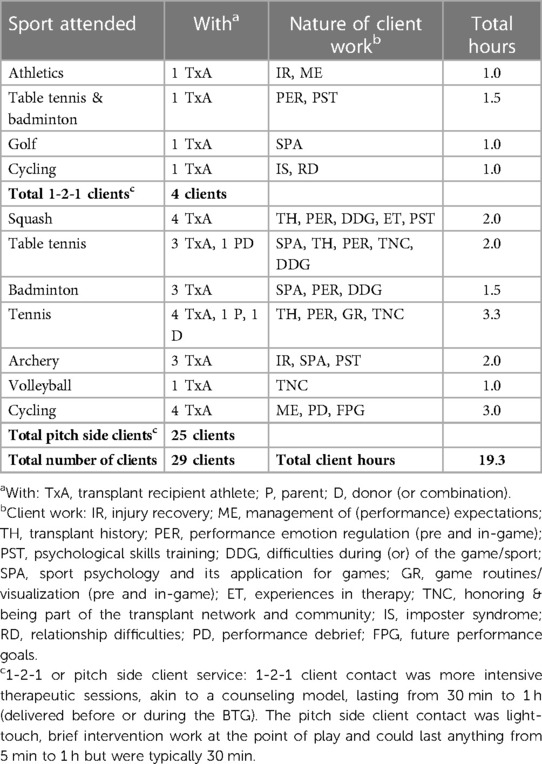
Table 1 Nature of client work.
2.2 Relationship to therapy team
The psychology service was incorporated under the Therapy Team in name only. For this pilot, the psychology team operated independently and differed in terms of trainee support level. Whilst other team trainees were directly supervised by SLW, and AB, the sport and exercise trainees worked independently of ED. This ensured client confidentiality as per professional practice guidelines (40, 41) and was consistent with placement experiences within the GCU program. To support practice, the psychology trainees engaged in one-to-one supervision with ED, typical of the doctorate program. A client referral system between the Therapy Team and the psychology service was not a feature of this pilot. However, AB did use clinical judgment to sign-post two clients to the service. ED produced a report on the use of psychology service which AB's include in the overall report on Therapy Team activities. This was shared with the event organisers, (Multi-Level Services, MLS) and the chairman of Transplant Sport, enabling resource planning at future events.
2.3 Raising awareness of service delivery
Awareness of the service was raised via two methods, firstly using relevant transplant community social media and secondly requesting that transplant Team Managers cascade our service advert to their team members. Interested TxA shared an initial online session with ED before onward referral to trainees to discuss pre-and/or during the Games support. At the event, the psychology team wore the official Therapy Team t-shirt and displayed accreditation passes to access all areas.
3 Reflections and challenges during service delivery
3.1 Initiating therapeutic relationships and finding confidential spaces
One key element was setting the scene for competitors; that is, succinctly outlining the nature of the psychological service offered and the overlap between physical activity, psychology, and behavior. This required skill in gauging the level of interest and degree of engagement in the service. Understanding what the client may seek from our interaction can be an important first step (42). Our brief contact interventions were guided by the following principles: prioritizing present psychological experience, observance of an athlete's verbal and non-verbal cues, and listening for entry points (43). These were important guides in initiating therapeutic encounters and part of the team's decision matrix of when to move through to more intensive and longer one-on-one sessions to supplement pitch-side style encounters (44). Brief interventions can be an effective mechanism for improving athlete psychological well-being (45) and adaptations can be made by sports psychologists to work effectively within this time-limited environment (46). Related to this is the challenge of working at live sporting events whilst preserving confidentiality. The event's dynamic nature meant it was often not possible to find a quiet, confidential space as noted by other practitioners at live events (47, 48). It was, therefore, important to ensure that attendees felt comfortable talking in the space we had available, a challenge evidenced by other service delivery teams at live sporting events (49).
3.2 Managing the climate and emotional labor of the games
At one extreme the climate was one of joy, hope, and celebration of life: yet at the other, a complex interplay between gratitude and guilt. Competitors spoke of the pressure they put themselves under, of performing in front of the donors' families, to somehow make their loss more bearable, and to give back. Tebbens (50) has highlighted this phenomenon that others call “survivor guilt” (51). Author (RN) bore witness to this emotional dichotomy when transplant recipients expressed gratitude towards their donors and donors’ families, across breakfast with an athlete and their family, and when watching a tennis as a parent disclosed the story of their donor child. The personal wants to simply meet another human in suffering but the professional may need to draw upon emotion-regulation skills to hold onto boundaries that support a practitioner's well-being (52). These experiences of blurred boundaries between personal and professional roles have been reported by others providing services at live sporting events (53–55).
Part of the Transplant Games experience is the opportunity to attend the opening ceremony. A street parade of teams, families, and friends, akin to the Olympics, albeit scaled down in duration, and budget. The psychology team chose to attend this ceremony sensing the value of an immersive approach to consultancy that advocates familiarization with the dynamics of a live sports event, or tournament (56). The author RN reflected on how overwhelming and emotional this was, hitting them most unexpectedly when a poem was recited by a grateful sister for having been given the chance to grow up with her little brother thanks to a lifesaving donation only made possible by another human being losing their own life. It is possible that trainee preparation for and confidence in managing in-session client work may not necessarily consider what is needed in terms of coping with the broader context of a sporting event like the Games. Hings and colleagues (52) have looked at the demands of the applied practice of sport and exercise psychologists in training identifying what they called, an emotional experiential gap. This gap is defined as inexperience in managing emotional labor and can be reduced with appropriate support, education, and experience to better prepare them for the challenges they face (52). Emotional labor is defined as the management and verbal and non-verbal expression of emotions, in line with the requirements of a specific situation (57). Studies have found that in the healthcare professions, emotional labor demands are often difficult to cope with (58–60). Studies looking at the emotional labor of coaches and support staff at the Olympic Games (61) have also shown that most of the participants described the sports event as an emotional roller coaster with feelings of excitement, low mood, and emotional exhaustion. These results are also consistent with Hayton's (62) on volunteers taking part in a sport-based project. Hings and colleagues' results (52) have shown that support can make a difference in trainees' applied practice. As a team, we quickly recognized the emotional labor of the Games and the importance of having peer supervision in place to better manage the emotional demands of the event and support each other (63).
4 Key recommendations for service delivery at future transplant games
Evaluation and reflection-in-action are necessary components of applied sports psychology practice (64–66). Although the response rate to the post-games survey wasn't high (n = 19) author LM was still able to extract key themes which alongside the psychology team's reflection shaped recommendations for future service delivery.
Half of the respondents who had prior knowledge of the service found it difficult to access, suggesting that the psychology team liaised with the event organizers to improve signage to the service at the BTG. Placing signage in areas known to have higher footfall (e.g., the multi-event sports venues) and stationing members of the psychology team in the hubs where the other Therapy Team practitioners work could improve this. A more structured process of onward referral from practitioners within the Therapy Team to the psychology service is also proposed. This would require the creation of guidelines to help Therapy Team practitioners judge when physical and restorative support needs to be supplemented with psychological support.
In answer to the survey question “What role could sport, and exercise psychologists play at future transplant games” several competitors said they would value help managing the nature of competing at the games with one saying they “never produce good throws under the pressure of the games”. Others reported that psychologists could help with “self-doubt” and “managing stress and anxiety”. Several mentioned how psychologists could help competitors “understand their feelings” about being a transplant recipient and help with “personal development”. There was, therefore, some synergy between these priorities and the psychology team's applied work. However, a larger study of TxA needs before the BTG could better inform future service delivery, a strategy adopted by a psychology service delivery team in preparation for 2024 Olympic games (67).
The psychology trainees recommend enhancing pre-games preparation, specifically, more education on the psychological and physical milieu of being a transplant recipient. This should include more information on the impact of a transplant recipient's medication regime and factors associated with managing a long-term health condition. The addition of a blanket consent process to access the service could be alongside the Game's registration process. This may be a more agile and fit-for-purpose approach to informed consent and raise awareness of the service earlier. The psychology team should also adopt online and/or telephone modes for supervision and debriefing, this may have eased the logistical difficulties the team experienced attempting to conduct in-person.
Moving beyond this pilot would necessitate a more systematic and multi-dimensional approach to service evaluation. Measures proximal to service delivery may be preferable to a post-games approach. Assessing client's understanding of the interventions they engaged in, and outcomes such as well-being and performance goals could be incorporated. We could also evaluate the practitioner's skills, such as empathy, and degree of fit to client needs (68).
5 Conclusion
This paper presented perspectives from the first integrated sports performance and well-being service delivered at the British Transplant Games. It was feasible to do so and the responses to the post-games survey suggest a sports psychology service would be of value to TxA. This experience provided trainee sport and exercise psychologists with an opportunity to work with a broader base of client presentations than typically exposed to with much to reflect upon, not least how to navigate the climate and emotional labor of the Games. Our recommendations are essential if ambitions to upscale the sports performance and well-being service at future Games are to be realized.
Data availability statement
The raw data supporting the conclusions of this article will be made available by the authors, without undue reservation.
Author contributions
ED: Funding acquisition, Supervision, Writing – original draft, Writing – review & editing. RN: Writing – original draft, Writing – review & editing. AL: Writing – original draft, Writing – review & editing. S-LW: Writing – review & editing. AB: Writing – review & editing. LM: Writing – review & editing. DS: Visualization, Writing – review & editing.
Funding
The author(s) declare financial support was received for the research, authorship, and/or publication of this article.
The Therapy Team services at the BTG have always been free and provided voluntarily by the trainees and the practitioners who mentor them. The psychology team services were also offered on the same voluntary basis. However, partial funding for the psychological support of transplant recipients at the BTG was provided by Glasgow Caledonian University, Department of Psychology, School of Health and Life Sciences for ED, RN & AL, in the form of provision of the team members' travel, accommodation, and subsistence. Funding for the publication of this paper was provided by Glasgow Caledonian University, Alex Ferguson Library, Collections & Discovery.
Acknowledgments
We would like to acknowledge the input of Sahen Gupta (University of Portsmouth) in proofreading, constructive feedback and helpful comments on an earlier draft.
Conflict of interest
The authors declare that the research was conducted in the absence of any commercial or financial relationships that could be construed as a potential conflict of interest.
Footnotes
1. ^In an email from L. O'Halloran, PhD (lisa.o'halloran@ntu.ac.uk) in April 2024.
2. ^Findlay SE. Wellbeing in Solid Organ Transplant Recipients. Glasgow: GCU (2020).
Publisher's note
All claims expressed in this article are solely those of the authors and do not necessarily represent those of their affiliated organizations, or those of the publisher, the editors and the reviewers. Any product that may be evaluated in this article, or claim that may be made by its manufacturer, is not guaranteed or endorsed by the publisher.
References
1. Copelan EA, Chojecki A, Lazarus HM, Avalos BR. Allogeneic hematopoietic cell transplantation; the current renaissance. Blood Rev. (2019) 34:34–44. doi: 10.1016/j.blre.2018.11.001
2. Black CK, Termanini KM, Aguirre O, Hawksworth JS, Sosin M. Solid organ transplantation in the 21st century. Ann Transl Med. (2018) 6(20):409. doi: 10.21037/atm.2018.09.68
3. Langer D, Burtin C, Schepers L, Ivanova A, Verleden G, Decramer M, et al. Exercise training after lung transplantation improves participation in daily activity: a randomized controlled trial. Am J Transplant. (2012) 12(6):1584–92. doi: 10.1111/j.1600-6143.2012.04000.x
4. Janaudis-Ferreira T, Mathur S, Deliva R, Howes N, Patterson C, Räkel A, et al. Exercise for solid organ transplant candidates and recipients: a joint position statement of the Canadian society of transplantation and CAN-RESTORE. Transplantation. (2019) 103(9):e220–38. doi: 10.1097/TP.0000000000002806
5. Pérez-Amate È, Roqué-Figuls M, Fernández-González M, Giné-Garriga M. Exercise interventions for adults after liver transplantation. Cochrane Database Syst Rev. (2023) 5:1–17. doi: 10.1002/14651858.CD013204.pub2
6. Baker LA, March DS, Wilkinson TJ, Billany RE, Bishop NC, Castle EM, et al. Clinical practice guideline exercise and lifestyle in chronic kidney disease. BMC Nephrol. (2022) 23(1):75. doi: 10.1186/s12882-021-02618-1
7. Cicognani E, Mazzoni D, Totti V, Roi GS, Mosconi G, Nanni Costa A. Health-related quality of life after solid organ transplantation: the role of sport activity. Psychol Health Med. (2015) 20(8):997–1004. doi: 10.1080/13548506.2014.993404
8. Stylemans D, Vandecruys M, Leunis S, Engelborghs S, Gargioli D, Monbaliu D, et al. Physical exercise after solid organ transplantation: a cautionary tale. Transpl Int. (2024) 37:1–12. doi: 10.3389/ti.2024.12448
9. Wiltshire G, Clarke NJ, Phoenix C, Bescoby C. The role of sport-based social networks in the management of long-term health conditions: insights from the world transplant games. Int Rev Sociol Sport. (2022) 57(2):256–72. doi: 10.1177/1012690220979202
10. Pečnikar Oblak V, Campos MJ, Lemos S, Rocha M, Ljubotina P, Poteko K, et al. Narrowing the definition of social inclusion in sport for people with disabilities through a scoping review. Healthcare. (2023) 11(16):2292. doi: 10.3390/healthcare11162292
11. Hames T, Leddington-Wright S, Thake CD, Price M. Characteristics of transplant athletes competing at national and international transplant games. BMJ Open Sport Exerc Med. (2022) 8(1):e001248. doi: 10.1136/bmjsem-2021-001248
12. Goetzmann L, Lieberherr M, Krombholz L, Ambühl P, Boehler A, Noll G, et al. Subjective experiences following organ transplantation–a qualitative study of 120 heart, lung, liver, and kidney recipients. Z Psychosom Med Psychother. (2010) 56(3):268–82. doi: 10.13109/zptm.2010.56.3.268
13. Pascazio L, Nardone IB, Clarici A, Enzmann G, Grignetti M, Panzetta GO, et al. Anxiety, depression and emotional profile in renal transplant recipients and healthy subjects: a comparative study. Transplant Proc. (2010) 42(9):3586–90. Available online at: https://linkinghub.elsevier.com/retrieve/pii/S0041134510012960 doi: 10.1016/j.transproceed.2010.08.056
14. Sánchez Z V, Cashion AK, Cowan PA, Jacob SR, Wicks MN, Velasquez-Mieyer P. Perceived barriers and facilitators to physical activity in kidney transplant recipients. Prog Transplant. (2007) 17(4):324–31. doi: 10.1177/152692480701700411
15. Moini M. Review on immunosuppression in liver transplantation. World J Hepatol. (2015) 7(10):1355. doi: 10.4254/wjh.v7.i10.1355
16. Jooste J, Rogerson D, Hogg M, Houghton S. Transplant recipients’ motivational orientation towards sport participation and physical activity enjoyment at the 2019 world transplant games in Newcastle-Gateshead UK. Journal of Human Sport and Exercise—2020—Spring Conferences of Sports Science. Universidad de Alicante (2020). Available online at: http://hdl.handle.net/10045/108911
17. Leddington-Wright S, Price MJ. The transplant athlete: an emerging sporting population. Br J Sports Med. (2018). Available online at: http://blogs.bmj.com/bjsm/2018/03/07/the-transplant-athlete-an-emerging-sporting-population/ (accessed April 6, 2024).
18. Johnson U, Hinic H, Billstrom A, Gabel H. Transplant recipients’ experience of participation at the world transplant games in Gothenburg 2011: a study of psychological well-being. Open Transplant J. (2013) 7(1):1–9. Available online at: http://benthamopen.com/ABSTRACT/TOTRANSJ-7-1 doi: 10.2174/1874418420130605002
19. Leddington Wright S, Bloxham A, Hames T, Price M. Therapeutic perceptions in management of transplant athletes at transplant games. Phys Ther Sport. (2019) 39:114–9. doi: 10.1016/j.ptsp.2019.07.003
20. Keegan R. Being a Sport Psychologist. 1st ed. London: Bloomsbury Publishing (2020). Available online at: https://www.bloomsbury.com/uk/being-a-sport-psychologist-9781137300898/ (accessed April 6, 2024).
21. Cruickshank A, Martindale A, Collins D. Raising our game: the necessity and progression of expertise-based training in applied sport psychology. J Appl Sport Psychol. (2020) 32(3):237–55. doi: 10.1080/10413200.2018.1492471
22. Hardy L, Parfitt G. The development of a model for the provision of psychological support to a national squad. Sport Psychol. (1994) 8(2):126–42. doi: 10.1123/tsp.8.2.126
23. Poczwardowski A, Sherman CP. Revisions to the sport psychology service delivery (SPSD) heuristic: explorations with experienced consultants. Sport Psychol. (2011) 25(4):511–31. doi: 10.1123/tsp.25.4.511
24. Reyes-Bossio M, Corcuera-Bustamante S, Veliz-Salinas G, Villas Boas Junior M, Delgado-Campusano M, Brocca-Alvarado P, et al. Effects of psychological interventions on high sports performance: a systematic review. Front Psychol. (2022) 13:1–14. doi: 10.3389/fpsyg.2022.1068376
25. Garner L, McEwan H, Whitehead A. “He’s asked for you. … ” one-to-one support with an elite academy soccer player and navigating through the unforeseen roles of sport psychology practitioners. Case Stud Sport Exerc Psychol. (2023) 7(1):63–70. doi: 10.1123/cssep.2023-0011
26. Kerr G, Stirling A, Gurgis J. An athlete-centred approach to enhance thriving within athletes and coaches. In: Pill S, editor. Perspectives on Athlete-Centred Coaching. 1st ed. London: Taylor Francis (2017). p. 24–35.
27. Campbell N, Brady A, Tincknill-Smith A. Developing and Supporting Athlete Wellbeing: Person First, Athlete Second. 1st ed. London: Routledge (2022). doi: 10.4324/9780429287923
28. Pitt T, Thomas O, Lindsay P, Hanton S, Bawden M. Doing sport psychology briefly? A critical review of single session therapeutic approaches and their relevance to sport psychology. Int Rev Sport Exerc Psychol. (2015) 8(1):125–55. doi: 10.1080/1750984X.2015.1027719
29. Talmon M. When less is more: lessons from 25 years of attempting to maximize the effect of each (and often only) therapeutic encounter. Aust NZ J Fam Ther. (2012) 33(1):6–14. doi: 10.1017/aft.2012.2
30. Gupta S, Duncan E. Person-centered sport psychology practice: a framework for working with emotions and complex processes. Case Stud Sport Exerc Psychol. (2023) 7(1):135–49. doi: 10.1123/cssep.2023-0023
31. Katz J, Keyes J. Person-centred approaches. In: Tod D, Eubank M, editors. Applied Sport, Exercise, and Performance Psychology. 1st ed. New York: Routledge (2020). p. 31–52. doi: 10.4324/9780429503702
32. Rogers CR. The necessary and sufficient conditions of therapeutic personality change. J Consult Psychol. (1957) 21(2):95–103. doi: 10.1037/h0045357
33. Ravizza K. Sportpsych consultation issues in professional baseball. Sport Psychol. (1990) 4(4):330–40. doi: 10.1123/tsp.4.4.330
34. Röthlin P, Horvath S, Trösch S, Grosse Holtforth M, Birrer D. Differential and shared effects of psychological skills training and mindfulness training on performance-relevant psychological factors in sport: a randomized controlled trial. BMC Psychol. (2020) 8(1):80. doi: 10.1186/s40359-020-00449-7
35. Miçooğullari BO, Ekmekçi R. Evaluation of a psychological skill training program on mental toughness and psychological wellbeing for professional soccer players. Univers J Educ Res. (2017) 5(12):2312–9. doi: 10.13189/ujer.2017.051222
36. Barker JB, Slater MJ, Pugh G, Mellalieu SD, McCarthy PJ, Jones M V, et al. The effectiveness of psychological skills training and behavioral interventions in sport using single-case designs: a meta regression analysis of the peer-reviewed studies. Psychol Sport Exerc. (2020) 51:101746. doi: 10.1016/j.psychsport.2020.101746
37. Christoff K. Undirected thought: neural determinants and correlates. Brain Res. (2012) 1428:51–9. doi: 10.1016/j.brainres.2011.09.060
38. Latinjak AT, Zourbanos N, López-Ros V, Hatzigeorgiadis A. Goal-directed and undirected self-talk: exploring a new perspective for the study of athletes’ self-talk. Psychol Sport Exerc. (2014) 15(5):548–58. doi: 10.1016/j.psychsport.2014.05.007
39. Hardy J, Oliver E, Tod D. A framework for the study and application of self-talk within sport. In: Mellalieu S, Hanton S, editors. Advances in Applied Sport Psychology: A Review. 1st ed. London: Routledge (2008). p. 38.
40. BPS. Code of Ethics and Conduct. The British Psychological Society (2021). Available online at: https://www.bps.org.uk/guideline/code-ethics-and-conduct (accessed April 6, 2024).
41. HCPC. The Standards of Proficiency for Practitioner Psychologists. The Health and Care Professions Council (2023). Available online at: https://www.hcpc-uk.org/standards/standards-of-proficiency/practitioner-psychologists/ (accessed April 6, 2024).
42. Slive A, McElheran N, Lawson A. How brief does it get? Walk-in single session therapy. J Syst Ther. (2008) 27(4):5–22. doi: 10.1521/jsyt.2008.27.4.5
43. Giges B. Removing psychological barriers: clearing the way. In: Andersen MB, editor. Doing Sport Psychology: Process and Practice. Champaign, IL: Human Kinetics (2000). p. 17–32.
44. Wren B, Wagstaff CRD, Quartiroli A. “Caught in the headlights”: a reflective account of the challenges faced by a neophyte practitioner working with a national squad. Case Stud Sport Exerc Psychol. (2021) 5(1):79–85. doi: 10.1123/cssep.2020-0019
45. Johnson U. Short-term psychological intervention: a study of long-term-injured competitive athletes. J Sport Rehabil. (2000) 9(3):207–18. doi: 10.1123/jsr.9.3.207
46. Giges B, Petitpas A. Brief contact interventions in sport psychology. Sport Psychol. (2000) 14(2):176–87. doi: 10.1123/tsp.14.2.176
47. McCann SC. Doing sport psychology at the really big show. In: Andersen MB, editor. Doing Sport Psychology: Process and practice. 1st ed. Champaign, IL: Human Kinetics (2000). p. 209–22.
48. Van Raalte JL. Provision of sport psychology services at an international competition: the XVI Maccabiah games. Sport Psychol. (2003) 17(4):461–70. doi: 10.1123/tsp.17.4.461
49. Elsborg P, Diment GM, Elbe AM. Sport psychology consultants’ perceptions of their challenges at the London 2012 Olympic games. Sport Psychol. (2015) 29(2):183–95. doi: 10.1123/tsp.2013-0105
50. Tebbens J. Survivor Guilt Related to Transplant Recipients: A Concept Analysis. Windsor, Ontario, Canada: University of Windsor (2020). Available online at: https://scholar.uwindsor.ca/uwilldiscover/2020/online/49 (accessed April 6, 2024)
51. Blacher RS. “It isn’t fair”: postoperative depression and other manifestations of survivor guilt. Gen Hosp Psychiatry. (2000) 22(1):43–8. doi: 10.1016/S0163-8343(99)00059-6
52. Hings RF, Wagstaff CRD, Anderson V, Gilmore S, Thelwell RC. Better preparing sports psychologists for the demands of applied practice: the emotional labor training gap. J Appl Sport Psychol. (2020) 32(4):335–56. doi: 10.1080/10413200.2018.1560373
53. McGregor P, Winter S. A reflective case study of sport psychology support at the lacrosse world cup. Case Stud Sport Exerc Psychol. (2017) 1(1):40–51. doi: 10.1123/cssep.2016-0013
54. Arnold R, Sarkar M. Preparing athletes and teams for the Olympic games: experiences and lessons learned from the world’s best sport psychologists. Int J Sport Exerc Psychol. (2015) 13(1):4–20. doi: 10.1080/1612197X.2014.932827
55. Friesen A, Orlick T. A qualitative analysis of holistic sport psychology consultants’ professional philosophies. Sport Psychol. (2010) 24(2):227–44. doi: 10.1123/tsp.24.2.227
56. Brooks J. Reflections on the Athens Olympics and paralympics: my work as a sport psychologist working with equestrian. Sport Exerc Psychol Rev. (2007) 2(2):35–40. doi: 10.53841/bpssepr.2006.2.2.35
57. Hochschild AR. The Managed Heart: Commercialization of Human Feeling. 1st ed. Berkley, CA: University of California Press (2012). Available online at: https://www.jstor.org/stable/10.1525/j.ctt1pn9bk (accessed April 6, 2024).
58. Cavanagh N, Cockett G, Heinrich C, Doig L, Fiest K, Guichon JR, et al. Compassion fatigue in healthcare providers: a systematic review and meta-analysis. Nurs Ethics. (2020) 27(3):639–65. doi: 10.1177/0969733019889400
59. Jeung D-Y, Kim C, Chang S-J. Emotional labor and burnout: a review of the literature. Yonsei Med J. (2018) 59(2):187. doi: 10.3349/ymj.2018.59.2.187
60. Riley R, Weiss MC. A qualitative thematic review: emotional labour in healthcare settings. J Adv Nurs. (2016) 72(1):6–17. doi: 10.1111/jan.12738
61. DeWolfe CE, Dithurbide L. Beware of the blues: wellbeing of coaches and support staff throughout the Olympic games. Int J Sports Sci Coach. (2022) 17(6):1243–57. doi: 10.1177/17479541221116880
62. Hayton JW. “They need to learn to take it on the chin”: exploring the emotional labour of student volunteers in a sports-based outreach project in the north east of England. Sociol Sport J. (2017) 34(2):136–47. doi: 10.1123/ssj.2016-0098
63. Poczwardowski A, Andersen MB, Van Raalte JL, Harwood C, Si G, Tshube T, et al. ISSP position stand: competent supervision in sport psychology. Int J Sport Exerc Psychol. (2023) 21(6):931–50. doi: 10.1080/1612197X.2023.2229342
64. Winter S, Collins D. Where is the evidence in our sport psychology practice? A United Kingdom perspective on the underpinnings of action. Prof Psychol Res Pr. (2015) 46(3):175–82. doi: 10.1037/pro0000014
65. Strean WB, Roberts GC. Future directions in applied sport psychology research. Sport Psychol. (1992) 6(1):55–65. doi: 10.1123/tsp.6.1.55
66. Cropley B, Hanton S, Miles A, Niven A, Dohme L-C. Developing the effectiveness of applied sport psychology service delivery: a reflective practice intervention. Sport Exerc Psychol Rev. (2020) 16(1):38–60. doi: 10.53841/bpssepr.2020.16.1.38
67. Waite L, Stanley C, Zuleger B, Shadle A. Evaluating sport psychology service delivery for elite USA track and field athletes: findings and recommendations. Sport Psychol. (2022) 36(1):47–60. doi: 10.1123/tsp.2021-0069
Keywords: transplant games, transplant athletes, sport performance service-delivery, physical activity, well-being, reflective practice, trainee development
Citation: Duncan E, Nateri R, Lind A, Leddington-Wright S, Bloxham A, Moffitt L and Sykes D (2024) Supporting transplant athletes: perspectives on delivery of a sports performance and well-being service at the British Transplant Games. Front. Sports Act. Living 6:1416896. doi: 10.3389/fspor.2024.1416896
Received: 13 April 2024; Accepted: 17 June 2024;
Published: 4 July 2024.
Edited by:
Tania Janaudis-Ferreira, McGill University, Canada© 2024 Duncan, Nateri, Lind, Leddington-Wright, Bloxham, Moffitt and Sykes. This is an open-access article distributed under the terms of the Creative Commons Attribution License (CC BY). The use, distribution or reproduction in other forums is permitted, provided the original author(s) and the copyright owner(s) are credited and that the original publication in this journal is cited, in accordance with accepted academic practice. No use, distribution or reproduction is permitted which does not comply with these terms.
*Correspondence: Elaine Duncan, ZWR1QGdjdS5hYy51aw==
†These authors have contributed equally to this work and share first authorship