- Science news
- Frontiers updates
- 2025 in review: a message from our CEO
2025 in review: a message from our CEO
At Frontiers, quality is not a checkpoint. It is a culture.
In 2025, that culture translated into tangible progress across research integrity, open science, and responsible innovation, reinforcing Frontiers’ role as a trusted force in global publishing. At every level of our work, one principle remained constant: a commitment to quality at scale.
Leading global research integrity
Our distinctive three-pronged approach to research integrity, uniting in-house expertise, independent editorial boards, and advanced AI, continues to define who we are. It enables us to publish at scale while continuously raising standards and underpins the most advanced research integrity systems in the publishing industry.
At the core of this system is our research integrity team, one of the largest and most experienced in publishing. Established in 2016, this team safeguards the integrity of the Frontiers scientific record. Alongside quality checks conducted before, during, and after peer review, a dedicated auditing division, unique to Frontiers, proactively investigates authors linked to wider patterns of misconduct and uncovers networks of large-scale organized fraud.
The work of our research integrity team filters out approximately 35% of manuscript submissions before they even reach our editorial boards and peer review, while the overall rejection rate across all Frontiers’ journals currently stands at 58% and reaches over 80% in some journals or regions. This early-stage intervention allows editors and reviewers to focus their time on strengthening high-quality research and represents the most advanced detection process for sub-standard and fraudulent manuscripts in the industry. I invite you to learn more on how our teams work in our latest video. The team’s leadership extends across the field, with Elena Vicario, Director of Research Integrity, serving as an advisor to COPE, and Marie Soulière, Head of Editorial Ethics and Quality, contributing to the STM Research Integrity Committee.
Our dedication to quality and rigor delivers measurable results. We ask our editors, reviewers, authors, and readers to hold us accountable, and in 2025 this commitment translated into strong community validation alongside sustained citation performance. Frontiers journals continue to rank among the world’s top publishers by citations, reflecting the quality, visibility, and influence of the research we publish. Highlights include:
In 15 key disciplines, including neuroscience, psychology, plant science, immunology, microbiology, and pediatrics, Frontiers journals are the most cited in their respective JCR categories
Frontiers in Science, our flagship journal for transformative research, surpassing 1,000 citations in under three years, with 3.2 million views and 333,000 downloads.
Frontiers for Young Minds expanding its reach with a special Nobel Laureates collection, inspiring the next generation of scientists.
95% of authors rating article quality as good or excellent; 94% doing the same for peer review; and 95% for our editorial boards
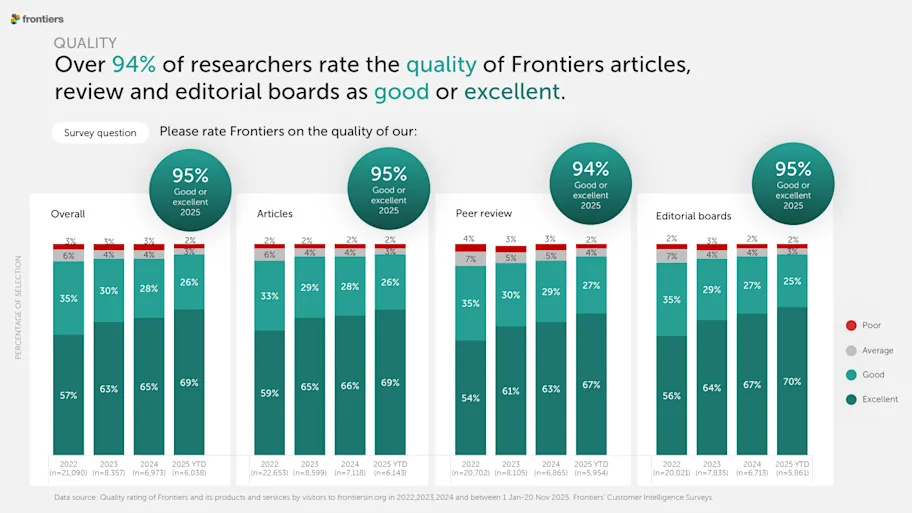
Full details on our citation performance and quality metrics are available in our latest annual report.
Responsible innovation with AI
At Frontiers, we approach artificial intelligence with a clear principle: innovation must strengthen research quality. Our artificial intelligence assistant, or AIRA, is part of the Frontiers team since 2018 and continues to evolve as a responsible partner in quality assurance.
In 2025, we further strengthened the industry-leading research integrity system that AIRA supports. Building on papermill detection capabilities established years ago, we integrated additional industry standards this year, including Cactus Communications’ Paperpal Preflight and Clear Skies’ Papermill Alarm and Oversight. These enhancements significantly reinforce our multilayered defences and position Frontiers’ platform as the strongest in papermill detection across the publishing industry.
At a time when many question AI’s role in science, we continue to lead responsibly by treating AI as a partner, not a replacement. For Peer Review Week 2025, we hosted a virtual conversation with AIRA itself, reflecting on how humans and AI can work side by side to strengthen peer review, research integrity, and trust in publishing.
The recent launch of our whitepaper, Unlocking AI’s untapped potential: responsible innovation in research publishing, further reinforced this commitment. It is the first study of its kind that examines how researchers are using AI today, explores where governance gaps remain, and considers how responsible leadership can unlock AI’s potential to elevate rigor and integrity. With the right guardrails, AI can be an elevator for research quality, not a shortcut around it. The paper and its findings have since been featured in Nature, underscoring the whitepaper’s relevance.
We also launched Frontiers FAIR² Data Management, a first-of-its-kind data management service that makes research data citable, reusable, and AI-ready. By combining AI-assisted curation with FAIR principles, FAIR² strengthens data reproducibility, accelerates discovery, and ensures that high-quality data delivers real-world impact.
Recognising transformative science
One of the most inspirational moments of the year was the 2025 Frontiers Planet Prize, which celebrated researchers from across five continents whose science offers scalable, evidence-based solutions to protect planetary health. Three international champions were awarded USD 3 million collectively to accelerate the real-world impact of their work.
As I shared during the ceremony, there is no place to hide from our responsibility – science must take central stage to address planetary health, and it must be openly available to drive solutions within the tight timescales that are necessary to transition carbon-free economies. Alongside the national champions, our three international champions embody this courage:
Dr Arunima Malik, The University of Sydney - recognized for her groundbreaking work in sustainability economics, uncovering the hidden global supply-chain impacts driving carbon emissions, biodiversity loss, and social inequality.
Professor Zahra Kalantari, KTH Royal Institute of Technology - celebrated for her integrated climate and water systems research, transforming how cities and regions prepare for flooding, drought, and planetary-scale hydrological risk.
Dr Zia Mehrabi, University of Colorado Boulder - honored for his pioneering work on transforming global food systems to restore biodiversity, strengthen resilience, and secure sustainable nutrition for a growing population.
Since launch, the Frontiers Planet Prize has more than tripled its institutional network, expanding from 233 institutions across 27 countries to 735 institutions across 69 countries. The strength of the network is reflected in the participation of 80 institutions from the Times Higher Education World University Rankings Top 100, including all eight Ivy League universities in the United States. Regional capacity has also deepened, with 23 National Representative Bodies in 2025 and growing engagement across Latin America, where six countries now represent 113 institutions.
Putting open science on the global stage
Opening scientific knowledge is not optional, it is essential. As I addressed leaders at the 2025 World Economic Forum in Davos earlier this year, open science remains one of the most powerful tools we have to accelerate solutions to planetary challenges like climate change, biodiversity loss and public health. It is a cost-effective and simple way to accelerate research discovery and to move the solutions out of labs into companies and policies.
In 2025, we took decisive steps to place open science at the centre of global decision-making, ensuring that high-quality research does not stop at publication but informs education, policy, and real-world action.
Through our expanding partnership with the World Economic Forum, we are strengthening the connection between scientists and global policy and decision makers. This collaboration created direct pathways for Frontiers’ editors and research to inform decision-making, including the launch of the inaugural 10 Emerging Technology Solutions for Planetary Health report and the third edition of our joint Top 10 Emerging Technologies report. We also brought open science into global forums, from Davos to COP30, where evidence-based solutions are urgently needed.
2026 will be even bolder and even more action-oriented: we will start the year with the launch of the Frontiers Science House at the World Economic Forum Annual Meeting in Davos to put open science and science leaders at the center of global decision-making. This initiative reflects our mission to advance open, rigorous science for the benefit of healthy lives on a healthy planet and to ensure that researchers help inform the decisions shaping our collective future.
As 2025 draws to a close, I am grateful to our authors, reviewers, editors, and partners for your trust and collaboration. Your dedication to quality, integrity, and openness is the true foundation of our success and our relentless drive to make all of science openly accessible to humanity.
Thank you for being part of this journey. I wish you a restful holiday season.
Dr Kamila Markram, CEO and co-founder, Frontiers


