Contesting Artificial Intelligence: Communicative Practices, Organizational Structures, and Enabling Technologies

Cover image for Research Topic "Contesting Artificial Intelligence: Communicative Practices, Organizational Structures, and Enabling Technologies"
47kviews
ORIGINAL RESEARCH
1 July 2025
Contestable AI for criminal intelligence analysis: improving decision-making through semantic modeling and human oversight
Falk Maoroand Michaela Geierhos
Contestable AI for criminal intelligence analysis: improving decision-making through semantic modeling and human oversight
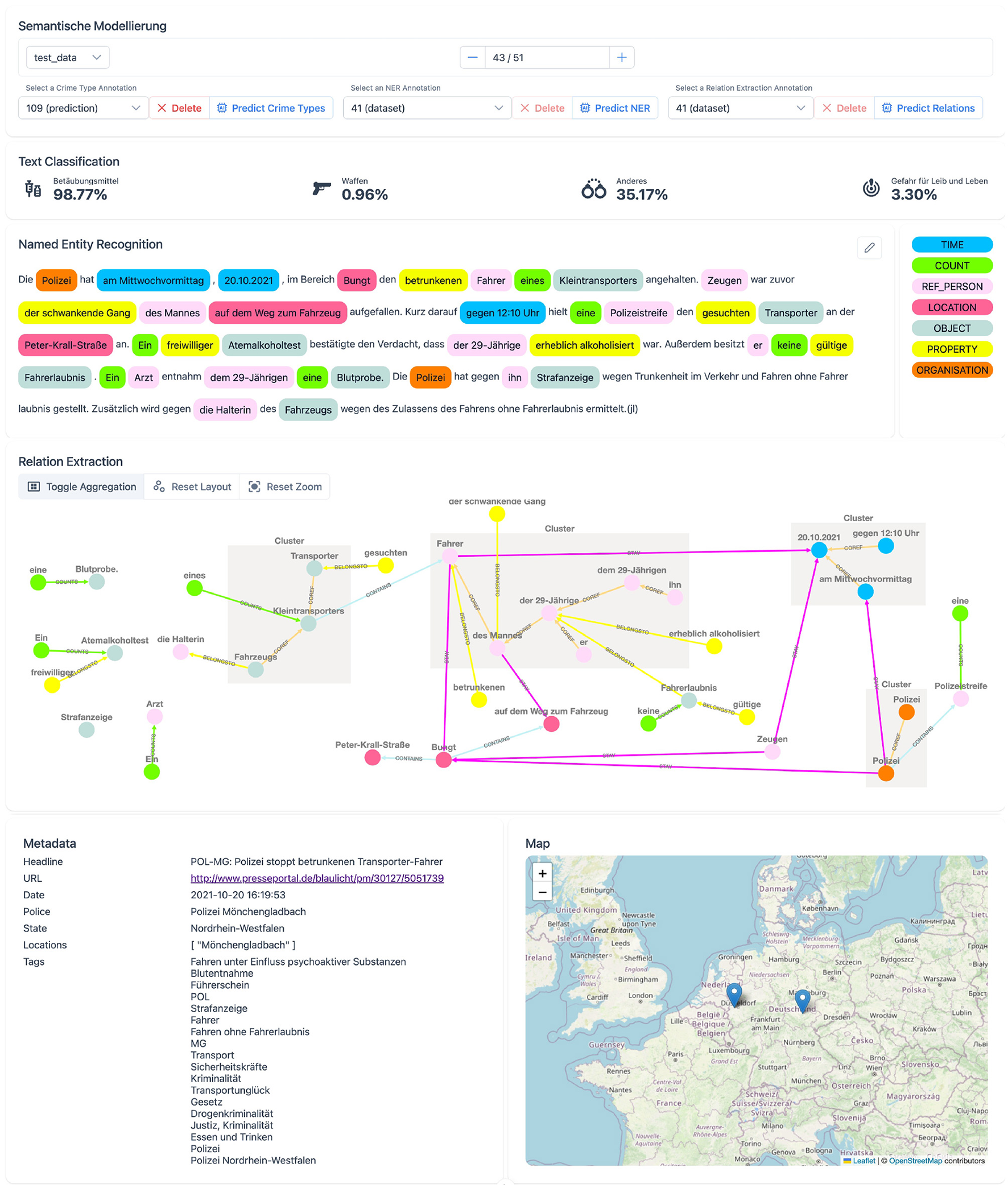
Criminal investigation analysis involves processing large amounts of data, making manual analysis impractical. Artificial intelligence (AI)-driven information extraction systems can assist investigators in handling this data, leading to significant improvements in effectiveness and efficiency. However, the use of AI in criminal investigations also poses significant risks to individuals, requiring the integration of contestability into systems and processes. To meet this challenge, contestability requirements must be tailored to specific contexts. In this work, we analyzed and adapted existing requirements for criminal investigation analysis, focusing on the retrospective analysis of police reports. For this purpose, we introduced a novel information extraction pipeline based on three language modeling tasks, which we refer to as semantic modeling. Building on this concept, we evaluated contestability requirements and integrated them into our system. As a proof of concept, we developed an AI-driven information extraction system that incorporates contestability features and provides multiple functionalities for data analysis. Our findings highlight three key perspectives essential for contestability in AI-driven investigations: information provision, interactive controls, and quality assurance. This work contributes to the development of more transparent, accountable, and adaptable AI systems for law enforcement applications.

6,087 views

4 citations

Advanced algorithmic technologies and artificial intelligence (AI) are projected to profoundly impact public employment services (PES) and the delivery of labor market policies. Focusing on the perspectives of PES counselors in Austria, this study examines workers’ anticipations of future AI technologies. Based on face-to-face interviews (n = 23), it identifies and explores the concept of “taming” as a primary tactic for managing and appropriating uncertain AI futures within the limits of current institutional and bureaucratic structures. “Tamed” anticipations of advanced algorithms are rooted within challenging working conditions (insufficient resources and time for clients), reconfigurations of roles and agencies (administration of systems instead of supporting clients) and nested within transformations of techno-bureaucratic regimes (from street- over screen- to system-level bureaucracies), which they envision to rectify and repair. Taming is thus applied as a lens to observe practices of anticipation that navigate and contest precarities of daily work life beyond dichotomies of compliance and resistance. Despite the differences in tamed AI futures identified, the analysis shows corresponding properties: Tamed anticipations consolidate dependencies between human and machinic actors, demarcate what is (un-)tamable, and are inherently dialectical. Synthesizing structural problems and an imperative for human elements into futures that rely on advanced technologies, a truly “human” counseling situation is thought to be obtained through “machinic” means. To “tame” futures with and by anticipating certain AI technologies here means affirming ideas of a supposedly better working conditions (more humanity and margin of discretion) and regaining (or even improving) them through the computational means that are considered responsible for their loss.

4,566 views

3 citations