 N. Afshar
 M. Yassine
- Power Electronics, Institute for Sustainable Systems Engineering INATECH, University of Freiburg, Freiburg im Breisgau, Germany
YAlN has emerged as a wide band gap semiconductor with high potential to compete with ScAlN in industrial applications. Theoretical predictions about YAlN’s material properties have been the main motivation for conducting experimental investigations and verify simulated results. However, several challenges have been faced in experimental studies on YAlN that contradict theoretical data, especially when trying to reach higher alloy concentrations. This work presents a systematic review analyzing different material properties including structural characterization, elastic properties, and thermal features. It combines all available experimental data on the growth and reported material parameters, such as band gap, lattice parameters, and electrical properties with the aim of introducing a new motivation to further study YAlN’s potential in various fields of device applications. The review provides a comprehensive overview on the current state of knowledge on YAlN, highlighting the discrepancies between theoretical predictions and experimental results. By providing information from multiple studies, this work offers valuable insights into the challenges and opportunities associated with YAlN development, paving the way for future research directions and potential industrial applications of this promising wide band gap semiconductor.
1 Introduction
Over many years, group III-nitrides have been widely used in various types of electronic and optoelectronic devices. These materials are semiconductors with direct band gaps ranging from 0.7 eV for InN to 6.2 eV for AlN (Monemar et al., 2005; Edgar et al., 1990). Due to the great number of possible applications, group III-nitrides have gained significant attention in recent years. The possibility of forming ternary alloys, such as AlGaN or AlInN, allows for the tuning of the band gap of these compounds, making them potential candidates for optical applications (Pelá et al., 2011). One of the outstanding materials within the group III-nitrides is AlN, which due to its notable properties has been extensively utilized in acoustic, electronic, and optical devices. AlN owns a wide band gap (6.2 eV) (Edgar et al., 1990), high spontaneous polarization and break down voltage (1.351
One of the most important physical properties of AlN for applications is piezoelectricity. Piezoelectric materials are crucial components in microelectromechanical systems (MEMS) and are widely utilized in acoustic devices (BAW and SAW), radio frequency (RF) systems, and sensors. Beside AlN, a variety of piezoelectric materials exists, including lead zirconated titanite (PZT), quartz (SiO2), zinc oxide (ZnO), and lithium niobite (LiNbO3). Despite its lower piezoelectric coefficient, AlN has been extensively employed in device applications. The primary reasons for this preference include its high stiffness and sound velocity in addition to its ease of growth, high thermal stability, and compatibility with CMOS technology (Shelton et al., 2009). However, the relatively low piezoelectric coefficient of AlN (d33
In 2009, Akiyama et al. (2009) demonstrated that alloying AlN with the transition metal nitride ScN can significantly enhance its piezoelectric properties. For Al0.6Sc0.4N, an increase in the piezoelectric coefficient d33 of up to 25
Despite the rapid progress in studies concerning YxAl1-xN, to the best of the author’s knowledge, there has been no systematic review article that consolidates all available data on this material. This review article aims to provide a comprehensive and detailed overview of the advancements made in the research of YxAl1-xN in recent years. The first three sections will discuss theoretical calculations and predictions related to the formation, structural, elastic, and thermal properties of YxAl1-xN. Following this, various methods developed for the growth of YxAl1-xN will be examined, along with experimental structural parameters. In section five, the article will present available data on material properties such as band gap, permittivity, piezoelectric coefficient, and spontaneous polarization. The subsequent section will explore potential device applications, and finally, the last section will summarize all data and discussions. This comprehensive review seeks to serve as a valuable resource for researchers and engineers interested in YxAl1-xN and its applications.
2 From AlN to YN: structural analysis
AlN and YN are binary compounds composed of nitrogen atoms bonded to metal atoms (Al or Y). In binary compounds, nitrogen and metal atoms form stacks of monolayers (Sahin et al., 2009). However, in the alloys like YxAl1-xN, the metal atoms (Y and Al) distribute randomly in the metal monolayers, with nitrogen atoms binding to either Al or Y atoms to form the crystal lattice. These compounds are referred to as ternary or pseudo binary systems. A ternary compound is made up of three different elements. Thus, it can apply to YAlN or ScAlN as they consist three distinct elements. On the other hand, a pseudo binary compound is a compound which is treated as a binary system, although it involves more than two elements. This approach is often utilized in order to simplify the properties by reducing the system into two effective components, in this case Y(Sc)N and AlN. Thus, the alloy can be viewed as a mixture of two binary nitrides. In this work, the alloy is referred to as a ternary system, and the fraction of Y is denoted by x, with the ratio of Y to Al atoms equal to
AlN crystallizes in the hexagonal wurtzite structure (P63mc space group) under ambient conditions (Siegel et al., 2006). The electronic configuration of Al (
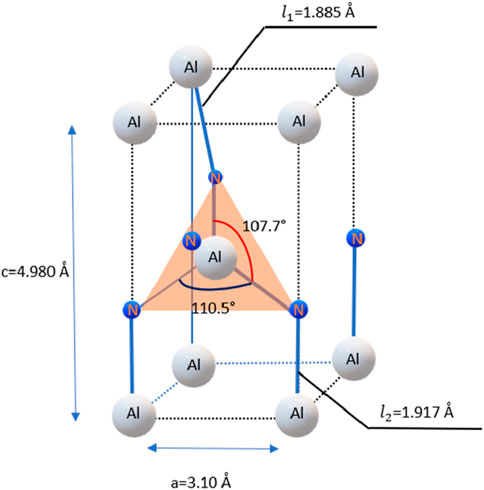
Figure 1. Crystal structure and lattice parameters of AlN. The lattice parameters and bond lengths are taken from (Cunha et al., 2022).
Additional to the stable wurtzite structure, theoretical studies have investigated the properties of rock salt, zinc blende, and layered hexagonal AlN (Ahmed and Sharma, 2021; Louhibi-Fasla et al., 2014). For small layer thicknesses of a few monolayers, calculations suggest that layered hexagonal AlN has a lower configuration energy compared to other structures (Louhibi-Fasla et al., 2014). This layered hexagonal form was experimentally observed by Tsipas et al in 2013 (Tsipas et al., 2013). Zinc blende AlN is stable only at very small thicknesses before transforming to the wurtzite structure (Hultman et al., 1992). Simulations predict a direct band gap of 3.44 eV (at Γ point) for layered hexagonal AlN (Bacaksiz et al., 2015), while the Zinc blende structure shows a bandgap of approximately 3.24 eV (Γ-X) at zero pressure (Silva et al., 2005). Ueno et al. (1992) has demonstrated that under high pressure (22.0 GPa), wurtzite AlN can transform into the cubic rock salt phase [NaCl (B1)]. In high pressure condition, AlN exhibits a band gap of 4.04 eV (Γ-X) (Ahmed and Sharma, 2021). The properties of different AlN structures are summarized in Table 1, providing a comprehensive overview of the material’s structural variations and their associated electronic properties.
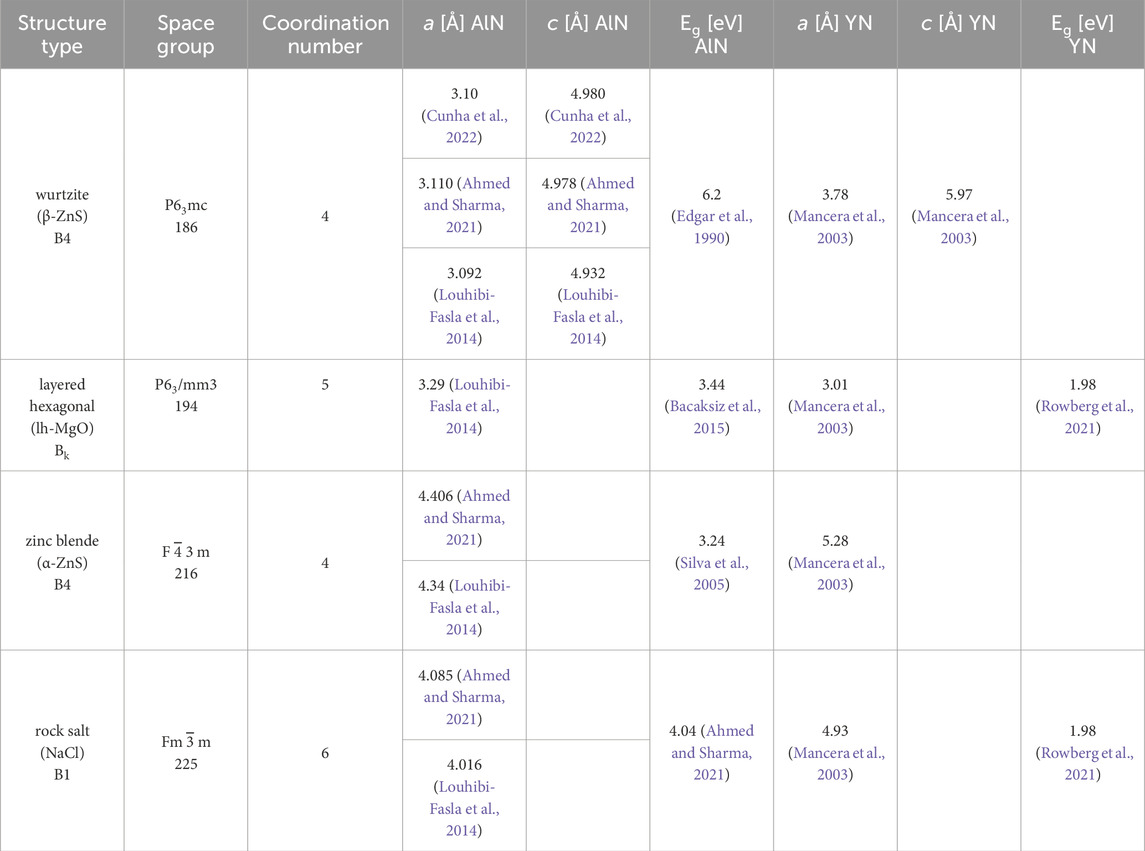
Table 1. Structural properties and band gap of different crystal structures of AlN and YN.
Transition metal nitrides have various commercial applications, with ScN receiving significant attentions in recent years due to its potential in semiconductor technologies (Eklumd et al., 2016; Adamski et al., 2019). Given the electronic similarities between Sc and Y atoms, similar potential is expected for YN. The high thermal stability and melting temperature of transition metal nitrides also enable the formation of single crystals through annealing (Hultman, 2000). Theoretical calculations have predicted several interesting properties for YN, including strong anisotropic mechanical and electronic characteristics, as well as ferroelastic properties (Xu et al., 2018). Density Functional Theory (DFT) calculations indicate that the formation enthalpy of rock salt YN is lower than that of its hexagonal structure (Rowberg et al., 2021), suggesting that YN is expected to crystallize in the rock salt phase under ambient conditions. In its rock salt structure, YN exhibits an indirect band gap in the range of 0.9–1.3 eV (Rowberg et al., 2021; Liu et al., 2014; Ramirez-Montes et al., 2016). The calculated lattice parameter for rock salt YN is
The first reports on the synthesis of YN dates back to 1950s, when Kempter et al. (1957) described the production of YN powder by converting metallic Y to YH2 and then heating it up to 900°C in nitrogen environment. In recent years, researchers have reported growing YN on various substrates using techniques such as magnetron sputtering and metal organic chemical vapor deposition (Gregoire et al., 2008; Leone et al., 2023). However, the growth of YN has consistently presented challenges due to the high degree of oxidation observed in thin layers (Žukauskaitė, 2012; Leone et al., 2023). This oxidation issue results in n-type conduction in YN layers, more pronounced compared to that observed in ScN thin films (Rowberg et al., 2021; Biswas and Saha, 2019; Deng et al., 2015). To address this oxidation problem, researchers have found that using a protective passivation layer is important for YN applications. Specifically, the use of AlN as a passivation layer has shown positive results in reducing oxidation of YN thin layers (Gregoire et al., 2008). Despite the experimental instability of YN in structures other than rock salt, theoretical studies have investigated the structural parameters of alternative crystalline phases for YN, including wurtzite, zinc blende, and layered hexagonal phases (Mancera et al., 2003; Rowberg et al., 2021). The structural parameters for these different phases of YN, along with corresponding data for AlN, are summarized in Table 1.
DFT calculations have provided valuable insights into the mixing enthalpies and phase stability of YxAl1-xN alloys across different compositions (Žukauskaitė, 2012; Manna et al., 2017; Xie et al., 2020). The calculations reveal that the wurtzite phase of YxAl1-xN remains stable up to a high Y concentration of x = 0.75. Manna et al. (2017) calculated a temperature-composition phase diagram for the full range of YxAl1-xN compositions, indicating a region between x = 0.2 and x = 0.9 were mixing enthalpies are not achievable under thermodynamic equilibrium. It is hypothesized that non-equilibrium growth techniques, such as reactive DC magnetron sputtering, could potentially overcome these thermodynamic limitations and enable the growth of compositions within this range.
The predictions for potential applications of wurtzite YxAl1-xN, such as high piezoelectric coefficient
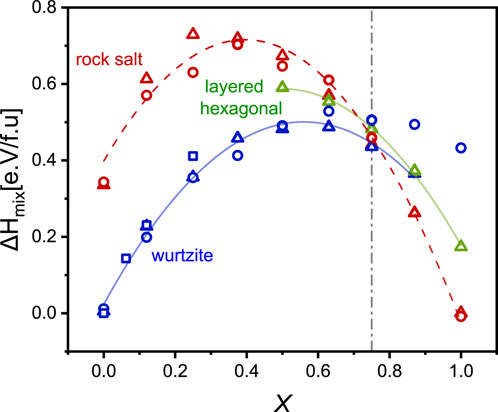
Figure 2. Mixing enthalpies of wurtzite (blue symbols), layered hexagonal (green symbols), and rock salt (red symbols) structures of YxAl1-xN acquired from different literature (Zukauskaite et al., 2012; Manna et al., 2017; Xie et al., 2020). Lines are polynomial fits to the data point for guiding the eye.
During the formation of YxAl1-xN, beside Al atoms, Y atoms, which have an atomic radius approximately 1.3 times larger than Al (
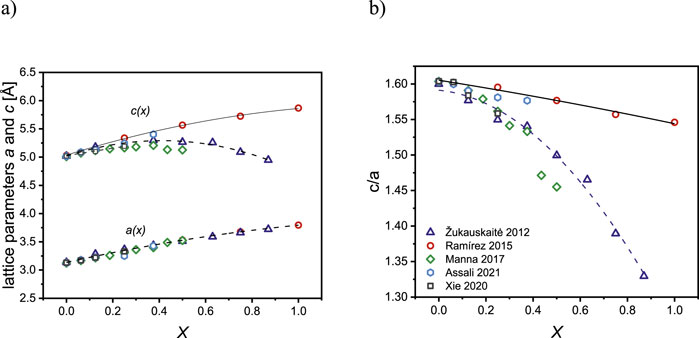
Figure 3. (A) Theoretical lattice parameters, and (B) their ratios for wurtzite YxAl1-xN reported by Ramirez-Montes et al. (2016) (red circles), Zukauskaite et al. (2012) (blue triangles), Manna et al. (2017) (green rhombus), Assali et al. (2021) (blue rhombus), and Xie et al. (2020) (black squares). Dashed lines are the polynomial fits to the data ponits assuming a phase transition from wurtzite to rock salt, and solid lines are the polynomial fit to the data points provided by Ramirez et al. with the assumption of the stability of the wurtzite structure in the whole concentration range.
For alloys that maintain the wurtzite structure throughout the entire composition range, such as GaxAl1-xN and InxAl1-xN, both lattice parameters
The calculated
The highest reported Y concentration in sputtered YxAl1-xN films is around x = 0.7 to x = 0.8 (Afshar et al., 2024). However, experimental studies have faced challenges in maintaining a high-quality wurtzite structure above x = 0.4, with possible amorphization occurring at higher concentration (Afshar et al., 2024), a discrepancy that has not been fully addressed in theoretical predictions. As shown in Figure 2, calculations consistently predict the wurtzite phase to be stable for x < 0.7, while above x = 0.75, the rock salt structure becomes energetically favorable. Previous research conducted by our group has identified amorphization as a limiting factor for maintaining YxAl1-xN at concentrations close to the predicted phase transition. This issue posed significant challenges in achieving the desired structural integrity at higher Y concentrations. These findings highlight both the potential and challenges in synthesizing YxAl1-xN alloys across a wide composition range, emphasizing the need for further research to bridge the gap between theoretical predictions and experimental realities.
For the cubic rock salt structure, the calculated lattice parameter for AlN is 4.085 Å (Ahmed and Sharma, 2021) and for YN is 4.88 Å (Rowberg et al., 2021). To the authors’ knowledge, the only available data for rock salt YxAl1-xN over the entire compositional range are those obtained by Ramirez-Montes et al. (2016), where they compared the calculated
3 Elastic properties of YxAl1-xN
The knowledge of mechanical and elastic parameters is crucial for understanding different physical phenomena, such as stiffness, stability, elastic anisotropy, and properties relevant to device application like electroacoustic devices. The relation between stress and strain in a crystal is defined by the Hook’s law, expressed as in Equation 1:
where
Given the elastic properties of crystals are directionally dependent, it is essential to define a standard orthogonal system. For hexagonal crystals, the standard axes are defined as
For describing the elastic properties in hexagonal crystals, only 5 independent stiffness coefficients are required due to their transverse isotropy, which means the elastic properties remain invariant under rotation around the z-axis (Mouhat and Coudert, 2014). This leads to equalities such as

Table 2. Calculated stiffness coefficients for YxAl1-xN.
For hexagonal crystals, these parameters can be calculated using stiffness coefficients (Nye, 1985). Several theoretical calculations are available for bulk and shear moduli of wurtzite YxAl1-xN (Ramirez-Montes et al., 2016; Assali et al., 2021; Laidoudi et al., 2022). All data show a decrease of the elastic moduli as the Y concentration increases, which is a result of the change in the bond angels. The only available data on the elastic properties of rock salt YxAl1-xN is the bulk modulus provided by Ramirez-Montes et al. (2016). Based on the available data, the bulk modulus of the rock salt structure has higher values compared to the hexagonal YxAl1-xN. The higher coordination number and structural uniformity of the rock salt crystal are the main reasons for these higher values (Ambacher et al., 2023). However, in both crystal systems, the lattice softening occurs as Y content increases. Similar behavior has also been reported for ScxAl1-xN (Ambacher et al., 2023). Figure 4 represents the bulk modulus of hexagonal and rock salt structures of YxAl1-xN as a function of Y concentration.
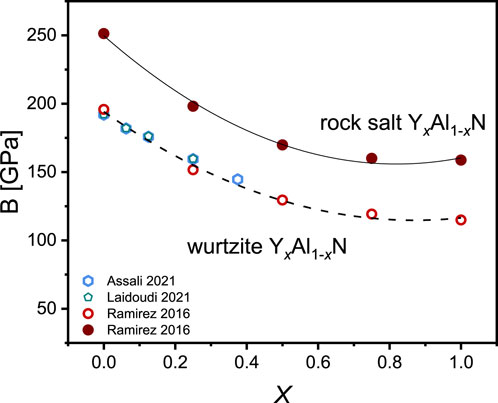
Figure 4. Theoretical bulk modulus of wurtzite and rock salt YxAl1-xN reported by Ramirez-Montes et al. (2016) (filled and unfilled red circles), Assali et al. (2021) (blue rhombus), and Laidoudi et al. (2026) (green rhombus).
Further understanding of the elastic properties of YxAl1-xN can be achieved by calculating the elastic compliance coefficients, which allows for the determination of useful elastic properties such as Young’s modulus, shear modulus, and Poisson’s ratio. The relationship between stiffness and compliance coefficients was established by Wei et al. (2019). Using this relationship and the stiffness coefficients calculated by Assali et al. (2021), the compliance coefficients of YxAl1-xN were calculated and are shown in Figure 5. Notably, within the studied concentration range (x < 0.4), no extreme changes in compliance coefficients were observed, suggesting that the alloy is still far from its structural phase transition point. For ScxAl1-xN, Ambacher et al. (2023) observed an extreme change in

Figure 5. Calculated compliance coefficients of wurtzite YxAl1-xN based on the stiffness coefficients simulated by Assali et al. (2021).
Young’s modulus is a material-specific property defined as the ratio of tensile stress
where
Using the equations provided in previous studies (Zhang et al., 2007), a polar representation of the directional dependence of Young’s modulus can be generated for hexagonal crystals. These structures exhibit both rotational symmetry and mirror symmetry with respect to the [0001] axis, allowing the polar representation of elastic properties be limited to the interval
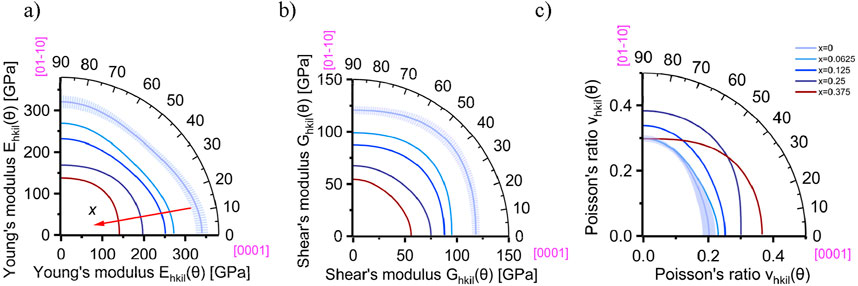
Figure 6. Calculated directional dependent elastic properties. (A) Young’s modulus, (B) Shear’s modulus, and (C) Poisson’s ratio of YxAl1-xN represented in polar coordinates. The calculations for AlN were done using the elastic data set of stiffness coefficients simulated by Assali et al. (2021), Kazan et al. (2007), McNeil et al. (1993), and Tsubouchi and Mikoshiba, (1985) and the average value for each parameter, along with error bars is shown. The calculations for YAlN were done using the elastic data set of stiffness coefficients simulated by Assali et al. (2021).
Assali et al. (2021) have calculated the mass density and directional-dependent sound velocities in YxAl1-xN crystals. The general relation between the sound velocities and stiffness coefficients is given by the following Equation 5, as (Ledbetter, 2006):
Where
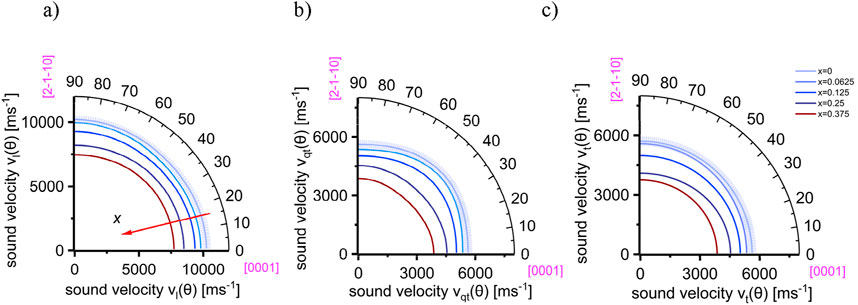
Figure 7. Calculated directional dependent sound velocities. (A) Longitudinal, (B) quasi-transversal, and (C) transversal sound velocities in YxAl1-xN at different alloy concentrations. The calculations for AlN were done using the elastic data set of stiffness coefficients simulated by Assali et al. (2021), Kazan et al. (2007), McNeil et al. (1993), and Tsubouchi and Mikoshiba, (1985) and the average value for each parameter, along with error bars is shown. The calculations for YAlN were done using the elastic data set of stiffness coefficients simulated by Assali et al. (2021).
Generally, wurtzite ScxAl1-xN exhibits higher sound velocities than wurtzite YxAl1-xN for the same values of x. This difference is due to Y’s larger atomic volume, resulting in longer bond lengths between Y and Al or N atoms, leading to more pronounced softening. Additionally, Y’s higher atomic mass increases mass densities, directly affecting crystal sound velocities as per Equation 9.
Compared to ScxAl1-xN, there are fewer available data sets and first-principle studies on YxAl1-xN, particularly regarding different structural phases and near the phase transition point. This limitation hinders comprehensive comparisons. More simulated data, especially near the predicted structural phase transition and considering various possible lattices, would enhance understanding of YxAl1-xN’s elastic properties. Such knowledge is crucial for applications in devices like resonators and actuators, highlighting the need for further research in this area to fully exploit the potential of YxAl1-xN in technological applications.
4 Thermal conductivity
In crystals, the heat conduction is a temperature-dependent random process that can be divided into two parts: conduction by electrons and phonons. In metals, thermal conduction is dominant by the electronic part, which originates from the high density of electrons in metals and the fact that the Fermi velocity of electrons is much higher compared to sound velocities. In semiconductors, heat conduction is dominated by phonons and depends on the mean free path of the phonons, which can be affected by two major parameters: geometry and scattering from other phonons (Kittel and Holcomb, 2005). Phonon-related thermal conductivity depends on the average speed of the collective lattice vibrations and the average phonon mean free path, and is given by the following Equation 6, as:
where
Debye temperature is a material property in solids that determines the maximum vibration frequency of phonons. It is related to the elastic properties of crystals via sound velocities. The average Debye velocity is connected to the crystal’s elastic properties through a set of equations (Anderson, 1963) as is shown in Equations 7a–7c,
in which the first equation defines the average Debye velocity (
The Debye temperatures is a crucial parameter for determining important thermal properties such as specific heat (
Assali et al. (2021) have calculated the Debye temperature of YxAl1-xN, finding that it decreases with increasing alloy composition, from approximately 920 K for AlN to 500 K for Y0.375Al0.625N. This decrease is attributed to the change in the bond angels which results in the bond softening and increased freedom of phonon vibrations at lower temperatures.
Various models have been proposed to understand and predict thermal conductivity in materials. Kittel modeled the phonon-deviated thermal conductivity by assuming the mean free path of phonons equals the bond length (Kittel and Holcomb, 2005). Cahill et al. (1992) took a quantum mechanical approach, dividing the sample into regions of size of
Tran et al. (2023) have experimentally measured the thermal conductivity of wurtzite YxAl1-xN and ScxAl1-xN for concentrations up to x = 0.2. Both alloys demonstrated a similar decreasing trend in thermal conductivity as the alloy concentration increased, which is attributed to enhanced phonon-alloy scattering. Notably, YxAl1-xN exhibited lower thermal conductivity compared to ScxAl1-xN, a result of the further intensified phonon-alloy scattering due to the larger atomic size of Y relative to Sc.
Using the elastic property data sets for YxAl1-xN provided by Assali et al. (2021), the minimum and minimum diffusive thermal conductivities of wurtzite YxAl1-xN were calculated. Figure 8 illustrates the calculated values for minimum and diffusive thermal conductivities, as well as experimental values at room temperature, as a function of alloy composition (Tran et al., 2023). As evident in Figure 8, the diffusive thermal conductivity shows a higher incorporation compared to the minimum thermal conductivity, which is attributed to the high degree of disorder and alloy-phonon scatterings in YxAl1-xN. This behavior aligns with similar observation reported by Ambacher et al for ScxAl1-xN (Ambacher et al., 2023).
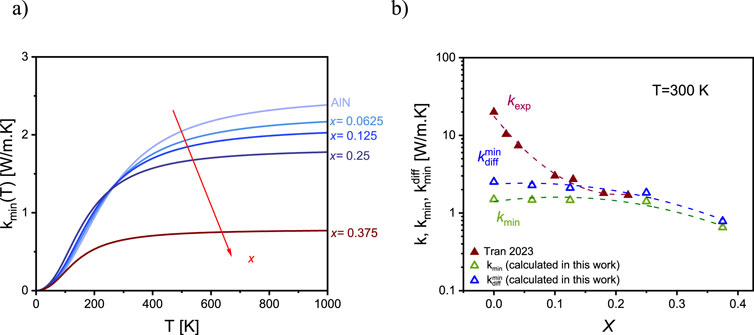
Figure 8. (A) Minimum thermal conductivity of YxAl1-xN as a function of temperature. (B) Experimentally measured thermal conductivity of YxAl1-xN at room temperature by Tran et al. (2023) along with the calculated minimum and minimum diffusive thermal conductivity at room temperature. The calculations were done using elastic data sets provided by Assali et al. (2021).
The observed reduction in both theoretical and experimental results, with the increase in alloy composition, can be a significant drawback for device applications, especially at higher Y concentration, where efficient heat dissipation becomes crucial. However, modern thermal management techniques offer potential solutions to mitigate this issue. Advanced material design strategies can be employed to enhance thermal properties while maintaining desired electrical and optical characteristics. In this case, Nano-structuring approaches or engineered interfaces can be utilized to manipulate phonon transport and potentially improve thermal conductivity (Dhumal et al., 2023). These innovative techniques can help reduce heating during device operation, thereby expanding the potential applications of YxAl1-xN alloys in high-performance electronic and optoelectronic devices.
5 Growth methods of YxAl1-xN
5.1 Sputter deposition
The growth process is crucial for achieving high-quality films suitable for various device applications. Up to date, several different growth techniques have been reported for the synthesis of YxAl1-xN, including sputter deposition, MOCVD, and MBE (Zukauskaite et al., 2012; Leone et al., 2023; Wang et al., 2023a). Among these methods, sputter deposition has been the most widely employed technique for experimental studies on YxAl1-xN thin films.
Sputter deposition is a versatile and widely used technique in the semiconductor industry, offering significant advantages for growing materials with very high melting temperatures, such as YN. The success of sputter deposition in producing high-quality ScxAl1-xN samples in the expected wurtzite phase has made it a promising method for achieving high-quality YxAl1-xN films, given the similarities between these two alloy systems. To optimize the quality of the sputtered YxAl1-xN crystals, several key parameters can be tuned, including the powers applied to the material targets, sputtering pressure, type and ratio of sputtering gases, gas flow rates, and substrate temperature. For alloys such as YxAl1-xN, the alloy concentration can be either tuned by controlling the powers applied on the separate material targets, or by using alloyed target materials with defined ratios. Independent control of target powers allows for precise adjustment of the desired alloy concentration.
One advantage of sputtering compared to other growth methods is the possibility of material growth at very low or room temperature, which cannot be offered by techniques such as MOCVD. This makes sputtering suitable for large-scale production lines and industrial applications. However, growth at room temperature may result in the lower crystalline quality of the films (Žukauskaitė, 2012). Moreover, the harsh plasma environment and high growth rate, especially at low temperatures, can result in high amounts of stress in the thin films, potentially affecting layers quality and decreasing device lifetime (Pandit et al., 2024).
The effects of different sputtering parameters have been extensively studied for the growth of ScxAl1-xN (ZhangY. et al., 2015; Rez-Campos et al., 2018), providing valuable insights that can be applied to YxAl1-xN. For ScxAl1-xN, it has been observed that the choice of substrates has a significant impact on film quality (Kobayashi et al., 2024; Mayrhofer et al., 2015b). Drawing from the experiences of ScxAl1-xN, similar optimization strategies can be applied for the growth of YxAl1-xN.
The sputter growth of YxAl1-xN has been reported and studied by several research groups (Žukauskaitė, 2012; Mayrhofer et al., 2015a; Solonenko et al., 2023; Pandit et al., 2023; Afshar et al., 2024). The first sputtered YxAl1-xN films were investigated in 2012 by Zukauskaite et al. (2012), who reported the growth of YxAl1-xN up to
In 2015, Mayrhofer et al. (2015a) studied the properties of YxAl1-xN films grown by sputtering technique on silicon substrates, addressing the oxidation problems of the layers. They used a 250 nm thin TiN capping layer to prevent oxidation and formation of yttrium hydroxide groups. The study investigated the effect of various sputtering parameters, including applied power on the Y target, Ar to N2 ratio, and growth temperature on film quality. Comparing growth temperatures of 250°C and 800°C, they reported improved crystal quality in samples grown at higher temperatures. The lattice parameter
The growth of sputtered YxAl1-xN with higher Y concentrations was reported for the first time in 2023 by Pandit et al. (2023) and Solonenko et al. (2023). Pandit et al used single alloyed targets with different Y and Al combinations, prepared by arc melting methods, to grow samples on p-type Si (100) substrates. They successfully grew wurtzite YxAl1-xN up to x = 0.20, though no systematic study on the effect of growth parameters were reported. XRD results showed the presence of (10–10) axis crystals at high concentrations, especially at x = 0.12. Scanning electron microscopy revealed columnar growth and hexagonal structure of the films, with x = 0.12 sample showing a high number of abnormally oriented grains. One of the most significant findings by Pandit et al. (2023) is the oxidation resistance of samples with
Another study on sputter growth of YxAl1-xN was conducted in 2023 by Solonenko et al. (2023), who reported for the first time the growth of wurtzite YxAl1-xN up to x = 0.29. They mentioned the use of an AlN seed layer to improve crystal quality in the samples. The growth process utilized two separate Al and Y sputtering targets, with silicon serving as the substrate for the films. XRD analysis revealed a shift in peak positions, indicating changes in lattice parameters as a function of Y concentration. A significant decrease in the intensity of symmetric XRD peaks was observed at higher alloy concentrations, which was interpreted as a decline in crystal quality at higher
In one of our recent works (Afshar et al., 2024) we reported the growth of wurtzite YxAl1-xN up to x = 0.37 on sapphire substrates. The successful measurement of the lattice parameters
The lattice parameters determined from various experimental results are summarized in Figures 9A, B. The FWHM of the rocking curve scans performed on YxAl1-xN are shown in Figure 9C, from which, an abrupt decrease in the quality can be observed as the Y content increases. For the achieved alloy concentrations, the experimental data generally align with the theoretical results presented in Figure 3. Fitting functions defining the relationship between
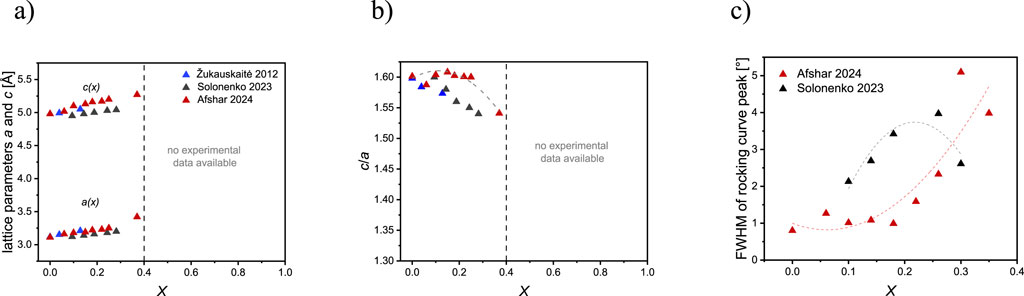
Figure 9. (A) Experimental lattice parameters, and (B) lattice parameters’ ratios for wurtzite YxAl1-xN reported by Zukauskaite et al. (2012) (blue), Solonenko et al. (2023) (black), and Afshar et al. (2024) (red). (C) FWHM of the rocking curve scan on YxAl1-xN reported by Afshar et al. (2024) and Solonenko et al. (2023).
5.2 Metal organic chemical vapor deposition (MOCVD)
Metal Organic Chemical Vapor Deposition (MOCVD) is a widely used growth method for both research and industrial production of thin films. This method involves the introduction of metalorganic precursors into a heated reactor, where they react on the substrate surface to form a solid thin film. The precursors are carried by gases, such as hydrogen (H2) and nitrogen (N2) into the reactor, where they undergo chemical reactions that result in the deposition of the desired material while gaseous byproducts are removed from the chamber. Several factors affect the quality of the films grown using MOCVD, including pressure, reactor temperature, and gas flow rates. Precise control over these parameters is essential, as they significantly influence the crystalline quality of the films (Stringfellow, 2012).
The MOCVD growth technique provides controlled reaction kinetics along with high substrate temperature, enabling the formation of highly ordered films on large substrates. This capability makes MOCVD an attractive method for industrial applications, particularly in sectors requiring uniform and high-quality thin films. However, achieving the desired material stoichiometry in alloy systems can be challenging, as it requires the precise control over growth parameters. This is especially true for materials with high melting temperature, which finding suitable precursors and achieving optimal gas pressures can complicate the growth process. Moreover, the high temperature required for MOCVD growth, often exceeding 1000°C, can limit the choice of substrate (An et al., 2021).
The growth of YxAl1-xN using metal organic chemical vapor deposition was first achieved in 2023 by Leone et al. (2023). They investigated the effect of growth temperature on film quality, using either GaN or AlN wurtzite buffer layers. Samples with concentrations ranging from
5.3 Molecular beam epitaxy (MBE)
Molecular Beam Epitaxy (MBE) is a sophisticated thin film growth technique renowned for its ability to produce high-purity epitaxial layers with precise control over composition and thickness, providing high purity deposition. This method involves the evaporation of ultra-pure elemental or molecular sources in an ultra-high vacuum (UHV) environment, typically ranging from 10−8 to 10−12 Torr. The evaporated atoms or molecules travel towards the heated substrate and they get condensate and form epitaxial layers through a process of atomic-layer deposition (Wang and Wu, 2023).
In the MBE process, the key parameters affecting the growth include substrate temperature and atomic beam flux and can be finely tuned to produce high-quality films with minimal defects. This high precision makes MBE a valuable tool in various research areas. However, this high precision comes with certain limitations. In this method, the growth rates are typically slow, which can make it unsuitable for large-scale production. Additionally, the requirement of UHV chambers necessitates expensive components and skilled operators, contributing to higher overall costs (Vishwanath et al., 2018). Despite these challenges, MBE still remains a critical technique in research for having a deep understanding of specific material properties.
The only reported growth of YxAl1-xN using molecular beam epitaxy (MBE) was achieved in 2023 by Wang et al. (2023b). They successfully grew a single concentration of Y (x = 0.07) by MBE on a GaN template and conducted studies on the band alignment and ferroelectricity of Y0.07Al0.93N (Wang et al., 2023a; Wang et al., 2023b). This research represents a significant milestone as it is the first and only study to report ferroelectricity in YxAl1-xN.
The discussed growth methods used for the growth YxAl1-xN layers and their advantages and disadvantages are summarized in Table 3. Despite the theoretically predicted high potential of YxAl1-xN for applications, especially at high Y content, no systematic studies have been conducted on the growth of high concentration Y near the phase transition point to gain better insight into the structural behavior of this material. These findings underscore the challenges associated with growth and characterization of high-quality YxAl1-xN films, particularly at elevated Y concentrations. They highlight the need for careful consideration of growth conditions, substrate effect, and characterization methods when interpreting experimental results. Further investigations will be essential to reconcile these differences and achieve a more comprehensive understanding of the structural evolution of YxAl1-xN alloys across a wide range of compositions.
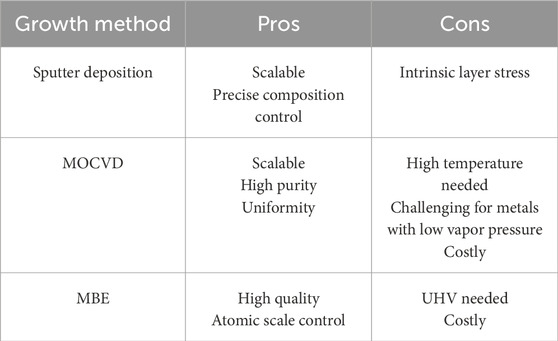
Table 3. Summary of comparison between different growth methods used for YAlN.
6 Material properties
6.1 Piezoelectricity
As mentioned in Section 1, high piezoelectricity has been one of the main motivations for studying transition metal nitrides. The discovery of elevated piezoelectricity in ScxAl1-xN in 2009 (Akiyama et al., 2009) shifted attentions toward the high potential of transition metal nitrides for high-frequency applications. Studies on alloying of Sc and III-N groups, such as GaN and AlN, have reported increases in the piezoelectric coefficient d33 (Uehara et al., 2019). Tasnádi et al. (2010) demonstrated that the increase in d33 of ScxAl1-xN is a quantum mechanical intrinsic property arising from the softening of the material, specifically the decrease in the stiffness coefficient
The first piezoelectric measurement on YxAl1-xN was reported in 2015 by Mayrhofer et al. (2015a). They measured the d33 of sputtered films, finding large deviations from theoretical predictions. They reported d33 of 3.2

Figure 10. Comparison of available data points for material properties of YxAl1-xN and ScxAl1-xN: (A) d33, (B) band gap, (C) relative permittivity at low frequency range, and (D) relative permittivity at high frequency (optical) range. Red stars in graphs (A–C) represent experimental data from Afshar et al. (2024). Graph (A): red triangles: experimental data for YxAl1-xN from Pandit et al. (2024), blue circles: experimental data for ScxAl1-xN by Akiyama et al. (2009). Graph (B): blue filled triangles: experimental data for YxAl1-xN from Leone et al. (2023), black open triangles: theoretical data for YxAl1-xN from Ramirez-Montes et al. (2016), blue circles, experimental data for ScxAl1-xN from Baeumler et al. (2019). Graph (C): red triangles: experimental data for YxAl1-xN from Sedrine et al. (2015), blue circles: experimental data for ScxAl1-xN from Baeumler et al. (2019). Graph (D): blue circles: experimental data for ScxAl1-xN from Akiyama et al. (2013). In all graphs red and black dashed lines are the exponential fits to the data points related to YxAl1-xN and ScxAl1-xN, respectively.
Tholander et al. (2016) have studied the electric and structural properties of YxIn1-xN, predicting that it crystallizes in the wurtzite structure up to x = 0.5 before transition to rock salt crystal. They reported an increase in d33 to 23.31
6.2 Ferroelectricity
Prior to the finding of ferroelectricity in ScxAl1-xN (Fichtner et al., 2019), this phenomenon has been primarily observed in limited materials, such as oxide perovskites (Cohen, 1992). However, the application of oxide materials in electronic devices is challenging due to the difficulties in deposition as thin films, diffusion of toxic materials, and high number of oxygen vacancies that can significantly affect device performance (Lee et al., 2023). Ferroelectric nitrides offer several advantages, including low operating voltage, high Curie temperature, large electromechanical response, and high compatibility with industrial semiconductor technologies (Wang et al., 2023a). From a crystallographic perspective, ferroelectric materials belong to 10 different polar point groups (Shahrokhi et al., 2020; Shi et al., 2016). Conventional group III-nitrides do not exhibit ferroelectricity, as the orientation of their spontaneous polarization cannot be switched (Bernardini et al., 1997). In a conventional wurtzite ferroelectric material, the structure should have the ability of transition between metal polar and nitrogen polar phases. This transition occurs through a change in the internal parameter, with an intermediate layered hexagonal phase forming during the ferroelectric switching process. In an ideal wurtzite structure, the internal parameter,
For practical applications, a low coercive field is desirable. Additionally, high insulation properties, typically characterized by wide band gaps, are necessary for the switching process. While AlN possesses a conventional wurtzite structure and a wide band gap, its very strong bonding between nitrogen and aluminum atoms and the bond angels close to an ideal wurtzite structure, results in the expectation of extremely large coercive fields. This high coercive field requirement can lead to a material breakdown before switching occurs, a limitation also observed in GaN (Moriwake et al., 2020).
Reported coercive fields of ScxAl1-xN typically range around 6
6.3 Band gap, optical, and dielectric properties
For a better understanding of the optical properties of YxAl1-xN, calculating the electronic band structure and the density of states is crucial. The tunable band gap of YxAl1-xN and ScxAl1-xN provides a significant benefit for the application of these material in different fields, such as photovoltaics, optoelectronics, and sensor technologies. The calculated band structure of YxAl1-xN shows significant changes with increasing Y content. Ramirez-Montes et al. (2016) calculated the band structure of wurtzite and rock salt YxAl1-xN, finding that rock salt AlN and YN both exhibit indirect band gaps of (
There are some experimental data available on the optical band gap YxAl1-xN from various studies (Zukauskaite et al., 2012; Leone et al., 2023; Afshar et al., 2024). The calculated experimental data show good agreement with theoretically predicted band gaps. As expected, a decreasing trend can be observed as the Y concentration increases, which is similar to the band gap behavior of ScxAl1-xN (Baeumler et al., 2019). The experimental band gaps of YxAl1-xN and ScxAl1-xN, and comparison with the theoretical data are shown in Figure 10B. As can be seen in this figure, YxAl1-xN and ScxAl1-xN show similar band gap trends, with the values of YxAl1-xN being slightly lower at the same concentrations compared to ScxAl1-xN. This difference is due to different bond length in the crystal. Larger, i.e., weaker, bonds in YxAl1-xN results in lower energy gap values (Miglio et al., 2017).
Another way to study the optical properties of YxAl1-xN is through the dielectric function, which is needed for understanding its potential in various applications, including semiconductor lasers, ultraviolet photodetectors, and conductive optically transparent layers. The interaction of the crystal and light in the macroscopic range is defined by the dielectric function, which consists of imaginary and real parts as a function of frequency
By having the dielectric function of the material, several optical properties such as refractive index, absorption, and loss function can be calculated. Xie et al. (2020) have calculated the dielectric functions and other optical parameters of YxAl1-xN for several alloy concentrations. The real part of dielectric function shows an increasing trend with increasing Y concentration. This increase in the dielectric function indicates an increase in the density of states and a band gap reduction as the number of Y atoms increase, which agrees with other studies (Xie et al., 2020). The absorption edge and band gap of YxAl1-xN exhibits a red shift with increasing Y concentration, with absorption in the visible region observed at
Additional to the dielectric function of YxAl1-xN at high frequency (visible range), information about the dielectric coefficient in the low frequency range (kHz-GHz) is crucial for understanding several properties of the material such as capacitive behavior and carrier dynamics, which are important for potential applications in power electronics, RF filters, and communication systems. Daoust et al. (2022) have simulated the static relative permittivity of YxAl1-xN for x = 0.06 and 0.25, while Mayrhofer et al. (2015a) have experimentally measured the relative permittivity of YxAl1-xN, up to x = 0.11. A recent study (Afshar et al., 2024) has reported the measured relative permittivity of YxAl1-xN up to x = 0.28, showing good agreement with previously reported experimental data by Mayrhofer et al. (2015a), and demonstrating good insulating properties. The experimental data show higher values compared to the simulated data and are also higher than the values reported for ScxAl1-xN (Akiyama et al., 2013). The deviation between simulated and experimental relative permittivity may be due to the underestimation of dielectric properties by DFT + U method (Lee et al., 2018; Lee et al., 2011). The predicted relative permittivity of YxAl1-xN up to x = 0.3 based on the equation provided by Afshar et al. (2024), along with the permittivity of ScxAl1-xN based on the fit function on the experimental data reported by Akiyama et al. (2013) are illustrated in Figure 10D. Having comprehensive data on various material properties of YxAl1-xN provides the opportunity to study its potential for different application devices, which will be discussed in the following section.
7 Potential device applications
7.1 Acoustic resonators
The discussed properties of YxAl1-xN in Section 6 highlights its possible application in high-frequency and high-power acoustic devices especially due to its predicted high piezoelectric coefficient. High-frequency and high-power acoustic devices such as surface acoustic wave devices (SAW) have significant application in next-generation telecommunication as sensors and high frequency filters. They are widely used in mobile devices, such as smartphones, GPS systems, and Wi-Fi modules, and are ideal for their low cost and small size, but can be used only for low frequencies (30 MHz to 2–3 GHz) (Mandal and Banerjee, 2022). One of the important components of a SAW device is the piezoelectric materials, on top of which the IDT is applied. Materials with higher piezoelectricity exhibit higher coupling coefficients leading to strong interaction between the acoustic waves and the electrical field resulting in higher efficiency in term of energy transfer. This makes transition metal nitrides, such as YxAl1-xN a potential candidate to be considered for such applications. Assali et al. (2021) have calculated the electromechanical coupling of YxAl1-xN-based surface acoustic filters with c-place sapphire as the substrate. They have demonstrated the possibility of improvement of electromechanical coupling coefficient of approximately 650%, and increase of the quality factor of approximately 6% compared to AlN-based devices in the frequency range of 0.8 GHz up to 1.2 GHz.
Bulk acoustic waves devices (BAWs) are particularly promising for future communication systems due to their ability to operate at frequencies exceeding 10 GHz (Vinita et al., 2024). The efficiency of BAW devices is often quantified by the coupling coefficient, which measures how effectively input electrical energy is converted to acoustic energy. This coefficient is influenced by various factors, including electrode geometry, piezoelectric material crystalline orientation, and film stress (Zhang et al., 2023; Vu et al., 2022). For BAW devices, the coupling coefficient can be expressed as a function of material-specific parameters (Dou et al., 2023):
Where
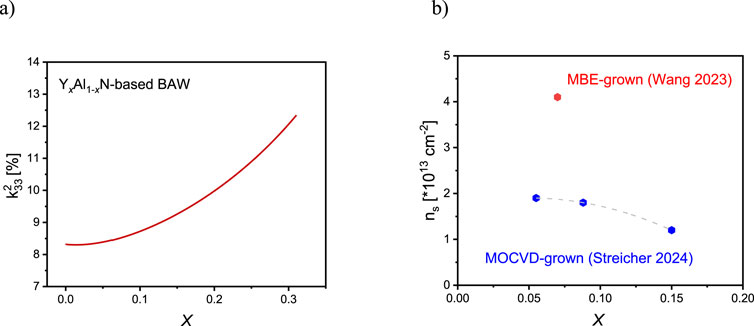
Figure 11. (A) Coupling coefficient of YxAl1-xN-based bulk acoustic wave devices calculated from the experimental and simulated data sets taken from references (Afshar et al., 2024; Assali et al., 2021). (B) Experimentally measured sheet carrier density at the interface of YAlN/GaN heterostructure grown by MOCVD (Streicher et al., 2024) and MBE (Wang et al., 2023b).
The comparable coupling coefficients of YxAl1-xN with what has been previously reported for ScxAl1-xN (Schneider et al., 2017), combined with the lower production costs of Y-based devices, highlight the promising potential of YxAl1-xN and underscores the need for further research into YxAl1-xN-based devices. Pandit et al. (2024) have recently reported the fabrication of a bulk acoustic resonator based on Y0.2Al0.8N, demonstrating approximately 16% increase in the electromechanical coupling coefficient compared to AlN. This experimental result provides concrete evidence supporting the calculated predictions regarding the high potential of YxAl1-xN as RF-resonators.
7.2 High electron mobility transistors (HEMTs)
In recent years, Gallium Nitride (GaN) based electronic devices have made significant contributions to high-power applications and sustainable energy solutions due to their exceptional efficiency. This advancement is primarily attributed to the development of High-Electron-Mobility Transistors (HEMTs), which exploit the unique properties of noncentrosymmetric crystal lattices in heterostructures. The critical parameters of the crystals used in HEMT heterostructures include wide band gap, spontaneous polarization, piezoelectric polarization, and band offset between the barrier and channel layers. In these structures, the material with the lower band gap typically serves as the channel layer, while the higher band gap material acts as the barrier. The combination of band offset and polarization gradient leads to charge accumulation at the interface of the heterostructure. Depending on the polarization direction, this accumulation can result in either electron or hole accumulation (Ambacher et al., 1999). The most common heterostructures in GaN technology focus on electron accumulation, referred to as the two-dimensional electron gas (2DEG). The quantity of charges accumulated in this region is determined by the total polarization gradient and is known as sheet electron density, denoted as ns. It describes the number of charge carriers per unit area in a two-dimensional electron gas. Most of the time, higher sheet carrier density results in lower channel resistance, typically measured in ohm per square (Ω/□), and better performance of the HEMT (Li et al., 2020). Lower channel resistance enables higher channel currents, enhanced output power, and improved energy efficiency. Moreover, sheet resistance can provide invaluable insight into the quality of the material specifically in the case of semiconductor layers for which doping has been done.
Theoretically, AlN/GaN HEMTs have shown exceptional performance potential. However, practical implementation faces challenges due to the significant lattice mismatch between AlN barrier and GaN channel in the lateral plane. This mismatch limits the critical thickness of the barrier layer to approximately 3-4 nm, beyond which cracks begin to form, negatively impacting device performance (Storm et al., 2013). To reduce this lattice mismatch, Ga is added to AlN. GaAlN/GaN HEMTs have been extensively studied and become widely adopted in industry. These state-of-the-art transistor devices can operate at high power levels. The sheet carrier density in these devices typically ranges from 5
In recent years, research has focused on the growth of YxAl1-xN/GaN heterostructures, showing type-I band alignment with a valance band offset of - 0.1 eV and a conduction band offset of 2.2 eV (Streicher et al., 2024; Wang et al., 2023b). The experimentally reported sheet carrier density in GaN-based heterostructures of YxAl1-xN are shown in Figure 11B. Streicher et al. (2024) and Wang et al. (2023b) have both demonstrated a well-defined confinement of the two-dimensional electron gas at the YxAl1-xN/GaN interface, grown by MOCVD and MBE, respectively. Streicher et al. (2024) have reported that the 2DEG remains unaffected by oxidation over time due to the high protection provided by an amorphous SiNx capping layer, while Wang et al. (2023b) have capped their layers with 2 nm GaN. Although the measured sheet carrier densities deviate from the simulated values, still an improvement compared to the state-of-the-art GaAlN/GaN is proven. The low sheet resistivity of 150 Ω/□ achieved for this heterostructure is also a significant improvement compared to the previous values reported for ScxAl1-xN/GaN and GaxAl1-xN/GaN (Streicher et al., 2024). Electrical measurements have shown low leakage currents and the absence of unwanted donors, indicating that YxAl1-xN/GaN is a potential candidate for next-generation power electronic devices.
7.3 Further application fields
Based on the material properties of YxAl1-xN, several other applications are expected from this alloy system, which have not been explored thoroughly by experimental means. Some research groups have reported the potential of YxAl1-xN and its tunable band gap in optical devices, such as solar blind ultraviolet photodetectors (Huang et al., 2023; Jiang et al., 2024). Huang et al and Jiang et al have reported the use of YxAl1-xN with specific absorption cut-off edge as solar blind detector, exhibiting good performance (Huang et al., 2023; Jiang et al., 2024). These studies have shown promising results for the application of YxAl1-xN as optical sensors, which is also encouraging for the application of other rare earth materials in this field of technology. Additionally, ferroelectric properties observed in YxAl1-xN allows for a wide application, such as ferroelectric self-power photovoltaic and energy efficient memory devices. For having an insight over the full capacity of YxAl1-xN for such applications, several researches have to be invested on this novel material.
8 Conclusion
Transition metal nitrides, specifically YxAl1-xN and ScxAl1-xN, represent a class of novel materials with promising properties that are anticipated to play a significant role in future semiconducting devices. This study provides a comprehensive review of the structural, elastic, optical, electronic, and thermal properties of the ternary alloy system YxAl1-xN, drawing from both simulated and experimental data. The structural analysis highlights the similarities between the structural characteristics and elastic parameters of YxAl1-xN and ScxAl1-xN. Alongside, optical and electronic properties of YxAl1-xN and ScxAl1-xN are also compared, further highlighting the similarities of the two alloy systems and emphasizing on the potential of YxAl1-xN. Based on the available elastic properties, the thermal conductivity of YxAl1-xN is evaluated and the limitation caused by insufficient thermal conductivity are discussed. In the following chapters, this study reviews the reported growth methods for the synthesis of YxAl1-xN and the pros and cons are described. Additionally, the structural data, especially lattice parameters calculated from experimental results are summarized. By studying different material properties, such as electrical and optical parameters, this review also delves into the potential applications of YxAl1-xN, such as acoustic resonators and high electron mobility transistors, by examining calculated sound velocities, elastic moduli, coupling coefficients, and carrier densities. A comparative analysis with ScxAl1-xN, a reference material with well-documented and analogous properties, was conducted for each material property. A significant obstacle in advancing the understanding of YxAl1-xN properties is the scarcity of experimental and simulated data. One of the critical challenges identified in experimental research is the oxidation and instability of films with high Y concentrations, which persist regardless of the growth methods employed. Therefore, systematic research, particularly focused on optimizing the growth processes of YxAl1-xN, is imperative for a more detailed exploration of its material parameters. The data available thus far indicate that YxAl1-xN exhibits behavior remarkably similar to ScxAl1-xN, which serves as a compelling incentive for the research community to dedicate further time and resources to a wide array of studies on YxAl1-xN. This investment is crucial for unlocking the full potential of these materials in various advanced technological applications.
Author contributions
NA: Conceptualization, Data curation, Formal Analysis, Investigation, Methodology, Resources, Validation, Visualization, Writing–original draft, Writing–review and editing. MY: Conceptualization, Methodology, Resources, Writing–review and editing. OA: Conceptualization, Funding acquisition, Resources, Supervision, Validation, Writing–review and editing.
Funding
The author(s) declare that financial support was received for the research, authorship, and/or publication of this article. The authors would like to thank to Gips-Schüle foundation and the German Science Foundation (DFG) who supported this work (Project No. AM 105/53-1). The authors would like to acknowledge the support of the library of the University of Freiburg for open access publication of this work.
Conflict of interest
The authors declare that the research was conducted in the absence of any commercial or financial relationships that could be construed as a potential conflict of interest.
Generative AI statement
The author(s) declare that no Generative AI was used in the creation of this manuscript.
Publisher’s note
All claims expressed in this article are solely those of the authors and do not necessarily represent those of their affiliated organizations, or those of the publisher, the editors and the reviewers. Any product that may be evaluated in this article, or claim that may be made by its manufacturer, is not guaranteed or endorsed by the publisher.
References
Adamski, N. L., Dreyer, C. E., and Van de Walle, C. G. (2019). Giant polarization charge density at lattice-matched GaN/ScN interfaces. Appl. Phys. Lett. 115 (23). doi:10.1063/1.5126717
Afshar, N., Yassine, M., Yassine, A., Maier, N., and Ambacher, O. (2024). Electrical and structural characterization of YAlN at high alloy concentrations. J. Appl. Phys. 136 (18). doi:10.1063/5.0241907
Agne, M. T., Hanus, R., and Snyder, G. J. (2018). Minimum thermal conductivity in the context of diffuson-mediated thermal transport. Energy Environ. Sci. 11 (3), 609–616. doi:10.1039/C7EE03256K
Ahmed, B., and Sharma, B. I. (2021). Structural and electronic properties of AlN in rock salt, zinc blende, and wurtzite phase: a DFT study. Dig. J. Nanomater. Biostructures 16 (1), 125–133. doi:10.15251/djnb.2021.161.125
Akiyama, M., Kamohara, T., Kano, K., Teshigahara, A., Takeuchi, Y., and Kawahara, N. (2009). Enhancement of piezoelectric response in scandium aluminum nitride alloy thin films prepared by dual reactive cosputtering. Adv. Mater. 21 (5), 593–596. doi:10.1002/adma.200802611
Akiyama, M., Umeda, K., Honda, A., and Nagase, T. (2013). Influence of scandium concentration on power generation figure of merit of scandium aluminum nitride thin films. Appl. Phys. Lett. 102 (2). doi:10.1063/1.4788728
Allen, P. B., and Feldman, J. L. (1993). Thermal conductivity of disordered harmonic solids. Phys. Rev. B 48 (17), 12581–12588. doi:10.1103/PhysRevB.48.12581
Ambacher, O., Christian, B., Feil, N., Urban, D. F., Elsässer, C., Prescher, M., et al. (2021). Wurtzite ScAlN, InAlN, and GaAlN crystals, a comparison of structural, elastic, dielectric, and piezoelectric properties. J. Appl. Phys. 130 (4). doi:10.1063/5.0048647
Ambacher, O., Mihalic, S., Yassine, M., Yassine, A., Afshar, N., and Christian, B. (2023). Review:Structural, elastic, and thermodynamic properties of cubic and hexagonal Sc x Al 1-x N crystals. J. Appl. Phys. 134. doi:10.1063/5.0170742
Ambacher, O., Smart, J., Shealy, J. R., Weimann, N. G., Chu, K., Murphy, M., et al. (1999). Two-dimensional electron gases induced by spontaneous and piezoelectric polarization charges in N- and Ga-face AlGaN/GaN heterostructures. J. Appl. Phys. 85 (6), 3222–3233. doi:10.1063/1.369664
An, J., Dai, L. F., and Zheng, J. (2021). Parameter study of the high temperature MOCVD numerical model for AlN growth using orthogonal test design. Sci. Rep. 11 (8877), 8877. doi:10.1038/s41598-021-87554-8
Anderson, O. L. (1963). A simplified method for calculating the Debye temperature from elastic constants. J. Phys. Chem. Solids 24 (7), 909–917. doi:10.1016/0022-3697(63)90067-2
Assali, A., Laidoudi, F., Serhane, R., Kanouni, F., and Mezilet, O. (2021). Highly enhanced electro-acoustic properties of YAlN/sapphire based surface acoustic wave devices for next generation of microelectromechanical systems. Mater. Commun. 26, 102067. doi:10.1016/j.mtcomm.2021.102067
Bacaksiz, C., Sahin, H., Ozaydin, H. D., Horzum, S., Senger, R. T., and Peeters, F. M. (2015). Hexagonal AlN:Dimensional-crossover-driven band-gap transition. Phys. Rev. B 19 (8), 085430. doi:10.1103/PhysRevB.91.085430
Baeumler, M., Lu, Y., Kurz, N., Kirste, L., Prescher, M., Christoph, T., et al. (2019). Optical constants and band gap of wurtzite Al 1-x Sc x N/Al2O3 prepared by magnetron sputter epitaxy for scandium concentrations up to x=0.41. J. Appl. Phys. 126 (4). doi:10.1063/1.5101043
Beaucejour, R., D'Agati, M., Kalyan, K., and Olson, R. H. (2022). Compensation of the stress gradient in physical vapor deposited Al1−xScxN films for microelectromechanical systems with low out-of-plane bending. Micromachines 13 (8), 1169. doi:10.3390/mi13081169
Bernardini, F., Fiorentini, V., and Vanderbilt, D. (1997). Spontaneous polarization and piezoelectric constants of III-V nitrides. Phys. Rev. B 56 (16), R10024–R10027. doi:10.1103/PhysRevB.56.R10024
Biswas, B., and Saha, B. (2019). Development of semiconducting ScN. Phys. Rev. Mater. 3 (2), 020301. doi:10.1103/PhysRevMaterials.3.020301
Cahill, D. G., Watson, S. K., and Pohl, R. O. (1992). Lower limit to the thermal conductivity of disordered crystals. Phys. Rev. B 46 (10), 6131–6140. doi:10.1103/PhysRevB.46.6131
Cheng, Z., Koh, Y. R., Mamun, A., Shi, J., Bai, T., Huynh, K., et al. (2020). Experimental observation of high intrinsic thermal conductivity of AlN. Phys. Rev. Mater. 4 (4), 044602. doi:10.1103/PhysRevMaterials.4.044602
Choi, H. S., Li, S., Park, I. H., Liew, W. H., Kwon, K. C., Wang, L., et al. (2022). Tailoring the coercive field in ferroelectric metal-free perovskites by hydrogen bonding. Nat. Commun. 13 (794), 794. doi:10.1038/s41467-022-28314-8
Clementi, E., Raimondi, D. L., and Reinhardt, W. P. (1967). Atomic screening constants from SCF functions. II. Atoms with 37 to 86 electrons. J. Chem. Phys. 47 (4), 1300–1307. doi:10.1063/1.1712084
Cohen, R. E. (1992). Origin of ferroelectricity in perovskite oxides. Nature 358, 136–138. doi:10.1038/358136a0
Corll, J. A. (1967). Effect of pressure on the elastic parameters and structure of CdS. Phys. Rev. 157 (3), 623–626. doi:10.1103/PhysRev.157.623
Cunha, C. L., Pimenta, T. C., and Fraga, M. A. (2022). “Development and applications of aluminum nitride thin film technology,” in Thin film deposition-fundamentals, processes, and applications (London: IntechOpen). doi:10.5772/intechopen.106288
Daoust, P., Desjardins, P., Maust, R. A., and Côté, M. (2022). Longitudinal piezoelectric, elastic, and dielectric properties of rare-earth aluminum nitride alloys determined by density-functional perturbation theory. Phys. Rev. Mater. 6 (3), 034405. doi:10.1103/PhysRevMaterials.6.034405
Deng, R., Ozsdolay, B. D., Zheng, P. Y., Khare, S. V., and Gall, D. (2015). Optical and transport measurement and first-principles determination of the ScN band gap. Phys. Rev. B 91 (4), 045104. doi:10.1103/PhysRevB.91.045104
Dhumal, A. R., Kulkarni, A. P., and Ambhore, N. H. (2023). A comprehensive review on thermal management of electronic devices. J. Eng. Appl. Sci. 70 (140), 140. doi:10.1186/s44147-023-00309-2
Dinh, D. V., Lähnemann, J., Geelhaar, L., and Brandt, O. (2023). Lattice parameters of ScxAl1−xN layers grown on GaN(0001) by plasma-assisted molecular beam epitaxy. Appl. Phys. Lett. 122 (15). doi:10.1063/5.0137873
Dou, W., Zhou, D., Qin, R., Yang, Y., Guo, H., Mu, Z., et al. (2023). Super-high-frequency bulk acoustic resonators based on aluminum scandium nitride for wideband applications. nanomaterials 13 (20), 2737. doi:10.3390/nano13202737
Dreyer, C. E., Janotti, A., Van de Walle, C. G., and Vanderbilt, D. (2016). Correct implementation of polarization constants in wurtzite materials and impact on III-nitrides. Phys. Rev. X 6 (2), 021038. doi:10.1103/PhysRevX.6.021038
Edgar, J. H., Yu, A. U., and Rys, A. (1990). Low temperature metal-organic chemical vapor deposition of aluminum nitride with nitrogen trifluoride as the nitrogen source. This Solid Films 189, L11–L14. doi:10.1016/0040-6090(90)90469-T
Eklumd, P., Kerdsongpanya, S., and Alling, B. (2016). Transition-metal-nitride-base thin films as novel energy harvesting materials. R. Soc. Chem. 4, 3905–3914. doi:10.1039/C5TC03891J
Farrell, R., Pagan, V. R., Kabulski, A., Kuchibhatl, S., Harman, J., Kasarla, K. R., et al. (2008). High temperature annealing studies on the piezoelectric properties of thin aluminum nitride films Pittsburgh, PA, and morgantown, WV (United States): national energy technology lab (NETL). doi:10.2172/1015474
Farrer, N., and Bellaiche, L. (2002). Properties of hexagonal ScN versus wurtzite GaN and InN. Phys. Rev. B 66 (20), 201203. doi:10.1103/PhysRevB.66.201203
Fichtner, S., Wolf, N., Lofink, F., Kienl, L., and Wagner, B. (2019). AlScN: a III-V semiconductor based ferroelectric. J. Appl. Phys. 125 (11). doi:10.1063/1.5084945
Frei, K., Trejo-Hernandez, R., Schütt, S., Kirste, L., Prescher, M., Aidam, R., et al. (2019). Investigation of growth parameters for ScAlN-barrier HEMT structures by plasma-assisted MBE. Jpn. J. Appl. Phys. 58, SC1045. doi:10.7567/1347-4065/ab124f
Furuta, K., Hirata, K., Anggraini, S. A., Akiyama, M., Uehara, M., and Yamada, H. (2021). First-principles calculations of spontaneous polarization in ScAlN. J. Appl. Phys. 130 (2). doi:10.1063/5.0051557
Gorobez, J., Maack, B., and Nilius, N. (2021). Growth of self-passivating oxide layers on aluminum—pressure and temperature dependence. PSS 258 (5). doi:10.1002/pssb.202000559
Gorodtsov, V. A., and Lisovenko, D. S. (2019). Extreme values of Young's modulus and Poisson's ratio of hexagonal crystals. Mech. Mater. 134, 1–8. doi:10.1016/j.mechmat.2019.03.017
Gregoire, J. M., Kirby, S. D., Scopelianos, G. E., Lee, F. H., and Bruce van Dover, R. (2008). High mobility single crystalline ScN and single orientation epitaxial YN on sapphire via magnetron sputtering. J. Appl. Phys. 104 (7). doi:10.1063/1.2996006
Gund, V., Davaji, B., Lee, H., Casamento, J., Xing, H. G., Jena, D., et al. (2021). “Towards realizing the low-coercive field operation of sputtered ferroelectric ScxAl1-xN,” in 21st international conference on solid-state sensors, actuators and microsystems (transducers) (Orlando; FL, USA). doi:10.1109/Transducers50396.2021.9495515
Hardy, M. T., Downey, B. P., Nepal, N., Storm, D. F., Katzer, D. S., and Meyer, D. J. (2017). Epitaxial ScAlN grown by molecular beam epitaxy on GaN and SiC substrates. Appl. Phys. Lett. 110 (16). doi:10.1063/1.4981807
Hill, R. (1952). The elastic behaviour of a crystalline aggregate. Proc. Phys. Soc. Sect. A 65, 349–354. doi:10.1088/0370-1298/65/5/307
Huang, L., Huang, S., Lin, J., Wang, Z., Chen, Z., Zheng, W., et al. (2023). Band gap engineering of AlYN films for solar-blind ultraviolet photodetection. ACS Appl. Electron. Mater. 5 (2), 1106–1113. doi:10.1021/acsaelm.2c01581
Hultman, L. (2000). Thermal stability of nitride thin films. Vacuum 57 (1), 1–30. doi:10.1016/S0042-207X(00)00143-3
Hultman, L., Benhenda, S., Radnoczi, G., Sundgren, J. E., Greene, J. E., and Petrov, I. (1992). Interfacial reactions in single-crystal-TiN(100)/Al/polycrystalline-TiN multilayer thin films. Thin Solid Films 215 (2), 152–161. doi:10.1016/0040-6090(92)90430-J
ISE (2024). “Current prices of rare earths,” in Institut für seltene erden und metalle AG. Retrieved on July 22nd 2024 from.
Jiang, X., Wu, Y., Qi, J., Liu, Y., Wang, Y., Zhou, B., et al. (2024). Preparation and deep-UV solar-blind photovoltaic performance of AlYN-based MSM detector. IEEE Sensors J. 24, 25581–25589. doi:10.1109/JSEN.2024.3418585
Kazan, M., Moussaed, E., Nader, R., and Masri, P. (2007). Elastic constants of aluminum nitride. PSS 4 (1), 204–207. doi:10.1002/pssc.200673503
Kempter, C. P., Krikorian, N. H., and McGuire, J. C. (1957). The crystal structure of yttrium nitride. J. Phys. Chem. 61 (9), 1237–1238. doi:10.1021/j150555a023
Kittel, C., and Holcomb, D. F. (2005). Introduction to solid state physics. Am. J. Phys. 35, 547–548. doi:10.1119/1.1974177
Knudson, M. D., and Gupta, Y. M. (1998). Real-time observation of a metastable state during the phase transition in shocked cadmium sulfide. Phys. Rev. Lett. 81 (14), 2938–2941. doi:10.1103/PhysRevLett.81.2938
Kobayashi, A., Honda, Y., Maeda, T., Okuda, T., Ueno, K., and Fujioka, H. (2024). Structural characterization of epitaxial ScAlN films grown on GaN by low-temperature sputtering. Appl. Phys. Express 17, 011002. doi:10.35848/1882-0786/ad120b
Krause, S., Streicher, I., Waltereit, P., Kirste, L., Brückner, P., and Leone, S. (2023). AlScN/GaN HEMTs grown by metal-organic chemical vapor deposition with 8.4 W/mm output power and 48% power added efficiency at 30GHz. IEEE Electron Device Lett. 44 (1), 17–20. doi:10.1109/LED.2022.3220877
Kronig, R. de L. (1926). On the theory of dispersion of X-rays. J. Opt. Soc. Am. 12 (6), 547–557. doi:10.1364/JOSA.12.000547
Laidoudi, F., Kanouni, F., Assali, A., Caliendo, C., Amara, S., Nezzari, H., et al. (2022). Thickness shear SMR resonator based on yttrium-doped AlN for high sensitive liquid sensors. Sensors Actuators A:Physical 333, 113238. doi:10.1016/j.sna.2021.113238
Lasky, R. (2015). Indium and Gallium: playing important roles in LED lighting and the 2014 nobel prize in physics. Indium Corp. Available at: https://www.indium.com/blog/indium-and-gallium-playing-important-roles-in-led-lighting-and-the-2014-nobel-prize-in-physics.php.
Ledbetter, H. (2006). Sound velocities, elastic constants: temperature dependence. Mater. Sci. Eng. A 442 (1-2), 31–34. doi:10.1016/j.msea.2006.04.147
Lee, B., Lee, C. K., Hwang, C. S., and Han, S. (2011). Influence of exchange-correlation functionals on dielectric properties of rutile TiO2. Curr. Appl. Phys. 11 (1), S293–S296. doi:10.1016/j.cap.2010.11.104
Lee, J., Yang, K., Kwon, J. Y., Kim, J. E., Han, D. I., Lee, D. H., et al. (2023). Role of oxygen vacancies in ferroelectric or resistive switching hafnium oxide. Nano Converg. 10 (55), 55. doi:10.1186/s40580-023-00403-4
Lee, M., Youn, Y., Yim, K., and Han, S. (2018). High-throughput ab initio calculations on dielectric constant and band gap of non-oxide dielectrics. Sci. Rep. 8 (14794), 14794. doi:10.1038/s41598-018-33095-6
Leone, S., Ligl, J., Manz, C., Kirste, L., Fuchs, T., Menner, H., et al. (2019). Metal-organic chemical vapor deposition of AluminumScandium nitride. PSS 14 (1). doi:10.1002/pssr.201900535
Leone, S., Streicher, I., Prescher, M., Stranák, P., and Kirste, L. (2023). Metal-organic chemical vapor deposition of aluminum yttrium nitride. PSS 17 (10). doi:10.1002/pssr.202300091
Li, J. Z., Li, J., Lin, J. Y., and Jian, H. X. (2020). Correlation between sheet carrier density-mobility product and persistent photoconductivity in AlGaN/GaN modulation doped heterostructures. MRS Internet J. Nitride Semicond. Res. 5, 626–632. doi:10.1557/S1092578300004853
Liu, J., Li, X., Zhang, H., Yin, W., Zhang, H., Peng, P., et al. (2014). Electronic structures and optical properties of two-dimensional scn and YN nanosheets. J. Appl. Phys. 115 (9). doi:10.1063/1.4867515
Loewen, E. (2024). Standford advanced matterials. Available at: https://stanfordmaterials.com/blog/yttrium-properties-and-applications.html.
Louhibi-Fasla, S., Achour, H., Kefif, K., and Ghalem, Y. (2014). First-principles study of high-pressure phases of AlN. Phys. Procedia 55, 324–328. doi:10.1016/j.phpro.2014.07.047
Mancera, L., Rodriguez, J. A., and Taheuchi, N. (2003). First principles calculations of the ground state properties and structural phase transformation in YN. J. Phys. Condens. Matter 15, 2625–2633. doi:10.1088/0953-8984/15/17/316
Mandal, D., and Banerjee, S. (2022). Surface acoustic wave (SAW) sensors: physics, materials, and applications. Sensors 22 (3), 820. doi:10.3390/s22030820
Manna, S., Brennecka, G. L., Stevanović, V., and Ciobanu, C. V. (2017). Tuning the piezoelectric and mechanical properties of the AlN system via alloying with YN and BN. J. Appl. Phys. 122 (10). doi:10.1063/1.4993254
Mayrhofer, P. M., Riedl, H., Euchner, H., Stöger-Pllach, M., Mayrhofer, P. H., Bittner, A., et al. (2015a). Microstructure and piezoelectric response of Y x Al 1-x N thin films. Acta Mater. 100, 81–89. doi:10.1016/j.actamat.2015.08.019
Mayrhofer, P. M., Persson, A. P. O., Bittner, A., and Schmid, U. (2015b). Properties of ScxAl1-xN (x = 0.27) thin films on sapphire and silicon substrates upon high temperature loading. Microsyst. Technol. 22, 1679–1689. doi:10.1007/s00542-015-2798-7
McNeil, L. E., Grimsditch, M., and French, R. H. (1993). Vibrational spectroscopy of aluminum nitride. J. Am. Ceram. Soc. 76 (5), 1132–1136. doi:10.1111/j.1151-2916.1993.tb03730.x
Miglio, A., Heinrich, C. P., Hautier, W., Tremel, G., and Zeier, W. G. (2017). Local bonding influence on the band edge and band gap formation in quaternary chalcopyrites. Adv. Sci. 4 (9), 1700080. doi:10.1002/advs.201700080
Mihalic, S., Wade, E., Lüttich, C., Hörich, F., Sun, C., Christian, B., et al. (2023). Structural properties and epitaxial relation of cubic rock salt Sc x Al 1-x N/ScN/Si. J. Appl. Phys. 134 (15). doi:10.1063/5.0169741
Moe, C. G., Leathersich, J., Carlstrom, D., Bi, F., Kim, D., and Shealy, J. B. (2023). Metal–organic chemical vapor deposition-grown AlScN for microelectromechanical-based acoustic filter applications. PSS 220 (16), 2200849. doi:10.1002/pssa.202200849
Monemar, B., Paskov, P. P., and Kasic, A. (2005). Optical properties of InN-the band gap question. Superlattices Microstruct. 38, 38–56. doi:10.1016/j.spmi.2005.04.006
Moriwake, H., Yokoi, R., Taguchi, A., Ogawa, T., Fisher, C. A. J., Kuwabara, A., et al. (2020). A computational search for wurtzite-structured ferroelectrics with low coercive voltages. Apl. Mater. 8 (12). doi:10.1063/5.0023626
Mouhat, F., and Coudert, F. X. (2014). Necessary and sufficient elastic stability conditions in various crystal systems. Phys. Rev. B 90 (22), 224104. doi:10.1103/PhysRevB.90.224104
Muller, C., and Dubios, M. A. (2008). Effect of size and shape on the performances of BAW resonators: a model and its applications. Beijing: IEEE, 1552–1556. doi:10.1109/ULTSYM.2008.0378
Nye, J. F. (1985). Physical properties of crystals:their representation by tensors and matrices. Clarendon Press.
Pandit, S., Schneider, M., Berger, C., and Schmid, U. (2024). Compressive stress reduction in sputter-deposited yttrium aluminum nitride (Y 0.2 Al 0.8 N) thin films for BAW resonators with high electromechanical coupling. Sensors Actuators A Phys. 376 (115638), 115638. doi:10.1016/j.sna.2024.115638
Pandit, S., Schneider, M., Schwarz, S., and Schmid, U. (2023). Enhancement of piezoelectric response in yttrium aluminum nitride (YxAl1-xN) thin films. Adv. Eng. Mater. 25 (22). doi:10.1002/adem.202300940
Pecharsky, V. K., and Geschneider, K. A. (2024). Rare-earth Elem. Available at: https://www.britannica.com/science/rare-earth-element (Accessed July 24, 2024).
Pelá, R. R., Caetano, C., Marques, M., Ferreira, L. G., Furthmüller, J., and Teles, L. K. (2011). Accurate band gaps of AlGaN, InGaN, and AlInN alloys calculations based on LDA-1/2 approach. Appl. Phys. Lett. 98 (15). doi:10.1063/1.3576570
Ramirez-Montes, L., Lopez-Perez, W., Gonzalez-Garcıa, A., and Gonzalez-Hernandez, R. (2016). Structural, optoelectronic, and thermodynamic properties of Y x Al 1-x N semiconducting alloys. J. Mater. Sci. 51, 2817–2829. doi:10.1007/s10853-015-9590-z
Reuss, A. (1929). Berechnung der Fließgrenze von Mischkristallen auf Grund der Plastizitätsbedingung für Einkristalle. J. Appl. Math. Mech. 9 (1), 49–58. doi:10.1002/zamm.19290090104
Rez-Campos, A.Pe ́, Sinusı ́a Lozano, M., Garcia-Garcia, F. J., Chen, Z., and Iriarte, G. F. (2018). Synthesis of ScAlN thin films on Si (100) substrates at room temperature. Microsyst. Technol. 24, 2711–2718. doi:10.1007/s00542-017-3660-x
Rowberg, A. J. E., Mu, S., Swift, M. W., and Van de Walle, C. G. (2021). Structural, electronic, and polarization properties of YN and LaN. Phys. Rev. Mater. 5 (9), 094602. doi:10.1103/PhysRevMaterials.5.094602
Ruemenapp, T., and Peier, D. (1999). “Dielectric breakdown in aluminum nitride,” in Eleventh international symposium on high voltage engineering (London). doi:10.1049/cp:19990870
Sahin, H., Cahangirov, S., Bekaroglu, E., Akturk, E., Senger, R. T., Ciraci, S., et al. (2009). Monolayer honeycomb structures of group-IV elements and III-V binary compounds: first-principles calculations. Phys. Rev. B 80 (15), 155453. doi:10.1103/PhysRevB.80.155453
Schlögl, M., Schneider, M., and Schmid, U. (2022). Piezoelectricity in Y0.09 Al0.91 N thin films. Mater. Sci. Engineering:B 276, 115543. doi:10.1016/j.mseb.2021.115543
Schneider, M., DeMiguel-Ramos, M., Flewitt, A. J., Iborra, E., and Schmid, U. (2017). Scandium aluminium nitride-based film bulk acoustic resonators. Proceedings 1 (4), 305. doi:10.3390/proceedings1040305
Sedrine, N. B., Zukauskaite, A., Birch, J., Hultman, L., and Darakchieva, V. (2015). Infrared dielectric functions and optical phonons of wurtzite YxAl1−xN (0 ⩽ x ⩽ 0.22). Jpn. J. Appl. Phys. 48. doi:10.1088/0022-3727/48/41/415102
Setter, N., Damjanovic, D., Eng, L., Fox, G., Gevorgian, S., Hong, S., et al. (2006). Ferroelectric thin films: review of materials, properties, and applications. J. Appl. Phys. 100 (5). doi:10.1063/1.2336999
Shahrokhi, S., Gao, W., Wang, Y., Anandan, P. R., Rahaman, Md. Z., Singh, S., et al. (2020). Emergence of ferroelectricity in halide perovskites. Small Methods 4 (8). doi:10.1002/smtd.202000149
Shelton, S., Chan, M., Park, H., Horsley, D., Boser, B., Izyumin, I., et al. (2009). “CMOS-compatible AlN piezoelectric micromachined ultrasonic transducers,” in IEEE international ultrasonic symposium (Rome). doi:10.1109/ULTSYM.2009.5441602
Shi, P. P., Tang, Y. Y., Li, P. F., Liao, W. Q., Wang, Z. X., Ye, Q., et al. (2016). Symmetry breaking in molecular ferroelectrics. Chem. Soc. Rev. 45 (14), 3811–3827. doi:10.1039/C5CS00308C
Siegel, A., Parlinski, K., and Wdowik, U. D. (2006). Ab initiocalculation of structural phase transitions in AlN crystal. Phys. Rev. B 74 (10), 104116. doi:10.1103/PhysRevB.74.104116
Silva, A. F. da, Souza Dantas, N., de Almeida, J. S., Ahuja, R., and Persson, C. (2005). Electronic and optical properties of wurtzite and zinc-blende TlN and AlN. J. Cryst. Growth 281 (1), 151–160. doi:10.1016/j.jcrysgro.2005.03.021
Smeltzer, W. W., and Young, D. J. (1975). Oxidation properties of transition metals. Prog. Solid State Chem. 10 (1), 17–54. doi:10.1016/0079-6786(75)90003-5
Solonenko, D., Strube, J., Fammels, J., Fissltheler, E., Röbisch, V., Howell, K., et al. (2023). AlYN thin films with high Y content: microstructure and performance. PSS 17 (10). doi:10.1002/pssr.202300193
Sowa, H. (2001). On the transition from the wurtzite to the NaCl type. Found. Adv. 57 (2), 176–182. doi:10.1107/S0108767300014902
Storm, D. F., Deen, D. A., Katzer, D. S., Mayer, D. J., Binari, S. C., Gougousi, T., et al. (2013). Ultrathin-barrier AlN/GaN heterostructures grown by rf plasma-assisted molecular beam epitaxy on freestanding GaN substrates. J. Cryst. Growth 380, 14–17. doi:10.1016/j.jcrysgro.2013.05.029
Streicher, I., Leone, S., Kirste, L., Manz, C., Straňák, P., Prescher, M., et al. (2022). Enhanced AlScN/GaN heterostructures grown with a novel precursor by metal–organic chemical vapor deposition. PSS 17 (2). doi:10.1002/pssr.202200387
Streicher, I., Straňák, P., Kirste, L., Prescher, M., Müller, S., and Leone, S. (2024). Two-dimensional electron gases in AlYN/GaN heterostructures grown by metal-organic chemical vapor deposition. Apl. Mater. 12 (5). doi:10.1063/5.0203156
Stringfellow, G. B. (2012). Organometallic vapor-phase epitaxy: theory and practice. Elsevier Science.
Talley, K. R., Millican, S. L., Mangum, J., Siol, S., Musgrave, C. B., Gorman, B., et al. (2018). Implications of heterostructural alloying for enhanced piezoelectric performance of (Al,Sc)N. Phys. Rev. Mater. 2 (6), 063802. doi:10.1103/PhysRevMaterials.2.063802
Tasnádi, F., Alling, B., Höglund, C., Wingqvist, G., Birch, J., Hultman, L., et al. (2010). Origin of the anomalous piezoelectric response in wurtzite Sc xAl 1-xN alloys. Phsical Rev. Lett. 104 (13), 137601. doi:10.1103/PhysRevLett.104.137601
Tholander, C., Abrikosov, I. A., Hultman, L., and Tasnádi, F. (2013). Volume matching condition to establish the enhanced piezoelectricity in ternary (Sc,Y)0.5(Al,Ga,In)0.5 alloys. Phys. Rev. B 87 (9), 094107. doi:10.1103/PhysRevB.87.094107
Tholander, C., Birch, J., Tasnádi, F., Hultman, L., Palisaitis, J., Persson, P. O. Å., et al. (2016). Ab initio calculations and experimental study of piezoelectric Y x in 1-x N thin films deposited using reactive magnetron sputter epitaxy. Acta Mater. 105, 199–206. doi:10.1016/j.actamat.2015.11.050
Tolbert, S. H., and Alivisatos, A. P. (1995). The wurtzite to rock salt structural transformation in CdSe nanocrystals under high pressure. J. Chem. Phys. 102 (11), 4642–4656. doi:10.1063/1.469512
Tran, D. Q., Tasandi, F., Zukauskaite, A., Birch, J., Darakchieva, V., and Paskov, P. P. (2023). Thermal conductivity of Sc x Al 1-x N and Y x Al 1-x N alloys. Appl. Phys. Lett. 122 (18). doi:10.1063/5.0145847
Tromans, D. (2011). Elastic anisotropy of HCP metal crystals and polycrystals. Int. J. Recent Res. Appl. Stud. 6 (462).
Tsipas, P., Kassavetis, S., Tsoutsou, D., Xenogiannopoulou, E., Golias, E., Giamini, S. A., et al. (2013). Evidence for graphite-like hexagonal AlN nanosheets epitaxially grown on single crystal Ag(111). Appl. Phys. Lett. 103 (25). doi:10.1063/1.4851239
Tsubouchi, K., and Mikoshiba, N. (1985). Zero-temperature-coefficient SAW devices on AlN epitaxial films. IEEE 32 (5): 634–644. doi:10.1109/T-SU.1985.31647
Uehara, M., Mizuno, T., Aida, Y., Yamada, H., Umeda, K., and Akiyama, M. (2019). Increase in the piezoelectric response of scandium-doped Gallium nitride thin films sputtered using a metal interlayer for piezo MEMS. Appl. Phys. Lett. 114 (1). doi:10.1063/1.5066613
Ueno, M., Onodera, A., Shimomura, O., and Takemura, K. (1992). X-Ray observation of the structural phase transition of aluminum nitride under high pressure. Phys. Rev. B 45 (17), 10123–10126. doi:10.1103/PhysRevB.45.10123
Vinita, P. D., Islam, Sk. M., and Singh, J. (2024). Bulk acoustic wave resonators for sensing applications: a review. Sensors Actuators A Phys. 378, 115839. doi:10.1016/j.sna.2024.115839
Vishwanath, S., Dang, P., and Xing, H. G. (2018). “Chapter 20 - challenges and opportunities in molecular beam epitaxy growth of 2D crystals: an overview,” in Molecular beam epitaxy (Elsevier), 443–485. doi:10.1016/B978-0-12-812136-8.00017-7
Vu, L., Shuai, Y., Huang, S., Zhu, D., Wang, Y., Luo, W., et al. (2022). Area dependence of effective electromechanical coupling coefficient induced by on-chip inductance in LiNbO3-based BAW resonators. Electronics 11 (23), 4032. doi:10.3390/electronics11234032
Wang, D., Mondal, S., Kezer, P., Hu, M., Liu, J., Wu, Y., et al. (2023b). Band alignment and charge carrier transport properties of YAlN/III-nitride heterostructures. Appl. Surf. Sci. 637 (15), 157893. doi:10.1016/j.apsusc.2023.157893
Wang, D., Mondal, S., Liu, J., Hu, M., Wang, P., Yang, S., et al. (2023a). Ferroelectric YAlN grown by molecular beam epitaxy. Appl. Phys. Lett. 123 (3). doi:10.1063/5.0159562
Wang, F., and Wu, J. (2023). Modern ion plating technology. Amsterdam: Elsevier Inc. doi:10.1016/C2019-0-03578-9
Wei, J., Zhou, W., Li, S., Shen, P., Ren, S., Hu, A., et al. (2019). Modified embedded atom method potential for modeling the thermodynamic properties of high thermal conductivity beryllium oxide. ACS Omega 4 (4), 6339–6346. doi:10.1021/acsomega.9b00174
Wilson, M., and Madden, P. A. (2002). Transformations between tetrahedrally and octahedrally coordinated crystals: the wurtzite → rocksalt and blende → rocksalt mechanisms. J. Physics:Condensed Matter 14, 4629–4643. doi:10.1088/0953-8984/14/18/301
Xie, Y., Cai, Y., Liu, Y., Zhao, Y., Guo, S., Sun, C., et al. (2020). Electronic structure and optical properties of YAlN: a first principle study. PSS 27 (5). doi:10.1002/pssb.201900678
Xu, B., Xiang, H., Yin, J., Xia, Y., and Liu, Z. (2018). A two-dimensional tetragonal yttrium nitride monolayer: a ferroelastic semiconductor with switchable anisotropic properties. Nanoscale 10 (1), 215–221. doi:10.1039/C7NR05679F
Yassine, M., Nair, A., Fammels, J., Wade, E., Fu, Z., Kirste, L., et al. (2022). Influence of structural properties on the ferroelectric behavior of hexagonal AlScN. J. Appl. Phys. 132 (11). doi:10.1063/5.0103578
Zhang, J.-M., Zhang, Y., Xu, K.-W., and Ji, V. (2007). Young's modulus surface and Poisson's ratio curve for cubic metals. J. Phys. Chem. Solids 68 (4), 503–510. doi:10.1016/j.jpcs.2007.01.025
Zhang, S., Holec, D., Fu, W. Y., Humphreys, C. J., and Moram, M. A. (2013). Tunable optoelectronic and ferroelectric properties in Sc-based III-nitrides. J. Appl. Phys. 114 (13). doi:10.1063/1.4824179
Zhang, Y., Zhu, W., Zhou, D., and Yang, C. (2015). Effects of sputtering atmosphere on the properties of c-plane ScAlN thin films prepared on sapphire substrate. J. Mater. Sci. Mater. Electron. 26, 472–478. doi:10.1007/s10854-014-2423-z
Zhang, Z., Xuan, W., Jiang, H., Xie, W., Li, Z., Dong, S., et al. (2023). High electromechanical coupling coefficient of longitudinally excited shear wave resonator based on optimized bragg structure. Micromechanics 14 (11), 2086. doi:10.3390/mi14112086
Zhang M., M., Yang, J., Si, C., Han, G., Zhao, Y., and Ning, J. (2015). Research on the piezoelectric properties of AlN thin films for MEMS applications. Micromachines 6 (9), 1236–1248. doi:10.3390/mi6091236
Žukauskaitė, A. (2012). Metastable YAlN and ScAlN thin films: growth and characterization. Linköping: Linköping University Institute of Technology. Dissertation.
Keywords: YAlN, ScAlN, crystal structure, elastic properties, thermal properties, semiconductors, metal nitrides, acoustic devices
Citation: Afshar N, Yassine M and Ambacher O (2025) A comprehensive review of yttrium aluminum nitride: crystal structure, growth techniques, properties, and applications. Front. Mater. 12:1526968. doi: 10.3389/fmats.2025.1526968
Received: 12 November 2024; Accepted: 16 January 2025;
Published: 04 February 2025.
Edited by:
Ding Wang, University of Michigan, United StatesReviewed by:
Abdul Kuddus, Ritsumeikan University, JapanDmytro Solonenko, Silicon Austria Labs GmbH, Austria
Joseph Casamento, Massachusetts Institute of Technology, United States
Copyright © 2025 Afshar, Yassine and Ambacher. This is an open-access article distributed under the terms of the Creative Commons Attribution License (CC BY). The use, distribution or reproduction in other forums is permitted, provided the original author(s) and the copyright owner(s) are credited and that the original publication in this journal is cited, in accordance with accepted academic practice. No use, distribution or reproduction is permitted which does not comply with these terms.
*Correspondence: N. Afshar, bmlsb29mYXIuYWZzaGFyQGluYXRlY2gudW5pLWZyZWlidXJnLmRl