 Laurence Henry
 Adrian J. F. K. Craig
 Alban Lemasson
 Martine Hausberger
- 1Laboratoire d'éthologie animale et humaine, Centre National de la Recherche Scientifique, UMR 6552, Université de Rennes 1, Rennes, France
- 2Department of Zoology and Entomology, Rhodes University, Grahamstown, South Africa
- 3Laboratoire d'éthologie animale et humaine, Centre National de la Recherche Scientifique, UMR 6552, Station Biologique, Université de Rennes 1, Paimpont, France
A corrigendum on:
Social coordination in animal vocal interactions. Is there any evidence of turn-taking? The starling as an animal model
by Henry, L., Craig, A. J. F. K., Lemasson, A., and Hausberger, M. (2015). Front. Psychol. 6:1416. doi: 10.3389/fpsyg.2015.01416
Figure 3 of the article by Henry et al. (2015) contained a minor error, which we correct here.
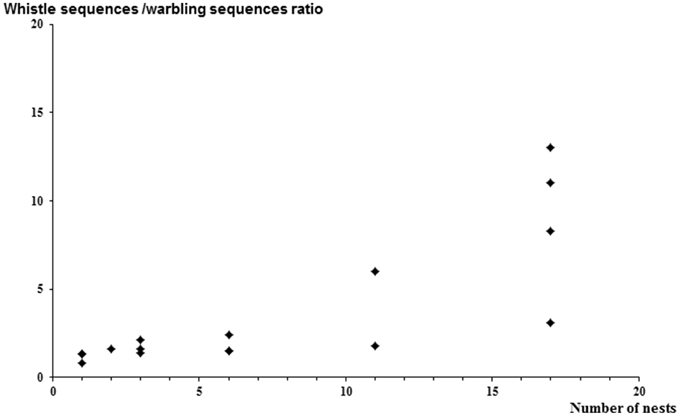
Figure 3. Whistle sequences/warbling sequences ratio according to the number of nests per colony (rs = 0.9, p = 0.003). Starlings produce more discontinuous song (whistles) when the number of neighbors is high (dense colonies).
Figure captions 4, 5, and 12 contained minor errors, which we correct here.
Figure 4. Song style of birds belonging to colonies of different sizes. Although the birds were recorded in very different conditions, a clear trend appeared toward an increase in whistling (hence discontinuous songs) and a decrease of warbling (hence continuous song) with increasing colony size (= number of neighbors). X: mean number of whistles per sequence (From Hausberger, 1997).
Figure 5. Intervals separating two successive whistles produced by two different individuals during vocal interaction (overlap: when two whistles overlap). Most whistling exchanges show an interval of 2 s or less between the first and second whistle (arrow).
Figure 12. Whistles of a male and a female O. morio (Top): whistles are separated by silent intervals. Choruses of L. nitens: several birds singing together with their songs in overlap.
Conflict of Interest Statement
The authors declare that the research was conducted in the absence of any commercial or financial relationships that could be construed as a potential conflict of interest.
Keywords: turn-taking, vocal interactions, conversation rules, mammals, birdsong, sturnids
Citation: Henry L, Craig AJFK, Lemasson A and Hausberger M (2015) Corrigendum: Social coordination in animal vocal interactions. Is there any evidence of turn-taking? The starling as an animal model. Front. Psychol. 6:1924. doi: 10.3389/fpsyg.2015.01924
Received: 22 October 2015; Accepted: 30 November 2015;
Published: 16 December 2015.
Edited and reviewed by: Marisa Casillas, Max Planck Institute for Psycholinguistics, Netherlands
Copyright © 2015 Henry, Craig, Lemasson and Hausberger. This is an open-access article distributed under the terms of the Creative Commons Attribution License (CC BY). The use, distribution or reproduction in other forums is permitted, provided the original author(s) or licensor are credited and that the original publication in this journal is cited, in accordance with accepted academic practice. No use, distribution or reproduction is permitted which does not comply with these terms.
*Correspondence: Laurence Henry, bGhlbnJ5QHVuaXYtcmVubmVzMS5mcg==