 Fernanda da Fonseca Freitas1,2
 Anna Cecília Queiroz de Medeiros
- 1Post-Graduate Program in Psychobiology, Department of Physiology and Behavior, Federal University of Rio Grande do Norte, Natal, Brazil
- 2Health Sciences College of Trairi, Federal University of Rio Grande do Norte, Santa Cruz, Brazil
- 3Department of Physiology and Behavior, Federal University of Rio Grande do Norte, Natal, Brazil
As social animals, humans need to live in groups. This contact with conspecifics is essential for their evolution and survival. Among the recommendations to reduce transmission of the new coronavirus (SARS-CoV-2) responsible for COVID-19 are social distancing and home confinement. These measures may negatively affect the social life and, consequently, the emotional state and eating behavior of individuals. We assessed the impact of the COVID-19 pandemic on the anxiety, premenstrual symptoms, and eating behavior of young women. Data collection was conducted in person (prepandemic—from March to December 2019) and online (during the pandemic—August 2020). A total of 71 participants, average age of 21.26 years (SD = 0.41), took part in the study. Trait anxiety during the pandemic was significantly lower than in the prepandemic period. Investigation of the “anxiety/stress” symptom of the Premenstrual Symptoms Screening Tool (PSST) revealed that this symptom was more severe before the pandemic. There was a decline in the desire for sweet and fatty foods during the pandemic. However, craving for traditional foods rose significantly in the same period. Uncontrolled and emotional eating were significantly lower during the pandemic. The results suggest that the pandemic may have had a positive impact on anxiety and eating behavior of the participants, which may be due to differences between urban and rural populations and the latter living with their families. These findings are important for raising a discussion regarding the effects of the current environment on the regulation of cognitive and dietary adaptations.
Introduction
As social animals, human beings benefit from contact with co-specifics, since living in a group is an important strategy used by our ancestors to overcome daily challenges, which resulted in cognitive adaptations that support sociability (Dunbar, 2008, 2020; Lopes et al., 2018). Once basic needs are met, a more significant factor for the subjective and emotional well-being of most people seems to be good relationships with friends and family. In addition, the size and quality of a person’s social network also have a positive influence on mental health (Dunbar, 2017; Kenrick and Krems, 2018).
Similar to how our species evolved to live in groups, another clearly important psychological mechanism is activated in this context. The risk of dying from a contagious disease was a real and significant threat to our ancestors. However, a behavioral immune system, that is, a set of specific behaviors, may help us avoid diseases (Schaller and Park, 2011; Griskevicius and Kenrick, 2013; Ackerman et al., 2020). SARS-CoV-2 is a new coronavirus responsible for coronavirus disease 2019 (COVID-19) (Parlapani et al., 2020). In order to reduce virus transmission, social distancing and home confinement were recommended by health authorities and governments (Lakhan et al., 2020; Parlapani et al., 2020; Tang et al., 2020). However, distancing measures, even when added to activation of this behavioral immune system, may have a negative effect on the social life and emotional state of individuals (Ackerman et al., 2020; Akdeniz et al., 2020; Cornine, 2020; Di Renzo et al., 2020; Ingram et al., 2020; Shigemura et al., 2020; Volino-Souza et al., 2020; Wang et al., 2020; Zhou et al., 2020).
Thus, in addition to the protective recommendations against COVID-19, the fear of contracting the virus, and subsequently dying from it, uncertainty about disease control and vaccine availability, daily routine interruptions, economic loss, and constant exposure to negative news are factors considered highly responsible for the surge in mental health problems, such as anxiety (Akdeniz et al., 2020; Cornine, 2020; Di Renzo et al., 2020; Ingram et al., 2020; Kang et al., 2020; Ozamiz-Etxebarria et al., 2020; Shigemura et al., 2020; Volino-Souza et al., 2020; Wang et al., 2020; Zhou et al., 2020). In university students, anxiety symptoms have also been caused by concern about delays in academic activities and future job prospects (Akdeniz et al., 2020; Cornine, 2020; Zhou et al., 2020).
In principle, anxiety is a response that arises naturally as individuals are exposed to some everyday situations, serving as preparation for future events (Nesse, 2019a). However, when the response to these situations is no longer adequate (adaptive), anxiety can be pathological and present itself as a mental disorder, known as anxiety disorder. What differentiates adaptive anxiety from anxiety disorders are fear, emotional reaction, and excessive behavioral disturbances, which exist without adequate or proportional external stimulation to explain them and generally persist beyond the periods considered appropriate (Braga et al., 2010; American Psychiatric Association, 2014).
From an evolutionary point of view, it is necessary to consider that the demands of the current environment differ enormously from those in which the set of human development adaptations was selected. Thus, it is possible that an incompatibility between the evolved adaptation and the current environment favors the occurrence of these mental disorders, that is, the current environment does not drive the evolved mechanism in the way predicted (Kennair, 2003).
With respect to anxiety in women, in addition to the possible changes caused by the pandemic, the menstrual cycle also influences neurological and psychological functions. The hormonal variations that occur during the menstrual cycle, more specifically, the decline in estrogen and increase in progesterone that take place in the luteal phase or premenstrual period, may affect brain function, cognitive processes, emotional state, and appetite, among others. The symptoms associated with this phase can be variable or inconstant and generally include the following emotional signs: anger, irritability, anxiety, lack of concentration, and changes in mood and eating behavior (Johnson et al., 1995; Nissar et al., 2008).
Concerning the last point, stress and anxiety caused by social distancing, home confinement, the routine acquired during the pandemic, and partial or total loss of income (De Backer et al., 2021) may also influence eating behavior, having a negative effect on the amount and quality of the food consumed and access to it (Ammar et al., 2020; Cherikh et al., 2020; Górnicka et al., 2020; Naja and Hamadeh, 2020; Cummings et al., 2021). However, the psychological suffering caused by COVID-19 can also be related to positive eating behavior, as preparing food potentially works as an activity to relieve stress (Mosko and Delach, 2020; De Backer et al., 2021).
Many characteristics acquired by human beings through natural selection have reflected on dietary quality. Selective pressure has resulted in the foods obtained being composed of essential nutrients able to rapidly meet their nutritional needs. However, despite the maintenance of adaptive predispositions, over time, the reason for food intake was no longer exclusively to meet nutritional needs because current life conditions (such as the development of a series of diseases) have emerged (Zucoloto, 2011; Lopes et al., 2018; Nettersheim et al., 2018; Rantala et al., 2019).
Current life conditions that have a negative effect on mental health, causing stress and anxiety, can also be responsible for dietary changes (Ammar et al., 2020). In order to regulate and reduce negative emotions, these situations are generally associated with unhealthy foods, since due to the interaction between some foods and the central reward pathways, there is a propensity to desiring and consuming “tasty” foods with high levels of sugar, fat, and calories (Wardle et al., 2000; Sominsky and Spencer, 2014; Ingram et al., 2020). In line with this information, some research has observed an increase in total caloric intake (Ismail et al., 2020) and in candy intake (Deschasaux-Tanguy et al., 2020; Górnicka et al., 2020; Ismail et al., 2020; Cummings et al., 2021) during home confinement caused by COVID-19. However, Rodríguez-Pérez et al. (2020) described that home confinement promoted a low intake of sweets by the participants in their study.
In studies on eating behavior, the term food craving has been used to describe an “intense desire to eat a certain type of food” (Rogers and Smit, 2000) and is more associated with eating foods with high sugar content. The foundation for the strong preferences that many animals have for sweet foods results from their need to identify sources of metabolic fuel, especially glucose. In this respect, energy that is more readily available in food containing glucose would allow the brain to react to signals and symptoms caused by anxiety. However, the degree of sweetness does not provide quantitative information on glucose content, that is, energy (Beauchamp, 2016). Thus, the primary function of preference for sweets may lie in the flavor of these foods, since the sensation of sweetness is generally associated with a pleasant experience or reward, not necessarily proportional to the glucose content present in the food (Beulens et al., 2004; Beauchamp, 2016).
It is noteworthy that in ancestral environments, sweet flavors were associated with fruits, yams, and honey. Thus, the preference and ingestion of foods considered sweet were not considered harmful to health. In this perspective, the sweet foods currently desired by humans can be considered evolutionarily incompatible, as they are produced with large amounts of processed sugars and lacking nutrients, and the physiological mechanisms that involve insulin and glucagon have not evolved to repeatedly metabolize abnormally large amounts of sugar (Li et al., 2018).
This trend to eat certain foods, excessively or not, which manifests itself as a response to some emotional states, is called emotional eating behavior or emotional eating (Ouwens et al., 2009; Serin and Koç, 2020). Considering anxiety during the premenstrual period and its relation with eating patterns, the preference/desire and increase in sweet food consumption that occur during this time (Gingnell et al., 2012) may be related to an attempt to modulate anxiety as a symptom attributed to the luteal phase of the menstrual cycle (Bernardi et al., 2005). In addition, from an evolutionary perspective, the desire and intake of caloric foods in the premenstrual period (reflecting proximal aspects, according to Tinbergen, 1963; Nesse, 2019b) may be due to the increased metabolic expense to prepare the body for reproduction (distal aspects— Tinbergen, 1963; Nesse, 2019b). The metabolic rate in the follicular phase is approximately 7% lower than in the luteal phase of the menstrual cycle (Strassmann, 1999).
In light of the above, the aim of the present study was to assess the impact of the pandemic caused by COVID-19 on anxiety, premenstrual symptoms, and eating behavior in young women. Our expectation was that the pandemic was related to an increase in the levels of anxiety and premenstrual symptoms and that it had an impact on eating behavior, intensifying emotional eating and the craving for certain foods, especially sweets.
Materials and Methods
Participants and Procedures
The sample was composed of university students from rural Rio Grande do Norte state (RN), northeastern Brazil. The study occurred in two stages, one in person and one online. During the first stage, volunteers were recruited through personal contact and advertising the study on posters, in classrooms, and other common areas of the university. The second stage was conducted on the internet using the Google Forms platform and the link was shared through WhatsApp and by email (according to information reported by the participants in the first stage). The study is in accordance with Brazilian National Health Council and the Declaration of Helsinki and was approved by the Research Ethics Committee for the Faculty of Health Sciences of Trairi of the Federal University of Rio Grande do Norte (Protocol number CASE: 91161718.0.0000.5568; Research authorization: 2.830.540).
Included were volunteers aged 18 years and older who gave written informed consent to participate. Students using anxiolytics or antidepressants (including natural) were excluded from the study. The in-person stage, which occurred from March to December 2019 (prepandemic period), included 136 participants, who responded to five questionnaires: sociodemographic, Brazilian Food Craving Inventory (FCI-Br), the Brazilian version of the Three Factor Eating Questionnaire—R21 (TFEQ-R21), State Trait Anxiety Inventory (STAI), and the Brazilian version of the Premenstrual Symptoms Screening Tool (PSST). In the online stage, conducted in August 2020 (during the pandemic), 5 months after the implementation of confinement measures in Rio Grande do Norte state (RN), 71 students responded online to the same questionnaires applied in the first stage, adding whether they had been diagnosed with COVID-19 and answering a question related to home confinement (Figure 1).
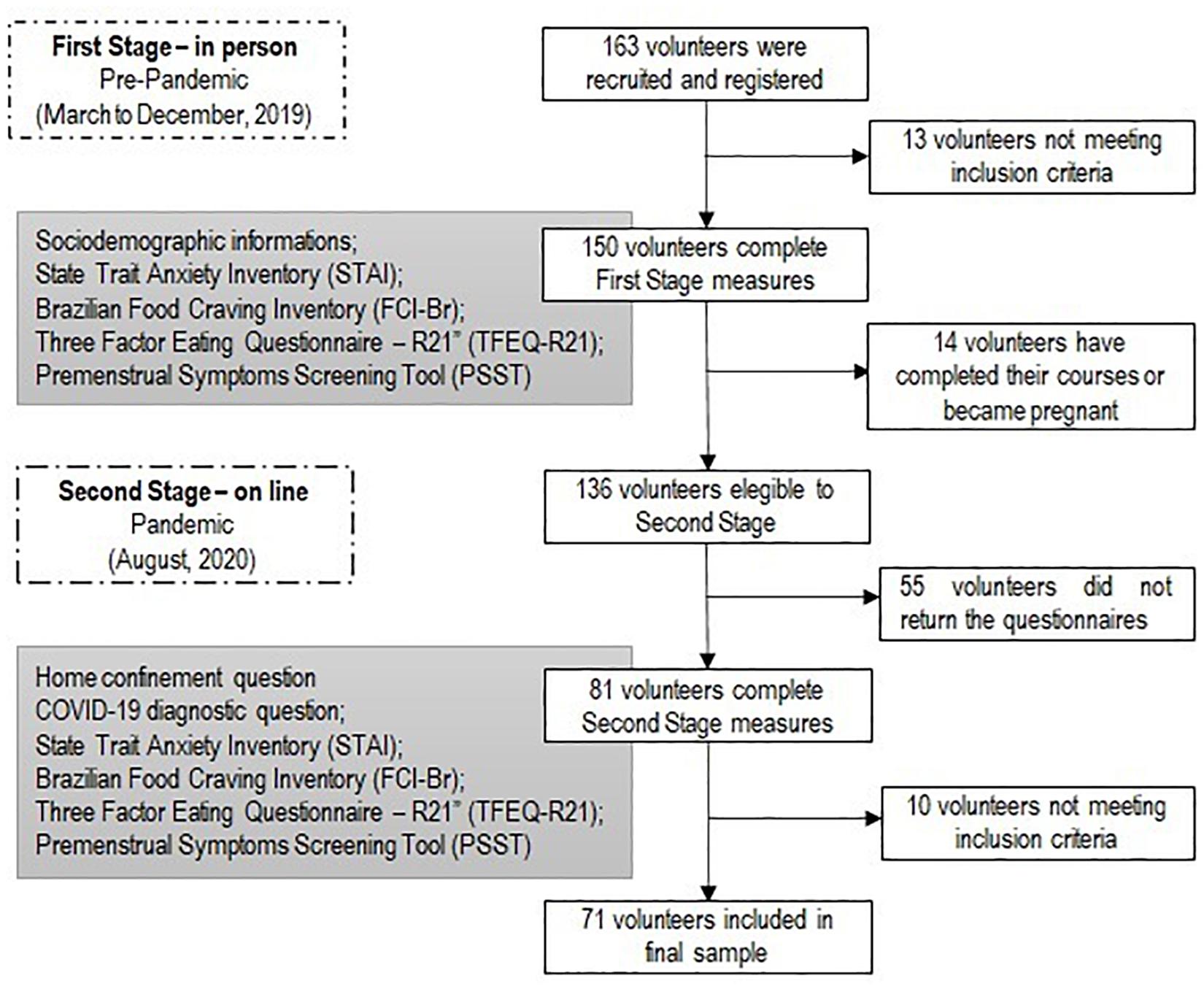
Figure 1. Diagram for the participants’ recruitment and inclusion in the study.
Measures and Instruments
Nutritional Status Assessment
Prepandemic nutritional status was assessed using body mass index (BMI), which was calculated from the weight and height self-reported by the participants in the sociodemographic questionnaire [validation of BMI from self-reported measures, in this population, was performed in the study of Lima et al. (2018)].
Assessment of Eating Behavior
The FCI-Br and the Brazilian version of the TFEQ-R21 were used to assess eating behavior. The FCI-Br was validated by Medeiros et al. (2017) and was created based on the Food Craving Inventory (White et al., 2002), which categorizes and identifies foods that are most related to craving, investigating the frequency of these episodes in the previous month. The FCI-Br consists of 23 foods commonly related to craving, divided into three categories: high fat content (pizza, fried pastry, bacon, salty packaged snacks, lasagna, sandwich/hamburger, coxinha, and French fries), sweets (cookies; dulce de leche; chocolate; condensed milk pudding; candy such as hard candy, lollipop, and jelly beans; ice cream; brigadeiro; sweet pie; and cake), and traditional foods (bread, barbecue/grilled meat, farofa, cheese, beans/feijoada, and steak) (Medeiros et al., 2016a; Meule, 2020).
The TFEQ was developed by Stunkard and Messick (1985) to determine cognitive restraint (CR), disinhibition, and susceptibility to hunger in adults. The first version of the TFEQ consisted of 51 items, but later studies developed shorter and psychometrically improved versions of this questionnaire, such as the TFEQ-R21. The shorter TFEQ-R21 version, adapted and translated to Brazilian Portuguese by Medeiros et al. (2016b), was created based on the TFEQ-51, containing 21 items and assessing three eating behavior dimensions: emotional eating (EA), uncontrolled eating (UE), and CR. The EA scale measures the susceptibility of consuming foods as a response to emotional stress and negative mood states. UE behavior is the tendency to lose control overeating when feeling hungry or exposed to external stimuli (for example very tasty food), even in the absence of hunger. Finally, CR is characterized as the limitation (cognitive and self-imposed) of food ingestion in order to control body weight (Medeiros et al., 2016b, 2019).
Assessment of Anxiety
The State-Trait Anxiety Inventory (STAI) was used to assess anxiety. The STAI was developed by Spielberger et al. (1970) and translated and adapted for Brazil by Biaggio and Natalício (1979). The tool is used to assess relatively stable anxiety. It consists of 20 statements concerning personal feelings, where the subjects report on the frequency at which these feelings generally occur. Each statement is answered on a scale varying from 1 (almost never) to 4 points (almost always), and each volunteer obtained scores between 20 and 80 (Spielberger et al., 1970; Vigneau and Cormier, 2008; Leal et al., 2017).
Assessment of Premenstrual Symptoms
Premenstrual symptoms were assessed using the Brazilian version of the PSST. The PSST was developed and validated for Brazil by Câmara et al. (2016). This instrument identifies the presence of premenstrual symptoms (PMS) and premenstrual dysphoric disorder (PMDD) and is composed of 19 items subdivided into two domains. Domain I consists of 14 physical and psychological manifestations of PMDD described in the diagnostic and statistical manual of mental disorders (DSM-IV). Among the symptoms assessed in this domain is “anxiety/stress.” Domain II is composed of five items that assess the functional impact of PMS. Each item is answered according to a four-point Likert scale (0 = absent; 1 = mild; 2 = moderate; 3 = severe) (Steiner et al., 2003; Henz et al., 2018).
Assessment of Home Confinement
The participants answered a question about how much people were leaving home (for any purpose) during confinement, using a five-point Likert scale (0 = much less than usual; 1 = less than usual; 2 = the same, no change; 3 = more than usual; 4 = much more than usual).
Data Analysis
Data normality and homogeneity were verified by the Kolmogorov–Smirnov and Shapiro–Wilk tests, respectively. Normally distributed variables were compared using the paired Student’s t-test, and for the others, the Wilcoxon signed rank test was used. The relation between variables was determined by the chi-squared test. The results were considered significant at a 95% significance level (p < 0.05).
Results
A total of 71 subjects, with an average age of 21.26 years (SD = 0.41) and mean prepandemic BMI of 22.93 kg/m2 (SD = 0.44), indicating a predominance of eutrophic nutritional status in the evaluated group (88.7% of participants), took part in the study. Three of the students (4.3%) had been infected by COVID-19.
Anxiety
With respect to anxiety, the STAI revealed that trait anxiety during the pandemic (44.4 ± 8.4 points) was significantly lower [t(70) = 2.023, p = 0.047, r = 0.23, n = 71] than in the prepandemic period (46.4 ± 8.7 points) (Figure 2A). It is important to underscore, reinforcing the stability of the measure, that the score remained classified as moderate anxiety despite the significant difference.
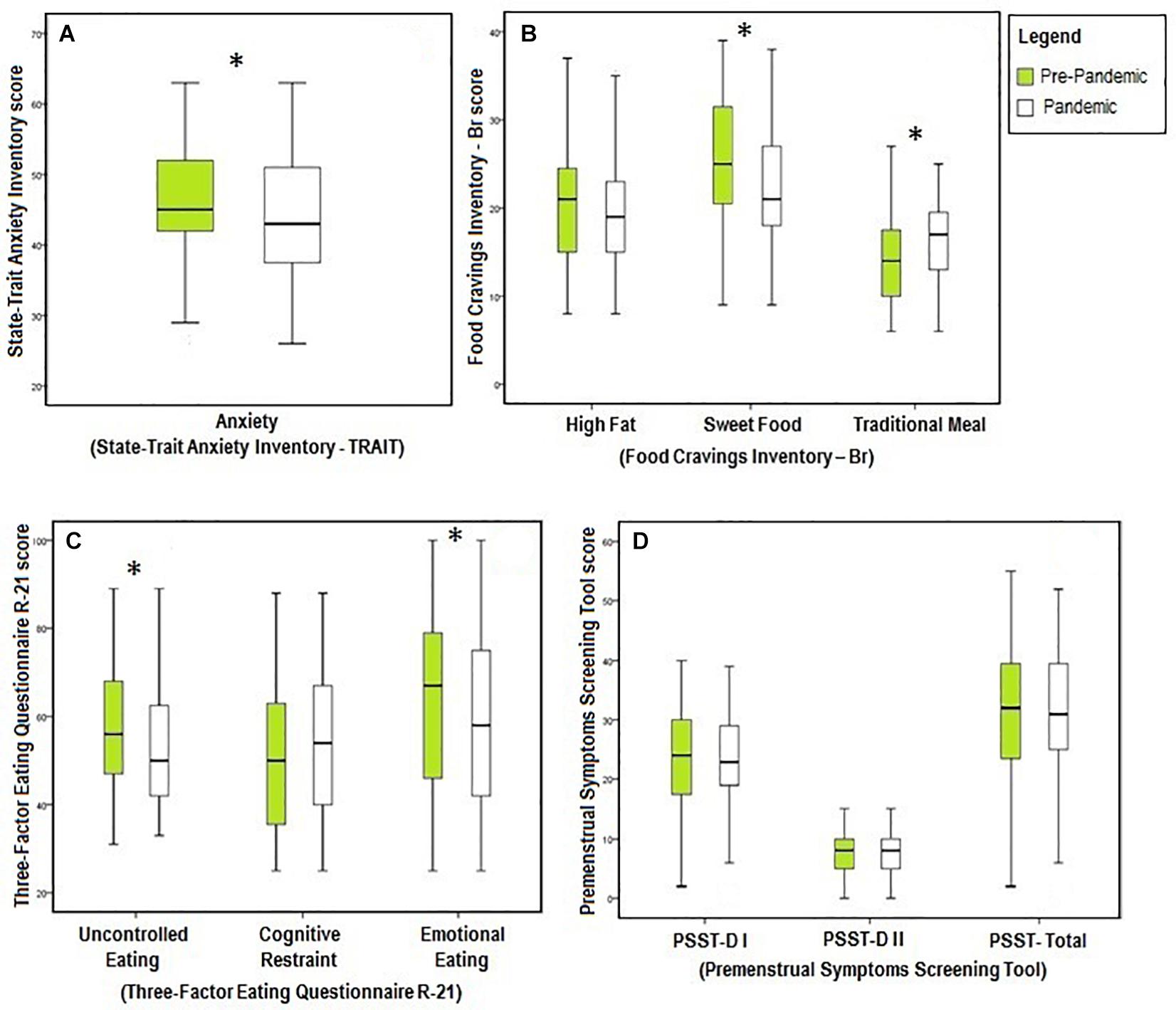
Figure 2. Result of the main measures observed in the study. (A) Trait anxiety before and during the pandemic. (B) Food craving before and during the pandemic. (C) Dimensions of eating behavior before and during the pandemic. (D) Premenstrual symptoms by domain and total before and during the pandemic. PSST, Premenstrual Symptoms Screening Tool; DI, domain I from PSST; DII, domain II from PSST; ∗p < 0.05.
The total PSST score showed no change in the presence and severity of premenstrual symptoms between the two periods analyzed [t(70) = −0.013, p = 0.990, n = 71] (Figure 2D). However, the “anxiety/stress” symptoms of this tool revealed that it was more severe in the students before the pandemic [χ2(2) = 8.884, p = 0.012, Table 1].
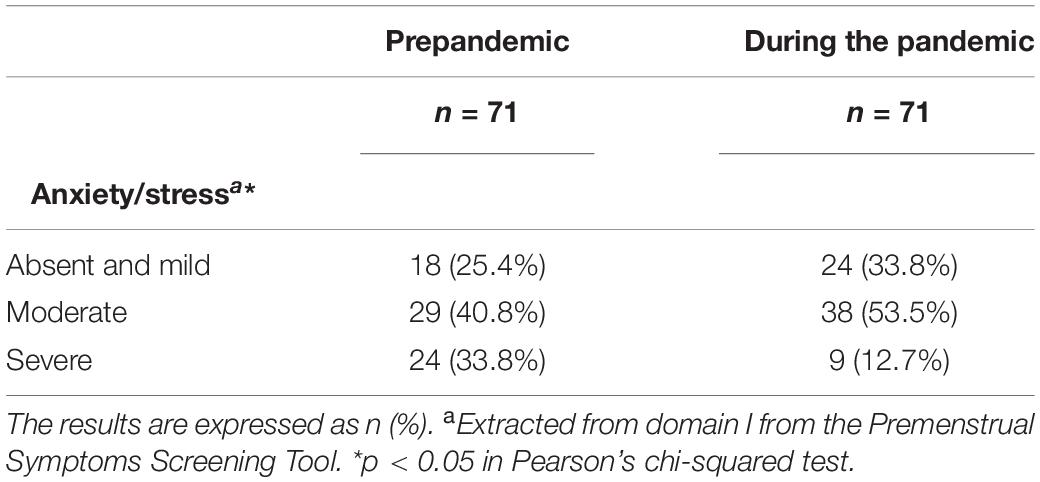
Table 1. Evaluation of anxiety/stress from the Premenstrual Symptoms Screening Tool (PSST).
Eating Behavior
Considering food craving, there was a significant decline in the desire for sweet foods during the pandemic [25.0 (20.5–31.5) versus 21.0 (18.0–27.0), z = −3.776, p < 0.001, r = 0.45, n = 71]. The craving for traditional foods rose significantly in the same period [14.0 (10.0–17.5) versus 17.0 (13.0–19.5), z = −3.203, p = 0.001, r = 0.38, n = 71] (Figure 2B).
In relation to the three dimensions of eating behavior assessed by TFEQ-R21, uncontrolled [56.0 (47.0–68.0) versus 50.0 (42.0–62.5), z = −2.771, p = 0.006, r = 0.33, n = 71] and emotional eating [67.0 (46.0–79.0) versus 58.0 (42.0–75.0), z = −2.229, p = 0.026, r = 0.26, n = 71] were significantly lower during the pandemic. Cognitive restraint increased during this time, but the difference was not significant (Figure 2C).
Actions During the Pandemic
In relation to “outings during social distancing,” 49 (69.0%) of the participants left their home “much less than usual,” 21 (29.6%) “less than usual,” and 1 (1.4%) “more than usual.”
As shown in Figure 3, when analyzed separately, differences were identified between the prepandemic and pandemic period only in the group that left their home “much less than usual,” which demonstrated a decline in craving for sweet foods [26.0 (22.0–33.0) versus 21.0 (19.0–29.0), z = −3.616, p < 0.001, r = 0.52, n = 49] and uncontrolled [58.0 (50.0–69.0) versus 50.0 (44.0–61.0), z = −2763, p = 0.006, r = 0.39, n = 49] and emotional eating [67.0 (50.0–79.0) versus 58.0 (46.0–75.0), z = −1.982, p = 0.047, r = 0.28, n = 49], as well as an increase in craving for traditional foods [26.0 (22.0–33.0) versus 21.0 (19.0–29.0), t(48) = −2.733, p = 0.009, r = 0.37, n = 49].
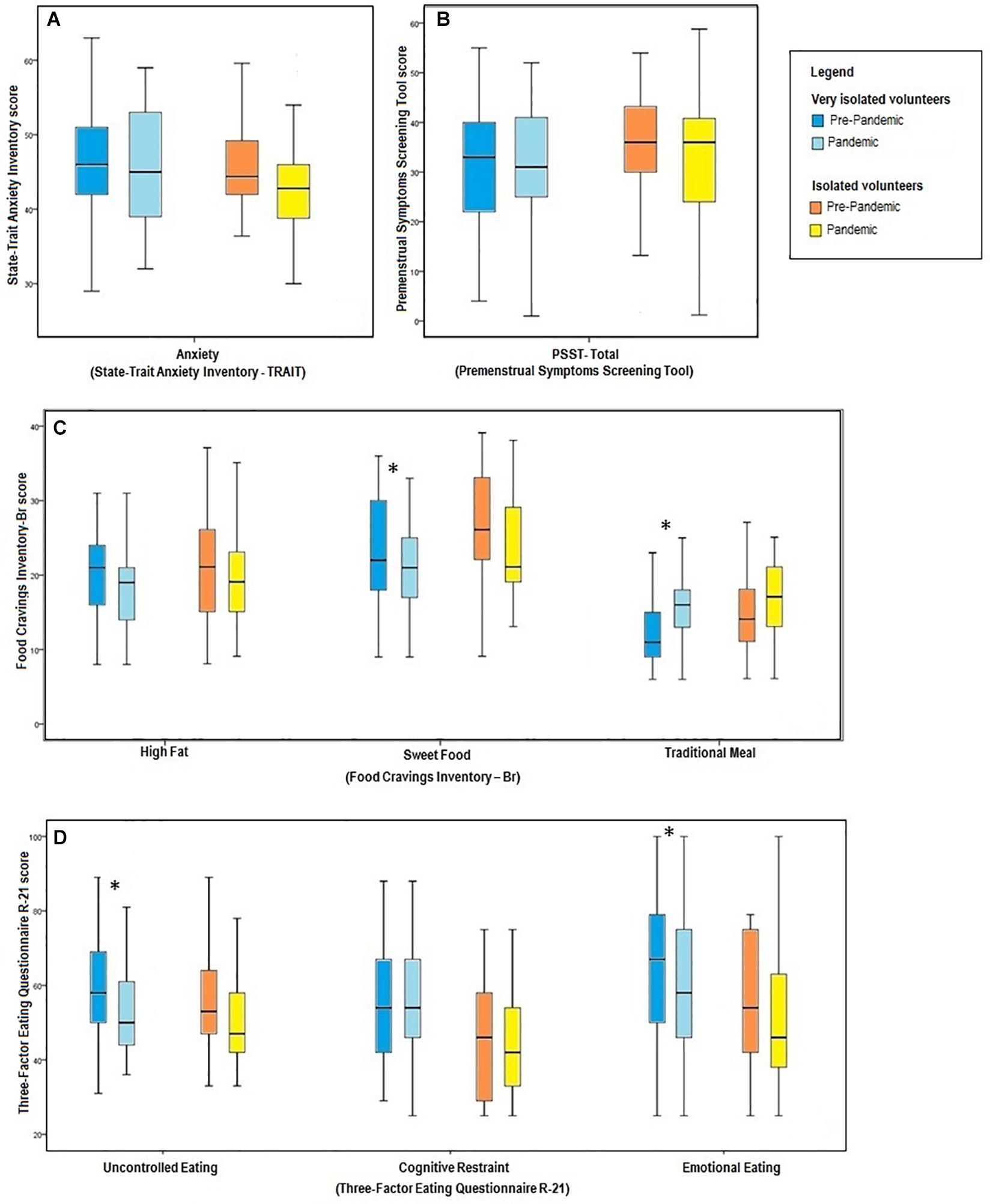
Figure 3. Comparison between the different measures obtained in the study, considering the confinement at home of participants during the pandemic. (A) Trait anxiety according to confinement at home. (B) Premenstrual symptoms according to confinement at home. (C) Food craving according to confinement at home. (D) Dimensions of eating behavior according to confinement at home. PSST, Premenstrual Symptoms Screening Tool; ∗p < 0.05.
When the prepandemic and pandemic periods were compared, no significant differences were found in terms of trait anxiety (Figure 3A), presence and severity of premenstrual symptoms (Figure 3B), “anxiety/stress” symptom, craving for fatty foods, and food restraint.
Discussion
Stressful situations observed in contemporary environment may be associated with the desire to eat foods with high sugar or fat contents, since there is an attempt to attenuate psychological stress by consuming these foods (Rantala et al., 2019). In this respect, the spread of the pandemic and the protective measures adopted, such as social isolation and distancing, would compromise mental health and lead to the intake of unhealthy foods (Wardle et al., 2000; Sominsky and Spencer, 2014; Ammar et al., 2020; Ingram et al., 2020).
Unlike the above-described expectation, the present study found that the anxiety trait remained moderate before and during the pandemic and that the “anxiety/stress” symptom was milder during the pandemic. It also revealed a decrease in craving for sweet foods and an increase for traditional foods during the same period, in addition to a decline in uncontrolled and emotional eating.
Pandemics cause concern and anxiety is a commonly observed psychological problem in these situations. Reinforcing this fact, it was reported that in China (Wang et al., 2020), Spain (Ozamiz-Etxebarria et al., 2020), Japan (Shigemura et al., 2020), Wuhan, and Scotland, COVID-19 caused mental problems in the population (Ingram et al., 2020).
However, although the fear of contracting the virus is a continuous stressor that stimulates the appetite and emotional eating mediated by glucocorticoids (Sominsky and Spencer, 2014), biological (Rantala et al., 2018), sociocultural, economic, and environmental factors may affect the mental health of individuals differently in stressful situations (Liu et al., 2020). For example, confinement can produce healthier eating habits, due to the greater time available for cooking and fewer temptations to eat harmful foods (Ingram et al., 2020; López-Bueno et al., 2020; Rodríguez-Pérez et al., 2020).
With respect to home confinement, our results corroborate these explanations in that the participants who leave home “much less than usual” during the pandemic reported a decline in craving for sweet foods, while craving for traditional foods increased, likely due to the greater exposure to this type of food.
In this respect, an electronic survey conducted in Poland (PLifeCOVID-19) revealed that 48% of those interviewed reported an increase in the consumption of home-cooked meals, attributed to the increased possibility of preparing a meal at home or more free time to take care of health during home confinement (Górnicka et al., 2020). Similarly, the COVIDiet study (Rodríguez-Pérez et al., 2020) carried out with 7,514 Spanish adults showed that during COVID-19 confinement, there was significant adherence to the Mediterranean diet (characterized by the consumption of extra virgin olive oil, whole grains, and vegetables, with low intake of sweets, red meat, and processed foods; Bach-Faig et al., 2011).
Another cross-sectional online survey carried out in 38 countries, which investigated three domains of food literacy behavior (food planning, selection, and preparation), observed that during the COVID-19 pandemic, the perception of having more time was associated with increases in planning, selecting, and preparing healthier foods for women and men and that policies for staying at home or working at home were positively related to planning and preparing healthier foods for both sexes (De Backer et al., 2021).
On the other hand, an online survey on mental health and lifestyle during home confinement (ECLB-COVID19), involving 35 research organizations from Europe, North Africa, Western Asia, and the Americas, found an unhealthy dietary pattern (type of food, uncontrolled eating, between-meal snacks, and number of main meals) during home confinement (Ammar et al., 2020). Another study with 1,012 participants from the United Arab Emirates showed a significant increase in the percentage of subjects that consumed primarily home-cooked meals, and that the foods selected were not nutritious, with the daily presence of sweets and savory snacks, which was also attributed to restricted food access (Ismail et al., 2020).
De Backer et al. (2021) also observed that staying at home was negatively associated with the selection of healthier foods for women and men. In addition, another relevant finding was a greater psychological distress observed in women during the COVID-19 pandemic and that this psychological distress was related to decreased planning, selection, and preparation of healthier foods. Among men, there was an increase in the preparation of healthier meals when psychological suffering increased. This result can be explained by the possibility that, during the pandemic, psychological suffering became a barrier to the daily cooking of women, but for men, it was an alternative to relieve stress.
It is important to underscore a significant aspect of the present study, namely that food intake was not measured, but rather eating behavior. Particularly with respect to craving, the decrease and increase in craving for sweets and traditional foods, respectively, indicate a change in the desire to eat a certain type of food, suggesting an intriguing perspective for the future eating habits of these women.
In relation to the impact of the pandemic on dietary behavior, 638 undergraduate and former undergraduate female students from King Saud University in Saudi Arabia were studied. In this survey, approximately half the women in the sample reported emotional eating (EE) during the COVID-19 pandemic. A total of 335 women (52.5%) reported low EE, while 202 (31.7%) were in the moderate and 101 (15.8%) in the high EE group. The study also demonstrated that eaters with the highest EE score had a trend to report anxiety. However, no significant association was observed between anxiety and EE. One possible explanation is that anxiety provoked by COVID-19 was an acute stressor, thereby reducing appetite and emotional eating (Al-Musharaf, 2020). It is important to emphasize that these reports were compiled over a short period of time after the onset of the pandemic.
In the United States, the study by Cummings et al. (2021) demonstrated that during the COVID-19 pandemic, American adults increased the addition of sugars to foods by 14%, but despite this increase in sugar intake, there was no increase in total food consumption in response to the stress caused by the pandemic. So, the reason for this sharp change in eating behavior may be due to the purchase of more nonperishable processed foods during this period.
Given these different results, a key factor to consider is that the participants of the present study are university students from a rural area of the state, but most come from small towns in the region and are only living in the city where the university is located for study purposes. Living outside the family home has been a factor related to poor quality of diet and emotional and anxiety disorders in undergraduate students (Papadaki et al., 2007; Zurita-Ortega et al., 2018; Cao et al., 2020). Thus, despite the protective measures and the concern about the new coronavirus, returning to their hometowns to be with their families may explain the lower anxiety and eating behaviors observed.
As humans are highly social animals, the response to the threat of infection by COVID-19 causes the desire for contact and social support, especially in relation to loved or vulnerable people, such as family members (Dezecache et al., 2020). The loss of this type of social contact can have an impact on subjective well-being (Paredes et al., 2021), with a negative response from the nervous system, since the activation of some psychological mechanisms in contexts of food sharing and other forms of cooperation so important in the evolutionary history of our species is limited (Ringer et al., 2019).
This influence seems to be supported by evidence from the Spanish study COVIDiet, which found that living at home with one’s family may be associated with a healthier diet (Rodríguez-Pérez et al., 2020). A study with 7,143 Chinese university students reported that living with families/parents during the pandemic may be a protective factor against anxiety (Cao et al., 2020). In addition, it is believed that people who frequently eat with others are happier and more satisfied with their lives, since eating socially releases endorphins, which may promote the same positive effect as that caused by physical exercise (Cohen et al., 2010; Dunbar, 2017).
One aspect that deserves attention is the opportunity we had to observe the behavior of a group outside of large urban centers. A number of factors indicate that living in small cities may also protect individuals against stress and anxiety. Most cases of COVID-19 occurred in the state capitals, resulting in greater sensitivity and vulnerability to psychosocial impacts of the pandemic on the residents of these communities. The high population densities of the capitals facilitate the transmission of the virus, producing stress due to the increased perceived risk of infection. Moreover, living in large cities may also raise the likelihood of access to communication and information. A study performed with 3,068 subjects in China, consisting of 1,928 urban dwellers and 1,140 rural residents, reported a significantly higher prevalence of mental health problems associated with the COVID-19 pandemic in urban individuals compared with those who live in rural environments (Liu et al., 2020).
In addition to the reasons explained above, the higher incidence of mental health problems in individuals living in urban environments may be due to an evolutionary incompatibility, as different from the ancestral world and small cities, urban centers are marked by a greater dispersion of families, less exposure to nature, sleep disturbances, greater sedentary lifestyle, and greater intake of processed foods (Rantala et al., 2021). As societies globalize and human-induced environmental changes increase rapidly, evolutionary mismatches are becoming increasingly prevalent (Li et al., 2018).
The protective measures implemented due to the COVID-19 pandemic may have aggravated the practice of unhealthy lifestyles, such as physical inactivity and the consumption of processed foods. In this sense, in addition to the stress and anxious symptoms caused by the incompatibility of biological and cognitive expectations between the ancestral and the contemporary environment of urban centers (Kavanagh and Kahl, 2018), the negative changes in mood can also be related to neuroinflammation caused by current and evolutionarily new lifestyles, as factors such as unhealthy eating and low or no physical activity favor the increase in the serum amount of proinflammatory cytokines (Rantala et al., 2018, 2021).
The influence of returning to their families and the fact that the study population live in small cities seem to be essential to understanding the results of the present study, since they contradict other research, which found an increase in anxiety levels among university students in several countries (Akdeniz et al., 2020; Cornine, 2020; Wang et al., 2020; Zhou et al., 2020). In our study, we recorded a reduction in anxiety trait expression. Although we are referring to a trait, and therefore, with less expectation of change, Cohen et al. (2014) argue that it is possible that there are changes in the expression of a trait, especially when we consider the nature of the situations in which the trait is expressed. Dealing with the pandemic situation has been one of the greatest experiments that humanity has been facing. We still have no way of accurately measuring the psychological effects that such a situation can have in the short, medium, and long term.
This study has several limitations due to the following factors: not investigating the economic situation and exposure to pandemic-related information of the participants; the data being self-reported, which may have introduced memory bias; and the online stage having occurred at a time when some of the social distancing measures had been relaxed (beginning of the reopening of commercial stores and nonessential services). Nevertheless, the study exhibits strong points that produced robust results. We compared data collected in the prepandemic and pandemic periods, and the sample was non-urban (less studied in other research) and composed of young women, who are more predisposed to developing mental disorders. Also, as a positive aspect, the study was carried out in a sample of the Latin American population that was little studied. Most research are conducted in North America or Western Europe (Henrich et al., 2010). Thus, in order to obtain representativeness regarding human species diversity, science needs to include more cultures (Barrett, 2020), focusing particularly on less studied populations. Still, at a time when public policies for coping with COVID-19 have been formulated and implemented quite quickly, the present study warns about the importance of studying differences between urban and rural environments. Different contexts can generate different responses to the current state of the world pandemic, reflecting the need for differentiated strategies in health care for the population.
In conclusion, our findings suggest that the pandemic may have had a positive impact on the anxiety and eating behavior of the participants, which may be due to the differences between urban and city dwellers and living with families. These findings demonstrate the importance of discussing the effects of the current environment on the regulation of cognitive and dietary adaptations, as well as emphasizing the importance of diversifying participants, since contexts in which we live are essential to understanding possible variations in the behavioral expression of our species.
Data Availability Statement
The raw data supporting the conclusions of this article will be made available by the authors, without undue reservation.
Ethics Statement
The studies involving human participants were reviewed and approved by Research Ethics Committee for the Faculty of Health Sciences of Trairi of the Federal University of Rio Grande do Norte under protocol number 2.830.540. The patients/participants provided their written informed consent to participate in this study.
Author Contributions
FF, AM, and FL conceived and designed the study, conducted the statistical analysis, and wrote and revised the manuscript. FF organized the database. All the authors contributed to the article and approved the version submitted.
Funding
This work was supported by the Coordenação de Aperfeiçoamento de Pessoal de Nível Superior (CAPES—Grant number 001) and Conselho Nacional de Desenvolvimento Científico e Tecnológico (CNPq—Grant Number 310515/2018-1).
Conflict of Interest
The authors declare that the research was conducted in the absence of any commercial or financial relationships that could be construed as a potential conflict of interest.
References
Ackerman, J. M., Tybur, J. M., and Blackwell, A. D. (2020). What Role Does Pathogen-Avoidance Psychology Play in Pandemics? Trends Cogn. Sci. 25, 177–186. doi: 10.1016/j.tics.2020.11.008
Akdeniz, G., Kavakci, M., Gozugok, M., Yalcinkaya, S., Kucukay, A., and Sahutogullari, B. (2020). A Survey of Attitudes, Anxiety Status, and Protective Behaviors of the University Students During the COVID-19 Outbreak in Turkey. Front. Psych. 11, 1–9. doi: 10.3389/fpsyt.2020.00695
Al-Musharaf, S. (2020). Prevalence and Predictors of Emotional Eating among Healthy Young Saudi Women during the COVID-19 Pandemic. Nutrients 12, 1–17. doi: 10.3390/nu12102923
American Psychiatric Association (2014). Diagnostic and Statistical Manual of Mental Disorders - DSM-5. Translation: Maria Inês Corrêa Nascimento [et al.]; Technical review. Aristides Volpato Cordioli [et al.] 5rd ed. Porto Alegre: Artmed.
Ammar, A., Brach, M., Trabelsi, K., Chtourou, H., Boukhris, O., Masmoudi, L., et al. (2020). Efects of COVID-19 Home Confinement on Eating Behaviour and Physical Activity: Results of the ECLB-COVID19 International Online Survey. Nutrients 12, 1583–1596. doi: 10.3390/nu12061583
Bach-Faig, A., Berry, E. M., Lairon, D., Reguant, J., Trichopoulou, A., Dernini, S., et al. (2011). Mediterranean diet pyramid today. Science and cultural updates. Public Health Nutr. 14, 2274–2284. doi: 10.1017/S1368980011002515
Barrett, H. C. (2020). Towards a cognitive science of the human: cross-cultural approaches and their urgency. Trends Cogn. Sci. 24, 620–638. doi: 10.1016/j.tics.2020.05.007
Beauchamp, G. K. (2016). Why do we like sweet taste: A bitter tale? Physiol. Behav. 164, 432–437. doi: 10.1016/j.physbeh.2016.05.007
Bernardi, F., Cichelero, C., and Vitolo, M. R. (2005). Restrained eating behavior and obesity. Nutr. Magaz. 18, 85–93. doi: 10.1590/S1415-52732005000100008
Beulens, J. W. J., Bindels, J. G., De Graaf, C., Alles, M. S., and Wouters-Wesseling, W. (2004). Alpha-lactalbumin combined with a regular diet increases plasma Trp-LNAA ratio. Physiol. Behav. 81, 585–593. doi: 10.1016/j.physbeh.2004.02.027
Biaggio, A. M. B., and Natalício, L. (1979). Manual para o Inventário de Ansiedade Traço Estado (IDATE). [Brazilian reference]. Rio de Janeiro: Centro Editor Psicologia Aplicada -CEPA.
Braga, J. E. F., Pordeus, L. C., Silva, A. T. M. C., Pimenta, F. C. F., Diniz, M. F. F. M., and Almeida, R. N. (2010). Pathological Anxiety: Neural Bases and Advances in the Psychopharmacological Approach. [Brazilian reference]. Brazilian J. Health Sci. 14, 93–100. doi: 10.4034/rbcs.2010.14.02.13
Câmara, R. A., Kohler, C. A., Frey, B. N., Hyphantis, T. N., and Carvalho, A. F. (2016). Validation of the Brazilian Portuguese version of the Premenstrual Symptoms Screening Tool (PSST) and association of PSST scores with health-related quality of life. Brazilian J. Psych. 39, 140–146. doi: 10.1590/1516-4446-2016-1953
Cao, W., Fang, Z., Hou, G., Han, M., Xu, X., Dong, J., et al. (2020). The Psychological Impact of the COVID-19 Epidemic on College Students in China. Psych. Res. 287, 1–5. doi: 10.1016/j.psychres.2020.112934
Cherikh, F., Frey, S., Bel, C., Attanasi, G., Alifano, M., and Iannelli, A. (2020). Behavioral Food Addiction During Lockdown: Time for Awareness, Time to Prepare the Aftermath. Obesity Surg. 30, 3585–3587. doi: 10.1007/s11695-020-04649-3
Cohen, E. E. A., Ejsmond-Frey, R., Knight, N., and Dunbar, R. I. M. (2010). Rowers’ High: Behavioural Synchrony Is Correlated with Elevated Pain Thresholds. Biol. Lett. 6, 106–108. doi: 10.1098/rsbl.2009.0670
Cohen, R. J., Swerdlik, M. E., and Sturman, E. D. (2014). Testagem e avaliação psicológicas: introdução e medidas. Translation: Maria Cristina G. Monteiro; Technical review: Claudio Simon Hutz, Ana Claudia Vazquez and Juliana Cerentini Pacico 8rd ed. Porto Alegre: AMGH.
Cornine, A. (2020). Reducing Nursing Student Anxiety in the Clinical Setting: An Integrative Review. Nurs. Educat. Perspect. 41, 229–234. doi: 10.1097/01.NEP.0000000000000633
Cummings, J. R., Ackerman, J. M., Wolfson, J. A., and Gearhardt, A. N. (2021). COVID-19 stress and eating and drinking behaviors in the United States during the early stages of the pandemic. Appetite 162, 1–8.
De Backer, C., Teunissen, L., Cuykx, I., Decorte, P., Pabian, S., Gerritsen, S., et al. (2021). An Evaluation of the COVID-19 Pandemic and Perceived Social Distancing Policies in Relation to Planning, Selecting, and Preparing Healthy Meals: An Observational Study in 38 Countries Worldwide. Front. Nutr. 7, 1–11. doi: 10.3389/fnut.2020.621726
Deschasaux-Tanguy, M., Druesne-Pecollo, N., Esseddik, Y., de Edelenyi, F. S., Allès, B., Andreeva, V. A., et al. (2020). Diet and physical activity during the COVID-19 lockdown period (March-May 2020): Results from the French NutriNet-Santé cohort study. MedRxiv [preprint]. doi: 10.1101/2020.06.04.20121855
Dezecache, G., Frith, C. D., and Deroy, O. (2020). Pandemics and the great evolutionary mismatch. Curr. Biol. 30, R417–R419. doi: 10.1016/j.cub.2020.04.010
Di Renzo, L., Gualtieri, P., Cinelli, G., Bigioni, G., Soldati, L., Attinà, A., et al. (2020). Psychological aspects and eating habits during covid-19 home confinement: Results of ehlc-covid-19 italian online survey. Nutrients 12, 1–14. doi: 10.3390/nu12072152
Dunbar, R. I. M. (2008). Why Humans Aren’t Just Great Apes. Ethnol. Anthropol. 3, 15–33. doi: 10.1007/s40750-017-0061-4
Dunbar, R. I. M. (2017). Breaking Bread: The Functions of Social Eating. Adapt. Hum. Behav. Physiol. 3, 198–211. doi: 10.1007/s40750-017-0061-4
Dunbar, R. I. M. (2020). Structure and function in human and primate social networks: implications for diffusion, network stability and health. Proc. Royal Soc. A 476:2020044620200446. doi: 10.1098/rspa.2020.0446
Gingnell, M., Morell, A., Bannbers, E., Wikström, J., and Sundström Poromaa, I. (2012). Menstrual cycle effects on amygdala reactivity to emotional stimulation in premenstrual dysphoric disorder. Horm. Behav. 62, 400–406. doi: 10.1016/j.yhbeh.2012.07.005
Górnicka, M., Drywień, M. E., Zielinska, M. A., and Hamułka, J. (2020). Dietary and Lifestyle Changes during Covid-19 and the Subsequent Lockdowns among Polish Adults: A Cross-Sectional Online Survey Plifecovid-19 Study. Nutrients 12, 1–20. doi: 10.3390/nu12082324
Griskevicius, V., and Kenrick, D. T. (2013). Fundamental motives: How evolutionary needs influence consumer behavior. J. Consumer Psychol. 23, 372–386. doi: 10.1016/j.jcps.2013.03.003
Henrich, J., Heine, S. J., and Norenzayan, A. (2010). Most people are not WEIRD. Nature 466, 29–29. doi: 10.1038/466029a
Henz, A., Ferreira, C. F., Oderich, C. L., Gallon, C. W., Castro, J. R. S., Conzatti, M., et al. (2018). Premenstrual Syndrome Diagnosis: A Comparative Study between the Daily Record of Severity of Problems (DRSP) and the Premenstrual Symptoms Screening Tool (PSST). Rev. Bras. Ginecol. Obstet. 40, 20–25. doi: 10.1055/s-0037-1608672
Ingram, J., Maciejewski, G., and Hand, C. J. (2020). Changes in Diet, Sleep, and Physical Activity Are Associated With Differences in Negative Mood During COVID-19 Lockdown. Front. Psychol. 11, 1–9. doi: 10.3389/fpsyg.2020.588604
Ismail, L. C., Osaili, T. M., Mohamad, M. N., Al Marzouqi, A., Jarrar, A. H., Jamous, D. O. A., et al. (2020). Eating Habits and Lifestyle during Covid-19 Lockdown in the United Arab Emirates: A Cross-Sectional Study. Nutrients 12, 1–20. doi: 10.3390/nu12113314
Johnson, W. G., Carr-Nangle, R. E., and Bergeron, K. C. (1995). Macronutrient intake, eating habits, and exercise as moderators of menstrual distress in healthy women. Psychosom. Med. 57, 324–330. doi: 10.1097/00006842-199507000-00003
Kang, L., Li, Y., Chen, M., Yang, C., Yang, B. X., et al. (2020). The Mental Health of Medical Workers in Wuhan, China Dealing with the 2019 Novel Coronavirus. Lancet Psych. 7:e14. doi: 10.1016/S2215-0366(20)30047-X
Kavanagh, P. S., and Kahl, B. L. (2018). Are Expectations the Missing Link between Life History Strategies and Psychopathology? Front. Psychol. 9, 1–7. doi: 10.3389/fpsyg.2018.00089
Kennair, L. E. O. (2003). Evolutionary Psychology and psychopathology. Curr. Opin. Psyc. 16, 691–699. doi: 10.1097/01.yco.0000097655.75497.2e
Kenrick, D. T., and Krems, J. A. (2018). “Well-being, self-actualization, and fundamental motives: An evolutionary perspective,” in Handbook of well-being, eds E. Diener, S. Oishi, and L. Tay (Salt Lake City, UT: DEF Publishers).
Lakhan, R., Agrawal, A., and Sharma, M. (2020). Prevalence of Depression, Anxiety, and Stress during COVID-19 Pandemic. J. Neurosci. Rural Pract. 11, 519–525. doi: 10.1055/s-0040-1716442
Leal, P. C., Goes, T. C., Silva, L. C. F., and Teixeira-Silva, F. (2017). Trait vs. state anxiety in different threatening situations. Trends Psych. Psychother. 39, 147–157. doi: 10.1590/2237-6089-2016-0044
Li, N. P., van Vugt, M., and Colarelli, S. M. (2018). The evolutionary mismatch hypothesis: Implications for psychological science. Curr. Direct. Psychol. Sci. 27, 38–44. doi: 10.1177/0963721417731378
Lima, L. R. M., Freitas, R. P. A., Silva, L. R. D., and Medeiros, A. C. Q. (2018). Estimation of body mass index from self-reported measures: what is the validity? J. Phys. Educ. 29, 1–9. doi: 10.4025/jphyseduc.v29i1.2907
Liu, L., Xue, P., Li, S. X., Zhang, J., Zhou, J., and Zhang, W. (2020). Urban-Rural Disparities in Mental Health Problems Related to COVID-19 in China. General Hospital Psych. 7, 1–2. doi: 10.1016/j.genhosppsych.2020.07.011
Lopes, F. A., Ferreira, D. Q. C., and Araujo, A. (2018). Eating behavior. In: Yamamoto, E.; Valentova, J. V. (org.). [Brazilian reference]. Translation: Monique Bezerra Paz Leitão and Wallisen Tadashi Hattori. Handbook of Evolutionary Psychology. Natal: EDUFRN.
López-Bueno, R., Calatayud, J., Casaña, J., Casajús, J. A., Smith, L., Tully, M. A., et al. (2020). COVID-19 Confinement and Health Risk Behaviors in Spain. Front. Psychol. 11, 1–10. doi: 10.3389/fpsyg.2020.01426
Medeiros, A. C. Q., Pedrosa, L. F. C., and Yamamoto, M. E. (2017). Food cravings among Brazilian population. Appetite 108, 212–218. doi: 10.1016/j.appet.2016.10.009
Medeiros, A. C. Q., Pedrosa, L. F. C., and Yamamoto, M. E. (2019). Exploring the structural and construct validity of the Brazilian Food Cravings Questionnaire-Trait-reduced (FCQ-T-r). Braz. J. Psych. 41, 66–69. doi: 10.1590/1516-4446-2017-0019
Medeiros, A. C. Q., Pedrosa, L. F. C., Hutz, C. S., and Yamamoto, M. E. (2016a). Brazilian version of food cravings questionnaires: Psychometric properties and sex differences. Appetite 105, 328–333. doi: 10.1016/j.appet.2016.06.003
Medeiros, A. C. Q., Yamamoto, M. E., Pedrosa, L. F. C., and Hutz, C. S. (2016b). The Brazilian version of the three-factor eating questionnaire-R21: psychometric evaluation and scoring pattern. Eat Weight Disord 22, 169–175. doi: 10.1007/s40519-016-0256-x
Meule, A. (2020). Twenty Years of the Food Cravings Questionnaires: a Comprehensive Review. Curr. Addict. Rep. 7, 30–43. doi: 10.1007/s40429-020-00294-z
Mosko, J. E., and Delach, M. (2020). Cooking, Creativity, and Well−Being: An Integration of Quantitative and Qualitative Methods. J. Creat. Behav. 2020:459. doi: 10.1002/jocb.459
Naja, F., and Hamadeh, R. (2020). Nutrition amid the COVID-19 Pandemic: A Multi-Level Framework for Action. Europ. J. Clin. Nutr. 74, 1117–1121. doi: 10.1038/s41430-020-0634-3
Nesse, R. M. (2019a). Good reasons for bad feelings: Insights from the frontier of Evolutionary Psychiatry. New York: Dutton.
Nesse, R. M. (2019b). Tinbergen’s four questions: Two proximate, two evolutionary, Evolution. Med. Public Health 1:35. doi: 10.1093/emph/eoy035
Nettersheim, J., Gerlach, G., Herpertz, S., Abed, R., Figueredo, A. J., and Brune, M. (2018). Evolutionary Psychology of Eating Disorders: An Explorative Study in Patients With Anorexia Nervosa and Bulimia Nervosa. Front. Psychol. 9, 1–12. doi: 10.3389/fpsyg.2018.02122
Nissar, N., Zehra, N., Haider, G., Munir, A. A., and Sohoo, N. A. (2008). Frequency, intensity and impact of premenstrual syndrome in medical students. J. College Physic. Surg. Pakistan 18, 481–484.
Ouwens, M. A., van Strien, T., and van Leeuwe, J. F. J. (2009). Possible Pathways between Depression, Emotional and External Eating. A Structural Equation Model. Appetite 53, 245–248. doi: 10.1016/j.appet.2009.06.001
Ozamiz-Etxebarria, N., Idoiaga Mondragon, N., Dosil Santamaría, M., and Picaza Gorrotxategi, M. (2020). Psychological Symptoms During the Two Stages of Lockdown in Response to the COVID-19 Outbreak: An Investigation in a Sample of Citizens in Northern Spain. Front. Psychol. 11:1491. doi: 10.3389/fpsyg.2020.01491
Papadaki, A., Hondros, G., Scott, J. A., and Kapsokefalou, M. (2007). Eating habits of university students living at, or away from home in Greece. Appetite 49, 169–176. doi: 10.1016/j.appet.2007.01.008
Paredes, M. R., Apaolaza, V., Fernandez-Robin, C., Hartmann, P., and Yañez-Martinez, D. (2021). The impact of the COVID-19 pandemic on subjective mental well-being: The interplay of perceived threat, future anxiety and resilience. Person. Indiv. Diff. 170:110455. doi: 10.1016/j.paid.2020.110455
Parlapani, E., Holeva, V., Voitsidis, P., Blekas, A., Gliatas, I., Georgia, N., et al. (2020). Psychological and Behavioral Responses to the COVID-19 Pandemic in Greece. Front. Psych. 11, 1–17. doi: 10.3389/fpsyt.2020.00821
Rantala, M. J., Luoto, S., Borráz-León, J. I., and Krams, I. (2021). Bipolar disorder: An evolutionary psychoneuroimmunological approach. Neurosci. Biobehav. Rev. 122, 28–37. doi: 10.1016/j.neubiorev.2020.12.031
Rantala, M. J., Luoto, S., Krama, T., and Krams, I. (2019). Eating Disorders: An Evolutionary Psychoneuroimmunological Approach. Front. Psychol. 10, 1–21. doi: 10.3389/fpsyg.2019.02200
Rantala, M. J., Luoto, S., Krams, I., and Karlsson, H. (2018). Depression subtyping based on evolutionary psychiatry: Proximate mechanisms and ultimate functions. Brain Behav. Immun. 69, 603–617. doi: 10.1016/j.bbi.2017.10.012
Ringer, E. J., Duda, P., and Jaeggi, A. V. (2019). The evolution of daily food sharing: A Bayesian phylogenetic analysis. Evolut. Huma Behav. 40, 375–384. doi: 10.1016/j.evolhumbehav.2019.04.003
Rodríguez-Pérez, C., Molina-Montes, E., Verardo, V., Artacho, R., García-Villanova, B., Guerra-Hernández, E. J., et al. (2020). Changes in Dietary Behaviours during the COVID-19 Outbreak Confinement in the Spanish COVIDiet Study. Nutrients 12, 1–19. doi: 10.3390/nu12061730
Rogers, P. J., and Smit, H. J. (2000). Food Craving and Food “Addiction”: A Critical Review of the Evidence From a Biopsychosocial Perspective. Pharmacol. Biochem. Behav. 66, 3–14. doi: 10.1016/s0091-3057(00)00197-0
Schaller, M., and Park, J. H. (2011). The Behavioral Immune System (and Why It Matters). Curr. Direct. Psychol. Sci. 20, 99–103. doi: 10.1177/0963721411402596
Serin, E., and Koç, M. C. (2020). Examination of the Eating Behaviours and Depression States of the University Students Who Stay at Home during the Coronavirus Pandemic in Terms of Different Variables. Progr. Nutr. 22, 33–43. doi: 10.23751/pn.v22i1-S.9780
Shigemura, J., Ursano, R. J., Morganstein, J. C., Kurosawa, M., and Benedek, D. M. (2020). Public Responses to the Novel 2019 Coronavirus (2019-NCoV) in Japan: Mental Health Consequences and Target Populations. Psych. Clin. Neurosci. 74, 277–283. doi: 10.1111/pcn.12988
Sominsky, L., and Spencer, S. J. (2014). Eating Behavior and Stress: A Pathway to Obesity. Front. Psychol. 5, 1–8. doi: 10.3389/fpsyg.2014.00434
Spielberger, C. D., Gorsuch, R. L., and Lushene, R. E. (1970). Manual for the Strait-Trait Anxiety Inventory. Palo Alto, CA: Consulting Psychologists Press.
Steiner, M., Macdougall, M., and Brown, E. (2003). The premenstrual symptoms screening tool (PSST) for clinicians. Arch. Womens Ment. Health 6, 203–209. doi: 10.1007/s00737-003-0018-4
Strassmann, B. I. (1999). Menstrual cycling and breast cancer: an evolutionary perspective. J. Women’s Health 8, 193–202. doi: 10.1089/jwh.1999.8.193
Stunkard, A. J., and Messick, S. (1985). The three-factor eating questionnaire to measure dietary restraint, disinhibition and hunger. J. Psychosom. Res. 29, 71–83. doi: 10.1016/0022-3999(85)90010-8
Tang, B., Bragazzi, N. L., Li, Q., Tang, S., Xiao, Y., and Wu, J. (2020). An Updated Estimation of the Risk of Transmission of the Novel Coronavirus (2019-NCov). Infect. Dis. Model. 5, 248–255. doi: 10.1016/j.idm.2020.02.001
Tinbergen, N. (1963). TI - On aims and methods of Ethology. Zeitschrift für Tierpsychologie 20, 410–433. doi: 10.1111/j.1439-0310.1963.tb01161.x
Vigneau, F., and Cormier, S. (2008). The factor structure of the State-Trait Anxiety Inventory: an alternative view. J. Pers. Assess. 90, 280–285. doi: 10.1080/00223890701885027
Volino-Souza, M., Oliveira, G. V., Conte-Junior, C. A., and Alvares, T. S. (2020). Covid-19 Quarantine: Impact of Lifestyle Behaviors Changes on Endothelial Function and Possible Protective Effect of Beetroot Juice. Front. Nutr. 7, 1–7. doi: 10.3389/fnut.2020.582210
Wang, C., Pan, R., Wan, X., Tan, Y., Xu, L., McIntyre, R. S., et al. (2020). A Longitudinal Study on the Mental Health of General Population during the COVID-19 Epidemic in China. Brain Behav. Immun. 87, 40–48. doi: 10.1016/j.bbi.2020.04.028
Wardle, J., Steptoe, A., Oliver, G., and Lipsey, Z. (2000). Stress, Dietary Restraint and Food Intake. J. Psychoso. Res. 48, 195–202. doi: 10.1016/S0022-3999(00)00076-3
White, M. A., Whisenhunt, B. L., Williamson, D. A., Greenway, F. L., and Netemeyer, R. G. (2002). Development and validation of the food-craving inventory. Obes. Res. 10, 107–114. doi: 10.1038/oby.2002.17
Zhou, N., Cao, H., Liu, F., Wu, L., Liang, Y., Xu, J., et al. (2020). A Four-Wave, Cross-Lagged Model of Problematic Internet Use and Mental Health among Chinese College Students: Disaggregation of within-Person and between-Person Effects. Devel. Psychol. 56, 1009–1021. doi: 10.1037/dev0000907
Zucoloto, F. S. (2011). Evolution of the human feeding behavior. Psychol. Neurosci. 4, 131–141. doi: 10.3922/j.psns.2011.1.015
Keywords: COVID-19, social isolation, confinement, dietary behavior, mental health, human evolution
Citation: Freitas FF, de Medeiros ACQ and Lopes FA (2021) Effects of Social Distancing During the COVID-19 Pandemic on Anxiety and Eating Behavior—A Longitudinal Study. Front. Psychol. 12:645754. doi: 10.3389/fpsyg.2021.645754
Received: 04 January 2021; Accepted: 19 April 2021;
Published: 01 June 2021.
Edited by:
Marco Antonio Correa Varella, University of São Paulo, BrazilReviewed by:
Hamdi Chtourou, University of Sfax, TunisiaNaiara Ozamiz, University of the Basque Country, Spain
Laisa Liane Paineiras-Domingos, Federal University of Bahia, Brazil
Copyright © 2021 Freitas, de Medeiros and Lopes. This is an open-access article distributed under the terms of the Creative Commons Attribution License (CC BY). The use, distribution or reproduction in other forums is permitted, provided the original author(s) and the copyright owner(s) are credited and that the original publication in this journal is cited, in accordance with accepted academic practice. No use, distribution or reproduction is permitted which does not comply with these terms.
*Correspondence: Fívia de Araújo Lopes, Zml2aWFsb3Blc0BnbWFpbC5jb20=