Abstract
Objective:
This study investigated the relationships among school belonging, psychological capital and professional commitment among nursing undergraduates, and further assessed the mediating role of psychological capital in the link between school belonging and professional commitment.
Methods:
A total of 301 nursing undergraduates from two universities in Hubei Province, China, participated in this cross-sectional investigation. Validated questionnaires were used to measure psychological capital, school belonging, and professional commitment. Data analysis involved Pearson correlation coefficients and mediation analyses conducted via PROCESS Model 4.
Results:
Findings revealed positive correlations of psychological capital and school belonging with professional commitment, and school belonging was positively associated with psychological capital. Additionally, psychological capital was found to partially mediate the relationship between school belonging and professional commitment.
Conclusion:
The findings suggest that improving students’ perceptions of belonging to their institution and enhancing their psychological capital could contribute to increased professional commitment among nursing undergraduates. Future longitudinal research is encouraged to verify the directionality of these relationships.
1 Introduction
High turnover rates and nursing workforce shortages have emerged as global challenges (Ren et al., 2024; Hu et al., 2022), with undergraduate nursing students representing the backbone of the future nursing workforce. Increased professional commitment among nurses is associated with enhanced job satisfaction (Lu et al., 2019), reduced burnout (Chang et al., 2017), and lower turnover intentions (Chang et al., 2019). Professional commitment, originating from the theories of organizational and occupational commitment, pertains to an individual’s sense of identity with their profession, their willingness to invest effort, and a favorable attitude toward continuing in that profession (Lian et al., 2005). Existing literature suggests that professional commitment typically emerges and strengthens during academic training, and the extent of such commitment among undergraduate nursing students strongly forecasts their continuation within the nursing field after graduation (Lu et al., 2000). Thus, promoting professional commitment in nursing students is crucial for ensuring workforce stability and supporting the progression of the nursing profession. However, current undergraduate nursing students face considerable academic pressure (Liu and Fu, 2024), anxiety, depression (Aloufi et al., 2021), and low professional identity (Li et al., 2023) during their studies, all of which directly undermine their professional commitment.
School belonging refers to students’ identification with their school, including their emotional experiences and attitudinal perceptions regarding interactions within the school environment (Cui et al., 2025). Baumeister proposed that belonging is a fundamental human motivation (Baumeister and Leary, 1995), critically shaping individuals’ value identification and professional goal-setting (Lee and Huang, 2021). For undergraduate nursing students, whose primary responsibility involves academic learning, the school environment significantly influences their daily experiences. A strong sense of school belonging may enhance their commitment to the nursing profession and motivate greater academic investment. Li and Shi (2021) further demonstrated a positive association between school belonging and college students’ professional commitment.
Psychological capital refers to a positive psychological state of development characterized by four core dimensions (Luthans et al., 2018): hope, self-efficacy, resilience, and optimism. It significantly influences psychological well-being (Parviniannasab et al., 2022), learning engagement (Zou et al., 2024), innovative behavior (Kotb et al., 2024), and professional identity (Feng et al., 2024). For undergraduate nursing students, psychological capital plays a crucial role in their personal and professional development, enabling them to manage academic and life challenges more effectively and enhancing their adaptability. The level of psychological capital substantially affects students’ performance in both academic learning and clinical practice. Moreover, students with higher psychological capital demonstrate stronger commitment to their professional goals.
Numerous factors impact the level of professional commitment in undergraduate nursing students. According to Bandura’s Social Cognitive Theory (Bandura, 1978), there is a reciprocal interaction among environmental contexts, personal psychological resources, and behavioral outcomes. Based on this theoretical perspective, the current study proposes a behavioral outcome framework in which school belonging represents an environmental variable, psychological capital acts as a personal psychological resource, and professional commitment is the outcome variable. School belonging describes students’ emotional bond and sense of identity with their educational institutions, serving as a significant source of environmental support. Prior studies have consistently identified school belonging as a critical environmental determinant of students’ academic behaviors and career intentions (Burger, 2023). Students who perceive stronger acceptance and recognition from their institution are generally more inclined to commit themselves to their academic pursuits and invest substantial effort. Such positive environmental influences are essential for fostering and sustaining professional commitment. Based on these considerations, this study proposes Hypothesis H1: School belonging is positively correlated with professional commitment.
Beyond this direct effect, a deeper question arises: through what internal mechanism does school belonging influence professional commitment? According to triadic reciprocal determinism, environmental influences affect behavior through individual cognition, suggesting that psychological capital may play a key mediating role. Psychological capital comprises a set of positive psychological resources developed throughout individual growth. As a measurable and cultivable internal strength, psychological capital can motivate individuals to adopt and maintain positive behaviors to achieve their goals. First, as a positive personal resource, students with higher psychological capital are better able to cope with challenges and academic pressure, sustain learning motivation (Liu et al., 2024), and consequently exhibit stronger professional commitment. Thus, Hypothesis H2 is proposed: Psychological capital is positively correlated with professional commitment.
Second, a positive school environment provides fertile ground for cultivating psychological capital. Social Cognitive Theory posits that environmental conditions shape individuals’ beliefs and self-perceptions. When students experience a strong sense of belonging, the perception of “I am accepted and valued as part of the school” can be internalized as a stable psychological strength. Therefore, this study proposes Hypothesis H3: School belonging is positively associated with psychological capital.
Moreover, school belonging can function as an environmental facilitator that promotes psychological resources such as optimism, resilience, self-efficacy, and hope. These psychological attributes subsequently enhance professional commitment by fostering students’ confidence in their potential to succeed within the nursing profession and by maintaining their motivation in the face of obstacles. This theoretical rationale underpins the mediating function of psychological capital in linking school belonging to professional commitment. Consequently, Hypothesis H4 is formulated: School belonging was positively associated with professional commitment through the mediating role of psychological capital.
2 Methods
2.1 Study design
The research utilized a descriptive cross-sectional design.
2.2 Participants
A convenience sampling method was employed to recruit undergraduate nursing students from two universities in Hubei Province from February to April 2025. Inclusion criteria were: (1) full-time undergraduate nursing students (freshman to senior), and (2) voluntary participation with informed consent. Exclusion criteria were: (1) students on leave during data collection. Following Kendall’s (Preacher and Kelley, 2011) sample size estimation guideline, a minimum of 5–10 observations per independent variable is recommended. Given 19 independent variables and structural equation modeling requirements (Wu, 2010) (minimum n = 200), along with an anticipated 20% dropout rate, the target recruitment was set at 301 participants.
2.3 Instruments
2.3.1 General information questionnaire
Based on existing research, a self-developed questionnaire was created to collect background and demographic information. Items included were gender, academic year, student leadership experience, hometown location, whether participants were an only child, perceived employment stress, academic pressure, clinical clerkship experience, and whether nursing was initially preferred as their major.
2.3.2 School belonging
The evaluation of students’ school belonging employed the School Belonging Scale developed by Chinese scholar Hao (2008). This scale contains 34 items distributed across six dimensions: recognition by the school, identification with one’s role, peer relationships, personal status, sense of responsibility, and security. Participants provided ratings on a 5-point Likert scale, where higher total scores indicated a greater sense of school belonging. The reliability coefficient (Cronbach’s α) for this scale was 0.993.
2.3.3 Positive psychological capital
To evaluate the construct of psychological capital, this research adopted the Psychological Capital Scale developed by Zhang et al. (2010), a Chinese scholar. The instrument consists of four domains, hope, optimism, resilience, and self-efficacy, and includes a total of 26 items. Participants provided responses on a seven-point Likert scale, where elevated scores indicated greater psychological capital. The reliability of this instrument was demonstrated to be excellent (Cronbach’s α = 0.90).
2.3.4 Nursing professional commitment
The Professional Commitment Scale, originally developed by Taiwanese scholar Lv and Qiu (1998) specifically for nursing populations, assessed students’ professional commitment. This 34-item instrument measures four dimensions: willingness to exert professional effort, career involvement, positive professional evaluation, and professional value identification. Responses used a 4-point Likert scale, with higher scores indicating stronger professional commitment. The scale showed excellent reliability (α = 0.94).
2.4 Data collection
Prior to data collection, approval was secured from the director of the nursing program. A web-based questionnaire was hosted on the Wenjuanxing platform.1 IP address restriction (one response per address) and anonymous data collection (no identifiable information) ensured data integrity and participant anonymity. All questions were mandatory to avoid missing data. After approval, grade counselors distributed the survey via QR codes to class groups. Participation was voluntary, with implied consent through survey completion. From 315 distributed surveys, 301 valid responses were collected, after excluding questionnaires with highly repetitive answer patterns and completion times under 5 min, yielding a 95.56% response rate.
2.5 Ethical considerations
This study received ethical authorization from the Ethics Committee of the Affiliated Renhe Hospital of China Three Gorges University (approval code: RHLL-2025-16). Written informed consent was obtained through an explicit consent selection embedded within the distributed questionnaire.
2.6 Data analysis
Statistical analyses involved normality assessments and chi-square tests for data screening. Frequencies and percentages were applied to describe categorical variables, while means and standard deviations summarized continuous variables. One-way ANOVA and independent samples t-tests were conducted to compare professional commitment levels among student groups with different characteristics. Factors influencing professional commitment were identified through multiple linear regression analyses. Pearson correlation coefficients were computed to explore associations among school belonging, psychological capital, and professional commitment. A mediation model was constructed using Model 4 of the PROCESS component. A 95% confidence interval was established through the Bootstrap method with 5,000 repeated samples, and the significance level was set at α = 0.05.
3 Results
3.1 Comparison of professional commitment scores across demographic characteristics
The 301 undergraduate nursing students ranged in age from 17 to 27 years (20.26 ± 1.27). Among them, 64 (21.26%) were male and 237 (78.74%) female. By academic year, there were 71 (23.59%) first-year, 74 (24.58%) second-year, 84 (27.91%) third-year, and 72 (23.92%) fourth-year students. Further demographic details are presented in Table 1. Univariate analysis revealed significant variations in professional commitment scores associated with factors such as academic year, preference for nursing as the initial major, employment-related anxiety, perceived academic pressure, and clinical internship experience.
Table 1
| Variable | N (%) | M ± SD | t/F | P |
|---|---|---|---|---|
| Gender | −0.900 | 0.369 | ||
| Male | 64 (21.26) | 95.89 ± 14.72 | ||
| Female | 237 (78.74) | 97.56 ± 12.73 | ||
| Academic year | 3.073 | 0.028 | ||
| First-year students | 71 (23.59) | 93.86 ± 14.16 | ||
| Second-year students | 74 (24.58) | 100.42 ± 10.98 | ||
| Third-year students | 84 (27.91) | 97.00 ± 13.11 | ||
| Fourth-year students | 72 (23.92) | 97.44 ± 13.72 | ||
| Hometown location | −1.187 | 0.236 | ||
| Rural | 207 (68.77) | 96.6 ± 13.01 | ||
| Urban | 94 (31.23) | 98.54 ± 13.50 | ||
| Only-child status | −0.087 | 0.931 | ||
| Yes | 104 (34.55) | 97.12 ± 14.96 | ||
| No | 197 (65.45) | 97.25 ± 12.16 | ||
| Student leadership experience | −0.069 | 0.945 | ||
| Yes | 121 (40.20) | 97.14 ± 14.31 | ||
| No | 180 (59.80) | 97.25 ± 12.39 | ||
| First-choice nursing program | 2.466 | 0.014 | ||
| Yes | 163 (54.15) | 98.91 ± 13.31 | ||
| No | 138 (45.85) | 95.19 ± 12.76 | ||
| Concern about future employment | −2.043 | 0.048 | ||
| Yes | 266 (88.37) | 96.52 ± 12.53 | ||
| No | 35 (11.63) | 102.46 ± 16.59 | ||
| Academic pressure | 7.055 | 0.001 | ||
| Low | 29 (9.63) | 89.66 ± 12.97 | ||
| Moderate | 117 (38.87) | 99.61 ± 14.25 | ||
| High | 155 (51.50) | 96.81 ± 11.80 | ||
| Clinical clerkship experience | 4.003 | <0.001 | ||
| Yes | 186 (61.79) | 99.54 ± 13.18 | ||
| No | 115 (38.21) | 93.43 ± 12.31 | ||
Professional commitment by demographic characteristics (n = 301).
3.2 Current status of school belonging, psychological capital, and professional commitment scores
Professional commitment scores ranged from 34 to 136, with an overall moderate level (97.21 ± 13.17). Dimension scores ranked from highest to lowest were: professional effort willingness (47.59 ± 9.85), career involvement (21.04 ± 5.26), value identification (15.69 ± 2.83), and positive evaluation (12.88 ± 2.57). School belonging and psychological capital scores were 130.44 ± 21.67 and 122.57 ± 22.48, respectively (Table 2).
Table 2
| Scale | Score range | M ± SD | 1 | 2 | 3 |
|---|---|---|---|---|---|
| 1. School belonging | 34–170 | 130.44 ± 21.67 | |||
| School recognition | 12–60 | 46.30 ± 8.33 | |||
| Self-role recognition | 5–25 | 18.48 ± 6.13 | |||
| Peer relationship recognition | 5–25 | 19.67 ± 3.31 | |||
| Personal status recognition | 4–20 | 15.62 ± 2.83 | |||
| Sense of security | 4–20 | 15.92 ± 2.81 | |||
| Sense of responsibility | 4–20 | 14.45 ± 3.14 | |||
| 2. Psychological capital | 26–182 | 122.57 ± 22.48 | 0.708*** | ||
| Resilience | 7–49 | 29.44 ± 6.51 | |||
| Self-efficacy | 7–49 | 33.50 ± 8.23 | |||
| Hope | 6–42 | 29.75 ± 5.82 | |||
| Optimism | 6–42 | 29.88 ± 6.66 | |||
| 3. Professional commitment | 34–136 | 97.21 ± 13.17 | 0.555*** | 0.497*** | |
| Professional effort willingness | 16–64 | 47.59 ± 9.85 | |||
| Professional career involvement | 8–32 | 21.04 ± 5.26 | |||
| Professional positive evaluation | 5–20 | 12.88 ± 2.57 | |||
| Professional value identification | 5–20 | 15.69 ± 2.83 |
Correlation analysis of three scales (n = 301).
*** indicates statistical significance at the p <0.001 level.
3.3 Regression analysis of factors influencing professional commitment
Multiple regression analysis was conducted, treating professional commitment total scores as the dependent variable, to identify relevant influencing factors. Independent variables that demonstrated significance in both Pearson’s correlations and univariate analyses were incorporated. According to Table 3, professional commitment scores were notably influenced by students’ year of study (β = −0.173, p = 0.002), nursing as the primary choice of major (β = −0.138, p = 0.003), concern about employment prospects (β = 0.100, p = 0.036), and experience with clinical internships (β = −0.203, p < 0.001).
Table 3
| Independent variables | B | β | SE | 95% CI | P | VIF |
|---|---|---|---|---|---|---|
| Constant | 60.425 | – | 6.583 | [47.469, 73.382] | <0.001 | – |
| Academic year | −2.072 | −0.173 | 0.675 | [−3.401, −0.744] | 0.002 | 1.533 |
| First-choice nursing program | −3.647 | −0.138 | 1.209 | [−6.026, −1.268] | 0.003 | 1.018 |
| Concern about future employment | 4.120 | 0.100 | 1.952 | [0.278, 7.961] | 0.036 | 1.099 |
| Academic pressure | 1.788 | 0.09 | 0.992 | [−0.165, 3.740] | 0.073 | 1.205 |
| Clinical clerkship experience | −5.499 | −0.203 | 1.476 | [−8.405, −2.594] | <0.001 | 1.444 |
| Psychological capital | 0.127 | 0.217 | 0.040 | [0.049, 0.205] | 0.001 | 2.227 |
| School belonging | 0.233 | 0.384 | 0.041 | [0.153, 0.313] | <0.001 | 2.161 |
Predictors of professional commitment (n = 301).
R ² = 0.396, Adjusted R² = 0.377, F = 27.46, p <0.001 level.
3.4 Correlations among school belonging, professional commitment, and psychological capital
Correlation analysis (Table 2) revealed significant positive relationships among school belonging, psychological capital, and professional commitment: school belonging and professional commitment (r = 0.555, p < 0.001), school belonging and psychological capital (r = 0.708, p < 0.001), and psychological capital and professional commitment (r = 0.497, p < 0.001).
3.5 Mediating role of psychological capital between school belonging and professional commitment
Mediation testing was carried out using Model 4 of PROCESS, assigning psychological capital as the mediator, school belonging as the independent variable, and professional commitment as the dependent variable. Bootstrap resampling with 5,000 iterations and 95% confidence intervals (CIs) was applied; intervals not containing zero indicated statistical significance (Preacher and Hayes, 2004). Results revealed significant positive effects of school belonging on psychological capital (β = 0.734, p < 0.001) and on professional commitment (β = 0.337, p < 0.001). Additionally, psychological capital, as the mediator, significantly predicted professional commitment (β = 0.123, p < 0.001), and school belonging continued to have a notable direct impact (β = 0.247, p < 0.001). The 95% CIs for the direct effect (β = 0.247, 95% CI: 0.167–0.328) and indirect effect (β = 0.090, 95% CI: 0.027–0.161) both excluded zero, thereby confirming psychological capital’s role as a partial mediator. Specifically, the indirect effect accounted for 26.70% (0.090) of the total observed relationship (0.337), while the direct contribution represented 73.30% (0.247) (Table 4; Figure 1).
Table 4
| Effects | Path | β | SE | 95%CI | Effect percentage |
|---|---|---|---|---|---|
| Direct effect | School belonging → professional commitment (c′) | 0.247 | 0.041 | [0.167, 0.328] | 73.30% |
| Indirect effect | School belonging → psychological capital → professional commitment (a×b) | 0.090 | 0.084 | [0.027, 0.161] | 26.70% |
| Total effect | School belonging → professional commitment (c) | 0.337 | 0.029 | [0.280, 0.395] | 100% |
Mediating role of psychological capital in school belonging and professional commitment (n = 301).
Figure 1
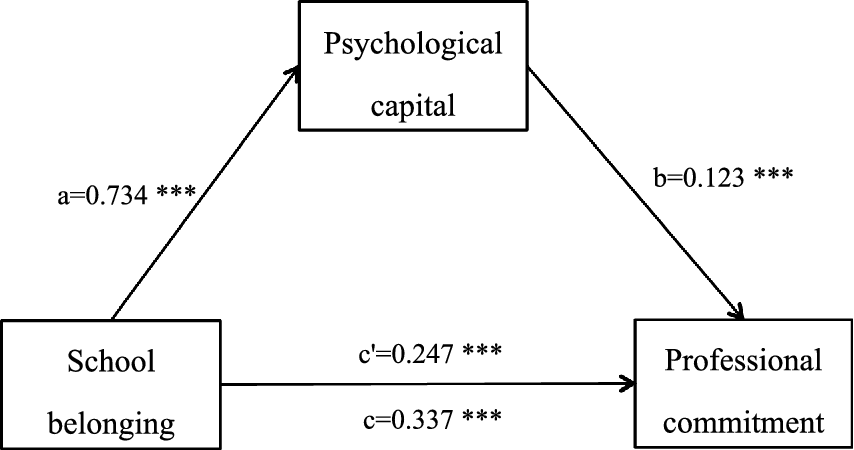
Psychological capital’s mediating role between school belonging and professional commitment. ***p < 0.001.
4 Discussion
4.1 Professional commitment among undergraduate nursing students and its influencing factors
The professional commitment of undergraduate nursing students was at a moderate level, consistent with findings by Ahmadzadeh-Zeidi et al. (2024). Among the dimensions, students scored highest in “professional effort willingness” and lowest in “professional positive evaluation.” This indicates that students are generally willing to invest effort into their professional growth but need stronger identification and positive views about nursing. Nursing educators and administrators should recognize this issue and implement targeted interventions to enhance students’ professional commitment and career willingness. The study identified several factors associated with professional commitment among undergraduate nursing students. Second-year students showed the highest professional commitment, consistent with research by Zhang et al. (2024). This may be because second-year students are at a critical stage of developing professional identity. They have a stable initial understanding of the profession but have not yet faced significant academic pressures. Moreover, they are starting core courses and clinical practice, improving both theoretical knowledge and practical skills. Students who selected nursing as their first-choice major had higher professional commitment. According to Vroom’s Career Motivation Theory (Vroom, 1964), initial career choice significantly influences students’ professional identity and development. Students with nursing as their first choice usually have a clearer understanding and stronger interest in the profession. Thus, they tend to be more resilient when facing academic and career challenges. Concerns about future employment correlated with lower professional commitment. This may relate to nursing’s demanding work intensity (Ren et al., 2022), limited career development opportunities (Liu et al., 2021), and low public recognition of the profession (Chen et al., 2025). Such factors can lead students to worry about their career prospects, reducing their professional commitment (Ayaz-Alkaya et al., 2018). Clinical clerkship experience was associated with higher professional commitment scores, supporting findings from a study among Turkish undergraduate nursing students. Clinical internships enhance students’ professional identity and competencies by immersing them in real clinical environments and engaging them in patient care early. This experiential learning strengthens their understanding of their future roles, deepening professional commitment. Nursing educators should emphasize career development education, understand students’ professional attitudes, increase early practice opportunities, and develop targeted training programs. Additionally, enhancing mental health education to alleviate employment anxiety and improving public perceptions through promotional activities can help students better appreciate the nursing profession and build a stronger professional identity.
4.2 Relationships among school belonging, psychological capital, and professional commitment
Students’ school belonging was at a moderate to high level, consistent with previous studies (McKenna et al., 2013). The “school recognition” dimension had the highest score, indicating that students generally feel their academic efforts and personal values are acknowledged, strengthening their belonging. However, the “sense of responsibility” dimension had the lowest scores, which warrants attention. The sense of responsibility reflects students’ identification with and willingness to contribute to their school. Lower scores in this dimension may result from issues related to curriculum design, campus culture, or student-faculty interactions. Correlation analyses demonstrated a positive association between school belonging and professional commitment, consistent with prior studies such as those conducted by Li and Shi (2021). Students with a heightened sense of school belonging exhibited stronger professional identification, enhanced academic motivation, and clearer vocational objectives. Such positive psychological states help students maintain commitment and consistency in professional learning, crucial for improving nursing education quality. Therefore, nursing educators should promote collective activities, enhance campus culture, and encourage volunteer service to increase students’ sense of responsibility.
Levels of psychological capital among nursing students were observed to be moderate to high, aligning with previous research outcomes (Terry et al., 2019). The dimension of “self-efficacy” received the highest score, indicating that nursing students possess considerable confidence in managing academic responsibilities. Conversely, the lowest scores were observed in “resilience,” suggesting that certain students may need additional support to strengthen their stress-coping abilities, particularly in response to academic and professional challenges. Additionally, psychological capital exhibited a significantly positive correlation with professional commitment, in alignment with findings from Yu et al. (2023). Higher psychological capital correlated with more favorable professional attitudes, including stronger commitment to learning, clearer professional identification, and well-defined career ambitions. Self-efficacy, a fundamental component of psychological capital, is influential in shaping students’ decisions and effort exerted toward academic and professional tasks. Students with strong self-efficacy adopt more active learning strategies and show greater resilience and problem-solving ability when facing difficulties (Altıntaş et al., 2024). It is suggested that nursing educators focus on cultivating students’ self-efficacy, practical skills, and career planning awareness to enhance their psychological capital.
4.3 The partial mediating role of psychological capital between school belonging and professional commitment
The findings show that school belonging was positively associated with professional commitment, with psychological capital partially mediating this relationship. A strong sense of school belonging was linked to higher psychological capital, and higher psychological capital was linked to greater professional commitment. Bandura’s Social Cognitive Theory states that the environment, the individual, and behavior interact dynamically. School belonging, as a key environmental factor, reflects how well students identify with and integrate into the school. It directly influences their learning attitudes and behaviors. Research in Australia has shown that school belonging is an important indicator of whether nursing students can successfully complete their studies (Middleton et al., 2021). Albloushi et al. (2019) also reported that students with a stronger sense of belonging adapt better to the clinical and campus environment, which strengthens motivation and professional identity. Beyond the direct effect, school belonging can indirectly influence professional commitment through psychological capital. Woo and Park’s (2017) study found that higher psychological capital improves professional satisfaction. Students who feel supported and recognized by their institution tend to develop greater confidence, maintain optimism, and persist more effectively through challenges. These psychological strengths contribute to higher psychological capital, which further reinforces their belief in building meaningful nursing careers. Therefore, it is recommended that nursing educators help students enhance psychological capital through mental health education, career planning guidance, team-building activities, and alumni engagement. At the same time, when teachers provide academic and emotional support, when parents participate actively, and when counselors and administrators strengthen school relationships and leadership, students’ sense of belonging increases (Turan Bora and Akbaba Altun, 2025), thereby further improving their paths toward professional commitment.
5 Limitations and future research
There are several limitations of this investigation that should be recognized. Firstly, due to the cross-sectional methodology employed, causal interpretations regarding the studied variables cannot be conclusively established. Secondly, the reliance on convenience sampling involving participants from merely two universities within a single geographic region restricts the external validity and applicability of the results. Therefore, subsequent studies should employ longitudinal or experimental methodologies and involve broader and more representative samples to verify the causal directions and enhance the generalizability of the observed associations.
Despite these limitations, the findings offer a compelling impetus for further research. Given the established roles of psychological capital and school belonging, researchers should develop targeted interventions. For example, programs that enhance psychological capital, such as resilience training, mentorship initiatives, and simulation-based exercises promoting self-efficacy, could be systematically implemented and evaluated. Similarly, interventions aimed at increasing school belonging, including team-building activities, volunteer programs, and structured alumni engagement, need rigorous testing. Future studies should evaluate the feasibility and effectiveness of such interventions, which would help determine whether they can meaningfully improve professional commitment, academic performance, and career intentions.
6 Conclusions and implications
This study revealed a positive association between school belonging and professional commitment among undergraduate nursing students, with psychological capital playing a partial mediating role in this relationship. These findings hold significant theoretical and practical implications. Theoretically, this study reveals the relationships among school belonging, psychological capital, and professional commitment, providing a theoretical basis for subsequent research. In addition, by exploring the mediating effect, it deepens the understanding of the formation mechanism of professional commitment. Meanwhile, the method adopted in this study offers a reference for similar research and contributes to promoting the in-depth development of quantitative research in the field of nursing education. Practically, this study provides new insights into enhancing the professional commitment of nursing undergraduates. Firstly, given the positive impact of school belonging on psychological capital and professional commitment, universities can strengthen students’ sense of school identification and emotional bonds by optimizing campus culture, expanding student club activities, and enhancing teacher-student interaction. Secondly, nursing educators should emphasize cultivating students’ psychological capital. For instance, they can offer mental health courses, organize group psychological counseling, conduct positive psychological training, and provide personalized development guidance to help students establish a positive self-perception, improve psychological resilience, and cultivate an optimistic attitude and a goal-oriented sense of hope. In conclusion, nursing managers and educators can take two approaches—strengthening school belonging and developing psychological capital—to improve the professional commitment of undergraduate nursing students, thereby promoting the stability and sustainable development of the nursing workforce.
Statements
Data availability statement
The raw data supporting the conclusions of this article will be made available by the authors, without undue reservation.
Ethics statement
The studies involving humans were approved by the Medical Committee of Affiliated Renhe Hospital of China Three Gorges University. The studies were conducted in accordance with the local legislation and institutional requirements. The ethics committee/institutional review board waived the requirement of written informed consent for participation from the participants or the participants’ legal guardians/next of kin because written informed consent was waived by the Institutional Review Board because the study involved minimal risk, participation was entirely voluntary, and informed consent was implied through the completion and return of the questionnaire.
Author contributions
YL: Data curation, Investigation, Software, Writing – original draft, Methodology, Project administration, Writing – review & editing. XG: Conceptualization, Supervision, Writing – review & editing. HL: Data curation, Investigation, Software, Writing – review & editing.
Funding
The author(s) declared that financial support was received for this work and/or its publication. This work was supported by the Provincial-level Teaching Reform Research Project of Hubei, China (2024; Grant No. 2024255).
Conflict of interest
The author(s) declared that this work was conducted in the absence of any commercial or financial relationships that could be construed as a potential conflict of interest.
Generative AI statement
The author(s) declared that Generative AI was not used in the creation of this manuscript.
Any alternative text (alt text) provided alongside figures in this article has been generated by Frontiers with the support of artificial intelligence and reasonable efforts have been made to ensure accuracy, including review by the authors wherever possible. If you identify any issues, please contact us.
Correction note
A correction has been made to this article. Details can be found at: 10.3389/fpsyg.2026.1785610.
Publisher’s note
All claims expressed in this article are solely those of the authors and do not necessarily represent those of their affiliated organizations, or those of the publisher, the editors and the reviewers. Any product that may be evaluated in this article, or claim that may be made by its manufacturer, is not guaranteed or endorsed by the publisher.
Footnotes
References
1
Ahmadzadeh-Zeidi M. J. Rooddehghan Z. Haghani S. (2024). The relationship between nurses' professional commitment and missed nursing care: a cross-sectional study in Iran. BMC Nurs.23:533. doi: 10.1186/s12912-024-02196-1,
2
Albloushi M. Ferguson L. Stamler L. Bassendowski S. Hellsten L. Kent-Wilkinson A. (2019). Saudi female nursing students experiences of sense of belonging in the clinical settings: a qualitative study. Nurse Educ. Pract.35, 69–74. doi: 10.1016/j.nepr.2019.01.008,
3
Aloufi M. A. Jarden R. J. Gerdtz M. F. Kapp S. (2021). Reducing stress, anxiety and depression in undergraduate nursing students: systematic review. Nurse Educ. Today102:104877. doi: 10.1016/j.nedt.2021.104877,
4
Altıntaş S. Çelik S. Karahan E. Uçar Ö. Yücel M. (2024). Investigation of the relationship between the self-efficacy levels in clinical practice and coping behaviors with stress among international nursing students. Nurse Educ. Today143:106366. doi: 10.1016/j.nedt.2024.106366
5
Ayaz-Alkaya S. Yaman-Sözbir Ş. Bayrak-Kahraman B. (2018). The effect of nursing internship program on burnout and professional commitment. Nurse Educ. Today68, 19–22. doi: 10.1016/j.nedt.2018.05.020,
6
Bandura A. (1978). The self-system in reciprocal determinism. Am. Psychol.33, 344–358. doi: 10.1037/0003-066X.33.4.344
7
Baumeister R. F. Leary M. R. (1995). The need to belong: desire for interpersonal attachments as a fundamental human motivation. Psychol. Bull.117, 497–529. doi: 10.1037/0033-2909.117.3.497,
8
Burger K. (2023). Disentangling the interplay of the sense of belonging and institutional channels in individuals' educational trajectories. Dev. Psychol.59, 30–42. doi: 10.1037/dev0001448,
9
Chang H. Y. Lee I. C. Chu T. L. Liu Y. C. Liao Y. N. Teng C. I. (2019). The role of professional commitment in improving nurses' professional capabilities and reducing their intention to leave: two-wave surveys. J. Adv. Nurs.75, 1889–1901. doi: 10.1111/jan.13969,
10
Chang H. Y. Shyu Y. L. Wong M. K. Chu T. L. Lo Y. Y. Teng C. I. (2017). How does burnout impact the three components of nursing professional commitment?Scand. J. Caring Sci.31, 1003–1011. doi: 10.1111/scs.12425,
11
Chen X. Li J. Arber A. Qiao C. Wu J. Sun C. et al . (2025). The impact of the nursing work environment on compassion fatigue: The mediating role of general self-efficacy. Int. Nurs. Rev.72:e13044. doi: 10.1111/inr.13044,
12
Cui Y. Zhang L. Zhang D. Fang J. Patel S. E. (2025). Sinicization and reliability test of the nursing school belongingness scale. J. Nurs. Sci.40, 5–8. doi: 10.3870/j.issn.1001-4152.2025.02.005
13
Feng X. J. Chai X. H. Liu H. Li X. X. Heng C. N. Tong J. H. et al . (2024). Serial multiple mediation of psychological capital and self-directed learning ability in the relationship between perceived stress and professional identity among undergraduate nursing students in China: a cross-sectional questionnaire survey. BMC Med. Educ.24:1450. doi: 10.1186/s12909-024-06459-y,
14
Hao J. 2008 A correlational study on the current status of college students' sense of school belonging and their mental health level. [Master's thesis, Liaoning Normal University].
15
Hu H. Wang C. Lan Y. Wu X. (2022). Nurses' turnover intention, hope and career identity: the mediating role of job satisfaction. BMC Nurs.21:43. doi: 10.1186/s12912-022-00821-5,
16
Kotb A. H. A. Shazly M. M. Mostafa H. A. (2024). Psychological capital educational program and its effect on nurse interns' innovative behavior. BMC Nurs.23:544. doi: 10.1186/s12912-024-02192-5,
17
Lee C. J. Huang J. (2021). The relations between students' sense of school belonging, perceptions of school kindness and character strength of kindness. J. Sch. Psychol.84, 95–108. doi: 10.1016/j.jsp.2020.12.001,
18
Li F. Ning L. Li S. Fu Y. Wang Y. Deng Q. et al . (2023). Latent profiles of nursing students' professional identity and their relationship with stress and coping styles during clinical practicum. Nurse Educ. Pract.73:103840. doi: 10.1016/j.nepr.2023.103840,
19
Li W. Shi Q. H. (2021). How the sense of school belonging affects the learning commitment of college students majoring in teacher education—a mediation effect analysis based on professional commitment. Educ. Sci.37, 82–89.
20
Lian R. Yang L. Wu L. (2005). The relationship between college students' professional commitment, learning burnout, and scale development. Acta Psychol. Sin.37, 632–636.
21
Liu Y. Aungsuroch Y. Gunawan J. Zeng D. (2021). Job stress, psychological capital, perceived social support, and occupational burnout among hospital nurses. J. Nurs. Scholarsh.53, 511–518. doi: 10.1111/jnu.12642,
22
Liu Y. Y. Fu C. Q. (2024). The mediating role of school belonging in undergraduate nursing students’ comprehension of social support and psychological resilience. Chin. Nurs. Educ.21, 47–52. doi: 10.3761/j.issn.1672-9234.2024.01.008
23
Liu Y. Ma S. Chen Y. (2024). The impacts of learning motivation, emotional engagement and psychological capital on academic performance in a blended learning university course. Front. Psychol.15:1357936. doi: 10.3389/fpsyg.2024.1357936,
24
Lu K. Y. Chiou S. L. Chang Y. Y. (2000). A study of the professional commitment changes from nursing students to registered nurses. Kaohsiung J. Med. Sci.16, 39–46.
25
Lu H. Zhao Y. While A. (2019). Job satisfaction among hospital nurses: a literature review. Int. J. Nurs. Stud.94, 21–31. doi: 10.1016/j.ijnurstu.2019.01.011,
26
Luthans F. Youssef-Morgan C. Avolio B. (2018). Psychological capital (2, WangL. (Trans.) Beijing: China Light Industry Press.
27
Lv G. Y. Qiu X. L. (1998). A study of nursing students' professional commitment. Nurs. Res.6, 109–120.
28
McKenna L. Gilmour C. Biro M. A. McIntyre M. Bailey C. Jones J. et al . (2013). Undergraduate midwifery students' sense of belongingness in clinical practice. Nurse Educ. Today33, 880–883. doi: 10.1016/j.nedt.2012.09.009,
29
Middleton R. Fernandez R. Cutler N. Jans C. Antoniou C. Trostian B. et al . (2021). Students' perceptions of belonging in the School of Nursing at a regional university in Australia. Nurse Educ. Today99:104817. doi: 10.1016/j.nedt.2021.104817,
30
Parviniannasab A. M. Bijani M. Dehghani A. (2022). The mediating role of psychological capital in relations between spiritual well-being and mental health among nursing students. BMC Psychol.10:230. doi: 10.1186/s40359-022-00935-0,
31
Preacher K. J. Hayes A. F. (2004). SPSS and SAS procedures for estimating indirect effects in simple mediation models. Behav. Res. Methods Instrum. Comput.36, 717–731. doi: 10.3758/BF03206553,
32
Preacher K. J. Kelley K. (2011). Effect size measures for mediation models: quantitative strategies for communicating indirect effects. Psychol. Methods16, 93–115. doi: 10.1037/a0022658,
33
Ren Y. Gao F. Ma D. (2022). The relationship between nurses' different sources of social support and work-family balance. Chin. Ment. Health J.36, 519–525. doi: 10.3969/j.issn.1000-6729.2022.06.012
34
Ren H. Li P. Xue Y. Xin W. Yin X. Li H. (2024). Global prevalence of nurse turnover rates: a Meta-analysis of 21 studies from 14 countries. J. Nurs. Manag.2024:5063998. doi: 10.1155/2024/5063998,
35
Terry D. Peck B. Smith A. Nguyen H. (2019). Occupational self-efficacy and psychological capital amongst nursing students: a cross sectional study understanding the malleable attributes for success. Eur. J. Investigat. Health Psychol. Educ.10, 159–172. doi: 10.3390/ejihpe10010014,
36
Turan Bora H. Akbaba Altun S. (2025). Fostering students' sense of school belonging: emotional intelligence and socio-ecological perspectives. J. Intelligence13:112. doi: 10.3390/jintelligence13090112,
37
Vroom V. H. (1964). Work and motivation. New York: Wiley.
38
Woo C. H. Park J. Y. (2017). Specialty satisfaction, positive psychological capital, and nursing professional values in nursing students: a cross-sectional survey. Nurse Educ. Today57, 24–28. doi: 10.1016/j.nedt.2017.06.010,
39
Wu M. L. (2010). Structural equation modeling: Operation and application of AMOS. 2nd Edn. Chongqing: Chongqing Medical University Press.
40
Yu S. Li W. Yu H. Ju X. Ling C. (2023). The relationship between learning burnout, professional commitment, and psychological capital in undergraduate clinical medical students. Medicine102:e35207. doi: 10.1097/MD.0000000000035207,
41
Zhang X. Chen Y. Li B. Jiang L. Lang X. Zeng T. (2024). The association between school educational atmosphere, learning engagement, and professional commitment of nursing students, and learning engagement as the mediator. Nurse Educ. Today139:106223. doi: 10.1016/j.nedt.2024.106223,
42
Zhang K. Zhang S. Dong Y. H. (2010). Positive psychological capital: measurement and its relationship with mental health. Stud. Psychol. Behav.8, 58–64.
43
Zou L. Xie Z. Tan M. Ou Q. Liao M. (2024). The effect of professional identity on nursing academic achievement: the chain mediating effect of general self-efficacy and learning engagement. BMC Med. Educ.24:1014. doi: 10.1186/s12909-024-05995-x,
Summary
Keywords
mediation, professional commitment, psychological capital, school belonging, undergraduate nursing students
Citation
Lan Y, Gao X and Liu H (2026) The role of psychological capital as a mediator in the relationship between school belonging and professional commitment among undergraduate nursing students. Front. Psychol. 16:1702516. doi: 10.3389/fpsyg.2025.1702516
Received
15 September 2025
Revised
06 December 2025
Accepted
10 December 2025
Published
06 January 2026
Corrected
02 February 2026
Volume
16 - 2025
Edited by
Eduardo Hernández-Padilla, Autonomous University of the State of Morelos, Mexico
Reviewed by
Yazan Kenjrawi, Syrian Virtual University, Syria
Ramon Vargas-Vera, University of Guayaquil, Ecuador
Updates
Copyright
© 2026 Lan, Gao and Liu.
This is an open-access article distributed under the terms of the Creative Commons Attribution License (CC BY). The use, distribution or reproduction in other forums is permitted, provided the original author(s) and the copyright owner(s) are credited and that the original publication in this journal is cited, in accordance with accepted academic practice. No use, distribution or reproduction is permitted which does not comply with these terms.
*Correspondence: Yuting Lan, 745945579@qq.com; Xuenong Gao, 821913695@qq.com
Disclaimer
All claims expressed in this article are solely those of the authors and do not necessarily represent those of their affiliated organizations, or those of the publisher, the editors and the reviewers. Any product that may be evaluated in this article or claim that may be made by its manufacturer is not guaranteed or endorsed by the publisher.