 Charles Mountifield
- Faculty of Health, University of Canberra, Canberra, ACT, Australia
This paper reviews some mainstream meso-level policy analysis frameworks widely applied in sport. There is, however, an absence of consensus for an established framework for analysing sport policy in general and, instead, techniques emanating from other fields of study have been relied upon. The resultant approach to sport policy analysis is inconsistent, multidimensional, and lacks unanimity, leading to calls for a sport-specific framework. This research outlines how meso-level frameworks have been applied in sport policy and issues linked to sustainability from a grassroots policy perspective. A narrative literature review provides an overview of prevalent approaches, namely Institutional Analysis, the Multiple Streams Framework, Policy Network Theory, and the Advocacy Coalition Framework. Aspects of applying these models to sport policy—including some key advantages and disadvantages—are outlined, especially the issue of conventional top-policy processes, the impact on policy implementers at grassroots level, and the potential for bottom-up policy influence. The article examines the four frameworks in the context of praxes in sport, noting the overall importance of a meso-level approach to sport policy analysis and that arriving at an holistic and inclusive accord has merit.
Introduction
The sport sector is an increasingly complex, multifaceted and dynamic area (1–3) and is accompanied by a growing government influence in sport policy (4–6). The literature on sport policy, however, indicates a dearth of development in policy analysis frameworks that target sport exclusively. Indeed, while the application of frameworks is fundamental to research in sport (7–12), an absence of theoretical improvement of policy analysis frameworks in sport is evident (4, 13, 14). Similarly, there is only limited research in relation to the complexities of policy implementation—defined as “the process of interaction between the setting of goals and the actions geared to achieve them” (15)—in sport at grassroots level (16–19). For the purposes herein, grassroots sport is defined as the elementary layer of sport (20) taking place at the community level (21), and where there is evidence of the complexities associated with sport policy implementation (22–24).
The resultant effect of the sport policy situation is that topical analysis relies on frameworks drawn from other disciplines (4, 25, 26). Indeed, the trend has been toward adapting methods for sport policy analysis that are ordinarily applied in a non-sporting context (14). This scenario leads to issues with an inconsistent approach to policy analysis in sport, including the experiences at ground level (16, 27), partly because of the typically top-down nature of the policy process (28, 29). Scant attention has been given to the sport policy process, especially the reality of policy implementation (16, 27, 30, 31), including identifying causal mechanisms or independent variables that impact implementation performance (32, 33). With issues such as a reliance on policy frameworks from non-sporting disciplines, discrepancies with the policy process, and implementation concerns, there is merit in exploring a greater understanding of the impact of policy frameworks, especially from the perspective of the sustainability of grassroots sport.
Significance
Policy implementation in sport, especially that at grassroots level, involves a series of issues for those involved in the policy process (16, 24, 34) and in some situations, leads to a paradox as a result of differing stakeholder priorities (20). Such a situation points to a degree of friction in relation to conventional top-down policy processes, the impact on policy implementers at grassroots level, and the potential for a more consistent and holistic application of policy (35–37). The significance of the situation is such that there have been calls to develop a unique framework for sport policy analysis (14). From a governance perspective, policy analysis is an essential tool for managing sport (12), and there is a need to structure policy in ways that enhance the potential for sport to benefit individuals and communities (37, 38), hence the concerns relating to top-down policy (14, 37).
To gain an understanding of the policy process, alongside the potential significance of a dedicated sport policy analysis framework, four mainstream meso-level frameworks commonly applied [see, for example (4, 26),] in sport policy analysis—the Institutional Analysis model, the Multiple Streams Framework, the Policy Network Theory model, and the Advocacy Coalition Framework—are discussed in light of the need to identify and address issues impacting sport. Said frameworks are considered as a result of the recent application in a sport setting (14, 26, 37). The frameworks are evaluated on the basis of their application in policy settings in general, followed by sport-specific examples to provide context and a point for comparison. That said, the evaluation of the frameworks is non-exhaustive—a complete analysis is beyond the scope of this paper—and the outline provided herein seeks to illuminate general aspects of each framework with a view to informing future research. With that context, this review is guided by the following research question: What influence do mainstream meso-level policy frameworks have on the sport policy process and the sustainability of grassroots sport?
Method
Based on a qualitative approach, this paper seeks to provide a descriptive overview of policy frameworks commonly applied in the sport domain. To achieve this objective and to address the research question, the paper adopts a narrative review format review (39) and provides an outline of the four meso-level frameworks in a general context and their links to sport policy. Narrative reviews highlight connected events and describe topics from an essentially contextual position (40). Further, narrative reviews provide a succinct outline of literature and a platform to stimulate further research (41). Ultimately, with regard to the policy focus of this paper, the objective is to provide interpretation and critique intended to deepen understanding with a purposive selection of evidence (42).
Data collection
The narrative review considered peer-reviewed journal articles and books/book chapters. The data was collected based on simple searches through Google Scholar and academic institution libraries, the latter of which allowed for specific search terms to be entered. No restrictions on time-frames were set, “gray” literature was not included, and articles with an overt focus on elite sport were excluded. The key search terms applied were bottom-up policy, community sport, grassroots sport, meso-level, policy frameworks, sport, sport policy, and top-down policy.
Delimitations
In the first instance, this paper does not offer a comprehensive analysis. As a narrative review, the purpose is to provide a descriptive, not systematic, outline of the situation. Narrative reviews are not designed to be conclusive but instead provide a platform for further research (39). Unlike systematic reviews, for example, there are fewer guidelines governing narrative reviews (253). Researchers choose what should be the focus of the review and what will be included in order to offer useful research (255). Indeed, such literature reviews are almost always selective, non-exhaustive, and involve less demanding search methods (39).
Literature review
The narrative review is divided into five sections consisting of Policy Background, the Institutional Analysis (IA) model, the Multiple Streams Framework (MSF), the Policy Network Theory (PNT) model, and the Advocacy Coalition Framework (ACF).
Policy background
Historically, analyses of sport policy have addressed a range of matters including political issues such as foreign affairs, developments relating to governance, and concerns relating to equality, such as people with disabilities (43) and, more recently, issues relating to physical fitness and health, participation in sport, and general welfare (26). The scope of policy analysis includes analysing data on government policy intentions and the efficacy of government initiatives (4, 19, 44). Such analysis has consistently stressed the fact that government investment in sport is inconsistent (45–47), yet given government policy on health and participation, sound policy processes and evaluation might be considered essential to sport policy architects (6, 12, 48). Consequently, although government intervention in sport policy, including defining strategies and subsequent evaluation, has been the subject of academic enquiry, few analyses have addressed sport policy effectively (14, 49). In that context, a greater awareness of the stages of the policy-making process and the nature of policy subsystems—defined by the diversity and number of stakeholders and their policy focus (50–52)—can help policymakers leverage sport's inextricable role in society (12, 53, 54) and to address issues pertaining to macro-political agenda-setting (37).
From the perspective of understanding sport's relationship to society—its social role, especially at grassroots level (54–56)—it is useful to recognize the utility of mainstream analytical frameworks in the policy process, particularly to appreciate why the theoretical constructs of sport policy are based on the importance of meso-level assessment, as opposed to macro or micro-level approaches. An initial consideration is that sport policy serves aspects of more general public policy, particularly concerning community policy matters, where meso-level frameworks are commonly applied (57–59). Labelled as “policies that originate within, or are dependent upon the resources of, the state” (4), public policy significantly shapes sport policy (37, 60). Informed by macro-level theorising and micro-level evaluation, the direction for robust analysis is linked to policy analysis at the meso-level (61, 62). All meso-level frameworks incorporate macro-level assumptions, and when considering an analytical framework, any structure also needs to adequately cater for matters of stability and change (62, 63), no less so than in the sport policy process (64). Indeed, the scope for expounding the process of change, and a drive toward stability, is of particular importance in any analysis because there is evidence of regular and rapid change in sport policies and subsequent objectives globally (4), and in Australia (47, 65–67).
In identifying and illuminating numerous variables that make up the creation of policy, several analytical frameworks have an explicit focus on key stages of the process but are lacking when investigating the connection, and often interdependency, between key stakeholders (4). Further, there is consideration of contemporary policy-making and (a) assessing the nature of application of meso-level frameworks across various disciplines (4) and (b) that the frameworks have been subject to germane level of examination of their value as models for sound analysis of the policy process (62, 68). Sabatier (68) and Houlihan (4) provided a benchmark to gauge the merit of a meso-level approach to policy analysis, as per Table 1.
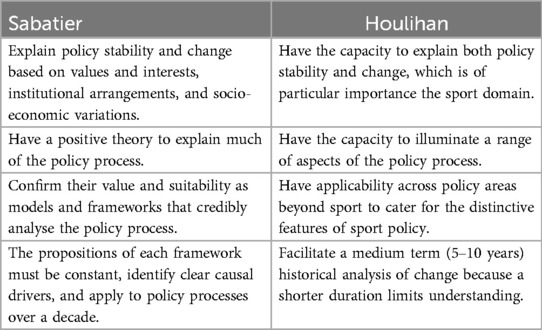
Sabatier's (68) model supports generic policy analysis, whereas Houlihan's (4) version provides detail relating to sport; there is an emphasis on the conditions of stability and change in sports-related policy (64) due in part to “constant reviews of sports policy in many developed countries” (4). Such a scenario is in keeping with policy review processes in non-sporting disciplines in general which are very much subject to regular evaluation (69, 70). Indeed, policy processes and systems are complex (68, 71), challenged by a range of variables that disrupt the policy process. Such variables include (i) numerous and diverse stakeholders; (ii) timeframes for policy creation, implementation, and evaluation; (iii) involvement of government and the impact of strategies and objectives; (iv) conflict relating to issues and effect of policy change, and (v) coercive relationships directing the policy process (68). Due to the challenging nature of policy-making (14), such wide-ranging variables make it extremely difficult for the analysis to fully address every aspect of the process. In the following section, IA, the MSF, PNT, and the ACF, are outlined for understanding and addressing policy with a particular focus on policy implementation in sport and the impact of political, social, and cultural structures on the policy process (14).
Institutional analysis
Applied extensively in the policy realm, IA represents a robust meso-level framework that examines institutional pressure on stakeholder conduct by way of a range of regulations and behavioral norms (72–74). Institutionalisation embodies a phenomenon through which stakeholders consent to a collective view leading to legitimisation, which occurs “whenever there is reciprocal typification of habitual actions by types of actors [stakeholders]” (75). From the perspective of research into the policy process, institutions form a central aspect of the arena within which policy-making takes place (63). IA provides estimable understanding of the role of institutional guidance—and coercion—and the resultant behavior of stakeholders (76); indeed, a key attribute of IA is that it facilitates the concurrent evaluation of stakeholder conduct and the establishment in which they operate (77, 78). The formation of an institutional collective relies upon the (a) resources brought to a situation, (b) value assigned to actions, (c) way knowledge and information are acquired and used, and (d) processes and justification for particular courses of action (76). In turn, the realisation of a collective accelerates the concept of an institution (79–81), particularly when considering the institutional nature of sport, both globally (82–87) and in Australia (66, 88–90).
In light of the multiple variables involved, a sound approach for the interpretation and role of institutions in the policy process is necessary (4). Institutions can be defined as (a) organisational entities such as government agencies (e.g., the Australian Sports Commission) and (b) cultural constructs with values and beliefs amongst stakeholders (4). Further, institutions occupy an official place from a legislative or procedural perspective, and are also seated more informally in relation to behavior or customs (76). Within that context, IA focuses on adapting the institutional development process, alongside the reciprocal stakeholder values and beliefs, to resolve policy issues (14). Individually, or as an element of collective, official settings, IA provides an avenue for connecting two or more individuals to align behavior and subsequent action (91, 92), and can help “elucidate the role institutions play in the determination of social and political outcomes” (93).
In terms of the application in a sport setting, IA has been utilized in macro-level analyses, reflected in sport policy literature (94), where the centrality of institutions to the policy-making process is noted (63), and where the significance of the function of institutions in sport policy processes is documented (4, 95–97). O'Brien (98) incorporated IA in a discussion analysing stakeholders working together across unequal governance levels in sport. The imbalance stemmed from the status of government involvement in public policy-making and the attempt to foster a culture of evidence-based policy considerations (98). A noted aspect of the importance of IA in sport policy analysis is based on the reliance many sport organisations have on government resources (14).
Some examples of the strong IA link between government sport policy objectives include national sporting organisations in the United Kingdom (UK), such as Sport England and UK Sport, being heavily influenced by the government and its focus on “modernisation” of sport (99), alongside Scandinavian examples where competitive sport poses an issue from an organisational perspective, and where structural and institutional relationships present challenges for change because they are based on strong “egalitarian” values (100). Other examples of the application of IA include the evaluation of sport development processes and the contribution from political circles, inclusive of local government, and not-for-profit groups (101, 102), along with more recent examples of the conceptualisation of institutional change from an international perspective, and the increasingly topical evaluation policies relating to concussion legislation (103, 104).
At grassroots level, there have been changes in the philosophical foundation of policy together with a strategic shift resulting in the prioritisation of one sport policy objective (e.g., elite sport) over another (e.g., grassroots sport) and the subsequent variation in levels of commitment from different institutions (23, 76). IA offers the potential to commence a process for identifying the key issues confronting grassroots sport (64, 105–108) and within that setting, there is merit in taking grassroots sport clubs as the point of departure in the policy process to build on the sociological perspective of IA (16). Finally, the outcomes emanating from IA are useful in “explaining policy related [sic] actions, interactions and outcomes” (109). Based on such observations, institutions represent independent and intervening variables in the policy-making process (4), a delineation that impacts policy implementation in relation to the differing priorities of implementers vs. government. Indeed, centrally designed policy influences localized implementation, potentially catering for sometimes contradictory but not mutually exclusive perspectives, and offers a potential solution for analysing the implementation process (16).
There is, however, a view that is problematic for IA which is that there is a lack of clarity about what an institution is and what institutionalism means (81). Ostrom's (76) reference to institutional pressures is validated by Thelen's (110) earlier argument that institutions meld the interests of stakeholders based on their relations of power with other stakeholders, which represents constraints and mediating factors in the political arena. Fischer (111) stated aspects of IA pointed to attempts to discreetly manipulate power within institutional structures, and Ostrom (76) recognized numerous organisations were governed by regulations which dictate patterns of interaction for organisations. Cairney (81) proposed that institutions are both the physical structures in which policy is made but also the rules that dictate behavior and how policy is made, with IA providing for a more robust emphasis on regulations, norms, and actions than on conventional arrangements.
The imprecision of IA is in part based on the variations in interpretation, whereas some uncertainties could be dismissed if IA was excluded as a “unified body of thought” (93). From a policy framework perspective, further problems arise because each new framework is perceived as a novel approach to the concept of institutionalism (93). In addition, ensuing deliberations create problems for the theoretical contribution that IA offers because its strength may lie in its multi-theoretical character (112). Thus, rather than strict distinction or disagreement between each version, IA may allow for the assessment of competing propositions drawn from different theories (81, 113). Houlihan (4) points to an historical context to IA, noting the autonomous nature of institutions, which contrasts markedly with resultant constraints enforced on society (114), viz., institutions can restrict options by influencing stakeholder perceptions and interpretations of problems and solutions (4, 115). Further, IA offers a mechanism for the control stakeholder behavior and expectations by addressing issues with generally appropriate methods (116).
Overall, the main disadvantage of IA is the explicit focus on various connected aspects of organisational structures, resulting in a reduced focus on institutional factors (94). In addition, IA generally only facilitates macro-level analysis (14), which is problematic if adopting a emphasis on all stages of policy creation and implementation, particularly the views of stakeholders implementing policy. Further, from a sport policy perspective, IA has been applied to analyse institutional conditions as opposed to technical settings (94) where, for example, the structure of sport organisations and the reliance on government resources results in a scenario where stakeholder behavior is influenced by more than institutional regulations and norms (14). Finally, the presumption that an institution might shape stakeholder opinions, behavior, and interests is potentially inaccurate for policy implementers involved with grassroots sport, where there is a lack of sophistication in terms of the process of implementation (117–119).
Multiple streams framework
Established on a “garbage can” model of organisational choice (120, 121), Kingdon and Thurber's (122) MSF is theoretical paradigm applied in sport policy analysis (14). The concept of policy choice linked to the MSF leads to the garbage can analogy (123), where an array of policy issues, along with potential answers, are discarded (121). Although discussion and reason are fundamental to policy formation (124), the process comes with a degree of complexity where decision-making is characterized as a form of anarchy (125). The MSF emphasizes the chaotic character of organisations involved in policy creation, and political manipulation forms a significant part of the process (4, 51, 126). Indeed, there is a degree of ambiguity and accompanying attempts to regulate such uncertainty, in turn leading to governmental influence that “is more than just persuasion and identity construction” (125). Noting the manipulative and complex nature of the policy-making process (127), the MSF is made up of three distinct streams, namely, problems, policies and politics (51). Further, three additional conventions direct the MSF policy process: (i) individual processing is methodical and concurrent; (ii) there are substantial time limitations; and (iii) the three streams are separate (125).
Based on the key assumptions, the MSF provides an avenue to uncover the connections between individuals that manipulate policy processes, known as policy entrepreneurs, and individuals who are controlled as part of the policy process, the policy-makers (125). Policy entrepreneurs are “more than mere advocates of particular solutions; they are actors [stakeholders] that are power brokers and manipulators of problematic preferences and unclear technology” (125) who try to link the three MSF streams, which is contrary to their ordinarily level of independence (4, 51, 68, 99, 125). Further, policy entrepreneurs address disordered choices that have been created in an imprecise fashion, viz., a chaotic assortment of theories and concepts without any guidelines for implementation (121). Policymakers are those involved in making policies and policy decisions, often members of a government department, legislature, or head of an organisation responsible for making new rules or laws. Policy-makers can also be institutions, as opposed to individuals (128, 129). Often described as experts who consider their role to serve a cause greater than themselves, policy-makers face constant pressure on their cognition and emotion, and need to gather information quickly and effectively (130–133).
In relation to the three streams—problems, policies and politics—the MSF focuses on problems where public stakeholders want solutions, or where policy-makers deem action is required, in contrast to problems that are deliberately disregarded (4, 51). There is also the requirement for consensus to address issues, thus creating a catalyst for ensuring problems become part of a policy agenda (134). The policy stream incorporates a grouping of interrelated stakeholders pursuing a matter of public policy that is important to them for instrumental reasons (135). Alternatively, policy entrepreneurs embrace a particular issue and seek consent for solutions (4), and maintain the salience of a policy issue on the political agenda (95). The political stream occupies a position completely independent of other streams and includes national sentiment, political parties and lobby groups, and government (4, 51, 125). By observing general reactions and opinion, governments are better able to enact specific policy agendas or, conversely, dim the prospects of others (136).
In a sporting context, the MSF has been widely used in sport policy (14) and it is further positioned as a useful platform for sport policy analysis in nations worldwide and with diverse political conditions (4). In terms of policy agendas in sport, limited success on the international stage, declining participation levels, or rising obesity levels, serve as examples of common policy issues, especially based on mainstream initiatives. The scale of specific circumstances, potential for change, and success or failure of existing strategies are focal considerations within the MSF (125). Within that context, the success or otherwise of sport policy “can have a ripple effect through the political system by spilling over into other policy fields” (4), including situations where stakeholders focused on industry-specific initiatives are absorbed into more universal policy directives (60). The enunciation of inclusivity concepts within the sport policy system, however, reveals that sport policy is susceptible to manipulation by political, health and educational interests (137, 138). The matter of rising obesity levels serves as a topical example, demonstrating a direct correlation between declining levels of sport and physical activity and the resultant increase in expenditure on issues related to public health (14). Indeed, the MSF offers insight into the links between physical activity and public policy and helps facilitate a greater understanding of the problem and potential solution (139). Other examples of the MSF evaluation of policy change in physical education policy can be subject to the turnover of government ministers and general bureaucracy (140).
Changes in government and national sentiment can exert a considerable effect on policy agendas (125), pointing to the concept of how events of a political nature can focus attention on the policy process and create opportunities to legitimize sport and shape associated policy (14). By way of example, the accomplishments of British athletes competing at the 2008 Olympic Games in Beijing led to higher levels of government investment in the lead up to the 2012 London Olympics, alongside a general policy shift resulting in significant government support for the staging of an increasing number of international sports events in the UK. In Australia, following the success of the 2000 Sydney Olympics, the Federal government supported the 2016 Commonwealth Games in the Gold Coast and committed to underwrite fifty per cent of the costs for Brisbane to host the 2032 Olympic Games (141). Within that context, the three streams of the MSF link together at critical moments in time, wherein policy choices are made (125). Forming a critical stage of the MSF, the combination of the three streams leads to policy problems achieving recognition by government, and thus greater potential for a solution. For example, in sport there are potential favorable circumstances that relate to funding cycles linked to new polices to, for example, increase participation in physical activity through sport over a set period. Other examples include that of the Brazilian Olympic Committee (BOC) expanded investment possibilities by implementing policies that stimulated preparation for the Olympic and Paralympic Games in 2016 (142). From an MSF perspective, the BOC approach demonstrated the efficacy of the activities of policy entrepreneurs in the high-performance sport policy domain (142). In Australia, policy entrepreneurs have featured in grassroots sport, albeit subject to a complex array of factors internal and external to grassroots sport clubs, in various policy initiatives (13, 143).
In spite of the MSF's application by policy specialists, however, there are criticisms that relate to the assumptions of the framework and the limited perspectives of aspects of the policy process (125). These criticisms include a lack of unambiguous, falsifiable hypotheses within the MSF (62), and that the original “garbage can” model does not elicit robust findings which instead emanate from the MSF assumptions (144). Conversely, outcomes stemming from the MSF were arrived at due to the variations in each of the three streams, linked deliberately by policy entrepreneurs, and where data from different policy areas across various nations has been observed (51, 145, 146). The appropriateness of conceptualising independent streams, however, is debatable and the MSF streams can be deemed mutually dependent, with one prompting variations and modifications in the other(s) (123, 144).
Accordingly, the MSF's aptness for sport policy analysis is brought into question, as evidenced by its limited application (60, 127). Although the framework offers some direction in the policy analysis, that is largely only from a macro perspective, thus impacting its appeal to sport policy research. As a result, the MSF provides limited interpretation of matters relating to policy stability and change (99), particularly due to the claim that the MSF does fully assess policy beyond the initial opportunity (147), instead focussing mainly on formation and disregards other steps, notably matters of implementation (4, 14). Finally, timeframes for change are not an explicit consideration, there is overt attention on the notion that institutional foci influence political agendas (4), and there is an absence of empirical evidence (121). Ultimately, the capacity of the MSF to formulate and assess the complete policy process in sport is constrained; the “model focuses on policy issues, political intervention and solution development” (14).
Policy network theory
PNT provides an avenue to assess numerous variables involved in policy change and the policy-making process as part of policy communities. As an integral component of PNT, a policy community is based on restricted, durable, and interdependent relationships, based on common values and beliefs amongst stakeholders, that form a homogeneous structure with joint accountability for policy implementation (14, 148). In terms of key stakeholders, governments frequently represent the dominant party in a policy community, at the expense of other non-government stakeholders (135, 148). Additional literature relating to PNT suggests it is suitable for investigating the impact on network stability in sport policy processes (149–151), and has the potential to provide a mediatory function between government and non-government stakeholders (152). Although a significant methodology for the analysis of public policy-making (153, 154), however, PNT lacks a single, accepted definition (63, 154, 155). Further, PNT has evolved as a result of undue government influence in the policy process (156), a situation that neglects the views of other stakeholders and the relationships between them (135).
The PNT approach builds on several theoretical frameworks that offer explanatory power of policy networks, both on the level of strategic interaction processes as well as on the level of institutional relations. Policy networks rely on “dependency relationships that emerge between both organisations and individuals who are in frequent contact with each other in particular policy areas” (157). Accordingly, PNT assumes that stakeholders that form a policy community are reliant upon each other to combine resources to achieve objectives (14). Ultimately, this situation benefits each stakeholder in reaching their goals based on mutual understanding (158). Within such policy communities, interaction between non-governmental stakeholders is largely egalitarian (159) and based on “stable patterns of social relations existing between interdependent actors [stakeholders], which take shape around policy problems and/or programmes” (61). There are four key elements that form the basis for PNT: (i) rational decisions, (ii) individual relations, (iii) formal analysis, and (iv) stable structures (160–162).
Understanding the nature of relationships in PNT is impacted by the way power is used, particular in relation to influencing government decisions (135). From the perspective of managing the balance of power, the interaction between stakeholders has led to numerous considerations for influencing the policy process, including the aforementioned policy communities, the concept of iron triangles—constraints based on budget, scope and schedule (163)—and focused issue networks (135). Thus, incorporating the view of power, PNT caters for the incorporating the nature of membership, stages of integration, sharing of resources, and levels of control, in the development of network types (148). Such viewpoints have methodological flaws, including what potentially amounts to overclassification, with designations for one set of circumstances being interchanged and applied to describe completely different phenomena (164). To address the inconsistency, a two-dimensional approach was developed based on dual factors: stakeholders and their interrelations (164). In terms of explaining these factors, there are two key variables: (i) composition element—the characteristics of stakeholders; and (ii) structural element—the forms of stakeholder relationships (164). Alongside the categorisations, the policy area of a network—“the territorial and functional specificities” (164)—incorporate political considerations that impact the ratification and structure of a policy network.
In sport, policy networks are often focused on altering the balance of power in order to influence the policy process by, in part, separating policy discussions from government agendas (14). Such manipulative objectives are often a result of relationship instability amongst unsuitable stakeholder numbers, resulting in the limited application of PNT in sport policy (14). An initial example relates to attempts in Australia, Canada, and the UK to analyse and elite sport policy programs based on global developments (165) where countries “interpret and adapt external policy pressures to their particular national circumstances and history” (166). Further, examination of the status and potential homogenisation of international sports policy results in policies being introduced internally, as part of a process of incorporating sport policy into national objectives (166). Other examples include the application of PNT to understand partnerships and policy development processes in the UK relating to physical education and sport programs, where various partnerships impacted policy outcomes (150). Also, PNT was applied to develop a new form of governance in UK sport to address aspects of interference in education and sport policy communities (167).
Although it is suggested that PNT can assume a mediatory function between government and key stakeholders (152), the model is criticized for its complex approach by combining multiple policies as part of the analysis. While there is the potential to apply top-down and bottom-up processes to provide a more thorough analysis, there is a risk that individual policies are not adequately assessed (158). In addition, the meso-level policy PNT approach creates a need for greater consideration of potentially complementary theoretical application (152), but introducing or merging other macro-level paradigms does not guarantee a sound analysis. Further, such investigation focuses on the associations between stakeholders as opposed to having a focus on the implementation and the consequences of policy; PNT does not have the capacity to address the steps that follow policy implementation (14). There are other issues that relate to PNT that are sometimes characterized by the diverse range of stakeholder interests (148) and on occasion viewed as volatile, unstable, and associated with policy consultation rather than the development of policy (148, 162). Although the categorisation of networks emanating from PNT is often helpful when evaluating various types of stakeholder nexuses at different levels, such methods usually represent radical stakeholder connections, and the practical application does not allow for a comprehensive approach (168).
Advocacy coalition framework
Emerging in the 1980s, the ACF has featured in studies of public policy in many developed nations—both Western and Eastern (68, 169–171)—and increasingly so in developing countries (172, 173). The ACF is a contemporary meso-level framework in the policy realm, intended to expand policy analysis by incorporating a greater range of processes than other frameworks (4, 50, 52, 174–178). The framework provides a method to examine the behavior and attitudes of numerous policy stakeholders by clustering them into advocacy coalitions, formed by a range of stakeholders with common values, beliefs, and perceptions of policy issues, and who establish levels of coordination over time (179).
As an instrument of collective public action designed to address a public problem (180), the ACF is viewed as holistic, with a broad, multi-level focus on the policy process (50, 52) and has been applied in various domains and in numerous regions globally (176, 181, 182). The influence of the ACF on public policy development, implementation and analysis has been significant and has changed and shaped thinking about public policy (183, 184) based on the examination of policy change, policy learning, and the structure and stability of coalitions (147, 172, 184, 185). According to its founder, Sabatier (186) posits that the ACF has at least four basic premises: (i) policy change can take ten years or more; (ii) policy change occurs through subsystems involving the interaction of stakeholders seeking to influence government; (iii) the subsystems involve all levels of government; (iv) policies are conceptualized in conjunction with beliefs (186).
The format of the ACF is based on three key foundations, as follows: (i) a macro-level understanding that policy-making is based on the stability of behavior of key stakeholders in a policy subsystem is; (ii) a meso-level assumption that analysing stakeholder behavior is best achieved by clustering them into advocacy coalitions; and (iii) a micro-level approach to the beliefs of each stakeholder in a policy subsystem (50). The make-up of an advocacy coalition relies principally upon the alignment of beliefs which in turn generate the enthusiasm necessary to stir stakeholders into action—such stakeholders often engage in political activity to translate beliefs into action (184)—and it is the fundamental beliefs of implementing stakeholders involved in policy that lead to understanding the policy implementation process. The ACF encourages a fusion of top-down and bottom-up elements to better understand key aspects of the policy process (187–190). The top-down perspective is based on the influence of dominant parties in policy creation process and the fulfilment by those stakeholders responsible for implementing policy. The bottom-up approach argues that a sound process relies upon effective policy implementation; thus, the policy process should commence at the bottom and influence policy creation from that position (191).
Conventionally, a top-down approach to the policy process is based on a centralist model of policy creation and suggests that the likelihood of success at the implementation stage is based on the ultimate compliance of those implementing policy (192–194). In opposition to the top-down method, bottom-up theory focusses on the perceptions of grassroots stakeholders, or “street-level bureaucrats” (195, 196), the logic being that stakeholders responsible for implementation are also key to policy outcomes. Further, the bottom-up approach is based on the skills and abilities of stakeholders to arrive at a consensus, based on common values and beliefs, to constructively impact the environment and the associated implementation process. Supporters of bottom-up theory argue that it is a more realistic and progressive approach due to the focus on the perspectives and subsequent actions of street-level implementers (191). The decisions and routines of stakeholders responsible for policy implementation are determined by the burden of said implementation, a situation that is more challenging with a solely top-down policy process. Such conditions result in part from the paradox of the grassroots, street-level implementer: while the actions of policy implementers need to be orchestrated to realize policy aims based on the nature of policy creation as part of the political process, the effort of implementers also requires improvisation and responsiveness to individual circumstances (74).
In terms of examples in sport, the ACF has been operationalized by several researchers (175, 177, 197, 198) with numerous specific attempts to evaluate sport policy through the ACF (16, 199, 200). Significant research has been dedicated to the varying levels of commitment from the government to, for example, elite sport vs. grassroots sport (201). In their analysis of Canadian and UK examples, Green and Houlihan (177) found the ACF useful in understanding the process of change and policy making in elite sport. Further, the analysis of policy subsystems highlighted complex dealings between the respective national governments and sport organisations seeking to advance systems for elite sport, and it was noted that stakeholder beliefs were crucial in the process of change occurring over many years. The element of time, as per Sabatier (186), was noted by Houlihan and Green (99) where the changing status of sport policy in schools in the UK was analysed. In the European Union (EU), Parrish (202) assessed aspects of law relating to sport and identified two advocacy coalitions; the Single Market coalition, the dominant sport policy subsystem in the EU that, based on clear capitalist foundations, supported the commercialisation of sport, along with a socio-cultural coalition responsible for influencing sport policy generally (202). More recently, Fahlén and Skille (175) applied the ACF to assess policy processes impacting Sami sport, in Norway, and Yilmaz (198) examined the beliefs of coalition stakeholders in the EU and issues regarding aspects of integrity relating to agents in sport.
Despite the above examples, there are numerous challenges associated with the ACF in policy analysis. Firstly, the framework lacks sound consideration of the influence of institutions in the policy process (16), a potentially substantial oversight when considering institutional influence on stakeholders (203). Within that context, belief systems are considered more important than institutional affiliations (62), giving rise to a problematic view that belief systems do not guarantee a robust foundation for interaction within an advocacy coalition (14). Although a coalition may engage in activities in a synchronized fashion to achieve a common goal, they may not be not “jointly agreed upon” (204), such as monitoring other stakeholders' resources or strategies and shifting their behavior accordingly (205).
With issues linked to harmonising stakeholder beliefs within an advocacy coalition, it is difficult to identify a pathway for a coordinated approach to policy implementation at ground level. For example, beliefs stemming from grassroots sport issues would likely conflict with elite sport policy beliefs, thus impacting the potential for policy stability as part of a coalition structure. The ACF implies that stability relies upon “dominant coalitions and the persistence of deep core and policy core beliefs” (4). Such a platform, however, is critiqued for its hierarchical focus on the stability of belief systems in a coalition and the perception of consistency across all stakeholders. Schlager (206) argued that not all stakeholders in a coalition will have common beliefs; rather, it is potentially more realistic to assume that stakeholders may be able to coalesce, they can equally have divergent opinions. Further, the ACF's description of policy change relies upon a multifaceted interrelationship between cogent norms, external events, and policy learning, but fails to adequately account for the concept of power impacting coalition structure and relations (4).
Finally, while the ACF theoretically caters for a comprehensive analysis of policy-making, it does not properly outline multi-tier influence, viz., the impact of local, regional, and national involvement, particularly of government, on the policy-making process (4). Overall, there are issues with the ACF cultivating a comprehensive approach to the entire policy-making process and due to its meso-level application (50, 52, 207), policy input at some levels or from some stakeholders can be limited (4); thus, for example, clubs involved with grassroots sport—the stakeholders responsible for policy implementation—can be omitted from a potentially useful opportunity to influence the policy process (16).
Review synthesis
Although there are numerous considerations, variables, and nuances when synthesizing the findings of this review, the scope of this paper is not to provide an exhaustive outline, rather to point to the overall influence of mainstream meso-level policy frameworks on the sport policy process. Accordingly, to provide contrast on key points, the review is broken down into a comparison between meso-level frameworks, as per Table 2.

Table 2. Key findings.
Discussion
Sabatier and Weible (50) posit that the complicated nature of the policy process leads to a need for adequate tools to facilitate a comprehensive analysis. While the meso-level frameworks outlined herein may be considered, in part, robust means for analysis, their application is not without challenge (203). Further, many of the frameworks outlined fail to adequately consider the impact of policy, instead placing greater emphasis on policy creation, rather implementation and the outcomes thereof. In addition, each model brings into sharp relief the fundamental limitations relating to the evaluation of grassroots sport, where the implementation of policy occurs. With these points in mind, the main criticism herein concerns the boundaries relating to grassroots sport and long term, sustainable policy; the meso-level frameworks focus on the policy process leading up to implementation, as opposed to assessing and evaluating the outcomes to properly inform future policy creation. That is not to say that any single policy framework should or indeed can effectively cover all stages of the policy process, particularly with regard to nuances that arise in differing policy dynamics and in different disciplines [e.g., (57, 208)]. Within such context, however, the consideration of implementation theory as part of meso-level strategies because it is helpful to establish what happened but also the reasons why it happened (209) and interpret “what happens between policy expectations and policy results” (210).
Given the narrative herein based on issues associated with implementation, it is clear that criticism of historically dominant top-down policy approaches gives credence to bottom-up models that offer a real-world view of implementation and consideration of the reality from the perspective of the policy implementer (191). Based on macro and micro views of implementation (211), the bottom-up school outlines the nature of macro-level programs that are created, and subsequently, at the micro-implementation level, the policy morphs because local institutions adjust to the macro-level directives by implementing said programs within their capabilities (158, 211). A prominent characteristic of such situations, implementation-related issues result from the interpretation of policy by, and the limitations of, micro-level organisations. Dominant stakeholders responsible for creating policy, such as governments, have restricted power over, and access to, micro-level organisations, leading to the possibility for enhanced interpretation and understanding of change in relation to nationally formulated policy how it is implemented locally (211, 212). Such dynamic is an issue within the sport policy system and implementing a centrally created, one-size-fits-all policy (213) is fraught with challenge. Indeed, because contextual factors impacting grassroots sport are critical to policy processes and impact the nationally devised policy (158), if local policy implementers such as grassroots sport clubs are unable to manage policy edicts in a local context, the implementation process may be unsuccessful (158, 214, 215). Thus, at a micro-level, the beliefs of stakeholders involved with grassroots sport mean that policy subsystems will ultimately be comprised of stakeholders with a similar philosophical position (50, 52).
The investigation of the four meso-level analytical frameworks herein offers useful insight into a more pluralistic approach to sport policy. Indeed, there is good reason to consider the collective insights offered by IA, the MSF, PNT and the ACF, by operationalising multiple approaches to policy analysis and emphasising potential for theoretical pluralism in the policy process (184, 216). For example, Fahlén and Skille (175) posit that, for a more robust platform to conduct policy analysis in sport, blending the ACF with another meso-level framework, such as IA, would be advantageous. Galey and Youngs (217) suggest that, conceptually, a more thorough method for policy analysis might be realized by synthesising the ACF with other approaches to provide a more coherent theory of policy-making. With its acknowledgement of human agency, the ACF complements, for example, the emphasis on structures found in the IA approach (218). With a potential integration with IA, the ACF provides a strong theoretical framework for a comparative study in relation to the policy learning process. Incorporating IA into the approach will help to address analytically weak points of the ACF and such integration will provide valuable insights (219).
Green and Houlihan (177) suggest that the ACF offers only partial application for recreational sport policy analysis, adding that PNT—the “new paradigm of policy planning [that] focuses on governance processes which take place in policy networks or bargaining systems” (220)—is often favored due to its ability to embrace holistic analysis of the policy process. Adam and Kriesi (164), John (63) and Jenkins-Smith et al. (176) adopt a position whereby they link the ACF with PNT to promote a concept of analysis of policy processes that lead to a better understanding of applying more theoretical foci. With regard to the MSF, despite its weaknesses, Houlihan and Green (99) suggested that the MSF is potentially more beneficial compared to the ACF when examining school sport policy, and Jayawardhana and Piggin (14) also point to the reliability of the MSF for analysing sport policy. Finally, developing the concept of a blended approach to meso-level frameworks and accounting for old paradigms, a form of IA, along with an interpretation of the PNT, will merge with the ACF analysis; indeed, it is a “perspective that is deemed fruitful for the study of variations between local sport clubs and their relationships to central sport policy” (16). Applying a new paradigm of PNT at the level of individual policy subsystems within the ACF, alongside the integration of IA, there is the potential to better influence the decisions of government (221).
In sum, this evaluation of policy frameworks is worthy because it develops an understanding of the policy process—why it is important, how it works, and what the flaws are—and provides direction for change to policy (222) by enabling an interpretation of meso-level approaches that are more than a mere justification of policy (12, 37). Developing the comprehensive nature of the ACF (50, 52, 207) and with a sufficient level of stakeholder involvement—indeed, potentially myriad supporting stakeholders (68)—the ACF has a significant role to play in catering for grassroots influence on the policy-making process. Shared beliefs contribute to coalition stability (223, 224) and that forms a significant consideration for the sustainability of grassroots sport. Further, the ACF offers an avenue for the evaluation of policy objectives against more inclusive criteria that guides more effective policy creation and contributes toward policy learning (222). Such opinions are of specific significance to policymakers who need to manage increasing government interest in the governance of sport (4, 37, 225), especially when factoring in collaborative approaches to sport policy (27).
Future direction
There is significant value in the sound analysis of sport policy, particularly the role of government, industry in general, the involvement of grassroots organisations, and the subsequent impact on longer-term strategic policy decisions (226). Within the context of formulating sport policy, any approach to planning needs to consider factors including policy structure, power relations, stakeholder beliefs, top-down and bottom-up methods, and the actions of implementers (227, 228). Given the lack of consensus on a universal method for sport policy analysis, however, and where developing one appears problematic (14), a potential opportunity for conducting reliable analyses might be to combine different theoretical perspectives (229). Indeed, creating a novel framework for evaluating sport policy that unites key advantages provided in existing frameworks has merit. There are, however, also suggestions that such an approach could lead to oversimplification of the policy process and that there remains a need for future research to direct greater attention to developing an holistic and ultimately sustainable framework for sport policy analysis (37). Thus, a key opportunity would be to consider further research—but of an applied nature in grassroots sport (225)—that focuses on policy implementation and gives greater credence to bottom-up policy influence including some of the key aforementioned factors of power relations, stakeholder beliefs, and the actions of implementers (227, 228).
As part of any further research, consideration will need to be given to the beliefs of key stakeholders involved with policy subsystems, the number of stakeholders, the diversity of their views, and their policy focus (50–52). Considering the Australian sport policy domain, for example, the different factors influencing the policy process is a point of deliberation due to the structural arrangements and multi-level governance practices. The diversity of stakeholders include all levels of government, government agencies, governing bodies of sport, academic institutions, health promotion organisations, and grassroots sport clubs, the implementers of policy (16). Examples of foci on strategic policy in Australia include the Future Directions policy which adopted an aspirational and inclusive approach to sport and recreation and priorities in terms of government decision-making processes (230). There are also the 2030 National Sport Plan and the Playwell policy which relate to strategies for sporting success and increasing physical activity in general (231, 232). In such a context, any consideration of meso-level frameworks needs to include a greater focus on understanding the implementation process (233, 234).
From an overall perspective of the policy process and the implementation issue, there is a missing link (31, 235–237) demonstrating that sound consideration of factors impacting implementation necessitates an understanding of inter-organisational dynamics, rather than an acceptance of solely top-down policy directives. In such scenarios, to understand the public setting where implementation ensues, and the viewpoint of those implementing policy, a bottom-up perspective provides an opportunity to consider government policy in the context of local conditions. Indeed, given the aforementioned notion that a robust approach to policy processes and evaluation might be valuable to sport policy planners (6, 12, 48), ensuring that the views of stakeholders in grassroots sport are factored into a conceptual framework that caters for more than a cursory influence on policy-making is crucial. Houlihan (4) advocates that for, policy for sport, the ACF “has a broader focus than many of its rivals and has the potential to illuminate aspects of the policy process beyond a preoccupation with agenda setting” (4), a position supported in more recent research involving the ACF (52, 175, 176, 178). With an evolving ACF theoretical model, organisations and governmental agencies might focus on their role in the policy-making subsystem and reduce the otherwise inherent and endemic organisational conflicts (238–240) that are reminiscent of a prior system.
With the above in mind, and despite the ACF's limitations, the relative use and consistent application of the ACF for policy analysis has significant potential (4, 165, 202, 224, 241). Further, the framework offers the possibility for innovation (242) and is well-tested in numerous policy domains and considered dependable in the sport policy realm (243), especially the notion of synthesising top-down and bottom-up policy processes (187–189). From the perspective of collaboration, a sophisticated and holistic approach is needed (37) in order to foster an environment conducive to more balanced and inclusive sport policy processes (244, 245). Without question, collaboration from a governance outlook lends itself to a more inclusive and potentially sustainable policy process (225, 246), particularly in sport policy (27).
In light of the absence of a definitive and dedicated meso-level for sport policy analysis and rather than reinventing the wheel or face the challenge of creating a more holistic policy framework, the ACF offers a robust and sophisticated construct for sport policy analysis, particularly from a more inclusive bottom-up perspective (175, 247). When contemplating a policy analysis framework to better understand processes impacting policy implementers involved with grassroots sport, the ACF lends itself to a potentially more universal approach (37, 62), and provides a valuable starting point as a tool for the analysis of sport policy (248, 249). Indeed, as Houlihan (4) suggests, the ACF offers a promising point of departure for a collaborative, inclusive, bottom-up, and ultimately sustainable approach to sport policy. Further, “before we discard a useful friend … we need to make sure … that we have a better, more robust framework on which to rely” (210).
Conclusion
Through the lens of the ACF, incorporating the synthesis of top-down/bottom-up processes (187–189), the literature points to the potential for policy stakeholders to form a coalition with an holistic and more sustainable approach to sport policy (37, 62). With its emphasis on stakeholders, institutions and context, the ACF offers greater potential for policy analysis than other meso-level frameworks (4, 37). Based on a collaborative method and robust inclination toward bottom-up processes (250), there is the potential to identify if policy creators and implementers can better understand interactions between various levels of the policy process (particularly local), and accordingly, to appreciate if activity in one layer can act as a positive input into or influence upon other levels. Further, where grassroots, community involvement is important in local projects, the bottom-up process represents a superior consideration compared to the failings of top-down approaches (251). This is not to say that top-down processes will not be factored into a coalition structure—indeed, they must—and the analysis of the conditions preceding a coalition will dictate appropriate levels of emphasis on either a top-down or bottom-up approach (158, 252).
It is noted that for an ACF-based coalition to be effective, sport stakeholders may find it necessary to compromise and ensure member compliance (192–194). In that context, the ACF may not always incorporate what best suits all levels of sport policy and there is an element of caveat emptor when embracing the ACF (save that the same would be true for any coalition structure). Indeed, whereas the ACF remains helpful in the analysis and comprehension of shifts in values and beliefs and the link to policy change, alongside demonstrating that factors outside a policy subsystem require examination, there are numerous possibilities for superfluities to the framework for future analysis of sport policy. Flaws aside, however, the ACF is considered a practical and widely accepted structure for analysing the complete policy process (50, 52). The ACF meets key criteria for the purpose of analysing policy change (179) and is a valid approach within the arena of policy process research (181, 253). To reiterate Houlihan (4), the ACF is consequently a “valuable starting point for the development of analytical frameworks capable of illuminating the sport policy area” (4).
Author contributions
CM: Writing – original draft, Writing – review & editing.
Funding
The author(s) declare that no financial support was received for the research, authorship, and/or publication of this article.
Conflict of interest
The author declares that the research was conducted in the absence of any commercial or financial relationships that could be construed as a potential conflict of interest.
Generative AI statement
The author(s) declare that no Generative AI was used in the creation of this manuscript.
Publisher's note
All claims expressed in this article are solely those of the authors and do not necessarily represent those of their affiliated organizations, or those of the publisher, the editors and the reviewers. Any product that may be evaluated in this article, or claim that may be made by its manufacturer, is not guaranteed or endorsed by the publisher.
References
2. Lock D, Adams A. Learners and learning in the global industry of sport management. In: Rayner M, Webb T, editors. Sport Management Education: Global Perspectives and Implications for Practice. 1st ed. London: Routledge (2022). p. 75–85. doi: 10.4324/9781003140078
4. Houlihan B. Public sector sport policy: developing a framework for analysis. Int Rev Sociol Sport. (2005) 40:163–85. doi: 10.1177/1012690205057193
6. Hoye R, Misener K, Naraine ML, Ordway C. Sport Policy. Sport Management. London: Routledge (2022).
7. Edwards A, Skinner J, Gilbert K. Extending the Boundaries: Theoretical Frameworks for Research in Sport Management. Altona, Victoria: Common Ground Research Networks (2002).
8. Finch C. A new framework for research leading to sports injury prevention. J Sci Med Sport. (2006) 9:3–9. doi: 10.1016/j.jsams.2006.02.009
9. Levermore R. Sport-in-international development: theoretical frameworks. In:Levermore R, Beacom A editors. Sport and International Development. Global Culture and Sport. London: Palgrave Macmillan (2009). pp 26–54. doi: 10.1057/9780230584402_2
10. Skinner J, Edwards A, Smith AC. Qualitative Research in Sport Management. London: Routledge (2020).
11. Gerke A, Woratschek H, Dickson G. The sport cluster concept as middle-range theory for the sport value framework. Sport Manage Rev. (2020) 23:200–14. doi: 10.1016/j.smr.2018.12.004
12. Chalip L. Policy analysis in sport management. J Sport Manage. (1995) 9:1–13. doi: 10.1123/jsm.9.1.1
13. Ratten V. Entrepreneurial sport policy. Int J Sport Policy Politics. (2017) 9:641–8. doi: 10.1080/19406940.2017.1334693
14. Jayawardhana A, Piggin J. The need for the development of a unique framework for sport policy analysis. J Phys Educ Health. (2021) 10:14–29. doi: 10.5281/zenodo.6481139
15. Pressman JL, Wildavsky A. Implementation: How Great Expectations in Washington are Dashed in Oakland. Los Angeles, California: University of California Press (1984).
16. Skille EÅ. Understanding sport clubs as sport policy implementers: a theoretical framework for the analysis of the implementation of central sport policy through local and voluntary sport organizations. Int Rev Sociol Sport. (2008) 43:181–200. doi: 10.1177/1012690208096035
17. Donaldson A, Leggett S, Finch CF. Sports policy development and implementation in context: researching and understanding the perceptions of community end-users. Int Rev Sociol Sport. (2012) 47:743–60. doi: 10.1177/1012690211422009
18. May C. Towards a general theory of implementation. Implement Sci. (2013) 8:18. doi: 10.1186/1748-5908-8-18
19. Strittmatter A-M, Stenling C, Fahlén J, Skille E. Sport policy analysis revisited: the sport policy process as an interlinked chain of legitimating acts. Int J Sport Policy Politics. (2018) 10:621–35. doi: 10.1080/19406940.2018.1522657
20. Phillpots L, Grix J, Quarmby T. Centralized grassroots sport policy and ‘new governance’: a case study of county sports partnerships in the UK–unpacking the paradox. Int Rev Sociol Sport. (2011) 46:265–81. doi: 10.1177/1012690210378461
21. Sharpe S, Mountifield C. Grassroots. In: Pedersen PM, editor. Encyclopedia of Sport Management. 2nd ed. Cheltenham, Gloucester: Edward Elgar Publishing (2024). p. 427–9.
22. Sam MP. Sport, policy, and politics. In: Wenner LA, editor. The Oxford Handbook of Sport and Society. Oxford: Oxford University Press (2022). p. 67.
23. Green M. Olympic Glory or grassroots development?: sport policy priorities in Australia, Canada and the United Kingdom, 1960–2006. Int J Hist Sport. (2007) 24:921–53. doi: 10.1080/09523360701311810
24. May T, Harris S, Collins M. Implementing community sport policy: understanding the variety of voluntary club types and their attitudes to policy. Int J Sport Policy Politics. (2013) 5:397–419. doi: 10.1080/19406940.2012.735688
25. Piggin J. Designed to move? Physical activity lobbying and the politics of productivity. Health Educ J. (2015) 74:16–27. doi: 10.1177/0017896913517385
26. Ouyang Y, Lee P-C, Ko L-M. A systematic review of the development of sport policy research (2000–2020). Sustainability. (2022) 15:389. doi: 10.3390/su15010389
27. Lehtonen K, Uusikylä P. How do networks reflect collaborative governance? The case of a sport policy program. Int J Environ Res Public Health. (2021) 18:7229. doi: 10.3390/ijerph18147229
28. Sutton R. The Policy Process: An Overview. Oxford: Overseas Development Institute London (1999).
29. Pülzl H, Treib O. Implementing public policy. In: Fischer F, Miller GJ, editors. Handbook of Public Policy Analysis. New York: Routledge (2017).
30. De Leon P, De Leon L. What ever happened to policy implementation. J Public Adm Res Theory. (2002) 12(4):467–92. doi: 10.1093/oxfordjournals.jpart.a003544
31. Adam C, Hurka S, Knill C, Peters BG, Steinebach Y. Introducing vertical policy coordination to comparative policy analysis: the missing link between policy production and implementation. J Comp Policy Anal Res Pract. (2019) 21:499–517. doi: 10.1080/13876988.2019.1599161
32. Hill M, Hupe P. Implementing Public Policy: Governance in Theory and in Practice. London: Sage (2002).
33. Lester JP, Bowman AOM, Goggin ML, O'toole JR LJ. Public policy implementation: evolution of the field and agenda for future research. Rev Policy Res. (1987) 7:200–16. doi: 10.1111/j.1541-1338.1987.tb00038.x
34. Hoekman R, Scheerder J. Sport policy practice and outcome: theoretical and empirical approaches. Eur J Sport Soc. (2021) 18:103–13. doi: 10.1080/16138171.2021.1926772
35. Grix J, Harris S. Governance and governmentality of sport. In: Bairner A, Kelly J, Lee JW, editors. Routledge Handbook of Sport and Politics. London: Routledge (2016).
36. Berry R, Manoli AE. Alternative revenue streams for centrally funded sport governing bodies. Int J Sport Policy Politics. (2018) 10:429–50. doi: 10.1080/19406940.2017.1387587
37. Jedlicka SR, Harris S, Houlihan B. “Policy analysis in sport management” revisited: a critique and discussion. J Sport Manage. (2022) 36:521–33. doi: 10.1123/jsm.2021-0193
38. Sotiriadou KP. The Australian sport system and its stakeholders: development of cooperative relationships. Aust Sport. (2013) 12(7):842–60. doi: 10.1080/17430430903053067
39. Davies P. The relevance of systematic reviews to educational policy and practice. Oxf Rev Educ. (2000) 26:365–78. doi: 10.1080/713688543
40. Leahy A, Ferri D. Barriers and facilitators to cultural participation by people with disabilities: a narrative literature review. Scand J Disabil Res. (2022) 24:68. doi: 10.16993/sjdr.863
41. Sarkar S, Bhatia G. Writing and appraising narrative reviews. J Clin Sci Res. (2021) 10:169–72. doi: 10.4103/jcsr.jcsr_1_21
42. Greenhalgh T, Thorne S, Malterud K. Time to challenge the spurious hierarchy of systematic over narrative reviews? Eur J Clin Investig. (2018) 48:e12931. doi: 10.1111/eci.12931
43. Chalip L. Critical policy analysis: the illustrative case of New Zealand sport policy development. J Sport Manage. (1996) 10:310–24. doi: 10.1123/jsm.10.3.310
44. Fahlén J, Stenling C. Sport policy in Sweden. Int J Sport Policy Politics. (2016) 8:515–31. doi: 10.1080/19406940.2015.1063530
45. Weed M. Should we privilege sport for health? The comparative effectiveness of UK government investment in sport as a public health intervention. In: Mansfield L, Piggin J, editors. Sport, Physical Activity and Public Health. London: Routledge (2017). p. 27–44. doi: 10.4324/9781315112145-3
46. Widdop P, King N, Parnell D, Cutts D, Millward P. Austerity, policy and sport participation in England. Int J Sport Policy Politics. (2018) 10:7–24. doi: 10.1080/19406940.2017.1348964
47. Shilbury D, Karg A, Rowe K, Phillips P. Sport Management in Australia: An Organisational Overview. London, UK: Routledge (2020).
48. Brockett C. Australia: evolution and motivators of national sport policy. In: Scheerder J, Willem A, Claes E, editors. Sport Policy Systems and Sport Federations. London: Palgrave Macmillan (2017). p. 19–40.
49. Mcgrath R. A discourse analysis of Australian local government recreation and sport plans provision for people with disabilities. Public Manage Rev (2009) 11:477–97. doi: 10.1080/14719030902989540
50. Sabatier PA, Weible CM. The advocacy coalition framework. In: Sabatier P, editor. Theories of the Policy Process. Boulder, Colorado: Westview Press (2007). p. 189–220.
53. Frey JH, Eitzen DS. Sport and society. Annu Rev Sociol. (1991) 17:503–22. doi: 10.1146/annurev.so.17.080191.002443
55. Coalter F. A Wider Social Role for Sport: Who’s Keeping the Score? Abingdon, Oxon: Routledge (2007).
56. Waardenburg M. Which wider social roles? An analysis of social roles ascribed to voluntary sports clubs. Eur J Sport Soc. (2016) 13:38–54. doi: 10.1080/16138171.2016.1153883
57. Windle A, Javanparast S, Freeman T, Baum F. Factors that influence evidence-informed meso-level regional primary health care planning: a qualitative examination and conceptual framework. Health Res Policy Syst. (2023) 21:99. doi: 10.1186/s12961-023-01049-8
58. O’hara S, Ahmadi G, Hampton M, Dunson K. Telling our story—a community-based meso-level approach to sustainable community development. Sustainability. (2023) 15:5795. doi: 10.3390/su15075795
59. Hampton M, O’hara S, Gearin E. Assessing restorative community development frameworks—a meso-level and micro-level integrated approach. Sustainability. (2024) 16:2061. doi: 10.3390/su16052061
60. King N. Sport Policy and Governance: Local Perspectives. Oxford: Elsevier Butterworth-Heinemann (2009).
61. Kickert WJ, Klijn E-H, Koppenjan JF. Managing complex Networks: Strategies for the Public Sector. London: Sage (1997).
64. Harris S, Mori K, Collins M. Great expectations: voluntary sports clubs and their role in delivering national policy for English sport. VOLUNTAS Int J Volunt Nonprofit Org. (2009) 20:405. doi: 10.1007/s11266-009-9095-y
65. Stewart B, Nicholson M, Westerbeek H, Smith A. Australian Sport–better by Design?: The Evolution of Australian Sport Policy. London: Psychology Press (2004).
66. Cashman R. Paradise of Sport: A History of Australian Sport. Sydney, Australia: Walla Walla Press (2010).
67. Hoye R, Nicholson M, Houlihan B. Sport and Policy: Issues and Analysis. London: Routledge (2010).
68. Sabatier PA. Fostering the development of policy theory. In: Sabatier PA, editor. Theories of the Policy Process. London: Routledge (2007). p. 321–36.
70. Baumgartner F, Jones B. Policy Dynamics. Chicago: Bibliovault OAI Repository, the University of Chicago Press (2002).
71. De Leon P, Vogenbeck DM. Back to square one: the history and promise of the policy sciences. In: Rabin JWH, Miller G, editors. Handbook of Public Administration. Boca Raton, FL: CRC Press (2007). p. 504–34.
72. DiMaggio PJ, Powell WW. The iron cage revisited: institutional isomorphism and collective rationality in organizational fields. Am Sociol Rev. (1983) 48(2):147–60. doi: 10.2307/2095101
73. Peters BG. Institutional Theory in Political Science: The new Institutionalism. Cheltenham, Gloucester: Edward Elgar Publishing (2019).
74. Lipsky M. Street-level Bureaucracy: Dilemmas of the Individual in Public Service. New York: Russell Sage Foundation (2010).
75. Berger PL, Luckmann T. A construção social da realidade: tratado de sociologia do conhecimento. Rev Cult Vozes. (2017) 12:316–9. doi: 10.5433/1980-511X.2017v12n2p316
76. Ostrom E. Institutional rational choice: an assessment of the institutional analysis and development framework. In: Sabatier PA, editor. Theories of the Policy Process. Cambridge, MA: Westview Press (2007). p. 21–64.
77. Hall PA. Governing the Economy: The Politics of State Intervention in Britain and France. New York: Oxford University Press (1986).
78. Morgan G, Campbell J, Crouch C, Pedersen OK, Whitley R. The Oxford Handbook of Comparative Institutional Analysis. Oxford: Oxford University Press (2010).
79. Steinmo S. The new institutionalism. In: Clark B, Foweraker J, editors. The Encyclopedia of Democratic Thought. 1st ed. London: Routledge (2001). p. 560–65.
80. Ansell C. Institutionalism. In: Riddervold M, Trondal J, Newsome A editors. The Palgrave Handbook of EU Crises. Palgrave Studies in European Union Politics. Cham, IL: Palgrave Macmillan (2021). p. 135–52. doi: 10.1007/978-3-030-51791-5_7
82. Eitzen DS, Sage GH. Sociology of American Sport. Dubuque, Iowa: Wm. C. Brown Company Publishers (1982).
83. Godfrey PC. Corporate social responsibility in sport: an overview and key issues. J Sport Manage. (2009) 23:698–716. doi: 10.1123/jsm.23.6.698
84. Loy JW, Mcpherson BD, Kenyon GS. Sport and Social Systems: A Guide to the Analysis, Problems, and Literature. White Plains, New York: Addison Wesley Publishing Company (1978).
85. Snyder EE, Spretzer E. Sociology of sport: an overview. Sociol Q. (1974) 15:467–87. doi: 10.1111/j.1533-8525.1974.tb00909.x
86. Tomlinson A. Pierre Bourdieu and the sociological study of sport: habitus, capital and field. In: Giulianotti R, editor. Sport and Modern Social Theorists. London: Palgrave Macmillan (2004). p. 161–72. doi: 10.1057/9780230523180_11
87. Russell J. Play and the moral limits of sport. In: Morgan WJ, editor. Ethics in Sport. Champaign, IL: Human Kinetics (2018). p. 205–22. doi: 10.5040/9781492595465.ch-013
88. Cashman R. Paradise of Sport: The Rise of Organised Sport in Australia. South Melbourne: Oxford University Press (1995). p. 54.
89. Stoddart B. Saturday Afternoon Fever. Sport in the Australian Culture. Angus and Robertson Publishers (1986).
90. Smith ACT, Stewart B. The special features of sport: a critical revisit. Sport Manag Rev. (2010) 13:1–13. doi: 10.1016/j.smr.2009.07.002
91. Hurwicz L. Economic design, adjustment processes, mechanisms, and institutions. Econ Des. (1994) 1:1–14. doi: 10.1007/BF02716611
92. Haggard S, Kaufman RR. Introduction. Institutions and Economic Adjustment. The Politics of Economic Adjustment. Princeton, NJ: Princeton University Press (2018).
93. Hall PA, Taylor RC. Political science and the three new institutionalisms. Polit Stud. (1996) 44:936–57. doi: 10.1111/j.1467-9248.1996.tb00343.x
94. Washington M, Patterson KD. Hostile takeover or joint venture: connections between institutional theory and sport management research. Sport Manage Rev. (2011) 14:1–12. doi: 10.1016/j.smr.2010.06.003
95. Green M. An Analysis of Elite Sport Policy Change in Three Sports in Canada and the United Kingdom. Loughborough: Loughborough University (2003).
96. Houlihan B, White A. The Politics of Sports Development: Development of Sport or Development Through Sport? London, UK: Routledge (2002).
98. O'Brien D. The culture and sport evidence programme: new forms of evidence and new questions for cultural policy. Cult Trends. (2012) 21(4):275–80. doi: 10.1080/09548963.2012.726788
99. Houlihan B, Green M. The changing status of school sport and physical education: explaining policy change. Sport Educ Soc. (2006) 11:73–92. doi: 10.1080/13573320500453495
100. Skille EÅ. Sport for all in scandinavia: sport policy and participation in Norway, Sweden and Denmark. Int J Sport Policy Politics. (2011) 3:327–39. doi: 10.1080/19406940.2011.596153
101. Danisman A, Hinings C, Slack T. Integration and differentiation in institutional values: an empirical investigation in the field of Canadian national sport organizations. Can J Admin Sci. (2006) 23:301–17. doi: 10.1111/j.1936-4490.2006.tb00609.x
102. Lin C-Y, Lee P-C, Nai H-F. Theorizing the role of sport in state-politics. Int J Sport Exerc Sci. (2008) 1(1):23–32.
103. Fahlén J, Stenling C. (Re) conceptualizing institutional change in sport management contexts: the unintended consequences of sport organizations’ everyday organizational life. Eur Sport Manage Q. (2019) 19:265–85. doi: 10.1080/16184742.2018.1516795
104. Di Lu L, Heinze KL. Sport policy institutionalization: examining the adoption of concussion legislation across states. J Sport Manage. (2019) 33:493–505. doi: 10.1123/jsm.2018-0330
105. Cuskelly G, Taylor T, Hoye R, Darcy S. Volunteer management practices and volunteer retention: a human resource management approach. Sport Manage Rev. (2006) 9:141–63. doi: 10.1016/S1441-3523(06)70023-7
106. Taylor P, Nichols G, Holmes K, James M, Gratton C, Garrett R, et al. Sports Volunteering in England. London: Sport England (2003).
107. Nichols G, James M. One size does not fit all: implications of sports club diversity for their effectiveness as a policy tool and for government support. Manag Leis. (2008) 13:104–14. doi: 10.1080/13606710801933461
108. Stenling C, Fahlén J. Same same, but different? Exploring the organizational identities of Swedish voluntary sports: possible implications of sports clubs’ self-identification for their role as implementers of policy objectives. Int Rev Sociol Sport. (2016) 51:867–83. doi: 10.1177/1012690214557103
110. Thelen K. Historical institutionalism in comparative politics. Annu Rev Political Sci. (1999) 2:369–404. doi: 10.1146/annurev.polisci.2.1.369
111. Fischer F. Reframing Public Policy: Discursive Politics and Deliberative Practices. Oxford: Oxford University Press (2003).
112. Lowndes V, Marsh D, Stoker G. Theory and Methods in Political Science. London: Bloomsbury Publishing (2017).
113. Lowndes V, Roberts M. Why Institutions Matter: The new Institutionalism in Political Science. London: Bloomsbury Publishing (2013).
114. Howlett M, Ramesh M, Perl A. Studying Public Policy: Policy Cycles and Policy Subsystems. Oxford: Oxford University Press (2009).
115. Campbell JL. 7. Institutional analysis and the role of ideas in political economy. In: Campbell JL, Pedersen OK, editors. The Rise of Neoliberalism and Institutional Analysis. Princeton: Princeton University Press (2018). p. 159–90.
116. Ostrom E. Governing the Commons: The Evolution of Institutions for Collective Action. Cambridge: Cambridge University Press (2015).
117. Ives B, Penney D, O’gorman J, Nichol AJ, Potrac P, Nelson L. Investigating policy enactment in community sport coaching: directions for future research. Sports Coach Rev. (2023):1–20. doi: 10.1080/21640629.2023.2291253
118. Hartmann D, Kwauk C. Sport and development: an overview, critique, and reconstruction. J Sport Soc Issues. (2011) 35:284–305. doi: 10.1177/0193723511416986
119. Mcfadyen T, Chai LK, Wyse R, Kingsland M, Yoong SL, Clinton-Mcharg T, et al. Strategies to improve the implementation of policies, practices or programmes in sporting organisations targeting poor diet, physical inactivity, obesity, risky alcohol use or tobacco use: a systematic review. BMJ Open. (2018) 8:e019151. doi: 10.1136/bmjopen-2017-019151
120. Cohen MD, March JG, Olsen JP. A garbage can model of organizational choice. Adm Sci Q. (1972) 17(1):1–25. doi: 10.2307/2392088
121. Cohen MD, March JG, Olsen JP. “A garbage can model” at forty: a solution that still attracts problems. In: Lomi A, Harrison JR, editors. The Garbage can Model of Organizational Choice: Looking Forward at Forty. Leeds: Emerald Group Publishing Limited (2012). p. 19–30. doi: 10.1108/S0733-558X(2012)36
123. Mucciaroni G. The garbage can model & the study of policy making: a critique. Polity. (1992) 24:459–82. doi: 10.2307/3235165
124. Fischer F, Forester J, Hajer M, Hoppe R, Jennings B. The Argumentative Turn in Policy Analysis and Planning. Durham, NC: Duke University Press (1993).
125. Zahariadis N. The multiple streams framework: structure, limitations, prospects. In: Sabatier P, editor. Theories of the Policy Process. 2nd ed. New York: Routledge (2007). p. 65–92. doi: 10.4324/9780367274689
126. Fioretti G, Lomi A. Passing the buck in the garbage can model of organizational choice. Comput Math Organ Theory. (2010) 16:113–43. doi: 10.1007/s10588-010-9070-6
128. Dahl RA. Decision-making in a Democracy: The Supreme Court as a National Policy-Maker. London: Routledge (2017).
129. Epstein L, Knight J, Martin AD. The supreme court as a strategic national policymaker. EMoRY Lj. (2001) 50:583.
130. Cairney P, Kwiatkowski R. How to communicate effectively with policymakers: combine insights from psychology and policy studies. Palgrave Commun. (2017) 3:1–8. doi: 10.1057/s41599-017-0046-8
131. Perez O. Can experts be trusted and what can be done about it? Insights from the biases and heuristics literature. In: Alemanno A, Sibony A-L, editors. Nudge and the Law: A European Perspective. London: Bloomsbury Publishing (2015). p. 115–37. doi: 10.13140/2.1.4839.0409
132. Cassidy MF, Buede D. Does the accuracy of expert judgment comply with common sense: caveat emptor. Manage Decis. (2009) 47(3):454–69. doi: 10.1108/00251740910946714
133. Snare CE. Windows of opportunity: when and how can the policy analyst influence the policymaker during the policy process. Rev Policy Res. (1995) 14:407–30. doi: 10.1111/j.1541-1338.1995.tb00719.x
134. Sotiriadou P, Brouwers J. A Critical Analysis of the Impact of the Beijing Olympic Games on Australia’s Sport Policy Direction. The'Olympic and Paralympic'Effect on Public Policy. London: Routledge (2016).
135. Miller HT, Demir T. Policy communities. In: Fischer F, Miller GJ, editors. Handbook of Public Policy Analysis. New York: Routledge (2017). p. 163–74.
136. Thesen G. When good news is scarce and bad news is good: government responsibilities and opposition possibilities in political agenda-setting. Eur J Polit Res. (2013) 52:364–89. doi: 10.1111/j.1475-6765.2012.02075.x
137. Houlihan B. Sporting excellence, schools and sports development: the politics of crowded policy spaces. Eur Phy Educ Rev. (2000) 6:171–93. doi: 10.1177/1356336X000062005
138. Dery D. Policy by the way: when policy is incidental to making other policies. J Public Policy. (1998) 18:163–76. doi: 10.1017/S0143814X98000087
139. Piggin J, Hart L. Physical activity advocacy in the UK: a multiple streams analysis of a hybrid policy issue. Leis Stud. (2017) 36:708–20. doi: 10.1080/02614367.2017.1285957
140. Reid G, Thorburn M. Analysing policy change in Scottish physical education and school sport. J Policy Res Tour Leis Events. (2011) 3:298–315. doi: 10.1080/19407963.2011.576872
141. Moore T. Federal Government Agrees to Fund Half of Brisbane’s 2032 Olympic Games Costs. Brisbane: Brisbane Times (2021).
142. Camargo P, Piggin J, Mezzadri F. The politics of sport funding in Brazil: a multiple streams analysis. Int J Sport Policy Politics. (2020) 12:599–615. doi: 10.1080/19406940.2020.1821080
143. Jeanes R, Spaaij R, Magee J, Farquharson K, Gorman S, Lusher D. ‘Yes we are inclusive’: examining provision for young people with disabilities in community sport clubs. Sport Manage Rev. (2018) 21:38–50. doi: 10.1016/j.smr.2017.04.001
144. Bendor J, Moe TM, Shotts KW. Recycling the garbage can: an assessment of the research program. Am Poli Sci Rev. (2001) 95:169–90. doi: 10.1017/S0003055401000041
145. Zahariadis N. Ambiguity and Choice in Public Policy: Political Decision Making in Modern Democracies. Washington, DC: Georgetown University Press (2003).
146. Birkland TA. After Disaster: Agenda Setting, Public Policy, and Focusing Events. Washington, DC: Georgetown University Press (1997).
147. Birkland TA. An introduction to the Policy Process: Theories, Concepts, and Models of Public Policy Making. London, UK: Routledge (2019).
149. Enjolras B, Waldahl RH. Policy-making in sport: the Norwegian case. Int Rev Sociol Sport. (2007) 42:201–16. doi: 10.1177/1012690207084753
150. Lindsey I. Local partnerships in the United Kingdom for the new opportunities for PE and sport programme: a policy network analysis. Eur Sport Manage Q. (2006) 6:167–84. doi: 10.1080/16184740600955053
151. Mäkinen J, Lämsä J, Lehtonen K. The analysis of structural changes in Finnish sport policy network from 1989 to 2017. Int J Sport Policy Politics. (2019) 11:561–83. doi: 10.1080/19406940.2019.1583680
152. Rhodes RA, Marsh D. New directions in the study of policy networks. Eur J Polit Res. (1992) 21:181–205. doi: 10.1111/j.1475-6765.1992.tb00294.x
153. Howlett M. Predictable and unpredictable policy windows: institutional and exogenous correlates of Canadian federal agenda-setting. Can J Political Sci. (1998) 31(3):495–524. doi: 10.1017/S0008423900009100
154. Howlett M. Policy Instruments: Definitions and Approaches. A Modern Guide to Public Policy. Cheltenham: Edward Elgar Publishing (2020).
156. Heclo H. Issue networks and the executive establishment. In: King A, editor. The New American Political System. Washington (DC): American Enterprise Institute (1978). p. 263–87.
157. Benson JK. A Framework for Policy Analysis. Interorganizational Coordination: Theory, Research, and Implementation. Ames, IA: Iowa State University Press (1982). p. 137–76.
158. Matland RE. Synthesizing the implementation literature: the ambiguity-conflict model of policy implementation. J Public Adm Res Theory. (1995) 5:145–74. doi: 10.1093/oxfordjournals.jpart.a037242
159. Kenis P, Schneider V. Policy networks and policy analysis: scrutinizing a new analytical toolbox. In: Marin B, Mayntz R, editors. Policy Networks: Empirical Evidence and Theoretical Considerations. Frankfurt: Campus Verlag (1991). p. 25–59.
160. Dowding K. Model or metaphor? A critical review of the policy network approach. Polit Stud (Oxf). (1995) 43:136–58. doi: 10.1111/j.1467-9248.1995.tb01705.x
161. Dowding K. There must be end to confusion: policy networks, intellectual fatigue, and the need for political science methods courses in British universities. Polit Stud. (2001) 49:89–105. doi: 10.1111/1467-9248.00304
162. Marsh D, Smith M. Understanding policy networks: towards a dialectical approach. Polit Stud. (2000) 48:4–21. doi: 10.1111/1467-9248.00247
163. Pollack J, Helm J, Adler D. What is the iron triangle, and how has it changed? Int J Manag Projects Business. (2018) 11:527–47. doi: 10.1108/IJMPB-09-2017-0107
164. Adam S, Kriesi H. The network approach. In: Sabatier P, editor. Theories of the Policy Process. 2nd ed. New York: Routledge (2007). p.189–220. doi: 10.4324/9780367274689
165. Green M, Houlihan B. Elite Sport Development: Policy Learning and Political Priorities. London: Routledge (2005).
166. Houlihan B. Mechanisms of international influence on domestic elite sport policy. Int J Sport Policy Politics. (2009) 1:51–69. doi: 10.1080/19406940902739090
167. Goodwin M, Grix J. Bringing structures back in: the ‘governance narrative’, the ‘decentred approach’and ‘asymmetrical network governance’in the education and sport policy communities. Public Adm. (2011) 89:537–56. doi: 10.1111/j.1467-9299.2011.01921.x
168. Smith T. ’Something old, something new, something borrowed, something blue’: themes of tony blair and his government. Parliam Aff. (2003) 56:580–96. doi: 10.1093/pa/gsg116
169. Pierce JJ, Peterson HL, Jones MD, Garrard SP, Vu T. There and back again: a tale of the advocacy coalition framework. Policy Stud J. (2017) 45:S13–46. doi: 10.1111/psj.12197
170. Weible CM, Jenkins-Smith HC. The advocacy coalition framework: an approach for the comparative analysis of contentious policy issues. In: Peters B, Zittoun P, editors. Contemporary Approaches to Public Policy. London: Palgrave Macmillan (2016). p. 15–34.
171. Jang S, Weible CM, Park K. Policy processes in South Korea through the lens of the advocacy coalition framework. J Asian Public Policy. (2016) 9:274–90. doi: 10.1080/17516234.2016.1201877
172. Li W, Weible CM. China’s policy processes and the advocacy coalition framework. Policy Stud J. (2019) 49:703. doi: 10.1111/psj.12369
173. Kukkonen A, Ylä-Anttila T, Swarnakar P, Broadbent J, Lahsen M, Stoddart MC. International organizations, advocacy coalitions, and domestication of global norms: debates on climate change in Canada, the US, Brazil, and India. Environ Sci Policy. (2018) 81:54–62. doi: 10.1016/j.envsci.2017.12.008
174. Jenkins-Smith HC, Nohrstedt D, Weible CM, Sabatier PA. The advocacy coalition framework: foundations, evolution, and ongoing research. In: Sabatier PA, W CM, editors. Theories of the Policy Process. 3rd ed. Boulder, Colarado: Westview Press (2014). p. 183–223.
175. Fahlén J, Skille EÅ. State sport policy for indigenous sport: inclusive ambitions and exclusive coalitions. Int J Sport Policy Politics. (2017) 9:173–87. doi: 10.1080/19406940.2016.1232297
176. Jenkins-Smith HC, Nohrstedt D, Weible CM, Ingold K. The advocacy coalition framework: an overview of the research program. In: Weible CM, Sabatier PA, editors. Theories of the Policy Process. 4th ed. New York: Routledge (2018). p. 135–71.
177. Green M, Houlihan B. Advocacy coalitions and elite sport policy change in Canada and the United Kingdom. Int Rev Sociol Sport. (2004) 39:387–403. doi: 10.1177/1012690204049066
178. Funke N, Huitema D, Petersen A, Nienaber S. The roles of experts and expert-based information in the advocacy coalition framework: conceptual and empirical considerations based on the acid mine drainage case study in gauteng, South Africa. Policy Stud J. (2020) 49(4):785–810. doi: 10.1111/psj.12409
179. Jenkins-Smith HC, Sabatier PA. The advocacy coalition framework: an assessment. In: Sabatier P, editor. Theories of the Policy Process. Boulder, Colorado: Westview Press (1999). p. 117–66.
180. Elliott OV, Salamon LM. The Tools of Government: A Guide to the new Governance. Oxford: Oxford University Press (2002).
181. Weible CM, Sabatier PA, Mcqueen K. Themes and variations: taking stock of the advocacy coalition framework. Policy Stud J. (2009) 37:121–40. doi: 10.1111/j.1541-0072.2008.00299.x
182. Ozgur H, Kulaç O. An overview of the stages (heuristics) model as a public policy analysis framework. Eur Sci J. (2017) 13(12):1857–7881. doi: 10.19044/ESJ.2017.V13N12P
183. Moran M, Rein M, Goodin RE. The Oxford Handbook of Public Policy. Oxford: Oxford University Press (2008).
184. Cairney P. Understanding public policy: theories and issues. Public Adm. (2013) 91:782–93. doi: 10.1111/padm.12038
185. WellsteaD A. Plus ça change, plus C’est la même chose? A review of paul Sabatier’s “An advocacy coalition framework of policy change and the role of policy-oriented learning therein”. Policy Sci. (2017) 50:549–61. doi: 10.1007/s11077-017-9307-z
186. Sabatier PA. Policy change over a decade or more. In: Sabatier PA, Jenkins-Smith HC, editors. Policy Change and Learning: An Advocacy Coalition Approach. Boulder, Colorado: Westview Press (1993). p. 13–40.
187. Sabatier PA. The advocacy coalition framework: revisions and relevance for Europe. J Eur Public Policy. (1998) 5:98–130. doi: 10.1080/13501768880000051
188. Sabatier PA. Top-down and bottom-up approaches to implementation research: a critical analysis and suggested synthesis. J Public Policy. (1986) 6:21–48. doi: 10.1017/S0143814X00003846
189. Pierce JJ, Giordono LS, Peterson HL, Hicks KC. Common approaches for studying advocacy: review of methods and model practices of the advocacy coalition framework. Soc Sci J. (2022) 59:139–58. doi: 10.1016/j.soscij.2019.06.005
190. Sabatier PA, Jenkins-Smith HC. The dynamics of policy-oriented learning. In: Sabatier PA, Jenkins-Smith HC, editors. Policy Change and Learning: An Advocacy Coalition Approach. Boulder, Colorado: Westview Press (1993). p. 41–56.
192. Durazzi N. Between rule-makers and rule-takers: policy change as the interaction of design, compliance and feedback. J Eur Public Policy. (2020) 29(2):1–20. doi: 10.1080/13501763.2020.1839536
193. Halpin D. Interest groups and (re-) establishing stability in policy making: the case of the NSW Farmers’ association and the native vegetation conservation act. Aust J Polit Sci. (2002) 37:489–507. doi: 10.1080/1036114021000026373
194. Heidbreder EG. Strategies in multilevel policy implementation: moving beyond the limited focus on compliance. J Eur Public Policy. (2017) 24:1367–84. doi: 10.1080/13501763.2017.1314540
195. Rice D. Street-level bureaucrats and the welfare state: toward a micro-institutionalist theory of policy implementation. Adm Soc. (2013) 45:1038–62. doi: 10.1177/0095399712451895
196. Gofen A, Sella S, Gassner D. Levels of analysis in street-level bureaucracy research. In: Research Handbook on Street-level bureaucracy. Cheltenham: Edward Elgar Publishing (2019).
197. Harris S. An Analysis of the Significance of sub-regional partnerships in the Community Sport Policy Process. Doctoral: Loughborough University (2014).
198. Yilmaz S. Advancing our understanding of the EU sports policy: the socio-cultural model of sports regulation and players’ agents. Int J Sport Policy Politics. (2018) 10:353–69. doi: 10.1080/19406940.2018.1432671
199. Park J-W. Elite Sport Development in South Korea: An Analysis of Policy Change in the Sports of Athletics, Archery and Baseball. Loughborough: Loughborough University (2011).
200. Parrish R. Social dialogue in European professional football. Eur Law J. (2011) 17:213–29. doi: 10.1111/j.1468-0386.2010.00545.x
201. Skinner J, Smith AC. Introduction: sport and COVID-19: impacts and challenges for the future (volume 1). Eur Sport Manage Q. (2021) 21(3):323–32. doi: 10.1080/16184742.2021.1925725
202. Parrish R. Sports law and Policy in the European Union. Manchester: Manchester University Press (2003).
203. Schlager E. A comparison of frameworks, theories, and models of policy processes. In: Sabatier P, editor. Theories of the Policy Process. 2nd ed. New York: Routledge (2007). p. 293–319. doi: 10.4324/9780367274689
204. Weible CM, Ingold K. Why advocacy coalitions matter and practical insights about them. Policy Politics. (2018) 46:325–43. doi: 10.1332/030557318X15230061739399
205. Koebele EA. Cross-coalition coordination in collaborative environmental governance processes. Policy Stud J. (2020) 48:727–53. doi: 10.1111/psj.12306
206. Schlager E. Policy making and collective action: defining coalitions within the advocacy coalition framework. Policy Sci. (1995) 28:243–70. doi: 10.1007/BF01000289
208. Peiris D, Feyer A-M, Barnard J, Billot L, Bouckley T, Campain A, et al. Overcoming silos in health care systems through meso-level organisations—a case study of health reforms in New South Wales, Australia. Lancet Reg Health West Pac. (2024) 44:101013. doi: 10.1016/j.lanwpc.2024.101013
209. Pressman JL, Wildavsky AB. How Great Expectations in Washington are Dashed in Oakland. Berkeley, LA, USA: University of California (1973).
210. deLeon P. The stages approach to the policy process: what has it done? Where is it going? In: Sabatier PA editor. Theories of the Policy Process. Boulder, CO: Westview Press (1999). p. 19–32.
211. Berman P. The study of macro-and micro-implementation. Public Policy. (1978) 26(2):157–84.10308532
212. Cho C-L, Kelleher CA, Wright DS, Yackee SW. Translating national policy objectives into local achievements across planes of governance and among multiple actors: second-order devolution and welfare reform implementation. J Public Adm Res Theory. (2005) 15:31–54. doi: 10.1093/jopart/mui002
213. Rochester C. The role of boards in small voluntary organisations. In: Cornforth C, editor. The Governance of Public and non-profit organisations: What do Boards do. London, UK: Routledge (2003). p. 115–30.
214. Palumbo DJ, Maynard-Moody S, Wright P. Measuring degrees of successful implementation: achieving policy versus statutory goals. Eval Rev. (1984) 8:45–74. doi: 10.1177/0193841X8400800103
215. Peters BG. State failure, governance failure and policy failure: exploring the linkages. Public Policy Admin. (2015) 30:261–76. doi: 10.1177/0952076715581540
216. Van Der Heijden J. Different but equally plausible narratives of policy transformation: a plea for theoretical pluralism. Int Political Sci Rev. (2013) 34:57–73. doi: 10.1177/0192512112453604
217. Galey S, Youngs P. Moving Towards an Integrated Theory of Policy Networks: A Multi-Theoretical Approach for Examining State-Level Policy Change in US Subsystems. Working Paper# 45. East Lansing, MI: Education Policy Center at Michigan State University (2014).
218. Bergsgard NA, Houlihan B, Mangset P, Nødland SI, Rommetvedt H. Comparing sport policies in economically developed countries. In: Bergsgard NA, Houlihan B, Mangset P, Nødland SI, Rommetvedt H, editors. Sport Policy. London: Routledge (2007). p. 19–37.
219. Engel F. (2007). Analyzing Policy Learning in European Union Policy Formulation: The Advocacy Coalition Framework Meets New-Institutional Theory. Bruges Political Research Paper No. 5. November 2007. Bruges Political Research Paper series, 5.
220. Gluck P. European forest politics in process. Proceedings of the European Forest Research Institute Research Forum on Future Forest Policy In Europe: Balancing Economic and Ecological Demands, 15_18 (1997).
221. Elliott C, Schlaepfer R. Understanding forest certification using the advocacy coalition framework. Forest Policy Econ. (2001) 2:257–66. doi: 10.1016/S1389-9341(01)00043-0
223. Botterill LC. Policy change and network termination: the role of farm groups in agricultural policy making in Australia. Aust J Polit Sci. (2005) 40:207–19. doi: 10.1080/10361140500129982
224. Weible CM, Ingold K, Nohrstedt D, Henry AD, Jenkins-Smith HC. Sharpening advocacy coalitions. Policy Stud J. (2020) 48:1054–81. doi: 10.1111/psj.12360
225. Lowther M, Digennaro S, Borgogni A, Lowther AP. Exploring and establishing a framework for effective governance in European grassroots sports organisations. J Appl Sport Manage. (2016) 8:12. doi: 10.18666/JASM-2016-V8-I1-6234
226. Hajkowicz S, Cook H, Wilhelmseder L, Boughen N. The Future of Australian Sport: Megatrends Shaping the Sports Sector Over Coming Decades. A Consultancy Report for the Australian Sports Commission. Australia: CSIRO (2013).
227. Fahlén J, Eliasson I, Wickman K. Resisting Self-regulation: An Analysis of Sport Policy Programme Making and Implementation in Sweden. Sport Policy in Small States. London: Routledge (2018).
228. Sager F, Gofen A. The polity of implementation: organizational and institutional arrangements in policy implementation. Governance. (2022) 35:347–64. doi: 10.1111/gove.12677
229. Slack T, Hinings B. Institutional pressures and isomorphic change: an empirical test. Organ Stud. (1994) 15:803–27. doi: 10.1177/017084069401500602
231. ASC. Sport 2030. Commission AS, Canberra: Australian Government (2018). Available online at: https://www.sportaus.gov.au/__data/assets/pdf_file/0005/677894/Sport_2030_-_National_Sport_Plan_-_2018.pdf (Accessed July 01, 2024).
232. ASC. Ausplay national sport and physical activity participation report. Australian Sports Commission. Canberra: Australian Government (2023). Available online at: http://www.clearinghouseforsport.gov.au/__data/assets/pdf_file/0004/1122754/AusPlay-National-Sport-and-Physical-Activity-Participation-Report-October-2023.pdf (Accessed July 01, 2024).
233. Sherry E, Schulenkorf N, Seal E, Nicholson M, Hoye R. Sport-for-development in the south pacific region: macro-, meso-, and micro-perspectives. Sociol Sport J. (2017) 34:303–16. doi: 10.1123/ssj.2017-0022
234. Dickson TJ, Darcy S. A question of time: a brief systematic review and temporal extension of the socioecological framework as applied in sport and physical activity. Transl Sports Med. (2021) 4:163–73. doi: 10.1002/tsm2.203
235. Deleon P. The missing link revisited: contemporary implementation research. Rev Policy Res. (1999) 16:311–38. doi: 10.1111/j.1541-1338.1999.tb00887.x
236. Robichau RW, Lynn LE Jr. The implementation of public policy: still the missing link. Policy Stud J. (2009) 37:21–36. doi: 10.1111/j.1541-0072.2008.00293.x
237. Hjern B. Implementation research: the link gone missing. J Public Policy. (1982) 2:301–8. doi: 10.1017/S0143814X00001975
239. Pfeffer J, Salancik GR. The External Control of Organizations: A Resource Dependence Perspective. Stanford, USA: Stanford University Press (2003).
240. Amis J, Slack T, Hinings CR. Strategic change and the role of interests, power, and organizational capacity. J Sport Manage. (2004) 18:158–98. doi: 10.1123/jsm.18.2.158
241. Moyson S. Cognition and policy change: the consistency of policy learning in the advocacy coalition framework. Policy Soc. (2017) 36:320–44. doi: 10.1080/14494035.2017.1322259
242. Sabatier PA, Weible CM. The advocacy coalition framework: innovations and clarifications. In: Sabatier P, editor. Theories of the Policy Process. 2nd ed. New York: Routledge (2019). p. 189–200.
243. Houlihan B. Sport policy making. In: Butterworth M, Bairner A, Kelly J, Lee JW, editors. Routledge Handbook of Sport and Politics. London, UK: Routledge (2016). p. 16–27.
244. Lindsey I. Collaboration in local sport services in England: issues emerging from case studies of two local authority areas. Int J Sport Policy Politics. (2009) 1:71–88. doi: 10.1080/19406940802681210
245. Rowe K, Shilbury D, Ferkins L, Hinckson E. Sport development and physical activity promotion: an integrated model to enhance collaboration and understanding. Sport Manage Rev. (2013) 16:364–77. doi: 10.1016/j.smr.2012.12.003
246. Ansell C, Doberstein C, Henderson H, Siddiki S, Thart P. Understanding inclusion in collaborative governance: a mixed methods approach. Policy Soc. (2020) 39:570–91. doi: 10.1080/14494035.2020.1785726
247. Mansfield L. Resourcefulness, Reciprocity and Reflexivity: The Three Rs of Partnership in Sport for Public Health Research. Sport, Physical Activity and Public Health. London: Routledge (2017).
248. Halkyard T. Policy ’Shapers’ or Policy ‘Takers’? the Case of Three Small-to-Mid-Sized National Governing Bodies of Olympic Sports in England. Loughborough: Loughborough University (2019).
249. Chatzopoulos I. Sport Policy, Citizenship and the Social Integration of Immigrants in Denmark. Doctoral: Loughborough University (2019).
250. Koontz TM, Newig J. From planning to implementation: top-down and bottom-up approaches for collaborative watershed management. Policy Stud J. (2014) 42:416–42. doi: 10.1111/psj.12067
251. Fraser ED, Dougill AJ, Mabee WE, Reed M, Mcalpine P. Bottom up and top down: analysis of participatory processes for sustainability indicator identification as a pathway to community empowerment and sustainable environmental management. J Environ Manag. (2006) 78:114–27. doi: 10.1016/j.jenvman.2005.04.009
252. Jensen C, Johansson S, Löfström M. Policy implementation in the era of accelerating projectification: synthesizing matland’s conflict–ambiguity model and research on temporary organizations. Public Policy Admin. (2018) 33:447–65. doi: 10.1177/0952076717702957
253. Weible CM, Sabatier PA, Jenkins-Smith HC, Nohrstedt D, Henry AD, Deleon P. A quarter century of the advocacy coalition framework: an introduction to the special issue. Policy Stud J. (2011) 39:349–60. doi: 10.1111/j.1541-0072.2011.00412.x
254. Ferrari R. Writing narrative style literature reviews. Medical Writing. (2015) 24(4):230–5. doi: 10.1179/2047480615Z.000000000329
Keywords: implementation, bottom-up, policy frameworks, sport, top-down
Citation: Mountifield C (2025) Policy analysis in sport: a review of mainstream meso-level frameworks and developing more sustainable policy for grassroots sport. Front. Sports Act. Living 7:1529906. doi: 10.3389/fspor.2025.1529906
Received: 18 November 2024; Accepted: 22 January 2025;
Published: 6 February 2025.
Edited by:
Simon Darnell, University of Toronto, CanadaReviewed by:
Annette Greenhow, Bond University, AustraliaLouis Moustakas, University of Applied Sciences Kufstein, Austria
Copyright: © 2025 Mountifield. This is an open-access article distributed under the terms of the Creative Commons Attribution License (CC BY). The use, distribution or reproduction in other forums is permitted, provided the original author(s) and the copyright owner(s) are credited and that the original publication in this journal is cited, in accordance with accepted academic practice. No use, distribution or reproduction is permitted which does not comply with these terms.
*Correspondence: Charles Mountifield, Y2hhcmxlcy5tb3VudGlmaWVsZEBjYW5iZXJyYS5lZHUuYXU=