Kaneko and Fischer (https://www.frontiersin.org/articles/10.3389/fphy.2022.905392) put forth an augmented-basis method (ABM) to stabilize reduced order models (ROMs) of turbulent incompressible flows. The new strategy augments the classical POD basis functions with divergence-free projections of a subset of the nonlinear interaction terms that constitute a significant fraction of the time-derivative of the solution. The numerical investigation shows that the ABM outperforms the standard ROM and the Leray regularized ROM. Huang et al. (https://www.frontiersin.org/articles/10.3389/fphy.2022.900064) propose a component-based domain-decomposition framework for the modeling of large-scale systems that cannot be directly accessed using the high-fidelity simulations (e.g., rocket engines or wind farms). The new framework decomposes the full system into different components, each of which can flexibly adopt different modeling strategies (e.g., reduced order modeling or full order modeling), balancing physical complexity with accuracy requirements. The authors investigate the new framework in the numerical simulation of complex flows involving combustion dynamics. Tsai and Fischer (https://www.frontiersin.org/articles/10.3389/fphy.2022.903169) propose a time-averaged error indicator for regularized ROMs of two-dimensional unsteady natural convection in a high-aspect ratio slot parameterized with the Prandtl number, Rayleigh number, and slot angle with respect to the gravity. The authors show that the Leray-regularized ROMs provide a robust strategy for this class of flows. Chan et al. (https://www.frontiersin.org/articles/10.3389/fphy.2022.898028) show that, for variable density flows with under-resolved features, there are differences in robustness between entropy stable schemes which incorporate the entropy projection and those which do not. These differences in robustness are observed to depend on the density contrast and persist across a range of polynomial degrees, mesh resolutions, and types of discretization. Chacón Rebollo et al.(https://www.frontiersin.org/articles/10.3389/fphy.2022.869681) propose a new low-rank tensorized decomposition (LRTD) to approximate the solution of parametric non-symmetric elliptic problems. Furthermore, they prove that the truncated LRTD expansion strongly converges to the parametric solution. Finally, the numerical investigation for convection-diffusion problems supports the theoretical developments and illustrates the computational efficiency of the new algorithm.Schmekel et al. (https://www.frontiersin.org/articles/10.3389/fphy.2022.888832) use data from a direct numerical simulation (DNS) of a turbulent channel flow to train a convolutional neural network (CNN) and predict the number and volume of the coherent structures in the channel over time. The numerical investigation shows that the proposed CNN accurately predicts the temporal evolution of the coherent structures and displays very good agreement with the reference data. Jacobsen and Duraisamy (https://www.frontiersin.org/articles/10.3389/fphy.2022.890910) utilize variational autoencoders (VAEs) for nonlinear dimension reduction to disentangle the low-dimensional latent variables and identify independent physical parameters that generated the data. A disentangled decomposition is interpretable and can be transferred to, e.g., design optimization and probabilistic reduced order modeling. To characterize the training process of the VAEs and to study disentanglement, the authors employ a porous media flow modeled by the twodimensional steady-state Darcy equations. Popov and Sandu (https://www.frontiersin.org/articles/10.3389/fams.2022.904687) propose a significant improvement of the multifidelity ensemble Kalman filter (MFEnKF), which combines a full order physical model and a hierarchy of reduced order surrogate models to increase the computational efficiency of data assimilation. In this new strategy, the linear framework is generalized to leverage nonlinear projection and interpolation operators implemented using autoencoders. The new approach, named NL-MFEnKF, enables the use of a much more general class of surrogate models than MFEnKF. The 10 articles in this Research Topic survey recent developments in data-driven modeling in CFD, with a particular emphasis on turbulent flows. This is an exciting research area, with many open problems and grand challenges waiting to be addressed.
Editorial02 December 2022
Editorial: Data-driven modeling and optimization in fluid dynamics: From physics-based to machine learning approaches
A time-averaged error indicator with POD-$h$Greedy is developed to
drive parametric model order reduction (pMOR) for 2D unsteady natural
convection in a high-aspect ratio slot parameterized with the Prandtl
number, Rayleigh number, and slot angle with respect to the gravity. The
error indicator is extended to accommodate the energy equation and Leray
regularization. Despite being two-dimensional and laminar, the target flow
regime presents several challenges: (i) there is a bifurcation in the angle
parameter space; (ii) the solution can be multivalued, even at steady state;
and (iii) the solution exhibits spatio-temporal chaos at several points in
the parameter space. The authors explore several reduced-order models
(ROMs) and demonstrate that Leray-regularized Galerkin ROMs provide a robust
solution approach for this class of flows. They further demonstrate that
error-indicated pMOR can efficiently predict several QOIs, such as mean
flow, mean Nusselt number and mean turbulent kinetic energy, even in the
presence of a bifurcation. Finally, they show that spatio-temporal chaos
can lead to lack of reproducibility in both the full-order model and the
reduced-order model and that the variance in the full-order model provides a
lower bound on the pMOR error in these cases.

Large-scale systems occurring in engineering, physics, biological and other fields feature complex, multi-scale interactions between multiple physical phenomena. Characterizing the operation and performance of such systems requires detailed computational models. Even with advances in modern computational capabilities, however, high-fidelity (e.g., Large Eddy) simulations of such a system remain out of reach. In this work, we develop a reduced complexity modeling framework to enable accurate predictions of large-scale systems. We target systems which are difficult to simulate at a high-enough level of fidelity, but are decomposable into different components. These component can be modeled using a combination of strategies, such as reduced-order models (ROM) or reduced-fidelity full-order model (RF-FOM). Component-based training strategies are developed to construct ROMs for each individual component. These ROMs are then integrated to represent the full system. Notably, this approach only requires high-fidelity simulations of a much smaller computational domain. System-level responses are mimicked via external boundary forcing during training. Model reduction is accomplished using model-form preserving least-squares projections with variable transformation (MP-LSVT)~\citep{HuangMPLSVT2022}. Predictive capabilities are greatly enhanced by developing adaptive bases which are locally linear in time. The trained ROMs are then coupled and integrated into the framework to model the full large-scale system. We apply the methodology to extremely complex flow physics involving combustion dynamics. With the use of the adaptive basis, the framework is demonstrated to accurately predict local pressure oscillations, time-averaged and RMS fields of target state variables, even with geometric changes.
ORIGINAL RESEARCH
1 July 2022
Jesse Chan, 3 more and Tim Warburton
5 Authors
- JC
Jesse Chan
Department of Computational and Applied Mathematics, United States
- HR
Hendrik Ranocha
Department of Mathematics, Germany
- AM
Andrés M. Rueda-Ramírez
Department of Mathematics and Computer Science, Germany
- GG
Gregor Gassner
Department of Mathematics and Computer Science, Germany
- TW
Tim Warburton
Department of Mathematics, United States
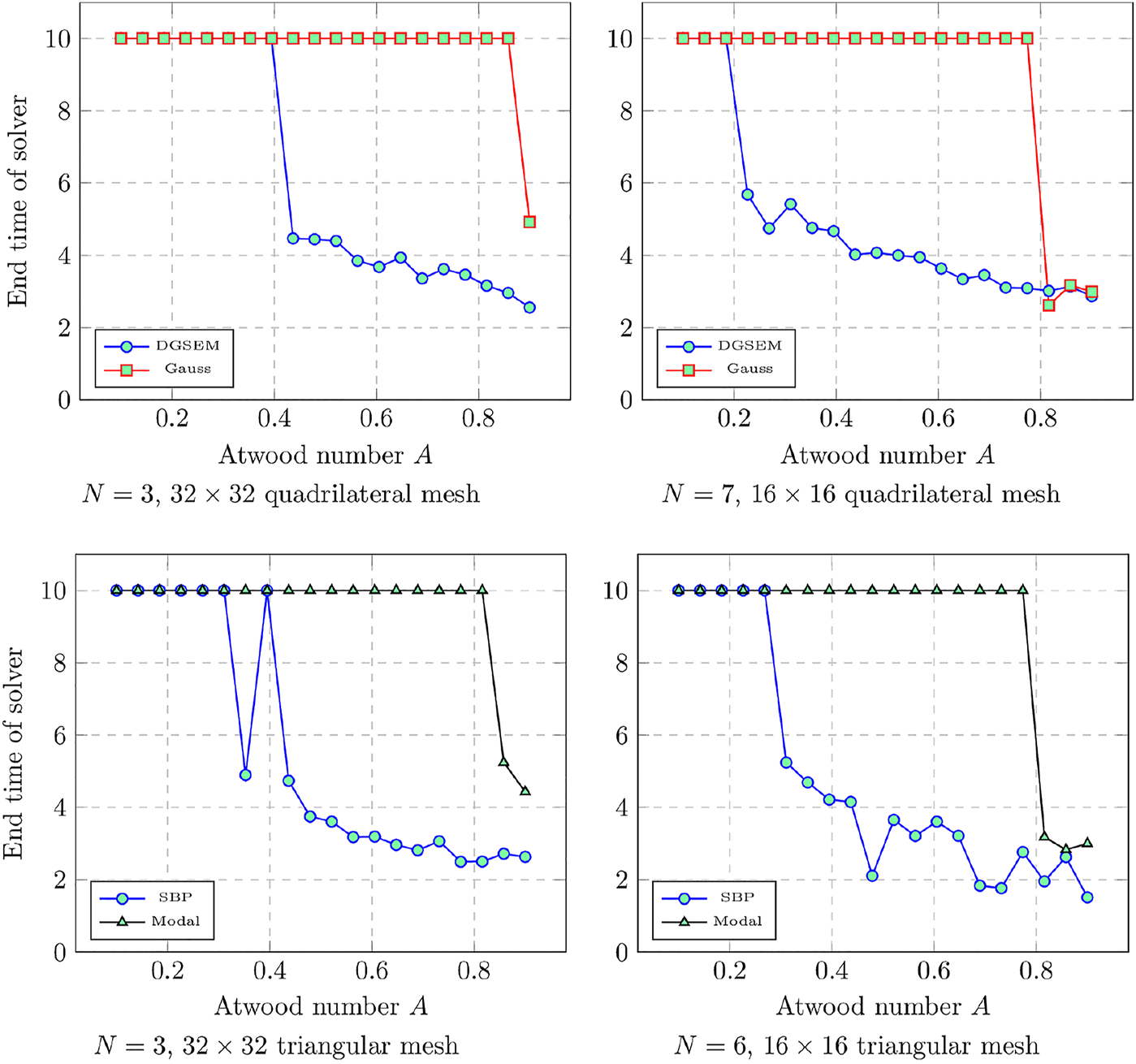
High order entropy stable schemes provide improved robustness for computational simulations of fluid flows. However, additional stabilization and positivity preserving limiting can still be required for variable-density flows with under-resolved features. We demonstrate numerically that entropy stable DG methods which incorporate an "entropy projection" are less likely to require additional limiting to retain positivity for certain types of flows. We conclude by investigating potential explanations for this observed improvement in robustness.

ORIGINAL RESEARCH
30 June 2022
Christian Jacobsen and Karthik Duraisamy
The ability to extract generative parameters from high-dimensional fields of data in an unsupervised manner is a highly desirable yet unrealized goal in computational physics. This work explores the use of variational autoencoders (VAEs) for non-linear dimension reduction with the specific aim of {\em disentangling} the low-dimensional latent variables to identify independent physical parameters that generated the data. A disentangled decomposition is interpretable, and can be transferred to a variety of tasks including generative modeling, design optimization, and probabilistic reduced order modelling. A major emphasis of this work is to characterize disentanglement using VAEs while minimally modifying the classic VAE loss function (i.e. the Evidence Lower Bound) to maintain high reconstruction accuracy. The loss landscape is characterized by over-regularized local minima which surround desirable solutions. We illustrate comparisons between disentangled and entangled representations by juxtaposing learned latent distributions and the true generative factors in a model porous flow problem. Hierarchical priors are shown to facilitate the learning of disentangled representations. The regularization loss is unaffected by latent rotation when training with rotationally-invariant priors, and thus learning non-rotationally-invariant priors aids in capturing the properties of generative factors, improving disentanglement. Finally, it is shown that semi-supervised learning - accomplished by labeling a small number of samples (O(1%)) - results in accurate disentangled latent representations that can be consistently learned.

ORIGINAL RESEARCH
29 April 2022
Jan Heiland, 1 more and Rezvan Bahmani
3 Authors
- JH
Jan Heiland
Computational Methods in Systems and Control Theory, Max Planck Institute for Dynamics of Complex Technical Systems, Germany
- PB
Peter Benner
Computational Methods in Systems and Control Theory, Max Planck Institute for Dynamics of Complex Technical Systems, Germany
- RB
Rezvan Bahmani
School of Electrical and Computer Engineering, College of Engineering, University of Tehran, Iran
The control of general nonlinear systems is a challenging task in particular
for large-scale models as they occur in the semi-discretization of partial
differential equations (PDEs) of, say, fluid flow. In order to employ powerful
methods from linear numerical algebra and linear control theory, one may embed
the nonlinear system in the class of linear parameter varying (LPV) systems.
In this work, we show how convolutional neural networks can be used to design LPV
approximations of incompressible Navier-Stokes equations. In view of a
possibly low-dimensional approximation of the parametrization, we discuss the
use of deep neural networks (DNNs) in a semi-discrete PDE context and compare their
performance to an approach based on proper orthogonal decomposition (POD). For a
streamlined training of DNNs directed to the PDEs in a Finite
Element (FEM) framework, we also discuss algorithmical details of implementing the
proper norms in general loss functions.
