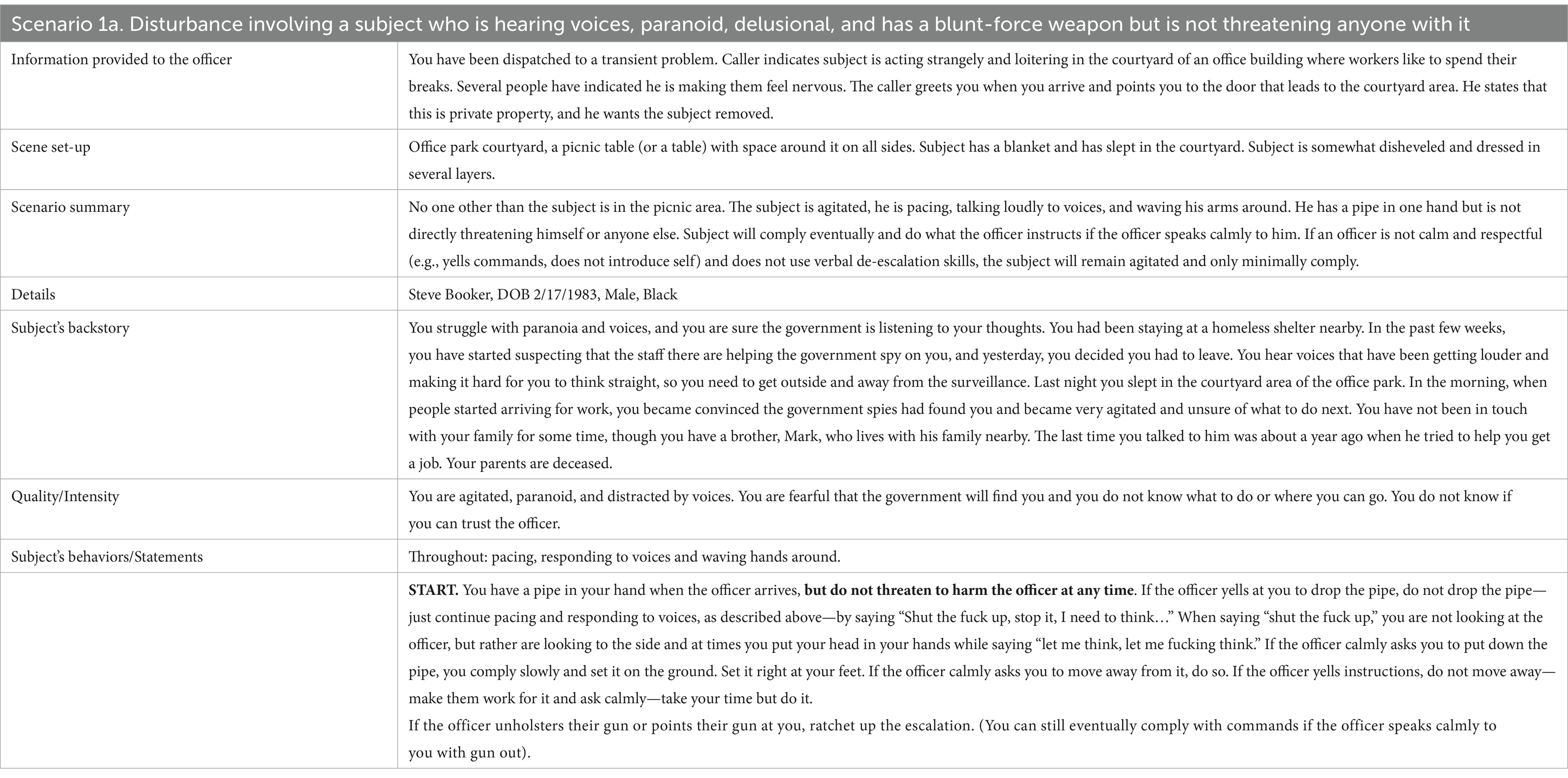
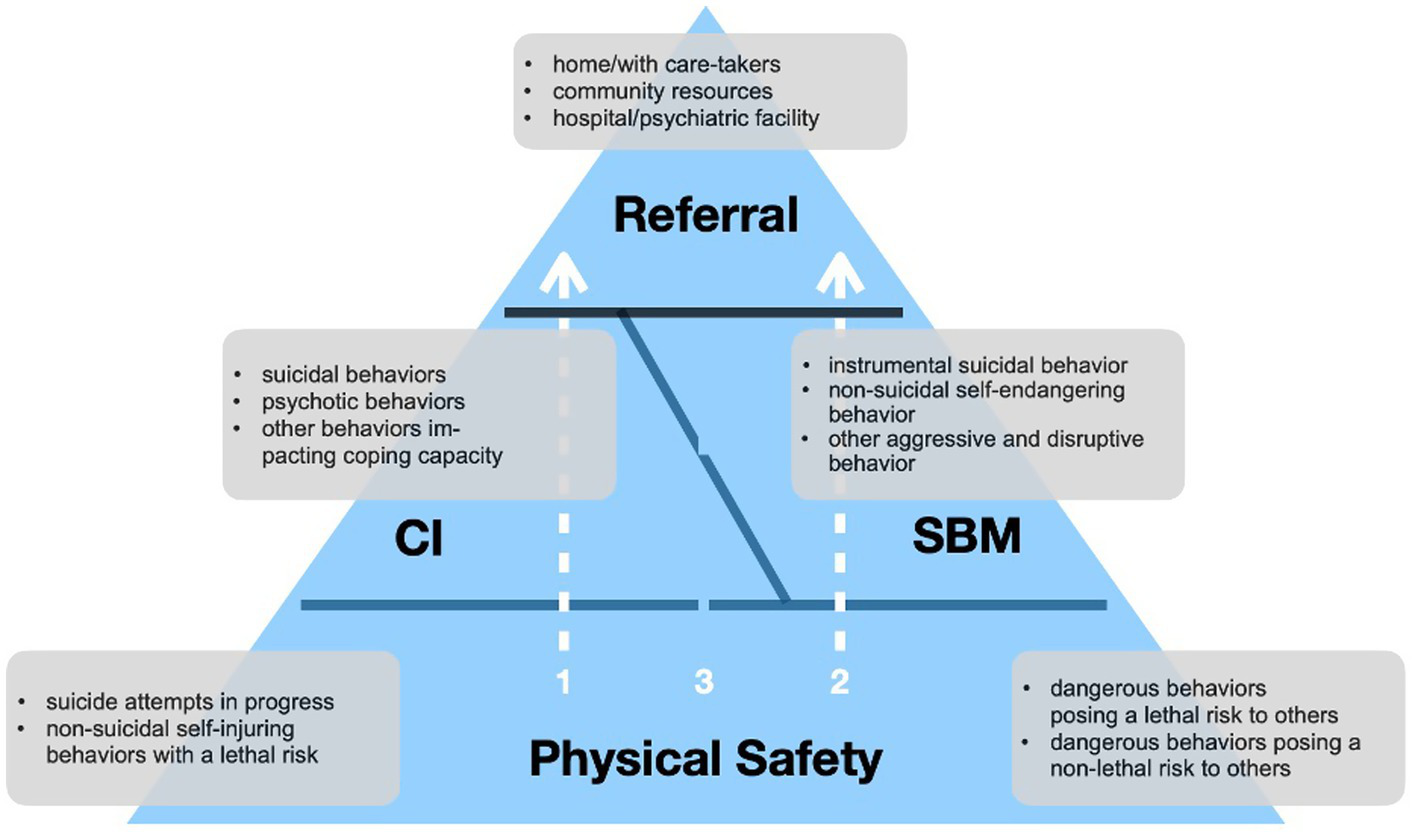
are conceptualized, how competencies are defined and assessed, and how responsibility for crisis response is distributed across systems. By drawing on perspectives from psychology, policing studies, behavioral science, occupational health, and social systems theory, the contributions collectively illuminate both the limits of traditional police-centric models and the potential of interdisciplinary approaches to reshape practice:• Schade & Thielgen (2025) synthesize policing scholarship into a broader intervention model that clarifies how police actions unfold across phases, constraints, and intended effects. By mapping intervention logics, situational demands, and outcome pathways, this narrative review offers a scaffolding that can connect training, policy, and evaluation.• Koerner et al. (2026) provide a systems-theoretical lens on how understanding is produced in crisis encounters. By distinguishing first-order understanding (making sense of the situation) from second-order understanding (understanding how one's understanding is formed and constrained), the article clarifies why misalignment can persist even when all actors aim for resolution. The analysis offers a conceptual bridge between de-escalation as a practical goal and reflexivity as a structural competency in police-citizen crisis interaction.• Staller et al. ( 2026) re-positions officer safety as more than a set of tactical prescriptions. The article argues for a reflexive concept (officer safety 2.0) that treats "control" itself as an object of professional observation and calibration, especially in encounters where escalation risk is co-produced by interaction dynamics.• Lavoie et al. ( 2025) address a central bottleneck in the field: how to operationalize and measure de-escalation competencies in a way that is meaningful across disciplines.• Watson et al. (2024) focus on the practical conditions of producing reliable evidence in CIT research. By outlining the development and implementation of standardized scenarios, the article strengthens methodological foundations for training evaluation and cross-study comparability.• Watson et al. (2025) widen the frame from police competencies to the design of crisis response systems. The article discusses the rationale and requirements for developing alternative or complementary workforces in community behavioral health crisis response.• Zaiser et al. ( 2025) offer a structured model that integrates assessment and response options for mental health calls. The iBEAR approach explicitly addresses heterogeneity-recognizing that "mental health crisis" is not a singular category and that response strategies should be differentiated accordingly.• Marlatte et al. ( 2025) add an empirical layer on the psychophysiology of crisis work. By examining how physiological stress relates to cognitive performance during simulated encounters and to memory afterward, the article highlights mechanisms that matter for training transfer, decision quality, and post-incident reporting.• Easton et al. (2025) foreground the cumulative psychological burden that investigative work can impose on police officery. While not limited to mental health crisis calls, the article speaks directly to the broader occupational context in which crisis encounters occur: sustained exposure to distressing material, moral strain, and emotional labor.Taken together, the articles in this Research Topic advance an understanding of policing and mental health crises as fundamentally interdisciplinary phenomena. They show that effective crisis response cannot be reduced to single interventions, isolated training programs, or narrowly defined performance metrics. Instead, it emerges from the interaction of individual competencies, organizational cultures, systemic structures, and cross-sector collaboration. By integrating conceptual, methodological, and applied perspectives, the Research Topic contributes to a growing body of scholarship that seeks not only to critique existing practices but to provide constructive pathways forward.In framing these contributions, this Editorial also points toward future directions for research and practice. Continued progress will depend on longitudinal evaluations of interdisciplinary models, deeper engagement with lived experience perspectives, and closer alignment between research, policy, and frontline realities. As jurisdictions experiment with new response configurations, the need for theoretically grounded, methodologically rigorous, and practically relevant research becomes ever more pressing. We hope that this Research Topic offers a substantive step in that direction.
Editorial26 May 2026
Editorial: Interdisciplinary approaches to policing and mental health crisisCONCEPTUAL ANALYSIS
3 March 2026
Mario S. Staller, 1 more and Benni Zaiser
1,610 views
BRIEF RESEARCH REPORT
17 March 2026
Swen Koerner, 1 more and Benni Zaiser
3 Authors
1,366 views

IntroductionCommunities across the United States and elsewhere are working to implement alternatives to law enforcement as primary responders to behavioral health crises. These efforts can only be successful if there is a skilled workforce prepared to take on this role. We argue that this workforce must be developed, and propose a new, credentialed Community Behavioral Health Crisis Responder (CBHCR) role.MethodsGuided by a 13-member advisory board with expertise across behavioral health, crisis services, and law enforcement, we conducted a literature review, key informant interviews, and focus groups to identify the foundational values, competencies, and skills for this proposed role.ResultsInterview and focus group participants discussed desired characteristics of CBHCRs and emphasized values such as cultural humility, a nonjudgmental approach, and the importance of lived experience broadly defined. Competencies and skills included engagement and communication strategies that enhance safety and trust, suicide prevention, conflict resolution, and situational awareness. Participants highlighted the need to train CBHCRs to provide compassionate, trauma-informed crisis intervention, de-escalation, support, and connection to needed resources. In conjunction with our advisory board and external experts, we used the findings to iteratively refine the values, competencies, and skills of CBHCRs.DiscussionWe discuss the next steps in creating this new, skilled and credentialed crisis response workforce.