Abstract
Kinematic algebras can be realised on geometric spaces and constrain the physical models that can live on these spaces. Different types of kinematic algebras exist and we consider the interplay of these algebras for non-relativistic limits of a relativistic system, including both the Galilei and the Carroll limit. We develop a framework that captures systematically the corrections to the strict non-relativistic limit by introducing new infinite-dimensional algebras, with emphasis on the Carroll case. One of our results is to highlight a new type of duality between Galilei and Carroll limits that extends to corrections as well. We realise these algebras in terms of particle models. Other applications include curvature corrections and particles in a background electro-magnetic field.
1 Introduction
Relativistic and non-relativistic systems are usually distinguished by their kinematic algebras. Classifications of possible kinematic algebras (for point particles) have been obtained in four space-time dimensions in Refs. 1, 2 and in different dimensions for instance in Refs. 3, 4. The Poincaré algebra constrains relativistic systems in flat space, while non-relativistic systems of particles are subjected for example to Galilean or Carrollian algebras.1 In a given system, there is typically a physical quantity that can be combined with the speed of light c to form a dimensionless quantity whose limit to zero (or to infinity) defines the non-relativistic limit of the system. The prototypical example is the speed of a particle v and then the dimensionless quantity can be taken as v/c. In gravitational systems there is additionally the Newton constant to form dimensionless parameters and multiple limits can be considered in such cases [5, 6]. Similarly, for extended objects one can consider non-relativistic limits, but the extended nature of the world-volume allows for a variety of different limits [7–10].
The kinematic algebras do not contain the dimensionful quantity of a given physical system but only fundamental constants, for example c in the case of the Poincaré algebra although it is usually not explicit since it is absorbed in the definition of the generators. One can still consider non-relativistic limits of the algebras by formally scaling the parameters. This process, first performed for obtaining the Galilei algebra from the Poincaré algebra, is known as a (Inönü–Wigner) contraction of a Lie algebra [11]. The limit c → ∞ considered there implicitly assumes that all particle velocities that can arise are small compared to the speed of light. The similar contraction c → 0 giving the Carroll algebra [12, 13] makes the assumption that all particle velocities are large compared to the speed of light. We shall review these cases in detail in Section 2.1.
The non-relativistic symmetries obtained by Inönü–Wigner contractions are the strict limits of the scaling parameter, e.g., c → ∞ or c → 0. However, the inclusion of relativistic corrections is desirable for many systems such as their contributions to the fine structure of atoms. While many relativistic equations can be expanded in the small parameters, the resulting equations do not exhibit symmetries beyond the contracted algebra. It is one of the aims of this contribution to explain how to formulate a framework of kinematic algebras for these corrections. The main method we will use is to enlarge the space on which the symmetry acts and thereby allow for extensions of the contracted algebra.
One can construct systematically kinematic algebras that include perturbative corrections in a parameter (like 1/c) by deforming the contracted algebra, in this way performing something like the inverse of a Lie algebra contraction. This process adds new generators to the original algebra and thus enlarges it. Considering all-order expansions in the small parameter we obtain infinite-dimensional algebras and there are different ways of arriving at them.
One is to view the deformation problem as a cohomology problem such that one is asking for the most general non-trivial commutator of generators that commute in the contracted algebra. For instance, in the Galilei algebra one has famously that spatial translations Pi and Galilean boosts Bj commute while their most general commutator would be , containing both a symmetric (Zi,j = Zj,i) and an anti-symmetric (Bij = −Bji) part and all these generators can be considered as new.2 Adding these generators to the original algebra one can repeat the question of what is now the most general commutator of the elements of this new algebra, for instance of Pi with Bjk, and introduce new elements in this way. The algebra obtained in this way typically involves a free Lie algebra where all possible commutators are present; in this case the Galilean free Lie algebra of Ref. 16.3 Free Lie algebras are characterised by containing all possible commutators of a basic set of elements such that the Jacobi identity is satisfied. They are infinite-dimensional and possess many interesting quotient Lie algebras whose physical interpretation can differ as we shall show in many examples.
A second way of obtaining a systematic perturbative extension of a kinematic algebra is the method of Lie algebra expansion [17–22]. This method can be described in its simplest form by starting with an algebra and tensoring it with a commutative semigroup. An example of a commutative semigroup is given by such that λnλm = λm+n for m + n ≤ N and the product is zero otherwise. Clearly, there is a relation of this structure to the expansion up to order N in a small parameter λ, thinking of 0 as . Typically, one uses refinements of this construction that we shall discuss in more detail in the main body of the paper and a full perturbative treatment including all terms up to N → ∞ then relies on formal power series in λ.
The two constructions are not unrelated. This can be seen in the Galilean example with free Lie algebra commutator as follows. Maintaining spatial rotation invariance, we can separate out the trace of the symmetric generator Z = δijZi,j and from the structure of the Poincaré algebra we would expect this term to be related to temporal relativistic translation P0. However, it is more useful to consider Z as the first relativistic correction to the non-relativistic Hamiltonian and thus as something of order c−2. The relation to a Lie algebra expansion is thus achieved by considering Z as P0 ⊗ c−2 and Pi and Bi as Pi ⊗ c−1 and Mi0 ⊗ c−1. If one quotients the free Lie algebra by the tracefree part of Zi,j and the anti-symmetric Bij, the commutator [Pi, Bj] = δijZ agrees exactly with that of the expanded algebra to order c−2.4 Therefore the Lie algebra expansion is a special case of a free Lie algebra construction. The Carrollian limit is obtained by exchanging P0 ↔ Pi [10, 24], see the next section for more details. We generalise this duality to the infinite-dimensional case where corrections are included in the kinematic algebra.
There is furthermore a connection of the two constructions to (Borel subalgebras of) affine Kac–Moody algebras. Affine Kac–Moody algebras are obtained by tensoring a finite-dimensional algebra with Laurent polynomial rings in a variable, say λ, possibly additionally twisted by an outer automorphism. Restricting to ordinary polynomials rather than Laurent polynomials one describes the subalgebra of non-negative levels of the Kac–Moody algebra and clearly this agrees with a specific Lie algebra expansion of . At the same time, the subalgebra of positive levels is the quotient algebra of a free Lie algebra [25], so that also the viewpoint of the free Lie algebra enters in this relation. We shall describe this connection in more detail.
There are many variations of these constructions one can consider, depending on the algebra one starts with and the precise expansion or quotient of a free Lie algebra one takes. The physical interpretation of the parameter λ depends on the context one considers and is by no means restricted to non-relativistic limits. It can also be viewed as a curvature parameter when one wants to describe deviations from flat space isometries as we shall review. Another arena is where higher powers of λ correspond to more and more complicated electro-magnetic backgrounds in Minkowski space, where the kinematic algebra becomes a generalisation of the Maxwell algebra [26–29].
The above methods provide a plethora of kinematic algebras of finite or even infinite dimension. Our next aim will be to describe a space on which they can act in the same way that the Poincaré algebra acts on flat Minkowski space. Such a space is not hard to find using a non-linear realisation [30–35] approach with a suitable coset. It is of higher dimension than usual space-time and we present many examples with different physical interpretations. Once a generalised space is defined we strive to probe it using a physical model. The simplest instance is that of a free particle moving in it and there are canonical constructions of associated particle models that we shall go through.5 One could also consider using higher-dimensional objects as probes but we shall not pursue this here.
As we shall demonstrate, these particle models give rise systematically to relativistic (or similar) corrections to the dynamics associated with the truncated algebra. Particular emphasis will be put on the case of Carroll particles, both of ordinary [38, 39] and of tachyonic [40] type. The reason for this is that they have featured prominently in recent studies, including applications to cosmology [40–44]. Formally, the Carroll limit is also related to the Belinsky–Khalatnikov–Lifshitz limit [45, 46] where temporal derivatives dominate over spatial derivatives ∂t ≫ c∂x and so formally c → 0. We shall also exhibit a new type of duality between (corrections to) Galilei and Carroll particle actions in Section 4.3.
The structure of this contribution is as follows. We first explain the basic algebraic constructions of kinematic algebras and their interrelations in Section 2. Then we present generalised space-times on which the kinematic algebras can act in Section 3. To probe the set-up we then consider free particle actions in Section 4 where we deduce non-relativistic and similar corrections. Some concluding comments are given in Section 5.
2 Algebraic Constructions
We present various methods for constructing kinematic algebras and how they are related to one another.
2.1 Contractions and Extensions of Kinematic Algebras
As an illustrative starting point we choose the Poincaré algebra in D = d + 1 space-time dimensionswhere small Roman indices from the beginning of the alphabet are fundamental indices, e.g., a = 0, 1, … , d, and ηab is the flat Minkowski metric of signature (− + +⋯ +). When separating the time and space indices according to a = (0, i) with i = 1, … , d, we let [12]which is an invertible change of basis for any λ > 0 and the algebra becomes
We see that we can take the limit λ → 0 smoothly and obtain a new algebra in that limit. This so-called contracted algebra is the non-relativistic Galilei algebra (c → ∞) where now Galilean boosts commute among themselves and with translations. This is the most famous example of an Inönü–Wigner contraction of a Lie algebra [11]. As is usual, the contracted algebra is no longer isomorphic to the algebra with λ > 0. The square root in Eq. 2.2 arises since we think of λ as 1/c2.6 For future reference we write the resulting contracted Galilei algebra
An alternative contraction of the algebra is obtained by formally interchanging the roles of time and space directions for the translation generators, i.e., letting [12]
and contracting again λ → 0. This leads to the Carroll algebra
This contraction of the Poincaré algebra is also known as the Carroll limit in which the speed of light tends to zero (c → 0). We see from Eqs 2.2 and 2.5 that there is a duality between the Galilean and the Carrollian contraction that simply exchanges the role of space and time translations in the contraction. Thinking of the time direction as the longitudinal direction of the world-line of a (massive) particle and the space directions as the transverse directions, makes it clear that a similar duality between longitudinal and transverse directions will be present for contractions related to extended objects as was discussed in more detail in Ref. 10.
Let us now formalise the contraction process. We start from an algebra with generators tα and structures constants fαβγ. Then for each λ > 0 we define a Lie algebra isomorphism to another algebra . If the limit λ → 0 is well-defined, we call the limiting algebra the contracted algebra. Note that at λ = 0 we no longer necessarily have a Lie algebra isomorphism. In the examples above, the isomorphisms for λ > 0 were given in Eqs 2.2 and 2.5, respectively. Contractions preserve the number of generators but the resulting algebra is not necessarily isomorphic to the starting one. Moreover, it is not generally possible to reverse the contraction process directly.
One approach to undoing the contraction perturbatively requires the knowledge of the original algebra . Writing its generators multiplied by a formal power series in λwhere the offset n0(α) can depend on the generator, we construct an infinite-dimensional algebra of the generators . We refer to the generator as “level n” and think of it as the nth order perturbative expansion in the parameter λ. The offset should be chosen in such a way that the commutators of level m with level n only contain generators of level , where the commutator is defined in using the associative product of power series together with the Lie bracket on . The lowest order commutators involving only the then correspond to the contracted algebra, but the higher terms capture the perturbative expansion of the original of the original algebra . We denote by the algebra obtained by keeping terms up to level N. In this way, , the contraction of . When we keep all levels, we shall use the notation .7
Let us exemplify this in the case of the Galilei algebra Eq. 2.4. We define for n ≥ 0where the offsets are taken in accordance with Eq. 2.2. The associated Lie algebra is
Since all commutators of generators at levels m and n generate only terms of level at least m + n, we can consistently quotient out all generators above a fixed level N. This leads to a finite-dimensional algebra. Retaining only the generators of level 0 leads to the Galilei algebra that is obtained by contraction. Keeping all generators up to level N then gives a perturbative approximation to the Poincaré algebra up to that order. The algebra Eq. 2.9 was given in Ref. 48, see also Refs. 49–52.
Repeating the same construction for the Carroll contraction Eq. 2.5 one can start with
We note that, when comparing Eq. 2.8 for the expanded Galilei algebra with Eq. 2.10 for the Carroll algebra, there is a duality between the two algebras where the λ1/2 is changed from P0 to Pi. This is a generalisation of the type of duality that has been noted before in Refs. 10, 24, 53.
The definition Eq. 2.10 leads to the infinite-dimensional algebra
We note that comparing this formula to Eq. 2.9, there are subtle but important differences in the shifts of the indices by + 1 on the right-hand sides which are due to the placements of λ1/2 in the definitions of the algebra, and so ultimately to the physical meaning of the contractions.
The above procedure can also be viewed as a variant of the method of Lie algebra expansions that was originally introduced in Refs. 17–22. For a Lie algebra expansion in its formulation given in Ref. 20 one requires an abelian semi-group S whose elements we call λi and the S-expanded Lie algebra has a basis tα ⊗ λi and the Lie bracket
and commutativity of the product on S ensures the Jacobi identity of the expanded algebra. A simple example of a semi-group is given by with abelian product
The element λN+1 serves as a substitute for zero in the multiplication. Tensoring this semi-group with the real numbers corresponds to taking the quotient of the polynomial rings , i.e., working perturbatively in λ up to order N. In this identification we have simply λi = λi, i.e., the ith basis of the semi-group should be identified with the ith power of the expansion parameter λ. One can also take the limit N → ∞ and work with formal power series.
A more refined version of the Lie algebra expansion method can be obtained when the original Lie algebra has a decomposition. We here restrict to the case when8
(We use different letters here for the graded pieces in order to avoid confusion with the contracted algebra studied above.) A resonant expansion of with is then given by the space
with the obvious Lie brackets. It is this refined version of a Lie algebra expansion that makes direct contact with Eq. 2.7. A simple example of the refined expansion would be to take the Poincaré algebra Eq. 2.1 and write it as
The expansion with then would have the basis elements
with new non-trivial commutators
in the expanded algebra.
The algebra obtained by expanding with gives the Galilei algebra Eq. 2.4. The algebra above is a quotient of Eq. 2.9. A more general discussion of the expansion method can be found in Ref. 20. We shall apply this method to several more cases in this paper.
2.2 Free Algebras, Cohomology and Quotients
We now turn to the discussion of free Lie algebras. General references for this are Refs. 54 and 55 and we follow the exposition in Refs. 16 and 29.
A free Lie algebra on a (finite) set of D = d + 1 generators
is obtained by considering all possible multi-commutators of the generators Pa only subject to anti-symmetry and the Jacobi identity. There is a natural grading of the free Lie algebra by the number of times the generators Pa appear in the multi-commutator.9 The infinite-dimensional free Lie algebra is therefore
with for example
being of dimension because of the anti-symmetry of the commutator. We use the symbol ∧kV to denote the kth anti-symmetric tensor power of a vector space V. The element [Pa, Pb] is an independent element in the free Lie algebra.
The full structure of can be summarised elegantly by a generating series in a formal parameter t as [56, 57]
that leads for example toWith ⊖ we mean the removal of a vector space from the tensor product, so that for the formula states that one takes all commutators of Pa from with the anti-symmetric [Pb, Pc] from but has to remove the completely anti-symmetric Jacobi identity in all three elements.
Free Lie algebras as defined above are graded consistently with Eq. 2.20, i.e., they satisfy
The elements in can be represented by Young diagrams with ℓ boxes that represent the irreducible action of the symmetric group on the elements in a set of multicommutator. In this way we write

The free Lie algebra can also be viewed as a successive extension of the real commutative Lie algebra using the method of Chevalley–Eilenberg Lie algebra cohomology [29]. The second cohomology of with values in is non-trivial and of dimension and therefore the Lie algebra can be extended by introducing anti-symmetric generators Zab = Z[ab] with the new commutatorbut the Zab are central in this extended algebra. Thus one has obtained a graded Lie algebra by considering the cohomology of . The process can now be repeated by studying the cohomology of which leads to and so on. In this way, the free Lie algebra is the maximal cohomological extension of .
As suggested by the notation (Eq. 2.19), we wish to think of the elements of for instance as the translation generators of some kinematic algebra. Typically, there is also a set of rotation generators, such as the Lorentz generators Mab, under which the translation generators form a module. We call the space of the rotation generators as then we have a graded structure
to begin with. As a Lie algebra this is a semi-direct sum since acts on its representation space . The free Lie algebra based on then inherits an action of on each and the expressions in Eq. 2.23 can be viewed as products and sums of modules. Extensions to super-algebras are discussed for example in Refs. 56, 57.
Free Lie algebras
admit many different quotients. We list a few important and representative examples and consider the case when there are also rotations
acting on the algebra, see also Ref.
29.
1. Level truncation: Due to the grading (Eq. 2.24), the space
is a Lie algebra ideal inside
for any integer
ℓ> 0. The corresponding quotient
consists of all elements up to level
ℓ(as a vector space) and commutators going beyond the truncation are set to zero.
2. Row truncation: Referring back to the representation (Eq. 2.25) of elements of as Young diagrams, we can define the space
which is an ideal of
since commutation only adds boxes but never removes them. The corresponding quotient
then consists of all elements of
with at most
rrows in their Young diagram.
3. Derivative truncation: The row truncation above can be refined by considering the ideal
The corresponding quotientthen consists only of those generators of whose Young diagrams have the shape

with an arbitrary number of boxes in the first row. Why we refer to this quotient as the derivative truncation will become clear in Section 4.6 below.
Yet another common quotient is described by Serre relations and this arises for Kac–Moody algebras [25, 58] as we shall review in Section 2.3 below.
2.2.1 Maxwell Free Lie algebra
Let us illustrate the free Lie algebra construction in the simplest case where is the Lorentz algebra and are the translations Pa of the Poincaré algebra (Eq. 2.1). In this case, we obtain the algebrawhere Zab = Z[ab] is a basis of and Yab,c a basis of . The symmetries of Yab,c are those of the (2,1) hook:
Under the Lorentz generators Mab all elements transform as tensors in the way that their indices dictate.
The antisymmetric element Zab arose first in studies of the extension of the Poincaré algebra in the presence of a constant electro-magnetic field [1, 26, 27] when one co-rotates the constant field Fab under Lorentz [27, 28]. The extension including the generators Yab,c was also considered in Ref. 28 where it was linked to linearly varying electro-magnetic backgrounds: Fab ∼ Yab,cxc (in Cartesian coordinates) and the Young irreducibility (Eq. 2.35) is equivalent to the Bianchi identity . The extension to the full free Lie algebra was considered in Ref. 29, see also Section 4.6 below for a corresponding particle model.
We note that one can also consider non-relativistic limits of the relativistic Maxwell algebra and there are different limits that arise depending on the scaling of the electric and magnetic fields. The corresponding algebras can be called electric, magnetic and pulse Maxwell algebras [16, 59].
2.2.2 Galilean Free Lie algebra
A second instance of the free Lie algebra construction can be obtained by starting from the Galilei algebra (Eq. 2.4) and letting [16]
Note that this assignment of generators to levels is different from that that would be inherited directly from the Poincaré case in the previous section. However, this assignment is consistent with the grading due to the contracted commutation relations (Eq. 2.4). A consequence of Eq. 2.36 is that the translation generator Ti occurs at level two in the free Lie algebra via the commutator
The free Lie algebra generated from Eq. 2.36 was called the magnetic Galilei algebra in Ref. 16 and it is the only case we consider here. Due to the presence of the rotation-invariant H inside , the structure of Young diagrams gets a bit more involved. The resulting structure actually admits a double-grading by assigning the level (ℓ, m) = (0, 0) to the spatial rotations Jij, the level (1, 0) to the Galilean boosts Bi and level (1, 1) to the Hamiltonian H. The first few terms in the resulting free Lie algebra are then shown in Table 1.
TABLE 1
| ℓ = 0 | ℓ = 1 | ℓ = 2 | ℓ = 3 | |
|---|---|---|---|---|
| m = 0 | Jij | Bi | Sij | Yij,k |
| m = 1 | H | Ti | Bij, Zi,j | |
| m = 2 | Zi |
The notation in the table is such that indices that are separated with commas are in separate columns of a Young diagram while unseparated ones are in the same column. For instance, the commutator between the Galilean boost Bi and translation Ti is

The symmetric tensor Zi,j can be traced using the Euclidean metric δij and the corresponding scalar M under rotations is nothing but the Bargmann central extension [Bi, Tj] ∝ δijM.
However, the free Lie algebra methods provides many further extensions of interest that are discussed in more detail in Ref. 16.
2.2.3 Carrollian Free Lie algebra
In the same way as for the Galilei algebra above one can also construct a free Lie extension of the Carroll algebra (Eq. 2.6). By applying the duality P0 ↔ Pi between the Carroll and Maxwell case discussed in Section 2.1 one is led to starting fromthat should be compared to Eq. 2.36.
Running the free Lie algebra construction (Eq. 2.23) then produces as next generators the result shown in Table 2, where we also introduced a second grading m to distinguish the generators Ki and Ti. Some commutators defining the elements in the table are written explicitly aswhere Zi,j is symmetric while all the other rank two tensors Sij, Bij and Tij are anti-symmetric. The Carroll Hamiltonian K (see Eq. 2.6) is obtained as the trace of the symmetric tensor:where we recall that d is the number of spatial dimensions.
TABLE 2
| ℓ = 0 | ℓ = 1 | ℓ = 2 | ℓ = 3 | |
|---|---|---|---|---|
| m = 0 | Jij | Ki | Sij | Yij,k |
| m = 1 | Ti | Bij, Zi,j | 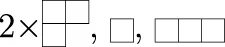 | |
| m = 2 | Tij | 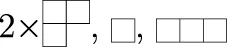 | ||
| m = 3 | Tij,k |
The first few levels of the free Lie algebra generated by Carroll. The double-grading (ℓ, m) is explained in the text, as is the relation between Young diagrams and comma-separated index notation.
We can recover the infinite Carroll algebra (Eq. 2.11) from the free Lie algebra construction by following steps similar to Ref. 16. By restricting to anti-diagonal lines (of fixed ℓ − m) in Table 2, restricting further to m ∈ {0, 1} and keeping only generators of vector and scalar type under rotations, we obtain an infinity of generators , , and K(n) whose commutation relations are those of Eq. 2.11. Besides K(0) ∼ δijZi,j we also have for example and . As the infinite Carroll algebra (Eq. 2.11) is an expansion of the Poincaré algebra, we see that the Carrollian free Lie algebra contains this particular expansion as a quotient.
2.3 Connection to Kac–Moody Algebras
In this final section on algebraic constructions we would like to make a brief comment on the relation to (affine) Kac–Moody algebras. For any finite-dimensional Lie algebra it is well-known that one can construct the (untwisted) loop algebra by lettingof Laurent polynomials in λ with values in . It is also possible to add a central term and a derivation element to this construction to obtain a proper Kac–Moody algebra [25].
The relation to the constructions above becomes transparent by restricting to the parabolic subalgebra of polynomials whose elements can be written in terms of the basis tα ⊗ λn for n = 0, 1, …. Clearly, this can be seen as a version of the method (Eq. 2.7) when setting all offsets n0(α) to zero. Setting some of the offsets to a non-zero value can result in twisted in affine algebras, see Ref. 16 for examples.
The parabolic subalgebra is also closely related to free Lie algebras. Indeed it is known that the Borel subalgebra of a Kac–Moody algebra can be described as the quotient of a free Lie algebra on the simple Chevalley generators (often denoted ei) subject to the Serre relations that are encoded in the generalised Cartan matrix of the Kac–Moody algebra [58]. This is in particular true for affine algebras. Since we are dealing with a parabolic subalgebra rather than a Borel subalgebra in that the starting finite-dimensional Lie algebra is not the abelian Cartan subalgebra, the Serre relations have to be adapted slightly but one can still describe as a quotient of the free Lie algebra with that is acted upon by . Again, refinements of this constructions are available when is decomposed already into V0 ⊕ V1, see Ref. 16 for examples.10 This shows that all the various algebraic constructions in this section are interrelated.
3 Geometric Realisations
Suppose we have a kinematic algebra that has an action on some space-time M. For a given contraction of with corresponding perturbative expansion as introduced in Section 2.1, we now want to construct a space M(∞) on which this algebra acts.11 Since is interpreted as the perturbative expansion of the kinematic algebra in the parameter λ, this will provide the arena to describe perturbatively corrected dynamics.
Let xa denote a set of local coordinates of M on which there is a faithful action of . This set of coordinates is assumed to be compatible with the contraction to in the sense that one can define an associated contraction on the coordinates such that acts faithfully on the contracted coordinates.
With this we mean that
with an appropriate offset n(a) depending on the coordinate and restricted to n = 0 carries a faithful action of . The space M(∞) on which acts is then given by considering all values of n ≥ 0. The opposite sign of n on the coordinates compared the generators in Eq. 2.7 is due to the fact that we would like formal Lie algebra elementsto be dimensionless which means that the scaling of with λ must be opposite to that of (whose precise definition depends on the context). The Lie algebra element above can then be exponentiated and used in a non-linear realisation. We now exemplify these considerations in various cases. We shall also construct a case of a generalised space-time related to a full free Lie algebra rather than to an expanded algebra.
3.1 Post-Galilean Space-Time
For the Poincaré algebra (Eq. 2.1) the space M is Minkowski space in D dimensions with coordinates xa of dimension L = length. The faithful action of the Poincaré algebra can described as follows. Letbe an arbitrary element of the Poincaré algebra. Its action on the coordinate xa is given byFor the Lorentz part this is nothing but the fundamental representation on which the Pa act as translations.
For the Galilean contraction (Eq. 2.2) we split space and time a = (0, i) and letHere, the dimensions of t(n) and are fixed by the dimension of x0 and xi (that we always maintain at dimension length) and that of λ which for the Galilean case follows from λ = c−2. In particular, even though we use the notation t(m), the lowest element t(0) does not have the dimension of time (T) but of length (L) and does not have the dimension of length but of L2/T. We note also that in our conventions the Poincaré generators Pa in Eq. 2.1 have dimension of L−1 while the Mab are dimensionless.
The action of an elementof the algebra (Eq. 2.9) on a (dimensionless) coordinate elementis then given by the commutator of the two elements, leading to
We see that restricting to only level 0 this becomes the usual action on the Galilean coordinates (t, zi) with t = t(0) and . In particular, the Galilean boost with only yieldswhich is the lowest order term of the Lorentz boost. Note that in our conventions the parameter v(0) has dimension of L/T as a velocity, but we recall that and [t(0)] = L.
In order to see the systematic higher order expansion of the Lorentz boost encoded in Eq. 3.5, we follow [48] and define collective coordinates formally byas well as the collective boost parameter
The transformation of the collective coordinates (Eq. 3.11) under such a collective boost then works out as
the usual expression for an infinitesimal relativistic Lorentz boost with rapidity Θi. However, the difference is that now the boost parameter and the coordinate are collective.
If one imposes thatfor some scalar v and spatial unit vector ni, i.e., δijninj = 1, then the transformations (Eq. 3.13) become for λ = c−2which are the expansions of the infinitesimal Lorentz boost with parameter θi = θni, where tanh θ = v/c for v/c ≪ 1.
At this point we should comment on the geometrical meaning of the collective coordinates (Eq. 3.11). These define a hyperspace of co-dimension D within the infinite-dimensional generalised Minkowski space with coordinates (Eq. 3.5). Since the sums are infinite and we are not making any assumptions about convergence here, the expressions are formal but the formal expansion parameter λ is introduced in such a way as to render meaningful expressions at any finite order in the expansion. What the transformation (Eq. 3.13) then describes is a transformation from one hyperspace to another one, so we obtain a description of ordinary Minkowski space as a family of hyperspaces inside generalised Minkowski space. We shall see that a similar picture applies to all other expansions considered in this paper.
3.2 Post-Carrollian Space-Time
For the case of the Carroll algebra, we use “Carroll time” s = Cx0 introduced in Refs. 12, 39. The contraction limit in these variables is C → ∞. Morally, we can think of C as being related to the inverse of the speed of light, so that the speed of light goes to zero. However, the dimension of C is that of a velocity. The expansion parameter λ = C−2, so that s(0) = x0 ⊗ C is the Carroll time of Refs. 12, 39.
For the Carrollian contraction (Eq. 2.5) we proceed analogously to the generalised Galilei space-time and definewhere the difference to Eq. 3.5 that the constant shift has moved from the space to the time translations. The dimensions of the coordinates implied by these definitions are [s(n)] = L2n+2/T2n+1 and .
A dimensionless elementof the expanded Carroll algebra (Eq. 2.11) then acts on the coordinates by
Especially, restricting to lowest order we obtain for the Carrollian time coordinate s = s(0) and that the Carrollian boost (only ) acts bythe well-known expression for this boost, see, e.g., Refs. 12, 39. In particular, an ordinary particle at rest cannot be Carroll boosted to one in motion: it is effectively stationary in any frame.
We now turn to corrections to this classical statement as contained in the infinite-dimensional algebra (Eq. 2.11). We introduce the collective coordinatesas well as the collective boost parameterThe transformation then becomesjust as in Eq. 3.13 and thus formally resembles the usual infinitesimal Lorentz boost with parameter Θi. With λ = C−2 we can now specialise toto arrive atThis is the correct expansion of a Lorentz boost in Carroll parametrisation where is fixed in the limit C → ∞ [39].
3.3 Conformal Post-Galilean Space-Time
The relativistic conformal algebra in D > 2 dimensions is that contains, besides the Poincaré generators (Eq. 2.1), the special conformal generators Sa and the dilatation generator D with additional commutatorsA non-relativistic Galilean version of this algebra can be obtained by considering the contraction (λ = c−2)that extends the Galilean contraction (Eq. 2.2) from Poincaré to the conformal algebra. The resulting contracted algebra is known as the Galilei conformal algebra and has been studied for example in Refs. 61–65, see also Refs. 66, 67 for a recent extension to higher spin algebras.
The two lines of Eq. 3.27 also define spaces V0 and V1 satisfying (Eq. 2.14), so that an infinite expanded algebra undoing the contraction can be defined, exactly in the same way as for the previous cases. An infinite generalised space-time on which the infinite expanded Galilei conformal algebra can act is then defined by introducing coordinatesThe action of the algebra on these coordinates can be worked out in the same way as in the previous cases, with the additional feature that the action of the special conformal transformation is non-linear in the coordinates due to the relativistic expressionsextending the Poincaré transformations (Eq. 3.4).
Collectives coordinates are defined byexactly as for the non-conformal Galilei case (Eq. 3.11). Under special conformal transformations (Eq. 3.29), the lowest order coordinates transform aswhere we have expanded the parameter of the transformation as
3.4 Post-Minkowski Space-Time
The small parameter can also be taken to be the curvature of space-time in appropriate dimensions. This was considered in Ref. 68 and leads to corrections to Minkowski space-time towards (Anti-)de Sitter space when the starting point is the (A)dS algebra that differs from the Poincaré algebra (Eq. 2.1) by the non-trivial commutatoramong the translations. The sign σ = +1 is the AdS algebra and σ = −1 is the dS algebra .12 Here, and in contrast to the Poincaré algebra (Eq. 2.1), we have rescaled all generators to be dimensionless.13
Following our usual expansion method we define the generatorswhere now λ = R−2 is to be thought of as the curvature scale of the (A)dS space-time. For R → ∞ we obtain the Poincaré algebra (Eq. 2.1) as a contraction of the (A)dS algebra similar to the non-relativistic cases in Section 2.1.
One can now similarly consider an extended space-time with coordinates
The transformations formula for these coordinates is now more complicated since the underlying translations no longer commute due to Eq. 3.33. Since we do not rely on them in the following, we refer the reader to Ref. 68. In Section 4.5 we shall study a particle model based on this generalised space-time.
3.5 Minkowski–Maxwell Space-Time
In the case of the Maxwell extension of Poincaré we also deal with non-commuting translations Pa, the basic commutator is Eq. 2.26, where Zab is a new generator unlike in the case of the (A)dS algebra.
The most general algebra that we can construct when starting from the Poincaré algebra is the Maxwell free Lie algebra that was introduced in Section 2.2.1. An associated generalised space-time can be defined by considering the Pa and all their free commutators as translation generators. This means that one has coordinates for each of them [28, 29]The generalised space-time defined by these coordinates has non-abelian translationswhere the higher-level coordinates are also affected by the translations of all lower levels.
In Section 4.6, we consider a particle model on the associated space-time and how it relates to the motion of charged particle in an electro-magnetic background field. We also note that one can consider various non-relativistic limits of Maxwell algebras and space-times [16, 59, 69].
4 Free Actions
In this section, we consider particle actions for free spinless particles in the various generalised space-times constructed in the previous section. We shall discuss in particular how they can be used to reproduce the corrections to the usual relativistic free particles. The case of the Carrollian generalisation will be discussed in most detail since it is less well-covered in the literature but has recently attracted attention in the context of cosmology and gravity [40–44]. We shall consider both tachyonic and ordinary particles and the resulting corrections in the case of Carroll are new to the best of our knowledge. In general, we shall parametrise the world-lines of particles using a parameter τ and denote derivatives with respect to this parameter by dots. The dimension of this parameter will be that of time (T) for Galilei but that of Carroll time (L2/T) for Carroll.
4.1 Particle in Post-Galilean Space-Time
The starting point for all actions comes from the expansion of the relativistic invariant metric using the collective coordinates (Eq. 3.11)where the factor of λ in front of the spatial metric is crucial.
We shall first consider the usual massive relativistic particle, corresponding to a time-like norm of the velocity vector, and its Galilean limit. Then we shall consider the same procedure for a relativistic tachyon whose velocity vector is space-like and whose Galilean limit is a massless Galilean particle. The intuitive reason for this is that massless propagation in Newtonian physics is instantaneous which corresponds to space-like trajectories in Minkowski space. Galilean limits of relativistic light-like particles will not be considered in the context of post-Galilean space-time but in its conformal extension in Section 4.4.
4.1.1 Massive Galilean Particle
Perturbative actions for a massive particle can be obtained by expanding the reparametrisation invariant configuration space actionin powers of λ = c−2 with the resultThis was given in Ref. 48 up to the fact that the dimensions of the variables here differ from there by a factor of c.
The actions written in Eq. 4.3 have global symmetries associated with the expanded algebras from Section 2.1 up to the order in the expansion. In particular, the action S(2) has more symmetries than the usual Galilei (or Bargmann) invariance. In addition, the actions have gauge symmetries generated by first-class constraints [48]. Gauge-fixing these symmetries one still retains enhanced global symmetries that are realised non-linearly. As we shall describe next, we will also identify the space coordinates to a single xi through what we refer to as “choosing a slice”. This step makes it possible to connect to the usual non-relativistic expansions at the price of breaking the global symmetries.
The first action S(0) is a total derivative and does not describe any non-trivial local dynamics. The existence of this term is nevertheless significant and related to the possibility of centrally extending the Galilei algebra to the Bargmann algebra [70].
The next action S(1) becomes the usual non-relativistic after gauge-fixing t(0) = cτ and dropping a total derivative. Moreover, we identify as a slice conditionin order to obtain conventional dimensions, but we emphasise that this step is not fixing a gauge symmetry but breaks symmetries [48].
For the next order term S(2), we similarly gauge-fixand choose a slice as
This choice of slice is dictated by the relation (Eq. 3.5) between Minkowski and generalised Minkowski space. Plugging this into Eq. 4.3 leads to (using vector notation for the spatial components for simplicity)Working out the energy of the particle associated with this action leads towhich agrees with the expansion of the relativistic energyto the order given. Such an analysis can be performed to any desired order. Similarly, the momentum can be worked out aswhich are the first two terms in the large-c expansion of . Note that in order to get the desired expansion to order n − 1 we only have to consider the action S(n) that comprises all corrections to that order. The action (Eq. 4.7) has no global symmetries but our procedure allowed us to systematically arrive at it through a formalism with enhanced symmetry.
There is an ambiguity in interpreting the actions (Eq. 4.3) in terms of which space they are defined on. Since we started with an action on Minkowski space it is natural to view the actions as being defined on generalised Minkowski space to the same order in λ for both time and space variables. This means for example that we would like to viewto depend also formally on x(0) although x(0) does not enter the action at all. Taking this point of view implies that there are two canonical constraints associated to the action S(0), namelyThe second constraint can be viewed as somewhat artificial mathematically but stems from the physical origin of Minkowski space. In a similar way, the Nth order action S(N) will always contain an extra constraint by making S(N) depend on the same number N + 1 of t(n) and .
4.1.2 Massless Galilean Particle
The massless Galilean particle [71] can be obtained as the non-relativistic limit of the relativistic tachyon [72]. From the point of view of the kinematic algebra the massless Galilean particle has vanishing Bargmann central charge. We will work out the first correction starting from a phase form of the action, starting fromwhere we have introduced the “colour” k2 = m2c2 [71]. The lowest order term in the limit c → ∞ removes the energy from the mass-shell constraint, leading to the action [72]Here, we have used the expansions (λ = c−2)
These expansions are consistent with Eq. 3.11 except for an adjustment of dimensions. The variables appearing here have canonical dimensions while the ones in Eq. 3.11 were rescaled by factors of c. If one wanted to use the expansion (Eq. 3.11) directly while keeping the collective symplectic term free of factors of λ, this would also require rescaling Pi and therefore introduce additional factors of λ into the collective mass-shell constraint.
One thing we can immediately deduce from Eq. 4.14 is that and therefore t(0) is constant and the evolution is in this sense instantaneous. Moreover, and the pair of variables (E(0), t(0)) is decoupled from the other variables. For the other variables we find that is a constant vector on the sphere with radius k and we could take a Euclidean evolution by picking this space-like direction.
The next order action in S = ∑n≥0S(n) with S(n) of order λn then isWe note that the expansion of the momenta and coordinates always leads to a symplectic structure where the components are paired from opposite ends. The action enforces the constraints
Moreover, the action (Eq. 4.16) gives the constraint
similar to the constraint in the lowest order action (Eq. 4.14). An additional noteworthy point is that when starting from the phase space action (Eq. 4.13) and expanding the phase space variables according to Eq. 4.15 one naturally ends up with what could be called an unconventional symplectic structure where, at order λN, the variable is paired with . This does not happen when starting from configuration space as in the previous Section 4.1.1 where the momentum was defined as being conjugate to .
The expanded actions S(N) derived from phase space always feature the same number N + 1 of t(n) and by construction. This makes them a bit different from the configuration space actions such as (Eq. 4.3), where there is a superficial imbalance. As discussed at the end of the previous section, this imbalance can be rectified by introducing one more seemingly spurious variable into configuration space. This extra variable has a well-justified physical origin from Minkowski space. A similar phenomenon arises here since for all expanded S(N) from Galilean phase space the final pair (E(N), t(0)) only enters the canonical action through its symplectic term and is completely decoupled from the rest. It carries no dynamics and leads to the very simple canonical constraint , see for instance (Eq. 4.18).
As we shall see later, there is an interesting connection of this constraint structure to that of particles in Carroll space-time and that we comment on in Section 4.3. The special role played by the final pair of canonical variables as well as the unconventional symplectic structure will be seen to enter in the connection.
An important observation here is that we have now transitioned to a phase space action. In the case of configuration space actions we could recover corrections to relativistic actions by combining a gauge choice with a choice of a slice condition, see for instance Eqs 4.5 and 4.6. We are not aware of a similar construction for phase space.
4.2 Particles in Post-Carrollian Space-Time
In this section we study the Carrollian limits of relativistic particles, using the post-Carrollian space-time introduced in Section 3.2.
4.2.1 Massive Carroll Particle
In order to obtain the Carrollian expansion of a time-like Carroll particle we will start by considering the canonical action of a time-like massive relativistic particle given by the Lagrangian
We also use the Carrollian expansion of the collective coordinates (Eq. 3.21)The first few terms of these expansions are explicitlyThe expansion for the space-time momenta is given byIn order to expand (Eq. 4.19) we also need the expansion of the einbeinand also the rescaling (recall λ = C−2)that defines a new mass M. The relativistic action then becomesThe first terms of the expansion arewhich agrees with the one of Refs. 38, 39, andThis action derived from phase space also has the unconventional symplectic structure already encountered in Section 4.1.2. If we integrate out the auxiliary variables (E(0), E(1), e(0), e(1)) from this action we obtainThe equations of motion obtained from this action by varying the areThe are constant and there are no further constraints by varying the s(i) whose values can be fixed by gauge invariance. One important consequence now is that while the lowest order Carroll tachyon is well-known to be stationary at a fixed position, we now see that the correction in principle allows for a non-trivial motion. This is also what one would expect from a correction to the strict Carroll limit c → 0 where the light-cone collapses to a line: The correction should open the light-cone slightly and thus allow for motion.
4.2.2 Tachyonic Carroll Particle
In the strict Carroll limit, where the speed of light tends to zero, all moving particles have to be tachyonic as just argued. We therefore consider the action of a tachyonic particle that is constructed from the invariant metricwhere we used (Eq. 3.16). The tachyonic configuration space action to be expanded is thenwhere the difference to the massive Galilean particle (Eq. 4.2) is that the sign inside the square-root has changed since we are now dealing with a tachyon. Moreover, we express the mass of the tachyon as and recall that λ = C−2. The “mass” does not have canonical dimensions, but this is compensated for by declaring τ to be of the Carroll time dimension L2/T. The individual terms in the expanded action are thenand higher order terms can be obtained easily. The action S(0) has already been studied in Ref. 40.
In order to elucidate the nature of these further actions, we now analyse them canonically.
4.2.2.1 Lowest Order Carroll Tachyon
From the action S(0) in Eq. 4.32 one finds the canonical momentum (using λ−1/2 = C)where . The canonical momentum therefore satisfies the primary (scalar) constraintThis mass-shell constraint is first-class and generates the gauge transformationsin phase space. If one considers the action to formally also depend on the lowest order Carroll time s(0) we also get E(0) = 0 as a constraint since the variable does not appear in the action. There are no further constraints.
The extended Hamiltonian action isThe gauge symmetry (Eq. 4.35) can be gauge-fixed by setting for instance the first spatial component (assuming without loss of generality). The reduced phase space consists then of the transverse components where α = 2, 3, … , d. The action on the reduced phase space isThere is a choice of square root when solving the constraint ϕ1 = 0. The Hamiltonian is no longer invariant under the full rotation group SO(d) but only under an SO(d − 1) subgroup. Moreover, the energy is not bounded from below or above. A similar phenomenon has been observed for the Galilean string [73].
4.2.2.2 First Correction to Carroll Tachyon
From the action S(1) in Eq. 4.32 we deduce the following conjugate momenta (setting for simplicity)and the two primary, first-class constraintsSimilar to the discussion at the end of Section 4.1.1 above, we could complement this by
by thinking of the theory as depending on both space and (Carroll) time coordinates to second order by including s(1). There are no further constraints. The first-class constraints (Eq. 4.39) generate the gauge transformationsand
The constraints can be gauge-fixed by setting s(0) = 0 (for ϕ1) and (for ϕ2). The reduced phase space then consists of where α = 2, 3, … , d labels the transverse coordinates. The Hamiltonian action on this reduced phase space isThe dynamics implied by this action is that and moves with the Euclidean time τ from the gauge-fixing.
4.2.2.3 Configuration Space Actions and Choice of Slice
As for the Galilean particle in Eq. 4.5, we can now consider a gauge-fixing in configuration space. Here, we use the freedom to think of the world-line parameter τ to be of the same dimension as Carroll time, meaning it has dimension L2/T. Then the gauge choice we make is
Moreover, and similar to Eq. 4.6, we make the choice of sliceThat this gauge choice is admissible can be checked using the gauge symmetries exhibited above. Substituting these conditions into Eq. 4.32 we obtainThis is to be compared to the large-C expansion of the relativistic tachyon action (Eq. 4.31), now rewritten as (x0 = s/C)whose gauge-fixed form with s = τ agrees with the actions above.
4.3 Relation Between the Expanded Galilean and Carrollian Particle Actions
There is a close relationship between the Galilean and Carrollian particle actions discussed in Sections 4.1 and 4.2. This can be seen by comparing for instance the constraints implied by the various actions in canonical form and the connection is illustrated in Figure 1. In the figure we have also illustrated whether or not the particle was obtained starting from phase space or configuration space in the preceding sections.
FIGURE 1
A special role is played by the conditions in parentheses. These arise as constraints for configuration space from considering the action to formally depend also on one more variable, namely for massive Galilei and s(N) for tachyonic Carroll at order λN. These variables do not appear in the configuration space action S(N) and therefore their conjugate momenta are constrained to vanish. Similarly, the expanded phase space actions contain the (unconventional) symplectic term for massless Galilei and for massive Carroll with the canonical variables appearing nowhere else in the action and thus also decoupling completely. The associated equations of motion from phase space in parentheses only imply constancy of a “top” canonical variable or E(N). The variables appearing in the figure can also have different dimensions due to the different scalings used, but since we are exhibiting a similarity in structures we use the same letters in all cases.
There is a known duality between Galilei and Carroll limits [10] that acts horizontally in the diagram in each row. The duality was mentioned in the algebraic context in Section 2.1 and it exchanges morally the spatial and temporal translations.14 This duality relates massive to tachyonic particles because of the interchange of the associate physical quantities in the mass-shell condition which implies a change of sign of the squared mass.
On top of this, there is new relationship between Galilei and Carroll limits that acts across the diagonals, with only small differences. If one disregards the conditions in parentheses one can construct maps between the other constraints across diagonals as follows. At order λN for the NW-SE diagonal (black arrow) one exchanges E(n) ↔ E(N−n) and p(n) ↔ p(N−1−n). The reason for treating the E(n) and p(n) slightly differently is due to the fact that p(N) appears in the special condition in parentheses. Since we only allow for positive energies in the massive Galilei case by construction, the constraints there contain a choice of square of the constraints in the massive Carroll case.
Similarly, the SW-NE diagonal (red arrow) corresponds to the map E(n) ↔ E(N−1−n) and p(n) ↔ p(N−n) where now E(N) is treated in a special way since it enters the special constraints. The special condition in parentheses at lowest order is related to the energy of the particle. The zero energy condition was important in recent cosmological applications [40]. For the massless Galilei the condition follows from the equation of motion only requires the energy to be a constant but does not determine this constant and is thus weaker. Intriguingly, the dynamics in the reduced phase space is identical in both cases.15
We have verified explicitly that the maps indicated above also hold at the next order in λ and from the construction of the actions it seems clear that this correspondence will to any order.
We note that a feature of both types of dualities (horizontal and across the diagonal) is that the number of degrees of freedom is not preserved. As an example in D = 3 + 1, the order λ0 of massive Galilei has no degrees of freedom as there are four first-class constraints for eight phase space variables. By contrast, the horizontally mapped tachyonic Carroll has only two first-class constraints for eight variables and therefore four degrees of freedom in phase space, corresponding to the direction of the motion of the tachyon. Going across the diagonal to massive Carroll at order λ0, one finds six degrees of freedom in phase space that correspond the arbitrary position of the Carroll particle and the components of (which are unrelated to velocity).
4.4 Particle in Conformal Galilean Space-Time
Massless relativistic particles in Minkowski space enjoy more symmetries than massive ones in that the global symmetry is extended from the Poincaré algebra to the conformal algebra. This can be seen by looking at the actionand checking invariance of the equations under the transformations (Eq. 3.29). For this one has to also consider the relativistic transformation of the einbein under special conformal transformations. Under dilatations, the einbein scales as δσDe = 2σe.
Expanding this action expressed in terms of the collective coordinates (Eq. 3.30) leads to S = S(0) + S(1) + ⋯ withwhere we have also expanded the einbein according to e = ∑n≥0e(n)λn. For the expanded components this implies the following transformations under special conformal transformations
One can verify that these transformations, together with Eq. 3.31, leave the actions S(0) and S(1) invariant.
In order to see the physical degrees of freedom of S(0) and S(1) we do the Hamiltonian analysis. The momenta areand the canonical Hamiltonian is
We have two first-class constraints ; the second constraint is irregular and we should consider E(0) = 0 as an effective constraint, see for example [75]. Since the dimension of the phase space is four and we have two first-class constraints there no physical degrees of freedom. In the case of S(1) we have four constraints
Again, there are irregular constraints the true effective constraints are
The number of physical degrees of freedom is different from zero this time, and we are left with two degrees in phase space, namely t(0) and E(0). The fact that the number of degrees of freedom changes with the order in the expansion also occurs in the other cases prior to the choice of a slice. Once a slice condition is applied the number of degrees of freedom is unchanged.
4.5 Particle in Curved Background
We now study massive particle dynamics that are invariant under the extended algebra with generators (Eq. 3.34). As shown in Ref. 68, expanding the usual (A)dS invariant particle metric using the coordinates (Eq. 3.35) can be done in a way similar to non-relativistic cases and leads at lowest orders to the following actionswhere m is the mass of the particle and all contractions are done with the Minkowski metric ηab. The
Putting now together the equation of motion for the collective coordinate
we find from the individual equations of motion (when evaluated at a given fixed order) thatThis equation can be checked to agree with the expansion of the geodesic equation of a massive particle on an (A)dS background for large radius of curvature R [68], written in appropriate coordinates where the metric takes the formwhere r = σxaηabxb and . Therefore, we conclude again that the infinite expansion of the symmetry allows us to recover the expansion of dynamics in the desired limit of small curvature.
4.6 Particle in Electro-Magnetic Background
Particles in electric-magnetic backgrounds are subject to the Lorentz force, where the relativistic equation of motion can be written aswhere we have set the electric charge of the massive particle to one. When the electro-magnetic field is constant, the Poincaré symmetry is broken to translations Pa and FabMab as well as ɛabcdFabMcd in D = 4 [1]. If one considers the space of all constant electro-magnetic fields Fab with the obvious action of the Lorentz algebra one can maintain the whole Poincaré algebra. One can also consider constant shifts of Fab by introducing a new generator Zab and the resulting system then is invariant under the Maxwell algebra where Zab = [Pa, Pb] [27].
In order to describe varying electro-magnetic fields one has to consider an even further extension of the Maxwell algebra as shown originally in Ref. 28. Here, we recall how this works in a free Lie algebra language [29], where we use the free Lie algebra discussed in Section 2.2.1.
The starting point is a non-linear realisation of the Maxwell free Lie algebra where the local symmetry is just the Lorentz symmetry. This means that we are considering a coset element whose gauge-fixed form is
using the coordinates introduced in Eq. 3.36. The corresponding Maurer–Cartan formhas an expansion in terms of the levels of the free Lie algebra generated by the Pa.
We then consider the particle action given by the Lagrangianwhere the various Ωa, Ωab, Ωab,c are the pull-backs of the components of the Maurer–Cartan form (Eq. 4.61) in an obvious way. The fields fab, fab,c are new dynamical quantities whose transformation under the Lorentz symmetry is dual to that of the components of the Maurer–Cartan form. Note that the first component Ωa has been treated differently, namely in such a way that it would just give a free massive Poincaré particle.
The equations of motion implied by Eq. 4.62 are such that one always has [29]
resembling the Lorentz force equation. While this equation is universal, the dynamical field fab is obeying its own equation of motion that needs to be solved. However, the Lagrangian also implies equations for the other fields that, in the truncation to level ℓ ≤ 3 as shown in Eq. 4.62, lead to
The evolution of the extra coordinates θab and ξab,c is therefore determined16 by that of the lowest coordinate xa. The form of this dependence resembles a multipole expansion of a system of particles [76]. By contrast, the first line introduces other integration constants for the dynamical f-fields. In the truncation shown we can solve the corresponding equations and arrive atwhere the superscript 0 indicates an integration constant. In the previous equation we recognise the beginning of a Taylor expansion of an electro-magnetic field in Minkowski coordinates. Therefore, the extended Maxwell space-time has the potential to accommodate arbitrary electro-magnetic fields.
This can be made more precise by considering the next level in the expansion [28, 29]. This reveals that the full free Maxwell Lie algebra has too many generators compared to the Taylor expansion. In particular, there are generators that result in non-integrable contributions to fab, meaning that the field does not satisfy the Bianchi identity . To the level shown in Eq. 4.65 this is guaranteed by the Young symmetry (Eq. 2.35) but it fails in general.
One can guarantee integrable field strengths by restricting the Maxwell free Lie algebra consistently to a quotient, namely the derivative quotient shown in Eq. 2.33 [29]. We note that this kind of expansion is similar to what arises in unfolded dynamics [77, 78]. An open problem is the precise connection of the behaviour of the higher coordinates θab, ξab,c and so on to multipole moments [76]. Moreover, in the analysis above the electro-magnetic field was a background field and it would be interesting to extend the analysis such that it becomes dynamical, i.e., such that the Maxwell equations also emerge.
5 Conclusion
In this paper, we have studied the algebraic structures of corrections to kinematic algebras, using the methods of Lie algebra expansions and free Lie algebras. This has allowed us to describe several physically interesting situations starting from generalised configuration spaces and by considering particle actions associated with them. From these we could recover systematically corrections to strict (non-relativistic, flat space, field free) limits. We paid particular to attention Carroll limits and their relation to Galilei. It would be interesting to exploit the Galilei/Carroll dualities and relations put forward in Section 4.3 for applications such as gravity or hydrodynamics.
There are several avenues opened up by our approach. The first one is to extend our construction of generalised configuration spaces to that of generalised phase spaces and to see which conditions are needed to recover systematically corrections in phase space language. Besides particle actions one could also consider extended objects as probes. There are typically many more kinematic set-ups available due to the extended nature of the object [7–10, 53]. We anticipate a similar multitude of generalised configuration spaces.
The particle actions considered in this paper were obtained either geometrically, using the invariant metrics of the expanded algebras, or from their corresponding phase space versions. An alternative approach to particle actions is given by non-linear realisations [30–35] whose generalisation to our infinite-dimensional algebras would be interesting to explore in detail. Non-linear realisations are also tied closely to the method of co-adjoint orbits that have not been studied for expanded algebras to the best of our knowledge.17
Another interesting possibility to explore could be the possible interaction among tachyonic Carroll particles. Let us first consider two free tachyonic Carroll particles with spatial positions and and whose action is given bywhere are the masses of the two particles. Like in a model of two interacting relativistic particles [81, 82] we introduce the interaction among them by considering masses that depend on the relative position of the coordinateswhere V is a scalar function under spatial rotations. The action for the interacting model is given by Eq. 5.1 with the substitution . The primary constraints of the model are
There is also the secondary constraint . The possible physical implications of this model will be analysed elsewhere.
Our analysis was restricted to particle models and it would be interesting to generalise it to field theory. A bridge in that direction might be provided by world-line descriptions of field theory processes, see for instance [83–85]. Among other things this requires a quantisation and generalisation of our considerations to interacting systems. Different non-relativistic limits of field theories can be studied by considering limits of the ratio between the “electric” and “magnetic” contributions to a field’s Hamiltonian energy, see for instance [43]. The electric contribution is the one due to time derivatives of the field while the magnetic one stems from space derivatives. As these two are related by the speed of light, making one larger than the other can also be thought of as a limit in the speed of light and therefore directly suggests to identify the electric limit as the Carroll limit and the magnetic limit as the Galilei limit. Whether this intuitive picture holds up to a more detailed study when applying the world-line picture to field theory is left to future work.
Statements
Data availability statement
The original contributions presented in the study are included in the article, further inquiries can be directed to the corresponding author.
Author contributions
All authors listed have made a substantial, direct, and intellectual contribution to the work and approved it for publication.
Funding
The work of JG has been supported in part by MINECO FPA2016-76005-C2-1-P and PID2019-105614GB-C21 and from the State Agency for Research of the Spanish Ministry of Science and Innovation through the Unit of Excellence Maria de Maeztu 2020-203 award to the Institute of Cosmos Sciences (CEX2019-000918-M). Open access provided through Max Planck Digital Library.
Acknowledgments
We thank Jakob Palmkvist, Diederik Roest and Patricio Salgado-Rebolledo for very enjoyable collaborations that underlie some of the results presented here. We are grateful to E. A. Bergshoeff, R. Casalbuoni, J. Figueroa-O’Farrill, H. Godazgar, M. Godazgar, M. Henneaux, C. N. Pope and P. K. Townsend for discussions.
Conflict of interest
The authors declare that the research was conducted in the absence of any commercial or financial relationships that could be construed as a potential conflict of interest.
Publisher’s note
All claims expressed in this article are solely those of the authors and do not necessarily represent those of their affiliated organizations, or those of the publisher, the editors and the reviewers. Any product that may be evaluated in this article, or claim that may be made by its manufacturer, is not guaranteed or endorsed by the publisher.
Footnotes
1.^In this paper we use “non-relativistic” generally to refer to any system that does not have Poincaré symmetry.
2.^The trace δZi,j is proportional to the Bargmann extension associated with massive representations of the Galilei algebra. The general symmetric Zi,j can be thought of as the anisotropic mass mij of a particle [14, 15].
3.^In our construction, it will be the semi-direct product of a manifest covariance algebra (e.g., spatial rotations) with a free Lie algebra. This is why we only say “includes”.
4.^The algebra with [Pi, Bj] = δijZ is known as the Bargmann central extension of the Galilei algebra [23].
5.^In the case of gravity, 1/c corrections have been considered already for example in Refs. 36 and 37.
6.^The same contraction can also be achieved when replacing the second line of Eq. 2.2 by Ti = Pi and H = λP0. The two choices are related by an overall scaling of the translation generators Pa ↔ λPa in the Poincaré algebra which, for λ > 0 is an invertible basis redefinition. For λ = c this includes changing the dimension of the translation generators.
7.^In the construction, we are assuming for simplicity that we have a basis of in which the contraction works by simply rescaling the basis generators. There are also contractions where this assumption is not satisfied, see for example the contraction of Poincaré to the Bargmann algebra in Ref. 47.
8.^More general cases can be found in Refs. 20 and 21.
9.^In later applications we shall also consider a refined double -grading (ℓ, m) where the second label will be used to distinguish among the elements within , see for instance Section 2.2.2.
10.^In this case a relation of the Galilean construction to the algebras introduced in Ref. 60 has been noticed in Ref. 16.
11.^Our considerations will be purely local and leave out questions of topology of the spaces.
12.^The AdS algebra in D dimensions is famously isomorphic to the conformal algebra in D − 1 dimensions. Since we use the indices a to run over the space-time dimension, the range of indices in this section and Section 3.3 is different although they are based on the same types of algebra. However, they also address different contractions and expansions.
13.^If one wanted to keep the dimensions of Pa at L this would require keeping an explicit 1/R on the right-hand side of the commutator (Eq. 3.33), where R is the (A)dS radius.
14.^It is an exact duality in 1 + 1 dimensions, in higher dimensions it is only heuristic since vector and scalar quantities are being interchanged.
15.^The massless Galilean particle has also appeared in the context of the optical Hall effect [74] where the appropriate Galilean coadjoint orbits were used.
16.^up to integration constants that reflect the global Maxwell symmetry.
17.^For the case of affine algebras, studies of co-adjoint orbits can be found for example in Refs. 79 and 80.
References
1.
BacryHLévy‐LeblondJM. Possible Kinematics. J Math Phys (1968) 9:1605–14. 10.1063/1.1664490
2.
BacryHNuytsJ. Classification of Ten‐Dimensional Kinematical Groups With Space Isotropy. J Math Phys (1986) 27(10):2455–7. 10.1063/1.527306
3.
Figueroa-O’FarrillJM. Kinematical Lie Algebras via Deformation Theory. J Math Phys (2018) 59(6):061701. arXiv:1711.06111 [hep-th].
4.
Figueroa-O’FarrillJProhazkaS. Spatially Isotropic Homogeneous Spacetimes. J High Energy Phys (2019) 01:229. arXiv:1809.01224 [hep-th].
5.
BuonannoADamourT. Effective One-Body Approach to General Relativistic Two-Body Dynamics. Phys Rev D (1999) 59:084006. arXiv:gr-qc/9811091. 10.1103/physrevd.59.084006
6.
BlanchetL. Gravitational Radiation from Post-Newtonian Sources and Inspiralling Compact Binaries. Living Rev Relativ (2014) 17:2. arXiv:1310.1528 [gr-qc]. 10.12942/lrr-2014-2
7.
BruguesJCurtrightTGomisJMezincescuL. Non-Relativistic Strings and Branes as Non-Linear Realizations of Galilei Groups. Phys Lett B (2004) 594:227–33. arXiv:hep-th/0404175. 10.1016/j.physletb.2004.05.024
8.
AndringaRBergshoeffEGomisJde RooM. ‘Stringy' Newton-Cartan Gravity. Class Quan Grav (2012) 29:235020. arXiv:1206.5176 [hep-th]. 10.1088/0264-9381/29/23/235020
9.
BatlleCGomisJNotD. Extended Galilean Symmetries of Non-Relativistic Strings. J High Energ Phys (2017) 02049. arXiv:1611.00026 [hep-th]. 10.1007/jhep02(2017)049
10.
BarducciACasalbuoniRGomisJ. Nonrelativistic k-Contractions of the Coadjoint Poincaré Algebra. Int J Mod Phys A (2020) 35(04):2050009. arXiv:1910.11682 [physics.gen-ph]. 10.1142/s0217751x20500098
11.
InönüEWignerEP. On the Contraction of Groups and Their Representations. Proc Natl Acad Sci U.S.A (1953) 39:510–24. 10.1073/pnas.39.6.510
12.
Lévy-LeblondJ-M. Une nouvelle limite non-relativiste du groupe de Poincaré. Ann de l’I.H.P. Physique théorique (1965) 3(1):1–12. http://archive.numdam.org/item/AIHPA_1965__3_1_1_0/(Accessed August 12, 2021).
13.
Sen GuptaND. On an Analogue of the Galilei Group. Nuov Cim A (1966) 44(2):512–7. 10.1007/bf02740871
14.
BogoslovskyGY. On the Local Anisotropy of Space-Time, Inertia and Force Fields. Nuovo Cim B (1983) 77:181–90. 10.1007/bf02721483
15.
BonanosSGomisJ. A Note on the Chevalley-Eilenberg Cohomology for the Galilei and Poincaré Algebras. J Phys A: Math Theor (2009) 42:145206. arXiv:0808.2243 [hep-th]. 10.1088/1751-8113/42/14/145206
16.
GomisJKleinschmidtAPalmkvistJ. Galilean Free Lie Algebras. J High Energ Phys (2019) 2019:109. arXiv:1907.00410 [hep-th]. 10.1007/jhep09(2019)109
17.
HatsudaMSakaguchiM. Wess-Zumino Term for the AdS Superstring and Generalized Inonu-Wigner Contraction. Prog Theor Phys (2003) 109:853–67. arXiv:hep-th/0106114. 10.1143/ptp.109.853
18.
BoulangerNHenneauxMNieuwenhuizenPv.Conformal (Super)Gravities with Several Gravitons. J High Energ Phys (2002) 2002:035. arXiv:hep-th/0201023. 10.1088/1126-6708/2002/01/035
19.
de AzcárragaJAIzquierdoJMPicónMVarelaO. Generating Lie and Gauge Free Differential (Super)Algebras by Expanding Maurer-Cartan Forms and Chern-Simons Supergravity. Nucl Phys B (2003) 662:185–219. arXiv:hep-th/0212347.
20.
IzaurietaFRodríguezESalgadoP. Expanding Lie (Super)Algebras Through Abelian Semigroups. J Math Phys (2006) 47:123512. arXiv:hep-th/0606215. 10.1063/1.2390659
21.
de AzcárragaJAIzquierdoJMPicónMVarelaO. Expansions of Algebras and Superalgebras and Some Applications. Int J Theor Phys (2007) 46:2738–52. arXiv:hep-th/0703017. 10.1007/s10773-007-9385-3
22.
BergshoeffEIzquierdoJMOrtínTRomanoL. Lie Algebra Expansions and Actions for Non-Relativistic Gravity. J High Energy Phys (2019) 08:048. arXiv:1904.08304 [hep-th]. 10.1007/jhep08(2019)048
23.
BargmannV. On Unitary Ray Representations of Continuous Groups. Ann Maths (1954) 59:1–46. 10.2307/1969831
24.
BarducciACasalbuoniRGomisJ. Confined Dynamical Systems with Carroll and Galilei Symmetries. Phys Rev D (2018) 98(8):085018. arXiv:1804.10495 [hep-th]. 10.1103/physrevd.98.085018
25.
KacVG. Infinite-Dimensional Lie Algebras. 3rd ed.Cambridge: Cambridge University Press (1990).
26.
BacryHCombePRichardJL. Group-Theoretical Analysis of Elementary Particles in an External Electromagnetic Field. Nuov Cim A (1970) 67:267–99. 10.1007/bf02725178
27.
SchraderR. The Maxwell Group and the Quantum Theory of Particles in Classical Homogeneous Electromagnetic Fields. Fortschr Phys (1972) 20:701–34. 10.1002/prop.19720201202
28.
BonanosSGomisJ. Infinite Sequence of Poincaré Group Extensions: Structure and Dynamics. J Phys A: Math Theor (2010) 43:015201. arXiv:0812.4140 [hep-th]. 10.1088/1751-8113/43/1/015201
29.
GomisJKleinschmidtA. On Free Lie Algebras and Particles in Electro-Magnetic Fields. J High Energy Phys (2017) 07:085. arXiv:1705.05854 [hep-th]. 10.1007/jhep07(2017)085
30.
ColemanSWessJZuminoB. Structure of Phenomenological Lagrangians. I. Phys Rev (1969) 177:2239–47. 10.1103/physrev.177.2239
31.
CallanCGJr.ColemanSWessJZuminoB. Structure of Phenomenological Lagrangians. II. Phys Rev (1969) 177:2247–50. 10.1103/physrev.177.2247
32.
SalamAStrathdeeJ. Nonlinear Realizations. I. The Role of Goldstone Bosons. Phys Rev (1969) 184:1750–9. 10.1103/physrev.184.1750
33.
IshamCJSalamAStrathdeeJ. Nonlinear Realizations of Space-Time Symmetries. Scalar and Tensor Gravity. Ann Phys (1971) 62:98–119. 10.1016/0003-4916(71)90269-7
34.
VolkovDV. Phenomenological Lagrangians. Fiz Elem Chast Atom Yadra (1973) 4:3–41.
35.
OgievetskyVI. Non-Linear Realizations of Internal and Spacetime Symmetries. In: Proceedings of the 10th Karpacz Winter School (1974). vol. 207 of Acta Univ. Wratislaviensis. Wroclaw: University of Wroclaw. Available at: https://www.imperial.ac.uk/media/imperial-college/research-centres-and-groups/theoretical-physics/msc/current/smb/other-resources/Ogievetsky---Karpacz-nonlinear-realization-lectures.pdf.
36.
DautcourtG. On the Newtonian Limit of General Relativity. Acta Phys Polon B (1990) 21(10):755–65.
37.
Van den BleekenD. Torsional Newton-Cartan Gravity from the Large c Expansion of General Relativity. Class Quan Grav (2017) 34(18):185004. arXiv:1703.03459 [gr-qc]. 10.1088/1361-6382/aa83d4
38.
BergshoeffEGomisJLonghiG. Dynamics of Carroll Particles. Class Quan Grav (2014) 31(20):205009. arXiv:1405.2264 [hep-th]. 10.1088/0264-9381/31/20/205009
39.
DuvalCGibbonsGWHorváthyPAZhangPM. Carroll versus Newton and Galilei: Two Dual Non-Einsteinian Concepts of Time. Class Quan Grav (2014) 31:085016. arXiv:1402.0657 [gr-qc]. 10.1088/0264-9381/31/8/085016
40.
de BoerJHartongJObersNASybesmaWVandorenS. Carroll Symmetry, Dark Energy and Inflation (2021). arXiv:2110.02319 [hep-th].
41.
BergshoeffEGomisJRollierBRosseelJter VeldhuisT. Carroll versus Galilei Gravity. JHEP (2017) 03:165. arXiv:1701.06156 [hep-th]. 10.1007/jhep03(2017)165
42.
GomisJKleinschmidtAPalmkvistJSalgado-RebolledoP. Newton-Hooke/Carrollian Expansions of (A)dS and Chern-Simons Gravity. JHEP (2020) 02009. arXiv:1912.07564 [hep-th]. 10.1007/jhep02(2020)009
43.
HenneauxMSalgado-RebolledoP. Carroll Contractions of Lorentz-Invariant Theories. J High Energ Phys (2021) 2021:180. arXiv:2109.06708 [hep-th]. 10.1007/jhep11(2021)180
44.
HansenDObersNAOlingGSøgaardBT. Carroll Expansion of General Relativity (2021). arXiv:2112.12684 [hep-th].
45.
BelinskyVAKhalatnikovIMLifshitzEM. Oscillatory Approach to a Singular Point in the Relativistic Cosmology. Adv Phys (1970) 19:525–73.
46.
DamourTHenneauxMNicolaiH. Cosmological Billiards. Class Quan Grav (2003) 20:R145–R200. arXiv:hep-th/0212256. 10.1088/0264-9381/20/9/201
47.
AldayaVde AzcárragaJA. Cohomology, Central Extensions, and (Dynamical) Groups. Int J Theor Phys (1985) 24(2):141–54. 10.1007/bf00672649
48.
GomisJKleinschmidtAPalmkvistJSalgado-RebolledoP. Symmetries of Post-Galilean Expansions. Phys Rev Lett (2020) 124(8):081602. arXiv:1910.13560 [hep-th]. 10.1103/PhysRevLett.124.081602
49.
KhasanovOKupersteinS. (In)finite Extensions of Algebras from Their İnönü-Wigner Contractions. J Phys A: Math Theor (2011) 44:475202. arXiv:1103.3447 [hep-th]. 10.1088/1751-8113/44/47/475202
50.
HansenDHartongJObersNA. Action Principle for Newtonian Gravity. Phys Rev Lett (2019) 122(6):061106. arXiv:1807.04765 [hep-th]. 10.1103/PhysRevLett.122.061106
51.
OzdemirNOzkanMTuncaOZorbaU. Three-Dimensional Extended Newtonian (Super)Gravity. JHEP (2019) 05130. arXiv:1903.09377 [hep-th]. 10.1007/jhep05(2019)130
52.
HansenDHartongJObersNA. Gravity Between Newton and Einstein. Int J Mod Phys D (2019) 28(14):1944010. arXiv:1904.05706 [gr-qc]. 10.1142/s0218271819440103
53.
BergshoeffEIzquierdoJMRomanoL. Carroll versus Galilei from a Brane Perspective. JHEP (2020) 10:066. arXiv:2003.03062 [hep-th]. 10.1007/jhep10(2020)066
54.
BourbakiN. Lie Groups and Lie Algebras. Chapters 1–3. Elements of Mathematics (Berlin). Berlin: Springer-Verlag (1998). Translated from the French, Reprint of the 1989 English Translation.
55.
ViennotG. Bases des algèbres de lie libres, in Algèbres de Lie Libres et Monoïdes Libres. Lecture Notes in Mathematics. Berlin: Springer (1978). Vol. 691. 10.1007/BFb0067952
56.
CederwallMPalmkvistJ. Superalgebras, Constraints and Partition Functions. JHEP (2015) 08:036. arXiv:1503.06215 [hep-th]. 10.1007/jhep08(2015)036
57.
GomisJKleinschmidtAPalmkvistJ. Symmetries of M-Theory and Free Lie Superalgebras. JHEP (2019) 03160. arXiv:1809.09171 [hep-th]. 10.1007/jhep03(2019)160
58.
GabberOKacVG. On Defining Relations of Certain Infinite-Dimensional Lie Algebras. Bull Amer Math Soc (1981) 5(2):185–9. 10.1090/s0273-0979-1981-14940-5
59.
BarducciACasalbuoniRGomisJ. Contractions of the Maxwell Algebra. J Phys A: Math Theor (2019) 52(39):395201. arXiv:1904.00902 [hep-th]. 10.1088/1751-8121/ab38f0
60.
SalgadoPSalgadoS. 𝔰𝔬(D−1, 1) ⊗ 𝔰𝔬(D−1, 2) Algebras and Gravity. Phys Lett B (2014) 728:5–10. 10.1016/j.physletb.2013.11.009
61.
NegroJDel OlmoMARodríguez-MarcoA. Nonrelativistic Conformal Groups. J Math Phys (1997) 38(7):3786–809. 10.1063/1.532067
62.
HenkelM. Local Scale Invariance and Strongly Anisotropic Equilibrium Critical Systems. Phys Rev Lett (1997) 78:1940–3. arXiv:cond-mat/9610174. 10.1103/physrevlett.78.1940
63.
LukierskiJStichelPCZakrzewskiWJ. Exotic Galilean Conformal Symmetry and its Dynamical Realisations. Phys Lett A (2006) 357:1–5. arXiv:hep-th/0511259. 10.1016/j.physleta.2006.04.016
64.
BagchiAGopakumarR. Galilean Conformal Algebras and AdS/CFT. JHEP (2009) 07:037. arXiv:0902.1385 [hep-th]. 10.1088/1126-6708/2009/07/037
65.
DuvalCHorváthyPA. Conformal Galilei Groups, Veronese Curves and Newton-Hooke Spacetimes. J Phys A: Math Theor (2011) 44:335203. arXiv:1104.1502 [hep-th]. 10.1088/1751-8113/44/33/335203
66.
AmmonMPannierMRieglerM. Scalar Fields in 3D Asymptotically Flat Higher-Spin Gravity. J Phys A (2021) 54(10):105401. arXiv:2009.14210 [hep-th]. 10.1088/1751-8121/abdbc6
67.
CampoleoniAPekarS. Carrollian and Galilean Conformal Higher-Spin Algebras in Any Dimensions (2021). arXiv:2110.07794 [hep-th].
68.
GomisJKleinschmidtARoestDSalgado-RebolledoP. A Free Lie Algebra Approach to Curvature Corrections to Flat Space-Time. JHEP (2020) 09:068. arXiv:2006.11102 [hep-th]. 10.1007/jhep09(2020)068
69.
Le BellacMLévy-LeblondJM. Galilean Electromagnetism. Nuovo Cim B (1973) 14:217–34. 10.1007/bf02895715
70.
Lévy-LeblondJ-M. Group-Theoretical Foundations of Classical Mechanics: the Lagrangian Gauge Problem. Commun Math Phys (1969) 12(1):64–79. 10.1007/bf01646436
71.
SouriauJ-M. Structure of Dynamical Systems: A Symplectic View of Physics. Cham: Birkhäuser (1997). (Translated by C. H. Cushman-de Vries), Vol. 139 of Progress in Mathematics.
72.
BatlleCGomisJMezincescuLTownsendPK. Tachyons in the Galilean Limit. J High Energ Phys (2017) 2017:120. arXiv:1702.04792 [hep-th]. 10.1007/jhep04(2017)120
73.
GomisJTownsendPK. The Galilean Superstring. J High Energ Phys (2017) 2017:105. arXiv:1612.02759 [hep-th]. 10.1007/jhep02(2017)105
74.
DuvalCHorváthZHorváthyPA. Geometrical Spinoptics and the Optical Hall Effect. J Geometry Phys (2007) 57:925–41. arXiv:math-ph/0509031. 10.1016/j.geomphys.2006.07.003
75.
MiskovicOZanelliJ. Dynamical Structure of Irregular Constrained Systems. J Math Phys (2003) 44:3876–87. arXiv:hep-th/0302033. 10.1063/1.1601299
76.
DixonWG. Description of Extended Bodies by Multipole Moments in Special Relativity. J Math Phys (1967) 8:1591–605. 10.1063/1.1705397
77.
VasilievMA. Actions, Charges and Off-Shell fields in the Unfolded Dynamics Approach. Int J Geom Methods Mod Phys (2006) 03:37–80. arXiv:hep-th/0504090. 10.1142/s0219887806001016
78.
BoulangerNSundellPWestP. Gauge Fields and Infinite Chains of Dualities. J High Energ Phys (2015) 2015:192. arXiv:1502.07909 [hep-th]. 10.1007/jhep09(2015)192
79.
ReymanAGSemenov-Tian-ShanskyMA. Reduction of Hamiltonian Systems, Affine Lie Algebras and Lax Equations. Invent Math (1979) 54(1):81–100. 10.1007/bf01391179
80.
KhesinBWendtR. The Geometry of Infinite-Dimensional Groups. In: A Series of Modern Surveys in Mathematics [Results in Mathematics and Related Areas. 3rd Series. A Series of Modern Surveys in Mathematics]. Berlin: Springer-Verlag (2009). Vol. 51 of Ergebnisse der Mathematik und ihrer Grenzgebiete. 3. Folge.
81.
KamimuraK. Elimination of Relative Time in Bilocal Model. Prog Theor Phys (1977) 58:1947–53. 10.1143/ptp.58.1947
82.
DominiciDGomisJLonghiG. A Lagrangian for Two Interacting Relativistic Particles. Nuov Cim B (1978) 48:152–66. 10.1007/bf02743639
83.
FeynmanRP. Mathematical Formulation of the Quantum Theory of Electromagnetic Interaction. Phys Rev (1950) 80:440–57. 10.1103/physrev.80.440
84.
CasalbuoniRGomisJLonghiG. The Relativistic Point Revisited in the Light of the String Model. Nuov Cim A (1974) 24:249–58. 10.1007/bf02821992
85.
SchubertC. An Introduction to the Worldline Technique for Quantum Field Theory Calculations. Acta Phys Polon B (1996) 27:3965–4001. arXiv:hep-th/9610108.
Summary
Keywords
free Lie algebras, Carrollian dynamics, Kac-Moody algebras, particle actions, non-relativistic corrections, kinematic algebras
Citation
Gomis J and Kleinschmidt A (2022) Infinite-Dimensional Algebras as Extensions of Kinematic Algebras. Front. Phys. 10:892812. doi: 10.3389/fphy.2022.892812
Received
09 March 2022
Accepted
28 March 2022
Published
06 July 2022
Volume
10 - 2022
Edited by
Jan Rosseel, University of Vienna, Austria
Reviewed by
Evelyn Rodríguez, Catholic University of the Most Holy Conception, Chile
Stefan Prohazka, University of Edinburgh, United Kingdom
Updates
Copyright
© 2022 Gomis and Kleinschmidt.
This is an open-access article distributed under the terms of the Creative Commons Attribution License (CC BY). The use, distribution or reproduction in other forums is permitted, provided the original author(s) and the copyright owner(s) are credited and that the original publication in this journal is cited, in accordance with accepted academic practice. No use, distribution or reproduction is permitted which does not comply with these terms.
*Correspondence: Axel Kleinschmidt, axel.kleinschmidt@aei.mpg.de
This article was submitted to High-Energy and Astroparticle Physics, a section of the journal Frontiers in Physics
Disclaimer
All claims expressed in this article are solely those of the authors and do not necessarily represent those of their affiliated organizations, or those of the publisher, the editors and the reviewers. Any product that may be evaluated in this article or claim that may be made by its manufacturer is not guaranteed or endorsed by the publisher.