ZR
zbigniew r. struzik
The University of Tokyo
Bunkyo, Japan
590
Total downloads
11k
Total views and downloads
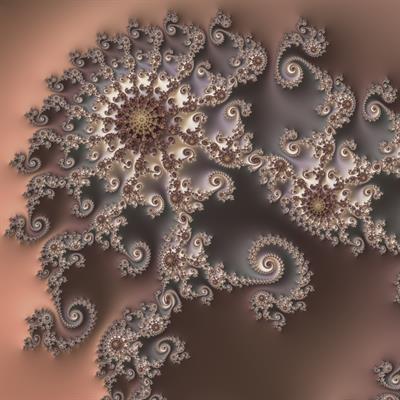
The year 2025 marks half a century since Benoit Mandelbrot first suggested in his book 'Les objet fractals: forme, hasard et dimension' the use of a neologism he coined — fractal — to describe 'broken' or 'fractured' mathematical and natural objects, infinitely rich in detail. Lacking a suitable unifying terminology, these 'monstrous' objects were primarily of interest to mathematicians, mainly for their untamed properties. The concept of fractals encapsulated and solidified hundreds of years of thought and mathematical development. Illustrating his first and subsequent books with striking visualizations of the recursive construction of fractal objects, Mandelbrot struck the right chord not only with scientists but also with the general public. Fractal images, such as those of his canonical Mandelbrot set, instantly resonated with viewers through their immense and infinite beauty.
The timing of Mandelbrot's first book could not have been better. Both the Intel 8080 and Motorola 6800 microprocessors were in full production by 1975, having been introduced just one year earlier. Powerful and versatile microprocessors such as these were instrumental in making computational power widely accessible for use in the recursive computation required for generating and analyzing fractals. First shown in 1980 at the SIGGRAPH conference, computer-generated fractal landscapes and objects became a new way of seeing the world and captivating the general public. Books such as 'The Beauty of Fractals' and 'Fractals Everywhere' made the profound statement that beauty and art can be observed, measured, and modeled, in virtually any field of human progress.
The concept of fractals provided another bridge of unparalleled importance to science. The physics of the early 20th century fascinated humanity with revolutionary insights into micro and macro scales, from fundamental building blocks of observable nature to the forces shaping the Universe. Yet the vast majority of phenomena of direct relevance to humanity lacked methodology and quantification. Complexity required a multiscale approach, which is inherent in fractals. Using the hierarchical description of complex systems, through interlinked levels of abstraction, forming multi-resolution representations, scientists became aware of the infinite complexity of natural phenomena on mesoscales. Methods to analyze phenomena at multiple resolutions were devised, most notably the beautiful methodology of wavelets. Complex systems science became the umbrella encompassing the now possible 'new science' - fractals, multifractals, and multiscaling being an integral part of the new scientific vision.
This topic aims to celebrate the profound influence of fractals and related concepts over the past fifty years, exploring both historical perspectives and proposing future directions of research into multiscale methodologies and their applications across various scientific and artistic disciplines.
Submissions are invited exploring:
• Theoretical advancements in fractal geometry and beyond
• Innovations in fractal, multifractal, and multiscaling analysis methodologies
• Applications of fractal concepts to natural and man-made complex systems
• Multiscale modeling and its impact on technological and scientific progress
• Interdisciplinary applications of fractal concepts in technology, natural sciences, and art.
Original research, review, and hypothesis contributions are welcome, dealing with the past, present, and future of fractals, multifractals, and multiscaling from any discipline of physics, natural science, or indeed computer graphics and art.
Keywords: Fractals, Multifractality, Chaos Theory, Complex Systems, Multiscale Modeling
Important note: All contributions to this Research Topic must be within the scope of the section and journal to which they are submitted, as defined in their mission statements. Frontiers reserves the right to guide an out-of-scope manuscript to a more suitable section or journal at any stage of peer review.