Abstract
Sorghum (Sorghum bicolor) is an economically important cereal crop that can be used as human food, animal feed, and for industrial use such as bioenergy. In sorghum breeding programs, development of cultivars with desirable seed quality characteristics is important and development of rapid low-cost screening methods for seed nutritional traits are desired, since most standard methods are destructive, slow, and less environmentally friendly. This study investigates the feasibility of single kernel NIR spectroscopy (SKNIRS) for rapid determination of individual sorghum seed components. We developed successful multivariate prediction models based on partial least squares (PLS) regression for protein, oil, and weight in sorghum. The results showed that for sorghum protein content ranging from 8.92% to 18.7%, the model coefficients of determination obtained were (RMSEC= 0.44) and (RMSEP= 0.69). The model coefficients of determination for oil prediction were (RMSEC= 0.23) and (RMSEP= 0.41) for oil content ranging from 1.96% to 5.61%. For weight model coefficients of determination were (RMSEC= 0.007) and (RMSEP= 0.007) for seeds ranging from 4.40 mg to 77.0 mg. In conclusion, mean spectra SKNIRS can be used to rapidly determine protein, oil, and weight in intact single seeds of sorghum seeds and can provide a nondestructive and quick method for screening sorghum samples for these traits for sorghum breeding and industry use.
Introduction
Sorghum (Sorghum bicolor) ranks fifth in world cereal production after corn, wheat, rice, and barley, with over 66 million tons produced (FAOSTAT, 2019). The United States is the leading sorghum producer (25% of world’s production and $2.4 billion in economic value) and Kansas is the leading state with half of the U.S. sorghum production (FAOSTAT, 2019; Hacisalihoglu and Armstrong, 2022). It is an economically important cereal and major grain crop for animal feed, and biofuels. Recent research on biofortification has focused on increasing seed nutrient value including protein, amino acids, beta carotene, and vitamins to make crops more nutritious without reducing crop yield (Hacisalihoglu et al., 2010; Murgia et al., 2013; Hacisalihoglu, 2020; Hacisalihoglu and Vallejos, 2005; Hacisalihoglu and Settles, 2017).
As a gluten-free source of protein, sorghum is increasingly used in human food, in antioxidant health promoting compounds and in snack foods. Therefore, measurement of seed nutritional quality traits and their variation are important as breeding parameters. (Ciampitti and Prasad, 2019). The current standard methods to quantify seed composition are costly, slow, destructive in nature, and sometimes not considered environmentally friendly. Near infrared spectroscopy (NIRS) coupled with multivariate calibration is an environmentally friendly, nondestructive, and fast method for seed nutrition quality analysis (Armstrong et al., 2011; Peiris et al. (2019)). More recently, single kernel NIR spectroscopy (SKNIRS) has been used in quality trait characterization of food crops such as corn, soybean, peas, and beans (Hacisalihoglu et al., 2010; Gustin et al., 2013; Hacisalihoglu et al., 2016; and Spielbauer et al. (2009); Hacisalihoglu et al., 2020). It has shown potential in variety identification, sorting based on protein content, and separating damaged from sound single wheat kernels (Delwiche, 1995; Delwiche, 1998; Peiris and Dowell, 2011). There also exists potential to identify double haploid seeds which can decrease cultivar development by several years as has been done in other crops such as maize in which haploid and hybrid seeds can be discriminated based on oil content (Hussain and Franks, 2019; Gustin et al., 2020).
It is highly useful for crop breeders and industry to measure single seed quality composition and subsequently select the desired traits easily and nondestructively. In this regard, NIR spectroscopy has significant advantages such as working with limited sample size, fast quantification without sample preparation and cost effectiveness (Armstrong, 2006).
It is challenging to develop SKNIRS methods for small-seeded crops such as sorghum and particularly for sorghum oil content which is small in concentration. Therefore, the objectives of the current study were: 1) to assess the feasibility of using SKNIRS for small-seeded crops; and 2) to evaluate calibration models to predict protein, oil, and weight in single intact sorghum seeds that could be used to indicate seed trait variability in samples as well as potentially sorting seeds by traits for breeders.
Materials and methods
Sorghum seed samples
A collection of 108 widely diverse sorghum accessions (Sorghum bicolor) were selected and obtained from the U.S. Department of Agriculture (USDA) National Germplasm Center (https://npgsweb.ars-grin.gov/gringlobal). The samples were selected to maximize diversity based on size and country of origin, Figure 1.
Figure 1
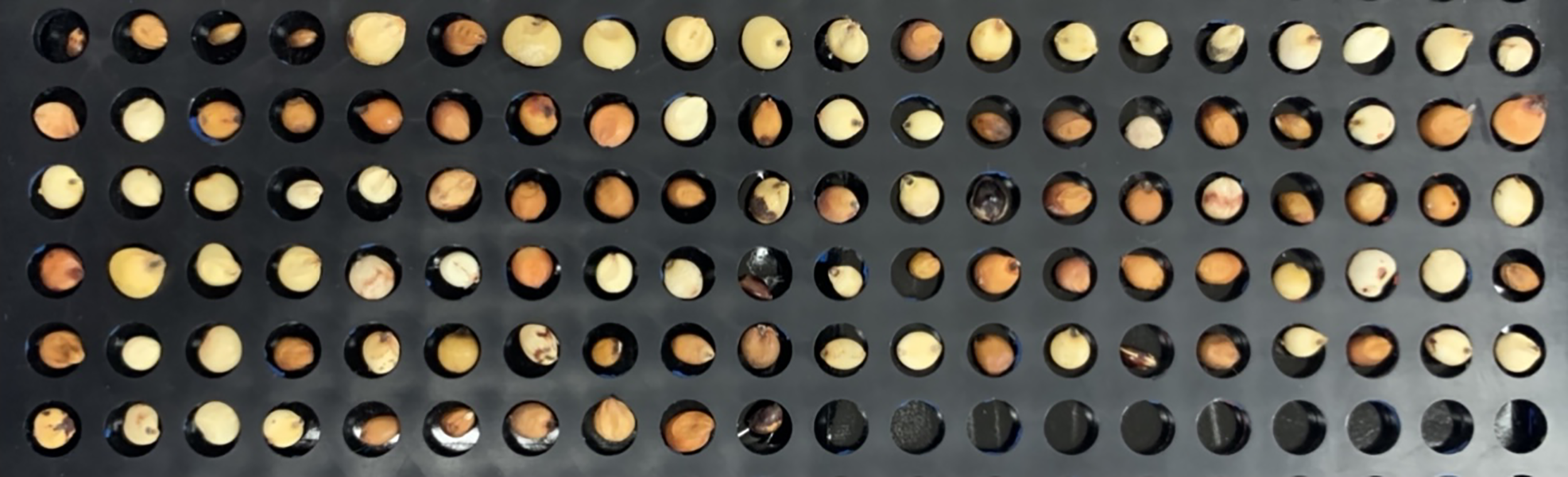
Sorghum accessions used for single NIR spectroscopy calibration prediction model development in the current study.
NIR spectroscopy measurements
NIR spectra were collected with a custom-built single-seed instrument. Armstrong (2006) provides a detailed description of the instrument and spectral data collection. Briefly, the instrument used was a 907-1689 nm InGaAs-based spectrometer (CD NIR-256-1.7T1, Control Development, South Bend, IN) where two fiber-optic cables were positioned at each end of an inclined, 8 mm diameter, glass tube and reflected light from seeds falling through the tube was collected. The glass tube was illuminated by 48 miniature halogen lamps along its length and circumference. Spectra were collected at 1 nm intervals and converted to absorbance values.
Protein wet lab analysis and seed weight
Protein content (%, as-is) was measured from single whole seeds using a Leco FP-628 nitrogen combustion analyzer (St. Joseph, MI, USA) according to AACC Method 46-30.01 as described elsewhere (Hacisalihoglu et al., 2020). Individual seed weights were measured in triplicate with a balance. Total protein was calculated as N x 6.25.
Oil analysis
Oil content (%, as-is) of the intact seeds was measured by a Bruker MiniSpec mq20 NMR Analyzer (Bruker Biospin, Billerica, MA, USA) as described previously (Hacisalihoglu et al., 2020). The oil content was obtained by placing 1 g of seeds into a 20 mm test tube warmed to 40°C, then inserting the tube in the NMR instrument using the standard procedures suggested by the manufacturer. The analyzer was calibrated prior to measurements and optimized for the range of oil to be measured. This small bulk sample was used as a reference for single seed oil as there is no practical way to measure oil content on such small seeds.
Calibration model development and validation
Spectral data were analyzed using Unscrambler X software (CAMO Analytics, Oslo, Norway). Standard normal variate (SNV) was used as a pre-processing method for oil and protein. Partial least squares (PLS) regression was performed and evaluated using leave-one-out cross validation to select the optimal models. The samples were further subdivided into training (2/3 of total samples) and validation (1/3 of total samples) sets based on creating equal variability, as much as possible, in the biochemical seed parameter reference values. Model evaluation and selection were based on model factor levels as suggested by the Unscrambler software and evaluation of independent spectral data in the validation sets. For protein models, reference protein was the average protein from the three kernels from each accession. These values were indexed to the nine averaged spectra from the same kernels. For oil models, the nine averaged spectra were indexed to the oil content measured by NMR as previously described. Weight models indexed the three spectra average of a single seed to its true seed weight. Table 1 summarizes the PLS modelling data.
Table 1
| Single Seed Model Reference Spectra | Average Model Reference Spectra | Model Reference Trait | |
|---|---|---|---|
| Protein | 3 spectra averaged for each seed | 9 spectra from 3 seeds averaged | Single seed-LECO |
| Oil | 3 spectra averaged for each seed | 9 spectra from 3 seeds avg | 1 gm sample-NMR |
| Weight | 3 spectra averaged for each seed | NA | Single seed-weight |
PLS modelling data.
Results and discussion
Mean spectra and single kernel NIR spectroscopy seed composition and weight parameters
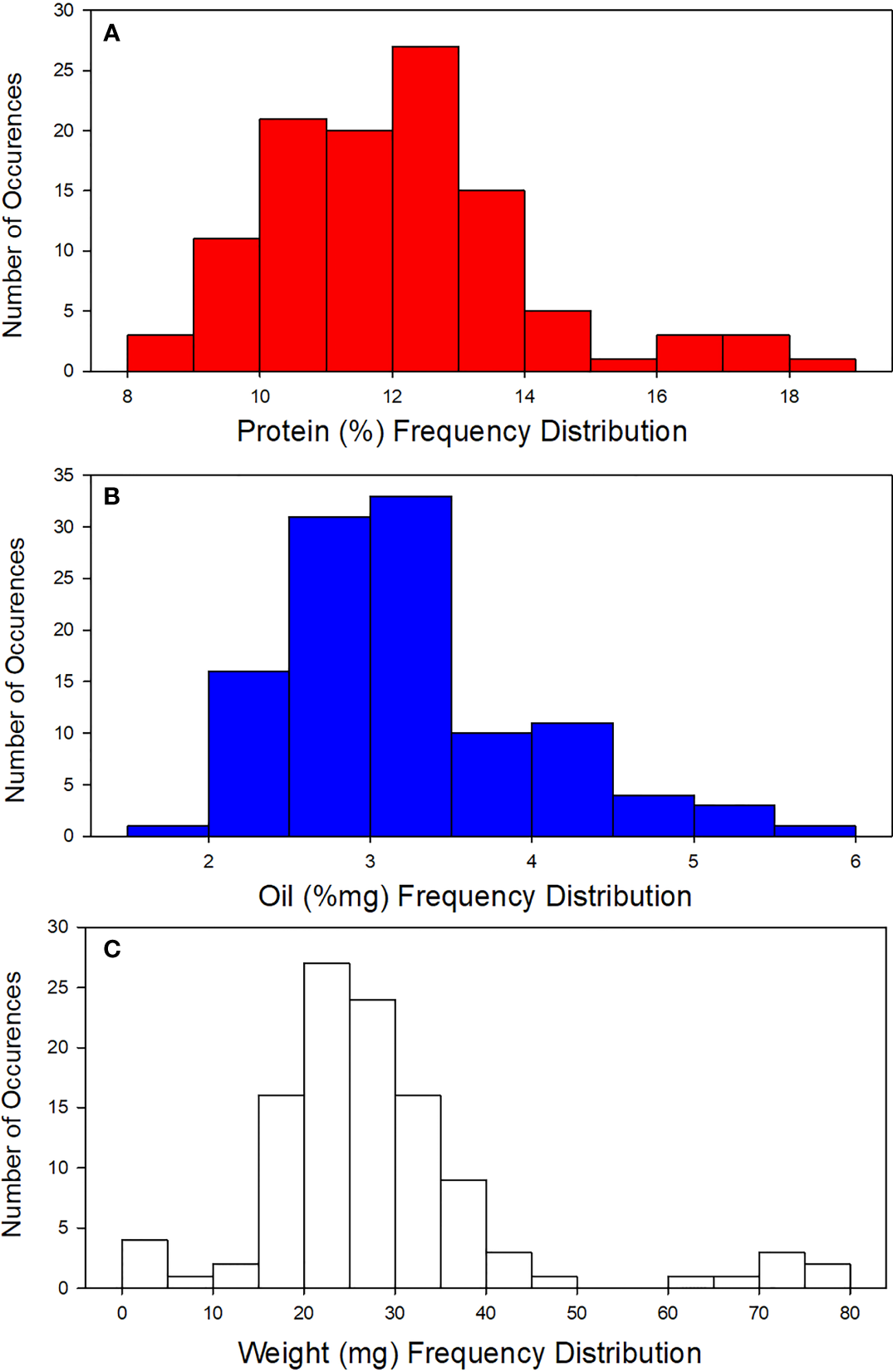
Seed parameters of 108 diverse sorghum accessions represented by their means, standard deviations (SD), and ranges are summarized in Table 2 and Figure 2. Analytical data from sorghum accessions showed a wide variation in protein content (8.92% - 18.7%), oil (1.96% - 5.61%), and weight (4.40 mg – 77.0 mg) (Figure 2). Furthermore, there were no statistically significant correlations detected between seed weight and protein or oil content (p< 0.01; Table 3). This is in agreement with Hacisalihoglu et al. (2020) who reported no strong relationship between protein and seed weight in peas.
Table 2
| Parameter | Mean | SD | Range |
|---|---|---|---|
| Protein (%, as-is) | 12.1 | 1.94 | 8.92-18.7 |
| Oil (%, as-is) | 3.23 | 0.79 | 1.96-5.61 |
| Weight (mg) | 28.8 | 13.5 | 4.40-77.0 |
Reference protein, oil, and weight of 108 single sorghum seeds.
Figure 2
Frequency distribution for (A) protein, (B) Oil, and (C) weight for the sorghum accession.
Table 3
| Traits | Protein | Oil |
|---|---|---|
| Oil | 0.32 | |
| Weight | -0.27 | -0.13 |
Phenotypic correlations between seed nutritional traits and weight in sorghum.
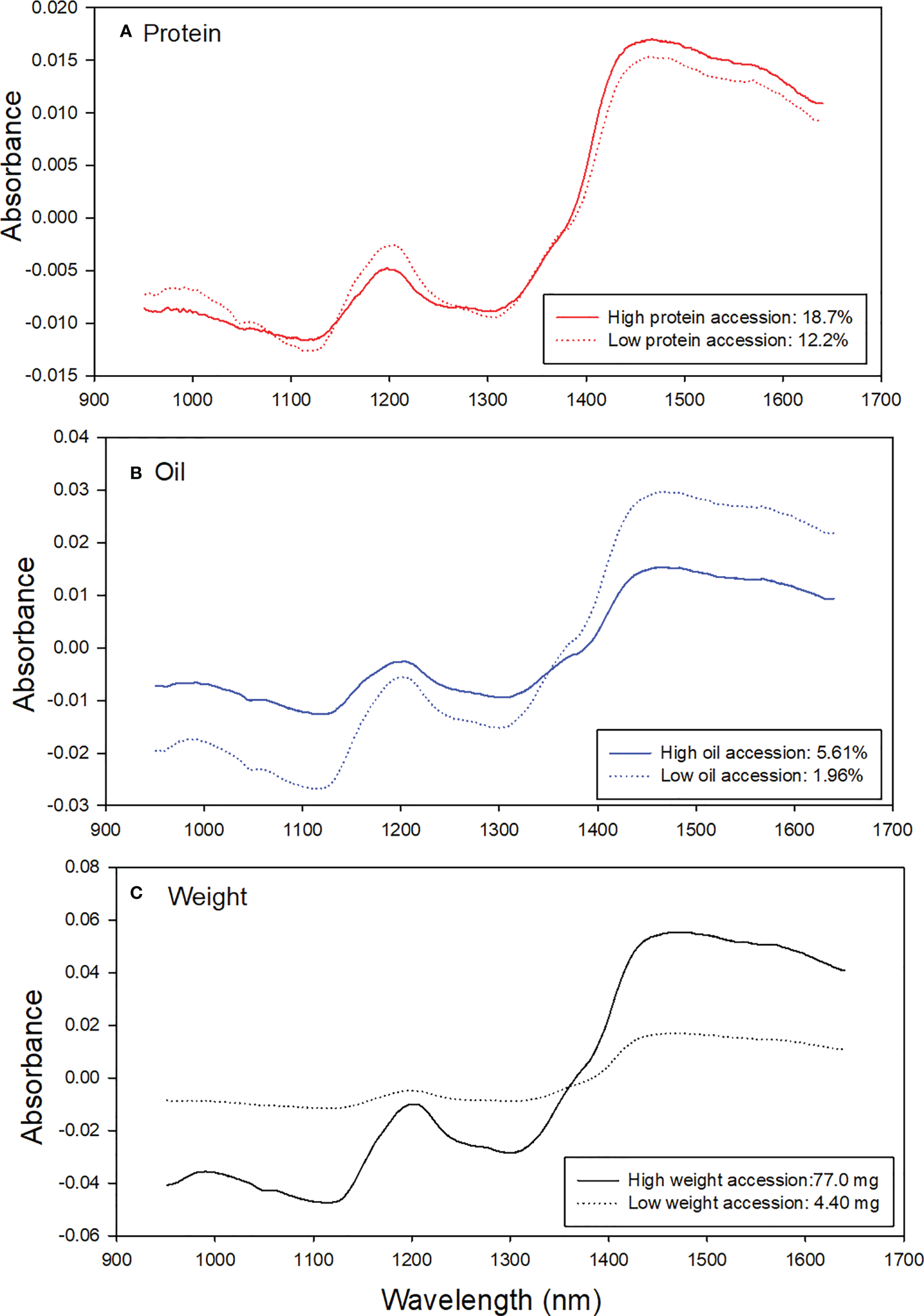
Figure 3 shows examples of contrasting spectra pairs of sorghum protein, oil, and weight. Each line represents average original SKNIR spectra of nine sorghum seeds. Absorbance differences were found between high- and low-protein sorghum accessions (Figure 3A), weight sorghum accessions (Figure 3C), and oil sorghum accessions (Figure 3B). The results show that average spectral absorbance differences between seeds with high or low composition and weight.
Figure 3
Examples of contrasting spectra of high- and low-contents of (A) protein, (B) Oil, and (C) weight in sorghum seeds.
Protein, oil, and weight calibration development
The predicted vs. reference plots of external validation sets for protein, oil, and weight models are shown in Figure 4 and model statistics Table 4. The PLS regression protein model using validation mean spectra showed good prediction accuracy (R2 = 0.87, RMSEP= 0.69, Figure 4A). Similarly, the oil model showed reasonable accuracy for validation data (R2 = 0.71, RMSEP= 0.41, Figure 4B) and would be appropriate for screening low or high oil sorghum samples. The weight model showed reasonable accuracy (R2 = 0.63, RMSEP= 0.007, Figure 4D) but was lower than previous research on maize (Gustin et al., 2013) and common beans (Hacisalihoglu et al., 2010).
Figure 4
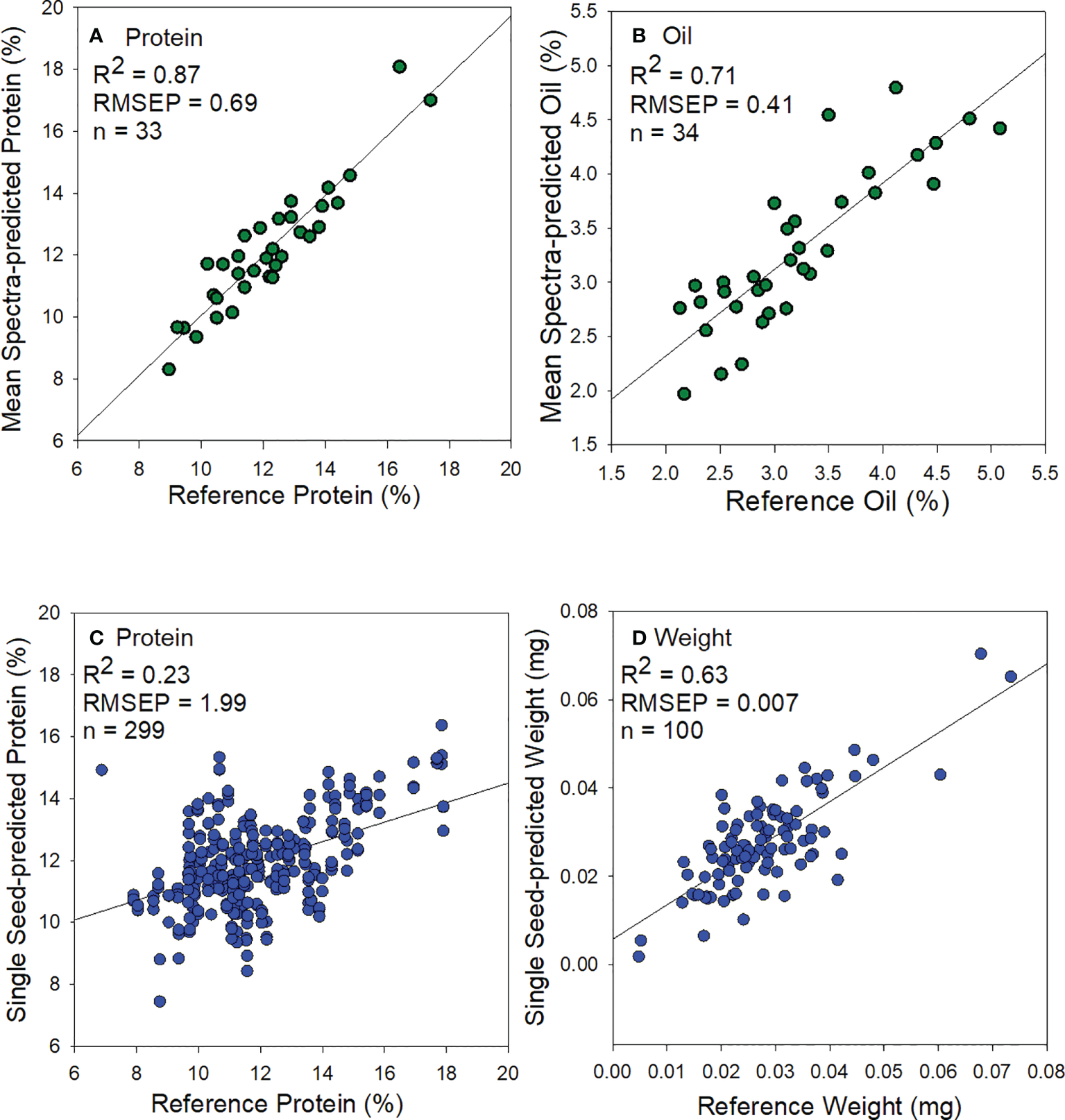
Scatter plots of predicted and analytically wet-lab measured (A) protein from using mean spectra, (B) oil from using mean spectra, (C) protein from single sorghum seeds, and (D) weight from single sorghum seeds.
Table 4
| CALIBRATION | PREDICTION | ||||||
|---|---|---|---|---|---|---|---|
| Parameter | N | factors | RMSEC | R2 | N | RMSEP | R2 |
| Average spectra | |||||||
| Protein | 76 | 12 | 0.44 | 0.95 | 33 | 0.69 | 0.87 |
| Oil | 74 | 12 | 0.23 | 0.92 | 34 | 0.41 | 0.71 |
| Single seed | |||||||
| Protein | 678 | 12 | 1.48 | 0.55 | 299 | 1.96 | 0.23 |
| Weight | 228 | 10 | 0.007 | 0.81 | 100 | 0.007 | 0.63 |
Summary of calibration and prediction statistics for protein, oil, and weight models using mean and single seed spectra of sorghum.
N is sample size; R2 is coefficient of determination; RMSEC is root mean standard error of calibration; and RMSEP is root mean standard error of prediction.
The protein model from single sorghum seeds showed poor prediction (R2 = 0.23, RMSEP= 1.96, Figure 4C). Overall, mean spectral based models for weight determination in single intact sorghum seeds gave the best results for both calibration and prediction performances. Similar results have been reported with another small-seeded crop, namely chia seeds for bulk oil prediction (Serson et al., 2020).
PLS regression coefficients and NIRS regions associated with sorghum traits
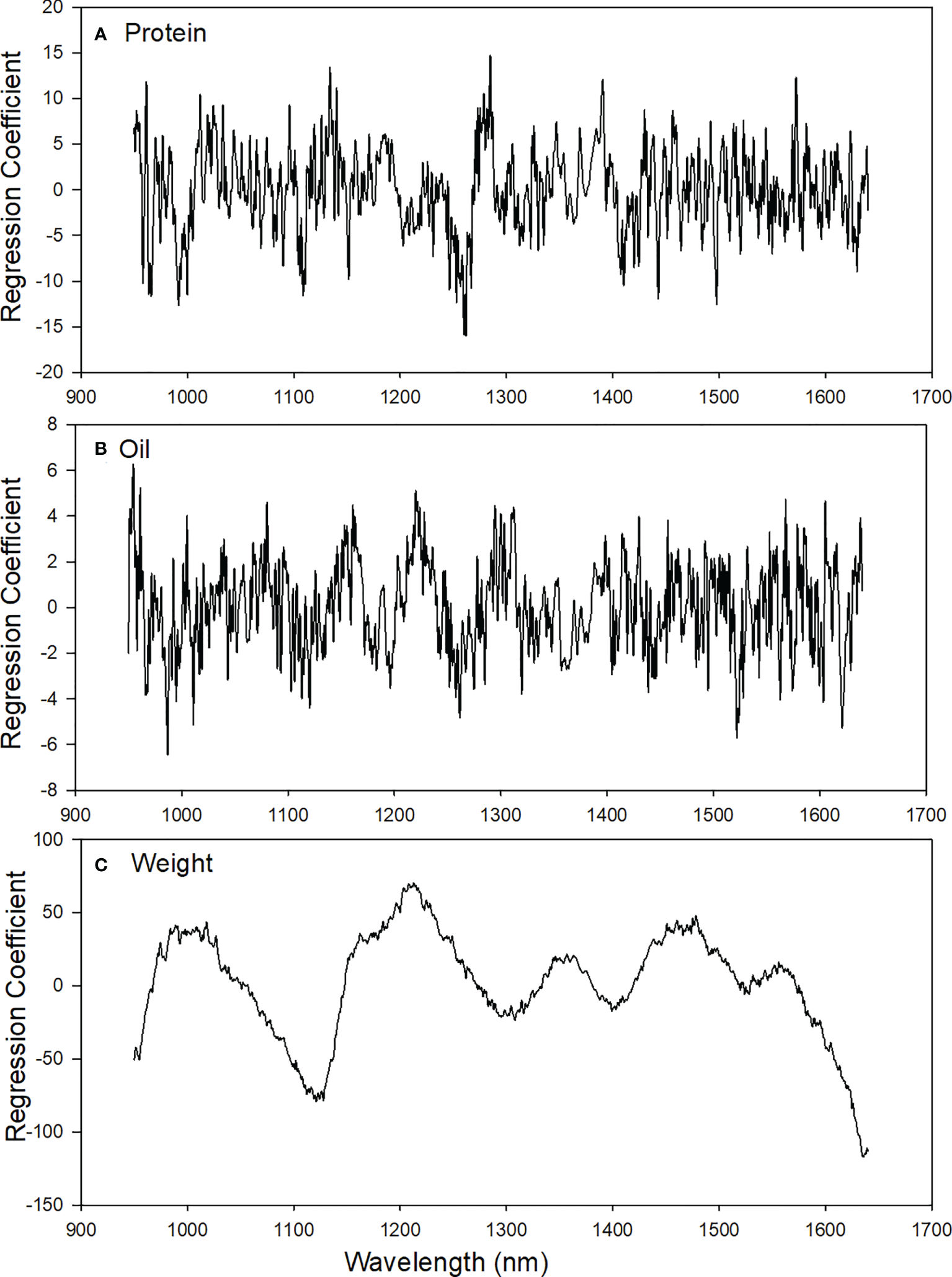
Figure 5 shows regions of influence for PLS model coefficients. These regions are distinguished by large positive and negative coefficients which more heavily contribute to protein and oil prediction. The peaks for protein were observed for calibration models around 2nd overtone N-H stretching (973-1020 nm; 1035-1040 nm; and 1498 nm). The peaks for oil were observed for calibration models around 3rd overtone C-H stretching (992-1025 nm and 1210 nm) and 3rd overtone O-H stretching (960 nm), Table 5. Prediction of weight cannot be explained in relationship to chemical composition and is thought to be more related to light quantity, i.e. large seeds may create different total reflectance over smaller seeds. As such better methods of modelling such as a summation of the absorbance spectra might provide better weight predictions over PLS modeling.
Figure 5
Beta-coefficient plots based on the optimal PLS models of (A) protein, (B) oil, and (C) weight in single sorghum seeds.
Table 5
| Absorption | Parameter | |
|---|---|---|
| Peak location | band assignment | associated with |
| 992-1025 nm | C-H stretch of 3rd overtone | Oil related |
| 1210 nm | C-H stretch of 2nd overtone | Oil related |
| 973-1020 nm | N-H stretch of 2nd overtone | Protein related |
| 1035-1040 nm | N-H stretch of 2nd overtone | Protein related |
| 1498 nm | N-H stretch of 2nd overtone | Protein related |
| 1123 nm | O-H stretch of 2nd overtone | Water related |
| 960 nm | O-H stretch of 3rd overtone | Water, Oil related |
Peak wavelength locations, their band assignment, and seed parameter associated with in single sorghum seed.
Summary and conclusions
To the best of our knowledge, this is the first study which has applied SKNIRS to predict sorghum seed protein, oil, and weight. Our findings in this paper are applicable to a broad range of sorting implementations in the field, industry, as well as sorghum breeding programs. The SKNIRS technique provides numerous advantages including: i) as wet chemistry methods of sorghum quality assessments are slow and costly, the SKNIRS method is a suitable, non-chemical alternative for classification or screening for protein, oil, and weight, nondestructively; ii) SKNIRS may provide a powerful, fast, high-throughput seed nutrient quality technique for sorghum breeding as well as uniformity screening activities; iii) SKNIRS can simultaneously quantify sorghum seed constituents; and iv) SKNIRS does not require sample preparation and therefore minimizes potential errors in the sample preparation process.
Funding
This study was supported by the United States Department of Agriculture (USDA-ARS) 1890 Research Sabbatical program to ARS Project 3020-43440-010-002-S and a subsequent Non-Assistance Cooperative Agreement with GH (FAMU).
Acknowledgments
We thank USDA National Plant Germplasm Center (Griffin, GA) for providing the seeds. We thank Kevin Fay (Manhattan, KS) for his excellent technical help with nitrogen combustion. The mention of a proprietary product or trade name does not constitute a recommendation or endorsement by the US Department of Agriculture. The USDA is an equal opportunity provider and employer.
Publisher’s note
All claims expressed in this article are solely those of the authors and do not necessarily represent those of their affiliated organizations, or those of the publisher, the editors and the reviewers. Any product that may be evaluated in this article, or claim that may be made by its manufacturer, is not guaranteed or endorsed by the publisher.
Statements
Data availability statement
The raw data supporting the conclusions of this article will be made available by the authors, without undue reservation.
Author contributions
GH developed the research hypothesis, designed the research methodology, performed the research, analyzed the data, and wrote the original draft with the contributions from PA, PM, and BS. PA developed the methodology and draft. PA and PM interpreted data analysis, helped with methodology and software. All authors contributed to the article and approved the submitted version.
Conflict of interest
The authors declare that the research was conducted in the absence of any commercial or financial relationships that could be construed as a potential conflict of interest.
References
1
Armstrong P. R. (2006). Rapid single-kernel NIR measurement of grain and oil-seed attributes. Appl. Eng. Agric.22 (5), 767–772. doi: 10.13031/2013.21991
2
Armstrong P. R. Tallada J. G. Hurburgh C. Hildebrand D. F. Specht J. E. (2011). Development of single-seed near-infrared spectroscopic predictions of corn and soybean constituents using bulk reference values and mean spectra. Trans. ASABE54 (4), 1529–1535. doi: 10.13031/2013.39012
3
Ciampitti I. A. Prasad P. V. V. (2019). Sorghum: State of art and future perspective (New Jersey, USA: Wiley & Sons).
4
Delwiche S. R. (1995). Single wheat kernel analysis by near-infrared transmittance protein content. Cereal Chem.72, 11–16. doi: 10.1006/jcrs.1997.0165
5
Delwiche S. R. (1998). Protein content of single kernels of wheat by near-infrared reflectance spectroscopy. J. Cereal Sci.27, 241–254. doi: 10.1006/jcrs.1997.0165
6
FAOSTAT (2019). Food and agriculture organization of the united nations, Rome. In: FAO statistical databases. Available at: http://www.fao.org/faostat (Accessed September 1, 2021).
7
Gustin J. L. Frei U. K. Baier J. Armstrong P. Lübberstedt T. Settles A. M. (2020). Classification approaches for sorting maize (Zea mays subsp. mays) haploids using single-kernel near-infrared spectroscopy. Plant Breed.139, 1103–1112. doi: 10.1111/pbr.12857
8
Gustin J. L. Jackson S. Williams C. Patel A. Armstrong P. R. Peter G. F. et al . (2013). Analysis of maize (Zea mays) kernel density and volume using micro-computed tomography and single-kernel near infrared spectroscopy. J. Agric. Food Chem.61, 10872–10880. doi: 10.1021/jf403790v
9
Hacisalihoglu G. (2020). Zinc (Zn): The last nutrient in the alphabet and shedding light on zn efficiency for future of crop production under suboptimal zn. Plants9 (11), 1471. doi: 10.3390/plants9111471
10
Hacisalihoglu G. Armstrong P. R. (2022). Flax and sorghum: multi-element contents and nutritional values within 210 varieties and potential selection for future climates to sustain food security. Plants11 (3), 451. doi: 10.3390/plants11030451
11
Hacisalihoglu G. Freeman J. Armstrong P. Seaborn B. Porter L. D. Settles A. M. et al . (2020). Protein, weight, and oil prediction by single-seed near-infrared spectroscopy for selection of seed quality and yield traits in pea (P. sativum). J. Sci. Food Agric.100 (8), 3488–3497. doi: 10.1002/jsfa.10389
12
Hacisalihoglu G. Gustin J. Louisma J. Armstrong P. Peter G. Settles A. M. (2016). Enhanced single seed trait predictions in soybean and robust calibration model transfer with NIR spectroscopy. J. Agric. Food Chem.64, 1079–1086. doi: 10.1021/acs.jafc.5b05508
13
Hacisalihoglu G. Larbi B. Settles A. M. (2010). Near infrared reflectance spectroscopy predicts protein, starch, and seed weight in intact seeds of common bean. J.Agric. Food Chem.58 (2), 702–706. doi: 10.1021/jf9019294
14
Hacisalihoglu G. Settles A. M. (2017). ). Quantification of seed ionome variation in 90 diverse soybean (Glycine max) lines. J. Plant Nutr.40 (20), 2808–2817. doi: 10.1080/01904167.2017.1382528
15
Hacisalihoglu G. Vallejos C. E. (2005). Distribution of seed mineral nutrients and their correlation in Phaseolus vulgaris. Proc. Florida State Hortic. Society.118, 102–105.
16
Hussain T. Franks C. (2019). “Discovery of sorghum haploid induction system,” in Sorghum. methods in molecular biology, vol. 1931 . Eds. ZhaoZ. Y.DahlbergJ. (New York, NY: Humana Press).
17
Murgia I. De Gara L. Grusak M. A. (2013). Biofortification: how can we exploit plant science and biotechnology to reduce micronutrient deficiencies? Front. Plant Sci.4. doi: 10.3389/fpls.2013.00429
18
Peiris K. H. S. Bean S. R. Chiluwal A. Perumal R. Jagadish S. V. (2019). Moisture effects on robustness of sorghum grain protein near-infrared spectroscopy calibration. Cereal Chem.96, 678–668. doi: 10.1002/cche.10164
19
Peiris K. H. S. Dowell F. E. (2011). Determining weight and moisture properties of sound and fusarium-damaged single wheat kernels by near-infrared spectroscopy. Cereal Chem.88, 45–50. doi: 10.1094/CCHEM-04-10-0067
20
Serson W. Armstrong P. Maghirang E. Al-Bakri A. Phillips T. Al-Amery M. et al . (2020). Development of whole and ground seed near-infrared spectroscopy calibrations for oil, protein, moisture, and fatty acids in salvia hispanica. J. Amer. Oil Chem. Soc97, 3–13. doi: 10.1002/aocs.12300
21
Spielbauer G. Armstrong P. Baier J. Allen W. Richardson K. Shen B. et al . (2009). High-throughput near-infrared reflectance spectroscopy for predicting quantitative and qualitative composition phenotypes of individual maize kernels. Cereal Chem.86, 556–564. doi: 10.1094/CCHEM-86-5-0556
Summary
Keywords
sorghum protein, sustainable food systems, near infrared spectroscopy, seed content, oil, phenotyping
Citation
Hacisalihoglu G, Armstrong PR, Mendoza PTD and Seabourn BW (2022) Compositional analysis in sorghum (Sorghum bicolor) NIR spectral techniques based on mean spectra from single seeds. Front. Plant Sci. 13:995328. doi: 10.3389/fpls.2022.995328
Received
08 August 2022
Accepted
21 September 2022
Published
17 October 2022
Volume
13 - 2022
Edited by
Ruslan Kalendar, University of Helsinki, Finland
Reviewed by
Subhadip Banerjee, Jadavpur University, India; Hengchang Zang, Shandong University, China
Updates
Copyright
© 2022 Hacisalihoglu, Armstrong, Mendoza and Seabourn.
This is an open-access article distributed under the terms of the Creative Commons Attribution License (CC BY). The use, distribution or reproduction in other forums is permitted, provided the original author(s) and the copyright owner(s) are credited and that the original publication in this journal is cited, in accordance with accepted academic practice. No use, distribution or reproduction is permitted which does not comply with these terms.
*Correspondence: Paul R. Armstrong, paul.armstrong@usda.gov
This article was submitted to Technical Advances in Plant Science, a section of the journal Frontiers in Plant Science
Disclaimer
All claims expressed in this article are solely those of the authors and do not necessarily represent those of their affiliated organizations, or those of the publisher, the editors and the reviewers. Any product that may be evaluated in this article or claim that may be made by its manufacturer is not guaranteed or endorsed by the publisher.