 Endrick Guy1
 Hélène Boulain1Yoann Aigu1Charlotte Le Pennec1Khaoula Chawki1Stéphanie Morlière1Kristina Schädel2
 Grit Kunert2Jean-Christophe Simon1
 Akiko Sugio1*
- 1INRA, UMR1349, Institute of Genetics, Environment and Plant Protection, Le Rheu, France
- 2Department of Biochemistry, Max Planck Institute for Chemical Ecology, Jena, Germany
A corrigendum on
Optimization of Agroinfiltration in Pisum sativum Provides a New Tool for Studying the Salivary Protein Functions in the Pea Aphid Complex
by Guy, E., Boulain, H., Aigu, Y., Le Pennec, C., Chawki, K., Morlière, S., et al. (2016). Front. Plant Sci. 7:1171. doi: 10.3389/fpls.2016.01171
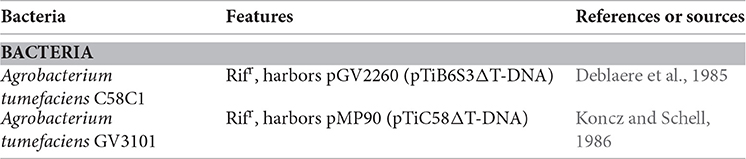
Corrigendum on Supplemental Table 2.
In the original article, description of helper plasmids in C58C1 (pGV2260) and GV3101 (pMP90) were missing. The correct information of these two strains appears below. The authors apologize for the missing information. This error does not change the scientific conclusions of the article in any way.
Conflict of Interest Statement
The authors declare that the research was conducted in the absence of any commercial or financial relationships that could be construed as a potential conflict of interest.
References
Deblaere, R., Bytebier, B., De Greve, H., Deboeck, F., Schell, J., Van Montagu, M., et al. (1985). Efficient octopine Ti plasmid-derived vectors for Agrobacterium-mediated gene transfer to plants. Nucleic Acids Res. 13, 4777–4788. doi: 10.1093/nar/13.13.4777
Keywords: pea aphid, Acyrtosiphon pisum, Leguminosae, agroinfiltration, salivary proteins, biotypes, host specialization, effector
Citation: Guy E, Boulain H, Aigu Y, Le Pennec C, Chawki K, Morlière S, Schädel K, Kunert G, Simon J-C and Sugio A (2017) Corrigendum: Optimization of Agroinfiltration in Pisum sativum Provides a New Tool for Studying the Salivary Protein Functions in the Pea Aphid Complex. Front. Plant Sci. 7:2046. doi: 10.3389/fpls.2016.02046
Received: 19 December 2016; Accepted: 21 December 2016;
Published: 10 January 2017.
Edited and reviewed by: Jyoti Shah, University of North Texas, USA
Copyright © 2017 Guy, Boulain, Aigu, Le Pennec, Chawki, Morlière, Schädel, Kunert, Simon and Sugio. This is an open-access article distributed under the terms of the Creative Commons Attribution License (CC BY). The use, distribution or reproduction in other forums is permitted, provided the original author(s) or licensor are credited and that the original publication in this journal is cited, in accordance with accepted academic practice. No use, distribution or reproduction is permitted which does not comply with these terms.
*Correspondence: Akiko Sugio, YWtpa28uc3VnaW9AaW5yYS5mcg==