 Cristina Ribaudo1,2*
 Juliette Tison-Rosebery2
 Damien Buquet3Gwilherm Jan2Aurélien Jamoneau2
 Gwenaël Abril3,4,5
 Pierre Anschutz3
 Vincent Bertrin2
- 1EA 4592 Géoressources et Environnement, ENSEGID, Pessac, France
- 2Irstea, UR EABX, Centre de Bordeaux, Cestas, France
- 3CNRS UMR 5805 Environnements et Paléoenvironnements Océaniques et Continentaux, Université de Bordeaux, Pessac, France
- 4Biologie des Organismes et Ecosystèmes Aquatiques, Muséum National d'Histoire Naturelle, Paris, France
- 5Programa de Geoquímica, Universidade Federal Fluminense, Niterói, Brazil
A Corrigendum on
Invasive Aquatic Plants as Ecosystem Engineers in an Oligo-Mesotrophic Shallow Lake
by Ribaudo, C., Tison-Rosebery, J., Buquet, D., Jan, G., Jamoneau, A., Abril, G., et al. (2018). Front. Plant Sci. 9:1781. doi: 10.3389/fpls.2018.01781
In the original article, there was a mistake in Figure 8 as published. An error was made while converting carbon flux values from moles to grams. As a consequence, the original figure showed diffusive carbon fluxes which were lower than real ones. The corrected Figure 8 appears below.
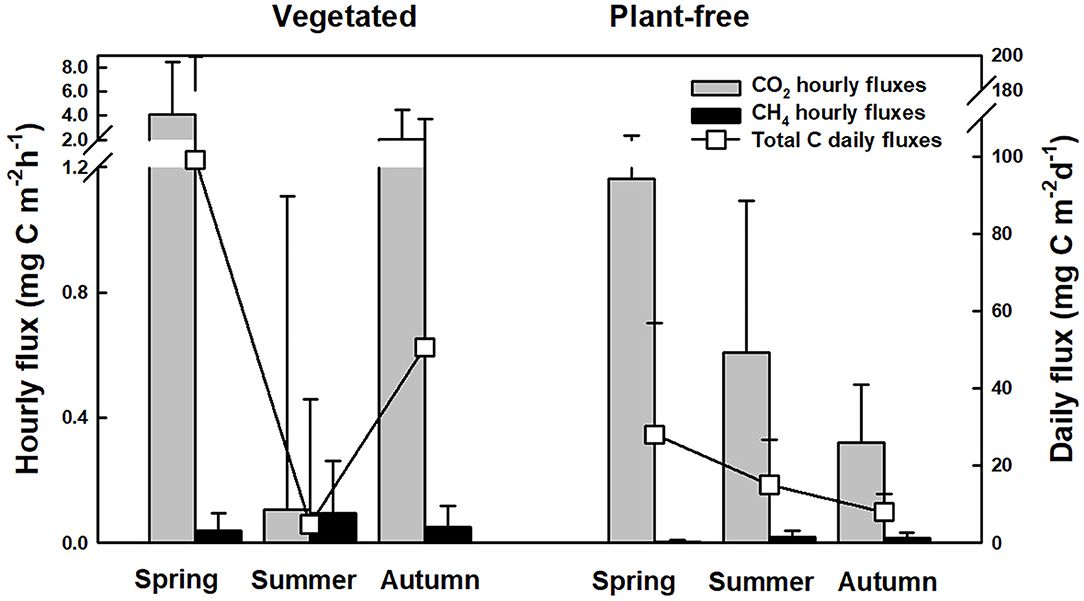
Figure 8. Hourly and total diffusive carbon fluxes (from CO2 and CH4) calculated from concentrations measured at the surface of the water column of vegetated and plant-free areas.
Further, due to the same error outlined above, the carbon budget extended to the annual period and lake scale was incorrect.
A correction has therefore been made to the Results section, subsection Seasonal Nutrients and Carbon Budget, paragraph three:
“Coherently with concentrations measured at the surface of the water column, diffusive carbon fluxes calculated at the water–air interface followed a seasonal pattern (Figure 8). At vegetated stands, the highest value was recorded in spring (99.2 ± 104.8 mg C m−2 d−1) and the lowest in summer (4.9 ± 32.3 mg C m−2 d−1); at plant-free sites, the highest value was recorded in spring (28.0 ± 28.9 mg C m−2 d−1) and the lowest in autumn (8.0 ± 4.6 mg C m−2 d−1). Overall, the major contribution to diffusive carbon fluxes was given by CO2, and only in a minor part by CH4, with the summer period at vegetated sites as solely exception. At the annual scale, during the growing season of the plants (March to November), we can estimate that vegetated stands release 13.9 ± 1.2 g C m−2 year−1, while plant-free sites release 4.6 ± 0.3 g C m−2 year−1. When upscaling to the lake scale, we can estimate that dense vegetated stands emit 17 ± 1 tons C per growing season, whereas plant-free areas emit, in the same period, an estimated amount of 69 ± 4 tons C.”
The authors apologize for this error and state that this does not change the scientific conclusions of the article in any way. The original article has been updated.
Keywords: carbon emission, methane, hypoxia, water stratification, nutrients regeneration, seasonal, primary production, exotic plants
Citation: Ribaudo C, Tison-Rosebery J, Buquet D, Jan G, Jamoneau A, Abril G, Anschutz P and Bertrin V (2021) Corrigendum: Invasive Aquatic Plants as Ecosystem Engineers in an Oligo-Mesotrophic Shallow Lake. Front. Plant Sci. 12:656314. doi: 10.3389/fpls.2021.656314
Received: 20 January 2021; Accepted: 16 February 2021;
Published: 08 March 2021.
Edited by:
Rossano Bolpagni, University of Parma, ItalyReviewed by:
Monica Pinardi, National Research Council (CNR), ItalyCopyright © 2021 Ribaudo, Tison-Rosebery, Buquet, Jan, Jamoneau, Abril, Anschutz and Bertrin. This is an open-access article distributed under the terms of the Creative Commons Attribution License (CC BY). The use, distribution or reproduction in other forums is permitted, provided the original author(s) and the copyright owner(s) are credited and that the original publication in this journal is cited, in accordance with accepted academic practice. No use, distribution or reproduction is permitted which does not comply with these terms.
*Correspondence: Cristina Ribaudo, Y3Jpc3RpbmEucmliYXVkb0BlbnNlZ2lkLmZy