 Stien Mertens1,2Lennart Verbraeken1,2
 Heike Sprenger1,2†Kirin Demuynck1,2Katrien Maleux1,2†Bernard Cannoot1,2Jolien De Block1,2
 Steven Maere1,2
 Hilde Nelissen1,2Gustavo Bonaventure3Steven J. Crafts-Brandner4
 Jonathan T. Vogel4Wesley Bruce4
 Dirk Inzé1,2*
 Nathalie Wuyts1,2†
- 1Department of Plant Biotechnology and Bioinformatics, Ghent University, Ghent, Belgium
- 2VIB-UGent Center for Plant Systems Biology, Ghent, Belgium
- 3BASF SE, Ghent, Belgium
- 4BASF Corporation, Research Triangle Park, NC, United States
A Corrigendum on
Proximal hyperspectral imaging detects diurnal and drought-induced changes in maize physiology
By Mertens S, Verbraeken L, Sprenger H, Demuynck K, Maleux K, Cannoot B, De Block J, Maere S, Nelissen H, Bonaventure G, Crafts-Brandner SJ, Vogel JT, Bruce W, Inzé D and Wuyts N (2021) Front. Plant Sci. 12:640914. doi: 10.3389/fpls.2021.640914
In the published article, there was an error in Figure 2 and Supplementary Figure 1. The values on the left Y-axis in Figure 2 and Supplementary Figure 1 were switched. The corrected Figure 2 and its caption appear below.
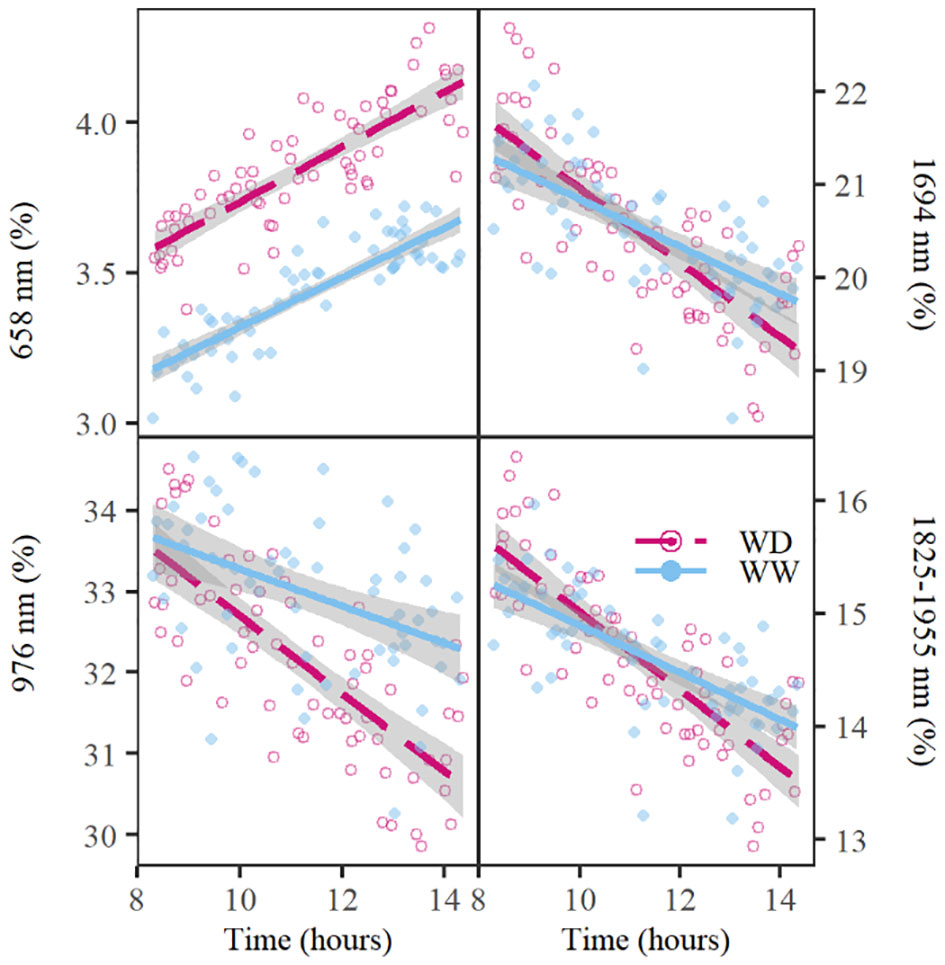
Figure 2 Diurnal changes in relative reflectance at 658; 976; and 1,694 nm and the water absorption trough with the ridge at 1,825 nm and the valley at 1,955 nm on day 6 of the drought period. The well-watered (WW) and water deficit (WD) treatments are indicated with a blue line or dot and a red dashed line or circle, respectively. The lines show the average trend of the treatment, whereas the dots and circles represent the relative reflectance of individual plants at the respective wavelengths. The gray shading around the lines indicate the standard error of relative reflectance. The water absorption trough depth values were calculated as the difference in relative reflectance between 1,825 and 1,955 nm.
The authors apologize for this error and state that this does not change the scientific conclusions of the article in any way. The original article has been updated.
Publisher’s note
All claims expressed in this article are solely those of the authors and do not necessarily represent those of their affiliated organizations, or those of the publisher, the editors and the reviewers. Any product that may be evaluated in this article, or claim that may be made by its manufacturer, is not guaranteed or endorsed by the publisher.
Keywords: automated phenotyping platform, hyperspectral, phenotyping, drought, physiology, maize, proximal sensing
Citation: Mertens S, Verbraeken L, Sprenger H, Demuynck K, Maleux K, Cannoot B, De Block J, Maere S, Nelissen H, Bonaventure G, Crafts-Brandner SJ, Vogel JT, Bruce W, Inzé D and Wuyts N (2024) Corrigendum: Proximal hyperspectral imaging detects diurnal and drought-induced changes in maize physiology. Front. Plant Sci. 15:1379654. doi: 10.3389/fpls.2024.1379654
Received: 31 January 2024; Accepted: 05 February 2024;
Published: 21 February 2024.
Edited and Reviewed by:
Paul Christiaan Struik, Wageningen University and Research, NetherlandsCopyright © 2024 Mertens, Verbraeken, Sprenger, Demuynck, Maleux, Cannoot, De Block, Maere, Nelissen, Bonaventure, Crafts-Brandner, Vogel, Bruce, Inzé and Wuyts. This is an open-access article distributed under the terms of the Creative Commons Attribution License (CC BY). The use, distribution or reproduction in other forums is permitted, provided the original author(s) and the copyright owner(s) are credited and that the original publication in this journal is cited, in accordance with accepted academic practice. No use, distribution or reproduction is permitted which does not comply with these terms.
*Correspondence: Dirk Inzé, ZGlyay5pbnplQHBzYi52aWItdWdlbnQuYmU=; , ZGlpbnpAcHNiLnVnZW50LmJl
†Present address: Heike Sprenger, German Federal Institute for Risk Assessment, Department Food Safety, Berlin, Germany
Katrien Maleux, Aphea.Bio, Ghent, Belgium
Nathalie Wuyts, IBG-2: Plant Sciences, Forschungszentrum Jülich GmbH, Jülich, Germany