Interplay of Plant Volatiles in Enhancing Immunity and Sustainable Pest Management

Cover image for Research Topic "Interplay of Plant Volatiles in Enhancing Immunity and Sustainable Pest Management"
70kviews
Editorial: Interplay of plant volatiles in enhancing immunity and sustainable pest management
Editorial24 April 2026
Editorial: Interplay of plant volatiles in enhancing immunity and sustainable pest management

Volatile organic compounds (VOCs) have emerged as pivotal mediators of plant physiology and ecology, challenging their traditional characterization as mere metabolic by-products (Dudareva et al., 2013). These compounds function as chemical signals that coordinate plant defence responses and mediate ecological communication across multiple trophic levels, offering promising avenues for sustainable agricultural innovation (Turlings and Erb, 2018). The thirteen contributions compiled in this Research Topic advance both mechanistic understanding and practical applications of VOC-mediated plant protection strategies (Figure 1), building upon previous insights into the multifaceted roles of plant volatiles in agricultural ecosystems (Sobhy et al., 2022a).

The manipulation of VOC emissions and how the insects perceive these altered VOC bouquets during host recognition and location represent currently a cornerstone of innovative integrated pest management (Bruce and Pickett, 2011;Sobhy et al., 2014;Zhou and Jander, 2022). In this context, Tabanca et al. ( 2025) demonstrated a compelling dual functionality of essential oil constituents from Artemisia absinthium, revealing that both monoterpenes α-thujone and β-thujone not only attract male Mediterranean fruit flies (Ceratitis capitata) but also exhibit potent toxicity against Caribbean fruit flies (Anastrepha suspensa). Such a bifunctional characteristic (i.e., combining attractant properties with insecticidal activities) highlights the potential for plant-derived volatiles to be integrated into sustainable pest management strategies that reduce reliance on synthetic pesticides.Similarly, methyl benzoate (MeBA), a common floral aromatic VOC, exhibits both insecticidal activity and attractant properties in several pest species, supporting such dual VOC Functions (Zhao et al., 2022).In another article, Song et al. ( 2025) elucidated the olfactory mechanisms underlying the noctuid Athetis dissimilis responses to plant VOCs, identifying the green leaf volatiles (GLVs) trans-2hexenal, cis-3-hexen-1-ol, and trans-2-hexen-1-ol as key compounds eliciting strong electroantennogram responses. Most promising was the finding that males exhibit higher sensitivity to these GLVs, associated with differences in odorant-binding protein expression. A similar pattern has been reported in C. capitata, where mated males exhibit higher sensitivity to host-plant fruit and leaf headspace volatiles than females (Sollai et al., 2020). These findings emphasize the importance of understanding sex-specific chemosensory mechanisms when developing VOC-based attractants and pest control strategies for effective field implementation.The specificity of VOC-mediated tritrophic interactions is further highlighted by Sion et al.(2025), who investigated how egg parasitoids Trissolcus japonicus and Trissolcu basalis utilize volatile cues from stink bug egg masses for host location. The identification of γ-butyrolactone and βfunebrene in the headspace of Nezara viridula eggs, coupled with differential parasitoid responses to egg age, reveals the chemical complexity underlying host-parasitoid dynamics and offers practical applications for optimizing biological control programs.

VOCs function not only as external signals but also as internal priming agents that enhance plant immunity against herbivores (Conrath et al., 2015). In this regard, Ortells-Fabra et al. ( 2025) provided compelling evidence that synthetic herbivore-induced plant volatiles (HIPVs) activate defense pathways in citrus rootstocks. Notably, the GLVs (Z)-3-hexenyl propanoate and (Z)-3-hexen-1-ol consistently activated both salicylic acid and jasmonic acid pathways while simultaneously repressing CsPUB21, a gene associated with huanglongbing susceptibility. This dual mode of action (i.e., enhancing plant immune signalling while reducing the expression of a key susceptibility gene), a mechanism also demonstrated earlier in hybrid poplar by Frost and colleagues (2008), represents a sophisticated defence strategy with immediate practical applications for citrus disease management.The genotypic variation in volatile responsiveness, as demonstrated across the four citrus rootstocks, emphasized that effective VOC-based priming strategies must account for genetic background. This principle is further reinforced by Markovic et al. ( 2025), who developed a trait-based laboratory method to identify cereal cultivar pairs capable of reciprocal volatile priming. Over three years of field trials, cultivar mixtures with two-way volatile interactions significantly reduced aphid infestation without compromising yield. These findings lend support to the practical potential of volatile-mediated plant-plant communication as a sustainable pest management strategy.

The rhizosphere represents a frontier in VOC research, where root-derived signals mediate complex plant-microbe (Sharifi et al., 2022) and plant-plant interactions (Huang et al., 2019). Cascone et al.

Understanding how herbivores perceive and respond to plant volatile profiles is essential for predicting pest pressure and developing deterrent strategies (Zhou and Jander, 2022). In this vein, Chen et al.

Endophytic and rhizosphere microorganisms profoundly influence plant volatile emissions, adding another layer of complexity to VOC-mediated defense (Wilberts et al., 2022). In this article collection, Yang et al. (2025) demonstrate that the endophytic fungus Pyrenochaeta nobilis exhibits potent antagonistic activity against Botrytis cinerea in tomato, with fermentation filtrates achieving complete pathogen growth inhibition in vitro and significant disease reduction in planta. Genomic characterisation, including carbohydrate-active enzymes and secondary metabolite biosynthetic gene clusters, provides mechanistic insights into fungal-mediated plant protection and informs future biocontrol optimisation.Plant viruses have evolved sophisticated strategies to manipulate host volatile emissions for their own transmission advantage (Blanc and Michalakis, 2016). In this regard, Li et al. (2025) demonstrate that Pepper veinal yellows virus, via its movement protein P4, manipulates host volatile biosynthesis to simultaneously attract both aphid vectors and non-vector whiteflies. This co-attraction strategy (i.e., enhancing certain volatiles while suppressing others) facilitates viral replication through increased trans-zeatin accumulation in co-infested plants, revealing the ecological complexity of virus-vector-plant interactions with broad implications for disease epidemiology in agricultural systems where multiple insect species coexist.

Beyond airborne chemical signalling, other secondary metabolites contribute to plant defence through complementary mechanisms (Erb and Kliebenstein, 2020). For example, Zhang et al. (2025) demonstrate that seven flavonoids (e.g., naringenin, apigenin, and kaempferol) effectively suppress cotton aphid populations by deterring host settling, reducing phloem feeding, and decreasing reproductive rates, establishing them as promising eco-friendly alternatives to synthetic insecticides.

1,404 views

1 citations

ORIGINAL RESEARCH
16 October 2025
Identification and genome insights into Pyrenochaeta nobilis, a novel endophytic fungus isolated from Astragalus membranaceus with gray mold-control activity
Fan Yang, 5 more and Chunlai Liu

2,719 views

4 citations

Legumes are crops of significant global importance for ensuring food security, promoting sustainable production, and enhancing cropping efficiency within diverse agroecosystems. The pulse pea (Pisum sativum L.) is highly valued for its protein and micronutrient content, ranking third in global cultivation after soybeans and beans, with production mainly present in temperate regions. Pea production can be afflicted by crop losses due to biotic and abiotic stress factors, leading to an increased demand for improved defense systems. To cope with environmental stresses, plants have evolved several defense mechanisms, including the production of volatile organic compounds (VOCs), which are key in plant-to-plant communication and environmental interactions. Despite the growing interest in the characterization of plant VOCs in legumes, there has been a paucity of research on the emissions and functional roles of VOCs produced by peas, either constitutively or in response to various factors such as insects, pathogens, drought, and heat. In this review, we focused on the emission patterns and potential biological functions of VOCs produced by peas in response to various stimuli. Moreover, we discuss mass spectrometry techniques currently used or with potential applications for the study of pea VOCs. The emission of specific VOCs in response to external stimuli suggests a precise involvement in pea defense mechanisms. What emerges from this essay is that further functional studies are needed to enhance and exploit the potential of VOCs for sustainable applications, such as insect repellency, pathogen inhibition, and signaling in pea plant defense.

4,112 views

7 citations

4,101 views

1 citations

ORIGINAL RESEARCH
9 July 2025
Electroantennographic response and odorant-binding protein expression alterations induced by host plant volatiles in Athetis dissimilis (Hampson)
Yue Qin Song, 3 more and Bo Liao Li

3,425 views

4 citations

ORIGINAL RESEARCH
28 May 2025
Exploring repellency of odors from non-host plants native to Xinjiang, China to Aphis gossypii
Zhipeng Bian, 4 more and Yanhui Lu

3,186 views

3 citations

Volatile-mediated plant interactions: an innovative approach to cultivar mixture selection for enhanced pest resilience
Mixing different cultivars has been recognized as a promising strategy for the reduction of pest pressure and the enhancement of crop performance. However, this applies only in specific combinations, creating a need to select cultivars that interact synergistically in mixtures. We propose a trait-based laboratory method to identify complementary pairs of cereal cultivars based on their ability to prime one another’s defense response through volatile organic compounds (VOCs). In this study, we screened 25 locally-grown cultivars from six European countries to assess their responsiveness to volatile priming under controlled conditions. The tested cultivars exhibited three primary types of volatile interactions: no interaction, one-way interaction (where one cultivar responded to volatiles from another) and two-way interaction (where both cultivars reciprocally responded). Subsequently, the efficacy of these cultivar pairs was evaluated over a three-year period in field trials where aphid infestation, natural enemy abundance and plant traits (height, number of plants per 1-meter, Thousand Grain Weight (TGW) and yield) were assessed. Field trials results demonstrated that only specific cultivar mixtures led to a significant reduction in aphid infestation, indicating a robust genetic and environmental interaction. Mixtures in which both cultivars exhibited two-way interaction under controlled conditions, demonstrated reductions in aphid abundance in comparison to monoculture controls. In contrast, the abundance of natural enemies was not significantly affected by cultivar mixtures, and there were no notable changes in plant traits. We propose that the strategic pairing of cultivars, which actively engage in volatile interactions in the laboratory, can effectively reduce aphid pressure in the field without compromising plant traits or crop yield, thereby reducing reliance on chemical control. Given the role of aphids as vectors of economically significant viruses, reducing their population could also limit the spread of plant diseases in the field. This approach underscores the importance of understanding plant interactions at a chemical level to optimize cultivar pairing and develop sustainable pest management strategies.

3,815 views

9 citations

ORIGINAL RESEARCH
16 May 2025
A viral movement protein mediates host volatile biosynthesis to co-attract vectors and non-vectors and enhances viral infection
Shijun Li, 10 more and Yong Liu

3,150 views

3 citations

ORIGINAL RESEARCH
3 April 2025
Application of flavonoid compounds suppresses the cotton aphid, Aphis gossypii
Ying Zhang, 4 more and Yanhui Lu
Application of flavonoid compounds suppresses the cotton aphid, Aphis gossypii
IntroductionThe cotton aphid Aphis gossypii is a significant polyphagous crop pest and has evolved a high level of resistance to neonicotinoids and other insecticides. Flavonoids, plant phytonutrients, have shown promise as natural insect deterrents and growth inhibitors. However, comprehensive evaluations of the effects of flavonoids on A. gossypii are currently lacking.MethodsIn this study, we first evaluated the effects of seven flavonoids (kaempferol, genistein, daidzein, naringenin, rutin, luteolin, and apigenin) on aphid settling behavior using choice assays, followed by electrical penetration graph (EPG) recordings to assess their influence on feeding activity. We then measured honeydew excretion and conducted life table analysis under laboratory conditions to assess effects on growth and reproduction. Under greenhouse conditions, all seven flavonoids were tested for their inhibitory effects on A. gossypii population growth over 12 days. Based on the results, three effective flavonoids were selected for further testing at four concentrations (1×, 2×, 3×, and 4× of 1 μg/μL) to assess dose-dependent effects.ResultsWe found that all seven flavonoids significantly deterred aphid settling on host plants. Kaempferol, daidzein, naringenin, rutin, luteolin, and apigenin significantly reduced the total duration of phloem feeding and the proportion of time spent on phloem-related activities. And also, each of seven flavonoids reduced honeydew production compared to controls. In the laboratory, all flavonoids reduced adult longevity and fecundity, and kaempferol, genistein, daidzein, naringenin, luteolin and apigenin also reduced the net reproductive rate (R0), intrinsic rate of increase (rm), and finite rate of increase (λ). Naringenin, apigenin, and kaempferol significantly inhibited A. gossypii population growth in a dose-dependent manner over 12 days.DiscussionThese results demonstrate that the seven flavonoids, especially naringenin, apigenin, and kaempferol tested provided effective management of A. gossypii populations by deterring host settling, reducing phloem feeding, honeydew production, and decreasing reproductive rates. This study highlights the potential of flavonoids as eco-friendly control agents against A. gossypii.

5,018 views

17 citations

Small volatile lipophilic molecules induced belowground by aphid attack elicit a defensive response in neighbouring un-infested plants
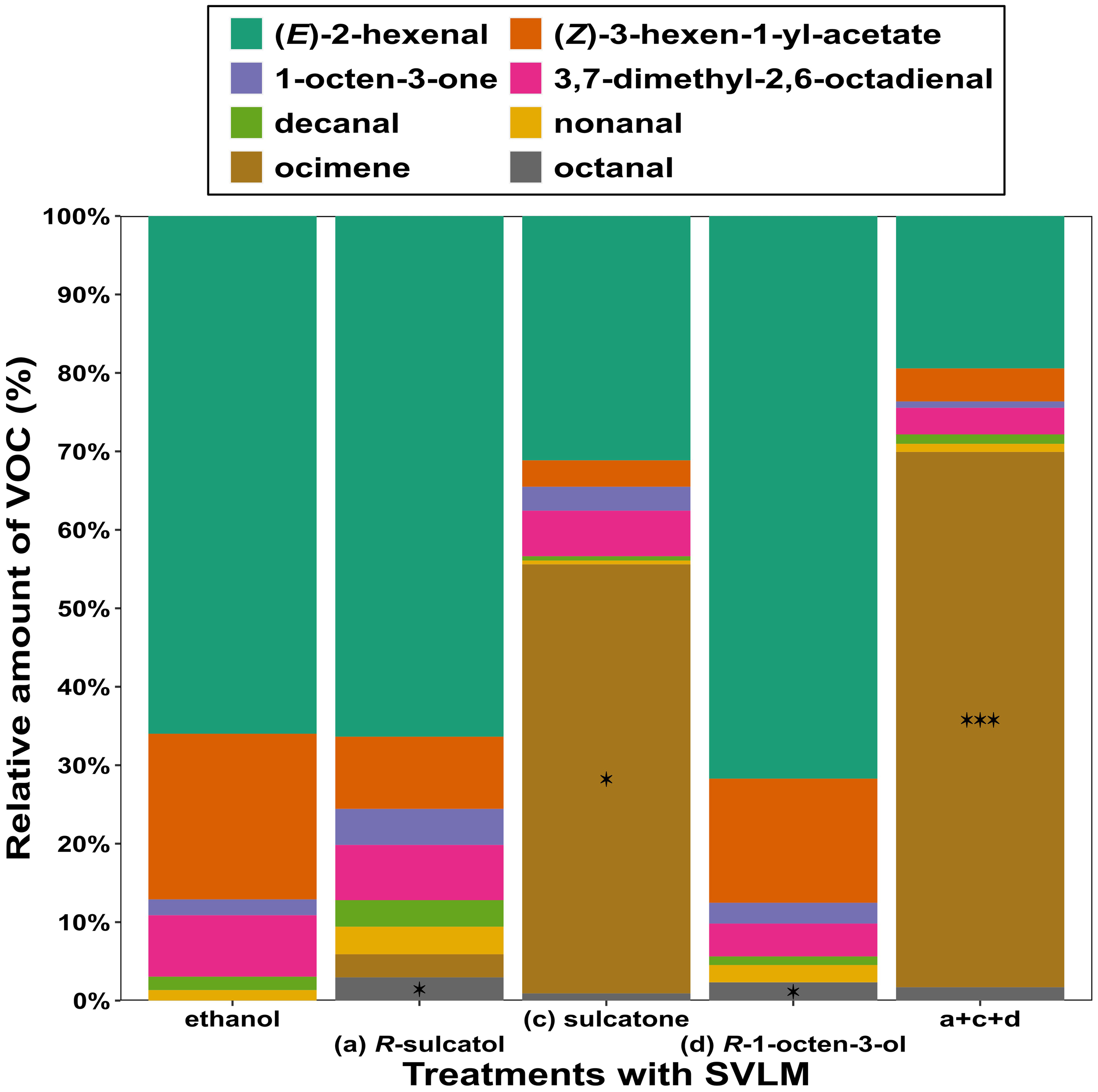
In pioneering studies on plant-aphid interactions, we have observed that Vicia faba plants infested by aphids can transmit signals via the rhizosphere that induce aboveground defence in intact, neighbouring plants. The aphid parasitoid Aphidius ervi is significantly attracted towards intact broad bean plants grown in a hydroponic solution previously harbouring Acyrtosiphon pisum-infested plants. To identify the rhizosphere signal(s) possibly mediating this belowground plant-plant communication, root exudates were collected using Solid-Phase Extraction (SPE) from hydroponically grown 10-day old A. pisum-infested and un-infested Vicia faba plants. We identified three small volatile lipophilic molecules as plant defence elicitors: 1-Octen-3-ol, Sulcatone and Sulcatol, in SPE extracts of A. pisum-infested broad bean plants. In wind tunnel assays, we recorded a significant increase in the attractiveness of A. ervi towards V. faba plants grown in hydroponic solution treated with these compounds, compared to plants grown in hydroponics treated with ethanol (control). Both 1-Octen-3-ol and Sulcatol have asymmetrically substituted carbon atoms at positions 3 and 2, respectively. Therefore, both enantiomers for each have been tested alone as well as the complete mixture. We highlighted a synergistic effect on the level of attractiveness towards the parasitoid when testing the three compounds together in respect of the response recorded against each of them. These behavioural responses were supported by the characterization of leaf volatiles released by tested plants. These results shed new light on the mechanisms underlying plant-plant communication belowground and prompt the use of bio-derived semiochemicals for a sustainable protection of agricultural crops.

5,429 views

11 citations

ORIGINAL RESEARCH
31 August 2023
Specific volatiles of tea plants determine the host preference behavior of Empoasca onukii
Feng Chen, 5 more and Xin-Gang Liu

3,703 views

11 citations